
Market Overview:
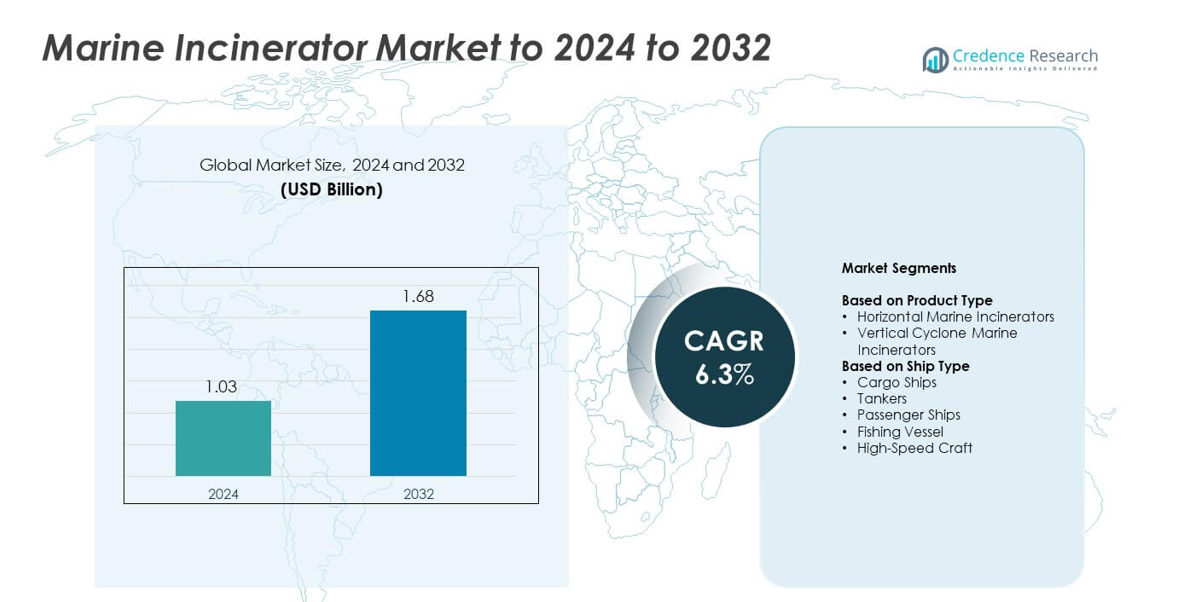
The Marine Incinerator Market was valued at USD 1.03 billion in 2024 and is projected to reach USD 1.68 billion by 2032, growing at a CAGR of 6.3% during the forecast period.
| REPORT ATTRIBUTE | DETAILS |
|---|---|
| Historical Period | 2020-2023 |
| Base Year | 2024 |
| Forecast Period | 2025-2032 |
| Marine Incinerator Market Size 2024 | USD 1.03 billion |
| Marine Incinerator Market, CAGR | 6.3% |
| Marine Incinerator Market Size 2032 | USD 1.68 billion |
The Marine Incinerator Market is driven by key players including Alfa Laval Corporate AB, ACS, INC, TeamTec AS, ATLAS INCINERATORS ApS, HANSUN, Fuente International Co., Ltd., China Deyuan Marine Fitting Co., Ltd., DETEGASA, and INCINER8. These companies lead the market with their advanced incineration systems that cater to the growing demand for environmentally compliant waste management solutions in the maritime industry. North America and Europe dominate the market, with North America holding a 30% share, followed by Europe at 28%. The Asia-Pacific region is rapidly growing, accounting for 25% of the market, driven by the expansion of shipping industries in countries like China, Japan, and South Korea. Latin America and the Middle East & Africa regions, though smaller, are witnessing steady growth as shipping infrastructure expands and environmental regulations tighten. The market is expected to grow dynamically, with key players focusing on technological innovations and strategic regional expansions.
Market Insights
- The Marine Incinerator Market was valued at USD 1.03 billion in 2024 and is projected to reach USD 1.68 billion by 2032, growing at a CAGR of 6.3% during the forecast period.
- The demand for marine incinerators is primarily driven by stringent environmental regulations, such as MARPOL, requiring ships to manage waste safely and efficiently.
- Increasing focus on sustainability and the adoption of green technologies in the maritime sector is fostering the growth of advanced incineration systems that comply with environmental standards.
- The competitive landscape features key players like Alfa Laval Corporate AB, ACS, INC, and TeamTec AS, which are focusing on technological innovations, product differentiation, and regional expansion to maintain market leadership.
- North America leads the market with a 30% share, followed by Europe at 28%. Asia-Pacific is growing rapidly, accounting for 25%, with Latin America and the Middle East & Africa contributing smaller shares.
Market Segmentation Analysis:
By Product Type
Horizontal marine incinerators dominate this segment with a market share of about 58%. These systems lead due to simple installation, low maintenance, and stable combustion performance across large vessels. Horizontal units also handle mixed waste streams more efficiently, which supports their strong use on cargo fleets and tankers. Vertical cyclone marine incinerators gain steady demand because cyclone action improves burning speed and lowers emissions, but adoption remains smaller due to higher system complexity. Growth in both categories comes from strict MARPOL waste-handling rules and rising global vessel activity.
- For instance, Alfa Laval secured its first commercial order for an ammonia fuel supply system on a total of seven LPG/ammonia carriers for Tianjin Southwest Maritime (TSM). The order includes systems for three 25,000 cubic meter vessels and four 41,000 cubic meter vessels.
By Ship Type
Cargo ships hold the largest share in this segment with nearly 46%. Cargo operators rely on marine incinerators to process high daily waste volumes generated during long voyages, which strengthens adoption. Tankers follow as they also require strict onboard waste treatment to meet international discharge rules. Passenger ships show rising use due to increasing traveler numbers and tighter hygiene standards. Fishing vessels and high-speed craft adopt smaller units for plastic, food, and operational waste. Demand across all ship categories grows as regulators tighten global marine waste-management compliance.
- For instance, the Micro Auto Gasification System (MAGS), which is part of Wärtsilä's offerings, converts organic-based waste into energy and reduces the waste volume to less than 5% of the original, supporting major vessels in processing large volumes onboard.
Key Growth Drivers
Regulatory Compliance and Environmental Standards
Stringent regulations, especially under the MARPOL convention, are one of the main growth drivers for the Marine Incinerator Market. These regulations require ships to manage their waste in an environmentally safe manner by incinerating it onboard rather than discharging it at sea. As international regulations tighten, marine incinerators become essential to ensure compliance, thus boosting their demand across various vessel types. This trend is expected to drive consistent growth in the market as operators invest in solutions to meet environmental standards and avoid costly penalties.
- For instance, Detegasa indicates more than 40 years of experience and over 3,000 systems installed worldwide in its waste‑treatment range.
Rising Global Maritime Traffic
The global increase in maritime trade and passenger movement plays a significant role in expanding the Marine Incinerator Market. With the growing number of ships on the seas, including cargo vessels, tankers, and passenger ships, there is a corresponding increase in the generation of waste. This trend drives the need for onboard waste management systems, such as marine incinerators, to handle the increasing waste volumes. The expansion of the global shipping industry, particularly in emerging markets, supports sustained demand for these waste treatment solutions.
- For instance, Atlas Incinerators lists over 9,000 systems supplied globally since 1974, underscoring demand as shipping activity grows.
Technological Advancements in Waste Management
Innovations in marine incinerator technologies are improving combustion efficiency and reducing harmful emissions, driving market growth. Newer models are more energy-efficient, feature advanced control systems, and ensure compliance with updated environmental standards. These advancements are making marine incinerators more cost-effective and appealing to ship operators seeking sustainable solutions. As technology improves, the adoption of these systems becomes more attractive to fleet owners, further contributing to the market’s growth as they look to enhance operational efficiency and sustainability.
Key Trends & Opportunities
Focus on Sustainable Shipping Solutions
The growing emphasis on sustainability within the shipping industry presents an opportunity for the Marine Incinerator Market. As companies increasingly prioritize green shipping practices, demand for environmentally friendly waste disposal technologies, including marine incinerators, is expected to rise. Shipping companies are investing in eco-friendly solutions to comply with stricter environmental regulations and to meet the sustainability expectations of consumers and investors. This trend is likely to lead to increased adoption of advanced marine incinerators capable of minimizing environmental impact.
- For instance, Atlas Incinerators emphasises a three‑chamber incinerator design that burns waste at 850‑950 °C in its after‑burning chamber, allowing longer retention time and lower emissions.
Integration of Smart Technology
The integration of smart technology into marine incinerators offers a significant opportunity for growth. These technologies allow for real-time monitoring, automated waste management, and optimized combustion processes, enhancing the efficiency of marine incinerators. As smart ships and connected systems become more common in the maritime industry, marine incinerators equipped with sensors and automation features can provide better operational insights, predictive maintenance, and improved performance. This technological shift creates opportunities for manufacturers to offer advanced products tailored to the needs of modern fleets.
- For instance, Atlas Incinerators states the sludge oil mixing tank options include 500 L, 1200 L, 2600 L and 4000 L sizes, reflecting modular design flexibility for varying markets including emerging ones.
Expansion in Emerging Markets
Emerging economies with expanding maritime industries present untapped opportunities for the Marine Incinerator Market. Countries in regions such as Asia-Pacific, Africa, and Latin America are investing heavily in maritime infrastructure, driving demand for waste management solutions. As these regions strengthen their shipping capabilities, there is a growing need for marine incinerators on newly built vessels. Additionally, emerging markets often face less stringent regulations, offering opportunities for cost-effective and scalable solutions, particularly in smaller vessels and developing shipping fleets.
Key Challenges
High Initial Investment Costs
One of the key challenges facing the Marine Incinerator Market is the high upfront cost associated with purchasing and installing incineration systems. Many shipping companies, especially smaller operators, find the initial investment to be a barrier to adoption. While the long-term operational cost savings and regulatory compliance benefits justify the investment, the high price tag for advanced incinerators, coupled with installation costs, can deter smaller businesses from upgrading their waste management systems. This challenge is particularly pronounced in developing regions where budget constraints may limit widespread adoption.
Maintenance and Operational Costs
Although marine incinerators are essential for waste management onboard, their maintenance and operational costs can pose a challenge. Frequent servicing, part replacements, and monitoring requirements increase the overall lifecycle costs for ship operators. For many companies, these ongoing costs can be significant, especially for older incinerator models that may require more frequent maintenance. Additionally, ensuring the incinerators are operating efficiently and complying with evolving environmental standards adds complexity and expense to operations, limiting their attractiveness to some ship owners.
Regional Analysis
North America
In 2024, North America holds a significant share of the Marine Incinerator Market, accounting for approximately 30%. This strong market presence is driven by stringent environmental regulations in the United States and Canada, which enforce compliance with laws such as MARPOL. The region's well-established maritime infrastructure and the large number of commercial, cargo, and passenger ships further support the demand for marine incinerators. The rising focus on sustainable shipping practices and green technologies also contribute to market growth, with increasing adoption of high-efficiency incineration systems for waste management expected to continue through 2032.
Europe
Europe accounted for around 28% of the Marine Incinerator Market in 2024. The market's growth is driven by the strong maritime presence of countries such as Norway, the UK, and Germany, combined with Europe’s rigorous environmental regulations. The European Union's commitment to sustainability and eco-friendly shipping solutions boosts the demand for advanced waste management technologies like marine incinerators. In 2024, Europe's environmental focus, particularly in the passenger and cargo ship segments, has fueled the continued adoption of efficient incineration systems, with the trend expected to persist as regulatory standards tighten through 2032.
Asia-Pacific
The Asia-Pacific region is the fastest-growing market in 2024, with a market share of approximately 25%. This growth is driven by the rapid expansion of the shipping industry in countries like China, Japan, and South Korea. As these nations continue to increase their maritime fleets to meet the growing demand for global trade and passenger transport, the need for effective waste management systems, such as marine incinerators, becomes critical. The region's increasing regulatory focus on environmental protection and sustainability, along with a higher number of vessels, will further drive market growth through 2032.
Latin America
In 2024, Latin America holds a smaller share of the Marine Incinerator Market, estimated at 10%. However, the region is gradually expanding, with countries like Brazil, Mexico, and Argentina increasing their maritime operations and adopting stricter waste management solutions. Latin America's adoption of marine incinerators is driven by the need to comply with international regulations like MARPOL, which requires efficient onboard waste management. As shipping volumes grow and environmental awareness rises, the market for marine incinerators in Latin America is expected to expand steadily through 2032.
Middle East & Africa
The Middle East & Africa region represented around 7% of the Marine Incinerator Market in 2024. This region is driven by significant oil-exporting nations and expanding maritime infrastructure, particularly in countries like the UAE, Saudi Arabia, and South Africa. While the market share is smaller compared to other regions, investments in cleaner shipping technologies and growing awareness of environmental concerns are contributing to the demand for marine incinerators. The continued expansion of ports and increasing number of vessels will support market growth in the region, with continued progress expected through 2032.
Market Segmentations:
By Product Type
- Horizontal Marine Incinerators
- Vertical Cyclone Marine Incinerators
By Ship Type
- Cargo Ships
- Tankers
- Passenger Ships
- Fishing Vessel
- High-Speed Craft
By Geography
- North America
- U.S.
- Canada
- Mexico
- Europe
- Germany
- France
- U.K.
- Italy
- Spain
- Rest of Europe
- Asia Pacific
- China
- Japan
- India
- South Korea
- South-east Asia
- Rest of Asia Pacific
- Latin America
- Brazil
- Argentina
- Rest of Latin America
- Middle East & Africa
- GCC Countries
- South Africa
- Rest of the Middle East and Africa
Competitive Landscape
The Marine Incinerator Market is highly competitive, with key players such as Alfa Laval Corporate AB, ACS, INC, TeamTec AS, ATLAS INCINERATORS ApS, HANSUN, Fuente International Co., Ltd., China Deyuan Marine Fitting Co., Ltd., DETEGASA, and INCINER8 leading the charge. These companies offer a range of advanced incineration systems designed to meet the growing demand for efficient waste management onboard vessels. With increasing regulatory pressures and a shift towards sustainability in the maritime sector, these companies are focused on developing innovative solutions that comply with environmental standards like MARPOL. Market players are also prioritizing technological advancements, such as improving incinerator efficiency, reducing emissions, and integrating smart technologies for real-time monitoring and maintenance. Furthermore, as the global shipping industry expands, demand for smaller, more cost-effective systems for smaller vessels is rising, creating opportunities for niche players. Competitive strategies include product differentiation, collaborations, and regional expansion, especially in emerging markets. The market is expected to remain dynamic, with companies continuing to innovate and adapt to the evolving needs of the maritime industry.
Key Player Analysis
- Alfa Laval Corporate AB
- ACS, INC
- TeamTec AS
- ATLAS INCINERATORS ApS
- HANSUN
- Fuente International Co., Ltd.
- China Deyuan Marine Fitting Co., Ltd.
- DETEGASA
- INCINER8
Recent Developments
- In 2025, Alfa Laval secured an order for the world's first marine boiler system specifically designed for the safe incineration of ammonia waste.
- In 2025, ACS, Inc Advanced Combustion Systems (ACS), Inc. continues to produce durable, efficient marine incinerators such as the MCA-Series with vertical and horizontal configurations designed for robust shipboard use.
- In 2024, Inciner8 Ltd Inciner8 focused on providing a wide array of marine waste management solutions, including both batch and continuous-load incinerators for various vessel sizes.
Report Coverage
The research report offers an in-depth analysis based on Product Type, Ship Type and Geography. It details leading market players, providing an overview of their business, product offerings, investments, revenue streams, and key applications. Additionally, the report includes insights into the competitive environment, SWOT analysis, current market trends, as well as the primary drivers and constraints. Furthermore, it discusses various factors that have driven market expansion in recent years. The report also explores market dynamics, regulatory scenarios, and technological advancements that are shaping the industry. It assesses the impact of external factors and global economic changes on market growth. Lastly, it provides strategic recommendations for new entrants and established companies to navigate the complexities of the market.
Future Outlook
- The Marine Incinerator Market will continue to expand as global shipping activities increase, driving demand for effective waste management solutions.
- Stringent environmental regulations, including MARPOL, will further push the adoption of incinerators in the maritime industry.
- Technological advancements in incinerator efficiency, such as improved combustion processes and reduced emissions, will be key to market growth.
- Rising focus on sustainability and eco-friendly shipping practices will encourage investments in cleaner waste disposal systems onboard vessels.
- Emerging markets, particularly in Asia-Pacific, will witness rapid growth as shipping industries expand and environmental regulations tighten.
- The market will see increased demand for compact, high-efficiency marine incinerators suitable for smaller vessels like fishing boats and high-speed crafts.
- The integration of smart technologies into marine incinerators, offering real-time monitoring and predictive maintenance, will enhance operational efficiency.
- Continued investment in the retrofit of existing vessels with advanced waste management systems will contribute to market growth.
- The growing number of passenger ships will drive the demand for incinerators as onboard waste management becomes more critical for hygiene and compliance.
- Competitive pressure in the market will lead to the development of cost-effective, low-maintenance incinerators designed to reduce operational expenses for ship owners.

Request a Free Sample
Fill in your details and we'll send you a free sample report.
- Sample data tables & charts
- Research methodology
Need a Custom Version of This Report?
Tailor the scope, geography, or segments to your exact requirements.
- Custom geography or segment scope
- Direct access to our analyst team
Frequently Asked Questions
What is the current market size for Marine Incinerator Market, and what is its projected size in 2032?
At what Compound Annual Growth Rate is the Marine Incinerator Market projected to grow between 2025 and 2032?
Which Marine Incinerator Market segment held the largest share in 2024?
What are the primary factors fueling the growth of the Marine Incinerator Market?
Who are the leading companies in the Marine Incinerator Market?
Which region commanded the largest share of the Marine Incinerator Market in 2024?
Table of Content
Chapter 1 Market Segmentation
- 1.1 Segmentation Framework
- 1.1.1 Product and Service Classification
- 1.1.2 Application and End-Use Classification
- 1.1.3 Technology and Solution Classification
- 1.1.4 Customer and Distribution Channel Classification
- 1.1.5 Geographic Segmentation
- 1.1.6 Market Segment Definitions and Boundaries
Chapter 2 Introduction
- 2.1 Report Objectives and Scope
- 2.2 Product Definition and Industry Terminology
- 2.3 Market Inclusions and Exclusions
- 2.4 Research Process
- 2.4.1 Primary Research and Expert Interviews
- 2.4.2 Secondary Research and Source Review
- 2.4.3 Top-Down and Bottom-Up Estimation
- 2.4.4 Data Triangulation and Verification
- 2.5 Market Size Measurement Basis
- 2.5.1 2024: USD 1.03 billion → 2032: USD 1.68 billion
- 2.6 Historical and Forecast Reference Periods
- 2.6.1 Base Year: 2024
- 2.6.2 Forecast Period: 2024-2032
- 2.7 Research Assumptions and Limitations
Chapter 3 Executive Summary
- 3.1 Market Snapshot and Key Findings
- 3.2 Base-Year Market Size, 2024
- 3.3 Forecast Market Size, 2032
- 3.4 Revenue and Volume Growth Outlook
- 3.5 Key Demand and Supply Indicators
- 3.6 Leading Market Segments
- 3.7 Fastest-Growing Market Opportunities
- 3.8 Regional Performance Highlights
- 3.9 Technology and Industry Transformation
- 3.10 Competitive Landscape Summary
- 3.11 Analyst View and Strategic Implications
Chapter 4 Global Marine Incinerator Market Trends and Developments
- 4.1 Historical Industry Development
- 4.2 Recent Market Trends and Developments
- 4.3 Demand and Customer Behavior Trends
- 4.4 Technology and Product Innovation
- 4.5 Artificial Intelligence, Automation and Digitalization
- 4.6 Local Manufacturing and Supply Chain Realignment
- 4.7 Industry Partnerships, Mergers and Acquisitions
- 4.8 Sustainability and Circular Economy Developments
- 4.9 Government and Private Sector Investment Trends
- 4.10 Emerging Business Models and Commercialization
- 4.11 Industry Developments and Announcements
Chapter 5 Global Marine Incinerator Market Production, Supply and Demand Analysis
- 5.1 Demand Trend and Consumption Analysis
- 5.2 Demand Forecast, 2024-2032
- 5.3 Production and Output Trend
- 5.4 Production and Output Forecast, 2024-2032
- 5.5 Installed Capacity and Capacity Utilization
- 5.6 Company-Wise Production Plants and Statistics
- 5.6.1 Installed Production Capacity
- 5.6.2 Actual Production
- 5.6.3 Planned Capacity and Expansion Targets
- 5.7 Supply Chain Structure and Procurement Trends
- 5.8 Supply-Demand Gap and Bottlenecks
- 5.9 Import Dependence and Sourcing Structure
- 5.10 Contract Manufacturing and Outsourcing
- 5.11 Regional Supply and Demand Concentration
Chapter 6 Global Marine Incinerator Market Pricing Analysis
- 6.1 Pricing Structure and Measurement
- 6.2 Historical Pricing Trends
- 6.3 Pricing Outlook, 2024-2032
- 6.4 Average Selling Price and Unit Economics
- 6.5 Pricing by Product and Market Segment
- 6.6 Geographic Pricing Differences
- 6.7 Key Input, Energy, Labor and Logistics Costs
- 6.8 Contract Pricing and Purchasing Models
- 6.9 Pricing Sensitivity and Competitive Positioning
- 6.10 Price, Margin and Profitability Implications
Chapter 7 Global Marine Incinerator Market Dynamics
- 7.1 Market Growth Drivers
- 7.1.1 Demand-Side Drivers
- 7.1.2 Technology and Innovation Drivers
- 7.1.3 Infrastructure and Investment Drivers
- 7.1.4 Regulatory and Policy Drivers
- 7.2 Market Restraints
- 7.2.1 Cost and Affordability Constraints
- 7.2.2 Technology and Adoption Barriers
- 7.2.3 Supply Chain and Operational Constraints
- 7.3 Market Challenges
- 7.3.1 Competitive Pressure and Margin Erosion
- 7.3.2 Skills, Infrastructure and Implementation Gaps
- 7.4 Emerging Market Opportunities
- 7.5 Market Dynamics Impact and Time-Horizon Assessment
Chapter 8 Global Marine Incinerator Value Chain Analysis
- 8.1 Industry Value Chain Overview
- 8.2 Upstream Suppliers and Critical Inputs
- 8.3 Technology and Component Providers
- 8.4 Manufacturing or Service Delivery
- 8.5 Distribution, Channel Partners and Integrators
- 8.6 Downstream Applications and End Users
- 8.7 Value Addition and Profit Pools
- 8.8 Vertical Integration and Outsourcing
- 8.9 Supplier Concentration and Risk
- 8.10 Supply Chain Localization and Resilience
Chapter 9 Global Marine Incinerator Market Regulations and Policies
- 9.1 Relevant Laws, Standards and Compliance Frameworks
- 9.2 Product, Service, Safety and Quality Requirements
- 9.3 Government Policies, Incentives and Subsidies
- 9.4 Imports, Exports and Trade Barriers
- 9.5 Public Procurement and Local Content Requirements
- 9.6 Environmental and Sustainability Compliance
- 9.7 Upcoming Policy Changes and Market Implications
Chapter 10 Global Marine Incinerator Market Hotspots and Opportunities
- 10.1 Market Opportunity Mapping and Growth Hotspots
- 10.2 High-Growth Applications and Customer Groups
- 10.3 Underserved Markets and White-Space Opportunities
- 10.4 Emerging Technology and Product Opportunities
- 10.5 New Capacity and Investment Hotspots
- 10.6 Market Entry and Expansion Opportunities
- 10.7 Distribution and Partnership Opportunities
- 10.8 Near-Term and Long-Term Commercial Potential
- 10.9 Opportunity Attractiveness and Execution Risks
Chapter 11 Global Marine Incinerator Market Outlook, 2024-2032
- 11.1 Market Size and Analysis
- 11.1.1 Revenue (Market Measurement: 2024: USD 1.03 billion → 2032: USD 1.68 billion)
- 11.1.2 Market Volume and Quantity Sold
- 11.1.3 Historical Market Size
- 11.1.4 Base-Year Market Size, 2024
- 11.2 Market Forecast, 2024-2032
- 11.2.1 Revenue Forecast to 2032
- 11.2.2 Volume Forecast to 2032
- 11.2.3 CAGR and Year-on-Year Growth
- 11.2.4 Incremental Revenue Opportunity
- 11.3 Forecast Assumptions and Scenario Analysis
- 11.3.1 Base-Case Forecast
- 11.3.2 Optimistic and Conservative Scenarios
- 11.3.3 Technology, Pricing and Policy Sensitivities
- 11.4 Market Attractiveness and Growth Outlook
Chapter 12 Global Marine Incinerator Market Segmentation and Outlook
- 12.1 Segmentation Summary and Market Shares, 2024
- 12.2 Largest and Fastest-Growing Segments
- 12.3 Segment Growth Comparison
- 12.4 Segment Attractiveness and Priority Matrix
Chapter 13 Global Marine Incinerator Geographic Market Outlook, 2024-2032
- 13.1 Regional Market Size and Share, 2024
- 13.2 Regional Market Forecast, 2024-2032
- 13.3 Regional Pricing, Production and Demand Differences
- 13.4 North America
- 13.4.1 United States
- 13.4.2 Canada
- 13.4.3 Mexico
- 13.5 Europe
- 13.5.1 Germany
- 13.5.2 France
- 13.5.3 Italy
- 13.5.4 United Kingdom
- 13.5.5 Spain
- 13.5.6 Poland
- 13.5.7 Russia
- 13.5.8 Netherlands
- 13.5.9 Belgium
- 13.5.10 Sweden
- 13.5.11 Denmark
- 13.5.12 Norway
- 13.5.13 Rest of Europe
- 13.6 Asia Pacific
- 13.6.1 China
- 13.6.2 India
- 13.6.3 Japan
- 13.6.4 South Korea
- 13.6.5 Thailand
- 13.6.6 Indonesia
- 13.6.7 Vietnam
- 13.6.8 Malaysia
- 13.6.9 Australia
- 13.6.10 Rest of Asia Pacific
- 13.7 Latin America
- 13.7.1 Brazil
- 13.7.2 Argentina
- 13.7.3 Colombia
- 13.7.4 Chile
- 13.7.5 Rest of Latin America
- 13.8 Middle East
- 13.8.1 Saudi Arabia
- 13.8.2 United Arab Emirates
- 13.8.3 Turkey
- 13.8.4 Israel
- 13.8.5 Iran
- 13.8.6 Rest of the Middle East
- 13.9 Africa
- 13.9.1 South Africa
- 13.9.2 Egypt
- 13.9.3 Nigeria
- 13.9.4 Morocco
- 13.9.5 Rest of Africa
- 13.10 Regional Investment, Policy and Supply Chain Differences
- 13.11 Regional Competitive Landscape
- 13.12 Geographic Growth Hotspots
Chapter 14 Global Marine Incinerator Technology, Innovation and Sustainability Outlook
- 14.1 Technology Landscape and Maturity
- 14.2 Product, Process and Service Innovation
- 14.3 AI, Automation and Digital Tools in the Industry
- 14.4 Technology Adoption and Performance Benchmarking
- 14.5 Innovation Pipeline and R&D Investment
- 14.6 Patent and Intellectual Property Trends
- 14.7 Energy Efficiency and Resource Management
- 14.8 Sustainability, Recycling and Circularity
- 14.9 Technology Roadmap, 2024-2032
- 14.10 Risks of Obsolescence and Technology Substitution
Chapter 15 Global Marine Incinerator Market Key Strategic Imperatives
- 15.1 Growth and Market Entry Priorities
- 15.2 High-Return Products and Segments
- 15.3 Pricing, Profitability and Cost Optimization
- 15.4 Technology Investment and Product Differentiation
- 15.5 Supply Chain Localization and Resilience
- 15.6 Distribution and Customer Acquisition
- 15.7 Partnership, Acquisition and Capacity Strategy
- 15.8 Regional Expansion Priorities
- 15.9 Short-, Medium- and Long-Term Actions
Chapter 16 Competition Outlook
- 16.1 Industry Competition Characteristics
- 16.2 Market Structure and Concentration
- 16.3 Market Share and Competitive Positioning, 2024
- 16.4 Company-Wise Revenue and Product Benchmarking
- 16.5 Production and Service Capacity Benchmarking
- 16.6 Technology, Pricing and Differentiation
- 16.7 Regional Footprint and Distribution Strength
- 16.8 Mergers, Acquisitions and Strategic Alliances
- 16.9 New Entrants and Competitive Threats
- 16.10 Porter's Five Forces and Industry Attractiveness
- 16.11 Competitive Outlook, 2024-2032
Chapter 17 Company Profiles
- 17.1 Company Coverage and Selection Criteria
- 17.2 Leading Market Participants – Standard Profile Structure
- 17.2.1 Business Description
- 17.2.2 Company Ownership and Geographic Presence
- 17.2.3 Product and Service Portfolio
- 17.2.4 Manufacturing and Operating Footprint
- 17.2.5 Production Capacity and Expansion Plans
- 17.2.6 Financial Performance and Investment
- 17.2.7 Market Share and Competitive Position
- 17.2.8 Technology and Innovation Capabilities
- 17.2.9 Strategic Alliances or Partnerships
- 17.2.10 Recent Developments
- 17.2.11 Growth Strategy and Outlook
- 17.3 Other Relevant Market Participants
Note: Every listed company is profiled on the structure shown under the first company. The company list is preliminary and may change based on research findings, market developments, data availability and client requirements.
Chapter 18 Disclaimer
- 18.1 Research and Forecast Disclaimer
- 18.2 Data Source and Estimation Limitations
Note: The depth of individual sections depends on data availability for this market. Volume, capacity, trade and other unit-based metrics are included where applicable.

