Market Overview
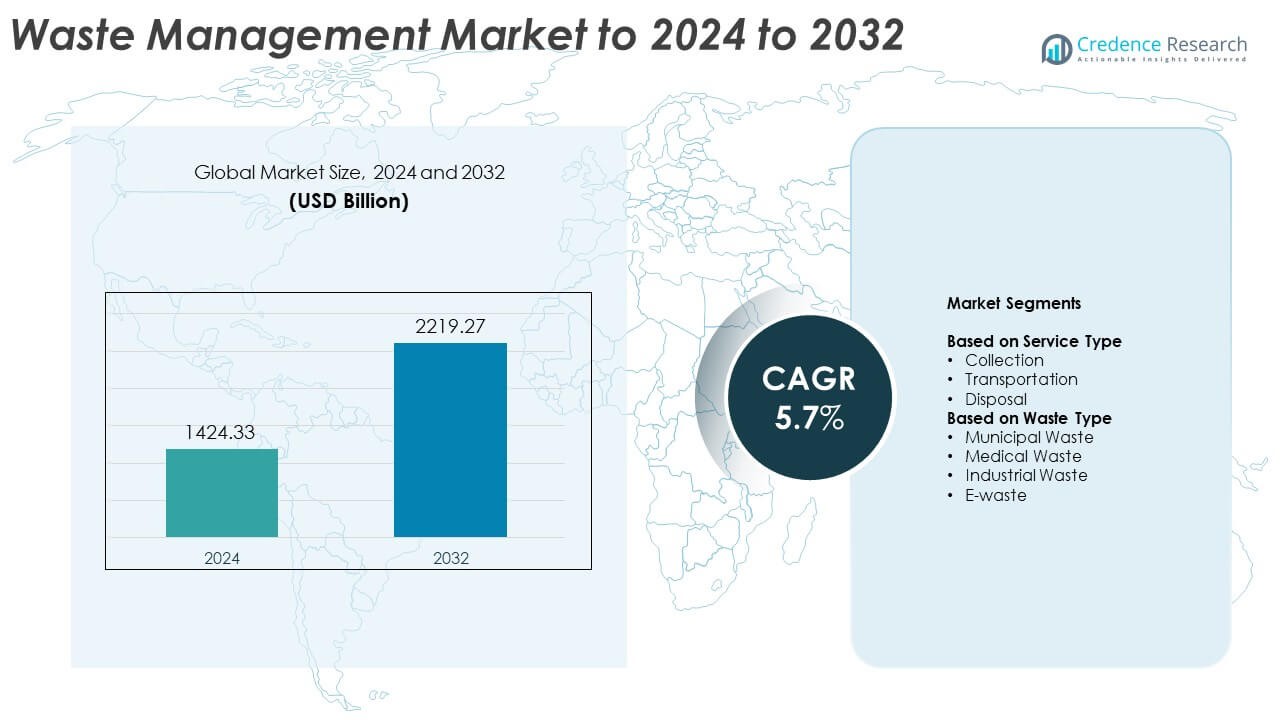
Waste management market size was valued USD 1424.33 billion in 2024 and is anticipated to reach USD 2219.27 billion by 2032, at a CAGR of 5.7% during the forecast period.
| REPORT ATTRIBUTE | DETAILS |
|---|---|
| Historical Period | 2020-2023 |
| Base Year | 2024 |
| Forecast Period | 2025-2032 |
| Waste Management Market Size 2024 | USD 1424.33 Billion |
| Waste Management Market, CAGR | 5.7% |
| Waste Management Market Size 2032 | USD 2219.27 Billion |
The waste management market features major players such as Republic Services, Clean Harbors, SIAAP, Biffa, Reworld Holding Corporation, Waste Connections, Veolia, Valicor, WM Intellectual Property Holdings, L.L.C., Suez, and Daiseki Co., Ltd., all competing through broad service portfolios, regulated operations, and strong recycling and disposal networks. These companies focus on expanding treatment capacity, upgrading smart collection systems, and strengthening hazardous waste solutions to meet rising environmental compliance needs. North America emerged as the leading region in 2024 with about 34% share, supported by advanced infrastructure, strict regulatory standards, and high adoption of digital waste handling technologies across municipalities and industrial sectors.
Market Insights
- The waste management market reached USD 1424.33 billion in 2024 and will achieve USD 2219.27 billion by 2032, growing at a CAGR of 5.7%.
- Rising urban waste generation and stricter environmental rules drive stronger demand for regulated collection, recycling, and disposal services.
- Digital routing tools, automated sorting lines, and waste-to-energy projects shape current trends as operators seek higher efficiency and better material recovery.
- Competitive activity grows as major companies expand treatment capacity, pursue long-term municipal contracts, and strengthen hazardous and industrial waste portfolios.
- North America led the market with about 34% share in 2024, while municipal waste remained the dominant segment with nearly 63% share across global waste streams.
Market Segmentation Analysis:
By Service Type
Collection dominated the service-type segment in 2024 with about 56% share, supported by rising urban waste volumes and strict city-level sanitation rules. Municipal bodies and private operators expanded door-to-door logistics as households generated more mixed waste from packaged goods and e-commerce deliveries. Collection services grew further due to smart routing systems and sensor-based bins that reduced fuel use and improved pickup frequency. Transportation and disposal services advanced at a steady pace, yet collection remained the largest segment because most waste-handling contracts prioritize regular pickup cycles to prevent overflow in dense urban areas.
- For instance, Veolia treated 63 million tonnes of waste in 2023, according to its annual results.
By Waste Type
Municipal waste led the waste-type segment in 2024 with nearly 63% share, driven by high output from households, retail activity, and food service operators across cities. Governments increased segregation rules and recycling targets, which boosted handling needs for organic, plastic, and paper fractions. Rapid urbanization added more residential complexes, raising daily mixed-waste loads. Medical, industrial, and e-waste streams expanded due to higher hospital activity, manufacturing output, and device consumption, but municipal waste stayed dominant because it remains the most consistent and large-volume category handled by public and private waste operators.
- For instance, SUEZ reported processing almost 28 million tonnes of waste in 2023 in its non-financial performance statement.
Key Growth Drivers
Rising Urban Waste Generation
Cities produced larger daily waste volumes due to population growth, packaged goods use, and rapid commercial activity. Urban households generated more mixed waste, which pushed municipalities to expand formal collection networks and recycling capacity. Governments invested in smart bins, GPS tracking, and material recovery systems to reduce overflow and improve pickup reliability. This steady rise in urban waste loads strengthened long-term demand for organized waste management services across emerging and developed regions.
- For instance, Biffa states that its plastics operations now have capacity for 213,000 tonnes of plastic recycling per year, up from 63,000 tonnes in 2019.
Stricter Environmental Regulations
Regulatory bodies enforced tighter rules on landfill use, hazardous waste handling, and recycling performance. Compliance requirements encouraged industries, hospitals, and commercial facilities to adopt certified waste services instead of informal disposal. Extended producer responsibility programs increased formal demand for collection, sorting, and material recovery operations. These measures supported safer disposal methods and pushed companies to upgrade infrastructure, which fueled sustained adoption of regulated waste management solutions.
- For instance, Indorama Ventures expanded its Juiz de Fora recycling plant in Brazil from 9,000 tons to 25,000 tons of PET per year and is targeting recycling 50 billion PET bottles annually by 2025.
Expansion of Industrial and Healthcare Activity
Industrial units and healthcare networks generated higher waste volumes as production lines expanded and medical services scaled up. Manufacturing facilities increased solid, chemical, and process-related waste streams that required specialized handling and treatment. Hospitals, clinics, and diagnostic centers produced more biomedical waste as patient loads rose. This growth created steady demand for compliant treatment systems, licensed disposal partners, and advanced waste-tracking technologies across major economies.
Key Trends & Opportunities
Adoption of Digital and Automation Technologies
Waste operators used route-optimization tools, RFID tags, robotic sorters, and AI-based quality checks to improve efficiency. Automated sorting enabled higher recovery of plastics, metals, and paper, which increased recycling yields. Digital platforms supported real-time bin monitoring and predictive maintenance for fleets. This shift created new opportunities for technology vendors and strengthened operational accuracy for waste processors seeking to reduce costs and enhance sustainability performance.
- For instance, TOMRA’s sensor-based sorting technology at Dubai’s FARZ materials recovery facility enables processing of around 1,200 tons of commercial and municipal waste per day.
Rising Investment in Recycling Infrastructure
Companies and governments increased funding for material recovery facilities, composting plants, and advanced plastic recycling units. High global focus on circular economy models encouraged industries to shift toward recycled inputs. Improved sorting and treatment facilities created opportunities for growth in reclaimed materials such as PET, paper fiber, metals, and organics. This trend opened new revenue streams for operators that could supply high-quality secondary resources to packaging, textile, and construction industries.
- For instance, Sims Limited recycled approximately 8 million tonnes of proprietary ferrous and non-ferrous metals in fiscal year 2023 through its global network of facilities.
Growth of E-waste and Hazardous Waste Streams
Consumer electronics use expanded, which increased discarded devices and components. Industrial sectors also produced more hazardous residues needing certified handling and disposal. These specialized waste categories created opportunities for operators with expertise in safe dismantling, data-safe e-waste processing, and chemical treatment systems. Demand rose for compliant facilities that meet strict environmental standards, boosting growth in niche segments such as lithium battery recycling and PCB recovery.
Key Challenges
High Operational and Infrastructure Costs
Collection fleets, treatment facilities, trained staff, and safety systems require significant capital and operating expenditure. Many municipalities struggle to fund modern waste systems, which limits service reach in suburban and rural zones. Rising fuel prices and maintenance costs also reduce margins for private operators. These financial pressures slow infrastructure upgrades and restrict adoption of advanced technologies in low-revenue regions.
Inefficient Segregation and Informal Waste Handling
Poor waste segregation at the household and commercial levels reduces recycling efficiency and contaminates material streams. Informal waste collection networks dominate in many developing regions, leading to unsafe practices and inconsistent quality. Lack of awareness and limited enforcement weaken adoption of structured disposal methods. This challenge disrupts material recovery, limits recycling rates, and increases landfill dependence across many cities.
Regional Analysis
North America
North America held about 34% share in 2024, driven by strong regulatory systems, advanced recycling plants, and high municipal spending on solid waste services. The United States expanded landfill diversion goals, which increased demand for material recovery and composting facilities. Canada strengthened extended producer responsibility laws, pushing industries toward certified waste partners. High urban waste volumes and strong industrial output supported stable demand across collection, transportation, and disposal services. Rising adoption of digital fleet tools and automated sorting technologies further enhanced operational efficiency across large cities.
Europe
Europe accounted for nearly 29% share in 2024, supported by strict sustainability policies and high recycling targets under the EU Waste Framework Directive. Countries such as Germany, France, and the Netherlands expanded advanced sorting lines and waste-to-energy projects to reduce landfill dependency. Circular economy initiatives encouraged manufacturers to raise recycled content usage, strengthening demand for quality secondary materials. Strong compliance enforcement and robust municipal systems helped maintain high service reliability. Industrial and hazardous waste services also grew as regional regulations mandated safer handling standards across various sectors.
Asia Pacific
Asia Pacific captured about 28% share in 2024, driven by rapid urbanization, rising consumer waste, and expanding industrial activity. China advanced large-scale recycling and waste-to-energy investments, while India boosted national programs focused on segregation and scientific disposal. Growing healthcare networks increased medical waste volumes, creating stronger demand for compliant treatment systems. Southeast Asian countries worked on modernizing waste logistics to address rising plastic and food waste loads. The region’s large population base and fast economic growth positioned Asia Pacific as one of the most dynamic markets for future waste management capacity expansion.
Latin America
Latin America held roughly 6% share in 2024, supported by gradual improvements in municipal waste systems and stronger policy focus on landfill reduction. Brazil and Mexico increased investment in urban collection coverage and recycling initiatives, aiming to reduce informal handling. Growth in packaged consumer goods raised mixed-waste volumes, pushing cities to adopt better sorting and transport systems. Private operators expanded services in major metropolitan areas, while new partnerships helped improve medical and industrial waste treatment capacity. Regional modernization efforts continued to improve service quality across key countries.
Middle East and Africa
Middle East and Africa accounted for nearly 3% share in 2024, shaped by ongoing infrastructure development and rising waste generation from expanding urban centers. Gulf countries invested in large-scale waste-to-energy plants and improved recycling frameworks to reduce landfill dependency. African nations worked to upgrade collection networks and formalize waste systems in fast-growing cities. Industrial expansion increased demand for hazardous and construction waste handling. Growing awareness of environmental protection encouraged public-private partnerships that supported wider adoption of structured waste management practices across priority urban zones.
Market Segmentations:
By Service Type
- Collection
- Transportation
- Disposal
By Waste Type
- Municipal Waste
- Medical Waste
- Industrial Waste
- E-waste
By Geography
- North America
- U.S.
- Canada
- Mexico
- Europe
- Germany
- France
- U.K.
- Italy
- Spain
- Rest of Europe
- Asia Pacific
- China
- Japan
- India
- South Korea
- South-east Asia
- Rest of Asia Pacific
- Latin America
- Brazil
- Argentina
- Rest of Latin America
- Middle East & Africa
- GCC Countries
- South Africa
- Rest of the Middle East and Africa
Competitive Landscape
The competitive landscape of the waste management market is shaped by leading companies such as Republic Services, Clean Harbors, Inc., SIAAP, Biffa, Reworld Holding Corporation, Waste Connections, Veolia, Valicor, WM Intellectual Property Holdings, L.L.C., Suez, and Daiseki Co., Ltd. These players operate across collection, transportation, recycling, hazardous waste handling, and disposal services, supported by broad infrastructure networks and compliance-driven operations. Market competition grows as firms adopt automation, smart routing tools, and advanced sorting technologies to increase efficiency and material recovery rates. Strategic partnerships with municipalities and industrial clients help strengthen long-term service contracts, while investments in waste-to-energy plants and high-quality recycling facilities support new revenue streams. Companies also expand environmental services such as hazardous waste treatment and industrial cleaning to target higher-margin sectors. Growing regulations, sustainability goals, and rising waste volumes continue to push operators toward scalable, technology-enabled, and environmentally responsible waste management solutions.
Key Player Analysis
- Republic Services
- Clean Harbors, Inc.
- SIAAP
- Biffa
- Reworld Holding Corporation
- Waste Connections
- Veolia
- Valicor
- WM Intellectual Property Holdings, L.L.C.
- Suez
- Daiseki Co., Ltd.
Recent Developments
- In 2025, SIAAP and SUEZ inaugurated France’s largest biogas production unit at the Seine Aval wastewater treatment plant near Paris.
- In 2023, Suez Established a new joint venture in China to build six post-consumer plastic collection and sorting centers.
- In 2023, Republic Services Launched its first Polymer Center in Las Vegas, a plastic processing facility to enhance its recycling capabilities.
Report Coverage
The research report offers an in-depth analysis based on Service Type, Waste Type and Geography. It details leading market players, providing an overview of their business, product offerings, investments, revenue streams, and key applications. Additionally, the report includes insights into the competitive environment, SWOT analysis, current market trends, as well as the primary drivers and constraints. Furthermore, it discusses various factors that have driven market expansion in recent years. The report also explores market dynamics, regulatory scenarios, and technological advancements that are shaping the industry. It assesses the impact of external factors and global economic changes on market growth. Lastly, it provides strategic recommendations for new entrants and established companies to navigate the complexities of the market.
Future Outlook
- Global waste volumes will rise due to urban growth and higher consumption rates.
- Recycling infrastructure will expand as governments push circular economy targets.
- Waste-to-energy projects will scale as regions seek alternatives to landfills.
- Digital tools and automation will improve fleet efficiency and sorting accuracy.
- E-waste processing capacity will grow with higher device turnover and stricter rules.
- Hazardous and biomedical waste services will strengthen as healthcare activity increases.
- Private operators will gain more contracts as cities outsource complex waste functions.
- Extended producer responsibility programs will drive higher recovery of plastics and packaging.
- Advanced plastic recycling technologies will gain adoption for high-quality secondary materials.
- Public awareness of segregation and sustainability will improve overall waste handling efficiency.

Request a Free Sample
Fill in your details and we'll send you a free sample report.
- Sample data tables & charts
- Research methodology
Market Dynamics
Rising Urban Waste Generation
Rapid urbanization and population growth are increasing daily waste volumes, especially in cities. This drives demand for expanded collection networks, recycling capacity, and formal waste management services to handle higher mixed-waste loads.
Stricter Environmental Regulations
Governments are enforcing tighter rules on landfill use, hazardous waste handling, and recycling targets. These regulations require industries and municipalities to adopt certified waste management solutions, boosting demand for compliant collection, sorting, and disposal services.
Expansion of Industrial and Healthcare Activity
Growth in manufacturing and healthcare sectors is generating more industrial and biomedical waste, which requires specialized handling and treatment. This trend is fueling demand for advanced treatment systems and licensed disposal partners.
Adoption of Digital and Automation Technologies
Waste operators are increasingly using digital routing, automated sorting, and sensor-based monitoring to improve efficiency and material recovery. These technologies reduce operational costs and enhance recycling yields, supporting market growth.
Rising Investment in Recycling Infrastructure
Governments and private companies are investing in new material recovery facilities, composting plants, and advanced recycling units. This expansion supports higher recycling rates and creates new revenue streams from reclaimed materials.
Need a Custom Version of This Report?
Tailor the scope, geography, or segments to your exact requirements.
- Custom geography or segment scope
- Direct access to our analyst team
Frequently Asked Questions
What is the current market size for the waste management market, and what is its projected size in 2032?
At what Compound Annual Growth Rate is the waste management market projected to grow between 2025 and 2032?
Which waste management market segment held the largest share in 2024?
What are the primary factors fueling the growth of the waste management market?
Who are the leading companies in the waste management market?
Which region commanded the largest share of the waste management market in 2024?
Table of Content
Chapter 1 Market Segmentation
- 1.1 Segmentation Framework
- 1.1.1 Product and Service Classification
- 1.1.2 Application and End-Use Classification
- 1.1.3 Technology and Solution Classification
- 1.1.4 Customer and Distribution Channel Classification
- 1.1.5 Geographic Segmentation
- 1.1.6 Market Segment Definitions and Boundaries
- 1.2 By Waste Type
- 1.2.1 Municipal Waste
- 1.2.2 Medical Waste
- 1.2.3 Industrial Waste
- 1.2.4 E-waste
- 1.3 By Service Type
- 1.3.1 Collection
- 1.3.2 Transportation
- 1.3.3 Disposal
Chapter 2 Introduction
- 2.1 Report Objectives and Scope
- 2.2 Product Definition and Industry Terminology
- 2.3 Market Inclusions and Exclusions
- 2.4 Research Process
- 2.4.1 Primary Research and Expert Interviews
- 2.4.2 Secondary Research and Source Review
- 2.4.3 Top-Down and Bottom-Up Estimation
- 2.4.4 Data Triangulation and Verification
- 2.5 Market Size Measurement Basis
- 2.5.1 2024: USD 1424.33 billion → 2032: USD 2219.27 billion
- 2.6 Historical and Forecast Reference Periods
- 2.6.1 Base Year: 2024
- 2.6.2 Forecast Period: 2024-2032
- 2.7 Research Assumptions and Limitations
Chapter 3 Executive Summary
- 3.1 Market Snapshot and Key Findings
- 3.2 Base-Year Market Size, 2024
- 3.3 Forecast Market Size, 2032
- 3.4 Revenue and Volume Growth Outlook
- 3.5 Key Demand and Supply Indicators
- 3.6 Leading Market Segments
- 3.7 Fastest-Growing Market Opportunities
- 3.8 Regional Performance Highlights
- 3.9 Technology and Industry Transformation
- 3.10 Competitive Landscape Summary
- 3.11 Analyst View and Strategic Implications
Chapter 4 Global Waste Management Market Trends and Developments
- 4.1 Historical Industry Development
- 4.2 Recent Market Trends and Developments
- 4.3 Demand and Customer Behavior Trends
- 4.4 Technology and Product Innovation
- 4.5 Artificial Intelligence, Automation and Digitalization
- 4.6 Local Manufacturing and Supply Chain Realignment
- 4.7 Industry Partnerships, Mergers and Acquisitions
- 4.8 Sustainability and Circular Economy Developments
- 4.9 Government and Private Sector Investment Trends
- 4.10 Emerging Business Models and Commercialization
- 4.11 Industry Developments and Announcements
Chapter 5 Global Waste Management Market Production, Supply and Demand Analysis
- 5.1 Demand Trend and Consumption Analysis
- 5.2 Demand Forecast, 2024-2032
- 5.3 Production and Output Trend
- 5.4 Production and Output Forecast, 2024-2032
- 5.5 Installed Capacity and Capacity Utilization
- 5.6 Company-Wise Production Plants and Statistics
- 5.6.1 Installed Production Capacity
- 5.6.2 Actual Production
- 5.6.3 Planned Capacity and Expansion Targets
- 5.7 Supply Chain Structure and Procurement Trends
- 5.8 Supply-Demand Gap and Bottlenecks
- 5.9 Import Dependence and Sourcing Structure
- 5.10 Contract Manufacturing and Outsourcing
- 5.11 Regional Supply and Demand Concentration
Chapter 6 Global Waste Management Market Pricing Analysis
- 6.1 Pricing Structure and Measurement
- 6.2 Historical Pricing Trends
- 6.3 Pricing Outlook, 2024-2032
- 6.4 Average Selling Price and Unit Economics
- 6.5 Pricing by Product and Market Segment
- 6.6 Geographic Pricing Differences
- 6.7 Key Input, Energy, Labor and Logistics Costs
- 6.8 Contract Pricing and Purchasing Models
- 6.9 Pricing Sensitivity and Competitive Positioning
- 6.10 Price, Margin and Profitability Implications
Chapter 7 Global Waste Management Market Dynamics
- 7.1 Market Growth Drivers
- 7.1.1 Demand-Side Drivers
- 7.1.2 Technology and Innovation Drivers
- 7.1.3 Infrastructure and Investment Drivers
- 7.1.4 Regulatory and Policy Drivers
- 7.2 Market Restraints
- 7.2.1 Cost and Affordability Constraints
- 7.2.2 Technology and Adoption Barriers
- 7.2.3 Supply Chain and Operational Constraints
- 7.3 Market Challenges
- 7.3.1 Competitive Pressure and Margin Erosion
- 7.3.2 Skills, Infrastructure and Implementation Gaps
- 7.4 Emerging Market Opportunities
- 7.5 Market Dynamics Impact and Time-Horizon Assessment
Chapter 8 Global Waste Management Value Chain Analysis
- 8.1 Industry Value Chain Overview
- 8.2 Upstream Suppliers and Critical Inputs
- 8.3 Technology and Component Providers
- 8.4 Manufacturing or Service Delivery
- 8.5 Distribution, Channel Partners and Integrators
- 8.6 Downstream Applications and End Users
- 8.7 Value Addition and Profit Pools
- 8.8 Vertical Integration and Outsourcing
- 8.9 Supplier Concentration and Risk
- 8.10 Supply Chain Localization and Resilience
Chapter 9 Global Waste Management Market Regulations and Policies
- 9.1 Relevant Laws, Standards and Compliance Frameworks
- 9.2 Product, Service, Safety and Quality Requirements
- 9.3 Government Policies, Incentives and Subsidies
- 9.4 Imports, Exports and Trade Barriers
- 9.5 Public Procurement and Local Content Requirements
- 9.6 Environmental and Sustainability Compliance
- 9.7 Upcoming Policy Changes and Market Implications
Chapter 10 Global Waste Management Market Hotspots and Opportunities
- 10.1 Market Opportunity Mapping and Growth Hotspots
- 10.2 High-Growth Applications and Customer Groups
- 10.3 Underserved Markets and White-Space Opportunities
- 10.4 Emerging Technology and Product Opportunities
- 10.5 New Capacity and Investment Hotspots
- 10.6 Market Entry and Expansion Opportunities
- 10.7 Distribution and Partnership Opportunities
- 10.8 Near-Term and Long-Term Commercial Potential
- 10.9 Opportunity Attractiveness and Execution Risks
Chapter 11 Global Waste Management Market Outlook, 2024-2032
- 11.1 Market Size and Analysis
- 11.1.1 Revenue (Market Measurement: 2024: USD 1424.33 billion → 2032: USD 2219.27 billion)
- 11.1.2 Market Volume and Quantity Sold
- 11.1.3 Historical Market Size
- 11.1.4 Base-Year Market Size, 2024
- 11.2 Market Forecast, 2024-2032
- 11.2.1 Revenue Forecast to 2032
- 11.2.2 Volume Forecast to 2032
- 11.2.3 CAGR and Year-on-Year Growth
- 11.2.4 Incremental Revenue Opportunity
- 11.3 Forecast Assumptions and Scenario Analysis
- 11.3.1 Base-Case Forecast
- 11.3.2 Optimistic and Conservative Scenarios
- 11.3.3 Technology, Pricing and Policy Sensitivities
- 11.4 Market Attractiveness and Growth Outlook
Chapter 12 Global Waste Management Market Segmentation and Outlook
- 12.1 Segmentation Summary and Market Shares, 2024
- 12.2 Largest and Fastest-Growing Segments
- 12.3 By Waste Type - Market Size and Forecast, 2024-2032
- 12.3.1 Segment Definition and Scope
- 12.3.2 Historical Market Size
- 12.3.3 Revenue Forecast, 2024-2032
- 12.3.4 Volume Forecast, 2024-2032
- 12.3.5 Base-Year Market Share, 2024
- 12.3.6 Segment CAGR and Growth Drivers
- 12.3.7 Subsegment Market Size and Forecast
- 12.3.7.1 Municipal Waste
- 12.3.7.2 Medical Waste
- 12.3.7.3 Industrial Waste
- 12.3.7.4 E-waste
- 12.3.8 Subsegment Pricing and Adoption Trends
- 12.3.9 Leading Suppliers and Competition
- 12.3.10 Regional Demand and Opportunities
- 12.4 By Service Type - Market Size and Forecast, 2024-2032
- 12.4.1 Segment Definition and Scope
- 12.4.2 Historical Market Size
- 12.4.3 Revenue Forecast, 2024-2032
- 12.4.4 Volume Forecast, 2024-2032
- 12.4.5 Base-Year Market Share, 2024
- 12.4.6 Segment CAGR and Growth Drivers
- 12.4.7 Subsegment Market Size and Forecast
- 12.4.7.1 Collection
- 12.4.7.2 Transportation
- 12.4.7.3 Disposal
- 12.4.8 Subsegment Pricing and Adoption Trends
- 12.4.9 Leading Suppliers and Competition
- 12.4.10 Regional Demand and Opportunities
- 12.5 Segment Growth Comparison
- 12.6 Segment Attractiveness and Priority Matrix
Chapter 13 Global Waste Management Geographic Market Outlook, 2024-2032
- 13.1 Regional Market Size and Share, 2024
- 13.2 Regional Market Forecast, 2024-2032
- 13.3 Regional Pricing, Production and Demand Differences
- 13.4 North America
- 13.4.1 United States
- 13.4.2 Canada
- 13.4.3 Mexico
- 13.5 Europe
- 13.5.1 Germany
- 13.5.2 France
- 13.5.3 Italy
- 13.5.4 United Kingdom
- 13.5.5 Spain
- 13.5.6 Poland
- 13.5.7 Russia
- 13.5.8 Netherlands
- 13.5.9 Belgium
- 13.5.10 Sweden
- 13.5.11 Denmark
- 13.5.12 Norway
- 13.5.13 Rest of Europe
- 13.6 Asia Pacific
- 13.6.1 China
- 13.6.2 India
- 13.6.3 Japan
- 13.6.4 South Korea
- 13.6.5 Thailand
- 13.6.6 Indonesia
- 13.6.7 Vietnam
- 13.6.8 Malaysia
- 13.6.9 Australia
- 13.6.10 Rest of Asia Pacific
- 13.7 Latin America
- 13.7.1 Brazil
- 13.7.2 Argentina
- 13.7.3 Colombia
- 13.7.4 Chile
- 13.7.5 Rest of Latin America
- 13.8 Middle East
- 13.8.1 Saudi Arabia
- 13.8.2 United Arab Emirates
- 13.8.3 Turkey
- 13.8.4 Israel
- 13.8.5 Iran
- 13.8.6 Rest of the Middle East
- 13.9 Africa
- 13.9.1 South Africa
- 13.9.2 Egypt
- 13.9.3 Nigeria
- 13.9.4 Morocco
- 13.9.5 Rest of Africa
- 13.10 Regional Investment, Policy and Supply Chain Differences
- 13.11 Regional Competitive Landscape
- 13.12 Geographic Growth Hotspots
Chapter 14 Global Waste Management Technology, Innovation and Sustainability Outlook
- 14.1 Technology Landscape and Maturity
- 14.2 Product, Process and Service Innovation
- 14.3 AI, Automation and Digital Tools in the Industry
- 14.4 Technology Adoption and Performance Benchmarking
- 14.5 Innovation Pipeline and R&D Investment
- 14.6 Patent and Intellectual Property Trends
- 14.7 Energy Efficiency and Resource Management
- 14.8 Sustainability, Recycling and Circularity
- 14.9 Technology Roadmap, 2024-2032
- 14.10 Risks of Obsolescence and Technology Substitution
Chapter 15 Global Waste Management Market Key Strategic Imperatives
- 15.1 Growth and Market Entry Priorities
- 15.2 High-Return Products and Segments
- 15.3 Pricing, Profitability and Cost Optimization
- 15.4 Technology Investment and Product Differentiation
- 15.5 Supply Chain Localization and Resilience
- 15.6 Distribution and Customer Acquisition
- 15.7 Partnership, Acquisition and Capacity Strategy
- 15.8 Regional Expansion Priorities
- 15.9 Short-, Medium- and Long-Term Actions
Chapter 16 Competition Outlook
- 16.1 Industry Competition Characteristics
- 16.2 Market Structure and Concentration
- 16.3 Market Share and Competitive Positioning, 2024
- 16.4 Company-Wise Revenue and Product Benchmarking
- 16.5 Production and Service Capacity Benchmarking
- 16.6 Technology, Pricing and Differentiation
- 16.7 Regional Footprint and Distribution Strength
- 16.8 Mergers, Acquisitions and Strategic Alliances
- 16.9 New Entrants and Competitive Threats
- 16.10 Porter's Five Forces and Industry Attractiveness
- 16.11 Competitive Outlook, 2024-2032
Chapter 17 Company Profiles
- 17.1 Company Coverage and Selection Criteria
- 17.2 Republic Services
- 17.2.1 Business Description
- 17.2.2 Company Ownership and Geographic Presence
- 17.2.3 Product and Service Portfolio
- 17.2.4 Manufacturing and Operating Footprint
- 17.2.5 Production Capacity and Expansion Plans
- 17.2.6 Financial Performance and Investment
- 17.2.7 Market Share and Competitive Position
- 17.2.8 Technology and Innovation Capabilities
- 17.2.9 Strategic Alliances or Partnerships
- 17.2.10 Recent Developments
- 17.2.11 Growth Strategy and Outlook
- 17.3 Clean Harbors, Inc.
- 17.4 SIAAP
- 17.5 Biffa
- 17.6 Reworld Holding Corporation
- 17.7 Waste Connections
- 17.8 Veolia
- 17.9 Valicor
- 17.10 WM Intellectual Property Holdings, L.L.C.
- 17.11 Suez
- 17.12 Daiseki Co., Ltd.
- 17.13 Other Relevant Market Participants
Note: Every listed company is profiled on the structure shown under the first company. The company list is preliminary and may change based on research findings, market developments, data availability and client requirements.
Chapter 18 Disclaimer
- 18.1 Research and Forecast Disclaimer
- 18.2 Data Source and Estimation Limitations
Note: The depth of individual sections depends on data availability for this market. Volume, capacity, trade and other unit-based metrics are included where applicable.