
Market Insights
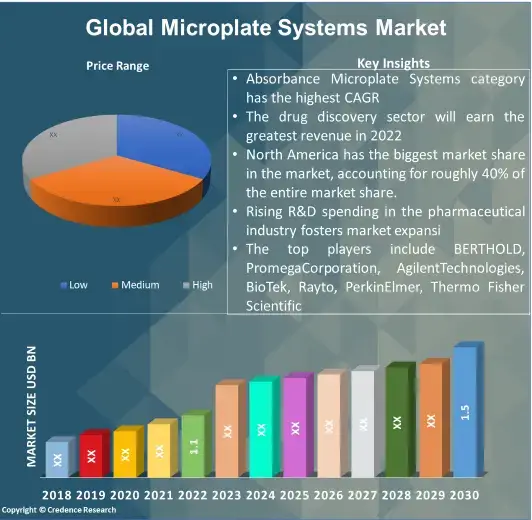
- The global demand for Microplate Systems was valued at USD 1.1 Million in 2022 and is expected to reach USD 1.5 Million in 2030, growing at a CAGR of 4.20% between 2023 and 2030.
- In the microplate systems market, the fluorescence microplate systems category is the fastest growing. and the microplate systems market's greatest CAGR is in the absorbance microplate systems category.
- The 96-well microplates segment leads the microplate systems market, while the 384-well microplates sector is the market's fastest growing.
- The drug discovery sector will earn the greatest revenue in 2022, and the enzyme-linked immunosorbent assays (ELISA) segment will lead the market.
- The pharmaceutical and biotechnology companies category is unquestionably the market leader in Microplate Systems, and the fastest growing sector in the market is research institutes and academic centres.
- The monochromator-based detection sector leads the microplate systems market, while filter-based detection is another key area in the market.
- North America has the biggest market share in the Microplate Systems Market, accounting for roughly 40% of the entire market share.
- Rising R&D spending in the pharmaceutical industry fosters market expansion.
- High acquisition and maintenance costs stifle market expansion.
Executive Summary
Market Definition
The microplate systems market refers to the market for systems and equipment used in different laboratory applications employing microplates. Microplate systems are utilized in research, diagnostics, and drug development. They offer high-throughput screening, sample analysis, and automation, making them indispensable instruments in a variety of scientific and medical sectors. The market comprises several types of microplate systems, including as readers, washers, handlers, and software solutions, to meet the demands of various sectors and research institutes. Technological developments, increased need for efficient laboratory operations, and a rising emphasis on drug research and development are driving the market.
Market Overview
The global Microplate Systems Market has grown steadily in recent years and is predicted to expand at a CAGR of 4.20% between 2023 and 2030. In 2022, the market was worth USD 1.1 million, and it is predicted to grow to USD 1.5 million by 2030.
The microplate systems market is expanding rapidly and has a promising future. It is propelled by a number of variables that contribute to its growth. The growing demand for efficient laboratory operations and automation in sectors such as pharmaceuticals, biotechnology, and research institutes is one of the primary factors. Microplate systems improve productivity and accuracy by enabling high-throughput screening, sample analysis, and data management.
Another motivator is the increased emphasis on medication discovery and development. Microplate devices play an important part in these procedures, allowing researchers to screen prospective drug candidates and evaluate vast volumes of materials rapidly. Microplate systems are widely used in the pharmaceutical and biotechnology sectors for these applications, which contributes to the market's growth.
However, there are several constraints that may have an influence on the market. One of them is the high expense of purchasing and maintaining microplate systems. This might provide difficulties, particularly for small and medium-sized laboratories with restricted funding. Furthermore, some users may be put off by the difficulty of managing and maintaining these systems.
Despite these constraints, the microplate systems market offers a number of opportunities. The growing acceptance of customized treatment, as well as the necessity for enhanced diagnostic technologies, provide chances for the industry to grow. Microplate systems are also in high demand in emerging nations, where research and development activities are increasing.
Segmentation by Type
- The fluorescence microplate systems category is the fastest growing in the microplate systems market. This is owing to its capacity to identify and measure different biomolecules with great sensitivity and specificity.
- The absorbance microplate systems category has the highest CAGR in the microplate systems market.
Segmentation by Plate Format
- The 96-well microplates segment dominates the microplate systems market. It is extensively utilized in a variety of applications and provides an excellent mix of sample volume and simplicity of usage.
- According to industry trends, the 384-well microplates sector is the fastest expanding in the market.
Segmentation by Application
- In 2022, the drug discovery segment generated the most revenue. The increasing prevalence of cancer and patient knowledge of cancer screening are the key reasons driving the segment's growth.
- The enzyme-linked immunosorbent assays (ELISA) segment dominates the market. It is widely employed in a variety of applications including as diagnostics, research, and drug development. Its capacity to identify and measure individual proteins or compounds makes it a popular option in the business.
Segmentation by End-User
- The pharmaceutical and biotechnology companies category is certainly the market leader in microplate systems. This is due to the fact that these industries rely extensively on microplate systems for a variety of applications such as drug research, development, and quality control. Their enormous investments in research and development, as well as their emphasis on innovation, contribute to their market domination.
- The microplate systems market's fastest growing sector is research institutes and academic centres. This is owing to an increase in the academic and research communities' desire for improved research tools and technology.
Segmentation by Detection Mode
- The monochromator-based detection sector leads the microplate systems market because to its adaptability and flexibility in wavelength selection.
- Another significant area in the microplate systems market is filter-based detection. Its cost-effectiveness and simplicity make it a popular choice for a variety of applications.
Segmentation by Region
- North America controls around 40% of the Microplate Systems Market.
- The Asia Pacific Microplate Systems Market is expected to grow at the fastest rate.
- The rest of the world, including Latin America, the Middle East, and Africa, supplies the remaining demand for microplate systems.
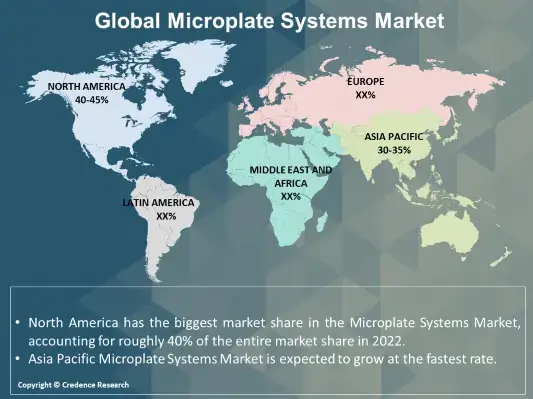
North America is estimated to lead the market during the forecast period due to the existence of several hospitals, research institutes, and modern healthcare infrastructure. Major research institutes are increasingly adopting cell-based research approaches, which is significant in medication development and toxicity assessment. Using a microplate system, automation technology makes sophisticated cell-based tests easy to execute. Technical developments in microplate systems with increased features and capacities with improving accuracy of a laboratory assay occur on a regular basis.
Furthermore, the Asia Pacific market is expected to display the highest CAGR over the projected years due to the expanding number of diagnostic centres as the number of patients increases, resulting in considerable market expansion throughout the region. The increasing number of efforts and innovations aimed at the development of labs and diagnostic centres is driving up market demand. Furthermore, India, China, and Japan have the most people, thus the need for the largest diagnostic centres accelerates quickly during the predicted period.
Key Highlights of the Report
The global Microplate Systems Market is segmented by Type, Plate Format, Applications, End-User, Detection Mode, and region. Pharmaceutical and Biotechnology Companies is unquestionably the industry leader in Microplate Systems. The microplate systems market is dominated by the 96-well microplates sector and the monochromator-based detection segment. Absorbance microplate systems category has the highest CAGR, with North America leading the market growth.
The key drivers of the market include the increasing requirement for high-throughput screening in drug research, technical developments in microplate systems, and an increase in the prevalence of chronic disorders. Furthermore, market expansion is hampered by high acquisition and maintenance costs, the difficulty of running and maintaining microplate systems, and limited access for small and medium-sized laboratories with limited resources.
Nonetheless, in 2022, North America is expected to lead the market throughout the projection period due to the presence of several hospitals, research institutes, and advanced healthcare infrastructure. Furthermore, the Asia Pacific market is estimated to exhibit the greatest CAGR during the projected years due to an increasing number of diagnostic centres as the number of patients grows, leading in significant market development throughout the region.
What Factors Are Fueling The Growth Of The Global Microplate Systems Market?
Increasing need for high-throughput screening in drug development, technological advances in microplate systems, and an increase in the frequency of chronic illnesses are pushing the need for diagnostic testing are the primary drivers of the market.
What Are The Key Challenges Encountered By The Global Microplate Systems Market?
High acquisition and maintenance costs, the complexity of running and maintaining microplate systems, and limited access for small and medium-sized laboratories with limited budgets all hinder market expansion.
What Opportunities For Growth Exist In The Global Microplate Systems Market?
The market's significant potential are rising demand for personalized medicine and targeted therapeutics, the incorporation of artificial intelligence and machine learning in microplate systems, and the expansion of the biotechnology and pharmaceutical sectors.
Market Drivers
The global Microplate Systems Market is driven by several factors. The following are the key drivers of the global Microplate Systems Market:
Increasing R&D Spending in the Pharmaceuticals Industry
Pharmaceutical and biotechnology companies are important end customers in the microplate systems industry. Microplate systems are widely used in current drug R&D activities, as well as genomic and proteomic research, since they boost test speed and accuracy, saving time and allowing researchers to concentrate on essential duties. As a result, the increasing pace of R&D in the pharmaceutical business, as indicated by increased R&D investment, may be viewed as a significant growth driver for the market. According to PhRMA, R&D spending in the United States by PhRMA member companies increased from -USD 26.0 billion in 2000 to USD 58.8 billion in 2015. Pharmaceutical research and development spending in Europe increased from USD 16.5 billion (EUR 17.8 billion) in 2000 to USD 45.6 billion (EUR 37.5 billion) in 2019 (Source: EFPIA).
Market Restraints
The global Microplate Systems Market faces some challenges that may hinder its growth. These include the following:
High Cost of Acquisition And Maintenance
The initial expenditure necessary to buy microplate systems can be large, especially for small and medium-sized laboratories with restricted finances. In addition, recurring maintenance charges like as calibration, service, and software upgrades can add to the overall price.The high cost may make it difficult for laboratories and research organizations to adopt or upgrade to newer microplate systems. It may restrict access to innovative technology and impede the adoption of effective laboratory operations. Furthermore, the difficulty of managing and maintaining microplate systems might be a hurdle for certain users. Training workers to use these systems properly and fix any problems takes time, resources, and skill.
Opportunities
The global microplate systems market offers significant growth opportunities. These include the following:
Increasing the Number of Applications for Point-of-Care Testing
There is a tremendous opportunity for microplate systems in the field of point-of-care testing (POCT) with the rising need for speedy and accurate diagnostic solutions. These technologies have the ability to deliver laboratory-quality testing to the patient's bedside, clinic, or remote location, allowing for rapid and accurate diagnosis. POCT may use microplate systems for a variety of applications, including infectious illness diagnostics, cardiac indicators, cancer biomarkers, and more. Because of their capacity to deliver high-throughput screening and exact analysis in a short period of time, they are excellent for point-of-care settings.
The combination of microplate systems with portable and handheld equipment improves their usefulness for POCT even more.With developments in miniaturization and automation, these systems can provide dependable and timely findings, allowing healthcare practitioners to make educated decisions more swiftly.
Competitive Landscape
Key Players
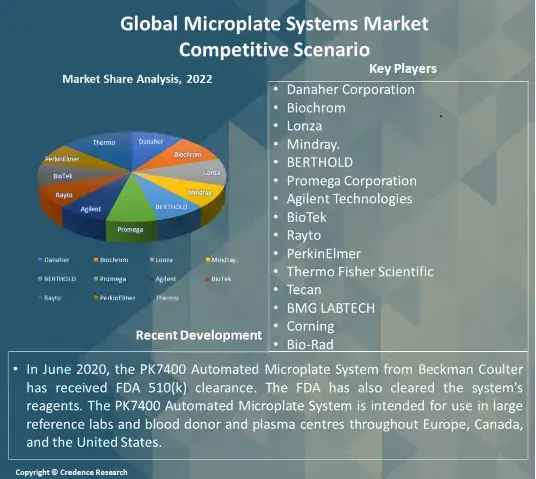
The global Microplate Systems Market is highly competitive, with several key players. Some of the major players in the market and their market share are as follows:
- Danaher Corporation
- Biochrom
- Lonza
- Mindray.
- BERTHOLD
- Promega Corporation
- Agilent Technologies
- BioTek
- Rayto
- PerkinElmer
- Thermo Fisher Scientific
- Tecan
- BMG LABTECH
- Corning
- Bio-Rad
These organizations prioritize product innovation, Detection Mode expansion, and mergers and acquisitions to stay competitive.
The global Microplate Systems Market's key players continually seek to stay ahead by offering new products and developments.
In July 2022, Porvair Sciences has launched a 96-well deep well microplate for labs that use magnetic beads for nucleic acid purification, clean-up, and protein purification. The strengthened base of the 96-well magnetic bead separation plate allows for regular centrifugation at up to 6,000x g, allowing for quicker magnetic bead separation processes and enhanced sample quality.
In April 2022, Molecular Devices, a manufacturer of high-performance life science products, has introduced the SpectraMax Mini Multi-Mode Microplate Reader, a tiny device meant to save researchers both space and money.
Summary of Key Findings
- Increasing need for high-throughput screening in drug research, technical developments in microplate systems, and a growth in the prevalence of chronic diseases are driving the market's major drivers.
- Market is divided into types, plate formats, applications, end-users, detecting modes, and regions.
- The monochromator-based detection sector is the industry leader in microplate systems.
- North America leads market growth; the market is highly competitive, with key players such as Danaher Corporation, Biochrom, Lonza, Mindray., BERTHOLD, Promega Corporation, Agilent Technologies, BioTek, Rayto, PerkinElmer, Thermo Fisher Scientific, Tecan, BMG LABTECH, Corning, Bio-Rad, and others.
Future Outlook
- Increased use of automation and robots in laboratory procedures
- Technological advancements such as downsizing and integration of numerous functions
- Demand for customized medicine and tailored medicines is growing
- Artificial intelligence and machine learning are being integrated into microplate systems
- Expansion of R&D activities in emerging economies
- Increasing emphasis on high-throughput screening and drug discovery
- Increasing collaborations and partnerships among industry players
- Continuous product innovations and improvements
- Growing demand for microplate systems in academic research
Segmentation
- By Type:
- Absorbance Microplate Systems
- Fluorescence Microplate Systems
- Luminescence Microplate Systems
- Scintillation Microplate Systems
- By Plate Format:
- 96-Well Microplates
- 384-Well Microplates
- 1536-Well Microplates
- Other Microplate Formats
- By Type:
- Drug Discovery and Development
- Enzyme-Linked Immunosorbent Assays (ELISA)
- Protein and Nucleic Acid Quantification
- Cell-based Assays
- Microbial Growth Monitoring
- Others
- By Plate Format:
- Pharmaceutical and Biotechnology Companies
- Research Institutes and Academic Centers
- Clinical Laboratories
- Contract Research Organizations (CROs)
- By Detection Mode:
- Monochromator-based Detection
- Filter-based Detection
- By Region
- North America
- U.S
- Canada
- Mexico
- Europe
- Germany
- France
- U.K.
- Italy
- Spain
- Rest of Europe
- Asia Pacific
- China
- Japan
- India
- South Korea
- South-east Asia
- Rest of Asia Pacific
- Latin America
- Brazil
- Argentina
- Rest of Latin America
- Middle East & Africa
- GCC Countries
- South Africa
- Rest of Middle East and Africa
- North America
Adjacent Markets
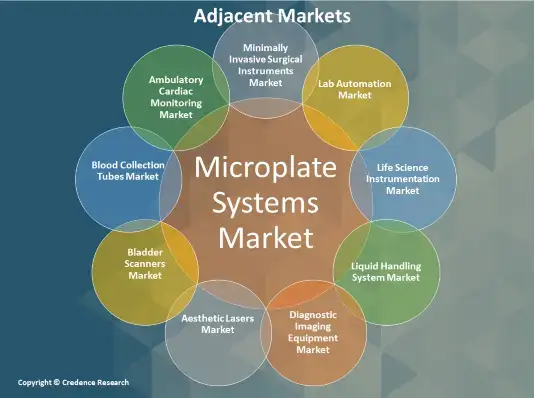
In the Microplate Systems Market, there are several adjacent markets which has high revenue growth opportunities. The key adjacent markets for Microplate Systems Market -

Request a Free Sample
Fill in your details and we'll send you a free sample report.
- Sample data tables & charts
- Research methodology
Market Dynamics
Increasing R&D Spending in Pharmaceuticals
Pharmaceutical and biotechnology companies are investing heavily in research and development, driving demand for microplate systems that enable high-throughput screening, faster drug discovery, and more efficient laboratory workflows.
Technological Advancements in Microplate Systems
Continuous innovation, such as improved automation, integration of multiple detection modes, and enhanced data management, is making microplate systems more versatile and attractive for a wide range of laboratory applications.
Rising Prevalence of Chronic Diseases
The growing incidence of chronic illnesses like cancer and infectious diseases is increasing the need for diagnostic testing and drug development, both of which rely heavily on microplate systems for efficient sample analysis.
Expansion of Diagnostic and Research Infrastructure in Emerging Markets
Rapid growth in healthcare and research infrastructure, especially in Asia Pacific, is boosting adoption of microplate systems as more diagnostic centers and research institutes seek advanced laboratory automation solutions.
Need a Custom Version of This Report?
Tailor the scope, geography, or segments to your exact requirements.
- Custom geography or segment scope
- Direct access to our analyst team
Frequently Asked Questions
What is the current market size for the Microplate System Market, and what is its projected size in 2032?
At what Compound Annual Growth Rate is the Microplate System Market projected to grow between 2025 and 2032?
Which detection mode segment drives global demand for Microplate Systems?
Which Type segment is predicted to grow at the fastest rate over the forecast period?
Who are the major players in the global Microplate Systems Market?
What are the major market drivers of the Microplate Systems industry?
What are the major market restraints of the Microplate Systems industry?
What are the major market opportunities of the Microplate Systems industry?
Who are the leading companies in the Microplate System Market?
Table of Content
Chapter 1 Market Segmentation
- 1.1 Segmentation Framework
- 1.1.1 Product and Service Classification
- 1.1.2 Application and End-Use Classification
- 1.1.3 Technology and Solution Classification
- 1.1.4 Customer and Distribution Channel Classification
- 1.1.5 Geographic Segmentation
- 1.1.6 Market Segment Definitions and Boundaries
- 1.2 By Type
- 1.2.1 Absorbance Microplate Systems
- 1.2.2 Fluorescence Microplate Systems
- 1.2.3 Luminescence Microplate Systems
- 1.2.4 Scintillation Microplate Systems
- 1.3 By End-User
- 1.3.1 Pharmaceutical and Biotechnology Companies
- 1.3.2 Research Institutes and Academic Centers
- 1.3.3 Clinical Laboratories
- 1.3.4 Contract Research Organizations (CROs)
- 1.4 By Application
- 1.4.1 Drug Discovery and Development
- 1.4.2 Enzyme-Linked Immunosorbent Assays (ELISA)
- 1.4.3 Protein and Nucleic Acid Quantification
- 1.4.4 Cell-based Assays
- 1.4.5 Microbial Growth Monitoring
- 1.5 By Plate Format
- 1.5.1 96-Well Microplates
- 1.5.2 384-Well Microplates
- 1.5.3 1536-Well Microplates
- 1.5.4 Other Microplate Formats
Chapter 2 Introduction
- 2.1 Report Objectives and Scope
- 2.2 Product Definition and Industry Terminology
- 2.3 Market Inclusions and Exclusions
- 2.4 Research Process
- 2.4.1 Primary Research and Expert Interviews
- 2.4.2 Secondary Research and Source Review
- 2.4.3 Top-Down and Bottom-Up Estimation
- 2.4.4 Data Triangulation and Verification
- 2.5 Research Assumptions and Limitations
Chapter 3 Executive Summary
- 3.1 Market Snapshot and Key Findings
- 3.2 Base-Year Market Size
- 3.3 Forecast Market Size
- 3.4 Revenue and Volume Growth Outlook
- 3.5 Key Demand and Supply Indicators
- 3.6 Leading Market Segments
- 3.7 Fastest-Growing Market Opportunities
- 3.8 Regional Performance Highlights
- 3.9 Technology and Industry Transformation
- 3.10 Competitive Landscape Summary
- 3.11 Analyst View and Strategic Implications
Chapter 4 Global Microplate Systems Market Trends and Developments
- 4.1 Historical Industry Development
- 4.2 Recent Market Trends and Developments
- 4.3 Demand and Customer Behavior Trends
- 4.4 Technology and Product Innovation
- 4.5 Artificial Intelligence, Automation and Digitalization
- 4.6 Local Manufacturing and Supply Chain Realignment
- 4.7 Industry Partnerships, Mergers and Acquisitions
- 4.8 Sustainability and Circular Economy Developments
- 4.9 Government and Private Sector Investment Trends
- 4.10 Emerging Business Models and Commercialization
- 4.11 Industry Developments and Announcements
Chapter 5 Global Microplate Systems Market Production, Supply and Demand Analysis
- 5.1 Demand Trend and Consumption Analysis
- 5.2 Demand Forecast
- 5.3 Production and Output Trend
- 5.4 Production and Output Forecast
- 5.5 Installed Capacity and Capacity Utilization
- 5.6 Company-Wise Production Plants and Statistics
- 5.6.1 Installed Production Capacity
- 5.6.2 Actual Production
- 5.6.3 Planned Capacity and Expansion Targets
- 5.7 Supply Chain Structure and Procurement Trends
- 5.8 Supply-Demand Gap and Bottlenecks
- 5.9 Import Dependence and Sourcing Structure
- 5.10 Contract Manufacturing and Outsourcing
- 5.11 Regional Supply and Demand Concentration
Chapter 6 Global Microplate Systems Market Pricing Analysis
- 6.1 Pricing Structure and Measurement
- 6.2 Historical Pricing Trends
- 6.3 Pricing Outlook
- 6.4 Average Selling Price and Unit Economics
- 6.5 Pricing by Product and Market Segment
- 6.6 Geographic Pricing Differences
- 6.7 Key Input, Energy, Labor and Logistics Costs
- 6.8 Contract Pricing and Purchasing Models
- 6.9 Pricing Sensitivity and Competitive Positioning
- 6.10 Price, Margin and Profitability Implications
Chapter 7 Global Microplate Systems Market Dynamics
- 7.1 Market Growth Drivers
- 7.1.1 Demand-Side Drivers
- 7.1.2 Technology and Innovation Drivers
- 7.1.3 Infrastructure and Investment Drivers
- 7.1.4 Regulatory and Policy Drivers
- 7.2 Market Restraints
- 7.2.1 Cost and Affordability Constraints
- 7.2.2 Technology and Adoption Barriers
- 7.2.3 Supply Chain and Operational Constraints
- 7.3 Market Challenges
- 7.3.1 Competitive Pressure and Margin Erosion
- 7.3.2 Skills, Infrastructure and Implementation Gaps
- 7.4 Emerging Market Opportunities
- 7.5 Market Dynamics Impact and Time-Horizon Assessment
Chapter 8 Global Microplate Systems Value Chain Analysis
- 8.1 Industry Value Chain Overview
- 8.2 Upstream Suppliers and Critical Inputs
- 8.3 Technology and Component Providers
- 8.4 Manufacturing or Service Delivery
- 8.5 Distribution, Channel Partners and Integrators
- 8.6 Downstream Applications and End Users
- 8.7 Value Addition and Profit Pools
- 8.8 Vertical Integration and Outsourcing
- 8.9 Supplier Concentration and Risk
- 8.10 Supply Chain Localization and Resilience
Chapter 9 Global Microplate Systems Market Regulations and Policies
- 9.1 Relevant Laws, Standards and Compliance Frameworks
- 9.2 Product, Service, Safety and Quality Requirements
- 9.3 Government Policies, Incentives and Subsidies
- 9.4 Imports, Exports and Trade Barriers
- 9.5 Public Procurement and Local Content Requirements
- 9.6 Environmental and Sustainability Compliance
- 9.7 Upcoming Policy Changes and Market Implications
Chapter 10 Global Microplate Systems Market Hotspots and Opportunities
- 10.1 Market Opportunity Mapping and Growth Hotspots
- 10.2 High-Growth Applications and Customer Groups
- 10.3 Underserved Markets and White-Space Opportunities
- 10.4 Emerging Technology and Product Opportunities
- 10.5 New Capacity and Investment Hotspots
- 10.6 Market Entry and Expansion Opportunities
- 10.7 Distribution and Partnership Opportunities
- 10.8 Near-Term and Long-Term Commercial Potential
- 10.9 Opportunity Attractiveness and Execution Risks
Chapter 11 Global Microplate Systems Market Outlook
- 11.1 Market Size and Analysis
- 11.1.1 Revenue
- 11.1.2 Market Volume and Quantity Sold
- 11.1.3 Historical Market Size
- 11.1.4 Base-Year Market Size
- 11.2 Market Forecast
- 11.2.1 Revenue Forecast
- 11.2.2 Volume Forecast
- 11.2.3 CAGR and Year-on-Year Growth
- 11.2.4 Incremental Revenue Opportunity
- 11.3 Forecast Assumptions and Scenario Analysis
- 11.3.1 Base-Case Forecast
- 11.3.2 Optimistic and Conservative Scenarios
- 11.3.3 Technology, Pricing and Policy Sensitivities
- 11.4 Market Attractiveness and Growth Outlook
Chapter 12 Global Microplate Systems Market Segmentation and Outlook
- 12.1 Segmentation Summary and Market Shares
- 12.2 Largest and Fastest-Growing Segments
- 12.3 By Type - Market Size and Forecast
- 12.3.1 Segment Definition and Scope
- 12.3.2 Historical Market Size
- 12.3.3 Revenue Forecast
- 12.3.4 Volume Forecast
- 12.3.5 Base-Year Market Share
- 12.3.6 Segment CAGR and Growth Drivers
- 12.3.7 Subsegment Market Size and Forecast
- 12.3.7.1 Absorbance Microplate Systems
- 12.3.7.2 Fluorescence Microplate Systems
- 12.3.7.3 Luminescence Microplate Systems
- 12.3.7.4 Scintillation Microplate Systems
- 12.3.8 Subsegment Pricing and Adoption Trends
- 12.3.9 Leading Suppliers and Competition
- 12.3.10 Regional Demand and Opportunities
- 12.4 By End-User - Market Size and Forecast
- 12.4.1 Segment Definition and Scope
- 12.4.2 Historical Market Size
- 12.4.3 Revenue Forecast
- 12.4.4 Volume Forecast
- 12.4.5 Base-Year Market Share
- 12.4.6 Segment CAGR and Growth Drivers
- 12.4.7 Subsegment Market Size and Forecast
- 12.4.7.1 Pharmaceutical and Biotechnology Companies
- 12.4.7.2 Research Institutes and Academic Centers
- 12.4.7.3 Clinical Laboratories
- 12.4.7.4 Contract Research Organizations (CROs)
- 12.4.8 Subsegment Pricing and Adoption Trends
- 12.4.9 Leading Suppliers and Competition
- 12.4.10 Regional Demand and Opportunities
- 12.5 By Application - Market Size and Forecast
- 12.5.1 Segment Definition and Scope
- 12.5.2 Historical Market Size
- 12.5.3 Revenue Forecast
- 12.5.4 Volume Forecast
- 12.5.5 Base-Year Market Share
- 12.5.6 Segment CAGR and Growth Drivers
- 12.5.7 Subsegment Market Size and Forecast
- 12.5.7.1 Drug Discovery and Development
- 12.5.7.2 Enzyme-Linked Immunosorbent Assays (ELISA)
- 12.5.7.3 Protein and Nucleic Acid Quantification
- 12.5.7.4 Cell-based Assays
- 12.5.7.5 Microbial Growth Monitoring
- 12.5.8 Subsegment Pricing and Adoption Trends
- 12.5.9 Leading Suppliers and Competition
- 12.5.10 Regional Demand and Opportunities
- 12.6 By Plate Format - Market Size and Forecast
- 12.6.1 Segment Definition and Scope
- 12.6.2 Historical Market Size
- 12.6.3 Revenue Forecast
- 12.6.4 Volume Forecast
- 12.6.5 Base-Year Market Share
- 12.6.6 Segment CAGR and Growth Drivers
- 12.6.7 Subsegment Market Size and Forecast
- 12.6.7.1 96-Well Microplates
- 12.6.7.2 384-Well Microplates
- 12.6.7.3 1536-Well Microplates
- 12.6.7.4 Other Microplate Formats
- 12.6.8 Subsegment Pricing and Adoption Trends
- 12.6.9 Leading Suppliers and Competition
- 12.6.10 Regional Demand and Opportunities
- 12.7 Segment Growth Comparison
- 12.8 Segment Attractiveness and Priority Matrix
Chapter 13 Global Microplate Systems End-Use and Application Market Outlook
- 13.1 End-Use Industry and Customer Demand Structure
- 13.2 Leading Applications and Customer Groups
- 13.3 End-Use Market Size, Share and Forecast
- 13.4 Major End-Use Industry Deep Dives
- 13.4.1 Customer Requirements and Use Cases
- 13.4.2 Demand and Replacement Cycles
- 13.4.3 Technical and Regulatory Considerations
- 13.4.4 Purchasing and Procurement Models
- 13.4.5 Leading Vendors and Distribution Channels
- 13.4.6 Forecast and Commercial Opportunities
- 13.5 Emerging Applications and Cross-Segment Demand
- 13.6 End-Use Industry Investment Priorities
Chapter 14 Global Microplate Systems Geographic Market Outlook
- 14.1 Regional Market Size and Share
- 14.2 Regional Market Forecast
- 14.3 Regional Pricing, Production and Demand Differences
- 14.4 North America
- 14.4.1 United States
- 14.4.2 Canada
- 14.4.3 Mexico
- 14.5 Europe
- 14.5.1 Germany
- 14.5.2 France
- 14.5.3 Italy
- 14.5.4 United Kingdom
- 14.5.5 Spain
- 14.5.6 Poland
- 14.5.7 Russia
- 14.5.8 Netherlands
- 14.5.9 Belgium
- 14.5.10 Sweden
- 14.5.11 Denmark
- 14.5.12 Norway
- 14.5.13 Rest of Europe
- 14.6 Asia Pacific
- 14.6.1 China
- 14.6.2 India
- 14.6.3 Japan
- 14.6.4 South Korea
- 14.6.5 Thailand
- 14.6.6 Indonesia
- 14.6.7 Vietnam
- 14.6.8 Malaysia
- 14.6.9 Australia
- 14.6.10 Rest of Asia Pacific
- 14.7 Latin America
- 14.7.1 Brazil
- 14.7.2 Argentina
- 14.7.3 Colombia
- 14.7.4 Chile
- 14.7.5 Rest of Latin America
- 14.8 Middle East
- 14.8.1 Saudi Arabia
- 14.8.2 United Arab Emirates
- 14.8.3 Turkey
- 14.8.4 Israel
- 14.8.5 Iran
- 14.8.6 Rest of the Middle East
- 14.9 Africa
- 14.9.1 South Africa
- 14.9.2 Egypt
- 14.9.3 Nigeria
- 14.9.4 Morocco
- 14.9.5 Rest of Africa
- 14.10 Regional Investment, Policy and Supply Chain Differences
- 14.11 Regional Competitive Landscape
- 14.12 Geographic Growth Hotspots
Chapter 15 Global Microplate Systems Technology, Innovation and Sustainability Outlook
- 15.1 Technology Landscape and Maturity
- 15.2 Product, Process and Service Innovation
- 15.3 AI, Automation and Digital Tools in the Industry
- 15.4 Technology Adoption and Performance Benchmarking
- 15.5 Innovation Pipeline and R&D Investment
- 15.6 Patent and Intellectual Property Trends
- 15.7 Energy Efficiency and Resource Management
- 15.8 Sustainability, Recycling and Circularity
- 15.9 Technology Roadmap
- 15.10 Risks of Obsolescence and Technology Substitution
Chapter 16 Global Microplate Systems Market Key Strategic Imperatives
- 16.1 Growth and Market Entry Priorities
- 16.2 High-Return Products and Segments
- 16.3 Pricing, Profitability and Cost Optimization
- 16.4 Technology Investment and Product Differentiation
- 16.5 Supply Chain Localization and Resilience
- 16.6 Distribution and Customer Acquisition
- 16.7 Partnership, Acquisition and Capacity Strategy
- 16.8 Regional Expansion Priorities
- 16.9 Short-, Medium- and Long-Term Actions
Chapter 17 Competition Outlook
- 17.1 Industry Competition Characteristics
- 17.2 Market Structure and Concentration
- 17.3 Market Share and Competitive Positioning
- 17.4 Company-Wise Revenue and Product Benchmarking
- 17.5 Production and Service Capacity Benchmarking
- 17.6 Technology, Pricing and Differentiation
- 17.7 Regional Footprint and Distribution Strength
- 17.8 Mergers, Acquisitions and Strategic Alliances
- 17.9 New Entrants and Competitive Threats
- 17.10 Porter's Five Forces and Industry Attractiveness
- 17.11 Competitive Outlook
Chapter 18 Company Profiles
- 18.1 Company Coverage and Selection Criteria
- 18.2 Danaher Corporation
- 18.2.1 Business Description
- 18.2.2 Company Ownership and Geographic Presence
- 18.2.3 Product and Service Portfolio
- 18.2.4 Manufacturing and Operating Footprint
- 18.2.5 Production Capacity and Expansion Plans
- 18.2.6 Financial Performance and Investment
- 18.2.7 Market Share and Competitive Position
- 18.2.8 Technology and Innovation Capabilities
- 18.2.9 Strategic Alliances or Partnerships
- 18.2.10 Recent Developments
- 18.2.11 Growth Strategy and Outlook
- 18.3 Thermo Fisher Scientific
- 18.4 PerkinElmer
- 18.5 Tecan
- 18.6 BioTek (Agilent Technologies)
- 18.7 BMG LABTECH
- 18.8 Corning
- 18.9 Bio-Rad
- 18.10 Promega Corporation
- 18.11 Molecular Devices
- 18.12 Other Relevant Market Participants
Note: Every listed company is profiled on the structure shown under the first company. The company list is preliminary and may change based on research findings, market developments, data availability and client requirements.
Chapter 19 Disclaimer
- 19.1 Research and Forecast Disclaimer
- 19.2 Data Source and Estimation Limitations
Note: The depth of individual sections depends on data availability for this market. Volume, capacity, trade and other unit-based metrics are included where applicable.

