
Chronic pain visits carry most acupuncture spending
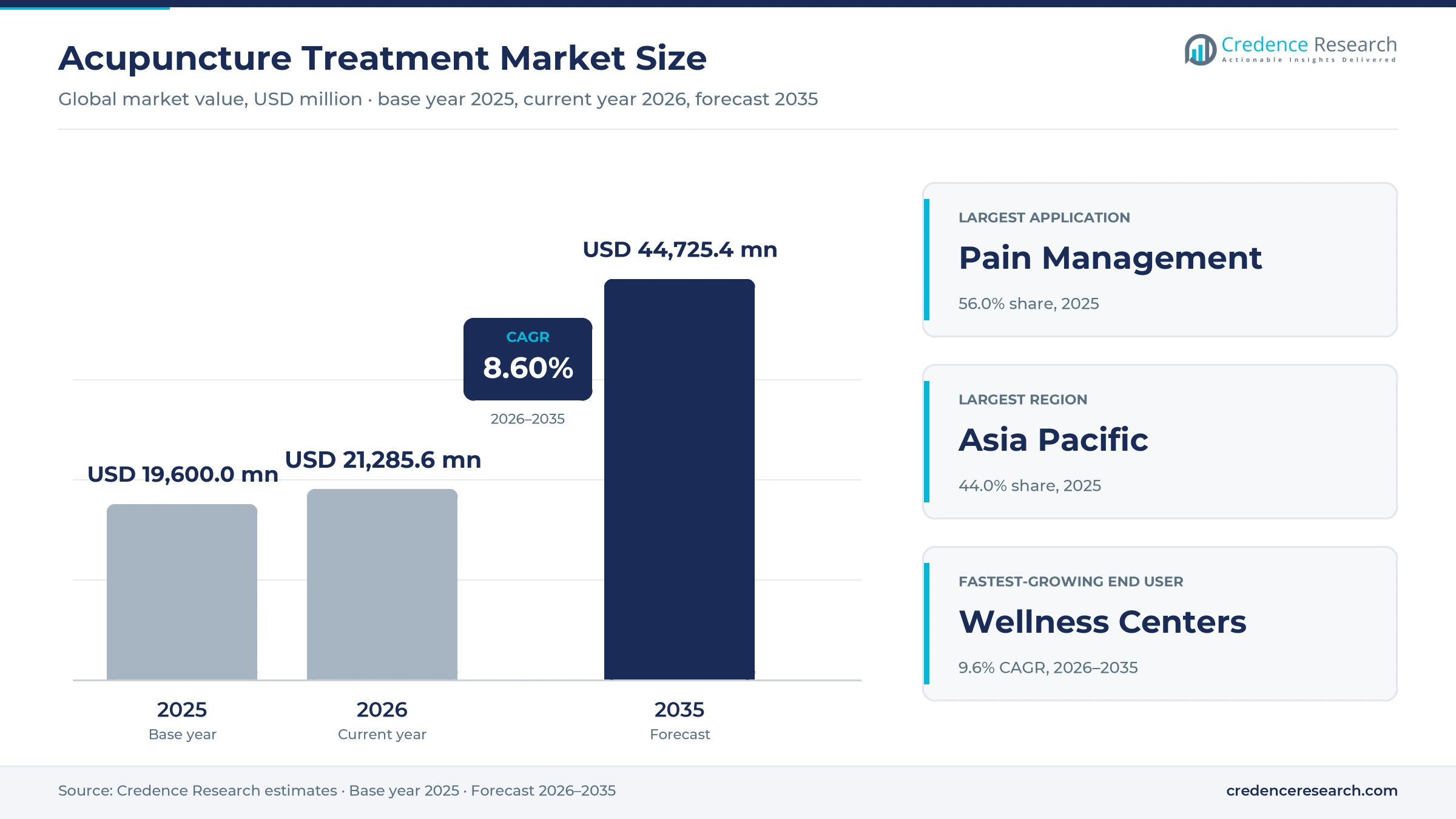
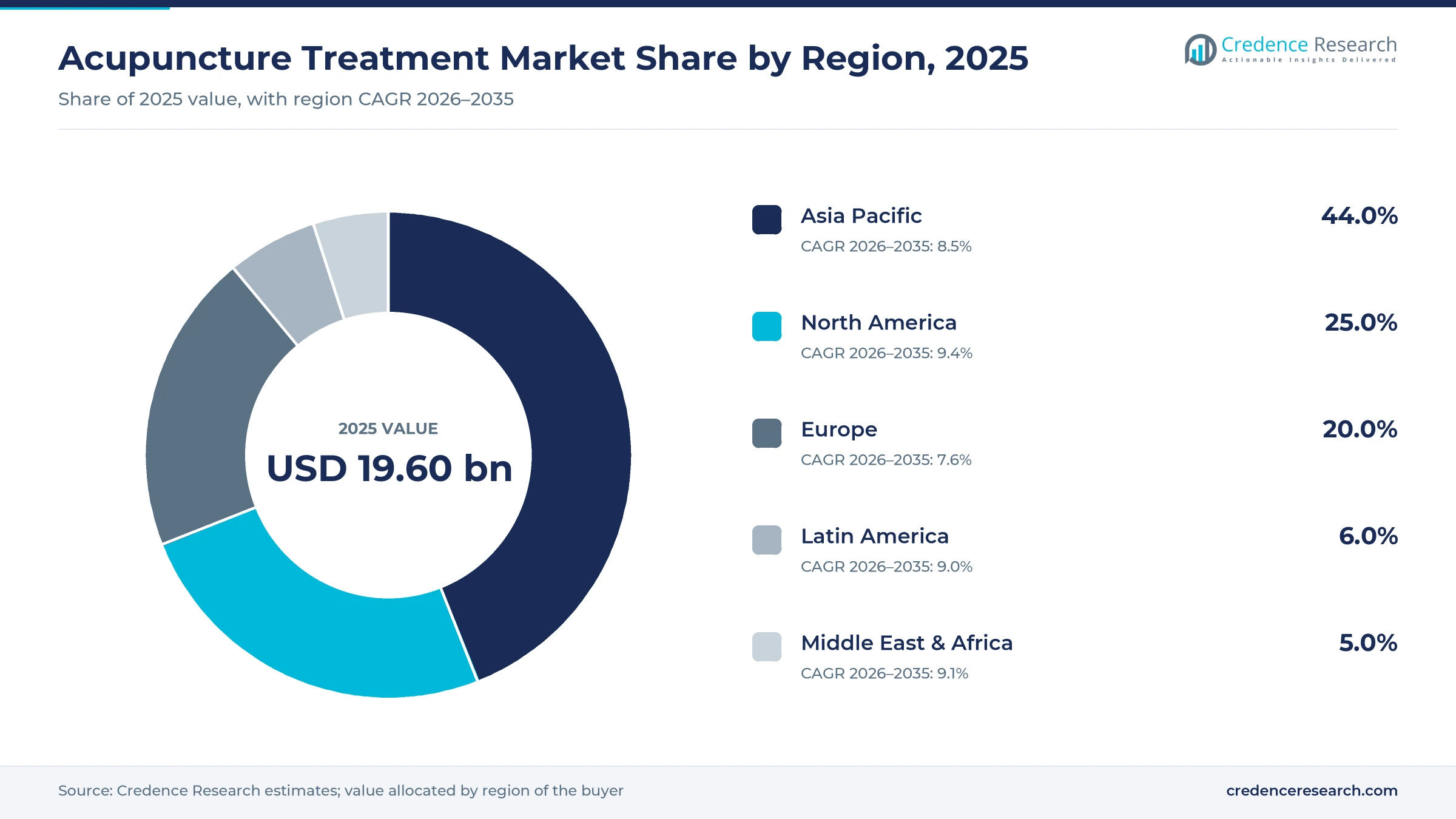
The global acupuncture treatment market was valued at USD 19.60 billion in 2025 and is projected to increase from USD 21.29 billion in 2026 to USD 44.73 billion by 2035, registering a CAGR of 8.60% during 2026–2035. Spending comes mainly from patients with chronic back, neck and joint pain who pay per session, from public and private insurers that cover defined pain conditions, and from hospitals that run traditional medicine departments. Asia Pacific held the largest regional share, 44.0% in 2025, because China, Korea and Japan deliver acupuncture inside mainstream health systems and insurance schemes. North America is the fastest-growing region at 9.4% a year, as Medicare and private plans pay for courses of needling for chronic low back pain. The main commercial change is the shift of acupuncture from a cash-pay wellness service toward a covered pain therapy with session caps. Disputed trial evidence and narrow provider rules remain the clearest restraints.
Why does chronic pain decide where acupuncture money goes?
The market counts the value of acupuncture sessions delivered by licensed acupuncturists, physicians and traditional medicine practitioners, including electroacupuncture, ear acupuncture and moxibustion given in the same visit. It also counts single-use needles, guide tubes and electrical stimulation units sold to clinics. Patients pay cash, claim a capped number of sessions from insurers, or receive needling inside a public hospital episode.
Herbal medicines, massage-only visits and acupressure products sold for home use fall outside the count. The value chain runs from needle makers in Japan, Korea, China and Germany through specialist distributors to hospitals, solo practices and franchise clinics. Most value sits in practitioner time rather than in consumables, because a single needle costs cents while a session is billed in tens of dollars.
Acupuncture Treatment Market Insights
- The acupuncture treatment market grows from USD 19.60 billion in 2025 to USD 44.73 billion by 2035 at an 8.60% CAGR, driven by covered pain care and public traditional medicine capacity.
- Asia Pacific held 44.0% of 2025 value, because China, Korea and Japan deliver acupuncture through public hospitals and insurance schemes.
- Pain Management led applications with 56.0% in 2025, because payers in the U.S. and Germany cover needling mainly for chronic back and knee pain.
- The World Health Assembly adopted the WHO Global Traditional Medicine Strategy 2025–2034 on May 26, 2025, setting a ten-year frame for integration.
- House bill H.R. 1667, introduced on Feb. 28, 2025, would let licensed acupuncturists bill Medicare directly as independent providers.
Clinic services and pain care hold most of the value
Practitioner sessions hold the value, needles cost cents
Based on product and services, the market is categorized into services and products. Services led with 88.0% of 2025 value because practitioner time is billed per visit, and Inova's Virginia program lists a 60-minute session at USD 99 while Lhasa OMS sells Seirin J-type needles for about 13 cents each. Services also grow fastest at 8.7% a year, as covered courses add visits rather than consumables, and the Medicare benefit described under drivers pays for whole courses rather than single visits. Products grow more slowly because needle prices stay low and competition among Asian makers is intense.
Pain care leads, while anxiety and sleep uses grow fastest
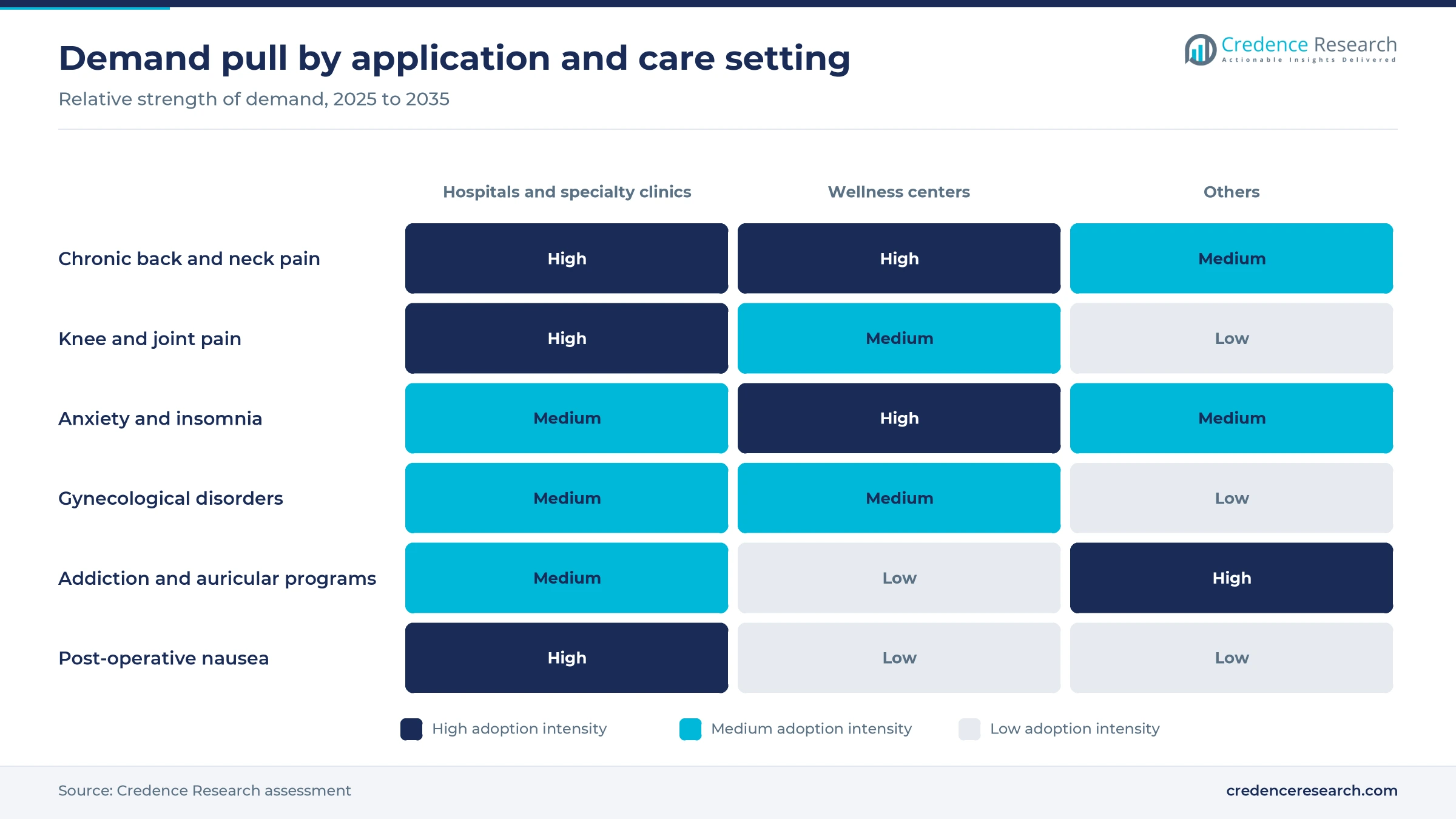
Based on application, the market is categorized into pain management, gynecological disorders and others. Pain Management led with 56.0% of 2025 value because coverage rules are written around pain, and the German statutory insurer SBK pays for up to 10 sessions within six weeks for chronic lumbar or knee osteoarthritis pain, with 15 sessions in medically justified cases. Others grow fastest at 9.1% a year, as anxiety, insomnia and nausea uses enter benefit lists, with Minnesota Medicaid covering anxiety and insomnia according to GoodRx. No payer decision expanding coverage for gynecological or fertility uses could be verified in this review, so that segment rests on cash demand.
Hospital departments lead while wellness clinics grow fastest
Based on end user, the market is categorized into hospitals and specialty clinics, wellness centers and others. Hospitals and Specialty Clinics led with 47.0% of 2025 value because Asian public systems deliver needling inside hospital departments, and Xinhua reported that Chinese traditional medicine institutions provided diagnoses and care to an estimated 1.28 billion people in 2023. Wellness Centers grow fastest at 9.6% a year, as cash-pay franchise formats spread, with Modern Acupuncture listing 44 units in operation on FranchiseHelp. Home and workplace settings stay small because needling requires a licensed practitioner on site.
| Segment Group | Leading Sub-segment | Share, 2025 | Fastest-growing Sub-segment | CAGR, 2026–2035 |
|---|---|---|---|---|
| By Product and Services | Services | 88.0% | Services | 8.7% |
| By Application | Pain Management | 56.0% | Others | 9.1% |
| By End User | Hospitals and Specialty Clinics | 47.0% | Wellness Centers | 9.6% |
Sessions sell for tens of dollars, needles for cents
Pricing works per session, and practitioner time drives almost all of it. Hospital-run and franchise clinics in the U.S. charge close to USD 100 a visit and discount packages of six or twelve sessions to lock in a full course. Public payers set fixed fees, as the Victorian accident insurer does, which keeps prices well below U.S. cash levels. Session caps from insurers matter more than fee levels, because they decide how many paid visits a patient completes. Needles and stimulators are a small cost per visit, so suppliers compete on comfort, sterility and distribution rather than price.
| Service or product | Typical price or fee | Basis |
|---|---|---|
| Initial consultation with treatment, U.S. hospital program | USD 149 per visit | Inova price list, 2026 |
| Single 60-minute session, U.S. hospital program | USD 99, or USD 565 for six | Inova price list, 2026 |
| Average U.S. cash fee, initial and follow-up | About USD 112 and USD 80 | 2019 study cited by GoodRx, March 2022 |
| Chinese medicine consultation, Victoria accident scheme | AUD 70.53 initial, AUD 57.64 standard | TAC fee schedule from July 1, 2025 |
| Seirin J-type single-use needles | USD 13.00 per box of 100 | Lhasa OMS list price, November 2026 |
| ITO ES-160 six-channel stimulator | USD 949 per unit | Lhasa OMS list price, November 2026 |
Request a Free Sample
Fill in your details and we'll send you a free sample report.
- Sample data tables & charts
- Research methodology
Pain coverage, state TCM capacity and aging lift volume
Insurer coverage for chronic back pain adds paid sessions
Coverage decisions turn acupuncture from an occasional cash purchase into a reimbursed course of care. The Medicare national coverage determination covers up to 12 visits in 90 days for chronic low back pain from Jan. 21, 2020, with eight more for patients who improve and a cap of 20 a year. German statutory insurers run a similar capped benefit for chronic lumbar and knee pain, described in the segment analysis. A JAMA Network Open study of 6.8 million U.S. adults with low back pain found that the share with an acupuncture claim rose from 0.9% in 2010 to 1.6% in 2019. Providers who can bill these schemes gain repeat visits, while cash-only practices compete on price.
Pain patients move toward drug-free options
Patients and clinicians are looking for pain care that avoids long-term opioid use, and needling fits that demand. NCCIH analysis of the National Health Interview Survey shows that acupuncture use among U.S. adults rose from 1% in 2002 to 2.2% in 2022. Over the same period, the share of complementary health users who cited pain management rose from 42.3% to 49.2%. In England, NICE guidance NG193 told clinicians in April 2021 to consider a course of acupuncture or dry needling for people aged 16 and over with chronic primary pain. These signals keep pain care at 56.0% of 2025 value and favor practices built around musculoskeletal patients.
Public traditional medicine capacity expands in China and Hong Kong
Governments in China and Hong Kong are adding hospital and primary-care capacity that delivers acupuncture at scale. China's National Administration of Traditional Chinese Medicine said in January 2026 that visits to traditional medicine institutions were 58.9% higher at the end of 2024 than at the end of 2020. Guidelines issued in March 2026 require township and community clinics to offer at least ten types of techniques, with acupuncture among them. The Chinese Medicine Hospital of Hong Kong plans 400 beds and 400,000 outpatient attendances a year by the end of 2030. Public providers capture this volume, and needle makers supplying Chinese tenders gain steady orders.
Older populations enlarge the chronic pain caseload
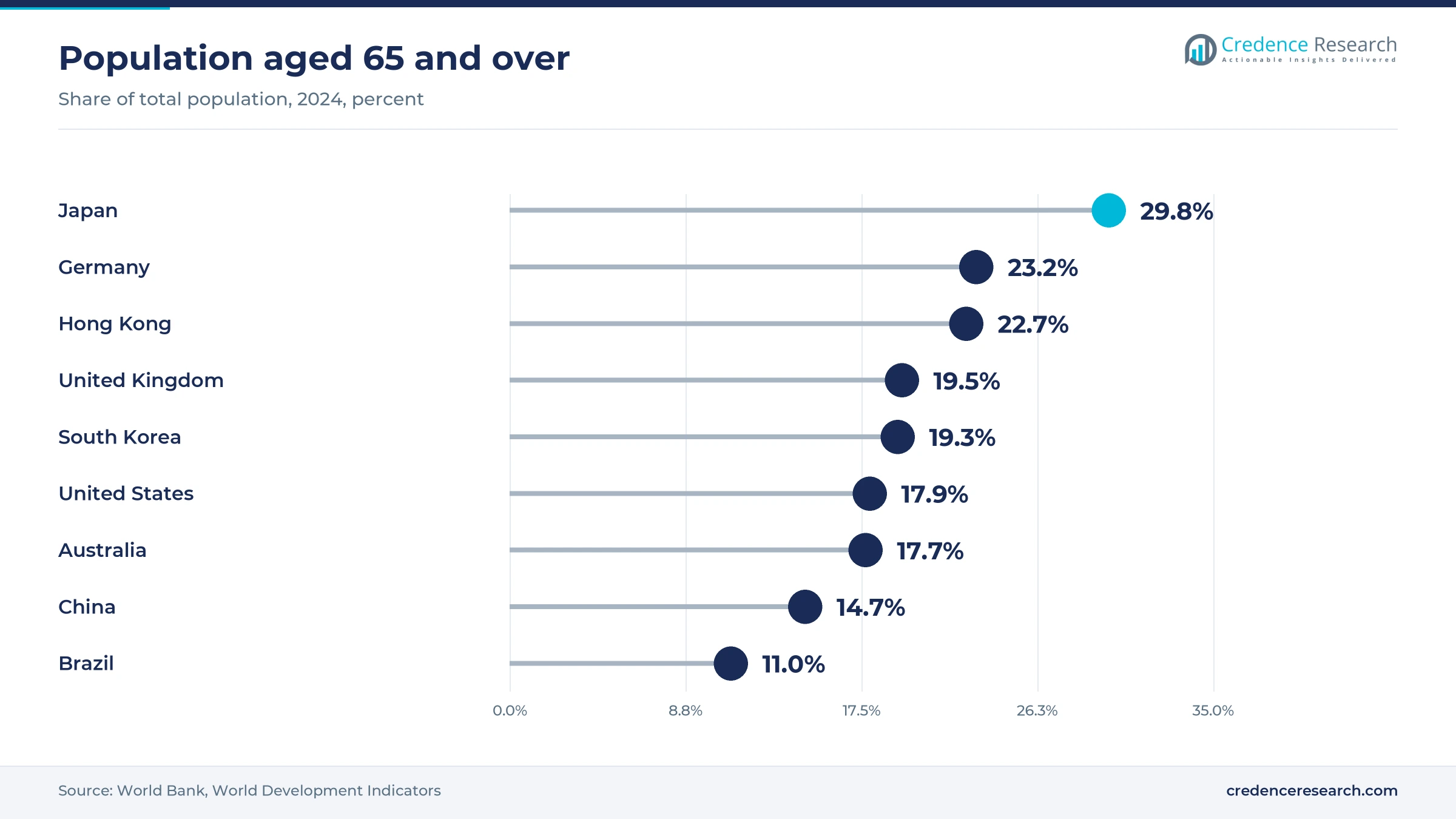
Chronic musculoskeletal pain rises with age, so aging populations add long-term acupuncture patients each year. World Bank data show that people aged 65 and over made up 29.8% of Japan's population in 2024, 23.2% of Germany's and 19.3% of Korea's. The BackInAction trial, led by Kaiser Permanente researchers and published in September 2025, found that acupuncture reduced pain-related disability in 800 adults aged 65 and older at six and twelve months, with few adverse effects reported in the trial. Older patients also tend to need repeated courses rather than single visits, so each older patient tends to add more sessions a year. Practices that serve older patients and bill senior insurance plans stand to gain most.
WHO integration and franchise clinics reshape delivery
Health systems are shifting toward integrated traditional medicine
Health ministries are shifting toward formal integration of traditional medicine to address chronic disease loads, creating openings for acupuncture across hospital and primary care. Member states agreed the WHO Global Traditional Medicine Strategy 2025–2034 on May 26, 2025, during the 78th World Health Assembly. India's Ministry of Ayush and WHO signed a USD 3 million agreement to bring traditional medicine into the International Classification of Health Interventions, which supports standard codes for traditional medicine interventions, starting with Ayurveda, Siddha and Unani, in global health data. WHO also launched dashboards on May 21, 2025, built from its third global survey on traditional, complementary and integrative medicine. Standard codes and comparable country data make it easier for insurers to price, audit and reimburse acupuncture sessions.
Franchise clinics bring retail formats to acupuncture
Branded franchise clinics now sell acupuncture as a short, scheduled retail visit, which suits patients who want predictable appointments outside hospital settings and opens cash-pay packages for stress and pain care. Modern Acupuncture lists 44 franchise units, an initial fee of USD 39,500 and a royalty of 7.0%, according to FranchiseHelp. Hospital programs package sessions the same way, as the six-session price in the table shows. GoodRx notes that acupuncture is an eligible expense for flexible spending and health savings accounts, which lets employed patients pay with pre-tax money. Wellness centers gain most from this format, while solo practitioners face branded competition for cash patients.
Medicare provider status would open a large senior market
The largest single opening sits in letting licensed acupuncturists bill Medicare directly, which current rules do not allow. U.S. Representatives Judy Chu and Brian Fitzpatrick introduced House bill H.R. 1667 on Feb. 28, 2025, and the bill was still pending at the time of this review. Southern California University of Health Sciences researchers reported in February 2026 that Medicare acupuncture use from 2020 to 2023 varied more than a hundredfold between states. The BackInAction authors argued that direct billing would substantially improve older adults' access. Independent acupuncturists and chiropractic care groups with licensed staff would gain the most if the bill passes.
Electroacupuncture devices create a clinic upgrade cycle
A second opening lies in programmable stimulators that let practitioners standardize electroacupuncture protocols for pain and rehabilitation patients. Japanese maker ITO Co. sells the ES-160 six-channel unit, which lists at USD 949 at Lhasa OMS, a price equal to fewer than ten sessions at the USD 99 hospital rate shown in the table. Because a stimulator serves many patients over several years, its cost per session becomes small once a clinic runs a full schedule. German maker schwa-medico sells electroacupuncture units and electrodes beside its wider electrotherapy devices range. Device makers with clinic distribution gain, and practices can bill longer stimulation sessions for chronic pain and rehabilitation patients who need repeated courses.
Evidence disputes and payer limits cap session volume
Conflicting guidance keeps some public payers away
Clinical guidance remains split, and that limits acupuncture inside some public health systems. NICE guideline NG59, first issued in 2016 and amended in 2026, still tells clinicians not to offer acupuncture for low back pain with or without sciatica. The same body recommends considering it for chronic primary pain, so NHS commissioners face mixed signals by condition. Practitioners who depend on NHS referrals are most exposed, and private practices carry most English demand instead.
Korean auto insurers push back on Korean medicine claims
Rising claims have made Korean medicine a target of cost control in motor insurance. Korean medicine treatment costs in auto insurance reached about KRW 1.62 trillion in 2024, up 43% from 2020, according to Yonhap reporting of insurer statistics. The Ministry of Land, Infrastructure and Transport moved in November 2023 to limit the number of acupuncture sessions for minor traffic injuries. Korean medicine clinics that rely on accident patients are most exposed to lower visit counts.
Thin public coverage leaves most patients paying cash
Low public coverage keeps many patients paying out of pocket, which shortens courses of care. Korean medicine accounts for only 4% of national health insurance expenditures in South Korea, according to a 2025 study in Frontiers in Medicine. In the U.S., GoodRx says uninsured patients can pay USD 100 or more per session. Patients with chronic conditions who need weekly visits are most exposed, and practices in lower-income areas see the highest dropout.
Small licensed workforces cap capacity outside Asia
Supply of licensed practitioners limits how fast session volume can rise in Western markets. The Chinese Medicine Board of Australia counted 4,945 registered Chinese medicine practitioners in its 2024/25 annual summary, and the title acupuncturist is protected, so unregistered staff cannot fill the gap. Rural patients and new clinic operators are most exposed, because recruiting qualified staff takes longer than fitting out premises.
Asia Pacific leads while North America grows fastest
| Region | Value, 2025 (USD billion) | Share, 2025 | CAGR, 2026–2035 |
|---|---|---|---|
| Asia Pacific | 8.62 | 44.0% | 8.5% |
| North America | 4.90 | 25.0% | 9.4% |
| Europe | 3.92 | 20.0% | 7.6% |
| Latin America | 1.18 | 6.0% | 9.0% |
| Middle East & Africa | 0.98 | 5.0% | 9.1% |
Asia Pacific leads on hospital-based delivery
Asia Pacific held a 44.0% share of 2025 value and grows at 8.5% a year to 2035. The region leads because China, Korea and Japan deliver acupuncture through hospitals, public insurance and accident schemes. Korean auto insurance spending on Korean medicine, noted under challenges, shows how accident cover alone adds large session volume. Hong Kong's new public hospital will provide 65% of its services at subsidized rates, which shifts demand from private clinics. Growth trails North America because prices are capped and volumes are already high.
North America grows fastest on new coverage
North America held a 25.0% share of 2025 value and grows fastest at 9.4% a year to 2035. U.S. session fees, shown in the price table, make each visit worth several times an Asian visit, and covered pain courses add volume. Medicare restricts billing to physicians and certain supervised practitioners, which leaves much of the licensed workforce outside the program. Independent clinics in West Coast and Northeast states hold the strongest positions, since use there is far higher than in many southern states.
Europe grows slowest under condition-limited benefits
Europe held a 20.0% share of 2025 value and grows slowest at 7.6% a year to 2035. Germany anchors covered demand because statutory insurers pay for physician-delivered acupuncture for chronic back and knee pain, while other conditions are paid privately. England offers mixed guidance by condition, as noted under challenges. German needle maker asia-med sells its TeWa needle range to these practices, and growth depends on cash patients rather than wider statutory benefits.
Latin America grows on cash demand with thin data
Latin America held a 6.0% share of 2025 value and grows at 9.0% a year to 2035. World Bank data put Brazil's population aged 65 and over at 11.0% in 2024, a younger profile than in Europe or East Asia. No new public coverage decision for acupuncture in the region could be verified in this review, so the estimate rests on private clinic fees and needle imports. That evidence gap makes Latin America one of the least certain regional estimates.
Middle East and Africa remain a small private market
Middle East & Africa held a 5.0% share of 2025 value and grows at 9.1% a year to 2035. Credence Research assumes that demand rests mainly on private clinics in Gulf cities and South Africa, often linked to physiotherapy and medical travel services. No regional payer decision or official visit count for acupuncture could be verified in this review. The WHO strategy adopted in May 2025 gives health ministries a framework, but the region's estimate carries the widest margin of error.
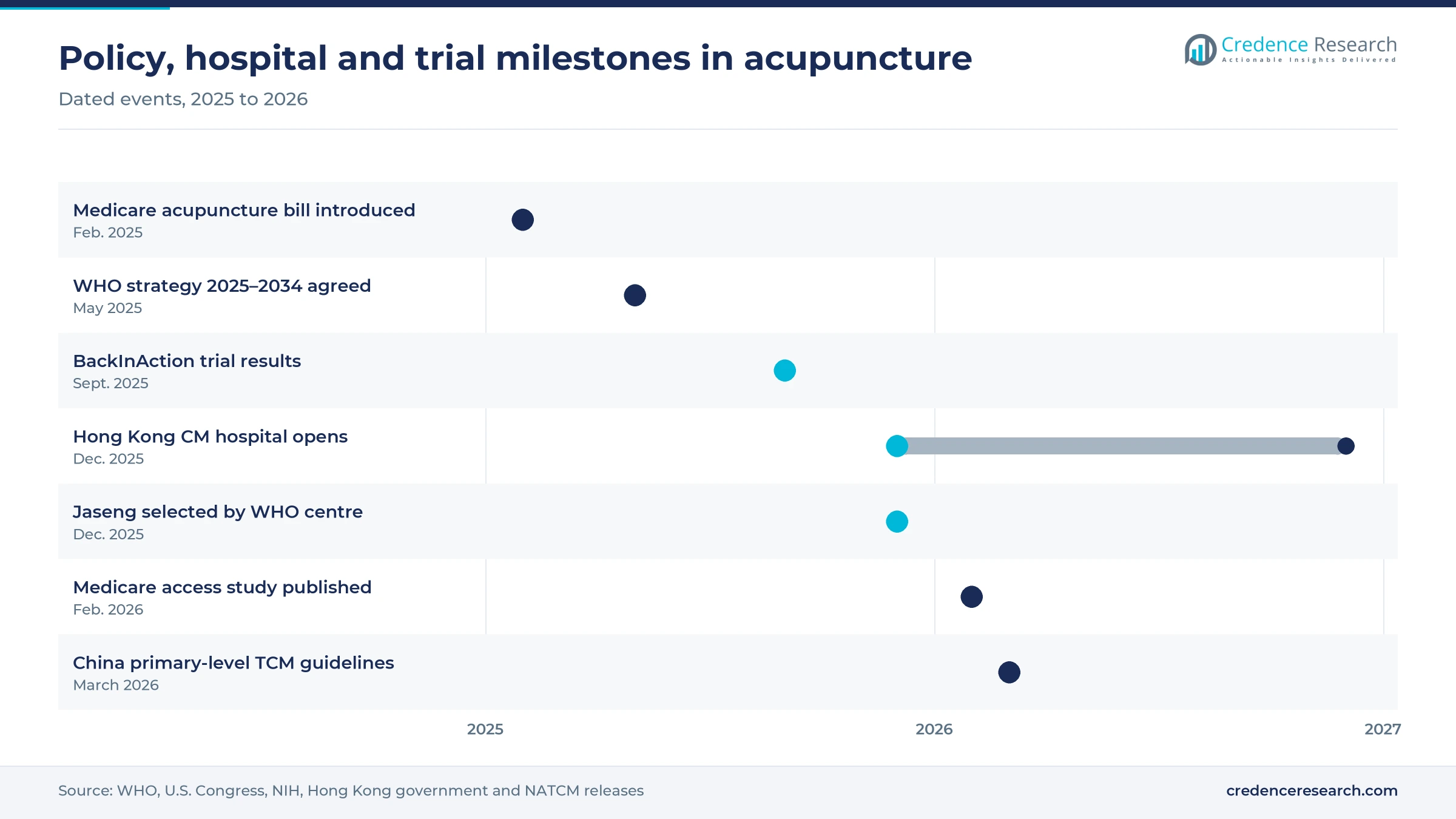
Bills, hospitals and trials shaping access, 2025 to 2026
| Development | Status and market relevance |
|---|---|
| In March 2026, China's National Administration of Traditional Chinese Medicine and two partner agencies issued guidelines requiring primary-level clinics to offer at least ten types of traditional techniques, including acupuncture. | Policy issued; local health authorities now implement the service requirements. |
| In December 2025, the Chinese Medicine Hospital of Hong Kong began outpatient and day-patient services, with an acupuncture and moxibustion service among six specialties to be launched in the first year. | Operational launch in phases; full inpatient service with 400 beds is planned by the end of 2030. |
| In September 2025, Kaiser Permanente researchers published BackInAction trial results showing that acupuncture reduced pain-related disability in 800 adults aged 65 and older. | Completed trial; results published in JAMA Network Open and cited in support of Medicare access. |
| In May 2025, the 78th World Health Assembly agreed the WHO Global Traditional Medicine Strategy 2025–2034. | Adopted strategy; implementation runs through national policies to 2034. |
| In February 2025, U.S. Representatives Judy Chu and Brian Fitzpatrick introduced House bill H.R. 1667 to make licensed acupuncturists Medicare providers. | Bill introduced and pending in Congress; no vote verified as of November 2026. |
Needle design and stimulation methods separate suppliers
- Single-use guide-tube needles replace reusable steel needles in most clinics, and makers such as Seirin compete on coating, tip finish and individual blister packs that reduce insertion pain and infection risk.
- Electroacupuncture stimulators pass low-frequency current between inserted needles, which lets clinics standardize pain protocols and bill longer sessions with multi-channel units.
- Auricular protocols place short needles or seeds on ear points, which suits group sessions in addiction and stress programs where many patients are treated at once.
- Moxibustion and cupping add-ons extend a needling visit with heat or suction, which raises the value of a session without needing a second appointment.
Need a Custom Version of This Report?
Tailor the scope, geography, or segments to your exact requirements.
- Custom geography or segment scope
- Direct access to our analyst team
Fragmented providers buy from a few needle makers
Competition in the acupuncture treatment market runs on two levels. In services, public hospitals in China, Hong Kong and Korea compete for patients on access and fees, while private groups such as Jaseng Hospital of Korean Medicine build reputations through research and international training links. In the U.S., Modern Acupuncture competes with solo practices and hospital programs through branded franchise clinics and standard session formats. In products, Seirin, Dong Bang Medical, Suzhou Medical Appliance Factory and asia-med compete for needle orders on comfort, sterility and distributor reach. ITO and schwa-medico supply electroacupuncture stimulators and electrodes to clinics in Asia and Europe. Insurer credentialing, practitioner licensing and referral relationships with physicians decide which providers win covered patients.
How is supply organized between needle makers and clinics?
Supply is concentrated in consumables and highly fragmented in services. A handful of needle makers, including Seirin in Japan, Dong Bang in Korea and Suzhou Medical Appliance Factory in China, sell widely distributed branded needles listed in the FDA device identification database through specialist distributors. Services are delivered by public hospital departments in East Asia and by solo practices and small groups elsewhere, with franchise brands still a small share. Licensing and insurer credentialing are the main entry barriers, not capital. Margins sit with practitioners and franchisors, while a 7.0% royalty shows how brands take a slice of clinic sales.
Companies profiled and their roles in this market
| Company | Type | Role in the market |
|---|---|---|
| Seirin Corporation | Needle maker | Single-use guide-tube acupuncture needles made in Japan, sold worldwide |
| Dong Bang Medical Co., Ltd. | Needle maker | DBC single-use acupuncture needles from Korea for clinics abroad |
| Suzhou Medical Appliance Factory (Hwato) | Needle maker | Hwato acupuncture needles and related consumables from China |
| asia-med GmbH (TeWa) | Needle maker | TeWa acupuncture needles and practice supplies for German and European clinics |
| ITO Co., Ltd. | Device maker | ES-160 multi-channel electroacupuncture and electrotherapy units |
| schwa-medico GmbH | Device maker | Electroacupuncture devices and electrodes alongside electrotherapy systems |
| Jaseng Hospital of Korean Medicine | Provider | Korean medicine hospitals delivering acupuncture for spine and joint pain |
| Modern Acupuncture | Franchise provider | Branded U.S. franchise clinics offering acupuncture sessions and packages |
| The Chinese Medicine Hospital of Hong Kong | Provider | Public-private hospital with an acupuncture and moxibustion service |
Payer rules matter more than evidence for growth
Credence Research's view is that payer rules, not clinical evidence, will decide how fast the acupuncture treatment market grows. Coverage for chronic low back pain in the U.S. and Germany has already created a reimbursed course of care, and the Medicare provider bill is the largest pending change. In East Asia, public hospitals and primary clinics add volume at controlled prices, so value grows more slowly than visits. The main risks are session caps by accident insurers, mixed guidance in England and a thin licensed workforce outside Asia. Practitioner services keep almost all of the value, while needle makers earn steady but low-priced volume.
A 2025 base tested against visits, fees and coverage
The report uses 2025 as the base year, with 2026 as the first forecast year and 2035 as the last. The 2025 value was rebuilt from session volumes and fees in the United States, China, Korea, Japan and Europe, because the earlier estimate could not be reconciled with published visit counts, usage rates and coverage rules. Sources used are regulators and public agencies, the World Bank, peer-reviewed studies, company and franchise disclosures, price lists and trade press. Regional, segment and scenario splits are Credence Research estimates, and no interviews or surveys were conducted. Private and wellness sessions in Asia Pacific are the least measured input, so the total carries a wide margin of error.
Medicare billing rules and Asian capacity set the pace
The acupuncture treatment market is expected to grow from USD 21.29 billion in 2026 to USD 44.73 billion in 2035, with growth weighted toward covered pain care in North America and public capacity in East Asia. Asia Pacific remains the largest region, while North America grows fastest. The forecast assumes that Medicare coverage for chronic low back pain stays in place, that Chinese primary clinics meet the 2026 service requirements and that accident insurers in Korea limit rather than end acupuncture claims. A decision on direct Medicare billing is the variable most likely to move results away from the base case.
Medicare billing and Asian payer controls set the range
The range of outcomes depends mainly on payer rules rather than on clinical demand. A downside case assumes that Korean and Chinese payers tighten session limits and that the Medicare provider bill stalls. The base case assumes current coverage, fee and capacity plans hold to 2035. The upside case assumes that licensed acupuncturists win direct Medicare billing and that more European insurers widen covered conditions.
| Scenario | CAGR, 2026–2035 | Value, 2035 | What has to hold |
|---|---|---|---|
| Downside | 6.5% | USD 37.52 billion | Asian payers cap sessions, U.S. billing rules stay closed and evidence disputes widen |
| Base | 8.60% | USD 44.73 billion | Current coverage, fee schedules and public capacity plans continue through 2035 |
| Upside | 10.0% | USD 50.19 billion | Licensed acupuncturists bill Medicare directly and European insurers add covered conditions |
Frequently Asked Questions
How big is the acupuncture treatment market?
Which application holds the largest share?
Which region leads the acupuncture treatment market?
Does Medicare cover acupuncture?
How much does an acupuncture session cost?
How many U.S. adults use acupuncture?
What did the WHO decide on traditional medicine in 2025?
Which companies are active in the acupuncture treatment market?
Table of Content
Chapter 1 Market Segmentation
- 1.1 Segmentation Framework
- 1.1.1 Product and Service Classification
- 1.1.2 Application and End-Use Classification
- 1.1.3 Technology and Solution Classification
- 1.1.4 Customer and Distribution Channel Classification
- 1.1.5 Geographic Segmentation
- 1.1.6 Market Segment Definitions and Boundaries
- 1.2 By Product and Services
- 1.2.1 Services
- 1.2.2 Products
- 1.3 By Application
- 1.3.1 Pain Management
- 1.3.2 Gynecological Disorders
- 1.3.3 Others
- 1.4 By End User
- 1.4.1 Hospitals and Specialty Clinics
- 1.4.2 Wellness Centers
- 1.4.3 Others
Chapter 2 Introduction
- 2.1 Report Objectives and Scope
- 2.2 Product Definition and Industry Terminology
- 2.3 Market Inclusions and Exclusions
- 2.4 Research Process
- 2.4.1 Primary Research and Expert Interviews
- 2.4.2 Secondary Research and Source Review
- 2.4.3 Top-Down and Bottom-Up Estimation
- 2.4.4 Data Triangulation and Verification
- 2.5 Market Size Measurement Basis
- 2.5.1 2025: USD 19.60 billion → 2035: USD 44.73 billion
- 2.6 Historical and Forecast Reference Periods
- 2.6.1 Historical Period: 2018-2025
- 2.6.2 Base Year: 2025
- 2.6.3 Forecast Period: 2025-2035
- 2.7 Research Assumptions and Limitations
Chapter 3 Executive Summary
- 3.1 Market Snapshot and Key Findings
- 3.2 Base-Year Market Size, 2025
- 3.3 Forecast Market Size, 2035
- 3.4 Revenue and Volume Growth Outlook
- 3.5 Key Demand and Supply Indicators
- 3.6 Leading Market Segments
- 3.7 Fastest-Growing Market Opportunities
- 3.8 Regional Performance Highlights
- 3.9 Technology and Industry Transformation
- 3.10 Competitive Landscape Summary
- 3.11 Analyst View and Strategic Implications
Chapter 4 Global Acupuncture Treatment Market Trends and Developments
- 4.1 Historical Industry Development, 2018-2025
- 4.2 Recent Market Trends and Developments
- 4.3 Demand and Customer Behavior Trends
- 4.4 Technology and Product Innovation
- 4.5 Artificial Intelligence, Automation and Digitalization
- 4.6 Local Manufacturing and Supply Chain Realignment
- 4.7 Industry Partnerships, Mergers and Acquisitions
- 4.8 Sustainability and Circular Economy Developments
- 4.9 Government and Private Sector Investment Trends
- 4.10 Emerging Business Models and Commercialization
- 4.11 Industry Developments and Announcements
Chapter 5 Global Acupuncture Treatment Market Production, Supply and Demand Analysis
- 5.1 Demand Trend and Consumption Analysis, 2018-2025
- 5.2 Demand Forecast, 2025-2035
- 5.3 Production and Output Trend, 2018-2025
- 5.4 Production and Output Forecast, 2025-2035
- 5.5 Installed Capacity and Capacity Utilization
- 5.6 Company-Wise Production Plants and Statistics
- 5.6.1 Installed Production Capacity
- 5.6.2 Actual Production
- 5.6.3 Planned Capacity and Expansion Targets
- 5.7 Supply Chain Structure and Procurement Trends
- 5.8 Supply-Demand Gap and Bottlenecks
- 5.9 Import Dependence and Sourcing Structure
- 5.10 Contract Manufacturing and Outsourcing
- 5.11 Regional Supply and Demand Concentration
Chapter 6 Global Acupuncture Treatment Market Pricing Analysis
- 6.1 Pricing Structure and Measurement
- 6.2 Historical Pricing Trends, 2018-2025
- 6.3 Pricing Outlook, 2025-2035
- 6.4 Average Selling Price and Unit Economics
- 6.5 Pricing by Product and Market Segment
- 6.6 Geographic Pricing Differences
- 6.7 Key Input, Energy, Labor and Logistics Costs
- 6.8 Contract Pricing and Purchasing Models
- 6.9 Pricing Sensitivity and Competitive Positioning
- 6.10 Price, Margin and Profitability Implications
Chapter 7 Global Acupuncture Treatment Market Dynamics
- 7.1 Market Growth Drivers
- 7.1.1 Demand-Side Drivers
- 7.1.2 Technology and Innovation Drivers
- 7.1.3 Infrastructure and Investment Drivers
- 7.1.4 Regulatory and Policy Drivers
- 7.2 Market Restraints
- 7.2.1 Cost and Affordability Constraints
- 7.2.2 Technology and Adoption Barriers
- 7.2.3 Supply Chain and Operational Constraints
- 7.3 Market Challenges
- 7.3.1 Competitive Pressure and Margin Erosion
- 7.3.2 Skills, Infrastructure and Implementation Gaps
- 7.4 Emerging Market Opportunities
- 7.5 Market Dynamics Impact and Time-Horizon Assessment
Chapter 8 Global Acupuncture Treatment Value Chain Analysis
- 8.1 Industry Value Chain Overview
- 8.2 Upstream Suppliers and Critical Inputs
- 8.3 Technology and Component Providers
- 8.4 Manufacturing or Service Delivery
- 8.5 Distribution, Channel Partners and Integrators
- 8.6 Downstream Applications and End Users
- 8.7 Value Addition and Profit Pools
- 8.8 Vertical Integration and Outsourcing
- 8.9 Supplier Concentration and Risk
- 8.10 Supply Chain Localization and Resilience
Chapter 9 Global Acupuncture Treatment Market Regulations and Policies
- 9.1 Relevant Laws, Standards and Compliance Frameworks
- 9.2 Product, Service, Safety and Quality Requirements
- 9.3 Government Policies, Incentives and Subsidies
- 9.4 Imports, Exports and Trade Barriers
- 9.5 Public Procurement and Local Content Requirements
- 9.6 Environmental and Sustainability Compliance
- 9.7 Upcoming Policy Changes and Market Implications
Chapter 10 Global Acupuncture Treatment Market Hotspots and Opportunities
- 10.1 Market Opportunity Mapping and Growth Hotspots
- 10.2 High-Growth Applications and Customer Groups
- 10.3 Underserved Markets and White-Space Opportunities
- 10.4 Emerging Technology and Product Opportunities
- 10.5 New Capacity and Investment Hotspots
- 10.6 Market Entry and Expansion Opportunities
- 10.7 Distribution and Partnership Opportunities
- 10.8 Near-Term and Long-Term Commercial Potential
- 10.9 Opportunity Attractiveness and Execution Risks
Chapter 11 Global Acupuncture Treatment Market Outlook, 2025-2035
- 11.1 Market Size and Analysis
- 11.1.1 Revenue (Market Measurement: 2025: USD 19.60 billion → 2035: USD 44.73 billion)
- 11.1.2 Market Volume and Quantity Sold
- 11.1.3 Historical Market Size, 2018-2025
- 11.1.4 Base-Year Market Size, 2025
- 11.2 Market Forecast, 2025-2035
- 11.2.1 Revenue Forecast to 2035
- 11.2.2 Volume Forecast to 2035
- 11.2.3 CAGR and Year-on-Year Growth
- 11.2.4 Incremental Revenue Opportunity
- 11.3 Forecast Assumptions and Scenario Analysis
- 11.3.1 Base-Case Forecast
- 11.3.2 Optimistic and Conservative Scenarios
- 11.3.3 Technology, Pricing and Policy Sensitivities
- 11.4 Market Attractiveness and Growth Outlook
Chapter 12 Global Acupuncture Treatment Market Segmentation and Outlook
- 12.1 Segmentation Summary and Market Shares, 2025
- 12.2 Largest and Fastest-Growing Segments
- 12.3 By Product and Services - Market Size and Forecast, 2025-2035
- 12.3.1 Segment Definition and Scope
- 12.3.2 Historical Market Size, 2018-2025
- 12.3.3 Revenue Forecast, 2025-2035
- 12.3.4 Volume Forecast, 2025-2035
- 12.3.5 Base-Year Market Share, 2025
- 12.3.6 Segment CAGR and Growth Drivers
- 12.3.7 Subsegment Market Size and Forecast
- 12.3.7.1 Services
- 12.3.7.2 Products
- 12.3.8 Subsegment Pricing and Adoption Trends
- 12.3.9 Leading Suppliers and Competition
- 12.3.10 Regional Demand and Opportunities
- 12.4 By Application - Market Size and Forecast, 2025-2035
- 12.4.1 Segment Definition and Scope
- 12.4.2 Historical Market Size, 2018-2025
- 12.4.3 Revenue Forecast, 2025-2035
- 12.4.4 Volume Forecast, 2025-2035
- 12.4.5 Base-Year Market Share, 2025
- 12.4.6 Segment CAGR and Growth Drivers
- 12.4.7 Subsegment Market Size and Forecast
- 12.4.7.1 Pain Management
- 12.4.7.2 Gynecological Disorders
- 12.4.7.3 Others
- 12.4.8 Subsegment Pricing and Adoption Trends
- 12.4.9 Leading Suppliers and Competition
- 12.4.10 Regional Demand and Opportunities
- 12.5 By End User - Market Size and Forecast, 2025-2035
- 12.5.1 Segment Definition and Scope
- 12.5.2 Historical Market Size, 2018-2025
- 12.5.3 Revenue Forecast, 2025-2035
- 12.5.4 Volume Forecast, 2025-2035
- 12.5.5 Base-Year Market Share, 2025
- 12.5.6 Segment CAGR and Growth Drivers
- 12.5.7 Subsegment Market Size and Forecast
- 12.5.7.1 Hospitals and Specialty Clinics
- 12.5.7.2 Wellness Centers
- 12.5.7.3 Others
- 12.5.8 Subsegment Pricing and Adoption Trends
- 12.5.9 Leading Suppliers and Competition
- 12.5.10 Regional Demand and Opportunities
- 12.6 Segment Growth Comparison
- 12.7 Segment Attractiveness and Priority Matrix
Chapter 13 Global Acupuncture Treatment End-Use and Application Market Outlook
- 13.1 End-Use Industry and Customer Demand Structure
- 13.2 Leading Applications and Customer Groups
- 13.3 End-Use Market Size, Share and Forecast
- 13.4 Major End-Use Industry Deep Dives
- 13.4.1 Customer Requirements and Use Cases
- 13.4.2 Demand and Replacement Cycles
- 13.4.3 Technical and Regulatory Considerations
- 13.4.4 Purchasing and Procurement Models
- 13.4.5 Leading Vendors and Distribution Channels
- 13.4.6 Forecast and Commercial Opportunities
- 13.5 Emerging Applications and Cross-Segment Demand
- 13.6 End-Use Industry Investment Priorities
Chapter 14 Global Acupuncture Treatment Geographic Market Outlook, 2025-2035
- 14.1 Regional Market Size and Share, 2025
- 14.2 Regional Market Forecast, 2025-2035
- 14.3 Regional Pricing, Production and Demand Differences
- 14.4 North America
- 14.4.1 United States
- 14.4.2 Canada
- 14.4.3 Mexico
- 14.5 Europe
- 14.5.1 Germany
- 14.5.2 France
- 14.5.3 Italy
- 14.5.4 United Kingdom
- 14.5.5 Spain
- 14.5.6 Poland
- 14.5.7 Russia
- 14.5.8 Netherlands
- 14.5.9 Belgium
- 14.5.10 Sweden
- 14.5.11 Denmark
- 14.5.12 Norway
- 14.5.13 Rest of Europe
- 14.6 Asia Pacific
- 14.6.1 China
- 14.6.2 India
- 14.6.3 Japan
- 14.6.4 South Korea
- 14.6.5 Thailand
- 14.6.6 Indonesia
- 14.6.7 Vietnam
- 14.6.8 Malaysia
- 14.6.9 Australia
- 14.6.10 Rest of Asia Pacific
- 14.7 Latin America
- 14.7.1 Brazil
- 14.7.2 Argentina
- 14.7.3 Colombia
- 14.7.4 Chile
- 14.7.5 Rest of Latin America
- 14.8 Middle East
- 14.8.1 Saudi Arabia
- 14.8.2 United Arab Emirates
- 14.8.3 Turkey
- 14.8.4 Israel
- 14.8.5 Iran
- 14.8.6 Rest of the Middle East
- 14.9 Africa
- 14.9.1 South Africa
- 14.9.2 Egypt
- 14.9.3 Nigeria
- 14.9.4 Morocco
- 14.9.5 Rest of Africa
- 14.10 Regional Investment, Policy and Supply Chain Differences
- 14.11 Regional Competitive Landscape
- 14.12 Geographic Growth Hotspots
Chapter 15 Global Acupuncture Treatment Technology, Innovation and Sustainability Outlook
- 15.1 Technology Landscape and Maturity
- 15.2 Product, Process and Service Innovation
- 15.3 AI, Automation and Digital Tools in the Industry
- 15.4 Technology Adoption and Performance Benchmarking
- 15.5 Innovation Pipeline and R&D Investment
- 15.6 Patent and Intellectual Property Trends
- 15.7 Energy Efficiency and Resource Management
- 15.8 Sustainability, Recycling and Circularity
- 15.9 Technology Roadmap, 2025-2035
- 15.10 Risks of Obsolescence and Technology Substitution
Chapter 16 Global Acupuncture Treatment Market Key Strategic Imperatives
- 16.1 Growth and Market Entry Priorities
- 16.2 High-Return Products and Segments
- 16.3 Pricing, Profitability and Cost Optimization
- 16.4 Technology Investment and Product Differentiation
- 16.5 Supply Chain Localization and Resilience
- 16.6 Distribution and Customer Acquisition
- 16.7 Partnership, Acquisition and Capacity Strategy
- 16.8 Regional Expansion Priorities
- 16.9 Short-, Medium- and Long-Term Actions
Chapter 17 Competition Outlook
- 17.1 Industry Competition Characteristics
- 17.2 Market Structure and Concentration
- 17.3 Market Share and Competitive Positioning, 2025
- 17.4 Company-Wise Revenue and Product Benchmarking
- 17.5 Production and Service Capacity Benchmarking
- 17.6 Technology, Pricing and Differentiation
- 17.7 Regional Footprint and Distribution Strength
- 17.8 Mergers, Acquisitions and Strategic Alliances
- 17.9 New Entrants and Competitive Threats
- 17.10 Porter's Five Forces and Industry Attractiveness
- 17.11 Competitive Outlook, 2025-2035
Chapter 18 Company Profiles
- 18.1 Company Coverage and Selection Criteria
- 18.2 Seirin Corporation
- 18.2.1 Business Description
- 18.2.2 Company Ownership and Geographic Presence
- 18.2.3 Product and Service Portfolio
- 18.2.4 Manufacturing and Operating Footprint
- 18.2.5 Production Capacity and Expansion Plans
- 18.2.6 Financial Performance and Investment
- 18.2.7 Market Share and Competitive Position
- 18.2.8 Technology and Innovation Capabilities
- 18.2.9 Strategic Alliances or Partnerships
- 18.2.10 Recent Developments
- 18.2.11 Growth Strategy and Outlook
- 18.3 Dong Bang Medical Co., Ltd.
- 18.4 Suzhou Medical Appliance Factory (Hwato)
- 18.5 asia-med GmbH (TeWa)
- 18.6 ITO Co., Ltd.
- 18.7 schwa-medico GmbH
- 18.8 Jaseng Hospital of Korean Medicine
- 18.9 Modern Acupuncture
- 18.10 The Chinese Medicine Hospital of Hong Kong
- 18.11 Other Relevant Market Participants
Note: Every listed company is profiled on the structure shown under the first company. The company list is preliminary and may change based on research findings, market developments, data availability and client requirements.
Chapter 19 Disclaimer
- 19.1 Research and Forecast Disclaimer
- 19.2 Data Source and Estimation Limitations
Note: The depth of individual sections depends on data availability for this market. Volume, capacity, trade and other unit-based metrics are included where applicable.

