
Key Highlights of the report
How are the major segments performing in the Silicone Nasal Cannula market?
In 2021, the Low flow nasal cannula segment will dominate the market due to the low cost and growing adoption, leading to the largest market share for low-flow nasal cannula. In 2021, the Hospitals segment dominated and accounted for the largest Silicone Nasal Cannula market share. Due to the increasing adoption of high-flow nasal cannulas, critical respiratory distress needs high-flow oxygen.Which region dominated the Silicone Nasal Cannula market?
In 2021, North America dominated the highest market share in the global Silicone Nasal Cannula market due to the increasing prevalence of respiratory diseases such as COPD and asthma, driving the Silicone Nasal Cannula market in North America. Additionally, the development of nasal cannula treatment and the increasing healthcare expenditures for chronic diseases on Silicone Nasal Cannula is a growth in this region. Furthermore, with the increasing number of local and international manufacturing facilities, the product is available at the lowest cost and the growing adoption is expected in the Silicone Nasal cannula market in the North America region.What is the competitive environment of the Silicone Nasal Cannula market?
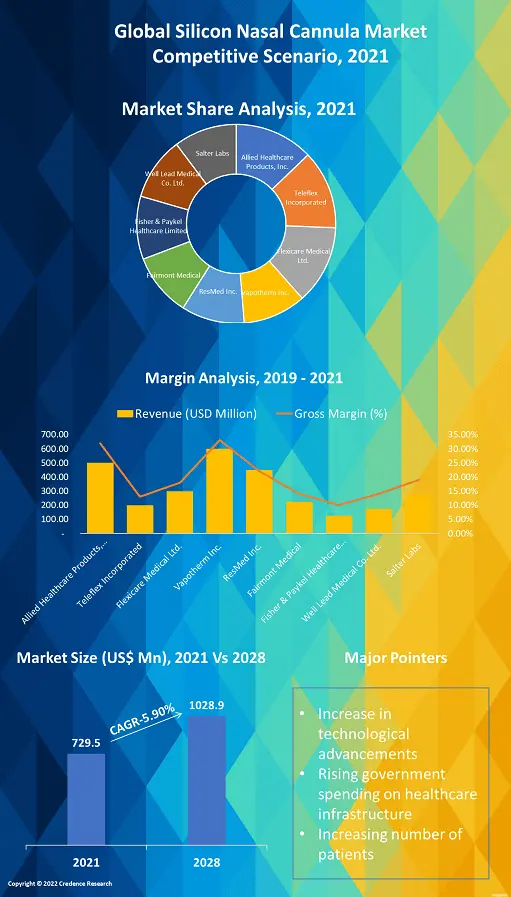
The Silicone nasal cannula competitive environment offers information on the total economic profit made by suppliers and businesses, the sales and revenues produced in this sector, the Silicone nasal cannula market share globally, the business organization overview, the introduction of new products, and the opportunities for the Silicone nasal cannula market. For instance, in January 2022, TSC Endovision, a pioneer in single-use endoscopy and a subsidiary of TSC Group, and Flexicare announced cooperation for the marketing of TSC Endovision's Broncoflex, a unique single-use bronchoscope, in the United States.Executive Summary
What are all technical developments being developed in the Silicone Nasal Cannula Market?
Technical development for the Silicone nasal cannula provides supplemental oxygen therapy to people with lower oxygen levels. The expansion of the global Silicone nasal cannula market is driven by an increase in demand for oxygen therapy to boost productivity and efficiency. For instance, in December 2021, Hangzhou Formed Medical Devices Co. Ltd announced the reusable Siliconee oxygen extension tube made of 100% medical Siliconee.Which are the key investments by the players in the Silicone Nasal Cannula Market?
Silicone nasal cannula has been used in end-various industries due to their exceptional flexibility and capacity to be adaptable in any setting. Various investments are made among the key player. For instance, in August 2022, Teleflex Incorporated, one of the world's top providers of medical technologies, announced the acquisition of Standard Bariatrics, Inc., which has commercialized a revolutionary powered stapling method for bariatric surgery. Some major market players are Allied Healthcare Products, Inc., Teleflex Incorporated, Flexicare Medical Ltd., Vapotherm Inc., ResMed Inc., Fairmont Medical, Fisher & Paykel Healthcare Limited, Well Lead Medical Co. Ltd., and Salter Labs.What are the Major Driving Factors for the Silicone Nasal Cannula market?
The major factor is the rising demand for the Silicone Nasal Cannula market due to the increasing prevalence of respiratory diseases such as asthma and COPD. The increasing smoking rate will contribute to the growing adoption of COPD, which is expected to boost the Silicone nasal cannula market. The increasing demand for nasal cannulas is the growing number of manufacturers and suppliers across the globe. Additionally, the development of nasal cannulas such as Silicone materials, extra soft, curved and flared cannulas to improve the flexibility and growing adoption of high flow nasal cannulas in chronic respiratory diseases treatment has expanded the use of nasal cannula patients of all ages. Furthermore, the increasing healthcare expenditures by some countries and governments initiating the public healthcare systems to afford healthcare and awareness are also expected to increase the Silicone nasal cannula market growth.What are the Major Risks for the Silicone Nasal Cannula market?
The rising occurrence of respiratory diseases declare the advanced technology needed for healthcare services to provide the supplying oxygen for patients, and there are various options available in the market, such as full-face masks with tubing masks which are used to supply oxygen for patients expected to hamper the Silicone nasal cannula market. Furthermore, the increasing use of nasal cannula can cause side effects such as the transmission of pathogenic viruses that can cause infection in patients. These factors negatively impacted the Silicone nasal cannula market.Which is the key End-use type in the Market Silicone Nasal Cannula market?
The End-use outlook is classified into Hospitals, Ambulatory Healthcare Services, Long term care centers and others. The Hospitals dominated and accounted for the largest market share of the Silicone nasal cannula market. Due to the increasing adoption of high flow nasal cannulas, critical respiratory distress needs high flow oxygen informed the largest market share of the hospital segment. Furthermore, the long-term care centers segment dominates the market during the forecast period due to the increasing geriatric population and patients with long-term respiratory distress are expected to grow in the Silicone nasal cannula market.How is the Silicone Nasal Cannula market performing in regions?
In 2021, North America dominated the highest market share in the global Silicone nasal cannula market due to the increasing prevalence of respiratory diseases such as COPD and asthma, driving the Silicone nasal cannula market in North America. Furthermore, with the increasing number of local and international manufacturing facilities, the product is available at the lowest cost and the growing adoption is expected in the Silicone nasal cannula market in the North American region. Additionally, the development of nasal cannula treatment and the increasing healthcare expenditures for chronic diseases on Silicone nasal cannula is a growth in this region. The Asia Pacific is expected to grow considerably due to the increasing geriatric population. The prevalence of respiratory diseases such as COPD, asthma, and other breathing disorders and the increasing healthcare expenditures are expected to grow the Silicone nasal cannula market in Asia. Additionally, the increasing local manufacturers and awareness of such countries are China and India and the rising purchasing power of the middle-class population are increasing the market growth in this region. These factors are attributed to the Silicone nasal cannula market growth in the Asia Pacific.What is the regulatory landscape for the Silicone Nasal Cannula market?
Governments are exploring a supportive regulatory strategy across regions in the regulatory landscape for this market. Various governments have extensively invested in healthcare infrastructure in many countries in recent years while developing countries are also spending more on healthcare development. As a result, the government's supportive activities are projected to encourage market participants to expand and create new products to support the global Silicone nasal cannula market throughout the forecast period.What is the Market Size of the Silicone Nasal Cannula market regarding value?
The global Silicone nasal cannula market is anticipated to grow at a substantial CAGR of 5.90% in the upcoming years. The global Silicone nasal cannula market was estimated to be worth USD 729.5 million in 2021 and was expected to be worth USD 1,028.96 million by 2028.What are the major players planning for the future of the Silicone Nasal Cannula market?
The major competitors in the Silicone Nasal Cannula market are substantially investing in various cutting-edge technologies, such as cloud computing, artificial intelligence, and others. Furthermore, future scenarios suggest that well-known market players invest significantly in startups and medium-sized enterprises to deliver effective solutions to the industry. Large players are expected to buy or merge with major enterprises or startups to achieve a competitive advantage.Segmentation of Global Silicone Nasal Cannula market-
Global Silicone Nasal Cannula Market – By Region
- North America
- US.
- Canada
- Europe
- Germany
- France
- UK.
- Italy
- Spain
- Rest of Europe
- Asia Pacific
- China
- Japan
- India
- South Korea
- South-east Asia
- Rest of Asia Pacific
- Latin America
- Brazil
- Mexico
- Rest of Latin America
- Middle East & Africa
- GCC Countries
- South Africa
- Rest of the Middle East and Africa

Request a Free Sample
Fill in your details and we'll send you a free sample report.
- Sample data tables & charts
- Research methodology
Market Dynamics
Rising Prevalence of Respiratory Diseases
The increasing incidence of chronic respiratory diseases such as COPD and asthma, particularly in developed regions like North America, is driving the demand for silicone nasal cannulas as essential devices for oxygen therapy.
Advancements in Silicone Cannula Design
Continuous innovation in cannula materials, such as the development of extra-soft, curved, and flared silicone cannulas, enhances patient comfort and flexibility, leading to broader adoption across all age groups and care settings.
Expansion of Healthcare Infrastructure
Growing investments in healthcare infrastructure and expenditures by governments and private entities, especially in emerging markets, are increasing access to advanced respiratory care devices, including silicone nasal cannulas.
Increasing Geriatric Population
The rising elderly population, particularly in Asia Pacific, is associated with higher rates of chronic respiratory conditions, thereby fueling the need for long-term oxygen therapy and boosting market growth for silicone nasal cannulas.
Need a Custom Version of This Report?
Tailor the scope, geography, or segments to your exact requirements.
- Custom geography or segment scope
- Direct access to our analyst team
Frequently Asked Questions
Which key factors will influence the silicone nasal cannula market growth over 2022-2028?
What will be the value of the silicone nasal cannula market during 2022-2028?
Which region will contribute notably towards the silicone nasal cannulas market value?
Which are the significant players leveraging the silicone nasal cannulas market growth?
Which is the major silicone nasal cannula market segment by closure type?
Table of Content
Chapter 1 Market Segmentation
- 1.1 Segmentation Framework
- 1.1.1 Product and Service Classification
- 1.1.2 Application and End-Use Classification
- 1.1.3 Technology and Solution Classification
- 1.1.4 Customer and Distribution Channel Classification
- 1.1.5 Geographic Segmentation
- 1.1.6 Market Segment Definitions and Boundaries
- 1.2 By End-use
- 1.2.1 Hospitals
- 1.2.2 Ambulatory Healthcare Services
- 1.2.3 Long Term Care Centers
- 1.2.4 Others
- 1.3 By Patient Type
- 1.3.1 Adult
- 1.3.2 Pediatric
- 1.3.3 Neonatal
- 1.4 By Product Type
- 1.4.1 Low Flow Nasal Cannula
- 1.4.2 High Flow Nasal Cannula
Chapter 2 Introduction
- 2.1 Report Objectives and Scope
- 2.2 Product Definition and Industry Terminology
- 2.3 Market Inclusions and Exclusions
- 2.4 Research Process
- 2.4.1 Primary Research and Expert Interviews
- 2.4.2 Secondary Research and Source Review
- 2.4.3 Top-Down and Bottom-Up Estimation
- 2.4.4 Data Triangulation and Verification
- 2.5 Market Size Measurement Basis
- 2.5.1 2021: USD 729.5 million → Forecast year: -
- 2.6 Historical and Forecast Reference Periods
- 2.6.1 Base Year: 2021
- 2.7 Research Assumptions and Limitations
Chapter 3 Executive Summary
- 3.1 Market Snapshot and Key Findings
- 3.2 Base-Year Market Size, 2021
- 3.3 Forecast Market Size
- 3.4 Revenue and Volume Growth Outlook
- 3.5 Key Demand and Supply Indicators
- 3.6 Leading Market Segments
- 3.7 Fastest-Growing Market Opportunities
- 3.8 Regional Performance Highlights
- 3.9 Technology and Industry Transformation
- 3.10 Competitive Landscape Summary
- 3.11 Analyst View and Strategic Implications
Chapter 4 Global Silicone Nasal Cannula Market Trends and Developments
- 4.1 Historical Industry Development
- 4.2 Recent Market Trends and Developments
- 4.3 Demand and Customer Behavior Trends
- 4.4 Technology and Product Innovation
- 4.5 Artificial Intelligence, Automation and Digitalization
- 4.6 Local Manufacturing and Supply Chain Realignment
- 4.7 Industry Partnerships, Mergers and Acquisitions
- 4.8 Sustainability and Circular Economy Developments
- 4.9 Government and Private Sector Investment Trends
- 4.10 Emerging Business Models and Commercialization
- 4.11 Industry Developments and Announcements
Chapter 5 Global Silicone Nasal Cannula Market Production, Supply and Demand Analysis
- 5.1 Demand Trend and Consumption Analysis
- 5.2 Demand Forecast
- 5.3 Production and Output Trend
- 5.4 Production and Output Forecast
- 5.5 Installed Capacity and Capacity Utilization
- 5.6 Company-Wise Production Plants and Statistics
- 5.6.1 Installed Production Capacity
- 5.6.2 Actual Production
- 5.6.3 Planned Capacity and Expansion Targets
- 5.7 Supply Chain Structure and Procurement Trends
- 5.8 Supply-Demand Gap and Bottlenecks
- 5.9 Import Dependence and Sourcing Structure
- 5.10 Contract Manufacturing and Outsourcing
- 5.11 Regional Supply and Demand Concentration
Chapter 6 Global Silicone Nasal Cannula Market Pricing Analysis
- 6.1 Pricing Structure and Measurement
- 6.2 Historical Pricing Trends
- 6.3 Pricing Outlook
- 6.4 Average Selling Price and Unit Economics
- 6.5 Pricing by Product and Market Segment
- 6.6 Geographic Pricing Differences
- 6.7 Key Input, Energy, Labor and Logistics Costs
- 6.8 Contract Pricing and Purchasing Models
- 6.9 Pricing Sensitivity and Competitive Positioning
- 6.10 Price, Margin and Profitability Implications
Chapter 7 Global Silicone Nasal Cannula Market Dynamics
- 7.1 Market Growth Drivers
- 7.1.1 Demand-Side Drivers
- 7.1.2 Technology and Innovation Drivers
- 7.1.3 Infrastructure and Investment Drivers
- 7.1.4 Regulatory and Policy Drivers
- 7.2 Market Restraints
- 7.2.1 Cost and Affordability Constraints
- 7.2.2 Technology and Adoption Barriers
- 7.2.3 Supply Chain and Operational Constraints
- 7.3 Market Challenges
- 7.3.1 Competitive Pressure and Margin Erosion
- 7.3.2 Skills, Infrastructure and Implementation Gaps
- 7.4 Emerging Market Opportunities
- 7.5 Market Dynamics Impact and Time-Horizon Assessment
Chapter 8 Global Silicone Nasal Cannula Value Chain Analysis
- 8.1 Industry Value Chain Overview
- 8.2 Upstream Suppliers and Critical Inputs
- 8.3 Technology and Component Providers
- 8.4 Manufacturing or Service Delivery
- 8.5 Distribution, Channel Partners and Integrators
- 8.6 Downstream Applications and End Users
- 8.7 Value Addition and Profit Pools
- 8.8 Vertical Integration and Outsourcing
- 8.9 Supplier Concentration and Risk
- 8.10 Supply Chain Localization and Resilience
Chapter 9 Global Silicone Nasal Cannula Market Regulations and Policies
- 9.1 Relevant Laws, Standards and Compliance Frameworks
- 9.2 Product, Service, Safety and Quality Requirements
- 9.3 Government Policies, Incentives and Subsidies
- 9.4 Imports, Exports and Trade Barriers
- 9.5 Public Procurement and Local Content Requirements
- 9.6 Environmental and Sustainability Compliance
- 9.7 Upcoming Policy Changes and Market Implications
Chapter 10 Global Silicone Nasal Cannula Market Hotspots and Opportunities
- 10.1 Market Opportunity Mapping and Growth Hotspots
- 10.2 High-Growth Applications and Customer Groups
- 10.3 Underserved Markets and White-Space Opportunities
- 10.4 Emerging Technology and Product Opportunities
- 10.5 New Capacity and Investment Hotspots
- 10.6 Market Entry and Expansion Opportunities
- 10.7 Distribution and Partnership Opportunities
- 10.8 Near-Term and Long-Term Commercial Potential
- 10.9 Opportunity Attractiveness and Execution Risks
Chapter 11 Global Silicone Nasal Cannula Market Outlook
- 11.1 Market Size and Analysis
- 11.1.1 Revenue (Market Measurement: 2021: USD 729.5 million → Forecast year: - )
- 11.1.2 Market Volume and Quantity Sold
- 11.1.3 Historical Market Size
- 11.1.4 Base-Year Market Size, 2021
- 11.2 Market Forecast
- 11.2.1 Revenue Forecast
- 11.2.2 Volume Forecast
- 11.2.3 CAGR and Year-on-Year Growth
- 11.2.4 Incremental Revenue Opportunity
- 11.3 Forecast Assumptions and Scenario Analysis
- 11.3.1 Base-Case Forecast
- 11.3.2 Optimistic and Conservative Scenarios
- 11.3.3 Technology, Pricing and Policy Sensitivities
- 11.4 Market Attractiveness and Growth Outlook
Chapter 12 Global Silicone Nasal Cannula Market Segmentation and Outlook
- 12.1 Segmentation Summary and Market Shares, 2021
- 12.2 Largest and Fastest-Growing Segments
- 12.3 By End-use - Market Size and Forecast
- 12.3.1 Segment Definition and Scope
- 12.3.2 Historical Market Size
- 12.3.3 Revenue Forecast
- 12.3.4 Volume Forecast
- 12.3.5 Base-Year Market Share, 2021
- 12.3.6 Segment CAGR and Growth Drivers
- 12.3.7 Subsegment Market Size and Forecast
- 12.3.7.1 Hospitals
- 12.3.7.2 Ambulatory Healthcare Services
- 12.3.7.3 Long Term Care Centers
- 12.3.7.4 Others
- 12.3.8 Subsegment Pricing and Adoption Trends
- 12.3.9 Leading Suppliers and Competition
- 12.3.10 Regional Demand and Opportunities
- 12.4 By Patient Type - Market Size and Forecast
- 12.4.1 Segment Definition and Scope
- 12.4.2 Historical Market Size
- 12.4.3 Revenue Forecast
- 12.4.4 Volume Forecast
- 12.4.5 Base-Year Market Share, 2021
- 12.4.6 Segment CAGR and Growth Drivers
- 12.4.7 Subsegment Market Size and Forecast
- 12.4.7.1 Adult
- 12.4.7.2 Pediatric
- 12.4.7.3 Neonatal
- 12.4.8 Subsegment Pricing and Adoption Trends
- 12.4.9 Leading Suppliers and Competition
- 12.4.10 Regional Demand and Opportunities
- 12.5 By Product Type - Market Size and Forecast
- 12.5.1 Segment Definition and Scope
- 12.5.2 Historical Market Size
- 12.5.3 Revenue Forecast
- 12.5.4 Volume Forecast
- 12.5.5 Base-Year Market Share, 2021
- 12.5.6 Segment CAGR and Growth Drivers
- 12.5.7 Subsegment Market Size and Forecast
- 12.5.7.1 Low Flow Nasal Cannula
- 12.5.7.2 High Flow Nasal Cannula
- 12.5.8 Subsegment Pricing and Adoption Trends
- 12.5.9 Leading Suppliers and Competition
- 12.5.10 Regional Demand and Opportunities
- 12.6 Segment Growth Comparison
- 12.7 Segment Attractiveness and Priority Matrix
Chapter 13 Global Silicone Nasal Cannula End-Use and Application Market Outlook
- 13.1 End-Use Industry and Customer Demand Structure
- 13.2 Leading Applications and Customer Groups
- 13.3 End-Use Market Size, Share and Forecast
- 13.4 Major End-Use Industry Deep Dives
- 13.4.1 Customer Requirements and Use Cases
- 13.4.2 Demand and Replacement Cycles
- 13.4.3 Technical and Regulatory Considerations
- 13.4.4 Purchasing and Procurement Models
- 13.4.5 Leading Vendors and Distribution Channels
- 13.4.6 Forecast and Commercial Opportunities
- 13.5 Emerging Applications and Cross-Segment Demand
- 13.6 End-Use Industry Investment Priorities
Chapter 14 Global Silicone Nasal Cannula Geographic Market Outlook
- 14.1 Regional Market Size and Share, 2021
- 14.2 Regional Market Forecast
- 14.3 Regional Pricing, Production and Demand Differences
- 14.4 North America
- 14.4.1 United States
- 14.4.2 Canada
- 14.4.3 Mexico
- 14.5 Europe
- 14.5.1 Germany
- 14.5.2 France
- 14.5.3 Italy
- 14.5.4 United Kingdom
- 14.5.5 Spain
- 14.5.6 Poland
- 14.5.7 Russia
- 14.5.8 Netherlands
- 14.5.9 Belgium
- 14.5.10 Sweden
- 14.5.11 Denmark
- 14.5.12 Norway
- 14.5.13 Rest of Europe
- 14.6 Asia Pacific
- 14.6.1 China
- 14.6.2 India
- 14.6.3 Japan
- 14.6.4 South Korea
- 14.6.5 Thailand
- 14.6.6 Indonesia
- 14.6.7 Vietnam
- 14.6.8 Malaysia
- 14.6.9 Australia
- 14.6.10 Rest of Asia Pacific
- 14.7 Latin America
- 14.7.1 Brazil
- 14.7.2 Argentina
- 14.7.3 Colombia
- 14.7.4 Chile
- 14.7.5 Rest of Latin America
- 14.8 Middle East
- 14.8.1 Saudi Arabia
- 14.8.2 United Arab Emirates
- 14.8.3 Turkey
- 14.8.4 Israel
- 14.8.5 Iran
- 14.8.6 Rest of the Middle East
- 14.9 Africa
- 14.9.1 South Africa
- 14.9.2 Egypt
- 14.9.3 Nigeria
- 14.9.4 Morocco
- 14.9.5 Rest of Africa
- 14.10 Regional Investment, Policy and Supply Chain Differences
- 14.11 Regional Competitive Landscape
- 14.12 Geographic Growth Hotspots
Chapter 15 Global Silicone Nasal Cannula Technology, Innovation and Sustainability Outlook
- 15.1 Technology Landscape and Maturity
- 15.2 Product, Process and Service Innovation
- 15.3 AI, Automation and Digital Tools in the Industry
- 15.4 Technology Adoption and Performance Benchmarking
- 15.5 Innovation Pipeline and R&D Investment
- 15.6 Patent and Intellectual Property Trends
- 15.7 Energy Efficiency and Resource Management
- 15.8 Sustainability, Recycling and Circularity
- 15.9 Technology Roadmap
- 15.10 Risks of Obsolescence and Technology Substitution
Chapter 16 Global Silicone Nasal Cannula Market Key Strategic Imperatives
- 16.1 Growth and Market Entry Priorities
- 16.2 High-Return Products and Segments
- 16.3 Pricing, Profitability and Cost Optimization
- 16.4 Technology Investment and Product Differentiation
- 16.5 Supply Chain Localization and Resilience
- 16.6 Distribution and Customer Acquisition
- 16.7 Partnership, Acquisition and Capacity Strategy
- 16.8 Regional Expansion Priorities
- 16.9 Short-, Medium- and Long-Term Actions
Chapter 17 Competition Outlook
- 17.1 Industry Competition Characteristics
- 17.2 Market Structure and Concentration
- 17.3 Market Share and Competitive Positioning, 2021
- 17.4 Company-Wise Revenue and Product Benchmarking
- 17.5 Production and Service Capacity Benchmarking
- 17.6 Technology, Pricing and Differentiation
- 17.7 Regional Footprint and Distribution Strength
- 17.8 Mergers, Acquisitions and Strategic Alliances
- 17.9 New Entrants and Competitive Threats
- 17.10 Porter's Five Forces and Industry Attractiveness
- 17.11 Competitive Outlook
Chapter 18 Company Profiles
- 18.1 Company Coverage and Selection Criteria
- 18.2 Allied Healthcare Products, Inc.
- 18.2.1 Business Description
- 18.2.2 Company Ownership and Geographic Presence
- 18.2.3 Product and Service Portfolio
- 18.2.4 Manufacturing and Operating Footprint
- 18.2.5 Production Capacity and Expansion Plans
- 18.2.6 Financial Performance and Investment
- 18.2.7 Market Share and Competitive Position
- 18.2.8 Technology and Innovation Capabilities
- 18.2.9 Strategic Alliances or Partnerships
- 18.2.10 Recent Developments
- 18.2.11 Growth Strategy and Outlook
- 18.3 Teleflex Incorporated
- 18.4 Flexicare Medical Ltd.
- 18.5 Vapotherm Inc.
- 18.6 ResMed Inc.
- 18.7 Fairmont Medical
- 18.8 Fisher & Paykel Healthcare Limited
- 18.9 Well Lead Medical Co. Ltd.
- 18.10 Salter Labs
- 18.11 Hangzhou Formed Medical Devices Co. Ltd.
- 18.12 Other Relevant Market Participants
Note: Every listed company is profiled on the structure shown under the first company. The company list is preliminary and may change based on research findings, market developments, data availability and client requirements.
Chapter 19 Disclaimer
- 19.1 Research and Forecast Disclaimer
- 19.2 Data Source and Estimation Limitations
Note: The depth of individual sections depends on data availability for this market. Volume, capacity, trade and other unit-based metrics are included where applicable.

