
| REPORT ATTRIBUTE | DETAILS |
|---|---|
| Historical Period | 2019-2022 |
| Base Year | 2023 |
| Forecast Period | 2024-2032 |
| Cystoscopes Market Size 2024 | USD 1,055 million |
| Cystoscopes Market, CAGR | 4.8% |
| Cystoscopes Market Size 2032 | USD 1,535.121 million |
Market Overview:
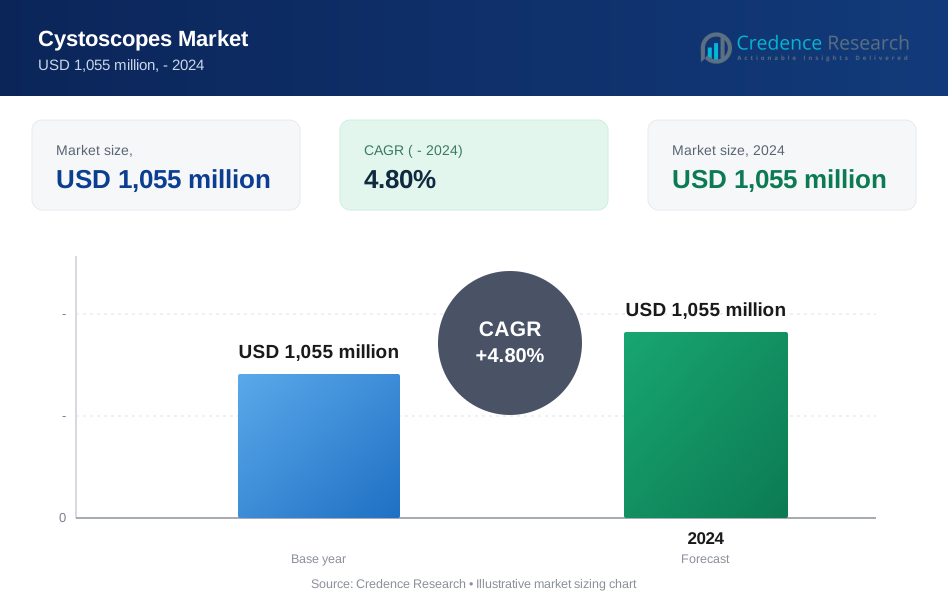
The global cystoscopes market is projected to expand from an estimated USD 1,055 million in 2024 to approximately USD 1,535.121 million by 2032, with a compound annual growth rate (CAGR) of 4.8% over the forecast period. This growth is driven by the increasing prevalence of urological disorders, advancements in minimally invasive surgical procedures, and a growing elderly population, which is more susceptible to conditions such as bladder cancer and urinary tract infections. Cystoscopes, which are used for examining, diagnosing, and treating conditions affecting the urinary bladder, have become essential tools in both diagnostic and therapeutic procedures, supporting the market's steady expansion.
Key drivers of the cystoscopes market include the rising incidence of urological conditions and a shift towards minimally invasive procedures, which cystoscopes facilitate by allowing precise examination of the urinary tract without the need for major surgery. Technological advancements have led to the development of flexible and video cystoscopes, improving patient comfort and diagnostic accuracy. Additionally, healthcare providers are increasingly adopting cystoscopes with digital imaging capabilities to enhance visualization during procedures. For instance, the American Cancer Society has highlighted that bladder cancer is one of the most common cancers globally, underscoring the need for regular cystoscopic screenings, especially in high-risk populations.
Regionally, North America holds a substantial share of the cystoscopes market, accounting for a significant portion of the demand due to well-established healthcare infrastructure, high healthcare expenditure, and rising incidences of urological diseases. The United States, in particular, sees strong market demand, supported by an increasing elderly population and the availability of advanced healthcare services. Europe also represents a key market, driven by high healthcare standards and government support for medical innovations. The Asia-Pacific region, however, is expected to experience the highest growth rate over the forecast period, attributed to increasing healthcare investments, a growing elderly population, and rising awareness of early diagnosis in emerging economies like China and India. This regional growth reflects the expanding demand for cystoscopes as healthcare providers prioritize early detection and minimally invasive treatments for urological conditions.
Market Drivers:
Increasing Prevalence of Urological Disorders:
The rising incidence of urological conditions such as bladder cancer, urinary tract infections (UTIs), and kidney stones is driving the demand for cystoscopes. According to the World Health Organization (WHO), bladder cancer is one of the top 10 most common cancers globally, particularly affecting the elderly. For instance, the Centers for Disease Control and Prevention (CDC) reports that approximately 150 million UTIs occur globally each year, necessitating effective diagnostic tools like cystoscopes. As these conditions continue to affect a large segment of the population, cystoscopes play an essential role in early diagnosis and treatment, contributing to market growth.
Advancements in Minimally Invasive Procedures:
The healthcare industry is increasingly moving towards minimally invasive procedures due to their benefits of reduced recovery times, lower risks, and improved patient outcomes. Cystoscopes facilitate minimally invasive diagnostic and therapeutic interventions in the urinary tract. For instance, video and flexible cystoscopes allow for enhanced visualization and patient comfort, making them ideal for both diagnostic and surgical applications. The American Urological Association (AUA) advocates for minimally invasive techniques as the preferred approach for bladder cancer surveillance and treatment, which aligns with the growing demand for advanced cystoscopic technology.
Technological Innovations in Cystoscopes:
Technological advancements are significantly transforming the cystoscopes market. Innovations such as high-definition imaging, digital cystoscopy, and narrow-band imaging enhance diagnostic accuracy and aid in detecting early-stage urological conditions. Companies like Olympus and Karl Storz have introduced video cystoscopes with integrated imaging capabilities that allow for improved visualization and more precise diagnosis. These advancements align with the healthcare industry’s emphasis on precision medicine, and the National Institutes of Health (NIH) highlights the importance of advanced imaging technology in improving patient outcomes and enhancing clinical decision-making.
Growing Geriatric Population:
The global rise in the elderly population further fuels the cystoscopes market, as older individuals are more susceptible to urological disorders. According to the United Nations, the global population aged 65 and older is projected to reach 1.5 billion by 2050, representing a significant demographic with higher healthcare needs. Bladder cancer and other urological conditions are particularly prevalent in this age group, increasing the demand for cystoscopic procedures. Healthcare providers are focusing on early diagnosis and monitoring for this population segment, which relies heavily on tools like cystoscopes for effective and minimally invasive diagnostic care.
Market Trends:
Shift Towards Single-Use Cystoscopes:
One of the notable trends in the cystoscopes market is the increasing adoption of single-use or disposable cystoscopes. Single-use cystoscopes reduce the risk of cross-contamination, a critical consideration in healthcare settings, especially after the COVID-19 pandemic. For instance, Boston Scientific launched a single-use digital cystoscope to meet demand for hygienic and cost-effective options, which eliminates the need for sterilization and minimizes infection risks. The U.S. Food and Drug Administration (FDA) has emphasized infection control in urological procedures, supporting the adoption of disposable medical devices like single-use cystoscopes.
Growing Use of Digital and Video Cystoscopes:
Digital and video cystoscopes are gaining traction due to their superior imaging capabilities and enhanced diagnostic accuracy. These advanced cystoscopes provide real-time, high-definition visuals, enabling more precise examination of the urinary tract. Companies such as Olympus and Karl Storz offer video cystoscopes with integrated digital imaging systems, allowing for better detection and monitoring of urological conditions. According to a report from the National Institutes of Health (NIH), advanced imaging technologies are crucial for improving diagnostic outcomes and enhancing treatment planning, further driving the adoption of video cystoscopes in clinical settings.
Increasing Adoption of Narrow-Band Imaging (NBI):
Narrow-band imaging (NBI) technology, which enhances visualization of blood vessels and mucosal structures, is becoming increasingly popular in cystoscopy. NBI technology helps clinicians identify early-stage bladder cancers that may not be visible with traditional white-light cystoscopy. For example, Olympus has incorporated NBI into its cystoscopes to facilitate early detection and improve patient outcomes. The American Urological Association (AUA) supports the use of enhanced imaging modalities like NBI in cystoscopic procedures, reflecting a broader trend toward technologies that improve visualization and diagnostic accuracy.
Integration of Telemedicine in Urological Care:
The integration of telemedicine and remote diagnostic capabilities in urology is emerging as a trend, particularly in response to growing telehealth adoption. Some cystoscopes now feature connectivity options that allow clinicians to share real-time images and videos with specialists for collaborative diagnosis and treatment planning. For instance, the Cleveland Clinic has expanded its telemedicine program, allowing patients to receive urological consultations remotely, a trend that aligns with the increased adoption of connected medical devices. This trend is supported by healthcare authorities, such as the Centers for Medicare & Medicaid Services (CMS), which have expanded telehealth coverage to improve accessibility to specialized care, including urological services, for patients in remote areas.
Market Challenges Analysis:
High Costs of Advanced Cystoscopic Equipment:
One of the primary challenges in the cystoscopes market is the high cost associated with advanced digital and video cystoscopes, which can be a barrier for smaller healthcare facilities. These costs extend beyond the initial purchase, as advanced cystoscopes also require regular maintenance and costly accessories. Smaller clinics and hospitals, especially in developing regions, may struggle to afford these devices, limiting market penetration. The Centers for Medicare & Medicaid Services (CMS) has acknowledged that high equipment costs can impact healthcare providers’ ability to offer advanced diagnostic services, which in turn affects patient access to quality care.
Limited Reimbursement Policies:
Reimbursement challenges also hinder the growth of the cystoscopes market. In many countries, healthcare providers face limited or inadequate reimbursement for cystoscopy procedures, particularly when using advanced diagnostic tools such as video cystoscopes or narrow-band imaging. This lack of coverage can discourage healthcare providers from adopting new technologies, as they may not be able to recoup the associated costs. In the United States, the CMS and private insurers have specific guidelines for reimbursable procedures, and these guidelines can limit the adoption of costly innovations in urological diagnostics. Additionally, in countries with limited healthcare funding, the lack of adequate reimbursement further impacts adoption rates.
Stringent Regulatory Requirements:
The cystoscopes market faces regulatory hurdles that can slow the approval and market entry of new products. Government authorities like the U.S. Food and Drug Administration (FDA) and the European Medicines Agency (EMA) have rigorous standards for the approval of medical devices, including cystoscopes. These regulatory bodies mandate thorough testing to ensure device safety and efficacy, which can prolong the development timeline and increase costs for manufacturers. While these regulations are essential for patient safety, they can be burdensome for companies, particularly smaller manufacturers, who may face delays in bringing new or improved products to market.
Infection Control and Sterilization Challenges:
Reprocessing and sterilizing reusable cystoscopes remain challenging for healthcare facilities, as improper cleaning can lead to infections and cross-contamination. The U.S. Centers for Disease Control and Prevention (CDC) has set strict guidelines for the sterilization of endoscopic equipment, including cystoscopes, to prevent healthcare-associated infections. However, adhering to these protocols requires specialized equipment, trained personnel, and additional resources, which can strain hospital budgets and discourage the use of reusable cystoscopes in favor of single-use options.
Market Segmentation Analysis:
By Type
The market includes two primary types: rigid cystoscopes and flexible cystoscopes. Rigid cystoscopes are widely used for procedures requiring high-definition images and precision, such as bladder tumor resections, due to their durability and superior imaging capabilities. However, flexible cystoscopes are increasingly preferred for diagnostic purposes and routine examinations due to their ability to provide enhanced patient comfort. The trend towards minimally invasive procedures is bolstering demand for flexible cystoscopes, especially in outpatient settings where patient comfort and quick recovery are prioritized.
By Technology
Based on technology, the market is segmented into digital cystoscopes, video cystoscopes, and fiber-optic cystoscopes. Video cystoscopes, which provide high-resolution images and improved visualization, are increasingly popular in urology practices. Digital cystoscopes are gaining traction for their advanced imaging capabilities, such as narrow-band imaging (NBI), which aids in the detection of early-stage bladder cancer. Fiber-optic cystoscopes, while more traditional, remain in use due to their cost-effectiveness and reliability in resource-limited healthcare settings.
By End User
The primary end users of cystoscopes include hospitals, ambulatory surgical centers (ASCs), and specialty clinics. Hospitals hold the largest market share, driven by the high volume of diagnostic and surgical procedures conducted in these facilities. Ambulatory surgical centers are experiencing increased adoption of cystoscopes, particularly flexible and single-use models, as they expand their urology services to offer more minimally invasive procedures. Specialty clinics, including urology clinics, also represent a growing segment, as they often utilize cystoscopes for routine diagnostic procedures, supported by rising demand for outpatient care and early diagnosis of urological conditions.
Segmentation:
By Type
- Flexible Cystoscope
- Rigid Cystoscope
By End-User
- Hospitals
- Clinics
- Ambulatory Surgical Centers
By Technology
- Video Cystoscope
- Fiber Optic Cystoscope
By Regions
- North America
- US
- Canada
- Mexico
- Europe
- Germany
- France
- UK
- Italy
- Spain
- Rest of Europe
- Asia Pacific
- China
- Japan
- India
- South Korea
- South-east Asia
- Rest of Asia Pacific
- Latin America
- Brazil
- Argentina
- Rest of Latin America
- Middle East & Africa
- GCC Countries
- South Africa
Regional Analysis:
North America
North America holds a substantial share of the global cystoscopes market, accounting for approximately 35% of the market. This dominance is driven by a well-established healthcare infrastructure, high healthcare expenditure, and a growing elderly population susceptible to urological disorders. The United States, in particular, is a significant contributor, with increasing incidences of bladder cancer and urinary tract infections necessitating the use of cystoscopes for diagnosis and treatment. The Centers for Disease Control and Prevention (CDC) reports high rates of urological conditions in the U.S., supporting the demand for advanced diagnostic tools. Furthermore, healthcare providers in North America are early adopters of technological innovations, including digital and video cystoscopes, which enhance diagnostic accuracy and patient care.
Europe
Europe represents around 25% of the cystoscopes market share, supported by high healthcare standards and strong government investment in medical technology. Countries such as Germany, France, and the United Kingdom lead in adopting advanced cystoscopic tools due to their well-developed healthcare systems and emphasis on minimally invasive procedures. The European Union’s focus on enhancing healthcare quality and accessibility, alongside strict regulatory standards, drives the demand for single-use and digital cystoscopes, which align with safety and infection control protocols. The aging population across Europe also contributes to rising demand, as older adults are at a higher risk for urological disorders, underscoring the need for regular cystoscopic screenings.
Asia-Pacific
Asia-Pacific is projected to experience the highest growth rate over the forecast period, currently accounting for approximately 20% of the global market. This growth is attributed to increasing healthcare investments, growing awareness of early diagnosis, and rising incidences of urological conditions, particularly in emerging economies such as China and India. Rapid urbanization, expanding middle-class populations, and increased healthcare spending support the demand for cystoscopes. In Japan, technological advancements play a key role, with hospitals and clinics adopting video cystoscopes to enhance diagnostic capabilities. Government initiatives focused on improving healthcare infrastructure, especially in India and Southeast Asia, are expected to boost demand for affordable and efficient cystoscopic solutions.
Latin America
Latin America holds around 10% of the market share, with Brazil and Mexico as primary contributors. Growing awareness of urological health, coupled with government efforts to enhance healthcare access, drives market growth in this region. Brazil’s healthcare sector is investing in modern medical equipment, including cystoscopes, to meet the needs of its aging population. Although infrastructure limitations pose challenges, the demand for cost-effective diagnostic tools in public and private healthcare facilities is steadily rising.
Middle East & Africa
The Middle East & Africa account for the remaining 10% of the cystoscopes market. While the region has relatively slower growth due to limited healthcare resources, countries like the United Arab Emirates and South Africa are investing in advanced medical technologies to improve urological healthcare services. The UAE’s healthcare initiatives focus on modernizing hospitals and clinics to attract medical tourism, which includes the adoption of advanced diagnostic tools such as digital cystoscopes. Additionally, growing government investments in healthcare infrastructure in countries like Saudi Arabia contribute to the steady demand for cystoscopic procedures.
Key Player Analysis:
- Olympus Corporation
- KARL STORZ SE & Co. KG
- Stryker Corporation
- Richard Wolf GmbH
- Boston Scientific Corporation
- Pentax Medical (HOYA Corporation)
- Smith & Nephew plc
- Medtronic plc
- Cook Medical
- Ambu A/S
Competitive Analysis:
The cystoscopes market is highly competitive, with leading players such as Olympus Corporation, KARL STORZ SE & Co. KG, and Stryker Corporation dominating due to their extensive product portfolios and technological expertise. These companies focus on advancing imaging capabilities and integrating minimally invasive technologies, catering to the demand for precision diagnostics and patient comfort. Olympus and KARL STORZ, for example, offer a comprehensive range of both rigid and flexible cystoscopes, enabling healthcare providers to perform diagnostic and therapeutic procedures with greater accuracy. Additionally, Boston Scientific and Ambu A/S are pioneering single-use cystoscopes, emphasizing infection control and cost-efficiency for high-volume healthcare settings. Competition is marked by continuous R&D investments and strategic acquisitions, as companies strive to expand their market share and innovate in digital imaging, narrow-band imaging (NBI), and other advanced cystoscopic technologies. This competitive landscape reflects the industry's focus on improving clinical outcomes through enhanced visualization and patient-centered solutions.
Recent Developments:
- In 2023, Ambu A/S launched its next-generation single-use cystoscope, designed to improve infection control and reduce cross-contamination risks in clinical settings. This cystoscope features advanced imaging technology and enhanced ergonomics, catering to healthcare providers focused on hygiene and operational efficiency. Single-use devices have become increasingly popular due to their convenience and the reduction in costs associated with sterilization procedures.
- Olympus introduced upgrades to its flexible video cystoscopes in 2022, incorporating narrow-band imaging (NBI) technology. NBI improves visualization of the bladder’s vascular patterns, which helps in the early detection of bladder cancer. Olympus's focus on advanced imaging technologies aligns with its goal to provide healthcare professionals with tools that enhance diagnostic accuracy and patient outcomes, especially in the detection of early-stage cancer.
- Stryker announced in 2024 its investment in artificial intelligence (AI) technology for its cystoscopy devices. This AI integration aims to support urologists by providing real-time analytics during procedures, assisting in more accurate diagnoses. The incorporation of AI reflects a growing trend in the medical device industry to enhance procedural efficiency and accuracy through intelligent software solutions.
- In 2023, Richard Wolf GmbH launched a new digital video cystoscope that features high-definition imaging and improved maneuverability. The device is tailored for outpatient and clinical use, offering enhanced visualization and diagnostic capabilities. This launch aligns with the company’s commitment to providing innovative tools that cater to the growing demand for minimally invasive procedures in urology.
Market Concentration & Characteristics:
The cystoscopes market is moderately concentrated, with major players like Olympus Corporation, KARL STORZ SE & Co. KG, and Stryker Corporation holding a significant share due to their strong brand recognition, extensive product portfolios, and continuous investment in technological advancements. These companies lead the market by offering a variety of cystoscopes, including rigid, flexible, and video cystoscopes, designed to meet diverse clinical needs. The market is characterized by rapid technological innovation, with key players focusing on integrating advanced imaging capabilities, such as narrow-band imaging (NBI) and AI-driven diagnostic support. Additionally, there is a notable trend towards single-use cystoscopes, driven by the need for enhanced infection control and cost-effectiveness in high-volume clinical environments. This competitive landscape encourages ongoing R&D investment, as companies strive to expand their product offerings to address rising demand for minimally invasive urological diagnostics and improved patient outcomes.
Report Coverage:
The research report offers an in-depth analysis based on Type, End-User, Technology, and Regions. It details leading market players, providing an overview of their business, product offerings, investments, revenue streams, and key applications. Additionally, the report includes insights into the competitive environment, SWOT analysis, current market trends, as well as the primary drivers and constraints. Furthermore, it discusses various factors that have driven market expansion in recent years. The report also explores market dynamics, regulatory scenarios, and technological advancements that are shaping the industry. It assesses the impact of external factors and global economic changes on market growth. Lastly, it provides strategic recommendations for new entrants and established companies to navigate the complexities of the market.
Future Outlook:
- The adoption of single-use cystoscopes is expected to increase as healthcare providers prioritize infection control, cost-efficiency, and ease of use in high-volume settings.
- Technological advancements, including AI and machine learning integration, will enhance diagnostic accuracy and support urologists with real-time analytics during cystoscopic procedures.
- High-definition and narrow-band imaging technologies will continue to gain traction, enabling earlier detection and improved visualization of bladder cancer.
- The shift toward minimally invasive procedures will drive demand for flexible cystoscopes, particularly in outpatient settings where patient comfort and quick recovery are prioritized.
- Increasing healthcare expenditure in emerging economies, especially in Asia-Pacific, will boost market growth as countries invest in advanced diagnostic tools for urological care.
- Rising awareness of urological health, particularly related to bladder cancer, is expected to drive more regular screenings and the use of cystoscopes in routine diagnostics.
- Telemedicine integration in urology will facilitate remote consultation and collaborative diagnostics, particularly for rural or underserved areas.
- Aging populations worldwide will sustain market demand, as older adults are more susceptible to urological conditions that require diagnostic interventions with cystoscopes.
- Regulatory emphasis on patient safety and equipment hygiene will increase adoption of single-use devices and encourage innovation in cystoscope sterilization and reprocessing methods.
- Partnerships between medical device manufacturers and healthcare providers are likely to expand.
Request a Free Sample
Fill in your details and we'll send you a free sample report.
- Sample data tables & charts
- Research methodology
Market Dynamics
Increasing Prevalence of Urological Disorders
The rising incidence of bladder cancer, urinary tract infections, and kidney stones is fueling demand for cystoscopes, as these devices are essential for early diagnosis and treatment of such conditions, particularly in aging populations.
Advancements in Minimally Invasive Procedures
Healthcare providers are increasingly adopting minimally invasive techniques, and cystoscopes enable precise examination and treatment of the urinary tract with reduced patient recovery times and lower procedural risks.
Technological Innovations in Cystoscopes
The introduction of high-definition imaging, digital cystoscopy, and narrow-band imaging has improved diagnostic accuracy and patient outcomes, encouraging healthcare facilities to upgrade to advanced cystoscopic technologies.
Growing Geriatric Population
As the global population ages, the prevalence of urological conditions rises, leading to greater demand for cystoscopic procedures for both diagnosis and ongoing monitoring in elderly patients.
Shift Toward Single-Use and Digital Devices
Concerns over infection control and the need for cost-effective, hygienic solutions have accelerated the adoption of single-use and digital cystoscopes, especially in high-volume clinical settings post-pandemic.
Need a Custom Version of This Report?
Tailor the scope, geography, or segments to your exact requirements.
- Custom geography or segment scope
- Direct access to our analyst team
Frequently Asked Questions
What is the size of Cystoscopes Market?
What factors are driving the growth of the Cystoscopes Market?
What are some challenges faced by the Cystoscopes Market?
Who are the major players in this market?
Table of Content
Chapter 1 Market Segmentation
- 1.1 Segmentation Framework
- 1.1.1 Product and Service Classification
- 1.1.2 Application and End-Use Classification
- 1.1.3 Technology and Solution Classification
- 1.1.4 Customer and Distribution Channel Classification
- 1.1.5 Geographic Segmentation
- 1.1.6 Market Segment Definitions and Boundaries
- 1.2 By Type
- 1.2.1 Flexible Cystoscope
- 1.2.2 Rigid Cystoscope
- 1.3 By End-User
- 1.3.1 Hospitals
- 1.3.2 Clinics
- 1.3.3 Ambulatory Surgical Centers
- 1.4 By Technology
- 1.4.1 Video Cystoscope
- 1.4.2 Fiber Optic Cystoscope
- 1.4.3 Digital Cystoscope
Chapter 2 Introduction
- 2.1 Report Objectives and Scope
- 2.2 Product Definition and Industry Terminology
- 2.3 Market Inclusions and Exclusions
- 2.4 Research Process
- 2.4.1 Primary Research and Expert Interviews
- 2.4.2 Secondary Research and Source Review
- 2.4.3 Top-Down and Bottom-Up Estimation
- 2.4.4 Data Triangulation and Verification
- 2.5 Market Size Measurement Basis
- 2.5.1 2024: USD 1,055 million → 2024: USD 1,055 million
- 2.6 Historical and Forecast Reference Periods
- 2.6.1 Base Year: 2024
- 2.6.2 Forecast Period: 2024-2024
- 2.7 Research Assumptions and Limitations
Chapter 3 Executive Summary
- 3.1 Market Snapshot and Key Findings
- 3.2 Base-Year Market Size, 2024
- 3.3 Forecast Market Size, 2024
- 3.4 Revenue and Volume Growth Outlook
- 3.5 Key Demand and Supply Indicators
- 3.6 Leading Market Segments
- 3.7 Fastest-Growing Market Opportunities
- 3.8 Regional Performance Highlights
- 3.9 Technology and Industry Transformation
- 3.10 Competitive Landscape Summary
- 3.11 Analyst View and Strategic Implications
Chapter 4 Global Cystoscopes Market Trends and Developments
- 4.1 Historical Industry Development
- 4.2 Recent Market Trends and Developments
- 4.3 Demand and Customer Behavior Trends
- 4.4 Technology and Product Innovation
- 4.5 Artificial Intelligence, Automation and Digitalization
- 4.6 Local Manufacturing and Supply Chain Realignment
- 4.7 Industry Partnerships, Mergers and Acquisitions
- 4.8 Sustainability and Circular Economy Developments
- 4.9 Government and Private Sector Investment Trends
- 4.10 Emerging Business Models and Commercialization
- 4.11 Industry Developments and Announcements
Chapter 5 Global Cystoscopes Market Production, Supply and Demand Analysis
- 5.1 Demand Trend and Consumption Analysis
- 5.2 Demand Forecast, 2024-2024
- 5.3 Production and Output Trend
- 5.4 Production and Output Forecast, 2024-2024
- 5.5 Installed Capacity and Capacity Utilization
- 5.6 Company-Wise Production Plants and Statistics
- 5.6.1 Installed Production Capacity
- 5.6.2 Actual Production
- 5.6.3 Planned Capacity and Expansion Targets
- 5.7 Supply Chain Structure and Procurement Trends
- 5.8 Supply-Demand Gap and Bottlenecks
- 5.9 Import Dependence and Sourcing Structure
- 5.10 Contract Manufacturing and Outsourcing
- 5.11 Regional Supply and Demand Concentration
Chapter 6 Global Cystoscopes Market Pricing Analysis
- 6.1 Pricing Structure and Measurement
- 6.2 Historical Pricing Trends
- 6.3 Pricing Outlook, 2024-2024
- 6.4 Average Selling Price and Unit Economics
- 6.5 Pricing by Product and Market Segment
- 6.6 Geographic Pricing Differences
- 6.7 Key Input, Energy, Labor and Logistics Costs
- 6.8 Contract Pricing and Purchasing Models
- 6.9 Pricing Sensitivity and Competitive Positioning
- 6.10 Price, Margin and Profitability Implications
Chapter 7 Global Cystoscopes Market Dynamics
- 7.1 Market Growth Drivers
- 7.1.1 Demand-Side Drivers
- 7.1.2 Technology and Innovation Drivers
- 7.1.3 Infrastructure and Investment Drivers
- 7.1.4 Regulatory and Policy Drivers
- 7.2 Market Restraints
- 7.2.1 Cost and Affordability Constraints
- 7.2.2 Technology and Adoption Barriers
- 7.2.3 Supply Chain and Operational Constraints
- 7.3 Market Challenges
- 7.3.1 Competitive Pressure and Margin Erosion
- 7.3.2 Skills, Infrastructure and Implementation Gaps
- 7.4 Emerging Market Opportunities
- 7.5 Market Dynamics Impact and Time-Horizon Assessment
Chapter 8 Global Cystoscopes Value Chain Analysis
- 8.1 Industry Value Chain Overview
- 8.2 Upstream Suppliers and Critical Inputs
- 8.3 Technology and Component Providers
- 8.4 Manufacturing or Service Delivery
- 8.5 Distribution, Channel Partners and Integrators
- 8.6 Downstream Applications and End Users
- 8.7 Value Addition and Profit Pools
- 8.8 Vertical Integration and Outsourcing
- 8.9 Supplier Concentration and Risk
- 8.10 Supply Chain Localization and Resilience
Chapter 9 Global Cystoscopes Market Regulations and Policies
- 9.1 Relevant Laws, Standards and Compliance Frameworks
- 9.2 Product, Service, Safety and Quality Requirements
- 9.3 Government Policies, Incentives and Subsidies
- 9.4 Imports, Exports and Trade Barriers
- 9.5 Public Procurement and Local Content Requirements
- 9.6 Environmental and Sustainability Compliance
- 9.7 Upcoming Policy Changes and Market Implications
Chapter 10 Global Cystoscopes Market Hotspots and Opportunities
- 10.1 Market Opportunity Mapping and Growth Hotspots
- 10.2 High-Growth Applications and Customer Groups
- 10.3 Underserved Markets and White-Space Opportunities
- 10.4 Emerging Technology and Product Opportunities
- 10.5 New Capacity and Investment Hotspots
- 10.6 Market Entry and Expansion Opportunities
- 10.7 Distribution and Partnership Opportunities
- 10.8 Near-Term and Long-Term Commercial Potential
- 10.9 Opportunity Attractiveness and Execution Risks
Chapter 11 Global Cystoscopes Market Outlook, 2024-2024
- 11.1 Market Size and Analysis
- 11.1.1 Revenue (Market Measurement: 2024: USD 1,055 million → 2024: USD 1,055 million)
- 11.1.2 Market Volume and Quantity Sold
- 11.1.3 Historical Market Size
- 11.1.4 Base-Year Market Size, 2024
- 11.2 Market Forecast, 2024-2024
- 11.2.1 Revenue Forecast to 2024
- 11.2.2 Volume Forecast to 2024
- 11.2.3 CAGR and Year-on-Year Growth
- 11.2.4 Incremental Revenue Opportunity
- 11.3 Forecast Assumptions and Scenario Analysis
- 11.3.1 Base-Case Forecast
- 11.3.2 Optimistic and Conservative Scenarios
- 11.3.3 Technology, Pricing and Policy Sensitivities
- 11.4 Market Attractiveness and Growth Outlook
Chapter 12 Global Cystoscopes Market Segmentation and Outlook
- 12.1 Segmentation Summary and Market Shares, 2024
- 12.2 Largest and Fastest-Growing Segments
- 12.3 By Type - Market Size and Forecast, 2024-2024
- 12.3.1 Segment Definition and Scope
- 12.3.2 Historical Market Size
- 12.3.3 Revenue Forecast, 2024-2024
- 12.3.4 Volume Forecast, 2024-2024
- 12.3.5 Base-Year Market Share, 2024
- 12.3.6 Segment CAGR and Growth Drivers
- 12.3.7 Subsegment Market Size and Forecast
- 12.3.7.1 Flexible Cystoscope
- 12.3.7.2 Rigid Cystoscope
- 12.3.8 Subsegment Pricing and Adoption Trends
- 12.3.9 Leading Suppliers and Competition
- 12.3.10 Regional Demand and Opportunities
- 12.4 By End-User - Market Size and Forecast, 2024-2024
- 12.4.1 Segment Definition and Scope
- 12.4.2 Historical Market Size
- 12.4.3 Revenue Forecast, 2024-2024
- 12.4.4 Volume Forecast, 2024-2024
- 12.4.5 Base-Year Market Share, 2024
- 12.4.6 Segment CAGR and Growth Drivers
- 12.4.7 Subsegment Market Size and Forecast
- 12.4.7.1 Hospitals
- 12.4.7.2 Clinics
- 12.4.7.3 Ambulatory Surgical Centers
- 12.4.8 Subsegment Pricing and Adoption Trends
- 12.4.9 Leading Suppliers and Competition
- 12.4.10 Regional Demand and Opportunities
- 12.5 By Technology - Market Size and Forecast, 2024-2024
- 12.5.1 Segment Definition and Scope
- 12.5.2 Historical Market Size
- 12.5.3 Revenue Forecast, 2024-2024
- 12.5.4 Volume Forecast, 2024-2024
- 12.5.5 Base-Year Market Share, 2024
- 12.5.6 Segment CAGR and Growth Drivers
- 12.5.7 Subsegment Market Size and Forecast
- 12.5.7.1 Video Cystoscope
- 12.5.7.2 Fiber Optic Cystoscope
- 12.5.7.3 Digital Cystoscope
- 12.5.8 Subsegment Pricing and Adoption Trends
- 12.5.9 Leading Suppliers and Competition
- 12.5.10 Regional Demand and Opportunities
- 12.6 Segment Growth Comparison
- 12.7 Segment Attractiveness and Priority Matrix
Chapter 13 Global Cystoscopes End-Use and Application Market Outlook
- 13.1 End-Use Industry and Customer Demand Structure
- 13.2 Leading Applications and Customer Groups
- 13.3 End-Use Market Size, Share and Forecast
- 13.4 Major End-Use Industry Deep Dives
- 13.4.1 Customer Requirements and Use Cases
- 13.4.2 Demand and Replacement Cycles
- 13.4.3 Technical and Regulatory Considerations
- 13.4.4 Purchasing and Procurement Models
- 13.4.5 Leading Vendors and Distribution Channels
- 13.4.6 Forecast and Commercial Opportunities
- 13.5 Emerging Applications and Cross-Segment Demand
- 13.6 End-Use Industry Investment Priorities
Chapter 14 Global Cystoscopes Geographic Market Outlook, 2024-2024
- 14.1 Regional Market Size and Share, 2024
- 14.2 Regional Market Forecast, 2024-2024
- 14.3 Regional Pricing, Production and Demand Differences
- 14.4 North America
- 14.4.1 United States
- 14.4.2 Canada
- 14.4.3 Mexico
- 14.5 Europe
- 14.5.1 Germany
- 14.5.2 France
- 14.5.3 Italy
- 14.5.4 United Kingdom
- 14.5.5 Spain
- 14.5.6 Poland
- 14.5.7 Russia
- 14.5.8 Netherlands
- 14.5.9 Belgium
- 14.5.10 Sweden
- 14.5.11 Denmark
- 14.5.12 Norway
- 14.5.13 Rest of Europe
- 14.6 Asia Pacific
- 14.6.1 China
- 14.6.2 India
- 14.6.3 Japan
- 14.6.4 South Korea
- 14.6.5 Thailand
- 14.6.6 Indonesia
- 14.6.7 Vietnam
- 14.6.8 Malaysia
- 14.6.9 Australia
- 14.6.10 Rest of Asia Pacific
- 14.7 Latin America
- 14.7.1 Brazil
- 14.7.2 Argentina
- 14.7.3 Colombia
- 14.7.4 Chile
- 14.7.5 Rest of Latin America
- 14.8 Middle East
- 14.8.1 Saudi Arabia
- 14.8.2 United Arab Emirates
- 14.8.3 Turkey
- 14.8.4 Israel
- 14.8.5 Iran
- 14.8.6 Rest of the Middle East
- 14.9 Africa
- 14.9.1 South Africa
- 14.9.2 Egypt
- 14.9.3 Nigeria
- 14.9.4 Morocco
- 14.9.5 Rest of Africa
- 14.10 Regional Investment, Policy and Supply Chain Differences
- 14.11 Regional Competitive Landscape
- 14.12 Geographic Growth Hotspots
Chapter 15 Global Cystoscopes Technology, Innovation and Sustainability Outlook
- 15.1 Technology Landscape and Maturity
- 15.2 Product, Process and Service Innovation
- 15.3 AI, Automation and Digital Tools in the Industry
- 15.4 Technology Adoption and Performance Benchmarking
- 15.5 Innovation Pipeline and R&D Investment
- 15.6 Patent and Intellectual Property Trends
- 15.7 Energy Efficiency and Resource Management
- 15.8 Sustainability, Recycling and Circularity
- 15.9 Technology Roadmap, 2024-2024
- 15.10 Risks of Obsolescence and Technology Substitution
Chapter 16 Global Cystoscopes Market Key Strategic Imperatives
- 16.1 Growth and Market Entry Priorities
- 16.2 High-Return Products and Segments
- 16.3 Pricing, Profitability and Cost Optimization
- 16.4 Technology Investment and Product Differentiation
- 16.5 Supply Chain Localization and Resilience
- 16.6 Distribution and Customer Acquisition
- 16.7 Partnership, Acquisition and Capacity Strategy
- 16.8 Regional Expansion Priorities
- 16.9 Short-, Medium- and Long-Term Actions
Chapter 17 Competition Outlook
- 17.1 Industry Competition Characteristics
- 17.2 Market Structure and Concentration
- 17.3 Market Share and Competitive Positioning, 2024
- 17.4 Company-Wise Revenue and Product Benchmarking
- 17.5 Production and Service Capacity Benchmarking
- 17.6 Technology, Pricing and Differentiation
- 17.7 Regional Footprint and Distribution Strength
- 17.8 Mergers, Acquisitions and Strategic Alliances
- 17.9 New Entrants and Competitive Threats
- 17.10 Porter's Five Forces and Industry Attractiveness
- 17.11 Competitive Outlook, 2024-2024
Chapter 18 Company Profiles
- 18.1 Company Coverage and Selection Criteria
- 18.2 Olympus Corporation
- 18.2.1 Business Description
- 18.2.2 Company Ownership and Geographic Presence
- 18.2.3 Product and Service Portfolio
- 18.2.4 Manufacturing and Operating Footprint
- 18.2.5 Production Capacity and Expansion Plans
- 18.2.6 Financial Performance and Investment
- 18.2.7 Market Share and Competitive Position
- 18.2.8 Technology and Innovation Capabilities
- 18.2.9 Strategic Alliances or Partnerships
- 18.2.10 Recent Developments
- 18.2.11 Growth Strategy and Outlook
- 18.3 KARL STORZ SE & Co. KG
- 18.4 Stryker Corporation
- 18.5 Richard Wolf GmbH
- 18.6 Boston Scientific Corporation
- 18.7 Pentax Medical (HOYA Corporation)
- 18.8 Smith & Nephew plc
- 18.9 Medtronic plc
- 18.10 Cook Medical
- 18.11 Ambu A/S
- 18.12 Other Relevant Market Participants
Note: Every listed company is profiled on the structure shown under the first company. The company list is preliminary and may change based on research findings, market developments, data availability and client requirements.
Chapter 19 Disclaimer
- 19.1 Research and Forecast Disclaimer
- 19.2 Data Source and Estimation Limitations
Note: The depth of individual sections depends on data availability for this market. Volume, capacity, trade and other unit-based metrics are included where applicable.

