| REPORT ATTRIBUTE | DETAILS |
|---|---|
| Historical Period | 2020-2023 |
| Base Year | 2024 |
| Forecast Period | 2025-2032 |
| Used Bike Market Size 2024 | USD 44854 million |
| Used Bike Market, CAGR | 4.9% |
| Used Bike Market Size 2032 | USD 65766.5 million |
Market Overview:
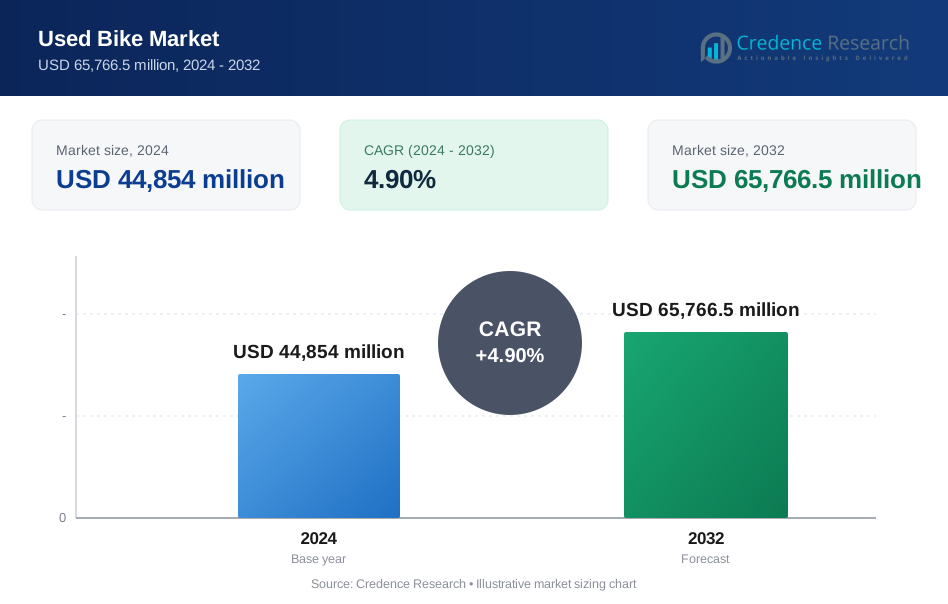
The Used Bike Market size was valued at USD 44854 million in 2024 and is anticipated to reach USD 65766.5 million by 2032, at a CAGR of 4.9% during the forecast period (2024-2032).
Several factors are contributing to the expansion of the Used Bike Market. First, the increasing focus on eco-friendly transportation options is prompting consumers to opt for pre-owned motorcycles, reducing the carbon footprint associated with manufacturing new bikes. Additionally, the affordability of used bikes makes them an attractive choice for environmentally-conscious consumers. Second, the growing trend of e-commerce platforms for used vehicle sales has made it more convenient for buyers to access quality used bikes with transparent pricing. This shift to online platforms has also led to increased consumer trust in the used bike market. Third, rising fuel prices and the increasing cost of owning a new bike have encouraged consumers to explore affordable alternatives. The ongoing improvement in the quality and longevity of motorcycles also enhances the appeal of used bikes, as they offer high value at a lower cost, making them a preferred choice for budget-conscious buyers.
Regionally, the Used Bike Market is experiencing significant growth in Asia Pacific, particularly in countries like India, China, and Southeast Asian nations, where a large population of young, budget-conscious consumers drives demand. In these regions, rapid urbanization and the rise of middle-class consumers further fuel the market. North America and Europe are also seeing increased activity in the used bike market, with a focus on premium and luxury motorcycle segments. The trend of buying pre-owned luxury bikes is gaining popularity in these regions, especially among consumers seeking a high-end experience at a lower cost. In these regions, the growing adoption of digital platforms for buying and selling used bikes is enhancing market accessibility and contributing to overall growth. With a robust market infrastructure and increasing consumer confidence, the used bike market is poised for steady growth globally.
Market Insights:
- The Used Bike Market is valued at USD 44,854 million in 2024 and is projected to reach USD 65,766.5 million by 2032, with a CAGR of 4.9% during the forecast period.
- The demand for affordable transportation options is driving growth in the Used Bike Market, particularly in emerging economies where consumers seek budget-friendly alternatives.
- Digital platforms for buying and selling used motorcycles have improved market access, allowing consumers to find quality bikes, compare prices, and build trust.
- Environmental concerns are driving the demand for pre-owned motorcycles, as more consumers opt for eco-friendly, sustainable transportation options.
- Improvements in bike quality and durability are boosting consumer confidence, making used bikes a reliable, long-lasting option for buyers.
- Limited consumer trust in the condition and quality of used bikes remains a challenge, with concerns about defects and maintenance issues hindering market growth.
- The Used Bike Market is growing in Asia Pacific, North America, and Europe, with each region focusing on specific market segments such as budget-friendly, premium, and eco-friendly bikes.
Market Drivers:
Growing Demand for Affordable Transportation
The Used Bike Market has witnessed significant growth due to the increasing demand for affordable transportation options. Consumers, particularly in emerging economies, are seeking cost-effective alternatives to new motorcycles, which are often expensive. The high price of new bikes, combined with the rising cost of living, drives people to explore pre-owned motorcycles. These bikes offer a lower entry price while still providing reliable performance, making them an attractive option for budget-conscious consumers. The market is further supported by the wide variety of models available, allowing consumers to select from a range of bikes that meet their specific needs.
- For instance, Hero MotoCorp sold 5.9 million two-wheelers in the fiscal year 2025, reinforcing its position as the world's second largest two-wheeler manufacturer and demonstrating the substantial scale of affordable mobility solutions offered by leading players in the used bike segment.
Advancements in E-Commerce Platforms
The rise of digital platforms for buying and selling used motorcycles is a key driver for the Used Bike Market. E-commerce platforms have made it easier for consumers to access quality pre-owned bikes with transparent pricing, allowing them to make informed purchasing decisions. The convenience of online transactions, coupled with detailed listings, photos, and customer reviews, has instilled greater confidence in buyers. This shift to digital sales channels has streamlined the buying process, contributing to the overall growth of the market. Furthermore, the ability to compare prices and specifications online makes it easier for consumers to find the best deals.
Environmental Concerns and Sustainability
Environmental consciousness is another crucial factor driving the Used Bike Market. With the increasing emphasis on sustainability and reducing carbon footprints, more consumers are opting for pre-owned motorcycles. Purchasing a used bike not only reduces the demand for new vehicle manufacturing but also contributes to the reduction of waste associated with bike production. The growing awareness of eco-friendly transportation options is prompting consumers to choose motorcycles that have a smaller environmental impact, further boosting the demand for used bikes.
- For instance, Yamaha Motor began using green aluminum in motorcycle parts in February 2023, making it the first time this sustainable material was adopted in Japanese motorcycles.
Improving Quality and Durability of Motorcycles
The ongoing improvement in the quality and longevity of motorcycles is enhancing the appeal of the Used Bike Market. Manufacturers are producing bikes that are more durable and require less maintenance over time, making used motorcycles a reliable and long-lasting option. This increased durability, combined with the availability of high-quality pre-owned motorcycles, has contributed to growing consumer confidence in purchasing second-hand bikes. As a result, more buyers are turning to the used bike market, knowing they can acquire vehicles that will perform well and retain value over time.
Market Trends:
Increasing Adoption of Digital Platforms
One of the prominent trends in the Used Bike Market is the increasing adoption of digital platforms for buying and selling motorcycles. Online marketplaces have made it easier for both buyers and sellers to connect, with platforms offering features such as detailed listings, secure transactions, and customer reviews. This shift towards e-commerce has significantly expanded the reach of the market, making it more accessible to a wider audience. The ability to compare prices, check bike conditions, and read user reviews online has increased consumer confidence, driving the market's growth. As smartphones and internet penetration continue to rise globally, this trend is expected to continue expanding, particularly in emerging markets where digital infrastructure is improving.
- For instance, BikeDekho, a leading digital marketplace, received 14 million visits in a single month as of early 2025, reflecting a substantial increase in user engagement and accessibility for buyers and sellers.
Growth of Premium and Luxury Segments
Another key trend in the Used Bike Market is the growth of the premium and luxury segments. There is an increasing demand for high-end pre-owned motorcycles, particularly in developed regions like North America and Europe. Consumers are drawn to these bikes due to their superior quality, advanced features, and brand prestige, often at a lower price than new models. The rising trend of buying pre-owned luxury bikes is linked to the growing desire for premium experiences without the high costs associated with new motorcycles. As the market matures, there is a noticeable shift toward more discerning buyers looking for quality over affordability, further driving the demand for luxury used bikes in specific regions.
- For instance, Harley-Davidson launched its HD-1 Marketplace in the United States, which offers a dedicated online platform for buying and selling pre-owned Harley-Davidson motorcycles; since its debut in July 2021, the platform has featured thousands of certified pre-owned Harley-Davidson bikes across the U.S., each verified and customizable before purchase.
Market Challenges Analysis:
Limited Consumer Trust and Perceived Risk
A key challenge facing the Used Bike Market is the limited consumer trust in the condition and quality of pre-owned motorcycles. Buyers often perceive used bikes as unreliable due to concerns about hidden defects, lack of warranties, or potential maintenance issues. This perception of risk can hinder market growth, particularly in regions where consumers are more cautious about purchasing second-hand goods. Despite improvements in online platforms providing more transparency, including detailed listings and customer reviews, many still hesitate due to fears of being misled about the condition of the bike. Overcoming this trust gap remains a significant barrier for further market expansion.
Regulatory and Safety Standards
Another challenge in the Used Bike Market is the lack of uniform regulatory and safety standards across regions. Inconsistent regulations can affect the quality control of used bikes, making it difficult for consumers to ensure they are buying a safe and reliable product. Different countries and regions have varying standards for vehicle inspection, which can complicate the buying process. The absence of a universal certification system for used motorcycles creates uncertainty for both buyers and sellers, potentially limiting the market's growth. Stricter enforcement of safety and regulatory standards is necessary to boost consumer confidence and ensure the long-term success of the market.
Market Opportunities:
Expansion of E-Commerce Platforms
The Used Bike Market presents significant opportunities for growth with the continued expansion of e-commerce platforms. Online marketplaces are making it easier for consumers to access a wide range of used motorcycles, offering transparent pricing, secure payment methods, and detailed product listings. This shift towards digital sales channels can help bridge the gap between buyers and sellers, particularly in regions where access to physical dealerships is limited. The growing acceptance of online shopping, combined with enhanced digital marketing strategies, will drive the market's reach, attracting a broader consumer base. By leveraging these platforms, sellers can offer bikes to a wider audience, boosting sales and expanding market share.
Increasing Popularity of Sustainable Transportation
There is a growing opportunity in the Used Bike Market driven by the increasing demand for sustainable transportation options. As environmental concerns rise, more consumers are opting for eco-friendly alternatives like pre-owned motorcycles. Choosing a used bike over a new one helps reduce the environmental impact associated with manufacturing new vehicles. This demand for sustainable transportation aligns with the market's growth, particularly in urban areas where traffic congestion and pollution are major concerns. The shift towards environmentally conscious purchasing decisions provides a strong growth opportunity for the market, especially as consumers seek affordable, greener alternatives for personal transportation.
Market Segmentation Analysis:
By Type
The Used Bike Market is primarily segmented into motorcycles, scooters, and mopeds. Motorcycles lead the market due to their performance, variety, and popularity among young, budget-conscious consumers. Scooters and mopeds follow, with a growing demand driven by their affordability and fuel efficiency, particularly in urban areas. This segment is expected to continue growing as consumers increasingly seek practical and cost-effective commuting options.
By Source
The market is divided into online and offline channels. Online platforms have seen a significant rise in popularity due to the convenience, transparency in pricing, and a wider selection available to consumers. These platforms have built trust and are becoming the preferred choice for many buyers. Offline channels, such as dealerships and showrooms, remain strong, particularly among consumers who prefer direct interaction and immediate purchases. Both channels are likely to coexist as they cater to different consumer preferences.
- For instance, The Pro's Closet, a leading online certified pre-owned bike retailer, subjects every bike to a 141-point inspection before listing, ensuring meticulous quality for buyers.
By Engine Capacity
The Used Bike Market is also segmented by engine capacity into low, medium, and high engine capacity bikes. Low-capacity bikes, particularly those under 150cc, dominate the market due to their affordability and fuel efficiency. Medium-capacity bikes (150cc to 500cc) are seeing increased demand as they offer a balance between power and economy. High-capacity bikes, above 500cc, cater to a niche market that seeks performance and luxury, contributing to the growth of the premium segment within the Used Bike Market.
- For instance, in August 2024, Bajaj Pulsar recorded 40,181 units sold in the 150cc to 200cc category, demonstrating strong momentum in medium engine capacity bikes.
Segmentations:
By Type
- Motorcycles
- Scooters
- Mopeds
By Source
- Online
- Offline
By Engine Capacity
- Low Capacity (Under 150cc)
- Medium Capacity (150cc to 500cc)
- High Capacity (Above 500cc)
By Distribution Channel
- Dealerships
- E-commerce Platforms
- Independent Sellers
By Region
- North America
- U.S.
- Canada
- Mexico
- Europe
- Germany
- France
- U.K.
- Italy
- Spain
- Rest of Europe
- Asia Pacific
- China
- Japan
- India
- South Korea
- South-east Asia
- Rest of Asia Pacific
- Latin America
- Brazil
- Argentina
- Rest of Latin America
- Middle East & Africa
- GCC Countries
- South Africa
- Rest of the Middle East and Africa
Regional Analysis:
North America: A Robust Market with a Focus on Premium Segments
The Used Bike Market in North America holds a substantial share, contributing 28% of the global market. This growth is primarily driven by a strong preference for premium and luxury motorcycles. Consumers in the region are increasingly turning to used high-end motorcycles as they provide an opportunity to own quality brands at a reduced price. The market is supported by a robust infrastructure for buying and selling pre-owned vehicles, with well-established online platforms and dealer networks. The growing interest in eco-friendly transportation, along with rising fuel prices, has further encouraged the adoption of used bikes. The market is expected to maintain steady growth, with a shift toward more eco-conscious purchasing behaviors and an expanding e-commerce presence.
Asia Pacific: Dominance in Volume and Emerging Opportunities
Asia Pacific accounts for the largest share of the Used Bike Market, with a contribution of 38%. A large, young, and budget-conscious population fuels the demand for affordable transportation options. Rising urbanization, increasing disposable income, and the growing trend of using motorcycles for commuting have created a thriving market for used bikes. As digital platforms become more widely adopted, consumer access to pre-owned motorcycles has improved, facilitating faster market growth. This region is expected to continue leading the global market in terms of growth potential due to its large consumer base and expanding middle class.
Europe: Maturing Market with Focus on Sustainability
Europe holds a significant share of the Used Bike Market, contributing 22% to the global total. The region's increasing focus on reducing carbon footprints has encouraged consumers to explore pre-owned motorcycles as a viable alternative to new models. The market is particularly strong in countries like Germany, France, and the UK, where digital platforms for buying and selling used bikes are well-established. The demand for used motorcycles is also driven by higher fuel prices and the rising cost of owning new vehicles. This region presents opportunities for growth, particularly in the luxury segment, as consumers continue to seek premium pre-owned motorcycles with a lower environmental impact.
Key Player Analysis:
- BeepKart
- BikeDekho
- BikeWale
- Droom
- DriveX
- Front Drive
- Rahul Hero
- Bhavya Motors
- AGM Auto Consulting
- Kiran Automobiles
- Dakshina Motors
- 2WHEELR
Competitive Analysis:
The Used Bike Market is highly competitive, with several players leveraging both online and offline channels to meet growing consumer demand. Leading e-commerce platforms, such as Droom, BeepKart, and BikeWale, have expanded their market share by offering a wide range of pre-owned motorcycles with transparent pricing and extensive buyer reviews. These platforms enhance consumer trust and convenience, making it easier for buyers to access quality used bikes. Offline dealerships also play a crucial role, providing buyers with direct interactions and immediate purchases. Companies like DriveX and BikeDekho focus on offering quality assurance and financing options to cater to diverse consumer needs. Competition in the market is intensified by the increasing preference for eco-friendly transportation and the growing demand for premium, pre-owned motorcycles in regions like North America and Europe. With advancements in digital platforms and a rising middle class in emerging markets, the market continues to see increased growth opportunities.
Recent Developments:
- In December 2024, BikeWale covered the public launch of the Bajaj Chetak 35 series, which features new battery technology, enhanced range, and three new variants.
- In June 2025, Front announced new features for omnichannel support, including AI-powered Smart QA, a new Dialpad integration enabling real-time voice and SMS management, and enhancements to Front Chat.
Market Concentration & Characteristics:
The Used Bike Market exhibits moderate concentration, with a few key players dominating the online segment, such as Droom, BikeDekho, and BeepKart. These platforms have strengthened their position through extensive inventories, transparent pricing, and user-friendly interfaces, contributing to increased consumer trust. The market also features a strong presence of offline dealerships that provide direct interactions and immediate purchase options, catering to consumers who prefer physical buying experiences. The growing popularity of e-commerce has led to significant competition between online platforms and traditional dealerships. The market is characterized by a broad range of motorcycle types, from low-capacity to premium models, meeting diverse consumer preferences. The affordability of used bikes, coupled with rising fuel prices and environmental concerns, further drives demand. As urbanization continues, the market is likely to see more competition and innovation, particularly in regions with expanding middle-class populations.
Report Coverage:
The research report offers an in-depth analysis based on Type, Source, Engine Capacity, Distribution Channel and Capacity. It details leading market players, providing an overview of their business, product offerings, investments, revenue streams, and key applications. Additionally, the report includes insights into the competitive environment, SWOT analysis, current market trends, as well as the primary drivers and constraints. Furthermore, it discusses various factors that have driven market expansion in recent years. The report also explores market dynamics, regulatory scenarios, and technological advancements that are shaping the industry. It assesses the impact of external factors and global economic changes on market growth. Lastly, it provides strategic recommendations for new entrants and established companies to navigate the complexities of the market.
Future Outlook:
- The Used Bike Market is expected to continue its growth, driven by increasing demand for affordable and eco-friendly transportation options.
- E-commerce platforms will play a key role in market expansion, making it easier for consumers to access a wide range of used motorcycles.
- Growing awareness of sustainability and reduced environmental impact will increase consumer interest in pre-owned bikes.
- The market will see an increase in the availability of refurbished bikes, with more options for warranties and post-purchase services.
- Consumers will increasingly opt for used premium and luxury bikes, benefiting from cost savings without compromising on quality.
- The shift toward urbanization will drive demand for compact, fuel-efficient used bikes, particularly in densely populated cities.
- Digital platforms will continue to enhance transparency and build trust among buyers, contributing to greater market penetration.
- Financing options for used bikes will become more accessible, encouraging more buyers to explore pre-owned motorcycles.
- The market will experience regional growth, particularly in Asia Pacific, where demand for budget-friendly motorcycles remains high.
- With technological advancements, the quality and longevity of used bikes will improve, making them a more appealing option for a broader range of consumers.
Request a Free Sample
Fill in your details and we'll send you a free sample report.
- Sample data tables & charts
- Research methodology
Market Dynamics
Growing Demand for Affordable Transportation
As the cost of new motorcycles rises and economic pressures persist, consumers - especially in emerging markets - are increasingly turning to used bikes as a cost-effective mobility solution, driving market growth.
Advancements in E-Commerce Platforms
The proliferation of digital platforms for buying and selling used bikes has improved transparency, convenience, and trust, making it easier for consumers to access a wide range of pre-owned motorcycles and compare prices.
Environmental Concerns and Sustainability
Rising awareness of environmental issues is prompting consumers to choose used bikes over new ones, reducing the carbon footprint associated with manufacturing and supporting the shift toward sustainable transportation.
Improving Quality and Durability of Motorcycles
Manufacturers are producing more durable and reliable motorcycles, which increases the appeal and resale value of used bikes, boosting consumer confidence in the second-hand market.
Growth of Premium and Luxury Segments
In developed regions, there is a growing trend toward purchasing pre-owned premium and luxury motorcycles, allowing consumers to access high-end brands and features at lower prices, further expanding the market.
Need a Custom Version of This Report?
Tailor the scope, geography, or segments to your exact requirements.
- Custom geography or segment scope
- Direct access to our analyst team
Frequently Asked Questions
What is the current size of the Used Bike Market?
What are the key segments within the Used Bike Market?
Who are the major players in the Used Bike Market?
Which segment is leading the market share?
Table of Content
Chapter 1 Market Segmentation
- 1.1 Segmentation Framework
- 1.1.1 Product and Service Classification
- 1.1.2 Application and End-Use Classification
- 1.1.3 Technology and Solution Classification
- 1.1.4 Customer and Distribution Channel Classification
- 1.1.5 Geographic Segmentation
- 1.1.6 Market Segment Definitions and Boundaries
- 1.2 By Type
- 1.2.1 Motorcycles
- 1.2.2 Scooters
- 1.2.3 Mopeds
- 1.3 By Source
- 1.3.1 Online
- 1.3.2 Offline
- 1.4 By Engine Capacity
- 1.4.1 Low Capacity (Under 150cc)
- 1.4.2 Medium Capacity (150cc to 500cc)
- 1.4.3 High Capacity (Above 500cc)
Chapter 2 Introduction
- 2.1 Report Objectives and Scope
- 2.2 Product Definition and Industry Terminology
- 2.3 Market Inclusions and Exclusions
- 2.4 Research Process
- 2.4.1 Primary Research and Expert Interviews
- 2.4.2 Secondary Research and Source Review
- 2.4.3 Top-Down and Bottom-Up Estimation
- 2.4.4 Data Triangulation and Verification
- 2.5 Market Size Measurement Basis
- 2.5.1 2024: USD 44,854 million → 2032: USD 65,766.5 million
- 2.6 Historical and Forecast Reference Periods
- 2.6.1 Base Year: 2024
- 2.6.2 Forecast Period: 2024-2032
- 2.7 Research Assumptions and Limitations
Chapter 3 Executive Summary
- 3.1 Market Snapshot and Key Findings
- 3.2 Base-Year Market Size, 2024
- 3.3 Forecast Market Size, 2032
- 3.4 Revenue and Volume Growth Outlook
- 3.5 Key Demand and Supply Indicators
- 3.6 Leading Market Segments
- 3.7 Fastest-Growing Market Opportunities
- 3.8 Regional Performance Highlights
- 3.9 Technology and Industry Transformation
- 3.10 Competitive Landscape Summary
- 3.11 Analyst View and Strategic Implications
Chapter 4 Global Used Bike Market Trends and Developments
- 4.1 Historical Industry Development
- 4.2 Recent Market Trends and Developments
- 4.3 Demand and Customer Behavior Trends
- 4.4 Technology and Product Innovation
- 4.5 Artificial Intelligence, Automation and Digitalization
- 4.6 Local Manufacturing and Supply Chain Realignment
- 4.7 Industry Partnerships, Mergers and Acquisitions
- 4.8 Sustainability and Circular Economy Developments
- 4.9 Government and Private Sector Investment Trends
- 4.10 Emerging Business Models and Commercialization
- 4.11 Industry Developments and Announcements
Chapter 5 Global Used Bike Market Production, Supply and Demand Analysis
- 5.1 Demand Trend and Consumption Analysis
- 5.2 Demand Forecast, 2024-2032
- 5.3 Production and Output Trend
- 5.4 Production and Output Forecast, 2024-2032
- 5.5 Installed Capacity and Capacity Utilization
- 5.6 Company-Wise Production Plants and Statistics
- 5.6.1 Installed Production Capacity
- 5.6.2 Actual Production
- 5.6.3 Planned Capacity and Expansion Targets
- 5.7 Supply Chain Structure and Procurement Trends
- 5.8 Supply-Demand Gap and Bottlenecks
- 5.9 Import Dependence and Sourcing Structure
- 5.10 Contract Manufacturing and Outsourcing
- 5.11 Regional Supply and Demand Concentration
Chapter 6 Global Used Bike Market Pricing Analysis
- 6.1 Pricing Structure and Measurement
- 6.2 Historical Pricing Trends
- 6.3 Pricing Outlook, 2024-2032
- 6.4 Average Selling Price and Unit Economics
- 6.5 Pricing by Product and Market Segment
- 6.6 Geographic Pricing Differences
- 6.7 Key Input, Energy, Labor and Logistics Costs
- 6.8 Contract Pricing and Purchasing Models
- 6.9 Pricing Sensitivity and Competitive Positioning
- 6.10 Price, Margin and Profitability Implications
Chapter 7 Global Used Bike Market Dynamics
- 7.1 Market Growth Drivers
- 7.1.1 Demand-Side Drivers
- 7.1.2 Technology and Innovation Drivers
- 7.1.3 Infrastructure and Investment Drivers
- 7.1.4 Regulatory and Policy Drivers
- 7.2 Market Restraints
- 7.2.1 Cost and Affordability Constraints
- 7.2.2 Technology and Adoption Barriers
- 7.2.3 Supply Chain and Operational Constraints
- 7.3 Market Challenges
- 7.3.1 Competitive Pressure and Margin Erosion
- 7.3.2 Skills, Infrastructure and Implementation Gaps
- 7.4 Emerging Market Opportunities
- 7.5 Market Dynamics Impact and Time-Horizon Assessment
Chapter 8 Global Used Bike Value Chain Analysis
- 8.1 Industry Value Chain Overview
- 8.2 Upstream Suppliers and Critical Inputs
- 8.3 Technology and Component Providers
- 8.4 Manufacturing or Service Delivery
- 8.5 Distribution, Channel Partners and Integrators
- 8.6 Downstream Applications and End Users
- 8.7 Value Addition and Profit Pools
- 8.8 Vertical Integration and Outsourcing
- 8.9 Supplier Concentration and Risk
- 8.10 Supply Chain Localization and Resilience
Chapter 9 Global Used Bike Market Regulations and Policies
- 9.1 Relevant Laws, Standards and Compliance Frameworks
- 9.2 Product, Service, Safety and Quality Requirements
- 9.3 Government Policies, Incentives and Subsidies
- 9.4 Imports, Exports and Trade Barriers
- 9.5 Public Procurement and Local Content Requirements
- 9.6 Environmental and Sustainability Compliance
- 9.7 Upcoming Policy Changes and Market Implications
Chapter 10 Global Used Bike Market Hotspots and Opportunities
- 10.1 Market Opportunity Mapping and Growth Hotspots
- 10.2 High-Growth Applications and Customer Groups
- 10.3 Underserved Markets and White-Space Opportunities
- 10.4 Emerging Technology and Product Opportunities
- 10.5 New Capacity and Investment Hotspots
- 10.6 Market Entry and Expansion Opportunities
- 10.7 Distribution and Partnership Opportunities
- 10.8 Near-Term and Long-Term Commercial Potential
- 10.9 Opportunity Attractiveness and Execution Risks
Chapter 11 Global Used Bike Market Outlook, 2024-2032
- 11.1 Market Size and Analysis
- 11.1.1 Revenue (Market Measurement: 2024: USD 44,854 million → 2032: USD 65,766.5 million)
- 11.1.2 Market Volume and Quantity Sold
- 11.1.3 Historical Market Size
- 11.1.4 Base-Year Market Size, 2024
- 11.2 Market Forecast, 2024-2032
- 11.2.1 Revenue Forecast to 2032
- 11.2.2 Volume Forecast to 2032
- 11.2.3 CAGR and Year-on-Year Growth
- 11.2.4 Incremental Revenue Opportunity
- 11.3 Forecast Assumptions and Scenario Analysis
- 11.3.1 Base-Case Forecast
- 11.3.2 Optimistic and Conservative Scenarios
- 11.3.3 Technology, Pricing and Policy Sensitivities
- 11.4 Market Attractiveness and Growth Outlook
Chapter 12 Global Used Bike Market Segmentation and Outlook
- 12.1 Segmentation Summary and Market Shares, 2024
- 12.2 Largest and Fastest-Growing Segments
- 12.3 By Type - Market Size and Forecast, 2024-2032
- 12.3.1 Segment Definition and Scope
- 12.3.2 Historical Market Size
- 12.3.3 Revenue Forecast, 2024-2032
- 12.3.4 Volume Forecast, 2024-2032
- 12.3.5 Base-Year Market Share, 2024
- 12.3.6 Segment CAGR and Growth Drivers
- 12.3.7 Subsegment Market Size and Forecast
- 12.3.7.1 Motorcycles
- 12.3.7.2 Scooters
- 12.3.7.3 Mopeds
- 12.3.8 Subsegment Pricing and Adoption Trends
- 12.3.9 Leading Suppliers and Competition
- 12.3.10 Regional Demand and Opportunities
- 12.4 By Source - Market Size and Forecast, 2024-2032
- 12.4.1 Segment Definition and Scope
- 12.4.2 Historical Market Size
- 12.4.3 Revenue Forecast, 2024-2032
- 12.4.4 Volume Forecast, 2024-2032
- 12.4.5 Base-Year Market Share, 2024
- 12.4.6 Segment CAGR and Growth Drivers
- 12.4.7 Subsegment Market Size and Forecast
- 12.4.7.1 Online
- 12.4.7.2 Offline
- 12.4.8 Subsegment Pricing and Adoption Trends
- 12.4.9 Leading Suppliers and Competition
- 12.4.10 Regional Demand and Opportunities
- 12.5 By Engine Capacity - Market Size and Forecast, 2024-2032
- 12.5.1 Segment Definition and Scope
- 12.5.2 Historical Market Size
- 12.5.3 Revenue Forecast, 2024-2032
- 12.5.4 Volume Forecast, 2024-2032
- 12.5.5 Base-Year Market Share, 2024
- 12.5.6 Segment CAGR and Growth Drivers
- 12.5.7 Subsegment Market Size and Forecast
- 12.5.7.1 Low Capacity (Under 150cc)
- 12.5.7.2 Medium Capacity (150cc to 500cc)
- 12.5.7.3 High Capacity (Above 500cc)
- 12.5.8 Subsegment Pricing and Adoption Trends
- 12.5.9 Leading Suppliers and Competition
- 12.5.10 Regional Demand and Opportunities
- 12.6 Segment Growth Comparison
- 12.7 Segment Attractiveness and Priority Matrix
Chapter 13 Global Used Bike Geographic Market Outlook, 2024-2032
- 13.1 Regional Market Size and Share, 2024
- 13.2 Regional Market Forecast, 2024-2032
- 13.3 Regional Pricing, Production and Demand Differences
- 13.4 North America
- 13.4.1 United States
- 13.4.2 Canada
- 13.4.3 Mexico
- 13.5 Europe
- 13.5.1 Germany
- 13.5.2 France
- 13.5.3 Italy
- 13.5.4 United Kingdom
- 13.5.5 Spain
- 13.5.6 Poland
- 13.5.7 Russia
- 13.5.8 Netherlands
- 13.5.9 Belgium
- 13.5.10 Sweden
- 13.5.11 Denmark
- 13.5.12 Norway
- 13.5.13 Rest of Europe
- 13.6 Asia Pacific
- 13.6.1 China
- 13.6.2 India
- 13.6.3 Japan
- 13.6.4 South Korea
- 13.6.5 Thailand
- 13.6.6 Indonesia
- 13.6.7 Vietnam
- 13.6.8 Malaysia
- 13.6.9 Australia
- 13.6.10 Rest of Asia Pacific
- 13.7 Latin America
- 13.7.1 Brazil
- 13.7.2 Argentina
- 13.7.3 Colombia
- 13.7.4 Chile
- 13.7.5 Rest of Latin America
- 13.8 Middle East
- 13.8.1 Saudi Arabia
- 13.8.2 United Arab Emirates
- 13.8.3 Turkey
- 13.8.4 Israel
- 13.8.5 Iran
- 13.8.6 Rest of the Middle East
- 13.9 Africa
- 13.9.1 South Africa
- 13.9.2 Egypt
- 13.9.3 Nigeria
- 13.9.4 Morocco
- 13.9.5 Rest of Africa
- 13.10 Regional Investment, Policy and Supply Chain Differences
- 13.11 Regional Competitive Landscape
- 13.12 Geographic Growth Hotspots
Chapter 14 Global Used Bike Technology, Innovation and Sustainability Outlook
- 14.1 Technology Landscape and Maturity
- 14.2 Product, Process and Service Innovation
- 14.3 AI, Automation and Digital Tools in the Industry
- 14.4 Technology Adoption and Performance Benchmarking
- 14.5 Innovation Pipeline and R&D Investment
- 14.6 Patent and Intellectual Property Trends
- 14.7 Energy Efficiency and Resource Management
- 14.8 Sustainability, Recycling and Circularity
- 14.9 Technology Roadmap, 2024-2032
- 14.10 Risks of Obsolescence and Technology Substitution
Chapter 15 Global Used Bike Market Key Strategic Imperatives
- 15.1 Growth and Market Entry Priorities
- 15.2 High-Return Products and Segments
- 15.3 Pricing, Profitability and Cost Optimization
- 15.4 Technology Investment and Product Differentiation
- 15.5 Supply Chain Localization and Resilience
- 15.6 Distribution and Customer Acquisition
- 15.7 Partnership, Acquisition and Capacity Strategy
- 15.8 Regional Expansion Priorities
- 15.9 Short-, Medium- and Long-Term Actions
Chapter 16 Competition Outlook
- 16.1 Industry Competition Characteristics
- 16.2 Market Structure and Concentration
- 16.3 Market Share and Competitive Positioning, 2024
- 16.4 Company-Wise Revenue and Product Benchmarking
- 16.5 Production and Service Capacity Benchmarking
- 16.6 Technology, Pricing and Differentiation
- 16.7 Regional Footprint and Distribution Strength
- 16.8 Mergers, Acquisitions and Strategic Alliances
- 16.9 New Entrants and Competitive Threats
- 16.10 Porter's Five Forces and Industry Attractiveness
- 16.11 Competitive Outlook, 2024-2032
Chapter 17 Company Profiles
- 17.1 Company Coverage and Selection Criteria
- 17.2 BeepKart
- 17.2.1 Business Description
- 17.2.2 Company Ownership and Geographic Presence
- 17.2.3 Product and Service Portfolio
- 17.2.4 Manufacturing and Operating Footprint
- 17.2.5 Production Capacity and Expansion Plans
- 17.2.6 Financial Performance and Investment
- 17.2.7 Market Share and Competitive Position
- 17.2.8 Technology and Innovation Capabilities
- 17.2.9 Strategic Alliances or Partnerships
- 17.2.10 Recent Developments
- 17.2.11 Growth Strategy and Outlook
- 17.3 BikeDekho
- 17.4 BikeWale
- 17.5 Droom
- 17.6 DriveX
- 17.7 Front Drive
- 17.8 Rahul Hero
- 17.9 Bhavya Motors
- 17.10 AGM Auto Consulting
- 17.11 Kiran Automobiles
- 17.12 Other Relevant Market Participants
Note: Every listed company is profiled on the structure shown under the first company. The company list is preliminary and may change based on research findings, market developments, data availability and client requirements.
Chapter 18 Disclaimer
- 18.1 Research and Forecast Disclaimer
- 18.2 Data Source and Estimation Limitations
Note: The depth of individual sections depends on data availability for this market. Volume, capacity, trade and other unit-based metrics are included where applicable.