An older, heavier population lifts demand for larger fits
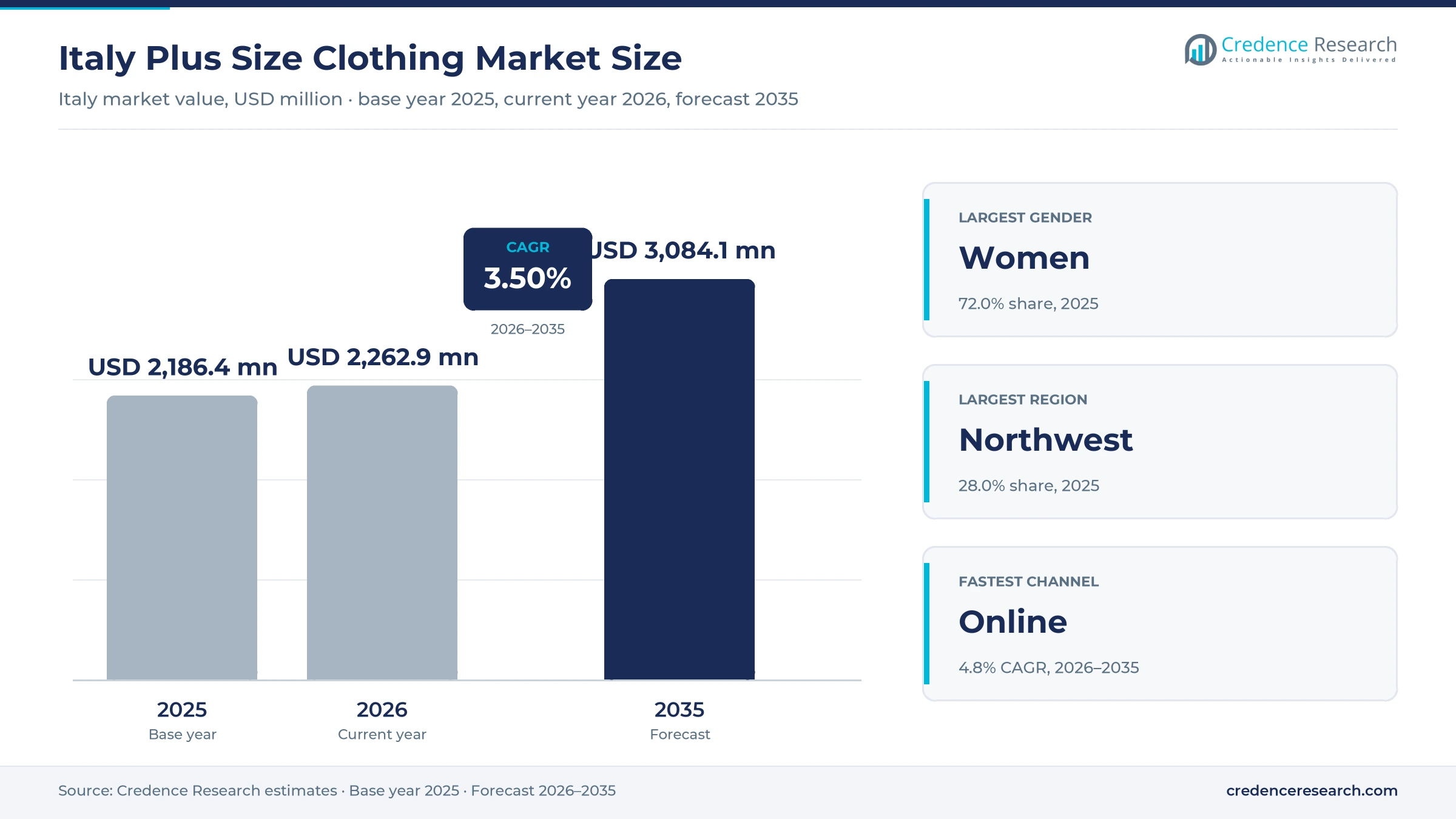
The Italy plus size clothing market was valued at USD 2.19 billion in 2025 and is projected to increase from USD 2.26 billion in 2026 to USD 3.08 billion by 2035, registering a CAGR of 3.50% during 2026–2035. Demand comes mainly from women who wear Italian size 48 and above and buy through specialist chains, mass fashion retailers and online platforms, with a smaller but faster-growing base of men who need extended fits. Northwest held the largest regional share, 28.0% in 2025, because household clothing budgets and store density are highest around Milan and Turin. South is the fastest-growing zone at 3.9% a year, as excess weight is most common there and low-price chains are adding stores in Naples. Law 149 of Oct. 3, 2025, recognized obesity as a chronic disease and called for social inclusion of people with obesity. A flat household clothing budget is the main restraint, because many shoppers now wait for promotions before buying.
Extended Italian sizes, not niche labels, define the scope
The market counts apparel sold to consumers in Italy in extended sizes, usually Italian size 48 and above for women and XXL and above for men, together with children's ranges cut for larger builds. It includes casual and formal wear, sportswear and inner wear sold by specialist brands such as Elena Mirò, Fiorella Rubino and Marina Rinaldi, by mass chains that carry extended size runs, and by online platforms that ship into Italy.
Footwear, accessories and made-to-measure tailoring are excluded, even when they are sold in the same stores. Value flows from design offices in Piedmont and Emilia-Romagna and from sourcing networks in Europe and Asia to single-brand stores, department store concessions, outlet villages and websites, with promotions and seasonal sales setting much of the realized price.
Italy Plus Size Clothing Market Insights
- The Italy plus size clothing market rises from USD 2.19 billion in 2025 to USD 3.08 billion by 2035, a 3.50% CAGR during 2026–2035, as obesity and aging enlarge the buyer base.
- Northwest held 28.0% of 2025 value, because clothing budgets, specialist stores and outlet villages cluster around Milan and Turin.
- Women led with 72.0% of 2025 value, because Italian specialists design mainly for women and most extended ranges are womenswear.
- ISTAT counted 46.4% of Italian adults in excess weight in 2025, with obesity up from 9.8% in 2015 to 11.6%, about 5.75 million people.
- A temporary EU customs duty of EUR 3 per item on parcels worth EUR 150 or less applied from July 1, 2026, narrowing the price gap with cross-border platforms.
Casual womenswear leads while sportswear and men gain
Casual wear leads while sportswear grows fastest
Based on type, the market is categorized into casual, formal, inner wear, sportswear and others. Casual led with 41.0% of 2025 value because knitwear, jeans and day dresses fill most extended-size shelves, and Elena Mirò built its autumn 2025 collection around knitwear and relaxed coats. Inner wear stays flat, as underwear spending fell 0.6% to EUR 1.83 billion in January to September 2025, according to national consumer panel data presented at the Pambianco summit in November 2025. Sportswear grows fastest at 4.7% a year, as running and athleisure move into daily wear, and Zalando calls sports one of its best-performing Italian categories, Il Sole 24 Ore reported in October 2026.
Womenswear leads while men's fits grow faster
Based on gender, the market is categorized into women, men and children. Women led with 72.0% of 2025 value because Italian specialists such as Marina Rinaldi and Miroglio's curvy labels design for women, and women's fashion spending held steady in the first half of 2025 while men's fell, according to Confcommercio Milano. Men grow fastest at 4.2% a year, as ISTAT counts 55.1% of adult men in excess weight against 38.2% of women, yet few brands offer tailored big-and-tall ranges in Italian stores. Children remain a small group that depends mainly on school-age ranges.
Mass pricing leads while premium gains on quality
Based on pricing, the market is categorized into mass, premium and luxury. Mass led with 61.0% of 2025 value because promotions are the first purchase driver for Italian fashion shoppers, ahead of quality and Made in Italy, according to an October 2025 Confcommercio Milano survey, and mass chains carry the widest extended size runs at low prices. Premium grows fastest at 4.0% a year, as the same panel data show rising interest in durable, quality and Made in Italy garments, which favors brands such as Elena Mirò and Persona by Marina Rinaldi that sell fit and fabric rather than price.
Stores lead while online grows on wider ranges
Based on distribution channel, the market is categorized into offline and online. Offline led with 76.0% of 2025 value because fit uncertainty is higher in larger sizes and shoppers still try garments on, and stores held 84.0% of Italian fashion value in 2025, the same panel data show. Online grows fastest at 4.8% a year, as platforms stock far more extended sizes than a single store can hold, and Italian online product sales passed EUR 40 billion in 2025, up 6%, according to the Netcomm and Politecnico di Milano observatory.
| Segment Group | Leading Sub-segment | Share, 2025 | Fastest-growing Sub-segment | CAGR, 2026–2035 |
|---|---|---|---|---|
| By Type | Casual | 41.0% | Sportswear | 4.7% |
| By Gender | Women | 72.0% | Men | 4.2% |
| By Pricing | Mass | 61.0% | Premium | 4.0% |
| By Distribution Channel | Offline | 76.0% | Online | 4.8% |
Fit and fabric, not size, set price tiers
Prices in Italian extended sizes follow the same tiers as standard fashion, from platform basics to premium coats made from Italian wool. Private labels on platforms anchor the entry tier, Italian mass specialists sit one step above, and premium labels charge for pattern grading, Italian fabrics and fit. Seasonal sales and promotions cut realized prices well below list, so margins depend on full-price sell-through. The listings below are observed list prices, and they show how wide the gap is between a private-label dress and a premium coat.
| Offer or brand tier | Typical price or fee | Basis |
|---|---|---|
| Platform private-label curvy dresses and tops | EUR 11 to EUR 40 per item | Zalando Italy listings, November 2026 |
| Fiorella Rubino dresses, blazers and trousers | EUR 48 to EUR 75 per item | Zalando Italy listings, November 2026 |
| Persona by Marina Rinaldi winter coats | EUR 150 to EUR 315 per coat | Zalando Italy listings, November 2026 |
| Elena Mirò knitwear and dresses | EUR 180 to EUR 295 per item | Zalando Italy listings, November 2026 |
| Marina Rinaldi virgin wool coat | EUR 1,450 list price | Harrods listing, November 2026 |
Request a Free Sample
Fill in your details and we'll send you a free sample report.
- Sample data tables & charts
- Research methodology
Body profile, Italian sizing and wider size runs lift sales
An older and heavier adult population widens the base
The share of Italians who need extended sizes is rising slowly but steadily, which keeps demand growing even while total clothing spending stalls. ISTAT reported that 46.4% of adults were in excess weight in 2025 and that obesity rose from 9.8% in 2015 to 11.6%, about 5.75 million people, while overweight edged down. One in four residents was 65 or older on Jan. 1, 2026, ISTAT demographic data show. Obesity is highest among people in their late sixties and early seventies, the same report shows, so aging shifts more buyers into larger and more comfortable cuts. Brands with mature customers and easy-fit patterns gain most from this shift.
Italian sizing leaves a large group outside standard ranges
Italian standard ranges often stop at size 46 or 48, which leaves a large group of women dependent on specialists and extended lines. More than 35% of Italian women wore sizes above 46 and one in five wore above 48, a 2018 consumer study reported by Panorama found, the most recent public reading, so current figures are an evidence gap. Elena Mirò now runs from size 40 to 56, hola.com reported in October 2025. Max Mara Fashion Group describes Marina Rinaldi as a plus fashion brand created in 1980 to cover a wide range of sizes. Specialists that grade patterns for curvier bodies hold loyal customers that mass chains rarely win back.
Online platforms solve the narrow-range problem of stores
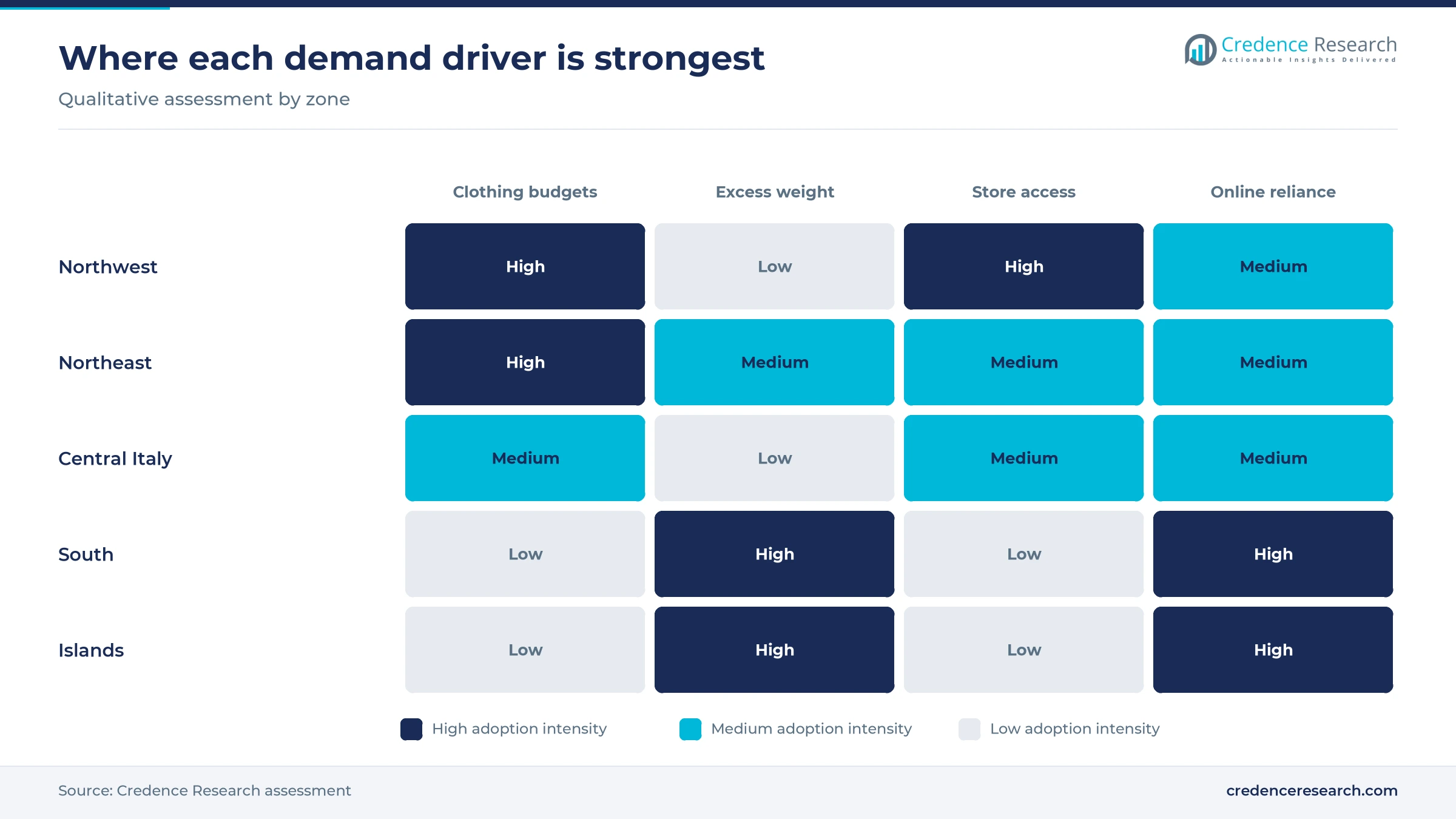
Online platforms let shoppers reach full extended size runs that most physical stores cannot stock, which matters more for larger sizes than for standard ones. Online held 16.0% of Italian fashion value in January to September 2025, up from 15.8% in 2024, as stores slipped from 84.2% to 84.0%, and pure online players gained share while independent stores kept closing, the same panel data show. Zalando calls Italy a key market and made its Zalando Plus loyalty program free, ItaliaOggi reported in February 2025, and its Italian site lists curvy private labels and brands such as Vero Moda Curve and Tommy Hilfiger Curve. Platforms with fit filters and free returns gain, while small boutiques with short size runs lose occasional buyers.
Mass chains are widening size runs and store networks
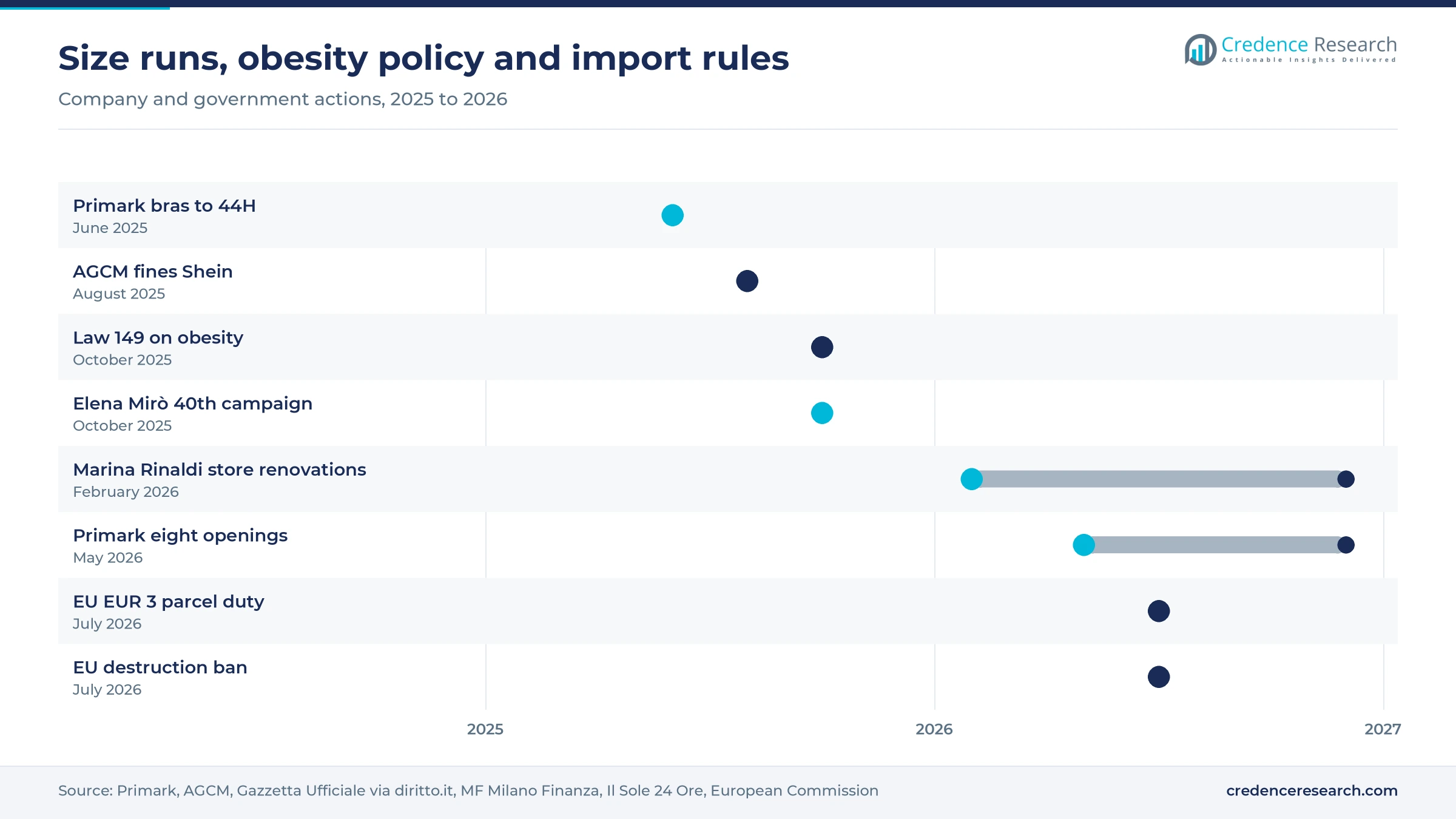
Mass chains are folding extended sizes into main collections, which brings larger fits into busier stores at lower prices. Mango completed the integration of more than 500 Violeta models, up to size 54, into its main womenswear line in August 2021, its pressroom says. Primark launched bras from 28AA to 44H in all its stores in June 2025, Primark said, a sign that lingerie ranges are widening too. Kiabi, which positions on low prices, ran 41 stores in Italy in 2024, ItaliaOggi reported. This spread of extended ranges favors shoppers on tight budgets but squeezes specialists that relied on being the only option.
Size-inclusive rebrands and import rules reshape supply
Specialists are shifting from plus-size labels to inclusive runs
Italian specialists are shifting from plus-size positioning toward inclusive size runs and single-brand identities to address younger buyers who reject the label, creating openings for redesigned stores and campaigns in womenswear. Elena Mirò added smaller sizes and a new logo in 2020, Textilwirtschaft reported, and marked its 40th anniversary in October 2025 with a campaign featuring women of different ages and bodies. Marina Rinaldi moved to a single label and a new logo, began renovating key stores in Düsseldorf, Palermo and London and plans Milan, Paris and Barcelona, MF Milano Finanza reported in February 2026. The shift widens the customer pool but blurs the specialist edge, so execution on fit decides who gains.
Regulators are raising scrutiny of ultra-cheap fashion imports
Regulators are shifting from tolerance toward scrutiny of cross-border fast fashion to address unfair price and claims competition, creating openings for domestic chains across mass extended sizes. The Italian competition authority fined the operator of Shein's European sites EUR 1 million on Aug. 4, 2025, for misleading environmental claims, AGCM said. A temporary EU customs duty of EUR 3 per item on consignments worth EUR 150 or less applied from July 1, 2026, until July 2028, the European Commission said. Platforms that sell fast fashion curvy ranges at very low prices face higher landed costs, which helps chains with Italian stores and warehouses.
Men's big-and-tall fits remain an underserved opening
Men who need extended fits form an underserved buyer group, because most Italian specialists design for women and many chains stop men's ranges at XXL. Excess weight affects more than half of adult men, and the gap with women exceeds 20 percentage points at ages 35 to 59, ISTAT's 2025 risk-factor report shows. Obesity among men aged 65 to 74 is the highest of any group. Men's fashion spending fell in the first half of 2025, Confcommercio Milano reported, which may reflect poor range fit as much as weak demand. Brands that add tailored shirts, trousers and workwear in XXL to 5XL can win a group that buys mainly online today.
Southern Italy offers room for extended-size stores
Southern Italy offers room for new extended-size stores, because excess weight is most common there while specialist and multi-brand stores cluster in the North. Excess weight reaches 51.5% of adults in Campania and 50.8% in Puglia, ISTAT data show. Independent multi-brand stores are concentrated in northern cities and the South has room to grow, store census data presented by Confcommercio Milano in October 2025 show. Primark plans eight Italian openings in 2026, including two in Naples, Il Sole 24 Ore reported in May 2026. Chains that bring full extended runs and women's sportswear into southern malls can capture demand that now leaks to websites.
Flat budgets, weight-loss drugs and stock rules weigh
Flat clothing budgets cap volume growth
Italian clothing spending fell 1.4% to EUR 10.1 billion in January to September 2025, and total fashion spending stayed 6.3% below 2019, the same panel data show. Store closures outnumbered openings among independent retailers in 2025, Confcommercio Milano reported. Independent plus-size boutiques with short size runs and high rents are most exposed, while chains with large promotional budgets and online reach can hold volume, though at lower margins.
Weight-loss drugs could shrink part of the base
GLP-1 drugs such as Wegovy and Mounjaro are not reimbursed for obesity in Italy and patients pay the full cost, Il Sole 24 Ore reported in June 2026, but France began reimbursing them on June 15, 2026, Euronews reported. The Italian Society for the Study of Obesity has asked national authorities for wider access. Wider use of anti-obesity drugs could move some buyers down one or two sizes, which most exposes brands concentrated in the largest sizes and their stock planning.
Wide size runs raise unsold stock under new EU rules
Extended size runs spread each style across more sizes, which raises the risk of slow-selling sizes at season end. The EU ban on destroying unsold clothes and shoes applied to large companies from July 19, 2026, and medium companies follow from 2030, the European Commission said, citing estimates that 4% to 9% of textiles placed on the European market are destroyed before use. Large chains with long size curves are most exposed and must sell, donate or recycle surplus.
Low-price platforms compress prices in entry ranges
Private-label curvy dresses and tops sell for about EUR 11 to EUR 40 on Zalando Italy in November 2026, against EUR 48 to EUR 75 for most Fiorella Rubino dresses and trousers on the same site. This gap pulls price-led shoppers toward platforms and private labels. Italian mass specialists are most exposed when promotions deepen, while the new EU parcel duty noted above narrows the gap only for goods shipped from outside the EU.
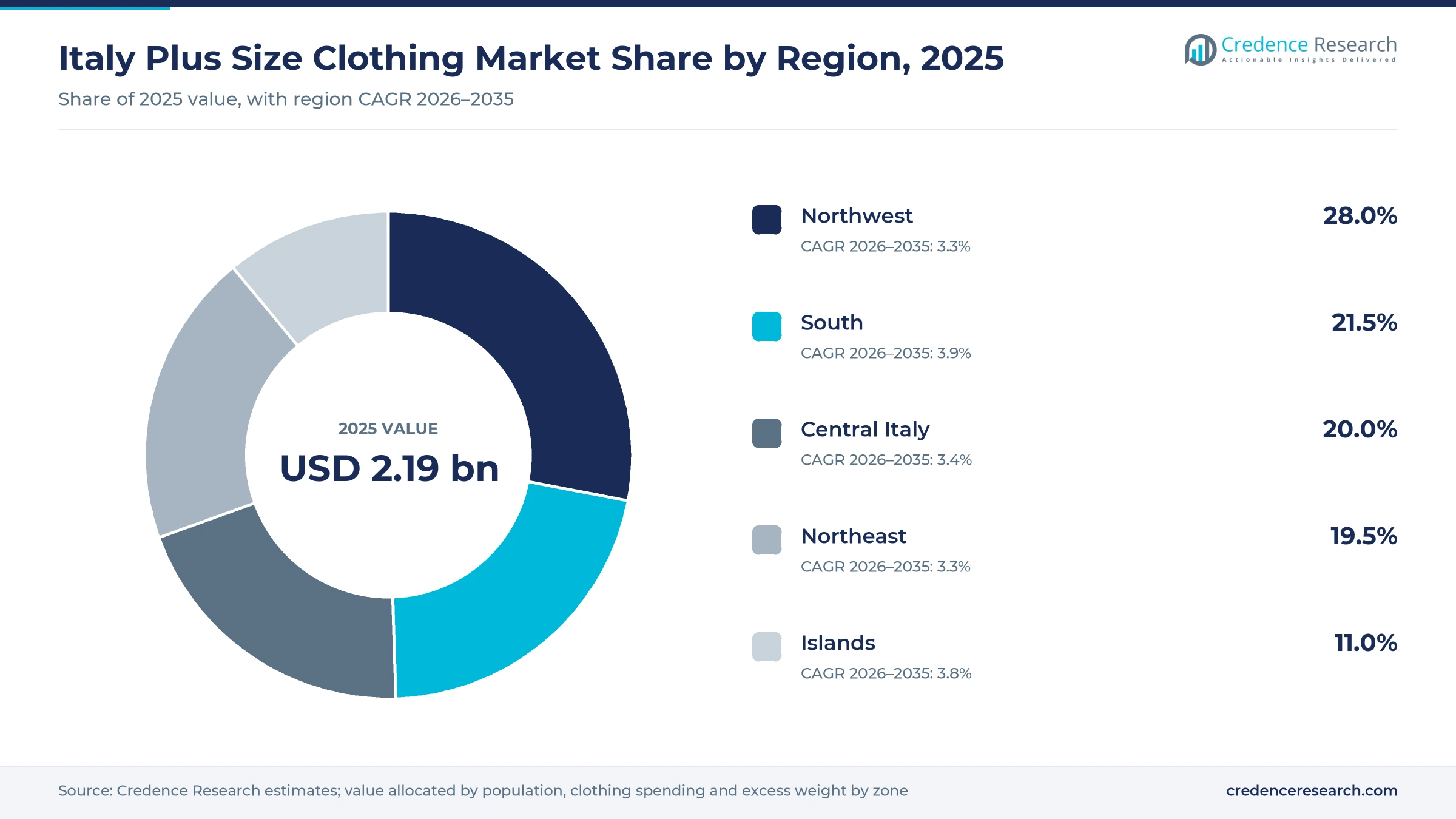
Milan area leads while the South grows fastest
| Region | Value, 2025 (USD billion) | Share, 2025 | CAGR, 2026–2035 |
|---|---|---|---|
| Northwest | 0.61 | 28.0% | 3.3% |
| South | 0.47 | 21.5% | 3.9% |
| Central Italy | 0.44 | 20.0% | 3.4% |
| Northeast | 0.43 | 19.5% | 3.3% |
| Islands | 0.24 | 11.0% | 3.8% |
Northwest leads on budgets and specialist stores
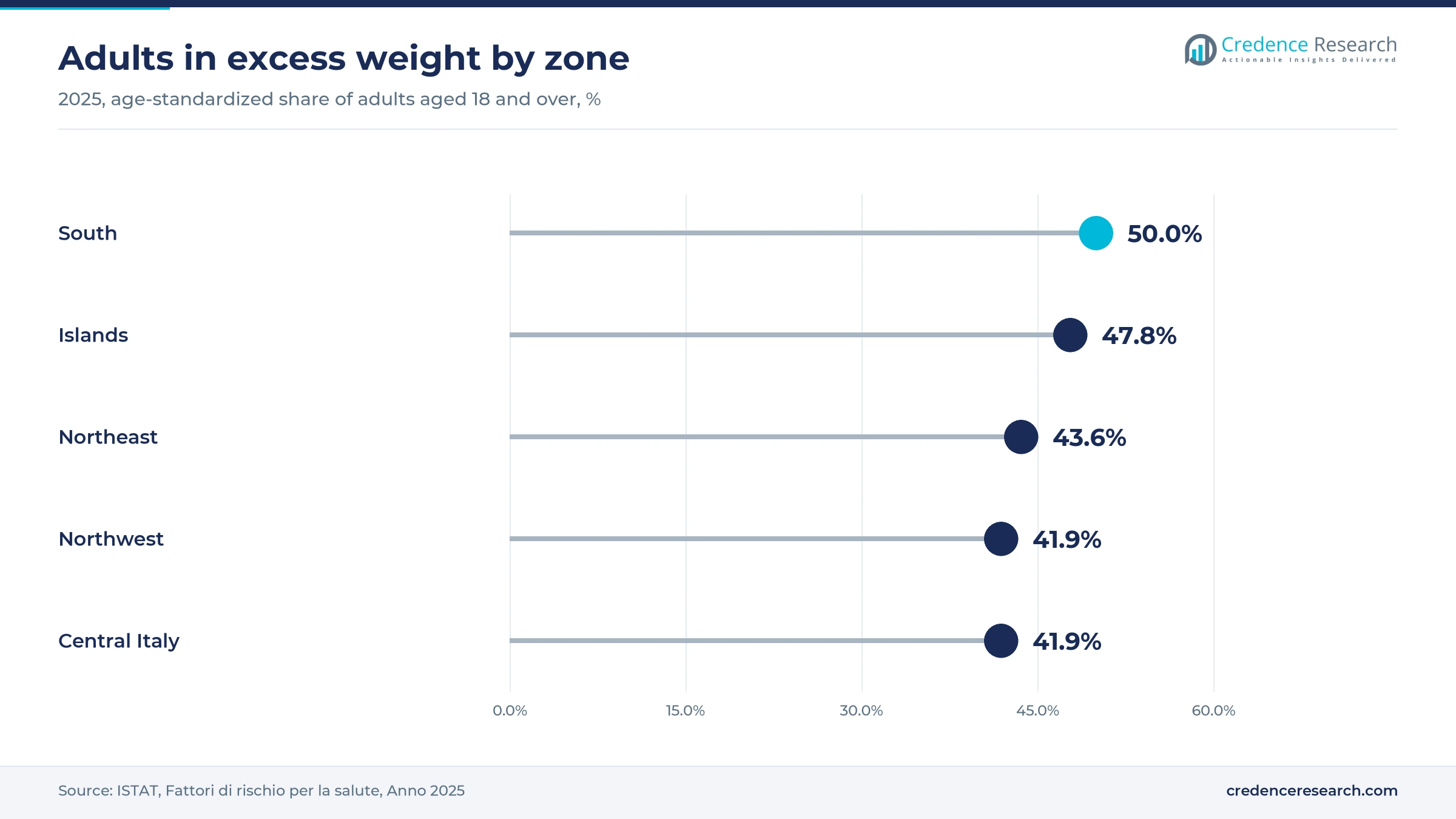
The Northwest held a regional share of 28.0% in 2025 and grows at 3.3% a year. The zone has 15.96 million residents, the largest population of the five, ISTAT data for year-end 2025 show, and the highest clothing budgets. Miroglio designs Elena Mirò and Fiorella Rubino in Alba, Piedmont and the Serravalle outlet in Piedmont sells Elena Mirò to shoppers from Milan, Turin and Genoa. Age-standardized excess weight is 41.9%, among the lowest, so value rests more on spending per buyer than on buyer numbers.
Northeast combines brand headquarters and steady demand
The Northeast held a regional share of 19.5% in 2025 and grows at 3.3% a year. The zone counts 11.62 million residents and age-standardized excess weight of 43.6%, ISTAT data show. Max Mara Fashion Group runs Marina Rinaldi from Reggio Emilia, and the Noventa di Piave outlet sells Elena Mirò. High household incomes support premium purchases, while growth stays near the national rate as the population ages.
Central Italy draws on Rome and new chain openings
Central Italy held a regional share of 20.0% in 2025 and grows at 3.4% a year. The zone has 11.70 million residents and age-standardized excess weight of 41.9%, ISTAT data show. Rome is the largest single city market, and Primark plans new stores in Rome, Perugia and Ancona in 2026, which adds low-price extended ranges to the zone. The Castel Romano outlet sells Elena Mirò, which keeps specialist ranges within reach of suburban shoppers.
South grows fastest on body profile and new stores
The South held a regional share of 21.5% in 2025 and grows at 3.9% a year, the fastest of the five zones. The zone has 13.34 million residents and age-standardized excess weight of 50.0%, the highest in Italy, ISTAT data show. Mono-brand stores carry less weight in the South than in the North, so chains and websites fill most demand. Primark's two planned Naples stores and the La Reggia outlet near Caserta, which sells Elena Mirò and Fiorella Rubino, widen access to extended sizes.
Islands depend on a few malls and online delivery
The Islands held a regional share of 11.0% in 2025 and grow at 3.8% a year. Sicily and Sardinia have 6.33 million residents and age-standardized excess weight of 47.8%, while Sicily alone reaches 50.0%, ISTAT data show. Marina Rinaldi has begun renovating its Palermo store, one of its key locations. Fewer specialist stores and longer delivery times leave the zone more reliant on online orders and on Palermo and Catania malls.
Rebrands, new stores and EU import duties
| Development | Status and market relevance |
|---|---|
| In August 2025, the Italian competition authority fined the operator of Shein's European sites EUR 1 million. | Completed decision over misleading environmental claims. |
| In October 2025, Italy enacted Law 149, recognizing obesity as a chronic, progressive and relapsing disease. | Enacted law; national programs funded from 2025 and an observatory set up. |
| In February 2026, Marina Rinaldi detailed its single-label rebrand and store renovations in Palermo and other cities. | Rebrand under way; Milan, Paris and Barcelona renovations planned. |
| In May 2026, Primark announced a EUR 62 million plan for eight Italian openings, reaching 28 stores. | Investment plan announced; openings scheduled through 2026. |
| In July 2026, a temporary EU duty of EUR 3 per item on low-value parcels came into application. | In force from July 1, 2026, until July 2028. |
Fit data, pattern grading and stock planning tools
- Fit recommendation engines match a shopper's past purchases and body data to the right size, which cuts returns on online orders of extended sizes.
- Curvy pattern grading reshapes patterns for fuller busts, hips and waists instead of scaling standard sizes up, which improves fit and repeat purchases.
- Size-curve demand planning sets how many units of each size to buy per store, which reduces unsold stock under the EU destruction ban.
- 3D virtual sampling tests fit on digital avatars of larger bodies before production, which shortens sampling rounds and cuts material waste.
Need a Custom Version of This Report?
Tailor the scope, geography, or segments to your exact requirements.
- Custom geography or segment scope
- Direct access to our analyst team
Italian specialists face mass chains and platforms
Competition in the Italy plus size clothing market splits between Italian specialists, mass chains and online platforms. Miroglio Group sells Elena Mirò and Fiorella Rubino through single-brand stores, outlet villages and Zalando, and invested EUR 6 million in its fashion business in 2025, MF Milano Finanza reported. Max Mara Fashion Group runs Marina Rinaldi and Persona at the premium end. OVS sells curvy womenswear lines through its national store network and website, which gives extended sizes the reach of a mass chain. H&M, Mango, Kiabi and Primark carry extended sizes in broad collections, while Nike and Adidas sell extended sizes in sportswear. Zalando, Shein and ASOS compete on the depth of their online size ranges. Buyers choose on fit, price and the chance to try garments on.
How is the supply side organized?
Supply to Italian shoppers runs in three tiers with very different economics. Italian specialists, led by Miroglio and Max Mara Fashion Group, design and grade patterns in house, own their stores and outlet units, and earn the highest gross margins. Mass chains such as OVS, H&M, Mango, Kiabi and Primark carry extended sizes inside broad collections and win on price and footfall. Platforms such as Zalando, Shein and ASOS hold the deepest size ranges with no store costs. Entry barriers sit in pattern grading, size-curve planning and prime store leases.
Specialists, mass chains and platforms selling extended sizes
| Company | Type | Role in the market |
|---|---|---|
| Miroglio Group (Elena Mirò, Fiorella Rubino) | Italian specialist | Designs and sells Elena Mirò and Fiorella Rubino curvy womenswear through stores and outlets |
| Max Mara Fashion Group (Marina Rinaldi) | Premium specialist | Sells Marina Rinaldi and Persona plus fashion through Italian stores |
| OVS | Mass fashion chain | Sells curvy womenswear lines through its Italian store network and website |
| H&M Hennes & Mauritz AB | Mass fashion chain | Sells extended-size womenswear and menswear in Italian stores and online |
| Mango | Mass fashion chain | Sells womenswear up to size 54 after integrating its Violeta line |
| Kiabi | Value fashion chain | Sells low-price family clothing, including extended sizes, through 41 Italian stores |
| Primark | Value fashion chain | Sells low-price apparel and bras up to 44H in Italian stores |
| Zalando | Online platform | Sells curvy brands and its own private labels to Italian shoppers |
| Shein | Online platform | Sells low-price curvy ranges to Italian shoppers through its websites |
| ASOS | Online platform | Ships its Curve range of extended womenswear sizes to Italy |
| Nike, Inc. | Sportswear brand | Sells extended-size sportswear through Italian retailers and online |
| Adidas AG | Sportswear brand | Sells extended-size sportswear through Italian retailers and online |
Value shifts to wide size runs and online fit tools
Credence Research's view is that value in Italian extended sizes is moving from niche plus-size labels toward wide size runs sold by chains and platforms, with specialists keeping the premium end through fit and fabric. Womenswear leads, but men's big-and-tall ranges and sportswear add value faster, and the South grows fastest as chains open stores. Weight-loss drugs are the main uncertainty, because reimbursement could shrink part of the largest-size base. Brands that plan size curves well, sell online with fit tools and keep stores in high-traffic malls should gain the most share.
Estimates rest on panel spending and body data
The report uses 2025 as the base year and 2026 to 2035 as the forecast period. The 2025 value is a new Credence Research estimate that replaces the earlier figure after a check against national clothing and underwear spending panels and the share of Italians who wear extended sizes. Market values come from the Credence Research model, and the regional, type, gender, pricing and channel splits are Credence Research estimates informed by public data. Sources include ISTAT health and population statistics, consumer spending panel data presented by trade associations, EU and Italian regulatory releases, company releases and retail listings, and business publishers. No interviews or surveys were used to build these estimates.
Aging, obesity policy and online fit set the path
Credence Research expects the market to reach USD 3.08 billion by 2035 as an older and heavier adult population needs larger and more comfortable fits, chains widen size runs and online platforms carry the deepest ranges. Growth is strongest in sportswear, men's fits and online sales, and in the South, while formal wear and the Northwest grow more slowly. The customs duty on low-value parcels and the EU destruction ban change how imported and surplus stock is priced. Weak clothing budgets and wider use of weight-loss drugs are the main risks to that path.
Body profile, drug access and prices set the range
The range to 2035 depends on how fast obesity and aging enlarge the buyer base, whether GLP-1 drugs become reimbursed and widely used in Italy, and whether household clothing budgets recover. Consumer panel projections presented in November 2025 put Italian clothing and footwear value growth at only 0.9% in 2026 and 1.2% in 2027, mostly from prices. Wider drug use and weak budgets would slow the market, while stronger men's ranges and southern store growth would lift it.
| Scenario | CAGR, 2026–2035 | Value, 2035 | What has to hold |
|---|---|---|---|
| Downside | 2.1% | USD 2.73 billion | GLP-1 drugs are reimbursed widely and clothing budgets keep falling in real terms |
| Base | 3.50% | USD 3.08 billion | Obesity and aging trends continue and chains keep widening extended size runs |
| Upside | 4.6% | USD 3.39 billion | Men's ranges expand, southern stores open and clothing budgets recover after 2027 |
Frequently Asked Questions
How big is the Italy plus size clothing market?
What share of Italian adults are overweight or obese?
Which Italian brands specialize in curvy womenswear?
How much do plus-size clothes cost in Italy?
Is online shopping growing for extended sizes in Italy?
Why does the South grow fastest?
How do EU import rules affect plus-size fashion prices?
Could weight-loss drugs reduce demand for larger sizes?
Table of Content
Chapter 1 Market Segmentation
- 1.1 Segmentation Framework
- 1.1.1 Product and Service Classification
- 1.1.2 Application and End-Use Classification
- 1.1.3 Technology and Solution Classification
- 1.1.4 Customer and Distribution Channel Classification
- 1.1.5 Geographic Segmentation
- 1.1.6 Market Segment Definitions and Boundaries
- 1.2 By Type
- 1.2.1 Casual
- 1.2.2 Inner Wear
- 1.2.3 Formal
- 1.2.4 Sportswear
- 1.2.5 Others
- 1.3 By Gender
- 1.3.1 Women
- 1.3.2 Men
- 1.3.3 Children
- 1.4 By Pricing
- 1.4.1 Mass
- 1.4.2 Premium
- 1.4.3 Luxury
Chapter 2 Introduction
- 2.1 Report Objectives and Scope
- 2.2 Product Definition and Industry Terminology
- 2.3 Market Inclusions and Exclusions
- 2.4 Research Process
- 2.4.1 Primary Research and Expert Interviews
- 2.4.2 Secondary Research and Source Review
- 2.4.3 Top-Down and Bottom-Up Estimation
- 2.4.4 Data Triangulation and Verification
- 2.5 Market Size Measurement Basis
- 2.5.1 2025: USD 2.19 billion → 2035: USD 3.08 billion
- 2.6 Historical and Forecast Reference Periods
- 2.6.1 Historical Period: 2018-2025
- 2.6.2 Base Year: 2025
- 2.6.3 Forecast Period: 2025-2035
- 2.7 Research Assumptions and Limitations
Chapter 3 Executive Summary
- 3.1 Market Snapshot and Key Findings
- 3.2 Base-Year Market Size, 2025
- 3.3 Forecast Market Size, 2035
- 3.4 Revenue and Volume Growth Outlook
- 3.5 Key Demand and Supply Indicators
- 3.6 Leading Market Segments
- 3.7 Fastest-Growing Market Opportunities
- 3.8 Regional Performance Highlights
- 3.9 Technology and Industry Transformation
- 3.10 Competitive Landscape Summary
- 3.11 Analyst View and Strategic Implications
Chapter 4 Italy Plus Size Clothing Market Trends and Developments
- 4.1 Historical Industry Development, 2018-2025
- 4.2 Recent Market Trends and Developments
- 4.3 Demand and Customer Behavior Trends
- 4.4 Technology and Product Innovation
- 4.5 Artificial Intelligence, Automation and Digitalization
- 4.6 Local Manufacturing and Supply Chain Realignment
- 4.7 Industry Partnerships, Mergers and Acquisitions
- 4.8 Sustainability and Circular Economy Developments
- 4.9 Government and Private Sector Investment Trends
- 4.10 Emerging Business Models and Commercialization
- 4.11 Industry Developments and Announcements
Chapter 5 Italy Plus Size Clothing Market Production, Supply and Demand Analysis
- 5.1 Demand Trend and Consumption Analysis, 2018-2025
- 5.2 Demand Forecast, 2025-2035
- 5.3 Production and Output Trend, 2018-2025
- 5.4 Production and Output Forecast, 2025-2035
- 5.5 Installed Capacity and Capacity Utilization
- 5.6 Company-Wise Production Plants and Statistics
- 5.6.1 Installed Production Capacity
- 5.6.2 Actual Production
- 5.6.3 Planned Capacity and Expansion Targets
- 5.7 Supply Chain Structure and Procurement Trends
- 5.8 Supply-Demand Gap and Bottlenecks
- 5.9 Import Dependence and Sourcing Structure
- 5.10 Contract Manufacturing and Outsourcing
- 5.11 Regional Supply and Demand Concentration
Chapter 6 Italy Plus Size Clothing Market Pricing Analysis
- 6.1 Pricing Structure and Measurement
- 6.2 Historical Pricing Trends, 2018-2025
- 6.3 Pricing Outlook, 2025-2035
- 6.4 Average Selling Price and Unit Economics
- 6.5 Pricing by Product and Market Segment
- 6.6 Geographic Pricing Differences
- 6.7 Key Input, Energy, Labor and Logistics Costs
- 6.8 Contract Pricing and Purchasing Models
- 6.9 Pricing Sensitivity and Competitive Positioning
- 6.10 Price, Margin and Profitability Implications
Chapter 7 Italy Plus Size Clothing Market Dynamics
- 7.1 Market Growth Drivers
- 7.1.1 Demand-Side Drivers
- 7.1.2 Technology and Innovation Drivers
- 7.1.3 Infrastructure and Investment Drivers
- 7.1.4 Regulatory and Policy Drivers
- 7.2 Market Restraints
- 7.2.1 Cost and Affordability Constraints
- 7.2.2 Technology and Adoption Barriers
- 7.2.3 Supply Chain and Operational Constraints
- 7.3 Market Challenges
- 7.3.1 Competitive Pressure and Margin Erosion
- 7.3.2 Skills, Infrastructure and Implementation Gaps
- 7.4 Emerging Market Opportunities
- 7.5 Market Dynamics Impact and Time-Horizon Assessment
Chapter 8 Italy Plus Size Clothing Value Chain Analysis
- 8.1 Industry Value Chain Overview
- 8.2 Upstream Suppliers and Critical Inputs
- 8.3 Technology and Component Providers
- 8.4 Manufacturing or Service Delivery
- 8.5 Distribution, Channel Partners and Integrators
- 8.6 Downstream Applications and End Users
- 8.7 Value Addition and Profit Pools
- 8.8 Vertical Integration and Outsourcing
- 8.9 Supplier Concentration and Risk
- 8.10 Supply Chain Localization and Resilience
Chapter 9 Italy Plus Size Clothing Market Regulations and Policies
- 9.1 Relevant Laws, Standards and Compliance Frameworks
- 9.2 Product, Service, Safety and Quality Requirements
- 9.3 Government Policies, Incentives and Subsidies
- 9.4 Imports, Exports and Trade Barriers
- 9.5 Public Procurement and Local Content Requirements
- 9.6 Environmental and Sustainability Compliance
- 9.7 Upcoming Policy Changes and Market Implications
Chapter 10 Italy Plus Size Clothing Market Hotspots and Opportunities
- 10.1 Market Opportunity Mapping and Growth Hotspots
- 10.2 High-Growth Applications and Customer Groups
- 10.3 Underserved Markets and White-Space Opportunities
- 10.4 Emerging Technology and Product Opportunities
- 10.5 New Capacity and Investment Hotspots
- 10.6 Market Entry and Expansion Opportunities
- 10.7 Distribution and Partnership Opportunities
- 10.8 Near-Term and Long-Term Commercial Potential
- 10.9 Opportunity Attractiveness and Execution Risks
Chapter 11 Italy Plus Size Clothing Market Outlook, 2025-2035
- 11.1 Market Size and Analysis
- 11.1.1 Revenue (Market Measurement: 2025: USD 2.19 billion → 2035: USD 3.08 billion)
- 11.1.2 Market Volume and Quantity Sold
- 11.1.3 Historical Market Size, 2018-2025
- 11.1.4 Base-Year Market Size, 2025
- 11.2 Market Forecast, 2025-2035
- 11.2.1 Revenue Forecast to 2035
- 11.2.2 Volume Forecast to 2035
- 11.2.3 CAGR and Year-on-Year Growth
- 11.2.4 Incremental Revenue Opportunity
- 11.3 Forecast Assumptions and Scenario Analysis
- 11.3.1 Base-Case Forecast
- 11.3.2 Optimistic and Conservative Scenarios
- 11.3.3 Technology, Pricing and Policy Sensitivities
- 11.4 Market Attractiveness and Growth Outlook
Chapter 12 Italy Plus Size Clothing Market Segmentation and Outlook
- 12.1 Segmentation Summary and Market Shares, 2025
- 12.2 Largest and Fastest-Growing Segments
- 12.3 By Type - Market Size and Forecast, 2025-2035
- 12.3.1 Segment Definition and Scope
- 12.3.2 Historical Market Size, 2018-2025
- 12.3.3 Revenue Forecast, 2025-2035
- 12.3.4 Volume Forecast, 2025-2035
- 12.3.5 Base-Year Market Share, 2025
- 12.3.6 Segment CAGR and Growth Drivers
- 12.3.7 Subsegment Market Size and Forecast
- 12.3.7.1 Casual
- 12.3.7.2 Inner Wear
- 12.3.7.3 Formal
- 12.3.7.4 Sportswear
- 12.3.7.5 Others
- 12.3.8 Subsegment Pricing and Adoption Trends
- 12.3.9 Leading Suppliers and Competition
- 12.3.10 Regional Demand and Opportunities
- 12.4 By Gender - Market Size and Forecast, 2025-2035
- 12.4.1 Segment Definition and Scope
- 12.4.2 Historical Market Size, 2018-2025
- 12.4.3 Revenue Forecast, 2025-2035
- 12.4.4 Volume Forecast, 2025-2035
- 12.4.5 Base-Year Market Share, 2025
- 12.4.6 Segment CAGR and Growth Drivers
- 12.4.7 Subsegment Market Size and Forecast
- 12.4.7.1 Women
- 12.4.7.2 Men
- 12.4.7.3 Children
- 12.4.8 Subsegment Pricing and Adoption Trends
- 12.4.9 Leading Suppliers and Competition
- 12.4.10 Regional Demand and Opportunities
- 12.5 By Pricing - Market Size and Forecast, 2025-2035
- 12.5.1 Segment Definition and Scope
- 12.5.2 Historical Market Size, 2018-2025
- 12.5.3 Revenue Forecast, 2025-2035
- 12.5.4 Volume Forecast, 2025-2035
- 12.5.5 Base-Year Market Share, 2025
- 12.5.6 Segment CAGR and Growth Drivers
- 12.5.7 Subsegment Market Size and Forecast
- 12.5.7.1 Mass
- 12.5.7.2 Premium
- 12.5.7.3 Luxury
- 12.5.8 Subsegment Pricing and Adoption Trends
- 12.5.9 Leading Suppliers and Competition
- 12.5.10 Regional Demand and Opportunities
- 12.6 Segment Growth Comparison
- 12.7 Segment Attractiveness and Priority Matrix
Chapter 13 Italy Plus Size Clothing Geographic Market Outlook, 2025-2035
- 13.1 Domestic Market Distribution and Demand Clusters
- 13.2 State- or Province-Wise Market Size and Forecast, 2025-2035
- 13.3 City and Metropolitan Market Outlook
- 13.4 Industrial, Manufacturing and Commercial Clusters
- 13.5 Geographic Concentration of Key End Users
- 13.6 Local Pricing and Purchasing Differences
- 13.7 Domestic Production Facilities and Capacity Map
- 13.8 Local Infrastructure and Project Pipeline
- 13.9 State-Level Policy and Incentive Differences
- 13.10 Subnational Investment Hotspots and Opportunities
- 13.11 Distribution and Logistics Networks
- 13.12 Domestic Competitive Footprint
Chapter 14 Italy Plus Size Clothing Technology, Innovation and Sustainability Outlook
- 14.1 Technology Landscape and Maturity
- 14.2 Product, Process and Service Innovation
- 14.3 AI, Automation and Digital Tools in the Industry
- 14.4 Technology Adoption and Performance Benchmarking
- 14.5 Innovation Pipeline and R&D Investment
- 14.6 Patent and Intellectual Property Trends
- 14.7 Energy Efficiency and Resource Management
- 14.8 Sustainability, Recycling and Circularity
- 14.9 Technology Roadmap, 2025-2035
- 14.10 Risks of Obsolescence and Technology Substitution
Chapter 15 Italy Plus Size Clothing Market Key Strategic Imperatives
- 15.1 Growth and Market Entry Priorities
- 15.2 High-Return Products and Segments
- 15.3 Pricing, Profitability and Cost Optimization
- 15.4 Technology Investment and Product Differentiation
- 15.5 Supply Chain Localization and Resilience
- 15.6 Distribution and Customer Acquisition
- 15.7 Partnership, Acquisition and Capacity Strategy
- 15.8 Regional Expansion Priorities
- 15.9 Short-, Medium- and Long-Term Actions
Chapter 16 Competition Outlook
- 16.1 Industry Competition Characteristics
- 16.2 Market Structure and Concentration
- 16.3 Market Share and Competitive Positioning, 2025
- 16.4 Company-Wise Revenue and Product Benchmarking
- 16.5 Production and Service Capacity Benchmarking
- 16.6 Technology, Pricing and Differentiation
- 16.7 Regional Footprint and Distribution Strength
- 16.8 Mergers, Acquisitions and Strategic Alliances
- 16.9 New Entrants and Competitive Threats
- 16.10 Porter's Five Forces and Industry Attractiveness
- 16.11 Competitive Outlook, 2025-2035
Chapter 17 Company Profiles
- 17.1 Company Coverage and Selection Criteria
- 17.2 Miroglio Group (Elena Mirò, Fiorella Rubino)
- 17.2.1 Business Description
- 17.2.2 Company Ownership and Geographic Presence
- 17.2.3 Product and Service Portfolio
- 17.2.4 Manufacturing and Operating Footprint
- 17.2.5 Production Capacity and Expansion Plans
- 17.2.6 Financial Performance and Investment
- 17.2.7 Market Share and Competitive Position
- 17.2.8 Technology and Innovation Capabilities
- 17.2.9 Strategic Alliances or Partnerships
- 17.2.10 Recent Developments
- 17.2.11 Growth Strategy and Outlook
- 17.3 Max Mara Fashion Group (Marina Rinaldi)
- 17.4 OVS
- 17.5 H&M Hennes & Mauritz AB
- 17.6 Mango
- 17.7 Kiabi
- 17.8 Primark
- 17.9 Zalando
- 17.10 Shein
- 17.11 ASOS
- 17.12 Nike, Inc.
- 17.13 Adidas AG
- 17.14 Other Relevant Market Participants
Note: Every listed company is profiled on the structure shown under the first company. The company list is preliminary and may change based on research findings, market developments, data availability and client requirements.
Chapter 18 Disclaimer
- 18.1 Research and Forecast Disclaimer
- 18.2 Data Source and Estimation Limitations
Note: The depth of individual sections depends on data availability for this market. Volume, capacity, trade and other unit-based metrics are included where applicable.