
Noodle seasonings and halal food plants anchor demand
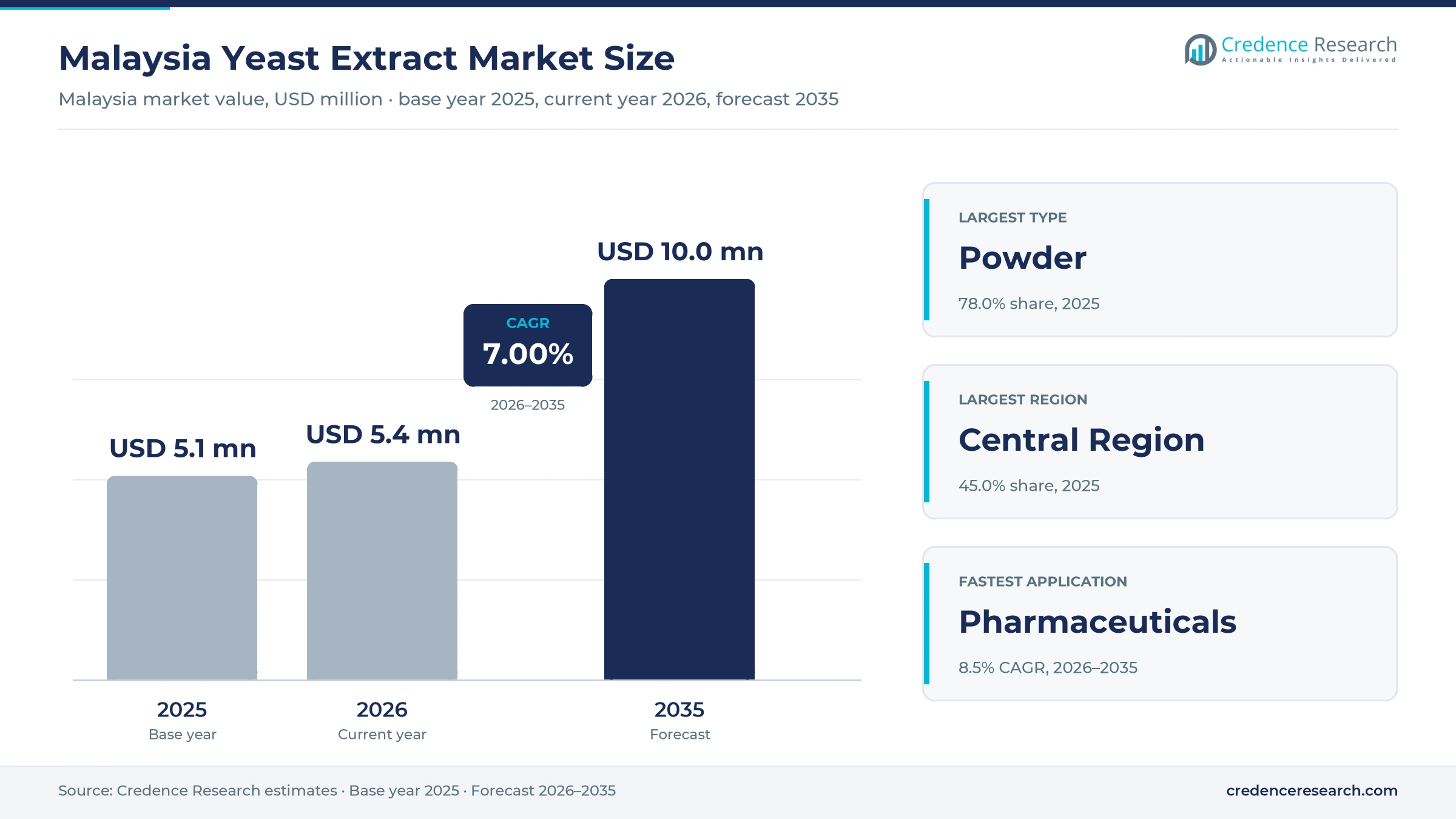
The Malaysia yeast extract market was valued at USD 5.06 million in 2025 and is projected to increase from USD 5.41 million in 2026 to USD 9.95 million by 2035, registering a CAGR of 7.00% during 2026–2035. Demand comes from instant noodle, bouillon, snack and sauce makers that use savory grades to build umami at lower salt, from feed and aquafeed mills that buy yeast nutrients, and from pharmaceutical fermentation plants that need nitrogen and vitamin sources. The Central Region held the largest share, 45.0% in 2025, because Selangor and Kuala Lumpur host most food plants and ingredient distributors. The Southern Region grows fastest at 7.6% a year, as food investment in Johor and Negeri Sembilan expands. The main commercial change is the Ministry of Health push to cut salt intake, which makes sodium content visible on every pack and turns yeast extract into a reformulation tool rather than a niche flavor.
Imported savory grades serve noodle, snack and feed makers
The market counts soluble extracts made by breaking down baker's or brewer's yeast cells through autolysis or added enzymes, then removing the cell walls and drying or concentrating the soluble fraction. Buyers are seasoning and noodle makers, snack and sauce producers, feed mills, pet food blenders and pharmaceutical plants, which mostly purchase imported powders and pastes through ingredient distributors on contract.
Live and dried baker's yeast, nutritional yeast flakes and yeast protein isolates are wider yeast products and sit outside this market, although several suppliers sell them through the same distributors. Retail yeast spreads are counted through the paste type, while finished seasoning blends that contain yeast extract are counted only for their yeast extract content.
Malaysia Yeast Extract Market Insights
- The Malaysia yeast extract market was valued at USD 5.06 million in 2025 and is projected to reach USD 9.95 million by 2035, growing at a 7.00% CAGR during 2026–2035.
- The Central Region held 45.0% of 2025 value, because Selangor and Kuala Lumpur together produced about 42% of national GDP in 2024.
- Powder held 78.0% of 2025 value, because noodle sachets, stock powders and snack seasonings all use dry enhancer blends.
- Malaysian adults ate 7.9 grams of salt a day in the MyCoSS survey, and the Health Ministry targets 5.5 grams by 2030.
- Pharmaceuticals grow fastest among applications at 8.5% a year during 2026–2035, as new biologics capacity raises demand for culture nutrients.
Powder and baker's yeast lead as pharma use grows fastest
Powder leads and grows fastest on dry seasoning demand
Based on type, the market is categorized into powder and paste. Powder led with 78.0% of 2025 value because seasoning plants blend dry enhancers into noodle sachets, stock powders and snack coatings, and Ajinomoto's TUMIX chicken stock, sold in 1-kilogram trade packs, lists yeast extracts alongside monosodium glutamate and ribonucleotides. Powder also grows fastest at 7.1% a year as snack and noodle makers reformulate dry seasonings for lower sodium. Paste demand rests mainly on retail spreads and food service sauces, which leaves it slower and more exposed to imported brand supply.
Food leads while pharmaceutical use grows fastest
Based on application, the market is categorized into food and beverages, pharmaceuticals, animal feed and others. Food & Beverages led with 72.0% of 2025 value because noodles, stocks, snacks and sauces carry most savory dosing, and Nestlé Malaysia says it has reduced added sodium in 58 products since 2017. Pharmaceutical use grows fastest at 8.5% a year from a small base, as the Puchong insulin plant described under opportunities moves to commercial production in 2026 and adds the country's first large local demand for fermentation nutrients.
Baker's yeast leads as halal rules favor molasses-grown extracts
Based on source, the market is categorized into baker's yeast and brewer's yeast. Baker's Yeast led with 82.0% of 2025 value and also grows fastest at 7.1% a year, because molasses-grown yeast gives halal buyers a clear certification trail, and AB Mauri says every product from its Balakong, Selangor, plant is certified halal by JAKIM. That trail matters to exporters whose halal product shipments reached RM61.79 billion in 2024. Brewer's yeast extract is mostly imported, because local spent yeast goes elsewhere, and Carlsberg Malaysia has sent its spent yeast to Veolia for black soldier fly bioconversion into insect feed since 2018.
| Segment Group | Leading Sub-segment | Share, 2025 | Fastest-growing Sub-segment | CAGR, 2026–2035 |
|---|---|---|---|---|
| By Type | Powder | 78.0% | Powder | 7.1% |
| By Application | Food & Beverages | 72.0% | Pharmaceuticals | 8.5% |
| By Source | Baker's Yeast | 82.0% | Baker's Yeast | 7.1% |
Pack size and enhancer blend set what buyers pay
Bulk yeast extract sells on contract at a few U.S. dollars per kilogram, while blended seasonings and retail powders carry brand and packing margins far above ingredient value. Monosodium glutamate sets the reference price for savory taste, so yeast extract must justify its premium through lower dosing, salt reduction or a cleaner label. Import prices move with freight, the ringgit and molasses costs at Chinese and European plants. Suppliers earn the highest margins on certified pharmaceutical and low-sodium grades, while feed grades compete with cheaper nucleotide sources.
| Product or grade | Typical price or fee | Basis |
|---|---|---|
| Savory yeast extract powder, bulk delivered | USD 5 to 9 per kg | Credence Research estimate from enhancer price points and import costs |
| Ajinomoto umami seasoning (MSG), 1 kg | RM15.00 per pack | Chai Hua Thin listing, November 2026 |
| TUMIX chicken stock with yeast extracts, 1 kg | RM16.10 per pack (RM17.50 list) | Ajinomoto Food Biz Partner shop, November 2026 |
| Lee Kum Kee mushroom powder with yeast extract, 200 g | RM12.00 per can | Watsons Malaysia listing, November 2026 |
Request a Free Sample
Fill in your details and we'll send you a free sample report.
- Sample data tables & charts
- Research methodology
Salt targets, noodle recipes and halal exports lift use
Salt reduction targets push savory reformulation
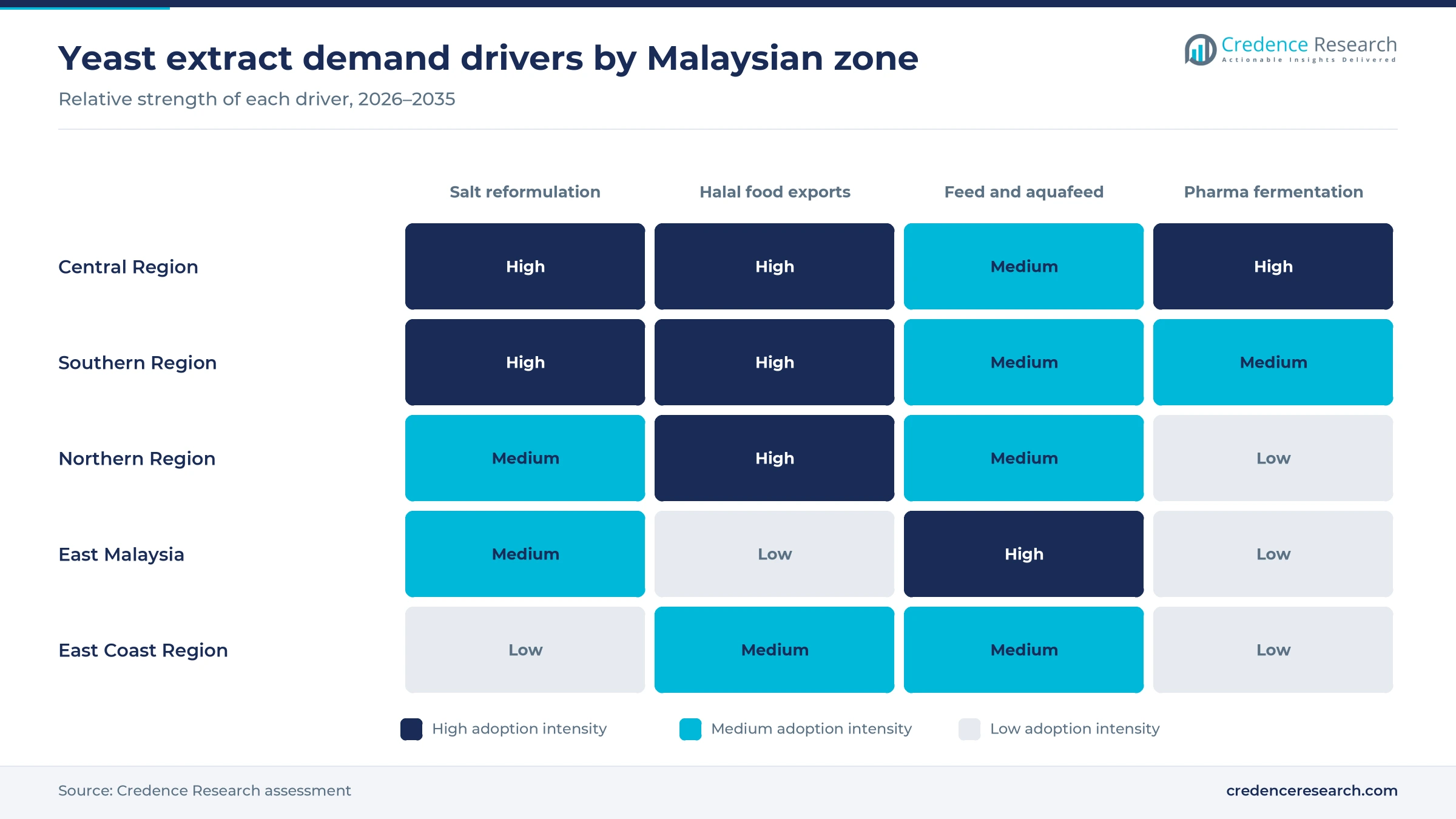
Food makers cut sodium in sauces, soups and seasonings under steady pressure from the Ministry of Health, and yeast extract lets them keep savory intensity at lower salt. The MyCoSS survey found adults ate 7.9 grams of salt a day and about 79% exceeded the WHO limit of 5 grams, according to a 2024 review of the national salt reduction strategy. The 2021–2025 strategy targets 6.0 grams a day by 2025 and 5.5 grams by 2030. NHMS 2024 data still show about 75% of adults above the recommended intake, the New Straits Times reported in April 2026. Sodium must also appear on the nutrition panel in milligrams per 100 grams or 100 milliliters, UN Malaysia notes, so shoppers can compare brands. Suppliers with low-sodium savory grades gain the first reformulation briefs.
Noodle and stock makers chase healthier choice criteria
Producers of instant noodles, stock powders and seasoning mixes use the most yeast extract, because every sachet needs a dense savory base at a low cost per pack. Malaysians ate 47 servings of instant noodles per person in the latest World Instant Noodles Association count, sixth highest worldwide and level with Japan, The Vibes reported in November 2025. The Ministry of Health's April 2025 Healthier Choice Logo criteria cap instant noodles at 700 milligrams of sodium per 100 grams, a level many soup bases exceed without enhancers. Angel Yeast reported in September 2026 that a yeast extract trial cut salt in instant noodles by 25% without a noticeable loss of saltiness. Noodle brands seeking the logo are the most immediate buyers of these grades.
Halal food exports need certified flavor inputs
Halal food exporters need flavor enhancers with clean certification trails, which favors yeast extract grown on molasses over animal-derived flavor bases. Halal product exports rose 15% to RM61.79 billion in 2024, Investment, Trade and Industry Minister Tengku Zafrul Aziz said, The Star reported. Ajinomoto (Malaysia) opened a halal-certified factory in the Bandar Enstek Halal Hub in December 2022, aiming to become a global halal production and specialty ingredients center. Mahsuri Food opened a JAKIM-certified sauce plant in Bandar Enstek on May 22, 2026, to export soy and oyster sauces to Southeast Asia, the Middle East and India, MIDA reported. Suppliers holding JAKIM-recognized certificates for each grade win export-oriented customers, while uncertified imports stay in non-halal channels.
Aquaculture and livestock feed widen nutrient demand
Feed mills and aquafeed producers buy yeast extract for nucleotides and palatability, so fish and livestock output sets a second demand base beside food. Aquaculture output reached about 511,000 tons in 2024, up from about 506,000 tons in 2023, The Star reported from fisheries data. Sales of manufactured prepared animal feed were about RM16.49 billion in 2021, and 139 MIDA-approved feed projects were operating at the end of March 2023 with RM3.8 billion invested. Cargill, CJ Bio and Win Men Biotech have moved into specialized feed additives in Malaysia, MIDA notes, which shows mills paying for inputs that improve feed conversion. Suppliers of feed additives with shrimp and broiler trial data gain most.
Blended enhancers and nearby yeast plants reshape supply
Seasoning makers are shifting to blended enhancer systems
Seasoning makers are shifting toward blended enhancer systems to address sodium and clean-label requirements, creating openings for yeast extract across stock powders, snack coatings and sauces. Lee Kum Kee's halal mushroom powder sold through Watsons Malaysia lists yeast extract with disodium inosinate and disodium guanylate as its flavor enhancers. About 702 products across more than 10 food groups carry the voluntary Healthier Choice Logo launched in April 2017, the strategy review notes, which rewards lower sodium formulas. Angel Yeast said in September 2026 that it has built customized enhancer systems for instant noodles, snacks, meat products and fermented condiments. Yeast extract therefore gains a share of the enhancer blend beside monosodium glutamate rather than replacing it outright.
Yeast capacity is rising in neighboring Indonesia
Global yeast groups are shifting production into Southeast Asia to address demand from fast-growing bakery and food sectors, creating shorter supply lines for Malaysian buyers of yeast and yeast derivatives. Lesaffre inaugurated a yeast plant in Malang, East Java, on Feb. 29, 2024, through PT Lesaffre Sari Nusa, to supply Indonesia and ASEAN countries. Angel Yeast said in October 2024 that it would put about USD 43.46 million into an 80% stake in a new Indonesian subsidiary in Lampung, and in June 2026 it described the Indonesian plant as under construction. Both announcements cover yeast output, and no yeast extract line has been confirmed, so the effect on extract prices remains an evidence gap.
Biologics plants open demand for nutrient grades
Pharmaceutical fermentation is an opening for nutrient-grade yeast extract, because microbes producing insulin, vaccines and enzymes need steady nitrogen, peptides and vitamins with full documentation. Pharmaniaga's Puchong plant, launched in September 2024 with capacity for 30 million insulin doses a year, could become a local buyer of such media inputs once production starts in 2026, and its biosimilar and vaccine plans would add volume. Lallemand Bio-Ingredients lists yeast extracts supplied from Brazil for sales markets that include Asia, which gives local plants a qualified import route for cell culture media ingredients. Suppliers with halal, animal-free and GMP-grade files capture margins well above food grades.
Pet food blenders open demand for palatant grades
Pet food is an opening for yeast extract palatants, because cats and dogs respond to the same savory peptides and nucleotides that food makers buy. Pet sales reached about RM699.4 million in 2022 and the local pet care sector grew 25% that year, with Selangor and Kuala Lumpur contributing most, according to Department of Statistics figures cited by Global Pet Industry. Pet care services alone generated about RM38.5 million in 2022, a sign that owners pay for premium care. No Malaysian pet food maker publishes its palatant use, so this opening is a Credence Research estimate built on pet sales growth rather than confirmed yeast extract contracts. Premium cat food blenders are the likeliest first buyers, because palatability decides repeat purchase in that category.
Cheap local MSG, halal checks and import exposure weigh
Low-cost local MSG caps savory grade prices
Locally made monosodium glutamate caps what price-sensitive buyers will pay for yeast extract, because both deliver glutamate-driven savory taste. Ajinomoto has produced halal umami seasoning in Malaysia since 1965, and a 1-kilogram pack retails for about RM15, as the pricing table shows. Imported yeast extract carries freight and distributor margins on top of that. Noodle makers, snack plants and food service operators on thin margins are most exposed, so suppliers must sell on dose efficiency.
Halal scrutiny restricts brewer's yeast grades
Brewer's yeast extract faces halal scrutiny because its feedstock comes from beer production, which halal buyers avoid. In neighboring Brunei, the Ministry of Religious Affairs ordered in November 2022 a brewer's yeast powder moved to the non-halal section of a supermarket because it came from an alcoholic beverage process, The Star reported. No comparable Malaysian ruling was found, so the exposure rests on certifier practice rather than a recorded case. Suppliers of brewer's yeast grades and their importers carry the exposure unless certificates trace every feedstock lot.
Import dependence exposes buyers to supply and currency swings
Malaysia has no publicly documented commercial yeast extract plant, so buyers rely on imported grades held by distributors, while AB Mauri's Balakong site makes baker's yeast rather than extract. The ringgit rose 10.2% against the U.S. dollar in 2025 after 2.7% in 2024, Bank Negara data show, which cut landed costs in 2025 but can reverse just as fast between contract rounds. Small seasoning makers without annual contracts are most exposed when shipments slip or prices reset.
Voluntary reformulation slows the policy pull on demand
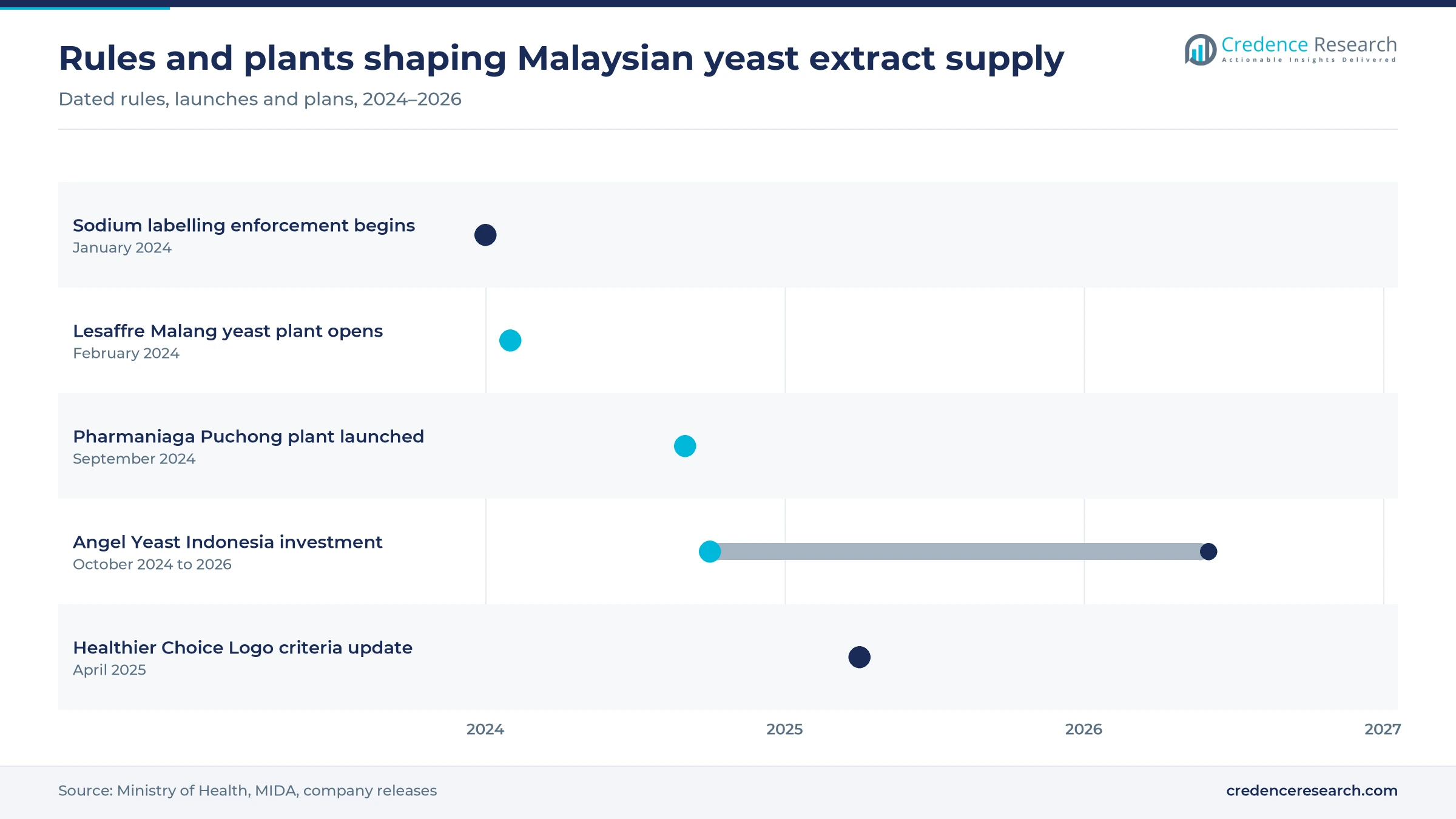
Salt reduction remains largely voluntary, so demand depends on how fast brand owners choose to reformulate. The strategy review counts 67 reformulated products with salt cut by 2% to 80%, while soy sauce and other sauces had not yet received the Healthier Choice Logo. Enforcement of mandatory sodium labelling was postponed to January 2024. Suppliers that planned capacity around fast policy-driven demand carry the most risk if reformulation stays at five or so products a year.
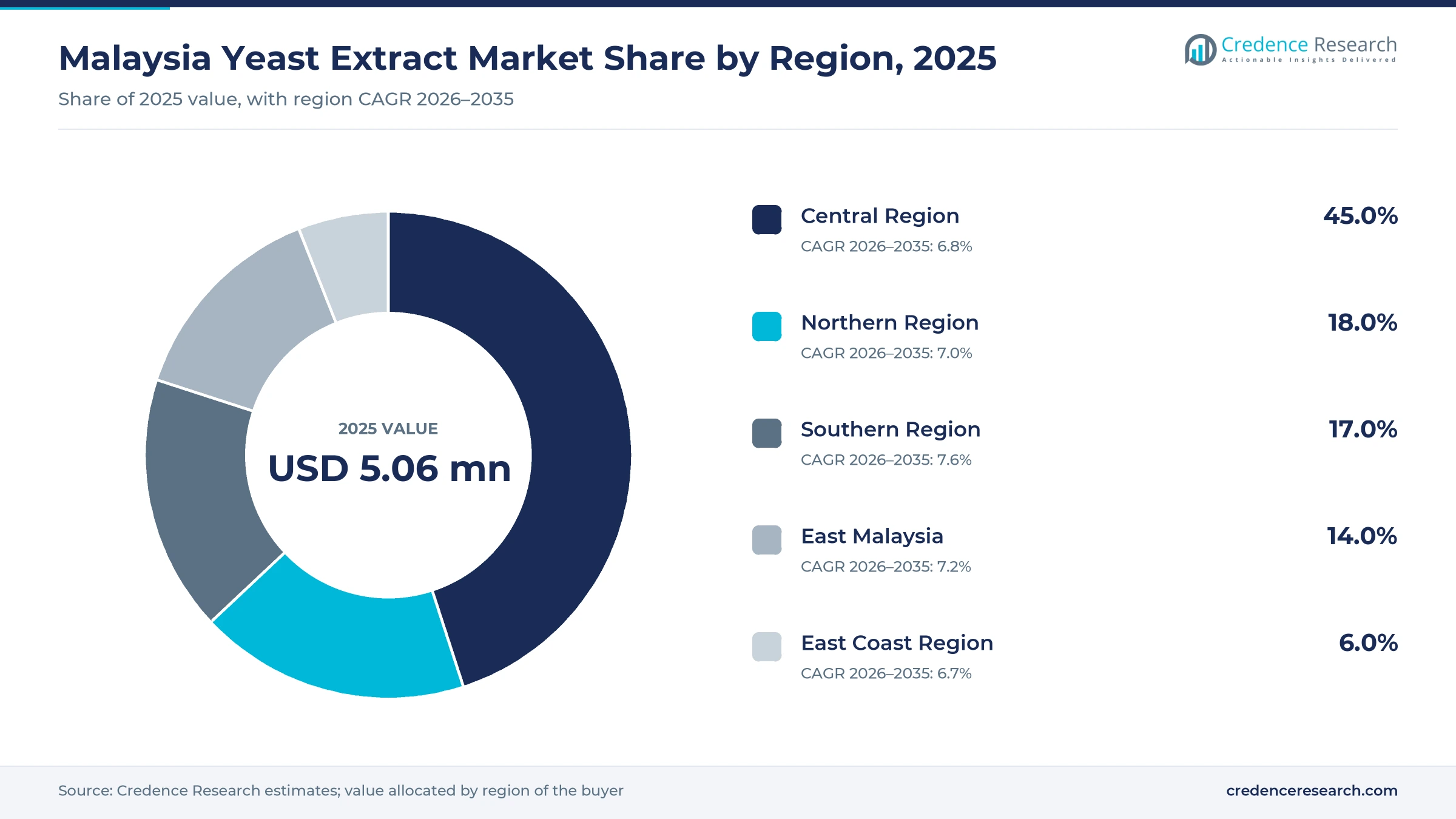
Central region leads while Southern Region grows fastest
| Region | Value, 2025 (USD million) | Share, 2025 | CAGR, 2026–2035 |
|---|---|---|---|
| Central Region | 2.3 | 45.0% | 6.8% |
| Northern Region | 0.9 | 18.0% | 7.0% |
| Southern Region | 0.9 | 17.0% | 7.6% |
| East Malaysia | 0.7 | 14.0% | 7.2% |
| East Coast Region | 0.3 | 6.0% | 6.7% |
Central region leads on food plants and distributors
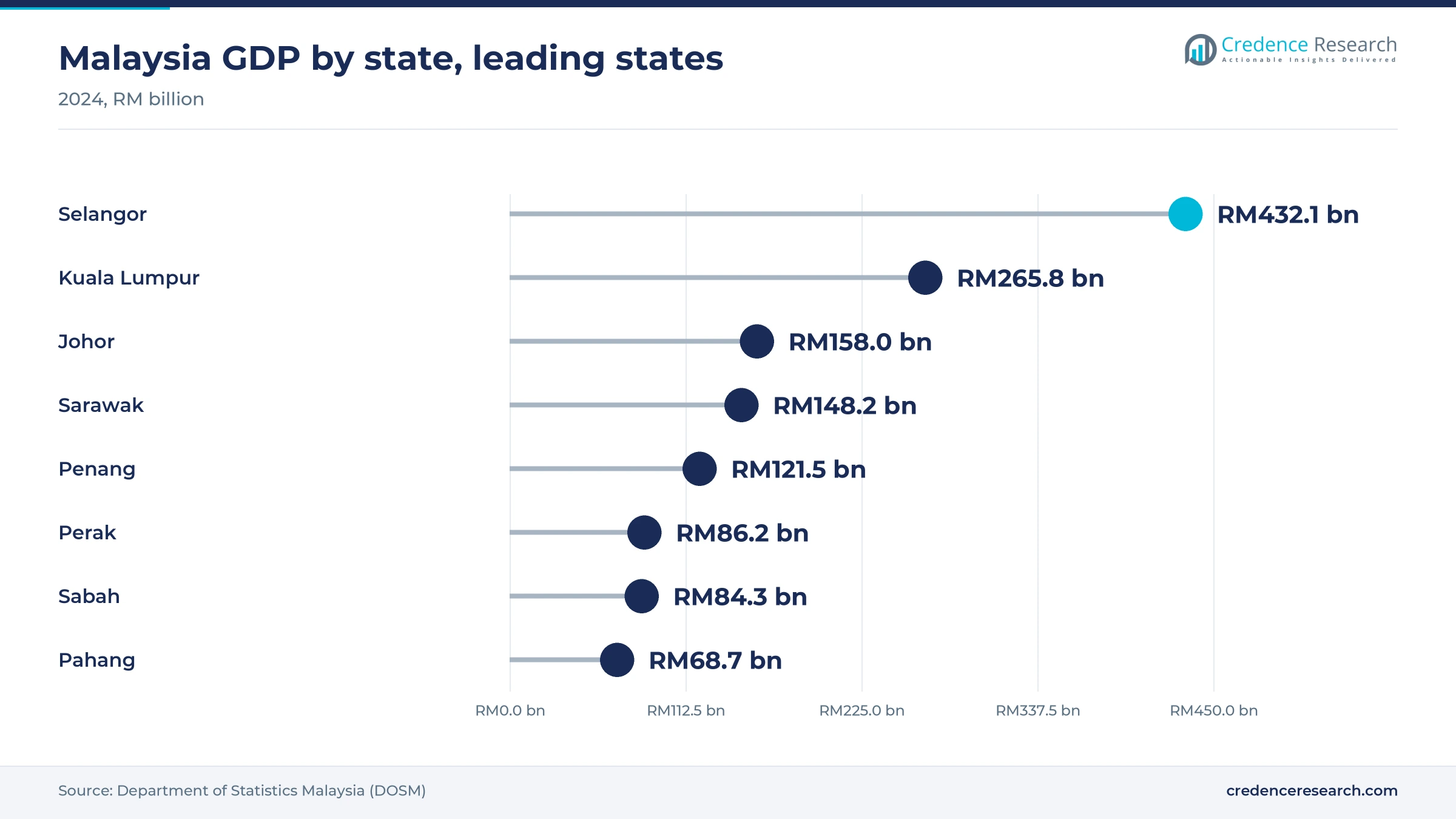
The Central Region, covering Selangor, Kuala Lumpur and Putrajaya, held 45.0% of 2025 value and grows at 6.8% a year. Selangor produced RM432.1 billion of GDP in 2024 and Kuala Lumpur RM265.8 billion, according to DOSM state GDP data. AB Mauri runs its baker's yeast plant and central warehouse at Balakong, and the Puchong biologics plant adds fermentation demand. Ingredient distributors serving seasoning, bakery and noodle plants hold their deepest stock in this zone, which keeps lead times shortest here.
Southern Region grows fastest on new food investment
The Southern Region, covering Johor, Negeri Sembilan and Melaka, held 17.0% of 2025 value and grows fastest at 7.6% a year. Ajinomoto's halal factory at Bandar Enstek and Hershey's Johor chocolate plant, a USD 250 million investment according to MIDA, anchor the zone's largest food processing sites, and the Tanjung Pelepas port suits importers of extract grades. New food and halal investment around Johor adds seasoning and snack lines faster than in older industrial zones, adding demand for savory powders.
Northern Region builds on Penang food exporters
The Northern Region, covering Penang, Perak, Kedah and Perlis, held 18.0% of 2025 value and grows at 7.0% a year. Penang produced RM121.5 billion of GDP in 2024 and Kedah RM54.0 billion, DOSM data show, so most zone value sits with Penang food exporters rather than the farm states. Snack and sauce exporters near Penang port are the main buyers, while Perak and Kedah feed mills take smaller feed-grade volumes. Zone-level demand data are thin, so the share is a Credence Research estimate.
East Malaysia grows from aquaculture and local food demand
East Malaysia, covering Sabah, Sarawak and Labuan, held 14.0% of 2025 value and grows at 7.2% a year. Sarawak's economy reached RM148.2 billion in 2024, DOSM data show, and shrimp and fish farms that buy feed grades, together with local noodle, sauce and bakery producers, account for most demand in the zone. Long shipping routes from Peninsular distributors raise delivered costs and favor larger, less frequent orders. The zone share is a Credence Research estimate from state output and population, because no local purchase data are published.
East Coast Region stays the smallest market
The East Coast Region, covering Pahang, Terengganu and Kelantan, held 6.0% of 2025 value and grows at 6.7% a year, the slowest pace. Fish processors, small seasoning makers and feed mills buy most volume, often through Klang Valley distributors rather than direct supplier accounts. Fewer large food plants operate in the zone, so reformulation briefs arrive later than in the Central and Southern regions. Pahang, the zone's largest economy, produced RM68.7 billion of GDP in 2024, according to DOSM, and because public data on ingredient use are thin, the share rests on such state output.
New regional plants and sodium rules mark 2024 to 2026
| Development | Status and market relevance |
|---|---|
| In February 2024, Lesaffre inaugurated a yeast plant in Malang, East Java, through PT Lesaffre Sari Nusa, to serve Indonesia and ASEAN. | Operational launch; it shortens baker's yeast supply lines into the region, while no extract line has been announced there. |
| In September 2024, Pharmaniaga launched an RM300 million biopharmaceutical plant in Puchong for insulin, vaccines and biosimilars. | Launch ceremony; commercial production is scheduled for 2026, after which it could become a local buyer of fermentation nutrients. |
| In October 2024, Angel Yeast announced a USD 43.46 million investment for an 80% stake in a new Indonesian subsidiary in Lampung. | Announced plan, described as under construction in June 2026; it adds regional yeast capacity close to Malaysian buyers. |
| In April 2025, the Ministry of Health issued updated Healthier Choice Logo nutrient criteria, capping instant noodle sodium at 700 mg per 100 g. | Approved guideline, voluntary for brands; it sets a sodium target that yeast extract helps noodle makers reach. |
Autolysis, hydrolysis and drying set taste and cost
- Autolysis lets the yeast's own enzymes break down proteins at controlled heat, which keeps costs low and gives a rounded savory taste.
- Enzymatic hydrolysis adds proteases and nucleases to raise free amino acids and nucleotides, which suppliers use for high-umami, low-dose grades.
- Spray drying turns the concentrate into a free-flowing powder, which uses much energy but suits noodle sachets and stock powders.
- Halal feedstock tracing documents molasses or brewery origin for every lot, which JAKIM-recognized certifiers check before Malaysian buyers approve a grade.
Need a Custom Version of This Report?
Tailor the scope, geography, or segments to your exact requirements.
- Custom geography or segment scope
- Direct access to our analyst team
Halal grades and local application labs decide position
Competition turns on halal certification, application support and the ability to deliver low-dose grades through local distributors. Lesaffre sells Biospringer extracts into the region and, since February 2024, runs a yeast plant in Malang, Indonesia, that serves ASEAN buyers. Associated British Foods competes through AB Mauri, which makes baker's yeast at Balakong, and through Ohly yeast extracts. Angel Yeast sells savory and halal-focused yeast extracts across Asia and is building capacity in Indonesia. Lallemand Bio-Ingredients, Leiber under Asahi Group Foods, Oriental Yeast and Mitsubishi Corporation Life Sciences through KOHJIN supply specialty and fermentation grades. Kerry supplies yeast-based umami ingredients made in Scotland and has five plant locations in Malaysia, which puts its taste teams close to local brand owners. Local seasoning makers such as Ajinomoto (Malaysia) are large buyers and, through monosodium glutamate, also the main price competitor.
Imported grades and a few global groups shape supply
The supply side is concentrated in a handful of global fermentation groups that sell into Malaysia through subsidiaries and ingredient distributors. Lesaffre through Biospringer, Angel Yeast, Associated British Foods through Ohly, Lallemand, Leiber and KOHJIN make extracts abroad, while AB Mauri's Balakong plant makes baker's yeast locally. Entry barriers are high, because a new extract plant needs fermenters, effluent treatment, steady molasses and halal approval. Margins sit with producers that hold certified grades and with distributors that run application labs for local seasoning makers.
Eight suppliers that Malaysian buyers shortlist
| Company | Type | Role in the market |
|---|---|---|
| Lesaffre Group (Biospringer) | Full-line supplier | Biospringer savory yeast extracts; Malang yeast plant serves ASEAN buyers |
| Angel Yeast Co., Ltd. | Full-line supplier | Savory, halal-focused yeast extracts for food, feed and fermentation buyers |
| Associated British Foods plc (AB Mauri, Ohly) | Yeast maker and specialist | AB Mauri baker's yeast from Balakong; Ohly yeast extracts and powders |
| Lallemand Inc. (Lallemand Bio-Ingredients) | Specialist | Yeast extracts and fermentation nutrients for food and industry |
| Leiber GmbH (Asahi Group Foods) | Specialist | Brewer's yeast extracts for seasonings, feed and culture media |
| Kerry Group plc | Taste and ingredient supplier | Yeast extract-based umami ingredients made in Scotland; taste systems from five Malaysian plants |
| Oriental Yeast Co., Ltd. | Specialist | Japanese yeast extracts and fermentation ingredients for food makers |
| Mitsubishi Corporation Life Sciences Limited (KOHJIN Life Sciences) | Specialist | KOHJIN yeast extracts for seasoning and food makers |
Value tilts toward low-sodium and certified grades
Credence Research's view is that value in Malaysia is moving from basic savory powders toward low-sodium, halal-documented and pharmaceutical grades, where consistency and certification earn higher prices. The market stays small and import-led, so distributor reach and application labs matter more than plant capacity. Monosodium glutamate keeps a firm ceiling on prices for noodle and snack grades. Buyers should qualify a second source for critical grades, because the import dependence described above leaves no domestic fallback.
Health surveys, trade data and plant records anchor it
The report uses 2025 as the base year and 2026 to 2035 as the forecast period. Market values come from the Credence Research model, checked against health survey data, instant noodle consumption, aquaculture and feed statistics, import price records, retail listings and company disclosures. Zone, type, application and source splits are Credence Research estimates built from these public sources and from DOSM state output. The estimates do not rely on interviews or surveys conducted by Credence Research, and no domestic yeast extract production data were available.
Sodium rules and halal exports carry growth to 2035
Value rises from USD 5.41 million in 2026 to USD 9.95 million by 2035, with low-sodium food grades and pharmaceutical nutrients adding a growing share. The Central Region keeps the largest base, while the Southern Region adds new volume as food and halal investment grows around Johor and Negeri Sembilan. The pace of voluntary reformulation, the ringgit and the price gap to monosodium glutamate will decide where growth lands within the scenario range. Suppliers with JAKIM-recognized grades and local application support are best placed to 2035.
Reformulation pace and halal exports decide the range
The base case assumes steady voluntary reformulation, continued halal food export growth and gradual uptake by biologics plants. The downside follows if salt reduction stays voluntary and slow, the ringgit weakens again and buyers fall back on cheaper monosodium glutamate. The upside requires binding sodium limits for noodles and sauces and faster expansion of pharmaceutical fermentation capacity around Selangor and Johor.
| Scenario | CAGR, 2026–2035 | Value, 2035 | What has to hold |
|---|---|---|---|
| Downside | 5.5% | USD 8.76 million | Reformulation stays slow and buyers fall back on cheaper monosodium glutamate blends |
| Base | 7.00% | USD 9.95 million | Voluntary salt cuts continue while halal food exports keep growing |
| Upside | 8.2% | USD 11.0 million | Binding sodium limits arrive and biologics plants scale up local fermentation |
Frequently Asked Questions
How big is the Malaysia yeast extract market?
Why do Malaysian food makers use yeast extract?
Is yeast extract sold in Malaysia halal?
Which yeast suppliers are active in Malaysia?
Which type and source lead the market?
Which region of Malaysia buys the most yeast extract?
How does yeast extract compare with MSG on price?
What limits growth in Malaysian yeast extract demand?
Table of Content
Chapter 1 Market Segmentation
- 1.1 Segmentation Framework
- 1.1.1 Product and Service Classification
- 1.1.2 Application and End-Use Classification
- 1.1.3 Technology and Solution Classification
- 1.1.4 Customer and Distribution Channel Classification
- 1.1.5 Geographic Segmentation
- 1.1.6 Market Segment Definitions and Boundaries
- 1.2 By Type
- 1.2.1 Powder
- 1.2.2 Paste
- 1.3 By Application
- 1.3.1 Food & Beverages
- 1.3.2 Pharmaceuticals
- 1.3.3 Animal Feed
- 1.3.4 Others
- 1.4 By Source
- 1.4.1 Baker's Yeast
- 1.4.2 Brewer's Yeast
Chapter 2 Introduction
- 2.1 Report Objectives and Scope
- 2.2 Product Definition and Industry Terminology
- 2.3 Market Inclusions and Exclusions
- 2.4 Research Process
- 2.4.1 Primary Research and Expert Interviews
- 2.4.2 Secondary Research and Source Review
- 2.4.3 Top-Down and Bottom-Up Estimation
- 2.4.4 Data Triangulation and Verification
- 2.5 Market Size Measurement Basis
- 2.5.1 2025: USD 5.06 million → 2035: USD 9.95 million
- 2.6 Historical and Forecast Reference Periods
- 2.6.1 Historical Period: 2018-2025
- 2.6.2 Base Year: 2025
- 2.6.3 Forecast Period: 2025-2035
- 2.7 Research Assumptions and Limitations
Chapter 3 Executive Summary
- 3.1 Market Snapshot and Key Findings
- 3.2 Base-Year Market Size, 2025
- 3.3 Forecast Market Size, 2035
- 3.4 Revenue and Volume Growth Outlook
- 3.5 Key Demand and Supply Indicators
- 3.6 Leading Market Segments
- 3.7 Fastest-Growing Market Opportunities
- 3.8 Regional Performance Highlights
- 3.9 Technology and Industry Transformation
- 3.10 Competitive Landscape Summary
- 3.11 Analyst View and Strategic Implications
Chapter 4 Malaysia Yeast Extract Market Trends and Developments
- 4.1 Historical Industry Development, 2018-2025
- 4.2 Recent Market Trends and Developments
- 4.3 Demand and Customer Behavior Trends
- 4.4 Technology and Product Innovation
- 4.5 Artificial Intelligence, Automation and Digitalization
- 4.6 Local Manufacturing and Supply Chain Realignment
- 4.7 Industry Partnerships, Mergers and Acquisitions
- 4.8 Sustainability and Circular Economy Developments
- 4.9 Government and Private Sector Investment Trends
- 4.10 Emerging Business Models and Commercialization
- 4.11 Industry Developments and Announcements
Chapter 5 Malaysia Yeast Extract Market Production, Supply and Demand Analysis
- 5.1 Demand Trend and Consumption Analysis, 2018-2025
- 5.2 Demand Forecast, 2025-2035
- 5.3 Production and Output Trend, 2018-2025
- 5.4 Production and Output Forecast, 2025-2035
- 5.5 Installed Capacity and Capacity Utilization
- 5.6 Company-Wise Production Plants and Statistics
- 5.6.1 Installed Production Capacity
- 5.6.2 Actual Production
- 5.6.3 Planned Capacity and Expansion Targets
- 5.7 Supply Chain Structure and Procurement Trends
- 5.8 Supply-Demand Gap and Bottlenecks
- 5.9 Import Dependence and Sourcing Structure
- 5.10 Contract Manufacturing and Outsourcing
- 5.11 Regional Supply and Demand Concentration
Chapter 6 Malaysia Yeast Extract Market Pricing Analysis
- 6.1 Pricing Structure and Measurement
- 6.2 Historical Pricing Trends, 2018-2025
- 6.3 Pricing Outlook, 2025-2035
- 6.4 Average Selling Price and Unit Economics
- 6.5 Pricing by Product and Market Segment
- 6.6 Geographic Pricing Differences
- 6.7 Key Input, Energy, Labor and Logistics Costs
- 6.8 Contract Pricing and Purchasing Models
- 6.9 Pricing Sensitivity and Competitive Positioning
- 6.10 Price, Margin and Profitability Implications
Chapter 7 Malaysia Yeast Extract Market Dynamics
- 7.1 Market Growth Drivers
- 7.1.1 Demand-Side Drivers
- 7.1.2 Technology and Innovation Drivers
- 7.1.3 Infrastructure and Investment Drivers
- 7.1.4 Regulatory and Policy Drivers
- 7.2 Market Restraints
- 7.2.1 Cost and Affordability Constraints
- 7.2.2 Technology and Adoption Barriers
- 7.2.3 Supply Chain and Operational Constraints
- 7.3 Market Challenges
- 7.3.1 Competitive Pressure and Margin Erosion
- 7.3.2 Skills, Infrastructure and Implementation Gaps
- 7.4 Emerging Market Opportunities
- 7.5 Market Dynamics Impact and Time-Horizon Assessment
Chapter 8 Malaysia Yeast Extract Value Chain Analysis
- 8.1 Industry Value Chain Overview
- 8.2 Upstream Suppliers and Critical Inputs
- 8.3 Technology and Component Providers
- 8.4 Manufacturing or Service Delivery
- 8.5 Distribution, Channel Partners and Integrators
- 8.6 Downstream Applications and End Users
- 8.7 Value Addition and Profit Pools
- 8.8 Vertical Integration and Outsourcing
- 8.9 Supplier Concentration and Risk
- 8.10 Supply Chain Localization and Resilience
Chapter 9 Malaysia Yeast Extract Market Regulations and Policies
- 9.1 Relevant Laws, Standards and Compliance Frameworks
- 9.2 Product, Service, Safety and Quality Requirements
- 9.3 Government Policies, Incentives and Subsidies
- 9.4 Imports, Exports and Trade Barriers
- 9.5 Public Procurement and Local Content Requirements
- 9.6 Environmental and Sustainability Compliance
- 9.7 Upcoming Policy Changes and Market Implications
Chapter 10 Malaysia Yeast Extract Market Hotspots and Opportunities
- 10.1 Market Opportunity Mapping and Growth Hotspots
- 10.2 High-Growth Applications and Customer Groups
- 10.3 Underserved Markets and White-Space Opportunities
- 10.4 Emerging Technology and Product Opportunities
- 10.5 New Capacity and Investment Hotspots
- 10.6 Market Entry and Expansion Opportunities
- 10.7 Distribution and Partnership Opportunities
- 10.8 Near-Term and Long-Term Commercial Potential
- 10.9 Opportunity Attractiveness and Execution Risks
Chapter 11 Malaysia Yeast Extract Market Outlook, 2025-2035
- 11.1 Market Size and Analysis
- 11.1.1 Revenue (Market Measurement: 2025: USD 5.06 million → 2035: USD 9.95 million)
- 11.1.2 Market Volume and Quantity Sold
- 11.1.3 Historical Market Size, 2018-2025
- 11.1.4 Base-Year Market Size, 2025
- 11.2 Market Forecast, 2025-2035
- 11.2.1 Revenue Forecast to 2035
- 11.2.2 Volume Forecast to 2035
- 11.2.3 CAGR and Year-on-Year Growth
- 11.2.4 Incremental Revenue Opportunity
- 11.3 Forecast Assumptions and Scenario Analysis
- 11.3.1 Base-Case Forecast
- 11.3.2 Optimistic and Conservative Scenarios
- 11.3.3 Technology, Pricing and Policy Sensitivities
- 11.4 Market Attractiveness and Growth Outlook
Chapter 12 Malaysia Yeast Extract Market Segmentation and Outlook
- 12.1 Segmentation Summary and Market Shares, 2025
- 12.2 Largest and Fastest-Growing Segments
- 12.3 By Type - Market Size and Forecast, 2025-2035
- 12.3.1 Segment Definition and Scope
- 12.3.2 Historical Market Size, 2018-2025
- 12.3.3 Revenue Forecast, 2025-2035
- 12.3.4 Volume Forecast, 2025-2035
- 12.3.5 Base-Year Market Share, 2025
- 12.3.6 Segment CAGR and Growth Drivers
- 12.3.7 Subsegment Market Size and Forecast
- 12.3.7.1 Powder
- 12.3.7.2 Paste
- 12.3.8 Subsegment Pricing and Adoption Trends
- 12.3.9 Leading Suppliers and Competition
- 12.3.10 Regional Demand and Opportunities
- 12.4 By Application - Market Size and Forecast, 2025-2035
- 12.4.1 Segment Definition and Scope
- 12.4.2 Historical Market Size, 2018-2025
- 12.4.3 Revenue Forecast, 2025-2035
- 12.4.4 Volume Forecast, 2025-2035
- 12.4.5 Base-Year Market Share, 2025
- 12.4.6 Segment CAGR and Growth Drivers
- 12.4.7 Subsegment Market Size and Forecast
- 12.4.7.1 Food & Beverages
- 12.4.7.2 Pharmaceuticals
- 12.4.7.3 Animal Feed
- 12.4.7.4 Others
- 12.4.8 Subsegment Pricing and Adoption Trends
- 12.4.9 Leading Suppliers and Competition
- 12.4.10 Regional Demand and Opportunities
- 12.5 By Source - Market Size and Forecast, 2025-2035
- 12.5.1 Segment Definition and Scope
- 12.5.2 Historical Market Size, 2018-2025
- 12.5.3 Revenue Forecast, 2025-2035
- 12.5.4 Volume Forecast, 2025-2035
- 12.5.5 Base-Year Market Share, 2025
- 12.5.6 Segment CAGR and Growth Drivers
- 12.5.7 Subsegment Market Size and Forecast
- 12.5.7.1 Baker's Yeast
- 12.5.7.2 Brewer's Yeast
- 12.5.8 Subsegment Pricing and Adoption Trends
- 12.5.9 Leading Suppliers and Competition
- 12.5.10 Regional Demand and Opportunities
- 12.6 Segment Growth Comparison
- 12.7 Segment Attractiveness and Priority Matrix
Chapter 13 Malaysia Yeast Extract End-Use and Application Market Outlook
- 13.1 End-Use Industry and Customer Demand Structure
- 13.2 Leading Applications and Customer Groups
- 13.3 End-Use Market Size, Share and Forecast
- 13.4 Major End-Use Industry Deep Dives
- 13.4.1 Customer Requirements and Use Cases
- 13.4.2 Demand and Replacement Cycles
- 13.4.3 Technical and Regulatory Considerations
- 13.4.4 Purchasing and Procurement Models
- 13.4.5 Leading Vendors and Distribution Channels
- 13.4.6 Forecast and Commercial Opportunities
- 13.5 Emerging Applications and Cross-Segment Demand
- 13.6 End-Use Industry Investment Priorities
Chapter 14 Malaysia Yeast Extract Geographic Market Outlook, 2025-2035
- 14.1 Domestic Market Distribution and Demand Clusters
- 14.2 State- or Province-Wise Market Size and Forecast, 2025-2035
- 14.3 City and Metropolitan Market Outlook
- 14.4 Industrial, Manufacturing and Commercial Clusters
- 14.5 Geographic Concentration of Key End Users
- 14.6 Local Pricing and Purchasing Differences
- 14.7 Domestic Production Facilities and Capacity Map
- 14.8 Local Infrastructure and Project Pipeline
- 14.9 State-Level Policy and Incentive Differences
- 14.10 Subnational Investment Hotspots and Opportunities
- 14.11 Distribution and Logistics Networks
- 14.12 Domestic Competitive Footprint
Chapter 15 Malaysia Yeast Extract Technology, Innovation and Sustainability Outlook
- 15.1 Technology Landscape and Maturity
- 15.2 Product, Process and Service Innovation
- 15.3 AI, Automation and Digital Tools in the Industry
- 15.4 Technology Adoption and Performance Benchmarking
- 15.5 Innovation Pipeline and R&D Investment
- 15.6 Patent and Intellectual Property Trends
- 15.7 Energy Efficiency and Resource Management
- 15.8 Sustainability, Recycling and Circularity
- 15.9 Technology Roadmap, 2025-2035
- 15.10 Risks of Obsolescence and Technology Substitution
Chapter 16 Malaysia Yeast Extract Market Key Strategic Imperatives
- 16.1 Growth and Market Entry Priorities
- 16.2 High-Return Products and Segments
- 16.3 Pricing, Profitability and Cost Optimization
- 16.4 Technology Investment and Product Differentiation
- 16.5 Supply Chain Localization and Resilience
- 16.6 Distribution and Customer Acquisition
- 16.7 Partnership, Acquisition and Capacity Strategy
- 16.8 Regional Expansion Priorities
- 16.9 Short-, Medium- and Long-Term Actions
Chapter 17 Competition Outlook
- 17.1 Industry Competition Characteristics
- 17.2 Market Structure and Concentration
- 17.3 Market Share and Competitive Positioning, 2025
- 17.4 Company-Wise Revenue and Product Benchmarking
- 17.5 Production and Service Capacity Benchmarking
- 17.6 Technology, Pricing and Differentiation
- 17.7 Regional Footprint and Distribution Strength
- 17.8 Mergers, Acquisitions and Strategic Alliances
- 17.9 New Entrants and Competitive Threats
- 17.10 Porter's Five Forces and Industry Attractiveness
- 17.11 Competitive Outlook, 2025-2035
Chapter 18 Company Profiles
- 18.1 Company Coverage and Selection Criteria
- 18.2 Lesaffre Group (Biospringer)
- 18.2.1 Business Description
- 18.2.2 Company Ownership and Geographic Presence
- 18.2.3 Product and Service Portfolio
- 18.2.4 Manufacturing and Operating Footprint
- 18.2.5 Production Capacity and Expansion Plans
- 18.2.6 Financial Performance and Investment
- 18.2.7 Market Share and Competitive Position
- 18.2.8 Technology and Innovation Capabilities
- 18.2.9 Strategic Alliances or Partnerships
- 18.2.10 Recent Developments
- 18.2.11 Growth Strategy and Outlook
- 18.3 Angel Yeast Co., Ltd.
- 18.4 Associated British Foods plc (AB Mauri, Ohly)
- 18.5 Lallemand Inc. (Lallemand Bio-Ingredients)
- 18.6 Leiber GmbH (Asahi Group Foods)
- 18.7 Kerry Group plc
- 18.8 Oriental Yeast Co., Ltd.
- 18.9 Mitsubishi Corporation Life Sciences Limited (KOHJIN Life Sciences)
- 18.10 Other Relevant Market Participants
Note: Every listed company is profiled on the structure shown under the first company. The company list is preliminary and may change based on research findings, market developments, data availability and client requirements.
Chapter 19 Disclaimer
- 19.1 Research and Forecast Disclaimer
- 19.2 Data Source and Estimation Limitations
Note: The depth of individual sections depends on data availability for this market. Volume, capacity, trade and other unit-based metrics are included where applicable.

