Media wear and compound dosing set recurring spend
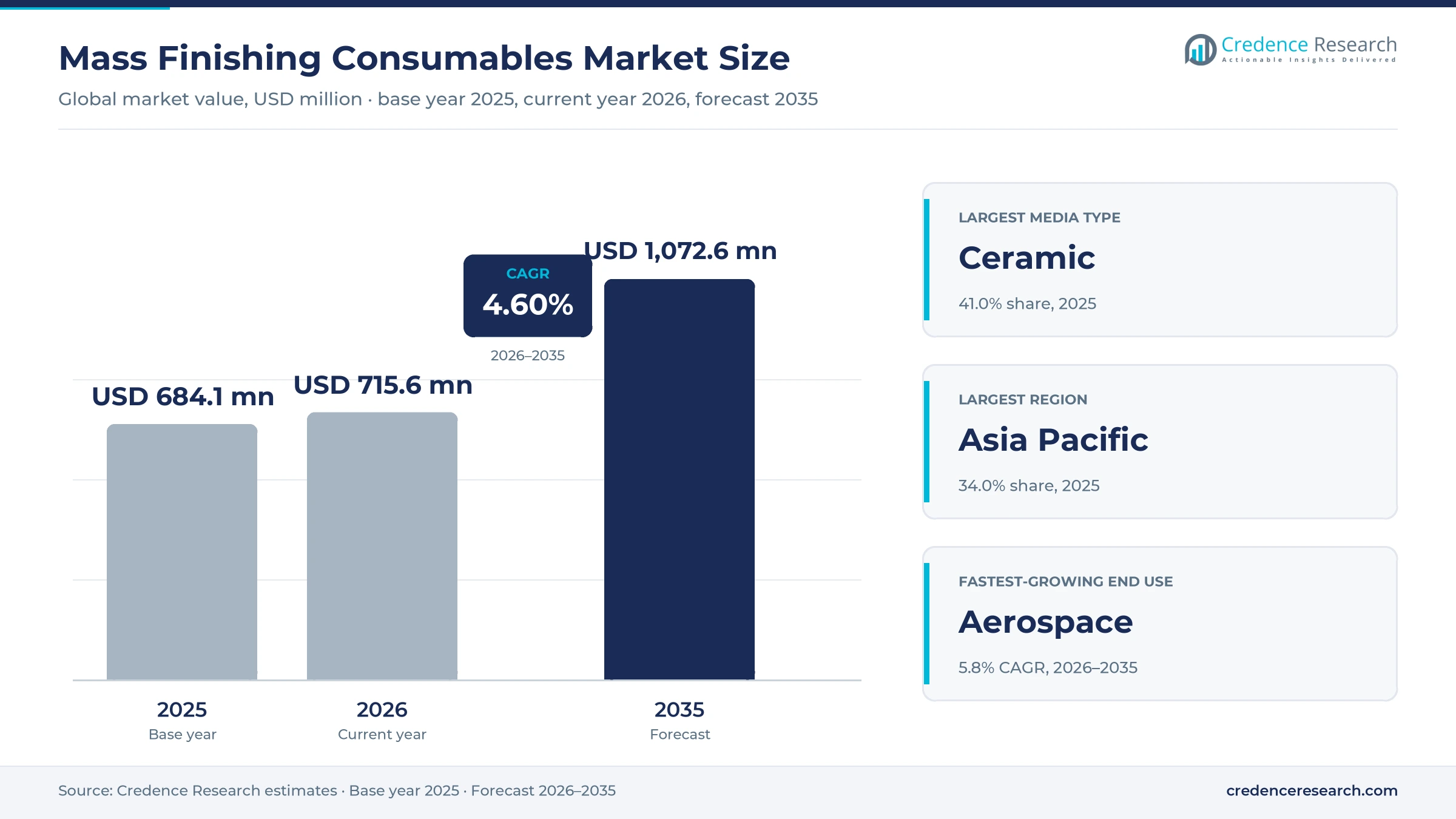
The global mass finishing consumables market was valued at USD 684.1 million in 2025 and is projected to increase from USD 715.6 million in 2026 to USD 1.07 billion by 2035, registering a CAGR of 4.60% during 2026–2035. Demand comes from automotive, aerospace, medical, tooling and jewelry plants that run vibratory, centrifugal disc, barrel, drag and stream finishing machines, which wear down ceramic, plastic and steel media and draw compounds in every cycle. Asia Pacific held the largest regional share, 34.0% in 2025, and is also the fastest-growing region at 5.3% a year, because Chinese and Indian vehicle output keeps rising while Western output slips. Engine ramp-ups and tighter roughness targets on implants are shifting spend toward fine polishing media and controlled compound dosing. Closed process water loops now cut fresh water and compound use per batch, so suppliers compete on cost per finished part rather than on price per bag.
Which media and compounds the estimate counts
The estimate counts the media and compounds that mass finishing machines consume, including ceramic, plastic, steel, aluminum oxide, porcelain and organic dry media, and the liquid or powder compounds that clean parts, carry away fines and protect against corrosion. Buyers reorder these items continuously, because media lose size and cutting power with every hour of machine time.
Finishing machines, centrifuges, dryers and blast abrasives sit outside the estimate, although the same suppliers often sell them. Large plants buy media and compounds on annual supply contracts tied to an approved process, while job shops and small users buy bags and drums from distributors.
Mass Finishing Consumables Market Insights
- The market is valued at USD 684.1 million in 2025 and is projected to reach USD 1.07 billion by 2035, growing at a 4.60% CAGR on engine, implant and vehicle part work.
- Asia Pacific led with 34.0% of 2025 value and grows fastest at 5.3% a year, as Chinese vehicle output rose about 10% in 2025.
- Ceramic media held 41.0% of 2025 value, because their density and cut suit the steel and cast parts that dominate deburring volumes.
- CFM delivered 1,802 LEAP engines in 2025, up 28%, which lifts demand for media and compounds used on disks, blisks and blades.
- The EU imposed anti-dumping duties of 88.7% to 110.6% on Chinese fused alumina in January 2026, which adds cost risk for media makers that buy the grain.
Ceramic media lead while aerospace parts grow fastest
Why do ceramic media lead while plastic media grow fastest?
Based on media type, the market is categorized into ceramic, plastic, steel, aluminum oxide and others. Ceramic led with 41.0% of 2025 value because fired clay and alumina bonds give the density and cut that steel stampings, castings and heat-treated parts need, and Washington Mills Ceramics, which describes itself as the largest ceramic media maker in North America, lists more than 20 ceramic bonds. Plastic media grow fastest at 5.4% a year as aluminum, titanium and coated parts need a softer cut, and Walther Trowal developed its AF plastic media, launched in September 2021, for turbine blades, automotive stampings and medical implants.
Why does deburring lead while fine refinement grows fastest?
Based on application, the market is categorized into deburring, polishing, surface finish and refinement, grinding, cleaning and degreasing, descaling and rust removal, and others. Deburring led with 33.0% of 2025 value because every machined, stamped or cast part leaves burrs, and Sinto markets its V7 Light barrel media for deburring bearings, clutch plates and valve seats. Surface Finish and Refinement grows fastest at 5.6% a year as implant and engine buyers set lower roughness limits, and Rösler reported in June 2025 that its multi-surf process polishes titanium knee castings to below Ra 0.1 micrometer in about 20 minutes.
Why does automotive lead while aerospace grows fastest?
Based on end-use industry, the market is categorized into automotive, general manufacturing, aerospace, machine tooling, healthcare, jewelry and accessories, and construction. Automotive led with 32.0% of 2025 value because gears, bearings, clutch plates and stampings are finished in large batches, and world vehicle output reached 96.4 million units in 2025, the base set out in the drivers. Aerospace grows fastest at 5.8% a year as engine programs ramp up, and Airbus ended 2025 with a record backlog of 8,754 commercial aircraft, which keeps disk, blisk and blade finishing lines running.
| Segment Group | Leading Sub-segment | Share, 2025 | Fastest-growing Sub-segment | CAGR, 2026–2035 |
|---|---|---|---|---|
| By Media Type | Ceramic | 41.0% | Plastic | 5.4% |
| By Application | Deburring | 33.0% | Surface Finish and Refinement | 5.6% |
| By End-Use Industry | Automotive | 32.0% | Aerospace | 5.8% |
List prices show plastic media cost twice ceramic per pound
Mass finishing media sell by weight, but buyers judge them by cost per finished part, which depends on wear rate, cycle time and compound use. U.S. distributor lists put plastic media at roughly twice the price per pound of standard ceramic media, because resin bonds cost more and wear faster, while bulk contracts with large plants are negotiated well below these retail levels. Abrasive grain, kiln energy and resin set the cost floor. Suppliers that qualify a process for an engine or implant part can price on process value rather than weight, which is where the widest margins sit.
| Media or reference | Typical price or fee | Basis |
|---|---|---|
| Ceramic media, triangle, 50 lb bag | USD 195.99 per bag (about USD 3.92 per lb) | Zoro list price for Raytech media, November 2026 |
| Ceramic media, 3/8 inch polyhedron, 45 lb | USD 275.70 per bag (about USD 6.13 per lb) | Kingsley North list price, November 2026 |
| Plastic media, pyramid, 50 lb bag | USD 418.99 per bag (about USD 8.38 per lb) | Zoro list price for Raytech media, November 2026 |
| Ceramic media, bulk contract | About USD 1.20-2.00 per lb | Credence Research estimate from list prices and contract discounts |
Request a Free Sample
Fill in your details and we'll send you a free sample report.
- Sample data tables & charts
- Research methodology
Vehicle output, engine ramp-ups and implants lift media use
Growing vehicle output keeps deburring lines loaded
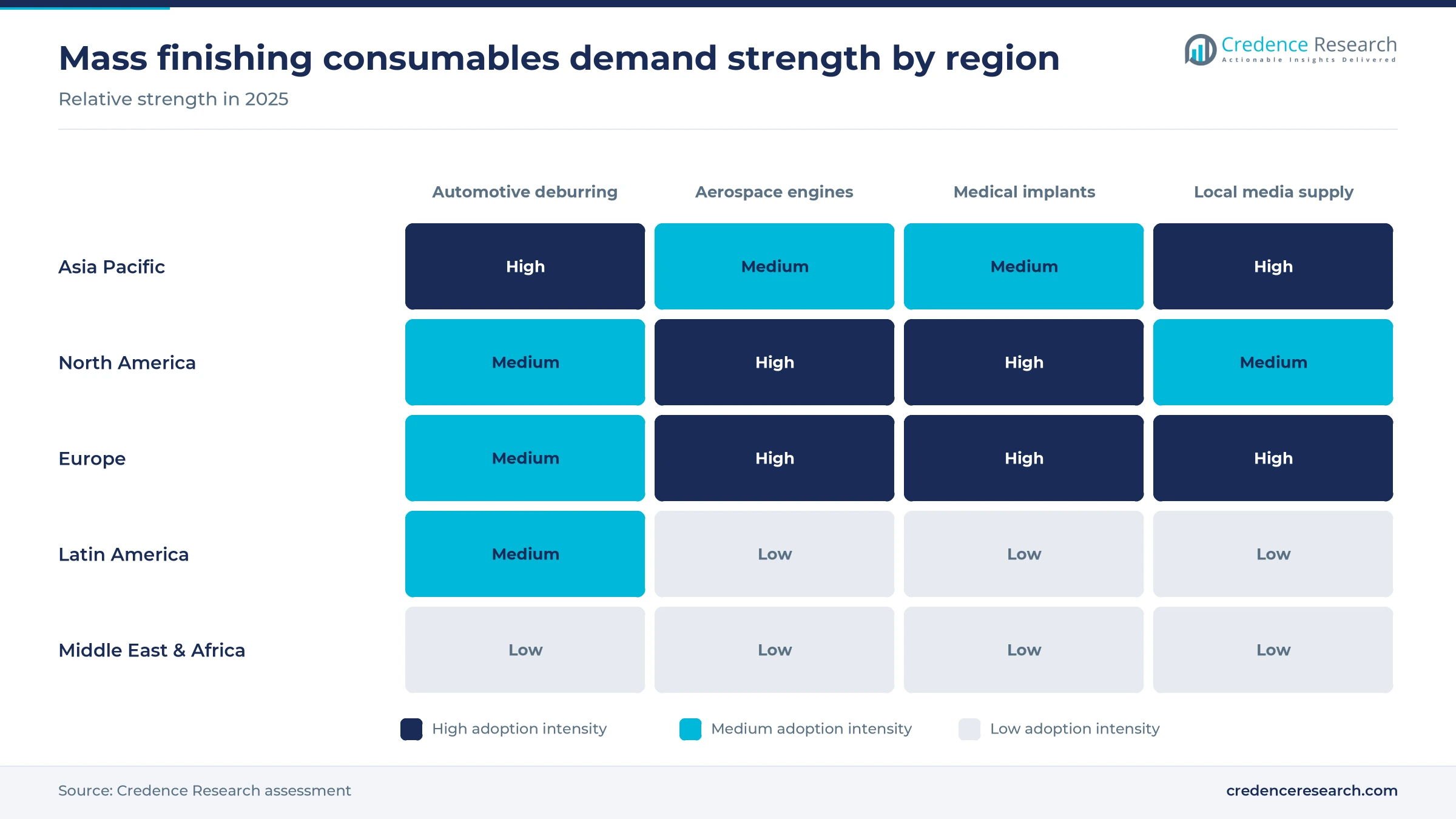
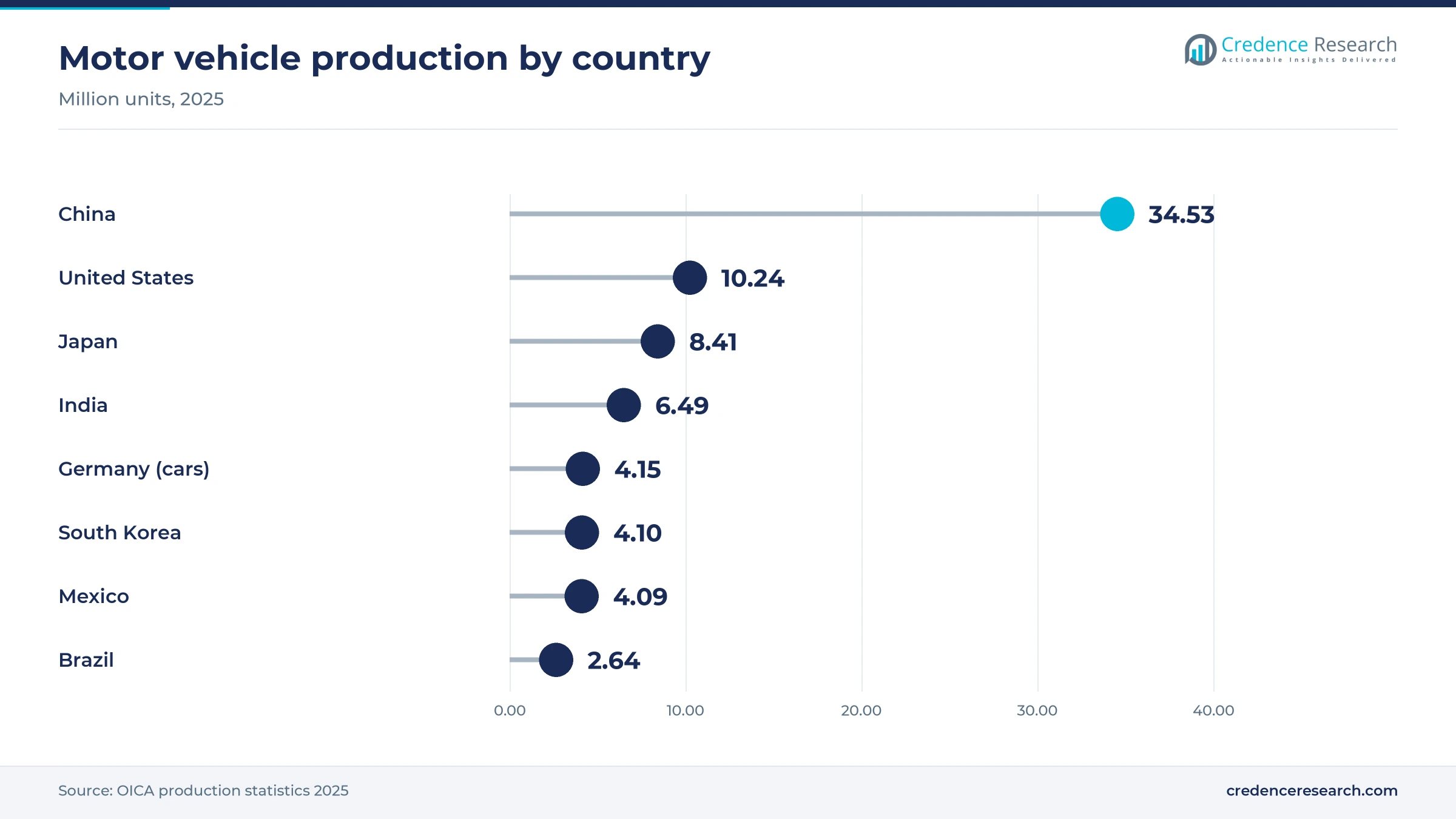
Vehicle production sets the base load for media and compounds, because transmissions, brakes, seats and engines carry hundreds of machined and stamped parts that must be deburred before assembly. OICA reported that world vehicle output rose 3.9% to 96.4 million units in 2025, with China and India adding most of the gain while output in the Americas and Europe declined. Automotive buyers held 32.0% of mass finishing consumables value in 2025, the largest share of any end use. Suppliers with plants or stock points in China and India gain the most, since media are heavy and freight eats into margins on long routes, while European suppliers face flat domestic volumes and must win share through process work.
Engine ramp-ups raise demand for qualified finishing media
Aerospace engine programs raise demand for finishing media because disks, blisks and blades need controlled edge radii and low roughness to pass fatigue and inspection rules. Safran reported that CFM delivered 1,802 LEAP engines in 2025, up 28%, and guided to about 15% more in 2026. GE Aerospace delivered 2,386 commercial engines in 2025, up 25%. OTEC says major engine makers have approved its stream finishing process for Class A rotating parts, where a single turbine disk can cost up to 60,000 euros. Media and compounds qualified on such parts are rarely replaced, so suppliers that win approvals lock in years of repeat orders.
Implant volumes favor fine polishing media and pastes
Orthopedic and dental implants support demand for fine polishing media, porcelain and pastes, because bearing surfaces must reach mirror finishes without acid baths. The American Joint Replacement Registry received 615,330 hip and knee procedures in 2025, the AAOS reported in November 2026, bringing its total to about 5.2 million. Rösler said in June 2025 that two multi-surf machines replaced three drag finishers at a knee implant maker. OTEC launched its EF-One high-gloss unit for cobalt chrome and titanium in March 2025. Makers of orthopedic implants buy small volumes at high prices, which lifts value per kilogram for polishing suppliers.
Labor shortages push plants toward automated finishing cells
Plants are replacing hand deburring with automated finishing cells, which raises steady media and compound use because machines run longer hours with metered dosing. Rösler reported in January 2025 that an automated cell with two rotary vibrators, a dryer and a semi-automatic centrifuge lifted throughput at Swiss contractor ESB by more than 50%. Finishing Systems of York, Pennsylvania, opened job shop vibratory deburring in June 2026 with 12 finishers, citing labor shortages and strict quality demands. Builders of each type of deburring machine tie consumables to their equipment, so every new cell adds a recurring media and compound account for the supplier that commissions it.
Closed water loops and 3D-printed parts reshape buying
Plants shift toward closed process water loops
Finishing plants are shifting toward closed process water loops to cut fresh water, compound and wastewater costs, creating openings for compounds designed to work in recirculated water. At ESB, Rösler reported in January 2025 that a semi-automatic centrifuge recirculates process water, which reduced fresh water and compound use, while the heat-block dryer cut energy use by up to 40%. Germany already regulates wastewater from vibratory finishing shops under Annex 40 of its wastewater ordinance, which lists the process by name. Compound suppliers that can prove stable chemistry over many recirculation cycles gain, while low-cost compounds that foam or break down lose ground in regulated plants.
Machine builders shift toward process ownership and partnerships
Machine builders are shifting from selling machines toward owning the whole finishing process, which pulls consumables into long-term contracts. Rösler became exclusive global sales partner for the GPAINNOVA DLyte carbide series in April 2024 and took a stake in vapor smoothing specialist LuxYours in November 2025. Its AM Solutions brand co-developed the D1 and F1 systems with EOS, and says the D1 cuts labor needs by up to 80% and removes up to 10 hours of cooling wait. Each added process gives Rösler another route to sell its media and compounds, and Sinto, which also builds barrel machines, says its own V7 Light media last 250% longer than conventional coarse media. Buyers gain faster approvals from one supplier but lose leverage on media prices, which favors integrated groups.
Printed metal and polymer parts open a new media niche
Additive manufacturing creates an opening for media and compounds tuned to rough printed surfaces, internal channels and powder residues. AM Solutions reported at Formnext 2025 that three S1 systems at FORMRISE cut Polybeads use by 60% and glass bead use by 87% while halving processing time. Washington Mills lists 3DCM ceramic media for metal printed parts, especially titanium, in a bond rated for maximum metal removal in vibratory bowls and tubs. Producers of metal additive manufacturing parts need repeatable surfaces before aerospace and medical approval, so media suppliers that co-develop recipes with printer makers can enter qualified supply lists early, before price competition sets in.
Engine approvals open long contracts for qualified media
Engine approvals create an opening for media and compound suppliers that can document every batch, since approved processes are locked for years. OTEC says three of the largest engine makers are expected to use its systems on engine parts by the end of 2026, a plan rather than a signed order. Its process links each run to the part serial number. Walther Trowal said in May 2022 that its MV 50 machine finishes blisks to Ra 0.2 to 0.4 micrometer in under three hours, against several days by older methods. Aerospace, the fastest-growing end use, rewards suppliers that hold Nadcap or customer approvals for their media and compounds.
Grain duties, metal tariffs and wastewater rules weigh
EU duties raise the cost of alumina grain
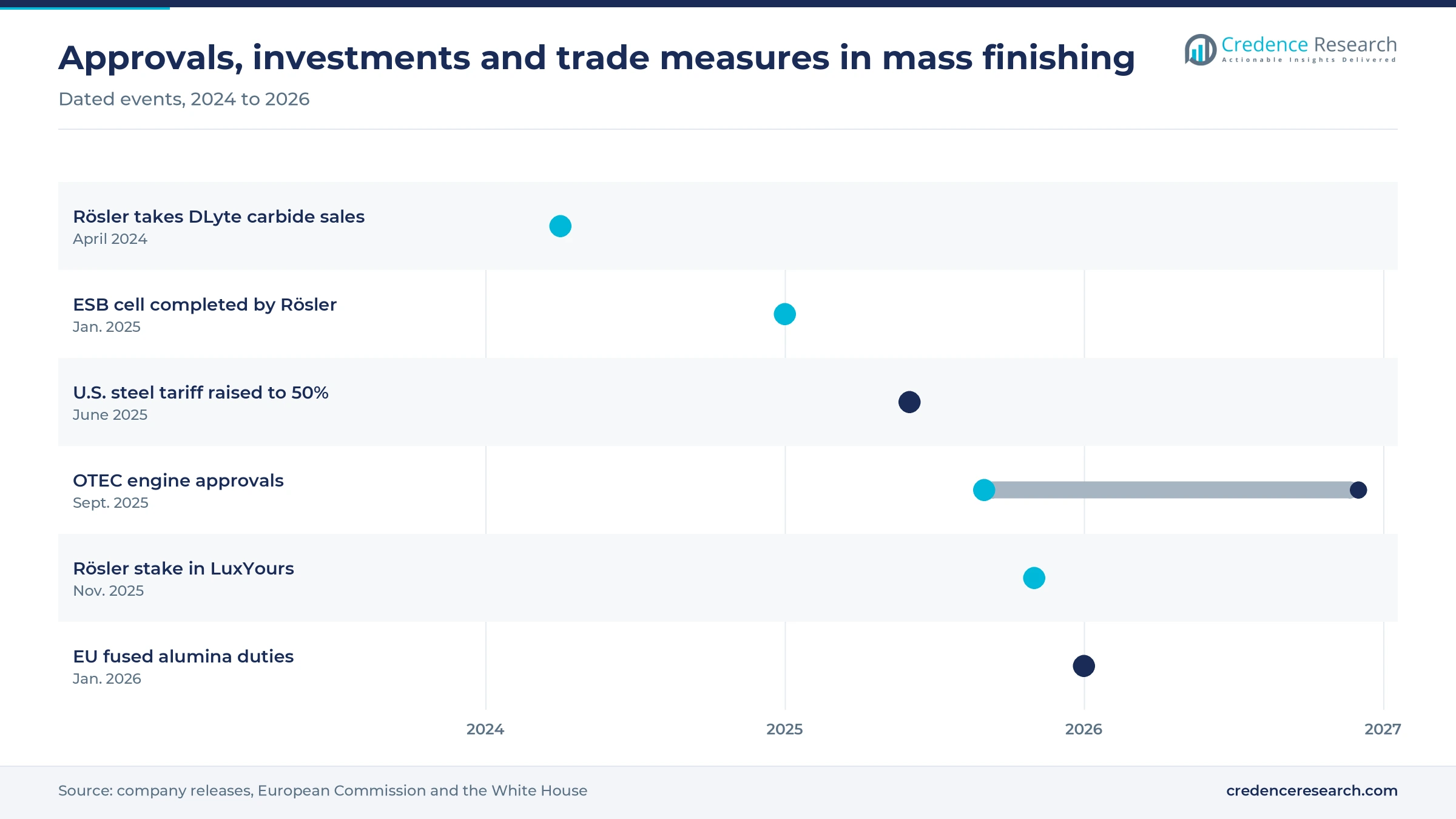
Abrasive grain costs are rising for media makers in Europe. The European Commission imposed definitive anti-dumping duties of 88.7% to 110.6% on Chinese fused alumina on Jan. 16, 2026, above a shrinking duty-free quota. China supplied about 160,000 of an estimated 380,000 tons of EU demand. European ceramic and plastic media makers that bought Chinese grain face higher input costs or a switch to EU smelters, while importers of finished Chinese media may gain a temporary price edge.
U.S. metal tariffs lift the cost of steel media
U.S. buyers of steel media face higher import costs on balls, pins and burnishing shapes. A presidential proclamation raised Section 232 tariffs on steel and aluminum content to 50% from 25%, effective June 4, 2025. Much of this stainless steel media is imported, so aerospace, jewelry and medical users that burnish parts pay more per batch. Domestic steel media makers gain pricing room, while distributors that rely on imports must pass on costs or shift buyers to ceramic media.
Wastewater rules raise compound handling costs
Wastewater from mass finishing carries metal fines, surfactants and media sludge, and rules on its discharge raise running costs for small users. Germany lists vibratory finishing shops by name under Annex 40 of its wastewater ordinance, so discharges must meet metalworking limits. Small job shops without centrifuges face the heaviest costs, because sludge disposal and water testing cost the same per site regardless of volume, which pushes them toward recirculation systems that need capital spending.
Electrochemical and dry processes replace some media
Electrochemical and dry electropolishing processes compete with media in high-value niches. The DLyte dry electropolishing line that Rösler now sells, noted above, removes material by ion exchange instead of abrasion. OTEC published a comparison in May 2025 that recommends its EF electro finishing over stream finishing for delicate tool geometries. Media suppliers are most exposed on carbide tools and dental parts, where these methods reach high gloss with little or no abrasive media.
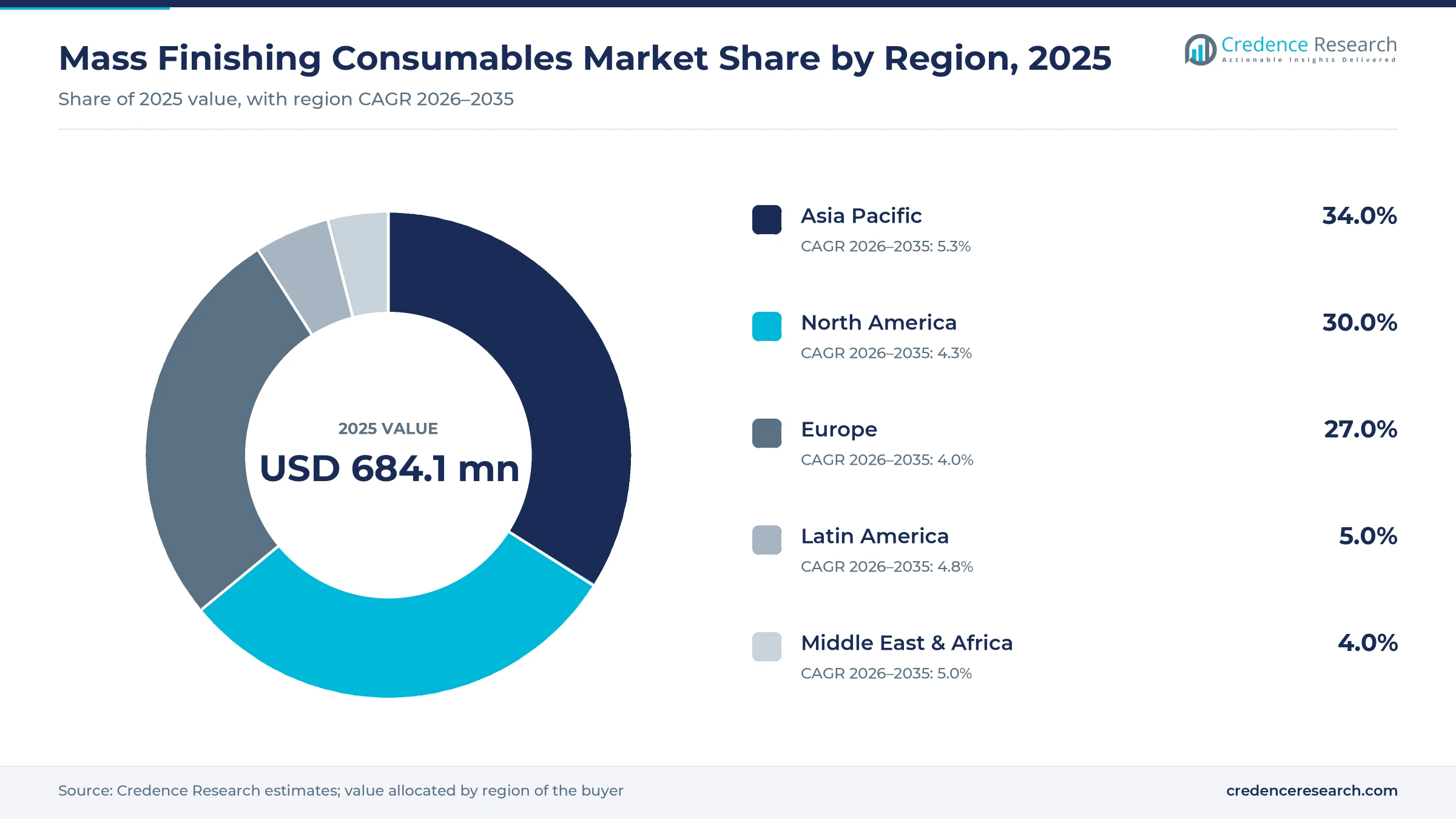
Asia Pacific leads on Chinese and Indian vehicle output
| Region | Value, 2025 (USD million) | Share, 2025 | CAGR, 2026–2035 |
|---|---|---|---|
| Asia Pacific | 232.6 | 34.0% | 5.3% |
| North America | 205.2 | 30.0% | 4.3% |
| Europe | 184.7 | 27.0% | 4.0% |
| Latin America | 34.2 | 5.0% | 4.8% |
| Middle East & Africa | 27.4 | 4.0% | 5.0% |
Asia Pacific leads on Chinese and Indian vehicle output
Asia Pacific builds most of the world's vehicles and machined parts, so it leads with 34.0% of 2025 value and grows fastest at 5.3% a year. OICA data show China built 34.53 million vehicles in 2025, up about 10%, while India rose 8% to 6.49 million. Japan adds high-value demand through Sinto and Nagoya-based Tipton, both of which sell their own barrel media to local parts makers. Local Chinese media makers compete hard on price, so imported brands must win on qualified processes rather than on bag price.
North America buys qualified media for engines and implants
Engine, implant and tool makers that pay for qualified media keep North America at 30.0% of 2025 value, growing at 4.3% a year, even as U.S. vehicle output fell 3% to 10.24 million units in 2025. Washington Mills Ceramics supplies ceramic, plastic and steel media to North American users, and Kramer Industries supplies stock and custom media to job shops. Vibra Finish in Mississauga, Ontario, blends its own compounds and runs finishing services, which gives Canadian aerospace buyers a local source.
Europe holds the process know-how but faces flat volumes
Europe hosts the process leaders but grows slowest, at 4.0% a year from 27.0% of 2025 value, because vehicle output slipped 0.8% in 2025 while Rösler, Walther Trowal and OTEC sell much of their process work abroad. These German groups design processes for engine, tool and implant makers worldwide and ship media from European plants. The 2026 duties on Chinese fused alumina raise grain costs for local media makers, which may narrow their price gap with Asian imports.
Latin America relies on vehicle plants in Mexico and Brazil
Parts plants that supply vehicle assembly drive Latin American demand, which held 5.0% of 2025 value and grows at 4.8% a year. Mexico built 4.09 million vehicles in 2025, down 3%, while Brazil rose 4% to 2.64 million, according to OICA. Most media are imported from the United States, Europe and Asia, and the region has no large media maker of its own, so the share is a Credence Research estimate with a wide error range.
Middle East & Africa grows from a small industrial base
A small base of aircraft maintenance shops, oil and gas valve makers and vehicle parts plants in Morocco and South Africa gives Middle East & Africa 4.0% of 2025 value, growing at 5.0% a year. No public data separate media consumption in the region, and no regional media producer was identified, so the estimate rests on import patterns and installed machine counts and carries a wide error range.
Approvals, stakes and installations marked 2024 to 2026
| Development | Status and market relevance |
|---|---|
| In April 2024, Rösler became the exclusive global sales partner for the GPAINNOVA DLyte carbide series for dry electropolishing of cutting tools. | Distribution agreement in force; it adds an electrochemical process to Rösler's range alongside its media and compounds. |
| In January 2025, Rösler reported completing an automated mass finishing cell with water recirculation for Swiss contractor ESB. | Completed installation; throughput rose by more than 50%, and fresh water and compound use fell. |
| In June 2025, Rösler reported that its multi-surf system finishes titanium knee implant castings in about 20 minutes. | Operational at a customer plant; two machines replaced three drag finishers, which shifts media demand to polishing grades. |
| In September 2025, OTEC said major engine makers approved its stream finishing process for Class A rotating engine parts. | Customer approvals in place, with adoption by three large engine makers planned by the end of 2026. |
| In November 2025, Rösler took a stake in LuxYours, a vapor smoothing specialist for 3D-printed polymer parts. | Completed minority investment; it widens Rösler's post-processing offer for additive manufacturing users. |
Media shape, bond and compound chemistry decide results
- Media bond and density sets the cut and wear rate, as fired ceramic bonds suit steel and cast parts while resin-bonded plastic media suit aluminum, brass and printed parts.
- Media shape and size must reach into part features without lodging in holes, so suppliers offer triangles, cylinders, cones and stars in many sizes.
- Compound chemistry controls cleaning, corrosion protection and pH, and Walther Trowal said in 2021 that a mineral in its AF plastic media keeps process water pH stable.
- Process water treatment uses centrifuges to remove fines and sludge, so compounds can be reused and wastewater meets discharge rules.
Need a Custom Version of This Report?
Tailor the scope, geography, or segments to your exact requirements.
- Custom geography or segment scope
- Direct access to our analyst team
Machine builders sell media into their installed base
Competition in this market turns on process approval, media range and service rather than on bag price alone. Rösler leads through about 15,000 consumables, 15 group locations and about 150 sales agents, and it often supplies the machine, media, compound and centrifuge as one system. Walther Trowal, OTEC, Sinto and Tipton follow the same model in engine, tool, implant and Japanese automotive work. Sinto and Tipton sell barrel media alongside their own centrifugal and barrel machines, while OTEC ties wet and dry media to its stream and disc finishers, so switching media often means requalifying the process. Washington Mills Ceramics competes as an independent media maker with more than 20 ceramic bonds plus plastic and steel media. Kramer Industries and Vibra Finish serve North American job shops and plants. The eight companies profiled below sell media or compounds for mass finishing.
How is the supply side organized and where do margins sit?
Supply is split between machine builders that sell media into their own installed base and independent media makers. Rösler, Walther Trowal, OTEC, Sinto and Tipton design machines, processes, media and compounds together, so a qualified process tends to lock in their consumables. Washington Mills and Kramer sell media to any machine owner, competing on bond range and delivery. Many small Chinese and Indian producers sell standard ceramic and plastic shapes on price. Margins sit in qualified engine, implant and tool processes, while standard shapes for automotive deburring earn thin returns. Entry barriers are kiln capacity, bond recipes and customer approvals.
Companies profiled and their roles in this market
| Company | Type | Role in the market |
|---|---|---|
| Rösler Oberflächentechnik GmbH | Integrated machine and media maker | Sells about 15,000 consumables with vibratory, surf and centrifugal finishing systems |
| Washington Mills (Washington Mills Ceramics) | Independent media maker | Makes ceramic, plastic, steel and 3D-print media for North American users |
| Sintokogio, Ltd. | Integrated machine and media maker | Sells V7 Light barrel media for bearings, clutch plates and valve seats |
| Walther Trowal GmbH & Co. KG | Integrated machine and media maker | Supplies AF plastic media and blisk finishing machines |
| OTEC Präzisionsfinish GmbH | Integrated machine and media maker | Sells wet and dry media with stream and disc finishing for engines and tools |
| Tipton Corp. | Integrated machine and media maker | Makes ceramic, plastic, steel and soft media plus powder and liquid compounds in Japan |
| Kramer Industries Inc. | Media supplier | Sells stock and custom-made finishing media to North American job shops |
| Vibra Finish Limited | Media, compound and service supplier | Blends its own compounds and runs finishing services in Ontario |
Process ownership, not media tonnage, decides margins
Credence Research's view is that process ownership, not media tonnage, will decide which suppliers earn margin in this market. Automotive deburring keeps volumes steady but earns thin returns, while engine, implant and printed part processes pay for qualified media and documented compounds. Integrated machine builders hold the strongest position because approvals tie consumables to their systems. Buyers should test cost per finished part, including water and sludge handling, and keep a second qualified media source where grain duties or metal tariffs raise supply risk.
Earlier estimate rolled forward and checked on tonnage
The report uses 2025 as the base year and forecasts to 2035. The earlier Credence Research estimate for 2024 was rolled forward one year at its own growth rate and tested against an estimate of media tonnage multiplied by bulk prices derived from published list prices, plus compound spending. Regional and segment shares are Credence Research estimates based on vehicle and engine output, implant volumes and supplier locations. Sources include OICA, Airbus, Safran, the AAOS registry, the European Commission, the White House, German wastewater law, company releases and distributor price lists. No interviews or surveys were conducted for this update of the estimate.
Engine and implant finishing carry growth to 2035
Growth to 2035 depends on engine and implant programs, vehicle output in Asia and the spread of closed water loops. The base case assumes steady engine ramp-ups and slow vehicle growth, so fine refinement and aerospace uses gain share while automotive deburring keeps the largest volume. Aerospace demand for mass finishing consumables is projected to grow at 5.8% a year through 2035, the fastest rate of any end use. Plastic media should grow faster than ceramic as aluminum, titanium and printed parts rise. Grain duties and metal tariffs will keep pressure on media costs, which favors suppliers that sell whole processes.
Engine output and grain costs decide the range of outcomes
The range of outcomes depends mainly on how fast engine and implant programs grow and on what happens to grain and metal costs. Faster LEAP and widebody engine output would lift high-value polishing media, while a vehicle downturn in China would cut the automotive deburring base. Higher alumina and steel costs could squeeze margins without changing volumes much. In the base case, mass finishing consumables demand grows at 4.60% a year, with fine refinement and aerospace uses gaining share.
| Scenario | CAGR, 2026–2035 | Value, 2035 | What has to hold |
|---|---|---|---|
| Downside | 3.2% | USD 950.1 million | Chinese vehicle output stalls and electrochemical finishing wins more tool and implant parts |
| Base | 4.60% | USD 1.07 billion | Engine ramp-ups continue and vehicle output grows slowly in Asia |
| Upside | 5.8% | USD 1.19 billion | Engine and printed part volumes rise faster and closed water loops spread to job shops |
Frequently Asked Questions
How big is the mass finishing consumables market?
What are mass finishing consumables?
Which media type holds the largest share?
How does mass finishing process development work?
Which region leads the market?
How much do mass finishing media cost?
What restrains the mass finishing consumables market?
Who are the main mass finishing consumables suppliers?
Table of Content
Chapter 1 Market Segmentation
- 1.1 Segmentation Framework
- 1.1.1 Product and Service Classification
- 1.1.2 Application and End-Use Classification
- 1.1.3 Technology and Solution Classification
- 1.1.4 Customer and Distribution Channel Classification
- 1.1.5 Geographic Segmentation
- 1.1.6 Market Segment Definitions and Boundaries
- 1.2 By Media Type
- 1.2.1 Ceramic
- 1.2.2 Plastic
- 1.2.3 Steel
- 1.2.4 Aluminum Oxide
- 1.2.5 Others
- 1.3 By Application
- 1.3.1 Deburring
- 1.3.2 Polishing
- 1.3.3 Surface Finish and Refinement
- 1.3.4 Grinding
- 1.3.5 Cleaning and Degreasing
- 1.3.6 Descaling and Rust Removal
- 1.3.7 Others
- 1.4 By End-Use Industry
- 1.4.1 Automotive
- 1.4.2 General Manufacturing
- 1.4.3 Aerospace
- 1.4.4 Machine Tooling
- 1.4.5 Healthcare
- 1.4.6 Jewelry and Accessories
- 1.4.7 Construction
Chapter 2 Introduction
- 2.1 Report Objectives and Scope
- 2.2 Product Definition and Industry Terminology
- 2.3 Market Inclusions and Exclusions
- 2.4 Research Process
- 2.4.1 Primary Research and Expert Interviews
- 2.4.2 Secondary Research and Source Review
- 2.4.3 Top-Down and Bottom-Up Estimation
- 2.4.4 Data Triangulation and Verification
- 2.5 Market Size Measurement Basis
- 2.5.1 2025: USD 684.1 million → 2035: USD 1.07 billion
- 2.6 Historical and Forecast Reference Periods
- 2.6.1 Historical Period: 2018-2025
- 2.6.2 Base Year: 2025
- 2.6.3 Forecast Period: 2025-2035
- 2.7 Research Assumptions and Limitations
Chapter 3 Executive Summary
- 3.1 Market Snapshot and Key Findings
- 3.2 Base-Year Market Size, 2025
- 3.3 Forecast Market Size, 2035
- 3.4 Revenue and Volume Growth Outlook
- 3.5 Key Demand and Supply Indicators
- 3.6 Leading Market Segments
- 3.7 Fastest-Growing Market Opportunities
- 3.8 Regional Performance Highlights
- 3.9 Technology and Industry Transformation
- 3.10 Competitive Landscape Summary
- 3.11 Analyst View and Strategic Implications
Chapter 4 Global Mass Finishing Consumables Market Trends and Developments
- 4.1 Historical Industry Development, 2018-2025
- 4.2 Recent Market Trends and Developments
- 4.3 Demand and Customer Behavior Trends
- 4.4 Technology and Product Innovation
- 4.5 Artificial Intelligence, Automation and Digitalization
- 4.6 Local Manufacturing and Supply Chain Realignment
- 4.7 Industry Partnerships, Mergers and Acquisitions
- 4.8 Sustainability and Circular Economy Developments
- 4.9 Government and Private Sector Investment Trends
- 4.10 Emerging Business Models and Commercialization
- 4.11 Industry Developments and Announcements
Chapter 5 Global Mass Finishing Consumables Market Production, Supply and Demand Analysis
- 5.1 Demand Trend and Consumption Analysis, 2018-2025
- 5.2 Demand Forecast, 2025-2035
- 5.3 Production and Output Trend, 2018-2025
- 5.4 Production and Output Forecast, 2025-2035
- 5.5 Installed Capacity and Capacity Utilization
- 5.6 Company-Wise Production Plants and Statistics
- 5.6.1 Installed Production Capacity
- 5.6.2 Actual Production
- 5.6.3 Planned Capacity and Expansion Targets
- 5.7 Supply Chain Structure and Procurement Trends
- 5.8 Supply-Demand Gap and Bottlenecks
- 5.9 Import Dependence and Sourcing Structure
- 5.10 Contract Manufacturing and Outsourcing
- 5.11 Regional Supply and Demand Concentration
Chapter 6 Global Mass Finishing Consumables Market Pricing Analysis
- 6.1 Pricing Structure and Measurement
- 6.2 Historical Pricing Trends, 2018-2025
- 6.3 Pricing Outlook, 2025-2035
- 6.4 Average Selling Price and Unit Economics
- 6.5 Pricing by Product and Market Segment
- 6.6 Geographic Pricing Differences
- 6.7 Key Input, Energy, Labor and Logistics Costs
- 6.8 Contract Pricing and Purchasing Models
- 6.9 Pricing Sensitivity and Competitive Positioning
- 6.10 Price, Margin and Profitability Implications
Chapter 7 Global Mass Finishing Consumables Market Dynamics
- 7.1 Market Growth Drivers
- 7.1.1 Demand-Side Drivers
- 7.1.2 Technology and Innovation Drivers
- 7.1.3 Infrastructure and Investment Drivers
- 7.1.4 Regulatory and Policy Drivers
- 7.2 Market Restraints
- 7.2.1 Cost and Affordability Constraints
- 7.2.2 Technology and Adoption Barriers
- 7.2.3 Supply Chain and Operational Constraints
- 7.3 Market Challenges
- 7.3.1 Competitive Pressure and Margin Erosion
- 7.3.2 Skills, Infrastructure and Implementation Gaps
- 7.4 Emerging Market Opportunities
- 7.5 Market Dynamics Impact and Time-Horizon Assessment
Chapter 8 Global Mass Finishing Consumables Value Chain Analysis
- 8.1 Industry Value Chain Overview
- 8.2 Upstream Suppliers and Critical Inputs
- 8.3 Technology and Component Providers
- 8.4 Manufacturing or Service Delivery
- 8.5 Distribution, Channel Partners and Integrators
- 8.6 Downstream Applications and End Users
- 8.7 Value Addition and Profit Pools
- 8.8 Vertical Integration and Outsourcing
- 8.9 Supplier Concentration and Risk
- 8.10 Supply Chain Localization and Resilience
Chapter 9 Global Mass Finishing Consumables Market Regulations and Policies
- 9.1 Relevant Laws, Standards and Compliance Frameworks
- 9.2 Product, Service, Safety and Quality Requirements
- 9.3 Government Policies, Incentives and Subsidies
- 9.4 Imports, Exports and Trade Barriers
- 9.5 Public Procurement and Local Content Requirements
- 9.6 Environmental and Sustainability Compliance
- 9.7 Upcoming Policy Changes and Market Implications
Chapter 10 Global Mass Finishing Consumables Market Hotspots and Opportunities
- 10.1 Market Opportunity Mapping and Growth Hotspots
- 10.2 High-Growth Applications and Customer Groups
- 10.3 Underserved Markets and White-Space Opportunities
- 10.4 Emerging Technology and Product Opportunities
- 10.5 New Capacity and Investment Hotspots
- 10.6 Market Entry and Expansion Opportunities
- 10.7 Distribution and Partnership Opportunities
- 10.8 Near-Term and Long-Term Commercial Potential
- 10.9 Opportunity Attractiveness and Execution Risks
Chapter 11 Global Mass Finishing Consumables Market Outlook, 2025-2035
- 11.1 Market Size and Analysis
- 11.1.1 Revenue (Market Measurement: 2025: USD 684.1 million → 2035: USD 1.07 billion)
- 11.1.2 Market Volume and Quantity Sold
- 11.1.3 Historical Market Size, 2018-2025
- 11.1.4 Base-Year Market Size, 2025
- 11.2 Market Forecast, 2025-2035
- 11.2.1 Revenue Forecast to 2035
- 11.2.2 Volume Forecast to 2035
- 11.2.3 CAGR and Year-on-Year Growth
- 11.2.4 Incremental Revenue Opportunity
- 11.3 Forecast Assumptions and Scenario Analysis
- 11.3.1 Base-Case Forecast
- 11.3.2 Optimistic and Conservative Scenarios
- 11.3.3 Technology, Pricing and Policy Sensitivities
- 11.4 Market Attractiveness and Growth Outlook
Chapter 12 Global Mass Finishing Consumables Market Segmentation and Outlook
- 12.1 Segmentation Summary and Market Shares, 2025
- 12.2 Largest and Fastest-Growing Segments
- 12.3 By Media Type - Market Size and Forecast, 2025-2035
- 12.3.1 Segment Definition and Scope
- 12.3.2 Historical Market Size, 2018-2025
- 12.3.3 Revenue Forecast, 2025-2035
- 12.3.4 Volume Forecast, 2025-2035
- 12.3.5 Base-Year Market Share, 2025
- 12.3.6 Segment CAGR and Growth Drivers
- 12.3.7 Subsegment Market Size and Forecast
- 12.3.7.1 Ceramic
- 12.3.7.2 Plastic
- 12.3.7.3 Steel
- 12.3.7.4 Aluminum Oxide
- 12.3.7.5 Others
- 12.3.8 Subsegment Pricing and Adoption Trends
- 12.3.9 Leading Suppliers and Competition
- 12.3.10 Regional Demand and Opportunities
- 12.4 By Application - Market Size and Forecast, 2025-2035
- 12.4.1 Segment Definition and Scope
- 12.4.2 Historical Market Size, 2018-2025
- 12.4.3 Revenue Forecast, 2025-2035
- 12.4.4 Volume Forecast, 2025-2035
- 12.4.5 Base-Year Market Share, 2025
- 12.4.6 Segment CAGR and Growth Drivers
- 12.4.7 Subsegment Market Size and Forecast
- 12.4.7.1 Deburring
- 12.4.7.2 Polishing
- 12.4.7.3 Surface Finish and Refinement
- 12.4.7.4 Grinding
- 12.4.7.5 Cleaning and Degreasing
- 12.4.7.6 Descaling and Rust Removal
- 12.4.7.7 Others
- 12.4.8 Subsegment Pricing and Adoption Trends
- 12.4.9 Leading Suppliers and Competition
- 12.4.10 Regional Demand and Opportunities
- 12.5 By End-Use Industry - Market Size and Forecast, 2025-2035
- 12.5.1 Segment Definition and Scope
- 12.5.2 Historical Market Size, 2018-2025
- 12.5.3 Revenue Forecast, 2025-2035
- 12.5.4 Volume Forecast, 2025-2035
- 12.5.5 Base-Year Market Share, 2025
- 12.5.6 Segment CAGR and Growth Drivers
- 12.5.7 Subsegment Market Size and Forecast
- 12.5.7.1 Automotive
- 12.5.7.2 General Manufacturing
- 12.5.7.3 Aerospace
- 12.5.7.4 Machine Tooling
- 12.5.7.5 Healthcare
- 12.5.7.6 Jewelry and Accessories
- 12.5.7.7 Construction
- 12.5.8 Subsegment Pricing and Adoption Trends
- 12.5.9 Leading Suppliers and Competition
- 12.5.10 Regional Demand and Opportunities
- 12.6 Segment Growth Comparison
- 12.7 Segment Attractiveness and Priority Matrix
Chapter 13 Global Mass Finishing Consumables End-Use and Application Market Outlook
- 13.1 End-Use Industry and Customer Demand Structure
- 13.2 Leading Applications and Customer Groups
- 13.3 End-Use Market Size, Share and Forecast
- 13.4 Major End-Use Industry Deep Dives
- 13.4.1 Customer Requirements and Use Cases
- 13.4.2 Demand and Replacement Cycles
- 13.4.3 Technical and Regulatory Considerations
- 13.4.4 Purchasing and Procurement Models
- 13.4.5 Leading Vendors and Distribution Channels
- 13.4.6 Forecast and Commercial Opportunities
- 13.5 Emerging Applications and Cross-Segment Demand
- 13.6 End-Use Industry Investment Priorities
Chapter 14 Global Mass Finishing Consumables Geographic Market Outlook, 2025-2035
- 14.1 Regional Market Size and Share, 2025
- 14.2 Regional Market Forecast, 2025-2035
- 14.3 Regional Pricing, Production and Demand Differences
- 14.4 North America
- 14.4.1 United States
- 14.4.2 Canada
- 14.4.3 Mexico
- 14.5 Europe
- 14.5.1 Germany
- 14.5.2 France
- 14.5.3 Italy
- 14.5.4 United Kingdom
- 14.5.5 Spain
- 14.5.6 Poland
- 14.5.7 Russia
- 14.5.8 Netherlands
- 14.5.9 Belgium
- 14.5.10 Sweden
- 14.5.11 Denmark
- 14.5.12 Norway
- 14.5.13 Rest of Europe
- 14.6 Asia Pacific
- 14.6.1 China
- 14.6.2 India
- 14.6.3 Japan
- 14.6.4 South Korea
- 14.6.5 Thailand
- 14.6.6 Indonesia
- 14.6.7 Vietnam
- 14.6.8 Malaysia
- 14.6.9 Australia
- 14.6.10 Rest of Asia Pacific
- 14.7 Latin America
- 14.7.1 Brazil
- 14.7.2 Argentina
- 14.7.3 Colombia
- 14.7.4 Chile
- 14.7.5 Rest of Latin America
- 14.8 Middle East
- 14.8.1 Saudi Arabia
- 14.8.2 United Arab Emirates
- 14.8.3 Turkey
- 14.8.4 Israel
- 14.8.5 Iran
- 14.8.6 Rest of the Middle East
- 14.9 Africa
- 14.9.1 South Africa
- 14.9.2 Egypt
- 14.9.3 Nigeria
- 14.9.4 Morocco
- 14.9.5 Rest of Africa
- 14.10 Regional Investment, Policy and Supply Chain Differences
- 14.11 Regional Competitive Landscape
- 14.12 Geographic Growth Hotspots
Chapter 15 Global Mass Finishing Consumables Technology, Innovation and Sustainability Outlook
- 15.1 Technology Landscape and Maturity
- 15.2 Product, Process and Service Innovation
- 15.3 AI, Automation and Digital Tools in the Industry
- 15.4 Technology Adoption and Performance Benchmarking
- 15.5 Innovation Pipeline and R&D Investment
- 15.6 Patent and Intellectual Property Trends
- 15.7 Energy Efficiency and Resource Management
- 15.8 Sustainability, Recycling and Circularity
- 15.9 Technology Roadmap, 2025-2035
- 15.10 Risks of Obsolescence and Technology Substitution
Chapter 16 Global Mass Finishing Consumables Market Key Strategic Imperatives
- 16.1 Growth and Market Entry Priorities
- 16.2 High-Return Products and Segments
- 16.3 Pricing, Profitability and Cost Optimization
- 16.4 Technology Investment and Product Differentiation
- 16.5 Supply Chain Localization and Resilience
- 16.6 Distribution and Customer Acquisition
- 16.7 Partnership, Acquisition and Capacity Strategy
- 16.8 Regional Expansion Priorities
- 16.9 Short-, Medium- and Long-Term Actions
Chapter 17 Competition Outlook
- 17.1 Industry Competition Characteristics
- 17.2 Market Structure and Concentration
- 17.3 Market Share and Competitive Positioning, 2025
- 17.4 Company-Wise Revenue and Product Benchmarking
- 17.5 Production and Service Capacity Benchmarking
- 17.6 Technology, Pricing and Differentiation
- 17.7 Regional Footprint and Distribution Strength
- 17.8 Mergers, Acquisitions and Strategic Alliances
- 17.9 New Entrants and Competitive Threats
- 17.10 Porter's Five Forces and Industry Attractiveness
- 17.11 Competitive Outlook, 2025-2035
Chapter 18 Company Profiles
- 18.1 Company Coverage and Selection Criteria
- 18.2 Rösler Oberflächentechnik GmbH
- 18.2.1 Business Description
- 18.2.2 Company Ownership and Geographic Presence
- 18.2.3 Product and Service Portfolio
- 18.2.4 Manufacturing and Operating Footprint
- 18.2.5 Production Capacity and Expansion Plans
- 18.2.6 Financial Performance and Investment
- 18.2.7 Market Share and Competitive Position
- 18.2.8 Technology and Innovation Capabilities
- 18.2.9 Strategic Alliances or Partnerships
- 18.2.10 Recent Developments
- 18.2.11 Growth Strategy and Outlook
- 18.3 Washington Mills (Washington Mills Ceramics)
- 18.4 Sintokogio, Ltd.
- 18.5 Walther Trowal GmbH & Co. KG
- 18.6 OTEC Präzisionsfinish GmbH
- 18.7 Tipton Corp.
- 18.8 Kramer Industries Inc.
- 18.9 Vibra Finish Limited
- 18.10 Other Relevant Market Participants
Note: Every listed company is profiled on the structure shown under the first company. The company list is preliminary and may change based on research findings, market developments, data availability and client requirements.
Chapter 19 Disclaimer
- 19.1 Research and Forecast Disclaimer
- 19.2 Data Source and Estimation Limitations
Note: The depth of individual sections depends on data availability for this market. Volume, capacity, trade and other unit-based metrics are included where applicable.