Abdominal pads stay the low-cost answer to heavy drainage
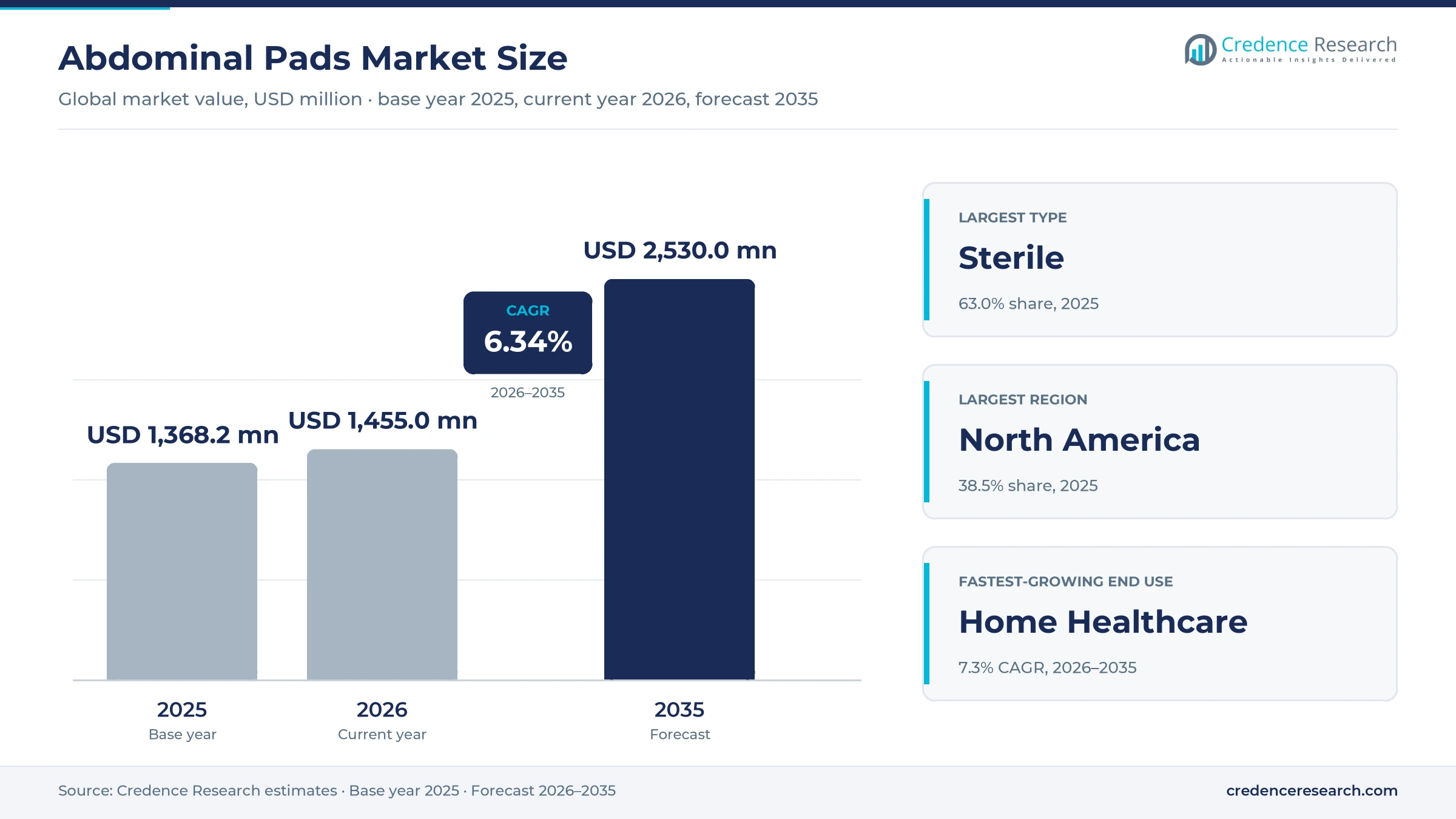
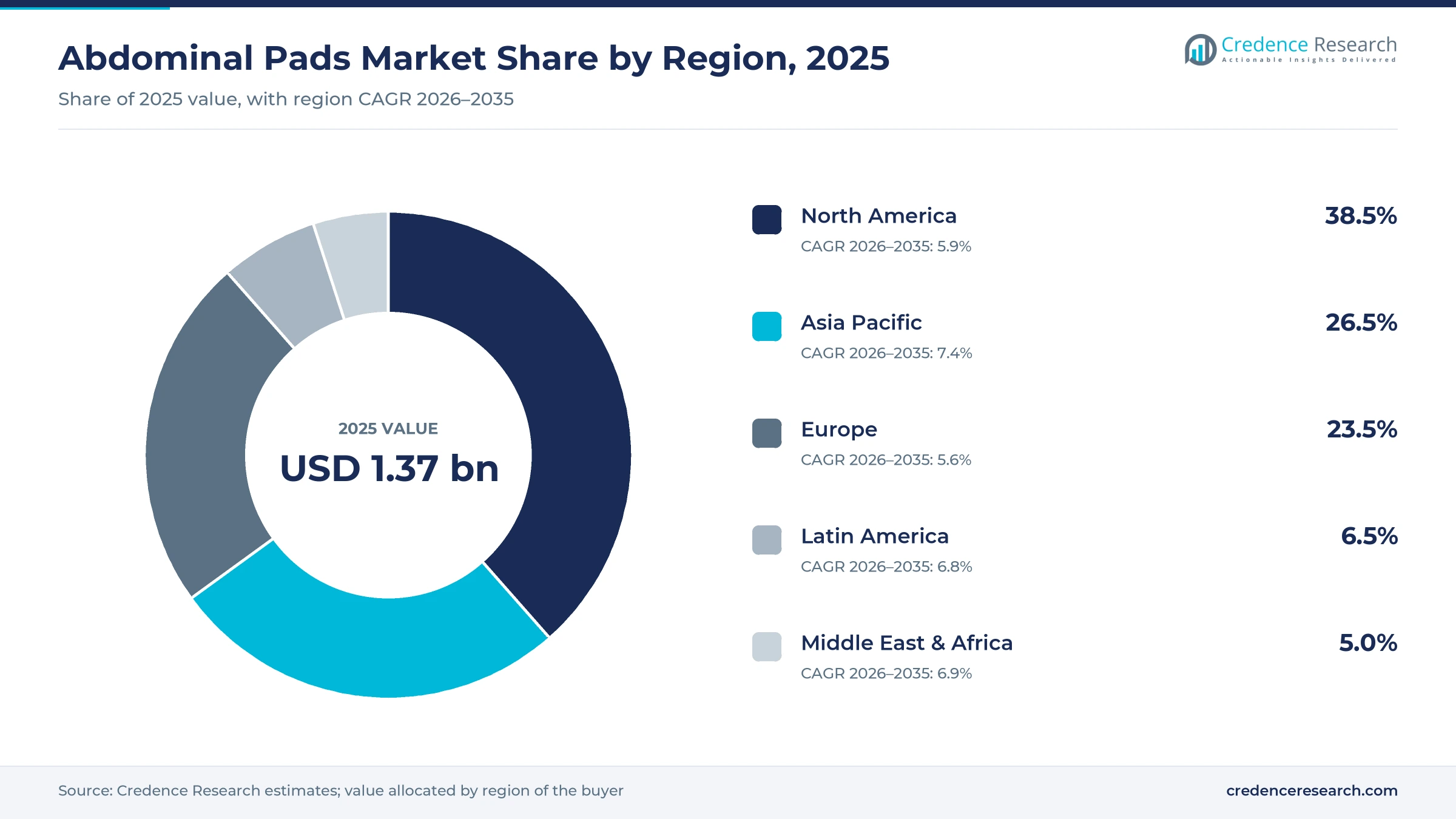
The global abdominal pads market was valued at USD 1.37 billion in 2025 and is projected to increase from USD 1.45 billion in 2026 to USD 2.53 billion by 2035, registering a CAGR of 6.34% during 2026–2035. Demand comes from hospitals, surgical centers, nursing facilities and home care providers that use thick cellulose pads to absorb heavy drainage from incisions, cesarean wounds, burns and leg or foot ulcers. North America held the largest regional share, 38.5% in 2025, because U.S. hospitals buy pads in high volume through distributor private labels. Asia Pacific is the fastest-growing region at 7.4% a year, as surgical access widens and converters in China and Vietnam add capacity close to buyers. Ownership of the supply channel is shifting, since two of the largest U.S. medical-surgical distributors changed their ownership structure at the end of 2025. The main restraint is substitution, because superabsorbent dressings hold more fluid per change than fluff-filled pads.
Which absorbent dressings fall inside this estimate?
The estimate counts sterile and non-sterile abdominal pads, also sold as ABD or combine pads, made from a cellulose fluff core inside a nonwoven cover, usually with a moisture-resistant back layer. Buyers use them as a primary dressing over large incisions or as a secondary absorbent layer over gauze, foam or packing, and most purchases run through hospital group contracts, distributors and home care suppliers.
Gauze swabs, bordered adhesive dressings, foam and alginate dressings, superabsorbent polymer dressings sold as a separate class and negative pressure systems are excluded, as are feminine hygiene and incontinence pads. The value chain runs from pulp and nonwoven suppliers through contract converters and brand owners to distributors and care settings.
Abdominal Pads Market Insights
- The global abdominal pads market was worth USD 1.37 billion in 2025 and reaches USD 2.53 billion by 2035 at a 6.34% CAGR, supported by cesarean births, chronic wounds and home-based dressing changes.
- North America held 38.5% of 2025 value, and the United States took 17.2% of world imports of non-adhesive dressings in 2023.
- Sterile pads led the type segment with 63.0% of 2025 value, because operating rooms and labor wards need sealed pads over fresh incisions.
- Winner Medical broke ground on a USD 60 million production base in Vietnam in May 2026 and expects mass production by the third quarter of 2027.
- The U.S. Section 232 investigation of medical consumables opened in September 2025 and remained without a report or tariff decision in late October 2026.
Sterile surgical use holds most of the value
Sterile leads while non-sterile grows fastest
Based on type, the market is categorized into sterile and non-sterile. Sterile pads led with 63.0% of 2025 value because operating rooms and labor wards need individually sealed pads over fresh incisions, and sterile packing raises the unit price by about 40% to 200% depending on size and pack count, according to Curity listings at Vitality Medical. Non-sterile pads grow fastest at 6.7% a year as nursing homes and home care agencies use them as outer covers over chronic wounds, and Dynarex sells a bulk case of 576 pads for USD 60.73 through CIA Medical.
Surgical wounds lead while chronic wounds grow fastest
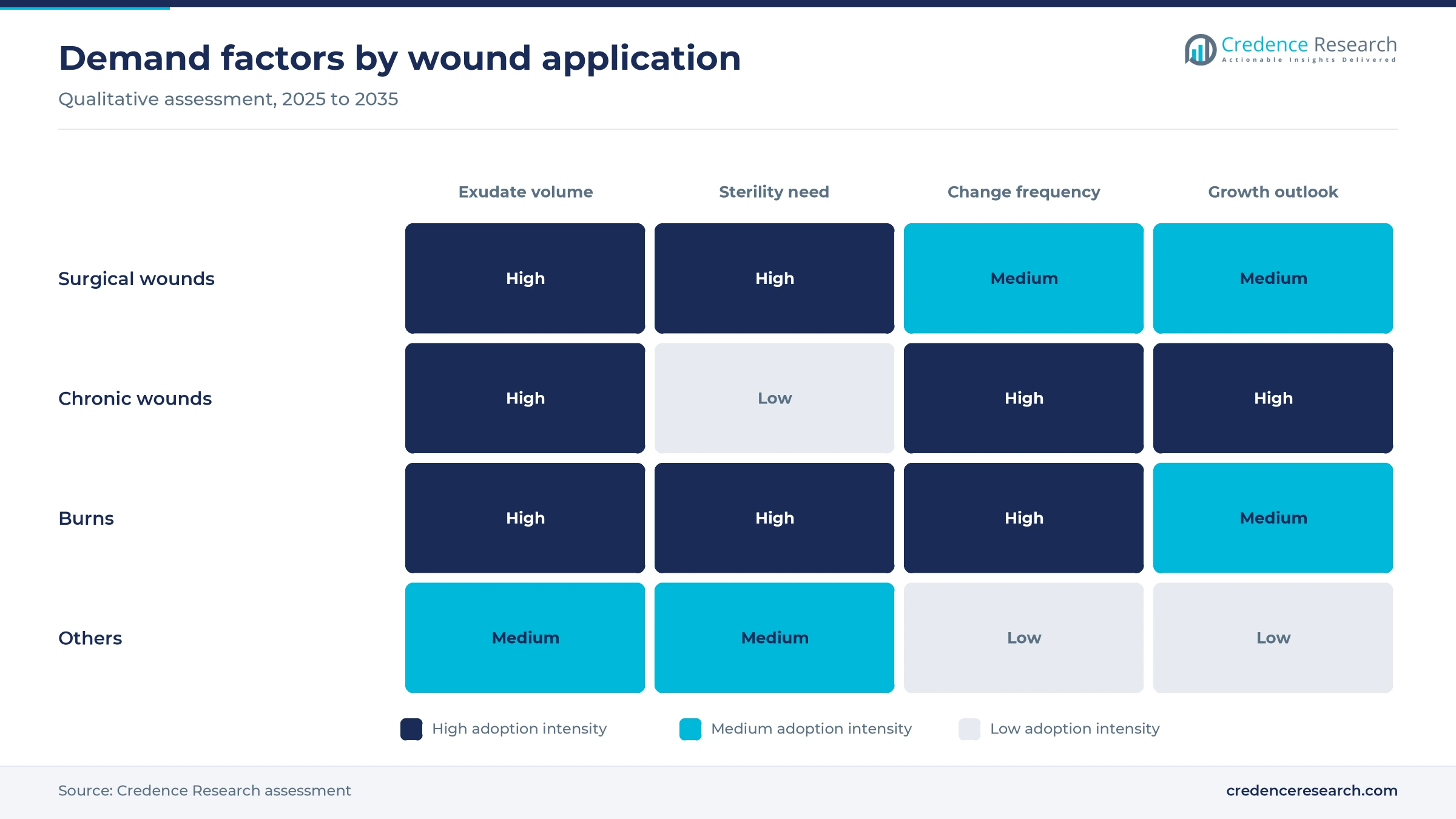
Based on application, the market is categorized into surgical wounds, chronic wounds, burns and others. Surgical wounds led with 54.0% of 2025 value because large incisions drain heavily in the first days after surgery, a pattern the cesarean trend described below reinforces, and Cardinal Health lists Curity pads in sizes up to 8 by 24 inches, according to Vitality Medical. Chronic wounds grow fastest at 7.0% a year as diabetes adds foot and leg ulcers that need weeks of absorbent dressing changes, the caseload shift detailed in the drivers. Burns stay small because specialist burn units favor dedicated dressings.
Hospitals lead while home healthcare grows fastest
Based on end use, the market is categorized into hospitals, specialty clinics, home healthcare and others. Hospitals led with 61.0% of 2025 value because surgical and inpatient units change pads often and buy them by the case through distributor private labels, which lets the distributor set the default pad on each hospital formulary, and Cardinal Health sells non-sterile 5 by 9 inch Curity pads in cases of 880, according to Vitality Medical. Home healthcare grows fastest at 7.3% a year as dressing changes move into homes, and the Medicare surgical dressing policy requires orders to be renewed every three months, which turns each covered home wound into a repeat purchase.
| Segment Group | Leading Sub-segment | Share, 2025 | Fastest-growing Sub-segment | CAGR, 2026–2035 |
|---|---|---|---|---|
| By Type | Sterile | 63.0% | Non-sterile | 6.7% |
| By Application | Surgical Wounds | 54.0% | Chronic Wounds | 7.0% |
| By End Use | Hospitals | 61.0% | Home Healthcare | 7.3% |
Cents per unit and case contracts set prices
Pads are priced per unit but bought by the case, so hospitals compare cost per pad, case size and fill rate rather than list price alone. Sterility and size set most of the spread, because sealed packs cost more to make and sterilize, and larger pads use more fluff and film. Distributor private labels anchor the low end, while branded European pads and superabsorbent hybrids sit above. Contract prices paid by hospital groups are below the online list prices shown here, and no public data on those contract prices were found. Suppliers earn most where they control sterile capacity and delivery terms.
| Product and pack | Typical price or fee | Basis |
|---|---|---|
| Curity sterile 5 by 9 inch, pack of 36 | USD 7.33 a pack, about USD 0.20 per pad | Vitality Medical listing, November 2026 |
| Curity sterile 8 by 10 inch, pack of 18 | USD 13.20 a pack, about USD 0.73 per pad | Vitality Medical listing, November 2026 |
| Curity non-sterile 8 by 10 inch, case of 432 | USD 103.11 a case, about USD 0.24 per pad | Vitality Medical listing, November 2026 |
| Curity non-sterile 5 by 9 inch, case of 880 | USD 119.63 a case, about USD 0.14 per pad | Vitality Medical listing, November 2026 |
| Curity non-sterile 12 by 16 inch, case of 144 | USD 128.68 a case, about USD 0.89 per pad | Vitality Medical listing, November 2026 |
| Dynarex 5 by 9 inch bulk, case of 576 | USD 60.73 a case, about USD 0.11 per pad | CIA Medical list price, November 2026 |
Request a Free Sample
Fill in your details and we'll send you a free sample report.
- Sample data tables & charts
- Research methodology
Cesarean births, diabetes and aging lift consumption
Cesarean births and large incisions anchor hospital demand
Every cesarean section or open abdominal operation leaves a long incision that drains for several days, and pads are the standard absorbent layer over it. The World Health Organization reported in June 2021 that cesarean sections account for 21% of births worldwide, up from about 7% in 1990. Its researchers project that nearly 29% of all births will take place by cesarean section by 2030, which adds incisions faster than the number of births grows. Surgical wounds already account for 54.0% of 2025 value in the Credence Research estimate. Suppliers holding sterile hospital contracts gain most, because each additional cesarean adds several pad changes before the patient leaves the ward and often more once she is at home.
Diabetes widens the pool of heavily draining wounds
Chronic wounds need absorbent dressings for weeks rather than days, so each new long-term ulcer patient multiplies pad consumption. The International Diabetes Federation counted 589 million adults aged 20 to 79 with diabetes in its 2025 atlas and projects 853 million by 2050. About 252 million of them are undiagnosed, which delays care until ulcers are larger and wetter, which lengthens each course of dressings. In the Credence Research assessment, most of this volume flows through clinics and home care rather than surgical wards. Pads usually sit as the outer absorbent layer in diabetic foot ulcer care, so chronic wound suppliers and home care distributors gain volume as caseloads rise.
Aging populations move dressing changes into homes
Older patients heal more slowly and carry more surgical and chronic wounds, so population aging raises both the number of wounds and the length of each course of dressings. WHO expects 1 in 6 people worldwide to be aged 60 or over by 2030, or 1.4 billion people, and the number aged 80 or older to triple between 2020 and 2050 to 426 million. In the United States, the Medicare surgical dressing policy requires wound evaluations at least monthly, or weekly for heavily draining wounds, which keeps covered patients on documented, recurring supply orders. Home healthcare grows at 7.3% a year, the fastest end use. Distributors with home delivery networks and nurse support capture this shift first.
Low unit cost keeps the product the default outer dressing
Pads remain the cheapest way to absorb large volumes of fluid over a primary dressing, which keeps them on hospital formularies even as advanced dressings spread. Under 21 CFR 878.4014, the FDA classes nonresorbable gauze and pads for external use as Class I devices exempt from premarket notification, so private-label suppliers can add sizes quickly. DeRoyal lists a sterile 8 by 36 inch pad sold 25 to a case through CIA Medical, which shows how far brand lines stretch sizes for large wounds. Hartmann describes its Zetuvit sterile pad as a single-use pad of cellulose fibers for absorbing wound exudate. Hospitals often place pads over gauze or foam and switch to negative pressure wound therapy only for the largest open wounds.
Channel owners and factory locations are changing
Distributor brands shift into new ownership structures
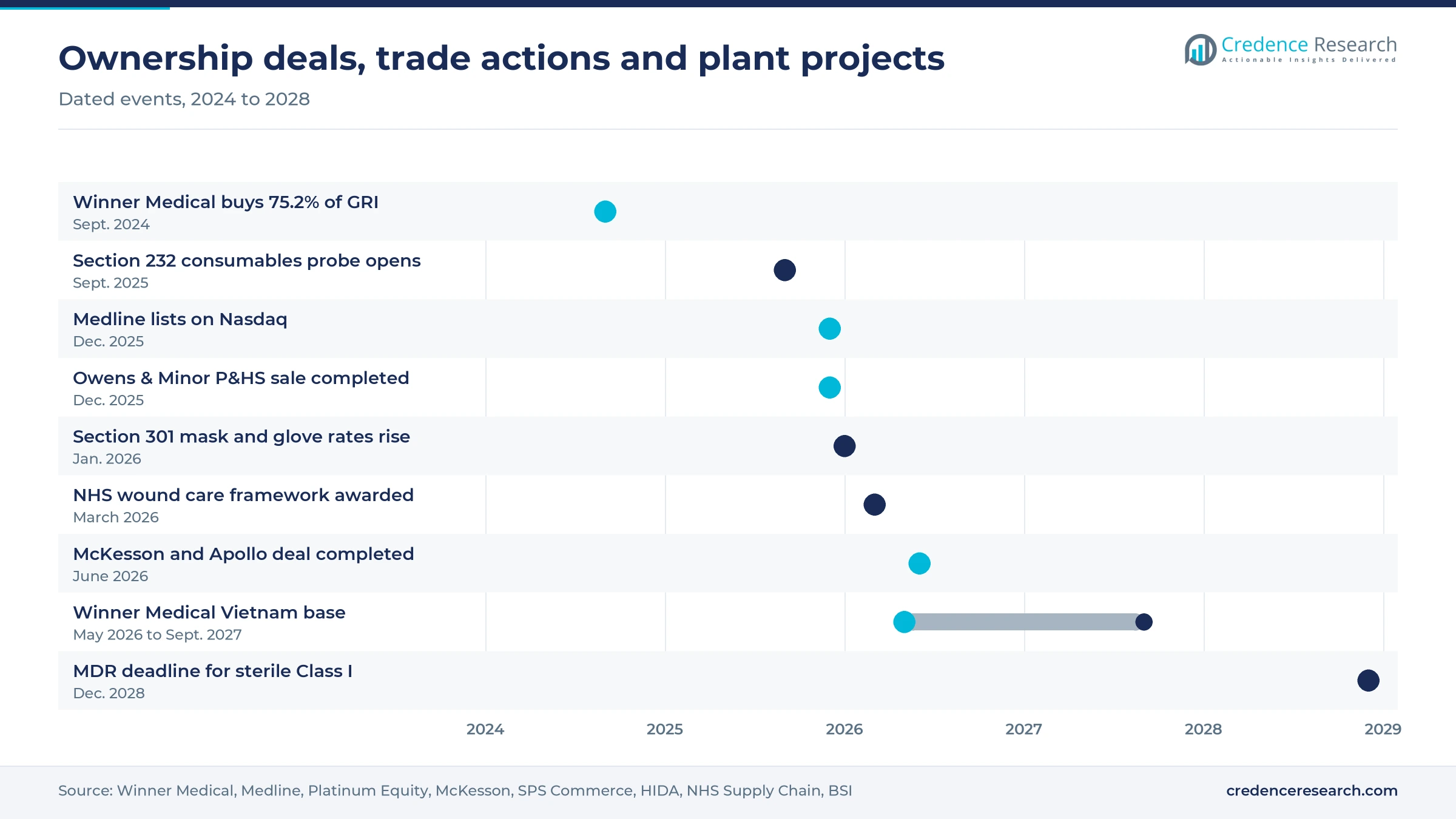
The largest U.S. sellers of pads are distributors that sell under their own brands, and their ownership is changing in ways that affect sourcing and pricing. Medline priced an upsized initial public offering at USD 29 a share on Dec. 16, 2025, and its shares began trading on the Nasdaq Global Select Market the next day. Platinum Equity completed its purchase of the Owens & Minor Products & Healthcare Services business on Dec. 31, 2025, for USD 375 million in cash. McKesson completed the sale of about 13% of its Medical-Surgical Solutions business to Apollo funds on June 1, 2026, a step toward separating the unit as an independent public company. New public and private owners are likely to press for margin, which favors low-cost contract converters.
Converters shift capacity toward Vietnam and the Americas
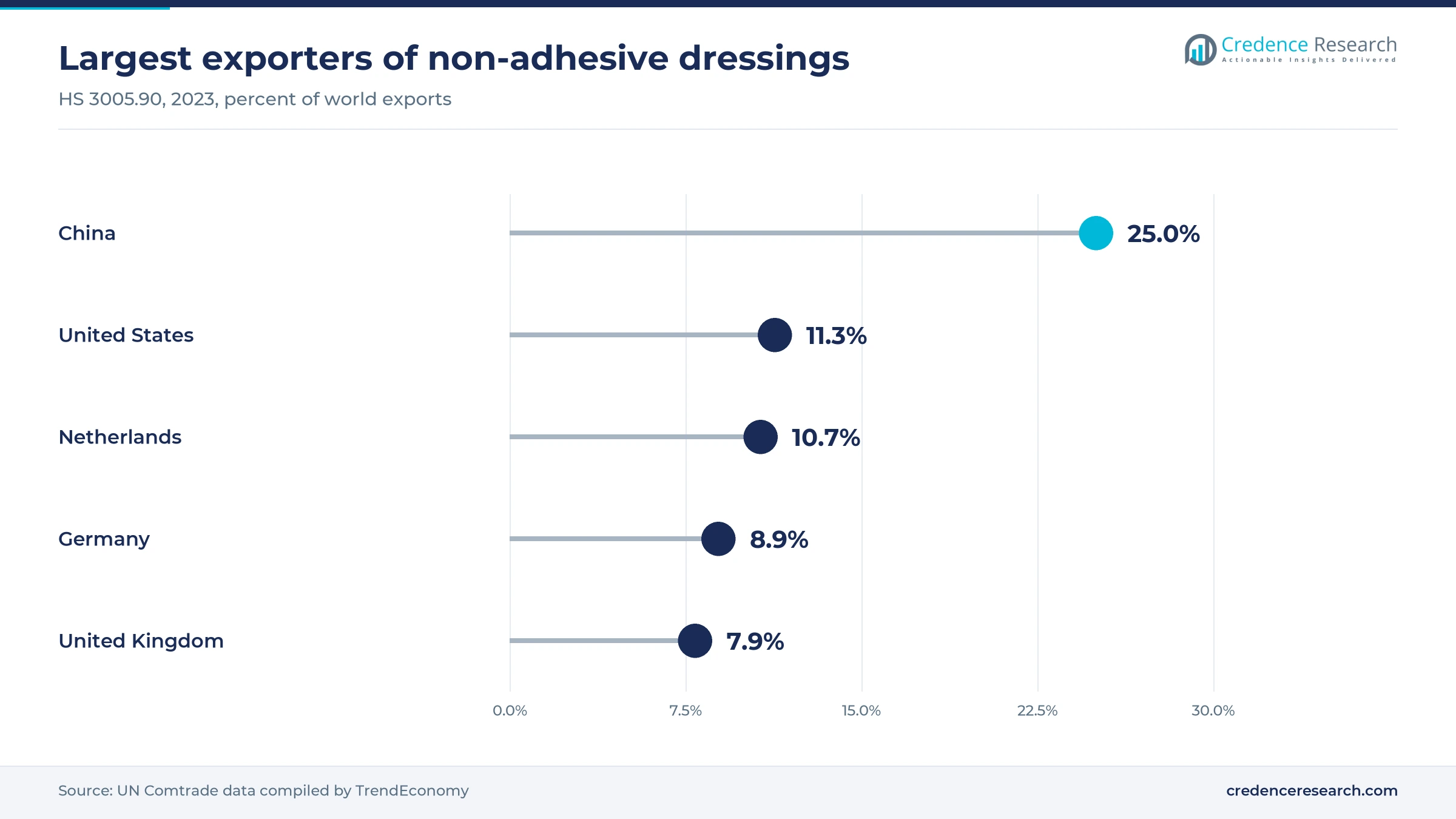
Gauze and pad converters are spreading production beyond China to protect export access to the United States and Europe. China supplied 25% of world exports of non-adhesive gauze, bandages and similar dressings under HS 3005.90 in 2023, according to UN Comtrade data compiled by TrendEconomy. Winner Medical broke ground in May 2026 on a USD 60 million production base in Quang Ninh Province, Vietnam and expects mass production of core lines by the third quarter of 2027. In September 2024, it acquired 75.2% of Global Resources International, a U.S. surgical products firm with plants in China, the United States, Vietnam and the Dominican Republic, for about USD 120 million. Buyers gain sourcing options, while single-country converters face tougher terms.
Superabsorbent cores open a premium tier for converters
Heavily exuding wounds create an opening for pad makers that add superabsorbent cores, because nursing staff value fewer changes per day. Lohmann & Rauscher says the cellulose flake core of its Vliwazell dressing has a much higher absorption capacity than gauze, and it sells sterile packs of 25 in the 10 by 10 cm size and 30 in the 10 by 20 cm size. Hartmann sells Zetuvit Plus as a superabsorbent dressing next to its standard Zetuvit pad, and Mölnlycke positions Mesorb for moderate to heavily exuding wounds. Converters that blend superabsorbent polymer into familiar pad formats can sell to nursing homes and home care agencies that want fewer nurse visits per week. Public price data for such hybrids are thin, so the opening is uncertain.
Public wound care tenders open contracts in Europe
Centralized hospital purchasing in Europe gives compliant suppliers an opening to large, multi-year volumes. NHS Supply Chain tendered a General Wound Care framework on May 30, 2025, covering gauze absorbents, bandages, swabs and cotton wool, and issued the contract award notice on March 20, 2026, according to the U.K. Find a Tender service. The framework carries an estimated spend of about GBP 13.5 million to GBP 14.5 million in its first year and GBP 54 million to GBP 58 million over its maximum term. Only NHS Supply Chain can order from it, so a place on the framework reaches hospital trusts across England. Suppliers with full certification under the EU device rules discussed below are best placed for later tenders on the continent.
Tariff probes and certification deadlines weigh on supply
Unresolved U.S. tariff probes cloud import costs
The U.S. Commerce Department opened a Section 232 investigation on Sept. 2, 2025, covering medical consumables, protective equipment and devices, and no report or tariff had been published by late October 2026, SPS Commerce reported. Section 301 tariffs on Chinese face masks rose to 50% and on medical gloves to 100% on Jan. 1, 2026, HIDA reported, showing how fast rates can move. Importers that source pads from China are most exposed, since the United States took 17.2% of world imports of these dressings in 2023.
Falling cotton prices invite contract renegotiation
World Bank data show that the Cotlook A cotton index averaged USD 1.71 per kg in 2025, down from USD 1.91 in 2024, and lower cotton prices give hospital groups grounds to reopen gauze and pad contracts, even though pads use mostly wood pulp fluff with nonwoven covers. Cotton is therefore only a partial guide, and no public price series for medical fluff pulp was found. Small converters without scale are most exposed, because their contract prices fall while freight and labor costs do not.
EU certification deadlines squeeze smaller sterile suppliers
Under Regulation (EU) 2023/607, sterile Class I devices with valid directive certificates as of March 20, 2023, must move to full MDR certification by Dec. 31, 2028, according to BSI. Sterile pads need notified body review of their sterilization, and the same bodies are certifying thousands of other devices before the deadline. Small European converters and importers with legacy certificates are most exposed, since losing a certificate removes them from public tenders. Larger groups such as Hartmann and Lohmann & Rauscher can spread certification costs over many product lines.
Limited access to surgery caps volume in poorer markets
WHO data show that only about 8% of women in the least developed countries and 5% in sub-Saharan Africa give birth by cesarean section, which points to unmet surgical need rather than low wound burden. Where hospitals lack surgeons, sterile supply and reliable funding, pads are rationed or replaced by cut gauze and cloth. Suppliers entering these markets face small, price-driven tenders and long payment cycles, so volumes stay low until surgical capacity grows.
North America leads as Asia Pacific adds surgical volume
| Region | Value, 2025 (USD billion) | Share, 2025 | CAGR, 2026–2035 |
|---|---|---|---|
| North America | 0.53 | 38.5% | 5.9% |
| Asia Pacific | 0.36 | 26.5% | 7.4% |
| Europe | 0.32 | 23.5% | 5.6% |
| Latin America | 0.09 | 6.5% | 6.8% |
| Middle East & Africa | 0.07 | 5.0% | 6.9% |
North America leads on surgical volume and private labels
North America held 38.5% of 2025 value and grows at 5.9% a year. The CDC's National Center for Health Statistics recorded 3,628,934 U.S. births in 2024, and the primary cesarean rate rose to 22.9% from 22.8% in 2023. The United States was also the largest importer of non-adhesive dressings in 2023, as noted above. Medline, Cardinal Health and McKesson supply most hospital volume under their own brands, which keeps list prices low and contract terms long.
Europe grows on public tenders and local production
Europe held 23.5% of 2025 value and grows at 5.6% a year. Germany was the second-largest importer of non-adhesive dressings in 2023, at 11.5% of world imports, and it is home to Hartmann and Lohmann & Rauscher, which sell pads and superabsorbent dressings across the region. Medline announced on June 8, 2026, that it is expanding its manufacturing center in Partizánske, Slovakia, with a new clean room, and production is planned for 2027. The NHS framework and certification deadline described above decide who wins public contracts.
Asia Pacific grows fastest as surgery and aging rise
Asia Pacific held 26.5% of 2025 value and grows fastest at 7.4% a year. Japan's Internal Affairs Ministry reported in September 2026 that people aged 65 and over made up a record 29.6% of the population, which sustains chronic and post-surgical wound care. WHO researchers project that Eastern Asia will have the highest cesarean rate of any region by 2030, at 63% of births. Chinese converters supply both home and export demand, while data on hospital pad use in India and Southeast Asia are scarce, so the share is a Credence Research estimate.
Latin America builds on high cesarean rates
Latin America held 6.5% of 2025 value and grows at 6.8% a year. WHO data show cesarean rates as high as 43% of births in Latin America and the Caribbean, and Brazil and the Dominican Republic are among five countries where cesarean births outnumber vaginal births. Mexico took 5.06% of world imports of non-adhesive dressings in 2023, much of it from the United States. In the Credence Research assessment, public hospital tenders in Brazil and Mexico favor low-cost bulk pads over premium absorbent products.
Middle East and Africa start from uneven surgical access
Middle East and Africa held 5.0% of 2025 value and grows at 6.9% a year. WHO estimates put the cesarean rate at 32.0% in Northern Africa against 5% in sub-Saharan Africa, and Egypt is one of the five countries where cesarean births exceed vaginal births. Demand is concentrated in Gulf private hospitals, Egypt and South Africa, where imported branded pads compete with low-cost Asian supply. Published consumption data for the region were not found, so the share is a Credence Research estimate.
Listings, divestments and new plants mark 2025 and 2026
| Development | Status and market relevance |
|---|---|
| In May 2026, Winner Medical broke ground on a new production base in Quang Ninh Province, Vietnam. | Construction started; the company plans mass production of core product lines from the site in 2027. |
| In June 2026, McKesson completed a minority investment by Apollo funds in its Medical-Surgical Solutions business. | Completed in June 2026; McKesson keeps control and intends to separate the unit as an independent, publicly traded company through a planned IPO. |
| In December 2025, Platinum Equity completed its purchase of the Owens & Minor Products & Healthcare Services business. | Completed; the business runs as a standalone private company, and the seller was renamed Accendra Health. |
| In December 2025, Medline completed its initial public offering and listed its Class A shares on Nasdaq. | Completed listing; Medline remains one of the largest private-label suppliers of pads to U.S. hospitals. |
| In June 2026, Medline announced an expansion of its manufacturing center in Partizánske, Slovakia, with a new clean room. | Under construction; production at the expanded site is planned to begin in 2027. |
Fluff cores, backings and superabsorbents define products
- Cellulose fluff cores hold the drainage inside a soft nonwoven cover, which Curity, Zetuvit and private-label pads use as the main absorbent layer at low cost.
- Moisture-resistant back layers stop fluid from striking through to gowns and bedding, which lets a single pad stay on longer over a draining incision.
- Sealed edges and nonwoven covers limit lint and side leakage, and suppliers source these covers from the medical nonwoven disposables supply chain.
- Superabsorbent hybrid cores lock fluid into a gel, which Vliwazell-type and Zetuvit Plus products use to cut the number of changes for heavily exuding wounds.
Need a Custom Version of This Report?
Tailor the scope, geography, or segments to your exact requirements.
- Custom geography or segment scope
- Direct access to our analyst team
Distributor brands set the terms for converters
Competition turns on hospital contracts, sterile capacity, case fill rates and price per pad. Medline, Cardinal Health and McKesson sell pads under their own brands to hospitals, clinics and home care buyers, which gives them control over shelf space and reorder data. Dukal, DeRoyal and Dynarex compete as brand specialists with broad size ranges, sterile and non-sterile versions and bulk cases for long-term care. In Europe, Paul Hartmann sells Zetuvit and Lohmann & Rauscher sells Vliwazell, and both pair standard pads with superabsorbent products inside broader wound dressing portfolios. Chinese and Vietnamese converters supply many private labels without selling under their own names in Western hospitals. Large distributors win on breadth and logistics, while specialists hold buyers that need unusual sizes or faster delivery.
How is supply organized, and where do margins sit?
Supply splits into distributor brand owners, independent brand specialists and contract converters. Medline, Cardinal Health and McKesson control access to U.S. hospitals and sell pads under their own labels, while Dukal, DeRoyal and Dynarex compete for the same contracts with their own brands. Converters in China, Vietnam and the Dominican Republic make much of the volume. Because the FDA classes these pads as exempt Class I devices, entry barriers are low in the United States, so margins sit with whoever controls distribution and sterile capacity.
Companies profiled and their roles in this market
| Company | Type | Role in the market |
|---|---|---|
| Medline Inc. | Distributor brand owner | Sells sterile and non-sterile Medline Brand pads to hospitals and post-acute care |
| Cardinal Health, Inc. | Distributor brand owner | Sells Curity sterile and non-sterile pads in sizes up to 12 by 16 inches |
| McKesson Corporation | Distributor brand owner | Sells McKesson Brand sterile pads through its Medical-Surgical Solutions business |
| Dukal LLC | Brand specialist | Sells sterile and non-sterile pads in bags and cases for clinics |
| DeRoyal Industries, Inc. | Brand specialist | Makes sterile pads, including long 8 by 36 inch sizes |
| Dynarex Corporation | Brand specialist | Sells sterile and bulk non-sterile combine pads for long-term care buyers |
| Paul Hartmann AG | Wound care manufacturer | Makes Zetuvit sterile pads and Zetuvit Plus superabsorbent dressings |
| Lohmann & Rauscher GmbH & Co. KG | Wound care manufacturer | Makes Vliwazell absorbent dressings for moderate to heavy exudate |
Buyers should weigh fill rates above unit price
Credence Research's view is that buyers should judge suppliers on fill rates, sterile capacity and sourcing spread, not only on price per pad. Prices are already low, and a missed delivery in a surgical ward costs far more than a cent saved per unit. Chronic wounds grow at 7.0% a year, the fastest application, so long-term care buyers will want bulk non-sterile packs and hybrid absorbent products. Sourcing outside a single country is the main defense against tariff changes. Suppliers that pair standard pads with superabsorbent options will hold accounts as wound nurses move heavy-exudate cases to fewer changes.
Wound caseloads and unit prices drive the estimate
The report uses 2025 as the base year and forecasts to 2035. Market values come from the Credence Research model, which combines surgical and chronic wound caseloads, typical pad use per wound, and observed prices by size and sterility, cross-checked against trade data for non-adhesive dressings. Segment and regional splits are Credence Research estimates built from birth and surgery statistics, diabetes data, trade statistics and supplier price lists. Sources include government and international agency statistics, regulator documents, company releases and distributor listings. No primary interviews or surveys were conducted for this report.
Home care and Asian capacity shape the next decade
Through 2035, growth will come mainly from more cesarean births, more diabetic and pressure ulcers and the shift of dressing changes into homes. Sterile pads will keep the largest type share after holding 63.0% of 2025 value, because surgical wards remain the core buyers. Asia Pacific will grow fastest of the five regions as surgical access widens and converters add local capacity. Home healthcare grows at the fastest end-use rate shown above as payers push care out of hospitals. The forecast is most sensitive to U.S. tariff decisions and to how fast superabsorbent dressings replace standard pads in heavily exuding wounds.
Tariffs and substitution set the range of outcomes
The outcome depends mainly on U.S. trade policy and on how fast superabsorbent dressings replace standard pads. In the base case, cesarean births, chronic wounds and home care keep volumes rising while prices stay flat. A downside follows if broad tariffs raise import costs and hospitals switch heavy-exudate cases to superabsorbent products. An upside needs faster growth in surgical access across Asia, Latin America and Africa.
| Scenario | CAGR, 2026–2035 | Value, 2035 | What has to hold |
|---|---|---|---|
| Downside | 4.8% | USD 2.23 billion | Broad U.S. tariffs on consumables and faster switching to superabsorbent dressings |
| Base | 6.34% | USD 2.53 billion | Cesarean births, chronic wounds and home care keep volumes rising at flat prices |
| Upside | 7.5% | USD 2.80 billion | Surgical access widens quickly across Asia, Latin America and Africa |
Frequently Asked Questions
How big is the abdominal pads market?
What are abdominal pads used for?
Which region leads the abdominal pads market?
Do sterile or non-sterile pads account for more spending?
How much does an ABD pad cost?
Who are the leading companies in abdominal pads?
How could U.S. tariffs affect pad supply?
Are superabsorbent dressings replacing standard pads?
Table of Content
Chapter 1 Market Segmentation
- 1.1 Segmentation Framework
- 1.1.1 Product and Service Classification
- 1.1.2 Application and End-Use Classification
- 1.1.3 Technology and Solution Classification
- 1.1.4 Customer and Distribution Channel Classification
- 1.1.5 Geographic Segmentation
- 1.1.6 Market Segment Definitions and Boundaries
- 1.2 By Type
- 1.2.1 Sterile
- 1.2.2 Non-sterile
- 1.3 By Application
- 1.3.1 Surgical Wounds
- 1.3.2 Chronic Wounds
- 1.3.3 Burns
- 1.3.4 Others
- 1.4 By End Use
- 1.4.1 Hospitals
- 1.4.2 Specialty Clinics
- 1.4.3 Home Healthcare
- 1.4.4 Others
Chapter 2 Introduction
- 2.1 Report Objectives and Scope
- 2.2 Product Definition and Industry Terminology
- 2.3 Market Inclusions and Exclusions
- 2.4 Research Process
- 2.4.1 Primary Research and Expert Interviews
- 2.4.2 Secondary Research and Source Review
- 2.4.3 Top-Down and Bottom-Up Estimation
- 2.4.4 Data Triangulation and Verification
- 2.5 Market Size Measurement Basis
- 2.5.1 2025: USD 1.37 billion → 2035: USD 2.53 billion
- 2.6 Historical and Forecast Reference Periods
- 2.6.1 Historical Period: 2018-2025
- 2.6.2 Base Year: 2025
- 2.6.3 Forecast Period: 2025-2035
- 2.7 Research Assumptions and Limitations
Chapter 3 Executive Summary
- 3.1 Market Snapshot and Key Findings
- 3.2 Base-Year Market Size, 2025
- 3.3 Forecast Market Size, 2035
- 3.4 Revenue and Volume Growth Outlook
- 3.5 Key Demand and Supply Indicators
- 3.6 Leading Market Segments
- 3.7 Fastest-Growing Market Opportunities
- 3.8 Regional Performance Highlights
- 3.9 Technology and Industry Transformation
- 3.10 Competitive Landscape Summary
- 3.11 Analyst View and Strategic Implications
Chapter 4 Global Abdominal Pads Market Trends and Developments
- 4.1 Historical Industry Development, 2018-2025
- 4.2 Recent Market Trends and Developments
- 4.3 Demand and Customer Behavior Trends
- 4.4 Technology and Product Innovation
- 4.5 Artificial Intelligence, Automation and Digitalization
- 4.6 Local Manufacturing and Supply Chain Realignment
- 4.7 Industry Partnerships, Mergers and Acquisitions
- 4.8 Sustainability and Circular Economy Developments
- 4.9 Government and Private Sector Investment Trends
- 4.10 Emerging Business Models and Commercialization
- 4.11 Industry Developments and Announcements
Chapter 5 Global Abdominal Pads Market Production, Supply and Demand Analysis
- 5.1 Demand Trend and Consumption Analysis, 2018-2025
- 5.2 Demand Forecast, 2025-2035
- 5.3 Production and Output Trend, 2018-2025
- 5.4 Production and Output Forecast, 2025-2035
- 5.5 Installed Capacity and Capacity Utilization
- 5.6 Company-Wise Production Plants and Statistics
- 5.6.1 Installed Production Capacity
- 5.6.2 Actual Production
- 5.6.3 Planned Capacity and Expansion Targets
- 5.7 Supply Chain Structure and Procurement Trends
- 5.8 Supply-Demand Gap and Bottlenecks
- 5.9 Import Dependence and Sourcing Structure
- 5.10 Contract Manufacturing and Outsourcing
- 5.11 Regional Supply and Demand Concentration
Chapter 6 Global Abdominal Pads Market Pricing Analysis
- 6.1 Pricing Structure and Measurement
- 6.2 Historical Pricing Trends, 2018-2025
- 6.3 Pricing Outlook, 2025-2035
- 6.4 Average Selling Price and Unit Economics
- 6.5 Pricing by Product and Market Segment
- 6.6 Geographic Pricing Differences
- 6.7 Key Input, Energy, Labor and Logistics Costs
- 6.8 Contract Pricing and Purchasing Models
- 6.9 Pricing Sensitivity and Competitive Positioning
- 6.10 Price, Margin and Profitability Implications
Chapter 7 Global Abdominal Pads Market Dynamics
- 7.1 Market Growth Drivers
- 7.1.1 Demand-Side Drivers
- 7.1.2 Technology and Innovation Drivers
- 7.1.3 Infrastructure and Investment Drivers
- 7.1.4 Regulatory and Policy Drivers
- 7.2 Market Restraints
- 7.2.1 Cost and Affordability Constraints
- 7.2.2 Technology and Adoption Barriers
- 7.2.3 Supply Chain and Operational Constraints
- 7.3 Market Challenges
- 7.3.1 Competitive Pressure and Margin Erosion
- 7.3.2 Skills, Infrastructure and Implementation Gaps
- 7.4 Emerging Market Opportunities
- 7.5 Market Dynamics Impact and Time-Horizon Assessment
Chapter 8 Global Abdominal Pads Value Chain Analysis
- 8.1 Industry Value Chain Overview
- 8.2 Upstream Suppliers and Critical Inputs
- 8.3 Technology and Component Providers
- 8.4 Manufacturing or Service Delivery
- 8.5 Distribution, Channel Partners and Integrators
- 8.6 Downstream Applications and End Users
- 8.7 Value Addition and Profit Pools
- 8.8 Vertical Integration and Outsourcing
- 8.9 Supplier Concentration and Risk
- 8.10 Supply Chain Localization and Resilience
Chapter 9 Global Abdominal Pads Market Regulations and Policies
- 9.1 Relevant Laws, Standards and Compliance Frameworks
- 9.2 Product, Service, Safety and Quality Requirements
- 9.3 Government Policies, Incentives and Subsidies
- 9.4 Imports, Exports and Trade Barriers
- 9.5 Public Procurement and Local Content Requirements
- 9.6 Environmental and Sustainability Compliance
- 9.7 Upcoming Policy Changes and Market Implications
Chapter 10 Global Abdominal Pads Market Hotspots and Opportunities
- 10.1 Market Opportunity Mapping and Growth Hotspots
- 10.2 High-Growth Applications and Customer Groups
- 10.3 Underserved Markets and White-Space Opportunities
- 10.4 Emerging Technology and Product Opportunities
- 10.5 New Capacity and Investment Hotspots
- 10.6 Market Entry and Expansion Opportunities
- 10.7 Distribution and Partnership Opportunities
- 10.8 Near-Term and Long-Term Commercial Potential
- 10.9 Opportunity Attractiveness and Execution Risks
Chapter 11 Global Abdominal Pads Market Outlook, 2025-2035
- 11.1 Market Size and Analysis
- 11.1.1 Revenue (Market Measurement: 2025: USD 1.37 billion → 2035: USD 2.53 billion)
- 11.1.2 Market Volume and Quantity Sold
- 11.1.3 Historical Market Size, 2018-2025
- 11.1.4 Base-Year Market Size, 2025
- 11.2 Market Forecast, 2025-2035
- 11.2.1 Revenue Forecast to 2035
- 11.2.2 Volume Forecast to 2035
- 11.2.3 CAGR and Year-on-Year Growth
- 11.2.4 Incremental Revenue Opportunity
- 11.3 Forecast Assumptions and Scenario Analysis
- 11.3.1 Base-Case Forecast
- 11.3.2 Optimistic and Conservative Scenarios
- 11.3.3 Technology, Pricing and Policy Sensitivities
- 11.4 Market Attractiveness and Growth Outlook
Chapter 12 Global Abdominal Pads Market Segmentation and Outlook
- 12.1 Segmentation Summary and Market Shares, 2025
- 12.2 Largest and Fastest-Growing Segments
- 12.3 By Type - Market Size and Forecast, 2025-2035
- 12.3.1 Segment Definition and Scope
- 12.3.2 Historical Market Size, 2018-2025
- 12.3.3 Revenue Forecast, 2025-2035
- 12.3.4 Volume Forecast, 2025-2035
- 12.3.5 Base-Year Market Share, 2025
- 12.3.6 Segment CAGR and Growth Drivers
- 12.3.7 Subsegment Market Size and Forecast
- 12.3.7.1 Sterile
- 12.3.7.2 Non-sterile
- 12.3.8 Subsegment Pricing and Adoption Trends
- 12.3.9 Leading Suppliers and Competition
- 12.3.10 Regional Demand and Opportunities
- 12.4 By Application - Market Size and Forecast, 2025-2035
- 12.4.1 Segment Definition and Scope
- 12.4.2 Historical Market Size, 2018-2025
- 12.4.3 Revenue Forecast, 2025-2035
- 12.4.4 Volume Forecast, 2025-2035
- 12.4.5 Base-Year Market Share, 2025
- 12.4.6 Segment CAGR and Growth Drivers
- 12.4.7 Subsegment Market Size and Forecast
- 12.4.7.1 Surgical Wounds
- 12.4.7.2 Chronic Wounds
- 12.4.7.3 Burns
- 12.4.7.4 Others
- 12.4.8 Subsegment Pricing and Adoption Trends
- 12.4.9 Leading Suppliers and Competition
- 12.4.10 Regional Demand and Opportunities
- 12.5 By End Use - Market Size and Forecast, 2025-2035
- 12.5.1 Segment Definition and Scope
- 12.5.2 Historical Market Size, 2018-2025
- 12.5.3 Revenue Forecast, 2025-2035
- 12.5.4 Volume Forecast, 2025-2035
- 12.5.5 Base-Year Market Share, 2025
- 12.5.6 Segment CAGR and Growth Drivers
- 12.5.7 Subsegment Market Size and Forecast
- 12.5.7.1 Hospitals
- 12.5.7.2 Specialty Clinics
- 12.5.7.3 Home Healthcare
- 12.5.7.4 Others
- 12.5.8 Subsegment Pricing and Adoption Trends
- 12.5.9 Leading Suppliers and Competition
- 12.5.10 Regional Demand and Opportunities
- 12.6 Segment Growth Comparison
- 12.7 Segment Attractiveness and Priority Matrix
Chapter 13 Global Abdominal Pads End-Use and Application Market Outlook
- 13.1 End-Use Industry and Customer Demand Structure
- 13.2 Leading Applications and Customer Groups
- 13.3 End-Use Market Size, Share and Forecast
- 13.4 Major End-Use Industry Deep Dives
- 13.4.1 Customer Requirements and Use Cases
- 13.4.2 Demand and Replacement Cycles
- 13.4.3 Technical and Regulatory Considerations
- 13.4.4 Purchasing and Procurement Models
- 13.4.5 Leading Vendors and Distribution Channels
- 13.4.6 Forecast and Commercial Opportunities
- 13.5 Emerging Applications and Cross-Segment Demand
- 13.6 End-Use Industry Investment Priorities
Chapter 14 Global Abdominal Pads Geographic Market Outlook, 2025-2035
- 14.1 Regional Market Size and Share, 2025
- 14.2 Regional Market Forecast, 2025-2035
- 14.3 Regional Pricing, Production and Demand Differences
- 14.4 North America
- 14.4.1 United States
- 14.4.2 Canada
- 14.4.3 Mexico
- 14.5 Europe
- 14.5.1 Germany
- 14.5.2 France
- 14.5.3 Italy
- 14.5.4 United Kingdom
- 14.5.5 Spain
- 14.5.6 Poland
- 14.5.7 Russia
- 14.5.8 Netherlands
- 14.5.9 Belgium
- 14.5.10 Sweden
- 14.5.11 Denmark
- 14.5.12 Norway
- 14.5.13 Rest of Europe
- 14.6 Asia Pacific
- 14.6.1 China
- 14.6.2 India
- 14.6.3 Japan
- 14.6.4 South Korea
- 14.6.5 Thailand
- 14.6.6 Indonesia
- 14.6.7 Vietnam
- 14.6.8 Malaysia
- 14.6.9 Australia
- 14.6.10 Rest of Asia Pacific
- 14.7 Latin America
- 14.7.1 Brazil
- 14.7.2 Argentina
- 14.7.3 Colombia
- 14.7.4 Chile
- 14.7.5 Rest of Latin America
- 14.8 Middle East
- 14.8.1 Saudi Arabia
- 14.8.2 United Arab Emirates
- 14.8.3 Turkey
- 14.8.4 Israel
- 14.8.5 Iran
- 14.8.6 Rest of the Middle East
- 14.9 Africa
- 14.9.1 South Africa
- 14.9.2 Egypt
- 14.9.3 Nigeria
- 14.9.4 Morocco
- 14.9.5 Rest of Africa
- 14.10 Regional Investment, Policy and Supply Chain Differences
- 14.11 Regional Competitive Landscape
- 14.12 Geographic Growth Hotspots
Chapter 15 Global Abdominal Pads Technology, Innovation and Sustainability Outlook
- 15.1 Technology Landscape and Maturity
- 15.2 Product, Process and Service Innovation
- 15.3 AI, Automation and Digital Tools in the Industry
- 15.4 Technology Adoption and Performance Benchmarking
- 15.5 Innovation Pipeline and R&D Investment
- 15.6 Patent and Intellectual Property Trends
- 15.7 Energy Efficiency and Resource Management
- 15.8 Sustainability, Recycling and Circularity
- 15.9 Technology Roadmap, 2025-2035
- 15.10 Risks of Obsolescence and Technology Substitution
Chapter 16 Global Abdominal Pads Market Key Strategic Imperatives
- 16.1 Growth and Market Entry Priorities
- 16.2 High-Return Products and Segments
- 16.3 Pricing, Profitability and Cost Optimization
- 16.4 Technology Investment and Product Differentiation
- 16.5 Supply Chain Localization and Resilience
- 16.6 Distribution and Customer Acquisition
- 16.7 Partnership, Acquisition and Capacity Strategy
- 16.8 Regional Expansion Priorities
- 16.9 Short-, Medium- and Long-Term Actions
Chapter 17 Competition Outlook
- 17.1 Industry Competition Characteristics
- 17.2 Market Structure and Concentration
- 17.3 Market Share and Competitive Positioning, 2025
- 17.4 Company-Wise Revenue and Product Benchmarking
- 17.5 Production and Service Capacity Benchmarking
- 17.6 Technology, Pricing and Differentiation
- 17.7 Regional Footprint and Distribution Strength
- 17.8 Mergers, Acquisitions and Strategic Alliances
- 17.9 New Entrants and Competitive Threats
- 17.10 Porter's Five Forces and Industry Attractiveness
- 17.11 Competitive Outlook, 2025-2035
Chapter 18 Company Profiles
- 18.1 Company Coverage and Selection Criteria
- 18.2 Medline Inc.
- 18.2.1 Business Description
- 18.2.2 Company Ownership and Geographic Presence
- 18.2.3 Product and Service Portfolio
- 18.2.4 Manufacturing and Operating Footprint
- 18.2.5 Production Capacity and Expansion Plans
- 18.2.6 Financial Performance and Investment
- 18.2.7 Market Share and Competitive Position
- 18.2.8 Technology and Innovation Capabilities
- 18.2.9 Strategic Alliances or Partnerships
- 18.2.10 Recent Developments
- 18.2.11 Growth Strategy and Outlook
- 18.3 Cardinal Health, Inc.
- 18.4 McKesson Corporation
- 18.5 Dukal LLC
- 18.6 DeRoyal Industries, Inc.
- 18.7 Dynarex Corporation
- 18.8 Paul Hartmann AG
- 18.9 Lohmann & Rauscher GmbH & Co. KG
- 18.10 Other Relevant Market Participants
Note: Every listed company is profiled on the structure shown under the first company. The company list is preliminary and may change based on research findings, market developments, data availability and client requirements.
Chapter 19 Disclaimer
- 19.1 Research and Forecast Disclaimer
- 19.2 Data Source and Estimation Limitations
Note: The depth of individual sections depends on data availability for this market. Volume, capacity, trade and other unit-based metrics are included where applicable.