Salt cuts and clean labels move umami toward yeast
The China yeast extract market was valued at USD 392.0 million in 2025 and is projected to increase from USD 408.5 million in 2026 to USD 591.5 million by 2035, registering a CAGR of 4.20% during 2026–2035. Demand comes from noodle seasoning, chicken essence, soy sauce, braised foods, fermentation media and feed, where yeast extract adds savory depth and replaces part of the salt and monosodium glutamate in a formula. East China held the largest regional share, 33.0% in 2025, because the coastal provinces host the densest cluster of packaged-food and condiment plants. Central and West China is the fastest-growing zone at 4.8% a year, as new capacity in the sugar-producing southwest and hot pot makers raise local use. A 5-gram daily salt cap in the 2025-2030 nutrition guideline gives food makers a reason to reformulate, while cheaper molasses pushes selling prices down.
Savory seasoning use defines most of the market
The market counts yeast extract sold for use in China, in powder and paste form, made by breaking down baker's or brewer's yeast cells so that their amino acids, peptides and nucleotides can be used as a savory flavor base. Food and condiment makers buy it by the ton under annual supply contracts, while catering chains and smaller processors buy through distributors in bags and drums.
Exports from Chinese plants, whole yeast, yeast protein and yeast beta-glucan are excluded, and values are measured at producer selling prices. The split between domestic sales and exports is a Credence Research estimate, because official trade and production statistics do not report yeast extract on its own.

China Yeast Extract Market Insights
- The China yeast extract market is projected to rise from USD 392.0 million in 2025 to USD 591.5 million by 2035, a 4.20% CAGR in which volume grows faster than price.
- East China held 33.0% of 2025 value, the largest zone, while Central and West China grows fastest at 4.8% a year.
- Food and beverages held 82.0% of 2025 value, because seasoning, condiment and noodle makers buy most of the domestic output.
- The 2025-2030 Food and Nutrition Development Guideline sets a 5-gram daily salt cap, giving condiment makers a reason to use more umami bases.
- Lesaffre completed its purchase of the dsm-firmenich yeast extract business in October 2024, consolidating the main foreign rival to Angel Yeast.
Powder seasoning use leads while fermentation media grow
Powder leads because dry seasoning blends dominate use
Based on type, the market is categorized into powder and paste. Powder led with 78.0% of 2025 value because seasoning packs for instant noodles, chicken essence and dry rubs need a flowable ingredient that blends with salt and sugar. Typical dosage runs from 0.5% to 3% in noodle seasoning and 0.8% to 5.0% in household seasonings and soup stock, according to application data cited in January 2026 equity research on Angel Yeast. Paste grows fastest at 4.7% a year as soy sauce, vinegar and oyster sauce makers dose 0.3% to 5.0% into liquid lines, where paste dissolves without a drying step.
Food use dominates while fermentation media grow fastest
Based on application, the market is categorized into food and beverages, pharmaceuticals, animal feed and others. Food and Beverages led with 82.0% of 2025 value because condiment, noodle, meat and snack makers are the core buyers, and the food additives branch of biomanufacturing generates more than RMB 400 billion of output a year, according to China Briefing. Pharmaceuticals grows fastest at 5.8% a year as antibiotic, vitamin and enzyme fermenters use yeast extract as a nitrogen and growth-factor source, in a country that holds more than 70% of global bio-fermentation output.
Baker's yeast feedstock leads as beer output shrinks
Based on source, the market is categorized into baker's yeast and brewer's yeast. Baker's Yeast led with 86.0% of 2025 value because producers grow primary yeast on molasses specifically for extraction, which gives them control over strain, nucleotide content and color. Baker's Yeast also grows fastest at 4.3% a year, as brewer's yeast supply depends on beer volumes, and large breweries produced 35.36 million kiloliters in 2025, down 1.1%, according to the National Bureau of Statistics.
| Segment Group | Leading Sub-segment | Share, 2025 | Fastest-growing Sub-segment | CAGR, 2026–2035 |
|---|---|---|---|---|
| By Type | Powder | 78.0% | Paste | 4.7% |
| By Application | Food and Beverages | 82.0% | Pharmaceuticals | 5.8% |
| By Source | Baker's Yeast | 86.0% | Baker's Yeast | 4.3% |
Molasses costs set the floor under extract prices
Producers price yeast extract per ton on annual or half-year contracts, with standard powder grades priced close to cost and nucleotide-rich grades carrying the margin. Molasses accounts for about 40% of yeast production cost in Credence Research estimates, so the drop in cane and beet molasses since 2023 has fed through to lower contract prices in late 2025 and early 2026. Large buyers such as noodle and soy sauce groups use that cost transparency to push for reductions, while specialty grades for low-sodium and clean-label recipes hold prices better because each one is qualified inside a specific formula.
| Grade or input | Typical price or fee | Basis |
|---|---|---|
| Standard food-grade powder | About USD 2,800 per ton | Credence Research estimate from China price assessments, Q3 2026 |
| Yeast-series products, producer average | About RMB 26,900 per ton | Angel Yeast data cited in equity research, 2024 |
| Nucleotide-rich savory grades | About USD 5,000-9,000 per ton | Credence Research estimate of grade premiums; no public list price |
| Molasses feedstock, 2025/26 season | About RMB 800-900 per ton | Purchase prices cited in equity research, January 2026 |
Request a Free Sample
Fill in your details and we'll send you a free sample report.
- Sample data tables & charts
- Research methodology
Salt caps, MSG removal and western capacity carry demand
Salt caps in nutrition policy pull in umami bases
National salt policy gives food makers a direct reason to reformulate with yeast extract, because its glutamic acid and nucleotides restore the savory depth lost when sodium is cut. Average intake is about 10.5 grams of salt a day, and the State Council aims to cut it by 20% by 2030, according to the WHO office in China. The Food and Nutrition Development Guideline (2025-2030), issued in March 2025 by the agriculture, health and industry ministries, sets a 5-gram daily cap, the National Health Commission said. Consumers add about 80% of salt while cooking, according to the Chinese Center for Disease Control and Prevention, so the demand effect runs through bottled soy sauce, chicken essence and compound seasonings more than packaged snacks.
Clean-label condiments replace MSG with yeast-based taste
Condiment makers are removing monosodium glutamate from premium lines, and yeast extract is the main label-friendly ingredient that keeps savory intensity at a workable cost per serving. A December 2019 rule bars soy sauce sold as originally brewed from containing added MSG, according to Food Ingredients First, which pushed brewers toward fermentation-derived taste builders. Angel Yeast's enzyme arm won the Food Tech Innovation Award at Hi & Fi Asia-China in June 2024 for a glutaminase that raises natural glutamate during brewing. Biospringer said at the November 2026 import expo that it has helped customers replace MSG over the past five years, Yicai reported. Suppliers with application teams inside condiment plants gain most, because each reformulation fixes a multi-year specification.
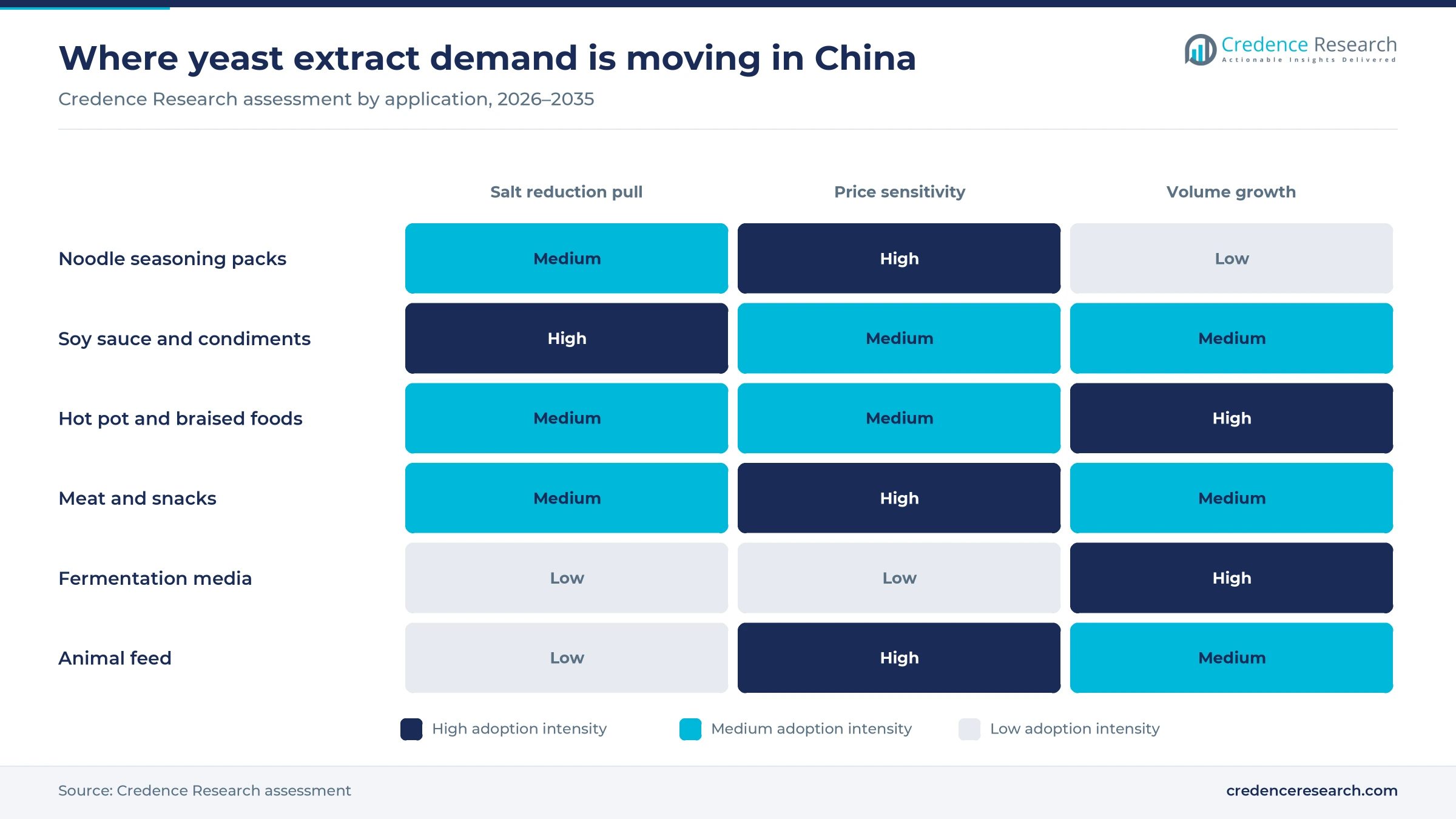
Noodle packs, hot pot bases and braised foods set volume
Mass-market convenience foods set the baseline tonnage, although their unit volumes have stopped growing and gains now come from richer recipes. China and Hong Kong consumed 43.27 billion servings of instant noodles in 2025, slightly fewer than in 2024, according to World Instant Noodles Association data. Biospringer's Chinese teams develop dishes for regional cuisines such as Cantonese food, Yicai reported in November 2026, so a shift toward bone-broth and premium spicy bases raises dosage per pack. Food and beverages already account for 82.0% of value, which means suppliers win share through recipe upgrades at large noodle, hot pot and braised-food groups rather than through new product categories.
New southwestern capacity lowers cost for local buyers
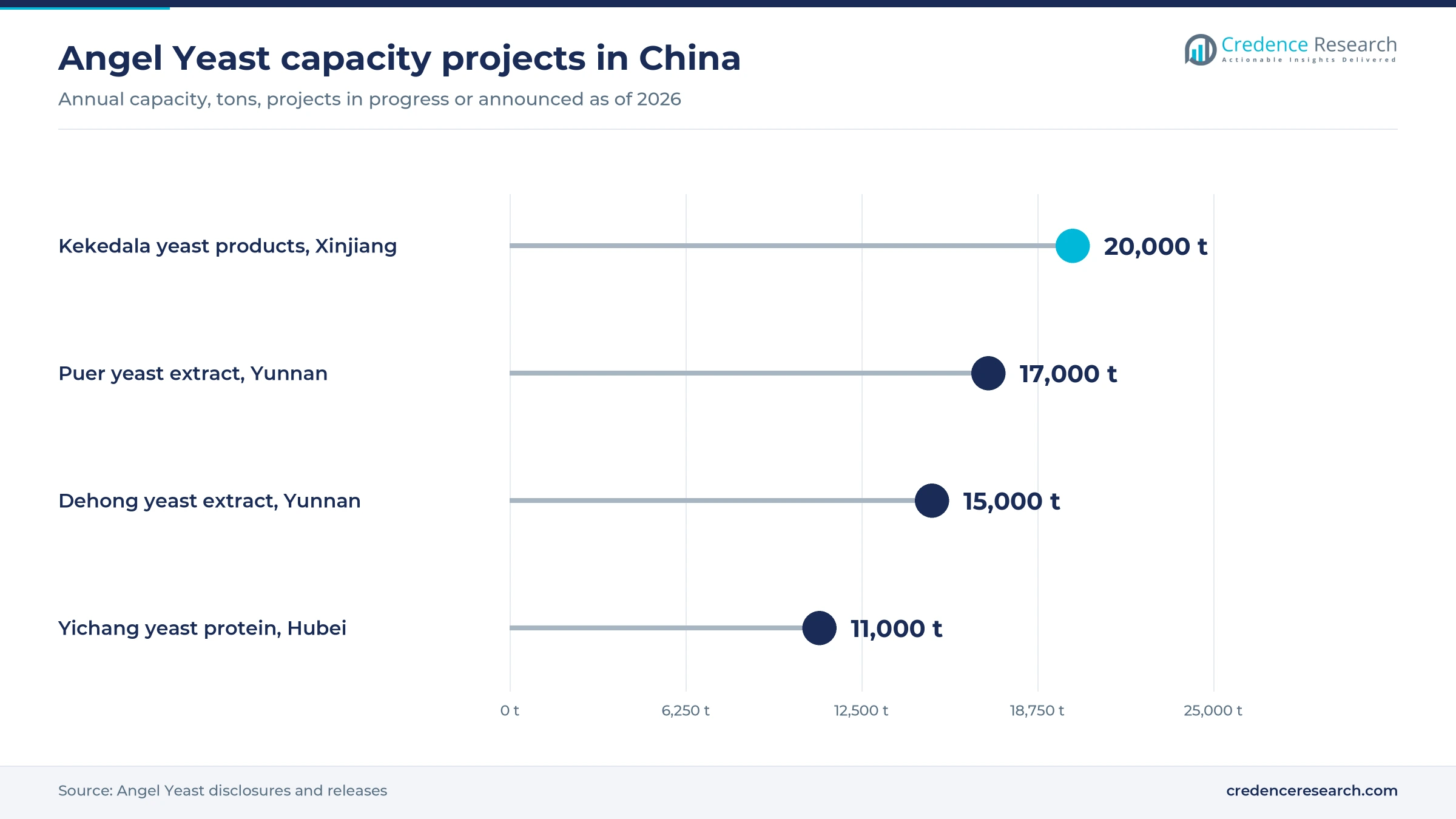
Capacity is moving toward the cane-growing southwest, where molasses is cheaper and freight to inland seasoning plants is shorter. Angel Yeast produced 146,400 tons of yeast extract in 2024, up 5.63%, according to its 2024 annual report. The same report says its yeast extract projects in Puer and Dehong, Yunnan, were under construction, with no completion dates given, while its 2025 sustainability report lists production in 11 Chinese cities. When both lines run, buyers in Sichuan, Chongqing and Yunnan gain shorter delivery times and an incentive to raise dosage, while producers without southwestern plants face a freight disadvantage on inland contracts.
Taste modulation and yeast protein reshape supplier focus
Supplier strategy is changing faster than end demand, with portfolio deals and new yeast-based products shaping who serves which buyer. One completed Lesaffre acquisition in 2024 and a second deal announced in 2026 show how quickly foreign supply in this market is being consolidated.
Suppliers shift toward taste modulation beyond umami
European suppliers are shifting from selling umami alone toward full taste systems that also mask bitterness and improve mouthfeel, to win briefs for high-protein and reduced-sugar products. Lesaffre completed its purchase of the dsm-firmenich yeast extract business on Oct. 2, 2024, with 46 employees transferring, according to the dsm-firmenich announcement. Biospringer by Lesaffre then announced in late October 2026 that it would acquire the ModuMax taste modulation technology from dsm-firmenich to pair with its yeast extracts, Food Ingredients First reported. Biospringer also moved production of its premium Springer Umami 2020 range to China after transferring the core technology. Chinese beverage and dairy alternative makers gain a single supplier for umami and masking, while umami-only producers face harder price talks.
Yeast protein rises as a second outlet for yeast cream
Large producers are shifting part of their fermentation capacity toward yeast protein, which competes with yeast extract for the same yeast cream and the same fermentation tanks. Angel Yeast began operating an 11,000-ton-a-year yeast protein line at Baiyang Biotechnology Park in Yichang in November 2025, the company said. At FIC 2026 in Shanghai in March 2026 it presented AngeoPro Hi90-A with 88% protein. Its September 2026 filing for an RMB 845 million Xinjiang project covers both high value-added yeast extract and yeast protein. Savory capacity may grow more slowly if protein earns better margins, which strengthens integrated producers in price talks.
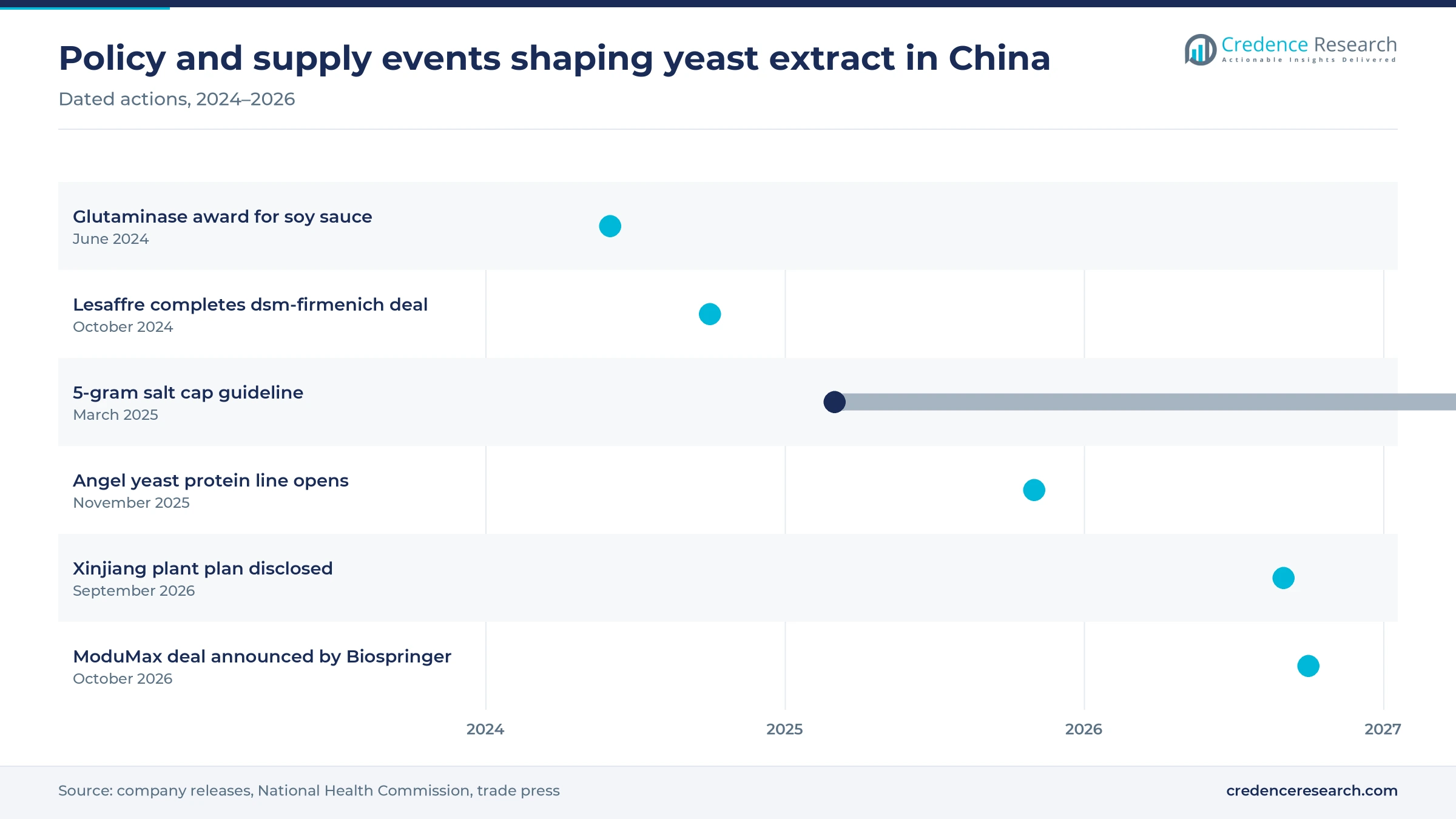
Fermentation media for biomanufacturing is an opening
Fermentation media for biomanufacturing offer a higher-value outlet than seasoning, because pharmaceutical and enzyme fermenters pay for consistent nitrogen content and low variability between lots. The 2025 Government Work Report named biomanufacturing a sector to nurture and scale, and the sector reached about RMB 1.1 trillion in 2025 with nearly RMB 30 billion of annual investment, according to China Briefing. Zhuhai TXY Biotech lists culture medium alongside yeast extract among its products, showing that domestic producers already sell into this channel. Pharmaceuticals grow at 5.8% a year, so suppliers that can document lot consistency and supply pharmaceutical-grade paperwork can earn a price premium over food-grade powder.
Feed and pet nutrition absorb lower-grade output
Feed and pet nutrition create an outlet for lower-grade yeast extract and yeast hydrolysates as palatability and gut-health ingredients, which helps producers use output that misses food specifications. China produced 342.25 million tons of feed in 2025, 27.2 million tons more than in 2024, according to China Feed Industry Association and National Bureau of Statistics data compiled for RFD-TV. Swine feed alone reached 166 million tons, up 22.5 million tons. Zhuhai TXY Biotech also lists yeast-derived feed products and feed additives, so the channel is already served by local producers. Feed mills gain a natural palatant, although their price ceiling is well below food grades.
Molasses swings, beer decline and supplier concentration
Molasses price swings unsettle contract pricing
Molasses price swings make annual contracts hard to set, because the feedstock is the largest single cost in yeast fermentation. The average molasses price in China rose from RMB 1,250 per ton in 2021 to RMB 1,920 in 2023, then fell to RMB 1,150 in 2025, according to June 2026 equity research, and purchase prices for the 2025/26 season of about RMB 800-900 per ton point lower still. Buyers who locked prices during the peak paid above spot, while smaller producers without long-term sugar mill supply carried the margin squeeze when prices rose.
Falling beer output limits brewer's yeast supply
Falling beer output limits the supply of spent brewer's yeast, which is the cheaper raw material for some extract grades and for feed hydrolysates. Beer production fell 6% in the first nine months of 2026, Vinetur reported, citing National Bureau of Statistics data, which extends the 2025 decline noted above. Producers that rely on brewery by-products face rising collection costs per ton and may have to switch to primary yeast, which costs more to grow.
Waste and residue rules raise compliance costs
Fermentation residues and high-strength wastewater make environmental compliance a material cost for every yeast plant. Angel Yeast's 2025 sustainability report, published in June 2026, warns that improper handling of residues and sludge could lead to fines and production suspension, and it lists molasses as a critical raw material for supplier risk checks in 2026. Small producers without treatment capacity are most exposed, while buyers face supply interruption if a single plant is shut.
High supplier concentration limits buyer leverage
Supplier concentration limits the leverage of food makers, because few producers can deliver large volumes of consistent savory grades. Angel Yeast holds more than 70% of domestic yeast extract supply, according to March 2025 equity research, after its capacity reached 138,600 tons in 2023. Mid-sized condiment makers that cannot qualify a second source are most exposed to price and allocation decisions, and dual sourcing with Lesaffre or Ohly usually requires reformulation trials.
Eastern food clusters lead while western zones gain share
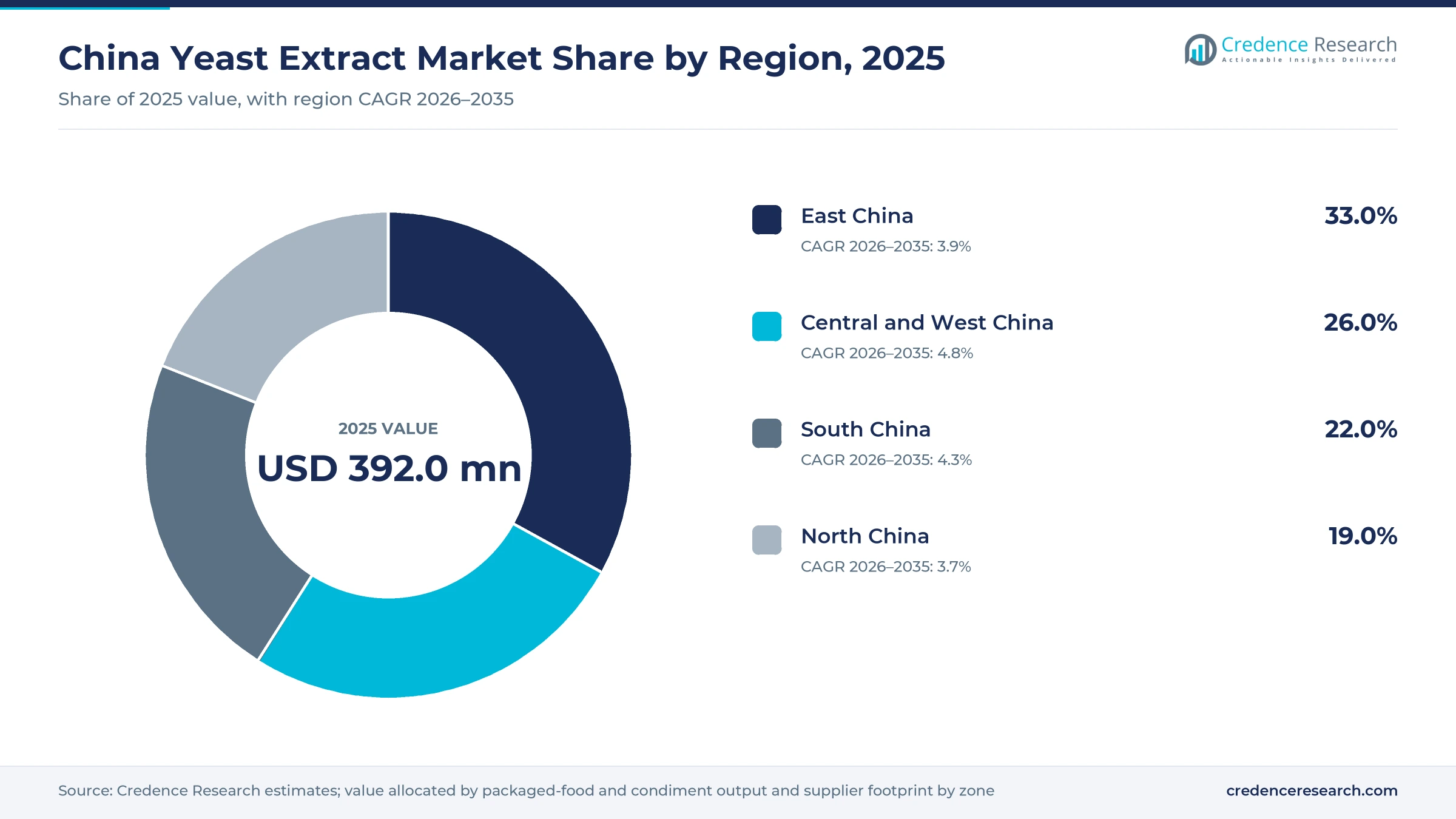
Regional shares and growth rates are Credence Research estimates, allocated by packaged-food and condiment output, catering demand and the location of yeast extract plants in each zone. East China remains the largest zone in 2025 demand, while the inland and southern zones together hold almost half of value.
| Region | Value, 2025 (USD million) | Share, 2025 | CAGR, 2026–2035 |
|---|---|---|---|
| East China | 129.4 | 33.0% | 3.9% |
| Central and West China | 101.9 | 26.0% | 4.8% |
| South China | 86.2 | 22.0% | 4.3% |
| North China | 74.5 | 19.0% | 3.7% |
East China leads through packaged-food and trade clusters
East China held 33.0% of 2025 value and grows at 3.9% a year, because Shanghai, Jiangsu, Zhejiang and Shandong host the largest cluster of noodle, snack, frozen food and multinational food plants. The zone is also the ingredient trade hub, with Ohly having announced a food application center and sales office in Shanghai and Angel Yeast launching its newest yeast protein grades at FIC 2026 in the city in March 2026. Growth is slower than inland because most large buyers have already adopted yeast extract in their main recipes.
Central and West China grows on capacity and spicy cuisines
Central and West China held 26.0% of 2025 value and grows fastest at 4.8% a year, as hot pot base, braised-food and chili sauce makers in Sichuan, Chongqing, Hunan and Hubei use higher dosages. Angel Yeast runs Baiyang Biotechnology Park in Yichang, Hubei, where it opened its new yeast protein line in November 2025, and the Yunnan and Xinjiang projects noted above put new capacity close to these buyers. Supply security improves for inland seasoning makers, although many are small and buy through distributors, which caps price levels.
South China combines condiment brewers and major plants
South China held 22.0% of 2025 value and grows at 4.3% a year, supported by the soy sauce and oyster sauce brewers of Guangdong and by large production sites in Guangxi. Angel Yeast lists its Liuzhou facility as the world's largest yeast extract plant in its 2025 sustainability report, Lesaffre runs a yeast plant in Chongzuo, and Biospringer operates an R&D center in Laibin. Zhuhai TXY Biotech produces yeast extract in Guangdong, so local buyers have more supplier choice than in any other zone.
North China relies on wheat foods, meat and feed demand
North China, including the northeast, held 19.0% of 2025 value and grows at 3.7% a year, the slowest pace, because wheat noodle, meat processing and feed demand in the zone is mature and grows with population rather than with new categories. Ohly opened a yeast extract plant in Harbin in 2010 to serve northern buyers, Food Ingredients First reported. Feed mills and meat processors buy mainly standard grades, so value per ton is lower than in the coastal condiment clusters.
Acquisitions, protein lines and new western capacity
| Development | Status and market relevance |
|---|---|
| In October 2024, Lesaffre completed the acquisition of the dsm-firmenich yeast extract business, adding it to Biospringer. | Completed acquisition; it removes one foreign competitor and gives Lesaffre a larger savory portfolio to sell into China. |
| In November 2025, Angel Yeast began operating an 11,000-ton-a-year yeast protein line at Baiyang Biotechnology Park in Yichang. | Operational launch; it shows the leader diverting part of its fermentation base to protein, outside this market. |
| In September 2026, Angel Yeast disclosed an RMB 845 million plan for a 20,000-ton yeast products plant in Kekedala, Xinjiang, covering yeast extract and yeast protein. | Investment plan; construction is expected to start in April 2027 and take 20 months, so output arrives around the end of 2028. |
| In October 2026, Biospringer by Lesaffre announced it would acquire the ModuMax taste modulation technology from dsm-firmenich. | Announced acquisition; Biospringer plans to debut it at the next China International Import Expo. |
| In November 2026, Biospringer showed Springer Umami 2020 at the China International Import Expo after moving its production to China. | Localized production; it lets the premium grade compete on lead time with domestic suppliers. |
Nucleotide grades, enzymes and low-sodium formulation
- Nucleotide-rich grades concentrate 5'-IMP and 5'-GMP through enzyme treatment, letting a small dose replace a larger share of MSG in seasoning.
- Enzymatic hydrolysis uses proteases, nucleases and glutaminase to raise free glutamate and peptides, which improves yield per ton of yeast cream.
- Low-sodium systems combine yeast extract with potassium salts and kokumi peptides so that reduced-salt soy sauce keeps its body.
- Taste modulation pairs yeast extract with bitterness and off-note masking for high-protein drinks, a use that differs from classic flavor enhancer work.
Need a Custom Version of This Report?
Tailor the scope, geography, or segments to your exact requirements.
- Custom geography or segment scope
- Direct access to our analyst team
One domestic leader faces two European groups
Competition turns on scale, fermentation cost and application support inside customer plants. Angel Yeast leads with production in 11 Chinese cities, including the Liuzhou yeast extract plant, and the widest range of standard and nucleotide grades. Lesaffre competes through Biospringer, its Chongzuo yeast plant and its Laibin R&D center, and it absorbed the former dsm-firmenich yeast extract business noted above. Associated British Foods competes through Ohly, with a Harbin plant and a Shanghai application center it announced. Lallemand sells nutritional and specialty yeast ingredients through local distribution. Zhuhai TXY Biotech is a domestic producer of yeast extract, culture medium and feed products, and Oriental Yeast is a Japanese maker of yeast extracts and specialty yeast. Buyers of broader savory ingredients compare these suppliers on dosage cost per kilogram of finished food rather than on price per ton.
How concentrated is supply of yeast extract in China?
Supply is highly concentrated, with one domestic producer, two European groups and a tail of smaller regional plants. Angel Yeast is by far the largest producer, as the domestic share noted in the challenges shows, and Lesaffre and Ohly follow at a distance because yeast extract is made from the same yeast fermentation base that both groups run. Entry barriers are high, since a new plant needs molasses contracts, wastewater treatment and years of recipe qualification with food buyers. Margins sit in nucleotide-rich and application-specific grades, while standard powder trades close to cost.
Producers and ingredient suppliers active in China
| Company | Type | Role in the market |
|---|---|---|
| Angel Yeast Co., Ltd. | Domestic leader | Largest yeast extract producer, with powder, paste and nucleotide grades from Chinese plants |
| Lesaffre (Biospringer) | Global specialist | Biospringer yeast extracts, localized premium umami grades and taste modulation |
| Associated British Foods (Ohly) | Global specialist | Ohly yeast extracts and yeast-based flavors from a Harbin plant |
| Lallemand Inc. (Lallemand Bio-Ingredients) | Specialist | Nutritional yeasts and yeast-based ingredients sold through distribution |
| Zhuhai TXY Biotech Holding Co., Ltd. | Local manufacturer | Yeast extract, culture medium and yeast-derived feed products in Guangdong |
| Oriental Yeast Co., Ltd. | Specialist | Yeast extracts and specialty yeast products for food and fermentation |
Value growth lags volume as input costs fall
Credence Research's view is that value will grow more slowly than tonnage through the forecast period, because cheaper molasses and a dominant domestic producer keep standard powder prices low. The best returns sit with suppliers that sell reformulation, not tons, for reduced-salt soy sauce, premium hot pot bases and protein drinks. Buyers should use the current price softness to lock multi-year contracts for standard grades and qualify a second source for nucleotide-rich grades. Price softness in 2026 favors buyers, but the share held by the leading producer limits how long that advantage lasts. Investors should watch whether western capacity arrives on time and whether pharmaceutical fermentation buyers switch to domestic media.
Estimates rest on producer output and price data
The report uses 2025 as the base year and forecasts values for 2026 to 2035 in U.S. dollars at producer selling prices. Market values come from the Credence Research model, built bottom-up from domestic yeast extract output, an estimated export share and weighted prices, and checked against company disclosures and public statistics. Segment and regional splits are Credence Research estimates derived from public production, trade and company data. Sources include company releases and sustainability reports, government guidelines, official statistics, trade association data and trade press, and no interviews or surveys were used for this edition.
Steady volume gains with slower value growth to 2035
Through 2035 the market should add volume steadily as salt reduction moves from policy to recipes, with condiment and seasoning makers raising dosage one product line at a time. Value growth will stay below volume growth while molasses remains cheap and the leading producer adds capacity in Yunnan and Xinjiang. Fermentation media and feed should take a larger share of tonnage, and taste modulation grades should widen the gap between commodity powder and specialty products. Salt reduction should remain the main source of new demand through 2035, with dosage gains concentrated in condiments and hot pot bases. Supply concentration is unlikely to ease, so buyer leverage will depend on qualifying alternative grades early.
Dosage upgrades decide where growth lands by 2035
The range of outcomes depends mainly on how far condiment and seasoning makers raise dosage under salt reduction, and on whether cheaper molasses keeps pushing prices down. Volume is less uncertain than value, because convenience food tonnage is stable while price per ton moves with feedstock and competition. Fermentation media and feed decide the upside, since they add tonnage outside food.
| Scenario | CAGR, 2026–2035 | Value, 2035 | What has to hold |
|---|---|---|---|
| Downside | 2.7% | USD 519.1 million | Molasses stays cheap, prices keep falling and salt reduction stays voluntary for most processed foods. |
| Base | 4.20% | USD 591.5 million | Dosage rises in condiments and hot pot bases while standard grade prices stabilize after 2027. |
| Upside | 5.7% | USD 672.7 million | Salt targets tighten for packaged foods and fermentation media buyers switch to domestic grades. |
Frequently Asked Questions
How big is the China yeast extract market?
Which region leads yeast extract demand in China?
Which application uses the most yeast extract in China?
Why does salt reduction matter for yeast extract demand?
Who are the main yeast extract suppliers in China?
How do molasses prices affect yeast extract prices?
Which yeast extract form grows fastest in China?
What new capacity is planned for yeast extract in China?
Table of Content
Chapter 1 Market Segmentation
- 1.1 Segmentation Framework
- 1.1.1 Product and Service Classification
- 1.1.2 Application and End-Use Classification
- 1.1.3 Technology and Solution Classification
- 1.1.4 Customer and Distribution Channel Classification
- 1.1.5 Geographic Segmentation
- 1.1.6 Market Segment Definitions and Boundaries
- 1.2 By Type
- 1.2.1 Powder
- 1.2.2 Paste
- 1.3 By Application
- 1.3.1 Food and Beverages
- 1.3.2 Pharmaceuticals
- 1.3.3 Animal Feed
- 1.3.4 Others
- 1.4 By Source
- 1.4.1 Baker's Yeast
- 1.4.2 Brewer's Yeast
Chapter 2 Introduction
- 2.1 Report Objectives and Scope
- 2.2 Product Definition and Industry Terminology
- 2.3 Market Inclusions and Exclusions
- 2.4 Research Process
- 2.4.1 Primary Research and Expert Interviews
- 2.4.2 Secondary Research and Source Review
- 2.4.3 Top-Down and Bottom-Up Estimation
- 2.4.4 Data Triangulation and Verification
- 2.5 Market Size Measurement Basis
- 2.5.1 2025: USD 392.0 million → 2035: USD 591.5 million
- 2.6 Historical and Forecast Reference Periods
- 2.6.1 Historical Period: 2018-2025
- 2.6.2 Base Year: 2025
- 2.6.3 Forecast Period: 2025-2035
- 2.7 Research Assumptions and Limitations
Chapter 3 Executive Summary
- 3.1 Market Snapshot and Key Findings
- 3.2 Base-Year Market Size, 2025
- 3.3 Forecast Market Size, 2035
- 3.4 Revenue and Volume Growth Outlook
- 3.5 Key Demand and Supply Indicators
- 3.6 Leading Market Segments
- 3.7 Fastest-Growing Market Opportunities
- 3.8 Regional Performance Highlights
- 3.9 Technology and Industry Transformation
- 3.10 Competitive Landscape Summary
- 3.11 Analyst View and Strategic Implications
Chapter 4 China Yeast Extract Market Trends and Developments
- 4.1 Historical Industry Development, 2018-2025
- 4.2 Recent Market Trends and Developments
- 4.3 Demand and Customer Behavior Trends
- 4.4 Technology and Product Innovation
- 4.5 Artificial Intelligence, Automation and Digitalization
- 4.6 Local Manufacturing and Supply Chain Realignment
- 4.7 Industry Partnerships, Mergers and Acquisitions
- 4.8 Sustainability and Circular Economy Developments
- 4.9 Government and Private Sector Investment Trends
- 4.10 Emerging Business Models and Commercialization
- 4.11 Industry Developments and Announcements
Chapter 5 China Yeast Extract Market Production, Supply and Demand Analysis
- 5.1 Demand Trend and Consumption Analysis, 2018-2025
- 5.2 Demand Forecast, 2025-2035
- 5.3 Production and Output Trend, 2018-2025
- 5.4 Production and Output Forecast, 2025-2035
- 5.5 Installed Capacity and Capacity Utilization
- 5.6 Company-Wise Production Plants and Statistics
- 5.6.1 Installed Production Capacity
- 5.6.2 Actual Production
- 5.6.3 Planned Capacity and Expansion Targets
- 5.7 Supply Chain Structure and Procurement Trends
- 5.8 Supply-Demand Gap and Bottlenecks
- 5.9 Import Dependence and Sourcing Structure
- 5.10 Contract Manufacturing and Outsourcing
- 5.11 Regional Supply and Demand Concentration
Chapter 6 China Yeast Extract Market Pricing Analysis
- 6.1 Pricing Structure and Measurement
- 6.2 Historical Pricing Trends, 2018-2025
- 6.3 Pricing Outlook, 2025-2035
- 6.4 Average Selling Price and Unit Economics
- 6.5 Pricing by Product and Market Segment
- 6.6 Geographic Pricing Differences
- 6.7 Key Input, Energy, Labor and Logistics Costs
- 6.8 Contract Pricing and Purchasing Models
- 6.9 Pricing Sensitivity and Competitive Positioning
- 6.10 Price, Margin and Profitability Implications
Chapter 7 China Yeast Extract Market Dynamics
- 7.1 Market Growth Drivers
- 7.1.1 Demand-Side Drivers
- 7.1.2 Technology and Innovation Drivers
- 7.1.3 Infrastructure and Investment Drivers
- 7.1.4 Regulatory and Policy Drivers
- 7.2 Market Restraints
- 7.2.1 Cost and Affordability Constraints
- 7.2.2 Technology and Adoption Barriers
- 7.2.3 Supply Chain and Operational Constraints
- 7.3 Market Challenges
- 7.3.1 Competitive Pressure and Margin Erosion
- 7.3.2 Skills, Infrastructure and Implementation Gaps
- 7.4 Emerging Market Opportunities
- 7.5 Market Dynamics Impact and Time-Horizon Assessment
Chapter 8 China Yeast Extract Value Chain Analysis
- 8.1 Industry Value Chain Overview
- 8.2 Upstream Suppliers and Critical Inputs
- 8.3 Technology and Component Providers
- 8.4 Manufacturing or Service Delivery
- 8.5 Distribution, Channel Partners and Integrators
- 8.6 Downstream Applications and End Users
- 8.7 Value Addition and Profit Pools
- 8.8 Vertical Integration and Outsourcing
- 8.9 Supplier Concentration and Risk
- 8.10 Supply Chain Localization and Resilience
Chapter 9 China Yeast Extract Market Regulations and Policies
- 9.1 Relevant Laws, Standards and Compliance Frameworks
- 9.2 Product, Service, Safety and Quality Requirements
- 9.3 Government Policies, Incentives and Subsidies
- 9.4 Imports, Exports and Trade Barriers
- 9.5 Public Procurement and Local Content Requirements
- 9.6 Environmental and Sustainability Compliance
- 9.7 Upcoming Policy Changes and Market Implications
Chapter 10 China Yeast Extract Market Hotspots and Opportunities
- 10.1 Market Opportunity Mapping and Growth Hotspots
- 10.2 High-Growth Applications and Customer Groups
- 10.3 Underserved Markets and White-Space Opportunities
- 10.4 Emerging Technology and Product Opportunities
- 10.5 New Capacity and Investment Hotspots
- 10.6 Market Entry and Expansion Opportunities
- 10.7 Distribution and Partnership Opportunities
- 10.8 Near-Term and Long-Term Commercial Potential
- 10.9 Opportunity Attractiveness and Execution Risks
Chapter 11 China Yeast Extract Market Outlook, 2025-2035
- 11.1 Market Size and Analysis
- 11.1.1 Revenue (Market Measurement: 2025: USD 392.0 million → 2035: USD 591.5 million)
- 11.1.2 Market Volume and Quantity Sold
- 11.1.3 Historical Market Size, 2018-2025
- 11.1.4 Base-Year Market Size, 2025
- 11.2 Market Forecast, 2025-2035
- 11.2.1 Revenue Forecast to 2035
- 11.2.2 Volume Forecast to 2035
- 11.2.3 CAGR and Year-on-Year Growth
- 11.2.4 Incremental Revenue Opportunity
- 11.3 Forecast Assumptions and Scenario Analysis
- 11.3.1 Base-Case Forecast
- 11.3.2 Optimistic and Conservative Scenarios
- 11.3.3 Technology, Pricing and Policy Sensitivities
- 11.4 Market Attractiveness and Growth Outlook
Chapter 12 China Yeast Extract Market Segmentation and Outlook
- 12.1 Segmentation Summary and Market Shares, 2025
- 12.2 Largest and Fastest-Growing Segments
- 12.3 By Type - Market Size and Forecast, 2025-2035
- 12.3.1 Segment Definition and Scope
- 12.3.2 Historical Market Size, 2018-2025
- 12.3.3 Revenue Forecast, 2025-2035
- 12.3.4 Volume Forecast, 2025-2035
- 12.3.5 Base-Year Market Share, 2025
- 12.3.6 Segment CAGR and Growth Drivers
- 12.3.7 Subsegment Market Size and Forecast
- 12.3.7.1 Powder
- 12.3.7.2 Paste
- 12.3.8 Subsegment Pricing and Adoption Trends
- 12.3.9 Leading Suppliers and Competition
- 12.3.10 Regional Demand and Opportunities
- 12.4 By Application - Market Size and Forecast, 2025-2035
- 12.4.1 Segment Definition and Scope
- 12.4.2 Historical Market Size, 2018-2025
- 12.4.3 Revenue Forecast, 2025-2035
- 12.4.4 Volume Forecast, 2025-2035
- 12.4.5 Base-Year Market Share, 2025
- 12.4.6 Segment CAGR and Growth Drivers
- 12.4.7 Subsegment Market Size and Forecast
- 12.4.7.1 Food and Beverages
- 12.4.7.2 Pharmaceuticals
- 12.4.7.3 Animal Feed
- 12.4.7.4 Others
- 12.4.8 Subsegment Pricing and Adoption Trends
- 12.4.9 Leading Suppliers and Competition
- 12.4.10 Regional Demand and Opportunities
- 12.5 By Source - Market Size and Forecast, 2025-2035
- 12.5.1 Segment Definition and Scope
- 12.5.2 Historical Market Size, 2018-2025
- 12.5.3 Revenue Forecast, 2025-2035
- 12.5.4 Volume Forecast, 2025-2035
- 12.5.5 Base-Year Market Share, 2025
- 12.5.6 Segment CAGR and Growth Drivers
- 12.5.7 Subsegment Market Size and Forecast
- 12.5.7.1 Baker's Yeast
- 12.5.7.2 Brewer's Yeast
- 12.5.8 Subsegment Pricing and Adoption Trends
- 12.5.9 Leading Suppliers and Competition
- 12.5.10 Regional Demand and Opportunities
- 12.6 Segment Growth Comparison
- 12.7 Segment Attractiveness and Priority Matrix
Chapter 13 China Yeast Extract End-Use and Application Market Outlook
- 13.1 End-Use Industry and Customer Demand Structure
- 13.2 Leading Applications and Customer Groups
- 13.3 End-Use Market Size, Share and Forecast
- 13.4 Major End-Use Industry Deep Dives
- 13.4.1 Customer Requirements and Use Cases
- 13.4.2 Demand and Replacement Cycles
- 13.4.3 Technical and Regulatory Considerations
- 13.4.4 Purchasing and Procurement Models
- 13.4.5 Leading Vendors and Distribution Channels
- 13.4.6 Forecast and Commercial Opportunities
- 13.5 Emerging Applications and Cross-Segment Demand
- 13.6 End-Use Industry Investment Priorities
Chapter 14 China Yeast Extract Geographic Market Outlook, 2025-2035
- 14.1 Domestic Market Distribution and Demand Clusters
- 14.2 State- or Province-Wise Market Size and Forecast, 2025-2035
- 14.3 City and Metropolitan Market Outlook
- 14.4 Industrial, Manufacturing and Commercial Clusters
- 14.5 Geographic Concentration of Key End Users
- 14.6 Local Pricing and Purchasing Differences
- 14.7 Domestic Production Facilities and Capacity Map
- 14.8 Local Infrastructure and Project Pipeline
- 14.9 State-Level Policy and Incentive Differences
- 14.10 Subnational Investment Hotspots and Opportunities
- 14.11 Distribution and Logistics Networks
- 14.12 Domestic Competitive Footprint
Chapter 15 China Yeast Extract Technology, Innovation and Sustainability Outlook
- 15.1 Technology Landscape and Maturity
- 15.2 Product, Process and Service Innovation
- 15.3 AI, Automation and Digital Tools in the Industry
- 15.4 Technology Adoption and Performance Benchmarking
- 15.5 Innovation Pipeline and R&D Investment
- 15.6 Patent and Intellectual Property Trends
- 15.7 Energy Efficiency and Resource Management
- 15.8 Sustainability, Recycling and Circularity
- 15.9 Technology Roadmap, 2025-2035
- 15.10 Risks of Obsolescence and Technology Substitution
Chapter 16 China Yeast Extract Market Key Strategic Imperatives
- 16.1 Growth and Market Entry Priorities
- 16.2 High-Return Products and Segments
- 16.3 Pricing, Profitability and Cost Optimization
- 16.4 Technology Investment and Product Differentiation
- 16.5 Supply Chain Localization and Resilience
- 16.6 Distribution and Customer Acquisition
- 16.7 Partnership, Acquisition and Capacity Strategy
- 16.8 Regional Expansion Priorities
- 16.9 Short-, Medium- and Long-Term Actions
Chapter 17 Competition Outlook
- 17.1 Industry Competition Characteristics
- 17.2 Market Structure and Concentration
- 17.3 Market Share and Competitive Positioning, 2025
- 17.4 Company-Wise Revenue and Product Benchmarking
- 17.5 Production and Service Capacity Benchmarking
- 17.6 Technology, Pricing and Differentiation
- 17.7 Regional Footprint and Distribution Strength
- 17.8 Mergers, Acquisitions and Strategic Alliances
- 17.9 New Entrants and Competitive Threats
- 17.10 Porter's Five Forces and Industry Attractiveness
- 17.11 Competitive Outlook, 2025-2035
Chapter 18 Company Profiles
- 18.1 Company Coverage and Selection Criteria
- 18.2 Angel Yeast Co., Ltd.
- 18.2.1 Business Description
- 18.2.2 Company Ownership and Geographic Presence
- 18.2.3 Product and Service Portfolio
- 18.2.4 Manufacturing and Operating Footprint
- 18.2.5 Production Capacity and Expansion Plans
- 18.2.6 Financial Performance and Investment
- 18.2.7 Market Share and Competitive Position
- 18.2.8 Technology and Innovation Capabilities
- 18.2.9 Strategic Alliances or Partnerships
- 18.2.10 Recent Developments
- 18.2.11 Growth Strategy and Outlook
- 18.3 Lesaffre (Biospringer)
- 18.4 Associated British Foods (Ohly)
- 18.5 Lallemand Inc. (Lallemand Bio-Ingredients)
- 18.6 Zhuhai TXY Biotech Holding Co., Ltd.
- 18.7 Oriental Yeast Co., Ltd.
- 18.8 Other Relevant Market Participants
Note: Every listed company is profiled on the structure shown under the first company. The company list is preliminary and may change based on research findings, market developments, data availability and client requirements.
Chapter 19 Disclaimer
- 19.1 Research and Forecast Disclaimer
- 19.2 Data Source and Estimation Limitations
Note: The depth of individual sections depends on data availability for this market. Volume, capacity, trade and other unit-based metrics are included where applicable.