USA cigars value rests on handmade imports and price mix
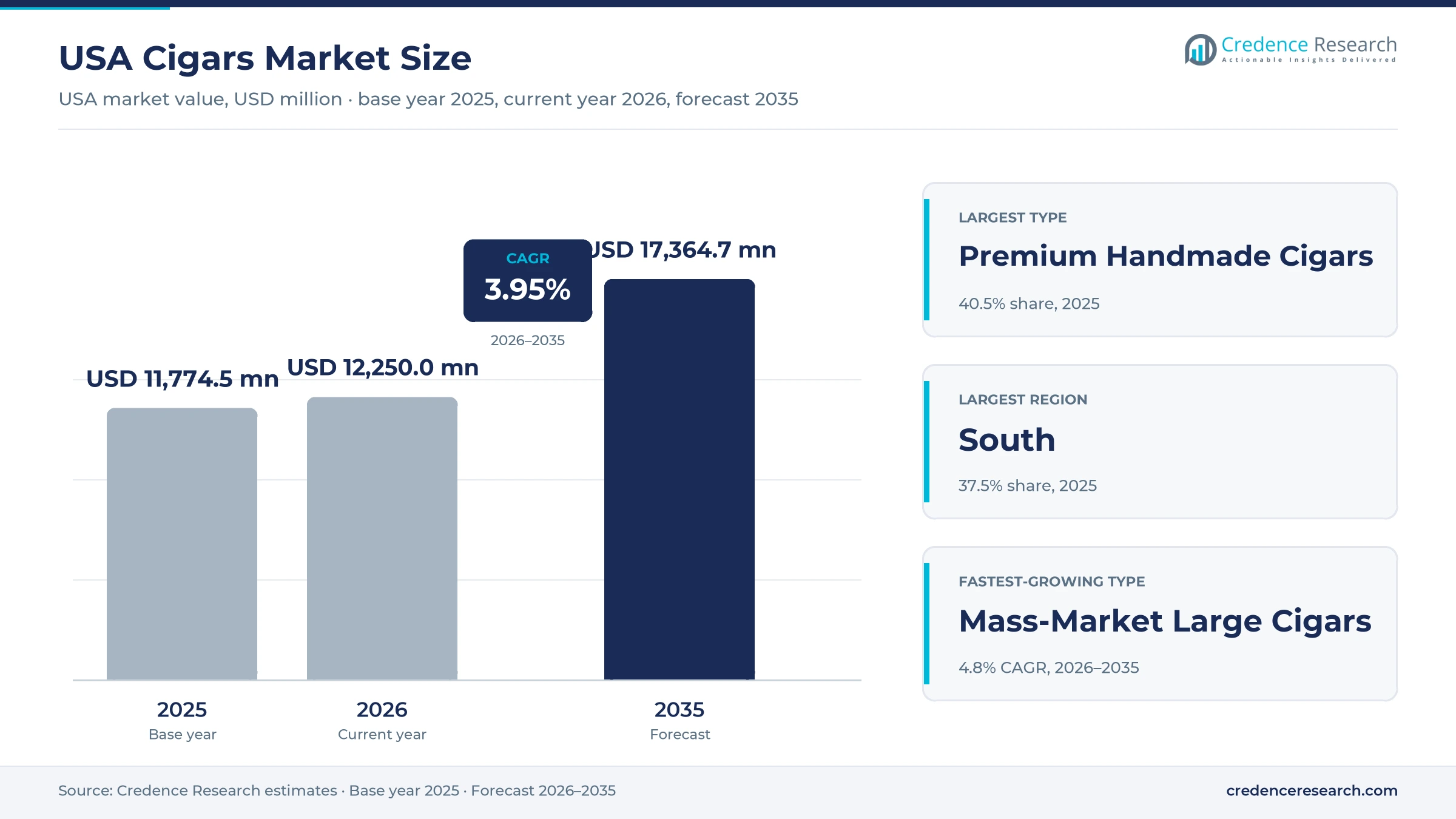
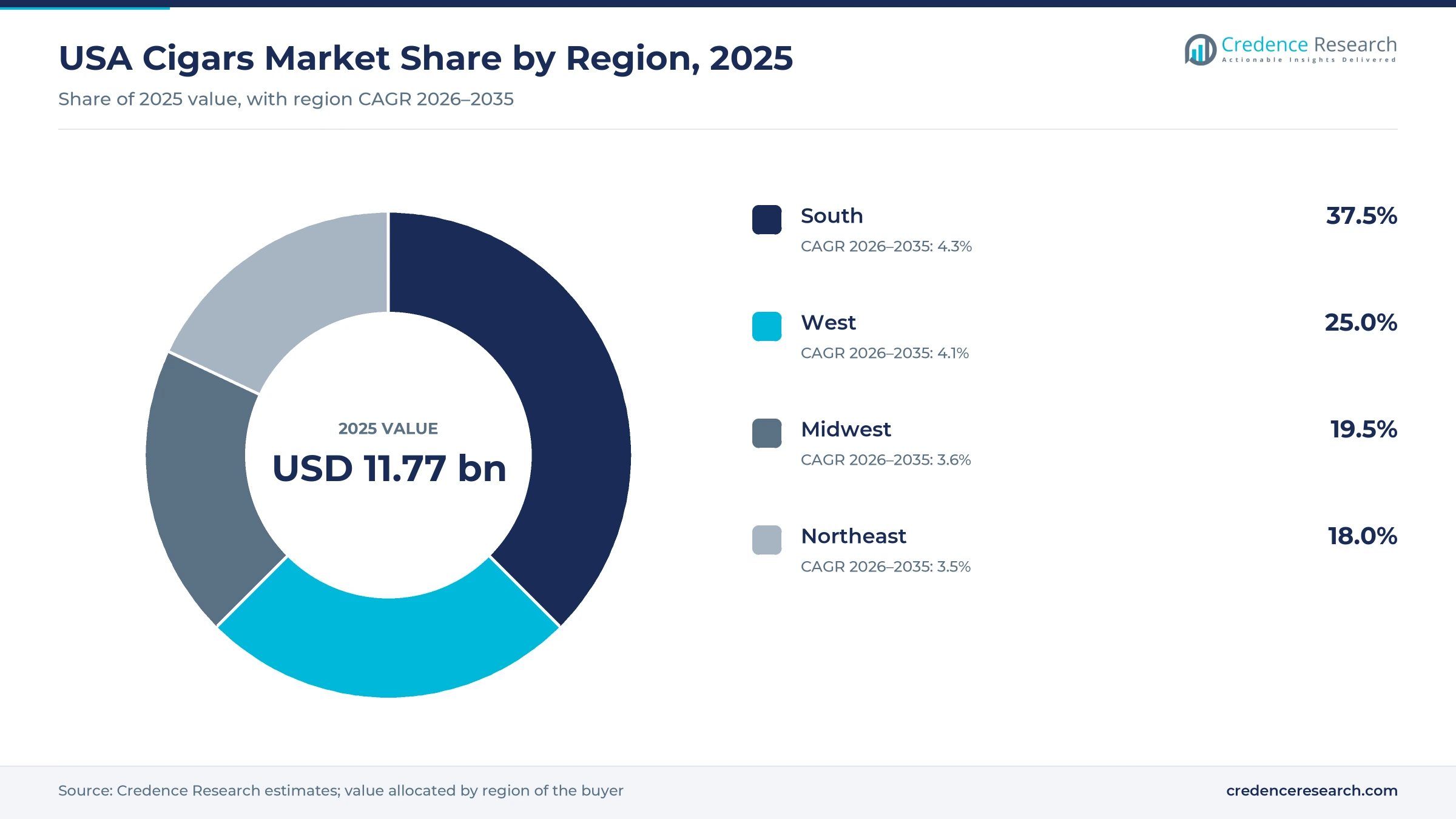
The USA cigars market was valued at USD 11.77 billion in 2025 and is projected to increase from USD 12.25 billion in 2026 to USD 17.36 billion by 2035, registering a CAGR of 3.95% during 2026–2035. Demand rests on two different businesses, a high-volume convenience trade in machine-made cigarillos and large cigars, and a specialty trade in handmade cigars imported from Nicaragua, the Dominican Republic and Honduras. The South held the largest regional share, 37.5% in 2025, and is also the fastest-growing region at 4.3% a year, because the region combines the largest adult population with dense specialty retail and large Texas superstores. The largest regulatory change came in 2025 and 2026, when federal courts set aside the FDA deeming rule for premium cigars and fixed an eight-part definition of the exempt product.
Which products and buyers make up cigar spending in the United States?
The market counts retail spending on premium handmade cigars, machine-made large cigars such as tipped and natural leaf brands, cigarillos sold in pre-priced packs, and little filtered cigars. Buyers range from daily mass-market smokers who buy at convenience counters to enthusiasts who buy boxes from walk-in humidors, online retailers and lounges. Values are measured at the price the final buyer pays, including federal and state excise taxes.
The estimate excludes pipe tobacco, roll-your-own tobacco, hookah tobacco, blunt wraps sold without a cigar inside, and lounge fees charged for seating or memberships. Cigars shipped for export and duty-free sales are also left out. The value chain runs from leaf growers and factories in Central America, the Caribbean, Pennsylvania and Florida through importers and federal tax-paid distributors to convenience, specialty and online retailers.
USA Cigars Market Insights
- USA cigars value grows from USD 11.77 billion in 2025 to USD 17.36 billion by 2035, a 3.95% pace led by price and mix rather than more sticks smoked.
- The South led with 37.5% of 2025 value, supported by Florida, which levies no tax on premium cigars, and by large Texas superstores.
- Premium Handmade Cigars held 40.5% of 2025 value, because imports have stayed above 400 million sticks for five straight years.
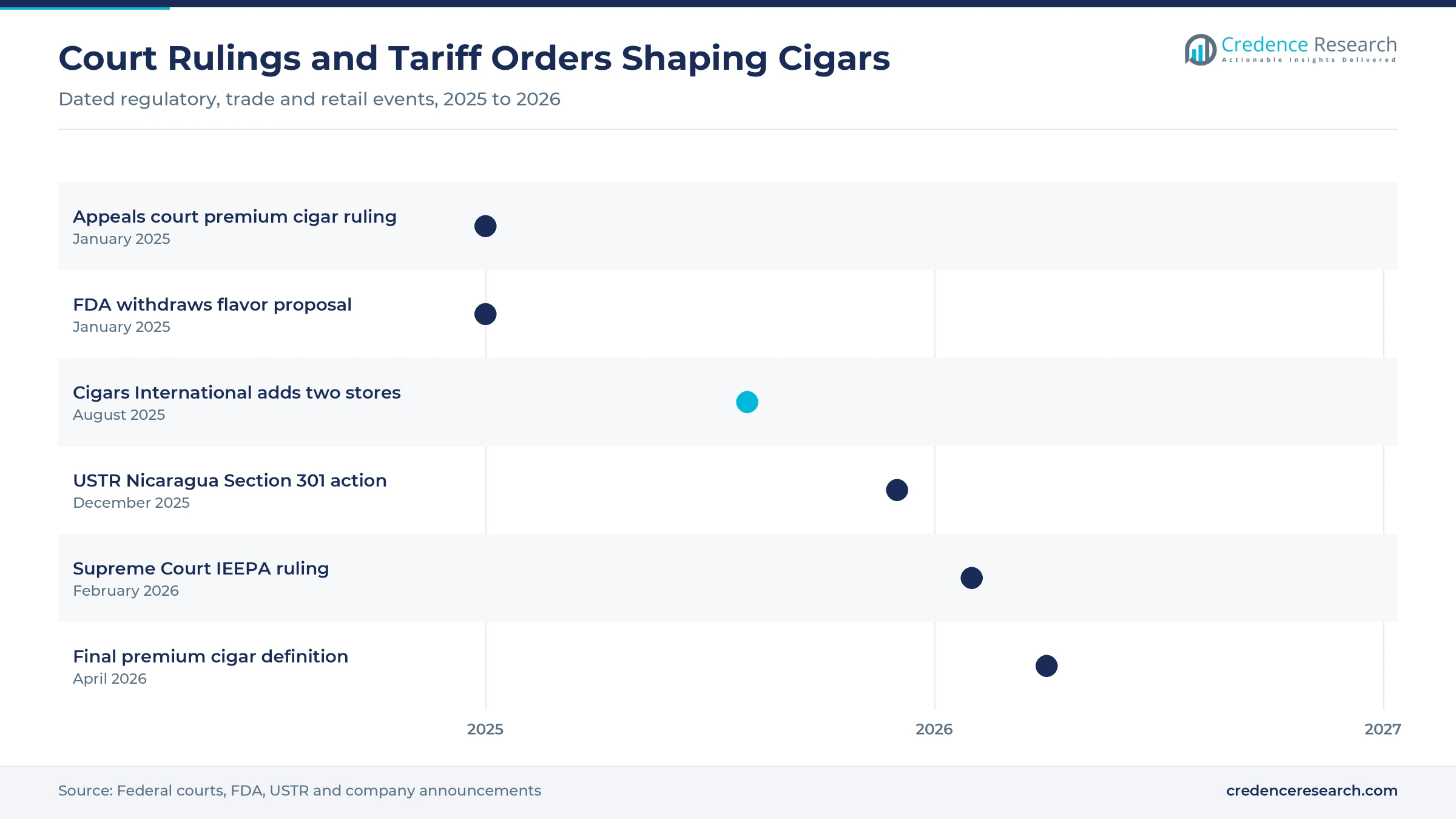
- Federal courts removed premium cigars from FDA premarket review in January 2025 and fixed the exempt definition in April 2026.
- Honduras gained share of handmade imports in 2025 and 2026 as tariffs on Nicaraguan goods rose and Dominican shipments fell.
Handmade sticks lead value while natural leaf gains fastest
Why do handmade cigars hold the most value, and what grows fastest?
Based on product type, the market is categorized into premium handmade cigars, mass-market large cigars, cigarillos and little filtered cigars. Premium Handmade Cigars led with 40.5% of 2025 value because each stick sells for many times the price of a machine-made cigar, and handmade imports have topped 400 million sticks for five years, the Cigar Association of America reported. Mass-Market Large Cigars grow fastest at 4.8% a year as natural leaf and tipped brands hold volume, with ITG Brands saying Backwoods is the leading natural leaf cigar in the country. Little filtered cigars keep losing shelf space to these formats.
How does spending split across value, premium and luxury price tiers?
Based on price tier, the market is categorized into value, mid-market, premium and luxury. Value led with 34.0% of 2025 value because pre-priced cigarillo packs and five-packs dominate convenience counters, where cigar sales reached USD 4.09 billion in the 52 weeks to Oct. 4, 2026, according to convenience scan data reported by Tobacco Insider. Luxury grows fastest at 5.5% a year as handmade imports held near 430 million sticks while makers raised list prices, and domestic removals of large cigars priced above the federal tax cap rose to 3.41 million sticks in 2025 from 2.76 million, TTB data show, a small but rising signal of premium pricing.
Why do convenience counters lead, and where is specialty retail gaining?
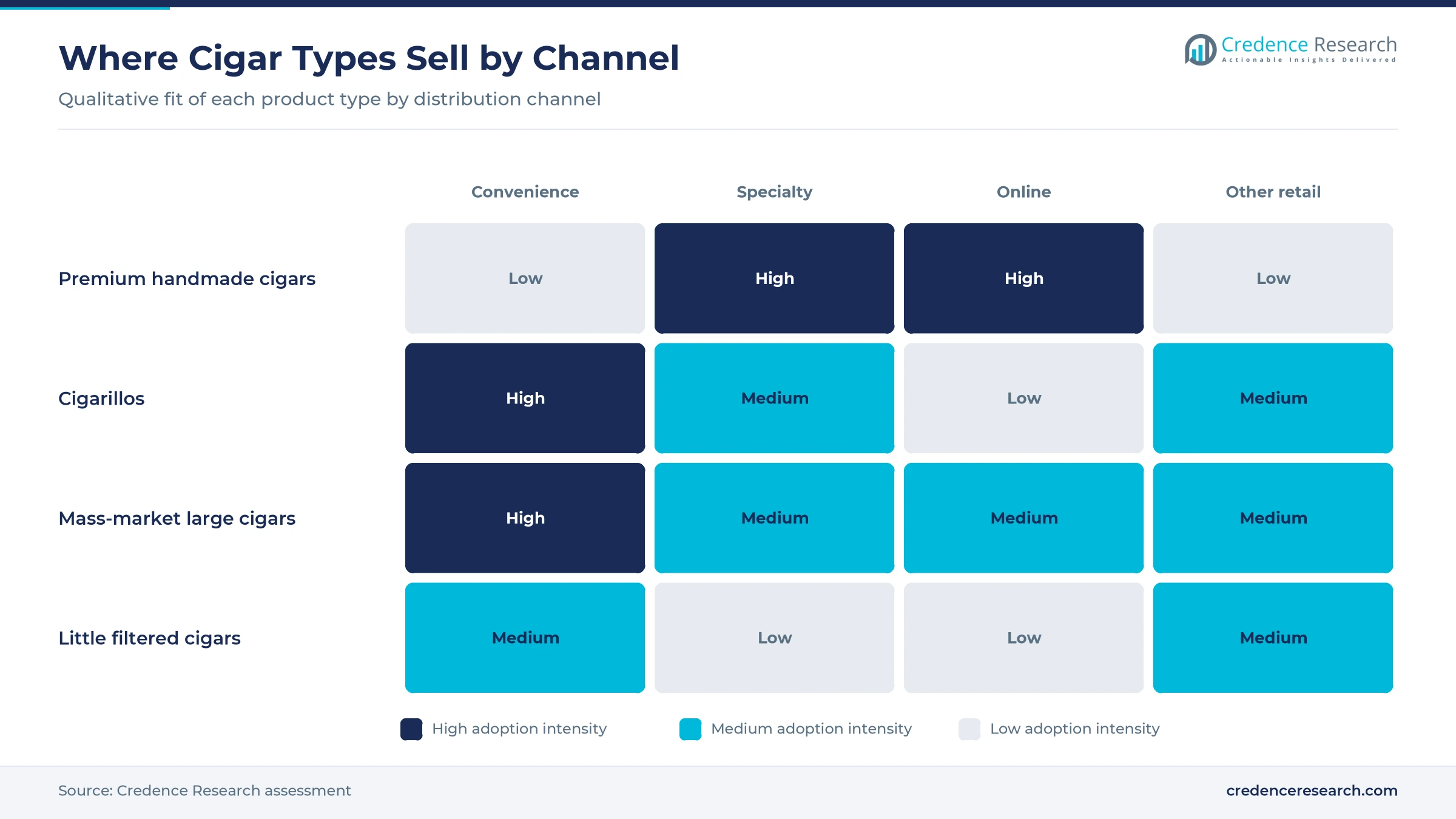
Based on distribution channel, the market is categorized into convenience stores and gas stations, tobacco specialty retailers, online and direct-to-consumer, and other retail channels. Convenience Stores and Gas Stations led with 37.0% of 2025 value because nearly all cigarillos and tipped cigars are bought there, often several times a week, by habitual smokers. Tobacco Specialty Retailers grow fastest at 4.8% a year as Scandinavian Tobacco Group expanded its superstore network by about 15% in 2025 and targets about 25 superstores by 2030. Large walk-in stores also sell humidors, cutters and lighters alongside boxes.
| Segment Group | Leading Sub-segment | Share, 2025 | Fastest-growing Sub-segment | CAGR, 2026–2035 |
|---|---|---|---|---|
| By Product Type | Premium Handmade Cigars | 40.5% | Mass-Market Large Cigars | 4.8% |
| By Price Tier | Value | 34.0% | Luxury | 5.5% |
| By Distribution Channel | Convenience Stores and Gas Stations | 37.0% | Tobacco Specialty Retailers | 4.8% |
Federal tax caps and tariffs set the price ladder
Cigar pricing in the United States works on two separate price ladders. Machine-made cigars sell in pre-priced packs at round shelf prices, so makers protect volume by holding the printed price and adjusting count or blend. Handmade cigars are priced per stick from manufacturer list prices, and the federal tax cap of about 40 cents per large cigar means taxes fall sharply as a share of price at higher price points. Tariffs and state taxes now move handmade prices most, and makers pass them through as fixed per-stick increases rather than percentage rises.
| Product or price point | Typical price or fee | Basis |
|---|---|---|
| Federal excise tax, large cigars | 52.75% of sale price, capped at USD 0.4026 per cigar | Alcohol and Tobacco Tax and Trade Bureau rate table, 2026 |
| Federal excise tax, small cigars | USD 50.33 per 1,000, or USD 1.01 per pack of 20 | Alcohol and Tobacco Tax and Trade Bureau rate table, 2026 |
| Large mass-market cigars, convenience channel | Average USD 2.15 per unit sold | Convenience scan data via Tobacco Insider, November 2026 |
| Tariff pass-through, Nicaraguan handmade cigars | USD 0.25 per cigar, effective May 1, 2025 | Perdomo price notice via Tobacco Reporter, 2025 |
| New York tax on a sample premium cigar | About USD 4.42 per cigar at 75% of wholesale | Tax Foundation state comparison, October 2024 |
Request a Free Sample
Fill in your details and we'll send you a free sample report.
- Sample data tables & charts
- Research methodology
Stable handmade imports and higher price points lift value
Handmade cigar imports hold above 400 million sticks
Premium handmade demand has proved resilient, and that resilience anchors the highest-value part of the market. Importers brought in 429.8 million premium cigars in 2025, essentially flat on 2024 and the fifth straight year above 400 million, Cigar Aficionado reported from Cigar Association of America data. Imports were only 338 million sticks in 2019, so the post-pandemic customer base has largely stayed. First-half 2026 imports reached 199.5 million, against 200.5 million a year earlier, showing the plateau is holding. The court rulings on the FDA deeming rule, listed under recent developments, also removed user fees and premarket review costs. Stable volume with lower compliance cost allows makers to spend on blends and limited releases.
Price and product mix expansion lifts value per stick
Value is growing faster than volume because buyers are trading up and makers are raising list prices. Convenience-channel cigar sales rose 0.2% in value while units fell 5.5% in the 52 weeks to Oct. 4, 2026, Tobacco Insider reported, a clear sign of price and mix gains. In mass-market cigars, Altria reported cigar shipments of 1,786 million units in 2025, up 1.8%, almost all of it Black & Mild, which shows tipped large cigars holding share. In handmade cigars, Perdomo added 25 cents per cigar from May 1, 2025, its second increase that year. Federal data also show more sticks priced above the tax cap. Each of these moves pushes up the average price paid per stick.
Specialty superstores and lounges widen the buyer funnel
Specialty retail is shifting from small tobacconists to large walk-in humidors with lounges, a format that enlarges basket sizes and attracts occasional buyers. Cigars International, owned by Scandinavian Tobacco Group, announced a 9,000-square-foot Orlando store and a 5,700-square-foot Newport, Kentucky, store in August 2025, lifting its count to 15. Tabacalera USA runs Casa de Montecristo lounges and stores alongside the JR Cigar retail business, so one owner captures both the box sale and the lounge visit. The Premium Cigar Association trade show in April 2026 drew nearly 2,540 retailers from 970 retail accounts. More lounge seats mean more box purchases and more trials of new blends.
Federal flavor ban withdrawal protects cigarillo volume
The largest federal threat to mass-market cigarillos has been removed, so flavored volume stays on convenience shelves outside states with their own bans. The FDA proposed a ban on all characterizing flavors in cigars on May 4, 2022, then withdrew the proposal in January 2025, the Tobacco Law Blog reported. Flavored cigarillos such as the Swisher Sweets line therefore remain legal under federal law. Youth use remains the main argument for state action, and 1.5% of high school students smoked cigars in 2024, CDC data show. State rules still apply, and California voters upheld a flavored tobacco ban with 63.5% of the vote in 2022, although premium handmade cigars are exempt. Mass-market makers can plan flavored assortments state by state rather than face a national withdrawal.
Honduran sourcing and natural leaf formats reshape supply
Shift toward Honduran production as tariffs reprice supply
Importers are shifting part of their handmade volume toward Honduras to reduce exposure to Nicaraguan tariffs and weaker Dominican output. Nicaragua still sent 258.4 million handmade cigars in 2025, but Honduran shipments rose 11% to 74.5 million, while Dominican shipments fell 12% to 93.7 million, according to Cigar Association of America data. In the first half of 2026, Honduras rose another 10% to 37.5 million sticks and nearly matched the Dominican Republic. Oettinger Davidoff raised production 4.9% to 36.6 million cigars in 2025 and cited expanded sites in the Dominican Republic and Honduras, Cigar Aficionado reported. Brand owners with factories in more than one country can shift blends between them and protect retail prices when duties change.
Rise of natural leaf and tipped formats in the mass market
Mass-market makers are moving toward natural leaf wraps and tipped large cigars as cheaper homogenized cigarillos lose ground. ITG Brands markets Backwoods as the leading natural leaf cigar in the country and sells Dutch Masters Leaf with a 100% natural leaf wrapper. Altria’s cigar shipments grew 1.8% in 2025 on Black & Mild tipped cigars while convenience-store units overall fell. Imports of the cheapest machine-made cigars, valued under 15 cents each, fell about 11% in the first nine months of 2025, the Cigar Association of America reported. Natural leaf formats sell at higher shelf prices, so the shift adds value per stick for Mass-Market Large Cigars.
Opening in Sun Belt superstores with lounge seating
Specialty retailers have an opening in fast-growing Sun Belt states where premium cigar taxes are low or absent. Several Southern states levy little or no premium cigar tax, the Tax Foundation reported in October 2024, as the regional analysis below details. Scandinavian Tobacco Group was rebuilding its largest superstore in Colony, Texas, during 2025, and its new Orlando and Newport stores cover 9,000 and 5,700 square feet. The group plans about 25 superstores by 2030, and the Sun Belt’s low tax rates make the region the natural site for much of that expansion. Low taxes leave room for larger humidors, lounge memberships and events that convert occasional buyers into box buyers. Operators that pair walk-in humidors with lounge seating and whiskey pairings can earn more per visitor than counter-only shops.
Opening for American-rolled heritage cigars as duties rise
Domestic factories have an opening, because cigars rolled in the United States pay no import tariff while Central American supply faces new duties. The Newman family company still hand-rolls cigars at El Reloj in Tampa, which it calls the country’s last large operating cigar factory, and sells The American with a Florida-grown wrapper as a domestic-origin line. The USTR duty on non-originating Nicaraguan goods, which stays at 0% in 2026 and then steps up as detailed in the tariff challenge, will widen that cost edge from 2027, because Nicaragua ships about 60% of handmade imports. Domestic factories also removed 2.06 billion taxable cigars under the federal cap in 2025, TTB data show, so a domestic production base already exists. Heritage brands can market domestic origin to collectors and lounges, although Tampa capacity remains small next to Nicaraguan output.
Tariffs, shrinking volume and state taxes squeeze margins
How exposed are Nicaraguan cigars to stacked tariffs?
Nicaragua supplies about 60% of handmade imports, so its trade status sets costs for much of the premium shelf. USTR announced a Section 301 tariff on Nicaraguan goods on Dec. 10, 2025, at 0% in 2026, 10% in 2027 and 15% in 2028, excluding goods that originate under CAFTA-DR. Brands blending non-originating leaf face the highest risk, and retailers carrying deep Nicaraguan assortments absorb pass-through first. Makers can limit exposure by documenting CAFTA-DR origin or shifting production.
Can mass-market makers offset falling stick counts?
Mass-market volume is shrinking, and that limits growth for convenience-channel brands. Convenience-store cigar units kept falling through 2026, as the scan data noted above show. Domestic taxable removals of cigars under the federal cap fell to 2.06 billion sticks in 2025 from 3.94 billion in 2022, TTB yearly data show, although part of that drop reflects imports. Swisher, ITG Brands and Middleton depend most on this channel, so they must win share through price and natural leaf lines.
Why do state cigar taxes split the national market?
State taxes vary so widely that the same handmade cigar carries very different shelf prices across state lines. Utah taxed premium cigars at 86% of wholesale in October 2024, among the highest rates, while Florida, Pennsylvania and New Hampshire levied nothing, the Tax Foundation reported. Seventeen states cap the tax per premium cigar, most at 50 cents. Retailers in high-tax states lose box sales to online sellers and neighboring states, so tax caps matter for store economics.
How much does a shrinking smoker base limit demand?
The adult smoker base is small and concentrated, so new customer recruitment is hard. The CDC reports that about 8.6 million adults, or 3.5%, smoked cigars in 2021, with use at 6.2% among men against 1.0% among women. Cigar use among high school students was 1.5% in 2024, which keeps flavored cigarillos under scrutiny from state regulators. Makers relying on young adult smokers face the largest risk, while handmade brands that sell to older enthusiasts are less exposed.
The South leads spending on population and low taxes
| Region | Value, 2025 (USD billion) | Share, 2025 | CAGR, 2026–2035 |
|---|---|---|---|
| South | 4.42 | 37.5% | 4.3% |
| West | 2.94 | 25.0% | 4.1% |
| Midwest | 2.30 | 19.5% | 3.6% |
| Northeast | 2.12 | 18.0% | 3.5% |
The South leads on population, low taxes and cigar heritage
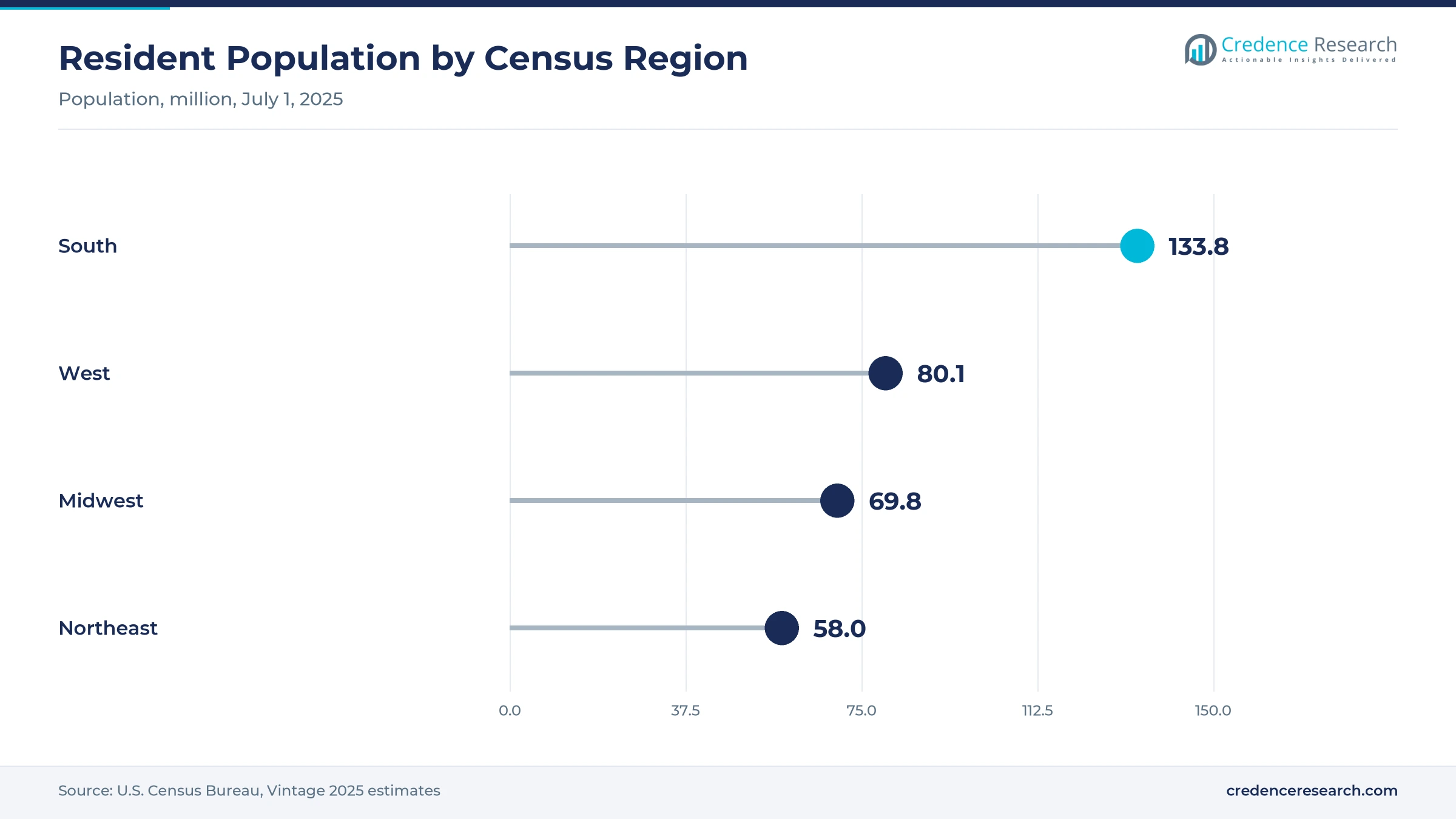
The South held 37.5% of 2025 value and grows at 4.3% a year, the fastest of the four regions. The Census Bureau counted 133.8 million residents in July 2025 in the South, about 39% of the national total. Florida levies no tax on premium cigars and hosts both the Swisher base in Jacksonville and the El Reloj factory in Tampa. Texas taxes premium cigars at about one cent each, a setting that favors large superstores such as the Colony store. Low taxes and steady population growth keep the region ahead of the other three.
The West pairs high spending with the strictest flavor rules
The West held 25.0% of 2025 value and grows at 4.1% a year. California’s flavored tobacco ban, upheld by voters in 2022, covers flavored products other than premium handmade cigars, hookah tobacco and loose leaf, so spending there tilts toward specialty shops. California also taxes premium cigars at 52.92% of wholesale and Utah at 86%, so online sellers capture a larger share of box sales in the West than elsewhere, because high state taxes widen the price gap with in-state shops.
The Midwest relies on convenience volume and capped taxes
The Midwest held 19.5% of 2025 value and grows at 3.6% a year. Minnesota taxes premium cigars at 95% of wholesale but caps the charge at 50 cents per cigar, and Ohio caps it at about 64 cents, so handmade shelf prices stay competitive. The Newport, Kentucky, superstore sits across the river from Cincinnati, within easy reach of Ohio buyers. Mass-market volume through convenience stores carries a larger share of value here.
The Northeast splits between high-tax and no-tax states
The Northeast held 18.0% of 2025 value and grows at 3.5% a year, the slowest of the four regions. New York taxes premium cigars at 75% of wholesale, adding about USD 4.42 to a sample cigar, while Pennsylvania and New Hampshire levy none, as noted in the tax challenge above. These gaps send many New York buyers across state lines or online, which limits value growth in that state.
Court rulings and tariff orders defined 2025 and 2026
| Development | Status and market relevance |
|---|---|
| In January 2025, the U.S. Court of Appeals for the D.C. Circuit upheld the order vacating the FDA deeming rule as applied to premium cigars. | Court decision; definition sent back to the district court |
| In January 2025, the FDA withdrew its 2022 proposed rule to ban characterizing flavors in all cigars. | Proposed rule withdrawn; state flavor bans unaffected |
| In December 2025, USTR announced a phased Section 301 tariff on Nicaraguan goods that do not originate under CAFTA-DR, rising in steps through 2028. | Final action announced; 10% rate starts January 2027 |
| In February 2026, the Supreme Court ruled that IEEPA does not authorize tariffs, ending the 2025 reciprocal tariffs on Central American cigars. | Ruling issued; a temporary 10% Section 122 tariff applied from Feb. 24, 2026 |
| In April 2026, the U.S. District Court for the District of Columbia re-adopted an eight-part definition of FDA-exempt premium cigars. | Final order issued; 30-day appeal window applied |
Leaf content and construction decide regulatory status
- Whole-leaf wrappers and binders are required for the FDA exemption, together with at least 50% long-filler tobacco by weight and hand rolling.
- Machine-bunched natural leaf lets mass-market makers sell leaf-wrapped cigars at value prices, the approach behind brands such as Backwoods and Dutch Masters Leaf.
- Weight above six pounds per 1,000 is one of the eight tests for an FDA-exempt premium cigar, which keeps light machine-made cigarillos outside the exemption.
- Cedar boxes, foil pouches and multi-pack cartons hold humidity in transit, and their cost rises with the shift to boxed handmade cigars supplied by tobacco packaging makers.
Need a Custom Version of This Report?
Tailor the scope, geography, or segments to your exact requirements.
- Custom geography or segment scope
- Direct access to our analyst team
Three mass-market owners face hundreds of handmade brands
Competition in the United States runs on two separate tracks with different owners. In mass-market cigars, Swisher sells Swisher Sweets cigarillos from Jacksonville, Middleton sells Black & Mild under Altria, and ITG Brands sells Backwoods, Dutch Masters and Dutch. These owners compete on shelf placement, pre-priced packs and natural leaf launches. In handmade cigars, Scandinavian Tobacco Group pairs its brands with Cigars International retail, and Tabacalera USA owns Montecristo, Romeo y Julieta and H. Upmann in the United States and also owns the JR Cigar retail business. Swisher also owns Drew Estate, maker of Liga Privada and ACID. Oettinger Davidoff makes Davidoff, Camacho and Avo in the Dominican Republic and Honduras, and Perdomo produces in Nicaragua. Arturo Fuente and the Newman family company remain family owned, and the Newman company still rolls cigars in Tampa. Handmade makers compete on blends, ratings, limited releases and retailer relationships.
How is cigar supply organized, and where do margins sit?
Supply splits into a concentrated mass-market tier and a fragmented handmade tier. Swisher, Middleton under Altria and ITG Brands own the leading cigarillo, tipped and natural leaf brands and control distribution to convenience stores, a channel that also sells most other tobacco products. The handmade tier counts hundreds of brands, with 262 companies exhibiting at the April 2026 Premium Cigar Association show. Vertical integration sets margins, because Scandinavian Tobacco Group and Tabacalera USA own both brands and large retail operations, capturing wholesale and retail margin together.
Which companies shape cigar supply in the United States?
| Company | Type | Role in the market |
|---|---|---|
| Swisher International (Drew Estate) | Full-line maker | Swisher Sweets cigarillos plus Drew Estate handmade brands Liga Privada and ACID |
| John Middleton Co. (Altria) | Mass-market maker | Black & Mild tipped and plain large cigars |
| ITG Brands (Imperial Brands) | Mass-market maker | Backwoods, Dutch Masters and Dutch natural leaf and machine-made cigars |
| Scandinavian Tobacco Group | Handmade maker and retailer | Handmade cigar brands sold through Cigars International stores and online |
| Tabacalera USA | Handmade maker and retailer | Montecristo, Romeo y Julieta and H. Upmann, plus JR Cigar retail |
| Arturo Fuente Cigar Company | Handmade maker | Dominican-made handmade cigars including Fuente Fuente OpusX |
| Oettinger Davidoff | Handmade maker | Davidoff, Camacho and Avo cigars made in the Dominican Republic and Honduras |
| J.C. Newman Cigar Co. | Handmade maker | Tampa-rolled cigars such as The American plus Nicaraguan-made lines |
| Perdomo Cigars | Handmade maker | Nicaraguan-made handmade cigars sold through specialty retailers |
Pricing power, not stick volume, will carry growth
Credence Research’s view is that cigar value in the United States will be carried by pricing power, not by more sticks. Handmade imports have plateaued near 430 million a year, and convenience units keep falling, yet spending rises because buyers trade up and makers pass through tariffs per stick. Trade policy is now the swing factor, since Nicaragua supplies most handmade cigars. Suppliers with production in several countries, owned retail and natural leaf brands are best placed, while single-origin importers and flavored cigarillo specialists face the most risk.
Import, tax and shipment records anchor the estimate
The report uses 2025 as the base year and forecasts values to 2035. Market values come from the Credence Research model, and segment and regional splits are Credence Research estimates. The size was built from handmade import volumes, federal taxable removals, large cigar import volumes and typical shelf prices, then cross-checked against convenience-channel sales. Evidence comes from TTB tax data and rates, Census Bureau population estimates, CDC surveys, court and trade orders, company results and trade press. No interviews or surveys were conducted by Credence Research for this report.
Handmade and natural leaf lines carry value to 2035
USA cigars value should rise from USD 12.25 billion in 2026 to USD 17.36 billion by 2035, with growth coming from price, mix and handmade demand rather than from more smokers. Mass-Market Large Cigars should keep gaining share as natural leaf and tipped brands replace cheaper cigarillos at convenience counters. Premium Handmade Cigars should keep the largest share, provided handmade imports hold near 430 million sticks a year and tariffs on Nicaraguan goods stay limited to non-originating products. The main risks are higher duties from 2027 and any new federal rulemaking on premium cigars.
What separates the downside, base and upside paths to 2035?
The range of outcomes depends on trade policy and on whether handmade imports hold their plateau. A downside path follows if the top Nicaraguan duty rate applies to most supply and the FDA restarts premium cigar rulemaking. The base case assumes handmade volume stays near current levels and prices keep rising modestly. An upside path needs tariff relief, more superstore openings and steady natural leaf growth.
| Scenario | CAGR, 2026–2035 | Value, 2035 | What has to hold |
|---|---|---|---|
| Downside | 2.5% | USD 15.23 billion | The top Nicaraguan duty rate hits most supply and FDA restarts premium cigar rules |
| Base | 3.95% | USD 17.36 billion | Handmade imports hold near current levels and list prices rise modestly each year |
| Upside | 5.0% | USD 18.92 billion | Tariffs ease, superstores keep opening and natural leaf brands keep gaining share |
Frequently Asked Questions
How big is the USA cigars market?
Which region leads cigar spending in the United States?
Which product type holds the largest share?
How many premium cigars does the United States import?
Are premium cigars regulated by the FDA?
How do tariffs affect cigar prices?
What is the biggest challenge for the market?
Which companies are active in the market?
Table of Content
Chapter 1 Market Segmentation
- 1.1 Segmentation Framework
- 1.1.1 Product and Service Classification
- 1.1.2 Application and End-Use Classification
- 1.1.3 Technology and Solution Classification
- 1.1.4 Customer and Distribution Channel Classification
- 1.1.5 Geographic Segmentation
- 1.1.6 Market Segment Definitions and Boundaries
- 1.2 By Product Type
- 1.2.1 Premium Handmade Cigars
- 1.2.2 Cigarillos
- 1.2.3 Mass-Market Large Cigars
- 1.2.4 Little Filtered Cigars
- 1.3 By Price Tier
- 1.3.1 Value
- 1.3.2 Mid-Market
- 1.3.3 Premium
- 1.3.4 Luxury
Chapter 2 Introduction
- 2.1 Report Objectives and Scope
- 2.2 Product Definition and Industry Terminology
- 2.3 Market Inclusions and Exclusions
- 2.4 Research Process
- 2.4.1 Primary Research and Expert Interviews
- 2.4.2 Secondary Research and Source Review
- 2.4.3 Top-Down and Bottom-Up Estimation
- 2.4.4 Data Triangulation and Verification
- 2.5 Market Size Measurement Basis
- 2.5.1 2025: USD 11.77 billion → 2035: USD 17.36 billion
- 2.6 Historical and Forecast Reference Periods
- 2.6.1 Historical Period: 2018-2025
- 2.6.2 Base Year: 2025
- 2.6.3 Forecast Period: 2025-2035
- 2.7 Research Assumptions and Limitations
Chapter 3 Executive Summary
- 3.1 Market Snapshot and Key Findings
- 3.2 Base-Year Market Size, 2025
- 3.3 Forecast Market Size, 2035
- 3.4 Revenue and Volume Growth Outlook
- 3.5 Key Demand and Supply Indicators
- 3.6 Leading Market Segments
- 3.7 Fastest-Growing Market Opportunities
- 3.8 Regional Performance Highlights
- 3.9 Technology and Industry Transformation
- 3.10 Competitive Landscape Summary
- 3.11 Analyst View and Strategic Implications
Chapter 4 USA Cigars Market Trends and Developments
- 4.1 Historical Industry Development, 2018-2025
- 4.2 Recent Market Trends and Developments
- 4.3 Demand and Customer Behavior Trends
- 4.4 Technology and Product Innovation
- 4.5 Artificial Intelligence, Automation and Digitalization
- 4.6 Local Manufacturing and Supply Chain Realignment
- 4.7 Industry Partnerships, Mergers and Acquisitions
- 4.8 Sustainability and Circular Economy Developments
- 4.9 Government and Private Sector Investment Trends
- 4.10 Emerging Business Models and Commercialization
- 4.11 Industry Developments and Announcements
Chapter 5 USA Cigars Market Production, Supply and Demand Analysis
- 5.1 Demand Trend and Consumption Analysis, 2018-2025
- 5.2 Demand Forecast, 2025-2035
- 5.3 Production and Output Trend, 2018-2025
- 5.4 Production and Output Forecast, 2025-2035
- 5.5 Installed Capacity and Capacity Utilization
- 5.6 Company-Wise Production Plants and Statistics
- 5.6.1 Installed Production Capacity
- 5.6.2 Actual Production
- 5.6.3 Planned Capacity and Expansion Targets
- 5.7 Supply Chain Structure and Procurement Trends
- 5.8 Supply-Demand Gap and Bottlenecks
- 5.9 Import Dependence and Sourcing Structure
- 5.10 Contract Manufacturing and Outsourcing
- 5.11 Regional Supply and Demand Concentration
Chapter 6 USA Cigars Market Pricing Analysis
- 6.1 Pricing Structure and Measurement
- 6.2 Historical Pricing Trends, 2018-2025
- 6.3 Pricing Outlook, 2025-2035
- 6.4 Average Selling Price and Unit Economics
- 6.5 Pricing by Product and Market Segment
- 6.6 Geographic Pricing Differences
- 6.7 Key Input, Energy, Labor and Logistics Costs
- 6.8 Contract Pricing and Purchasing Models
- 6.9 Pricing Sensitivity and Competitive Positioning
- 6.10 Price, Margin and Profitability Implications
Chapter 7 USA Cigars Market Dynamics
- 7.1 Market Growth Drivers
- 7.1.1 Demand-Side Drivers
- 7.1.2 Technology and Innovation Drivers
- 7.1.3 Infrastructure and Investment Drivers
- 7.1.4 Regulatory and Policy Drivers
- 7.2 Market Restraints
- 7.2.1 Cost and Affordability Constraints
- 7.2.2 Technology and Adoption Barriers
- 7.2.3 Supply Chain and Operational Constraints
- 7.3 Market Challenges
- 7.3.1 Competitive Pressure and Margin Erosion
- 7.3.2 Skills, Infrastructure and Implementation Gaps
- 7.4 Emerging Market Opportunities
- 7.5 Market Dynamics Impact and Time-Horizon Assessment
Chapter 8 USA Cigars Value Chain Analysis
- 8.1 Industry Value Chain Overview
- 8.2 Upstream Suppliers and Critical Inputs
- 8.3 Technology and Component Providers
- 8.4 Manufacturing or Service Delivery
- 8.5 Distribution, Channel Partners and Integrators
- 8.6 Downstream Applications and End Users
- 8.7 Value Addition and Profit Pools
- 8.8 Vertical Integration and Outsourcing
- 8.9 Supplier Concentration and Risk
- 8.10 Supply Chain Localization and Resilience
Chapter 9 USA Cigars Market Regulations and Policies
- 9.1 Relevant Laws, Standards and Compliance Frameworks
- 9.2 Product, Service, Safety and Quality Requirements
- 9.3 Government Policies, Incentives and Subsidies
- 9.4 Imports, Exports and Trade Barriers
- 9.5 Public Procurement and Local Content Requirements
- 9.6 Environmental and Sustainability Compliance
- 9.7 Upcoming Policy Changes and Market Implications
Chapter 10 USA Cigars Market Hotspots and Opportunities
- 10.1 Market Opportunity Mapping and Growth Hotspots
- 10.2 High-Growth Applications and Customer Groups
- 10.3 Underserved Markets and White-Space Opportunities
- 10.4 Emerging Technology and Product Opportunities
- 10.5 New Capacity and Investment Hotspots
- 10.6 Market Entry and Expansion Opportunities
- 10.7 Distribution and Partnership Opportunities
- 10.8 Near-Term and Long-Term Commercial Potential
- 10.9 Opportunity Attractiveness and Execution Risks
Chapter 11 USA Cigars Market Outlook, 2025-2035
- 11.1 Market Size and Analysis
- 11.1.1 Revenue (Market Measurement: 2025: USD 11.77 billion → 2035: USD 17.36 billion)
- 11.1.2 Market Volume and Quantity Sold
- 11.1.3 Historical Market Size, 2018-2025
- 11.1.4 Base-Year Market Size, 2025
- 11.2 Market Forecast, 2025-2035
- 11.2.1 Revenue Forecast to 2035
- 11.2.2 Volume Forecast to 2035
- 11.2.3 CAGR and Year-on-Year Growth
- 11.2.4 Incremental Revenue Opportunity
- 11.3 Forecast Assumptions and Scenario Analysis
- 11.3.1 Base-Case Forecast
- 11.3.2 Optimistic and Conservative Scenarios
- 11.3.3 Technology, Pricing and Policy Sensitivities
- 11.4 Market Attractiveness and Growth Outlook
Chapter 12 USA Cigars Market Segmentation and Outlook
- 12.1 Segmentation Summary and Market Shares, 2025
- 12.2 Largest and Fastest-Growing Segments
- 12.3 By Product Type - Market Size and Forecast, 2025-2035
- 12.3.1 Segment Definition and Scope
- 12.3.2 Historical Market Size, 2018-2025
- 12.3.3 Revenue Forecast, 2025-2035
- 12.3.4 Volume Forecast, 2025-2035
- 12.3.5 Base-Year Market Share, 2025
- 12.3.6 Segment CAGR and Growth Drivers
- 12.3.7 Subsegment Market Size and Forecast
- 12.3.7.1 Premium Handmade Cigars
- 12.3.7.2 Cigarillos
- 12.3.7.3 Mass-Market Large Cigars
- 12.3.7.4 Little Filtered Cigars
- 12.3.8 Subsegment Pricing and Adoption Trends
- 12.3.9 Leading Suppliers and Competition
- 12.3.10 Regional Demand and Opportunities
- 12.4 By Price Tier - Market Size and Forecast, 2025-2035
- 12.4.1 Segment Definition and Scope
- 12.4.2 Historical Market Size, 2018-2025
- 12.4.3 Revenue Forecast, 2025-2035
- 12.4.4 Volume Forecast, 2025-2035
- 12.4.5 Base-Year Market Share, 2025
- 12.4.6 Segment CAGR and Growth Drivers
- 12.4.7 Subsegment Market Size and Forecast
- 12.4.7.1 Value
- 12.4.7.2 Mid-Market
- 12.4.7.3 Premium
- 12.4.7.4 Luxury
- 12.4.8 Subsegment Pricing and Adoption Trends
- 12.4.9 Leading Suppliers and Competition
- 12.4.10 Regional Demand and Opportunities
- 12.5 Segment Growth Comparison
- 12.6 Segment Attractiveness and Priority Matrix
Chapter 13 USA Cigars Geographic Market Outlook, 2025-2035
- 13.1 Domestic Market Distribution and Demand Clusters
- 13.2 State- or Province-Wise Market Size and Forecast, 2025-2035
- 13.3 City and Metropolitan Market Outlook
- 13.4 Industrial, Manufacturing and Commercial Clusters
- 13.5 Geographic Concentration of Key End Users
- 13.6 Local Pricing and Purchasing Differences
- 13.7 Domestic Production Facilities and Capacity Map
- 13.8 Local Infrastructure and Project Pipeline
- 13.9 State-Level Policy and Incentive Differences
- 13.10 Subnational Investment Hotspots and Opportunities
- 13.11 Distribution and Logistics Networks
- 13.12 Domestic Competitive Footprint
Chapter 14 USA Cigars Technology, Innovation and Sustainability Outlook
- 14.1 Technology Landscape and Maturity
- 14.2 Product, Process and Service Innovation
- 14.3 AI, Automation and Digital Tools in the Industry
- 14.4 Technology Adoption and Performance Benchmarking
- 14.5 Innovation Pipeline and R&D Investment
- 14.6 Patent and Intellectual Property Trends
- 14.7 Energy Efficiency and Resource Management
- 14.8 Sustainability, Recycling and Circularity
- 14.9 Technology Roadmap, 2025-2035
- 14.10 Risks of Obsolescence and Technology Substitution
Chapter 15 USA Cigars Market Key Strategic Imperatives
- 15.1 Growth and Market Entry Priorities
- 15.2 High-Return Products and Segments
- 15.3 Pricing, Profitability and Cost Optimization
- 15.4 Technology Investment and Product Differentiation
- 15.5 Supply Chain Localization and Resilience
- 15.6 Distribution and Customer Acquisition
- 15.7 Partnership, Acquisition and Capacity Strategy
- 15.8 Regional Expansion Priorities
- 15.9 Short-, Medium- and Long-Term Actions
Chapter 16 Competition Outlook
- 16.1 Industry Competition Characteristics
- 16.2 Market Structure and Concentration
- 16.3 Market Share and Competitive Positioning, 2025
- 16.4 Company-Wise Revenue and Product Benchmarking
- 16.5 Production and Service Capacity Benchmarking
- 16.6 Technology, Pricing and Differentiation
- 16.7 Regional Footprint and Distribution Strength
- 16.8 Mergers, Acquisitions and Strategic Alliances
- 16.9 New Entrants and Competitive Threats
- 16.10 Porter's Five Forces and Industry Attractiveness
- 16.11 Competitive Outlook, 2025-2035
Chapter 17 Company Profiles
- 17.1 Company Coverage and Selection Criteria
- 17.2 Swisher International (Drew Estate)
- 17.2.1 Business Description
- 17.2.2 Company Ownership and Geographic Presence
- 17.2.3 Product and Service Portfolio
- 17.2.4 Manufacturing and Operating Footprint
- 17.2.5 Production Capacity and Expansion Plans
- 17.2.6 Financial Performance and Investment
- 17.2.7 Market Share and Competitive Position
- 17.2.8 Technology and Innovation Capabilities
- 17.2.9 Strategic Alliances or Partnerships
- 17.2.10 Recent Developments
- 17.2.11 Growth Strategy and Outlook
- 17.3 John Middleton Co. (Altria)
- 17.4 ITG Brands (Imperial Brands)
- 17.5 Scandinavian Tobacco Group
- 17.6 Tabacalera USA
- 17.7 Arturo Fuente Cigar Company
- 17.8 Oettinger Davidoff
- 17.9 J.C. Newman Cigar Co.
- 17.10 Perdomo Cigars
- 17.11 Other Relevant Market Participants
Note: Every listed company is profiled on the structure shown under the first company. The company list is preliminary and may change based on research findings, market developments, data availability and client requirements.
Chapter 18 Disclaimer
- 18.1 Research and Forecast Disclaimer
- 18.2 Data Source and Estimation Limitations
Note: The depth of individual sections depends on data availability for this market. Volume, capacity, trade and other unit-based metrics are included where applicable.