| REPORT ATTRIBUTE | DETAILS |
|---|---|
| Historical Period | 2019-2022 |
| Base Year | 2023 |
| Forecast Period | 2024-2032 |
| Negative Pressure Wound Therapy Market Size 2023 | USD 6681.2 Million |
| Negative Pressure Wound Therapy Market, CAGR | 6.20% |
| Negative Pressure Wound Therapy Market Size 2032 | USD 11480.9 Million |
Market Insights
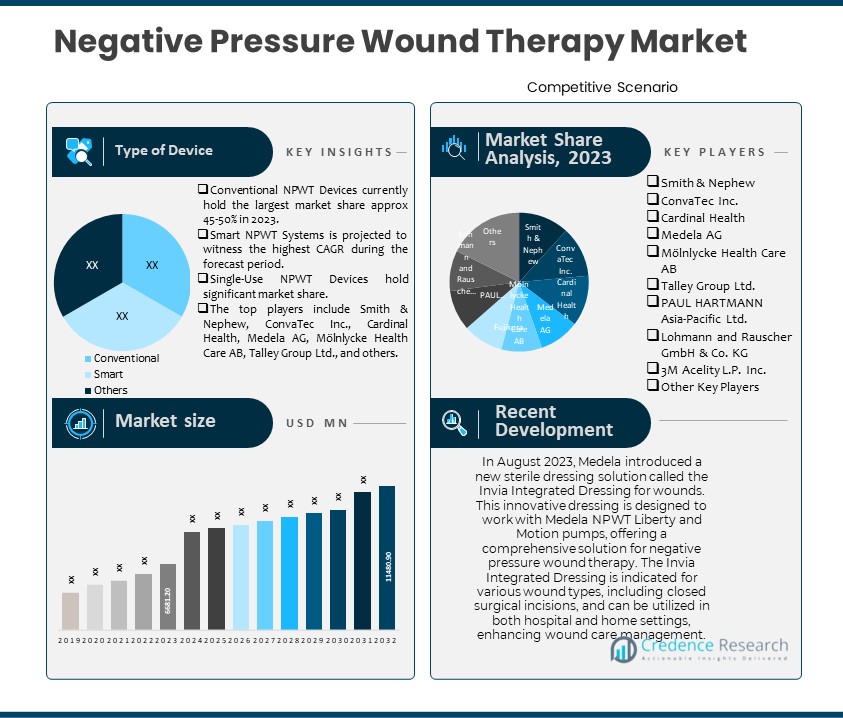
- The global Negative Pressure Wound Therapy Market reached a valuation of USD 6681.2 Million in 2023 and is anticipated to surge to USD 11480.9 Million by 2032, exhibiting a robust CAGR of 6.20% from 2024 to 2032.
- Among the key segments, Conventional NPWT Devices emerged as the market leader by type of device, holding approximately 45-50% of the total market share in 2023. However, Smart NPWT Systems are projected to witness the highest growth rate during the forecast period.
- Chronic Wounds dominate the market by wound type, holding around 35-45% of the market share in 2023, driven by the increasing prevalence of chronic wounds such as diabetic foot ulcers and pressure ulcers.
- Hospitals and Clinics hold the largest share of the market by end-user, accounting for approximately 60-62% in 2023, attributed to the extensive use of negative pressure wound therapy in wound care treatments.
- North America accounts for the largest share of the market in 2023, followed by Asia Pacific and Europe with a collective share of just under 55%.
- The rise in demand for negative pressure wound therapy, driven by increasing prevalence of chronic wounds, technological advancements, and rising awareness, fuels the growth of the Negative Pressure Wound Therapy Market.
- Key opportunities in the market include significant growth potential in homecare settings, increased adoption across various wound types and end-users, and continuous innovations in NPWT technology, fostering market expansion.
Executive Summary
Market Definition
The Negative Pressure Wound Therapy (NPWT) market refers to the medical device industry that provides products and services for the treatment of wounds using negative pressure technology. NPWT, also known as vacuum-assisted wound closure, uses a suction device to apply negative pressure to the wound bed, promoting healing by enhancing blood flow, reduces a biological burden, increases healing and enhances the global enpill-bazer because wound- the foot-leg wound is very ulcerated- Vranah, Shalya -It has an effective effect in healing chronic and acute wounds like ulcers. There are several devices on the NPWT market, such as standalone units, portable devices, disposable bandages with integrated negative pressure systems and these devices are designed to provide continuous or intermittent negative pressure depending on the wound type and severity. The market also offers accessories such as foam pads, gauze pads and adhesive pads to secure the device to the wound site. Growing prevalence of chronic wounds, increasing demand for advanced wound care therapies and increasing awareness of NPWT benefits have contributed to market expansion.
Market Overview
The Negative Pressure Wound Therapy Market has demonstrated consistent expansion and is projected to maintain a robust CAGR of 6.20% from 2024 to 2032. Valued at USD 6681.2 million in 2023, this market is expected to reach USD 11480.9 million by 2032.
Among the primary segments, Conventional NPWT Devices dominated the market landscape by type of device, comprising approximately 45-50% of the total market share in 2023. However, Smart NPWT Systems are anticipated to observe the highest CAGR over the forecast period.
The Hospitals and Clinics segment captured around 60-62% of the market share in 2023, driven by the extensive utilization of negative pressure wound therapy in treating various wounds and preventing infections in clinical settings.
Conventional NPWT Devices held the largest market share in 2023 by type of device, accounting for approximately 45-50% of the total market, attributed to their established presence and familiarity among healthcare professionals.
Chronic Wounds emerged as the leading wound type segment in 2023, with a market share of about 35-45%, primarily due to the increasing prevalence of chronic wounds such as diabetic foot ulcers and pressure ulcers.
North America constituted a significant portion of the market in 2023, followed by Asia Pacific and Europe, collectively representing just under 55% of the market share.
The rise in demand for negative pressure wound therapy is driven by factors such as increasing prevalence of chronic wounds, technological advancements, and rising awareness, particularly in regions like North America and Europe.
Continuous advancements in NPWT technology, including improvements in device portability and usability, are further driving the demand for negative pressure wound therapy, especially in homecare settings and for treating complex wounds.
Segmentation by Type of Device
- Conventional NPWT Devices currently hold the largest market share approx 45-50% in 2023 due to their established presence in the market, wide range of applications, and familiarity among healthcare professionals.
- Smart NPWT Systems is projected to witness the highest CAGR during the forecast period.The importance of disease control in remotely, and integrating smart technologies into health care . Smart NPWT systems provide real-time analytics, data analysis, and automated treatment planning, making them an attractive option for healthcare professionals looking to improve patient outcomes and streamline clinical workflow.
- Single-Use NPWT Devices hold significant market share These devices are gaining popularity due to their simplicity, ease of use and low cost.
Segmentation by Wound Type
- Chronic Wounds currently hold the largest market share approx 35-45% in 2023. his is because of the increasing incidence of continual wounds, along with diabetic foot ulcers, pressure ulcers, and venous leg ulcers, which require extended remedy durations and are often difficult to heal. Negative strain wound therapy has been shown to promote wound recuperation and decrease the danger of infection in patients with chronic wounds.
- Complex Wounds is projected to witness the highest CAGR during the forecast period. Negative stress wound remedy is specially beneficial in coping with complicated wounds, as it helps to sell debridement, lessen edema, and beautify granulation tissue formation.
Segmentation by End-User
- Hospitals and Clinics currently hold the largest market share approx 60-62% in 2023. This is because hospitals and clinics are the main areas for wound care treatment, extensively using negative pressure wound healing to promote wound healing and prevent infection in these cases.
- Homecare Settings is projected to witness the highest CAGR during the forecast period. Negative pressure wound therapy is particularly suitable for home care settings, as it is easy to use and does not require frequent visits to healthcare facilities.
Segmentation by Region
- North America held significant share around 40-43% of the market in 2023. This dominance is primarily due to This is due to well-established healthcare infrastructure, vast knowledge of wound care treatments, and key market players regions.
- Asia Pacific and Europe collectively account for just under 55% share in 2023, with Europe holding over 20% share in the same year.
- The rest of the world, including Latin America, the Middle East, and Africa, supplies the remaining demand for Negative Pressure Wound Therapy.
he increasing use of advanced wound care technologies, government support and emerging markets are the major factors driving the market growth.
The North America region held the largest market share of the Negative Pressure Wound Therapy market. The region has a well-established health system with advanced medical facilities that enable patients to receive access cutting-edge wound care. Additionally, there is a high prevalence of chronic wounds such as diabetic foot and pressure ulcers are very common in the region, leading to a demand for effective wound therapy solutions. The market players such as Smith & Nephew, and Medline Industries, Inc., have helped to capture significant market share in negative pressure wound therapy in North America. These companies have broad product portfolios and and strong distribution networks, which enable them to effectively cater to the demands of the market. For instance, in May 2023, Smith+Nephew has received an Innovative Technology contract from Vizient for their PICO Single Use Negative Pressure Wound Therapy Systems. This contract was awarded based on the recommendation of the PICO Single Use Negative Pressure Wound Therapy Systems by hospital experts, highlighting the recognition of the innovative technology and its benefits in wound care management. Moreover, increased awareness of the benefits of negative pressure wound healing among healthcare professionals and patients has led to increased acceptance in the profession.
The Asia-Pacific is projected to witness the highest CAGR during the forecast period of the Negative Pressure Wound Therapy Market. This growth can be attributed to several factors,such as increasing prevalence of chronic wounds, the growing elderly population, expanding healthcare sector in the region, and higher incidences of diabetes across the region. For instance, According to the IDF, in South-East Asia, 90 million adults live with diabetes, and 1 in 2 are undiagnosed. By 2045, the number of adults with diabetes is expected to reach 151 million. Diabetes caused 747,000 deaths in 2021, and $10 billion was spent on diabetes care. Moreover, the growing availability of superior wound care products and the growing awareness approximately the benefits of poor strain wound remedy amongst healthcare experts and sufferers in the location are also contributing to the market's growth. For instance,, in China, the authorities has launched tasks to improve the first-class of healthcare services, including the established order of specialised wound care centers, which is anticipated to growth the call for for negative stress wound therapy products. However, innovations in wound care technology, is expected to drive the growth of the negative pressure wound therapy market in the Asia-Pacific region.
Key Highlights of the Report
The Negative Pressure Wound Therapy Market is segmented by Type of Device, Wound Type, End-User, and Region. The growing demand for negative pressure wound therapy is driven by factors such as technological advancements, increasing prevalence of chronic wounds, and the need for effective wound care solutions across various healthcare settings.
Conventional NPWT Devices dominate the segment, serving critical functions in wound management and promoting healing due to their established presence and wide range of applications. Disposable bandages with integrated negative pressure systems lead the single-use device segment, offering simplicity and cost-effectiveness in wound treatment.
Hospitals and Clinics hold a significant market share in the end-user segment, utilizing negative pressure wound therapy for promoting wound healing and preventing infections in clinical settings. The homecare settings segment is witnessing rapid growth, driven by the increasing demand for convenient wound care solutions and the rise in home-based healthcare services.
North America held the largest share of the negative pressure wound therapy market, supported by well-established healthcare infrastructure and the presence of key players such as Smith & Nephew and Medline Industries, Inc. These players focus on product innovation and strategic collaborations to maintain their market position and competitiveness.
What Are The Main Drivers Of The Global Negative Pressure Wound Therapy Market?
Global Negative Pressure Wound Therapy is primarily driven by increasing prevalence of chronic wound, increasing prevalence of chronic conditions in the elderly population, technological advancements in wound care monitoring devices and increasing awareness of advanced wound care treatments. Other factor also contributing to the market growth are, diabetic ulcers , Expanding application of negative pressure wound healing in the treatment of various wounds such as burns and traumatic injuries is driving significant market expansion.
What Are The Major Challenges Faced By The Global Negative Pressure Wound Therapy Market?
The global Negative Pressure Wound Therapy market faces challenges such as unavailability of comprehensive wound care in developing regions due to inadequate healthcare facilities and lack of awareness. In addition, the high medical costs associated with the treatment of negative pressure wound care management present a challenge, especially in developing countries. Regulatory hurdles and stringent approval processes for new devices hinder the growth of the market.
What Are The Growth Opportunities In The Global Negative Pressure Wound Therapy Market?
The global Negative Pressure Wound Therapy market presents growth opportunities driven by include development of portable and user-friendly devices for patient convenience and compliance. Expansion in emerging markets including healthcare increased spending and increased awareness of advanced wound care lead to significant improvements. In addition, the integration of digital technologies such as telemedicine and remote patient monitoring into negative pressure wound care systems can streamline treatment and improve patient outcomes. Additionally, collaboration between industry and healthcare providers to research and develop new treatments and solutions provides a platform for market expansion.
Market Drivers
The global Negative Pressure Wound Therapy market is driven by several factors. The following are the key drivers of the global Negative Pressure Wound Therapy market:
Growing Adoption of Smart NPWT Systems
Increasing adoption of smart NPWT systems is a major driver of the negative pressure wound therapy market. This advanced system provides improved efficiency, and patient comfort compared to traditional NPWT devices. They provide real-time analytics and data analytics, enabling healthcare professionals to make informed decisions about treatment options and optimize patient outcomes. In addition, smart NPWT systems often have wireless connectivity, allowing for remote disease monitoring and timely intervention. This has led to increased adoption and preference by physicians and patients, contributing to the growth of the NPWT market. The adoption of the systems is expected to further drive the negative growth pressure wound therapy market in the coming years. For instance, the 3M V.A.C. Ulta Therapy System is a versatile wound care device that offers four different treatment options in one unit. It provides negative pressure wound therapy (NPWT) with the addition of an instillation feature, which allows for the controlled delivery of topical wound treatments and suspensions over the wound bed. This comprehensive system is designed to promote wound healing by creating an optimal environment for the body's natural healing process.
Market Restraints
The global Negative Pressure Wound Therapy market faces some challenges that may hinder its growth. These include the following:
High Medical Costs Associated With The Treatment Of Negative Pressure Wound Therapy
High medical costs associated with negative pressure wound therapy is a major restraint in the negative pressure wound therapy market. The equipment, disposal and maintenance costs of NPWT can be high, making technical costs more expensive for hospitals and clinics especially in developing countries. In addition, the high cost of NPWT can be prohibitive limiting their patient access to these effective treatments, resulting in lower demand and accepted rates. Furthermore, the lack of reimbursement for NPWT treatment by many insurance providers adds to the financial burden, and health care providers discourage investment in technology. To overcome these challenges, manufacturers should focus on developing cost-effective NPWT solutions without compromising quality and efficiency. Government and private organizations also play a role in subsidizing or reimbursing NPWT treatments, making them accessible to more patients.
Opportunities
The global Negative Pressure Wound Therapy market offers significant growth opportunities. These include the following:
Adoption Of Various Strategies Among Market Players
The major companies serving the global Negative Pressure Wound Therapy Market are Smith & Nephew, ConvaTec Inc., Cardinal Health, Medela AG,, among others. The market players are considerably contributing to the market growth by the adoption of various strategies including mergers & acquisitions, collaborations, funding, and new product launches, to stay competitive in the market. For instance, in September 2023, The Smith & Nephew PICO Single Use Negative Pressure Wound Therapy (sNPWT) system has been utilized in various medical settings, including abdominal, breast and plastic surgery, orthopedic surgery, cardiothoracic surgery, obstetrics and gynecology, and vascular surgery. This innovative system has shown effectiveness in promoting wound healing and managing different types of wounds, contributing to improved patient outcomes in wound care management.
Competitive Landscape
Key Players
The global Negative Pressure Wound Therapy market is highly competitive, with several key players. Some of the major players in the market and their market share are as follows:
- Smith & Nephew
- ConvaTec Inc.
- Cardinal Health
- Medela AG
- Mölnlycke Health Care AB
- Talley Group Ltd.
- PAUL HARTMANN Asia-Pacific Ltd.
- Lohmann and Rauscher GmbH & Co. KG
- 3M Acelity L.P. Inc.
- Others
These organizations prioritize product innovation, distribution channel expansion, and mergers and acquisitions to stay competitive.
The global Negative Pressure Wound Therapy market's key players continually seek to stay ahead by offering new products and developments.
In August 2023, Medela introduced a new sterile dressing solution called the Invia Integrated Dressing for wounds. This innovative dressing is designed to work with Medela NPWT Liberty and Motion pumps, offering a comprehensive solution for negative pressure wound therapy. The Invia Integrated Dressing is indicated for various wound types, including closed surgical incisions, and can be utilized in both hospital and home settings, enhancing wound care management.
In March 2020, Smith+Nephew has announced the US launch of the PICO 14 Single Use Negative Pressure Wound Therapy System for use on high-risk surgical patients. This innovative system is designed to reduce the risk of wound complications by minimizing post-operative fluid and tension, particularly beneficial for patients undergoing surgeries like cardiothoracic and abdominal procedures. The PICO 14 system offers 14 days of therapy and aims to improve patient outcomes in wound care management.
Summary of Key Findings
- The Negative Pressure Wound Therapy Market is experiencing significant growth, driven by the increasing demand for effective wound care solutions across healthcare facilities, homecare settings, and long-term care facilities. Key drivers contributing to this growth include technological advancements, increasing prevalence of chronic wounds, and the need for advanced wound care treatments.
- Market segmentation within the Negative Pressure Wound Therapy Market encompasses various factors including type of device, wound type, end-user, and region, reflecting the diverse needs and applications within the industry.
- Conventional NPWT Devices emerge as the dominant device type, capturing the majority market share due to their established presence, versatility, and wide range of applications in managing chronic and complex wounds. Single-use NPWT Devices also contribute significantly to the market, offering simplicity and cost-effectiveness in wound treatment.
- Chronic Wounds hold the largest market share among wound types, driven by the increasing prevalence of conditions such as diabetic foot ulcers, pressure ulcers, and venous leg ulcers. However, the complex wounds segment is projected to witness the highest growth rate, fueled by the effectiveness of negative pressure wound therapy in promoting debridement and tissue regeneration.
- Hospitals and Clinics emerge as the leading end-user segment, owing to the extensive utilization of negative pressure wound therapy in clinical settings for wound healing and infection prevention. Homecare settings are projected to witness significant growth, driven by the increasing demand for convenient wound care solutions and the rise in home-based healthcare services.
- Geographically, North America holds the largest market share, attributed to well-established healthcare infrastructure, high prevalence of chronic wounds, and the presence of key industry players. Asia Pacific and Europe collectively account for a substantial share of the market, with Asia Pacific witnessing growth due to increasing healthcare spending and expanding wound care facilities.
Future Outlook
- The future outlook for the Negative Pressure Wound Therapy Market indicates promising growth opportunities, particularly within healthcare facilities, homecare settings, and long-term care facilities, driven by the increasing demand for effective wound care solutions. However, anticipated challenges include regulatory hurdles, stringent approval processes, and the high costs associated with treatment, especially in developing regions.
- To maintain competitiveness in the Negative Pressure Wound Therapy Market, industry players should adopt various strategies such as continuous product innovation, strategic collaborations, and expanding market presence. It is crucial for companies to focus on developing cost-effective solutions without compromising quality, improving device usability, and enhancing patient outcomes to address the evolving needs of healthcare professionals and patients.
- Additionally, exploring opportunities in emerging markets, leveraging digital technologies such as telemedicine and remote patient monitoring, and collaborating with healthcare providers to research and develop new treatments will be essential for sustained growth and market expansion in the future.
How CXOs Can Benefit from the Credence Research Negative Pressure Wound Therapy Networks Market Report
The Credence Research Negative Pressure Wound Therapy Networks Market Report provides CXOs with a comprehensive overview of the market, including:
- Market size and growth forecast: The report provides detailed estimates of the global Negative Pressure Wound Therapy networks market size, segmented by type of device, wound type, end-user, and region. It also includes forecasts for the market through 2032, based on key trends and drivers.
- Market segmentation: The report segments the Negative Pressure Wound Therapy networks market by type of device, wound type, end-user, and region. The increasing demand for advanced solutions is driven. This segmentation provides CXOs with a granular understanding of the market and the opportunities in each segment.
- Competitive landscape: The report profiles the key players in the Negative Pressure Wound Therapy networks market and provides insights into their strategies, product offerings, and financial performance. This information can help CXOs to identify and assess their competition.
- Key trends and drivers: The report identifies and analyzes the key trends and drivers that are shaping the Negative Pressure Wound Therapy networks market. This information can help CXOs to make informed decisions about their investments and strategies.
CXOs can use the insights from the Credence Research Negative Pressure Wound Therapy Networks Market Report to:
- Identify growth opportunities: The report can help CXOs to identify new growth opportunities in the Negative Pressure Wound Therapy networks market. For example, the report identifies the growing demand for Negative Pressure Wound Therapy networks from cloud computing providers and telecom companies as a key opportunity.
- Make informed investment decisions: The report can help CXOs to make informed investment decisions about Negative Pressure Wound Therapy networks. For example, the report provides insights into the key factors to consider when evaluating Negative Pressure Wound Therapy providers and selecting Negative Pressure Wound Therapy solutions.
- Develop competitive strategies: The report can help CXOs to develop competitive strategies for their Negative Pressure Wound Therapy networks businesses. For example, the report identifies the key strategies that Negative Pressure Wound Therapy providers are using to differentiate themselves from their competitors.
- Track market developments: The report can help CXOs to track market developments and stay ahead of the curve. For example, the report provides insights into the latest trends and innovations in the Negative Pressure Wound Therapy networks market.
Overall, the Credence Research Negative Pressure Wound Therapy Networks Market Report is a valuable resource for CXOs who are looking to gain a deeper understanding of the market and identify opportunities for growth.
Segmentation
- Type of Device Segmentation:
- Conventional NPWT Devices
- Single-Use NPWT Devices
- Portable NPWT Devices
- Smart NPWT Systems
- NPWT Accessories and Consumables
- Wound Type Segmentation:
- Chronic Wounds
- Acute Wounds
- Surgical Wounds
- Traumatic Wounds
- Complex Wounds
- End-User Segmentation:
- Hospitals and Clinics
- Homecare Settings
- Long-Term Care Facilities
- Ambulatory Surgery Centers (ASCs)
- Military and Disaster Response
- By Region
- North America
- The U.S.
- Canada
- Mexico
- Europe
- Germany
- France
- The U.K.
- Italy
- Spain
- Rest of Europe
- Asia Pacific
- China
- Japan
- India
- South Korea
- South-east Asia
- Rest of Asia Pacific
- Latin America
- Brazil
- Argentina
- Rest of Latin America
- Middle East & Africa
- GCC Countries
- South Africa
- Rest of Middle East and Africa
- North America

Request a Free Sample
Fill in your details and we'll send you a free sample report.
- Sample data tables & charts
- Research methodology
Market Dynamics
Increasing Prevalence of Chronic Wounds
The rising incidence of chronic wounds such as diabetic foot ulcers, pressure ulcers, and venous leg ulcers is fueling demand for advanced wound care solutions like NPWT, as these wounds require prolonged and effective treatment to promote healing and prevent complications.
Technological Advancements in NPWT Devices
Continuous innovation, including the development of smart NPWT systems with real-time analytics, wireless connectivity, and improved portability, is making these therapies more effective and accessible, thereby expanding their adoption across healthcare settings.
Expansion of Homecare and Outpatient Settings
The shift toward home-based healthcare and outpatient wound management is driving demand for user-friendly, portable, and single-use NPWT devices, enabling patients to receive effective wound care outside traditional hospital environments.
Growing Awareness and Training Among Healthcare Professionals
Increased education and awareness initiatives regarding the benefits and proper use of NPWT are leading to higher adoption rates in both developed and emerging markets, improving patient outcomes and supporting market growth.
Supportive Healthcare Infrastructure and Reimbursement Policies
Regions with well-established healthcare systems and favorable reimbursement frameworks, particularly in North America and parts of Europe, are seeing higher uptake of NPWT devices, as these factors reduce financial barriers for both providers and patients.
Need a Custom Version of This Report?
Tailor the scope, geography, or segments to your exact requirements.
- Custom geography or segment scope
- Direct access to our analyst team
Frequently Asked Questions
What is the current size of the global Negative Pressure Wound Therapy market?
What is the expected growth rate of the Negative Pressure Wound Therapy market between 2024 and 2032?
Which segment is leading the market share in terms of Type of Device?
Which Wound Type Segments governs the demand for Negative Pressure Wound Therapys in the world?
Which End-User Specific Negative Pressure Wound Therapy segment is expected to post the highest CAGR during the forecast period?
Who are the major players in the global Negative Pressure Wound Therapy market?
Table of Content
Chapter 1 Market Segmentation
- 1.1 Segmentation Framework
- 1.1.1 Product and Service Classification
- 1.1.2 Application and End-Use Classification
- 1.1.3 Technology and Solution Classification
- 1.1.4 Customer and Distribution Channel Classification
- 1.1.5 Geographic Segmentation
- 1.1.6 Market Segment Definitions and Boundaries
- 1.2 By End-User
- 1.2.1 Hospitals and Clinics
- 1.2.2 Homecare Settings
- 1.2.3 Long-Term Care Facilities
- 1.2.4 Ambulatory Surgery Centers (ASCs)
- 1.2.5 Military and Disaster Response
- 1.3 By Wound Type
- 1.3.1 Chronic Wounds
- 1.3.2 Acute Wounds
- 1.3.3 Surgical Wounds
- 1.3.4 Traumatic Wounds
- 1.3.5 Complex Wounds
- 1.4 By Type of Device
- 1.4.1 Conventional NPWT Devices
- 1.4.2 Single-Use NPWT Devices
- 1.4.3 Portable NPWT Devices
- 1.4.4 Smart NPWT Systems
- 1.4.5 NPWT Accessories and Consumables
Chapter 2 Introduction
- 2.1 Report Objectives and Scope
- 2.2 Product Definition and Industry Terminology
- 2.3 Market Inclusions and Exclusions
- 2.4 Research Process
- 2.4.1 Primary Research and Expert Interviews
- 2.4.2 Secondary Research and Source Review
- 2.4.3 Top-Down and Bottom-Up Estimation
- 2.4.4 Data Triangulation and Verification
- 2.5 Market Size Measurement Basis
- 2.5.1 2023: USD 6681.2 Million → 2032: USD 11,480.9 Million
- 2.6 Historical and Forecast Reference Periods
- 2.6.1 Base Year: 2023
- 2.6.2 Forecast Period: 2023-2032
- 2.7 Research Assumptions and Limitations
Chapter 3 Executive Summary
- 3.1 Market Snapshot and Key Findings
- 3.2 Base-Year Market Size, 2023
- 3.3 Forecast Market Size, 2032
- 3.4 Revenue and Volume Growth Outlook
- 3.5 Key Demand and Supply Indicators
- 3.6 Leading Market Segments
- 3.7 Fastest-Growing Market Opportunities
- 3.8 Regional Performance Highlights
- 3.9 Technology and Industry Transformation
- 3.10 Competitive Landscape Summary
- 3.11 Analyst View and Strategic Implications
Chapter 4 Global Negative Pressure Wound Therapy Market Trends and Developments
- 4.1 Historical Industry Development
- 4.2 Recent Market Trends and Developments
- 4.3 Demand and Customer Behavior Trends
- 4.4 Technology and Product Innovation
- 4.5 Artificial Intelligence, Automation and Digitalization
- 4.6 Local Manufacturing and Supply Chain Realignment
- 4.7 Industry Partnerships, Mergers and Acquisitions
- 4.8 Sustainability and Circular Economy Developments
- 4.9 Government and Private Sector Investment Trends
- 4.10 Emerging Business Models and Commercialization
- 4.11 Industry Developments and Announcements
Chapter 5 Global Negative Pressure Wound Therapy Market Production, Supply and Demand Analysis
- 5.1 Demand Trend and Consumption Analysis
- 5.2 Demand Forecast, 2023-2032
- 5.3 Production and Output Trend
- 5.4 Production and Output Forecast, 2023-2032
- 5.5 Installed Capacity and Capacity Utilization
- 5.6 Company-Wise Production Plants and Statistics
- 5.6.1 Installed Production Capacity
- 5.6.2 Actual Production
- 5.6.3 Planned Capacity and Expansion Targets
- 5.7 Supply Chain Structure and Procurement Trends
- 5.8 Supply-Demand Gap and Bottlenecks
- 5.9 Import Dependence and Sourcing Structure
- 5.10 Contract Manufacturing and Outsourcing
- 5.11 Regional Supply and Demand Concentration
Chapter 6 Global Negative Pressure Wound Therapy Market Pricing Analysis
- 6.1 Pricing Structure and Measurement
- 6.2 Historical Pricing Trends
- 6.3 Pricing Outlook, 2023-2032
- 6.4 Average Selling Price and Unit Economics
- 6.5 Pricing by Product and Market Segment
- 6.6 Geographic Pricing Differences
- 6.7 Key Input, Energy, Labor and Logistics Costs
- 6.8 Contract Pricing and Purchasing Models
- 6.9 Pricing Sensitivity and Competitive Positioning
- 6.10 Price, Margin and Profitability Implications
Chapter 7 Global Negative Pressure Wound Therapy Market Dynamics
- 7.1 Market Growth Drivers
- 7.1.1 Demand-Side Drivers
- 7.1.2 Technology and Innovation Drivers
- 7.1.3 Infrastructure and Investment Drivers
- 7.1.4 Regulatory and Policy Drivers
- 7.2 Market Restraints
- 7.2.1 Cost and Affordability Constraints
- 7.2.2 Technology and Adoption Barriers
- 7.2.3 Supply Chain and Operational Constraints
- 7.3 Market Challenges
- 7.3.1 Competitive Pressure and Margin Erosion
- 7.3.2 Skills, Infrastructure and Implementation Gaps
- 7.4 Emerging Market Opportunities
- 7.5 Market Dynamics Impact and Time-Horizon Assessment
Chapter 8 Global Negative Pressure Wound Therapy Value Chain Analysis
- 8.1 Industry Value Chain Overview
- 8.2 Upstream Suppliers and Critical Inputs
- 8.3 Technology and Component Providers
- 8.4 Manufacturing or Service Delivery
- 8.5 Distribution, Channel Partners and Integrators
- 8.6 Downstream Applications and End Users
- 8.7 Value Addition and Profit Pools
- 8.8 Vertical Integration and Outsourcing
- 8.9 Supplier Concentration and Risk
- 8.10 Supply Chain Localization and Resilience
Chapter 9 Global Negative Pressure Wound Therapy Market Regulations and Policies
- 9.1 Relevant Laws, Standards and Compliance Frameworks
- 9.2 Product, Service, Safety and Quality Requirements
- 9.3 Government Policies, Incentives and Subsidies
- 9.4 Imports, Exports and Trade Barriers
- 9.5 Public Procurement and Local Content Requirements
- 9.6 Environmental and Sustainability Compliance
- 9.7 Upcoming Policy Changes and Market Implications
Chapter 10 Global Negative Pressure Wound Therapy Market Hotspots and Opportunities
- 10.1 Market Opportunity Mapping and Growth Hotspots
- 10.2 High-Growth Applications and Customer Groups
- 10.3 Underserved Markets and White-Space Opportunities
- 10.4 Emerging Technology and Product Opportunities
- 10.5 New Capacity and Investment Hotspots
- 10.6 Market Entry and Expansion Opportunities
- 10.7 Distribution and Partnership Opportunities
- 10.8 Near-Term and Long-Term Commercial Potential
- 10.9 Opportunity Attractiveness and Execution Risks
Chapter 11 Global Negative Pressure Wound Therapy Market Outlook, 2023-2032
- 11.1 Market Size and Analysis
- 11.1.1 Revenue (Market Measurement: 2023: USD 6681.2 Million → 2032: USD 11,480.9 Million)
- 11.1.2 Market Volume and Quantity Sold
- 11.1.3 Historical Market Size
- 11.1.4 Base-Year Market Size, 2023
- 11.2 Market Forecast, 2023-2032
- 11.2.1 Revenue Forecast to 2032
- 11.2.2 Volume Forecast to 2032
- 11.2.3 CAGR and Year-on-Year Growth
- 11.2.4 Incremental Revenue Opportunity
- 11.3 Forecast Assumptions and Scenario Analysis
- 11.3.1 Base-Case Forecast
- 11.3.2 Optimistic and Conservative Scenarios
- 11.3.3 Technology, Pricing and Policy Sensitivities
- 11.4 Market Attractiveness and Growth Outlook
Chapter 12 Global Negative Pressure Wound Therapy Market Segmentation and Outlook
- 12.1 Segmentation Summary and Market Shares, 2023
- 12.2 Largest and Fastest-Growing Segments
- 12.3 By End-User - Market Size and Forecast, 2023-2032
- 12.3.1 Segment Definition and Scope
- 12.3.2 Historical Market Size
- 12.3.3 Revenue Forecast, 2023-2032
- 12.3.4 Volume Forecast, 2023-2032
- 12.3.5 Base-Year Market Share, 2023
- 12.3.6 Segment CAGR and Growth Drivers
- 12.3.7 Subsegment Market Size and Forecast
- 12.3.7.1 Hospitals and Clinics
- 12.3.7.2 Homecare Settings
- 12.3.7.3 Long-Term Care Facilities
- 12.3.7.4 Ambulatory Surgery Centers (ASCs)
- 12.3.7.5 Military and Disaster Response
- 12.3.8 Subsegment Pricing and Adoption Trends
- 12.3.9 Leading Suppliers and Competition
- 12.3.10 Regional Demand and Opportunities
- 12.4 By Wound Type - Market Size and Forecast, 2023-2032
- 12.4.1 Segment Definition and Scope
- 12.4.2 Historical Market Size
- 12.4.3 Revenue Forecast, 2023-2032
- 12.4.4 Volume Forecast, 2023-2032
- 12.4.5 Base-Year Market Share, 2023
- 12.4.6 Segment CAGR and Growth Drivers
- 12.4.7 Subsegment Market Size and Forecast
- 12.4.7.1 Chronic Wounds
- 12.4.7.2 Acute Wounds
- 12.4.7.3 Surgical Wounds
- 12.4.7.4 Traumatic Wounds
- 12.4.7.5 Complex Wounds
- 12.4.8 Subsegment Pricing and Adoption Trends
- 12.4.9 Leading Suppliers and Competition
- 12.4.10 Regional Demand and Opportunities
- 12.5 By Type of Device - Market Size and Forecast, 2023-2032
- 12.5.1 Segment Definition and Scope
- 12.5.2 Historical Market Size
- 12.5.3 Revenue Forecast, 2023-2032
- 12.5.4 Volume Forecast, 2023-2032
- 12.5.5 Base-Year Market Share, 2023
- 12.5.6 Segment CAGR and Growth Drivers
- 12.5.7 Subsegment Market Size and Forecast
- 12.5.7.1 Conventional NPWT Devices
- 12.5.7.2 Single-Use NPWT Devices
- 12.5.7.3 Portable NPWT Devices
- 12.5.7.4 Smart NPWT Systems
- 12.5.7.5 NPWT Accessories and Consumables
- 12.5.8 Subsegment Pricing and Adoption Trends
- 12.5.9 Leading Suppliers and Competition
- 12.5.10 Regional Demand and Opportunities
- 12.6 Segment Growth Comparison
- 12.7 Segment Attractiveness and Priority Matrix
Chapter 13 Global Negative Pressure Wound Therapy End-Use and Application Market Outlook
- 13.1 End-Use Industry and Customer Demand Structure
- 13.2 Leading Applications and Customer Groups
- 13.3 End-Use Market Size, Share and Forecast
- 13.4 Major End-Use Industry Deep Dives
- 13.4.1 Customer Requirements and Use Cases
- 13.4.2 Demand and Replacement Cycles
- 13.4.3 Technical and Regulatory Considerations
- 13.4.4 Purchasing and Procurement Models
- 13.4.5 Leading Vendors and Distribution Channels
- 13.4.6 Forecast and Commercial Opportunities
- 13.5 Emerging Applications and Cross-Segment Demand
- 13.6 End-Use Industry Investment Priorities
Chapter 14 Global Negative Pressure Wound Therapy Geographic Market Outlook, 2023-2032
- 14.1 Regional Market Size and Share, 2023
- 14.2 Regional Market Forecast, 2023-2032
- 14.3 Regional Pricing, Production and Demand Differences
- 14.4 North America
- 14.4.1 United States
- 14.4.2 Canada
- 14.4.3 Mexico
- 14.5 Europe
- 14.5.1 Germany
- 14.5.2 France
- 14.5.3 Italy
- 14.5.4 United Kingdom
- 14.5.5 Spain
- 14.5.6 Poland
- 14.5.7 Russia
- 14.5.8 Netherlands
- 14.5.9 Belgium
- 14.5.10 Sweden
- 14.5.11 Denmark
- 14.5.12 Norway
- 14.5.13 Rest of Europe
- 14.6 Asia Pacific
- 14.6.1 China
- 14.6.2 India
- 14.6.3 Japan
- 14.6.4 South Korea
- 14.6.5 Thailand
- 14.6.6 Indonesia
- 14.6.7 Vietnam
- 14.6.8 Malaysia
- 14.6.9 Australia
- 14.6.10 Rest of Asia Pacific
- 14.7 Latin America
- 14.7.1 Brazil
- 14.7.2 Argentina
- 14.7.3 Colombia
- 14.7.4 Chile
- 14.7.5 Rest of Latin America
- 14.8 Middle East
- 14.8.1 Saudi Arabia
- 14.8.2 United Arab Emirates
- 14.8.3 Turkey
- 14.8.4 Israel
- 14.8.5 Iran
- 14.8.6 Rest of the Middle East
- 14.9 Africa
- 14.9.1 South Africa
- 14.9.2 Egypt
- 14.9.3 Nigeria
- 14.9.4 Morocco
- 14.9.5 Rest of Africa
- 14.10 Regional Investment, Policy and Supply Chain Differences
- 14.11 Regional Competitive Landscape
- 14.12 Geographic Growth Hotspots
Chapter 15 Global Negative Pressure Wound Therapy Technology, Innovation and Sustainability Outlook
- 15.1 Technology Landscape and Maturity
- 15.2 Product, Process and Service Innovation
- 15.3 AI, Automation and Digital Tools in the Industry
- 15.4 Technology Adoption and Performance Benchmarking
- 15.5 Innovation Pipeline and R&D Investment
- 15.6 Patent and Intellectual Property Trends
- 15.7 Energy Efficiency and Resource Management
- 15.8 Sustainability, Recycling and Circularity
- 15.9 Technology Roadmap, 2023-2032
- 15.10 Risks of Obsolescence and Technology Substitution
Chapter 16 Global Negative Pressure Wound Therapy Market Key Strategic Imperatives
- 16.1 Growth and Market Entry Priorities
- 16.2 High-Return Products and Segments
- 16.3 Pricing, Profitability and Cost Optimization
- 16.4 Technology Investment and Product Differentiation
- 16.5 Supply Chain Localization and Resilience
- 16.6 Distribution and Customer Acquisition
- 16.7 Partnership, Acquisition and Capacity Strategy
- 16.8 Regional Expansion Priorities
- 16.9 Short-, Medium- and Long-Term Actions
Chapter 17 Competition Outlook
- 17.1 Industry Competition Characteristics
- 17.2 Market Structure and Concentration
- 17.3 Market Share and Competitive Positioning, 2023
- 17.4 Company-Wise Revenue and Product Benchmarking
- 17.5 Production and Service Capacity Benchmarking
- 17.6 Technology, Pricing and Differentiation
- 17.7 Regional Footprint and Distribution Strength
- 17.8 Mergers, Acquisitions and Strategic Alliances
- 17.9 New Entrants and Competitive Threats
- 17.10 Porter's Five Forces and Industry Attractiveness
- 17.11 Competitive Outlook, 2023-2032
Chapter 18 Company Profiles
- 18.1 Company Coverage and Selection Criteria
- 18.2 Smith & Nephew
- 18.2.1 Business Description
- 18.2.2 Company Ownership and Geographic Presence
- 18.2.3 Product and Service Portfolio
- 18.2.4 Manufacturing and Operating Footprint
- 18.2.5 Production Capacity and Expansion Plans
- 18.2.6 Financial Performance and Investment
- 18.2.7 Market Share and Competitive Position
- 18.2.8 Technology and Innovation Capabilities
- 18.2.9 Strategic Alliances or Partnerships
- 18.2.10 Recent Developments
- 18.2.11 Growth Strategy and Outlook
- 18.3 ConvaTec Inc.
- 18.4 Cardinal Health
- 18.5 Medela AG
- 18.6 Mölnlycke Health Care AB
- 18.7 Talley Group Ltd.
- 18.8 PAUL HARTMANN Asia-Pacific Ltd.
- 18.9 Lohmann and Rauscher GmbH & Co. KG
- 18.10 3M Acelity L.P. Inc.
- 18.11 Medline Industries, Inc.
- 18.12 Other Relevant Market Participants
Note: Every listed company is profiled on the structure shown under the first company. The company list is preliminary and may change based on research findings, market developments, data availability and client requirements.
Chapter 19 Disclaimer
- 19.1 Research and Forecast Disclaimer
- 19.2 Data Source and Estimation Limitations
Note: The depth of individual sections depends on data availability for this market. Volume, capacity, trade and other unit-based metrics are included where applicable.