
Market Overview:
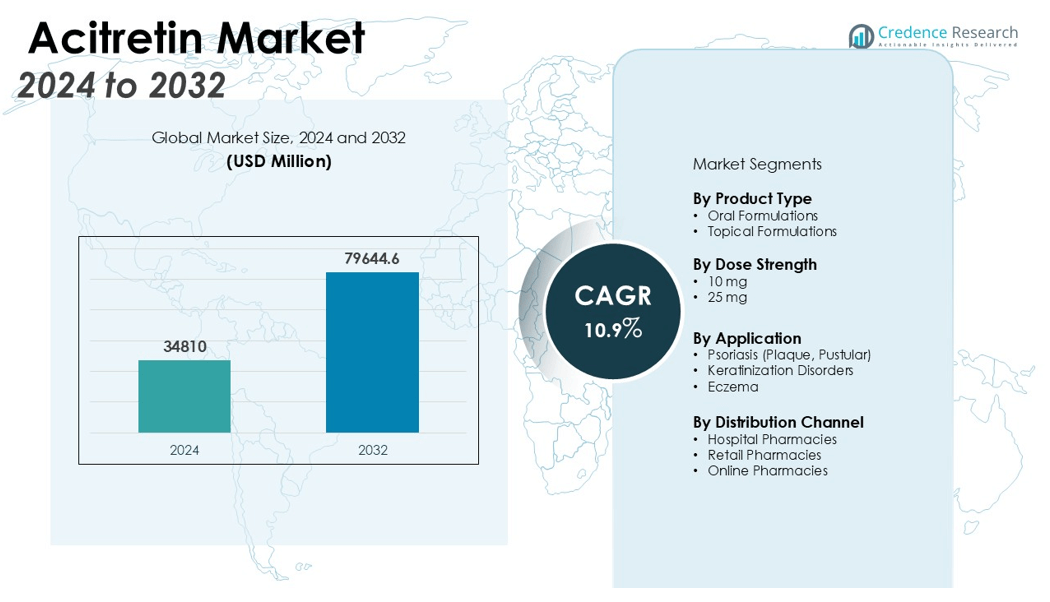
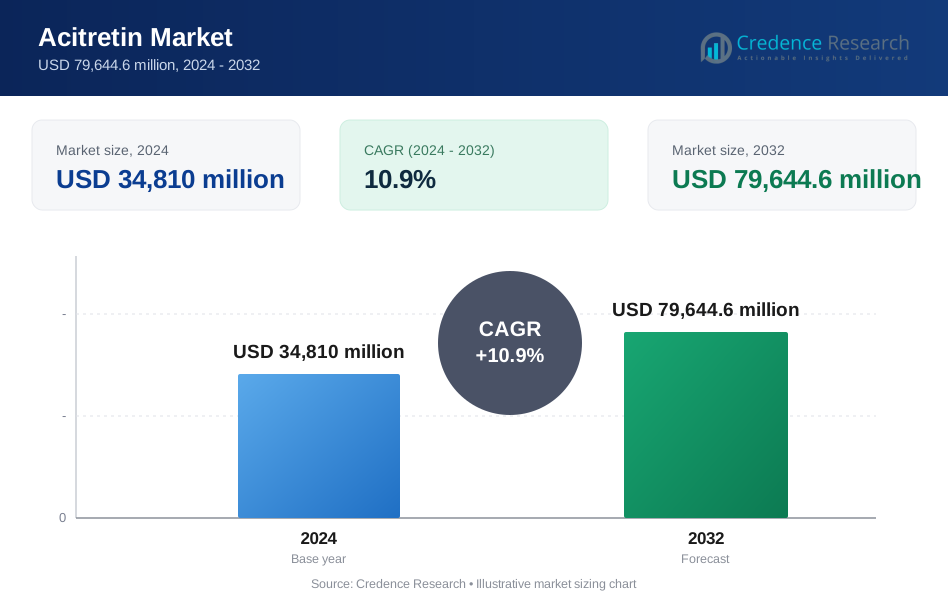
The Acitretin Market size was valued at USD 34810 million in 2024 and is anticipated to reach USD 79644.6 million by 2032, at a CAGR of 10.9% during the forecast period (2024-2032).
| REPORT ATTRIBUTE | DETAILS |
|---|---|
| Historical Period | 2020-2023 |
| Base Year | 2024 |
| Forecast Period | 2025-2032 |
| Acitretin Market Size 2024 | USD 34810 million |
| Acitretin Market, CAGR | 10.9% |
| Acitretin Market Size 2032 | USD 79644.6 million |
Key drivers of the Acitretin Market include the increasing prevalence of psoriasis and other skin disorders globally. As lifestyle factors, environmental conditions, and genetics continue to contribute to a rise in dermatological diseases, the demand for effective treatments like acitretin is expected to grow. Additionally, ongoing advancements in pharmaceutical formulations and the introduction of combination therapies are anticipated to fuel market growth. The expanding patient population seeking effective and long-term therapeutic options also drives demand for acitretin. Furthermore, the growing adoption of personalized medicine and targeted therapies is likely to enhance the treatment landscape and support market expansion.
Regionally, North America holds the largest market share, accounting for over 40% of the total market value, primarily due to the high incidence of skin conditions and advanced healthcare infrastructure in the region. The Asia-Pacific market is expected to witness the highest growth rate during the forecast period, driven by increasing healthcare access, rising awareness about dermatological disorders, and expanding healthcare expenditure in countries such as India and China.
Market Insights:
- The Acitretin Market was valued at USD 34,810 million in 2024 and is expected to reach USD 79,644.6 million by 2032, driven by a rising demand for effective treatments due to increasing dermatological disorders globally.
- Key drivers of market growth include the increasing prevalence of psoriasis, advancements in drug formulations, and growing adoption of combination therapies, all contributing to the demand for acitretin.
- The market is expected to grow at a CAGR of 10.9% from 2024 to 2032, with a significant expansion in regions like Asia-Pacific due to improved healthcare access and rising awareness.
- North America holds 42% of the global market share, supported by high incidence rates of skin conditions, advanced healthcare systems, and effective treatment adoption.
- The Asia-Pacific region, with a market share of 30%, is set to experience the highest growth rate, fueled by increased healthcare access and disposable income in countries like China and India.
- The growing preference for combination therapies and the introduction of personalized treatment plans are expected to drive market expansion.
- Despite its effectiveness, acitretin faces challenges related to side effects, safety concerns, and stringent regulatory requirements that could impact its adoption in certain regions.
Market Drivers:
Increasing Prevalence of Dermatological Disorders
The rising global prevalence of dermatological conditions, particularly psoriasis, is a key driver of the Acitretin Market. Psoriasis, a chronic autoimmune condition, affects millions worldwide, leading to a growing demand for effective treatments like acitretin. The increasing incidence of other skin diseases, such as acne and keratinization disorders, further drives the need for pharmaceutical solutions. It is expected that with the continuous rise in cases, acitretin’s role in providing relief will become more pivotal, contributing to its market growth.
- For instance, in an analytical study conducted at PIMS hospital, Islamabad, involving 43 patients with plaque psoriasis, treatment with acitretin resulted in a mean reduction in the Psoriasis Area and Severity Index (PASI) score of 6.60 after three months.
Advancements in Pharmaceutical Formulations
Advancements in the formulation of acitretin and its combination with other treatments are expected to fuel market growth. New drug delivery systems and enhanced bioavailability of acitretin formulations are expanding its effectiveness, leading to better patient outcomes. The introduction of oral and topical forms of acitretin increases accessibility, ensuring that more patients can benefit from the treatment. These improvements enhance the market's appeal, making it a preferred choice for dermatological conditions.
- For instance, research at The M.S. University of Baroda led to the development of Acitretin-loaded Nanostructured Lipid Carriers (ActNLCs), where the optimized nanoparticles achieved an average particle size of 223 nm, enhancing the drug's delivery for topical treatment.
Growing Awareness and Patient Education
Rising awareness about psoriasis and other skin disorders among patients and healthcare professionals is another key factor. Educating the public about available treatments, including acitretin, increases its usage in managing chronic skin conditions. With better knowledge of the benefits and risks of acitretin, more patients are likely to seek and adhere to prescribed therapies. Enhanced awareness supports the growing demand for this treatment, further contributing to market expansion.
Expansion of Healthcare Access in Emerging Markets
The expansion of healthcare access in emerging markets, particularly in regions like Asia-Pacific, is a significant driver for the Acitretin Market. As healthcare systems improve and access to dermatological care increases, more patients in developing nations are seeking effective treatments for skin disorders. This trend, along with rising disposable incomes and government support for healthcare, is expected to further accelerate the adoption of acitretin in these regions.
Market Trends:
Shift Toward Combination Therapies and Personalized Treatment
A prominent trend in the Acitretin Market is the increasing shift toward combination therapies. Healthcare providers are increasingly combining acitretin with other treatments, such as phototherapy or biologic drugs, to enhance therapeutic outcomes for patients with complex dermatological conditions like severe psoriasis. Personalized treatment approaches, tailored to individual patient profiles, are also gaining traction. These approaches aim to maximize efficacy while minimizing side effects, driving the adoption of acitretin as part of a broader treatment strategy. The market is seeing more targeted therapies that combine traditional drugs like acitretin with novel biologics, further enhancing patient compliance and satisfaction. As dermatological conditions become more varied in their manifestations, combination therapies present a promising avenue for improved patient care.
- For instance, Allergan Aesthetics, an AbbVie company, launched a signature program for personalized treatment planning that has demonstrated strong patient interest, with 8 out of 10 individuals proceeding with treatment after a holistic consultation.
Technological Advancements in Drug Delivery Systems
Technological advancements in drug delivery systems are shaping the future of the Acitretin Market. Innovations such as controlled-release formulations and new delivery methods, including topical gels and transdermal patches, are improving the convenience and efficacy of acitretin for patients. These advancements allow for more precise dosing, extended duration of action, and enhanced bioavailability. As a result, patients experience better management of their skin conditions with fewer side effects. Furthermore, these developments contribute to acitretin’s growing presence in the global dermatology market, reinforcing its role as a cornerstone treatment for chronic skin diseases. The continual improvement in drug delivery technology will drive both the market adoption and growth of acitretin in the coming years.
- For instance, the Spansule® sustained-release capsule technology, a landmark in modern drug delivery, can deliver a medication for a duration of 12 hours after being taken orally.
Market Challenges Analysis:
Side Effects and Safety Concerns
One of the key challenges in the Acitretin Market is the safety profile of the drug. Acitretin is associated with several side effects, including teratogenicity, liver toxicity, and hyperlipidemia, which limit its use in certain patient populations. These concerns particularly affect women of childbearing age, as it is contraindicated during pregnancy due to its potential to cause birth defects. The strict safety regulations and monitoring requirements also add complexity to its prescription, limiting its wider adoption. As healthcare professionals manage these risks, patient adherence to treatment can be impacted, posing challenges to the market growth.
Regulatory Hurdles and Market Access
Acitretin's market access is often hindered by stringent regulatory approvals and pricing challenges. Despite its clinical effectiveness, regulatory agencies impose rigorous standards for approval, particularly regarding its long-term safety. These hurdles delay the availability of acitretin in some regions, limiting its reach in emerging markets where demand is growing. Moreover, the cost of treatment can be prohibitive in low-income countries, where affordable alternatives are often sought. These barriers present significant challenges to expanding the market presence of acitretin globally.
Market Opportunities:
Expanding Patient Population and Growing Demand for Effective Treatments
The growing prevalence of psoriasis and other chronic skin disorders presents significant opportunities for the Acitretin Market. As the global patient population increases, especially in regions with rising healthcare access, the demand for effective treatments like acitretin will continue to grow. Improved diagnostic techniques and awareness campaigns are also contributing to earlier diagnosis and treatment, expanding the pool of patients seeking acitretin therapy. These factors create a solid foundation for sustained market growth, making acitretin a key treatment option for a broader segment of the population.
Potential for Market Expansion in Emerging Economies
Emerging markets represent a major growth opportunity for the Acitretin Market. As healthcare systems in regions like Asia-Pacific and Latin America continue to develop, more patients will have access to effective dermatological treatments, including acitretin. The increasing awareness of skin diseases and the rise in disposable income in these regions further support market expansion. Pharmaceutical companies are focusing on these areas to introduce affordable versions of acitretin, expanding its availability and reach. With a growing middle class and improving healthcare infrastructure, these markets offer substantial opportunities for long-term growth.
Market Segmentation Analysis:
By Product Type
The Acitretin Market is segmented by product type into oral and topical formulations. Oral formulations hold the largest market share due to their widespread use in treating moderate to severe psoriasis, offering systemic relief for patients. Topical formulations are gaining traction for localized treatment, especially for milder cases of psoriasis and keratinization disorders. These products are preferred for their ease of use and direct application, reducing systemic side effects.
- For instance, on August 7, 2024, Alembic Pharmaceuticals received final U.S. FDA approval for its Acitretin Capsules, which contributed to the company's cumulative total of 212 ANDA approvals.
By Dose Strength
Acitretin is available in various dose strengths, typically ranging from 10 mg to 25 mg. The 25 mg dose is the most commonly prescribed, catering to patients with moderate to severe psoriasis. The availability of different strengths allows healthcare providers to tailor the treatment based on the severity of the condition and the patient's response. This flexibility supports patient adherence and improves treatment outcomes.
- For instance, Mylan Pharmaceuticals Inc. enhanced the availability of this key dosage by launching its generic 25 mg Acitretin oral capsule, which received FDA approval under Abbreviated New Drug Application 202148.
By Application
The primary application of acitretin is in the treatment of psoriasis, including both plaque and pustular forms. It is also used for other dermatological conditions like keratinization disorders and certain forms of eczema. Psoriasis remains the dominant application, as the drug is highly effective in managing this chronic condition. The increasing incidence of skin diseases globally is expected to drive demand for acitretin in these therapeutic areas, contributing to market growth.
Segmentations:
By Product Type
- Oral Formulations
- Topical Formulations
By Dose Strength
- 10 mg
- 25 mg
By Application
- Psoriasis (Plaque, Pustular)
- Keratinization Disorders
- Eczema
By Distribution Channel
- Hospital Pharmacies
- Retail Pharmacies
- Online Pharmacies
By Region
- North America
- U.S.
- Canada
- Mexico
- Europe
- Germany
- France
- U.K.
- Italy
- Spain
- Rest of Europe
- Asia Pacific
- China
- Japan
- India
- South Korea
- South-east Asia
- Rest of Asia Pacific
- Latin America
- Brazil
- Argentina
- Rest of Latin America
- Middle East & Africa
- GCC Countries
- South Africa
- Rest of the Middle East and Africa
Regional Analysis:
North America: Leading Market Share
North America holds the largest share of the Acitretin Market, accounting for 42% of the total market value. This dominance is driven by the high prevalence of psoriasis and other skin disorders in the region. The robust healthcare infrastructure, along with advanced dermatological care, ensures widespread access to treatments like acitretin. The United States is particularly influential, where both the healthcare system and patient awareness contribute to the high demand for effective dermatological therapies. With a well-established regulatory framework and strong support for pharmaceutical innovation, the market for acitretin is expected to maintain steady growth in North America.
Asia-Pacific: Rapid Growth and Expansion
The Asia-Pacific region holds a 30% share of the Acitretin Market, experiencing the highest growth rate during the forecast period. Increasing healthcare access and rising awareness of dermatological conditions in countries like China, India, and Japan are driving demand for effective treatments. As urbanization and disposable income levels continue to rise, more patients seek medical solutions for chronic skin disorders, presenting substantial growth potential for acitretin. The region’s rapidly developing healthcare infrastructure and government efforts to improve healthcare accessibility create favorable conditions for market expansion. Rising healthcare expenditure further supports the adoption of treatments like acitretin in emerging economies.
Europe: Steady Growth Amid Regulatory Challenges
Europe accounts for 18% of the global Acitretin Market, with steady demand across key countries such as Germany, the UK, and France. High awareness of psoriasis and dermatological diseases, coupled with well-established healthcare systems, ensures continued use of acitretin in the region. Despite challenges in regulatory approval processes and the presence of alternative treatments, acitretin remains a preferred choice for many patients due to its effectiveness. The European market is expected to grow steadily, with increased focus on patient access and healthcare cost management supporting its long-term prospects.
Key Player Analysis:
- AvKARE
- Chongqing Huapont Pharmaceutical Co.
- Prasco Laboratories
- Biophore India Pharmaceuticals Pvt Ltd
- Hangzhou Jinlan Pharmaceutical Technology Development Co.
- Teva Pharmaceuticals USA
- Merck KGaA
- SGPharma Pvt Ltd.
- Sionc Pharmaceuticals Pvt Ltd.
- Glopec International Inc.
- Sun Pharma Industries Limited.
- Stiefel Laboratories Inc.
Competitive Analysis:
The Acitretin Market is competitive, with leading players such as Amgen Inc., Novartis International AG, and Roche dominating the space. These companies focus on enhancing the efficacy of acitretin formulations and expanding their product portfolios through combination therapies. Generic manufacturers also play a significant role by providing cost-effective alternatives. Competitive dynamics are influenced by factors such as regulatory approvals, pricing strategies, and distribution networks. Companies with a global presence benefit from access to regions like North America, Europe, and the rapidly growing Asia-Pacific market. Partnerships and collaborations further enhance market reach, while ongoing research and development efforts aimed at improving drug delivery systems and reducing side effects create opportunities for both established and emerging players to gain a competitive edge.
Recent Developments:
- In May 2025, Teva announced its ninth consecutive quarter of revenue growth, with first-quarter global revenues reaching $3.9 billion.
Market Concentration & Characteristics:
The Acitretin Market is moderately concentrated, with a few large pharmaceutical companies controlling a significant share of the market. These companies leverage strong distribution networks, extensive research and development capabilities, and established brand recognition. While multinational corporations dominate, generic manufacturers are gaining traction by offering cost-effective alternatives, increasing market competition. The market is characterized by high regulatory standards, requiring companies to invest in compliance and safety measures. The ongoing development of improved formulations and drug delivery systems presents opportunities for innovation, further shaping market dynamics. The market’s growth is driven by increasing demand for effective dermatological treatments, making it an attractive space for both established players and emerging companies.
Report Coverage:
The research report offers an in-depth analysis based on Product Type, Dose Strength, Application, Distribution Channel and Region. It details leading market players, providing an overview of their business, product offerings, investments, revenue streams, and key applications. Additionally, the report includes insights into the competitive environment, SWOT analysis, current market trends, as well as the primary drivers and constraints. Furthermore, it discusses various factors that have driven market expansion in recent years. The report also explores market dynamics, regulatory scenarios, and technological advancements that are shaping the industry. It assesses the impact of external factors and global economic changes on market growth. Lastly, it provides strategic recommendations for new entrants and established companies to navigate the complexities of the market.
Future Outlook:
- Increasing prevalence of psoriasis and other chronic skin disorders globally.
- Advancements in drug delivery systems enhancing efficacy and patient compliance.
- Rising awareness and early diagnosis leading to higher treatment adoption rates.
- Expansion of healthcare infrastructure, particularly in emerging markets.
- Growing preference for combination therapies to improve therapeutic outcomes.
- Development of personalized medicine approaches tailored to individual patient needs.
- Introduction of generic acitretin formulations improving affordability and access.
- Strengthening of distribution channels, including online pharmacies, facilitating wider reach.
- Increased participation in clinical trials and dermatological research advancing treatment options.
- Supportive reimbursement policies and government initiatives promoting dermatological care.
Request a Free Sample
Fill in your details and we'll send you a free sample report.
- Sample data tables & charts
- Research methodology
Need a Custom Version of This Report?
Tailor the scope, geography, or segments to your exact requirements.
- Custom geography or segment scope
- Direct access to our analyst team
Frequently Asked Questions
What is the current market size for Acitretin, and what is its projected size in 2032?
What are the primary factors fueling the growth of the Acitretin market?
Which region commanded the largest share of the Acitretin market in 2024?
At what Compound Annual Growth Rate is the Acitretin market projected to grow between 2024 and 2032?
Table of Content
Chapter 1. Report Introduction
- 1.1 Report Description & Purpose
- 1.1.1 Report Title & Market Definition
- 1.1.2 Unique Selling Propositions (USP) & Key Differentiators
- 1.1.3 Value Proposition for Stakeholders
- 1.2 Research Objectives
- 1.2.1 Market Sizing Objectives (Volume & Revenue)
- 1.2.2 Segmentation Objectives
- 1.2.3 Competitive Intelligence Objectives
- 1.2.4 Forecast & Scenario Objectives
- 1.3 Report Scope
- 1.3.1 Acitretin Scope – Types & Subtypes Covered
- 1.3.2 Geographic Scope – Regions & Countries Covered
- 1.3.3 Historical Period, Base Year & Forecast Period (2024; forecast to 2032)
- 1.3.4 Inclusions & Exclusions
- 1.4 HS Code & Classification Framework
- 1.5 Currency, Units & Pricing Basis
- 1.6 Target Stakeholders
- 1.7 Limitations & Assumptions
Chapter 2. Executive Summary
- 2.1 Global Acitretin Market Snapshot
- 2.1.1 Market Size – Historical (2024) & Forecast (2024-2032) (2024: USD 34,810 million → 2032: USD 79,644.6 million)
- 2.1.2 Volume & Revenue – Global Totals
- 2.1.3 Key Market Highlights – Top Five Facts
- 2.2 Acitretin Market Segmentation Snapshot
- 2.2.1 Market Split by Region – 2024 vs. 2032
- 2.3 Competitive Snapshot
- 2.3.1 Top 10 Players by Revenue Share – 2024
- 2.3.2 Top 10 Players by Volume Share – 2024
- 2.3.3 Recent Strategic Developments (18-Month Summary)
- 2.4 Key Investment Highlights & Strategic Conclusions
Chapter 3. Acitretin Market Dynamics & Industry Analysis
- 3.1 Market Overview & Context
- 3.1.1 Acitretin Market Position in the Broader Automotive Value Chain
- 3.1.2 OEM vs. Replacement Market Dynamics
- 3.1.3 Market Maturity & Development Stage by Region
- 3.2 Acitretin Market Drivers
- 3.3 Acitretin Market Restraints & Challenges
- 3.4 Acitretin Market Opportunities
- 3.5 Porter's Five Forces Analysis
- 3.5.1 Threat of New Entrants
- 3.5.2 Bargaining Power of Suppliers
- 3.5.3 Bargaining Power of Buyers
- 3.5.4 Threat of Substitutes
- 3.5.5 Competitive Rivalry – Intensity Assessment
- 3.6 Acitretin Value Chain Analysis
- 3.6.1 Upstream – Raw Material/Input Suppliers
- 3.6.1.1 Raw Material/Input 1
- 3.6.1.2 Raw Material/Input 2
- 3.6.1.3 Raw Material/Input 3
- 3.6.2 Midstream – Production/Manufacturing/Service Delivery
- 3.6.2.1 Production/Process Overview
- 3.6.2.2 Key Facility Locations & Capacity by Manufacturer
- 3.6.3 Downstream – Distribution & End Consumer
- 3.6.3.1 Primary Channel – B2B/OEM
- 3.6.3.2 Secondary Channels – Dealer, Retail, Online, Direct
- 3.6.4 Value Chain Profitability Analysis
- 3.6.1 Upstream – Raw Material/Input Suppliers
- 3.7 PESTEL Analysis
- 3.7.1 Political Factors
- 3.7.2 Economic Factors
- 3.7.3 Social Factors
- 3.7.4 Technological Factors
- 3.7.5 Environmental Factors
- 3.7.6 Legal Factors
- 3.8 Acitretin Supply Chain Analysis
- 3.8.1 Raw Material/Input Supply Risk Assessment
- 3.8.2 Manufacturing Concentration Risk (Geographic Exposure)
- 3.8.3 Trade Disruption Impact Analysis
- 3.9 Regulatory & Policy Landscape
Note: The regulatory and policy landscape section covers regulations based on their applicability to the market, Acitretin category, geography, and scope of the study. Only regulatory frameworks with a material impact on operations, compliance, trade, sustainability, or market access are analyzed in detail.
Chapter 4. Key Investment Pockets & Opportunity Analysis
- 4.1 Acitretin Market Attractiveness Analysis
- 4.1.1 By Region – Investment Attractiveness Matrix (Volume × CAGR)
- 4.2 Absolute Revenue Growth Opportunity
- 4.2.1 By Region – Absolute USD Growth Through 2032
- 4.3 Incremental Volume Opportunity
- 4.3.1 By Region – Incremental Volume Through 2032
- 4.3.2 Segment – Incremental Volume
- 4.4 Emerging Submarket Opportunity Deep Dive (Subject to Applicability)
- 4.5 Emerging Market Opportunity Scorecards
- 4.5.1 United States
- 4.5.2 Europe
- 4.5.3 Asia
- 4.5.4 Middle East & Africa
Note: Emerging Market Opportunity Scorecards will be included based on relevance and strategic importance. Regions listed are indicative and may vary depending on data availability and market dynamics.
Chapter 5. Acitretin Import-Export Analysis & Trade Flows
- 5.1 Global Trade Overview
- 5.1.1 Global Export Value by Country (2024)
- 5.1.2 Global Export Volume by Country (2024)
- 5.1.3 Global Import Value by Country (2024)
- 5.1.4 Global Import Volume by Country (2024)
- 5.1.5 Net Trade Balance by Country (2024)
- 5.2 Export Analysis – Segment
- 5.2.1 Type 1 (HS Code)
- 5.2.2 Type 2 (HS Code)
- 5.2.3 Type 3 (HS Code)
- 5.2.4 Type 4 (HS Code)
- 5.2.5 Type 5 (HS Code)
- 5.3 Import Analysis – Segment
- 5.3.1 Type 1 (HS Code)
- 5.3.2 Type 2 (HS Code)
- 5.3.3 Type 3 (HS Code)
- 5.3.4 Type 4 (HS Code)
- 5.3.5 Type 5 (HS Code)
- 5.4 Average Unit Trade Prices
- 5.4.1 Average Export Price – Segment & Country
- 5.4.2 Average Import Price – Segment & Source Country
- 5.4.3 Price Trends (2024)
- 5.5 Key Trade Route Analysis
- 5.5.1 Trade Route 1
- 5.5.2 Trade Route 2
- 5.5.3 Trade Route 3
- 5.5.4 Trade Route 4
- 5.5.5 Trade Route 5
- 5.6 Trade Policy Impact Assessment
- 5.6.1 US Anti-Dumping & Section 301 Tariffs
- 5.6.2 EU Customs Union Impact
- 5.6.3 Major Free Trade Agreements
- 5.6.4 USMCA Rules of Origin
Note: Trade policy analysis will be included only where relevant to the Acitretin market.
Chapter 6. Competitive Landscape & Company Benchmarking
- 6.1 Acitretin Market Concentration & Structure
- 6.1.1 Herfindahl-Hirschman Index (HHI) – vs. 2024
- 6.1.2 Tier 1, Tier 2 & Tier 3 Market Structure
- 6.1.3 Global, Regional & Local Player Dynamics
- 6.2 Acitretin Market Share Analysis – 2024
- 6.2.1 Global Revenue Share by Company
- 6.2.2 Global Volume Share by Company
- 6.2.3 Regional Revenue Share
- 6.2.4 Market Share Evolution ( vs. 2024)
- 6.2.5 OEM Segment Share by Company
- 6.2.6 Replacement Segment Share by Company
- 6.3 Production/Delivery Capacity & Facility Analysis
- 6.3.1 Global Installed Capacity
- 6.3.2 Capacity Utilization Rates
- 6.3.3 Production/Output Volume
- 6.3.4 Facility Locations & Capacity Map
- 6.3.5 Planned Capacity Additions
- 6.4 Acitretin Competitive Benchmarking Matrix
- 6.4.1 Revenue, Volume, CAGR & Profitability Comparison
- 6.4.2 Channel Revenue Mix
- 6.4.3 Geographic Revenue Exposure
- 6.4.4 R&D Intensity
- 6.4.5 Sustainability Maturity
- 6.5 Strategic Developments in Acitretin (Last 24 Months)
- 6.5.1 Mergers, Acquisitions & Divestments
- 6.5.2 New Acitretin Launches
- 6.5.3 Facility Expansions
- 6.5.4 Strategic Alliances, Joint Ventures & Partnerships
- 6.5.5 Distribution Expansion & Market Entry
- 6.5.6 Sustainability & ESG Initiatives
- 6.6 Competitive Strategy Mapping
- 6.6.1 Leader, Challenger, Follower & Niche Classification
- 6.6.2 Pricing Strategy Comparison
- 6.6.3 Channel Strategy Matrix
Note: Strategic developments are included based on their materiality and the availability of reliable information.
Chapter 7. Global Acitretin Market – By Distribution Channel
- 7.1 Segment Overview
- 7.1.1 Volume & Revenue Split by Channel (2024 & 2032)
- 7.1.2 Channel Mix Evolution (2024-2032)
Chapter 8. Regional Market Analysis – Global Overview
- 8.1 Global Regional Overview
- 8.1.1 Regional Volume Share
- 8.1.2 Regional Revenue Share
- 8.1.3 Regional Volume by Region
- 8.1.4 Regional Revenue by Region
- 8.1.5 Regional Forecast Through 2032
- 8.2 Cross-Regional Segment Analysis
- 8.2.1 By Distribution Channel
- 8.2.2 By Brand/Price Tier
Chapter 9. North America Acitretin Market
- 9.1 United States
- 9.2 Canada
- 9.3 Mexico
Chapter 10. Europe Acitretin Market
- 10.1 Germany
- 10.2 France
- 10.3 Italy
- 10.4 United Kingdom
- 10.5 Spain
- 10.6 Poland
- 10.7 Russia
- 10.8 Netherlands
- 10.9 Belgium
- 10.10 Sweden
- 10.11 Denmark
- 10.12 Norway
- 10.13 Rest of Europe
Chapter 11. Asia Pacific Acitretin Market
- 11.1 China
- 11.2 India
- 11.3 Japan
- 11.4 South Korea
- 11.5 Thailand
- 11.6 Indonesia
- 11.7 Vietnam
- 11.8 Malaysia
- 11.9 Australia
- 11.10 Rest of Asia Pacific
Chapter 12. Latin America Acitretin Market
- 12.1 Brazil
- 12.2 Argentina
- 12.3 Colombia
- 12.4 Chile
- 12.5 Rest of Latin America
Chapter 13. Middle East Acitretin Market
- 13.1 Saudi Arabia
- 13.2 United Arab Emirates
- 13.3 Turkey
- 13.4 Israel
- 13.5 Iran
- 13.6 Rest of the Middle East
Chapter 14. Africa Acitretin Market
- 14.1 South Africa
- 14.2 Egypt
- 14.3 Nigeria
- 14.4 Morocco
- 14.5 Rest of Africa
Chapter 15. Acitretin Company Profiles
- 15.1 [Company 01]
- 15.1.1 Company Overview
- 15.1.2 Key Management Personnel
- 15.1.3 Products & Services Portfolio
- 15.1.4 Financial Performance
- 15.1.5 Key Market Focus & Geographic Presence
- 15.1.6 Recent Developments & Strategic Initiatives
Note: The company profile list is preliminary and may change based on research findings, market developments, data availability, and client requirements.
Chapter 16. Appendices
- Appendix A – List of Abbreviations & Acronyms
- Appendix B – Industry Classification Code Reference – Full Series
- Appendix C – Production & Capacity Data Tables
- Appendix D – End-Use & Demand Base Tables
- Appendix E – Consumption & Replacement Rate Assumptions
- Appendix F – ASP Reference Tables
- Appendix G – Manufacturing & Facility Database
- Appendix H – Import-Export Data Tables
- Appendix I – Regulatory Summary Tables
- Appendix J – Primary Research Participant List (Anonymized)
- Appendix K – Primary Research Questionnaire Framework
- Appendix L – Data Sources & Bibliography
- Appendix M – Market Size Divergence & Source Comparison
Chapter 17. Research Methodology
- 17.1 Research Framework & Philosophy
- 17.2 Secondary Research – Sources, Hierarchy & Data Extraction
- 17.3 Data Modeling – Bottom-Up & Top-Down Market Sizing
- 17.4 Primary Research – Stakeholder Framework, LOI & Sample Sizes
- 17.5 Forecast Methodology – Regression, Scenario & Sensitivity Analysis
- 17.6 Quality Control – Four-Layer Validation Framework
- 17.7 Limitations & Standard Assumptions
- 17.8 Disclaimer
