
Air Purifying Escape Respirator Market Overview:
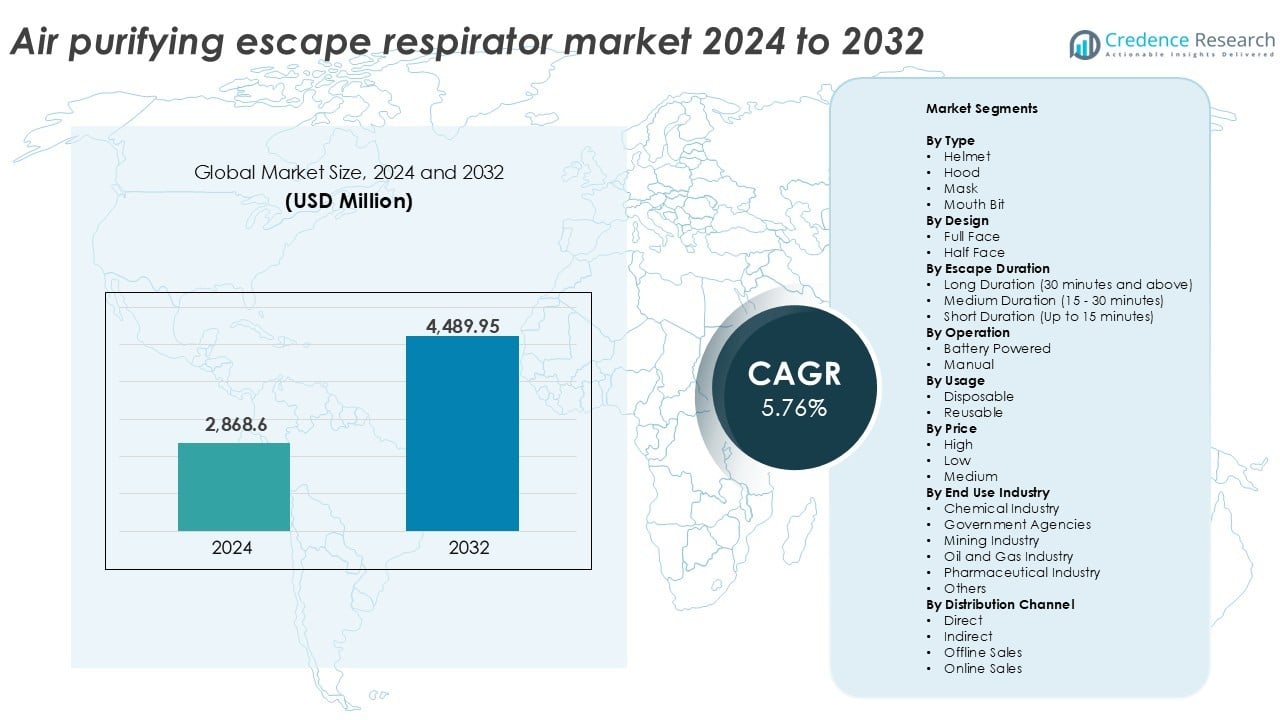
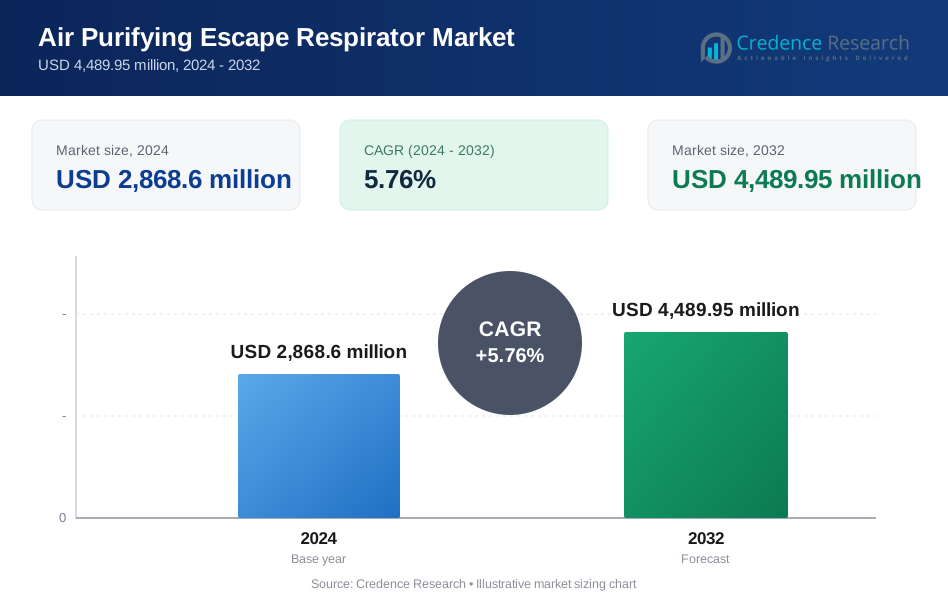
The air purifying escape respirator market size was valued at USD 2,868.6 million in 2024 and is anticipated to reach USD 4,489.95 million by 2032, at a CAGR of 5.76% during the forecast period.
| REPORT ATTRIBUTE | DETAILS |
|---|---|
| Historical Period | 2020-2023 |
| Base Year | 2024 |
| Forecast Period | 2025-2032 |
| Air Purifying Escape Respirator Market Size 2024 | USD 2,868.6 million |
| Air Purifying Escape Respirator Market, CAGR | 5.76% |
| Air Purifying Escape Respirator Market Size 2032 | USD 4,489.95 million |
The air purifying escape respirator market is led by key players such as 3M, Honeywell International Inc., Drägerwerk AG & Co. KGaA, MSA Safety, Avon Protection, ILC Dover LP, Delta Plus Group, Cam Lock Ltd, and Interspiro. These companies maintain a strong competitive edge through innovation, compliance with global safety standards, and broad distribution networks. Product differentiation, reliability, and emergency readiness drive their market position. In terms of regional performance, North America dominates the global market with a 32% share in 2024, fueled by stringent workplace safety regulations and widespread adoption across industrial and public sectors.
Air Purifying Escape Respirator Market Insights
- The air purifying escape respirator market was valued at USD 2,868.6 million in 2024 and is projected to reach USD 4,489.95 million by 2032, growing at a CAGR of 5.76%.
- Market growth is driven by stricter industrial safety regulations, rising emergency preparedness, and increasing use across oil & gas, chemical, and transportation sectors.
- Full-face respirators dominate by design with over 60% share, while hood-type devices lead by type due to ease of use and broad protection.
- Leading players such as 3M, Honeywell, and Drägerwerk focus on certified, high-performance products and invest in smart features and global expansion to stay competitive.
- North America holds the largest share at 32%, followed by Europe at 27% and Asia-Pacific at 22%, while high product costs and limited awareness in emerging economies continue to restrain market penetration.
Air Purifying Escape Respirator Market Segmentation Analysis:
By Type
Among the product types, hood-based air purifying escape respirators dominate the market with over 35% share in 2024. Hood designs provide full head and neck protection and are easier to don quickly, making them preferred in emergency evacuations. Their compatibility with various face shapes and ability to protect users with facial hair or eyewear drive preference in industrial and civilian applications. Helmet and mask types hold steady adoption, especially in oil & gas and military sectors where rugged protection is needed. Mouth bit types cater to low-cost or compact solutions but remain niche in usage.
- For instance, Dräger’s PARAT 5550 hooded escape respirator provides at least 15 minutes of protection against toxic industrial gases and is certified under DIN 58647-7 standards.
By Design
The full-face design segment accounted for more than 60% of the market share in 2024. It ensures superior respiratory and eye protection, making it highly suitable for chemical plants, mining operations, and emergency responders. Full-face units often include built-in filters and panoramic visors, enhancing user visibility and protection in hazardous situations. Half-face designs maintain relevance where lightweight and cost-effective solutions are sufficient, particularly in lower-risk environments or for short-term use. Growth in urban safety initiatives and industrial upgrades supports full-face dominance.
- For instance, Honeywell’s North Primair Escape Hood features a panoramic visor with a field of vision exceeding 70 degrees and integrated multi-gas filtration.
By Escape Duration
Medium duration respirators (15–30 minutes) lead the market, representing around 45% share in 2024. These units balance portability with enough time for safe evacuation, aligning well with industrial safety protocols. Their adoption is high across transportation, underground facilities, and manufacturing sectors. Long-duration devices serve high-risk facilities like offshore platforms, while short-duration models appeal to consumer and commercial buildings where quick exits are expected. Increasing emergency preparedness regulations support ongoing investment in medium and long-duration units.
Air Purifying Escape Respirator Market Key Growth Drivers
Stricter Industrial Safety Regulations Across Sectors
The air purifying escape respirator market benefits from increasing enforcement of workplace safety standards globally. Regulatory bodies such as OSHA (Occupational Safety and Health Administration) and EU-OSHA have mandated the use of respiratory protection in hazardous environments. Industries including oil & gas, chemical processing, and mining face high exposure risks, prompting mandatory integration of escape respirators into safety protocols. Employers invest in advanced escape solutions to avoid compliance penalties and ensure workforce safety. Regular audits and the push for zero-incident operations further accelerate adoption. Countries in Asia and the Middle East are also tightening industrial safety laws, boosting demand in emerging markets. Manufacturers respond with products that meet updated performance certifications such as NIOSH, CE, and ISO. The drive toward enhanced emergency preparedness, especially in confined space operations, reinforces sustained product demand.
- For instance, OSHA standard 29 CFR 1910.134 requires employers to provide appropriate respirators for emergency escape in atmospheres with known hazards.
Rising Risk of Chemical, Fire, and Biological Emergencies
The growing threat of chemical leaks, industrial fires, and biohazard incidents increases demand for air purifying escape respirators. Facilities handling toxic materials or operating in fire-prone environments require immediate-use respirators for employee safety. The use of flammable materials, reactive chemicals, and aging infrastructure in many facilities raises the frequency and severity of emergency evacuations. Public infrastructure and transportation hubs also see rising demand for emergency respirators as part of safety kits, especially after past incidents involving chemical exposure or smoke inhalation. Airports, metro systems, and power plants are integrating compact escape devices in emergency cabinets. Global awareness of preparedness during pandemics and biohazard threats supports the inclusion of these devices in health and emergency kits. This rising threat landscape makes rapid-access respiratory protection a critical safety asset in high-risk zones.
- For instance, London Underground includes smoke escape hoods in control-room emergency kits following fire safety reviews.
Expansion of Manufacturing and Industrial Infrastructure in Emerging Economies
Rapid industrialization in Asia-Pacific, the Middle East, and parts of Latin America drives new demand for air purifying escape respirators. Manufacturing plants, chemical facilities, refineries, and logistics hubs are expanding across India, China, Vietnam, UAE, and Brazil. These regions are witnessing foreign direct investments (FDIs) in oil & gas, metallurgy, and electronics manufacturing, which require stringent safety protocols. Local governments increasingly enforce evacuation preparedness plans aligned with global standards. As new plants get commissioned, safety product procurement becomes integral to project setup. Multinational corporations operating in these regions follow global environmental, health, and safety (EHS) practices, further reinforcing adoption. The presence of low-cost manufacturing also enables production scaling, making these respirators more accessible. Increasing workforce density in confined or hazardous environments further boosts uptake of personal protective equipment (PPE), especially easy-to-use escape respirators.
Air Purifying Escape Respirator Market Key Trends & Opportunities
Integration of Smart Technologies in Escape Respirators
Smart features are emerging as a transformative trend in the air purifying escape respirator market. Advanced models now integrate sensors to monitor air quality, filter status, and usage time. Connectivity to central control systems enables real-time tracking of personnel safety during emergency evacuations. Some devices offer voice guidance or automatic visor adjustments to support visibility in smoke-filled or chemical-heavy environments. Integration of RFID tags and QR-based identification also improves asset management and inventory control. These smart respirators enhance user confidence, streamline safety audits, and reduce training complexity. Demand from high-tech industries such as semiconductors, biotechnology, and aerospace supports this trend. Investment in R&D for intelligent PPE opens opportunities for differentiation among manufacturers targeting premium segments.
- For instance, Dräger integrates electronic end-of-service indicators in escape respirators that provide clear visual alerts when filter capacity is exhausted, validated under EN 14387 testing.
Growing Demand from Non-Industrial Sectors
The air purifying escape respirator market sees rising traction beyond traditional heavy industries. Sectors such as healthcare, public safety, mass transit, and residential infrastructure adopt escape respirators for contingency planning. Hospitals, especially those with infectious disease wards, invest in hood-type respirators to protect healthcare workers during airborne outbreak scenarios. Public transport operators install emergency respirators in metro trains and underground stations. High-rise buildings and hotels incorporate compact escape devices into fire safety cabinets. The post-COVID focus on airborne contamination prevention encourages broader integration of respirators into disaster kits and first-aid inventories. This trend expands the addressable market, pushing manufacturers to design user-friendly, lightweight, and affordable products suited for layperson use. The shift to multipurpose use cases opens long-term growth potential outside core industrial verticals.
Air Purifying Escape Respirator Market Key Challenges
High Cost and Limited Accessibility in Price-Sensitive Markets
Air purifying escape respirators, especially certified full-face and long-duration variants, often come at high price points. In developing markets, small and medium enterprises (SMEs) may delay or avoid adoption due to cost concerns. High import duties and limited local production in countries like Indonesia, Nigeria, and parts of Eastern Europe add to affordability issues. Even large organizations sometimes prioritize basic PPE over advanced escape solutions when budgets are tight. This challenge is further amplified by the need for regular filter replacement and user training, which adds to the total cost of ownership. Absence of financial incentives or regulatory mandates also affects penetration in price-sensitive regions. Manufacturers must innovate on low-cost designs without compromising safety standards to expand their presence in underserved markets.
Lack of Awareness and Training in Emergency Preparedness
Despite growing safety regulations, many facilities lack proper awareness and training for escape respirator usage. In several sectors, emergency response protocols are poorly enforced or outdated. Workers may be unaware of correct donning techniques or filter change intervals, reducing the effectiveness of respirators during critical incidents. In low-hazard or administrative environments, safety managers often overlook the importance of air purifying escape devices. This results in understocked or non-functional units during emergencies. In emerging regions, training resources and multilingual instructions are limited. Without simulation drills or regular refresher programs, product misuse and safety gaps persist. Addressing this challenge requires greater investment in on-site training programs, awareness campaigns, and integration of usage education into standard safety modules.
Air Purifying Escape Respirator Market Regional Analysis
North America
North America accounted for over 32% of the global air purifying escape respirator market share in 2024. The region leads due to strict workplace safety regulations, high industrialization, and advanced emergency preparedness infrastructure. The United States drives demand across oil & gas, chemical, and transportation sectors. Strong enforcement by OSHA ensures compliance with respiratory protection norms. Canada follows with rising adoption in mining and manufacturing sectors. Public safety initiatives and investment in smart PPE further support growth. Widespread product availability, coupled with strong distributor networks, helps sustain market penetration across commercial and institutional end-users.
Europe
Europe held approximately 27% of the global market share in 2024, driven by robust regulatory frameworks and widespread awareness of occupational safety. Countries such as Germany, France, and the UK exhibit strong adoption in industries such as pharmaceuticals, energy, and construction. EU regulations, including CE marking and REACH compliance, promote standardized product use. Industrial modernization, aging infrastructure, and fire safety policies support sustained demand. Public transport systems and critical infrastructure facilities integrate escape respirators in evacuation kits. The market also benefits from consistent investment in safety innovation, particularly in full-face and long-duration respirator technologies.
Asia-Pacific
Asia-Pacific captured nearly 22% of the global market share in 2024 and remains the fastest-growing region. Industrial expansion in China, India, and Southeast Asian countries drives strong demand from manufacturing, mining, and chemical processing sectors. Increasing regulatory enforcement, urban infrastructure growth, and rising worker safety awareness contribute to market growth. China leads in volume due to its extensive industrial base, while India sees rising adoption in refineries and metro rail projects. Local production growth and cost-effective product offerings support accessibility. The region benefits from increased public safety initiatives and government-led emergency preparedness programs.
Middle East & Africa
The Middle East & Africa region held around 11% market share in 2024. Demand is driven by the oil & gas sector, construction projects, and critical infrastructure development, particularly in the UAE, Saudi Arabia, and South Africa. Regulatory bodies in the Gulf Cooperation Council (GCC) implement stricter safety norms, encouraging the use of escape respirators in confined spaces and fire-prone environments. Africa’s uptake is slower but growing in mining and public safety programs. Import reliance, limited training resources, and price sensitivity challenge penetration, yet urbanization and megaprojects across the Middle East support future market expansion.
Latin America
Latin America accounted for approximately 8% of the global market share in 2024. Brazil and Mexico lead demand due to established industrial zones and rising workplace safety investments. The region sees moderate adoption in oil refining, mining, and heavy industries. Regulatory alignment with international safety standards remains uneven but is improving. Urban disaster preparedness and growth in public infrastructure projects support gradual uptake. However, limited awareness, import costs, and inconsistent enforcement hinder faster expansion. Manufacturers explore local partnerships and distributor networks to penetrate the region. Growth potential lies in public health, transport safety, and chemical industry applications.
Air Purifying Escape Respirator Market Segmentations:
By Type
- Helmet
- Hood
- Mask
- Mouth Bit
By Design
- Full Face
- Half Face
By Escape Duration
- Long Duration (30 minutes and above)
- Medium Duration (15 - 30 minutes)
- Short Duration (Up to 15 minutes)
By Operation
- Battery Powered
- Manual
By Usage
- Disposable
- Reusable
By Price
- High
- Low
- Medium
By End Use Industry
- Chemical Industry
- Government Agencies
- Mining Industry
- Oil and Gas Industry
- Pharmaceutical Industry
- Others
By Distribution Channel
- Direct
- Indirect
- Offline Sales
- Online Sales
By Geography
- North America
- U.S.
- Canada
- Mexico
- Europe
- Germany
- France
- U.K.
- Italy
- Spain
- Rest of Europe
- Asia Pacific
- China
- Japan
- India
- South Korea
- South-east Asia
- Rest of Asia Pacific
- Latin America
- Brazil
- Argentina
- Rest of Latin America
- Middle East & Africa
- GCC Countries
- South Africa
- Rest of the Middle East and Africa
Competitive Landscape
The air purifying escape respirator market features a mix of global safety equipment leaders and specialized respiratory protection manufacturers. Companies such as 3M, Honeywell International Inc., Drägerwerk AG & Co. KGaA, and MSA Safety dominate through broad product portfolios, global distribution, and strong brand recognition. These players invest heavily in R&D to offer certified, durable, and user-friendly respirators for industrial, defense, and emergency use. Avon Protection and ILC Dover LP maintain strong positions in military-grade and hood-based solutions. Delta Plus Group and Cam Lock Ltd focus on regional markets with cost-effective offerings. Interspiro and other niche players serve specialized sectors such as firefighting and marine. The market remains competitive due to evolving regulatory requirements and demand for technologically advanced, easy-to-deploy systems. Strategic partnerships, mergers, and geographic expansion are common tactics used to strengthen global reach and maintain compliance with emerging safety standards. Customization and smart features continue to drive product differentiation.
Key Player Analysis
- Delta Plus Group
- Honeywell International Inc.
- Interspiro
- Avon Protection
- ILC Dover LP
- Drägerwerk AG & Co. KGaA
- MSA Safety
- Cam Lock Ltd
- 3M
Recent Developments
- In May 2024, Personal Protective Equipment (PPE) remains vital for safeguarding healthcare workers from occupational hazards, with Powered Air-Purifying Respirators (PAPRs) playing a crucial role in ensuring respiratory health and safety.
- In February 2024, Avon Protection, a leading innovator in CBRN personal protective equipment, unveiled the EXOSKIN-S1 CBRN protective suit, a groundbreaking addition to its advanced product line. This launch underscores Avon Protection's commitment to equipping individuals operating in CBRN threat environments worldwide with cutting-edge protective solutions.
- In March 2023, 3M announced a collaboration with Guardhat, an industry-leading connected safety software company. 3M is transferring its Safety Inspection Management (SIM) software to Guardhat. The two companies are likely to evaluate future opportunities to collaborate by combining 3M's expertise in personal protection equipment with Guardhat's leading worker-centric software platform to create connected safety opportunities that aim to keep more frontline workers safe. SIM is a cloud- and mobile-based system that simplifies compliance, helps improve safety, and eases work for EHS teams by digitally connecting people, places, and PPE.
Report Coverage
The research report offers an in-depth analysis based on Type, Design, Escape Duration, Operation, Usage, Price, End Use Industry, Distribution Channel and Geography. It details leading market players, providing an overview of their business, product offerings, investments, revenue streams, and key applications. Additionally, the report includes insights into the competitive environment, SWOT analysis, current market trends, as well as the primary drivers and constraints. Furthermore, it discusses various factors that have driven market expansion in recent years. The report also explores market dynamics, regulatory scenarios, and technological advancements that are shaping the industry. It assesses the impact of external factors and global economic changes on market growth. Lastly, it provides strategic recommendations for new entrants and established companies to navigate the complexities of the market.
Future Outlook
- Demand for escape respirators will rise with stricter global safety regulations across industrial sectors.
- Adoption in transportation hubs and public infrastructure will increase due to urban emergency planning.
- Full-face and hood-type designs will remain preferred for their enhanced protection and usability.
- Asia-Pacific will emerge as the fastest-growing region with rising industrial investments and safety awareness.
- Smart features such as sensor integration and real-time monitoring will gain traction in premium models.
- Manufacturers will focus on lightweight, compact, and user-friendly designs for broader use cases.
- Partnerships and acquisitions will strengthen product portfolios and expand global market presence.
- Regulatory alignment and certification compliance will remain critical for market entry and growth.
- Price sensitivity in developing regions may drive innovation in affordable product lines.
- Training and awareness programs will play a vital role in boosting adoption and proper usage.
Request a Free Sample
Fill in your details and we'll send you a free sample report.
- Sample data tables & charts
- Research methodology
Need a Custom Version of This Report?
Tailor the scope, geography, or segments to your exact requirements.
- Custom geography or segment scope
- Direct access to our analyst team
Frequently Asked Questions
What is the current market size for Air Purifying Escape Respirator Market, and what is its projected size in 2032?
At what Compound Annual Growth Rate is the Air Purifying Escape Respirator Market projected to grow between 2024 and 2032?
Which Air Purifying Escape Respirator Market segment held the largest share in 2024?
What are the primary factors fueling the growth of the Air Purifying Escape Respirator Market?
Who are the leading companies in the Air Purifying Escape Respirator Market?
Which region commanded the largest share of the Air Purifying Escape Respirator Market in 2024?
Table of Content
Chapter 1. Report Introduction
- 1.1 Report Description & Purpose
- 1.1.1 Report Title & Market Definition
- 1.1.2 Unique Selling Propositions (USP) & Key Differentiators
- 1.1.3 Value Proposition for Stakeholders
- 1.2 Research Objectives
- 1.2.1 Market Sizing Objectives (Volume & Revenue)
- 1.2.2 Segmentation Objectives
- 1.2.3 Competitive Intelligence Objectives
- 1.2.4 Forecast & Scenario Objectives
- 1.3 Report Scope
- 1.3.1 Air Purifying Escape Respirator Scope – Types & Subtypes Covered
- 1.3.2 Geographic Scope – Regions & Countries Covered
- 1.3.3 Historical Period, Base Year & Forecast Period (2024; forecast to 2032)
- 1.3.4 Inclusions & Exclusions
- 1.4 HS Code & Classification Framework
- 1.5 Currency, Units & Pricing Basis
- 1.6 Target Stakeholders
- 1.7 Limitations & Assumptions
Chapter 2. Executive Summary
- 2.1 Global Air Purifying Escape Respirator Market Snapshot
- 2.1.1 Market Size – Historical (2024) & Forecast (2024-2032) (2024: USD 2,868.6 million → 2032: USD 4,489.95 million)
- 2.1.2 Volume & Revenue – Global Totals
- 2.1.3 Key Market Highlights – Top Five Facts
- 2.2 Air Purifying Escape Respirator Market Segmentation Snapshot
- 2.2.1 Market Split by Region – 2024 vs. 2032
- 2.3 Competitive Snapshot
- 2.3.1 Top 10 Players by Revenue Share – 2024
- 2.3.2 Top 10 Players by Volume Share – 2024
- 2.3.3 Recent Strategic Developments (18-Month Summary)
- 2.4 Key Investment Highlights & Strategic Conclusions
Chapter 3. Air Purifying Escape Respirator Market Dynamics & Industry Analysis
- 3.1 Market Overview & Context
- 3.1.1 Air Purifying Escape Respirator Market Position in the Broader Automotive Value Chain
- 3.1.2 OEM vs. Replacement Market Dynamics
- 3.1.3 Market Maturity & Development Stage by Region
- 3.2 Air Purifying Escape Respirator Market Drivers
- 3.3 Air Purifying Escape Respirator Market Restraints & Challenges
- 3.4 Air Purifying Escape Respirator Market Opportunities
- 3.5 Porter's Five Forces Analysis
- 3.5.1 Threat of New Entrants
- 3.5.2 Bargaining Power of Suppliers
- 3.5.3 Bargaining Power of Buyers
- 3.5.4 Threat of Substitutes
- 3.5.5 Competitive Rivalry – Intensity Assessment
- 3.6 Air Purifying Escape Respirator Value Chain Analysis
- 3.6.1 Upstream – Raw Material/Input Suppliers
- 3.6.1.1 Raw Material/Input 1
- 3.6.1.2 Raw Material/Input 2
- 3.6.1.3 Raw Material/Input 3
- 3.6.2 Midstream – Production/Manufacturing/Service Delivery
- 3.6.2.1 Production/Process Overview
- 3.6.2.2 Key Facility Locations & Capacity by Manufacturer
- 3.6.3 Downstream – Distribution & End Consumer
- 3.6.3.1 Primary Channel – B2B/OEM
- 3.6.3.2 Secondary Channels – Dealer, Retail, Online, Direct
- 3.6.4 Value Chain Profitability Analysis
- 3.6.1 Upstream – Raw Material/Input Suppliers
- 3.7 PESTEL Analysis
- 3.7.1 Political Factors
- 3.7.2 Economic Factors
- 3.7.3 Social Factors
- 3.7.4 Technological Factors
- 3.7.5 Environmental Factors
- 3.7.6 Legal Factors
- 3.8 Air Purifying Escape Respirator Supply Chain Analysis
- 3.8.1 Raw Material/Input Supply Risk Assessment
- 3.8.2 Manufacturing Concentration Risk (Geographic Exposure)
- 3.8.3 Trade Disruption Impact Analysis
- 3.9 Regulatory & Policy Landscape
Note: The regulatory and policy landscape section covers regulations based on their applicability to the market, Air Purifying Escape Respirator category, geography, and scope of the study. Only regulatory frameworks with a material impact on operations, compliance, trade, sustainability, or market access are analyzed in detail.
Chapter 4. Key Investment Pockets & Opportunity Analysis
- 4.1 Air Purifying Escape Respirator Market Attractiveness Analysis
- 4.1.1 By Region – Investment Attractiveness Matrix (Volume × CAGR)
- 4.2 Absolute Revenue Growth Opportunity
- 4.2.1 By Region – Absolute USD Growth Through 2032
- 4.3 Incremental Volume Opportunity
- 4.3.1 By Region – Incremental Volume Through 2032
- 4.3.2 Segment – Incremental Volume
- 4.4 Emerging Submarket Opportunity Deep Dive (Subject to Applicability)
- 4.5 Emerging Market Opportunity Scorecards
- 4.5.1 United States
- 4.5.2 Europe
- 4.5.3 Asia
- 4.5.4 Middle East & Africa
Note: Emerging Market Opportunity Scorecards will be included based on relevance and strategic importance. Regions listed are indicative and may vary depending on data availability and market dynamics.
Chapter 5. Air Purifying Escape Respirator Import-Export Analysis & Trade Flows
- 5.1 Global Trade Overview
- 5.1.1 Global Export Value by Country (2024)
- 5.1.2 Global Export Volume by Country (2024)
- 5.1.3 Global Import Value by Country (2024)
- 5.1.4 Global Import Volume by Country (2024)
- 5.1.5 Net Trade Balance by Country (2024)
- 5.2 Export Analysis – Segment
- 5.2.1 Type 1 (HS Code)
- 5.2.2 Type 2 (HS Code)
- 5.2.3 Type 3 (HS Code)
- 5.2.4 Type 4 (HS Code)
- 5.2.5 Type 5 (HS Code)
- 5.3 Import Analysis – Segment
- 5.3.1 Type 1 (HS Code)
- 5.3.2 Type 2 (HS Code)
- 5.3.3 Type 3 (HS Code)
- 5.3.4 Type 4 (HS Code)
- 5.3.5 Type 5 (HS Code)
- 5.4 Average Unit Trade Prices
- 5.4.1 Average Export Price – Segment & Country
- 5.4.2 Average Import Price – Segment & Source Country
- 5.4.3 Price Trends (2024)
- 5.5 Key Trade Route Analysis
- 5.5.1 Trade Route 1
- 5.5.2 Trade Route 2
- 5.5.3 Trade Route 3
- 5.5.4 Trade Route 4
- 5.5.5 Trade Route 5
- 5.6 Trade Policy Impact Assessment
- 5.6.1 US Anti-Dumping & Section 301 Tariffs
- 5.6.2 EU Customs Union Impact
- 5.6.3 Major Free Trade Agreements
- 5.6.4 USMCA Rules of Origin
Note: Trade policy analysis will be included only where relevant to the Air Purifying Escape Respirator market.
Chapter 6. Competitive Landscape & Company Benchmarking
- 6.1 Air Purifying Escape Respirator Market Concentration & Structure
- 6.1.1 Herfindahl-Hirschman Index (HHI) – vs. 2024
- 6.1.2 Tier 1, Tier 2 & Tier 3 Market Structure
- 6.1.3 Global, Regional & Local Player Dynamics
- 6.2 Air Purifying Escape Respirator Market Share Analysis – 2024
- 6.2.1 Global Revenue Share by Company
- 6.2.2 Global Volume Share by Company
- 6.2.3 Regional Revenue Share
- 6.2.4 Market Share Evolution ( vs. 2024)
- 6.2.5 OEM Segment Share by Company
- 6.2.6 Replacement Segment Share by Company
- 6.3 Production/Delivery Capacity & Facility Analysis
- 6.3.1 Global Installed Capacity
- 6.3.2 Capacity Utilization Rates
- 6.3.3 Production/Output Volume
- 6.3.4 Facility Locations & Capacity Map
- 6.3.5 Planned Capacity Additions
- 6.4 Air Purifying Escape Respirator Competitive Benchmarking Matrix
- 6.4.1 Revenue, Volume, CAGR & Profitability Comparison
- 6.4.2 Channel Revenue Mix
- 6.4.3 Geographic Revenue Exposure
- 6.4.4 R&D Intensity
- 6.4.5 Sustainability Maturity
- 6.5 Strategic Developments in Air Purifying Escape Respirator (Last 24 Months)
- 6.5.1 Mergers, Acquisitions & Divestments
- 6.5.2 New Air Purifying Escape Respirator Launches
- 6.5.3 Facility Expansions
- 6.5.4 Strategic Alliances, Joint Ventures & Partnerships
- 6.5.5 Distribution Expansion & Market Entry
- 6.5.6 Sustainability & ESG Initiatives
- 6.6 Competitive Strategy Mapping
- 6.6.1 Leader, Challenger, Follower & Niche Classification
- 6.6.2 Pricing Strategy Comparison
- 6.6.3 Channel Strategy Matrix
Note: Strategic developments are included based on their materiality and the availability of reliable information.
Chapter 7. Global Air Purifying Escape Respirator Market – By Distribution Channel
- 7.1 Segment Overview
- 7.1.1 Volume & Revenue Split by Channel (2024 & 2032)
- 7.1.2 Channel Mix Evolution (2024-2032)
Chapter 8. Regional Market Analysis – Global Overview
- 8.1 Global Regional Overview
- 8.1.1 Regional Volume Share
- 8.1.2 Regional Revenue Share
- 8.1.3 Regional Volume by Region
- 8.1.4 Regional Revenue by Region
- 8.1.5 Regional Forecast Through 2032
- 8.2 Cross-Regional Segment Analysis
- 8.2.1 By Distribution Channel
- 8.2.2 By Brand/Price Tier
Chapter 9. North America Air Purifying Escape Respirator Market
- 9.1 United States
- 9.2 Canada
- 9.3 Mexico
Chapter 10. Europe Air Purifying Escape Respirator Market
- 10.1 Germany
- 10.2 France
- 10.3 Italy
- 10.4 United Kingdom
- 10.5 Spain
- 10.6 Poland
- 10.7 Russia
- 10.8 Netherlands
- 10.9 Belgium
- 10.10 Sweden
- 10.11 Denmark
- 10.12 Norway
- 10.13 Rest of Europe
Chapter 11. Asia Pacific Air Purifying Escape Respirator Market
- 11.1 China
- 11.2 India
- 11.3 Japan
- 11.4 South Korea
- 11.5 Thailand
- 11.6 Indonesia
- 11.7 Vietnam
- 11.8 Malaysia
- 11.9 Australia
- 11.10 Rest of Asia Pacific
Chapter 12. Latin America Air Purifying Escape Respirator Market
- 12.1 Brazil
- 12.2 Argentina
- 12.3 Colombia
- 12.4 Chile
- 12.5 Rest of Latin America
Chapter 13. Middle East Air Purifying Escape Respirator Market
- 13.1 Saudi Arabia
- 13.2 United Arab Emirates
- 13.3 Turkey
- 13.4 Israel
- 13.5 Iran
- 13.6 Rest of the Middle East
Chapter 14. Africa Air Purifying Escape Respirator Market
- 14.1 South Africa
- 14.2 Egypt
- 14.3 Nigeria
- 14.4 Morocco
- 14.5 Rest of Africa
Chapter 15. Air Purifying Escape Respirator Company Profiles
- 15.1 [Company 01]
- 15.1.1 Company Overview
- 15.1.2 Key Management Personnel
- 15.1.3 Products & Services Portfolio
- 15.1.4 Financial Performance
- 15.1.5 Key Market Focus & Geographic Presence
- 15.1.6 Recent Developments & Strategic Initiatives
Note: The company profile list is preliminary and may change based on research findings, market developments, data availability, and client requirements.
Chapter 16. Appendices
- Appendix A – List of Abbreviations & Acronyms
- Appendix B – Industry Classification Code Reference – Full Series
- Appendix C – Production & Capacity Data Tables
- Appendix D – End-Use & Demand Base Tables
- Appendix E – Consumption & Replacement Rate Assumptions
- Appendix F – ASP Reference Tables
- Appendix G – Manufacturing & Facility Database
- Appendix H – Import-Export Data Tables
- Appendix I – Regulatory Summary Tables
- Appendix J – Primary Research Participant List (Anonymized)
- Appendix K – Primary Research Questionnaire Framework
- Appendix L – Data Sources & Bibliography
- Appendix M – Market Size Divergence & Source Comparison
Chapter 17. Research Methodology
- 17.1 Research Framework & Philosophy
- 17.2 Secondary Research – Sources, Hierarchy & Data Extraction
- 17.3 Data Modeling – Bottom-Up & Top-Down Market Sizing
- 17.4 Primary Research – Stakeholder Framework, LOI & Sample Sizes
- 17.5 Forecast Methodology – Regression, Scenario & Sensitivity Analysis
- 17.6 Quality Control – Four-Layer Validation Framework
- 17.7 Limitations & Standard Assumptions
- 17.8 Disclaimer
