
Australia Shop Fitting Contractors Market Overview:
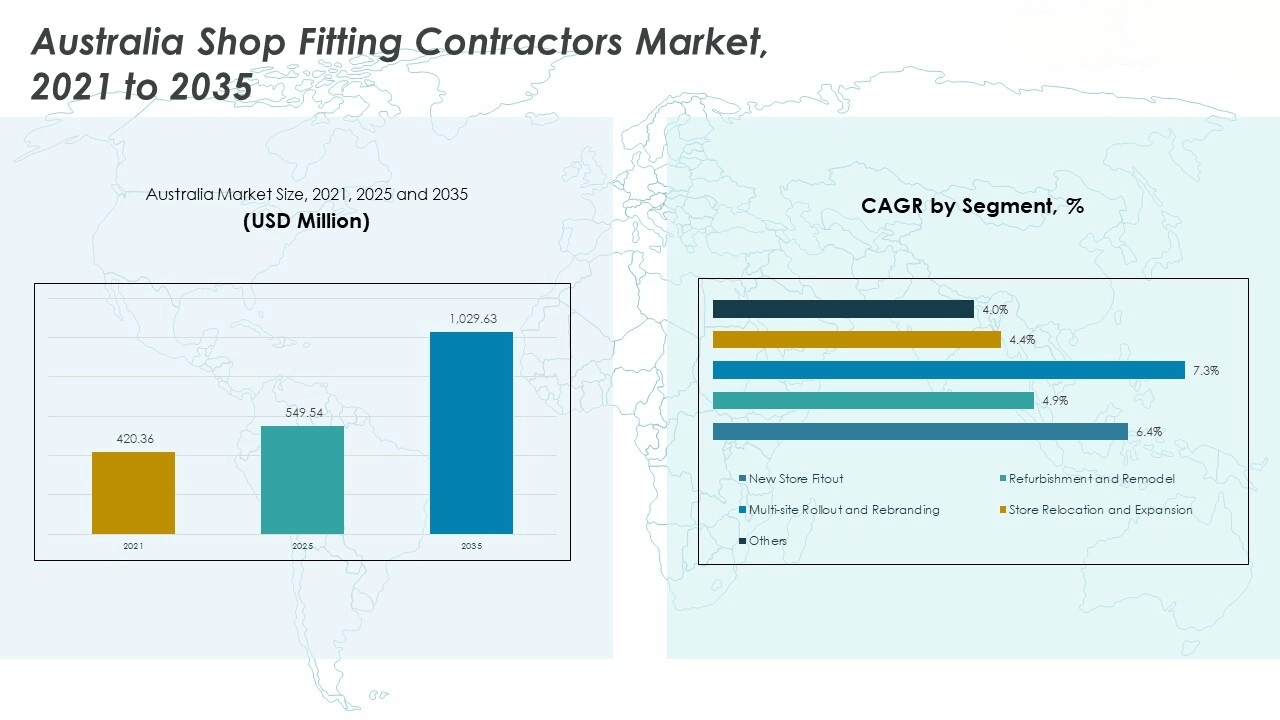
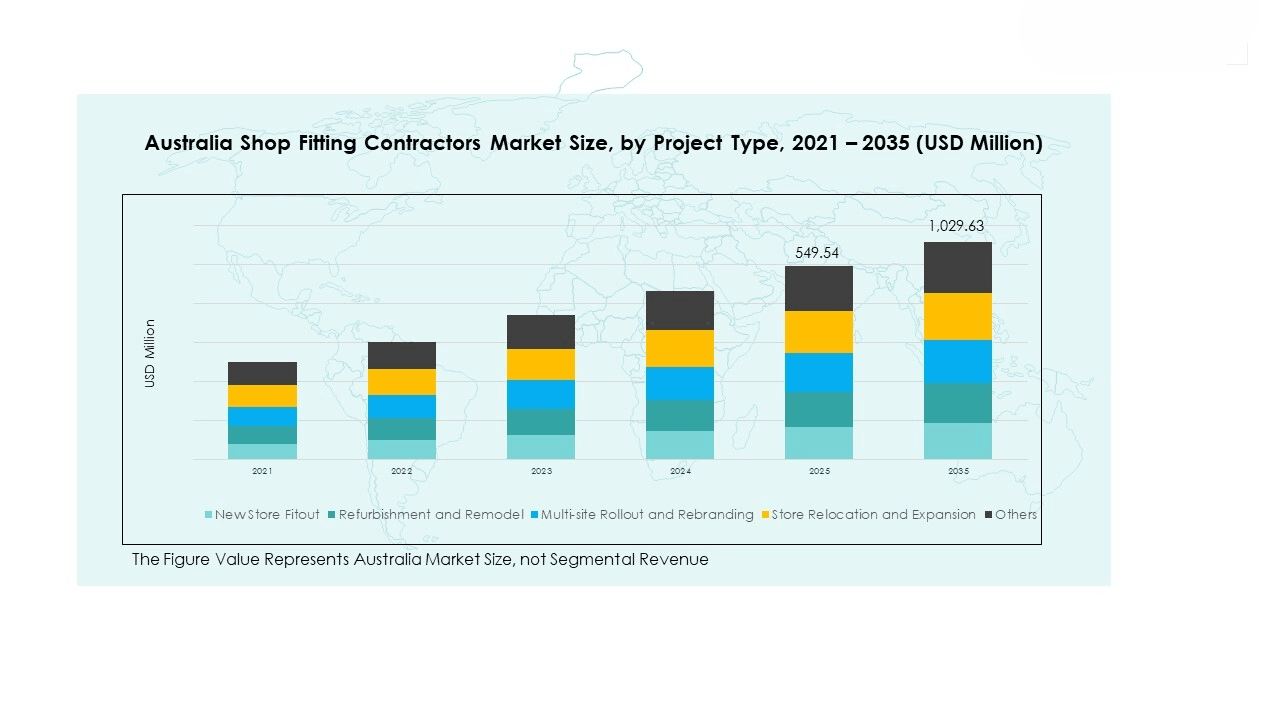
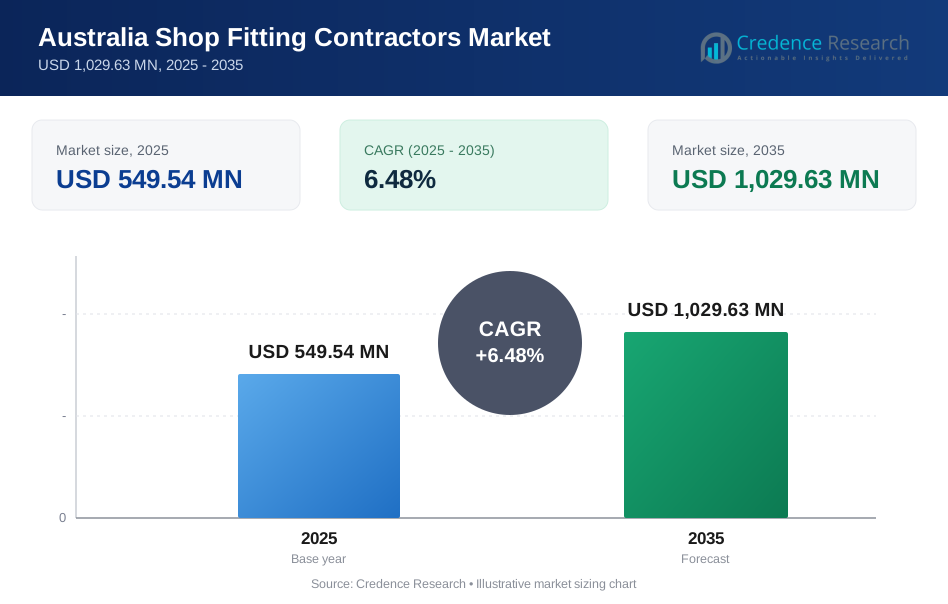
The Australia Shop Fitting Contractors Market size was valued at USD 420.36 MN in 2021 and reached USD 549.54 MN in 2025. It is anticipated to reach USD 1,029.63 MN by 2035, growing at a calculated CAGR of 6.48% during the forecast period.
| REPORT ATTRIBUTE | DETAILS |
|---|---|
| Historical Period | 2021-2024 |
| Base Year | 2025 |
| Forecast Period | 2025-2032 |
| Australia Shop Fitting Contractors Market Size 2025 | USD 549.54 million |
| Australia Shop Fitting Contractors Market, CAGR | 6.48% |
| Australia Shop Fitting Contractors Market Size 2032 | USD 1,029.63 million |
Australia Shop Fitting Contractors Market Insights
- Market growth is supported by new store fitouts, retail refurbishment cycles, hospitality venue upgrades, multi-site rollout programs and rising demand for turnkey design and build execution.
- New Store Fitout holds a strong position and is projected to grow at a CAGR of 6.4% as retailers, hospitality operators and service brands expand physical customer-facing premises.
- Multi-site Rollout and Rebranding is the fastest-growing project type with a CAGR of 7.3% because national brands need consistent store delivery, faster project cycles and controlled brand standards across locations.
- Turnkey Design and Build is gaining demand because clients prefer single-point accountability for design coordination, approvals, construction, joinery, fixtures and handover.
Australia Shop Fitting Contractors Market Segment Insights
By project type
By project type, New Store Fitout held a strong position in 2025 because retailers, hospitality brands, service businesses and franchise operators continue to invest in new customer-facing locations. The segment is projected to grow at a CAGR of 6.4%, supported by store openings, foodservice expansion and experiential retail formats. Refurbishment and Remodel is projected to grow at a CAGR of 4.9% as landlords and tenants upgrade aging premises, improve energy efficiency and refresh customer experience. Multi-site Rollout and Rebranding is projected to record the fastest CAGR of 7.3% because national brands require repeatable delivery across multiple locations. Store Relocation and Expansion is projected to grow at a CAGR of 4.4%, while Others is projected to grow at a CAGR of 4.0%.
By contract scope
By contract scope, Turnkey Design and Build held a strong position in 2025 because clients increasingly prefer contractors that manage concept design, documentation, approvals, procurement, construction and handover under one delivery structure. Construction and Installation remains essential because most fitout projects require site works, services coordination, finishes, equipment installation and compliance handover. Custom Joinery and Fixture Package is gaining demand because retailers and hospitality brands use bespoke counters, shelving, display units, service bars and cabinetry to differentiate customer experience. Project Management and Approvals are important in shopping centers, high streets, airports, hotels and foodservice sites where landlords, councils and building certifiers require coordinated documentation. Others include maintenance, minor works and specialist packages.
By contract model
By contract model, Design and Construct held a strong position in 2025 because clients seek speed, cost coordination and fewer interface risks between designers, contractors and suppliers. Fixed-price or Lump-sum Contract remains widely used where scope is clear and clients need budget certainty. Construction Management or Cost-plus is relevant for complex refurbishments, staged works, heritage buildings, hospitality venues and live trading environments where uncertainty affects final scope. Build-only Contract remains important when the client has already appointed designers and requires a contractor to execute documented works. Others include negotiated contracts, framework agreements, minor works programs and long-term maintenance arrangements.
By end-use
By end-use, Retail Stores held the strongest position in 2025 because fashion, grocery, specialty retail, electronics, beauty, pharmacy, convenience stores and franchise formats require regular fitout investment. Hospitality and Foodservice is gaining momentum as restaurants, cafés, pubs, hotels and quick-service operators invest in seating layouts, kitchens, service counters and brand-led interiors. Consumer Service Premises include gyms, wellness studios, medical clinics, salons, automotive showrooms, banks and other customer-facing spaces. Others include entertainment venues, airport concessions, education-linked retail areas and mixed-use commercial amenities. Growth will favor end users that need rapid delivery, customer experience upgrades and multi-location brand consistency.
Key Market Drivers
Retail premises investment and new store fitouts
Retail premises investment and new store fitouts represent major growth drivers for the Australia Shop Fitting Contractors Market. Retailers continue to invest in physical stores to support customer engagement, localized service and omnichannel pickup or return functions.
For instance, the Australian Bureau of Statistics reported that Australian retail turnover rose 1.2% in June 2025, following a 0.5% rise in May and a flat April, showing continued retail activity at the end of the monthly Retail Trade series. ABS also reported that online retail sales rose 13.0% through the year in June 2025, indicating continued pressure on store formats to support omnichannel operations. This driver supports New Store Fitout, Turnkey Design and Build, Retail Stores and Multi-site Rollout and Rebranding.
Refurbishment demand from existing retail and service premises
Refurbishment demand from existing retail and service premises is strengthening market growth as landlords and tenants modernize stores, improve customer flow and refresh interiors. Existing stores require upgrades to fixtures, lighting, accessibility, technology integration, security, sustainability and brand presentation.
For instance, ABS building and construction data showed total building work done rose 0.7% to $44.8 billion in the March quarter of 2026, while construction work done rose 3.4% to $83,360.6 million and non-residential building increased 2.5% in the same quarter. This construction activity supports Refurbishment and Remodel, Construction and Installation, Project Management and Approvals and hospitality-led upgrades. Demand will remain tied to tenancy churn, lease renewals, center upgrades and capital expenditure decisions.
Hospitality and foodservice fitout expansion
Hospitality and foodservice fitout expansion supports demand for interior construction, kitchens, bars, seating layouts, acoustic finishes, joinery and compliance-led project management. Restaurants, cafés, hotels and entertainment venues require high-quality fitouts that balance brand experience with durability, food safety and operational efficiency.
For instance, ABS private new capital expenditure data tracks buildings and structures investment across Accommodation and Food Services, and the March 2026 release showed positive expected movements for this industry category. FDC also highlights a growing fitout portfolio across corporate, hospitality, retail and specialized use sites, with more than 30 hospitality venue projects across its fitout, construction, mechanical and technology divisions. This driver supports Hospitality and Foodservice, Custom Joinery and Fixture Package, Turnkey Design and Build and Construction Management or Cost-plus models.
National rollout capability and brand consistency
National rollout capability and brand consistency are strengthening demand for shop fitting contractors with multi-state reach, repeatable processes and strong project controls. Franchise brands, banks, supermarkets, fashion retailers and foodservice chains need consistent store delivery across different landlords, councils and trading environments.
SHAPE says it operates nationwide and specializes in retail and multi-site projects, while its project portfolio includes more than 7,250 projects totaling more than $10 billion in value across fitouts, refurbishments, new builds and other sectors. Total Fitouts also says it has more than 30 commercial fitout and design teams across Australia and New Zealand. This driver supports Multi-site Rollout and Rebranding, Design and Construct, Project Management and Approvals and national retail store programs.
Key Trends and Opportunities
Turnkey design and build gains share
Turnkey design and build is gaining share as clients seek simplified procurement, faster delivery and clearer accountability. Retailers and hospitality operators often need one contractor to manage design coordination, landlord requirements, permits, services, joinery, fixtures and site handover. SHAPE describes design and build as a model that manages the project lifecycle from strategic planning through design and execution, reinforcing the market shift toward integrated delivery. This trend supports Turnkey Design and Build, Design and Construct and Retail Stores. Contractors with in-house design management, approvals knowledge and supplier networks will gain stronger positioning.
Custom joinery and fixture packages become brand assets
Custom joinery and fixture packages are becoming strategic brand assets because retailers and hospitality operators use interiors to differentiate customer experience. Display systems, counters, banquettes, service bars, shelving, back-of-house storage and branded fixtures influence customer flow and operational productivity. Unita says its fitout teams work with clients, designers and contractors to source joinery and fixtures, and it highlights cross-sector fitout experience across retail, hospitality, gym, wellness, medical and office spaces. This trend supports Custom Joinery and Fixture Package, Hospitality and Foodservice, Retail Stores and Consumer Service Premises. Contractors with strong joinery capability and procurement control can protect margins and improve delivery quality.
Multi-site rollout and rebranding accelerates
Multi-site rollout and rebranding is accelerating as national brands refresh formats, integrate digital retail tools and standardize customer experience across locations. Contractors that can deliver repeatable programs with minimal disruption to live trading environments will gain advantage. SHAPE’s retail sector page says Arden, backed by SHAPE’s capability, delivers large-scale rollouts and ongoing programs with speed, quality and minimal disruption. Unita also highlights national reach with offices in every major city across Australia, supporting multi-location project execution. This trend supports the fastest-growing project type, Multi-site Rollout and Rebranding, which is projected to grow at a CAGR of 7.3%.
Key Market Challenges
Construction cost pressure
Construction cost pressure remains a key challenge for the Australia Shop Fitting Contractors Market. Fitout contractors face rising costs for labour, timber, steel, glass, electrical components, HVAC, lighting, fixtures and imported finishes. ABS reported that non-residential building construction prices rose 1.0% in the June quarter of 2026, while building construction prices rose 4.9% over the previous 12 months. Cost escalation can pressure fixed-price contracts, reduce client budgets and delay discretionary refurbishments. Contractors must improve estimating accuracy, procurement planning and supplier coordination to protect margins.
Tight labour and subcontractor availability
Tight labour and subcontractor availability can slow project delivery and increase costs. Shop fitting projects require carpenters, joiners, electricians, plumbers, HVAC technicians, painters, flooring specialists, certifiers and site managers. Skilled trade shortages can create scheduling risk, especially when projects must be completed overnight, during trading restrictions or within shopping center access windows. Multi-site rollouts increase complexity because contractors must secure consistent subcontractor capacity across states. This challenge affects Turnkey Design and Build, Construction and Installation and Multi-site Rollout and Rebranding. Contractors with stable subcontractor networks and strong workforce planning will reduce delivery risk.
Approval complexity and live-site disruption
Approval complexity and live-site disruption create challenges for contractors working in malls, airports, hotels, restaurants and occupied premises. Projects may require landlord approvals, council permits, foodservice compliance, fire systems, accessibility upgrades, structural checks and strict working-hour controls. Refurbishments often need staging to avoid shutting down trading or guest operations. Construction Management or Cost-plus models may gain use where scope uncertainty is high, but clients still expect cost transparency. Contractors must manage documentation, site logistics, stakeholder communication and safety controls. Delivery failures can affect brand launches, tenant openings and revenue timing.
Regional Analysis
New South Wales
New South Wales leads the Australia Shop Fitting Contractors Market due to its large retail base, Sydney commercial corridors, shopping centers, hospitality precincts and strong concentration of national brand headquarters. Demand is strong across New Store Fitout, Refurbishment and Remodel, Multi-site Rollout and Rebranding and Consumer Service Premises. Contractors in the state benefit from dense retail activity, foodservice investment and premium commercial real estate. Hospitalities, wellness studios, medical clinics and specialty retail continue to support fitout demand. Growth will depend on retail leasing activity, construction costs, approval timelines and skilled trade availability.
Victoria
Victoria represents a major market supported by Melbourne’s retail strips, shopping centers, foodservice density and commercial refurbishment demand. Retail Stores and Hospitality and Foodservice remain the main end-use segments, while Consumer Service Premises are expanding through health, beauty, wellness and service-led formats. Refurbishment and Remodel is important as retailers upgrade stores to support omnichannel retail and improved customer experience. Multi-site Rollout and Rebranding also benefits from Melbourne’s role as a base for national chains. Growth will depend on property investment, tenancy churn, contractor capacity and consumer spending resilience.
Queensland
Queensland is one of the fastest-growing state markets due to population growth, tourism, hospitality expansion and regional retail development. Brisbane, Gold Coast, Sunshine Coast and major regional centers support demand for new store fitouts, foodservice projects, entertainment venues and service premises. FDC’s Queensland page highlights its national fitout and refurbishment capability and appointment as construction partner for Aura Town Centre on the Sunshine Coast, reinforcing the role of large mixed-use and retail-related developments. Multi-site rollout demand is also increasing as national brands expand into growth corridors. The state will remain attractive for contractors with regional delivery capacity.
Western Australia
Western Australia supports steady shop fitting demand through Perth retail centers, hospitality projects, service premises and resource-linked consumer spending. Retail Stores remain important, while Hospitality and Foodservice fitouts are supported by dining, hotel and entertainment activity. Contractors with national networks can capture opportunities from brands entering or expanding across Perth and regional hubs. Refurbishment and Remodel remains relevant as landlords and tenants reposition older spaces. Growth will depend on mining-linked income, population growth, tourism activity, subcontractor availability and logistics cost.
South Australia
South Australia is a smaller but active market supported by Adelaide retail, hospitality, commercial refurbishment and precinct development. FDC’s Station Road Restaurant project in Adelaide was listed as the ninth project delivered by FDC in the Festival Tower Precinct and won the MBA South Australia Commercial Building Fitout up to $5 million award in 2025. This reflects demand for high-quality hospitality and commercial fitout work in the state. Growth will be supported by restaurant upgrades, mixed-use precincts, retail refreshes and service-led premises. Contractors with strong design coordination and cost control will remain competitive.
Rest of Australia
Rest of Australia includes Tasmania, Australian Capital Territory, Northern Territory and regional markets across larger states. Demand is more project-specific but supported by retail chains, supermarkets, pharmacies, government-linked service premises, tourism assets, hospitality venues and local franchise growth. Multi-site contractors can serve these markets through rollout programs, while local contractors remain important for smaller refurbishments and maintenance. Logistics, labour availability and travel costs can raise project complexity. Growth will depend on regional population trends, local spending, tourism, essential services and national brand expansion.
Report Attribute Details
| Report Attribute | Details |
| Historical Period | 2021–2024 |
| Base Year | 2025 |
| Forecast Period | 2025–2035 |
| Market Size in 2021 | USD 420.36 MN |
| Market Size in 2025 | USD 549.54 MN |
| Market Size in 2035 | USD 1,029.63 MN |
| CAGR | 6.48% |
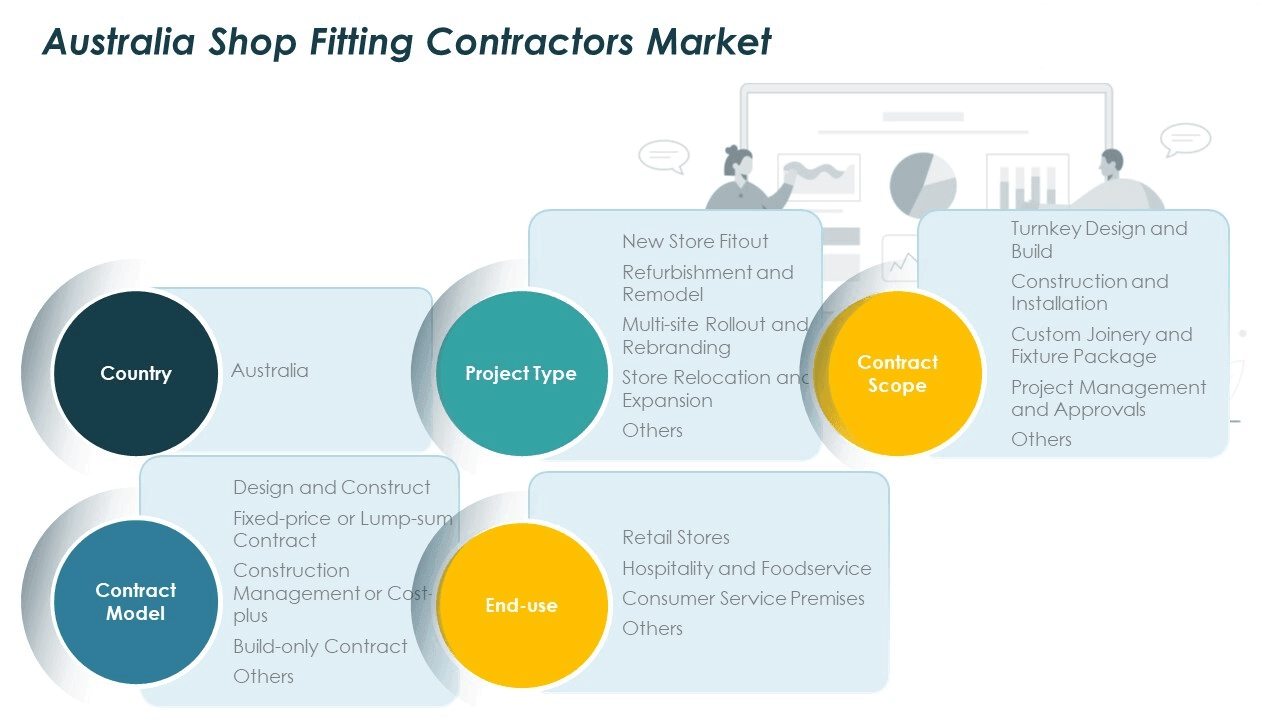
| Segments Covered | Project Type, Contract Scope, Contract Model, End-use and Geography |
| Key Companies Covered | SHAPE Australia, FDC Construction & Fitout, Unita, RAMVEK, Total Fitouts, Focus Shopfit, Shape Shopfitters, Woodland Fitouts, Ryder Shopfitting and Others |
Australia Shop Fitting Contractors Market Segmentations
By Project Type
- Shop Fitting Contractors Overview by Project Type Segment
- Shop Fitting Contractors Revenue Share By Project Type
- New Store Fitout
- Refurbishment and Remodel
- Multi-site Rollout and Rebranding
- Store Relocation and Expansion
- Others
By Contract Scope
- Shop Fitting Contractors
- Turnkey Design and Build
- Construction and Installation
- Custom Joinery and Fixture Package
- Project Management and Approvals
- Others
By Contract Model
- Shop Fitting Contractors
- Design and Construct
- Fixed-price or Lump-sum Contract
- Construction Management or Cost-plus
- Build-only Contract
- Others
By End-use
- Shop Fitting Contractors
- Retail Stores
- Hospitality and Foodservice
- Consumer Service Premises
- Others
Key Players
- SHAPE Australia
- FDC Construction & Fitout
- Unita
- RAMVEK
- Total Fitouts
- Focus Shopfit
- Shape Shopfitters
- Woodland Fitouts
- Ryder Shopfitting
- Others
Recent Developments
- In 2025, FDC’s Station Road Restaurant project in Adelaide won the MBA South Australia Commercial Building Fitout up to $5 million award, reflecting demand for premium hospitality fitout delivery.
- In 2026, SHAPE reported that its teams had delivered more than 7,250 projects totaling more than $10 billion in value across fitouts, refurbishments, new builds, facade restorations, modular construction and sustainable spaces.
- In 2026, Unita highlighted national reach through offices in every major city across Australia and cross-sector experience across retail, hospitality, gym, wellness, medical and office fitouts.
- In 2026, Total Fitouts reported more than 30 commercial fitout and design teams across Australia and New Zealand, strengthening localized shopfitting delivery capacity.
Report Coverage
The research report offers an in-depth analysis based on project type, contract scope, contract model, end-use and geography. It details leading market players, providing an overview of their business positioning, national delivery capability, retail fitout expertise, hospitality fitout execution, custom joinery capacity, project management capability and strategic relevance in the Australia Shop Fitting Contractors Market. The report includes insights into the competitive environment, market trends, growth drivers, restraints and opportunities. It also examines new store fitouts, refurbishment cycles, multi-site rollout programs, brand reformatting, hospitality upgrades, construction cost pressure, approval complexity and contractor capability as major factors shaping market development. The report assesses the impact of labour availability, material costs, live-site disruption, fixed-price contract risk and subcontractor coordination on market growth. It provides strategic recommendations for shop fitting contractors, retail chains, hospitality operators, consumer service brands, franchise groups, property owners, investors and new entrants seeking to navigate Australia’s shop fitting contractor ecosystem.
Future Outlook
- Demand for shop fitting contractors will continue to rise as retailers, hospitality operators and service brands invest in customer-facing premises.
- New Store Fitout will remain a major project type and is projected to grow at a CAGR of 6.4%.
- Refurbishment and Remodel will remain important as tenants refresh stores, improve customer experience and meet landlord requirements.
- Multi-site Rollout and Rebranding will grow fastest at a CAGR of 7.3% as national brands standardize store formats.
- Store Relocation and Expansion will support demand where brands move into better locations or larger premises.
- Turnkey Design and Build will gain share as clients seek single-point accountability and faster delivery.
- Custom Joinery and Fixture Package will become more strategic as customer experience and brand identity influence store design.
- Design and Construct will remain a preferred contract model where speed, cost control and design coordination are important.
- Hospitality and Foodservice fitouts will expand as restaurants, cafés, pubs and hotels upgrade customer experience.
- Competition will increase as contractors compete on national reach, cost certainty, delivery speed, joinery quality, approvals capability and live-site execution.
Request a Free Sample
Fill in your details and we'll send you a free sample report.
- Sample data tables & charts
- Research methodology
Need a Custom Version of This Report?
Tailor the scope, geography, or segments to your exact requirements.
- Custom geography or segment scope
- Direct access to our analyst team
Frequently Asked Questions
What is the current market size for the Australia Shop Fitting Contractors Market and what is its projected size in 2035?
At what CAGR is the Australia Shop Fitting Contractors Market projected to grow?
Which project type segment is expected to grow fastest?
Which project type holds strong market demand?
Which contract scope is gaining demand?
Who are the leading companies in the market?
Which state leads the Australia market?
Table of Content
Chapter 1. Report Introduction
- 1.1 Report Description & Purpose
- 1.1.1 Report Title & Market Definition
- 1.1.2 Unique Selling Propositions (USP) & Key Differentiators
- 1.1.3 Value Proposition for Stakeholders
- 1.2 Research Objectives
- 1.2.1 Market Sizing Objectives (Volume & Revenue)
- 1.2.2 Segmentation Objectives
- 1.2.3 Competitive Intelligence Objectives
- 1.2.4 Forecast & Scenario Objectives
- 1.3 Report Scope
- 1.3.1 Australia Shop Fitting Contractors Scope – Types & Subtypes Covered
- 1.3.2 Geographic Scope – Regions & Countries Covered
- 1.3.3 Historical Period, Base Year & Forecast Period (2025; forecast to 2035)
- 1.3.4 Inclusions & Exclusions
- 1.4 HS Code & Classification Framework
- 1.5 Currency, Units & Pricing Basis
- 1.6 Target Stakeholders
- 1.7 Limitations & Assumptions
Chapter 2. Executive Summary
- 2.1 Global Australia Shop Fitting Contractors Market Snapshot
- 2.1.1 Market Size – Historical (2025) & Forecast (2025-2035) (2025: USD 549.54 MN → 2035: USD 1,029.63 MN)
- 2.1.2 Volume & Revenue – Global Totals
- 2.1.3 Key Market Highlights – Top Five Facts
- 2.2 Australia Shop Fitting Contractors Market Segmentation Snapshot
- 2.2.1 Market Split by Region – 2025 vs. 2035
- 2.3 Competitive Snapshot
- 2.3.1 Top 10 Players by Revenue Share – 2025
- 2.3.2 Top 10 Players by Volume Share – 2025
- 2.3.3 Recent Strategic Developments (18-Month Summary)
- 2.4 Key Investment Highlights & Strategic Conclusions
Chapter 3. Australia Shop Fitting Contractors Market Dynamics & Industry Analysis
- 3.1 Market Overview & Context
- 3.1.1 Australia Shop Fitting Contractors Market Position in the Broader Automotive Value Chain
- 3.1.2 OEM vs. Replacement Market Dynamics
- 3.1.3 Market Maturity & Development Stage by Region
- 3.2 Australia Shop Fitting Contractors Market Drivers
- 3.3 Australia Shop Fitting Contractors Market Restraints & Challenges
- 3.4 Australia Shop Fitting Contractors Market Opportunities
- 3.5 Porter's Five Forces Analysis
- 3.5.1 Threat of New Entrants
- 3.5.2 Bargaining Power of Suppliers
- 3.5.3 Bargaining Power of Buyers
- 3.5.4 Threat of Substitutes
- 3.5.5 Competitive Rivalry – Intensity Assessment
- 3.6 Australia Shop Fitting Contractors Value Chain Analysis
- 3.6.1 Upstream – Raw Material/Input Suppliers
- 3.6.1.1 Raw Material/Input 1
- 3.6.1.2 Raw Material/Input 2
- 3.6.1.3 Raw Material/Input 3
- 3.6.2 Midstream – Production/Manufacturing/Service Delivery
- 3.6.2.1 Production/Process Overview
- 3.6.2.2 Key Facility Locations & Capacity by Manufacturer
- 3.6.3 Downstream – Distribution & End Consumer
- 3.6.3.1 Primary Channel – B2B/OEM
- 3.6.3.2 Secondary Channels – Dealer, Retail, Online, Direct
- 3.6.4 Value Chain Profitability Analysis
- 3.6.1 Upstream – Raw Material/Input Suppliers
- 3.7 PESTEL Analysis
- 3.7.1 Political Factors
- 3.7.2 Economic Factors
- 3.7.3 Social Factors
- 3.7.4 Technological Factors
- 3.7.5 Environmental Factors
- 3.7.6 Legal Factors
- 3.8 Australia Shop Fitting Contractors Supply Chain Analysis
- 3.8.1 Raw Material/Input Supply Risk Assessment
- 3.8.2 Manufacturing Concentration Risk (Geographic Exposure)
- 3.8.3 Trade Disruption Impact Analysis
- 3.9 Regulatory & Policy Landscape
Note: The regulatory and policy landscape section covers regulations based on their applicability to the market, Australia Shop Fitting Contractors category, geography, and scope of the study. Only regulatory frameworks with a material impact on operations, compliance, trade, sustainability, or market access are analyzed in detail.
Chapter 4. Key Investment Pockets & Opportunity Analysis
- 4.1 Australia Shop Fitting Contractors Market Attractiveness Analysis
- 4.1.1 By Region – Investment Attractiveness Matrix (Volume × CAGR)
- 4.2 Absolute Revenue Growth Opportunity
- 4.2.1 By Region – Absolute USD Growth Through 2035
- 4.3 Incremental Volume Opportunity
- 4.3.1 By Region – Incremental Volume Through 2035
- 4.3.2 Segment – Incremental Volume
- 4.4 Emerging Submarket Opportunity Deep Dive (Subject to Applicability)
- 4.5 Emerging Market Opportunity Scorecards
- 4.5.1 United States
- 4.5.2 Europe
- 4.5.3 Asia
- 4.5.4 Middle East & Africa
Note: Emerging Market Opportunity Scorecards will be included based on relevance and strategic importance. Regions listed are indicative and may vary depending on data availability and market dynamics.
Chapter 5. Australia Shop Fitting Contractors Import-Export Analysis & Trade Flows
- 5.1 Global Trade Overview
- 5.1.1 Global Export Value by Country (2025)
- 5.1.2 Global Export Volume by Country (2025)
- 5.1.3 Global Import Value by Country (2025)
- 5.1.4 Global Import Volume by Country (2025)
- 5.1.5 Net Trade Balance by Country (2025)
- 5.2 Export Analysis – Segment
- 5.2.1 Type 1 (HS Code)
- 5.2.2 Type 2 (HS Code)
- 5.2.3 Type 3 (HS Code)
- 5.2.4 Type 4 (HS Code)
- 5.2.5 Type 5 (HS Code)
- 5.3 Import Analysis – Segment
- 5.3.1 Type 1 (HS Code)
- 5.3.2 Type 2 (HS Code)
- 5.3.3 Type 3 (HS Code)
- 5.3.4 Type 4 (HS Code)
- 5.3.5 Type 5 (HS Code)
- 5.4 Average Unit Trade Prices
- 5.4.1 Average Export Price – Segment & Country
- 5.4.2 Average Import Price – Segment & Source Country
- 5.4.3 Price Trends (2025)
- 5.5 Key Trade Route Analysis
- 5.5.1 Trade Route 1
- 5.5.2 Trade Route 2
- 5.5.3 Trade Route 3
- 5.5.4 Trade Route 4
- 5.5.5 Trade Route 5
- 5.6 Trade Policy Impact Assessment
- 5.6.1 US Anti-Dumping & Section 301 Tariffs
- 5.6.2 EU Customs Union Impact
- 5.6.3 Major Free Trade Agreements
- 5.6.4 USMCA Rules of Origin
Note: Trade policy analysis will be included only where relevant to the Australia Shop Fitting Contractors market.
Chapter 6. Competitive Landscape & Company Benchmarking
- 6.1 Australia Shop Fitting Contractors Market Concentration & Structure
- 6.1.1 Herfindahl-Hirschman Index (HHI) – vs. 2025
- 6.1.2 Tier 1, Tier 2 & Tier 3 Market Structure
- 6.1.3 Global, Regional & Local Player Dynamics
- 6.2 Australia Shop Fitting Contractors Market Share Analysis – 2025
- 6.2.1 Global Revenue Share by Company
- 6.2.2 Global Volume Share by Company
- 6.2.3 Regional Revenue Share
- 6.2.4 Market Share Evolution ( vs. 2025)
- 6.2.5 OEM Segment Share by Company
- 6.2.6 Replacement Segment Share by Company
- 6.3 Production/Delivery Capacity & Facility Analysis
- 6.3.1 Global Installed Capacity
- 6.3.2 Capacity Utilization Rates
- 6.3.3 Production/Output Volume
- 6.3.4 Facility Locations & Capacity Map
- 6.3.5 Planned Capacity Additions
- 6.4 Australia Shop Fitting Contractors Competitive Benchmarking Matrix
- 6.4.1 Revenue, Volume, CAGR & Profitability Comparison
- 6.4.2 Channel Revenue Mix
- 6.4.3 Geographic Revenue Exposure
- 6.4.4 R&D Intensity
- 6.4.5 Sustainability Maturity
- 6.5 Strategic Developments in Australia Shop Fitting Contractors (Last 24 Months)
- 6.5.1 Mergers, Acquisitions & Divestments
- 6.5.2 New Australia Shop Fitting Contractors Launches
- 6.5.3 Facility Expansions
- 6.5.4 Strategic Alliances, Joint Ventures & Partnerships
- 6.5.5 Distribution Expansion & Market Entry
- 6.5.6 Sustainability & ESG Initiatives
- 6.6 Competitive Strategy Mapping
- 6.6.1 Leader, Challenger, Follower & Niche Classification
- 6.6.2 Pricing Strategy Comparison
- 6.6.3 Channel Strategy Matrix
Note: Strategic developments are included based on their materiality and the availability of reliable information.
Chapter 7. Global Australia Shop Fitting Contractors Market – By Distribution Channel
- 7.1 Segment Overview
- 7.1.1 Volume & Revenue Split by Channel (2025 & 2035)
- 7.1.2 Channel Mix Evolution (2025-2035)
Chapter 8. Regional Market Analysis – Global Overview
- 8.1 Global Regional Overview
- 8.1.1 Regional Volume Share
- 8.1.2 Regional Revenue Share
- 8.1.3 Regional Volume by Region
- 8.1.4 Regional Revenue by Region
- 8.1.5 Regional Forecast Through 2035
- 8.2 Cross-Regional Segment Analysis
- 8.2.1 By Distribution Channel
- 8.2.2 By Brand/Price Tier
Chapter 9. North America Australia Shop Fitting Contractors Market
- 9.1 United States
- 9.2 Canada
- 9.3 Mexico
Chapter 10. Europe Australia Shop Fitting Contractors Market
- 10.1 Germany
- 10.2 France
- 10.3 Italy
- 10.4 United Kingdom
- 10.5 Spain
- 10.6 Poland
- 10.7 Russia
- 10.8 Netherlands
- 10.9 Belgium
- 10.10 Sweden
- 10.11 Denmark
- 10.12 Norway
- 10.13 Rest of Europe
Chapter 11. Asia Pacific Australia Shop Fitting Contractors Market
- 11.1 China
- 11.2 India
- 11.3 Japan
- 11.4 South Korea
- 11.5 Thailand
- 11.6 Indonesia
- 11.7 Vietnam
- 11.8 Malaysia
- 11.9 Australia
- 11.10 Rest of Asia Pacific
Chapter 12. Latin America Australia Shop Fitting Contractors Market
- 12.1 Brazil
- 12.2 Argentina
- 12.3 Colombia
- 12.4 Chile
- 12.5 Rest of Latin America
Chapter 13. Middle East Australia Shop Fitting Contractors Market
- 13.1 Saudi Arabia
- 13.2 United Arab Emirates
- 13.3 Turkey
- 13.4 Israel
- 13.5 Iran
- 13.6 Rest of the Middle East
Chapter 14. Africa Australia Shop Fitting Contractors Market
- 14.1 South Africa
- 14.2 Egypt
- 14.3 Nigeria
- 14.4 Morocco
- 14.5 Rest of Africa
Chapter 15. Australia Shop Fitting Contractors Company Profiles
- 15.1 [Company 01]
- 15.1.1 Company Overview
- 15.1.2 Key Management Personnel
- 15.1.3 Products & Services Portfolio
- 15.1.4 Financial Performance
- 15.1.5 Key Market Focus & Geographic Presence
- 15.1.6 Recent Developments & Strategic Initiatives
Note: The company profile list is preliminary and may change based on research findings, market developments, data availability, and client requirements.
Chapter 16. Appendices
- Appendix A – List of Abbreviations & Acronyms
- Appendix B – Industry Classification Code Reference – Full Series
- Appendix C – Production & Capacity Data Tables
- Appendix D – End-Use & Demand Base Tables
- Appendix E – Consumption & Replacement Rate Assumptions
- Appendix F – ASP Reference Tables
- Appendix G – Manufacturing & Facility Database
- Appendix H – Import-Export Data Tables
- Appendix I – Regulatory Summary Tables
- Appendix J – Primary Research Participant List (Anonymized)
- Appendix K – Primary Research Questionnaire Framework
- Appendix L – Data Sources & Bibliography
- Appendix M – Market Size Divergence & Source Comparison
Chapter 17. Research Methodology
- 17.1 Research Framework & Philosophy
- 17.2 Secondary Research – Sources, Hierarchy & Data Extraction
- 17.3 Data Modeling – Bottom-Up & Top-Down Market Sizing
- 17.4 Primary Research – Stakeholder Framework, LOI & Sample Sizes
- 17.5 Forecast Methodology – Regression, Scenario & Sensitivity Analysis
- 17.6 Quality Control – Four-Layer Validation Framework
- 17.7 Limitations & Standard Assumptions
- 17.8 Disclaimer
