
Market Insights
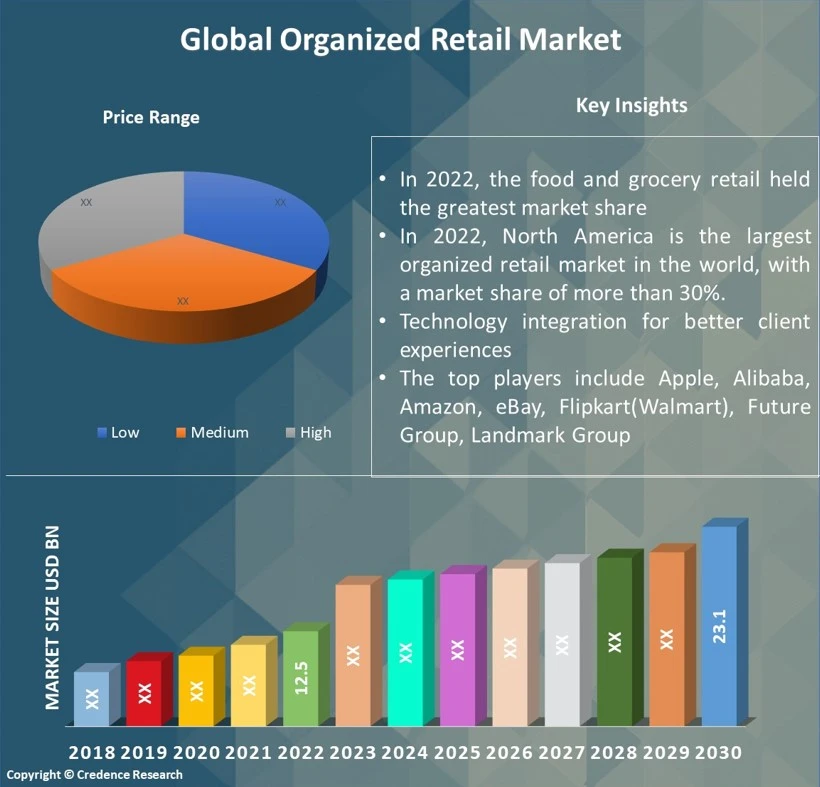
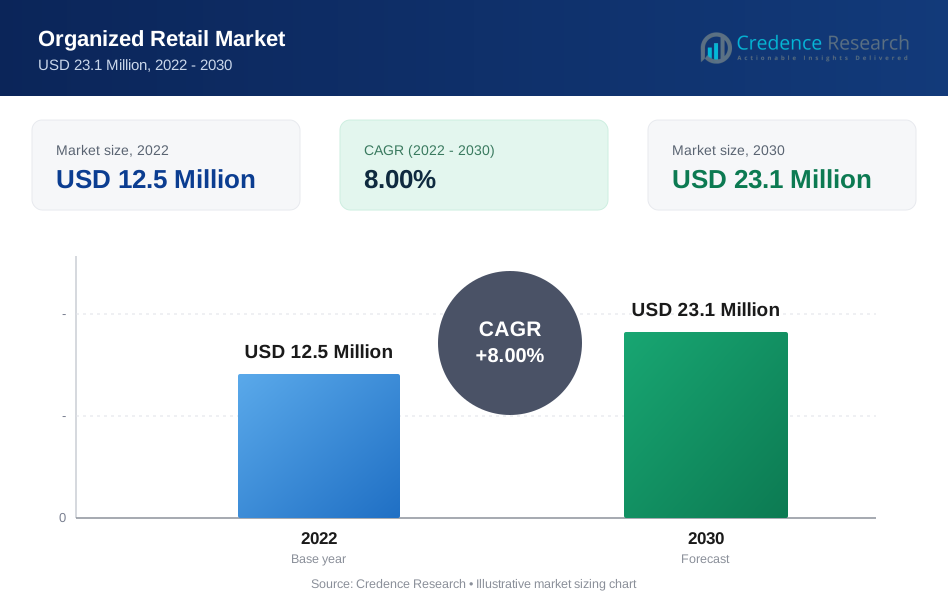
- The global demand for Organized Retails was valued at USD 12.5 Million in 2022 and is expected to reach USD 23.1Million in 2030, growing at a CAGR of 8.00% between 2023 and 2030.
- Supermarkets and hypermarkets are industry leaders, and Specialty Stores are another important segment of the Organized Retail industry.
- Food and grocery retail held the largest market share in 2022, and brick-and-click retailers are the fastest-growing segment of the organized retail business.
- Electronics superstores have the biggest market demand, while specialized electronics chains focus on certain product categories or niche markets.
- Sporting Goods Stores is the market's largest stakeholder, and Bookstores are another area that contributes to the organized retail industry.
- Supermarket chains are the largest shareholders in the organized retail industry.
- Fast fashion chains are the fastest-growing segment of the organized retail industry.
- The Retailer-Owned Brands sector has increased tremendously.
- Contactless payment has grown in popularity and demand.
- North America will be the world's largest organized retail market in 2022, with a market share of more than 30%, while Asia Pacific will be the world's fastest growing organized retail market, with a market share of more than 40%.
- Market expansion is hampered because reach and accessibility are constrained.
- Growing public knowledge of organized retail outlets propels market expansion.
Executive Summary
Market Definition
The Organized Retail Market is the retailing sector that operates through organized and structured channels. It entails establishing retail locations, chains, or franchises that adhere to a systematic approach to merchandising, inventory management, marketing, and customer service. These professionally managed retail establishments often feature a well-defined structure, established operations, and professional management.
Market Overview
The global Organized Retail Market has been steadily growing in recent years and is predicted to increase at a CAGR of 8.00% between 2023 and 2030. The market was valued at USD 12.5 million in 2022 and is predicted to reach USD 23.1 million in 2030.
The Organized Retail Market has grown significantly in recent years, owing to reasons like as urbanization, changing customer preferences, and rising disposable incomes. This market category has also benefited from technological improvements, such as e-commerce and digital payment methods, which have improved the shopping experience for consumers.
Overall, the Organized Retail Market plays an important role in the economy by producing jobs, contributing to tax revenues, and driving economic growth. It offers a wide range of products and services while making shopping convenient and fun for customers.
Segmentation by Retail Formats
- Supermarkets and hypermarkets are the market leaders. These large-scale retail businesses sell a wide variety of products, including food, household goods, and other necessities. Because of their convenience, variety, and competitive cost, they attract a major part of consumer expenditure.
- Specialty Stores are another popular section of the Organized Retail Market. These stores specialize in specific product categories or niche markets, offering a carefully chosen assortment of items.
Segmentation by Verticals and Categories
- In 2022, the food and grocery retail held the greatest market share. This segment's rapid expansion can be ascribed to reasons such as rising consumer desire for one-stop shopping and rising demand for fresh and sanitary food goods.
- Brick-and-Click Retailers are the fastest-growing part of the organized retail market. Businesses with both physical locations and an online presence are referred to as brick-and-click merchants.
Segmentation by Consumer Electronics and Appliances Retail
- Electronics Superstores are the category with the highest market demand in the organized retail industry. These large-scale retail outlets sell a variety of electronic items, such as cellphones, laptop computers, televisions, and home appliances. Customers flock to electronics superstores because of their broad product range, competitive price, and the ease of one-stop shopping for all of their electronic requirements.
- On the other hand, Specialized electronics chains focus on certain product categories or niche markets,
Segmentation by Specialty Retailers
- Sporting Goods Stores is the market's largest shareholder. These shops provide sporting equipment, gear, and accessories for a variety of sports and outdoor activities. Sporting goods stores have a strong presence in the organized retail industry, catering to the demands of sports fans, athletes, and fitness-conscious people. They provide a wide selection of products as well as expert advice and services relating to sports.
- Bookstores are another area that contributes to the organized retail industry. Bookstores stock a wide range of books, including fiction, nonfiction, instructional resources, and morbid literature.
Segmentation by Organized Grocery Retail
- Supermarket chains are the major shareholders in the organized retail market. Supermarket chains are large-scale retail shops that sell a diverse range of food and home goods. They have several sections such as fresh produce, dairy, meat, bakery, and non-perishable items.
Segmentation by Fashion and Apparel Retail
- Fast Fashion Chains are the fastest-growing part of the organized retail market. Fast fashion retailers are well-known for their ability to make and sell stylish and inexpensive items in a timely manner. They serve a diverse variety of people seeking attractive goods at low pricing. Fast fashion businesses have been able to gain a considerable market share and grow their presence internationally due to their efficient supply chain and rapid manufacturing cycles.
- On the other hand, Luxury Retailers cater to clients looking for high-end and exclusive items. Premium goods, excellent craftsmanship, and great customer service are all available at luxury stores.
Segmentation by Private Label Brands
- In the organized retail market, the Retailer-Owned Brands category has grown significantly. Retailers spend in R&D, product design, and marketing to position their private label brands as trustworthy and desired solutions for customers. These companies frequently offer a blend of quality, affordability, and exclusivity, attracting customers who appreciate the retailer's reputation and have faith in their products.
Segmentation by Sustainability and Ethical Retail
- Contactless payment has grown in popularity and demand due to its convenience, speed, and enhanced security. Customers like the ease of making quick and smooth payments, especially for minor purchases. Contactless payment solutions such as Apple Pay, Google Pay, and Samsung Pay have become increasingly popular as smartphone and wearable device adoption has increased.
Segmentation by Region
- In 2022, North America is the largest organized retail market in the world, with a market share of more than 30%.
- Asia Pacific is the world's fastest expanding organized retail market, with a market share of more than 40%.
- The rest of the world, including Latin America, the Middle East, and Africa, supplies the remaining demand for Organized Retail.
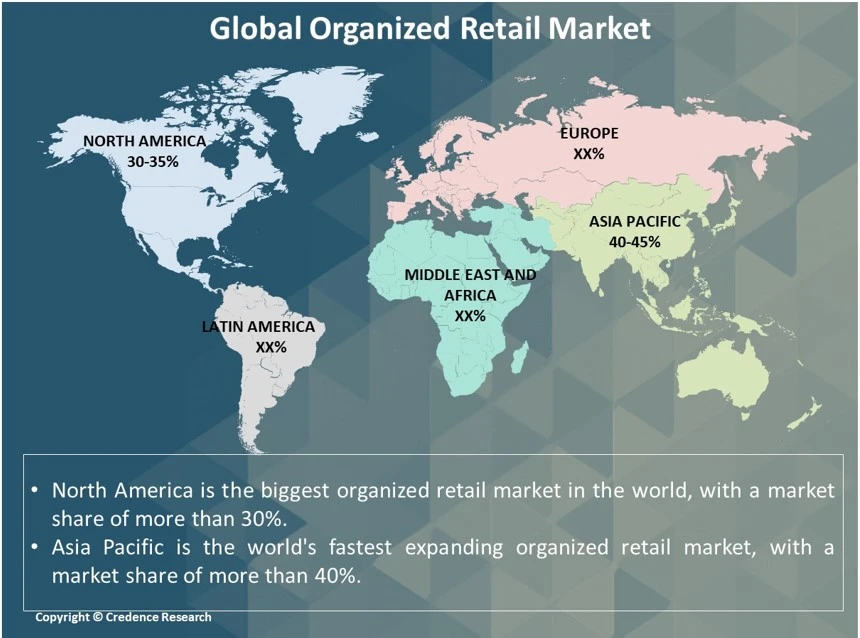
North America is the world's largest organized retail market. The region is home to some of the world's top retailers, including Walmart, Costco, and Target. The North American organized retail market is distinguished by its significant e-commerce penetration and a strong emphasis on customer experience.
Europe has the world's second-largest organized retail market, with a market share of more than 25%. Carrefour, Tesco, and Metro are among the region's largest retailers. The European organized retail market is diverse, with different countries having varied retail structures and preferences.
Furthermore, Asia Pacific has the world's fastest-growing organized retail market. The region is home to some of the world's fastest-growing economies, including China and India. The Asia Pacific organized retail market is distinguished by rapid growth in e-commerce and an increasing emphasis on modern retail models.
Key Highlights of the Report
The global Organized Retail Market is segmented by Retail Formats, Verticals and Categories, Consumer Electronics and Appliances Retails, Specialty Retailers, Organized Grocery Retail, Fashion and Apparel Retail, Private Label Brands, Sustainability and Ethical Retail and region. In 2022, the market's biggest stakeholder is Sporting Goods Stores and Supermarket Chains. Furthermore, Fast Fashion Chains are the fastest-growing segment of the organized retail business, while Electronics Superstores are the most popular. Also, supermarkets and hypermarkets dominate the industry, and contactless payment is becoming more popular and in demand, with North America leading the market growth.
Rising consumer preferences, technological advancements, and an expanding middle-class population with discretionary means are the key drivers of the sector. Furthermore, E-commerce and internet stores are formidable competitors. Rising operating and real estate costs, as well as regulatory and compliance issues in many areas, are the key market constraints.
Nonetheless, North America is the world's biggest organized retail market, with a market share of more than 30%. In addition, Europe boasts the world's second-largest organized retail market, with a market share of more than 25%. while, Asia Pacific has the world's fastest-growing organized retail industry, with a market share of more than 40%.
What Are The Main Drivers Of The Global Organized Retail Market?
The growing consumer desire for organized retail formats is one of the primary drivers of the Organized Retail Market. Consumers are driven to organized retail shops because of the ease, large product choice, and consistent shopping experience they provide. Furthermore, technological advances have played a crucial role in driving market expansion. Because of technological advancements, businesses can now easily link online and offline channels, offering customers with a more personalized and convenient purchasing experience. Furthermore, increased disposable incomes and a growing middle-class population in emerging nations have contributed to the growth of the Organized Retail Market.
What Are The Major Challenges Faced By The Global Organized Retail Market?
While the Organized Retail Market has grown significantly, it is not without challenges. The increasing competition from e-commerce and internet merchants is a huge challenge. Because of the convenience and accessibility of internet purchasing, customer behaviour has shifted, posing a threat to traditional organized retail shops. Furthermore, rising operational and real estate costs can be a substantial constraint for shops. The cost of operating physical stores, as well as the necessity for qualified labour and infrastructure, can place a strain on profit margins. Furthermore, managing varying regulatory and compliance standards across regions can be difficult for merchants who operate in multiple areas.
What Are The Growth Opportunities In The Global Organized Retail Market?
The Organized Retail Market also provides merchants with numerous opportunities. One such possibility is to expand into unexplored areas and rising economies. As disposable incomes rise and customer preferences shift, there is an increasing need in these countries for organized retail formats. Retailers can capitalize on this opportunity by creating a presence and catering to the demands of various consumer groups. Furthermore, the implementation of modern technologies provides merchants with an opportunity to improve customer experiences. Retailers may develop individualized shopping experiences that resonate with their customers by employing technology such as artificial intelligence, data analytics, and personalized recommendations.
Market Drivers
The global Organized Retail Market is driven by several factors. The following are the key drivers of the global Organized Retail Market:
Increasing Public Awareness Of Organized Retail Stores
A retail stores that is operated by a registered company and operates in a methodical and planned manner is referred to as an organized retail store. Supermarkets, hypermarkets, department stores, and specialty stores are examples of these establishments. They provide a diverse choice of products and services, as well as a more comfortable and convenient shopping experience for customers. According to the United Nations, 68% of the world's population will live in cities by 2050, up from 55% in 2018. This urbanization is influencing consumer lifestyle and shopping patterns, with more people preferring to shop at organized retail stores.
Consumers are becoming increasingly aware of the advantages of buying at organized retail outlets, such as a broader product selection, improved quality control, and better customer service. This increased knowledge is driving more customers to organized retail outlets. Furthermore, the advancement of technology in the retail industry is pushing the expansion of organized retail establishments.
Market Restraints
The global Organized Retail Market faces some challenges that may hinder its growth. These include the following:
Reach And Accessibility Are Limited
The Organized Retail Market is hampered by a lack of reach and accessibility, particularly in rural and remote locations. While organized retail chains and supermarkets thrive in cities, they frequently struggle to expand their operations to more remote places. The lack of sufficient infrastructure, such as transportation networks and distribution channels, makes reaching consumers in remote places difficult. Furthermore, due to reduced population density and purchasing power, the economic viability of developing and operating retail shops in these locations is an issue. Consumer selections and pricing are affected by the urban-rural split in access to organized shopping.
Opportunities
The global Organized Retail Market offers significant growth opportunities. These include the following:
Government Assistance
Government regulations and reforms are assisting in the expansion of organized retail in nations such as India. 100% FDI in B2B e-commerce and up to 51% in multi-brand retail are now permissible. Foreign retailers can now invest in and acquire local firms more easily thanks to industrial reforms. Government efforts such as Make in India, Digital India, and Startup India are assisting in the creation of infrastructure, the improvement of broadband access, and the development of a digital payments ecosystem, all of which are assisting in the expansion of organized retail. Tax measures such as GST encourage organized trading by removing interstate barriers.
Competitive Landscape
Key Players
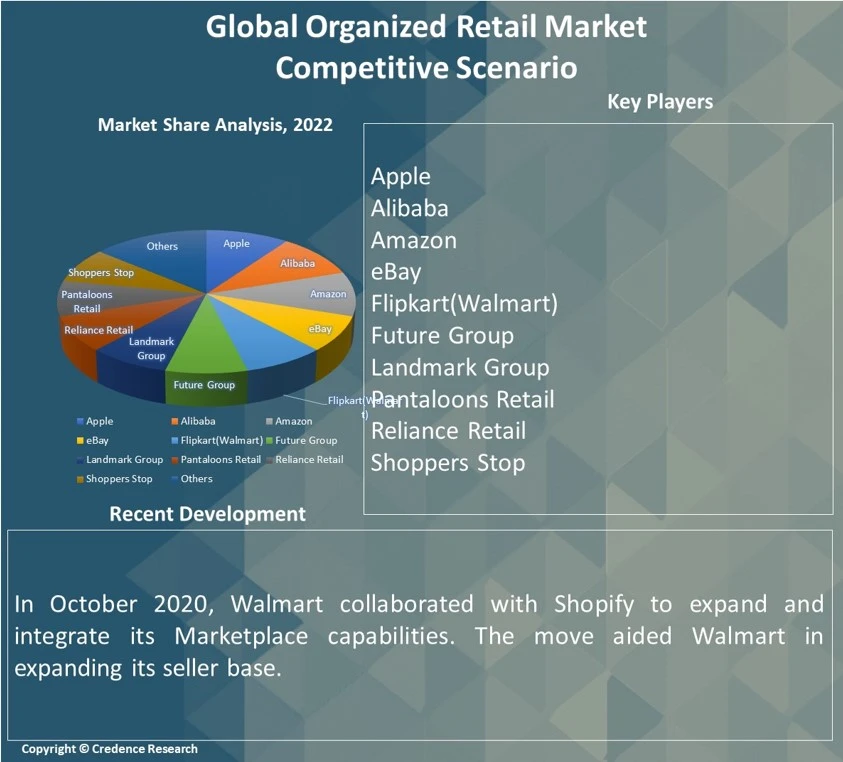
The global Organized Retail Market is highly competitive, with several key players. Some of the major players in the market and their market share are as follows:
- Apple
- Alibaba
- Amazon
- eBay
- Flipkart(Walmart)
- Future Group
- Landmark Group
- Pantaloons Retail
- Reliance Retail
- Shoppers Stop
- Spencer?s Retail
- Tata Group
- Adidas
- Ethos
- Nike
- Puma
- Zivame
- Costco
To remain competitive, these firms prioritize product innovation, Sustainability and Ethical Retail development, and mergers and acquisitions.
The leading players in the global Organized Retail Market strive to keep ahead of the competition by introducing new products and technologies.
In October 2022, Amazon Clinic is a virtual care service that treats common diseases such as allergies, acne, and hair loss. Customers can be treated without leaving their homes thanks to the service.
In March 2021, Walmart Cookshop, a digital meal planning and food preparation platform that provides recipes, stores customers' digital grocery lists, and integrates with Walmart Grocery for smooth shopping, has been launched.
In August 2022, CVS Health finalized its $8 billion acquisition of Signify Health. CVS Health was able to increase its healthcare service offerings as a result of this transaction.
Summary of Key Findings
- Growing public knowledge of organized retail outlets fosters industry expansion.
- Market segmented by Retail Formats, Verticals and Categories, Consumer Electronics and Appliances Retails, Specialty Retailers, Organized Grocery Retail, Fashion and Apparel Retail, Private Label Brands, Sustainability and Ethical Retail and region.
- Supermarkets and hypermarkets dominate the sector.
- Food and grocery retail will have the largest market share in 2022.
- North America is leading market growth; the market is highly competitive with key players including Apple, Alibaba, Amazon, eBay, Flipkart(Walmart), Future Group, Landmark Group
Future Outlook
- E-commerce and internet retailing continue to flourish
- Technology integration for better client experiences
- Increased emphasis on personalized and multichannel retail methods
- Greater emphasis on sustainability and ethical standards
- The rise of experiential retail ideas and one-of-a-kind store formats
- The expansion of convenience and grocery store formats
- The integration of artificial intelligence and data analytics for better decision-making
- The increased acceptance of mobile payment and contactless technologies
Segmentation
- By Retail Formats:
- Hypermarkets and Supermarkets
- Department Stores
- Specialty Stores
- Discount Stores
- By Verticals and Categories:
- Food and Grocery Retail
- Apparel and Fashion Retail
- Electronics and Appliances Retail
- Home Improvement and Furnishings
- Health and Beauty Retail
- Brick-and-Click Retailers
- By Consumer Electronics and Appliances Retail:
- Electronics Superstores
- Specialized Electronics Chains
- By Specialty Retailers:
- Sporting Goods Stores
- Bookstores
- Home Improvement Chains
- By Organized Grocery Retail:
- Supermarket Chains
- Specialized Grocery Chains
- By Fashion and Apparel Retail:
- Fast Fashion Chains
- Luxury Retailers
- By Private Label Brands:
- Retailer-Owned Brands
- By Technology Integration:
- Retail Tech
- Contactless Payment
- By Sustainability and Ethical Retail:
- Green Practices
- Ethical Sourcing
- By Region
- North America
- The U.S.
- Canada
- Mexico
- Europe
- Germany
- France
- The U.K.
- Italy
- Spain
- Rest of Europe
- Asia Pacific
- China
- Japan
- India
- South Korea
- South-east Asia
- Rest of Asia Pacific
- Latin America
- Brazil
- Argentina
- Rest of Latin America
- Middle East & Africa
- GCC Countries
- South Africa
- Rest of Middle East and Africa
- North America
Request a Free Sample
Fill in your details and we'll send you a free sample report.
- Sample data tables & charts
- Research methodology
Need a Custom Version of This Report?
Tailor the scope, geography, or segments to your exact requirements.
- Custom geography or segment scope
- Direct access to our analyst team
Frequently Asked Questions
What is the current size of the global Organized Retail Market?
What is the expected growth rate of the Organized Retail Market between 2023 and 2030?
Which segment is leading the market share in terms of Verticals and Categories?
Which Consumer Electronics and Appliances Retail segment governs the demand for Organized Retails in the world?
Which Fashion and Apparel Retail segment is expected to post the highest CAGR during the forecast period?
Who are the major players in the global Organized Retail Market?
Table of Content
Chapter 1. Report Introduction
- 1.1 Report Description & Purpose
- 1.1.1 Report Title & Market Definition
- 1.1.2 Unique Selling Propositions (USP) & Key Differentiators
- 1.1.3 Value Proposition for Stakeholders
- 1.2 Research Objectives
- 1.2.1 Market Sizing Objectives (Volume & Revenue) (Volume Where Applicable)
- 1.2.2 Segmentation Objectives
- 1.2.3 Competitive Intelligence Objectives
- 1.2.4 Forecast & Scenario Objectives
- 1.3 Report Scope
- 1.3.1 Organized Retail Scope – Segments & Subsegments Covered
- 1.3.2 Geographic Scope – Regions & Countries Covered
- 1.3.3 Historical Period, Base Year & Forecast Period (2022; forecast to 2030)
- 1.3.4 Inclusions & Exclusions
- 1.4 Industry Classification & Applicable Codes
- 1.5 Currency, Measurement Units & Valuation Basis
- 1.6 Target Stakeholders
- 1.7 Limitations & Assumptions
Chapter 2. Executive Summary
- 2.1 Global Organized Retail Market Snapshot
- 2.1.1 Market Size – Historical (2022) & Forecast (2022-2030) (2022: USD 12.5 Million → 2030: USD 23.1 Million)
- 2.1.2 Volume & Revenue – Global Totals (Volume Where Applicable)
- 2.1.3 Key Market Highlights – Top Five Facts
- 2.2 Organized Retail Market Segmentation Snapshot
- 2.2.1 Market Split by Region – 2022 vs. 2030
- 2.3 Competitive Snapshot
- 2.3.1 Top 10 Players by Revenue Share – 2022
- 2.3.2 Top 10 Players by Volume Share – 2022 (Volume Where Applicable)
- 2.3.3 Recent Strategic Developments (18-Month Summary)
- 2.4 Key Investment Highlights & Strategic Conclusions
Chapter 3. Organized Retail Market Dynamics & Industry Analysis
- 3.1 Market Overview & Context
- 3.1.1 Organized Retail Market Position in the Broader Industry Value Chain
- 3.1.2 Demand Structure & Purchasing Dynamics
- 3.1.3 Market Maturity & Development Stage by Region
- 3.2 Organized Retail Market Drivers
- 3.3 Organized Retail Market Restraints & Challenges
- 3.4 Organized Retail Market Opportunities
- 3.5 Porter's Five Forces Analysis
- 3.5.1 Threat of New Entrants
- 3.5.2 Bargaining Power of Suppliers
- 3.5.3 Bargaining Power of Buyers
- 3.5.4 Threat of Substitutes
- 3.5.5 Competitive Rivalry – Intensity Assessment
- 3.6 Organized Retail Value Chain Analysis
- 3.6.1 Upstream – Key Inputs, Resources & Suppliers
- 3.6.1.1 Key Input/Resource 1
- 3.6.1.2 Key Input/Resource 2
- 3.6.1.3 Key Input/Resource 3
- 3.6.2 Midstream – Core Operations & Value Creation
- 3.6.2.1 Operating Model & Process Overview
- 3.6.2.2 Key Operating Locations & Capabilities by Company
- 3.6.3 Downstream – Market Channels & End Users
- 3.6.3.1 Direct Sales & Customer Engagement Channels
- 3.6.3.2 Indirect Sales, Intermediaries & Partner Channels
- 3.6.4 Value Chain Profitability Analysis
- 3.6.1 Upstream – Key Inputs, Resources & Suppliers
- 3.7 PESTEL Analysis
- 3.7.1 Political Factors
- 3.7.2 Economic Factors
- 3.7.3 Social Factors
- 3.7.4 Technological Factors
- 3.7.5 Environmental Factors
- 3.7.6 Legal Factors
- 3.8 Organized Retail Supply Chain Analysis
- 3.8.1 Critical Input & Resource Availability Risk Assessment
- 3.8.2 Supplier & Operational Concentration Risk (Geographic Exposure)
- 3.8.3 Supply & Service Disruption Impact Analysis
- 3.9 Regulatory & Policy Landscape
Note: The regulatory and policy landscape section covers regulations based on their applicability to the market, Organized Retail category, geography, and scope of the study. Only regulatory frameworks with a material impact on operations, compliance, trade, sustainability, or market access are analyzed in detail.
Chapter 4. Key Investment Pockets & Opportunity Analysis
- 4.1 Organized Retail Market Attractiveness Analysis
- 4.1.1 By Region – Investment Attractiveness Matrix (Market Size × CAGR)
- 4.2 Absolute Revenue Growth Opportunity
- 4.2.1 By Region – Absolute Revenue Growth Through 2030
- 4.3 Incremental Demand Opportunity
- 4.3.1 By Region – Incremental Demand Through 2030
- 4.3.2 Segment – Incremental Demand
- 4.4 Emerging Submarket Opportunity Deep Dive (Subject to Applicability)
- 4.5 Priority Market Opportunity Scorecards
- 4.5.1 United States
- 4.5.2 Europe
- 4.5.3 Asia
- 4.5.4 Middle East & Africa
Note: Priority market opportunity scorecards reflect the geographic scope and strategic relevance of the study. Listed markets are indicative and may be adapted to the industry.
Chapter 5. Organized Retail Cross-Border Trade & Market Access Analysis
- 5.1 International Trade & Cross-Border Activity Overview
- 5.1.1 Global Export Value by Country (2022)
- 5.1.2 Global Export Volume by Country (2022) (Volume Where Applicable)
- 5.1.3 Global Import Value by Country (2022)
- 5.1.4 Global Import Volume by Country (2022) (Volume Where Applicable)
- 5.1.5 Net Trade Balance by Country (2022)
- 5.2 Export Analysis – Segment
- 5.2.1 Category 1 (Applicable Classification Code)
- 5.2.2 Category 2 (Applicable Classification Code)
- 5.2.3 Category 3 (Applicable Classification Code)
- 5.2.4 Category 4 (Applicable Classification Code)
- 5.2.5 Category 5 (Applicable Classification Code)
- 5.3 Import Analysis – Segment
- 5.3.1 Category 1 (Applicable Classification Code)
- 5.3.2 Category 2 (Applicable Classification Code)
- 5.3.3 Category 3 (Applicable Classification Code)
- 5.3.4 Category 4 (Applicable Classification Code)
- 5.3.5 Category 5 (Applicable Classification Code)
- 5.4 Cross-Border Pricing & Transaction Benchmarks
- 5.4.1 Export Pricing – Segment & Country
- 5.4.2 Import Pricing – Segment & Source Country
- 5.4.3 Price Trends (2022)
- 5.5 Key Cross-Border Trade & Delivery Routes
- 5.5.1 Cross-Border Trade/Delivery Route 1
- 5.5.2 Cross-Border Trade/Delivery Route 2
- 5.5.3 Cross-Border Trade/Delivery Route 3
- 5.5.4 Cross-Border Trade/Delivery Route 4
- 5.5.5 Cross-Border Trade/Delivery Route 5
- 5.6 Trade Policy & Market Access Impact Assessment
- 5.6.1 Tariff & Non-Tariff Barriers
- 5.6.2 Regional Trade & Economic Integration Frameworks
- 5.6.3 Bilateral & Multilateral Trade Agreements
- 5.6.4 Cross-Border Operating, Licensing & Localization Requirements
Note: This chapter applies where cross-border trade or delivery is relevant to Organized Retail. Goods, services, and digital offerings are assessed using applicable classifications and transaction measures. Import-export volumes, trade balances, and route analyses are included only where meaningful to the market.
Chapter 6. Competitive Landscape & Company Benchmarking
- 6.1 Organized Retail Market Concentration & Structure
- 6.1.1 Herfindahl-Hirschman Index (HHI) – vs. 2022
- 6.1.2 Leading, Mid-Sized & Emerging Player Structure
- 6.1.3 Global, Regional & Local Player Dynamics
- 6.2 Organized Retail Market Share Analysis – 2022
- 6.2.1 Global Revenue Share by Company
- 6.2.2 Global Volume Share by Company (Volume Where Applicable)
- 6.2.3 Regional Revenue Share
- 6.2.4 Market Share Evolution ( vs. 2022)
- 6.2.5 Company Market Share by Key Segment
- 6.2.6 Company Market Share by Customer Group
- 6.3 Operating Scale, Capacity & Infrastructure Analysis
- 6.3.1 Global Operating Scale & Supply Capacity
- 6.3.2 Resource Utilization & Operating Efficiency
- 6.3.3 Output, Service Delivery & Activity Metrics
- 6.3.4 Operating Footprint & Infrastructure Map
- 6.3.5 Planned Operational & Capacity Expansion
- 6.4 Organized Retail Competitive Benchmarking Matrix
- 6.4.1 Revenue, Growth, Profitability & Operating Metric Comparison
- 6.4.2 Channel Revenue Mix
- 6.4.3 Geographic Revenue Exposure
- 6.4.4 R&D Intensity
- 6.4.5 Sustainability Maturity
- 6.5 Strategic Developments in Organized Retail (Last 24 Months)
- 6.5.1 Mergers, Acquisitions & Divestments
- 6.5.2 New Products, Services & Solutions in Organized Retail
- 6.5.3 Operational & Infrastructure Expansions
- 6.5.4 Strategic Alliances, Joint Ventures & Partnerships
- 6.5.5 Distribution Expansion & Market Entry
- 6.5.6 Sustainability & ESG Initiatives
- 6.6 Competitive Strategy Mapping
- 6.6.1 Leader, Challenger, Follower & Niche Classification
- 6.6.2 Pricing Strategy Comparison
- 6.6.3 Channel Strategy Matrix
Note: Strategic developments are included based on their materiality and the availability of reliable information.
Chapter 7. Global Organized Retail Market – By Sales & Delivery Channel
- 7.1 Segment Overview
- 7.1.1 Volume & Revenue Split by Channel (2022 & 2030) (Volume Where Applicable)
- 7.1.2 Channel Mix Evolution (2022-2030)
Chapter 8. Regional Market Analysis – Global Overview
- 8.1 Global Regional Overview
- 8.1.1 Regional Volume Share (Volume Where Applicable)
- 8.1.2 Regional Revenue Share
- 8.1.3 Regional Volume by Region (Volume Where Applicable)
- 8.1.4 Regional Revenue by Region
- 8.1.5 Regional Forecast Through 2030
- 8.2 Cross-Regional Segment Analysis
- 8.2.1 By Sales & Delivery Channel
- 8.2.2 By Competitive Positioning & Price Tier
Chapter 9. North America Organized Retail Market
- 9.1 United States
- 9.2 Canada
- 9.3 Mexico
Chapter 10. Europe Organized Retail Market
- 10.1 Germany
- 10.2 France
- 10.3 Italy
- 10.4 United Kingdom
- 10.5 Spain
- 10.6 Poland
- 10.7 Russia
- 10.8 Netherlands
- 10.9 Belgium
- 10.10 Sweden
- 10.11 Denmark
- 10.12 Norway
- 10.13 Rest of Europe
Chapter 11. Asia Pacific Organized Retail Market
- 11.1 China
- 11.2 India
- 11.3 Japan
- 11.4 South Korea
- 11.5 Thailand
- 11.6 Indonesia
- 11.7 Vietnam
- 11.8 Malaysia
- 11.9 Australia
- 11.10 Rest of Asia Pacific
Chapter 12. Latin America Organized Retail Market
- 12.1 Brazil
- 12.2 Argentina
- 12.3 Colombia
- 12.4 Chile
- 12.5 Rest of Latin America
Chapter 13. Middle East Organized Retail Market
- 13.1 Saudi Arabia
- 13.2 United Arab Emirates
- 13.3 Turkey
- 13.4 Israel
- 13.5 Iran
- 13.6 Rest of the Middle East
Chapter 14. Africa Organized Retail Market
- 14.1 South Africa
- 14.2 Egypt
- 14.3 Nigeria
- 14.4 Morocco
- 14.5 Rest of Africa
Chapter 15. Organized Retail Company Profiles
- 15.1 [Company 01]
- 15.1.1 Company Overview
- 15.1.2 Key Management Personnel
- 15.1.3 Products & Services Portfolio
- 15.1.4 Financial Performance
- 15.1.5 Key Market Focus & Geographic Presence
- 15.1.6 Recent Developments & Strategic Initiatives
Note: The company profile list is preliminary and may change based on research findings, market developments, data availability, and client requirements.
Chapter 16. Appendices
- Appendix A – List of Abbreviations & Acronyms
- Appendix B – Industry Classification Code Reference – Full Series
- Appendix C – Supply, Output & Operating Capacity Data Tables
- Appendix D – End-Use & Demand Base Tables
- Appendix E – Demand, Adoption & Usage Assumptions
- Appendix F – Pricing & Revenue Metric Reference Tables
- Appendix G – Company Operations & Infrastructure Database
- Appendix H – Cross-Border Trade & Activity Data Tables (Where Applicable)
- Appendix I – Regulatory Summary Tables
- Appendix J – Primary Research Participant List (Anonymized)
- Appendix K – Primary Research Questionnaire Framework
- Appendix L – Data Sources & Bibliography
- Appendix M – Market Size Divergence & Source Comparison
Chapter 17. Research Methodology
- 17.1 Research Framework & Philosophy
- 17.2 Secondary Research – Sources, Hierarchy & Data Extraction
- 17.3 Data Modeling – Bottom-Up & Top-Down Market Sizing
- 17.4 Primary Research – Stakeholder Framework, LOI & Sample Sizes
- 17.5 Forecast Methodology – Regression, Scenario & Sensitivity Analysis
- 17.6 Quality Control – Four-Layer Validation Framework
- 17.7 Limitations & Standard Assumptions
- 17.8 Disclaimer
