Market Overview:
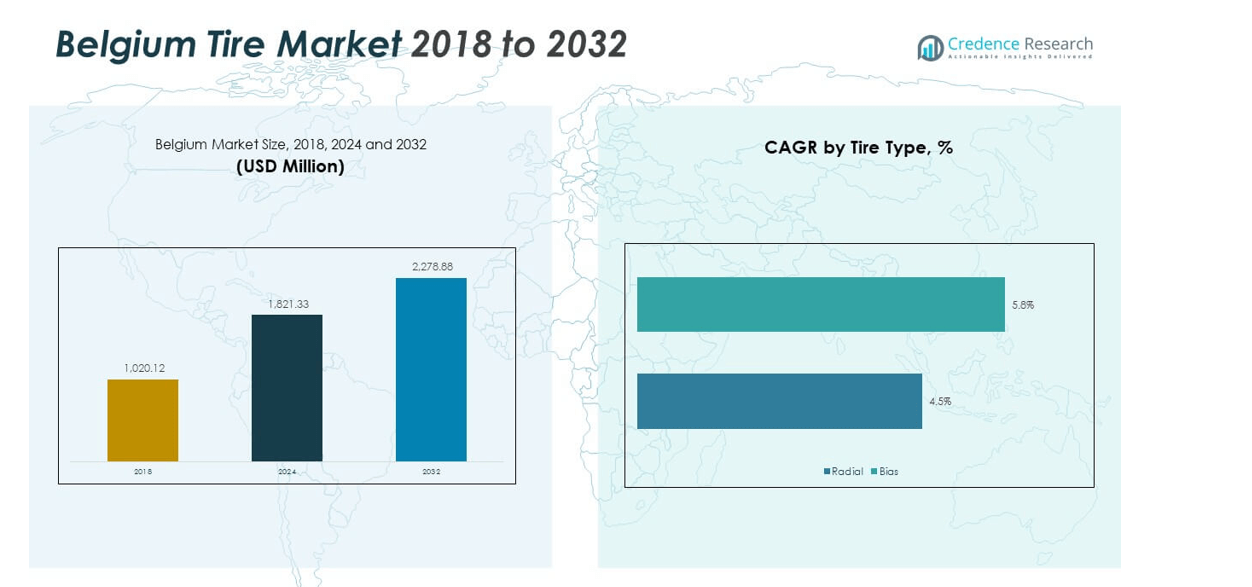
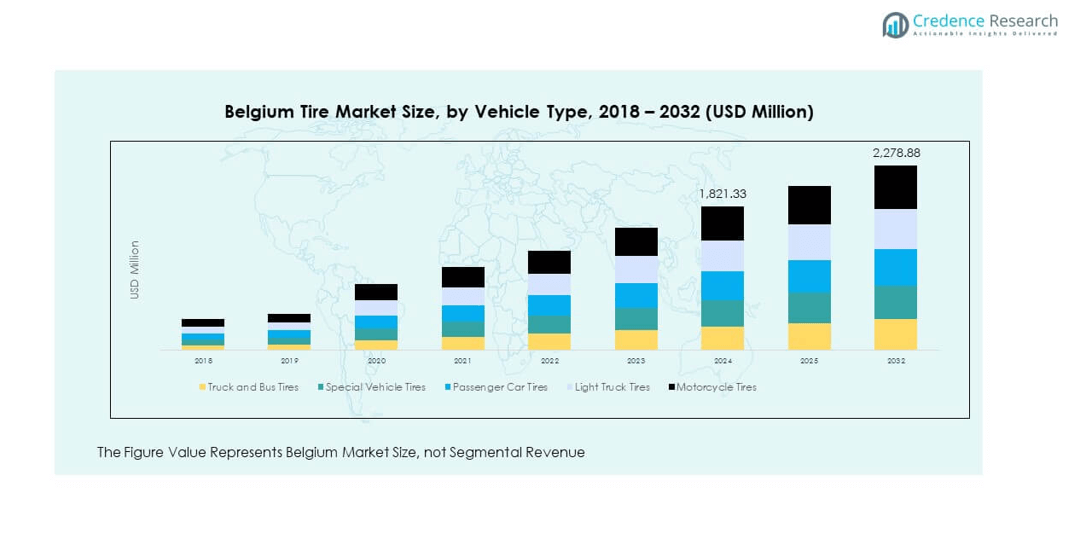
The Belgium Tire Market size was valued at USD 1,020.12 million in 2018 to USD 1,821.33 million in 2024 and is anticipated to reach USD 2,278.88 million by 2032, at a CAGR of 2.84% during the forecast period.
| REPORT ATTRIBUTE | DETAILS |
|---|---|
| Historical Period | 2020-2023 |
| Base Year | 2024 |
| Forecast Period | 2025-2032 |
| Belgium Tire Market Size 2024 | USD 1,821.33 million |
| Belgium Tire Market, CAGR | 2.84% |
| Belgium Tire Market Size 2032 | USD 2,278.88 million |
Growth in the Belgium Tire Market is driven by rising vehicle ownership, frequent replacement cycles, and consumer demand for premium quality tires. Strong adoption of eco-friendly and fuel-efficient models reflects increasing awareness of sustainability. Expansion of e-commerce platforms enhances accessibility, while specialized tires for electric vehicles and advanced designs for safety continue to strengthen market competitiveness. Leading manufacturers invest in research to meet evolving consumer and regulatory expectations.
Regionally, Western Europe holds the leading position with strong infrastructure, high premium car ownership, and advanced distribution networks. Northern Europe demonstrates steady demand for winter and all-season tires due to climatic conditions. Southern Europe remains supported by replacement demand and mid-range brand adoption, while Eastern Europe emerges as a growing hub with rising vehicle ownership and opportunities for OEM supply. This regional diversity strengthens the market’s overall outlook.
Market Insights:
- The Belgium Tire Market size was USD 1,020.12 million in 2018, USD 1,821.33 million in 2024, and is projected to reach USD 2,278.88 million by 2032, growing at a CAGR of 2.84%.
- Western Europe leads with 38% share due to strong infrastructure, premium car ownership, and advanced distribution networks, while Northern Europe follows with 24% share supported by winter tire adoption.
- Southern Europe holds 20% share, reflecting replacement demand and mid-range tire adoption, making it the third-largest subregion.
- Eastern Europe, with an 18% share, is the fastest-growing subregion, driven by rising car ownership, expanding middle-class demand, and OEM opportunities.
- Passenger car tires hold the largest segment share at 41%, followed by truck and bus tires at 27%, supported by logistics and transport demand. Light truck tires represent 14%, motorcycle tires 10%, and special vehicle tires 8%, reflecting balanced distribution.
Market Drivers
Rising Vehicle Ownership and Expanding Automobile Fleet Strengthening Tire Replacement Demand
The steady rise in vehicle ownership has created a sustained demand for tire replacement. Growing disposable income levels in Belgium are encouraging consumers to purchase passenger and commercial vehicles. The replacement cycle for tires remains shorter due to urban traffic, rough road surfaces, and higher mileage. Consumers are prioritizing safety, which pushes demand for premium quality tires. Seasonal variations such as winter increase the replacement rate and keep demand consistent. Fleet operators contribute significantly through bulk purchases and maintenance cycles. The Belgium Tire Market continues to benefit from this recurring replacement demand. It remains a key factor ensuring market resilience against economic fluctuations.
- For example, Bridgestone introduced the M-Steer 002 and M-Drive 002 truck tyres across Europe in January 2025. The new tyres deliver over 20% improved wear performance compared to the previous generation.
Growing Adoption of Premium and High-Performance Tires Driven by Consumer Preferences
Consumers are becoming more aware of tire performance, safety, and efficiency benefits. Rising interest in advanced tread designs and innovative compounds has strengthened demand for premium brands. Manufacturers are offering superior grip, longer durability, and optimized braking efficiency to meet expectations. Electric and hybrid vehicles further drive need for specialized tires with low rolling resistance. The trend toward sustainable mobility increases interest in eco-friendly and fuel-efficient options. Premium tire sales are supported by a strong retail and dealership network. The Belgium Tire Market leverages consumer trust in leading international brands. It strengthens the competitive landscape by attracting global and regional players.
Increasing Focus on Sustainability and Environmental Regulations Shaping Product Innovation
Belgium’s regulatory environment emphasizes sustainability and strict compliance with European standards. Tire manufacturers are compelled to introduce products with lower emissions and recyclable materials. Consumers are showing strong acceptance of green tires that improve energy efficiency. Governments promote policies encouraging reduced carbon footprint in transportation. Eco-label certifications and safety checks reinforce consumer trust. Manufacturers invest in R&D to design tires with reduced wear and enhanced recyclability. The Belgium Tire Market adapts quickly to align with evolving environmental policies. It reinforces industry growth through innovation and product advancement.
Rapid Expansion of E-Commerce Platforms Enhancing Tire Distribution and Consumer Reach
The growing e-commerce industry has transformed tire sales channels across Belgium. Online platforms allow customers to compare specifications, prices, and brands with ease. Tire companies collaborate with digital retailers and service providers to expand visibility. Consumers benefit from home delivery and doorstep installation services. Discounts and promotional offers online attract both individual buyers and fleet operators. Improved logistics networks ensure timely distribution across urban and rural regions. The Belgium Tire Market gains traction by capturing a wider digital customer base. It improves accessibility and contributes to consistent sales growth.
- For example, Goodyear launched an integrated online tire sales and installation platform in Germany, allowing customers to purchase tires and schedule installation with local retail partners. The company reported coverage reaching over half of German households within a 30-minute drive of a partner location.
Market Trends
Emergence of Smart Tire Technology Integrating Sensors and Real-Time Data Monitoring
Smart tire technology is gaining momentum with demand for advanced driving solutions. Integration of sensors enables real-time monitoring of pressure, temperature, and wear conditions. Drivers benefit from improved safety and reduced maintenance risks. Automakers are integrating connected tire systems into high-end vehicles. Fleet managers also adopt this technology to optimize operational efficiency. Consumers show interest in digital solutions that enhance driving experience. The Belgium Tire Market aligns with innovation by adopting smart tire offerings. It reinforces its position in advanced mobility ecosystems.
- For instance, in September 2024, Bosch and Pirelli announced a partnership to develop software-based solutions using in-tire MEMS sensors, with Pirelli’s Cyber Tyre transmitting tire data in real-time to a vehicle’s electronic stability program and delivering enhanced safety and custom driving dynamics for models like the Pagani Utopia Roadster.
Growing Popularity of All-Season Tires Due to Shifts in Consumer Behavior
Consumer preferences are shifting toward tires that perform across varying seasonal conditions. All-season tires reduce the need for frequent replacements between winter and summer. These tires appeal to cost-conscious buyers looking for value and convenience. Automobile dealers actively promote them as practical solutions for everyday use. Advancements in rubber compounds improve their performance under changing weather. Demand remains high among urban consumers with moderate driving patterns. The Belgium Tire Market reflects this trend through expanding all-season product lines. It reshapes market demand dynamics with broader consumer acceptance.
Strong Growth of Electric Vehicle Adoption Increasing Need for Specialized Tire Models
Electric vehicle adoption in Belgium is boosting demand for tailored tire solutions. EV tires require low rolling resistance, enhanced durability, and reduced noise levels. Manufacturers are designing innovative products to meet specific EV needs. Consumers expect longer lifespan and efficiency from these models. Charging infrastructure expansion supports the rapid uptake of EV-friendly tires. Public policy incentives further reinforce consumer adoption. The Belgium Tire Market positions itself at the forefront of this mobility transition. It attracts attention from global companies specializing in EV-compatible tires.
Expansion of Tire Recycling and Circular Economy Initiatives Driving Sustainability Focus
Circular economy principles are reshaping tire lifecycle management in Belgium. Recycling initiatives reduce waste and strengthen resource efficiency. Companies invest in new technologies for reprocessing used tires into usable materials. Government policies support extended producer responsibility frameworks. Consumers show preference for eco-conscious products aligned with sustainability goals. Energy recovery from end-of-life tires is also gaining attention. The Belgium Tire Market embraces these initiatives to align with global sustainability objectives. It fosters growth while maintaining environmental accountability.
- For instance, in September 2023, Belgian company RISORCE secured €12.5 million in funding to build a new plant in Liège capable of using a pyrolysis process to recycle up to half of all Belgium’s end-of-life car tires (estimated at 2.4 million tires annually) into oil, carbon black, and gas, marking a major local advance in tire circularity.
Market Challenges Analysis
Rising Raw Material Costs and Supply Chain Volatility Impacting Tire Manufacturing Operations
Tire production heavily depends on raw materials such as natural rubber, synthetic rubber, and carbon black. Price volatility in global commodity markets creates cost instability for manufacturers. Supply chain disruptions further intensify challenges by delaying shipments and increasing lead times. Rising energy and transportation expenses add pressure to operating margins. Smaller companies struggle to absorb these fluctuations compared to larger brands. The Belgium Tire Market experiences pressure in maintaining competitive pricing strategies. It highlights the need for efficient procurement and stronger supplier relationships.
Intense Competitive Pressure and Price Sensitivity Among Consumers Reducing Profit Margins
The tire industry in Belgium faces intense competition among global and regional brands. Consumers often compare products based on price rather than long-term performance. Aggressive discounting strategies by retailers reduce profitability across the supply chain. Market fragmentation makes differentiation difficult for mid-tier manufacturers. Tire imports from low-cost regions intensify competitive pressure. Maintaining innovation while keeping prices affordable remains a key challenge. The Belgium Tire Market must balance cost efficiency with value-driven innovation. It drives companies to adopt flexible strategies and strengthen brand loyalty.
Market Opportunities
Growing Demand for Specialized Tires for Electric Vehicles and Next-Generation Mobility
The rapid adoption of electric and hybrid vehicles is creating demand for tailored tire solutions. Specialized designs with low rolling resistance and enhanced durability appeal to eco-conscious buyers. Global manufacturers are investing in R&D for noise-reducing and efficiency-enhancing models. Public incentives for EV ownership encourage long-term growth in this category. Consumers show readiness to adopt advanced mobility products with proven benefits. The Belgium Tire Market benefits by expanding offerings for EV-friendly tire lines. It strengthens its role in next-generation transportation markets.
Expanding Aftermarket Services and Digital Platforms Enhancing Consumer Access and Engagement
Aftermarket services are becoming vital to the tire industry’s competitive growth strategy. Digital platforms allow customers to access tire fitting, repair, and replacement services quickly. Companies offering value-added services increase customer loyalty and recurring sales. Collaborations with garages and service centers further strengthen the aftermarket ecosystem. Online tire customization tools enhance consumer engagement with brand offerings. The Belgium Tire Market expands reach through innovation in service models. It improves consumer satisfaction and positions itself as a service-driven industry.
Market Segmentation Analysis:
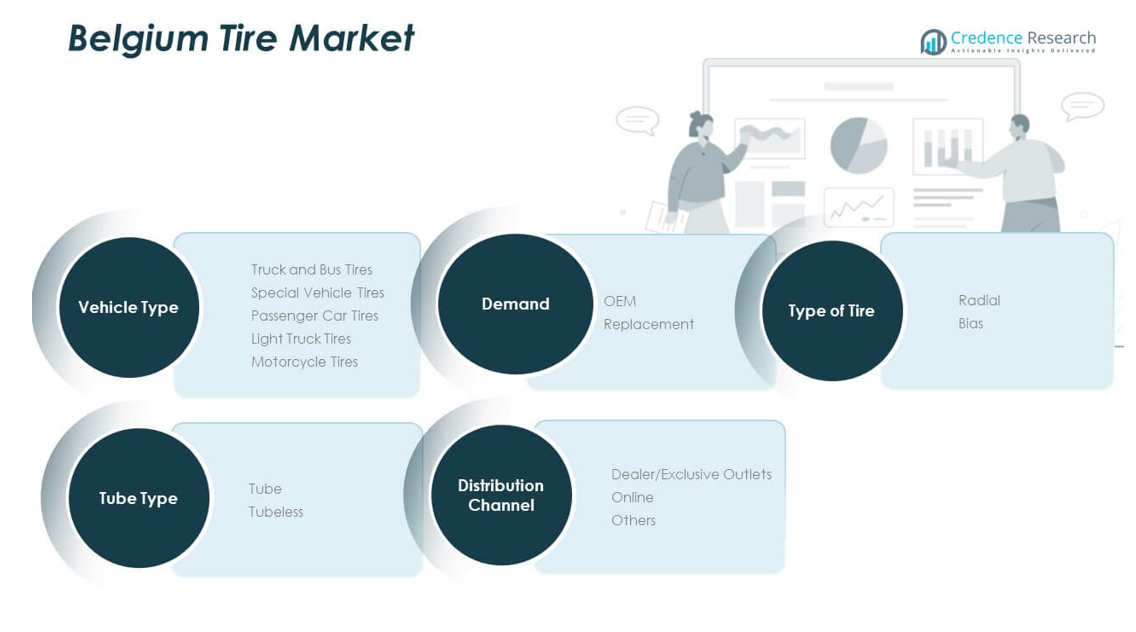
By vehicle type, passenger car tires dominate the Belgium Tire Market due to high car ownership and strong replacement demand. Truck and bus tires contribute steadily through logistics and public transport fleets, while light truck tires serve growing commercial applications. Motorcycle tires hold a smaller share but maintain relevance among urban commuters. Special vehicle tires remain niche but support industrial and agricultural operations. It demonstrates balanced growth across categories, though passenger and commercial segments remain primary revenue drivers.
- For example, Goodyear offers the KMAX GEN-2 range of radial truck tyres across Europe, designed for fleets that demand high mileage and fuel efficiency. The tyres feature low rolling resistance compounds and advanced tread designs to maximize fuel economy during operations. They also include RFID tags to enable tyre tracking and better fleet management.
By demand segment, replacement tires lead due to frequent wear, safety requirements, and seasonal shifts. OEM demand remains steady with new vehicle sales but represents a smaller proportion of overall volume. It highlights the market’s reliance on recurring consumer demand cycles.
- For instance, Volvo XC40 electric vehicles sold in Belgium in 2024 were factory-fitted with A-rated tires verified by European regulatory documents and tire performance databases, demonstrating compliance with stringent safety and efficiency labeling requirements.
By type, radial tires dominate due to durability, efficiency, and compliance with European standards, while bias tires retain limited applications in specific vehicles.
By tube type, tubeless tires lead, supported by safety, convenience, and growing consumer preference.
By distribution channel, dealer and exclusive outlets maintain leadership with strong networks, while online sales expand rapidly, supported by digital adoption. Others, including small retailers, sustain niche demand but face pressure from organized channels.
Segmentation:
By Vehicle Type
- Truck and Bus Tires
- Special Vehicle Tires
- Passenger Car Tires
- Light Truck Tires
- Motorcycle Tires
By Demand Segment
- OEM
- Replacement
By Type of Tires
- Radial
- Bias
By Tube Type
- Tube
- Tubeless
By Distribution Channel
- Dealer/Exclusive Outlets
- Online
- Others
Regional Analysis:
Western Europe holds a 38% share of the Belgium Tire Market, driven by premium car ownership, advanced infrastructure, and strong automotive manufacturing bases in nearby regions. Consumers in this subregion prefer high-performance, eco-friendly, and all-season tires that meet European safety and sustainability standards. The established presence of global brands supports steady supply and wide availability of premium models. Retail and distribution networks remain highly developed, creating consistent access for both urban and rural customers. Regulatory focus on carbon reduction encourages greater demand for green tires. It benefits from innovation and partnerships between tire manufacturers and automotive OEMs.
Northern Europe accounts for 24% share, with demand strongly linked to winter and all-season tires that match the region’s cold climate. The subregion demonstrates strong consumer acceptance of advanced tread designs and specialized tire technologies for safety in snow and icy conditions. Passenger car ownership rates remain high, sustaining consistent tire replacement cycles. Local consumers show interest in premium European and Nordic brands known for durability. The Belgium Tire Market reflects this demand pattern through strategic alignment of product portfolios. It also benefits from cross-border distribution that enhances availability in neighboring countries.
Southern Europe holds 20% share, supported by steady growth in replacement demand and the popularity of mid-range and budget tire brands. Warmer climates reduce winter tire demand but sustain strong sales for all-season and summer tires. Rising adoption of light commercial vehicles fuels demand for durable, cost-effective tire models. Distribution through dealer networks ensures accessibility across urban centers and semi-urban markets. The Belgium Tire Market benefits from consumer focus on affordability and performance balance in this subregion. Eastern Europe contributes 18% share, driven by rising car ownership, an expanding middle class, and growing imports of cost-effective tire solutions. It remains a developing hub with emerging opportunities for OEM supply and low-cost production bases.
Key Player Analysis:
- Michelin
- Continental
- Bridgestone
- Goodyear Dunlop
- Pirelli
- Yokohama
- Toyo
- Nokian
- Kumho
Competitive Analysis:
The Belgium Tire Market is highly competitive with the presence of global and regional players. Leading companies such as Michelin, Continental, Bridgestone, Goodyear Dunlop, and Pirelli dominate through advanced product portfolios and strong brand presence. Firms like Yokohama, Toyo, Nokian, and Kumho target niche segments with specialized tires and cost-efficient models. Companies compete on product innovation, distribution strength, and aftersales services to gain consumer loyalty. Strategic investments focus on expanding all-season, winter, and electric vehicle-compatible tires. Mergers, partnerships, and digital sales platforms enhance market penetration. It experiences constant rivalry, pushing manufacturers to innovate in materials, tread designs, and sustainability.
Recent Developments:
- In September 2025, Michelin announced the launch of its new global employee share ownership plan, “BIB’Action 2025,” as part of its ongoing commitment to value sharing and employee engagement. This initiative, open to approximately 115,000 active employees across 44 countries, aims to deepen employee shareholding, with a target for 4% of the company's shares to be held by employees by 2030.
- In August 2025, Bridgestone was selected as the exclusive tire partner for Lamborghini’s limited-edition Fenomeno, leveraging its Virtual Tyre Development technology to improve sustainability and reduce development times. This partnership further strengthens Bridgestone’s premium presence in the high-performance segment in the Belgian tire market.
- In February 2024, Davanti Tyres announced a strategic partnership with Deli Tyres BV, granting the Belgian wholesaler exclusive distribution rights for Davanti’s DX, Protoura Sport, and Alltoura tire ranges. This collaboration includes an upgraded depot that can store up to 50,000 tires, significantly strengthening Davanti’s position in the mid‑range segment across Benelux.
- In June 2024, Pirelli showcased its new P Zero Winter 2 tire at the Tire Cologne event, which is now available in Belgium with Class A wet-grip rating and over 50% bio‑based and recycled materials in the EV-specific versions. The range features 13 sizes with Elect technology, catering to luxury EV models and offering advanced noise-reduction capabilities.
Report Coverage:
The research report offers an in-depth analysis based on Vehicle Type, Demand Segment, Type of Tires, Tube Type and Distribution Channel. It details leading market players, providing an overview of their business, product offerings, investments, revenue streams, and key applications. Additionally, the report includes insights into the competitive environment, SWOT analysis, current market trends, as well as the primary drivers and constraints. Furthermore, it discusses various factors that have driven market expansion in recent years. The report also explores market dynamics, regulatory scenarios, and technological advancements that are shaping the industry. It assesses the impact of external factors and global economic changes on market growth. Lastly, it provides strategic recommendations for new entrants and established companies to navigate the complexities of the market.
Future Outlook:
- Demand for premium and eco-friendly tires will increase as consumers prioritize safety and sustainability.
- Electric vehicle adoption will create stronger demand for specialized tire designs with low rolling resistance.
- Digital platforms will expand tire sales channels, boosting aftermarket services and consumer engagement.
- Smart tire technology adoption will rise, offering real-time data on pressure, temperature, and wear.
- All-season tire demand will expand as buyers seek convenience and cost-efficient solutions.
- Regulatory policies will drive manufacturers toward recyclable and environmentally compliant tire materials.
- Competition among global brands will intensify, encouraging innovations in tread design and fuel efficiency.
- Tire recycling initiatives will strengthen, aligning with circular economy principles across the region.
- Strategic partnerships with automotive OEMs will enhance supply chain integration and product innovation.
- Regional expansion will continue, with emerging Eastern European demand contributing to overall market growth.

Request a Free Sample
Fill in your details and we'll send you a free sample report.
- Sample data tables & charts
- Research methodology
Market Dynamics
Rising Vehicle Ownership and Expanding Automobile Fleet
Increasing disposable incomes and urbanization in Belgium are leading to higher vehicle ownership, which in turn drives recurring tire replacement demand due to frequent wear and safety concerns.
Growing Adoption of Premium and High-Performance Tires
Consumers are increasingly prioritizing safety, efficiency, and advanced features, resulting in higher demand for premium, high-performance, and eco-friendly tires, especially for electric and hybrid vehicles.
Expansion of E-Commerce Platforms
The rapid growth of online tire sales channels in Belgium is making tire purchasing more accessible, offering consumers greater convenience, price transparency, and value-added services such as home delivery and installation.
Increasing Focus on Sustainability and Environmental Regulations
Stringent European and Belgian regulations are pushing manufacturers to innovate with recyclable materials and low-emission tire designs, while consumers show strong acceptance of green and energy-efficient tires.
Strong Demand for Specialized Tires for Electric Vehicles
The accelerating adoption of electric vehicles in Belgium is creating a need for specialized tires with low rolling resistance, enhanced durability, and noise reduction, prompting manufacturers to expand their EV-compatible product lines.
Need a Custom Version of This Report?
Tailor the scope, geography, or segments to your exact requirements.
- Custom geography or segment scope
- Direct access to our analyst team
Frequently Asked Questions
What is the current market size for Belgium Tire Market, and what is its projected size in 2032?
At what Compound Annual Growth Rate is the Belgium Tire Market projected to grow between 2024 and 2032?
Which Belgium Tire Market segment held the largest share in 2024?
What are the primary factors fueling the growth of the Belgium Tire Market?
Who are the leading companies in the Belgium Tire Market?
Table of Content
Chapter 1 Market Segmentation
- 1.1 Segmentation Framework
- 1.1.1 Product and Service Classification
- 1.1.2 Application and End-Use Classification
- 1.1.3 Technology and Solution Classification
- 1.1.4 Customer and Distribution Channel Classification
- 1.1.5 Geographic Segmentation
- 1.1.6 Market Segment Definitions and Boundaries
- 1.2 By Vehicle Type
- 1.2.1 Passenger Car Tires
- 1.2.2 Truck and Bus Tires
- 1.2.3 Light Truck Tires
- 1.2.4 Motorcycle Tires
- 1.2.5 Special Vehicle Tires
- 1.3 By Type of Tires
- 1.3.1 Radial
- 1.3.2 Bias
- 1.4 By Demand Segment
- 1.4.1 OEM
- 1.4.2 Replacement
Chapter 2 Introduction
- 2.1 Report Objectives and Scope
- 2.2 Product Definition and Industry Terminology
- 2.3 Market Inclusions and Exclusions
- 2.4 Research Process
- 2.4.1 Primary Research and Expert Interviews
- 2.4.2 Secondary Research and Source Review
- 2.4.3 Top-Down and Bottom-Up Estimation
- 2.4.4 Data Triangulation and Verification
- 2.5 Market Size Measurement Basis
- 2.5.1 2024: USD 1,821.33 million → 2032: USD 2,278.88 million
- 2.6 Historical and Forecast Reference Periods
- 2.6.1 Base Year: 2024
- 2.6.2 Forecast Period: 2024-2032
- 2.7 Research Assumptions and Limitations
Chapter 3 Executive Summary
- 3.1 Market Snapshot and Key Findings
- 3.2 Base-Year Market Size, 2024
- 3.3 Forecast Market Size, 2032
- 3.4 Revenue and Volume Growth Outlook
- 3.5 Key Demand and Supply Indicators
- 3.6 Leading Market Segments
- 3.7 Fastest-Growing Market Opportunities
- 3.8 Regional Performance Highlights
- 3.9 Technology and Industry Transformation
- 3.10 Competitive Landscape Summary
- 3.11 Analyst View and Strategic Implications
Chapter 4 Belgium Tire Market Trends and Developments
- 4.1 Historical Industry Development
- 4.2 Recent Market Trends and Developments
- 4.3 Demand and Customer Behavior Trends
- 4.4 Technology and Product Innovation
- 4.5 Artificial Intelligence, Automation and Digitalization
- 4.6 Local Manufacturing and Supply Chain Realignment
- 4.7 Industry Partnerships, Mergers and Acquisitions
- 4.8 Sustainability and Circular Economy Developments
- 4.9 Government and Private Sector Investment Trends
- 4.10 Emerging Business Models and Commercialization
- 4.11 Industry Developments and Announcements
Chapter 5 Belgium Tire Market Production, Supply and Demand Analysis
- 5.1 Demand Trend and Consumption Analysis
- 5.2 Demand Forecast, 2024-2032
- 5.3 Production and Output Trend
- 5.4 Production and Output Forecast, 2024-2032
- 5.5 Installed Capacity and Capacity Utilization
- 5.6 Company-Wise Production Plants and Statistics
- 5.6.1 Installed Production Capacity
- 5.6.2 Actual Production
- 5.6.3 Planned Capacity and Expansion Targets
- 5.7 Supply Chain Structure and Procurement Trends
- 5.8 Supply-Demand Gap and Bottlenecks
- 5.9 Import Dependence and Sourcing Structure
- 5.10 Contract Manufacturing and Outsourcing
- 5.11 Regional Supply and Demand Concentration
Chapter 6 Belgium Tire Market Pricing Analysis
- 6.1 Pricing Structure and Measurement
- 6.2 Historical Pricing Trends
- 6.3 Pricing Outlook, 2024-2032
- 6.4 Average Selling Price and Unit Economics
- 6.5 Pricing by Product and Market Segment
- 6.6 Geographic Pricing Differences
- 6.7 Key Input, Energy, Labor and Logistics Costs
- 6.8 Contract Pricing and Purchasing Models
- 6.9 Pricing Sensitivity and Competitive Positioning
- 6.10 Price, Margin and Profitability Implications
Chapter 7 Belgium Tire Market Dynamics
- 7.1 Market Growth Drivers
- 7.1.1 Demand-Side Drivers
- 7.1.2 Technology and Innovation Drivers
- 7.1.3 Infrastructure and Investment Drivers
- 7.1.4 Regulatory and Policy Drivers
- 7.2 Market Restraints
- 7.2.1 Cost and Affordability Constraints
- 7.2.2 Technology and Adoption Barriers
- 7.2.3 Supply Chain and Operational Constraints
- 7.3 Market Challenges
- 7.3.1 Competitive Pressure and Margin Erosion
- 7.3.2 Skills, Infrastructure and Implementation Gaps
- 7.4 Emerging Market Opportunities
- 7.5 Market Dynamics Impact and Time-Horizon Assessment
Chapter 8 Belgium Tire Value Chain Analysis
- 8.1 Industry Value Chain Overview
- 8.2 Upstream Suppliers and Critical Inputs
- 8.3 Technology and Component Providers
- 8.4 Manufacturing or Service Delivery
- 8.5 Distribution, Channel Partners and Integrators
- 8.6 Downstream Applications and End Users
- 8.7 Value Addition and Profit Pools
- 8.8 Vertical Integration and Outsourcing
- 8.9 Supplier Concentration and Risk
- 8.10 Supply Chain Localization and Resilience
Chapter 9 Belgium Tire Market Regulations and Policies
- 9.1 Relevant Laws, Standards and Compliance Frameworks
- 9.2 Product, Service, Safety and Quality Requirements
- 9.3 Government Policies, Incentives and Subsidies
- 9.4 Imports, Exports and Trade Barriers
- 9.5 Public Procurement and Local Content Requirements
- 9.6 Environmental and Sustainability Compliance
- 9.7 Upcoming Policy Changes and Market Implications
Chapter 10 Belgium Tire Market Hotspots and Opportunities
- 10.1 Market Opportunity Mapping and Growth Hotspots
- 10.2 High-Growth Applications and Customer Groups
- 10.3 Underserved Markets and White-Space Opportunities
- 10.4 Emerging Technology and Product Opportunities
- 10.5 New Capacity and Investment Hotspots
- 10.6 Market Entry and Expansion Opportunities
- 10.7 Distribution and Partnership Opportunities
- 10.8 Near-Term and Long-Term Commercial Potential
- 10.9 Opportunity Attractiveness and Execution Risks
Chapter 11 Belgium Tire Market Outlook, 2024-2032
- 11.1 Market Size and Analysis
- 11.1.1 Revenue (Market Measurement: 2024: USD 1,821.33 million → 2032: USD 2,278.88 million)
- 11.1.2 Market Volume and Quantity Sold
- 11.1.3 Historical Market Size
- 11.1.4 Base-Year Market Size, 2024
- 11.2 Market Forecast, 2024-2032
- 11.2.1 Revenue Forecast to 2032
- 11.2.2 Volume Forecast to 2032
- 11.2.3 CAGR and Year-on-Year Growth
- 11.2.4 Incremental Revenue Opportunity
- 11.3 Forecast Assumptions and Scenario Analysis
- 11.3.1 Base-Case Forecast
- 11.3.2 Optimistic and Conservative Scenarios
- 11.3.3 Technology, Pricing and Policy Sensitivities
- 11.4 Market Attractiveness and Growth Outlook
Chapter 12 Belgium Tire Market Segmentation and Outlook
- 12.1 Segmentation Summary and Market Shares, 2024
- 12.2 Largest and Fastest-Growing Segments
- 12.3 By Vehicle Type - Market Size and Forecast, 2024-2032
- 12.3.1 Segment Definition and Scope
- 12.3.2 Historical Market Size
- 12.3.3 Revenue Forecast, 2024-2032
- 12.3.4 Volume Forecast, 2024-2032
- 12.3.5 Base-Year Market Share, 2024
- 12.3.6 Segment CAGR and Growth Drivers
- 12.3.7 Subsegment Market Size and Forecast
- 12.3.7.1 Passenger Car Tires
- 12.3.7.2 Truck and Bus Tires
- 12.3.7.3 Light Truck Tires
- 12.3.7.4 Motorcycle Tires
- 12.3.7.5 Special Vehicle Tires
- 12.3.8 Subsegment Pricing and Adoption Trends
- 12.3.9 Leading Suppliers and Competition
- 12.3.10 Regional Demand and Opportunities
- 12.4 By Type of Tires - Market Size and Forecast, 2024-2032
- 12.4.1 Segment Definition and Scope
- 12.4.2 Historical Market Size
- 12.4.3 Revenue Forecast, 2024-2032
- 12.4.4 Volume Forecast, 2024-2032
- 12.4.5 Base-Year Market Share, 2024
- 12.4.6 Segment CAGR and Growth Drivers
- 12.4.7 Subsegment Market Size and Forecast
- 12.4.7.1 Radial
- 12.4.7.2 Bias
- 12.4.8 Subsegment Pricing and Adoption Trends
- 12.4.9 Leading Suppliers and Competition
- 12.4.10 Regional Demand and Opportunities
- 12.5 By Demand Segment - Market Size and Forecast, 2024-2032
- 12.5.1 Segment Definition and Scope
- 12.5.2 Historical Market Size
- 12.5.3 Revenue Forecast, 2024-2032
- 12.5.4 Volume Forecast, 2024-2032
- 12.5.5 Base-Year Market Share, 2024
- 12.5.6 Segment CAGR and Growth Drivers
- 12.5.7 Subsegment Market Size and Forecast
- 12.5.7.1 OEM
- 12.5.7.2 Replacement
- 12.5.8 Subsegment Pricing and Adoption Trends
- 12.5.9 Leading Suppliers and Competition
- 12.5.10 Regional Demand and Opportunities
- 12.6 Segment Growth Comparison
- 12.7 Segment Attractiveness and Priority Matrix
Chapter 13 Belgium Tire Geographic Market Outlook, 2024-2032
- 13.1 Domestic Market Distribution and Demand Clusters
- 13.2 State- or Province-Wise Market Size and Forecast, 2024-2032
- 13.3 City and Metropolitan Market Outlook
- 13.4 Industrial, Manufacturing and Commercial Clusters
- 13.5 Geographic Concentration of Key End Users
- 13.6 Local Pricing and Purchasing Differences
- 13.7 Domestic Production Facilities and Capacity Map
- 13.8 Local Infrastructure and Project Pipeline
- 13.9 State-Level Policy and Incentive Differences
- 13.10 Subnational Investment Hotspots and Opportunities
- 13.11 Distribution and Logistics Networks
- 13.12 Domestic Competitive Footprint
Chapter 14 Belgium Tire Technology, Innovation and Sustainability Outlook
- 14.1 Technology Landscape and Maturity
- 14.2 Product, Process and Service Innovation
- 14.3 AI, Automation and Digital Tools in the Industry
- 14.4 Technology Adoption and Performance Benchmarking
- 14.5 Innovation Pipeline and R&D Investment
- 14.6 Patent and Intellectual Property Trends
- 14.7 Energy Efficiency and Resource Management
- 14.8 Sustainability, Recycling and Circularity
- 14.9 Technology Roadmap, 2024-2032
- 14.10 Risks of Obsolescence and Technology Substitution
Chapter 15 Belgium Tire Market Key Strategic Imperatives
- 15.1 Growth and Market Entry Priorities
- 15.2 High-Return Products and Segments
- 15.3 Pricing, Profitability and Cost Optimization
- 15.4 Technology Investment and Product Differentiation
- 15.5 Supply Chain Localization and Resilience
- 15.6 Distribution and Customer Acquisition
- 15.7 Partnership, Acquisition and Capacity Strategy
- 15.8 Regional Expansion Priorities
- 15.9 Short-, Medium- and Long-Term Actions
Chapter 16 Competition Outlook
- 16.1 Industry Competition Characteristics
- 16.2 Market Structure and Concentration
- 16.3 Market Share and Competitive Positioning, 2024
- 16.4 Company-Wise Revenue and Product Benchmarking
- 16.5 Production and Service Capacity Benchmarking
- 16.6 Technology, Pricing and Differentiation
- 16.7 Regional Footprint and Distribution Strength
- 16.8 Mergers, Acquisitions and Strategic Alliances
- 16.9 New Entrants and Competitive Threats
- 16.10 Porter's Five Forces and Industry Attractiveness
- 16.11 Competitive Outlook, 2024-2032
Chapter 17 Company Profiles
- 17.1 Company Coverage and Selection Criteria
- 17.2 Michelin
- 17.2.1 Business Description
- 17.2.2 Company Ownership and Geographic Presence
- 17.2.3 Product and Service Portfolio
- 17.2.4 Manufacturing and Operating Footprint
- 17.2.5 Production Capacity and Expansion Plans
- 17.2.6 Financial Performance and Investment
- 17.2.7 Market Share and Competitive Position
- 17.2.8 Technology and Innovation Capabilities
- 17.2.9 Strategic Alliances or Partnerships
- 17.2.10 Recent Developments
- 17.2.11 Growth Strategy and Outlook
- 17.3 Continental
- 17.4 Bridgestone
- 17.5 Goodyear Dunlop
- 17.6 Pirelli
- 17.7 Yokohama
- 17.8 Toyo
- 17.9 Nokian
- 17.10 Kumho
- 17.11 Other Relevant Market Participants
Note: Every listed company is profiled on the structure shown under the first company. The company list is preliminary and may change based on research findings, market developments, data availability and client requirements.
Chapter 18 Disclaimer
- 18.1 Research and Forecast Disclaimer
- 18.2 Data Source and Estimation Limitations
Note: The depth of individual sections depends on data availability for this market. Volume, capacity, trade and other unit-based metrics are included where applicable.