
Market Overview
The employee engagement market is projected to grow from USD 6,850 million in 2024 to USD 14,683.5 million by 2032, reflecting a compound annual growth rate of 10%.
| REPORT ATTRIBUTE | DETAILS |
|---|---|
| Historical Period | 2020-2023 |
| Base Year | 2024 |
| Forecast Period | 2025-2032 |
| Employee Engagement Market Size 2024 | USD 6,850 million |
| Employee Engagement Market , CAGR | 10% |
| Employee Engagement Market Size 2032 | USD 14,683.5 million |
Organizations drive the employee engagement market by prioritizing workforce retention and productivity. Companies adopt advanced digital platforms, AI-driven analytics and mobile applications to measure sentiment, identify risk and deliver personalized communication. They expand well-being programs, recognition schemes and feedback loops to promote motivation and loyalty. Enterprises integrate engagement solutions with HRIS and performance management systems to streamline workflows and foster data-driven decision making. They implement gamification, collaboration tools and diversity, equity and inclusion initiatives to boost participation. As businesses face labor shortages and hybrid work models, they leverage predictive analytics and real-time insights to optimize strategies and improve employee experience.
The employee engagement market demonstrates varied regional adoption and leadership: North America claims 40% share with strong cloud integration and high digital literacy; Europe holds 25% share with GDPR‑compliant solutions; Asia Pacific captures 20% share through mobile‑first platforms; Latin America accounts for 10% share with growing cloud service uptake; and Middle East & Africa secures 5% share that focuses on managed services. Leading providers include Officevibe, IBM, Peakon, Microsoft, Atlassian, Connecteam, Cisco, ContactMonkey, Google, Lattice, Xoxoday and Bitrix24, each that target specific segments and use cases.

Market Insights
- The employee engagement market will expand from USD 6,850 million in 2024 to USD 14,683.5 million by 2032 at a 10% CAGR.
- Companies leverage AI‑driven analytics to process sentiment, forecast turnover and guide retention strategies.
- Organizations implement well‑being programs, recognition schemes and feedback loops to boost morale and loyalty.
- Enterprises integrate engagement solutions with HRIS and performance management systems to streamline workflows and support data‑driven decisions.
- Mobile‑first platforms and cloud‑based deployments enable real‑time access for remote and hybrid teams.
- North America leads with 40% share, followed by Europe (25%), Asia‑Pacific (20%), Latin America (10%) and Middle East & Africa (5%).
- Leading vendors-Officevibe, IBM, Peakon, Microsoft, Atlassian, Connecteam, Cisco, ContactMonkey, Google, Lattice, Xoxoday and Bitrix24-target distinct segments with specialized features.
Market Drivers
Digital Transformation and Data Analytics
Companies invest in advanced platforms to survey morale and workforce needs. It delivers real‑time feedback and risk detection. Organizations leverage AI‑powered analytics to process sentiment and predict turnover. This capability boosts retention and productivity metrics. The employee engagement market experiences growth due to these solutions. It fosters strategic decision making and aligns corporate goals with staff expectations. Executives integrate dashboards to track performance indicators.
- For instance, LinkedIn’s Glint, which provides real-time sentiment monitoring and AI-driven recommendations, resulting in a 25% rise in employee satisfaction and a 20% reduction in turnover rates among its users.
Enhanced Well‑Being and Recognition Programs
Employers expand wellness initiatives to address stress and foster resilience. It offers mental health resources and flexible scheduling. Recognition schemes celebrate achievements and boost morale. The employee engagement market grows with these targeted efforts. It encourages loyalty by valuing contributions and reinforcing positive behavior. Organizations design reward systems that adapt to individual preferences. Managers implement peer‑to‑peer recognition tools amplify engagement.
- For instance, Microsoft’s Viva Insights platform provides personalized feedback and wellness reminders, supporting resilient work habits and improving overall productivity.
Seamless Integration and Accessibility
Integration with existing HRIS streamlines workflows and reduces manual tasks. It centralizes data and simplifies reporting. Mobile applications enable employees to engage anytime and anywhere. The employee engagement market benefits from on‑the‑go access and increased adoption rates. It supports remote and hybrid teams through push notifications and intuitive interfaces. Vendors embed communication tools for instant feedback and collaboration. This configuration drives rapid implementation, continuous interactive training, and high employee satisfaction.
Predictive Analytics and Compliance Alignment
Predictive analytics identifies organizational risk patterns and informs proactive strategies. It applies machine learning models to accurately forecast disengagement. Compliance integration ensures strict adherence to labor regulations and corporate policies. The employee engagement market advances through these capabilities. It reduces legal exposure and aligns programs with governance standards. Vendors collaborate closely with legal teams to embed internal policy adherence checks. This trend empowers management to navigate evolving regulatory environments effectively.
Market Trends
Rise of AI and Predictive Feedback Tools
Companies deploy AI-driven feedback tools that gather sentiment and forecast trends in real time. It analyzes pulse surveys and text responses to highlight risk factors. Leaders customize messaging based on predictive insights to enhance retention metrics. The employee engagement market leverages these technologies to streamline communication and align performance goals. Teams receive automated alerts for disengagement risks. Organizations integrate chatbots to facilitate two-way dialogue. Executives review dashboards to refine strategy.
- For instance, 15Five’s Predictive Impact Model analyzes over 600,000 employee survey responses to generate Predictive Impact Scores, allowing leaders at companies like Core Medical Group to improve engagement, performance, and intent to stay among 35% of managers.
Expansion of Mobile and Social Platforms
Organizations adopt mobile applications and social channels to foster continuous connection across dispersed teams. It offers instant recognition and peer-to-peer collaboration tools. Users access engagement features from smartphones to boost participation rates. The employee engagement market benefits from this shift toward always-on accessibility. Leaders launch social feeds and interactive polls to drive transparency. Employees share achievements to reinforce positive culture. Companies schedule microlearning sessions within apps to support ongoing development.
- For instance, Microsoft Teams integrates Praise badges and Shifts scheduling, enabling employees to recognize peers instantly and manage work hours via mobile devices.
Integration with Performance Management Platforms
Companies integrate engagement modules into performance management to align goals and track progress. It unifies feedback, reviews and development plans on one platform. Managers set milestones and monitor engagement metrics alongside productivity indicators. The employee engagement market grows through these systems. Teams receive automated prompts to update objectives and share accomplishments. Human resources analyze combined data sets to identify high-potential talent. Leaders adjust incentives based on performance and engagement insights.
Adoption of Diversity and Inclusion Initiatives
Organizations launch diversity, equity and inclusion programs to foster belonging and innovation. It integrates training, mentorship and bias mitigation workshops. Employees participate in forums to share perspectives and build trust. The employee engagement market shifts toward inclusive frameworks that reflect modern expectations. Leaders measure belonging through tailored surveys and adjust initiatives accordingly. Units promote diverse representation in leadership pipelines. Companies track equity metrics to ensure fair opportunities and employee engagement.
Market Challenges Analysis
Complex Integration and Data Privacy Risks
Technology providers deliver versatile solutions but require seamless integration with legacy systems and HR platforms. It demands extensive customization and technical expertise. Stakeholders encounter data privacy regulations that vary across regions and industries. The employee engagement market faces scrutiny over secure storage of sensitive feedback and personal details. IT teams allocate significant resources to implement robust encryption and access controls. Companies struggle to balance transparency with confidentiality. Vendors must support compliance audits and adapt swiftly to evolving legal standards.
Budget Constraints and Cultural Adoption Barriers
Organizations allocate limited budgets to engagement programs while competing priorities consume funding. It forces teams to justify return on investment through quantifiable metrics. Some leaders resist change due to entrenched workflows and skepticism toward new platforms. The employee engagement market contends with uneven adoption across departments. Training efforts require ongoing reinforcement to build user confidence and ensure consistent usage. Executives must align engagement initiatives with broader strategic goals to secure executive sponsorship. Failure to embed these solutions in company culture undermines long‑term success.
Market Opportunities
Expansion through AI-Enabled Personalization
Organizations explore advanced algorithms to deliver tailored engagement experiences. It collects survey data and sentiment analysis to customize communication. Businesses can integrate machine learning solutions to predict turnover and suggest proactive measures. The employee engagement market benefits from personalized dashboards that align individual goals with corporate objectives. Vendors offer plug-and-play modules that reduce deployment time. Companies expand into emerging regions by adapting content to local cultures. This trend unlocks cross-border growth and diversifies revenue streams.
Growth in SME and Mobile-First Solutions
Small and mid-size enterprises seek cost-effective tools to boost morale and retention. It adopts mobile applications that enable on-the-go feedback and recognition. Vendors partner with HR platforms to offer subscription-based services tailored to SME budgets. The employee engagement market finds opportunity in microlearning embeds that support continuous skill development. Companies integrate wellness and diversity modules to enhance inclusion. This combination drives higher adoption rates among remote and hybrid teams.
Market Segmentation Analysis:
By Solution Category
Software platforms power engagement through integrated employee engagement platform and standalone modules. The employee engagement market segments include unified communications, enterprise social intranet, recognition and reward, performance management and other software. Services cover consulting, integration and implementation, support and maintenance, and training and development. It enables organizations to adopt best‑practice frameworks and measure outcomes. Managed services deliver end‑to‑end solution management and ongoing oversight. This breadth lets providers address varied client requirements.
- For instance, LumApps, which enhances employee communication and collaboration with AI-powered features like personalized article recommendations and embedded machine learning to boost engagement and knowledge sharing.
By Deployment Mode
Cloud based delivery provides scalable and secure interfaces that drive real‑time interaction. The employee engagement market offers on‑premises deployments for organizations that require full data control and customization. It supports hybrid models that combine cloud and local infrastructures to suit compliance and latency needs. Providers design workflows to reduce time to value. This flexibility lets companies align technology strategy with IT governance and resource constraints.
- For instance, Santander automated its employee onboarding process using cloud HR technology, reducing onboarding time from 6 weeks to just 2 days, greatly improving operational efficiency in a high-volume hiring environment.
By Enterprise Size
Small and mid‑sized enterprises adopt agile engagement tools to foster culture and boost retention. The employee engagement market supplies tailored software packages and subscription services that match budget constraints. It supports large enterprises with enterprise‑grade platforms that handle high user volumes and complex workflows. Vendors provide scalable licensing models and dedicated account teams. This segmentation enables targeted product roadmaps and sales approaches that align with organizational maturity and growth plans.
Segments:
Based on Solution:
- Software
- Integrated Employee Engagement Platform
- Standalone Software
- Unified Communications Software
- Enterprise Social Intranet Software
- Employee Recognition and Reward Software
- Employee Performance Management Software
- Others
- Services
-
- Professional Services
- Consulting Services
- Integration and Implementation
- Support and Maintenance
- Training and Development
- Professional Services
- Managed Services
Based on Deployment:
- Cloud Based
- On Premises
Based on Enterprise Size:
- Small and Mid Sized Enterprises
- Large Enterprises
Based on Industry:
- IT and Telecom
- BFSI
- Retail
- Healthcare
- Government
- Manufacturing
- Others
Based on the Geography:
- North America
- U.S.
- Canada
- Mexico
- Europe
- Germany
- France
- U.K.
- Italy
- Spain
- Rest of Europe
- Asia Pacific
- China
- Japan
- India
- South Korea
- South-east Asia
- Rest of Asia Pacific
- Latin America
- Brazil
- Argentina
- Rest of Latin America
- Middle East & Africa
- GCC Countries
- South Africa
- Rest of the Middle East and Africa
Regional Analysis
North America
North America leads corporate adoption of cloud engagement solutions and robust analytics frameworks. It experiences widespread integration of AI-powered feedback tools with HR systems across sectors. Enterprises retain talent through customized recognition and well‑being programs. Executives leverage real‑time dashboards to align performance and culture. The employee engagement market benefits from strong technology infrastructure and high digital literacy. Companies allocate budgets to advanced platforms that deliver measurable ROI. North America holds 40% market share, Europe 25%, Asia‑Pacific 20%, Latin America 10%, Middle East & Africa 5%.
Europe
Europe embraces stringent data privacy regulations that shape engagement platform features and vendor strategies. It adopts GDPR‑compliant solutions with robust encryption and regional hosting options. Organizations integrate multi‑language interfaces and mobile access to support remote teams. The employee engagement market advances through partnerships between local HR consultancies and global software providers. Leaders measure belonging metrics and implement diversity programs tailored to cultural norms. Companies invest in professional services to optimize adoption and change management. North America holds 40% market share, Europe 25%, Asia‑Pacific 20%, Latin America 10%, Middle East & Africa 5%.
Asia Pacific & Rest of World
Asia Pacific exhibits rapid uptake of mobile‑first engagement tools among technology and manufacturing sectors. It leverages digital platforms to address talent shortages and accelerate skill development. Latin America and Middle East & Africa follow with growing demand for cloud‑based solutions and professional services. The employee engagement market expands through cross‑border collaboration and scalable managed services. Vendors tailor offerings to local languages and cultural practices. Companies analyze global engagement benchmarks and adapt strategies to regional dynamics. North America holds 40% market share, Europe 25%, Asia‑Pacific 20%, Latin America 10%, Middle East & Africa 5%.
Key Player Analysis
- Officevibe (GSoft Group Inc.)
- IBM Corporation
- Peakon
- Microsoft Corporation
- Atlassian Corporation Plc
- Connecteam
- Cisco Systems
- ContactMonkey Inc.
- Lattice
- Xoxoday
- Bitrix24
Competitive Analysis
The employee engagement market features a competitive landscape where leaders differentiate through innovation, scalability and integration capabilities. Officevibe excels in real‑time pulse surveys and actionable insights, while IBM leverages its Watson AI to deliver predictive analytics. Peakon powers sentiment analysis with continuous listening, and Microsoft embeds engagement tools into its Teams environment. Atlassian offers collaboration‑focused modules, and Connecteam emphasizes frontline workforce connectivity. Cisco integrates engagement features with its Webex platform, and ContactMonkey focuses on email‑based recognition. Google delivers cloud‑native solutions with seamless G Suite integration, and Lattice couples performance management with engagement tracking. Xoxoday provides reward catalogues that drive motivation, and Bitrix24 bundles intranet, CRM and engagement tools in one package. It drives competition by enabling vendors to target distinct user segments through specialized offerings, premium support and flexible pricing models. Enterprises evaluate platforms based on analytics depth, customization options and ease of deployment.
Recent Developments
- In April 2023, Zoom acquired Workvivo, adding a leading employee experience platform to its portfolio.
- On June 30, 2025, NorthEdge added Oak Engage-an AI‑powered deskless workforce engagement platform-to its investment portfolio.
- On July 10, 2025, Simpplr achieved Workday Design Approved Integration status, enabling seamless HR and engagement workflows.
- On April 2, 2025, Workvivo by Zoom launched Workvivo AI, an intelligent workplace assistant to enhance internal communication.
Market Concentration & Characteristics
The employee engagement market exhibits moderate concentration, with leading vendors-Officevibe, IBM, Peakon, Microsoft and Atlassian-capturing significant share through comprehensive feature sets and deep integrations. It features a two‑tier structure where top platforms command around one‑third of total revenue while a diverse field of niche specialists and new entrants address unique user needs. Providers differentiate through predictive analytics, mobile‑first interfaces and service bundles that include consulting, training and managed support. Enterprise clients favor scalable, customizable solutions that integrate seamlessly with HRIS and performance management systems. Small and mid‑sized organizations gravitate toward cloud‑based, subscription‑priced offerings that require minimal IT overhead. Service providers build competitive advantage by offering rapid implementation, dedicated account management and localized compliance support. This structure balances high entry standards against opportunities for specialized innovation, ensuring continuous evolution and targeted growth across segments and regions.
Report Coverage
The research report offers an in-depth analysis based on Solution, Deployment, Enterprise Size, Industry and Geography. It details leading market players, providing an overview of their business, product offerings, investments, revenue streams, and key applications. Additionally, the report includes insights into the competitive environment, SWOT analysis, current market trends, as well as the primary drivers and constraints. Furthermore, it discusses various factors that have driven market expansion in recent years. The report also explores market dynamics, regulatory scenarios, and technological advancements that are shaping the industry. It assesses the impact of external factors and global economic changes on market growth. Lastly, it provides strategic recommendations for new entrants and established companies to navigate the complexities of the market.
Future Outlook
- AI-driven personalization will deliver engagement strategies that resonate with individual employee motivations and performance goals.
- Real-time sentiment analytics will enable leaders to identify issues early and implement targeted corrective actions.
- Mobile-first platforms will support seamless feedback and recognition features for remote and hybrid workforce environments.
- Integration with performance management systems will align objectives, track achievements and inform reward decisions effectively.
- Gamification elements will drive participation by introducing game mechanics into engagement workflows and measurement metrics.
- Well-being modules will expand to encompass mental health support and resilience-building programs for workforce needs.
- Diversity and inclusion tools will ensure equitable engagement by embedding bias mitigation, cultural sensitivity mechanisms.
- Predictive modeling will empower HR teams to forecast disengagement risks and implement proactive retention strategies.
- Cloud-based delivery will enable rapid deployment, scalability and continuous updates without substantial IT infrastructure investments.
- Cross-border collaboration features will facilitate unified engagement programs and consistent measurement across global multinational operations.
Request a Free Sample
Fill in your details and we'll send you a free sample report.
- Sample data tables & charts
- Research methodology
Market Dynamics
Digital Transformation and Data Analytics
Organizations are investing in advanced digital platforms and AI-powered analytics to measure employee sentiment, forecast turnover, and guide retention strategies, which enhances productivity and aligns workforce initiatives with business goals.
Enhanced Well-Being and Recognition Programs
Employers are expanding wellness initiatives and recognition schemes to address stress, foster resilience, and celebrate achievements, which boosts morale, loyalty, and overall employee engagement.
Seamless Integration and Accessibility
Integration of engagement solutions with HRIS and performance management systems, along with mobile-first and cloud-based deployments, enables real-time access and streamlined workflows for remote and hybrid teams, driving higher adoption and satisfaction.
Predictive Analytics and Compliance Alignment
The use of predictive analytics to identify disengagement risks and ensure compliance with labor regulations empowers organizations to proactively manage workforce challenges and reduce legal exposure.
Growth in SME and Mobile-First Solutions
Small and mid-sized enterprises are increasingly adopting cost-effective, mobile-first engagement tools that support on-the-go feedback and recognition, driving market expansion among remote and hybrid teams.
Need a Custom Version of This Report?
Tailor the scope, geography, or segments to your exact requirements.
- Custom geography or segment scope
- Direct access to our analyst team
Frequently Asked Questions
What is the current size of the employee engagement market?
What are the key segments within the employee engagement market?
What are some challenges faced by the employee engagement market?
Who are the major players in the employee engagement market?
Table of Content
Chapter 1 Market Segmentation
- 1.1 Segmentation Framework
- 1.1.1 Product and Service Classification
- 1.1.2 Application and End-Use Classification
- 1.1.3 Technology and Solution Classification
- 1.1.4 Customer and Distribution Channel Classification
- 1.1.5 Geographic Segmentation
- 1.1.6 Market Segment Definitions and Boundaries
- 1.2 By Industry
- 1.2.1 IT and Telecom
- 1.2.2 BFSI
- 1.2.3 Retail
- 1.2.4 Healthcare
- 1.2.5 Government
- 1.2.6 Manufacturing
- 1.2.7 Others
- 1.3 By Solution
- 1.3.1 Integrated Employee Engagement Platform
- 1.3.2 Standalone Software (Unified Communications, Social Intranet, Recognition & Reward, Performance Management, Others)
- 1.3.3 Professional Services (Consulting, Integration & Implementation, Support & Maintenance, Training & Development)
- 1.3.4 Managed Services
- 1.4 By Deployment
- 1.4.1 Cloud Based
- 1.4.2 On Premises
- 1.5 By Enterprise Size
- 1.5.1 Small and Mid Sized Enterprises
- 1.5.2 Large Enterprises
Chapter 2 Introduction
- 2.1 Report Objectives and Scope
- 2.2 Product Definition and Industry Terminology
- 2.3 Market Inclusions and Exclusions
- 2.4 Research Process
- 2.4.1 Primary Research and Expert Interviews
- 2.4.2 Secondary Research and Source Review
- 2.4.3 Top-Down and Bottom-Up Estimation
- 2.4.4 Data Triangulation and Verification
- 2.5 Market Size Measurement Basis
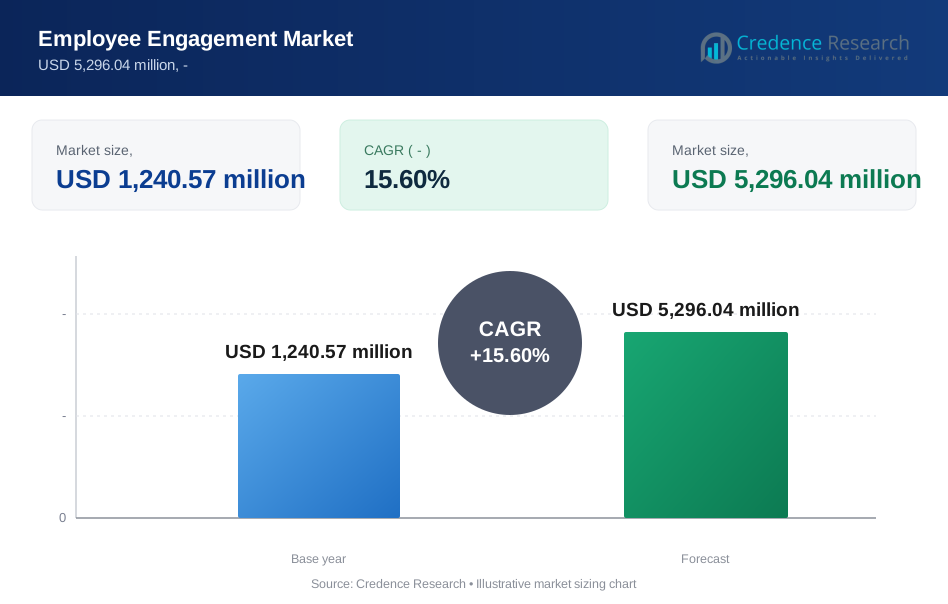
- 2.5.1 2024: USD 1,240.57 million → 2032: USD 5,296.04 million
- 2.6 Historical and Forecast Reference Periods
- 2.6.1 Base Year: 2024
- 2.6.2 Forecast Period: 2024-2032
- 2.7 Research Assumptions and Limitations
Chapter 3 Executive Summary
- 3.1 Market Snapshot and Key Findings
- 3.2 Base-Year Market Size, 2024
- 3.3 Forecast Market Size, 2032
- 3.4 Revenue and Volume Growth Outlook
- 3.5 Key Demand and Supply Indicators
- 3.6 Leading Market Segments
- 3.7 Fastest-Growing Market Opportunities
- 3.8 Regional Performance Highlights
- 3.9 Technology and Industry Transformation
- 3.10 Competitive Landscape Summary
- 3.11 Analyst View and Strategic Implications
Chapter 4 Global Employee Engagement Market Trends and Developments
- 4.1 Historical Industry Development
- 4.2 Recent Market Trends and Developments
- 4.3 Demand and Customer Behavior Trends
- 4.4 Technology and Product Innovation
- 4.5 Artificial Intelligence, Automation and Digitalization
- 4.6 Local Manufacturing and Supply Chain Realignment
- 4.7 Industry Partnerships, Mergers and Acquisitions
- 4.8 Sustainability and Circular Economy Developments
- 4.9 Government and Private Sector Investment Trends
- 4.10 Emerging Business Models and Commercialization
- 4.11 Industry Developments and Announcements
Chapter 5 Global Employee Engagement Market Production, Supply and Demand Analysis
- 5.1 Demand Trend and Consumption Analysis
- 5.2 Demand Forecast, 2024-2032
- 5.3 Production and Output Trend
- 5.4 Production and Output Forecast, 2024-2032
- 5.5 Installed Capacity and Capacity Utilization
- 5.6 Company-Wise Production Plants and Statistics
- 5.6.1 Installed Production Capacity
- 5.6.2 Actual Production
- 5.6.3 Planned Capacity and Expansion Targets
- 5.7 Supply Chain Structure and Procurement Trends
- 5.8 Supply-Demand Gap and Bottlenecks
- 5.9 Import Dependence and Sourcing Structure
- 5.10 Contract Manufacturing and Outsourcing
- 5.11 Regional Supply and Demand Concentration
Chapter 6 Global Employee Engagement Market Pricing Analysis
- 6.1 Pricing Structure and Measurement
- 6.2 Historical Pricing Trends
- 6.3 Pricing Outlook, 2024-2032
- 6.4 Average Selling Price and Unit Economics
- 6.5 Pricing by Product and Market Segment
- 6.6 Geographic Pricing Differences
- 6.7 Key Input, Energy, Labor and Logistics Costs
- 6.8 Contract Pricing and Purchasing Models
- 6.9 Pricing Sensitivity and Competitive Positioning
- 6.10 Price, Margin and Profitability Implications
Chapter 7 Global Employee Engagement Market Dynamics
- 7.1 Market Growth Drivers
- 7.1.1 Demand-Side Drivers
- 7.1.2 Technology and Innovation Drivers
- 7.1.3 Infrastructure and Investment Drivers
- 7.1.4 Regulatory and Policy Drivers
- 7.2 Market Restraints
- 7.2.1 Cost and Affordability Constraints
- 7.2.2 Technology and Adoption Barriers
- 7.2.3 Supply Chain and Operational Constraints
- 7.3 Market Challenges
- 7.3.1 Competitive Pressure and Margin Erosion
- 7.3.2 Skills, Infrastructure and Implementation Gaps
- 7.4 Emerging Market Opportunities
- 7.5 Market Dynamics Impact and Time-Horizon Assessment
Chapter 8 Global Employee Engagement Value Chain Analysis
- 8.1 Industry Value Chain Overview
- 8.2 Upstream Suppliers and Critical Inputs
- 8.3 Technology and Component Providers
- 8.4 Manufacturing or Service Delivery
- 8.5 Distribution, Channel Partners and Integrators
- 8.6 Downstream Applications and End Users
- 8.7 Value Addition and Profit Pools
- 8.8 Vertical Integration and Outsourcing
- 8.9 Supplier Concentration and Risk
- 8.10 Supply Chain Localization and Resilience
Chapter 9 Global Employee Engagement Market Regulations and Policies
- 9.1 Relevant Laws, Standards and Compliance Frameworks
- 9.2 Product, Service, Safety and Quality Requirements
- 9.3 Government Policies, Incentives and Subsidies
- 9.4 Imports, Exports and Trade Barriers
- 9.5 Public Procurement and Local Content Requirements
- 9.6 Environmental and Sustainability Compliance
- 9.7 Upcoming Policy Changes and Market Implications
Chapter 10 Global Employee Engagement Market Hotspots and Opportunities
- 10.1 Market Opportunity Mapping and Growth Hotspots
- 10.2 High-Growth Applications and Customer Groups
- 10.3 Underserved Markets and White-Space Opportunities
- 10.4 Emerging Technology and Product Opportunities
- 10.5 New Capacity and Investment Hotspots
- 10.6 Market Entry and Expansion Opportunities
- 10.7 Distribution and Partnership Opportunities
- 10.8 Near-Term and Long-Term Commercial Potential
- 10.9 Opportunity Attractiveness and Execution Risks
Chapter 11 Global Employee Engagement Market Outlook, 2024-2032
- 11.1 Market Size and Analysis
- 11.1.1 Revenue (Market Measurement: 2024: USD 1,240.57 million → 2032: USD 5,296.04 million)
- 11.1.2 Market Volume and Quantity Sold
- 11.1.3 Historical Market Size
- 11.1.4 Base-Year Market Size, 2024
- 11.2 Market Forecast, 2024-2032
- 11.2.1 Revenue Forecast to 2032
- 11.2.2 Volume Forecast to 2032
- 11.2.3 CAGR and Year-on-Year Growth
- 11.2.4 Incremental Revenue Opportunity
- 11.3 Forecast Assumptions and Scenario Analysis
- 11.3.1 Base-Case Forecast
- 11.3.2 Optimistic and Conservative Scenarios
- 11.3.3 Technology, Pricing and Policy Sensitivities
- 11.4 Market Attractiveness and Growth Outlook
Chapter 12 Global Employee Engagement Market Segmentation and Outlook
- 12.1 Segmentation Summary and Market Shares, 2024
- 12.2 Largest and Fastest-Growing Segments
- 12.3 By Industry - Market Size and Forecast, 2024-2032
- 12.3.1 Segment Definition and Scope
- 12.3.2 Historical Market Size
- 12.3.3 Revenue Forecast, 2024-2032
- 12.3.4 Volume Forecast, 2024-2032
- 12.3.5 Base-Year Market Share, 2024
- 12.3.6 Segment CAGR and Growth Drivers
- 12.3.7 Subsegment Market Size and Forecast
- 12.3.7.1 IT and Telecom
- 12.3.7.2 BFSI
- 12.3.7.3 Retail
- 12.3.7.4 Healthcare
- 12.3.7.5 Government
- 12.3.7.6 Manufacturing
- 12.3.7.7 Others
- 12.3.8 Subsegment Pricing and Adoption Trends
- 12.3.9 Leading Suppliers and Competition
- 12.3.10 Regional Demand and Opportunities
- 12.4 By Solution - Market Size and Forecast, 2024-2032
- 12.4.1 Segment Definition and Scope
- 12.4.2 Historical Market Size
- 12.4.3 Revenue Forecast, 2024-2032
- 12.4.4 Volume Forecast, 2024-2032
- 12.4.5 Base-Year Market Share, 2024
- 12.4.6 Segment CAGR and Growth Drivers
- 12.4.7 Subsegment Market Size and Forecast
- 12.4.7.1 Integrated Employee Engagement Platform
- 12.4.7.2 Standalone Software (Unified Communications, Social Intranet, Recognition & Reward, Performance Management, Others)
- 12.4.7.3 Professional Services (Consulting, Integration & Implementation, Support & Maintenance, Training & Development)
- 12.4.7.4 Managed Services
- 12.4.8 Subsegment Pricing and Adoption Trends
- 12.4.9 Leading Suppliers and Competition
- 12.4.10 Regional Demand and Opportunities
- 12.5 By Deployment - Market Size and Forecast, 2024-2032
- 12.5.1 Segment Definition and Scope
- 12.5.2 Historical Market Size
- 12.5.3 Revenue Forecast, 2024-2032
- 12.5.4 Volume Forecast, 2024-2032
- 12.5.5 Base-Year Market Share, 2024
- 12.5.6 Segment CAGR and Growth Drivers
- 12.5.7 Subsegment Market Size and Forecast
- 12.5.7.1 Cloud Based
- 12.5.7.2 On Premises
- 12.5.8 Subsegment Pricing and Adoption Trends
- 12.5.9 Leading Suppliers and Competition
- 12.5.10 Regional Demand and Opportunities
- 12.6 By Enterprise Size - Market Size and Forecast, 2024-2032
- 12.6.1 Segment Definition and Scope
- 12.6.2 Historical Market Size
- 12.6.3 Revenue Forecast, 2024-2032
- 12.6.4 Volume Forecast, 2024-2032
- 12.6.5 Base-Year Market Share, 2024
- 12.6.6 Segment CAGR and Growth Drivers
- 12.6.7 Subsegment Market Size and Forecast
- 12.6.7.1 Small and Mid Sized Enterprises
- 12.6.7.2 Large Enterprises
- 12.6.8 Subsegment Pricing and Adoption Trends
- 12.6.9 Leading Suppliers and Competition
- 12.6.10 Regional Demand and Opportunities
- 12.7 Segment Growth Comparison
- 12.8 Segment Attractiveness and Priority Matrix
Chapter 13 Global Employee Engagement End-Use and Application Market Outlook
- 13.1 End-Use Industry and Customer Demand Structure
- 13.2 Leading Applications and Customer Groups
- 13.3 End-Use Market Size, Share and Forecast
- 13.4 Major End-Use Industry Deep Dives
- 13.4.1 Customer Requirements and Use Cases
- 13.4.2 Demand and Replacement Cycles
- 13.4.3 Technical and Regulatory Considerations
- 13.4.4 Purchasing and Procurement Models
- 13.4.5 Leading Vendors and Distribution Channels
- 13.4.6 Forecast and Commercial Opportunities
- 13.5 Emerging Applications and Cross-Segment Demand
- 13.6 End-Use Industry Investment Priorities
Chapter 14 Global Employee Engagement Geographic Market Outlook, 2024-2032
- 14.1 Regional Market Size and Share, 2024
- 14.2 Regional Market Forecast, 2024-2032
- 14.3 Regional Pricing, Production and Demand Differences
- 14.4 North America
- 14.4.1 United States
- 14.4.2 Canada
- 14.4.3 Mexico
- 14.5 Europe
- 14.5.1 Germany
- 14.5.2 France
- 14.5.3 Italy
- 14.5.4 United Kingdom
- 14.5.5 Spain
- 14.5.6 Poland
- 14.5.7 Russia
- 14.5.8 Netherlands
- 14.5.9 Belgium
- 14.5.10 Sweden
- 14.5.11 Denmark
- 14.5.12 Norway
- 14.5.13 Rest of Europe
- 14.6 Asia Pacific
- 14.6.1 China
- 14.6.2 India
- 14.6.3 Japan
- 14.6.4 South Korea
- 14.6.5 Thailand
- 14.6.6 Indonesia
- 14.6.7 Vietnam
- 14.6.8 Malaysia
- 14.6.9 Australia
- 14.6.10 Rest of Asia Pacific
- 14.7 Latin America
- 14.7.1 Brazil
- 14.7.2 Argentina
- 14.7.3 Colombia
- 14.7.4 Chile
- 14.7.5 Rest of Latin America
- 14.8 Middle East
- 14.8.1 Saudi Arabia
- 14.8.2 United Arab Emirates
- 14.8.3 Turkey
- 14.8.4 Israel
- 14.8.5 Iran
- 14.8.6 Rest of the Middle East
- 14.9 Africa
- 14.9.1 South Africa
- 14.9.2 Egypt
- 14.9.3 Nigeria
- 14.9.4 Morocco
- 14.9.5 Rest of Africa
- 14.10 Regional Investment, Policy and Supply Chain Differences
- 14.11 Regional Competitive Landscape
- 14.12 Geographic Growth Hotspots
Chapter 15 Global Employee Engagement Technology, Innovation and Sustainability Outlook
- 15.1 Technology Landscape and Maturity
- 15.2 Product, Process and Service Innovation
- 15.3 AI, Automation and Digital Tools in the Industry
- 15.4 Technology Adoption and Performance Benchmarking
- 15.5 Innovation Pipeline and R&D Investment
- 15.6 Patent and Intellectual Property Trends
- 15.7 Energy Efficiency and Resource Management
- 15.8 Sustainability, Recycling and Circularity
- 15.9 Technology Roadmap, 2024-2032
- 15.10 Risks of Obsolescence and Technology Substitution
Chapter 16 Global Employee Engagement Market Key Strategic Imperatives
- 16.1 Growth and Market Entry Priorities
- 16.2 High-Return Products and Segments
- 16.3 Pricing, Profitability and Cost Optimization
- 16.4 Technology Investment and Product Differentiation
- 16.5 Supply Chain Localization and Resilience
- 16.6 Distribution and Customer Acquisition
- 16.7 Partnership, Acquisition and Capacity Strategy
- 16.8 Regional Expansion Priorities
- 16.9 Short-, Medium- and Long-Term Actions
Chapter 17 Competition Outlook
- 17.1 Industry Competition Characteristics
- 17.2 Market Structure and Concentration
- 17.3 Market Share and Competitive Positioning, 2024
- 17.4 Company-Wise Revenue and Product Benchmarking
- 17.5 Production and Service Capacity Benchmarking
- 17.6 Technology, Pricing and Differentiation
- 17.7 Regional Footprint and Distribution Strength
- 17.8 Mergers, Acquisitions and Strategic Alliances
- 17.9 New Entrants and Competitive Threats
- 17.10 Porter's Five Forces and Industry Attractiveness
- 17.11 Competitive Outlook, 2024-2032
Chapter 18 Company Profiles
- 18.1 Company Coverage and Selection Criteria
- 18.2 Officevibe (GSoft Group Inc.)
- 18.2.1 Business Description
- 18.2.2 Company Ownership and Geographic Presence
- 18.2.3 Product and Service Portfolio
- 18.2.4 Manufacturing and Operating Footprint
- 18.2.5 Production Capacity and Expansion Plans
- 18.2.6 Financial Performance and Investment
- 18.2.7 Market Share and Competitive Position
- 18.2.8 Technology and Innovation Capabilities
- 18.2.9 Strategic Alliances or Partnerships
- 18.2.10 Recent Developments
- 18.2.11 Growth Strategy and Outlook
- 18.3 IBM Corporation
- 18.4 Peakon
- 18.5 Microsoft Corporation
- 18.6 Atlassian Corporation Plc
- 18.7 Connecteam
- 18.8 Cisco Systems
- 18.9 ContactMonkey Inc.
- 18.10 Google
- 18.11 Lattice
- 18.12 Other Relevant Market Participants
Note: Every listed company is profiled on the structure shown under the first company. The company list is preliminary and may change based on research findings, market developments, data availability and client requirements.
Chapter 19 Disclaimer
- 19.1 Research and Forecast Disclaimer
- 19.2 Data Source and Estimation Limitations
Note: The depth of individual sections depends on data availability for this market. Volume, capacity, trade and other unit-based metrics are included where applicable.

