
| REPORT ATTRIBUTE | DETAILS |
|---|---|
| Historical Period | 2020-2023 |
| Base Year | 2024 |
| Forecast Period | 2025-2032 |
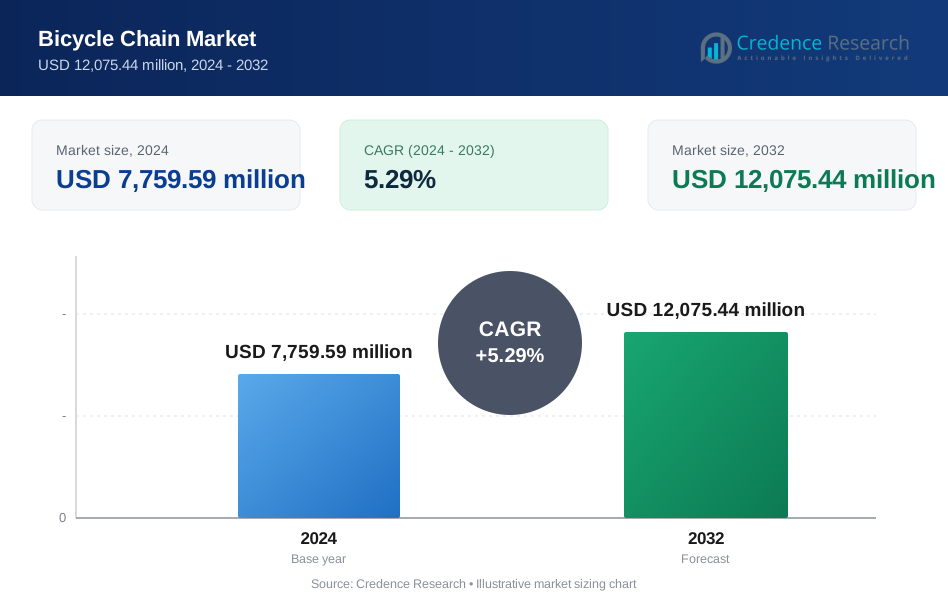
| Bicycle Chain Market Size 2024 | USD 7,759.59 million |
| Bicycle Chain Market, CAGR | 5.29% |
| Bicycle Chain Market Size 2032 | USD 12,075.44 million |
Market Overview
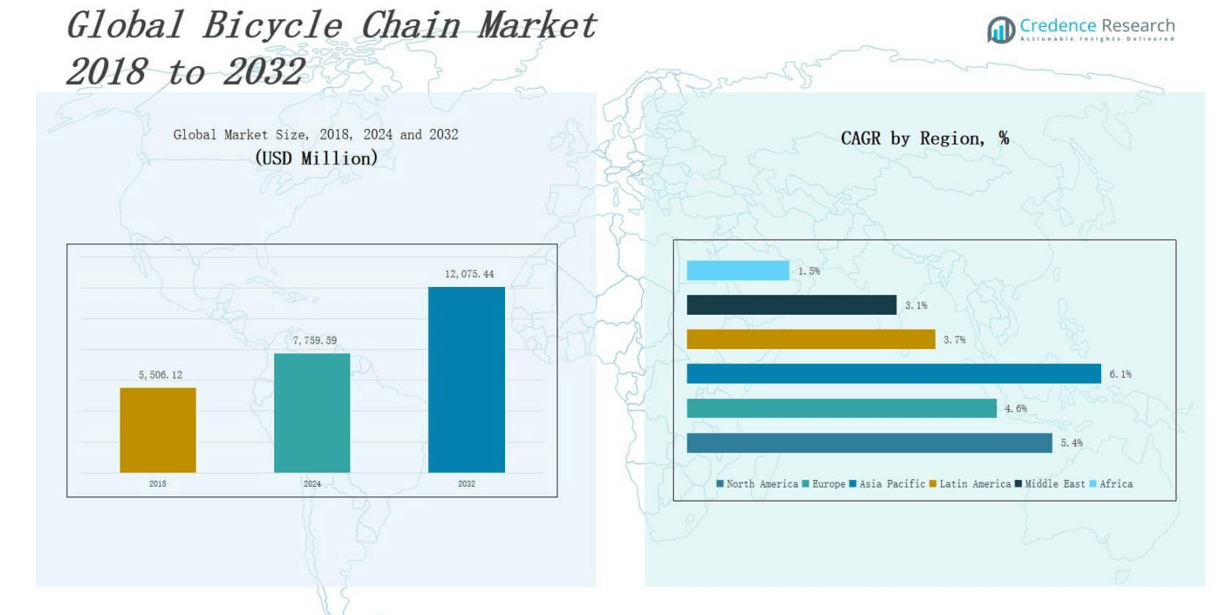
The Bicycle Chain Market size was valued at USD 5,506.12 million in 2018 to USD 7,759.59 million in 2024 and is anticipated to reach USD 12,075.44 million by 2032, at a CAGR of 5.29 % during the forecast period.
The Bicycle Chain Market is experiencing consistent growth, driven by the rising adoption of bicycles for fitness, recreation, and sustainable transportation. Urbanization and increased environmental awareness are encouraging consumers to shift toward cycling, supported by government initiatives promoting eco-friendly mobility. The expansion of bike-sharing programs and dedicated cycling infrastructure in metropolitan areas further boosts demand. Technological advancements in chain materials, such as corrosion-resistant alloys and low-friction coatings, are improving durability and performance, aligning with the growing popularity of high-performance and electric bicycles. The surge in e-bike sales, particularly in Europe and Asia-Pacific, is creating demand for specialized chains designed for higher torque loads. Lightweight, maintenance-free, and high-strength chains are gaining preference among competitive cyclists and commuters alike. The aftermarket segment also sees steady growth due to frequent chain replacements required by active riders. Overall, innovation in chain technology and rising consumer interest in health and sustainability continue to shape market trends positively.
The Bicycle Chain Market spans key regions including North America, Europe, Asia Pacific, Latin America, the Middle East, and Africa. Asia Pacific leads in volume and manufacturing, while Europe shows strong demand driven by e-bike adoption. North America holds a notable share with high-performance and recreational cycling trends. Latin America is growing steadily, supported by urban mobility needs. The Middle East and Africa show emerging potential with rising fitness awareness and utility cycling. Key players shaping the market include KMC Kuei Meng International, SRAM, TAYA Chain Group, YABAN Chain Industrial, Lixing Chain, Wippermann GmbH, Izumi Chain Company, Rohloff AG, Metro Group, and Tien Yuen Machinery. These companies focus on technological advancement, OEM partnerships, and product durability to stay competitive across diverse consumer and regional requirements in the global Bicycle Chain Market.
Market Insights
- The Bicycle Chain Market was valued at USD 5,506.12 million in 2018, reached USD 7,759.59 million in 2024, and is projected to grow to USD 12,075.44 million by 2032, registering a CAGR of 5.29%.
- Growing global interest in fitness, sustainable commuting, and urban mobility is boosting bicycle demand, directly driving chain sales across commuter, recreational, and performance categories.
- Technological advancements such as rust-resistant coatings, self-lubricating chains, and torque-resistant designs for e-bikes are enhancing product performance and longevity.
- Asia Pacific dominates the market with strong manufacturing capabilities and growing domestic demand, followed by Europe, which leads in e-bike chain consumption, and North America with its focus on premium cycling components.
- Latin America and the Middle East are witnessing steady market growth driven by expanding cycling infrastructure, while Africa holds long-term potential through donor-led bicycle access programs.
- Key players like KMC, SRAM, TAYA, YABAN, Wippermann, Izumi, and Rohloff focus on innovation, OEM alliances, and quality differentiation to maintain competitive edge.
- Market challenges include volatile raw material costs, supply chain disruptions, and counterfeit product circulation, requiring firms to invest in quality assurance and supply reliability.
Market Drivers
Rising Demand for Eco-Friendly and Sustainable Mobility Solutions
The Bicycle Chain Market benefits significantly from the global push toward sustainable transportation. Governments and municipalities across regions are investing in cycling infrastructure, including bike lanes and public bicycle-sharing programs. Consumers are increasingly choosing bicycles to reduce carbon emissions, cut fuel costs, and improve personal health. This behavioral shift is especially strong in urban areas where congestion and pollution are ongoing concerns. The market is capitalizing on these trends through higher sales volumes. It is also receiving support from policy incentives that promote non-motorized transport. The Bicycle Chain Market aligns with the sustainability goals of multiple stakeholders, making it a preferred segment in the broader mobility ecosystem.
- For instance, Campagnolo has advanced eco-friendly practices by focusing on recyclable packaging and biodegradable lubricants, responding to both regulatory standards and consumer demand for environmentally responsible products.
Expansion of the Electric Bicycle Segment
The rapid expansion of the electric bicycle (e-bike) segment is a key growth engine for the Bicycle Chain Market. E-bikes require specialized, high-torque-resistant chains due to their motorized assistance systems. This technical requirement has created demand for more durable, precision-engineered chain systems. Manufacturers are developing chains with enhanced strength and reduced wear to support the mechanical demands of e-bikes. It is driving innovation in chain materials and designs tailored for long-range performance. The Bicycle Chain Market leverages this trend by offering product lines optimized for e-bike compatibility, particularly in Europe and Asia-Pacific where e-bike usage is widespread.
- For instance, Bosch introduced its fifth-generation Performance Line CX motor for the 2025 season, featuring a quieter ride and larger batteries, which necessitate robust, long-lasting chains to handle increased torque and power output.
Growth in Recreational and Fitness Cycling Activities
Increasing interest in fitness, outdoor recreation, and cycling sports directly supports the Bicycle Chain Market. Health-conscious consumers are incorporating cycling into their daily routines, driving up sales of both standard and performance bicycles. The rise of amateur cycling events and community riding groups further boosts product demand. It creates recurring replacement needs for chains due to wear from regular use. Sports enthusiasts prefer lightweight, low-friction chains that support higher speed and smoother gear shifts. The Bicycle Chain Market responds with performance-optimized products for recreational and professional cyclists alike.
Technological Advancements in Chain Design and Materials
Ongoing innovation in chain technology is propelling the Bicycle Chain Market forward. Manufacturers are introducing corrosion-resistant coatings, self-lubricating chains, and advanced alloy compositions to extend chain life and reduce maintenance. These features cater to both high-performance users and casual riders seeking reliability and ease of use. It is enhancing the perceived value and functionality of modern bicycle chains. Smart manufacturing and precision engineering enable consistent product quality and performance. The Bicycle Chain Market benefits from these developments by offering differentiated solutions that meet evolving user expectations across diverse segments.
Market Trends
Increased Adoption of High-Performance and Lightweight Chains
The Bicycle Chain Market is witnessing a growing preference for high-performance, lightweight chains among fitness riders and professional cyclists. These chains reduce drivetrain weight and improve pedaling efficiency, supporting better performance in races and long-distance cycling. Manufacturers are focusing on using advanced materials such as hollow pins, titanium alloys, and nano-coatings. It enhances strength while minimizing weight. Cyclists demand smoother gear shifts and quieter operation, which these modern chains provide. The trend reflects consumers’ increasing awareness of quality and performance. The Bicycle Chain Market evolves to address these specific expectations with precision-engineered solutions.
- For instance, Gates Carbon Drive systems, featured in premium e-bikes like the Riese & Müller Nevo and Stromer ST3, use carbon fiber-reinforced belts that are lighter and quieter than traditional metal chains, offering a maintenance-free and efficient riding experience.
Rising Popularity of Low-Maintenance and Rust-Resistant Chains
Low-maintenance and rust-resistant chains are gaining popularity in both urban commuting and mountain biking applications. Consumers seek durability and longer service life with minimal upkeep, especially in varied weather conditions. The market is responding with pre-lubricated and corrosion-resistant chains that perform well in rain, mud, and dust. It reduces the frequency of replacements and maintenance efforts for cyclists. Chains with anti-rust coatings and self-lubricating features are becoming a key differentiator. The Bicycle Chain Market continues to grow in regions where year-round cycling is common and weather resistance is essential.
- For instance, KMC’s EPT Anti-Rust Series chains are fully coated using advanced technology, passing a 650-hour salt spray test-over ten times more durable than standard chains-and are specifically designed to withstand rain, mud, and snow, making them suitable for both urban commuting and mountain biking.
Technological Integration with Smart Drivetrain Systems
Integration of bicycle chains with smart drivetrain systems is becoming a prominent trend in the Bicycle Chain Market. Electronic shifting systems and performance-monitoring drivetrains require highly responsive, precision-calibrated chains. It leads to increased demand for specialized chains compatible with automatic or semi-automatic gear systems. The rise of smart e-bikes and connected fitness platforms is influencing product development. Chain manufacturers collaborate with drivetrain tech companies to ensure seamless compatibility. The Bicycle Chain Market adapts to these digital advancements by aligning product offerings with next-generation cycling technologies.
Growth of Customization and Aesthetic Appeal in Chains
Customization and visual appeal have become emerging trends in the Bicycle Chain Market, especially among enthusiasts and youth riders. Colored chains, branded engravings, and stylized finishes attract consumers looking to personalize their bicycles. It reflects a broader shift in the market toward fashion-forward and lifestyle-oriented cycling. These custom chains maintain high performance while offering unique visual identity. Bicycle brands and aftermarket suppliers are expanding their portfolios to include stylish yet functional options. The Bicycle Chain Market leverages this trend to appeal to image-conscious riders seeking both performance and personalization.
Market Challenges Analysis
Rising Raw Material Costs and Supply Chain Disruptions
The Bicycle Chain Market faces challenges from fluctuating raw material prices, especially for steel, aluminum, and specialty alloys used in chain manufacturing. Volatility in global metal markets impacts production costs and profit margins for manufacturers. It puts pressure on pricing strategies, particularly in the competitive mid-range segment. Disruptions in supply chains, including delays in component sourcing and shipping, further strain inventory and delivery timelines. Manufacturers must balance cost control with quality assurance to retain market share. The Bicycle Chain Market navigates these issues while maintaining production continuity and reliability.
Counterfeit Products and Inconsistent Aftermarket Quality
Proliferation of counterfeit and low-quality aftermarket chains poses a significant challenge in the Bicycle Chain Market. These products often fail to meet safety and performance standards, leading to premature failures and reputational damage for retailers. It undermines consumer trust, especially in markets with limited regulatory enforcement. Inconsistent quality in unbranded chains also affects drivetrain performance and maintenance frequency. Leading brands must invest in anti-counterfeiting measures and quality assurance programs to differentiate their offerings. The Bicycle Chain Market must address this concern to ensure long-term customer confidence and loyalty.
Market Opportunities
Expansion in Emerging Markets and Urban Mobility Projects
The Bicycle Chain Market has strong opportunities in emerging economies where cycling adoption is rising due to urban congestion, cost-effective transport needs, and government-backed infrastructure projects. Rapid urbanization in countries like India, Brazil, and Indonesia is encouraging bicycle use for daily commuting. It supports demand for reliable, low-cost chains suitable for varying road conditions. Public bike-sharing schemes and last-mile mobility solutions further stimulate volume-driven growth. The Bicycle Chain Market can scale by partnering with local assemblers and targeting affordable product segments.
Rising Demand for E-Bike-Specific and Premium Chains
E-bikes present a major opportunity for innovation and product differentiation in the Bicycle Chain Market. Chains designed to withstand higher torque and power loads are in demand due to increased e-bike usage in Europe, North America, and East Asia. It opens avenues for developing advanced, long-lasting, and low-noise chain systems tailored for electric drivetrains. Premium chains with features like low-friction coatings and smart compatibility appeal to performance cyclists and urban professionals alike. The Bicycle Chain Market can leverage this shift by expanding premium offerings and collaborating with OEMs for specialized product integration.
Market Segmentation Analysis:
By Product Type
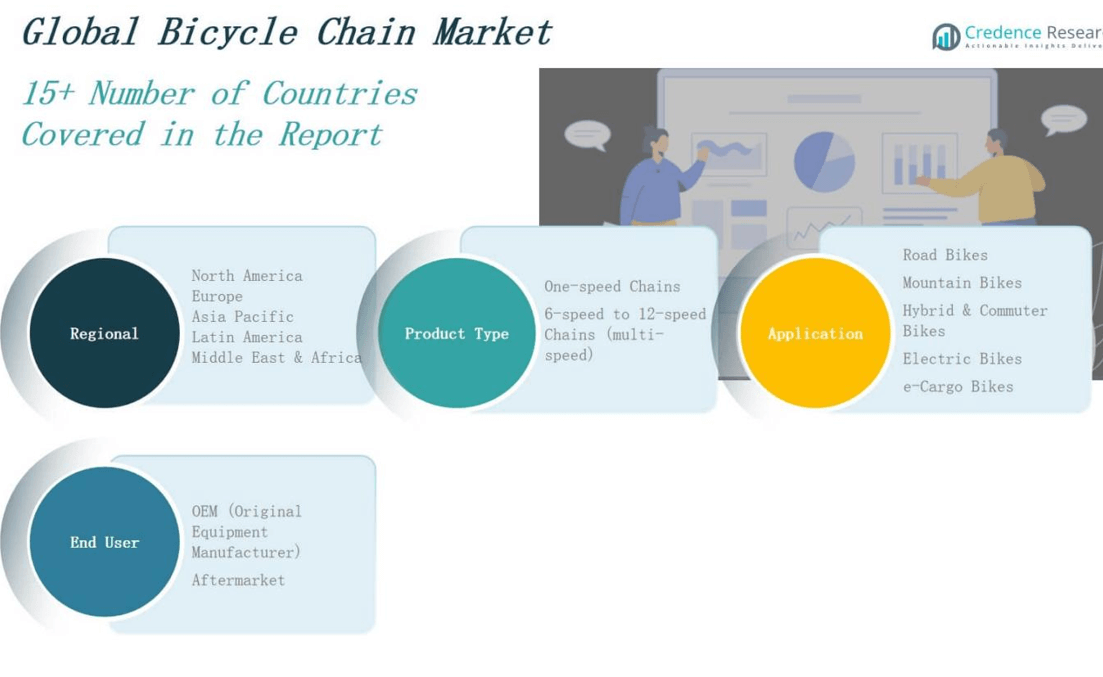
The Bicycle Chain Market includes one-speed and 6-speed to 12-speed chains, each serving distinct user needs. One-speed chains are primarily used in single-speed bikes and urban models where simplicity and durability are prioritized. These chains are cost-effective and require less maintenance. In contrast, multi-speed chains cater to road, mountain, and hybrid bikes that need smooth gear transitions. The 6-speed to 12-speed chains dominate the performance segment. The Bicycle Chain Market supports this diversity through continuous design innovations and compatibility enhancements.
- For instance, KMC Group launched a new line of lightweight bicycle chains in 2020, focusing on reducing weight for competitive cyclists while maintaining strength and compatibility across multiple gear configurations.
By Application
Road bikes, mountain bikes, hybrid & commuter bikes, electric bikes, and e-cargo bikes form the core application areas within the Bicycle Chain Market. Road bikes demand lightweight, precision-engineered chains for speed and efficiency. Mountain bikes need robust, shock-resistant chains to handle rough terrains. Hybrid and commuter bikes balance durability and ease of use, while electric bikes and e-cargo bikes require chains with high torque resistance. It enables manufacturers to tailor offerings across recreational, professional, and utility-focused cycling categories.
- For instance, Shimano’s 11-speed chains are precision-engineered for road bikes, featuring directional plate shaping and lightweight construction to deliver smooth, efficient shifting at high speeds.
By End User
The Bicycle Chain Market serves both OEMs and the aftermarket. OEMs demand large-scale supply with consistent quality, focusing on integration into newly manufactured bicycles. The aftermarket segment caters to individual replacements and upgrades, driven by wear-and-tear, customization, or performance enhancement. It offers growth opportunities for brands that provide value-added features like rust resistance, self-lubrication, or visual customization. The Bicycle Chain Market continues to expand in both segments, supported by rising global bicycle ownership and maintenance awareness.
Segments:
Based on Product Type
- One-speed Chains
- 6-speed to 12-speed Chains (Multi-speed)
Based on Application
- Road Bikes
- Mountain Bikes
- Hybrid & Commuter Bikes
- Electric Bikes
- e-Cargo Bikes
Based on End User
- OEM (Original Equipment Manufacturer)
- Aftermarket
Based on Region
- North America
- U.S.
- Canada
- Mexico
- Europe
- Germany
- France
- U.K.
- Italy
- Spain
- Rest of Europe
- Asia Pacific
- China
- Japan
- India
- South Korea
- South-east Asia
- Rest of Asia Pacific
- Latin America
- Brazil
- Argentina
- Rest of Latin America
- Middle East & Africa
- GCC Countries
- South Africa
- Rest of the Middle East and Africa
Regional Analysis
North America
The North America Bicycle Chain Market size was valued at USD 1,026.62 million in 2018 to USD 1,411.59 million in 2024 and is anticipated to reach USD 2,211.19 million by 2032, at a CAGR of 5.4% during the forecast period. The region holds a significant share of the global market due to widespread recreational cycling, high disposable income, and strong demand for premium and performance bicycle components. The U.S. leads in both OEM and aftermarket segments, supported by a large base of cycling enthusiasts and a growing e-bike market. It benefits from a mature retail infrastructure and robust online distribution channels. Manufacturers focus on innovation and product customization to meet evolving rider preferences. The Bicycle Chain Market in North America continues to grow with rising fitness trends and city-level investments in bike-friendly infrastructure.
Europe
The Europe Bicycle Chain Market size was valued at USD 1,680.66 million in 2018 to USD 2,289.13 million in 2024 and is anticipated to reach USD 3,369.13 million by 2032, at a CAGR of 4.6% during the forecast period. Europe accounts for a substantial market share driven by strong adoption of e-bikes and a supportive regulatory environment promoting green mobility. Countries like Germany, the Netherlands, and France are leading hubs for cycling innovation. It benefits from active government backing for sustainable transport and dense cycling infrastructure. Demand for high-performance chains compatible with multi-speed and electric drivetrains is rising. The Bicycle Chain Market in Europe remains highly competitive, with OEM partnerships and product differentiation being key growth enablers.
Asia Pacific
The Asia Pacific Bicycle Chain Market size was valued at USD 2,319.95 million in 2018 to USD 3,394.63 million in 2024 and is anticipated to reach USD 5,616.47 million by 2032, at a CAGR of 6.1% during the forecast period. Asia Pacific dominates the global market in terms of volume and manufacturing base. China, India, and Japan are key contributors due to high bicycle production, increasing urbanization, and affordability-driven adoption. It offers significant growth potential in both low-cost one-speed chains and high-end e-bike chain segments. Rising fitness awareness and government-backed cycling initiatives fuel regional demand. The Bicycle Chain Market in Asia Pacific also benefits from export-oriented manufacturing and expanding domestic aftermarket demand.
Latin America
The Latin America Bicycle Chain Market size was valued at USD 255.18 million in 2018 to USD 355.06 million in 2024 and is anticipated to reach USD 487.82 million by 2032, at a CAGR of 3.7% during the forecast period. The region holds a moderate market share, driven by increasing urban mobility needs and a growing middle-class population. Brazil and Argentina are leading contributors with expanding OEM assembly facilities and rising bicycle ownership. It faces challenges in infrastructure but shows strong demand in the commuter and utility bicycle categories. Affordability and durability drive product selection across the region. The Bicycle Chain Market in Latin America is poised to grow steadily as cycling adoption rises across metropolitan and semi-urban areas.
Middle East
The Middle East Bicycle Chain Market size was valued at USD 156.04 million in 2018 to USD 201.23 million in 2024 and is anticipated to reach USD 264.86 million by 2032, at a CAGR of 3.1% during the forecast period. The market is relatively nascent but expanding with the rise of fitness culture and cycling tourism in countries like UAE and Israel. Demand centers around high-quality chains for road and recreational bikes. It is also seeing limited but growing traction in e-bike segments driven by urban development projects. Government efforts to reduce vehicle congestion and promote healthy lifestyles are creating favorable conditions. The Bicycle Chain Market in the Middle East is expected to grow moderately with targeted infrastructure investment.
Africa
The Africa Bicycle Chain Market size was valued at USD 67.68 million in 2018 to USD 107.95 million in 2024 and is anticipated to reach USD 125.97 million by 2032, at a CAGR of 1.5% during the forecast period. Africa holds a small but essential share of the global market, mainly serving utilitarian transportation needs. Countries like South Africa, Egypt, and Kenya show growing interest in affordable and rugged bicycles. It relies heavily on low-cost one-speed chains due to budget constraints and minimal gear systems. Infrastructure limitations and import dependency affect regional supply. The Bicycle Chain Market in Africa offers long-term potential, especially with the emergence of mobility-focused development programs and donor-led bicycle distribution initiatives.
Key Player Analysis
- KMC Kuei Meng International
- Lixing Chain
- Tien Yuen Machinery
- YABAN Chain Industrial
- Metro Group
- TAYA Chain Group
- SRAM
- Izumi Chain Company
- Wippermann GmbH
- Rohloff AG
Competitive Analysis
The Bicycle Chain Market features a competitive landscape dominated by established global and regional players focusing on product innovation, quality, and OEM partnerships. Key companies such as KMC Kuei Meng International, SRAM, TAYA Chain, YABAN Chain Industrial, and Wippermann GmbH lead in technology, production capacity, and distribution reach. It sees continuous innovation in materials, coatings, and chain designs to meet the evolving demands of electric and performance bicycles. Companies compete on durability, precision, and compatibility with advanced drivetrains. The aftermarket segment remains fragmented, offering room for regional players to gain traction through cost-effective and customizable products. Strategic alliances with bicycle manufacturers, investments in R&D, and strong distribution networks define success. The Bicycle Chain Market continues to evolve as leading brands expand portfolios and improve value-added features to retain market share and meet global demand across recreational, commuter, and professional cycling categories.
Recent Developments
- In July 2025, SRAM acquired Italian chainring spider manufacturer Ochain, integrating its chain-dampening technology into SRAM's product portfolio.
- In February 2023, Shimano launched the CUE system with LINKGLIDE technology, offering enhanced durability and smoother shifting for a wide range of bicycles.
- In April 2025, KMC entered a sponsorship partnership with Challenge Family to promote its pre-waxed chain products across global triathlon and endurance events.
- In June 2025, SRAM introduced updated Force AXS and Rival AXS groupsets with improved 12- and 13-speed chains, targeting road and gravel cyclists
Market Concentration & Characteristics
The Bicycle Chain Market exhibits moderate to high market concentration, with a few established global players dominating the premium and OEM segments. Companies like KMC, SRAM, TAYA, and YABAN maintain strong brand presence through advanced product portfolios, strategic partnerships, and broad distribution networks. It features a mix of standardized and customized offerings, catering to both single-speed utility bikes and high-performance multi-speed and e-bike applications. While global players lead in innovation and high-margin products, regional manufacturers remain competitive in the aftermarket and low-cost segments. The market is characterized by steady demand, technology-driven product differentiation, and high replacement frequency, especially in urban and recreational segments. It responds rapidly to trends such as e-mobility, sustainability, and precision drivetrain integration. The Bicycle Chain Market relies heavily on manufacturing quality, supply chain efficiency, and compatibility with evolving gear systems to meet diverse customer requirements and retain long-term customer loyalty.
Report Coverage
The research report offers an in-depth analysis based on Product Type, Application, End-User and Region. It details leading market players, providing an overview of their business, product offerings, investments, revenue streams, and key applications. Additionally, the report includes insights into the competitive environment, SWOT analysis, current market trends, as well as the primary drivers and constraints. Furthermore, it discusses various factors that have driven market expansion in recent years. The report also explores market dynamics, regulatory scenarios, and technological advancements that are shaping the industry. It assesses the impact of external factors and global economic changes on market growth. Lastly, it provides strategic recommendations for new entrants and established companies to navigate the complexities of the market.
Future Outlook
- Demand for electric bike-specific chains will rise due to increased adoption of e-bikes worldwide.
- Urban mobility programs and bike-sharing initiatives will expand the need for durable, low-maintenance chains.
- Technological advancements will lead to wider use of corrosion-resistant and self-lubricating chain materials.
- OEMs will continue to partner with chain manufacturers to offer drivetrain-specific chain solutions.
- Aftermarket sales will grow steadily due to the frequent replacement cycle of bicycle chains.
- Asia Pacific will remain the leading production and export hub for bicycle chains.
- Consumer preference will shift toward lightweight, high-performance chains for sports and recreational bikes.
- Environmental regulations and sustainable transport goals will strengthen market demand across regions.
- Digital integration with smart drivetrains will influence design and compatibility standards in chain manufacturing.
- Key players will invest more in product innovation, brand protection, and global distribution efficiency.
Request a Free Sample
Fill in your details and we'll send you a free sample report.
- Sample data tables & charts
- Research methodology
Need a Custom Version of This Report?
Tailor the scope, geography, or segments to your exact requirements.
- Custom geography or segment scope
- Direct access to our analyst team
Frequently Asked Questions
What is the current size of the Bicycle Chain Market?
What are the key segments within the Bicycle Chain Market?
What are some challenges faced by the Bicycle Chain Market?
Who are the major players in the Bicycle Chain Market?
Table of Content
Chapter 1. Report Introduction
- 1.1 Report Description & Purpose
- 1.1.1 Report Title & Market Definition
- 1.1.2 Unique Selling Propositions (USP) & Key Differentiators
- 1.1.3 Value Proposition for Stakeholders
- 1.2 Research Objectives
- 1.2.1 Market Sizing Objectives (Volume & Revenue)
- 1.2.2 Segmentation Objectives
- 1.2.3 Competitive Intelligence Objectives
- 1.2.4 Forecast & Scenario Objectives
- 1.3 Report Scope
- 1.3.1 Bicycle Chain Scope – Types & Subtypes Covered
- 1.3.2 Geographic Scope – Regions & Countries Covered
- 1.3.3 Historical Period, Base Year & Forecast Period (2024; forecast to 2032)
- 1.3.4 Inclusions & Exclusions
- 1.4 HS Code & Classification Framework
- 1.5 Currency, Units & Pricing Basis
- 1.6 Target Stakeholders
- 1.7 Limitations & Assumptions
Chapter 2. Executive Summary
- 2.1 Global Bicycle Chain Market Snapshot
- 2.1.1 Market Size – Historical (2024) & Forecast (2024-2032) (2024: USD 7,759.59 million → 2032: USD 12,075.44 million)
- 2.1.2 Volume & Revenue – Global Totals
- 2.1.3 Key Market Highlights – Top Five Facts
- 2.2 Bicycle Chain Market Segmentation Snapshot
- 2.2.1 Market Split by Region – 2024 vs. 2032
- 2.3 Competitive Snapshot
- 2.3.1 Top 10 Players by Revenue Share – 2024
- 2.3.2 Top 10 Players by Volume Share – 2024
- 2.3.3 Recent Strategic Developments (18-Month Summary)
- 2.4 Key Investment Highlights & Strategic Conclusions
Chapter 3. Bicycle Chain Market Dynamics & Industry Analysis
- 3.1 Market Overview & Context
- 3.1.1 Bicycle Chain Market Position in the Broader Automotive Value Chain
- 3.1.2 OEM vs. Replacement Market Dynamics
- 3.1.3 Market Maturity & Development Stage by Region
- 3.2 Bicycle Chain Market Drivers
- 3.3 Bicycle Chain Market Restraints & Challenges
- 3.4 Bicycle Chain Market Opportunities
- 3.5 Porter's Five Forces Analysis
- 3.5.1 Threat of New Entrants
- 3.5.2 Bargaining Power of Suppliers
- 3.5.3 Bargaining Power of Buyers
- 3.5.4 Threat of Substitutes
- 3.5.5 Competitive Rivalry – Intensity Assessment
- 3.6 Bicycle Chain Value Chain Analysis
- 3.6.1 Upstream – Raw Material/Input Suppliers
- 3.6.1.1 Raw Material/Input 1
- 3.6.1.2 Raw Material/Input 2
- 3.6.1.3 Raw Material/Input 3
- 3.6.2 Midstream – Production/Manufacturing/Service Delivery
- 3.6.2.1 Production/Process Overview
- 3.6.2.2 Key Facility Locations & Capacity by Manufacturer
- 3.6.3 Downstream – Distribution & End Consumer
- 3.6.3.1 Primary Channel – B2B/OEM
- 3.6.3.2 Secondary Channels – Dealer, Retail, Online, Direct
- 3.6.4 Value Chain Profitability Analysis
- 3.6.1 Upstream – Raw Material/Input Suppliers
- 3.7 PESTEL Analysis
- 3.7.1 Political Factors
- 3.7.2 Economic Factors
- 3.7.3 Social Factors
- 3.7.4 Technological Factors
- 3.7.5 Environmental Factors
- 3.7.6 Legal Factors
- 3.8 Bicycle Chain Supply Chain Analysis
- 3.8.1 Raw Material/Input Supply Risk Assessment
- 3.8.2 Manufacturing Concentration Risk (Geographic Exposure)
- 3.8.3 Trade Disruption Impact Analysis
- 3.9 Regulatory & Policy Landscape
Note: The regulatory and policy landscape section covers regulations based on their applicability to the market, Bicycle Chain category, geography, and scope of the study. Only regulatory frameworks with a material impact on operations, compliance, trade, sustainability, or market access are analyzed in detail.
Chapter 4. Key Investment Pockets & Opportunity Analysis
- 4.1 Bicycle Chain Market Attractiveness Analysis
- 4.1.1 By Region – Investment Attractiveness Matrix (Volume × CAGR)
- 4.2 Absolute Revenue Growth Opportunity
- 4.2.1 By Region – Absolute USD Growth Through 2032
- 4.3 Incremental Volume Opportunity
- 4.3.1 By Region – Incremental Volume Through 2032
- 4.3.2 Segment – Incremental Volume
- 4.4 Emerging Submarket Opportunity Deep Dive (Subject to Applicability)
- 4.5 Emerging Market Opportunity Scorecards
- 4.5.1 United States
- 4.5.2 Europe
- 4.5.3 Asia
- 4.5.4 Middle East & Africa
Note: Emerging Market Opportunity Scorecards will be included based on relevance and strategic importance. Regions listed are indicative and may vary depending on data availability and market dynamics.
Chapter 5. Bicycle Chain Import-Export Analysis & Trade Flows
- 5.1 Global Trade Overview
- 5.1.1 Global Export Value by Country (2024)
- 5.1.2 Global Export Volume by Country (2024)
- 5.1.3 Global Import Value by Country (2024)
- 5.1.4 Global Import Volume by Country (2024)
- 5.1.5 Net Trade Balance by Country (2024)
- 5.2 Export Analysis – Segment
- 5.2.1 Type 1 (HS Code)
- 5.2.2 Type 2 (HS Code)
- 5.2.3 Type 3 (HS Code)
- 5.2.4 Type 4 (HS Code)
- 5.2.5 Type 5 (HS Code)
- 5.3 Import Analysis – Segment
- 5.3.1 Type 1 (HS Code)
- 5.3.2 Type 2 (HS Code)
- 5.3.3 Type 3 (HS Code)
- 5.3.4 Type 4 (HS Code)
- 5.3.5 Type 5 (HS Code)
- 5.4 Average Unit Trade Prices
- 5.4.1 Average Export Price – Segment & Country
- 5.4.2 Average Import Price – Segment & Source Country
- 5.4.3 Price Trends (2024)
- 5.5 Key Trade Route Analysis
- 5.5.1 Trade Route 1
- 5.5.2 Trade Route 2
- 5.5.3 Trade Route 3
- 5.5.4 Trade Route 4
- 5.5.5 Trade Route 5
- 5.6 Trade Policy Impact Assessment
- 5.6.1 US Anti-Dumping & Section 301 Tariffs
- 5.6.2 EU Customs Union Impact
- 5.6.3 Major Free Trade Agreements
- 5.6.4 USMCA Rules of Origin
Note: Trade policy analysis will be included only where relevant to the Bicycle Chain market.
Chapter 6. Competitive Landscape & Company Benchmarking
- 6.1 Bicycle Chain Market Concentration & Structure
- 6.1.1 Herfindahl-Hirschman Index (HHI) – vs. 2024
- 6.1.2 Tier 1, Tier 2 & Tier 3 Market Structure
- 6.1.3 Global, Regional & Local Player Dynamics
- 6.2 Bicycle Chain Market Share Analysis – 2024
- 6.2.1 Global Revenue Share by Company
- 6.2.2 Global Volume Share by Company
- 6.2.3 Regional Revenue Share
- 6.2.4 Market Share Evolution ( vs. 2024)
- 6.2.5 OEM Segment Share by Company
- 6.2.6 Replacement Segment Share by Company
- 6.3 Production/Delivery Capacity & Facility Analysis
- 6.3.1 Global Installed Capacity
- 6.3.2 Capacity Utilization Rates
- 6.3.3 Production/Output Volume
- 6.3.4 Facility Locations & Capacity Map
- 6.3.5 Planned Capacity Additions
- 6.4 Bicycle Chain Competitive Benchmarking Matrix
- 6.4.1 Revenue, Volume, CAGR & Profitability Comparison
- 6.4.2 Channel Revenue Mix
- 6.4.3 Geographic Revenue Exposure
- 6.4.4 R&D Intensity
- 6.4.5 Sustainability Maturity
- 6.5 Strategic Developments in Bicycle Chain (Last 24 Months)
- 6.5.1 Mergers, Acquisitions & Divestments
- 6.5.2 New Bicycle Chain Launches
- 6.5.3 Facility Expansions
- 6.5.4 Strategic Alliances, Joint Ventures & Partnerships
- 6.5.5 Distribution Expansion & Market Entry
- 6.5.6 Sustainability & ESG Initiatives
- 6.6 Competitive Strategy Mapping
- 6.6.1 Leader, Challenger, Follower & Niche Classification
- 6.6.2 Pricing Strategy Comparison
- 6.6.3 Channel Strategy Matrix
Note: Strategic developments are included based on their materiality and the availability of reliable information.
Chapter 7. Global Bicycle Chain Market – By Distribution Channel
- 7.1 Segment Overview
- 7.1.1 Volume & Revenue Split by Channel (2024 & 2032)
- 7.1.2 Channel Mix Evolution (2024-2032)
Chapter 8. Regional Market Analysis – Global Overview
- 8.1 Global Regional Overview
- 8.1.1 Regional Volume Share
- 8.1.2 Regional Revenue Share
- 8.1.3 Regional Volume by Region
- 8.1.4 Regional Revenue by Region
- 8.1.5 Regional Forecast Through 2032
- 8.2 Cross-Regional Segment Analysis
- 8.2.1 By Distribution Channel
- 8.2.2 By Brand/Price Tier
Chapter 9. North America Bicycle Chain Market
- 9.1 United States
- 9.2 Canada
- 9.3 Mexico
Chapter 10. Europe Bicycle Chain Market
- 10.1 Germany
- 10.2 France
- 10.3 Italy
- 10.4 United Kingdom
- 10.5 Spain
- 10.6 Poland
- 10.7 Russia
- 10.8 Netherlands
- 10.9 Belgium
- 10.10 Sweden
- 10.11 Denmark
- 10.12 Norway
- 10.13 Rest of Europe
Chapter 11. Asia Pacific Bicycle Chain Market
- 11.1 China
- 11.2 India
- 11.3 Japan
- 11.4 South Korea
- 11.5 Thailand
- 11.6 Indonesia
- 11.7 Vietnam
- 11.8 Malaysia
- 11.9 Australia
- 11.10 Rest of Asia Pacific
Chapter 12. Latin America Bicycle Chain Market
- 12.1 Brazil
- 12.2 Argentina
- 12.3 Colombia
- 12.4 Chile
- 12.5 Rest of Latin America
Chapter 13. Middle East Bicycle Chain Market
- 13.1 Saudi Arabia
- 13.2 United Arab Emirates
- 13.3 Turkey
- 13.4 Israel
- 13.5 Iran
- 13.6 Rest of the Middle East
Chapter 14. Africa Bicycle Chain Market
- 14.1 South Africa
- 14.2 Egypt
- 14.3 Nigeria
- 14.4 Morocco
- 14.5 Rest of Africa
Chapter 15. Bicycle Chain Company Profiles
- 15.1 [Company 01]
- 15.1.1 Company Overview
- 15.1.2 Key Management Personnel
- 15.1.3 Products & Services Portfolio
- 15.1.4 Financial Performance
- 15.1.5 Key Market Focus & Geographic Presence
- 15.1.6 Recent Developments & Strategic Initiatives
Note: The company profile list is preliminary and may change based on research findings, market developments, data availability, and client requirements.
Chapter 16. Appendices
- Appendix A – List of Abbreviations & Acronyms
- Appendix B – Industry Classification Code Reference – Full Series
- Appendix C – Production & Capacity Data Tables
- Appendix D – End-Use & Demand Base Tables
- Appendix E – Consumption & Replacement Rate Assumptions
- Appendix F – ASP Reference Tables
- Appendix G – Manufacturing & Facility Database
- Appendix H – Import-Export Data Tables
- Appendix I – Regulatory Summary Tables
- Appendix J – Primary Research Participant List (Anonymized)
- Appendix K – Primary Research Questionnaire Framework
- Appendix L – Data Sources & Bibliography
- Appendix M – Market Size Divergence & Source Comparison
Chapter 17. Research Methodology
- 17.1 Research Framework & Philosophy
- 17.2 Secondary Research – Sources, Hierarchy & Data Extraction
- 17.3 Data Modeling – Bottom-Up & Top-Down Market Sizing
- 17.4 Primary Research – Stakeholder Framework, LOI & Sample Sizes
- 17.5 Forecast Methodology – Regression, Scenario & Sensitivity Analysis
- 17.6 Quality Control – Four-Layer Validation Framework
- 17.7 Limitations & Standard Assumptions
- 17.8 Disclaimer
