
| REPORT ATTRIBUTE | DETAILS |
|---|---|
| Historical Period | 2020-2023 |
| Base Year | 2024 |
| Forecast Period | 2025-2032 |
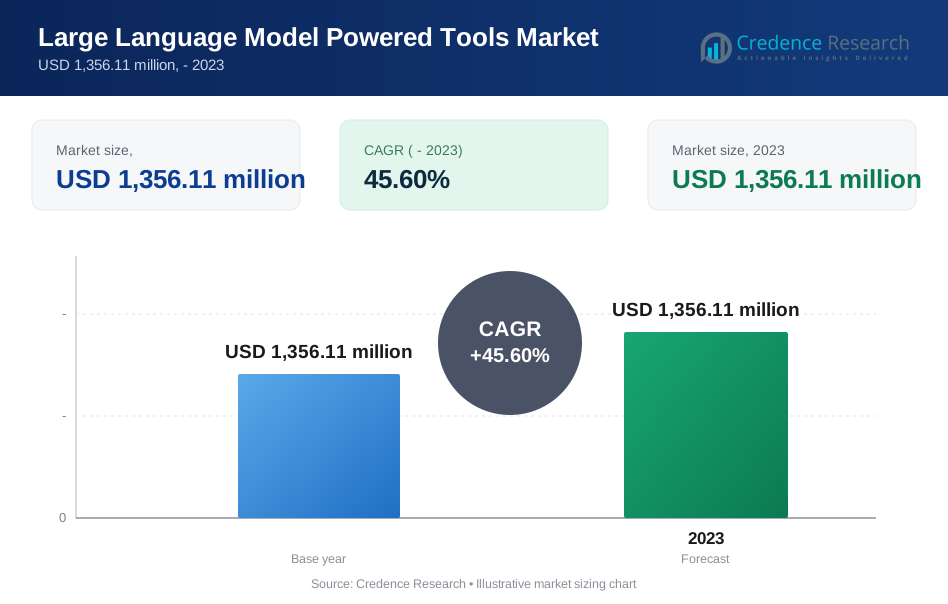
| Large Language Model Powered Tools Market Size 2023 | USD 1,356.11 Million |
| Large Language Model Powered Tools Market, CAGR | 45.60% |
| Large Language Model Powered Tools Market Size 2032 | USD 39,879.28 Million |
Market Overview
The global Large Language Model Powered Tools Market is projected to grow from USD 1,356.11 million in 2023 to an estimated USD 39,879.28 million by 2032, with a compound annual growth rate (CAGR) of 45.60% from 2024 to 2032. This remarkable growth is driven by the increasing demand for advanced AI-powered solutions across various industries, including finance, healthcare, and technology.
Several factors are driving the growth of the market, including the surge in data generation, advancements in AI and machine learning, and increasing reliance on automation. The adoption of large language models enhances the capabilities of tools for natural language processing (NLP), content generation, and customer support automation. Additionally, rising investments in AI-driven technologies and the development of more accurate, context-aware models are contributing to the market's expansion. Emerging trends such as personalized AI solutions and increasing integration of language models in everyday tools further bolster this growth.
Geographically, North America dominates the market due to the presence of key technology companies and strong investments in AI innovation. However, regions like Asia-Pacific are expected to witness the highest growth rates owing to increasing adoption of AI technologies and digitalization efforts in countries like China and India. Key players driving the market include Google, Microsoft, IBM, and OpenAI, all of which are focusing on enhancing their large language model offerings to cater to growing demand.
Market Insights
- The Global Large Language Model Powered Tools Market is projected to grow from USD 1,356.11 million in 2023 to USD 39,879.28 million by 2032, driven by advancements in AI and machine learning.
- The market is propelled by the increasing demand for automation, efficiency, and scalability across industries such as finance, healthcare, and technology.
- Data privacy concerns and high computational costs associated with training and deploying large language models pose significant market restraints.
- North America leads the market, benefiting from strong investments in AI and the presence of major technology players like Google, Microsoft, and IBM.
- The Asia-Pacific region is expected to witness the highest growth rate, driven by rising digitalization and AI adoption in countries like China and India.
- Large Language Models are playing a key role in driving the growth of NLP applications, content generation, and customer support automation across multiple sectors.
- The market is seeing a shift towards cloud-based solutions, enabling businesses of all sizes to access scalable, cost-effective LLM-powered tools.
Market Drivers
Growing Adoption of AI-Driven Customer Service Solutions
The increasing adoption of AI-driven customer service solutions, particularly chatbots and virtual assistants, marks a prominent trend in the China Large Language Model Powered Tools Market. Businesses are leveraging large language models (LLMs) to automate customer interactions, enhance customer satisfaction, and improve operational efficiency. These AI-powered tools are being integrated into customer support systems across industries such as e-commerce, telecommunications, banking, and healthcare to handle inquiries, process requests, and provide personalized responses in real time. For instance, Alibaba's AI customer service solution handles millions of customer inquiries daily with response times under a second. Tencent also reports increased customer satisfaction and decreased operational costs by using chatbots. The advanced natural language processing (NLP) capabilities of LLMs allow these systems to understand and interpret customer language with great accuracy, enabling businesses to deliver highly personalized and contextually relevant responses. This trend is expected to accelerate as businesses seek to improve customer experience and reduce operational costs.
Integration of LLMs in Content Creation and Marketing
The widespread adoption of LLMs for content creation and marketing automation represents another significant trend in the China Large Language Model Powered Tools Market. Businesses are increasingly using large language models to automate content generation, optimize marketing campaigns, and tailor messages to specific customer segments, driven by the growing demand for personalized content and data-driven marketing strategies. LLMs are transforming content production, from generating product descriptions and blog posts to creating marketing emails and social media content. For instance, NetEase uses AI tools like ChatGPT and Midjourney to change its e-commerce design process, which reduces costs and streamlines production. Baidu is also using LLM technologies to improve its advertising and content generation tools. These tools enable businesses to scale their content production without compromising on quality or relevance, analyzing vast amounts of consumer data to identify trends and preferences and then generate marketing materials that resonate with target audiences. This trend is expected to continue as more companies recognize the value of AI in enhancing their content marketing strategies and engaging consumers more effectively.
Expansion of AI Applications in Healthcare
The healthcare sector in China is increasingly adopting AI-powered language models to streamline clinical workflows, improve patient care, and enhance medical research. Large language models are being utilized to process and analyze complex medical data, including electronic health records (EHRs), medical literature, and patient reports. These tools extract valuable insights from unstructured text data, such as medical notes, research papers, and patient histories, to assist healthcare providers in making more accurate diagnoses, recommending treatments, and predicting patient outcomes. For instance, China is testing an AI assistant for neurosurgeons in hospitals. These AI models are trained with medical papers, journals, and manuals to act as surgery consultants for doctors. Furthermore, LLM-powered tools are improving communication between healthcare providers and patients, with AI-driven chatbots assisting patients with scheduling appointments, answering basic medical queries, and providing health information. The trend toward AI in healthcare is expected to grow as the Chinese government continues to invest in healthcare infrastructure and digital transformation, making this a key area for future growth in the market.
Increased Focus on Multilingual Capabilities and Global Expansion
The increasing focus on enhancing multilingual capabilities and expanding into global markets is a critical trend shaping the China Large Language Model Powered Tools Market. As Chinese companies look to expand internationally, there is a growing need for language models that can handle multiple languages and adapt to cultural nuances. Large language models in China are being developed to support not only Mandarin but also other languages such as English, Spanish, and French, enabling businesses to engage with global customers more effectively. For instance, Alibaba launched SeaLLMs, which is tailored for the Southeast Asian markets, aligning with the firm’s e-commerce and cloud computing businesses in the region. Palmyra LLMs support text generation and translation in over 30 languages, including Chinese. Companies are leveraging LLM-powered tools to build more sophisticated translation systems, automatic subtitling services, and multilingual chatbots, aiming to enhance communication with international clients and customers. This trend is expected to continue as the demand for global AI solutions increases, driving further innovation and growth in the market.
Market Trends
Growing Adoption of Pre-trained Large Language Models
A significant trend involves businesses increasingly adopting pre-trained large language models. For instance, models such as OpenAI’s GPT, Google’s BERT, and Anthropic’s Claude have gained traction because they perform various tasks with minimal fine-tuning. Trained on vast datasets, they understand and generate human-like text across diverse domains, reducing the need for heavy investment in model training and data collection. These pre-trained models offer accuracy and efficiency in natural language processing (NLP), enabling organizations to deploy solutions rapidly for customer support, content generation, data analysis, and language translation. This shift reflects the demand for quick, cost-effective solutions, accelerating AI adoption across industries like e-commerce, finance, and healthcare. Companies can leverage these models to enhance productivity, streamline operations, and reduce time spent developing custom models, valuable in fast-paced environments.
Focus on Ethical AI and Responsible Use of Large Language Models
As large language models integrate into business operations, ethical use and responsible deployment are increasingly emphasized. Concerns about biases, misinformation, and ethical implications have led to greater scrutiny. For example, AI developers are working to minimize inherent biases in models by incorporating diverse datasets, improving the interpretability of model outputs, and enhancing the fairness of algorithms. Organizations are also creating ethical guidelines for the development and use of LLM-powered tools to ensure AI applications are transparent, fair, and aligned with societal values. This trend has gained momentum due to regulatory frameworks like the EU’s Artificial Intelligence Act, which mandates transparency and accountability in AI systems. By embracing ethical AI practices, companies address public concerns and position themselves as responsible leaders in the evolving AI ecosystem.
Integration of Large Language Models in Industry-Specific Applications
A notable trend is the integration of large language models into industry-specific applications, offering tailored solutions to address unique challenges. For instance, in healthcare, large language models assist in medical record analysis, drug discovery, and automated patient communication, streamlining administrative tasks, improving decision-making, and reducing human error to make healthcare more efficient. Similarly, the financial sector employs LLMs for automated risk assessment, fraud detection, and regulatory compliance. The legal industry benefits from LLM-powered tools by automating contract analysis, legal research, and document generation, saving time and improving accuracy. As businesses realize the potential of these tools to solve industry-specific problems, there is a growing demand for customized AI solutions.
Cloud-Based Deployment and SaaS Solutions for Large Language Models
Another key trend is the shift toward cloud-based deployment and Software as a Service (SaaS) solutions for LLM-powered tools. Cloud platforms provide businesses with easy access to scalable, on-demand resources, integrating large language models without significant infrastructure investments. For instance, cloud service providers like Amazon Web Services (AWS), Microsoft Azure, and Google Cloud offer LLM-powered services as part of their cloud solutions, enabling companies to leverage AI capabilities without managing complex IT infrastructure. SaaS offerings make it easier for businesses of all sizes to access and utilize large language models for applications like content generation, sentiment analysis, and customer support automation. The cloud-based approach promotes collaboration by allowing teams to access and share AI models, data, and insights from anywhere, facilitating better decision-making and faster innovation.
Market Challenges
Biases and Ethical Concerns in Model Outputs
One of the key challenges faced by the Large Language Model Powered Tools Market is the inherent biases present in many language models. These biases stem from the datasets used to train the models, which often reflect societal, cultural, or demographic biases. As large language models are trained on vast amounts of publicly available data, they can inadvertently learn and perpetuate harmful stereotypes, leading to skewed or discriminatory outputs. This is particularly problematic when LLM-powered tools are used in sensitive applications such as hiring, legal decisions, and healthcare diagnoses, where biased decisions could have serious consequences. Moreover, there are growing concerns regarding the ethical implications of deploying AI systems that may perpetuate or amplify these biases, which could harm individuals or communities. As a result, addressing these biases and ensuring fairness, transparency, and accountability in AI-driven systems has become a significant challenge. The demand for ethical AI and responsible use of large language models is increasing, requiring developers to continuously refine their models, adopt diverse datasets, and implement measures to reduce bias and ensure the fairness of the outputs.
High Computational and Resource Costs
Another significant challenge for the Large Language Model Powered Tools Market is the high computational and resource costs associated with training and deploying large language models. These models require substantial computational power, advanced hardware, and large amounts of energy to process and generate outputs, especially when training on massive datasets. The expense of acquiring and maintaining such infrastructure can be a barrier, particularly for smaller businesses or startups that lack the resources to compete with major players in the industry. Furthermore, the energy consumption required for training and maintaining these models raises concerns regarding environmental sustainability. The environmental impact of running large-scale AI models has led to calls for more energy-efficient solutions and greater emphasis on sustainability within the AI community. As the demand for LLM-powered tools grows, addressing these cost and resource challenges will be crucial for ensuring that the benefits of these technologies are accessible to a wider range of businesses and industries.
Market Opportunities
Expansion of Industry-Specific Applications
A significant market opportunity for the Large Language Model Powered Tools Market lies in the expansion of industry-specific applications. As large language models become more advanced, their adaptability to specialized use cases is increasing. Industries such as healthcare, legal services, finance, and education are increasingly leveraging LLM-powered tools to automate tasks, enhance decision-making, and improve customer experiences. In healthcare, for example, LLMs are being used for clinical decision support, medical record analysis, and patient interaction, offering opportunities to reduce operational costs and improve service quality. Similarly, in finance, LLMs are employed for fraud detection, risk assessment, and regulatory compliance automation. As businesses in these sectors recognize the value of LLM-powered tools to address complex challenges and enhance operational efficiency, the demand for industry-specific solutions is expected to grow significantly, creating lucrative opportunities for market expansion.
Growth in Cloud-Based Solutions and SaaS Adoption
The increasing shift towards cloud-based solutions and Software as a Service (SaaS) presents another key market opportunity for the Large Language Model Powered Tools Market. Cloud platforms offer scalable, cost-effective solutions that allow businesses of all sizes to integrate LLM-powered tools without the need for extensive infrastructure investments. This democratization of AI technology enables organizations, especially small and medium-sized enterprises, to access advanced AI capabilities for automating customer support, content generation, and data analysis. As cloud adoption continues to rise, there is a growing opportunity for vendors to offer LLM-powered tools as part of comprehensive SaaS packages, providing easy integration and accessibility for a wide range of industries. This trend is expected to accelerate the growth of the market by expanding the customer base and promoting the adoption of AI-driven tools globally.
Market Segmentation Analysis
By Type
Large Language Model (LLM) tools are categorized into three primary types based on their functionality and application. General Purpose LLM Tools are versatile solutions designed to handle a broad spectrum of tasks across industries. These tools are not specialized for any particular domain but instead cater to multiple applications such as text generation, question answering, and summarization. Their adaptability makes them highly sought-after across various sectors. Domain-Specific LLM Tools, on the other hand, are tailored for particular industries, including healthcare, finance, and legal services. These tools address the unique challenges of their respective fields by offering industry-specific solutions. For instance, in healthcare, LLMs can assist in processing medical records and providing clinical decision support. Lastly, Task-Specific LLM Tools are optimized for precise functions such as content generation, sentiment analysis, and language translation. These tools are designed to maximize efficiency and accuracy for their designated tasks, making them highly effective for businesses with specialized needs.
By Deployment Mode
LLM-powered tools are deployed through two main modes: on-premise and cloud-based solutions. On-premise deployment is favored by organizations that prioritize data security, control over infrastructure, and compliance with regulatory requirements. Large enterprises operating in highly regulated industries, such as banking and healthcare, often prefer this model due to the need for strict data governance and integration with internal systems. Conversely, cloud-based deployment is becoming increasingly popular due to its scalability, cost-effectiveness, and ease of access. Businesses can leverage cloud-hosted LLM tools without substantial upfront infrastructure investments. Cloud solutions also facilitate faster updates, seamless integration with other digital tools, and improved flexibility, making them ideal for companies looking to enhance operational efficiency and innovation.
Segments
Based on Type
- General Purpose LLMs Tools
- Domain-Specific LLMs Tools
- Task-Specific LLMs Tools
Based on Deployment Mode
- On-Premise
- Cloud
Based on Application
- Content Generation
- Customer Support
- Data Analysis and Insights
- Language Translation
- Education and Training
- Personalization
- Others
Based on Region
- North America
- Europe
- Asia-Pacific
- Rest of the World
Regional Analysis
North America (40%)
North America holds the largest share of the global Large Language Model Powered Tools Market, accounting for approximately 40% of the market share. This dominance is attributed to the presence of major tech companies such as Google, Microsoft, and IBM, which are at the forefront of AI and machine learning innovations. The region's mature digital infrastructure, strong investments in AI research and development, and widespread adoption of automation technologies across industries such as healthcare, finance, and customer service have fueled this growth. Additionally, North America’s favorable regulatory environment and growing focus on ethical AI and responsible use of AI further support market expansion. The increasing demand for cloud-based AI solutions, as well as advancements in pre-trained language models, have made North America the leader in LLM-powered tools adoption.
Asia-Pacific (30%)
The Asia-Pacific region is witnessing the highest growth rate in the Large Language Model Powered Tools Market, with an estimated market share of 30%. Countries such as China, India, and Japan are rapidly adopting AI technologies across multiple sectors, driven by increasing investments in digital transformation and automation. In particular, China is making substantial advancements in AI and machine learning, focusing on natural language processing (NLP) and expanding its AI-powered applications in industries like e-commerce, healthcare, and finance. India is also seeing significant adoption of LLMs in customer support and content generation, particularly due to the rise of startups and the growing demand for AI-powered solutions in outsourcing and services. With a large, diverse population and increasing mobile penetration, the demand for personalization and language translation applications is expected to continue driving growth in this region.
Key players
- OpenAI, LLC
- Google LLC (Alphabet Inc.)
- Microsoft Corporation
- IBM Corporation
- Oracle Corporation
- Meta Platforms Inc.
- Amazon Web Services Inc.
- Salesforce, Inc.
- Hewlett Packard Enterprise Company
- NVIDIA Corporation
- Alibaba Group Holding Limited
- Stability AI
- Cohere
Competitive Analysis
The Global Large Language Model Powered Tools Market is highly competitive, with prominent players like OpenAI, Google, and Microsoft leading the charge. OpenAI has established itself as a key innovator with its GPT models, dominating the NLP and AI space. Google and Microsoft offer robust AI solutions, with Google focusing on deep learning and NLP tools like BERT, while Microsoft leverages its strong cloud infrastructure for AI integration. IBM and Oracle provide industry-specific solutions, catering to sectors such as finance and healthcare. Meta Platforms Inc. and Amazon Web Services continue to innovate in the AI space, particularly in scalable and cloud-based solutions. Meanwhile, emerging players like Stability AI and Cohere are challenging incumbents with innovative, flexible solutions targeting niche applications. With advancements in hardware and AI development, the competition remains intense, prompting continuous innovation and strategic partnerships.
Recent Developments
- In January 2025, OpenAI, LLC expanded access to its large language models to all 17 of the Department of Energy’s National Laboratories to support breakthrough discoveries.
- In February 2025, Google LLC announced updates to the Gemini family of large language models, including a new product line with competitive pricing to low-cost AI models. Also released Gemini 2.0 Flash to the general public and launched Flash-Lite.
- In October 2024, IBM Corporation unveiled Granite 3.0, its most advanced model of the Granite AI product line.
- In September 2023, Oracle Corporation announced limited availability of the new Oracle Cloud Infrastructure (OCI) Generative AI service, supporting the use of large language models (LLMs), built in collaboration with Cohere.
Market Concentration and Characteristics
The Global Large Language Model Powered Tools Market exhibits moderate to high market concentration, with a few dominant players such as OpenAI, Google, Microsoft, and IBM leading the space. These companies possess substantial resources, technological capabilities, and vast datasets that enable them to develop and deploy advanced large language models for a variety of applications across industries. While the market is driven by these large incumbents, there is also significant competition from emerging players like Stability AI and Cohere, who are challenging the market with innovative solutions and specialized offerings. The market is characterized by rapid technological advancements, increasing adoption of cloud-based solutions, and a growing emphasis on ethical AI practices. The demand for customizable, industry-specific applications and the rising focus on automation and personalization are key trends shaping the competitive dynamics in the market. Despite its concentration, the market remains dynamic, with opportunities for new entrants and evolving business models.
Report Coverage
The research report offers an in-depth analysis based on Type, Deployment Mode, Application, and Region. It details leading market players, providing an overview of their business, product offerings, investments, revenue streams, and key applications. Additionally, the report includes insights into the competitive environment, SWOT analysis, current market trends, as well as the primary drivers and constraints. Furthermore, it discusses various factors that have driven market expansion in recent years. The report also explores market dynamics, regulatory scenarios, and technological advancements that are shaping the industry. It assesses the impact of external factors and global economic changes on market growth. Lastly, it provides strategic recommendations for new entrants and established companies to navigate the complexities of the market.
Future Outlook
- As AI and NLP technologies continue to evolve, large language models will become increasingly sophisticated, offering more accurate and context-aware outputs. This progress will further drive their adoption across industries.
- The need for personalized customer experiences will push the demand for LLM-powered tools in sectors like e-commerce, finance, and healthcare. Organizations will increasingly use AI for tailored recommendations and services.
- LLM-powered tools will see expanded adoption in healthcare, finance, and legal sectors, where customized solutions will address unique industry challenges. This shift will unlock new growth opportunities.
- With increasing concerns about the ethical use of AI, companies will invest more in developing transparent, fair, and responsible models. Regulatory frameworks like GDPR will also shape AI deployment.
- Cloud-based deployment of LLMs will continue to grow, offering scalable, cost-effective solutions. This trend will make LLM-powered tools more accessible to a broader range of businesses, including SMEs.
- Countries in Asia-Pacific, Africa, and Latin America will experience rapid adoption of AI-powered tools as digital infrastructure improves. These regions will become significant contributors to market growth.
- LLMs will play a crucial role in automating customer support functions, reducing operational costs, and enhancing customer experiences. This integration will expand in sectors such as retail and telecommunications.
- The development of multilingual and culturally aware language models will fuel demand for language translation and cross-cultural communication tools, particularly in global businesses.
- Collaborations between AI companies and industries will drive innovation, leading to more tailored LLM-powered solutions. Strategic partnerships will also boost research and development in AI technologies.
- As environmental concerns around AI energy consumption rise, there will be a push for more energy-efficient and sustainable AI models. Companies will seek ways to optimize resource usage while maintaining model performance.
Request a Free Sample
Fill in your details and we'll send you a free sample report.
- Sample data tables & charts
- Research methodology
Need a Custom Version of This Report?
Tailor the scope, geography, or segments to your exact requirements.
- Custom geography or segment scope
- Direct access to our analyst team
Frequently Asked Questions
What is the market size of the Global Large Language Model Powered Tools Market in 2023 and 2032?
What is the compound annual growth rate (CAGR) of the market?
What factors are driving the growth of the market?
Which region is expected to experience the highest growth in the market?
Who are the key players in the Global Large Language Model Powered Tools Market?
Table of Content
Chapter 1. Report Introduction
- 1.1 Report Description & Purpose
- 1.1.1 Report Title & Market Definition
- 1.1.2 Unique Selling Propositions (USP) & Key Differentiators
- 1.1.3 Value Proposition for Stakeholders
- 1.2 Research Objectives
- 1.2.1 Market Sizing Objectives (Volume & Revenue)
- 1.2.2 Segmentation Objectives
- 1.2.3 Competitive Intelligence Objectives
- 1.2.4 Forecast & Scenario Objectives
- 1.3 Report Scope
- 1.3.1 Large Language Model Powered Tools Scope – Types & Subtypes Covered
- 1.3.2 Geographic Scope – Regions & Countries Covered
- 1.3.3 Historical Period, Base Year & Forecast Period (the historical period; forecast to 2023)
- 1.3.4 Inclusions & Exclusions
- 1.4 HS Code & Classification Framework
- 1.5 Currency, Units & Pricing Basis
- 1.6 Target Stakeholders
- 1.7 Limitations & Assumptions
Chapter 2. Executive Summary
- 2.1 Global Large Language Model Powered Tools Market Snapshot
- 2.1.1 Market Size – Historical (the historical period) & Forecast (2023) (base year: USD 1,356.11 million → 2023: USD 1,356.11 million)
- 2.1.2 Volume & Revenue – Global Totals
- 2.1.3 Key Market Highlights – Top Five Facts
- 2.2 Large Language Model Powered Tools Market Segmentation Snapshot
- 2.2.1 Market Split by Region – vs. 2023
- 2.3 Competitive Snapshot
- 2.3.1 Top 10 Players by Revenue Share –
- 2.3.2 Top 10 Players by Volume Share –
- 2.3.3 Recent Strategic Developments (18-Month Summary)
- 2.4 Key Investment Highlights & Strategic Conclusions
Chapter 3. Large Language Model Powered Tools Market Dynamics & Industry Analysis
- 3.1 Market Overview & Context
- 3.1.1 Large Language Model Powered Tools Market Position in the Broader Automotive Value Chain
- 3.1.2 OEM vs. Replacement Market Dynamics
- 3.1.3 Market Maturity & Development Stage by Region
- 3.2 Large Language Model Powered Tools Market Drivers
- 3.3 Large Language Model Powered Tools Market Restraints & Challenges
- 3.4 Large Language Model Powered Tools Market Opportunities
- 3.5 Porter's Five Forces Analysis
- 3.5.1 Threat of New Entrants
- 3.5.2 Bargaining Power of Suppliers
- 3.5.3 Bargaining Power of Buyers
- 3.5.4 Threat of Substitutes
- 3.5.5 Competitive Rivalry – Intensity Assessment
- 3.6 Large Language Model Powered Tools Value Chain Analysis
- 3.6.1 Upstream – Raw Material/Input Suppliers
- 3.6.1.1 Raw Material/Input 1
- 3.6.1.2 Raw Material/Input 2
- 3.6.1.3 Raw Material/Input 3
- 3.6.2 Midstream – Production/Manufacturing/Service Delivery
- 3.6.2.1 Production/Process Overview
- 3.6.2.2 Key Facility Locations & Capacity by Manufacturer
- 3.6.3 Downstream – Distribution & End Consumer
- 3.6.3.1 Primary Channel – B2B/OEM
- 3.6.3.2 Secondary Channels – Dealer, Retail, Online, Direct
- 3.6.4 Value Chain Profitability Analysis
- 3.6.1 Upstream – Raw Material/Input Suppliers
- 3.7 PESTEL Analysis
- 3.7.1 Political Factors
- 3.7.2 Economic Factors
- 3.7.3 Social Factors
- 3.7.4 Technological Factors
- 3.7.5 Environmental Factors
- 3.7.6 Legal Factors
- 3.8 Large Language Model Powered Tools Supply Chain Analysis
- 3.8.1 Raw Material/Input Supply Risk Assessment
- 3.8.2 Manufacturing Concentration Risk (Geographic Exposure)
- 3.8.3 Trade Disruption Impact Analysis
- 3.9 Regulatory & Policy Landscape
Note: The regulatory and policy landscape section covers regulations based on their applicability to the market, Large Language Model Powered Tools category, geography, and scope of the study. Only regulatory frameworks with a material impact on operations, compliance, trade, sustainability, or market access are analyzed in detail.
Chapter 4. Key Investment Pockets & Opportunity Analysis
- 4.1 Large Language Model Powered Tools Market Attractiveness Analysis
- 4.1.1 By Region – Investment Attractiveness Matrix (Volume × CAGR)
- 4.2 Absolute Revenue Growth Opportunity
- 4.2.1 By Region – Absolute USD Growth Through 2023
- 4.3 Incremental Volume Opportunity
- 4.3.1 By Region – Incremental Volume Through 2023
- 4.3.2 Segment – Incremental Volume
- 4.4 Emerging Submarket Opportunity Deep Dive (Subject to Applicability)
- 4.5 Emerging Market Opportunity Scorecards
- 4.5.1 United States
- 4.5.2 Europe
- 4.5.3 Asia
- 4.5.4 Middle East & Africa
Note: Emerging Market Opportunity Scorecards will be included based on relevance and strategic importance. Regions listed are indicative and may vary depending on data availability and market dynamics.
Chapter 5. Large Language Model Powered Tools Import-Export Analysis & Trade Flows
- 5.1 Global Trade Overview
- 5.1.1 Global Export Value by Country (the historical period)
- 5.1.2 Global Export Volume by Country (the historical period)
- 5.1.3 Global Import Value by Country (the historical period)
- 5.1.4 Global Import Volume by Country (the historical period)
- 5.1.5 Net Trade Balance by Country (the historical period)
- 5.2 Export Analysis – Segment
- 5.2.1 Type 1 (HS Code)
- 5.2.2 Type 2 (HS Code)
- 5.2.3 Type 3 (HS Code)
- 5.2.4 Type 4 (HS Code)
- 5.2.5 Type 5 (HS Code)
- 5.3 Import Analysis – Segment
- 5.3.1 Type 1 (HS Code)
- 5.3.2 Type 2 (HS Code)
- 5.3.3 Type 3 (HS Code)
- 5.3.4 Type 4 (HS Code)
- 5.3.5 Type 5 (HS Code)
- 5.4 Average Unit Trade Prices
- 5.4.1 Average Export Price – Segment & Country
- 5.4.2 Average Import Price – Segment & Source Country
- 5.4.3 Price Trends (the historical period)
- 5.5 Key Trade Route Analysis
- 5.5.1 Trade Route 1
- 5.5.2 Trade Route 2
- 5.5.3 Trade Route 3
- 5.5.4 Trade Route 4
- 5.5.5 Trade Route 5
- 5.6 Trade Policy Impact Assessment
- 5.6.1 US Anti-Dumping & Section 301 Tariffs
- 5.6.2 EU Customs Union Impact
- 5.6.3 Major Free Trade Agreements
- 5.6.4 USMCA Rules of Origin
Note: Trade policy analysis will be included only where relevant to the Large Language Model Powered Tools market.
Chapter 6. Competitive Landscape & Company Benchmarking
- 6.1 Large Language Model Powered Tools Market Concentration & Structure
- 6.1.1 Herfindahl-Hirschman Index (HHI) – vs.
- 6.1.2 Tier 1, Tier 2 & Tier 3 Market Structure
- 6.1.3 Global, Regional & Local Player Dynamics
- 6.2 Large Language Model Powered Tools Market Share Analysis –
- 6.2.1 Global Revenue Share by Company
- 6.2.2 Global Volume Share by Company
- 6.2.3 Regional Revenue Share
- 6.2.4 Market Share Evolution ( vs. )
- 6.2.5 OEM Segment Share by Company
- 6.2.6 Replacement Segment Share by Company
- 6.3 Production/Delivery Capacity & Facility Analysis
- 6.3.1 Global Installed Capacity
- 6.3.2 Capacity Utilization Rates
- 6.3.3 Production/Output Volume
- 6.3.4 Facility Locations & Capacity Map
- 6.3.5 Planned Capacity Additions
- 6.4 Large Language Model Powered Tools Competitive Benchmarking Matrix
- 6.4.1 Revenue, Volume, CAGR & Profitability Comparison
- 6.4.2 Channel Revenue Mix
- 6.4.3 Geographic Revenue Exposure
- 6.4.4 R&D Intensity
- 6.4.5 Sustainability Maturity
- 6.5 Strategic Developments in Large Language Model Powered Tools (Last 24 Months)
- 6.5.1 Mergers, Acquisitions & Divestments
- 6.5.2 New Large Language Model Powered Tools Launches
- 6.5.3 Facility Expansions
- 6.5.4 Strategic Alliances, Joint Ventures & Partnerships
- 6.5.5 Distribution Expansion & Market Entry
- 6.5.6 Sustainability & ESG Initiatives
- 6.6 Competitive Strategy Mapping
- 6.6.1 Leader, Challenger, Follower & Niche Classification
- 6.6.2 Pricing Strategy Comparison
- 6.6.3 Channel Strategy Matrix
Note: Strategic developments are included based on their materiality and the availability of reliable information.
Chapter 7. Global Large Language Model Powered Tools Market – By Distribution Channel
- 7.1 Segment Overview
- 7.1.1 Volume & Revenue Split by Channel ( & 2023)
- 7.1.2 Channel Mix Evolution (2023)
Chapter 8. Regional Market Analysis – Global Overview
- 8.1 Global Regional Overview
- 8.1.1 Regional Volume Share
- 8.1.2 Regional Revenue Share
- 8.1.3 Regional Volume by Region
- 8.1.4 Regional Revenue by Region
- 8.1.5 Regional Forecast Through 2023
- 8.2 Cross-Regional Segment Analysis
- 8.2.1 By Distribution Channel
- 8.2.2 By Brand/Price Tier
Chapter 9. North America Large Language Model Powered Tools Market
- 9.1 United States
- 9.2 Canada
- 9.3 Mexico
Chapter 10. Europe Large Language Model Powered Tools Market
- 10.1 Germany
- 10.2 France
- 10.3 Italy
- 10.4 United Kingdom
- 10.5 Spain
- 10.6 Poland
- 10.7 Russia
- 10.8 Netherlands
- 10.9 Belgium
- 10.10 Sweden
- 10.11 Denmark
- 10.12 Norway
- 10.13 Rest of Europe
Chapter 11. Asia Pacific Large Language Model Powered Tools Market
- 11.1 China
- 11.2 India
- 11.3 Japan
- 11.4 South Korea
- 11.5 Thailand
- 11.6 Indonesia
- 11.7 Vietnam
- 11.8 Malaysia
- 11.9 Australia
- 11.10 Rest of Asia Pacific
Chapter 12. Latin America Large Language Model Powered Tools Market
- 12.1 Brazil
- 12.2 Argentina
- 12.3 Colombia
- 12.4 Chile
- 12.5 Rest of Latin America
Chapter 13. Middle East Large Language Model Powered Tools Market
- 13.1 Saudi Arabia
- 13.2 United Arab Emirates
- 13.3 Turkey
- 13.4 Israel
- 13.5 Iran
- 13.6 Rest of the Middle East
Chapter 14. Africa Large Language Model Powered Tools Market
- 14.1 South Africa
- 14.2 Egypt
- 14.3 Nigeria
- 14.4 Morocco
- 14.5 Rest of Africa
Chapter 15. Large Language Model Powered Tools Company Profiles
- 15.1 [Company 01]
- 15.1.1 Company Overview
- 15.1.2 Key Management Personnel
- 15.1.3 Products & Services Portfolio
- 15.1.4 Financial Performance
- 15.1.5 Key Market Focus & Geographic Presence
- 15.1.6 Recent Developments & Strategic Initiatives
Note: The company profile list is preliminary and may change based on research findings, market developments, data availability, and client requirements.
Chapter 16. Appendices
- Appendix A – List of Abbreviations & Acronyms
- Appendix B – Industry Classification Code Reference – Full Series
- Appendix C – Production & Capacity Data Tables
- Appendix D – End-Use & Demand Base Tables
- Appendix E – Consumption & Replacement Rate Assumptions
- Appendix F – ASP Reference Tables
- Appendix G – Manufacturing & Facility Database
- Appendix H – Import-Export Data Tables
- Appendix I – Regulatory Summary Tables
- Appendix J – Primary Research Participant List (Anonymized)
- Appendix K – Primary Research Questionnaire Framework
- Appendix L – Data Sources & Bibliography
- Appendix M – Market Size Divergence & Source Comparison
Chapter 17. Research Methodology
- 17.1 Research Framework & Philosophy
- 17.2 Secondary Research – Sources, Hierarchy & Data Extraction
- 17.3 Data Modeling – Bottom-Up & Top-Down Market Sizing
- 17.4 Primary Research – Stakeholder Framework, LOI & Sample Sizes
- 17.5 Forecast Methodology – Regression, Scenario & Sensitivity Analysis
- 17.6 Quality Control – Four-Layer Validation Framework
- 17.7 Limitations & Standard Assumptions
- 17.8 Disclaimer
