
Market Overview
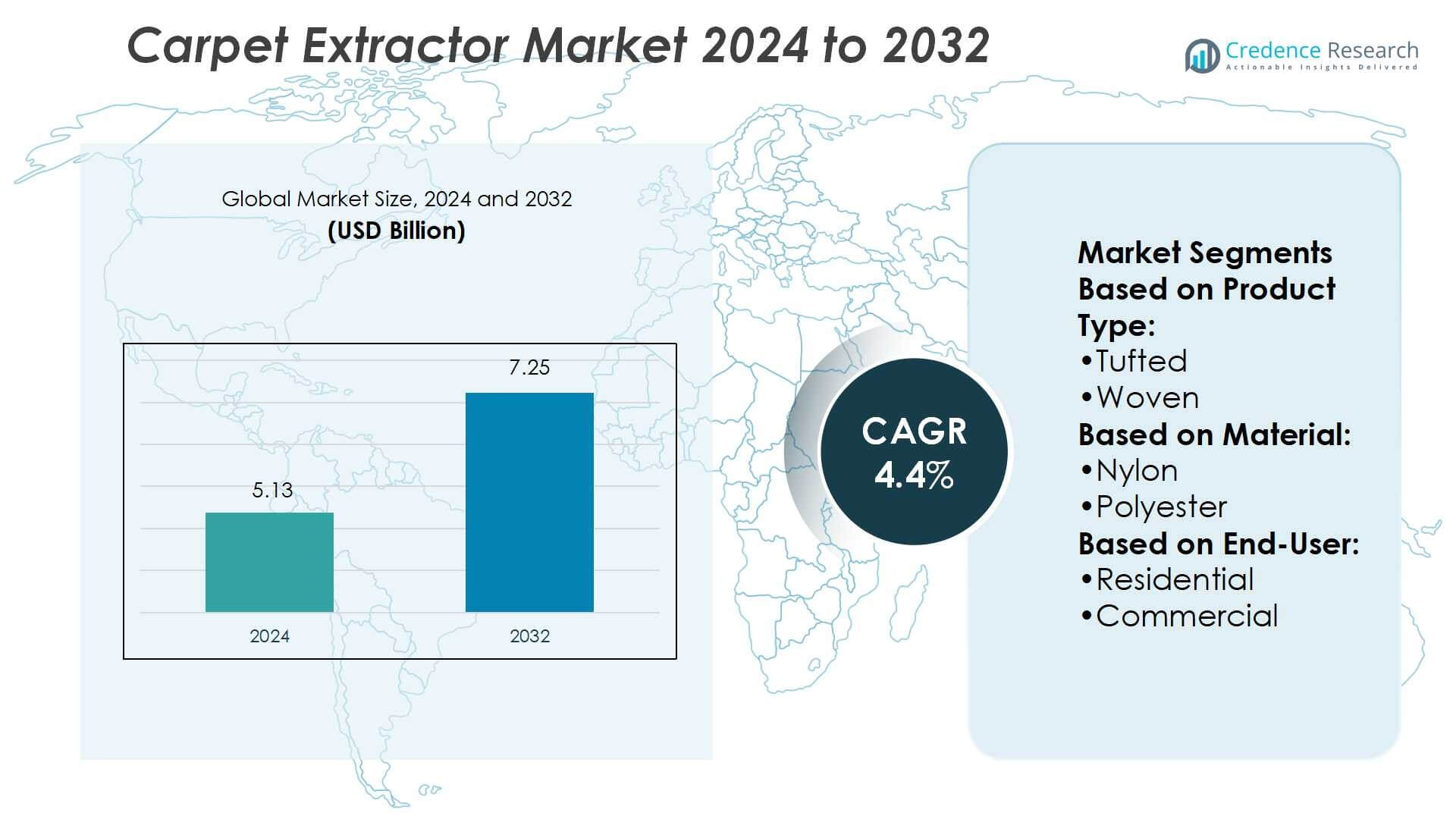
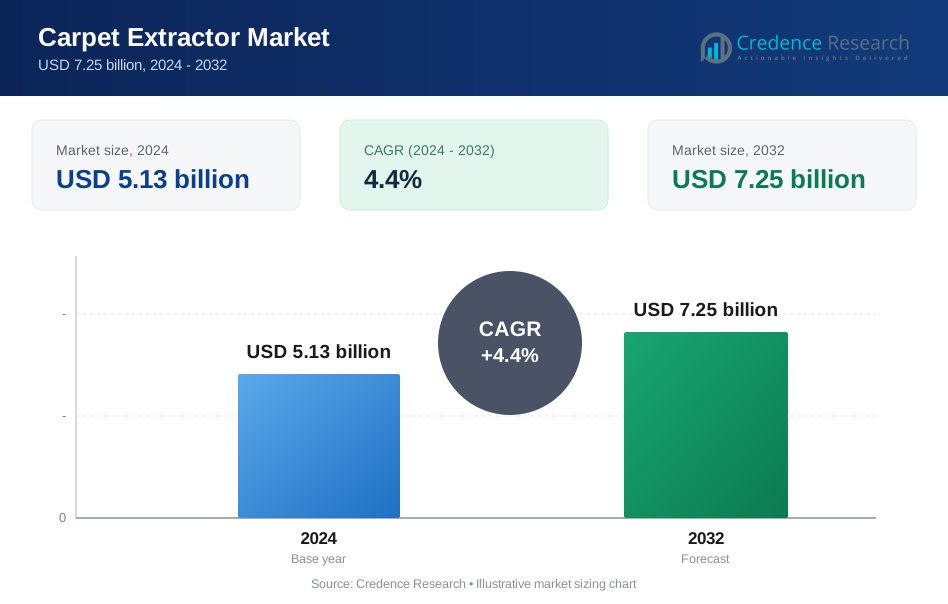
Carpet Extractor Market size was valued at USD 5.13 billion in 2024 and is anticipated to reach USD 7.25 billion by 2032, at a CAGR of 4.4% during the forecast period.
| REPORT ATTRIBUTE | DETAILS |
|---|---|
| Historical Period | 2020-2023 |
| Base Year | 2024 |
| Forecast Period | 2025-2032 |
| Carpet Extractor Market Size 2024 | USD 5.13 Billion |
| Carpet Extractor Market, CAGR | 4.4% |
| Carpet Extractor Market Size 2032 | USD 7.25 Billion |
The Carpet Extractor Market grows with rising demand for deep-cleaning solutions across residential and commercial spaces, supported by health awareness, urbanization, and expansion of hospitality and healthcare sectors. It benefits from technological advancements that improve suction efficiency, water recovery, and ease of use, driving faster adoption. Eco-friendly designs with reduced resource consumption align with sustainability goals and strengthen customer appeal. Trends highlight increasing preference for portable, compact, and smart-connected machines that enhance convenience and performance. Rental and subscription models expand accessibility, while regulatory focus on hygiene and sustainability reinforces innovation and long-term market growth.
The Carpet Extractor Market shows strong geographical presence, with North America leading due to advanced adoption in commercial facilities, Europe emphasizing regulatory compliance and sustainable solutions, and Asia Pacific emerging as the fastest-growing region with rising urbanization and hospitality expansion. Latin America and the Middle East & Africa present steady opportunities through growing service industries. Key players strengthen competitiveness with innovation and global distribution, focusing on durability, eco-friendly designs, and customer-centric strategies to capture diverse regional demand.
Market Insights
- The Carpet Extractor Market size was valued at USD 5.13 billion in 2024 and is anticipated to reach USD 7.25 billion by 2032, at a CAGR of 4.4%.
- Rising demand for deep-cleaning solutions in residential and commercial sectors supports steady market growth.
- Health awareness, urbanization, and hospitality expansion drive adoption of advanced cleaning equipment.
- Eco-friendly, compact, and smart-connected machines reflect key market trends shaping future demand.
- Competitive intensity remains high as companies focus on innovation, durability, and strong distribution networks.
- High equipment cost and maintenance requirements act as restraints for wider adoption.
- North America leads in market share, Europe emphasizes sustainable compliance, Asia Pacific grows fastest, while Latin America and the Middle East & Africa show steady opportunities.
 Market Drivers
Rising Demand for Professional Cleaning Solutions in Commercial Facilities
The Carpet Extractor Market benefits from strong adoption in commercial facilities where hygiene and presentation remain vital. Offices, hotels, and retail outlets depend on advanced carpet cleaning equipment to maintain a professional appearance for employees and customers. Increasing foot traffic in these environments accelerates the need for deep-cleaning systems that provide effective stain removal and quick drying. Facility managers prioritize machines that enhance efficiency, reduce manual labor, and lower long-term maintenance costs. It supports consistent cleanliness standards, which align with corporate policies and customer expectations. This demand strengthens the role of professional-grade carpet extractors across multiple commercial sectors.
- For instance, HengYe manufactures molecular sieves of types 3A, 4A, 5A, 13X and specialty zeolites. Their activated alumina products have surface area over 200 m²/g. They offer bead sizes and mesh sizes such as 4×8 mesh, 8×12 mesh, 20×40 mesh for molecular sieve beads; bead sizes like 1/4 inch, 3/16 inch, 1-8 inch, 7×14 mesh, powder form etc for activated alumina.
Expanding Residential Applications Supported by Health Awareness and Lifestyle Changes
Growing awareness of indoor air quality and health drives demand for advanced cleaning in households. The Carpet Extractor Market gains momentum from homeowners seeking solutions that eliminate allergens, dust, and bacteria embedded in carpets. Rising disposable incomes allow consumers to invest in durable, high-performance machines rather than relying only on basic cleaning methods. Urban lifestyles create a preference for devices that deliver convenience and long-lasting results. It reflects the trend of consumers prioritizing hygiene as part of overall wellness and home environment improvement. This shift supports steady residential adoption of carpet extractors, widening the customer base.
- For instance, The product information confirms a high adsorption capacity for water vapor. Specifically, it lists a minimum adsorption capacity of 22.0% at 80% relative humidity and 80.0% at 100% relative humidity.
Technological Advancements Enhancing Efficiency and Sustainability
Manufacturers focus on innovation that improves extraction performance, energy use, and water efficiency. The Carpet Extractor Market evolves with machines featuring powerful suction, advanced pump systems, and ergonomic designs. Integration of smart controls enables users to monitor performance and optimize cleaning cycles. Eco-friendly models that use less detergent and reduce resource consumption address sustainability goals. It highlights the industry’s response to both regulatory pressures and consumer preferences for greener products. These developments encourage faster replacement cycles and greater acceptance in both commercial and residential settings.
Growth in Service Industry and Rental Sector Adoption
Carpet cleaning service providers and rental companies significantly expand market reach by making equipment accessible without full ownership. The Carpet Extractor Market benefits from strong demand in cleaning services that cater to offices, event venues, and hospitality businesses. Rental firms support affordability for smaller businesses and households that prefer temporary usage. Expanding urbanization creates a consistent flow of customers seeking professional services, particularly in high-density areas. It increases machine utilization rates and strengthens recurring revenue opportunities for manufacturers and rental operators. This growth channel reinforces overall industry expansion and diversification.
Market Trends
Integration of Smart Features and Digital Monitoring in Cleaning Equipment
The Carpet Extractor Market shows a strong trend toward digital integration, with smart features gaining traction among users. Machines equipped with sensors, IoT connectivity, and automated controls deliver precise performance tracking. It enables operators to monitor water usage, suction efficiency, and cleaning cycles in real time. Service providers use these insights to reduce downtime, extend equipment life, and ensure consistent cleaning standards. Remote diagnostics and app-based control appeal to both commercial and residential users. This trend emphasizes the shift toward data-driven cleaning solutions that improve convenience and reliability.
- For instance, Clariant Aristocare Smart polymer can be used at concentrations starting from 0.05 % in detergent formulations, while maintaining stability across a pH range of 1 to 12 and compatibility with three surfactant types (cationic, non-ionic, anionic), offering technical consistency in highly variable cleaning environments.
Growing Preference for Eco-Friendly and Sustainable Carpet Care Solutions
Environmental awareness and strict regulations push manufacturers to design sustainable carpet extractors. The Carpet Extractor Market advances with models that use less water, eco-certified detergents, and energy-efficient motors. It supports businesses and households aiming to lower their environmental footprint without compromising cleaning results. Lightweight designs and recyclable materials in machine construction reflect the industry’s alignment with green practices. Demand for eco-labeled equipment strengthens among corporate buyers and government institutions prioritizing sustainability goals. This trend highlights the importance of balancing performance with environmental responsibility.
- For instance, W. R. Grace recently introduced its MIDAS Pro FCC catalyst platform, demonstrating maintenance of bottoms-cracking performance under iron contamination levels of 1,000 parts per million of Fe while delivering a Diffusivity Index of about 55 in commercial units, enabling greater feedstock tolerance without higher catalyst replacement.
Rising Demand for Portable and Compact Carpet Extractor Designs
Portability has become a key design focus, driven by the need for mobility and space efficiency. The Carpet Extractor Market benefits from compact machines that cater to small offices, apartments, and quick-service cleaning needs. It allows service providers to access tight spaces and complete tasks with greater flexibility. Lightweight, easy-to-carry designs improve operator comfort and productivity across diverse environments. Growing urbanization supports this trend, where consumers prefer equipment that fits modern living and working spaces. The emphasis on portability expands adoption beyond large-scale commercial facilities into broader consumer segments.
Expansion of Rental Services and Subscription-Based Cleaning Models
The market experiences growing traction from rental and subscription-based access to cleaning equipment. The Carpet Extractor Market gains visibility through providers offering affordable short-term use and pay-per-service options. It appeals to small businesses and households that seek professional cleaning without major capital investment. Rental companies upgrade fleets regularly, exposing customers to the latest machine technology. This trend strengthens recurring demand and broadens accessibility across emerging regions. It underlines a clear movement toward flexible ownership models supporting both affordability and innovation adoption.
Market Challenges Analysis
High Equipment Costs and Maintenance Requirements Restricting Wider Adoption
The Carpet Extractor Market faces challenges from high upfront costs and ongoing maintenance expenses. Commercial-grade machines require significant investment, which creates barriers for small businesses and budget-conscious households. It often demands regular servicing, replacement parts, and professional upkeep to maintain efficiency. Downtime during repairs can disrupt operations for cleaning companies that rely on consistent service delivery. Consumers hesitate to purchase advanced models when affordable alternatives, such as vacuum cleaners or outsourcing, remain available. This cost-driven challenge limits the speed of adoption in certain customer segments and slows penetration in price-sensitive markets.
Operational Complexity and Limited Awareness Among Residential Users
Complexity in handling carpet extractors restricts widespread use, particularly in residential applications. The Carpet Extractor Market struggles when homeowners view machines as difficult to operate compared to simpler cleaning tools. It requires training and proper technique to achieve optimal cleaning results, which discourages inexperienced users. Limited awareness about the benefits of deep extraction cleaning further reduces household adoption. Rental companies attempt to bridge this gap, but concerns about misuse and maintenance remain. This challenge underscores the importance of user-friendly designs and awareness campaigns to expand acceptance in the residential sector.
Market Opportunities
Expanding Demand from Hospitality, Healthcare, and Corporate Sectors
The Carpet Extractor Market presents strong opportunities in industries where cleanliness and hygiene remain critical. Hotels, hospitals, and corporate offices require advanced cleaning systems to meet strict health and safety standards. It enables organizations to maintain professional environments that improve customer trust and employee comfort. Rising construction of commercial spaces in emerging economies expands the need for large-scale carpet maintenance solutions. Service providers catering to these sectors gain recurring demand for efficient extractors with advanced features. This creates a profitable growth channel for manufacturers targeting professional applications.
Rising Adoption of Eco-Friendly and User-Friendly Cleaning Technologies
Sustainability initiatives open opportunities for carpet extractors designed with low water usage, eco-certified detergents, and energy-efficient motors. The Carpet Extractor Market benefits when consumers and institutions adopt green technologies that align with regulatory frameworks. It also favors machines with user-friendly designs, compact sizes, and simplified controls that attract residential buyers. Growing consumer awareness about indoor air quality creates a willingness to invest in deep cleaning solutions. Expansion of rental and subscription-based access models further lowers entry barriers for new users. This combination of sustainability and usability strengthens future adoption across both commercial and residential segments.
Market Segmentation Analysis:
By Product Type
The Carpet Extractor Market demonstrates varied adoption across tufted, woven, needle-punched, knotted or hand-knotted, and other carpet types. Tufted carpets dominate due to affordability, durability, and broad availability in residential and commercial spaces. Woven carpets retain demand in luxury settings, offering higher aesthetics and long-lasting performance. Needle-punched carpets find application in lower-cost environments, where functional performance outweighs appearance. Knotted and hand-knotted carpets, often handmade, represent a premium segment driven by cultural and artistic appeal. It requires specialized extraction systems capable of handling delicate fibers without damage. The diversity in carpet types supports a wide scope of extractor designs.
- For instance, Fuji Silysia Chemical produces silica-gel with primary particle sizes ranging from 3 to 30 nanometers, and pore sizes from a few nanometers to several hundred nanometers.
By Material
Segmentation by material highlights the influence of fiber type on cleaning needs and equipment performance. Nylon remains the most widely used carpet fiber, valued for resilience and stain resistance, driving demand for strong extraction systems. Polyester continues to grow due to affordability and color versatility, though it requires effective cleaning solutions to maintain longevity. Polypropylene serves as a popular choice in commercial installations for moisture resistance, requiring extractors with powerful suction. Wool carpets, though less common, demand gentle extraction due to their natural fiber structure. Other natural fibers and premium blends cater to niche markets emphasizing eco-friendliness. It also opens opportunities for extractors designed for recycled and bio-based fibers, aligning with sustainability goals.
- For instance, Evonik REWOFERM RL 100 rhamnolipid surfactant lowers the surface tension of water from 72 mN/m to a value less than 30 mN/m when used in cleaning formulations, and passes OECD 301 F and EN ISO 11734 biodegradability tests under both aerobic and anaerobic conditions.
By End User
The end-user segment divides into residential and commercial applications, each with distinct demand patterns. The Carpet Extractor Market grows significantly in commercial spaces, including hotels, offices, healthcare facilities, and retail outlets, where frequent cleaning ensures hygiene and extended carpet life. It creates steady demand for heavy-duty machines with advanced features like high-capacity tanks and faster drying. Residential users increasingly adopt portable, user-friendly extractors to maintain indoor hygiene and air quality. Growing urbanization and health awareness encourage homeowners to shift from basic cleaning methods to deep-cleaning solutions. Commercial demand continues to dominate in revenue share, but residential adoption shows strong long-term potential. This balance strengthens overall market expansion across diverse customer bases.
Segments:
Based on Product Type:
- Tufted
- Woven
Based on Material:
- Nylon
- Polyester
Based on End-User:
- Residential
- Commercial
Based on the Geography:
- North America
- U.S.
- Canada
- Mexico
- Europe
- UK
- France
- Germany
- Italy
- Spain
- Russia
- Rest of Europe
- Asia Pacific
- China
- Japan
- South Korea
- India
- Australia
- Southeast Asia
- Rest of Asia Pacific
- Latin America
- Brazil
- Argentina
- Rest of Latin America
- Middle East
- GCC Countries
- Israel
- Turkey
- Rest of Middle East
- Africa
- South Africa
- Egypt
- Rest of Africa
Regional Analysis
North America
North America holds the largest share of the Carpet Extractor Market, accounting for 34%. The region benefits from strong commercial adoption, particularly in the hospitality, healthcare, and corporate sectors where hygiene standards remain a priority. It supports widespread use of professional-grade machines that deliver advanced cleaning and quick drying times. The United States leads demand, supported by high carpet penetration in both residential and commercial spaces. Canada follows closely with growing investments in the hotel industry and rising awareness of indoor air quality. Service providers in the region continuously upgrade equipment fleets to meet customer expectations, strengthening demand for technologically advanced extractors. Regulatory emphasis on sustainable cleaning solutions further drives adoption of energy-efficient and eco-friendly models.
Europe
Europe represents 27% of the Carpet Extractor Market, driven by strict environmental regulations and a strong service-based cleaning culture. Countries such as Germany, the United Kingdom, and France lead the market with demand concentrated in commercial spaces like offices, airports, and retail outlets. It reflects the region’s emphasis on regulatory compliance, sustainable practices, and advanced hygiene standards. The popularity of wool and natural fiber carpets in European households also supports steady demand for specialized extractors. Professional cleaning services dominate, though residential adoption is rising in urban centers with growing consumer awareness. European manufacturers focus heavily on eco-labeled products, aligning with EU sustainability goals. Rental models are also gaining traction in the region, offering affordable access to high-performance machines.
Asia Pacific
Asia Pacific captures 22% of the Carpet Extractor Market, emerging as the fastest-growing region. Rapid urbanization, rising disposable incomes, and expansion of the hospitality industry drive demand for professional cleaning solutions. It benefits from large-scale construction of commercial properties in China, India, and Southeast Asia. Carpet penetration in urban homes increases the need for affordable and portable extractors that fit smaller living spaces. Japan and South Korea emphasize technologically advanced equipment, while Australia contributes with strong adoption in hospitality and healthcare. Service providers in the region are expanding quickly, offering cleaning solutions to meet the rising demand in metropolitan areas. Growth prospects remain strong as awareness of health and hygiene expands among both residential and commercial users.
Latin America
Latin America accounts for 10% of the Carpet Extractor Market, supported by rising demand in Brazil, Mexico, and Argentina. Commercial facilities such as shopping malls, hotels, and office complexes represent the core drivers of growth. It faces moderate adoption in residential settings due to relatively lower carpet penetration compared to other regions. The rental and service-based cleaning industry is gaining traction, offering affordable alternatives for businesses and households. Regional manufacturers are gradually introducing eco-friendly and compact designs to appeal to growing environmental awareness. Economic fluctuations present challenges, but increasing urban development supports stable long-term growth. This regional market shows potential for expansion as modernization and disposable incomes improve.
Middle East & Africa
The Middle East & Africa holds a 7% share of the Carpet Extractor Market, with demand concentrated in the Gulf countries. Hospitality remains the primary growth driver, with luxury hotels and resorts investing heavily in advanced cleaning solutions. It also gains demand from healthcare and corporate offices where hygiene and professional image remain essential. Carpet use in residential spaces varies, with higher penetration in urban centers and premium households. South Africa and the UAE serve as leading markets, while other countries adopt extractors at a slower pace due to affordability concerns. The region shows rising interest in eco-friendly and water-efficient machines, aligning with sustainability initiatives. Growth remains gradual, but increasing investment in infrastructure and hospitality projects supports steady demand.
Key Player Analysis
- TROPACK Packmitel GmbH
- Hengye, Inc
- OKER-CHEMIE
- CLARIANT
- R. Grace & Co-Conn
- Fuji Silysia Chemical Ltd.
- Capitol Scientific, Inc
- Multisorb
- Evonik Industries AG
- Desicca Chemical Pvt. Ltd.
Competitive Analysis
The Carpet Extractor Market remains players including TROPACK Packmitel GmbH, Hengye, Inc, OKER-CHEMIE, CLARIANT, W.R. Grace & Co-Conn, Fuji Silysia Chemical Ltd., Capitol Scientific, Inc, Multisorb, Evonik Industries AG, and Desicca Chemical Pvt. Ltd. The Carpet Extractor Market is defined by intense competition where companies prioritize innovation, performance, and sustainability to secure market advantage. Manufacturers focus on developing machines with stronger suction power, faster drying capability, and reduced water consumption to meet diverse customer needs. Product differentiation remains essential, as residential buyers seek compact and affordable models, while commercial clients demand heavy-duty, high-capacity solutions. Companies strengthen their positions by expanding distribution networks, offering rental and subscription-based options, and providing strong after-sales support. Growing emphasis on eco-friendly technologies and ergonomic designs drives further product development. It highlights a competitive landscape where success depends on balancing technological advancement, cost efficiency, and customer trust.
Recent Developments
- In December 2024, Xinyi Solar and Xinyi Glass have renewed their silica sand agreement under this agreement, a subsidiary of Xinyi Solar will continue supplying silica sand to the XYG Group for float glass production.A Xinyi Solar subsidiary will continue supplying silica sand to the XYG Group for float glass production.
- In December 2024, Elkem and Hafslund entered into a long-term power agreement covering the period from 2028 to 2035, securing an annual supply of approximately 400 GWh for Elkem’s Thamshavn plant.
- In August 2024, Uber and BYD announced a strategic partnership aimed at integrating 100,000 electric vehicles (EVs) into Uber's global ride-hailing platform. This multi-year collaboration will initially launch in Europe and Latin America, with plans to expand to regions including the Middle East, Canada, Australia, and New Zealand.
- In February 2024, Aptar CSP Technologies collaborated with ProAmpac announced the launching of ProActive Intelligence Moisture Protect. This helps in delivering a better moisture adsorbing packaging solution.
Report Coverage
The research report offers an in-depth analysis based on Product Type, Material, End-User and Geography. It details leading market players, providing an overview of their business, product offerings, investments, revenue streams, and key applications. Additionally, the report includes insights into the competitive environment, SWOT analysis, current market trends, as well as the primary drivers and constraints. Furthermore, it discusses various factors that have driven market expansion in recent years. The report also explores market dynamics, regulatory scenarios, and technological advancements that are shaping the industry. It assesses the impact of external factors and global economic changes on market growth. Lastly, it provides strategic recommendations for new entrants and established companies to navigate the complexities of the market.
Future Outlook
- Demand for carpet extractors will rise with growing hygiene awareness in homes and workplaces.
- Commercial facilities will continue to drive adoption through frequent cleaning requirements and high foot traffic.
- Eco-friendly models with reduced water and energy use will gain stronger acceptance.
- Portable and compact machines will see higher demand in urban residential spaces.
- Smart and connected extractors with IoT-enabled monitoring will expand in both sectors.
- Rental and subscription-based models will attract small businesses and households seeking affordability.
- Innovation in ergonomic design will improve operator comfort and efficiency.
- Emerging markets will offer growth opportunities through expanding hospitality and healthcare sectors.
- Manufacturers will focus on developing durable machines suitable for diverse carpet materials.
- Sustainability goals and regulations will shape future product design and market strategies.
Request a Free Sample
Fill in your details and we'll send you a free sample report.
- Sample data tables & charts
- Research methodology
Need a Custom Version of This Report?
Tailor the scope, geography, or segments to your exact requirements.
- Custom geography or segment scope
- Direct access to our analyst team
Frequently Asked Questions
What is the current market size for Carpet Extractor Market, and what is its projected size in 2032?
At what Compound Annual Growth Rate is the Carpet Extractor Market projected to grow between 2025 and 2032?
Which Carpet Extractor Market segment held the largest share in 2024?
What are the primary factors fueling the growth of the Carpet Extractor Market?
Who are the leading companies in the Carpet Extractor Market?
Which region commanded the largest share of the Carpet Extractor Market in 2024?
Table of Content
Chapter 1. Report Introduction
- 1.1 Report Description & Purpose
- 1.1.1 Report Title & Market Definition
- 1.1.2 Unique Selling Propositions (USP) & Key Differentiators
- 1.1.3 Value Proposition for Stakeholders
- 1.2 Research Objectives
- 1.2.1 Market Sizing Objectives (Volume & Revenue)
- 1.2.2 Segmentation Objectives
- 1.2.3 Competitive Intelligence Objectives
- 1.2.4 Forecast & Scenario Objectives
- 1.3 Report Scope
- 1.3.1 Carpet Extractor Scope – Types & Subtypes Covered
- 1.3.2 Geographic Scope – Regions & Countries Covered
- 1.3.3 Historical Period, Base Year & Forecast Period (2024; forecast to 2032)
- 1.3.4 Inclusions & Exclusions
- 1.4 HS Code & Classification Framework
- 1.5 Currency, Units & Pricing Basis
- 1.6 Target Stakeholders
- 1.7 Limitations & Assumptions
Chapter 2. Executive Summary
- 2.1 Global Carpet Extractor Market Snapshot
- 2.1.1 Market Size – Historical (2024) & Forecast (2024-2032) (2024: USD 5.13 billion → 2032: USD 7.25 billion)
- 2.1.2 Volume & Revenue – Global Totals
- 2.1.3 Key Market Highlights – Top Five Facts
- 2.2 Carpet Extractor Market Segmentation Snapshot
- 2.2.1 Market Split by Region – 2024 vs. 2032
- 2.3 Competitive Snapshot
- 2.3.1 Top 10 Players by Revenue Share – 2024
- 2.3.2 Top 10 Players by Volume Share – 2024
- 2.3.3 Recent Strategic Developments (18-Month Summary)
- 2.4 Key Investment Highlights & Strategic Conclusions
Chapter 3. Carpet Extractor Market Dynamics & Industry Analysis
- 3.1 Market Overview & Context
- 3.1.1 Carpet Extractor Market Position in the Broader Automotive Value Chain
- 3.1.2 OEM vs. Replacement Market Dynamics
- 3.1.3 Market Maturity & Development Stage by Region
- 3.2 Carpet Extractor Market Drivers
- 3.3 Carpet Extractor Market Restraints & Challenges
- 3.4 Carpet Extractor Market Opportunities
- 3.5 Porter's Five Forces Analysis
- 3.5.1 Threat of New Entrants
- 3.5.2 Bargaining Power of Suppliers
- 3.5.3 Bargaining Power of Buyers
- 3.5.4 Threat of Substitutes
- 3.5.5 Competitive Rivalry – Intensity Assessment
- 3.6 Carpet Extractor Value Chain Analysis
- 3.6.1 Upstream – Raw Material/Input Suppliers
- 3.6.1.1 Raw Material/Input 1
- 3.6.1.2 Raw Material/Input 2
- 3.6.1.3 Raw Material/Input 3
- 3.6.2 Midstream – Production/Manufacturing/Service Delivery
- 3.6.2.1 Production/Process Overview
- 3.6.2.2 Key Facility Locations & Capacity by Manufacturer
- 3.6.3 Downstream – Distribution & End Consumer
- 3.6.3.1 Primary Channel – B2B/OEM
- 3.6.3.2 Secondary Channels – Dealer, Retail, Online, Direct
- 3.6.4 Value Chain Profitability Analysis
- 3.6.1 Upstream – Raw Material/Input Suppliers
- 3.7 PESTEL Analysis
- 3.7.1 Political Factors
- 3.7.2 Economic Factors
- 3.7.3 Social Factors
- 3.7.4 Technological Factors
- 3.7.5 Environmental Factors
- 3.7.6 Legal Factors
- 3.8 Carpet Extractor Supply Chain Analysis
- 3.8.1 Raw Material/Input Supply Risk Assessment
- 3.8.2 Manufacturing Concentration Risk (Geographic Exposure)
- 3.8.3 Trade Disruption Impact Analysis
- 3.9 Regulatory & Policy Landscape
Note: The regulatory and policy landscape section covers regulations based on their applicability to the market, Carpet Extractor category, geography, and scope of the study. Only regulatory frameworks with a material impact on operations, compliance, trade, sustainability, or market access are analyzed in detail.
Chapter 4. Key Investment Pockets & Opportunity Analysis
- 4.1 Carpet Extractor Market Attractiveness Analysis
- 4.1.1 By Region – Investment Attractiveness Matrix (Volume × CAGR)
- 4.2 Absolute Revenue Growth Opportunity
- 4.2.1 By Region – Absolute USD Growth Through 2032
- 4.3 Incremental Volume Opportunity
- 4.3.1 By Region – Incremental Volume Through 2032
- 4.3.2 Segment – Incremental Volume
- 4.4 Emerging Submarket Opportunity Deep Dive (Subject to Applicability)
- 4.5 Emerging Market Opportunity Scorecards
- 4.5.1 United States
- 4.5.2 Europe
- 4.5.3 Asia
- 4.5.4 Middle East & Africa
Note: Emerging Market Opportunity Scorecards will be included based on relevance and strategic importance. Regions listed are indicative and may vary depending on data availability and market dynamics.
Chapter 5. Carpet Extractor Import-Export Analysis & Trade Flows
- 5.1 Global Trade Overview
- 5.1.1 Global Export Value by Country (2024)
- 5.1.2 Global Export Volume by Country (2024)
- 5.1.3 Global Import Value by Country (2024)
- 5.1.4 Global Import Volume by Country (2024)
- 5.1.5 Net Trade Balance by Country (2024)
- 5.2 Export Analysis – Segment
- 5.2.1 Type 1 (HS Code)
- 5.2.2 Type 2 (HS Code)
- 5.2.3 Type 3 (HS Code)
- 5.2.4 Type 4 (HS Code)
- 5.2.5 Type 5 (HS Code)
- 5.3 Import Analysis – Segment
- 5.3.1 Type 1 (HS Code)
- 5.3.2 Type 2 (HS Code)
- 5.3.3 Type 3 (HS Code)
- 5.3.4 Type 4 (HS Code)
- 5.3.5 Type 5 (HS Code)
- 5.4 Average Unit Trade Prices
- 5.4.1 Average Export Price – Segment & Country
- 5.4.2 Average Import Price – Segment & Source Country
- 5.4.3 Price Trends (2024)
- 5.5 Key Trade Route Analysis
- 5.5.1 Trade Route 1
- 5.5.2 Trade Route 2
- 5.5.3 Trade Route 3
- 5.5.4 Trade Route 4
- 5.5.5 Trade Route 5
- 5.6 Trade Policy Impact Assessment
- 5.6.1 US Anti-Dumping & Section 301 Tariffs
- 5.6.2 EU Customs Union Impact
- 5.6.3 Major Free Trade Agreements
- 5.6.4 USMCA Rules of Origin
Note: Trade policy analysis will be included only where relevant to the Carpet Extractor market.
Chapter 6. Competitive Landscape & Company Benchmarking
- 6.1 Carpet Extractor Market Concentration & Structure
- 6.1.1 Herfindahl-Hirschman Index (HHI) – vs. 2024
- 6.1.2 Tier 1, Tier 2 & Tier 3 Market Structure
- 6.1.3 Global, Regional & Local Player Dynamics
- 6.2 Carpet Extractor Market Share Analysis – 2024
- 6.2.1 Global Revenue Share by Company
- 6.2.2 Global Volume Share by Company
- 6.2.3 Regional Revenue Share
- 6.2.4 Market Share Evolution ( vs. 2024)
- 6.2.5 OEM Segment Share by Company
- 6.2.6 Replacement Segment Share by Company
- 6.3 Production/Delivery Capacity & Facility Analysis
- 6.3.1 Global Installed Capacity
- 6.3.2 Capacity Utilization Rates
- 6.3.3 Production/Output Volume
- 6.3.4 Facility Locations & Capacity Map
- 6.3.5 Planned Capacity Additions
- 6.4 Carpet Extractor Competitive Benchmarking Matrix
- 6.4.1 Revenue, Volume, CAGR & Profitability Comparison
- 6.4.2 Channel Revenue Mix
- 6.4.3 Geographic Revenue Exposure
- 6.4.4 R&D Intensity
- 6.4.5 Sustainability Maturity
- 6.5 Strategic Developments in Carpet Extractor (Last 24 Months)
- 6.5.1 Mergers, Acquisitions & Divestments
- 6.5.2 New Carpet Extractor Launches
- 6.5.3 Facility Expansions
- 6.5.4 Strategic Alliances, Joint Ventures & Partnerships
- 6.5.5 Distribution Expansion & Market Entry
- 6.5.6 Sustainability & ESG Initiatives
- 6.6 Competitive Strategy Mapping
- 6.6.1 Leader, Challenger, Follower & Niche Classification
- 6.6.2 Pricing Strategy Comparison
- 6.6.3 Channel Strategy Matrix
Note: Strategic developments are included based on their materiality and the availability of reliable information.
Chapter 7. Global Carpet Extractor Market – By Distribution Channel
- 7.1 Segment Overview
- 7.1.1 Volume & Revenue Split by Channel (2024 & 2032)
- 7.1.2 Channel Mix Evolution (2024-2032)
Chapter 8. Regional Market Analysis – Global Overview
- 8.1 Global Regional Overview
- 8.1.1 Regional Volume Share
- 8.1.2 Regional Revenue Share
- 8.1.3 Regional Volume by Region
- 8.1.4 Regional Revenue by Region
- 8.1.5 Regional Forecast Through 2032
- 8.2 Cross-Regional Segment Analysis
- 8.2.1 By Distribution Channel
- 8.2.2 By Brand/Price Tier
Chapter 9. North America Carpet Extractor Market
- 9.1 United States
- 9.2 Canada
- 9.3 Mexico
Chapter 10. Europe Carpet Extractor Market
- 10.1 Germany
- 10.2 France
- 10.3 Italy
- 10.4 United Kingdom
- 10.5 Spain
- 10.6 Poland
- 10.7 Russia
- 10.8 Netherlands
- 10.9 Belgium
- 10.10 Sweden
- 10.11 Denmark
- 10.12 Norway
- 10.13 Rest of Europe
Chapter 11. Asia Pacific Carpet Extractor Market
- 11.1 China
- 11.2 India
- 11.3 Japan
- 11.4 South Korea
- 11.5 Thailand
- 11.6 Indonesia
- 11.7 Vietnam
- 11.8 Malaysia
- 11.9 Australia
- 11.10 Rest of Asia Pacific
Chapter 12. Latin America Carpet Extractor Market
- 12.1 Brazil
- 12.2 Argentina
- 12.3 Colombia
- 12.4 Chile
- 12.5 Rest of Latin America
Chapter 13. Middle East Carpet Extractor Market
- 13.1 Saudi Arabia
- 13.2 United Arab Emirates
- 13.3 Turkey
- 13.4 Israel
- 13.5 Iran
- 13.6 Rest of the Middle East
Chapter 14. Africa Carpet Extractor Market
- 14.1 South Africa
- 14.2 Egypt
- 14.3 Nigeria
- 14.4 Morocco
- 14.5 Rest of Africa
Chapter 15. Carpet Extractor Company Profiles
- 15.1 [Company 01]
- 15.1.1 Company Overview
- 15.1.2 Key Management Personnel
- 15.1.3 Products & Services Portfolio
- 15.1.4 Financial Performance
- 15.1.5 Key Market Focus & Geographic Presence
- 15.1.6 Recent Developments & Strategic Initiatives
Note: The company profile list is preliminary and may change based on research findings, market developments, data availability, and client requirements.
Chapter 16. Appendices
- Appendix A – List of Abbreviations & Acronyms
- Appendix B – Industry Classification Code Reference – Full Series
- Appendix C – Production & Capacity Data Tables
- Appendix D – End-Use & Demand Base Tables
- Appendix E – Consumption & Replacement Rate Assumptions
- Appendix F – ASP Reference Tables
- Appendix G – Manufacturing & Facility Database
- Appendix H – Import-Export Data Tables
- Appendix I – Regulatory Summary Tables
- Appendix J – Primary Research Participant List (Anonymized)
- Appendix K – Primary Research Questionnaire Framework
- Appendix L – Data Sources & Bibliography
- Appendix M – Market Size Divergence & Source Comparison
Chapter 17. Research Methodology
- 17.1 Research Framework & Philosophy
- 17.2 Secondary Research – Sources, Hierarchy & Data Extraction
- 17.3 Data Modeling – Bottom-Up & Top-Down Market Sizing
- 17.4 Primary Research – Stakeholder Framework, LOI & Sample Sizes
- 17.5 Forecast Methodology – Regression, Scenario & Sensitivity Analysis
- 17.6 Quality Control – Four-Layer Validation Framework
- 17.7 Limitations & Standard Assumptions
- 17.8 Disclaimer
