Market Overview:
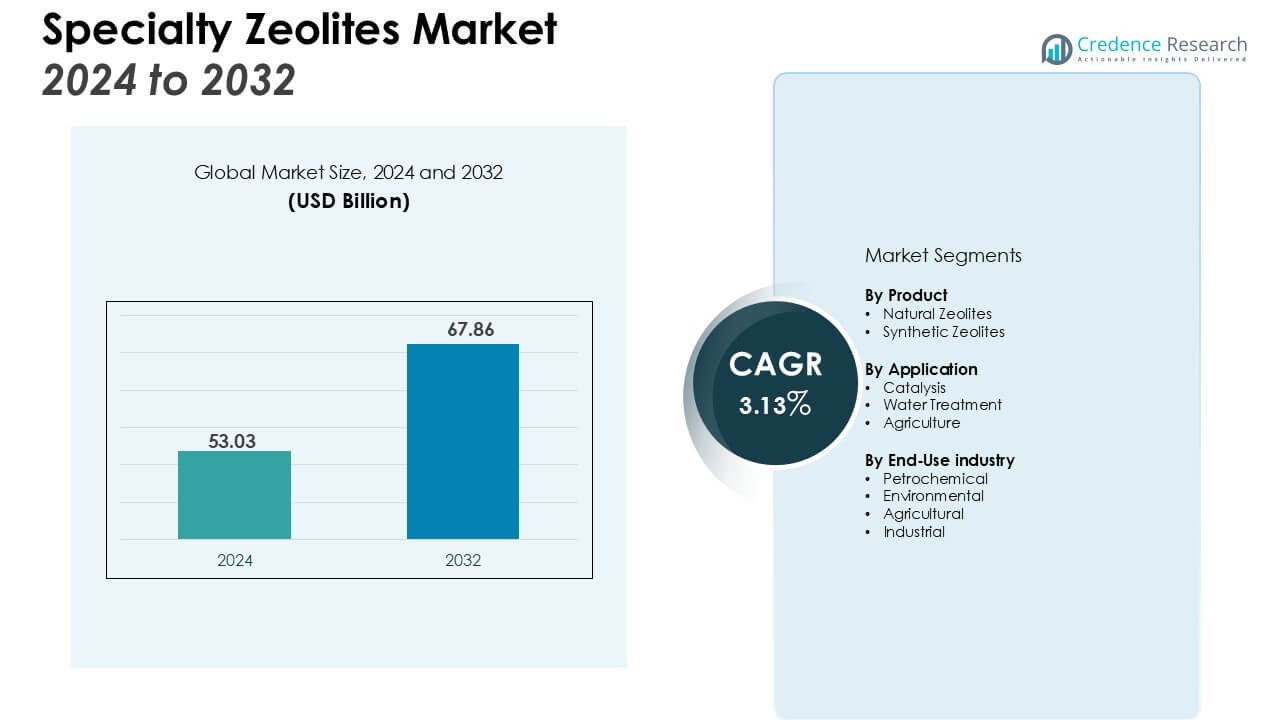
The Specialty Zeolites Market size was valued at USD 53.03 billion in 2024 and is anticipated to reach USD 67.86 billion by 2032, at a CAGR of 3.13% during the forecast period (2024-2032).
| REPORT ATTRIBUTE | DETAILS |
|---|---|
| Historical Period | 2020-2023 |
| Base Year | 2024 |
| Forecast Period | 2025-2032 |
| Specialty Zeolites Market Size 2024 | USD 53.03 Billion |
| Specialty Zeolites Market, CAGR | 3.13% |
| Specialty Zeolites Market Size 2032 | USD 67.86 Billion |
Key drivers of the Specialty Zeolites Market include the growing demand for high-performance catalysts in the petrochemical industry, where zeolites are used to enhance the efficiency of catalytic processes. Additionally, the rise in water treatment applications, driven by global environmental concerns and stringent regulations, further boosts market growth. The demand for zeolites in agricultural and livestock feed additives also plays a significant role in the market's expansion, as they contribute to enhanced crop yields and livestock health. Moreover, advancements in zeolite technology are leading to the development of more efficient and cost-effective solutions, driving further adoption across various industries.
Regionally, North America holds the largest share of the Specialty Zeolites Market due to the strong presence of key industrial players and a well-established petrochemical industry. The Asia Pacific region is expected to witness the highest growth during the forecast period, driven by rapid industrialization and infrastructure development in countries like China and India.
 Market Insights:
- The Specialty Zeolites Market is valued at USD 53.03 billion in 2024 and expected to reach USD 67.86 billion by 2032, growing at a CAGR of 3.13%.
- The demand for high-performance catalysts in the petrochemical industry drives market growth, with zeolites enhancing catalytic efficiency.
- Zeolites are increasingly used in water treatment to remove contaminants, benefiting from stringent environmental regulations.
- Zeolites improve soil health and crop yields in agriculture while enhancing livestock health by improving nutrient absorption.
- Advancements in zeolite production methods enable more efficient, cost-effective solutions, expanding their use in new applications.
- North America holds 35% of the market share, driven by a strong petrochemical industry and innovation, while Asia Pacific follows with 30%.
- Europe holds 25% of the market share, driven by sustainable agriculture practices and environmental regulations promoting green technologies.
Market Drivers:
Growing Demand for High-Performance Catalysts in Petrochemical Industry
The increasing need for high-performance catalysts in the petrochemical industry is a major driver of the Specialty Zeolites Market. Zeolites are widely used to enhance the efficiency of catalytic processes, particularly in refining crude oil and producing high-octane gasoline. Their unique properties, such as high thermal stability and selective adsorption, make them ideal for use in various catalytic applications. The demand for cleaner and more efficient processes in petrochemical manufacturing further boosts the need for zeolites, propelling market growth.
Rising Applications in Water Treatment and Environmental Concerns
The Specialty Zeolites Market is also benefiting from the growing use of zeolites in water treatment processes. The increasing concerns regarding water pollution and the need for efficient water purification methods have led to the adoption of zeolites for filtering and removing contaminants. Zeolites are effective in adsorbing heavy metals, ammonia, and other pollutants, making them ideal for water treatment applications in both municipal and industrial sectors. Stringent environmental regulations around water quality contribute to the demand for zeolite-based solutions.
For instance, a field test of a zeolite-based water treatment system demonstrated its high efficiency by successfully lowering the molybdenum concentration in the processed water from an initial 0.186 mg/l down to 0.012 mg/l.Increasing Demand in Agriculture and Livestock Feed Additives
Zeolites are gaining significant traction in agriculture and livestock feed additives due to their beneficial properties. They are used to improve soil health and enhance crop yields by improving nutrient retention and reducing water and fertilizer requirements. In livestock feed, zeolites help in improving animal health by reducing the presence of toxins and improving nutrient absorption. Their role in promoting sustainable agricultural practices supports the market's growth in these sectors.
For instance, Zeocem's product, ZeoFeed, is a natural zeolite additive authorized for use in animal feed for all species, with a maximum inclusion level of 10,000 mg/kg of complete feed.Technological Advancements in Zeolite Production
Advancements in zeolite technology are another key factor driving market growth. The development of more efficient and cost-effective production methods has led to the creation of specialized zeolites tailored for various industrial applications. These innovations are improving the performance of zeolites, expanding their use in emerging applications such as fuel cells, sensors, and advanced filtration systems. Enhanced zeolite formulations contribute to market expansion as they meet the evolving demands of industries worldwide.
Market Trends:
Expansion of Specialty Zeolites in Renewable Energy Applications
The Specialty Zeolites Market is witnessing a growing trend in the application of zeolites in renewable energy sectors, particularly in energy storage and hydrogen production. Zeolites are being used in fuel cells, where they aid in hydrogen storage and improve the efficiency of energy conversion processes. Their unique adsorption properties make them ideal for capturing and releasing hydrogen in a controlled manner, which is critical for fuel cell technology. As the global push for clean energy intensifies, zeolites play a significant role in enhancing the performance of renewable energy systems. This trend is expected to drive demand for zeolites as key enablers in the transition to more sustainable energy solutions.
For instance, Honeywell UOP's Polybed™ pressure swing adsorption (PSA) technology is widely used for hydrogen purification, the company has successfully installed more than 1,100 of these PSA units in over 70 countries, demonstrating its significant role in providing high-purity hydrogen for various industrial applications.Shift Towards Eco-Friendly and Sustainable Solutions
There is an increasing trend toward the use of eco-friendly and sustainable solutions across industries, which positively influences the Specialty Zeolites Market. Zeolites are naturally occurring, biodegradable, and highly efficient in various applications, making them attractive for industries focused on reducing their environmental impact. Their use in water purification, soil enhancement, and waste management aligns with the global shift toward sustainability. Furthermore, the demand for green technologies in sectors such as agriculture and construction is rising, leading to greater adoption of zeolites. These trends reflect the growing preference for natural, environmentally safe alternatives, enhancing the market’s potential.
For instance, research on Turkish clinoptilolite for ammonia removal in drinking water demonstrated its high efficiency. In fixed ion exchange column experiments, the zeolite's adsorption capabilities were so effective that breakthrough, or the point of saturation, was only observed after the system had processed 125 bed volumes of contaminated water.Market Challenges Analysis:
High Cost of Production and Technological Barriers
One of the key challenges facing the Specialty Zeolites Market is the high cost of production. The extraction and processing of zeolites can be expensive, particularly for high-purity grades used in advanced applications. The complex manufacturing processes and the need for specialized equipment contribute to increased production costs. These expenses can limit the widespread adoption of zeolites, particularly in industries with tight budgets. Overcoming these technological barriers and reducing production costs is essential for expanding the market's reach across various sectors.
Limited Availability and Raw Material Constraints
The Specialty Zeolites Market also faces challenges related to the availability of raw materials. Zeolites are primarily sourced from natural deposits, which can be limited and geographically concentrated. This can result in supply chain disruptions, particularly in regions where natural zeolite reserves are scarce. As demand for zeolites increases across industries, the competition for raw materials may intensify, further complicating production and pricing stability. Developing alternative sources or synthetic zeolites could help address these supply constraints and support the market's long-term growth.
Market Opportunities:
Growth in Emerging Markets and Industrial Applications
The Specialty Zeolites Market has significant opportunities for growth in emerging markets, particularly in regions like Asia Pacific, where industrialization and infrastructure development are rapidly advancing. As countries like China and India continue to expand their manufacturing and construction sectors, the demand for zeolites in applications such as water treatment, air purification, and catalytic processes will increase. Specialty zeolites' ability to enhance efficiency and sustainability in various industries presents a major opportunity for market expansion in these regions. Industries focused on environmental protection and waste management will increasingly rely on zeolites, further driving demand in these growing economies.
Advancements in Zeolite-Based Technologies for New Applications
The development of advanced zeolite-based technologies presents new opportunities for the Specialty Zeolites Market. Ongoing research into novel applications such as hydrogen storage, carbon capture, and energy storage systems is opening up new avenues for zeolite adoption. The growing interest in clean and renewable energy solutions will likely increase the use of zeolites in fuel cells and energy conversion technologies. Innovations in zeolite manufacturing, including improved synthetic methods and enhanced performance, can unlock further potential in various sectors, providing the market with long-term growth prospects.
Market Segmentation Analysis:
By Product
The Specialty Zeolites Market is divided into natural and synthetic zeolites. Natural zeolites are derived from volcanic deposits and are primarily used in water treatment, agriculture, and air filtration applications due to their affordability and availability. Synthetic zeolites, which are engineered for specific applications, offer superior performance, particularly in high-temperature and high-pressure environments. They are increasingly utilized in advanced catalytic processes, such as petroleum refining and chemical production, because of their enhanced stability and customizable properties.
For instance, UOP LLC, a Honeywell company, has engineered synthetic Y-type zeolites with a specialized affinity for contaminants in the petrochemical industry. In gas processing facilities, these materials can remove mercury down to a level of 1 part-per-trillion.By Application
Zeolites are applied across various sectors, including catalysis, water treatment, and agriculture. In catalysis, zeolites are critical in refining crude oil and producing high-octane gasoline. Their unique properties make them ideal for selective adsorption in chemical reactions. In water treatment, zeolites are used to filter contaminants like heavy metals and ammonia, improving water quality. In agriculture, they help improve soil health, enhance crop yields, and reduce the need for fertilizers by boosting nutrient retention and water absorption.
By End-Use Industry
The Specialty Zeolites Market serves several end-use industries, including petrochemical, environmental, agricultural, and industrial sectors. In the petrochemical industry, zeolites are essential for catalytic processes that improve the efficiency of chemical production and oil refining. In the environmental sector, zeolites are used for water and air purification. Agricultural industries benefit from zeolites for enhancing soil quality and in livestock feed additives. Industrial applications, including chemicals, plastics, and electronics, also rely on zeolites for various manufacturing processes.
For instance, within the environmental industry, zeolitic materials are applied to the purification of acid mine waters. In specific decontamination tests, a dose of 5 grams of zeolite per liter was successfully used to treat water containing heavy metals.Segmentations:
By Product
- Natural Zeolites
- Synthetic Zeolites
By Application
- Catalysis
- Water Treatment
- Agriculture
By End-Use Industry
- Petrochemical
- Environmental
- Agricultural
- Industrial
By Region
- North America
- U.S.
- Canada
- Mexico
- Europe
- Germany
- France
- U.K.
- Italy
- Spain
- Rest of Europe
- Asia Pacific
- China
- Japan
- India
- South Korea
- South-east Asia
- Rest of Asia Pacific
- Latin America
- Brazil
- Argentina
- Rest of Latin America
- Middle East & Africa
- GCC Countries
- South Africa
- Rest of the Middle East and Africa
Regional Analysis:
North America
North America holds 35% of the Specialty Zeolites Market share, driven by a well-established petrochemical industry and continuous technological advancements. The region's demand for zeolites in catalytic processes, particularly in refining and chemical production, is substantial. Key players in the United States focus on R&D to create new applications for zeolites, especially in the environmental and energy sectors. The presence of leading manufacturers and stringent environmental regulations further support the demand for specialty zeolites in water treatment and waste management applications.
Asia Pacific
Asia Pacific holds 30% of the Specialty Zeolites Market share, with rapid industrialization and urbanization fueling significant growth. Countries like China and India are expanding infrastructure, increasing the demand for zeolites in water purification, air filtration, and industrial catalysis. The growing focus on environmental sustainability and eco-friendly solutions further drives market growth. Additionally, zeolites' rising use in agriculture and livestock feed helps improve crop yields and livestock health, contributing to its expanding role in the region.
Europe
Europe holds 25% of the Specialty Zeolites Market share, driven by the demand for sustainable agricultural practices and strong environmental regulations. Zeolites play a vital role in agriculture, enhancing soil health and improving nutrient retention. The region's commitment to reducing pollution and promoting environmental sustainability fuels the growing use of zeolites in water treatment and air purification. The regulatory framework supporting green technologies ensures zeolites remain integral in various European industries.
Key Player Analysis:
- Honeywell UOP
- Zeolyst International
- Shell Catalysts Technologies
- Tosoh Corporation
- Clariant
- Criterion Catalyst Technologies LP
- Grace Davison
- PQ Corporation
- BASF SE
- Axens S.A.
- JGC Catalysts and Chemicals Ltd.
- SudChemie AG
Competitive Analysis:
The Specialty Zeolites Market is highly competitive, with key players such as BASF SE, Clariant AG, W.R. Grace & Co., and Arkema Group leading the market. These companies focus on technological innovations and strategic collaborations to enhance product performance and expand their market presence. BASF SE, for instance, specializes in the development of zeolite catalysts for the petrochemical industry, providing high-performance solutions for refining and chemical processes. Clariant AG emphasizes sustainability, offering zeolites for water treatment and environmental applications. Smaller players also contribute by offering niche products, catering to specific needs in agriculture, air filtration, and industrial applications. The market is characterized by constant research and development to improve the efficiency and cost-effectiveness of zeolite products, as well as partnerships with end-user industries. Competitive pressures drive continuous advancements in production processes and the development of specialized, application-specific zeolite formulations.
Recent Developments:
- In June 2025, Tosoh Corporation announced a 75 billion yen investment to construct a second production facility for chloroprene rubber in Japan, with construction set to begin in 2027.
- In September 2025, Axens S.A. successfully launched a unit in Asia capable of producing 100% Sustainable Aviation Fuel (SAF) using its Vegan® technology.
Report Coverage:
The research report offers an in-depth analysis based on Product, Application, End-User Industry and Region. It details leading market players, providing an overview of their business, product offerings, investments, revenue streams, and key applications. Additionally, the report includes insights into the competitive environment, SWOT analysis, current market trends, as well as the primary drivers and constraints. Furthermore, it discusses various factors that have driven market expansion in recent years. The report also explores market dynamics, regulatory scenarios, and technological advancements that are shaping the industry. It assesses the impact of external factors and global economic changes on market growth. Lastly, it provides strategic recommendations for new entrants and established companies to navigate the complexities of the market.
Future Outlook:
- The Specialty Zeolites Market will continue to grow as demand for high-performance catalysts in the petrochemical industry rises.
- Advancements in zeolite technology will lead to more efficient and cost-effective production methods, broadening application areas.
- The increasing need for water treatment solutions will drive the use of zeolites in both municipal and industrial purification systems.
- The agriculture sector will continue to adopt zeolites for improving soil health, boosting crop yields, and reducing the need for chemical fertilizers.
- Environmental regulations will push industries to adopt eco-friendly solutions, further expanding zeolites' role in environmental applications.
- Zeolites will see increased use in clean energy applications, including fuel cells and hydrogen storage, supporting the transition to renewable energy.
- The rise of urbanization and industrialization in emerging markets will fuel zeolite demand, particularly in Asia Pacific.
- There will be a shift toward synthetic zeolites, which offer tailored properties and better performance for specialized applications.
- Ongoing research into zeolite formulations will result in new product developments, enhancing their efficiency and expanding their range of uses.
- The Specialty Zeolites Market will witness consolidation, with key players focusing on strategic acquisitions and partnerships to strengthen their market positions.

Request a Free Sample
Fill in your details and we'll send you a free sample report.
- Sample data tables & charts
- Research methodology
Market Dynamics
Growing Demand for High-Performance Catalysts in Petrochemical Industry
Specialty zeolites are essential in refining and petrochemical processes, where their unique properties enhance catalytic efficiency and enable cleaner, more efficient production of fuels and chemicals. The ongoing need for high-octane gasoline and stringent fuel standards is driving increased adoption of zeolite-based catalysts.
Rising Applications in Water Treatment and Environmental Concerns
Zeolites are increasingly used in municipal and industrial water treatment due to their ability to adsorb heavy metals, ammonia, and other contaminants. Heightened environmental regulations and global concerns over water quality are accelerating the adoption of zeolite-based purification solutions.
Increasing Demand in Agriculture and Livestock Feed Additives
In agriculture, zeolites improve soil health, nutrient retention, and crop yields, while in livestock feed they enhance animal health by reducing toxins and improving nutrient absorption. The push for sustainable farming practices is expanding zeolite use in these sectors.
Technological Advancements in Zeolite Production
Innovations in zeolite synthesis and processing are enabling the development of more efficient, cost-effective, and application-specific zeolites. These advancements are broadening the range of industrial uses, including emerging applications in renewable energy, sensors, and advanced filtration.
Expansion in Renewable Energy and Clean Technology Applications
Zeolites are finding new roles in hydrogen storage, fuel cells, and carbon capture technologies, supporting the global transition to renewable energy. Their unique adsorption and catalytic properties make them valuable in clean energy systems, driving further market growth.
Need a Custom Version of This Report?
Tailor the scope, geography, or segments to your exact requirements.
- Custom geography or segment scope
- Direct access to our analyst team
Frequently Asked Questions
What is the current market size for U.S. Crop Input Controllers, and what is its projected size in 2032?
At what Compound Annual Growth Rate is the Specialty Zeolites projected to grow between 2024 and 2032?
Which Specialty Zeolites segment held the largest share in 2024?
What are the primary factors fueling the growth of the Specialty Zeolites?
Who are the leading companies in the Specialty Zeolites?
Which region commanded the largest share of the Specialty Zeolites in 2024?
Table of Content
Chapter 1 Market Segmentation
- 1.1 Segmentation Framework
- 1.1.1 Product and Service Classification
- 1.1.2 Application and End-Use Classification
- 1.1.3 Technology and Solution Classification
- 1.1.4 Customer and Distribution Channel Classification
- 1.1.5 Geographic Segmentation
- 1.1.6 Market Segment Definitions and Boundaries
- 1.2 By Product
- 1.2.1 Natural Zeolites
- 1.2.2 Synthetic Zeolites
- 1.3 By Application
- 1.3.1 Catalysis
- 1.3.2 Water Treatment
- 1.3.3 Agriculture
- 1.4 By End-Use Industry
- 1.4.1 Petrochemical
- 1.4.2 Environmental
- 1.4.3 Agricultural
- 1.4.4 Industrial
Chapter 2 Introduction
- 2.1 Report Objectives and Scope
- 2.2 Product Definition and Industry Terminology
- 2.3 Market Inclusions and Exclusions
- 2.4 Research Process
- 2.4.1 Primary Research and Expert Interviews
- 2.4.2 Secondary Research and Source Review
- 2.4.3 Top-Down and Bottom-Up Estimation
- 2.4.4 Data Triangulation and Verification
- 2.5 Market Size Measurement Basis
- 2.5.1 2024: USD 53.03 billion → 2032: USD 67.86 billion
- 2.6 Historical and Forecast Reference Periods
- 2.6.1 Base Year: 2024
- 2.6.2 Forecast Period: 2024-2032
- 2.7 Research Assumptions and Limitations
Chapter 3 Executive Summary
- 3.1 Market Snapshot and Key Findings
- 3.2 Base-Year Market Size, 2024
- 3.3 Forecast Market Size, 2032
- 3.4 Revenue and Volume Growth Outlook
- 3.5 Key Demand and Supply Indicators
- 3.6 Leading Market Segments
- 3.7 Fastest-Growing Market Opportunities
- 3.8 Regional Performance Highlights
- 3.9 Technology and Industry Transformation
- 3.10 Competitive Landscape Summary
- 3.11 Analyst View and Strategic Implications
Chapter 4 Global Specialty Zeolites Market Trends and Developments
- 4.1 Historical Industry Development
- 4.2 Recent Market Trends and Developments
- 4.3 Demand and Customer Behavior Trends
- 4.4 Technology and Product Innovation
- 4.5 Artificial Intelligence, Automation and Digitalization
- 4.6 Local Manufacturing and Supply Chain Realignment
- 4.7 Industry Partnerships, Mergers and Acquisitions
- 4.8 Sustainability and Circular Economy Developments
- 4.9 Government and Private Sector Investment Trends
- 4.10 Emerging Business Models and Commercialization
- 4.11 Industry Developments and Announcements
Chapter 5 Global Specialty Zeolites Market Production, Supply and Demand Analysis
- 5.1 Demand Trend and Consumption Analysis
- 5.2 Demand Forecast, 2024-2032
- 5.3 Production and Output Trend
- 5.4 Production and Output Forecast, 2024-2032
- 5.5 Installed Capacity and Capacity Utilization
- 5.6 Company-Wise Production Plants and Statistics
- 5.6.1 Installed Production Capacity
- 5.6.2 Actual Production
- 5.6.3 Planned Capacity and Expansion Targets
- 5.7 Supply Chain Structure and Procurement Trends
- 5.8 Supply-Demand Gap and Bottlenecks
- 5.9 Import Dependence and Sourcing Structure
- 5.10 Contract Manufacturing and Outsourcing
- 5.11 Regional Supply and Demand Concentration
Chapter 6 Global Specialty Zeolites Market Pricing Analysis
- 6.1 Pricing Structure and Measurement
- 6.2 Historical Pricing Trends
- 6.3 Pricing Outlook, 2024-2032
- 6.4 Average Selling Price and Unit Economics
- 6.5 Pricing by Product and Market Segment
- 6.6 Geographic Pricing Differences
- 6.7 Key Input, Energy, Labor and Logistics Costs
- 6.8 Contract Pricing and Purchasing Models
- 6.9 Pricing Sensitivity and Competitive Positioning
- 6.10 Price, Margin and Profitability Implications
Chapter 7 Global Specialty Zeolites Market Dynamics
- 7.1 Market Growth Drivers
- 7.1.1 Demand-Side Drivers
- 7.1.2 Technology and Innovation Drivers
- 7.1.3 Infrastructure and Investment Drivers
- 7.1.4 Regulatory and Policy Drivers
- 7.2 Market Restraints
- 7.2.1 Cost and Affordability Constraints
- 7.2.2 Technology and Adoption Barriers
- 7.2.3 Supply Chain and Operational Constraints
- 7.3 Market Challenges
- 7.3.1 Competitive Pressure and Margin Erosion
- 7.3.2 Skills, Infrastructure and Implementation Gaps
- 7.4 Emerging Market Opportunities
- 7.5 Market Dynamics Impact and Time-Horizon Assessment
Chapter 8 Global Specialty Zeolites Value Chain Analysis
- 8.1 Industry Value Chain Overview
- 8.2 Upstream Suppliers and Critical Inputs
- 8.3 Technology and Component Providers
- 8.4 Manufacturing or Service Delivery
- 8.5 Distribution, Channel Partners and Integrators
- 8.6 Downstream Applications and End Users
- 8.7 Value Addition and Profit Pools
- 8.8 Vertical Integration and Outsourcing
- 8.9 Supplier Concentration and Risk
- 8.10 Supply Chain Localization and Resilience
Chapter 9 Global Specialty Zeolites Market Regulations and Policies
- 9.1 Relevant Laws, Standards and Compliance Frameworks
- 9.2 Product, Service, Safety and Quality Requirements
- 9.3 Government Policies, Incentives and Subsidies
- 9.4 Imports, Exports and Trade Barriers
- 9.5 Public Procurement and Local Content Requirements
- 9.6 Environmental and Sustainability Compliance
- 9.7 Upcoming Policy Changes and Market Implications
Chapter 10 Global Specialty Zeolites Market Hotspots and Opportunities
- 10.1 Market Opportunity Mapping and Growth Hotspots
- 10.2 High-Growth Applications and Customer Groups
- 10.3 Underserved Markets and White-Space Opportunities
- 10.4 Emerging Technology and Product Opportunities
- 10.5 New Capacity and Investment Hotspots
- 10.6 Market Entry and Expansion Opportunities
- 10.7 Distribution and Partnership Opportunities
- 10.8 Near-Term and Long-Term Commercial Potential
- 10.9 Opportunity Attractiveness and Execution Risks
Chapter 11 Global Specialty Zeolites Market Outlook, 2024-2032
- 11.1 Market Size and Analysis
- 11.1.1 Revenue (Market Measurement: 2024: USD 53.03 billion → 2032: USD 67.86 billion)
- 11.1.2 Market Volume and Quantity Sold
- 11.1.3 Historical Market Size
- 11.1.4 Base-Year Market Size, 2024
- 11.2 Market Forecast, 2024-2032
- 11.2.1 Revenue Forecast to 2032
- 11.2.2 Volume Forecast to 2032
- 11.2.3 CAGR and Year-on-Year Growth
- 11.2.4 Incremental Revenue Opportunity
- 11.3 Forecast Assumptions and Scenario Analysis
- 11.3.1 Base-Case Forecast
- 11.3.2 Optimistic and Conservative Scenarios
- 11.3.3 Technology, Pricing and Policy Sensitivities
- 11.4 Market Attractiveness and Growth Outlook
Chapter 12 Global Specialty Zeolites Market Segmentation and Outlook
- 12.1 Segmentation Summary and Market Shares, 2024
- 12.2 Largest and Fastest-Growing Segments
- 12.3 By Product - Market Size and Forecast, 2024-2032
- 12.3.1 Segment Definition and Scope
- 12.3.2 Historical Market Size
- 12.3.3 Revenue Forecast, 2024-2032
- 12.3.4 Volume Forecast, 2024-2032
- 12.3.5 Base-Year Market Share, 2024
- 12.3.6 Segment CAGR and Growth Drivers
- 12.3.7 Subsegment Market Size and Forecast
- 12.3.7.1 Natural Zeolites
- 12.3.7.2 Synthetic Zeolites
- 12.3.8 Subsegment Pricing and Adoption Trends
- 12.3.9 Leading Suppliers and Competition
- 12.3.10 Regional Demand and Opportunities
- 12.4 By Application - Market Size and Forecast, 2024-2032
- 12.4.1 Segment Definition and Scope
- 12.4.2 Historical Market Size
- 12.4.3 Revenue Forecast, 2024-2032
- 12.4.4 Volume Forecast, 2024-2032
- 12.4.5 Base-Year Market Share, 2024
- 12.4.6 Segment CAGR and Growth Drivers
- 12.4.7 Subsegment Market Size and Forecast
- 12.4.7.1 Catalysis
- 12.4.7.2 Water Treatment
- 12.4.7.3 Agriculture
- 12.4.8 Subsegment Pricing and Adoption Trends
- 12.4.9 Leading Suppliers and Competition
- 12.4.10 Regional Demand and Opportunities
- 12.5 By End-Use Industry - Market Size and Forecast, 2024-2032
- 12.5.1 Segment Definition and Scope
- 12.5.2 Historical Market Size
- 12.5.3 Revenue Forecast, 2024-2032
- 12.5.4 Volume Forecast, 2024-2032
- 12.5.5 Base-Year Market Share, 2024
- 12.5.6 Segment CAGR and Growth Drivers
- 12.5.7 Subsegment Market Size and Forecast
- 12.5.7.1 Petrochemical
- 12.5.7.2 Environmental
- 12.5.7.3 Agricultural
- 12.5.7.4 Industrial
- 12.5.8 Subsegment Pricing and Adoption Trends
- 12.5.9 Leading Suppliers and Competition
- 12.5.10 Regional Demand and Opportunities
- 12.6 Segment Growth Comparison
- 12.7 Segment Attractiveness and Priority Matrix
Chapter 13 Global Specialty Zeolites End-Use and Application Market Outlook
- 13.1 End-Use Industry and Customer Demand Structure
- 13.2 Leading Applications and Customer Groups
- 13.3 End-Use Market Size, Share and Forecast
- 13.4 Major End-Use Industry Deep Dives
- 13.4.1 Customer Requirements and Use Cases
- 13.4.2 Demand and Replacement Cycles
- 13.4.3 Technical and Regulatory Considerations
- 13.4.4 Purchasing and Procurement Models
- 13.4.5 Leading Vendors and Distribution Channels
- 13.4.6 Forecast and Commercial Opportunities
- 13.5 Emerging Applications and Cross-Segment Demand
- 13.6 End-Use Industry Investment Priorities
Chapter 14 Global Specialty Zeolites Geographic Market Outlook, 2024-2032
- 14.1 Regional Market Size and Share, 2024
- 14.2 Regional Market Forecast, 2024-2032
- 14.3 Regional Pricing, Production and Demand Differences
- 14.4 North America
- 14.4.1 United States
- 14.4.2 Canada
- 14.4.3 Mexico
- 14.5 Europe
- 14.5.1 Germany
- 14.5.2 France
- 14.5.3 Italy
- 14.5.4 United Kingdom
- 14.5.5 Spain
- 14.5.6 Poland
- 14.5.7 Russia
- 14.5.8 Netherlands
- 14.5.9 Belgium
- 14.5.10 Sweden
- 14.5.11 Denmark
- 14.5.12 Norway
- 14.5.13 Rest of Europe
- 14.6 Asia Pacific
- 14.6.1 China
- 14.6.2 India
- 14.6.3 Japan
- 14.6.4 South Korea
- 14.6.5 Thailand
- 14.6.6 Indonesia
- 14.6.7 Vietnam
- 14.6.8 Malaysia
- 14.6.9 Australia
- 14.6.10 Rest of Asia Pacific
- 14.7 Latin America
- 14.7.1 Brazil
- 14.7.2 Argentina
- 14.7.3 Colombia
- 14.7.4 Chile
- 14.7.5 Rest of Latin America
- 14.8 Middle East
- 14.8.1 Saudi Arabia
- 14.8.2 United Arab Emirates
- 14.8.3 Turkey
- 14.8.4 Israel
- 14.8.5 Iran
- 14.8.6 Rest of the Middle East
- 14.9 Africa
- 14.9.1 South Africa
- 14.9.2 Egypt
- 14.9.3 Nigeria
- 14.9.4 Morocco
- 14.9.5 Rest of Africa
- 14.10 Regional Investment, Policy and Supply Chain Differences
- 14.11 Regional Competitive Landscape
- 14.12 Geographic Growth Hotspots
Chapter 15 Global Specialty Zeolites Technology, Innovation and Sustainability Outlook
- 15.1 Technology Landscape and Maturity
- 15.2 Product, Process and Service Innovation
- 15.3 AI, Automation and Digital Tools in the Industry
- 15.4 Technology Adoption and Performance Benchmarking
- 15.5 Innovation Pipeline and R&D Investment
- 15.6 Patent and Intellectual Property Trends
- 15.7 Energy Efficiency and Resource Management
- 15.8 Sustainability, Recycling and Circularity
- 15.9 Technology Roadmap, 2024-2032
- 15.10 Risks of Obsolescence and Technology Substitution
Chapter 16 Global Specialty Zeolites Market Key Strategic Imperatives
- 16.1 Growth and Market Entry Priorities
- 16.2 High-Return Products and Segments
- 16.3 Pricing, Profitability and Cost Optimization
- 16.4 Technology Investment and Product Differentiation
- 16.5 Supply Chain Localization and Resilience
- 16.6 Distribution and Customer Acquisition
- 16.7 Partnership, Acquisition and Capacity Strategy
- 16.8 Regional Expansion Priorities
- 16.9 Short-, Medium- and Long-Term Actions
Chapter 17 Competition Outlook
- 17.1 Industry Competition Characteristics
- 17.2 Market Structure and Concentration
- 17.3 Market Share and Competitive Positioning, 2024
- 17.4 Company-Wise Revenue and Product Benchmarking
- 17.5 Production and Service Capacity Benchmarking
- 17.6 Technology, Pricing and Differentiation
- 17.7 Regional Footprint and Distribution Strength
- 17.8 Mergers, Acquisitions and Strategic Alliances
- 17.9 New Entrants and Competitive Threats
- 17.10 Porter's Five Forces and Industry Attractiveness
- 17.11 Competitive Outlook, 2024-2032
Chapter 18 Company Profiles
- 18.1 Company Coverage and Selection Criteria
- 18.2 Honeywell UOP
- 18.2.1 Business Description
- 18.2.2 Company Ownership and Geographic Presence
- 18.2.3 Product and Service Portfolio
- 18.2.4 Manufacturing and Operating Footprint
- 18.2.5 Production Capacity and Expansion Plans
- 18.2.6 Financial Performance and Investment
- 18.2.7 Market Share and Competitive Position
- 18.2.8 Technology and Innovation Capabilities
- 18.2.9 Strategic Alliances or Partnerships
- 18.2.10 Recent Developments
- 18.2.11 Growth Strategy and Outlook
- 18.3 Zeolyst International
- 18.4 Shell Catalysts Technologies
- 18.5 Tosoh Corporation
- 18.6 Clariant
- 18.7 BASF SE
- 18.8 PQ Corporation
- 18.9 Grace Davison
- 18.10 Axens S.A.
- 18.11 JGC Catalysts and Chemicals Ltd.
- 18.12 Other Relevant Market Participants
Note: Every listed company is profiled on the structure shown under the first company. The company list is preliminary and may change based on research findings, market developments, data availability and client requirements.
Chapter 19 Disclaimer
- 19.1 Research and Forecast Disclaimer
- 19.2 Data Source and Estimation Limitations
Note: The depth of individual sections depends on data availability for this market. Volume, capacity, trade and other unit-based metrics are included where applicable.