
Market Overview:
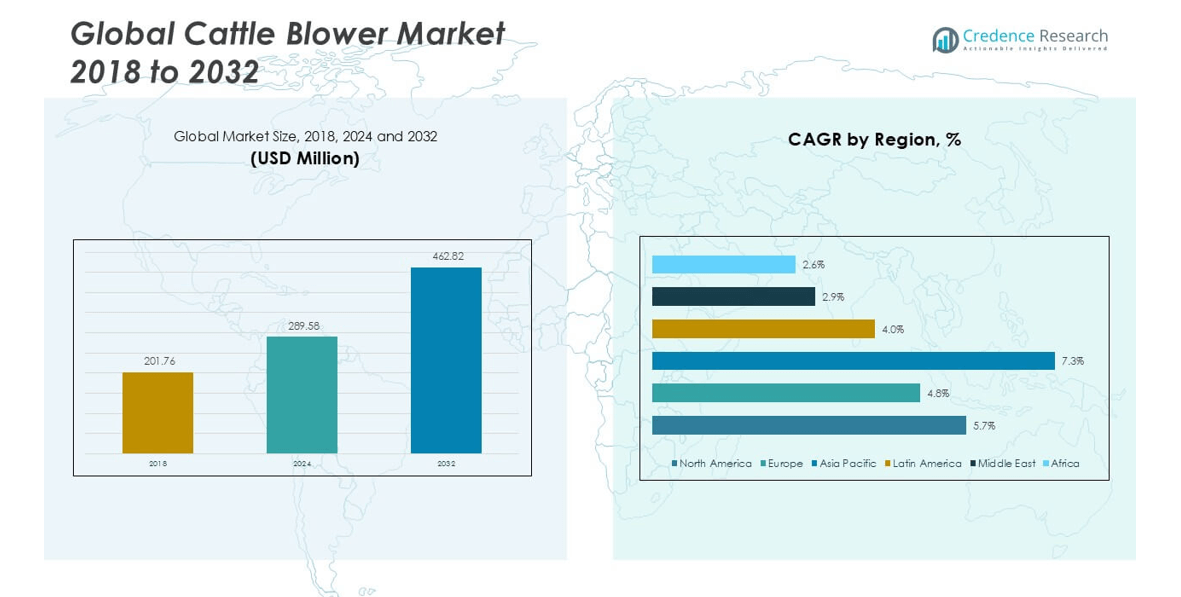
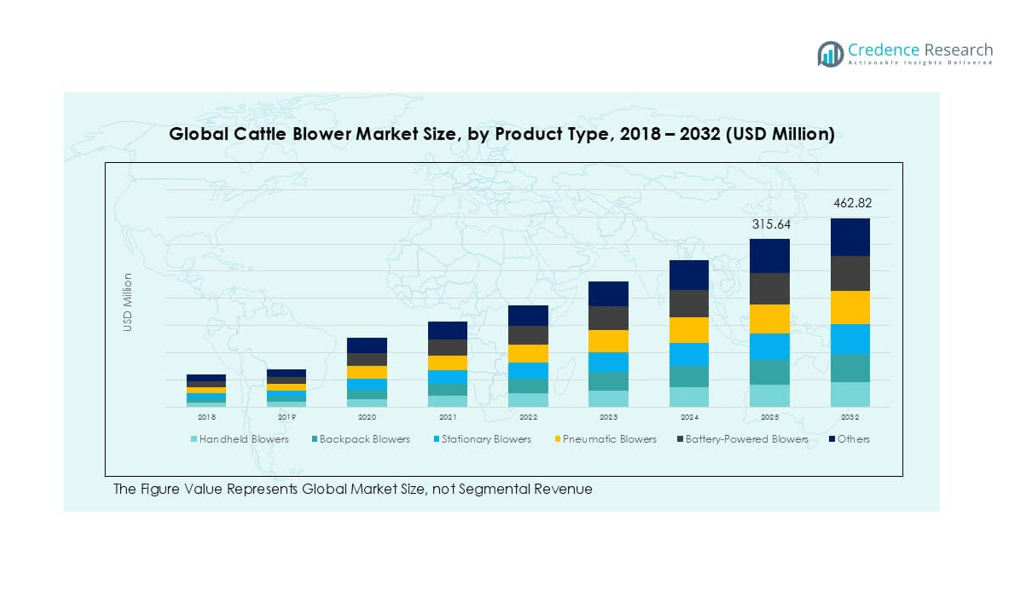
Cattle Blower market size was valued at USD 201.76 million in 2018, increased to USD 289.58 million in 2024, and is anticipated to reach USD 462.82 million by 2032, at a CAGR of 5.62% during the forecast period.
| REPORT ATTRIBUTE | DETAILS |
|---|---|
| Historical Period | 2020-2023 |
| Base Year | 2024 |
| Forecast Period | 2025-2032 |
| Cattle Blower Market Size 2024 | USD 289.58 million |
| Cattle Blower Market, CAGR | 5.62% |
| Cattle Blower Market Size 2032 | USD 462.82 million |
The cattle blower market is led by prominent players such as Sullivan Supply, Inc., The Toro Company, Weaver Livestock, Double K Industries, and MetroVac, all of which offer extensive product portfolios and strong market presence across North America and Europe. These companies maintain a competitive edge through continuous product innovation, strategic distribution partnerships, and a focus on user-friendly, durable equipment. Sullivan Supply, Inc. holds a significant share due to its specialization in livestock grooming solutions and strong brand loyalty among professional cattle exhibitors. North America is the leading region, accounting for approximately 43.3% of the global market in 2024, driven by the high adoption of modern livestock management practices and large-scale dairy and beef operations. As demand for efficient animal grooming tools increases, especially in developed agricultural economies, these top players are well-positioned to capitalize on market growth through technological advancements and regional expansion strategies.
Market Insights
- The cattle blower market was valued at USD 289.58 million in 2024 and is projected to reach USD 462.82 million by 2032, growing at a CAGR of 5.62% during the forecast period.
- Growth is driven by rising awareness of animal hygiene, increasing demand for efficient grooming tools in dairy and beef cattle farms, and the expansion of commercial livestock operations.
- Battery-powered and handheld blowers are gaining traction due to their ease of use and energy efficiency, while centrifugal blowers dominate the blower type segment due to their high performance.
- The market is moderately fragmented, with key players such as Sullivan Supply, The Toro Company, and Weaver Livestock competing through product innovation and distribution reach, while new entrants focus on affordable and portable solutions.
- North America leads with 43.3% market share in 2024, followed by Europe (27.3%) and Asia Pacific (20.9%), while the handheld blowers segment holds the largest product-type share globally.
Market Segmentation Analysis:
By Product Type
The Handheld Blowers segment dominates the cattle blower market by product type, accounting for the largest market share in 2024. These blowers are widely preferred due to their portability, ease of use, and cost-effectiveness, making them ideal for small and medium-scale farm operations. The Backpack Blowers follow closely, offering greater power and longer operation times for larger herds. Battery-powered blowers are witnessing rapid growth due to rising demand for eco-friendly and low-noise equipment. Stationary, pneumatic, and other types cater to specific use cases, with niche adoption in specialized farms requiring continuous or high-volume airflow.
- For instance, Double K Industries offers the ChallengAir 560 handheld blower, which operates with two 26,370 RPM motors, providing 248 CFM of airflow, and is used widely by livestock handlers for rapid drying and grooming applications.
By Blower Type
Within the blower type segment, Centrifugal Blowers lead the market in terms of revenue and volume share. Their superior airflow control, durability, and high-pressure output make them suitable for large-scale livestock environments where efficient drying and ventilation are essential. Axial Blowers, while more cost-effective, are primarily used in smaller facilities or for less intensive applications. The dominance of centrifugal blowers is driven by increased investments in automated livestock equipment and growing awareness regarding animal hygiene standards in commercial farming operations.
- For instance, Gardner Denver’s GAST Regen Blower Series R7P330A delivers maximum airflow of 355 CFM and maximum pressure of 96 inH2O, supporting high-capacity ventilation systems in commercial cattle facilities.
By Application
Dairy Farms emerge as the dominant application segment, holding the highest market share in 2024. Cattle blowers are extensively used in dairy farms for drying animals after washing, improving hygiene, and enhancing comfort, which directly impacts milk productivity. Beef cattle ranches also represent a significant share, where blowers help in maintaining animal cleanliness and reducing heat stress. Poultry farms adopt blowers for ventilation rather than direct animal grooming. The Others category, including mixed farming setups, contributes marginally but shows potential with rising demand for versatile livestock care tools.
Market Overview
Rising Focus on Animal Hygiene and Comfort
The growing awareness of animal welfare and hygiene standards is a primary driver of the cattle blower market. Farms are increasingly adopting blowers to maintain clean and dry cattle, which helps prevent infections and improves overall animal health. Enhanced hygiene directly correlates with higher productivity, especially in dairy farming where clean udders reduce the risk of mastitis. As regulatory and consumer pressure mounts for humane and sanitary livestock practices, more farms-both small and large-are investing in blower technologies to meet evolving standards.
- For instance, Sullivan Supply’s Air Express III blower uses dual 124 CFM motors, reducing average drying time to under 4 minutes per cow, thereby helping farms reduce incidences of mastitis through quicker post-wash drying.
Expansion of Commercial Livestock Farming
The rapid growth of commercial livestock operations is fueling demand for cattle blowers. Large-scale dairy and beef production facilities require efficient grooming and ventilation systems to manage larger herds effectively. Blowers play a critical role in maintaining cleanliness and thermal comfort, especially in climate-controlled environments. With increasing investments in industrialized agriculture and livestock automation, the need for time-saving and high-performance grooming tools is rising. This expansion supports steady growth in blower demand across developed and developing agricultural economies.
- For instance, The Toro Company integrated its 60V Max Flex-Force Power System™* into livestock-compatible blower systems, delivering over 605 CFM and runtime of up to 90 minutes, enabling efficient grooming of over 30 cattle per charge in large facilities.
Technological Advancements in Blower Equipment
Innovation in blower technology, such as energy-efficient motors, quieter operation, and cordless battery-powered units, is significantly boosting market growth. These advancements enhance ease of use, reduce energy costs, and make the equipment more suitable for diverse farming setups. Modern cattle blowers now offer adjustable airspeeds, ergonomic designs, and durable materials that extend equipment life and improve user safety. Technological improvements are attracting both existing users looking to upgrade and new adopters seeking performance and reliability, thereby widening the market base.
Key Trends & Opportunities
Growing Adoption of Battery-Powered Blowers
Battery-powered cattle blowers are gaining traction due to their portability, reduced noise levels, and environmental friendliness. As farms become more conscious of energy use and emissions, these blowers present an efficient alternative to fuel-based or pneumatic models. Their cordless operation allows for greater mobility and flexibility, especially in large open farms or remote locations. With advancements in battery life and charging efficiency, this segment presents a strong growth opportunity, particularly among medium and small-scale farmers seeking practical and sustainable solutions.
- For instance, Makita’s XBU03Z battery blower, adapted by livestock handlers, provides 459 CFM air volume and runs for approximately 28 minutes on a 5.0Ah 18V LXT® lithium-ion battery, enabling full grooming routines without interruptions.
Integration with Livestock Management Systems
The trend of integrating cattle blowers with broader livestock management systems is opening new avenues for market expansion. Smart farm technologies enable automation, remote control, and scheduling of blower operations, leading to improved efficiency and consistency in animal care. This integration supports data-driven decision-making by linking blower usage with animal health metrics, creating a more holistic and responsive farming ecosystem. As precision livestock farming gains momentum, equipment compatibility with digital platforms is emerging as a competitive differentiator.
Key Challenges
High Initial Investment for Large-Scale Equipment
One of the major challenges in the cattle blower market is the high upfront cost associated with advanced or industrial-grade blower systems. While handheld and battery-powered units are relatively affordable, stationary or pneumatic blowers with high airflow capacity require significant capital. This poses a barrier, particularly for small and mid-sized farms with constrained budgets. Despite long-term operational benefits, the initial cost of acquisition and installation can deter widespread adoption in resource-limited regions.
- For instance, GAST’s 2567-V103 Regenerative Blower used in intensive livestock ventilation costs around USD 3,900 per unit and delivers airflows up to 385 CFM, with installation requiring an additional USD 1,200 to 1,500 in hardware and labor for centralized systems.
Maintenance and Durability Concerns
Blower systems, especially those operating in harsh agricultural environments, are prone to wear and require regular maintenance. Dust, moisture, and animal debris can affect motor performance and reduce equipment lifespan. Farmers often face challenges in accessing spare parts or skilled service technicians, leading to operational downtime. These maintenance concerns can hinder productivity and raise total cost of ownership, discouraging adoption among users who prioritize reliability and long-term durability.
Limited Awareness in Emerging Markets
In many developing agricultural regions, awareness about the benefits and usage of cattle blowers remains limited. Traditional grooming practices, lack of training, and minimal exposure to modern livestock equipment inhibit market penetration. Additionally, language barriers and the absence of localized marketing strategies restrict the effective dissemination of product knowledge. Manufacturers must invest in education, demonstrations, and localized support networks to overcome this awareness gap and expand their reach in emerging economies.
Regional Analysis
North America
North America holds the largest share in the cattle blower market, accounting for approximately 43.3% of global revenue in 2024. The market size increased from USD 88.24 million in 2018 to USD 125.33 million in 2024, and is projected to reach USD 200.87 million by 2032, growing at a CAGR of 5.7%. The dominance of this region stems from the widespread adoption of mechanized farming practices, the presence of large-scale dairy operations, and a high emphasis on animal hygiene. The U.S. and Canada lead market consumption, driven by technological advancements and early adoption of modern livestock care tools.
- For instance, MetroVac’s Air Force Commander 2-Speed Blower produces 28,000 ft/min airflow velocity, and has been deployed across over 4,800 livestock farms in the U.S. as of 2023, particularly for dairy cow drying routines in colder climates.
Europe
Europe represents a significant share in the global cattle blower market, holding 27.3% of the total market value in 2024. The market grew from USD 57.19 million in 2018 to USD 79.12 million in 2024, and is expected to reach USD 119.05 million by 2032, expanding at a CAGR of 4.8%. This growth is fueled by strict animal welfare regulations and the strong presence of commercial dairy farms in countries like Germany, France, and the Netherlands. European consumers prioritize equipment efficiency and low noise levels, encouraging the adoption of eco-friendly and energy-efficient blower systems across farms of various scales.
- For instance, Eibenstock’s German-manufactured EBS Series blowers deliver airflow up to 360 m³/h (212 CFM) with a sound output of 54 dB(A), and have been installed in over 1,100 cattle sheds across Germany and Austria since 2022
Asia Pacific
Asia Pacific is the fastest-growing region in the cattle blower market, with a CAGR of 7.3% and a rising market share that reached 20.9% in 2024. The market expanded from USD 38.83 million in 2018 to USD 60.40 million in 2024, and is expected to reach USD 109.33 million by 2032. The region's growth is driven by the rapid industrialization of livestock farming in countries like China, India, and Australia, along with increased awareness of animal hygiene. Government support for modernizing agriculture and improving dairy productivity is further accelerating the adoption of cattle blowers in small and mid-sized farms.
Latin America
Latin America holds a modest yet growing share in the cattle blower market, contributing 4.7% of the global revenue in 2024. The market size rose from USD 9.55 million in 2018 to USD 13.54 million in 2024, and is forecasted to reach USD 19.16 million by 2032, at a CAGR of 4.0%. Growth in this region is primarily driven by expanding beef production and gradual modernization of livestock infrastructure in countries like Brazil and Argentina. However, limited access to advanced equipment and budget constraints among small-scale farmers remain barriers to broader adoption, despite growing awareness of productivity benefits.
Middle East
The Middle East accounted for 2.2% of the global cattle blower market in 2024. The market increased from USD 4.87 million in 2018 to USD 6.29 million in 2024, and is projected to reach USD 8.20 million by 2032, growing at a CAGR of 2.9%. While the market size remains small, rising investments in livestock farming and improved animal welfare practices in countries like Saudi Arabia and the UAE are supporting steady growth. However, extreme climatic conditions and limited water availability drive the need for efficient grooming and cooling systems, creating a niche demand for high-performance blowers.
Africa
Africa holds the smallest share in the cattle blower market, accounting for 1.7% of global revenue in 2024. The market expanded from USD 3.09 million in 2018 to USD 4.90 million in 2024, and is expected to reach USD 6.22 million by 2032, at a CAGR of 2.6%. Market growth in the region is hindered by limited access to modern farming equipment and low awareness of cattle hygiene practices. Nonetheless, development programs focused on livestock health and increasing dairy output in countries like Kenya and South Africa present opportunities for gradual market penetration, particularly among mid-sized farms.
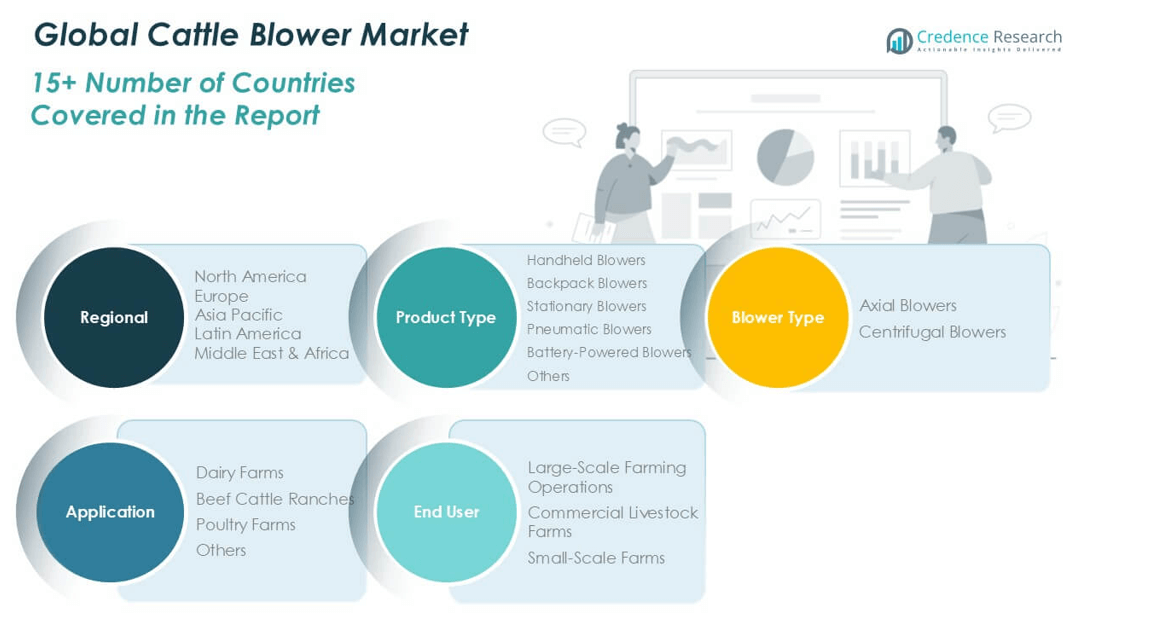
Market Segmentations:
By Product Type
- Handheld Blowers
- Backpack Blowers
- Stationary Blowers
- Pneumatic Blowers
- Battery-Powered Blowers
- Others
By Blower Type
- Axial Blowers
- Centrifugal Blowers
By Application
- Dairy Farms
- Beef Cattle Ranches
- Poultry Farms
- Others
By End User
- Large-Scale Farming Operations
- Commercial Livestock Farms
- Small-Scale Farms
By Geography
- North America
- U.S.
- Canada
- Mexico
- Europe
- UK
- France
- Germany
- Italy
- Spain
- Russia
- Belgium
- Netherlands
- Austria
- Sweden
- Poland
- Denmark
- Switzerland
- Rest of Europe
- Asia Pacific
- China
- Japan
- South Korea
- India
- Australia
- Thailand
- Indonesia
- Vietnam
- Malaysia
- Philippines
- Taiwan
- Rest of Asia Pacific
- Latin America
- Brazil
- Argentina
- Peru
- Chile
- Colombia
- Rest of Latin America
- Middle East
- UAE
- KSA
- Israel
- Turkey
- Iran
- Rest of Middle East
- Africa
- Egypt
- Nigeria
- Algeria
- Morocco
- Rest of Africa
Competitive Landscape
The cattle blower market features a moderately fragmented competitive landscape, with a mix of established manufacturers and niche livestock equipment providers. Key players such as Sullivan Supply, Inc., The Toro Company, Weaver Livestock, and Double K Industries dominate through broad product portfolios, strong distribution networks, and brand recognition within the livestock industry. Companies like MetroVac, Circuiteer Blower, and GAST (Gardner Denver) focus on specialized grooming and ventilation solutions, catering to both commercial and small-scale farms. Innovation, durability, and ergonomic design remain key competitive differentiators, with an increasing shift toward energy-efficient and battery-powered models. Emerging players are leveraging e-commerce channels and direct-to-consumer models to gain market traction, particularly in developing regions. Additionally, partnerships with farm equipment retailers and participation in agricultural expos enhance market presence. As animal welfare regulations tighten and demand for high-performance livestock care tools grows, competition is expected to intensify with new product development and strategic expansions.
- For instance, Circuiteer Blowers has sold over 85,000 units of its livestock grooming blowers globally since launch, with the Circuiteer II model providing dual motors at 114 CFM each, and currently utilized in over 1,200 competitive livestock shows annually in North America.
Key Player Analysis
- Sullivan Supply, Inc.
- The Toro Company
- Weaver Livestock
- Double K Industries
- MetroVac
- Cowboy Magic
- Barn World
- GAST (Gardner Denver)
- Husqvarna Group
- Greenworks
- Circuiteer Blower
Recent Developments
- In April 2025, Sullivan Supply, a company specializing in show supply products, opened a new facility in Hillsboro, Texas. This expansion was driven by the need to handle increased demand and improve the availability of their products.
- In April 2025, Husqvarna launched the 590BTS and 590BFS, now the world’s most powerful backpack blowers, boasting 56 Newtons of blow force and 1,245 CFM of air volume. These are powered by a 79.4cc X-TORQ engine and include features such as AutoTune® carburetor, cruise control, industry’s largest fuel tank, and improved ergonomic harnesses for operator comfort.
- In September 2022, for a less expensive solution, Greenworks produced a 450 CFM battery-powered blower.
Market Concentration & Characteristics
The cattle blower market exhibits a moderate level of concentration, with a mix of established manufacturers and emerging regional players. It is characterized by product specialization, brand loyalty, and a focus on practical, durable solutions tailored to livestock care. Major players such as Sullivan Supply, The Toro Company, and Weaver Livestock maintain a competitive edge through strong distribution networks, continuous product upgrades, and responsiveness to user needs. Product innovation centers on energy efficiency, noise reduction, and ergonomic design. The market responds strongly to shifts in animal hygiene standards and operational efficiency demands. It shows clear segmentation based on product type and end use, with handheld and centrifugal blowers leading due to ease of operation and high airflow performance. Demand aligns closely with regions that have established commercial farming operations and higher livestock populations. North America and Europe account for a significant share due to their mature livestock sectors and widespread mechanization in animal grooming practices.
Report Coverage
The research report offers an in-depth analysis based on Product Type, Blower Type, Application, End-User and Geography. It details leading market players, providing an overview of their business, product offerings, investments, revenue streams, and key applications. Additionally, the report includes insights into the competitive environment, SWOT analysis, current market trends, as well as the primary drivers and constraints. Furthermore, it discusses various factors that have driven market expansion in recent years. The report also explores market dynamics, regulatory scenarios, and technological advancements that are shaping the industry. It assesses the impact of external factors and global economic changes on market growth. Lastly, it provides strategic recommendations for new entrants and established companies to navigate the complexities of the market.
Future Outlook
- The market will experience steady growth driven by increased demand for livestock grooming efficiency.
- Battery-powered blowers will gain popularity due to portability and reduced operational noise.
- Technological upgrades will focus on energy efficiency and user comfort.
- Handheld blowers will continue to lead the product segment due to ease of use and affordability.
- Centrifugal blowers will remain preferred in large-scale farms for high airflow capacity.
- North America will retain the largest regional share supported by advanced livestock management practices.
- Asia Pacific will emerge as a key growth region due to expanding commercial farming operations.
- Manufacturers will invest in product diversification to target small and mid-sized farms.
- The market will see rising adoption of eco-friendly equipment to align with sustainability goals.
- Competitive intensity will increase as new entrants offer cost-effective and innovative solutions.

Request a Free Sample
Fill in your details and we'll send you a free sample report.
- Sample data tables & charts
- Research methodology
Market Dynamics
Rising Focus on Animal Hygiene and Comfort
Increasing awareness of animal welfare and hygiene standards is prompting farms to adopt cattle blowers for maintaining clean and dry livestock, which helps prevent infections and improves productivity, especially in dairy operations.
Expansion of Commercial Livestock Farming
The growth of large-scale dairy and beef production facilities is driving demand for efficient grooming and ventilation systems, as these operations require high-performance blowers to manage larger herds and maintain cleanliness.
Technological Advancements in Blower Equipment
Innovations such as energy-efficient motors, quieter operation, and cordless battery-powered units are making cattle blowers more attractive to farms of all sizes, enhancing ease of use and reducing operational costs.
Growing Adoption of Battery-Powered and Portable Blowers
Battery-powered and handheld blowers are gaining popularity due to their portability, reduced noise, and environmental benefits, making them especially appealing to small and medium-sized farms seeking practical and sustainable solutions.
Stricter Animal Welfare Regulations
Tighter regulations and consumer expectations around animal welfare are compelling farms to invest in modern grooming equipment like cattle blowers to comply with standards and improve livestock health outcomes.
Need a Custom Version of This Report?
Tailor the scope, geography, or segments to your exact requirements.
- Custom geography or segment scope
- Direct access to our analyst team
Frequently Asked Questions
What is the current market size for Cattle Blower, and what is its projected size in 2032?
At what Compound Annual Growth Rate is the Cattle Blower market projected to grow between 2025 and 2032?
What are the primary factors fueling the growth of the Cattle Blower market?
Who are the leading companies in the Cattle Blower market?
Table of Content
Chapter 1 Market Segmentation
- 1.1 Segmentation Framework
- 1.1.1 Product and Service Classification
- 1.1.2 Application and End-Use Classification
- 1.1.3 Technology and Solution Classification
- 1.1.4 Customer and Distribution Channel Classification
- 1.1.5 Geographic Segmentation
- 1.1.6 Market Segment Definitions and Boundaries
- 1.2 By End User
- 1.2.1 Large-Scale Farming Operations
- 1.2.2 Commercial Livestock Farms
- 1.2.3 Small-Scale Farms
- 1.3 By Application
- 1.3.1 Dairy Farms
- 1.3.2 Beef Cattle Ranches
- 1.3.3 Poultry Farms
- 1.3.4 Others
- 1.4 By Blower Type
- 1.4.1 Axial Blowers
- 1.4.2 Centrifugal Blowers
- 1.5 By Product Type
- 1.5.1 Handheld Blowers
- 1.5.2 Backpack Blowers
- 1.5.3 Stationary Blowers
- 1.5.4 Pneumatic Blowers
- 1.5.5 Battery-Powered Blowers
- 1.5.6 Others
Chapter 2 Introduction
- 2.1 Report Objectives and Scope
- 2.2 Product Definition and Industry Terminology
- 2.3 Market Inclusions and Exclusions
- 2.4 Research Process
- 2.4.1 Primary Research and Expert Interviews
- 2.4.2 Secondary Research and Source Review
- 2.4.3 Top-Down and Bottom-Up Estimation
- 2.4.4 Data Triangulation and Verification
- 2.5 Market Size Measurement Basis
- 2.5.1 2024: USD 289.58 million → 2032: USD 462.82 million
- 2.6 Historical and Forecast Reference Periods
- 2.6.1 Base Year: 2024
- 2.6.2 Forecast Period: 2024-2032
- 2.7 Research Assumptions and Limitations
Chapter 3 Executive Summary
- 3.1 Market Snapshot and Key Findings
- 3.2 Base-Year Market Size, 2024
- 3.3 Forecast Market Size, 2032
- 3.4 Revenue and Volume Growth Outlook
- 3.5 Key Demand and Supply Indicators
- 3.6 Leading Market Segments
- 3.7 Fastest-Growing Market Opportunities
- 3.8 Regional Performance Highlights
- 3.9 Technology and Industry Transformation
- 3.10 Competitive Landscape Summary
- 3.11 Analyst View and Strategic Implications
Chapter 4 Global Cattle Blower Market Trends and Developments
- 4.1 Historical Industry Development
- 4.2 Recent Market Trends and Developments
- 4.3 Demand and Customer Behavior Trends
- 4.4 Technology and Product Innovation
- 4.5 Artificial Intelligence, Automation and Digitalization
- 4.6 Local Manufacturing and Supply Chain Realignment
- 4.7 Industry Partnerships, Mergers and Acquisitions
- 4.8 Sustainability and Circular Economy Developments
- 4.9 Government and Private Sector Investment Trends
- 4.10 Emerging Business Models and Commercialization
- 4.11 Industry Developments and Announcements
Chapter 5 Global Cattle Blower Market Production, Supply and Demand Analysis
- 5.1 Demand Trend and Consumption Analysis
- 5.2 Demand Forecast, 2024-2032
- 5.3 Production and Output Trend
- 5.4 Production and Output Forecast, 2024-2032
- 5.5 Installed Capacity and Capacity Utilization
- 5.6 Company-Wise Production Plants and Statistics
- 5.6.1 Installed Production Capacity
- 5.6.2 Actual Production
- 5.6.3 Planned Capacity and Expansion Targets
- 5.7 Supply Chain Structure and Procurement Trends
- 5.8 Supply-Demand Gap and Bottlenecks
- 5.9 Import Dependence and Sourcing Structure
- 5.10 Contract Manufacturing and Outsourcing
- 5.11 Regional Supply and Demand Concentration
Chapter 6 Global Cattle Blower Market Pricing Analysis
- 6.1 Pricing Structure and Measurement
- 6.2 Historical Pricing Trends
- 6.3 Pricing Outlook, 2024-2032
- 6.4 Average Selling Price and Unit Economics
- 6.5 Pricing by Product and Market Segment
- 6.6 Geographic Pricing Differences
- 6.7 Key Input, Energy, Labor and Logistics Costs
- 6.8 Contract Pricing and Purchasing Models
- 6.9 Pricing Sensitivity and Competitive Positioning
- 6.10 Price, Margin and Profitability Implications
Chapter 7 Global Cattle Blower Market Dynamics
- 7.1 Market Growth Drivers
- 7.1.1 Demand-Side Drivers
- 7.1.2 Technology and Innovation Drivers
- 7.1.3 Infrastructure and Investment Drivers
- 7.1.4 Regulatory and Policy Drivers
- 7.2 Market Restraints
- 7.2.1 Cost and Affordability Constraints
- 7.2.2 Technology and Adoption Barriers
- 7.2.3 Supply Chain and Operational Constraints
- 7.3 Market Challenges
- 7.3.1 Competitive Pressure and Margin Erosion
- 7.3.2 Skills, Infrastructure and Implementation Gaps
- 7.4 Emerging Market Opportunities
- 7.5 Market Dynamics Impact and Time-Horizon Assessment
Chapter 8 Global Cattle Blower Value Chain Analysis
- 8.1 Industry Value Chain Overview
- 8.2 Upstream Suppliers and Critical Inputs
- 8.3 Technology and Component Providers
- 8.4 Manufacturing or Service Delivery
- 8.5 Distribution, Channel Partners and Integrators
- 8.6 Downstream Applications and End Users
- 8.7 Value Addition and Profit Pools
- 8.8 Vertical Integration and Outsourcing
- 8.9 Supplier Concentration and Risk
- 8.10 Supply Chain Localization and Resilience
Chapter 9 Global Cattle Blower Market Regulations and Policies
- 9.1 Relevant Laws, Standards and Compliance Frameworks
- 9.2 Product, Service, Safety and Quality Requirements
- 9.3 Government Policies, Incentives and Subsidies
- 9.4 Imports, Exports and Trade Barriers
- 9.5 Public Procurement and Local Content Requirements
- 9.6 Environmental and Sustainability Compliance
- 9.7 Upcoming Policy Changes and Market Implications
Chapter 10 Global Cattle Blower Market Hotspots and Opportunities
- 10.1 Market Opportunity Mapping and Growth Hotspots
- 10.2 High-Growth Applications and Customer Groups
- 10.3 Underserved Markets and White-Space Opportunities
- 10.4 Emerging Technology and Product Opportunities
- 10.5 New Capacity and Investment Hotspots
- 10.6 Market Entry and Expansion Opportunities
- 10.7 Distribution and Partnership Opportunities
- 10.8 Near-Term and Long-Term Commercial Potential
- 10.9 Opportunity Attractiveness and Execution Risks
Chapter 11 Global Cattle Blower Market Outlook, 2024-2032
- 11.1 Market Size and Analysis
- 11.1.1 Revenue (Market Measurement: 2024: USD 289.58 million → 2032: USD 462.82 million)
- 11.1.2 Market Volume and Quantity Sold
- 11.1.3 Historical Market Size
- 11.1.4 Base-Year Market Size, 2024
- 11.2 Market Forecast, 2024-2032
- 11.2.1 Revenue Forecast to 2032
- 11.2.2 Volume Forecast to 2032
- 11.2.3 CAGR and Year-on-Year Growth
- 11.2.4 Incremental Revenue Opportunity
- 11.3 Forecast Assumptions and Scenario Analysis
- 11.3.1 Base-Case Forecast
- 11.3.2 Optimistic and Conservative Scenarios
- 11.3.3 Technology, Pricing and Policy Sensitivities
- 11.4 Market Attractiveness and Growth Outlook
Chapter 12 Global Cattle Blower Market Segmentation and Outlook
- 12.1 Segmentation Summary and Market Shares, 2024
- 12.2 Largest and Fastest-Growing Segments
- 12.3 By End User - Market Size and Forecast, 2024-2032
- 12.3.1 Segment Definition and Scope
- 12.3.2 Historical Market Size
- 12.3.3 Revenue Forecast, 2024-2032
- 12.3.4 Volume Forecast, 2024-2032
- 12.3.5 Base-Year Market Share, 2024
- 12.3.6 Segment CAGR and Growth Drivers
- 12.3.7 Subsegment Market Size and Forecast
- 12.3.7.1 Large-Scale Farming Operations
- 12.3.7.2 Commercial Livestock Farms
- 12.3.7.3 Small-Scale Farms
- 12.3.8 Subsegment Pricing and Adoption Trends
- 12.3.9 Leading Suppliers and Competition
- 12.3.10 Regional Demand and Opportunities
- 12.4 By Application - Market Size and Forecast, 2024-2032
- 12.4.1 Segment Definition and Scope
- 12.4.2 Historical Market Size
- 12.4.3 Revenue Forecast, 2024-2032
- 12.4.4 Volume Forecast, 2024-2032
- 12.4.5 Base-Year Market Share, 2024
- 12.4.6 Segment CAGR and Growth Drivers
- 12.4.7 Subsegment Market Size and Forecast
- 12.4.7.1 Dairy Farms
- 12.4.7.2 Beef Cattle Ranches
- 12.4.7.3 Poultry Farms
- 12.4.7.4 Others
- 12.4.8 Subsegment Pricing and Adoption Trends
- 12.4.9 Leading Suppliers and Competition
- 12.4.10 Regional Demand and Opportunities
- 12.5 By Blower Type - Market Size and Forecast, 2024-2032
- 12.5.1 Segment Definition and Scope
- 12.5.2 Historical Market Size
- 12.5.3 Revenue Forecast, 2024-2032
- 12.5.4 Volume Forecast, 2024-2032
- 12.5.5 Base-Year Market Share, 2024
- 12.5.6 Segment CAGR and Growth Drivers
- 12.5.7 Subsegment Market Size and Forecast
- 12.5.7.1 Axial Blowers
- 12.5.7.2 Centrifugal Blowers
- 12.5.8 Subsegment Pricing and Adoption Trends
- 12.5.9 Leading Suppliers and Competition
- 12.5.10 Regional Demand and Opportunities
- 12.6 By Product Type - Market Size and Forecast, 2024-2032
- 12.6.1 Segment Definition and Scope
- 12.6.2 Historical Market Size
- 12.6.3 Revenue Forecast, 2024-2032
- 12.6.4 Volume Forecast, 2024-2032
- 12.6.5 Base-Year Market Share, 2024
- 12.6.6 Segment CAGR and Growth Drivers
- 12.6.7 Subsegment Market Size and Forecast
- 12.6.7.1 Handheld Blowers
- 12.6.7.2 Backpack Blowers
- 12.6.7.3 Stationary Blowers
- 12.6.7.4 Pneumatic Blowers
- 12.6.7.5 Battery-Powered Blowers
- 12.6.7.6 Others
- 12.6.8 Subsegment Pricing and Adoption Trends
- 12.6.9 Leading Suppliers and Competition
- 12.6.10 Regional Demand and Opportunities
- 12.7 Segment Growth Comparison
- 12.8 Segment Attractiveness and Priority Matrix
Chapter 13 Global Cattle Blower End-Use and Application Market Outlook
- 13.1 End-Use Industry and Customer Demand Structure
- 13.2 Leading Applications and Customer Groups
- 13.3 End-Use Market Size, Share and Forecast
- 13.4 Major End-Use Industry Deep Dives
- 13.4.1 Customer Requirements and Use Cases
- 13.4.2 Demand and Replacement Cycles
- 13.4.3 Technical and Regulatory Considerations
- 13.4.4 Purchasing and Procurement Models
- 13.4.5 Leading Vendors and Distribution Channels
- 13.4.6 Forecast and Commercial Opportunities
- 13.5 Emerging Applications and Cross-Segment Demand
- 13.6 End-Use Industry Investment Priorities
Chapter 14 Global Cattle Blower Geographic Market Outlook, 2024-2032
- 14.1 Regional Market Size and Share, 2024
- 14.2 Regional Market Forecast, 2024-2032
- 14.3 Regional Pricing, Production and Demand Differences
- 14.4 North America
- 14.4.1 United States
- 14.4.2 Canada
- 14.4.3 Mexico
- 14.5 Europe
- 14.5.1 Germany
- 14.5.2 France
- 14.5.3 Italy
- 14.5.4 United Kingdom
- 14.5.5 Spain
- 14.5.6 Poland
- 14.5.7 Russia
- 14.5.8 Netherlands
- 14.5.9 Belgium
- 14.5.10 Sweden
- 14.5.11 Denmark
- 14.5.12 Norway
- 14.5.13 Rest of Europe
- 14.6 Asia Pacific
- 14.6.1 China
- 14.6.2 India
- 14.6.3 Japan
- 14.6.4 South Korea
- 14.6.5 Thailand
- 14.6.6 Indonesia
- 14.6.7 Vietnam
- 14.6.8 Malaysia
- 14.6.9 Australia
- 14.6.10 Rest of Asia Pacific
- 14.7 Latin America
- 14.7.1 Brazil
- 14.7.2 Argentina
- 14.7.3 Colombia
- 14.7.4 Chile
- 14.7.5 Rest of Latin America
- 14.8 Middle East
- 14.8.1 Saudi Arabia
- 14.8.2 United Arab Emirates
- 14.8.3 Turkey
- 14.8.4 Israel
- 14.8.5 Iran
- 14.8.6 Rest of the Middle East
- 14.9 Africa
- 14.9.1 South Africa
- 14.9.2 Egypt
- 14.9.3 Nigeria
- 14.9.4 Morocco
- 14.9.5 Rest of Africa
- 14.10 Regional Investment, Policy and Supply Chain Differences
- 14.11 Regional Competitive Landscape
- 14.12 Geographic Growth Hotspots
Chapter 15 Global Cattle Blower Technology, Innovation and Sustainability Outlook
- 15.1 Technology Landscape and Maturity
- 15.2 Product, Process and Service Innovation
- 15.3 AI, Automation and Digital Tools in the Industry
- 15.4 Technology Adoption and Performance Benchmarking
- 15.5 Innovation Pipeline and R&D Investment
- 15.6 Patent and Intellectual Property Trends
- 15.7 Energy Efficiency and Resource Management
- 15.8 Sustainability, Recycling and Circularity
- 15.9 Technology Roadmap, 2024-2032
- 15.10 Risks of Obsolescence and Technology Substitution
Chapter 16 Global Cattle Blower Market Key Strategic Imperatives
- 16.1 Growth and Market Entry Priorities
- 16.2 High-Return Products and Segments
- 16.3 Pricing, Profitability and Cost Optimization
- 16.4 Technology Investment and Product Differentiation
- 16.5 Supply Chain Localization and Resilience
- 16.6 Distribution and Customer Acquisition
- 16.7 Partnership, Acquisition and Capacity Strategy
- 16.8 Regional Expansion Priorities
- 16.9 Short-, Medium- and Long-Term Actions
Chapter 17 Competition Outlook
- 17.1 Industry Competition Characteristics
- 17.2 Market Structure and Concentration
- 17.3 Market Share and Competitive Positioning, 2024
- 17.4 Company-Wise Revenue and Product Benchmarking
- 17.5 Production and Service Capacity Benchmarking
- 17.6 Technology, Pricing and Differentiation
- 17.7 Regional Footprint and Distribution Strength
- 17.8 Mergers, Acquisitions and Strategic Alliances
- 17.9 New Entrants and Competitive Threats
- 17.10 Porter's Five Forces and Industry Attractiveness
- 17.11 Competitive Outlook, 2024-2032
Chapter 18 Company Profiles
- 18.1 Company Coverage and Selection Criteria
- 18.2 Sullivan Supply, Inc.
- 18.2.1 Business Description
- 18.2.2 Company Ownership and Geographic Presence
- 18.2.3 Product and Service Portfolio
- 18.2.4 Manufacturing and Operating Footprint
- 18.2.5 Production Capacity and Expansion Plans
- 18.2.6 Financial Performance and Investment
- 18.2.7 Market Share and Competitive Position
- 18.2.8 Technology and Innovation Capabilities
- 18.2.9 Strategic Alliances or Partnerships
- 18.2.10 Recent Developments
- 18.2.11 Growth Strategy and Outlook
- 18.3 The Toro Company
- 18.4 Weaver Livestock
- 18.5 Double K Industries
- 18.6 MetroVac
- 18.7 GAST (Gardner Denver)
- 18.8 Circuiteer Blower
- 18.9 Husqvarna Group
- 18.10 Greenworks
- 18.11 Barn World
- 18.12 Other Relevant Market Participants
Note: Every listed company is profiled on the structure shown under the first company. The company list is preliminary and may change based on research findings, market developments, data availability and client requirements.
Chapter 19 Disclaimer
- 19.1 Research and Forecast Disclaimer
- 19.2 Data Source and Estimation Limitations
Note: The depth of individual sections depends on data availability for this market. Volume, capacity, trade and other unit-based metrics are included where applicable.

