
Polish sportswear spending follows rising pay and training
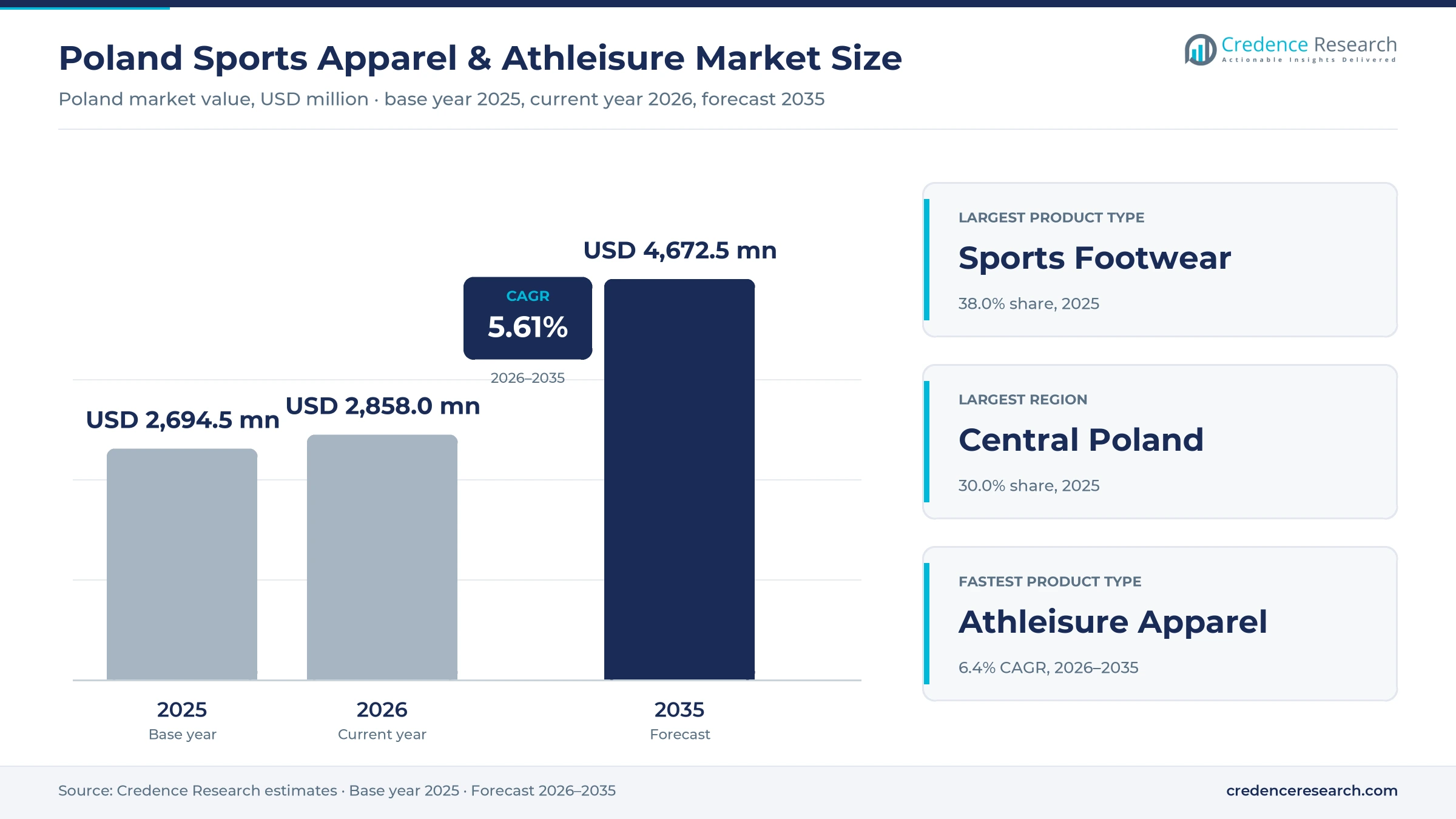
The Poland sports apparel and athleisure market was valued at USD 2.69 billion in 2025 and is projected to increase from USD 2.86 billion in 2026 to USD 4.67 billion by 2035, registering a CAGR of 5.61% during 2026–2035. Demand comes from a population that cycles, runs and trains in gyms in growing numbers, and from shoppers who wear training clothes and sneakers as everyday dress as real wages rise. Central Poland held the largest regional share, 30.0% in 2025, because Warsaw concentrates income, flagship brand stores and the head offices of retailers, and it is also the fastest-growing region at 5.9% a year. Sporting goods chains carry the largest share of sales, while e-commerce marketplaces grow fastest. The most important commercial change is the European Union flat customs duty of EUR 3 on low-value parcels from outside the bloc, which has applied since July 1, 2026, and narrows the price gap between cross-border platforms and domestic sellers.
Shoes and training clothes carry value, worn well beyond sport
The market counts performance sportswear, sports footwear, athleisure apparel and outdoor and performance apparel bought by Polish consumers at retail prices. It covers clothes and shoes made for football, running, gym training and hiking, and the same ranges worn for leisure, whether bought in brand stores, sporting goods chains, online marketplaces or brand web shops.
The count excludes bicycles, fitness machines, skis and other hard equipment, club kit bought in bulk by federations, and the goods that brands manufacture or warehouse in Poland for export to other European markets. Value sits with the brands that design and market products and with the chains and platforms that reach buyers in malls, retail parks and online.
Poland Sports Apparel & Athleisure Market Insights
- The Poland sports apparel & athleisure market rises from USD 2.69 billion in 2025 to USD 4.67 billion by 2035, growing at 5.61% a year as more Poles train and wear sportswear daily.
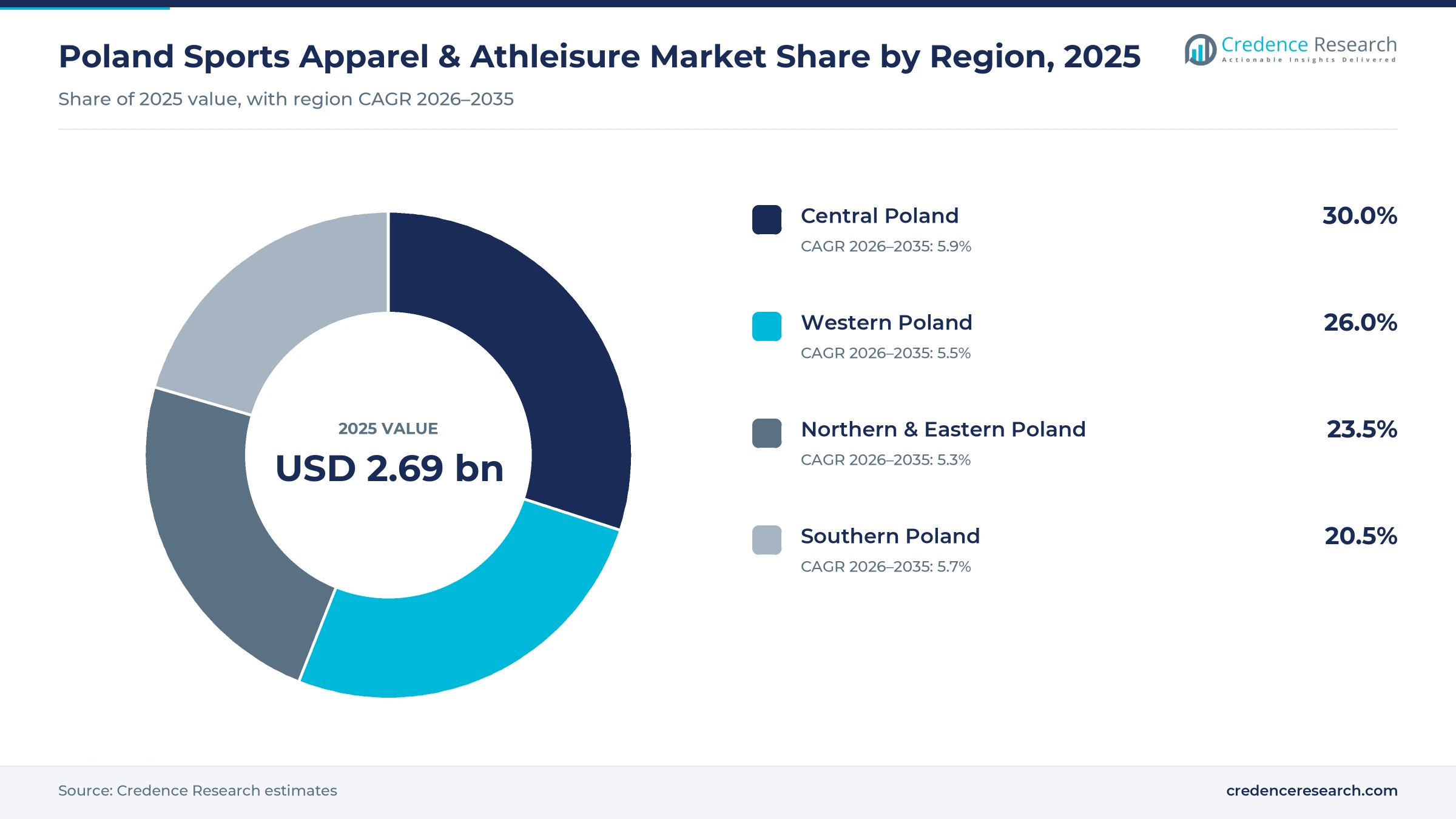
- Central Poland held a 30.0% share of 2025 value and grows fastest at 5.9% a year on Warsaw income and flagship stores.
- Sports footwear held 38.0% of 2025 value because running shoes carry the highest ticket in the category and sell to athletes and everyday buyers alike.
- The EU flat duty of EUR 3 per item category on low-value parcels has applied since July 1, 2026, narrowing the price edge of cross-border platforms.
- Decathlon ended 2025 with 68 Polish stores and plans at least 70 in 2026, while Nike opened its Rise concept in Warsaw in February 2025.
Footwear leads while athleisure and gym wear grow fastest
Footwear leads as athleisure apparel grows fastest
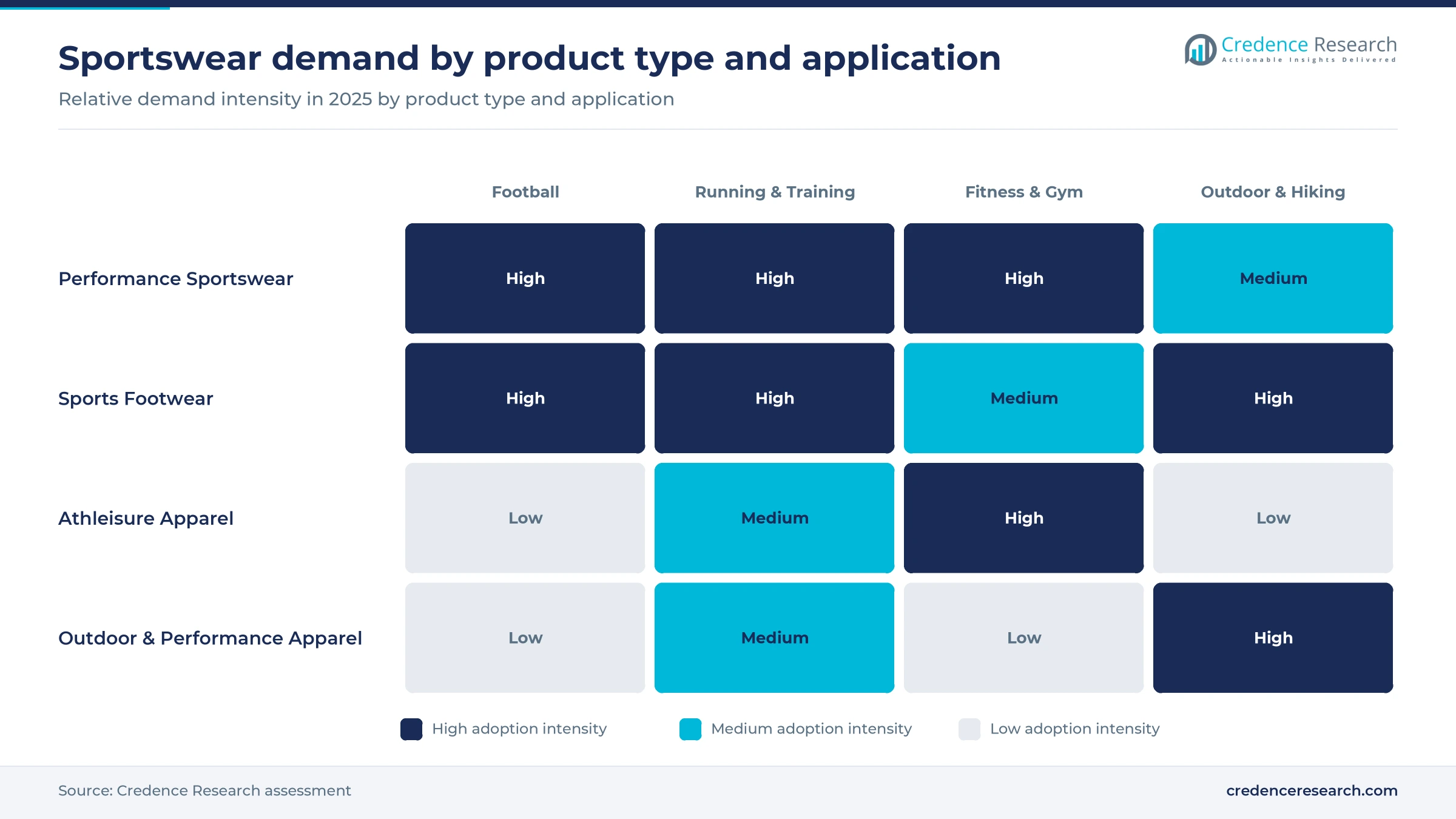
Based on product type, the market is categorized into performance sportswear, sports footwear, athleisure apparel and outdoor and performance apparel. Sports Footwear led with 38.0% of 2025 value because a pair of running shoes costs many times a training shirt, and Nike lists its Pegasus 42 at PLN 599.99 in its Polish store while Decathlon sells a Kiprun Run 100 shirt at PLN 19.99. Athleisure Apparel grows fastest at 6.4% a year as brands blend sport and street ranges, and the Nike Rise store that opened at Wola Park in Warsaw in February 2025 mixes sport, technology and urban culture with lifestyle products.
Running and training lead while gym wear grows fastest
Based on application, the market is categorized into football, running and training, fitness and gym, and outdoor and hiking. Running & Training led with 34.0% of 2025 value because the same shoes and kit serve daily workouts and road races, and Polish Radio reported that nearly 15,000 people ran the Warsaw Half Marathon on March 30, 2025, the largest field in the country's history. Fitness & Gym grows fastest at 6.2% a year as Benefit Systems counted about 1.88 million sports cards in Poland at the end of June 2026, up 11% in a year, which puts leggings, bras and gym shoes into weekly use.
Men lead spending while women's ranges gain pace
Based on end user, the market is categorized into men, women and children and teens. Men led with 46.0% of 2025 value because men take part in sport more often than women and dominate club football, and UEFA said in April 2025 that Poland has more than half a million registered players, most of them boys and men. Women grow fastest at 6.6% a year because participation among women, 41.5% against 46.1% among men in the year to September 2025 according to Statistics Poland, leaves the largest pool of new buyers, and rising gym-card use brings leggings and sports bras into weekly wear.
Chains lead as marketplaces grow fastest
Based on distribution channel, the market is categorized into brand DTC stores, sporting goods chains, e-commerce marketplaces and brand e-commerce. Sporting Goods Chains led with 40.0% of 2025 value because Decathlon alone ended 2025 with 68 Polish stores, according to the business news site XYZ, and Intersport Polska runs 29 stores in the largest cities. E-commerce Marketplaces grow fastest at 6.3% a year as LPP opened its Sinsay web shop to outside sellers on Aug. 3, 2026, with Nike among the first brands and footwear as a key category. Marketplaces give brands reach in smaller towns without the cost of new stores.
| Segment Group | Leading Sub-segment | Share, 2025 | Fastest-growing Sub-segment | CAGR, 2026–2035 |
|---|---|---|---|---|
| By Product Type | Sports Footwear | 38.0% | Athleisure Apparel | 6.4% |
| By Application | Running & Training | 34.0% | Fitness & Gym | 6.2% |
| By End User | Men | 46.0% | Women | 6.6% |
| By Distribution Channel | Sporting Goods Chains | 40.0% | E-commerce Marketplaces | 6.3% |
Running shoes set the ceiling as own labels hold the floor
Pricing in Polish sportswear follows brand tiers far more than material cost. Global brands set suggested retail prices for shoes and leggings and defend them in their own stores, while marketplaces and outlets clear older colors at deep discounts. Own-label ranges from Decathlon anchor the value tier, and the 4F brand sits in the mid-market between them and the global names. Footwear carries the highest ticket, so a shift toward premium running shoes lifts average prices even when volumes are flat. For brands, the margin sits in full-price direct sales, and frequent promotions on major platforms erode it.
| Product or offer | Typical price or fee | Basis |
|---|---|---|
| Nike Pegasus 42 road running shoe | PLN 599.99 suggested retail, offered at PLN 359.99 | Nike Polish online store, November 2026 |
| Nike Pegasus Premium running shoe | PLN 919.99 | Nike Polish online store, November 2026 |
| 4F FNK F405 women's training leggings | PLN 128.51 | Morele.net listing, November 2026 |
| Decathlon Kiprun Run 100 leggings and shirt | PLN 59.99 leggings, PLN 19.99 shirt | Decathlon Polish online store, November 2026 |
Request a Free Sample
Fill in your details and we'll send you a free sample report.
- Sample data tables & charts
- Research methodology
Training, real wage gains and online buying lift sales
Wider sport and recreation participation keeps kit in use
A broader base of active Poles turns training clothes and shoes into a regular purchase rather than a one-off. Statistics Poland found that 43.7% of residents took part in sport or recreation in the year to September 2025, with cycling the most common activity. The same survey put average household spending on sport and recreation at PLN 1,873, of which PLN 279 went on equipment. The Ministry of Sport and Tourism reported in October 2025 that 7,314 teams played in the local stage of its Z Orlika na stadion football program. Weekly use means steady replacement demand, which keeps footwear and training wear selling even when confidence dips.
Real wage gains move buyers up the price ladder
Higher real pay lets households trade up from own-label basics to branded shoes and technical layers. Statistics Poland put the 2025 average enterprise-sector wage at PLN 8,934.98, up 8.1% on 2024, while average 2025 consumer price inflation was 3.6%, the agency said, so real pay rose by more than 4%. Eurostat data reported by Notes from Poland in March 2026 show GDP per head reached 81% of the EU average in purchasing power terms in 2025, the highest level on record. Income convergence favors the premium and performance-luxury tiers, where global brands earn most of their margin, and it supports demand for running shoes above the PLN 500 mark.
Omnichannel and e-commerce expansion widens reach
Polish shoppers move easily between stores and screens, and sportswear sales follow them across both. Przelewy24 reported in September 2025 that nearly 78% of internet users, about 30 million people, shop online and that 77% of them buy clothing and 65% buy footwear. Decathlon has invested more than PLN 75 million in recent years in stores, modernization and electronic shelf labels that link store stock with its web shop. E-commerce marketplaces grow at 6.3% a year, the fastest channel rate, and they reach buyers in small towns far from any brand store. Stock depth, fast delivery and simple returns decide which brands win the online basket.
Mass running events expand the runner base
Big city races create a fixed calendar of training and kit buying that lasts for months. The Warsaw Marathon on Sept. 28, 2025 drew more than 11,500 registrations for the full distance, with nearly 5,000 first-time marathon runners, and the organizer called it the largest marathon in Polish history. About 18,000 people took part across all of the race weekend events. The Gdansk Marathon reported a record field of almost 3,000 runners from 19 countries on April 6, 2025. Each debutant needs at least one pair of running shoes, technical shirts and a winter layer, which lifts spending well beyond race weekends.
Bigger brand stores and circular rules reshape the offer
A shift to bigger brand-run stores in prime malls
Brands are concentrating space in fewer, larger stores that show full ranges and gather customer data. The North Face opened a store at Zlote Tarasy in Warsaw in October 2024, and Nike was combining two units there into a flagship of more than 1,400 square meters. JD Sports was set to take the unit vacated by Sizeer in the same mall. Decathlon has opened a store of about 1,400 square meters at Westfield Arkadia and one of more than 3,000 square meters in Widzew, Lodz and it plans stores of 800 to 1,200 square meters in mid-sized cities such as Leszno. Larger formats raise rents, so the shift favors brands with high sales per meter.
A shift to circular compliance under new textile rules
Producer responsibility is turning end-of-life clothing into a cost that brands must plan for. Polish law has required separate collection of textile waste since Jan. 1, 2025, and communes may charge households 200% to 400% of the standard waste fee for failing to sort, In Principle reported. The European Commission says the revised Waste Framework Directive entered into force on Oct. 16, 2025, and gives member states 30 months to set up producer schemes for textiles and footwear with fees adjusted for durability and recyclability. The EU ban on destroying unsold clothing applies to large firms from July 19, 2026. Brands that design single-fiber garments lower their future fees, which favors suppliers of textile recycling and recycled polyester.
Women's training wear offers an opening in fit and support
Women still take part in sport less often than men, which leaves room for growth that brands can address with better products. The participation gap between women and men noted in the segment analysis shows how many potential buyers have not yet started regular training. Nike built a women's zone into its Rise store at Wola Park, with sports bras and leggings grouped by level of support and comfort, Super Express reported in February 2025. Women grow at 6.6% a year, the fastest end-user rate, and UEFA counted 40 Playmakers football locations for girls in Poland in April 2025, with up to 20 more planned. Brands that extend sizes and supports in training wear for women can win loyal buyers before habits settle.
Mountain tourism offers an opening in outdoor ranges
Record traffic in the Polish mountains is building demand for waterproof jackets, hiking boots and thermal layers. Radio Krakow reported that Tatra National Park recorded 5,266,672 visitors in 2025, up from 5,081,842 in 2024 and the highest figure in its history. Decathlon runs a store of more than 600 square meters on Krupowki in Zakopane, the main gateway to the Tatras. Outdoor and hiking applications grow at about the market rate, but they carry high average prices, and many visitors buy or replace kit for each season in the hills. Brands that pair technical jackets with trail shoes can lift basket values in southern stores and online.
Parcel platforms, slower pay rises and births weigh
Cross-border platforms keep pressure on basics
Low-cost platforms still undercut domestic sellers on basic training clothes. The European Commission says the temporary duty of EUR 3 per item category on low-value parcels has applied since July 1, 2026, so five identical T-shirts in one parcel still attract only one EUR 3 fee. XYZ reported in September 2026 that platform pressure had eased after the duty took effect, but it has not disappeared. Value and mid-market brands selling plain shirts and shorts remain the most exposed.
Slower pay rises in 2026 cap trading up
Pay growth is slowing after two years of large gains, which limits how far households can trade up. The government Zielona Linia service says the minimum wage rose by only PLN 140, or about 3%, to PLN 4,806 a month on Jan. 1, 2026, from PLN 4,666 in 2025, far below the 8.1% average pay rise of 2025 noted above. Premium brands that rely on full-price sales face more discounting if real wage growth fades.
Fragile multi-brand chains narrow wholesale shelf space
Multi-brand sports chains operate on thin margins and some need fresh capital to keep trading. Fashion Biznes reported in July 2025 that OTCF, the owner of 4F, agreed to take up to 15,733,333 new Intersport Polska shares at PLN 0.75 each, almost PLN 11.8 million, to fund debt repayment and development. Intersport runs only 29 stores, all of them in the largest cities. Global brands that sell mainly through wholesale lose shelf space when such chains shrink.
Falling births shrink the children's and teen base
A shrinking cohort of children caps volume in school and club kit over the forecast period. Statistics Poland preliminary data, reported by Money.pl in July 2026, show about 115,000 live births in the first half of 2026, about 1,000 fewer than a year earlier, and a natural population decline of 0.24%. Children and teens are the slowest end-user group, so value chains and football brands face the steepest volume pressure in this group.
Central Poland leads on Warsaw income and flagships
| Region | Value, 2025 (USD billion) | Share, 2025 | CAGR, 2026–2035 |
|---|---|---|---|
| Central Poland | 0.81 | 30.0% | 5.9% |
| Western Poland | 0.70 | 26.0% | 5.5% |
| Northern & Eastern Poland | 0.63 | 23.5% | 5.3% |
| Southern Poland | 0.55 | 20.5% | 5.7% |
Central Poland leads on Warsaw income and flagship stores
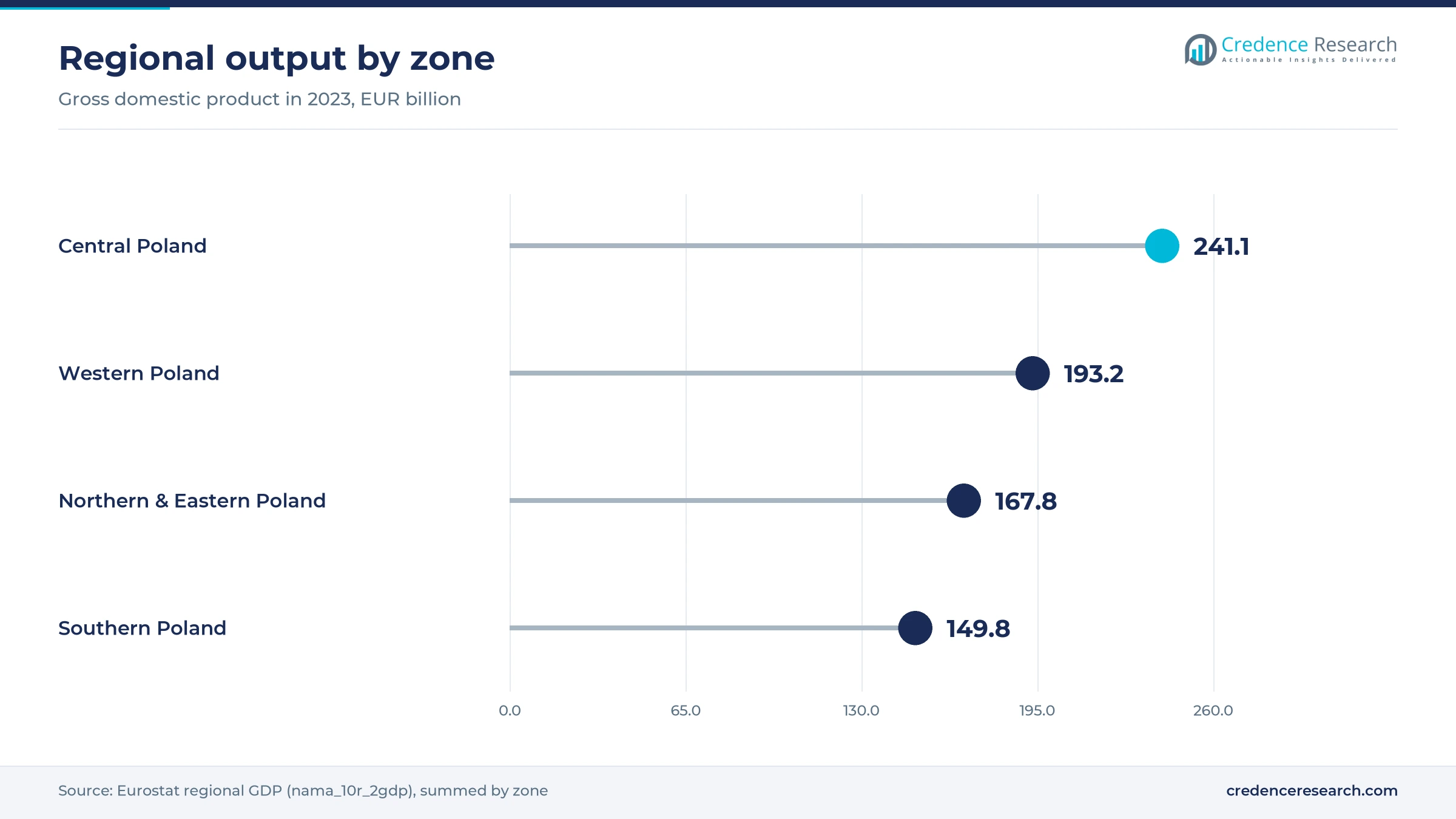
Central Poland held a 30.0% share of 2025 value and grows at 5.9% a year, the fastest regional rate. Eurostat data show the Warsaw capital region alone produced EUR 137.7 billion of the zone's EUR 241.1 billion output in 2023, while the zone housed about 8.9 million people at the start of 2025. Warsaw holds the brand flagships noted above, and the capital had more than 2 million residents at the end of 2025, GUS experimental data show. Premium upgrades and new formats keep its growth ahead of the national rate.
Western Poland combines industry hubs with retail parks
Western Poland held a 26.0% share of 2025 value and grows at 5.5% a year, close to the national rate. Wielkopolskie, Dolnoslaskie and three smaller provinces counted about 9.6 million residents in 2025 and EUR 193.2 billion of output in 2023, Eurostat data show. Poznan and Wroclaw anchor premium demand, while mid-sized towns such as Leszno are on Decathlon's expansion list. Retail parks and online delivery carry much of the demand outside the two cities, which favors chains and marketplaces.
Northern & Eastern Poland is the largest population base
Northern & Eastern Poland held a 23.5% share of 2025 value and grows at 5.3% a year, the slowest regional rate. The six provinces counted about 10.4 million residents in 2025, the most of any zone, but produced EUR 167.8 billion of output in 2023, Eurostat data show. The Tri-City coast supports premium demand, and Decathlon opened a store of about 1,000 square meters at Klif in Gdynia. Lower incomes in Lubelskie, Podkarpackie and Podlaskie keep buyers in value tiers and online channels.
Southern Poland adds mountain and city demand
Southern Poland held a 20.5% share of 2025 value and grows at 5.7% a year, slightly above the national rate. Slaskie and Malopolskie counted about 7.5 million residents in 2025 and EUR 149.8 billion of output in 2023, Eurostat data show. Krakow had almost 900,000 residents at the end of 2025, and the city anchors southern demand for running and outdoor ranges sold through Decathlon and the main chains. The Tatra visitor record noted above adds seasonal demand for outdoor ranges in Zakopane and Krakow stores.
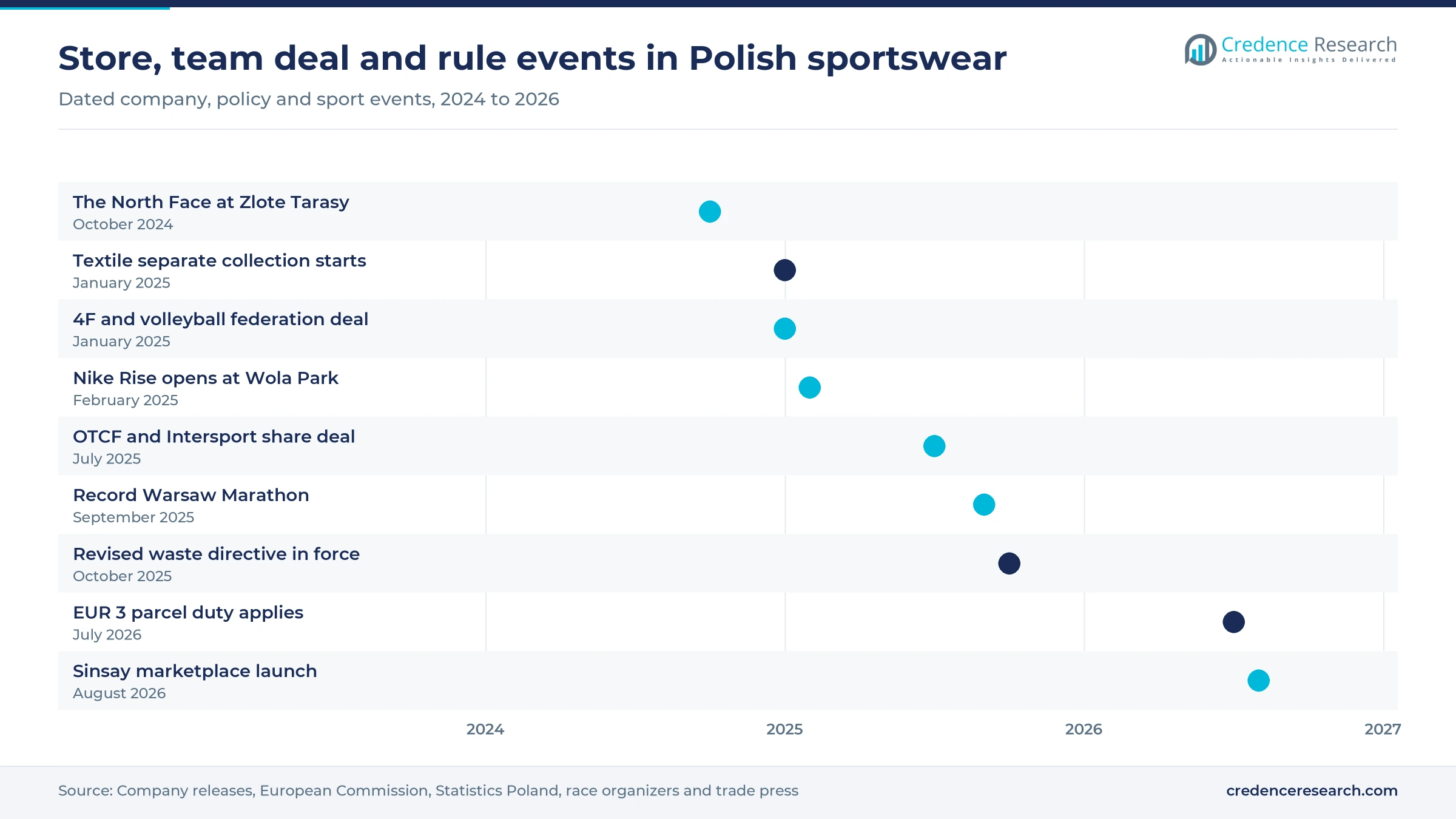
Store openings, team deals and channel moves, 2024 to 2026
| Development | Status and market relevance |
|---|---|
| In October 2024, The North Face opened a store at Zlote Tarasy in Warsaw as Nike enlarged its flagship there. | Opened; mall sports cluster |
| In January 2025, 4F became technical sponsor of the Polish volleyball national teams for at least four years. | Agreement signed; kit made in Poland |
| In February 2025, Nike opened its Nike Rise store of more than 1,000 square meters at Wola Park in Warsaw. | Opened; brand-run concept store |
| In July 2025, OTCF agreed to take up to 15,733,333 new shares in Intersport Polska. | Agreement; completion not yet confirmed |
| In July 2026, Stichd, part of the PUMA Group, announced a Warsaw hub and a move to direct-to-retail sales in Eastern Europe. | Announced; regional hub |
Moisture control fabrics dominate as recycled fibers gain
- Moisture management fabrics wick sweat and dry fast, so they dominate running shirts, football jerseys and gym tops sold by every major brand in the country.
- Thermal and weather protection keeps runners and hikers warm and dry through long Polish winters, which makes insulated jackets and waterproof shells a steady autumn purchase.
- Compression and support gives leggings, sports bras and recovery wear their fit, which suits gym, fitness class and running buyers who want support by activity.
- Recycled and lower-impact materials reuse polyester from bottles and old garments, which helps brands prepare for textile producer fees, although blended fabrics remain hard to recycle.
Need a Custom Version of This Report?
Tailor the scope, geography, or segments to your exact requirements.
- Custom geography or segment scope
- Direct access to our analyst team
Global brands and a home champion compete for shelf space
Competition in Polish sportswear turns on brand heat, product fit and direct access to buyers. Nike and adidas lead in footwear and football, and both sell through flagship stores in Warsaw, their own web shops and the main chains. OTCF competes with 4F, a domestic brand that dresses Polish national teams and sells through its own stores and web shop, and it now holds a stake in the Intersport Polska chain. Decathlon competes on price with own labels and a national store network. PUMA, New Balance, ASICS and Under Armour compete in running, training and lifestyle shoes, while The North Face and Columbia target hikers with technical jackets. Marketplaces such as Allegro and Sinsay set much of the price and delivery standard, so every brand needs stock depth and fast delivery to hold share.
Global brands, one home champion and a few big chains
The supply side combines a small group of global brands with one strong domestic brand and a few large retail chains. Nike and adidas lead in footwear and football and run their own stores in the main malls, while PUMA, New Balance, ASICS, Under Armour, Columbia and The North Face sell through chains, marketplaces and selected brand stores. OTCF brings the 4F brand, local production of team kit and its own store network. Decathlon combines retail scale with own labels, which caps prices in the value tier. Margins sit with brands at full price, while multi-brand chains earn thin margins.
Sportswear brands and their Polish roles
| Company | Type | Role in the market |
|---|---|---|
| Nike, Inc. | Global brand | Running, football and training shoes and apparel, Warsaw Rise and Zlote Tarasy stores |
| adidas AG | Global brand | Football, running and lifestyle shoes and apparel, Warsaw brand center and web shop |
| OTCF S.A. (4F) | Domestic brand | National team kit made in Poland, own stores and Intersport Polska stake |
| Decathlon S.A. | Sports retailer and own-label maker | 68 Polish stores at end of 2025 with own-label ranges |
| PUMA SE | Global brand | Running, football and lifestyle shoes and apparel through its Polish web shop and retailers |
| The North Face (VF Corporation) | Outdoor brand | Outdoor jackets, hiking footwear and layers, with a Zlote Tarasy store since October 2024 |
Women, gyms and marketplaces decide the next phase
Credence Research's view is that Polish sportswear will grow on both use and income, since fewer than half of residents take part in sport while real pay keeps rising. Value will move toward athleisure, gym wear, women's ranges and marketplaces, while multi-brand chains and basic training wear face pressure from platforms and own labels. Textile producer fees are the main new cost, and brands that design for recycling will carry lower charges. Gyms, women's sport and mountain tourism are the clearest openings for brands with ranges built for them.
Values built from apparel spending, sport mix and prices
The report uses 2025 as the base year and forecasts to 2035. Market values come from the Credence Research model, built from household clothing and footwear spending, the share of sportswear and sports footwear in that spending and average selling prices by product type. Regional, segment and channel splits are Credence Research estimates built from public inputs, including Eurostat population and regional output data. Inputs include Statistics Poland participation, wage, price and population data, European Commission rules on parcels and textiles, ministry program data, company and federation releases, trade press and published retail prices. No interviews or primary surveys were conducted for this report.
Athleisure, gym wear and online channels gain share to 2035
The Poland sports apparel & athleisure market is set to reach USD 4.67 billion by 2035, as rising participation, higher real pay and online buying keep spending climbing. Growth will be strongest in athleisure apparel, fitness and gym wear, women's ranges, e-commerce marketplaces and Central Poland, while multi-brand chains and children's kit lose share. The main variables are how fast real wages keep rising, how much volume cross-border platforms hold after the parcel duty, and how much the new textile producer schemes add to brand costs.
Pay, participation and platforms decide the range
The range of outcomes depends on whether real wages keep rising, how far participation in gyms and running keeps climbing, and how much volume cross-border platforms keep in basics after the parcel duty. Faster growth in women's sport and mountain tourism would lift demand above the base. A weaker zloty, slower pay rises and new textile producer fees would squeeze brands that rely on wholesale and discounting.
| Scenario | CAGR, 2026–2035 | Value, 2035 | What has to hold |
|---|---|---|---|
| Downside | 4.1% | USD 4.11 billion | Real wages stall, the zloty weakens and platforms keep share in basics despite the duty |
| Base | 5.61% | USD 4.67 billion | Steady participation gains, modest trading up and orderly textile producer rules |
| Upside | 6.8% | USD 5.17 billion | Faster growth in gym membership, women's sport and brand store openings in mid-sized cities |
Frequently Asked Questions
How big is the Poland sports apparel & athleisure market?
Which product type leads Polish sportswear spending?
Which region leads demand in Poland?
How many Poles take part in sport and recreation?
How much do Polish shoppers buy online?
What does the EU parcel duty change for sportswear sellers?
Who are the main sportswear suppliers in Poland?
What could slow the Poland sports apparel & athleisure market?
Table of Content
Chapter 1 Market Segmentation
- 1.1 Segmentation Framework
- 1.1.1 Product and Service Classification
- 1.1.2 Application and End-Use Classification
- 1.1.3 Technology and Solution Classification
- 1.1.4 Customer and Distribution Channel Classification
- 1.1.5 Geographic Segmentation
- 1.1.6 Market Segment Definitions and Boundaries
- 1.2 By Product Type
- 1.2.1 Performance Sportswear
- 1.2.2 Sports Footwear
- 1.2.3 Athleisure Apparel
- 1.2.4 Outdoor & Performance Apparel
- 1.3 By Application
- 1.3.1 Football
- 1.3.2 Running & Training
- 1.3.3 Fitness & Gym
- 1.3.4 Outdoor & Hiking
- 1.4 By End User
- 1.4.1 Men
- 1.4.2 Women
- 1.4.3 Children & Teens
Chapter 2 Introduction
- 2.1 Report Objectives and Scope
- 2.2 Product Definition and Industry Terminology
- 2.3 Market Inclusions and Exclusions
- 2.4 Research Process
- 2.4.1 Primary Research and Expert Interviews
- 2.4.2 Secondary Research and Source Review
- 2.4.3 Top-Down and Bottom-Up Estimation
- 2.4.4 Data Triangulation and Verification
- 2.5 Market Size Measurement Basis
- 2.5.1 2025: USD 2.69 billion → 2035: USD 4.67 billion
- 2.6 Historical and Forecast Reference Periods
- 2.6.1 Historical Period: 2018-2025
- 2.6.2 Base Year: 2025
- 2.6.3 Forecast Period: 2025-2035
- 2.7 Research Assumptions and Limitations
Chapter 3 Executive Summary
- 3.1 Market Snapshot and Key Findings
- 3.2 Base-Year Market Size, 2025
- 3.3 Forecast Market Size, 2035
- 3.4 Revenue and Volume Growth Outlook
- 3.5 Key Demand and Supply Indicators
- 3.6 Leading Market Segments
- 3.7 Fastest-Growing Market Opportunities
- 3.8 Regional Performance Highlights
- 3.9 Technology and Industry Transformation
- 3.10 Competitive Landscape Summary
- 3.11 Analyst View and Strategic Implications
Chapter 4 Poland Sports Apparel & Athleisure Market Trends and Developments
- 4.1 Historical Industry Development, 2018-2025
- 4.2 Recent Market Trends and Developments
- 4.3 Demand and Customer Behavior Trends
- 4.4 Technology and Product Innovation
- 4.5 Artificial Intelligence, Automation and Digitalization
- 4.6 Local Manufacturing and Supply Chain Realignment
- 4.7 Industry Partnerships, Mergers and Acquisitions
- 4.8 Sustainability and Circular Economy Developments
- 4.9 Government and Private Sector Investment Trends
- 4.10 Emerging Business Models and Commercialization
- 4.11 Industry Developments and Announcements
Chapter 5 Poland Sports Apparel & Athleisure Market Production, Supply and Demand Analysis
- 5.1 Demand Trend and Consumption Analysis, 2018-2025
- 5.2 Demand Forecast, 2025-2035
- 5.3 Production and Output Trend, 2018-2025
- 5.4 Production and Output Forecast, 2025-2035
- 5.5 Installed Capacity and Capacity Utilization
- 5.6 Company-Wise Production Plants and Statistics
- 5.6.1 Installed Production Capacity
- 5.6.2 Actual Production
- 5.6.3 Planned Capacity and Expansion Targets
- 5.7 Supply Chain Structure and Procurement Trends
- 5.8 Supply-Demand Gap and Bottlenecks
- 5.9 Import Dependence and Sourcing Structure
- 5.10 Contract Manufacturing and Outsourcing
- 5.11 Regional Supply and Demand Concentration
Chapter 6 Poland Sports Apparel & Athleisure Market Pricing Analysis
- 6.1 Pricing Structure and Measurement
- 6.2 Historical Pricing Trends, 2018-2025
- 6.3 Pricing Outlook, 2025-2035
- 6.4 Average Selling Price and Unit Economics
- 6.5 Pricing by Product and Market Segment
- 6.6 Geographic Pricing Differences
- 6.7 Key Input, Energy, Labor and Logistics Costs
- 6.8 Contract Pricing and Purchasing Models
- 6.9 Pricing Sensitivity and Competitive Positioning
- 6.10 Price, Margin and Profitability Implications
Chapter 7 Poland Sports Apparel & Athleisure Market Dynamics
- 7.1 Market Growth Drivers
- 7.1.1 Demand-Side Drivers
- 7.1.2 Technology and Innovation Drivers
- 7.1.3 Infrastructure and Investment Drivers
- 7.1.4 Regulatory and Policy Drivers
- 7.2 Market Restraints
- 7.2.1 Cost and Affordability Constraints
- 7.2.2 Technology and Adoption Barriers
- 7.2.3 Supply Chain and Operational Constraints
- 7.3 Market Challenges
- 7.3.1 Competitive Pressure and Margin Erosion
- 7.3.2 Skills, Infrastructure and Implementation Gaps
- 7.4 Emerging Market Opportunities
- 7.5 Market Dynamics Impact and Time-Horizon Assessment
Chapter 8 Poland Sports Apparel & Athleisure Value Chain Analysis
- 8.1 Industry Value Chain Overview
- 8.2 Upstream Suppliers and Critical Inputs
- 8.3 Technology and Component Providers
- 8.4 Manufacturing or Service Delivery
- 8.5 Distribution, Channel Partners and Integrators
- 8.6 Downstream Applications and End Users
- 8.7 Value Addition and Profit Pools
- 8.8 Vertical Integration and Outsourcing
- 8.9 Supplier Concentration and Risk
- 8.10 Supply Chain Localization and Resilience
Chapter 9 Poland Sports Apparel & Athleisure Market Regulations and Policies
- 9.1 Relevant Laws, Standards and Compliance Frameworks
- 9.2 Product, Service, Safety and Quality Requirements
- 9.3 Government Policies, Incentives and Subsidies
- 9.4 Imports, Exports and Trade Barriers
- 9.5 Public Procurement and Local Content Requirements
- 9.6 Environmental and Sustainability Compliance
- 9.7 Upcoming Policy Changes and Market Implications
Chapter 10 Poland Sports Apparel & Athleisure Market Hotspots and Opportunities
- 10.1 Market Opportunity Mapping and Growth Hotspots
- 10.2 High-Growth Applications and Customer Groups
- 10.3 Underserved Markets and White-Space Opportunities
- 10.4 Emerging Technology and Product Opportunities
- 10.5 New Capacity and Investment Hotspots
- 10.6 Market Entry and Expansion Opportunities
- 10.7 Distribution and Partnership Opportunities
- 10.8 Near-Term and Long-Term Commercial Potential
- 10.9 Opportunity Attractiveness and Execution Risks
Chapter 11 Poland Sports Apparel & Athleisure Market Outlook, 2025-2035
- 11.1 Market Size and Analysis
- 11.1.1 Revenue (Market Measurement: 2025: USD 2.69 billion → 2035: USD 4.67 billion)
- 11.1.2 Market Volume and Quantity Sold
- 11.1.3 Historical Market Size, 2018-2025
- 11.1.4 Base-Year Market Size, 2025
- 11.2 Market Forecast, 2025-2035
- 11.2.1 Revenue Forecast to 2035
- 11.2.2 Volume Forecast to 2035
- 11.2.3 CAGR and Year-on-Year Growth
- 11.2.4 Incremental Revenue Opportunity
- 11.3 Forecast Assumptions and Scenario Analysis
- 11.3.1 Base-Case Forecast
- 11.3.2 Optimistic and Conservative Scenarios
- 11.3.3 Technology, Pricing and Policy Sensitivities
- 11.4 Market Attractiveness and Growth Outlook
Chapter 12 Poland Sports Apparel & Athleisure Market Segmentation and Outlook
- 12.1 Segmentation Summary and Market Shares, 2025
- 12.2 Largest and Fastest-Growing Segments
- 12.3 By Product Type - Market Size and Forecast, 2025-2035
- 12.3.1 Segment Definition and Scope
- 12.3.2 Historical Market Size, 2018-2025
- 12.3.3 Revenue Forecast, 2025-2035
- 12.3.4 Volume Forecast, 2025-2035
- 12.3.5 Base-Year Market Share, 2025
- 12.3.6 Segment CAGR and Growth Drivers
- 12.3.7 Subsegment Market Size and Forecast
- 12.3.7.1 Performance Sportswear
- 12.3.7.2 Sports Footwear
- 12.3.7.3 Athleisure Apparel
- 12.3.7.4 Outdoor & Performance Apparel
- 12.3.8 Subsegment Pricing and Adoption Trends
- 12.3.9 Leading Suppliers and Competition
- 12.3.10 Regional Demand and Opportunities
- 12.4 By Application - Market Size and Forecast, 2025-2035
- 12.4.1 Segment Definition and Scope
- 12.4.2 Historical Market Size, 2018-2025
- 12.4.3 Revenue Forecast, 2025-2035
- 12.4.4 Volume Forecast, 2025-2035
- 12.4.5 Base-Year Market Share, 2025
- 12.4.6 Segment CAGR and Growth Drivers
- 12.4.7 Subsegment Market Size and Forecast
- 12.4.7.1 Football
- 12.4.7.2 Running & Training
- 12.4.7.3 Fitness & Gym
- 12.4.7.4 Outdoor & Hiking
- 12.4.8 Subsegment Pricing and Adoption Trends
- 12.4.9 Leading Suppliers and Competition
- 12.4.10 Regional Demand and Opportunities
- 12.5 By End User - Market Size and Forecast, 2025-2035
- 12.5.1 Segment Definition and Scope
- 12.5.2 Historical Market Size, 2018-2025
- 12.5.3 Revenue Forecast, 2025-2035
- 12.5.4 Volume Forecast, 2025-2035
- 12.5.5 Base-Year Market Share, 2025
- 12.5.6 Segment CAGR and Growth Drivers
- 12.5.7 Subsegment Market Size and Forecast
- 12.5.7.1 Men
- 12.5.7.2 Women
- 12.5.7.3 Children & Teens
- 12.5.8 Subsegment Pricing and Adoption Trends
- 12.5.9 Leading Suppliers and Competition
- 12.5.10 Regional Demand and Opportunities
- 12.6 Segment Growth Comparison
- 12.7 Segment Attractiveness and Priority Matrix
Chapter 13 Poland Sports Apparel & Athleisure End-Use and Application Market Outlook
- 13.1 End-Use Industry and Customer Demand Structure
- 13.2 Leading Applications and Customer Groups
- 13.3 End-Use Market Size, Share and Forecast
- 13.4 Major End-Use Industry Deep Dives
- 13.4.1 Customer Requirements and Use Cases
- 13.4.2 Demand and Replacement Cycles
- 13.4.3 Technical and Regulatory Considerations
- 13.4.4 Purchasing and Procurement Models
- 13.4.5 Leading Vendors and Distribution Channels
- 13.4.6 Forecast and Commercial Opportunities
- 13.5 Emerging Applications and Cross-Segment Demand
- 13.6 End-Use Industry Investment Priorities
Chapter 14 Poland Sports Apparel & Athleisure Geographic Market Outlook, 2025-2035
- 14.1 Domestic Market Distribution and Demand Clusters
- 14.2 State- or Province-Wise Market Size and Forecast, 2025-2035
- 14.3 City and Metropolitan Market Outlook
- 14.4 Industrial, Manufacturing and Commercial Clusters
- 14.5 Geographic Concentration of Key End Users
- 14.6 Local Pricing and Purchasing Differences
- 14.7 Domestic Production Facilities and Capacity Map
- 14.8 Local Infrastructure and Project Pipeline
- 14.9 State-Level Policy and Incentive Differences
- 14.10 Subnational Investment Hotspots and Opportunities
- 14.11 Distribution and Logistics Networks
- 14.12 Domestic Competitive Footprint
Chapter 15 Poland Sports Apparel & Athleisure Technology, Innovation and Sustainability Outlook
- 15.1 Technology Landscape and Maturity
- 15.2 Product, Process and Service Innovation
- 15.3 AI, Automation and Digital Tools in the Industry
- 15.4 Technology Adoption and Performance Benchmarking
- 15.5 Innovation Pipeline and R&D Investment
- 15.6 Patent and Intellectual Property Trends
- 15.7 Energy Efficiency and Resource Management
- 15.8 Sustainability, Recycling and Circularity
- 15.9 Technology Roadmap, 2025-2035
- 15.10 Risks of Obsolescence and Technology Substitution
Chapter 16 Poland Sports Apparel & Athleisure Market Key Strategic Imperatives
- 16.1 Growth and Market Entry Priorities
- 16.2 High-Return Products and Segments
- 16.3 Pricing, Profitability and Cost Optimization
- 16.4 Technology Investment and Product Differentiation
- 16.5 Supply Chain Localization and Resilience
- 16.6 Distribution and Customer Acquisition
- 16.7 Partnership, Acquisition and Capacity Strategy
- 16.8 Regional Expansion Priorities
- 16.9 Short-, Medium- and Long-Term Actions
Chapter 17 Competition Outlook
- 17.1 Industry Competition Characteristics
- 17.2 Market Structure and Concentration
- 17.3 Market Share and Competitive Positioning, 2025
- 17.4 Company-Wise Revenue and Product Benchmarking
- 17.5 Production and Service Capacity Benchmarking
- 17.6 Technology, Pricing and Differentiation
- 17.7 Regional Footprint and Distribution Strength
- 17.8 Mergers, Acquisitions and Strategic Alliances
- 17.9 New Entrants and Competitive Threats
- 17.10 Porter's Five Forces and Industry Attractiveness
- 17.11 Competitive Outlook, 2025-2035
Chapter 18 Company Profiles
- 18.1 Company Coverage and Selection Criteria
- 18.2 Nike, Inc.
- 18.2.1 Business Description
- 18.2.2 Company Ownership and Geographic Presence
- 18.2.3 Product and Service Portfolio
- 18.2.4 Manufacturing and Operating Footprint
- 18.2.5 Production Capacity and Expansion Plans
- 18.2.6 Financial Performance and Investment
- 18.2.7 Market Share and Competitive Position
- 18.2.8 Technology and Innovation Capabilities
- 18.2.9 Strategic Alliances or Partnerships
- 18.2.10 Recent Developments
- 18.2.11 Growth Strategy and Outlook
- 18.3 adidas AG
- 18.4 OTCF S.A. (4F)
- 18.5 Decathlon S.A.
- 18.6 PUMA SE
- 18.7 The North Face (VF Corporation)
- 18.8 New Balance Athletics, Inc.
- 18.9 ASICS Corporation
- 18.10 Under Armour, Inc.
- 18.11 Columbia Sportswear Company
- 18.12 Other Relevant Market Participants
Note: Every listed company is profiled on the structure shown under the first company. The company list is preliminary and may change based on research findings, market developments, data availability and client requirements.
Chapter 19 Disclaimer
- 19.1 Research and Forecast Disclaimer
- 19.2 Data Source and Estimation Limitations
Note: The depth of individual sections depends on data availability for this market. Volume, capacity, trade and other unit-based metrics are included where applicable.

