
Kenya furniture and interiors demand rests on new homes
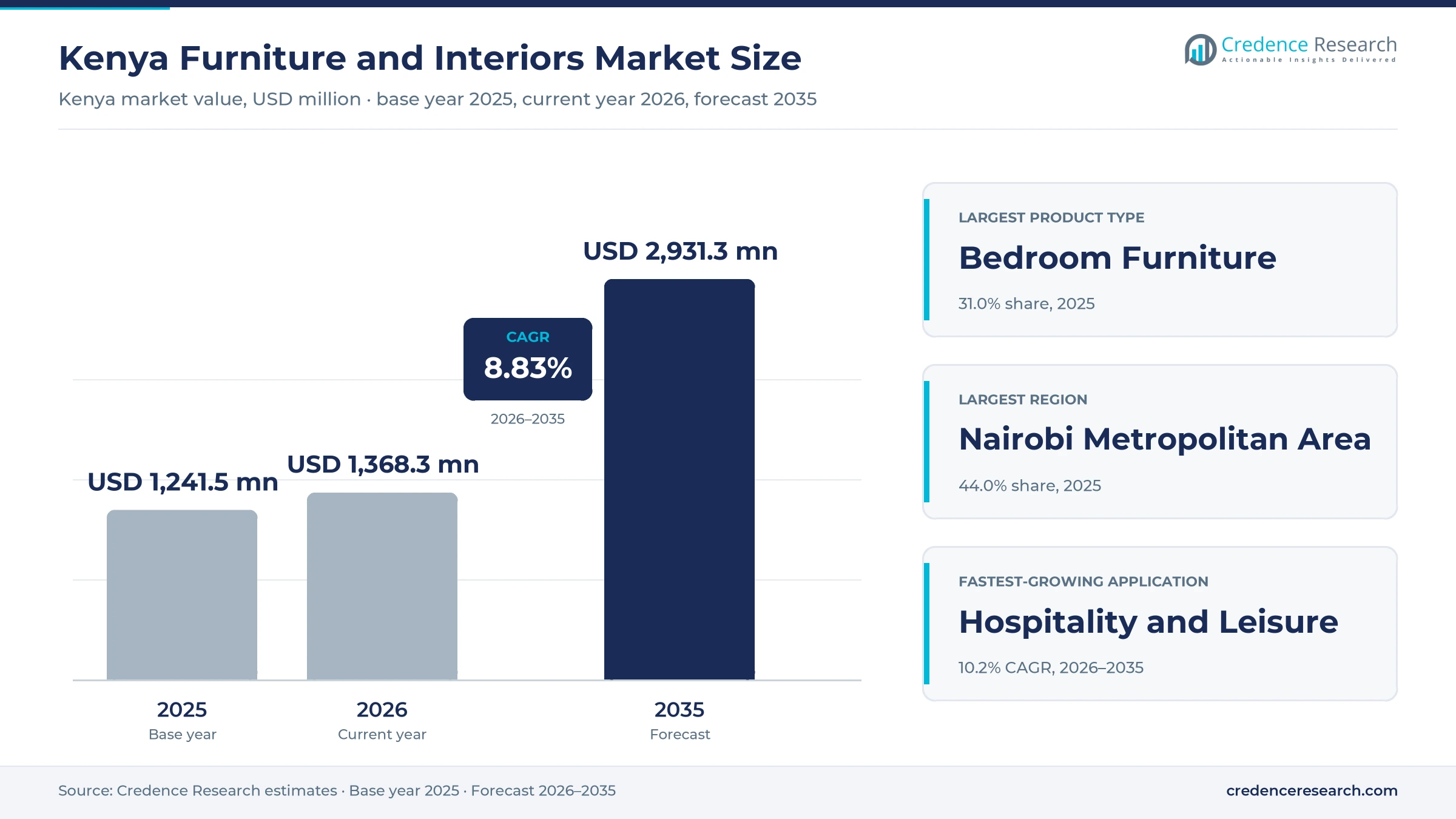
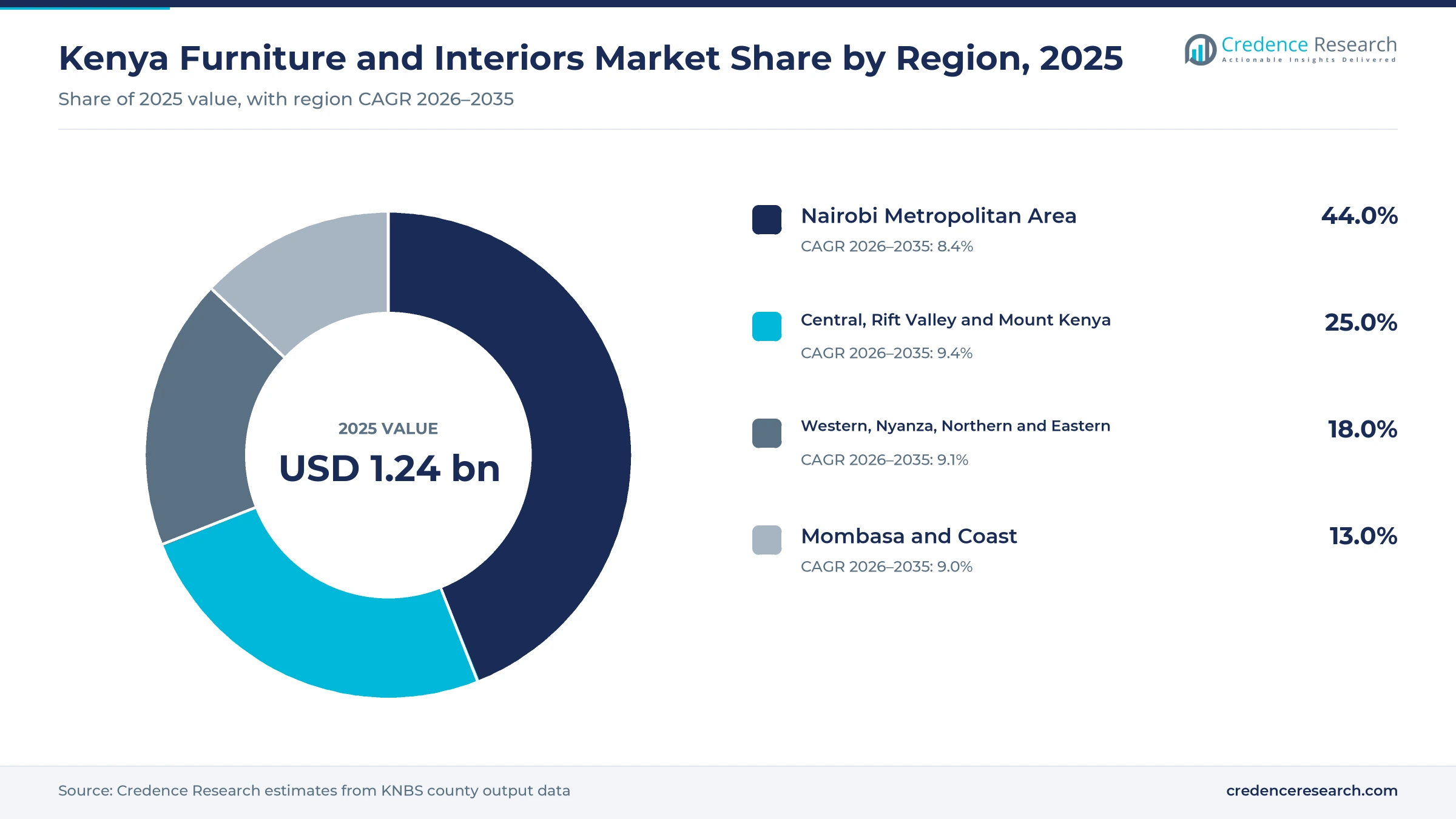
The Kenya furniture and interiors market was valued at USD 1.24 billion in 2025 and is projected to increase from USD 1.37 billion in 2026 to USD 2.93 billion by 2035, registering a CAGR of 8.83% during 2026–2035. Demand comes from households furnishing new and rented homes, developers fitting kitchens and wardrobes into apartment blocks, companies refitting offices and hotels, schools and county offices buying contract pieces. Nairobi Metropolitan Area held the largest regional share, 44.0% in 2025, because the capital and its satellite counties concentrate incomes, showrooms and apartment construction. Central, Rift Valley and Mount Kenya is the fastest-growing region at 9.4% a year, as affordable housing estates and the announced reopening of sawmills in towns such as Elburgon add buyers and, once mature-tree sales begin, timber supply. The main commercial change is import policy, because higher duties on finished furniture and a new excise on imported wood-based panels push value toward local workshops while raising their input costs.
Homes, offices and hotels furnished by workshops, factories and importers
The market counts the value of living room, bedroom, office, kitchen, storage and interior furnishing products sold in Kenya, at the price paid by households, companies, property and hospitality operators and public institutions. It covers finished pieces from showrooms and brand stores, made-to-order items from workshops, online orders and fitted kitchens and wardrobes supplied under project contracts.
Exported furniture, raw timber and boards sold to manufacturers, standalone building fit-out labor and secondhand sales are excluded. Value moves from plantation and imported timber, panels and hardware through factories and informal workshops to showrooms, contractors and installers, while imports from Asia supply much of the mass-market range.
Kenya Furniture and Interiors Market Insights
- The Kenya furniture and interiors market rises from USD 1.24 billion in 2025 to USD 2.93 billion by 2035, an 8.83% CAGR during 2026–2035, as housing and hotel projects add buyers.
- Nairobi Metropolitan Area held 44.0% of 2025 value, because Nairobi alone produces 27.5% of national output and hosts most showrooms and apartment projects.
- Bedroom Furniture led product types with 31.0% of 2025 value, as a bed frame is usually the first piece a new household buys.
- President William Ruto lifted the logging ban for mature trees on Oct. 27, 2025, and said furniture imports from China must end.
- The Finance Act 2026 added a 30% excise duty on imported wood-based panels, raising costs for local kitchen and wardrobe makers that rely on MDF.
Bedroom pieces lead while hotel and fitted work grow fastest
Bedroom furniture leads while fitted joinery grows fastest
Based on product type, the market is categorized into living room furniture, bedroom furniture, office furniture and kitchen, storage and interior furnishings. Bedroom Furniture led with 31.0% of 2025 value because a bed is the first purchase in most new or rented homes, and basic 4-by-6 wooden frames in Nairobi and Kiambu start at about KSh 9,500, according to a 2026 Sikam Furniture price guide. Kitchen, Storage and Interior Furnishings grow fastest at 9.6% a year, as apartment projects buy fitted joinery, and the Kitengela Jua Kali Association took about KSh 100 million of carpentry, joinery and fittings work at a Boma Yangu estate in October 2025, Citizen Digital reported.
Homes lead while hospitality spaces grow fastest
Based on application, the market is categorized into residential spaces, office and workplace spaces, hospitality and leisure spaces, and retail and institutional spaces. Residential Spaces led with 68.5% of 2025 value because households buy most pieces when they move, marry or replace worn items, and Nairobi approved private building plans worth KSh 221.6 billion in 2024, mostly residential, according to KNBS. Hospitality and Leisure Spaces grow fastest at 10.2% a year, as Kenya received 2.5 million international visitors in 2025, up 6.2%, according to the Economic Survey 2026, and each new guest room needs beds, seating and lobby pieces.
Handcrafted work leads while digital custom plants grow fastest
Based on technology, the market is categorized into mass-production systems, modular and knock-down systems, digitally enabled custom manufacturing, and handcrafted production. Handcrafted Production led with 48.0% of 2025 value because roadside and Jua Kali workshops build most beds, sofas and cabinets to order, and informal firms held more than a third of sales in a World Bank study of the sector based on 2013 data. Digitally Enabled Custom Manufacturing grows fastest at 11.0% a year, as factories automate panel cutting, and PG Bison put KSh 750 million into expanding and automating its Nairobi cabinet factory, Business Daily reported in September 2022, the latest public investment figure found.
Direct workshop and project sales lead while marketplaces grow fastest
Based on distribution channel, the market is categorized into multi-brand showrooms, brand-owned stores, online marketplaces and direct project and workshop sales. Direct Project and Workshop Sales led with 42.0% of 2025 value because many buyers commission pieces straight from carpenters and contractors fit kitchens on site, and the same World Bank study, built on 2013 data and still the latest published estimate, put sector employment at 160,000 people from forestry through manufacturing. Online Marketplaces grow fastest at 11.8% a year, as 52.3 million smartphones were connected to Kenyan networks by the end of June 2026, according to the Communications Authority of Kenya, which lets buyers compare listings and pay sellers by mobile money.
| Segment Group | Leading Sub-segment | Share, 2025 | Fastest-growing Sub-segment | CAGR, 2026–2035 |
|---|---|---|---|---|
| By Product Type | Bedroom Furniture | 31.0% | Kitchen, Storage and Interior Furnishings | 9.6% |
| By Application | Residential Spaces | 68.5% | Hospitality and Leisure Spaces | 10.2% |
| By Technology | Handcrafted Production | 48.0% | Digitally Enabled Custom Manufacturing | 11.0% |
| By Distribution Channel | Direct Project and Workshop Sales | 42.0% | Online Marketplaces | 11.8% |
Workshop prices sit far below showroom sets
Furniture in Kenya is priced per piece in showrooms and per job in workshops, so a similar bed or sofa can cost several times more in a mall store than from a roadside carpenter. Timber, boards, foam and fabric make up most of a workshop's cost, which is why permit fees and panel duties pass quickly into shelf prices. Showrooms add rent, imported finishes, delivery and credit terms, and bank installment plans help them hold higher list prices. Credence Research finds that margins are highest in branded upholstery and fitted kitchens, while economy beds and chairs earn thin returns that depend on volume.
| Item or cost | Typical price or fee | Basis |
|---|---|---|
| Basic 4-by-6 wooden bed frame, Nairobi and Kiambu | KSh 9,500 to 22,000 | Sikam Furniture price guide, 2026 |
| 4-by-6 storage bed with drawers | KSh 28,000 to 40,000 | Sikam Furniture price guide, 2026 |
| Five-seater fabric sofa, Nairobi retail listing | KSh 195,300 including VAT | tacc.co.ke listing, November 2026 |
| Mahogany beam, Nairobi timber yards | About KSh 300 per foot | The Star, July 2024 |
| Pine board, 6 by 1 | About KSh 40 per foot | The Star, July 2024 |
Request a Free Sample
Fill in your details and we'll send you a free sample report.
- Sample data tables & charts
- Research methodology
Housing, fit-out recovery and import policy lift demand
Urban housing and household formation widen the buyer base
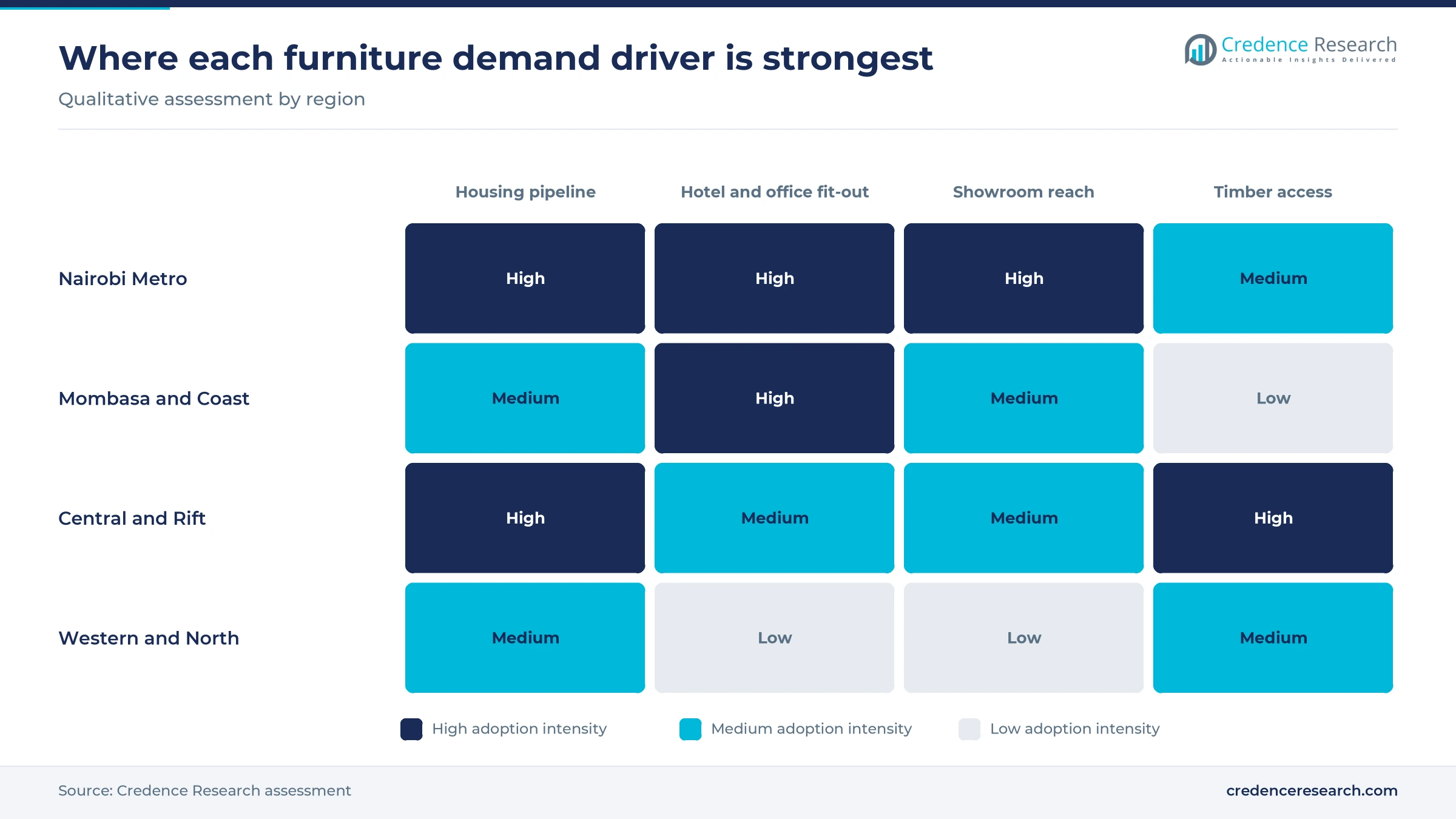
Each new urban home needs at least a bed, seating and storage, which makes household formation the widest base of furniture demand. Kenya's urban population reached 32.2% of the total in 2025 and grew 2.9% that year, according to World Bank data. Lands Cabinet Secretary Alice Wahome said on Dec. 31, 2025, that about 320,000 affordable housing units were completed or under construction, and that the state planned 500,000 more homes in 2026. The housing levy raises about KSh 65 billion a year, The Star reported, which gives the program a funded pipeline even when handovers slip. Retailers selling entry-level bedroom sets gain most from these first-time owners.
Construction and fit-out recovery restores project orders
Contractors buy kitchens, wardrobes, workstations and hotel room sets only as buildings near completion, so the 2025 construction rebound is now reaching furniture orders. Construction output grew 6.8% in 2025 after shrinking 0.7% in 2024, according to the Economic Survey 2026, which lifts project demand for fitted pieces. New hotel projects by international chains in Nairobi rose 58.3% to 3,650 rooms in 2026, the Nation reported, and Choice Hotels said in January 2026 that it had agreements for three hotels in Kenya. Companies are also moving from ageing buildings into Grade A offices, The Standard reported, which brings new workstation and meeting-room orders. Project buyers with fixed handover dates favor suppliers that can deliver and install at volume.
Domestic manufacturing and import substitution favor local makers
Tariff and timber policy now push in the same direction, making imported finished pieces dearer while promising more forest supply to Kenyan sawmills. President William Ruto lifted the logging ban for mature trees on Oct. 27, 2025, said sawmills in Elburgon would reopen, and told the trade ministry that furniture imports from China must end, Citizen Digital reported. Imports of furniture, bedding and mattresses still rose 13.1% to KSh 8.69 billion in the nine months to March 2024, the latest period in the KNBS figures The Star cited in October 2025. That rise came even after the Finance Act 2023 lifted import duty on furniture from 35% to 45%. Workshops and factories that can match imported finishes stand to win share from Asian suppliers, although the rise in imports shows that duty alone has not moved buyers.
Installment credit and lower rates ease big-ticket purchases
Many Kenyan households spread sofas, beds and dining sets over several months of payments, so credit access shapes when they buy. KCB lets cardholders buy furniture at Victoria Homestore, listed by the bank as Victoria Courts, and repay in 10 monthly installments, and offers a 7% discount for full card payment, the bank says. Buy-now-pay-later use rose from 2.1% of adults in 2021 to 6.2% in 2024, or about 1.75 million people, according to the 2024 FinAccess survey. The Central Bank of Kenya has kept cutting its policy rate, to 8.75% from Oct. 7, 2026, which lowers the cost of consumer credit over time. Mid-market showrooms that partner with banks and lenders convert more browsing households into buyers.
Hardwood imports and turnkey project supply reshape buying
Hardwood supply is shifting toward imports and plantation softwood
Furniture makers are shifting toward imported hardwood and plantation softwood, because domestic forests cannot meet demand for mahogany-type timber. Kenya needs about 100,000 cubic meters of hardwood a year, most of it from the Democratic Republic of Congo, and 65,000 to 68,000 cubic meters are officially imported, former KEFRI chief Joshua Cheboiwo told The Star in June 2025. The Kenya Forest Service put national wood demand at 45 million cubic meters against a supply of 30 million, the same paper reported in July 2024. The Standard reported in July 2025 that imports meet about half of national wood needs. That gap means workshops pair pine and cypress frames with veneered panels and keep solid hardwood for premium and luxury pieces.
Project buyers want design, supply and installation in one contract
Developers, short-stay operators and hotels are shifting toward single contracts that cover design, supply and installation, because handover schedules leave little room for separate fitters. Dr Mattress, run by Turea Limited, offers custom pieces for hotels, furnished apartments, offices and cafés, a form of hotel and office contract supply covering concept, manufacturing and installation under a Made in Kenya label. Fairdeal Furniture runs 10 branches and seven licensed Ashley HomeStores and says its pieces sit in most county government offices, The Star reported in February 2026. Odds & Ends, in business for more than 35 years, makes domestic furniture and sofa sets in its own workshops while importing antiques and decor. Suppliers with their own workshops and install teams win repeat orders from buyers furnishing many identical rooms.
Fitted joinery for affordable housing is a clear opening
Every affordable housing unit needs kitchen cabinets, wardrobes and doors before handover, which gives joinery shops a contract pipeline that loose-furniture sellers lack. President Ruto commissioned the 220-unit St Claire project and laid the foundation for the 2,680-unit Michinda project in Elburgon on Oct. 27, 2025, and said Kenyan youth would make the furniture for such estates. The 500,000-home target for 2026 noted above multiplies that demand across counties, even if delivery lags. The Kitengela Jua Kali Association contract cited earlier shows that small workshops can already win this work. Cabinet shops that can supply standard fitted kitchen cabinets at volume gain a recurring order book. A single estate the size of Michinda creates joinery demand for 2,680 kitchens and wardrobe sets.
County towns outside Nairobi offer room for showroom growth
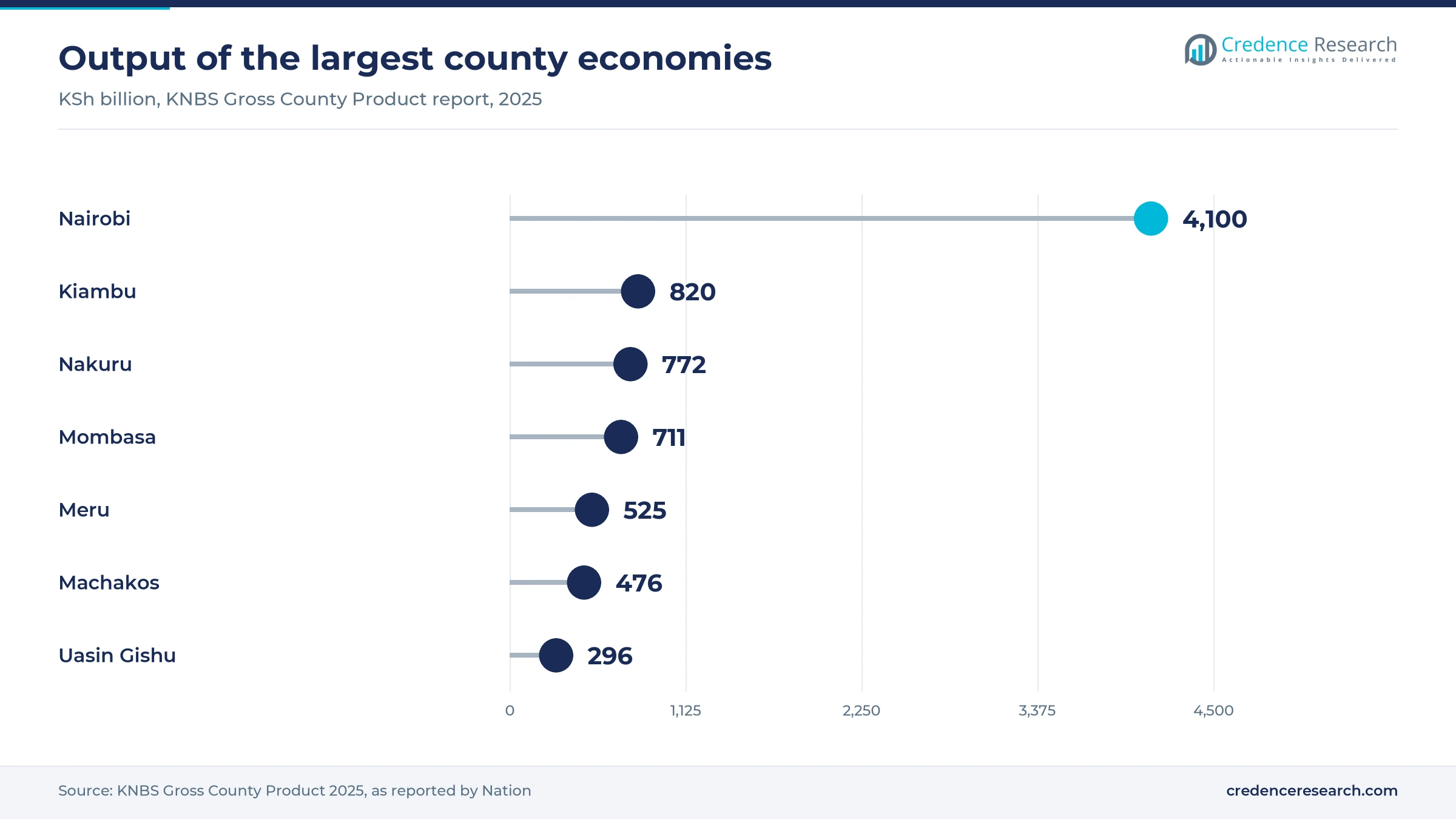
Organized furniture retail remains thin outside Nairobi even where county output is large, in the Credence Research assessment. Kiambu produced KSh 819.8 billion of output, Nakuru KSh 771.8 billion and Meru KSh 525 billion, according to the KNBS Gross County Product report of 2025. Fairdeal named Mombasa, Kisumu, Nakuru and Eldoret as cities with rapid apartment development, The Star reported in February 2026. Retailers that open mid-sized stores with delivery and installment plans can reach households that now buy mainly from local workshops. Nakuru and Eldoret also sit close to the Elburgon sawmills, which could lower the cost of locally made stock for stores in those towns.
Panel excise, timber fees and slow handovers pressure makers
Panel excise raises costs for kitchen and wardrobe makers
The new panel excise raises costs for local kitchen and wardrobe makers, because most fitted joinery is cut from imported MDF boards and particleboard. The Finance Act 2026 added a 30% excise duty on imported wood-based panels on top of the 35% import duty, and manufacturers told a parliamentary committee they had raised prices by 15% to 20%, Business Daily reported. Cabinet shops on fixed-price apartment contracts face the highest risk from this cost pressure. Some makers may shift to local boards or lobby for a review.
Timber permits and hardwood prices squeeze small workshops
Small workshops buy wood in small lots and cannot hedge, so permit fees and hardwood prices hit their costs at once. The Kenya Forest Service raised the cross-border timber movement charge to KSh 25,570 per permit from KSh 2,000 in July 2024, and mahogany beams rose to about KSh 300 per foot from KSh 280 earlier that year, The Star reported. Workshops that import hardwood through Busia and Malaba carry most of this cost. Many respond by switching to pine, cypress and veneered panels.
Slow housing completions delay project furniture orders
Fit-out comes last in any building program, so every slipped handover pushes furniture orders into a later year. Units completed by the State Department for Housing and Urban Development fell 50.7% to 1,655 in 2024, and cement sales fell 7.2% in the 2024/25 fiscal year, according to KNBS figures reported by People Daily. Suppliers that sized workshops for the housing pipeline face idle capacity when handovers slip. Spreading orders across hotels, offices and retail reduces that exposure.
High input costs keep formal factories behind on price
Formal factories carry full taxes and grid power tariffs that importers pass on and informal workshops often avoid, which keeps them behind on price. Manufacturing grew only 2.1% in 2025, against 3.2% in 2024, and its share of GDP slipped to 7.1%, according to KNBS figures. The Kenya Association of Manufacturers cites high electricity tariffs, transport costs and taxes on raw materials as the main burdens. Formal plants selling standard pieces against imports face the greatest risk. Factories respond by automating cutting lines and taking more project work.
Nairobi leads while Rift Valley and Mount Kenya gain fastest
| Region | Value, 2025 (USD billion) | Share, 2025 | CAGR, 2026–2035 |
|---|---|---|---|
| Nairobi Metropolitan Area | 0.55 | 44.0% | 8.4% |
| Central, Rift Valley and Mount Kenya | 0.31 | 25.0% | 9.4% |
| Western, Nyanza, Northern and Eastern | 0.22 | 18.0% | 9.1% |
| Mombasa and Coast | 0.16 | 13.0% | 9.0% |
Income and apartment density keep Nairobi Metropolitan Area ahead
Nairobi Metropolitan Area held 44.0% of 2025 value and grows at 8.4% a year. Nairobi alone produced more than KSh 4.1 trillion of output, or 27.5% of national GDP, according to the KNBS Gross County Product report of 2025, and the zone also covers Kiambu, Machakos, Kajiado and Murang'a. Most brand stores sit here, including Dignity Furniture's showrooms in Lang'ata, Mlolongo, Thika Road and Parklands. Its growth trails upcountry zones in the Credence Research estimate, because more city households are replacing pieces than furnishing a first home.
Tourism and port trade support the coastal zone
Mombasa and Coast held 13.0% of 2025 value and grows at 9.0% a year. Mombasa County produced KSh 711 billion of output in the same KNBS county series, and beach hotels and serviced apartments along the coast buy beds, seating and outdoor pieces for guest rooms. Imported furniture lands at Mombasa port before it moves inland, which gives coastal dealers early access to stock and makes the city the first store market outside Nairobi for national chains, a Credence Research assessment.
Why do Central, Rift Valley and Mount Kenya grow fastest?
Central, Rift Valley and Mount Kenya held 25.0% of 2025 value and grows fastest at 9.4% a year. Nakuru and Meru rank among the largest county economies, and both host growing towns with new estates such as the Michinda project in Elburgon. The reopening of Elburgon sawmills that President Ruto announced in October 2025 would put plantation timber close to workshops in Nakuru, Molo and Eldoret. Local makers in this zone stand to gain both raw material and new household buyers through 2035.
Local workshops anchor demand in western and northern counties
Western, Nyanza, Northern and Eastern held 18.0% of 2025 value and grows at 9.1% a year. Hardwood from Uganda and the Democratic Republic of Congo enters through Busia, where a clean import takes about four days, a Nairobi timber dealer told The Star in June 2025. Kisumu is one of the cities with rapid apartment building, while northern and arid counties have few showrooms and long delivery routes. Demand here leans toward economy beds, chairs, school furniture and county office pieces.
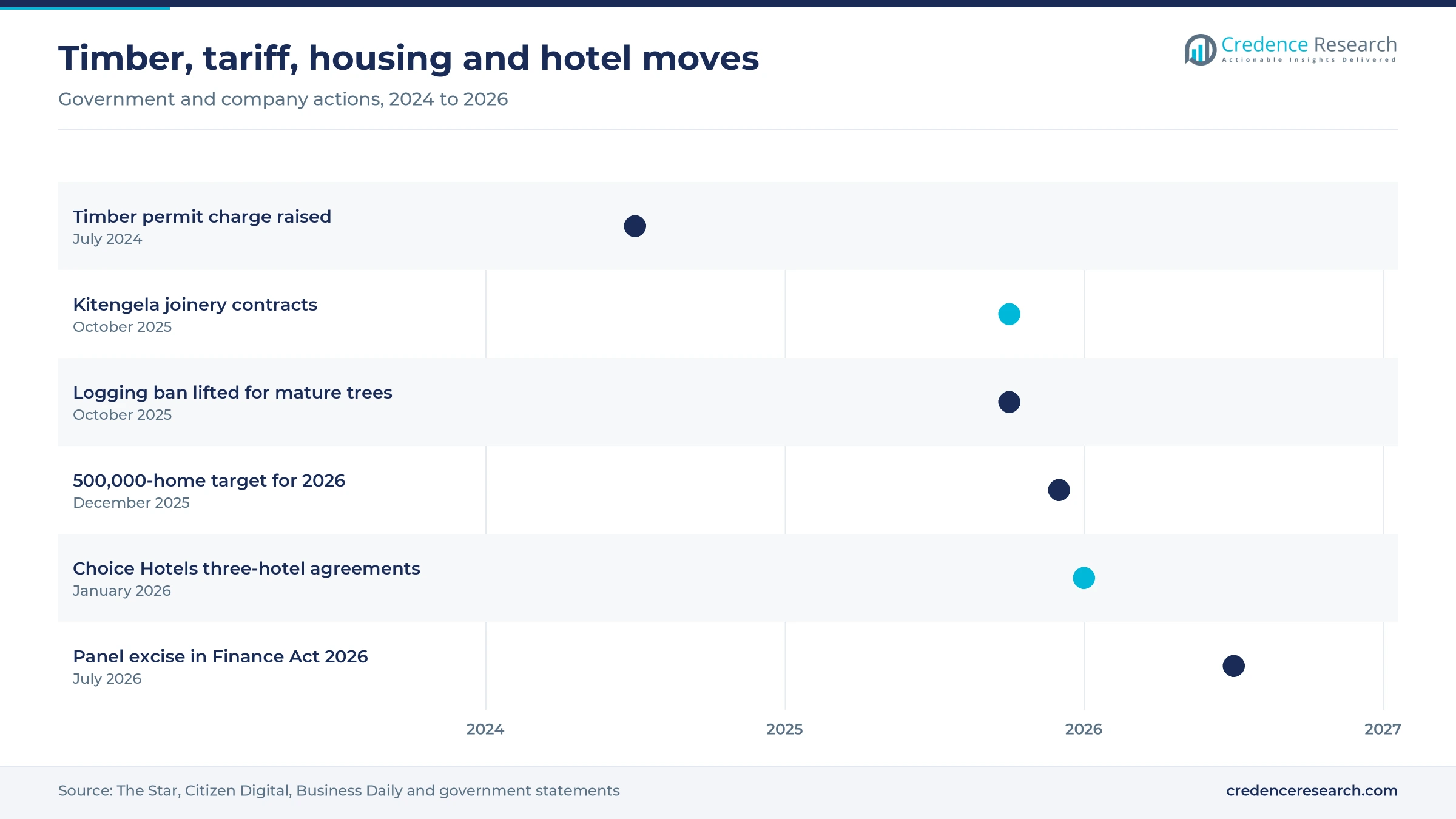
Logging, tariff and hotel moves that shaped 2024 to 2026
| Development | Status and market relevance |
|---|---|
| In July 2024, the Kenya Forest Service raised the cross-border timber movement charge to KSh 25,570 per permit from KSh 2,000. | In force; raises imported hardwood costs |
| In October 2025, the Kitengela Jua Kali Association took carpentry, joinery and fittings contracts at a Boma Yangu estate. | Contracts awarded; opens housing work to workshops |
| In October 2025, President William Ruto lifted the logging ban for mature trees and said Elburgon sawmills would reopen. | Presidential announcement; ban lifted for mature trees, sawmill reopening still being arranged with sawmillers |
| In January 2026, Choice Hotels said it had signed agreements for three hotels in Kenya under its Clarion and Quality Inn brands. | Agreements signed; future hotel fit-out demand |
| In July 2026, the Finance Act 2026 added a 30% excise duty on imported wood-based panels on top of the 35% import duty. | Enacted; raises fitted joinery costs |
CNC joinery, flat-pack fittings and kiln-dried softwood
- CNC panel cutting turns kitchen and wardrobe drawings into cut lists, which lets factories supply identical units for apartment blocks quickly.
- Knock-down fittings let flat-packed pieces ship cheaply and assemble on site, which suits upper-floor apartments and frequent rental moves.
- Pocket-spring and high-density foam sleep systems raise the value of each bed sold, and local makers such as Dr Mattress now pair them with frames, adding to mattress demand.
- Kiln drying and treatment stabilize plantation pine and cypress so they do not warp, which lets workshops substitute softwood for scarce hardwood.
Need a Custom Version of This Report?
Tailor the scope, geography, or segments to your exact requirements.
- Custom geography or segment scope
- Direct access to our analyst team
Showroom chains, specialist factories and workshops compete
Competition in the Kenya furniture and interiors market runs between importing showroom chains, specialist manufacturers and a large base of informal workshops. Victoria Homestore, Furniture Palace and Fairdeal compete for mid-market households on range breadth, delivery and installment plans, and Fairdeal adds licensed Ashley ranges. Dignity Furniture and Odds & Ends combine imported ranges with locally made sofas and made-to-order pieces. Rosewood Workspace Solutions, a local office specialist since 1992, competes for corporate fit-outs against importers of workplace seating and desking. Panesars Kenya supplies bespoke wooden pieces from its Mombasa Road workshop, and Dr Mattress sells beds and project furniture under a Made in Kenya label. BoConcept Kenya and Palacina Interiors serve premium homes with design-led furniture, curtains and decor. Buyers weigh finish, price, delivery time and credit, so suppliers with local workshops and stores in several towns hold the strongest position.
Three supply tiers with very different cost bases
Supply runs in three tiers that earn money in different ways. Informal workshops build beds, sofas and cabinets to order from local and imported timber, selling on price and speed with low overheads. Formal manufacturers such as Panesars, Rosewood and Dr Mattress serve offices, hotels and premium homes with their own factories and installation teams. Importing retailers such as Furniture Palace, Fairdeal and Victoria Homestore fill showrooms with Asian, European and U.S. ranges. Barriers are low for workshops but high in project supply, where finishes, warranties and delivery capacity decide tenders, so margins concentrate with factories and brands that control design and installation.
Suppliers that Kenyan buyers shortlist
| Company | Type | Role in the market |
|---|---|---|
| Victoria Homestore (Victoria Courts) | Retail chain | Sells home furniture with KCB card installment plans of up to 10 months |
| Furniture Palace Kenya | Importing retailer | Sells imported home, office and garden furniture ranges through Nairobi showrooms |
| Fairdeal Furniture | Retail chain and licensee | Runs 10 branches and seven Ashley HomeStores, supplies county government offices |
| Dr Mattress (Turea Limited) | Local manufacturer | Makes mattresses, beds and custom project furniture for hotels and apartments |
| Odds & Ends | Manufacturer and retailer | Makes sofas and domestic furniture locally and imports antiques and decor |
| Dignity Furniture Kenya | Retail chain | Sells home, office and bistro furniture from four Nairobi-area showrooms |
| Rosewood Workspace Solutions | Office specialist | Supplies office chairs, desks and workstation fit-outs since 1992 |
| Panesars Kenya | Bespoke manufacturer | Makes bespoke wooden furniture at its Mombasa Road workshop in Nairobi |
| BoConcept Kenya | Brand franchise | Sells Danish-design furniture and decor from its Nairobi franchise store |
| Palacina Interiors | Interior design house | Provides interior design with furniture, curtains, lighting and decor |
Local project supply gains on imported showroom ranges
Credence Research's view is that Kenyan furniture value will move steadily from imported showroom ranges and single workshop orders toward locally made project and fitted supply. Residential Spaces remain the base of demand, but housing estates, hotels and offices reward suppliers that can design, build and install at volume. Import duties and reopened forests favor domestic makers, yet the panel excise and timber fees show that policy can raise local costs as quickly as it shields them. Suppliers with their own workshops, bank credit partners and stores in several counties hold the strongest position, while small importers of economy pieces face the most pressure.
County output, trade and housing data anchor the estimate
The report uses 2025 as the base year and 2026 to 2035 as the forecast period. Market values come from the Credence Research model, and the regional, product, application, technology and channel splits are Credence Research estimates informed by public data. The 2025 value was checked against a bottom-up estimate built from household numbers, typical furniture spending, contract demand from offices and hotels, and import and production data. Regional shares were set from KNBS county output figures, because no official statistic tracks furniture sales by zone, so they carry wider ranges. Sources include KNBS, the World Bank, the Communications Authority, government statements, company pages and Kenyan business press. No interviews or surveys were used to build these estimates.
Housing estates and hotel rooms carry growth to 2035
Credence Research expects the market to reach USD 2.93 billion by 2035, rising from USD 1.37 billion in 2026, as household formation, housing estates and hotel projects add buyers. Central, Rift Valley and Mount Kenya should keep the fastest regional pace, while Nairobi Metropolitan Area remains the largest source of value. Value rises faster from 2025 to 2026 than the decade average, as the Nairobi hotel rooms in the 2026 pipeline and housing units already under construction reach fit-out, before growth settles toward the long-run rate. Housing delivery, credit and local board supply form the main upside, while panel duties, timber shortages and weak completions are the main restraints.
Housing delivery and import policy set the range of outcomes
The range to 2035 depends mainly on how fast affordable housing units reach handover, whether the panel excise stays, and how hotel and office projects hold up. The base case assumes steady household formation and partial delivery of the housing pipeline. A downside follows if completions stall and panel costs stay high, which would push buyers toward cheap imports and informal pieces. An upside follows if sawmill supply and local board production expand, letting factories compete on finish and price.
| Scenario | CAGR, 2026–2035 | Value, 2035 | What has to hold |
|---|---|---|---|
| Downside | 7.2% | USD 2.56 billion | Housing handovers stall and the panel excise stays in place after 2027 |
| Base | 8.83% | USD 2.93 billion | Household formation holds and part of the housing pipeline reaches handover |
| Upside | 10.0% | USD 3.23 billion | Local board output and sawmill supply expand while hotel projects open on time |
Frequently Asked Questions
How big is the Kenya furniture and interiors market?
Which region leads furniture demand in Kenya?
Which region grows fastest?
Which product type holds the largest share?
How did timber and import policy change in 2025 and 2026?
Which application grows fastest?
How do Kenyan households pay for furniture?
Which companies supply furniture and interiors in Kenya?
Table of Content
Chapter 1 Market Segmentation
- 1.1 Segmentation Framework
- 1.1.1 Product and Service Classification
- 1.1.2 Application and End-Use Classification
- 1.1.3 Technology and Solution Classification
- 1.1.4 Customer and Distribution Channel Classification
- 1.1.5 Geographic Segmentation
- 1.1.6 Market Segment Definitions and Boundaries
- 1.2 By Product Type
- 1.2.1 Living Room Furniture
- 1.2.2 Bedroom Furniture
- 1.2.3 Office Furniture
- 1.2.4 Kitchen, Storage and Interior Furnishings
- 1.3 By Application
- 1.3.1 Residential Spaces
- 1.3.2 Office and Workplace Spaces
- 1.3.3 Hospitality and Leisure Spaces
- 1.3.4 Retail and Institutional Spaces
- 1.4 By Technology
- 1.4.1 Mass-Production Systems
- 1.4.2 Modular and Knock-Down Systems
- 1.4.3 Digitally Enabled Custom Manufacturing
- 1.4.4 Handcrafted Production
Chapter 2 Introduction
- 2.1 Report Objectives and Scope
- 2.2 Product Definition and Industry Terminology
- 2.3 Market Inclusions and Exclusions
- 2.4 Research Process
- 2.4.1 Primary Research and Expert Interviews
- 2.4.2 Secondary Research and Source Review
- 2.4.3 Top-Down and Bottom-Up Estimation
- 2.4.4 Data Triangulation and Verification
- 2.5 Market Size Measurement Basis
- 2.5.1 2025: USD 1.24 billion → 2035: USD 2.93 billion
- 2.6 Historical and Forecast Reference Periods
- 2.6.1 Historical Period: 2018-2025
- 2.6.2 Base Year: 2025
- 2.6.3 Forecast Period: 2025-2035
- 2.7 Research Assumptions and Limitations
Chapter 3 Executive Summary
- 3.1 Market Snapshot and Key Findings
- 3.2 Base-Year Market Size, 2025
- 3.3 Forecast Market Size, 2035
- 3.4 Revenue and Volume Growth Outlook
- 3.5 Key Demand and Supply Indicators
- 3.6 Leading Market Segments
- 3.7 Fastest-Growing Market Opportunities
- 3.8 Regional Performance Highlights
- 3.9 Technology and Industry Transformation
- 3.10 Competitive Landscape Summary
- 3.11 Analyst View and Strategic Implications
Chapter 4 Kenya Furniture and Interiors Market Trends and Developments
- 4.1 Historical Industry Development, 2018-2025
- 4.2 Recent Market Trends and Developments
- 4.3 Demand and Customer Behavior Trends
- 4.4 Technology and Product Innovation
- 4.5 Artificial Intelligence, Automation and Digitalization
- 4.6 Local Manufacturing and Supply Chain Realignment
- 4.7 Industry Partnerships, Mergers and Acquisitions
- 4.8 Sustainability and Circular Economy Developments
- 4.9 Government and Private Sector Investment Trends
- 4.10 Emerging Business Models and Commercialization
- 4.11 Industry Developments and Announcements
Chapter 5 Kenya Furniture and Interiors Market Production, Supply and Demand Analysis
- 5.1 Demand Trend and Consumption Analysis, 2018-2025
- 5.2 Demand Forecast, 2025-2035
- 5.3 Production and Output Trend, 2018-2025
- 5.4 Production and Output Forecast, 2025-2035
- 5.5 Installed Capacity and Capacity Utilization
- 5.6 Company-Wise Production Plants and Statistics
- 5.6.1 Installed Production Capacity
- 5.6.2 Actual Production
- 5.6.3 Planned Capacity and Expansion Targets
- 5.7 Supply Chain Structure and Procurement Trends
- 5.8 Supply-Demand Gap and Bottlenecks
- 5.9 Import Dependence and Sourcing Structure
- 5.10 Contract Manufacturing and Outsourcing
- 5.11 Regional Supply and Demand Concentration
Chapter 6 Kenya Furniture and Interiors Market Pricing Analysis
- 6.1 Pricing Structure and Measurement
- 6.2 Historical Pricing Trends, 2018-2025
- 6.3 Pricing Outlook, 2025-2035
- 6.4 Average Selling Price and Unit Economics
- 6.5 Pricing by Product and Market Segment
- 6.6 Geographic Pricing Differences
- 6.7 Key Input, Energy, Labor and Logistics Costs
- 6.8 Contract Pricing and Purchasing Models
- 6.9 Pricing Sensitivity and Competitive Positioning
- 6.10 Price, Margin and Profitability Implications
Chapter 7 Kenya Furniture and Interiors Market Dynamics
- 7.1 Market Growth Drivers
- 7.1.1 Demand-Side Drivers
- 7.1.2 Technology and Innovation Drivers
- 7.1.3 Infrastructure and Investment Drivers
- 7.1.4 Regulatory and Policy Drivers
- 7.2 Market Restraints
- 7.2.1 Cost and Affordability Constraints
- 7.2.2 Technology and Adoption Barriers
- 7.2.3 Supply Chain and Operational Constraints
- 7.3 Market Challenges
- 7.3.1 Competitive Pressure and Margin Erosion
- 7.3.2 Skills, Infrastructure and Implementation Gaps
- 7.4 Emerging Market Opportunities
- 7.5 Market Dynamics Impact and Time-Horizon Assessment
Chapter 8 Kenya Furniture and Interiors Value Chain Analysis
- 8.1 Industry Value Chain Overview
- 8.2 Upstream Suppliers and Critical Inputs
- 8.3 Technology and Component Providers
- 8.4 Manufacturing or Service Delivery
- 8.5 Distribution, Channel Partners and Integrators
- 8.6 Downstream Applications and End Users
- 8.7 Value Addition and Profit Pools
- 8.8 Vertical Integration and Outsourcing
- 8.9 Supplier Concentration and Risk
- 8.10 Supply Chain Localization and Resilience
Chapter 9 Kenya Furniture and Interiors Market Regulations and Policies
- 9.1 Relevant Laws, Standards and Compliance Frameworks
- 9.2 Product, Service, Safety and Quality Requirements
- 9.3 Government Policies, Incentives and Subsidies
- 9.4 Imports, Exports and Trade Barriers
- 9.5 Public Procurement and Local Content Requirements
- 9.6 Environmental and Sustainability Compliance
- 9.7 Upcoming Policy Changes and Market Implications
Chapter 10 Kenya Furniture and Interiors Market Hotspots and Opportunities
- 10.1 Market Opportunity Mapping and Growth Hotspots
- 10.2 High-Growth Applications and Customer Groups
- 10.3 Underserved Markets and White-Space Opportunities
- 10.4 Emerging Technology and Product Opportunities
- 10.5 New Capacity and Investment Hotspots
- 10.6 Market Entry and Expansion Opportunities
- 10.7 Distribution and Partnership Opportunities
- 10.8 Near-Term and Long-Term Commercial Potential
- 10.9 Opportunity Attractiveness and Execution Risks
Chapter 11 Kenya Furniture and Interiors Market Outlook, 2025-2035
- 11.1 Market Size and Analysis
- 11.1.1 Revenue (Market Measurement: 2025: USD 1.24 billion → 2035: USD 2.93 billion)
- 11.1.2 Market Volume and Quantity Sold
- 11.1.3 Historical Market Size, 2018-2025
- 11.1.4 Base-Year Market Size, 2025
- 11.2 Market Forecast, 2025-2035
- 11.2.1 Revenue Forecast to 2035
- 11.2.2 Volume Forecast to 2035
- 11.2.3 CAGR and Year-on-Year Growth
- 11.2.4 Incremental Revenue Opportunity
- 11.3 Forecast Assumptions and Scenario Analysis
- 11.3.1 Base-Case Forecast
- 11.3.2 Optimistic and Conservative Scenarios
- 11.3.3 Technology, Pricing and Policy Sensitivities
- 11.4 Market Attractiveness and Growth Outlook
Chapter 12 Kenya Furniture and Interiors Market Segmentation and Outlook
- 12.1 Segmentation Summary and Market Shares, 2025
- 12.2 Largest and Fastest-Growing Segments
- 12.3 By Product Type - Market Size and Forecast, 2025-2035
- 12.3.1 Segment Definition and Scope
- 12.3.2 Historical Market Size, 2018-2025
- 12.3.3 Revenue Forecast, 2025-2035
- 12.3.4 Volume Forecast, 2025-2035
- 12.3.5 Base-Year Market Share, 2025
- 12.3.6 Segment CAGR and Growth Drivers
- 12.3.7 Subsegment Market Size and Forecast
- 12.3.7.1 Living Room Furniture
- 12.3.7.2 Bedroom Furniture
- 12.3.7.3 Office Furniture
- 12.3.7.4 Kitchen, Storage and Interior Furnishings
- 12.3.8 Subsegment Pricing and Adoption Trends
- 12.3.9 Leading Suppliers and Competition
- 12.3.10 Regional Demand and Opportunities
- 12.4 By Application - Market Size and Forecast, 2025-2035
- 12.4.1 Segment Definition and Scope
- 12.4.2 Historical Market Size, 2018-2025
- 12.4.3 Revenue Forecast, 2025-2035
- 12.4.4 Volume Forecast, 2025-2035
- 12.4.5 Base-Year Market Share, 2025
- 12.4.6 Segment CAGR and Growth Drivers
- 12.4.7 Subsegment Market Size and Forecast
- 12.4.7.1 Residential Spaces
- 12.4.7.2 Office and Workplace Spaces
- 12.4.7.3 Hospitality and Leisure Spaces
- 12.4.7.4 Retail and Institutional Spaces
- 12.4.8 Subsegment Pricing and Adoption Trends
- 12.4.9 Leading Suppliers and Competition
- 12.4.10 Regional Demand and Opportunities
- 12.5 By Technology - Market Size and Forecast, 2025-2035
- 12.5.1 Segment Definition and Scope
- 12.5.2 Historical Market Size, 2018-2025
- 12.5.3 Revenue Forecast, 2025-2035
- 12.5.4 Volume Forecast, 2025-2035
- 12.5.5 Base-Year Market Share, 2025
- 12.5.6 Segment CAGR and Growth Drivers
- 12.5.7 Subsegment Market Size and Forecast
- 12.5.7.1 Mass-Production Systems
- 12.5.7.2 Modular and Knock-Down Systems
- 12.5.7.3 Digitally Enabled Custom Manufacturing
- 12.5.7.4 Handcrafted Production
- 12.5.8 Subsegment Pricing and Adoption Trends
- 12.5.9 Leading Suppliers and Competition
- 12.5.10 Regional Demand and Opportunities
- 12.6 Segment Growth Comparison
- 12.7 Segment Attractiveness and Priority Matrix
Chapter 13 Kenya Furniture and Interiors End-Use and Application Market Outlook
- 13.1 End-Use Industry and Customer Demand Structure
- 13.2 Leading Applications and Customer Groups
- 13.3 End-Use Market Size, Share and Forecast
- 13.4 Major End-Use Industry Deep Dives
- 13.4.1 Customer Requirements and Use Cases
- 13.4.2 Demand and Replacement Cycles
- 13.4.3 Technical and Regulatory Considerations
- 13.4.4 Purchasing and Procurement Models
- 13.4.5 Leading Vendors and Distribution Channels
- 13.4.6 Forecast and Commercial Opportunities
- 13.5 Emerging Applications and Cross-Segment Demand
- 13.6 End-Use Industry Investment Priorities
Chapter 14 Kenya Furniture and Interiors Geographic Market Outlook, 2025-2035
- 14.1 Domestic Market Distribution and Demand Clusters
- 14.2 State- or Province-Wise Market Size and Forecast, 2025-2035
- 14.3 City and Metropolitan Market Outlook
- 14.4 Industrial, Manufacturing and Commercial Clusters
- 14.5 Geographic Concentration of Key End Users
- 14.6 Local Pricing and Purchasing Differences
- 14.7 Domestic Production Facilities and Capacity Map
- 14.8 Local Infrastructure and Project Pipeline
- 14.9 State-Level Policy and Incentive Differences
- 14.10 Subnational Investment Hotspots and Opportunities
- 14.11 Distribution and Logistics Networks
- 14.12 Domestic Competitive Footprint
Chapter 15 Kenya Furniture and Interiors Technology, Innovation and Sustainability Outlook
- 15.1 Technology Landscape and Maturity
- 15.2 Product, Process and Service Innovation
- 15.3 AI, Automation and Digital Tools in the Industry
- 15.4 Technology Adoption and Performance Benchmarking
- 15.5 Innovation Pipeline and R&D Investment
- 15.6 Patent and Intellectual Property Trends
- 15.7 Energy Efficiency and Resource Management
- 15.8 Sustainability, Recycling and Circularity
- 15.9 Technology Roadmap, 2025-2035
- 15.10 Risks of Obsolescence and Technology Substitution
Chapter 16 Kenya Furniture and Interiors Market Key Strategic Imperatives
- 16.1 Growth and Market Entry Priorities
- 16.2 High-Return Products and Segments
- 16.3 Pricing, Profitability and Cost Optimization
- 16.4 Technology Investment and Product Differentiation
- 16.5 Supply Chain Localization and Resilience
- 16.6 Distribution and Customer Acquisition
- 16.7 Partnership, Acquisition and Capacity Strategy
- 16.8 Regional Expansion Priorities
- 16.9 Short-, Medium- and Long-Term Actions
Chapter 17 Competition Outlook
- 17.1 Industry Competition Characteristics
- 17.2 Market Structure and Concentration
- 17.3 Market Share and Competitive Positioning, 2025
- 17.4 Company-Wise Revenue and Product Benchmarking
- 17.5 Production and Service Capacity Benchmarking
- 17.6 Technology, Pricing and Differentiation
- 17.7 Regional Footprint and Distribution Strength
- 17.8 Mergers, Acquisitions and Strategic Alliances
- 17.9 New Entrants and Competitive Threats
- 17.10 Porter's Five Forces and Industry Attractiveness
- 17.11 Competitive Outlook, 2025-2035
Chapter 18 Company Profiles
- 18.1 Company Coverage and Selection Criteria
- 18.2 Victoria Homestore (Victoria Courts)
- 18.2.1 Business Description
- 18.2.2 Company Ownership and Geographic Presence
- 18.2.3 Product and Service Portfolio
- 18.2.4 Manufacturing and Operating Footprint
- 18.2.5 Production Capacity and Expansion Plans
- 18.2.6 Financial Performance and Investment
- 18.2.7 Market Share and Competitive Position
- 18.2.8 Technology and Innovation Capabilities
- 18.2.9 Strategic Alliances or Partnerships
- 18.2.10 Recent Developments
- 18.2.11 Growth Strategy and Outlook
- 18.3 Furniture Palace Kenya
- 18.4 Fairdeal Furniture
- 18.5 Dr Mattress (Turea Limited)
- 18.6 Odds & Ends
- 18.7 Dignity Furniture Kenya
- 18.8 Rosewood Workspace Solutions
- 18.9 Panesars Kenya
- 18.10 BoConcept Kenya
- 18.11 Palacina Interiors
- 18.12 Other Relevant Market Participants
Note: Every listed company is profiled on the structure shown under the first company. The company list is preliminary and may change based on research findings, market developments, data availability and client requirements.
Chapter 19 Disclaimer
- 19.1 Research and Forecast Disclaimer
- 19.2 Data Source and Estimation Limitations
Note: The depth of individual sections depends on data availability for this market. Volume, capacity, trade and other unit-based metrics are included where applicable.

