Market Overview:
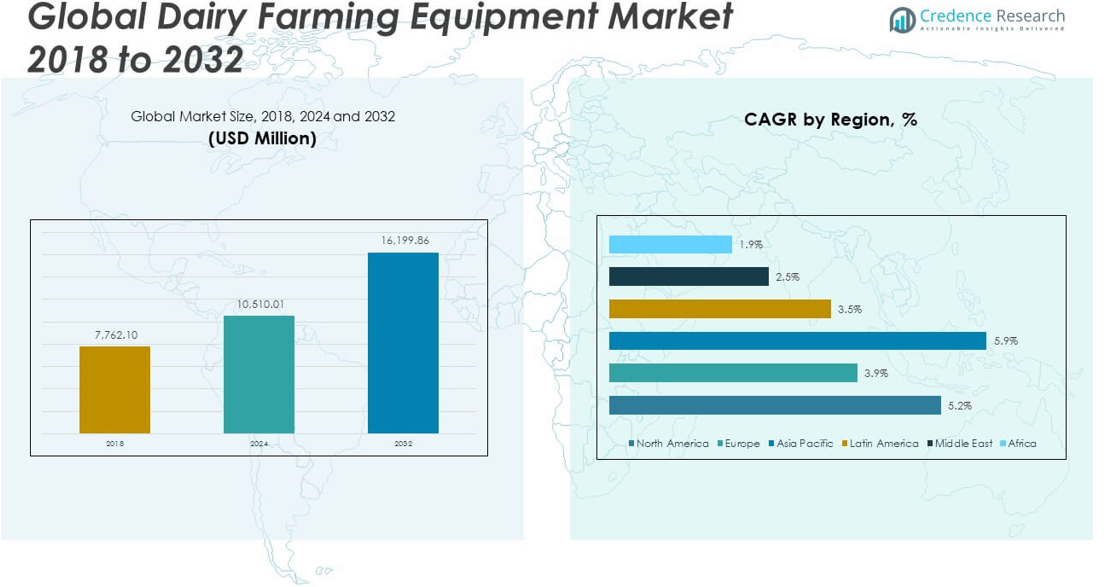
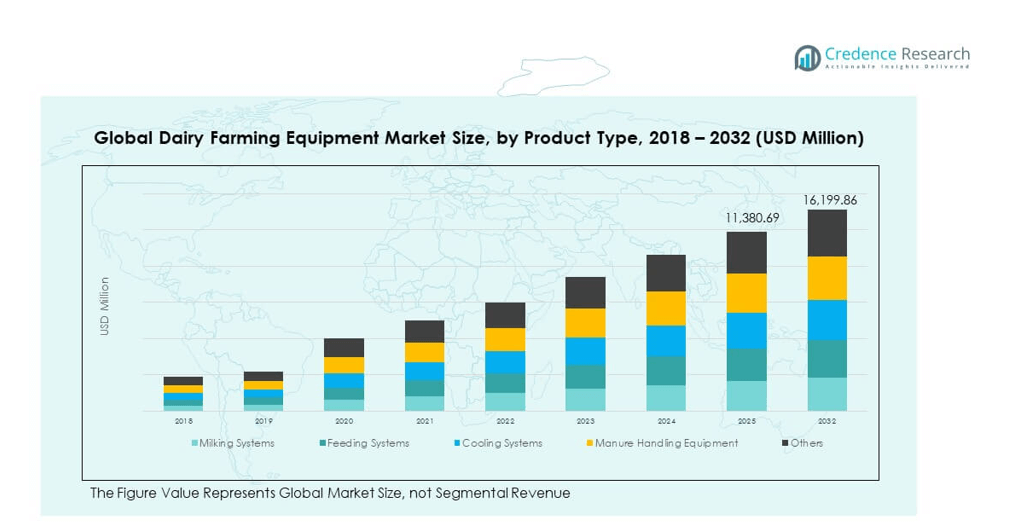
The Global Dairy Farming Equipment Market size was valued at USD 7,762.10 million in 2018 to USD 10,510.01 million in 2024 and is anticipated to reach USD 16,199.86 million by 2032, at a CAGR of 5.17% during the forecast period.
| REPORT ATTRIBUTE | DETAILS |
|---|---|
| Historical Period | 2020-2023 |
| Base Year | 2024 |
| Forecast Period | 2025-2032 |
| Dairy Farming Equipment Market Size 2024 | USD 10,510.01 million |
| Dairy Farming Equipment Market, CAGR | 5.17% |
| Dairy Farming Equipment Market Size 2032 | USD 16,199.86 million |
The Global Dairy Farming Equipment Market is expanding due to rising demand for automated milking systems, feeding solutions, and cooling equipment. Increasing global milk consumption, a growing shift toward commercial dairy farming, and technological advancements in automation are driving equipment adoption. Farmers are focusing on efficiency, animal welfare, and production consistency, creating strong demand for modernized systems that reduce labor dependence and enhance overall profitability.
The market shows notable regional dynamics. Asia-Pacific leads growth due to a large cattle population, rising dairy demand, and supportive government initiatives. North America and Europe are mature markets with high adoption of precision farming technologies. Latin America is emerging, supported by growing dairy exports. The Middle East and Africa show slower adoption but present opportunities with investments in modern farming infrastructure.
Market Insights:
- The Global Dairy Farming Equipment Market was valued at USD 10,510.01 million in 2024 and is projected to reach USD 16,199.86 million by 2032, growing at 5.17% CAGR.
- Market drivers include automation adoption, rising milk demand, and animal welfare focus.
- Market restraints involve high costs, regulatory compliance, and training gaps.
- Asia-Pacific leads growth due to high dairy consumption and farm modernization.
- North America and Europe remain mature markets with advanced automation.
- Latin America is growing with dairy exports supporting demand.
- Middle East and Africa show gradual adoption due to limited infrastructure.
Market Drivers:
Rising Global Milk Consumption and Increased Dairy Productivity Requirements:
The Global Dairy Farming Equipment Market is strongly influenced by rising milk consumption worldwide. Population growth, urbanization, and higher disposable incomes are fueling dairy demand in both developed and developing countries. Consumers are shifting toward protein-rich diets, making dairy a staple in many regions. This trend is compelling farmers to enhance productivity and meet market expectations. Automated milking machines and advanced feeding systems are helping producers maintain consistent output. It is also reducing labor dependency, which is critical in markets with workforce shortages. The emphasis on high productivity and quality assurance is accelerating demand for modern equipment.
- For instance, DeLaval, a leader in dairy farming technology, reported that its automated milking systems have increased average milk yield per cow by up to 20%, with over 14,000 units deployed globally as of 2024, helping farms meet rising demand efficiently.
Technological Advancements in Automated and Smart Farming Solutions:
The Global Dairy Farming Equipment Market benefits from rapid progress in robotics, sensors, and digital farming platforms. Robotic milking units, automated feeders, and IoT-enabled cooling systems are transforming traditional dairy practices. Farmers now monitor herd health, feeding cycles, and milk quality through real-time data dashboards. It is reducing errors and enhancing operational efficiency across dairy farms. Advanced equipment supports predictive maintenance, cutting downtime and saving operational costs. This growing reliance on technology makes equipment adoption essential for competitiveness. Countries with strong R&D support are witnessing faster integration of these solutions. The combination of automation and analytics is shaping the market’s future direction.
- For instance, Lely, a prominent player in automated dairy farming, reported that their Astronaut A5 robotic milking system processes milkings annually worldwide, enhancing milk yield per cow while decreasing labor demands .
Rising Emphasis on Animal Welfare and Sustainable Farming Practices:
The Global Dairy Farming Equipment Market is significantly impacted by the increasing focus on animal health and welfare. Consumers demand milk sourced from farms with ethical standards and humane practices. Automated feeding and milking systems ensure cows experience less stress while maintaining optimal nutrition. It also minimizes risks of overmilking and supports balanced herd management. Sustainable farming equipment such as energy-efficient cooling units helps reduce the sector’s environmental footprint. Regulatory frameworks in Europe and North America encourage eco-friendly practices, pushing equipment upgrades. Farmers are responding by investing in technologies that align with green certifications. This shift is driving long-term equipment adoption across all scales of farming.
Supportive Government Policies and Dairy Industry Investments:
The Global Dairy Farming Equipment Market is supported by favorable government initiatives and financial assistance programs. Subsidies and grants are being offered in emerging regions to modernize dairy infrastructure. These initiatives help small and medium farmers access milking, cooling, and manure management systems. It is encouraging faster adoption, especially where affordability is a concern. Large cooperatives and private investors are also funding advanced farm setups to boost dairy exports. This ecosystem of support provides stability for the sector’s expansion. Countries such as India and China are focusing on infrastructure improvements to strengthen dairy output. These measures ensure consistent growth in equipment adoption across geographies.
Market Trends:
Adoption of Robotic Milking and Automation Solutions:
The Global Dairy Farming Equipment Market is witnessing rapid adoption of robotic milking systems. These systems enhance efficiency by automating repetitive milking tasks with precision. Farmers gain higher milk yield while reducing labor reliance, which is crucial in regions with worker shortages. It also helps maintain animal welfare by providing stress-free milking processes. Developed regions such as Europe and North America are at the forefront of this adoption. Emerging economies are gradually embracing automation due to declining costs and government incentives. The push toward smarter farming methods continues to expand equipment penetration. This trend signals a future dominated by robotics in dairy operations.
- For instance, DeLaval reported deploying VMS V300 robotic milking units globally, with farms noting an average labor cost reduction and a consistent milk yield increase per cow within the first year of implementation.
Integration of IoT and Data-Driven Dairy Management:
The Global Dairy Farming Equipment Market is rapidly integrating IoT-enabled devices for smarter farm operations. Smart collars, sensors, and data platforms allow farmers to monitor herd health in real time. Feed optimization and disease detection are supported by advanced data analytics. It is enabling early interventions that improve both productivity and animal welfare. Cloud platforms are also connecting devices, enhancing remote farm management. Predictive tools further ensure timely equipment maintenance, lowering disruptions. Regions with strong digital infrastructure are leading in IoT adoption. This move toward precision dairy management is becoming a defining trend for global markets.
- For instance, Allflex Livestock Intelligence states their SMARTBOW ear tag sensors collect and process animal activity data points daily, enabling farmers to detect estrus and health issues with accuracy up to 48 hours earlier than traditional observation.
Focus on Eco-Friendly and Energy-Efficient Equipment:
The Global Dairy Farming Equipment Market is embracing eco-friendly and energy-efficient solutions. Farmers are increasingly aware of environmental sustainability and operational cost savings. Cooling systems, manure management equipment, and feeding systems are being redesigned with efficiency in mind. It is driving adoption of systems that lower power consumption and water use. Manufacturers are introducing recyclable materials and eco-friendly technologies to attract environmentally conscious buyers. Regulatory policies in Europe strongly reinforce this trend, influencing global practices. Emerging markets are also recognizing the value of sustainable operations for exports. This alignment with green goals makes energy-efficient equipment an industry priority.
Growth of Commercial Dairy Farms in Emerging Markets:
The Global Dairy Farming Equipment Market is expanding through the rise of large commercial dairy farms in developing countries. Rapid urbanization is increasing demand for packaged dairy products in Asia-Pacific and Latin America. Farmers are transitioning from traditional methods to industrial-scale operations. It is creating strong demand for milking systems, cooling tanks, and automated feeding units. Government programs promoting commercial farming are reinforcing this growth path. Countries like India, China, and Brazil are investing heavily in modern farm infrastructure. Dairy cooperatives are also consolidating smaller farms into larger entities for higher efficiency. This structural shift is driving significant equipment demand across emerging regions.
Market Challenges Analysis:
High Initial Investment Costs and Maintenance Burden:
The Global Dairy Farming Equipment Market faces significant barriers due to high capital investment requirements. Automated milking systems and robotic equipment involve large upfront costs that small farmers cannot always afford. Maintenance expenses and spare part availability also create recurring challenges. It is often difficult for smallholder farms in developing regions to sustain advanced systems. Limited access to financing and fluctuating milk prices worsen adoption difficulties. Even with subsidies, affordability remains a key challenge across rural markets. These factors slow penetration, particularly where small-scale farming dominates. High entry barriers restrict widespread modernization of the dairy sector globally.
Regulatory Pressures and Workforce Transition Issues:
The Global Dairy Farming Equipment Market also struggles with compliance pressures and workforce transitions. Governments enforce strict hygiene, animal welfare, and environmental standards in dairy production. Farmers are compelled to upgrade to equipment that meets evolving regulations. It raises costs for smaller farms, reducing adoption rates in cost-sensitive regions. Transitioning to advanced equipment requires workforce training, which is often lacking. It also faces resistance from farmers accustomed to traditional methods. Workforce skill gaps reduce operational efficiency when advanced systems are deployed. These regulatory and human resource challenges limit the speed of market expansion.
Market Opportunities
Expansion of Precision Dairy Farming Practices:
The Global Dairy Farming Equipment Market has promising opportunities through wider adoption of precision farming. Farmers are increasingly drawn to IoT and AI-driven tools that optimize feed, monitor health, and enhance productivity. It creates opportunities for equipment manufacturers to introduce data-integrated milking and feeding solutions. Growing interest in efficiency and sustainability ensures strong future demand for these technologies.
Growing Dairy Export Markets in Asia-Pacific and Latin America:
The Global Dairy Farming Equipment Market is also supported by rising exports from emerging economies. Countries with expanding dairy trade are upgrading infrastructure to meet international standards. It is boosting demand for advanced milking, cooling, and hygiene systems. Investments in export-focused farms in India, Brazil, and China are reinforcing equipment sales.
Market Segmentation Analysis:
By Product Type
The Global Dairy Farming Equipment Market is segmented into milking systems, feeding systems, cooling systems, manure handling equipment, and others. Milking systems dominate due to their essential role in automating dairy processes and improving efficiency. Feeding systems are growing steadily as farmers adopt precision feeding to ensure animal health and optimize productivity. Cooling systems are gaining traction with the rising demand for high-quality milk preservation, particularly in hot climate regions. Manure handling equipment is increasingly used to meet environmental regulations and improve farm hygiene. The “others” category includes specialized equipment for herd monitoring and farm management.
- For instance, BouMatic’s cooling systems have achieved decrease in energy consumption while maintaining milk cooling to below 4°C within an hour post-milking.
By Application
The Global Dairy Farming Equipment Market, by application, is divided into dairy farms, commercial dairy processing units, and others. Dairy farms remain the largest application area, driven by the modernization of small and medium-sized farms worldwide. Commercial dairy processing units are expanding with the rising demand for packaged dairy products and large-scale industrialized farming practices. It is also supported by government-backed investments and cooperative-led projects in emerging economies. The “others” segment includes niche operations that require tailored equipment, contributing to specialized demand within the industry.
- For instance, Tetra Pak’s commercial dairy processing equipment has enabled processing volumes exceeding in large-scale industrial plants, supporting expanding dairy product portfolios while adhering strictly to hygienic standards and process efficiency.
Segmentation:
By Product Type
- Milking Systems
- Feeding Systems
- Cooling Systems
- Manure Handling Equipment
- Others
By Application
- Dairy Farms
- Commercial Dairy Processing Units
- Others
By Region
- North America
- U.S.
- Canada
- Mexico
- Europe
- UK
- France
- Germany
- Italy
- Spain
- Russia
- Belgium
- Netherlands
- Austria
- Sweden
- Poland
- Denmark
- Switzerland
- Rest of Europe
- Asia Pacific
- China
- Japan
- South Korea
- India
- Australia
- Thailand
- Indonesia
- Vietnam
- Malaysia
- Philippines
- Taiwan
- Rest of Asia Pacific
- Latin America
- Brazil
- Argentina
- Peru
- Chile
- Colombia
- Rest of Latin America
- Middle East
- UAE
- KSA
- Israel
- Turkey
- Iran
- Rest of Middle East
- Africa
- Egypt
- Nigeria
- Algeria
- Morocco
- Rest of Africa
Regional Analysis:
North America
The North America Global Dairy Farming Equipment Market size was valued at USD 2,270.88 million in 2018 to USD 3,027.14 million in 2024 and is anticipated to reach USD 4,685.40 million by 2032, at a CAGR of 5.2% during the forecast period. North America represents around 28.8% of the 2024 market share, highlighting its strong presence. The region’s growth is supported by advanced automation, high adoption of robotic milking systems, and strong focus on animal welfare. Farmers invest in IoT-enabled devices to ensure compliance with regulatory standards. The United States dominates, backed by large-scale dairy farms and a strong export base. Canada and Mexico contribute steadily with modernization initiatives. The region remains attractive due to its well-established infrastructure and consumer preference for high-quality dairy products.
Europe
The Europe Global Dairy Farming Equipment Market size was valued at USD 1,438.63 million in 2018 to USD 1,840.44 million in 2024 and is anticipated to reach USD 2,577.60 million by 2032, at a CAGR of 3.9% during the forecast period. Europe accounts for 17.5% of the global share in 2024, reflecting its mature yet regulated environment. The region emphasizes sustainability, with eco-friendly equipment seeing rising demand. Germany, France, and the UK lead adoption, supported by strict animal welfare policies and consumer preferences for traceable milk products. Farmers are investing in energy-efficient cooling systems and smart feeding solutions to comply with green policies. Cooperative structures across Europe provide farmers with access to financial support for modernization. Eastern Europe is slowly catching up, driven by EU-backed rural development programs. Overall, Europe’s market growth remains steady, shaped by sustainability priorities and high automation.
Asia Pacific
The Asia Pacific Global Dairy Farming Equipment Market size was valued at USD 3,402.48 million in 2018 to USD 4,776.59 million in 2024 and is anticipated to reach USD 7,810.27 million by 2032, at a CAGR of 5.9% during the forecast period. Asia Pacific commands 45.5% of the market share in 2024, making it the largest regional contributor. Rising dairy consumption in China and India, coupled with supportive government initiatives, drives rapid adoption. The region is transitioning from small-scale to commercial farming, increasing demand for automated milking and feeding systems. Japan and South Korea adopt advanced technologies, while Southeast Asia focuses on farm-level upgrades. Dairy cooperatives in India and China are actively investing in infrastructure modernization. Export-driven growth is also boosting adoption in Australia and New Zealand. Asia Pacific’s strong consumer base ensures its continued leadership in the global market.
Latin America
The Latin America Global Dairy Farming Equipment Market size was valued at USD 351.11 million in 2018 to USD 469.24 million in 2024 and is anticipated to reach USD 636.44 million by 2032, at a CAGR of 3.5% during the forecast period. Latin America holds 4.5% of the global share in 2024, showing moderate but stable growth. Brazil dominates due to its large agricultural base and investments in dairy exports. Argentina is emerging with strong support from government modernization schemes. Smaller markets in Chile and Colombia are adopting basic equipment solutions. Adoption is slower compared to Asia and North America but remains promising. Growing demand for packaged dairy products and export-driven production supports adoption. Cooperative-led initiatives and regional dairy investments are likely to boost modernization. The region’s growth path is shaped by balancing traditional farming with new industrial-scale practices.
Middle East
The Middle East Global Dairy Farming Equipment Market size was valued at USD 188.11 million in 2018 to USD 229.41 million in 2024 and is anticipated to reach USD 288.80 million by 2032, at a CAGR of 2.5% during the forecast period. The Middle East accounts for 2.2% of the market share in 2024, reflecting limited adoption compared to larger regions. Harsh climates drive demand for advanced cooling systems and hygienic milking equipment. GCC countries, particularly Saudi Arabia and UAE, are investing in modern dairy farms to reduce reliance on imports. Israel shows high technology adoption in dairy operations, leveraging precision farming. Turkey provides a growing base with expanding dairy consumption. It remains a small but steadily growing market, shaped by climate challenges and high investment needs.
Africa
The Africa Global Dairy Farming Equipment Market size was valued at USD 110.90 million in 2018 to USD 167.19 million in 2024 and is anticipated to reach USD 201.33 million by 2032, at a CAGR of 1.9% during the forecast period. Africa represents 1.6% of the market share in 2024, marking it as the smallest contributor. Smallholder farms dominate, limiting large-scale equipment adoption. South Africa leads the region due to relatively modern infrastructure and commercial operations. Egypt is expanding through government support for dairy sector development. Sub-Saharan Africa shows slow adoption due to affordability and limited financing. It continues to rely heavily on traditional methods. However, gradual introduction of cooling and feeding systems is evident in export-oriented farms. Long-term opportunities exist, but adoption is expected to remain gradual.
Key Player Analysis:
- GEA Group AG
- DeLaval Inc.
- BouMatic LLC
- AMPI (American Milking & Parlor Equipment)
- Fullwood Packo
- Lely
- Dairymaster
- SAC Group
- WestfaliaSurge
- Zoetis
Competitive Analysis:
The Global Dairy Farming Equipment Market is characterized by strong competition among global and regional players. Large companies like GEA Group AG, DeLaval, and Lely dominate with wide portfolios in milking, feeding, and cooling systems. It is defined by continuous technological innovation, including robotics and IoT integration, which smaller players struggle to match. Regional companies such as Dairymaster and BouMatic strengthen competition by offering localized solutions. Farmers often prefer established brands due to reliability and service availability. Strategic partnerships, acquisitions, and geographic expansions remain central competitive strategies. Innovation around sustainability and cost efficiency is becoming a key differentiator. The market demonstrates moderate concentration with space for new entrants in niche equipment categories.
Recent Developments:
- In October 2024, GEA Group AG completed the acquisition of its long-time import partner Bellucci Orlando e c. S.r.l. in Italy. This acquisition strengthens GEA’s local business in the Italian dairy farming market by expanding its portfolio and dealer network, supported by the newly opened GEA Academy for training technical staff and dealers to better serve dairy farms with automated milking, feeding, and manure process solutions.
- In January 2024, DeLaval Inc. launched the VMS™ Batch Milking system designed for large herds, combining robotic technology with traditional milking routines. This innovative system, already installed in over 10 locations milking around 10,000 cows globally, reduces labor requirements while capturing detailed individual cow data to improve dairy management efficiency.
- In July 2025, BouMatic LLC announced a brand merger with SAC Group, unifying both under the BouMatic name by year-end. This strategic merger aims to streamline operations, expand global reach, and optimize product offerings, leveraging synergies from their prior partnership and acquisitions for a stronger presence in the dairy equipment market.
- AMPI (American Milk Producers Inc.) has not reported new major product launches or acquisitions recently, but leadership transition was noted with Sheryl Meshke becoming sole CEO effective January 2023, aiming to steer the cooperative toward future growth.
- Fullwood Packo launched the Fullwood M2erlin automated milking system recently, featuring multiple entry and exit points for cows and an electric arm for cluster attachment that enhances efficiency and reduces energy costs by eliminating outdated drive systems. The robot has been installed in trial and commercial farms in England and Ireland.
Report Coverage:
The research report offers an in-depth analysis based on product type and application. It details leading market players, providing an overview of their business, product offerings, investments, revenue streams, and key applications. Additionally, the report includes insights into the competitive environment, SWOT analysis, current market trends, as well as the primary drivers and constraints. Furthermore, it discusses various factors that have driven market expansion in recent years. The report also explores market dynamics, regulatory scenarios, and technological advancements that are shaping the industry. It assesses the impact of external factors and global economic changes on market growth. Lastly, it provides strategic recommendations for new entrants and established companies to navigate the complexities of the market.
Future Outlook:
- Growing adoption of robotic milking systems across developed and emerging regions.
- Strong demand for IoT-enabled herd monitoring and predictive maintenance solutions.
- Sustainability-driven equipment innovation focusing on energy efficiency.
- Expansion of commercial dairy farms in Asia-Pacific and Latin America.
- Rising government support for modernization of smallholder farms.
- Increasing consumer preference for ethically sourced dairy products.
- Global dairy exports driving infrastructure investments in emerging markets.
- Rising adoption of precision feeding and animal health systems.
- Market competition intensifying around automation and cost efficiency.
- Long-term growth shaped by digital transformation and environmental policies.

Request a Free Sample
Fill in your details and we'll send you a free sample report.
- Sample data tables & charts
- Research methodology
Market Dynamics
Automation and Robotics Adoption
The increasing integration of automated milking systems, robotic feeders, and IoT-enabled equipment is transforming dairy operations by reducing labor dependency, improving productivity, and ensuring consistent milk quality. This shift is particularly crucial in regions facing workforce shortages and rising operational costs.
Rising Global Milk Consumption
Population growth, urbanization, and higher disposable incomes are driving up global dairy demand, compelling farmers to invest in modern equipment to boost productivity and meet market expectations for high-quality, protein-rich dairy products.
Focus on Animal Welfare and Sustainability
Consumer demand for ethically sourced milk and stricter regulatory frameworks are pushing farms to adopt equipment that enhances animal welfare, reduces stress, and supports sustainable practices, such as energy-efficient cooling and manure management systems.
Government Support and Dairy Industry Investments
Subsidies, grants, and modernization initiatives from governments - especially in Asia-Pacific and emerging markets - are enabling small and medium farms to access advanced milking, cooling, and feeding technologies, accelerating equipment adoption and infrastructure upgrades.
Expansion of Commercial Dairy Farms
The transition from traditional to large-scale commercial dairy farming, particularly in Asia-Pacific and Latin America, is driving demand for industrial-grade equipment that supports higher herd sizes, export-oriented production, and compliance with international quality standards.
Need a Custom Version of This Report?
Tailor the scope, geography, or segments to your exact requirements.
- Custom geography or segment scope
- Direct access to our analyst team
Frequently Asked Questions
What is the current market size for Global Dairy Farming Equipment Market, and what is its projected size in 2032?
Which Global Dairy Farming Equipment Market segment held the largest share in 2024?
What are the primary factors fueling the growth of the Global Dairy Farming Equipment Market?
Who are the leading companies in the Global Dairy Farming Equipment Market?
Table of Content
Chapter 1 Market Segmentation
- 1.1 Segmentation Framework
- 1.1.1 Product and Service Classification
- 1.1.2 Application and End-Use Classification
- 1.1.3 Technology and Solution Classification
- 1.1.4 Customer and Distribution Channel Classification
- 1.1.5 Geographic Segmentation
- 1.1.6 Market Segment Definitions and Boundaries
- 1.2 By Application
- 1.2.1 Dairy Farms
- 1.2.2 Commercial Dairy Processing Units
- 1.2.3 Others
- 1.3 By Product Type
- 1.3.1 Milking Systems
- 1.3.2 Feeding Systems
- 1.3.3 Cooling Systems
- 1.3.4 Manure Handling Equipment
- 1.3.5 Others
Chapter 2 Introduction
- 2.1 Report Objectives and Scope
- 2.2 Product Definition and Industry Terminology
- 2.3 Market Inclusions and Exclusions
- 2.4 Research Process
- 2.4.1 Primary Research and Expert Interviews
- 2.4.2 Secondary Research and Source Review
- 2.4.3 Top-Down and Bottom-Up Estimation
- 2.4.4 Data Triangulation and Verification
- 2.5 Market Size Measurement Basis
- 2.5.1 2024: USD 10,510.01 million → 2032: USD 16,199.86 million
- 2.6 Historical and Forecast Reference Periods
- 2.6.1 Base Year: 2024
- 2.6.2 Forecast Period: 2024-2032
- 2.7 Research Assumptions and Limitations
Chapter 3 Executive Summary
- 3.1 Market Snapshot and Key Findings
- 3.2 Base-Year Market Size, 2024
- 3.3 Forecast Market Size, 2032
- 3.4 Revenue and Volume Growth Outlook
- 3.5 Key Demand and Supply Indicators
- 3.6 Leading Market Segments
- 3.7 Fastest-Growing Market Opportunities
- 3.8 Regional Performance Highlights
- 3.9 Technology and Industry Transformation
- 3.10 Competitive Landscape Summary
- 3.11 Analyst View and Strategic Implications
Chapter 4 Global Dairy Farming Equipment Market Trends and Developments
- 4.1 Historical Industry Development
- 4.2 Recent Market Trends and Developments
- 4.3 Demand and Customer Behavior Trends
- 4.4 Technology and Product Innovation
- 4.5 Artificial Intelligence, Automation and Digitalization
- 4.6 Local Manufacturing and Supply Chain Realignment
- 4.7 Industry Partnerships, Mergers and Acquisitions
- 4.8 Sustainability and Circular Economy Developments
- 4.9 Government and Private Sector Investment Trends
- 4.10 Emerging Business Models and Commercialization
- 4.11 Industry Developments and Announcements
Chapter 5 Global Dairy Farming Equipment Market Production, Supply and Demand Analysis
- 5.1 Demand Trend and Consumption Analysis
- 5.2 Demand Forecast, 2024-2032
- 5.3 Production and Output Trend
- 5.4 Production and Output Forecast, 2024-2032
- 5.5 Installed Capacity and Capacity Utilization
- 5.6 Company-Wise Production Plants and Statistics
- 5.6.1 Installed Production Capacity
- 5.6.2 Actual Production
- 5.6.3 Planned Capacity and Expansion Targets
- 5.7 Supply Chain Structure and Procurement Trends
- 5.8 Supply-Demand Gap and Bottlenecks
- 5.9 Import Dependence and Sourcing Structure
- 5.10 Contract Manufacturing and Outsourcing
- 5.11 Regional Supply and Demand Concentration
Chapter 6 Global Dairy Farming Equipment Market Pricing Analysis
- 6.1 Pricing Structure and Measurement
- 6.2 Historical Pricing Trends
- 6.3 Pricing Outlook, 2024-2032
- 6.4 Average Selling Price and Unit Economics
- 6.5 Pricing by Product and Market Segment
- 6.6 Geographic Pricing Differences
- 6.7 Key Input, Energy, Labor and Logistics Costs
- 6.8 Contract Pricing and Purchasing Models
- 6.9 Pricing Sensitivity and Competitive Positioning
- 6.10 Price, Margin and Profitability Implications
Chapter 7 Global Dairy Farming Equipment Market Dynamics
- 7.1 Market Growth Drivers
- 7.1.1 Demand-Side Drivers
- 7.1.2 Technology and Innovation Drivers
- 7.1.3 Infrastructure and Investment Drivers
- 7.1.4 Regulatory and Policy Drivers
- 7.2 Market Restraints
- 7.2.1 Cost and Affordability Constraints
- 7.2.2 Technology and Adoption Barriers
- 7.2.3 Supply Chain and Operational Constraints
- 7.3 Market Challenges
- 7.3.1 Competitive Pressure and Margin Erosion
- 7.3.2 Skills, Infrastructure and Implementation Gaps
- 7.4 Emerging Market Opportunities
- 7.5 Market Dynamics Impact and Time-Horizon Assessment
Chapter 8 Global Dairy Farming Equipment Value Chain Analysis
- 8.1 Industry Value Chain Overview
- 8.2 Upstream Suppliers and Critical Inputs
- 8.3 Technology and Component Providers
- 8.4 Manufacturing or Service Delivery
- 8.5 Distribution, Channel Partners and Integrators
- 8.6 Downstream Applications and End Users
- 8.7 Value Addition and Profit Pools
- 8.8 Vertical Integration and Outsourcing
- 8.9 Supplier Concentration and Risk
- 8.10 Supply Chain Localization and Resilience
Chapter 9 Global Dairy Farming Equipment Market Regulations and Policies
- 9.1 Relevant Laws, Standards and Compliance Frameworks
- 9.2 Product, Service, Safety and Quality Requirements
- 9.3 Government Policies, Incentives and Subsidies
- 9.4 Imports, Exports and Trade Barriers
- 9.5 Public Procurement and Local Content Requirements
- 9.6 Environmental and Sustainability Compliance
- 9.7 Upcoming Policy Changes and Market Implications
Chapter 10 Global Dairy Farming Equipment Market Hotspots and Opportunities
- 10.1 Market Opportunity Mapping and Growth Hotspots
- 10.2 High-Growth Applications and Customer Groups
- 10.3 Underserved Markets and White-Space Opportunities
- 10.4 Emerging Technology and Product Opportunities
- 10.5 New Capacity and Investment Hotspots
- 10.6 Market Entry and Expansion Opportunities
- 10.7 Distribution and Partnership Opportunities
- 10.8 Near-Term and Long-Term Commercial Potential
- 10.9 Opportunity Attractiveness and Execution Risks
Chapter 11 Global Dairy Farming Equipment Market Outlook, 2024-2032
- 11.1 Market Size and Analysis
- 11.1.1 Revenue (Market Measurement: 2024: USD 10,510.01 million → 2032: USD 16,199.86 million)
- 11.1.2 Market Volume and Quantity Sold
- 11.1.3 Historical Market Size
- 11.1.4 Base-Year Market Size, 2024
- 11.2 Market Forecast, 2024-2032
- 11.2.1 Revenue Forecast to 2032
- 11.2.2 Volume Forecast to 2032
- 11.2.3 CAGR and Year-on-Year Growth
- 11.2.4 Incremental Revenue Opportunity
- 11.3 Forecast Assumptions and Scenario Analysis
- 11.3.1 Base-Case Forecast
- 11.3.2 Optimistic and Conservative Scenarios
- 11.3.3 Technology, Pricing and Policy Sensitivities
- 11.4 Market Attractiveness and Growth Outlook
Chapter 12 Global Dairy Farming Equipment Market Segmentation and Outlook
- 12.1 Segmentation Summary and Market Shares, 2024
- 12.2 Largest and Fastest-Growing Segments
- 12.3 By Application - Market Size and Forecast, 2024-2032
- 12.3.1 Segment Definition and Scope
- 12.3.2 Historical Market Size
- 12.3.3 Revenue Forecast, 2024-2032
- 12.3.4 Volume Forecast, 2024-2032
- 12.3.5 Base-Year Market Share, 2024
- 12.3.6 Segment CAGR and Growth Drivers
- 12.3.7 Subsegment Market Size and Forecast
- 12.3.7.1 Dairy Farms
- 12.3.7.2 Commercial Dairy Processing Units
- 12.3.7.3 Others
- 12.3.8 Subsegment Pricing and Adoption Trends
- 12.3.9 Leading Suppliers and Competition
- 12.3.10 Regional Demand and Opportunities
- 12.4 By Product Type - Market Size and Forecast, 2024-2032
- 12.4.1 Segment Definition and Scope
- 12.4.2 Historical Market Size
- 12.4.3 Revenue Forecast, 2024-2032
- 12.4.4 Volume Forecast, 2024-2032
- 12.4.5 Base-Year Market Share, 2024
- 12.4.6 Segment CAGR and Growth Drivers
- 12.4.7 Subsegment Market Size and Forecast
- 12.4.7.1 Milking Systems
- 12.4.7.2 Feeding Systems
- 12.4.7.3 Cooling Systems
- 12.4.7.4 Manure Handling Equipment
- 12.4.7.5 Others
- 12.4.8 Subsegment Pricing and Adoption Trends
- 12.4.9 Leading Suppliers and Competition
- 12.4.10 Regional Demand and Opportunities
- 12.5 Segment Growth Comparison
- 12.6 Segment Attractiveness and Priority Matrix
Chapter 13 Global Dairy Farming Equipment End-Use and Application Market Outlook
- 13.1 End-Use Industry and Customer Demand Structure
- 13.2 Leading Applications and Customer Groups
- 13.3 End-Use Market Size, Share and Forecast
- 13.4 Major End-Use Industry Deep Dives
- 13.4.1 Customer Requirements and Use Cases
- 13.4.2 Demand and Replacement Cycles
- 13.4.3 Technical and Regulatory Considerations
- 13.4.4 Purchasing and Procurement Models
- 13.4.5 Leading Vendors and Distribution Channels
- 13.4.6 Forecast and Commercial Opportunities
- 13.5 Emerging Applications and Cross-Segment Demand
- 13.6 End-Use Industry Investment Priorities
Chapter 14 Global Dairy Farming Equipment Geographic Market Outlook, 2024-2032
- 14.1 Regional Market Size and Share, 2024
- 14.2 Regional Market Forecast, 2024-2032
- 14.3 Regional Pricing, Production and Demand Differences
- 14.4 North America
- 14.4.1 United States
- 14.4.2 Canada
- 14.4.3 Mexico
- 14.5 Europe
- 14.5.1 Germany
- 14.5.2 France
- 14.5.3 Italy
- 14.5.4 United Kingdom
- 14.5.5 Spain
- 14.5.6 Poland
- 14.5.7 Russia
- 14.5.8 Netherlands
- 14.5.9 Belgium
- 14.5.10 Sweden
- 14.5.11 Denmark
- 14.5.12 Norway
- 14.5.13 Rest of Europe
- 14.6 Asia Pacific
- 14.6.1 China
- 14.6.2 India
- 14.6.3 Japan
- 14.6.4 South Korea
- 14.6.5 Thailand
- 14.6.6 Indonesia
- 14.6.7 Vietnam
- 14.6.8 Malaysia
- 14.6.9 Australia
- 14.6.10 Rest of Asia Pacific
- 14.7 Latin America
- 14.7.1 Brazil
- 14.7.2 Argentina
- 14.7.3 Colombia
- 14.7.4 Chile
- 14.7.5 Rest of Latin America
- 14.8 Middle East
- 14.8.1 Saudi Arabia
- 14.8.2 United Arab Emirates
- 14.8.3 Turkey
- 14.8.4 Israel
- 14.8.5 Iran
- 14.8.6 Rest of the Middle East
- 14.9 Africa
- 14.9.1 South Africa
- 14.9.2 Egypt
- 14.9.3 Nigeria
- 14.9.4 Morocco
- 14.9.5 Rest of Africa
- 14.10 Regional Investment, Policy and Supply Chain Differences
- 14.11 Regional Competitive Landscape
- 14.12 Geographic Growth Hotspots
Chapter 15 Global Dairy Farming Equipment Technology, Innovation and Sustainability Outlook
- 15.1 Technology Landscape and Maturity
- 15.2 Product, Process and Service Innovation
- 15.3 AI, Automation and Digital Tools in the Industry
- 15.4 Technology Adoption and Performance Benchmarking
- 15.5 Innovation Pipeline and R&D Investment
- 15.6 Patent and Intellectual Property Trends
- 15.7 Energy Efficiency and Resource Management
- 15.8 Sustainability, Recycling and Circularity
- 15.9 Technology Roadmap, 2024-2032
- 15.10 Risks of Obsolescence and Technology Substitution
Chapter 16 Global Dairy Farming Equipment Market Key Strategic Imperatives
- 16.1 Growth and Market Entry Priorities
- 16.2 High-Return Products and Segments
- 16.3 Pricing, Profitability and Cost Optimization
- 16.4 Technology Investment and Product Differentiation
- 16.5 Supply Chain Localization and Resilience
- 16.6 Distribution and Customer Acquisition
- 16.7 Partnership, Acquisition and Capacity Strategy
- 16.8 Regional Expansion Priorities
- 16.9 Short-, Medium- and Long-Term Actions
Chapter 17 Competition Outlook
- 17.1 Industry Competition Characteristics
- 17.2 Market Structure and Concentration
- 17.3 Market Share and Competitive Positioning, 2024
- 17.4 Company-Wise Revenue and Product Benchmarking
- 17.5 Production and Service Capacity Benchmarking
- 17.6 Technology, Pricing and Differentiation
- 17.7 Regional Footprint and Distribution Strength
- 17.8 Mergers, Acquisitions and Strategic Alliances
- 17.9 New Entrants and Competitive Threats
- 17.10 Porter's Five Forces and Industry Attractiveness
- 17.11 Competitive Outlook, 2024-2032
Chapter 18 Company Profiles
- 18.1 Company Coverage and Selection Criteria
- 18.2 GEA Group AG
- 18.2.1 Business Description
- 18.2.2 Company Ownership and Geographic Presence
- 18.2.3 Product and Service Portfolio
- 18.2.4 Manufacturing and Operating Footprint
- 18.2.5 Production Capacity and Expansion Plans
- 18.2.6 Financial Performance and Investment
- 18.2.7 Market Share and Competitive Position
- 18.2.8 Technology and Innovation Capabilities
- 18.2.9 Strategic Alliances or Partnerships
- 18.2.10 Recent Developments
- 18.2.11 Growth Strategy and Outlook
- 18.3 DeLaval Inc.
- 18.4 BouMatic LLC
- 18.5 Lely
- 18.6 Fullwood Packo
- 18.7 Dairymaster
- 18.8 SAC Group
- 18.9 WestfaliaSurge
- 18.10 Zoetis
- 18.11 AMPI (American Milking & Parlor Equipment)
- 18.12 Other Relevant Market Participants
Note: Every listed company is profiled on the structure shown under the first company. The company list is preliminary and may change based on research findings, market developments, data availability and client requirements.
Chapter 19 Disclaimer
- 19.1 Research and Forecast Disclaimer
- 19.2 Data Source and Estimation Limitations
Note: The depth of individual sections depends on data availability for this market. Volume, capacity, trade and other unit-based metrics are included where applicable.