
Market Overview
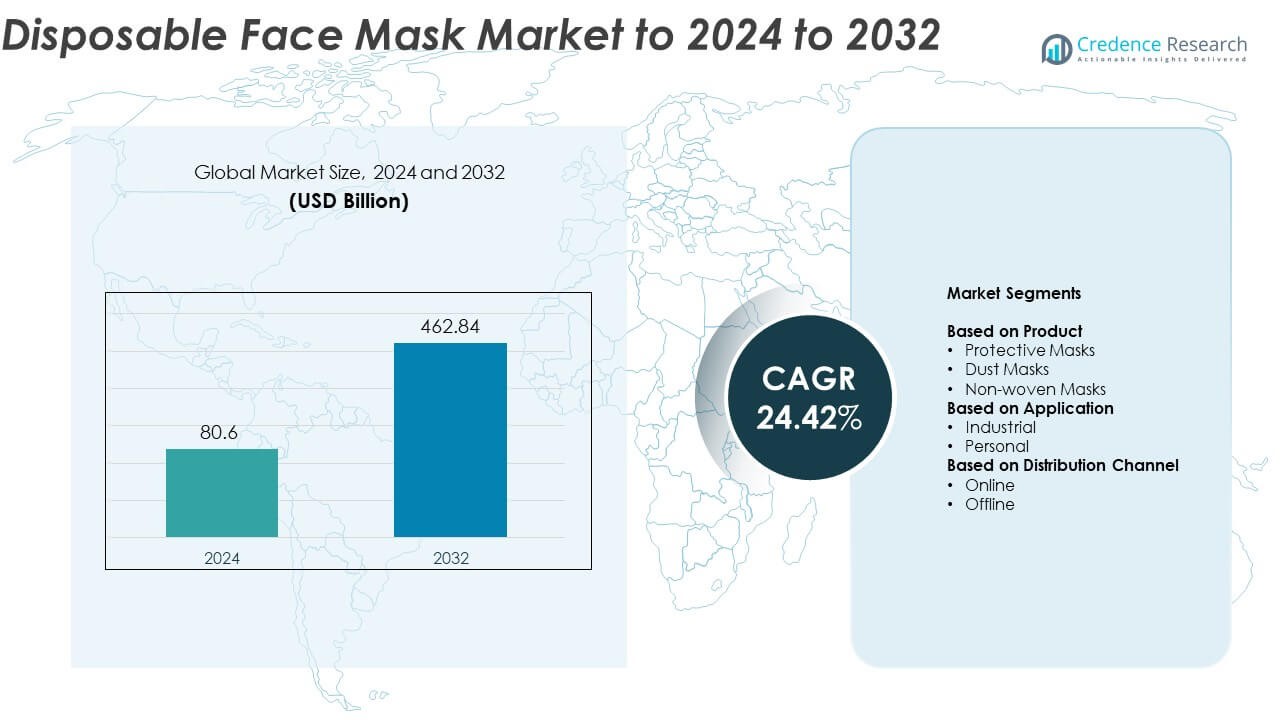
Disposable Face Mask Market size was valued at USD 80.6 Billion in 2024 and is anticipated to reach USD 462.84 Billion by 2032, at a CAGR of 24.42% during the forecast period.
| REPORT ATTRIBUTE | DETAILS |
|---|---|
| Historical Period | 2020-2023 |
| Base Year | 2024 |
| Forecast Period | 2025-2032 |
| Disposable Face Mask Market Size 2024 | USD 80.6 Billion |
| Disposable Face Mask Market , CAGR | 24.42% |
| Disposable Face Mask Market Size 2032 | USD 462.84 Billion |
The global disposable face mask market is led by companies such as Honeywell International Inc., The Gerson Companies, Inc., DACH, SAS Safety Corp., uvex group, 3M, Moldex-Metric, Inc., Kimberly-Clark Corporation, Kowa American Corporation, and JIANGSU TEYIN IMP. & EXP. CO., LTD. North America remains the dominant region with about 34% share in 2024, supported by strong healthcare infrastructure and high hygiene awareness. Asia-Pacific follows closely with around 30% share, driven by large-scale manufacturing and growing population needs. Europe contributes nearly 28% share, benefiting from strict regulatory standards and rising adoption in healthcare and industrial safety applications.
Market Insights
- The disposable face mask market was valued at USD 80.6 Billion in 2024 and is projected to reach USD 462.84 Billion by 2032, growing at a CAGR of 24.42%.
- Rising health awareness, infection control practices, and strict safety regulations across healthcare and industrial sectors are major market drivers.
- Increasing adoption of biodegradable materials and advancements in filtration technology are shaping product innovation and sustainability trends.
- The market is highly competitive, with leading manufacturers focusing on quality, comfort, and environmental compliance to maintain global presence.
- North America leads with 34% share, followed by Asia-Pacific at 30% and Europe at 28%, while the protective mask segment dominates with 52% share in 2024.
Market Segmentation Analysis:
By Product
Protective masks dominate the disposable face mask market, accounting for nearly 52% share in 2024. Their leadership is driven by widespread adoption in healthcare, public safety, and general preventive use. Increased awareness of airborne infections and stringent safety standards across hospitals and clinics have reinforced demand. The segment benefits from advanced multilayer filtration technology and improved comfort materials, making protective masks the preferred choice among medical professionals and consumers. Meanwhile, dust and non-woven masks continue to gain moderate traction in industrial and personal environments for daily protective applications.
- For instance, BYD scaled capacity to 50 million disposable masks per day in 2020.
By Application
The personal application segment leads the market with around 58% share in 2024. Rising consumer awareness regarding respiratory hygiene and pollution control has boosted usage among the general population. Post-pandemic behavior has made mask-wearing a regular precaution in crowded and polluted areas. Growing urbanization and rising health concerns have also accelerated adoption in Asia-Pacific and Latin America. Industrial applications remain vital, supported by regulatory mandates for worker safety and the growing use of masks across construction, mining, and manufacturing sectors.
- For instance, Apollo Pharmacy is now operating 6,928 stores across India, as of its Q2 FY26 earnings report. The company's expansion is ongoing, with 186 new stores added in Q2 FY26 alone.
By Distribution Channel
Offline distribution channels dominate the disposable face mask market with about 63% share in 2024. Pharmacies, supermarkets, and medical supply stores remain primary outlets due to easy availability and consumer trust. Bulk purchases by healthcare institutions and government agencies further strengthen offline sales. However, online platforms are expanding rapidly, supported by e-commerce growth and the convenience of doorstep delivery. The rise of direct-to-consumer brands and subscription-based sales models continues to enhance accessibility, especially in urban and semi-urban regions.
Key Growth Drivers
Rising Health Awareness and Infection Control Measures
Increasing public awareness of airborne diseases and hygiene has boosted disposable face mask usage worldwide. Hospitals, clinics, and consumers increasingly rely on high-quality masks for respiratory protection. Government regulations promoting infection control in public places and workplaces continue to strengthen market growth. Heightened focus on preventing cross-contamination in healthcare facilities further supports consistent demand across both developed and emerging regions.
- For instance, 3M’s 1860 respirator is NIOSH N95 and >99% BFE per ASTM F2101.
Expanding Industrial Safety Regulations
Stringent workplace safety standards are driving mask adoption in industrial sectors such as construction, manufacturing, and mining. Employers emphasize respiratory protection to meet compliance requirements and reduce occupational health risks. The enforcement of regional safety laws and the availability of advanced filtration masks have accelerated industrial consumption. Additionally, the growth of heavy industries in Asia-Pacific enhances large-scale demand for disposable protective masks designed for dust and chemical exposure.
- For instance, Honeywell H910 Plus is NIOSH N95 with ≥95% filtration efficiency.
Growth of E-commerce and Retail Penetration
The rapid expansion of e-commerce platforms and organized retail outlets has made disposable masks more accessible. Online sales have surged due to convenience, wider product variety, and competitive pricing. Retail pharmacies and supermarket chains continue to support brand visibility and customer trust. Companies investing in omni-channel strategies are gaining a stronger foothold across diverse consumer segments, particularly in developing economies with increasing internet penetration.
Key Trends & Opportunities
Sustainable and Biodegradable Mask Innovation
Manufacturers are focusing on eco-friendly materials to address environmental concerns related to mask waste. Biodegradable and recyclable face masks are emerging as sustainable alternatives to synthetic variants. This shift aligns with global sustainability goals and increasing consumer preference for green products. Innovation in plant-based fibers and non-woven biodegradable fabrics presents significant opportunities for long-term growth and market differentiation.
- For instance, Ahlstrom’s mask media meets EN 14683 Type I/II with 98% BFE; biodegradable options launched.
Technological Advancements in Filtration and Comfort
Recent innovations in nanofiber filtration, breathability, and ergonomic design are transforming product performance. Smart face masks with enhanced air permeability and antimicrobial coatings are gaining attention. These technologies improve comfort for extended use and ensure high filtration efficiency. The integration of advanced materials also allows manufacturers to target premium consumer segments while meeting global safety standards.
- For instance, Freudenberg masks achieved >98% aerosol filtration in external tests.
Key Challenges
Environmental Impact of Mask Disposal
The large-scale use of disposable face masks has created substantial environmental waste. Improper disposal contributes to plastic pollution and affects marine ecosystems. Managing post-use waste remains a critical challenge for governments and manufacturers. Developing efficient recycling systems and adopting biodegradable materials are essential to reduce the ecological footprint of disposable mask production and consumption.
Price Volatility and Supply Chain Disruptions
Fluctuations in raw material costs and transportation delays have affected production stability. During periods of high demand, manufacturers face supply constraints and rising costs for non-woven fabrics and elastic components. Global supply chain disruptions have also led to inconsistent availability in key markets. Balancing affordability with quality remains a pressing challenge, especially for small and mid-sized producers competing in price-sensitive regions.
Regional Analysis
North America North America holds the largest share of about 34% in the disposable face mask market in 2024. The region’s dominance is driven by high healthcare spending, strong awareness of infection control, and strict workplace safety regulations. The United States leads due to extensive hospital networks and government initiatives supporting public health preparedness. Continuous demand from healthcare professionals and urban consumers sustains market growth. Increasing innovation in protective materials and sustainable mask options further enhances market penetration across the United States and Canada.
Europe
Europe accounts for nearly 28% share of the disposable face mask market in 2024. The region’s growth is supported by robust healthcare infrastructure, hygiene awareness, and strict regulatory standards. Countries such as Germany, France, and the United Kingdom lead adoption across medical and industrial sectors. Rising environmental concerns are driving the development of recyclable and biodegradable mask materials. Ongoing research and domestic manufacturing investments are enhancing supply stability. Demand remains steady as the region emphasizes infection prevention and workplace health compliance in both public and private facilities.
Asia-Pacific
Asia-Pacific commands around 30% share of the global disposable face mask market in 2024. The region benefits from large-scale manufacturing, cost-effective production, and rising population density. China, Japan, and India are major contributors, supported by rapid urbanization and growing pollution levels. Expanding healthcare access and strong export capacity have positioned the region as a global manufacturing hub. Consumer awareness and affordable pricing further drive sales across developing economies. Increasing investment in eco-friendly and high-filtration masks continues to strengthen the region’s leadership in production and consumption.
Latin America
Latin America holds approximately 5% share of the disposable face mask market in 2024. Growth is primarily supported by public health initiatives and rising consumer hygiene awareness. Brazil and Mexico are key markets, driven by expanding healthcare facilities and government-led vaccination and safety programs. The retail sector and online distribution channels are increasing accessibility across urban regions. However, dependence on imports and pricing sensitivity remain challenges. Local manufacturing capabilities are gradually improving, supporting stable supply and moderate long-term market expansion across major Latin American economies.
Middle East & Africa
The Middle East and Africa account for nearly 3% share of the disposable face mask market in 2024. The region’s growth is driven by improved healthcare infrastructure and heightened awareness following global health crises. Gulf countries such as Saudi Arabia and the United Arab Emirates show strong adoption across hospitals and commercial sectors. Government investment in healthcare and worker safety initiatives continues to boost demand. However, limited domestic manufacturing and higher import dependency restrain broader growth potential, though expansion in urban healthcare networks supports gradual improvement in market penetration.
Market Segmentations:
By Product
- Protective Masks
- Dust Masks
- Non-woven Masks
By Application
- Industrial
- Personal
By Distribution Channel
- Online
- Offline
By Geography
- North America
- U.S.
- Canada
- Mexico
- Europe
- Germany
- France
- U.K.
- Italy
- Spain
- Rest of Europe
- Asia Pacific
- China
- Japan
- India
- South Korea
- South-east Asia
- Rest of Asia Pacific
- Latin America
- Brazil
- Argentina
- Rest of Latin America
- Middle East & Africa
- GCC Countries
- South Africa
- Rest of the Middle East and Africa
Competitive Landscape
Honeywell International Inc., The Gerson Companies, Inc., DACH, SAS Safety Corp., uvex group, 3M, Moldex-Metric, Inc., Kimberly-Clark Corporation, Kowa American Corporation, and JIANGSU TEYIN IMP. & EXP. CO., LTD. are among the key players shaping the global disposable face mask market. The competitive landscape is characterized by innovation, quality assurance, and strong distribution networks. Leading manufacturers focus on product diversification, advanced filtration technologies, and compliance with global safety standards to strengthen their market position. Companies are increasingly investing in automation, eco-friendly materials, and localized production facilities to enhance efficiency and meet growing environmental regulations. Strategic collaborations, capacity expansions, and brand partnerships have become common to capture emerging markets and sustain long-term growth. The competition remains intense as manufacturers continue to improve product performance, comfort, and sustainability while addressing shifting consumer preferences and global demand fluctuations in healthcare and industrial safety sectors.
Key Player Analysis
- Honeywell International Inc.
- The Gerson Companies, Inc.
- DACH
- SAS Safety Corp.
- uvex group
- 3M
- Moldex-Metric, Inc.
- Kimberly-Clark Corporation
- Kowa American Corporation
- JIANGSU TEYIN IMP. & EXP. CO.,LTD.
Recent Developments
- In 2024, 3M announced plans to increase disposable medical face mask production capacity in the U.S. to meet demand and decrease reliance on international supply chains, This is a continuation of efforts that began in 2020 during the COVID-19 pandemic.
- In 2023, Honeywell expanded its mask production in Vietnam with a $126 million investment to increase N95 respirator output by 80 million masks annually, creating 400 new jobs.
- In 2023, Moldex-Metric introduced an N95 disposable respirator with BioMask Antimicrobial Technology, which incorporates silver ions for antiviral and antibacterial properties.
Report Coverage
The research report offers an in-depth analysis based on Product, Application, Distribution Channel and Geography. It details leading market players, providing an overview of their business, product offerings, investments, revenue streams, and key applications. Additionally, the report includes insights into the competitive environment, SWOT analysis, current market trends, as well as the primary drivers and constraints. Furthermore, it discusses various factors that have driven market expansion in recent years. The report also explores market dynamics, regulatory scenarios, and technological advancements that are shaping the industry. It assesses the impact of external factors and global economic changes on market growth. Lastly, it provides strategic recommendations for new entrants and established companies to navigate the complexities of the market.
Future Outlook
- Growing awareness of personal hygiene will sustain steady demand across both medical and consumer sectors.
- Adoption of biodegradable and recyclable materials will address environmental concerns linked to mask waste.
- Expansion of domestic manufacturing units will reduce import dependence and improve supply resilience.
- Technological advancements in filtration efficiency and comfort design will enhance product performance.
- Strengthening healthcare infrastructure in developing regions will create new market opportunities.
- E-commerce growth will continue to drive direct-to-consumer mask sales globally.
- Industrial applications will expand as stricter workplace safety standards are enforced.
- Brand differentiation through sustainable packaging and certifications will shape competition.
- Strategic partnerships between governments and manufacturers will improve product availability during health emergencies.
- Continuous innovation in antimicrobial and reusable coatings will redefine product development trends.

Request a Free Sample
Fill in your details and we'll send you a free sample report.
- Sample data tables & charts
- Research methodology
Need a Custom Version of This Report?
Tailor the scope, geography, or segments to your exact requirements.
- Custom geography or segment scope
- Direct access to our analyst team
Frequently Asked Questions
What is the current market size for Disposable Face Mask Market, and what is its projected size in 2032?
At what Compound Annual Growth Rate is the Disposable Face Mask Market projected to grow between 2025 and 2032?
Which Disposable Face Mask Market segment held the largest share in 2024?
What are the primary factors fueling the growth of the Disposable Face Mask Market?
Who are the leading companies in the Disposable Face Mask Market?
Which region commanded the largest share of the Disposable Face Mask Market in 2024?
Table of Content
Chapter 1 Market Segmentation
- 1.1 Segmentation Framework
- 1.1.1 Product and Service Classification
- 1.1.2 Application and End-Use Classification
- 1.1.3 Technology and Solution Classification
- 1.1.4 Customer and Distribution Channel Classification
- 1.1.5 Geographic Segmentation
- 1.1.6 Market Segment Definitions and Boundaries
Chapter 2 Introduction
- 2.1 Report Objectives and Scope
- 2.2 Product Definition and Industry Terminology
- 2.3 Market Inclusions and Exclusions
- 2.4 Research Process
- 2.4.1 Primary Research and Expert Interviews
- 2.4.2 Secondary Research and Source Review
- 2.4.3 Top-Down and Bottom-Up Estimation
- 2.4.4 Data Triangulation and Verification
- 2.5 Market Size Measurement Basis
- 2.5.1 2024: USD 80.6 Billion → 2032: USD 462.84 Billion
- 2.6 Historical and Forecast Reference Periods
- 2.6.1 Base Year: 2024
- 2.6.2 Forecast Period: 2024-2032
- 2.7 Research Assumptions and Limitations
Chapter 3 Executive Summary
- 3.1 Market Snapshot and Key Findings
- 3.2 Base-Year Market Size, 2024
- 3.3 Forecast Market Size, 2032
- 3.4 Revenue and Volume Growth Outlook
- 3.5 Key Demand and Supply Indicators
- 3.6 Leading Market Segments
- 3.7 Fastest-Growing Market Opportunities
- 3.8 Regional Performance Highlights
- 3.9 Technology and Industry Transformation
- 3.10 Competitive Landscape Summary
- 3.11 Analyst View and Strategic Implications
Chapter 4 Global Disposable Face Mask Market Trends and Developments
- 4.1 Historical Industry Development
- 4.2 Recent Market Trends and Developments
- 4.3 Demand and Customer Behavior Trends
- 4.4 Technology and Product Innovation
- 4.5 Artificial Intelligence, Automation and Digitalization
- 4.6 Local Manufacturing and Supply Chain Realignment
- 4.7 Industry Partnerships, Mergers and Acquisitions
- 4.8 Sustainability and Circular Economy Developments
- 4.9 Government and Private Sector Investment Trends
- 4.10 Emerging Business Models and Commercialization
- 4.11 Industry Developments and Announcements
Chapter 5 Global Disposable Face Mask Market Production, Supply and Demand Analysis
- 5.1 Demand Trend and Consumption Analysis
- 5.2 Demand Forecast, 2024-2032
- 5.3 Production and Output Trend
- 5.4 Production and Output Forecast, 2024-2032
- 5.5 Installed Capacity and Capacity Utilization
- 5.6 Company-Wise Production Plants and Statistics
- 5.6.1 Installed Production Capacity
- 5.6.2 Actual Production
- 5.6.3 Planned Capacity and Expansion Targets
- 5.7 Supply Chain Structure and Procurement Trends
- 5.8 Supply-Demand Gap and Bottlenecks
- 5.9 Import Dependence and Sourcing Structure
- 5.10 Contract Manufacturing and Outsourcing
- 5.11 Regional Supply and Demand Concentration
Chapter 6 Global Disposable Face Mask Market Pricing Analysis
- 6.1 Pricing Structure and Measurement
- 6.2 Historical Pricing Trends
- 6.3 Pricing Outlook, 2024-2032
- 6.4 Average Selling Price and Unit Economics
- 6.5 Pricing by Product and Market Segment
- 6.6 Geographic Pricing Differences
- 6.7 Key Input, Energy, Labor and Logistics Costs
- 6.8 Contract Pricing and Purchasing Models
- 6.9 Pricing Sensitivity and Competitive Positioning
- 6.10 Price, Margin and Profitability Implications
Chapter 7 Global Disposable Face Mask Market Dynamics
- 7.1 Market Growth Drivers
- 7.1.1 Demand-Side Drivers
- 7.1.2 Technology and Innovation Drivers
- 7.1.3 Infrastructure and Investment Drivers
- 7.1.4 Regulatory and Policy Drivers
- 7.2 Market Restraints
- 7.2.1 Cost and Affordability Constraints
- 7.2.2 Technology and Adoption Barriers
- 7.2.3 Supply Chain and Operational Constraints
- 7.3 Market Challenges
- 7.3.1 Competitive Pressure and Margin Erosion
- 7.3.2 Skills, Infrastructure and Implementation Gaps
- 7.4 Emerging Market Opportunities
- 7.5 Market Dynamics Impact and Time-Horizon Assessment
Chapter 8 Global Disposable Face Mask Value Chain Analysis
- 8.1 Industry Value Chain Overview
- 8.2 Upstream Suppliers and Critical Inputs
- 8.3 Technology and Component Providers
- 8.4 Manufacturing or Service Delivery
- 8.5 Distribution, Channel Partners and Integrators
- 8.6 Downstream Applications and End Users
- 8.7 Value Addition and Profit Pools
- 8.8 Vertical Integration and Outsourcing
- 8.9 Supplier Concentration and Risk
- 8.10 Supply Chain Localization and Resilience
Chapter 9 Global Disposable Face Mask Market Regulations and Policies
- 9.1 Relevant Laws, Standards and Compliance Frameworks
- 9.2 Product, Service, Safety and Quality Requirements
- 9.3 Government Policies, Incentives and Subsidies
- 9.4 Imports, Exports and Trade Barriers
- 9.5 Public Procurement and Local Content Requirements
- 9.6 Environmental and Sustainability Compliance
- 9.7 Upcoming Policy Changes and Market Implications
Chapter 10 Global Disposable Face Mask Market Hotspots and Opportunities
- 10.1 Market Opportunity Mapping and Growth Hotspots
- 10.2 High-Growth Applications and Customer Groups
- 10.3 Underserved Markets and White-Space Opportunities
- 10.4 Emerging Technology and Product Opportunities
- 10.5 New Capacity and Investment Hotspots
- 10.6 Market Entry and Expansion Opportunities
- 10.7 Distribution and Partnership Opportunities
- 10.8 Near-Term and Long-Term Commercial Potential
- 10.9 Opportunity Attractiveness and Execution Risks
Chapter 11 Global Disposable Face Mask Market Outlook, 2024-2032
- 11.1 Market Size and Analysis
- 11.1.1 Revenue (Market Measurement: 2024: USD 80.6 Billion → 2032: USD 462.84 Billion)
- 11.1.2 Market Volume and Quantity Sold
- 11.1.3 Historical Market Size
- 11.1.4 Base-Year Market Size, 2024
- 11.2 Market Forecast, 2024-2032
- 11.2.1 Revenue Forecast to 2032
- 11.2.2 Volume Forecast to 2032
- 11.2.3 CAGR and Year-on-Year Growth
- 11.2.4 Incremental Revenue Opportunity
- 11.3 Forecast Assumptions and Scenario Analysis
- 11.3.1 Base-Case Forecast
- 11.3.2 Optimistic and Conservative Scenarios
- 11.3.3 Technology, Pricing and Policy Sensitivities
- 11.4 Market Attractiveness and Growth Outlook
Chapter 12 Global Disposable Face Mask Market Segmentation and Outlook
- 12.1 Segmentation Summary and Market Shares, 2024
- 12.2 Largest and Fastest-Growing Segments
- 12.3 Segment Growth Comparison
- 12.4 Segment Attractiveness and Priority Matrix
Chapter 13 Global Disposable Face Mask Geographic Market Outlook, 2024-2032
- 13.1 Regional Market Size and Share, 2024
- 13.2 Regional Market Forecast, 2024-2032
- 13.3 Regional Pricing, Production and Demand Differences
- 13.4 North America
- 13.4.1 United States
- 13.4.2 Canada
- 13.4.3 Mexico
- 13.5 Europe
- 13.5.1 Germany
- 13.5.2 France
- 13.5.3 Italy
- 13.5.4 United Kingdom
- 13.5.5 Spain
- 13.5.6 Poland
- 13.5.7 Russia
- 13.5.8 Netherlands
- 13.5.9 Belgium
- 13.5.10 Sweden
- 13.5.11 Denmark
- 13.5.12 Norway
- 13.5.13 Rest of Europe
- 13.6 Asia Pacific
- 13.6.1 China
- 13.6.2 India
- 13.6.3 Japan
- 13.6.4 South Korea
- 13.6.5 Thailand
- 13.6.6 Indonesia
- 13.6.7 Vietnam
- 13.6.8 Malaysia
- 13.6.9 Australia
- 13.6.10 Rest of Asia Pacific
- 13.7 Latin America
- 13.7.1 Brazil
- 13.7.2 Argentina
- 13.7.3 Colombia
- 13.7.4 Chile
- 13.7.5 Rest of Latin America
- 13.8 Middle East
- 13.8.1 Saudi Arabia
- 13.8.2 United Arab Emirates
- 13.8.3 Turkey
- 13.8.4 Israel
- 13.8.5 Iran
- 13.8.6 Rest of the Middle East
- 13.9 Africa
- 13.9.1 South Africa
- 13.9.2 Egypt
- 13.9.3 Nigeria
- 13.9.4 Morocco
- 13.9.5 Rest of Africa
- 13.10 Regional Investment, Policy and Supply Chain Differences
- 13.11 Regional Competitive Landscape
- 13.12 Geographic Growth Hotspots
Chapter 14 Global Disposable Face Mask Technology, Innovation and Sustainability Outlook
- 14.1 Technology Landscape and Maturity
- 14.2 Product, Process and Service Innovation
- 14.3 AI, Automation and Digital Tools in the Industry
- 14.4 Technology Adoption and Performance Benchmarking
- 14.5 Innovation Pipeline and R&D Investment
- 14.6 Patent and Intellectual Property Trends
- 14.7 Energy Efficiency and Resource Management
- 14.8 Sustainability, Recycling and Circularity
- 14.9 Technology Roadmap, 2024-2032
- 14.10 Risks of Obsolescence and Technology Substitution
Chapter 15 Global Disposable Face Mask Market Key Strategic Imperatives
- 15.1 Growth and Market Entry Priorities
- 15.2 High-Return Products and Segments
- 15.3 Pricing, Profitability and Cost Optimization
- 15.4 Technology Investment and Product Differentiation
- 15.5 Supply Chain Localization and Resilience
- 15.6 Distribution and Customer Acquisition
- 15.7 Partnership, Acquisition and Capacity Strategy
- 15.8 Regional Expansion Priorities
- 15.9 Short-, Medium- and Long-Term Actions
Chapter 16 Competition Outlook
- 16.1 Industry Competition Characteristics
- 16.2 Market Structure and Concentration
- 16.3 Market Share and Competitive Positioning, 2024
- 16.4 Company-Wise Revenue and Product Benchmarking
- 16.5 Production and Service Capacity Benchmarking
- 16.6 Technology, Pricing and Differentiation
- 16.7 Regional Footprint and Distribution Strength
- 16.8 Mergers, Acquisitions and Strategic Alliances
- 16.9 New Entrants and Competitive Threats
- 16.10 Porter's Five Forces and Industry Attractiveness
- 16.11 Competitive Outlook, 2024-2032
Chapter 17 Company Profiles
- 17.1 Company Coverage and Selection Criteria
- 17.2 Leading Market Participants – Standard Profile Structure
- 17.2.1 Business Description
- 17.2.2 Company Ownership and Geographic Presence
- 17.2.3 Product and Service Portfolio
- 17.2.4 Manufacturing and Operating Footprint
- 17.2.5 Production Capacity and Expansion Plans
- 17.2.6 Financial Performance and Investment
- 17.2.7 Market Share and Competitive Position
- 17.2.8 Technology and Innovation Capabilities
- 17.2.9 Strategic Alliances or Partnerships
- 17.2.10 Recent Developments
- 17.2.11 Growth Strategy and Outlook
- 17.3 Other Relevant Market Participants
Note: Every listed company is profiled on the structure shown under the first company. The company list is preliminary and may change based on research findings, market developments, data availability and client requirements.
Chapter 18 Disclaimer
- 18.1 Research and Forecast Disclaimer
- 18.2 Data Source and Estimation Limitations
Note: The depth of individual sections depends on data availability for this market. Volume, capacity, trade and other unit-based metrics are included where applicable.

