
Market Overview
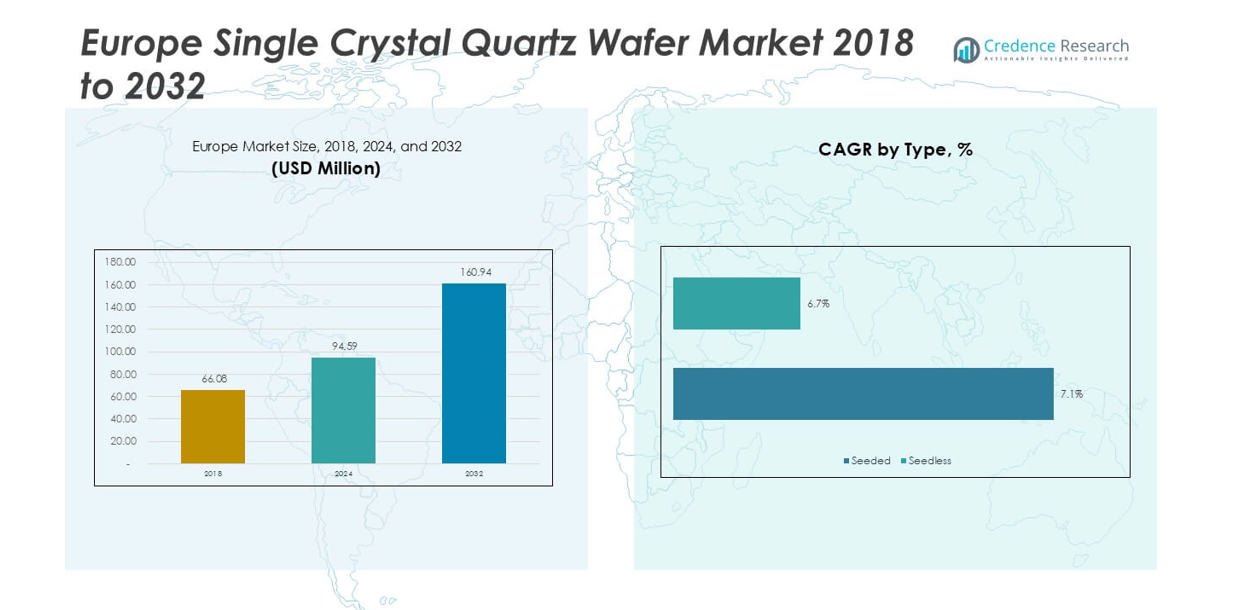
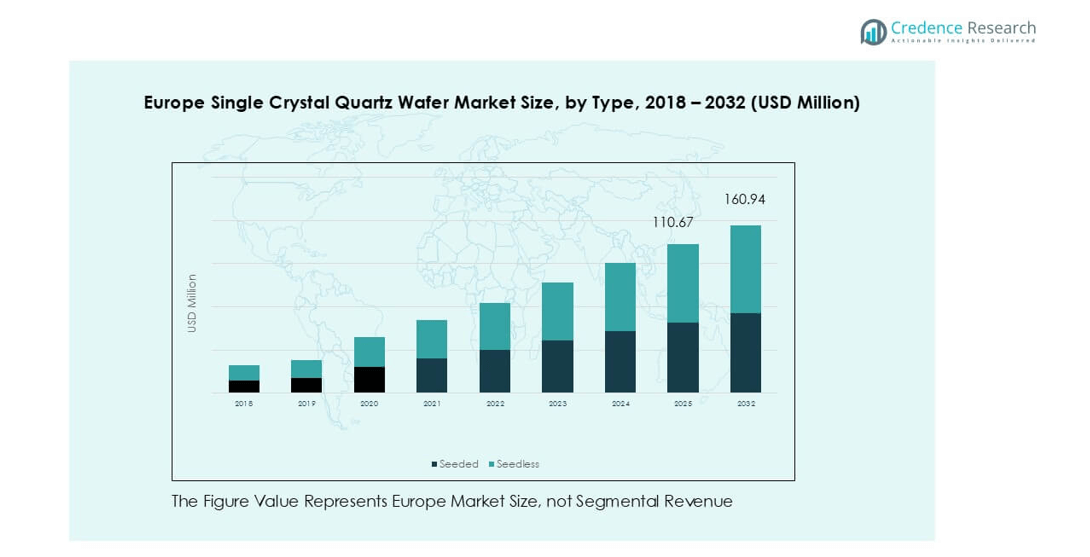
The Europe Single Crystal Quartz Wafer market size was valued at USD 66.08 million in 2018, reaching USD 94.59 million in 2024, and is anticipated to hit USD 160.94 million by 2032, at a CAGR of 6.85% during the forecast period.
| REPORT ATTRIBUTE | DETAILS |
|---|---|
| Historical Period | 2020-2023 |
| Base Year | 2024 |
| Forecast Period | 2025-2032 |
| Europe Single Crystal Quartz Wafer Market Size 2025 | USD 94.59 million |
| Europe Single Crystal Quartz Wafer Market, CAGR | 6.85% |
| Europe Single Crystal Quartz Wafer Market Size 2032 | USD 160.94 million |
The Europe single crystal quartz wafer market is led by key players such as SIEGERT WAFER GmbH, Corning Incorporated, NIHON DEMPA KOGYO CO., LTD., MTI Corporation, and Semiconductor Wafer, Inc. These companies hold strong positions through advanced manufacturing capabilities, broad product offerings, and strategic partnerships across semiconductor and MEMS industries. Germany emerges as the leading region, accounting for over 25% market share in 2024, driven by its robust semiconductor ecosystem, automotive electronics base, and Industry 4.0 initiatives. France and the United Kingdom follow with notable shares, supported by advancements in biotechnology, healthcare, and defense technologies. The combined strength of these players and regions positions Europe as a critical hub for quartz wafer innovation and adoption.
Market Insights
- The Europe single crystal quartz wafer market was valued at USD 94.59 million in 2024 and is projected to reach USD 160.94 million by 2032, growing at a CAGR of 6.85%.
- Growth is driven by rising semiconductor production, strong adoption in MEMS and electronics, and expanding demand from biotechnology and healthcare applications.
- Key trends include a shift toward larger-diameter wafers, integration in 5G and IoT devices, and increasing R&D investments under the EU Chips Act to strengthen the regional semiconductor ecosystem.
- The market is moderately consolidated, with leading players such as SIEGERT WAFER GmbH, Corning Incorporated, NIHON DEMPA KOGYO CO., LTD., and MTI Corporation focusing on technology innovation and partnerships, while new entrants target niche applications.
- Regionally, Germany leads with over 25% share, followed by France at 15%, the UK at 12%, Italy at 10%, Spain at 8%, Russia at 7%, and the Rest of Europe collectively holding 23%.
Market Segmentation Analysis:
By Type
The seeded quartz wafer segment dominated the Europe single crystal quartz wafer market in 2024, accounting for over 65% share. Seeded wafers are preferred due to their superior crystalline quality, stability, and low defect density, which make them ideal for semiconductor and MEMS manufacturing. Their consistent lattice structure supports precision in high-frequency applications and optoelectronic devices. The seedless segment remains smaller but is gaining adoption for niche applications requiring high-purity structures. Demand from electronics and advanced packaging continues to drive growth for seeded wafers across European semiconductor hubs.
- For instance, Heraeus Covantics, located in Germany, produces high-purity quartz and fused silica components for the semiconductor manufacturing industry. The company offers a variety of materials, some with impurity levels in the parts-per-billion range, for applications that accommodate industry-standard wafer sizes, including 200 mm and 300 mm.
By Diameter
Wafers sized 5 to 8 inches led the market in 2024, holding around 55% share. This dominance is linked to their extensive use in semiconductor production and MEMS devices, where mid-sized wafers balance cost-efficiency and high output. European foundries and research institutes favor this diameter for its scalability in IC packaging and advanced electronics. Smaller wafers, up to 4 inches, are primarily used in specialty and R&D applications, while above 8-inch wafers are emerging in high-volume semiconductor lines, reflecting future opportunities as fabrication technologies advance.
- For instance, Soitec in France uses 200 mm silicon-on-insulator (SOI) wafers for MEMS substrates, serving clients in the automotive and mobile communications industries.
By Application
The semiconductor segment accounted for the largest share of over 40% in 2024, driven by Europe’s strong base in microelectronics, automotive electronics, and industrial automation. Single crystal quartz wafers are essential for ensuring signal stability, thermal resistance, and precision in semiconductor devices. MEMS and electronics follow closely, supported by growing adoption in sensors, wearables, and smart devices. Biotechnology applications are rising steadily due to demand for advanced diagnostic tools and biosensors. Integrated circuit packaging also shows growth, supported by Europe’s increasing investments in semiconductor value-chain resilience.
Key Growth Drivers
Rising Semiconductor Manufacturing in Europe
Europe’s growing focus on semiconductor manufacturing is a primary driver of the single crystal quartz wafer market. The European Union has launched the EU Chips Act, targeting significant investments to strengthen the semiconductor supply chain. Quartz wafers play a critical role in semiconductor device fabrication, ensuring high thermal stability and signal precision. Countries such as Germany, France, and the Netherlands are expanding fabrication facilities to reduce dependency on imports. The rising demand for high-performance chips in automotive, aerospace, and industrial automation applications further boosts adoption. As electric vehicles and 5G networks proliferate, the need for precision substrates expands, positioning quartz wafers as a core material supporting Europe’s long-term technological competitiveness.
- For instance, Infineon Technologies is investing €5 billion in a new 300 mm fab in Dresden, designed for a capacity of over 400,000 wafers annually, all requiring precision quartz substrates for photolithography.
Expanding MEMS and Electronics Applications
Microelectromechanical systems (MEMS) and advanced electronics are witnessing rapid adoption across Europe, creating sustained demand for quartz wafers. MEMS devices, including accelerometers, gyroscopes, and pressure sensors, are integral to automotive safety systems, industrial robotics, and consumer electronics. Quartz wafers are crucial for ensuring frequency stability and miniaturization in these devices. The integration of MEMS into medical technologies and wearable electronics is further broadening the application scope. With Europe prioritizing smart manufacturing and Industry 4.0, MEMS deployment continues to accelerate. The region’s automotive sector, driven by autonomous and connected vehicle technologies, significantly contributes to MEMS demand, further strengthening quartz wafer consumption. This expanding role of MEMS across multiple sectors cements quartz wafers as indispensable for technological innovation and commercial growth.
- For instance, Bosch produces more than 4 million MEMS sensors per day at its wafer fabs in Reutlingen and Dresden, many based on quartz substrates for automotive and smartphone applications.
Biotechnology and Healthcare Advancements
The growing role of biotechnology and healthcare technologies is another key driver for the Europe quartz wafer market. Quartz wafers are used in biosensors, diagnostic systems, and lab-on-chip devices, enabling high sensitivity and reliable performance. Europe’s healthcare sector is adopting advanced analytical systems to support personalized medicine, point-of-care diagnostics, and genomic studies. Increasing investment in biotech R&D, supported by both government and private initiatives, accelerates demand for precision substrates. Additionally, the COVID-19 pandemic highlighted the importance of advanced diagnostic technologies, spurring greater focus on biosensor innovation. As healthcare providers continue to adopt smart and portable medical devices, the demand for quartz wafers in biotechnology expands, ensuring long-term growth across life sciences and healthcare applications.
Key Trends & Opportunities
Shift Toward Larger-Diameter Wafers
The transition toward larger-diameter quartz wafers presents a significant opportunity for manufacturers in Europe. While 5–8-inch wafers currently dominate, the move toward above 8-inch wafers aligns with the region’s push for high-volume semiconductor production. Larger wafers increase yield per batch, lowering manufacturing costs and enabling scale. As semiconductor fabs in Europe expand capacity under the EU Chips Act, demand for advanced wafer sizes is expected to grow. This shift creates opportunities for suppliers to innovate in wafer manufacturing technologies, addressing rising needs for efficiency, uniformity, and defect-free production. Larger wafers also align with long-term goals of strengthening Europe’s semiconductor autonomy.
- For instance, GlobalWafers Europe has piloted 300 mm (12-inch) wafer production in Germany, achieving defect densities below 200 cm⁻² to support next-generation IC packaging.
Integration with 5G and Emerging Technologies
The rollout of 5G networks and growth of emerging technologies such as IoT, AI, and advanced automotive systems open significant growth opportunities. Quartz wafers ensure signal accuracy and stability, making them critical for RF components and communication devices. With Europe investing heavily in 5G infrastructure, the need for reliable substrates is expanding. Moreover, applications in smart cities, autonomous vehicles, and defense electronics are increasing reliance on quartz wafers. Manufacturers positioned to meet the requirements of high-frequency and low-loss performance will benefit from these technology-driven opportunities. This trend also reflects Europe’s broader shift toward digital transformation and connected ecosystems.
Key Challenges
High Manufacturing Costs and Complexity
One of the key challenges for the Europe quartz wafer market is the high cost and complexity of production. The manufacturing of single crystal quartz wafers requires advanced crystal growth techniques, precision cutting, and defect control, which result in significant capital investment. Small and mid-scale players often struggle to compete with large-scale global suppliers. Additionally, achieving consistent quality at larger wafer diameters increases production costs. This cost barrier limits the widespread adoption of quartz wafers in price-sensitive applications and slows down regional production scalability. Companies must invest in cost optimization and advanced process technologies to overcome this challenge.
Supply Chain Dependencies and Raw Material Constraints
The market faces challenges related to supply chain dependencies and limited availability of high-quality quartz. Europe relies on imports of raw materials and equipment, which exposes manufacturers to global supply chain disruptions. Political tensions, trade restrictions, and logistical bottlenecks further intensify risks. Moreover, the niche requirement for defect-free quartz crystals narrows the supplier base, creating vulnerability in sourcing. These constraints hinder the region’s ability to scale local manufacturing and compete globally. Addressing this challenge requires strategic investments in domestic supply chains, resource security, and partnerships to ensure stable access to high-purity quartz for wafer production.
Regional Analysis
Germany
Germany dominated the Europe single crystal quartz wafer market in 2024, accounting for over 25% share. The country’s leadership stems from its advanced semiconductor manufacturing base, robust automotive electronics sector, and strong R&D ecosystem. German companies are at the forefront of microelectronics and MEMS applications, supported by government-backed initiatives under the EU Chips Act. Demand from electric vehicle technologies and Industry 4.0 integration further strengthens the market. The presence of leading automotive OEMs and technology developers ensures continuous adoption of quartz wafers for precision components, making Germany the regional hub for innovation and production.
France
France held around 15% share of the Europe single crystal quartz wafer market in 2024, driven by a growing focus on semiconductor research and microelectronics innovation. Strong investment in aerospace, defense, and biotechnology supports wafer demand across high-precision applications. The country’s semiconductor ecosystem benefits from collaborations between research institutions and industrial players, boosting adoption in MEMS and integrated circuits. Expanding adoption of biosensors and lab-on-chip devices in healthcare also strengthens growth. France’s balanced mix of industrial and healthcare-driven demand ensures its position as a significant contributor to the regional market.
United Kingdom
The United Kingdom captured approximately 12% share in the 2024 market, supported by expanding applications in biotechnology, healthcare, and advanced electronics. Strong demand for biosensors, diagnostic tools, and integrated medical devices drives quartz wafer usage. The UK’s semiconductor and electronics industry is relatively smaller but benefits from innovation-focused investments in start-ups and research labs. Demand is also fueled by defense technologies and precision communication systems. With growing emphasis on healthcare innovation and diagnostics, the UK market is set to expand steadily, positioning itself as a niche but vital player in Europe’s quartz wafer ecosystem.
Italy
Italy accounted for nearly 10% share of the Europe single crystal quartz wafer market in 2024, with growth supported by industrial automation and microelectronics adoption. Italian companies are increasingly leveraging quartz wafers for MEMS sensors, which are widely used in manufacturing and automotive applications. Strong ties to the European semiconductor value chain support domestic consumption. In addition, healthcare and biotechnology sectors are adopting quartz-based substrates for diagnostic equipment. Italy’s ongoing digitalization and Industry 4.0 programs enhance demand for precision substrates, ensuring steady growth while maintaining a competitive role within Southern Europe’s technology landscape.
Rest of Europe
The Rest of Europe region, including countries such as the Netherlands, Switzerland, and Nordic nations, collectively held around 38% share in 2024. The Netherlands plays a key role due to its semiconductor equipment manufacturers and strong R&D base, while Switzerland contributes through biotech innovation and precision electronics. Nordic countries are investing in smart manufacturing and clean technologies, creating new opportunities. This diverse regional cluster benefits from cross-border collaborations, EU-funded initiatives, and strong export capabilities. The combined strength of these markets ensures that Rest of Europe contributes significantly to driving technological advancement and supply chain resilience.
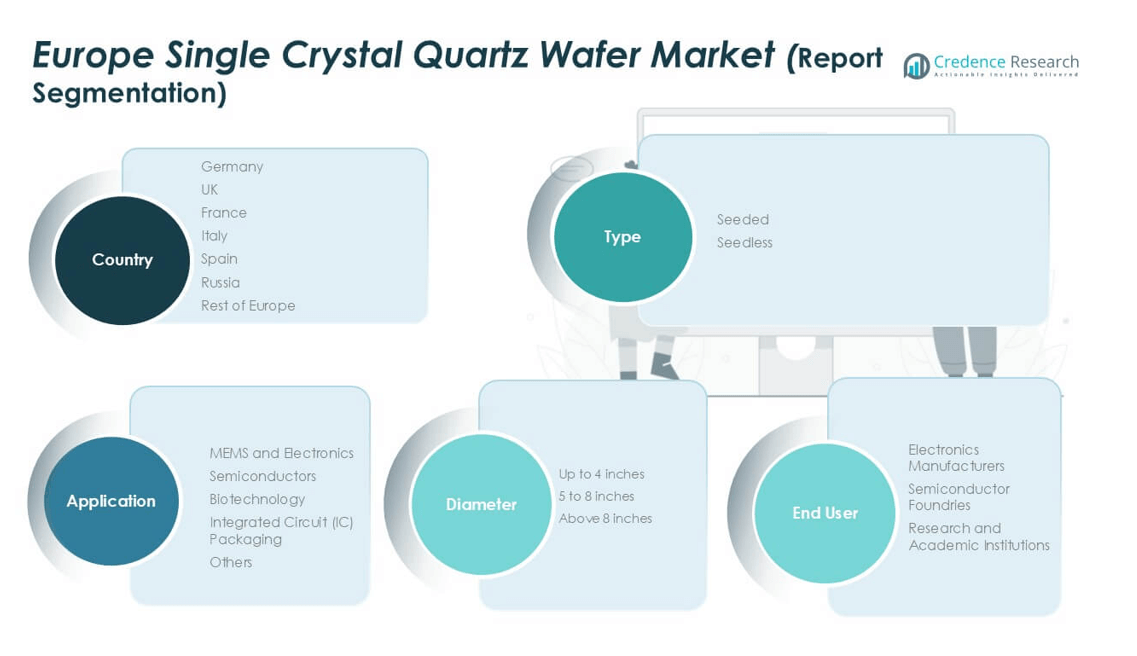
Market Segmentations:
By Type
- Seeded
- Seedless
By Diameter
- Up to 4 inches
- 5 to 8 inches
- Above 8 inches
By Application
- MEMS and Electronics
- Semiconductors
- Biotechnology
- Integrated Circuit (IC) Packaging
- Others
By End User
- Electronics Manufacturers
- Semiconductor Foundries
- Research and Academic Institutions
By Geography
- Germany
- UK
- France
- Italy
- Spain
- Russia
- Rest of Europe
Competitive Landscape
The Europe single crystal quartz wafer market features a moderately consolidated competitive landscape, with a mix of established multinational corporations and specialized regional suppliers. Key players such as SIEGERT WAFER GmbH, Corning Incorporated, and NIHON DEMPA KOGYO CO., LTD. dominate through their strong manufacturing capabilities, extensive product portfolios, and partnerships across semiconductor, MEMS, and biotechnology industries. Emerging companies like MTI Corporation, MicroChemicals GmbH, and Neyco are strengthening their positions by focusing on niche applications, high-purity wafers, and customized solutions for research institutions and advanced electronics. Strategic collaborations with European semiconductor fabs and R&D centers are increasingly common, enabling suppliers to align with the EU Chips Act and regional supply chain resilience goals. Continuous investment in large-diameter wafer technologies, defect-free crystal growth, and cost optimization strategies define the competitive edge. Recent developments also highlight growing participation from Asian manufacturers entering the European market, intensifying competition and driving innovation across applications.
Key Player Analysis
- SIEGERT WAFER GmbH
- Semiconductor Wafer, Inc.
- MTI Corporation
- Corning Incorporated
- Vritra Technologies
- Neyco
- MicroChemicals GmbH
- NIHON DEMPA KOGYO CO., LTD.
- Hangzhou Freqcontrol Electronic Technology Ltd.
- UniversityWafer, Inc.
- Other Key Players
Recent Developments
- In July 2025, Xiamen Powerway (PAM-XIAMEN) remains an active supplier of single crystal quartz wafers, specializing in X-cut, Y-cut, Z-cut, and ST-cut orientations up to 3-inch diameters.
- In July 2025, NDK highlighted its advancement in mass-producing high-uniformity quartz crystals using proprietary technologies. Their latest offering includes synthetic quartz wafers with AT-cut and tuning fork wafers, and a development plan for larger 6-inch wafers to cater to growing SAW device demand and frequency control in next-gen electronics.
- In August 2024, NDK (NIHON DEMPA KOGYO CO., LTD.) showcased its synthetic quartz crystals and quartz wafers for timing and optical applications at electronica India 2024, participating through a distributor's booth at the trade fair.
Report Coverage
The research report offers an in-depth analysis based on Type, Diameter, Application, End-User and Geography. It details leading market players, providing an overview of their business, product offerings, investments, revenue streams, and key applications. Additionally, the report includes insights into the competitive environment, SWOT analysis, current market trends, as well as the primary drivers and constraints. Furthermore, it discusses various factors that have driven market expansion in recent years. The report also explores market dynamics, regulatory scenarios, and technological advancements that are shaping the industry. It assesses the impact of external factors and global economic changes on market growth. Lastly, it provides strategic recommendations for new entrants and established companies to navigate the complexities of the market.
Future Outlook
- The market will expand steadily with rising demand from semiconductor manufacturing in Europe.
- MEMS and sensor applications will drive strong adoption across automotive, healthcare, and consumer electronics.
- Larger-diameter wafers will gain traction as fabs scale up high-volume production.
- Biotechnology and diagnostic devices will emerge as significant growth contributors.
- Germany will continue leading, supported by advanced industrial and automotive electronics ecosystems.
- France and the UK will strengthen their positions through healthcare, defense, and microelectronics demand.
- Strategic collaborations between suppliers and European R&D centers will accelerate innovation.
- Competition from Asian manufacturers will increase, intensifying technology differentiation.
- Supply chain localization efforts under the EU Chips Act will enhance regional resilience.
- Sustainability and cost optimization in wafer production will shape long-term market strategies.

Request a Free Sample
Fill in your details and we'll send you a free sample report.
- Sample data tables & charts
- Research methodology
Market Dynamics
Rising Semiconductor Manufacturing in Europe
The EU Chips Act and significant investments in local semiconductor fabs are driving demand for single crystal quartz wafers, which are essential for high-precision and high-performance chip production. Countries like Germany, France, and the Netherlands are expanding fabrication capacity, reducing import dependency and boosting local wafer consumption.
Expanding MEMS and Electronics Applications
The proliferation of MEMS devices in automotive, industrial automation, and consumer electronics is increasing the need for quartz wafers, which provide frequency stability and miniaturization. Europe's focus on smart manufacturing and Industry 4.0 further accelerates MEMS adoption, strengthening quartz wafer demand.
Biotechnology and Healthcare Advancements
Growth in biosensors, diagnostic systems, and lab-on-chip devices is fueling the use of quartz wafers in biotechnology and healthcare. The region's investment in advanced medical diagnostics and personalized medicine is expanding the application scope for high-purity quartz substrates.
Shift Toward Larger-Diameter Wafers
European fabs are increasingly adopting larger-diameter quartz wafers to improve manufacturing efficiency and scale up high-volume semiconductor production. This transition supports cost reduction and aligns with the region's goal of strengthening semiconductor autonomy.
Integration with 5G and Emerging Technologies
The rollout of 5G networks and the rise of IoT, AI, and advanced automotive systems are driving demand for quartz wafers in RF components and communication devices. Reliable, high-frequency substrates are critical for these emerging technologies, supporting market growth.
Need a Custom Version of This Report?
Tailor the scope, geography, or segments to your exact requirements.
- Custom geography or segment scope
- Direct access to our analyst team
Frequently Asked Questions
What is the current market size for Europe Single Crystal Quartz Wafer market, and what is its projected size in 2032?
At what Compound Annual Growth Rate is the Europe Single Crystal Quartz Wafer market projected to grow between 2025 and 2032?
Which Europe Single Crystal Quartz Wafer market segment held the largest share in 2024?
What are the primary factors fueling the growth of the Europe Single Crystal Quartz Wafer market?
Who are the leading companies in the Europe Single Crystal Quartz Wafer market?
Table of Content
Chapter 1 Market Segmentation
- 1.1 Segmentation Framework
- 1.1.1 Product and Service Classification
- 1.1.2 Application and End-Use Classification
- 1.1.3 Technology and Solution Classification
- 1.1.4 Customer and Distribution Channel Classification
- 1.1.5 Geographic Segmentation
- 1.1.6 Market Segment Definitions and Boundaries
- 1.2 By Type
- 1.2.1 Seeded
- 1.2.2 Seedless
- 1.3 By Diameter
- 1.3.1 Up to 4 inches
- 1.3.2 5 to 8 inches
- 1.3.3 Above 8 inches
- 1.4 By End User
- 1.4.1 Electronics Manufacturers
- 1.4.2 Semiconductor Foundries
- 1.4.3 Research and Academic Institutions
- 1.5 By Application
- 1.5.1 MEMS and Electronics
- 1.5.2 Semiconductors
- 1.5.3 Biotechnology
- 1.5.4 Integrated Circuit (IC) Packaging
- 1.5.5 Others
Chapter 2 Introduction
- 2.1 Report Objectives and Scope
- 2.2 Product Definition and Industry Terminology
- 2.3 Market Inclusions and Exclusions
- 2.4 Research Process
- 2.4.1 Primary Research and Expert Interviews
- 2.4.2 Secondary Research and Source Review
- 2.4.3 Top-Down and Bottom-Up Estimation
- 2.4.4 Data Triangulation and Verification
- 2.5 Market Size Measurement Basis
- 2.5.1 2024: USD 94.59 million → 2032: USD 160.94 million
- 2.6 Historical and Forecast Reference Periods
- 2.6.1 Base Year: 2024
- 2.6.2 Forecast Period: 2024-2032
- 2.7 Research Assumptions and Limitations
Chapter 3 Executive Summary
- 3.1 Market Snapshot and Key Findings
- 3.2 Base-Year Market Size, 2024
- 3.3 Forecast Market Size, 2032
- 3.4 Revenue and Volume Growth Outlook
- 3.5 Key Demand and Supply Indicators
- 3.6 Leading Market Segments
- 3.7 Fastest-Growing Market Opportunities
- 3.8 Regional Performance Highlights
- 3.9 Technology and Industry Transformation
- 3.10 Competitive Landscape Summary
- 3.11 Analyst View and Strategic Implications
Chapter 4 Europe Single Crystal Quartz Wafer Market Trends and Developments
- 4.1 Historical Industry Development
- 4.2 Recent Market Trends and Developments
- 4.3 Demand and Customer Behavior Trends
- 4.4 Technology and Product Innovation
- 4.5 Artificial Intelligence, Automation and Digitalization
- 4.6 Local Manufacturing and Supply Chain Realignment
- 4.7 Industry Partnerships, Mergers and Acquisitions
- 4.8 Sustainability and Circular Economy Developments
- 4.9 Government and Private Sector Investment Trends
- 4.10 Emerging Business Models and Commercialization
- 4.11 Industry Developments and Announcements
Chapter 5 Europe Single Crystal Quartz Wafer Market Production, Supply and Demand Analysis
- 5.1 Demand Trend and Consumption Analysis
- 5.2 Demand Forecast, 2024-2032
- 5.3 Production and Output Trend
- 5.4 Production and Output Forecast, 2024-2032
- 5.5 Installed Capacity and Capacity Utilization
- 5.6 Company-Wise Production Plants and Statistics
- 5.6.1 Installed Production Capacity
- 5.6.2 Actual Production
- 5.6.3 Planned Capacity and Expansion Targets
- 5.7 Supply Chain Structure and Procurement Trends
- 5.8 Supply-Demand Gap and Bottlenecks
- 5.9 Import Dependence and Sourcing Structure
- 5.10 Contract Manufacturing and Outsourcing
- 5.11 Regional Supply and Demand Concentration
Chapter 6 Europe Single Crystal Quartz Wafer Market Pricing Analysis
- 6.1 Pricing Structure and Measurement
- 6.2 Historical Pricing Trends
- 6.3 Pricing Outlook, 2024-2032
- 6.4 Average Selling Price and Unit Economics
- 6.5 Pricing by Product and Market Segment
- 6.6 Geographic Pricing Differences
- 6.7 Key Input, Energy, Labor and Logistics Costs
- 6.8 Contract Pricing and Purchasing Models
- 6.9 Pricing Sensitivity and Competitive Positioning
- 6.10 Price, Margin and Profitability Implications
Chapter 7 Europe Single Crystal Quartz Wafer Market Dynamics
- 7.1 Market Growth Drivers
- 7.1.1 Demand-Side Drivers
- 7.1.2 Technology and Innovation Drivers
- 7.1.3 Infrastructure and Investment Drivers
- 7.1.4 Regulatory and Policy Drivers
- 7.2 Market Restraints
- 7.2.1 Cost and Affordability Constraints
- 7.2.2 Technology and Adoption Barriers
- 7.2.3 Supply Chain and Operational Constraints
- 7.3 Market Challenges
- 7.3.1 Competitive Pressure and Margin Erosion
- 7.3.2 Skills, Infrastructure and Implementation Gaps
- 7.4 Emerging Market Opportunities
- 7.5 Market Dynamics Impact and Time-Horizon Assessment
Chapter 8 Europe Single Crystal Quartz Wafer Value Chain Analysis
- 8.1 Industry Value Chain Overview
- 8.2 Upstream Suppliers and Critical Inputs
- 8.3 Technology and Component Providers
- 8.4 Manufacturing or Service Delivery
- 8.5 Distribution, Channel Partners and Integrators
- 8.6 Downstream Applications and End Users
- 8.7 Value Addition and Profit Pools
- 8.8 Vertical Integration and Outsourcing
- 8.9 Supplier Concentration and Risk
- 8.10 Supply Chain Localization and Resilience
Chapter 9 Europe Single Crystal Quartz Wafer Market Regulations and Policies
- 9.1 Relevant Laws, Standards and Compliance Frameworks
- 9.2 Product, Service, Safety and Quality Requirements
- 9.3 Government Policies, Incentives and Subsidies
- 9.4 Imports, Exports and Trade Barriers
- 9.5 Public Procurement and Local Content Requirements
- 9.6 Environmental and Sustainability Compliance
- 9.7 Upcoming Policy Changes and Market Implications
Chapter 10 Europe Single Crystal Quartz Wafer Market Hotspots and Opportunities
- 10.1 Market Opportunity Mapping and Growth Hotspots
- 10.2 High-Growth Applications and Customer Groups
- 10.3 Underserved Markets and White-Space Opportunities
- 10.4 Emerging Technology and Product Opportunities
- 10.5 New Capacity and Investment Hotspots
- 10.6 Market Entry and Expansion Opportunities
- 10.7 Distribution and Partnership Opportunities
- 10.8 Near-Term and Long-Term Commercial Potential
- 10.9 Opportunity Attractiveness and Execution Risks
Chapter 11 Europe Single Crystal Quartz Wafer Market Outlook, 2024-2032
- 11.1 Market Size and Analysis
- 11.1.1 Revenue (Market Measurement: 2024: USD 94.59 million → 2032: USD 160.94 million)
- 11.1.2 Market Volume and Quantity Sold
- 11.1.3 Historical Market Size
- 11.1.4 Base-Year Market Size, 2024
- 11.2 Market Forecast, 2024-2032
- 11.2.1 Revenue Forecast to 2032
- 11.2.2 Volume Forecast to 2032
- 11.2.3 CAGR and Year-on-Year Growth
- 11.2.4 Incremental Revenue Opportunity
- 11.3 Forecast Assumptions and Scenario Analysis
- 11.3.1 Base-Case Forecast
- 11.3.2 Optimistic and Conservative Scenarios
- 11.3.3 Technology, Pricing and Policy Sensitivities
- 11.4 Market Attractiveness and Growth Outlook
Chapter 12 Europe Single Crystal Quartz Wafer Market Segmentation and Outlook
- 12.1 Segmentation Summary and Market Shares, 2024
- 12.2 Largest and Fastest-Growing Segments
- 12.3 By Type - Market Size and Forecast, 2024-2032
- 12.3.1 Segment Definition and Scope
- 12.3.2 Historical Market Size
- 12.3.3 Revenue Forecast, 2024-2032
- 12.3.4 Volume Forecast, 2024-2032
- 12.3.5 Base-Year Market Share, 2024
- 12.3.6 Segment CAGR and Growth Drivers
- 12.3.7 Subsegment Market Size and Forecast
- 12.3.7.1 Seeded
- 12.3.7.2 Seedless
- 12.3.8 Subsegment Pricing and Adoption Trends
- 12.3.9 Leading Suppliers and Competition
- 12.3.10 Regional Demand and Opportunities
- 12.4 By Diameter - Market Size and Forecast, 2024-2032
- 12.4.1 Segment Definition and Scope
- 12.4.2 Historical Market Size
- 12.4.3 Revenue Forecast, 2024-2032
- 12.4.4 Volume Forecast, 2024-2032
- 12.4.5 Base-Year Market Share, 2024
- 12.4.6 Segment CAGR and Growth Drivers
- 12.4.7 Subsegment Market Size and Forecast
- 12.4.7.1 Up to 4 inches
- 12.4.7.2 5 to 8 inches
- 12.4.7.3 Above 8 inches
- 12.4.8 Subsegment Pricing and Adoption Trends
- 12.4.9 Leading Suppliers and Competition
- 12.4.10 Regional Demand and Opportunities
- 12.5 By End User - Market Size and Forecast, 2024-2032
- 12.5.1 Segment Definition and Scope
- 12.5.2 Historical Market Size
- 12.5.3 Revenue Forecast, 2024-2032
- 12.5.4 Volume Forecast, 2024-2032
- 12.5.5 Base-Year Market Share, 2024
- 12.5.6 Segment CAGR and Growth Drivers
- 12.5.7 Subsegment Market Size and Forecast
- 12.5.7.1 Electronics Manufacturers
- 12.5.7.2 Semiconductor Foundries
- 12.5.7.3 Research and Academic Institutions
- 12.5.8 Subsegment Pricing and Adoption Trends
- 12.5.9 Leading Suppliers and Competition
- 12.5.10 Regional Demand and Opportunities
- 12.6 By Application - Market Size and Forecast, 2024-2032
- 12.6.1 Segment Definition and Scope
- 12.6.2 Historical Market Size
- 12.6.3 Revenue Forecast, 2024-2032
- 12.6.4 Volume Forecast, 2024-2032
- 12.6.5 Base-Year Market Share, 2024
- 12.6.6 Segment CAGR and Growth Drivers
- 12.6.7 Subsegment Market Size and Forecast
- 12.6.7.1 MEMS and Electronics
- 12.6.7.2 Semiconductors
- 12.6.7.3 Biotechnology
- 12.6.7.4 Integrated Circuit (IC) Packaging
- 12.6.7.5 Others
- 12.6.8 Subsegment Pricing and Adoption Trends
- 12.6.9 Leading Suppliers and Competition
- 12.6.10 Regional Demand and Opportunities
- 12.7 Segment Growth Comparison
- 12.8 Segment Attractiveness and Priority Matrix
Chapter 13 Europe Single Crystal Quartz Wafer End-Use and Application Market Outlook
- 13.1 End-Use Industry and Customer Demand Structure
- 13.2 Leading Applications and Customer Groups
- 13.3 End-Use Market Size, Share and Forecast
- 13.4 Major End-Use Industry Deep Dives
- 13.4.1 Customer Requirements and Use Cases
- 13.4.2 Demand and Replacement Cycles
- 13.4.3 Technical and Regulatory Considerations
- 13.4.4 Purchasing and Procurement Models
- 13.4.5 Leading Vendors and Distribution Channels
- 13.4.6 Forecast and Commercial Opportunities
- 13.5 Emerging Applications and Cross-Segment Demand
- 13.6 End-Use Industry Investment Priorities
Chapter 14 Europe Single Crystal Quartz Wafer Geographic Market Outlook, 2024-2032
- 14.1 Regional Market Size and Country-Level Shares, 2024
- 14.2 Country Market Size Comparison, 2024
- 14.3 Country Market Forecasts, 2024-2032
- 14.4 Subregional Industrial and Demand Clusters
- 14.5 Intra-Regional Pricing and Cost Differences
- 14.6 Cross-Border Trade and Supply Networks
- 14.7 Regional Supply and Demand Balances
- 14.8 Country Opportunity Comparison and Prioritization
Note: Every listed country is covered on the structure shown under the first country.
Chapter 15 Europe Single Crystal Quartz Wafer Technology, Innovation and Sustainability Outlook
- 15.1 Technology Landscape and Maturity
- 15.2 Product, Process and Service Innovation
- 15.3 AI, Automation and Digital Tools in the Industry
- 15.4 Technology Adoption and Performance Benchmarking
- 15.5 Innovation Pipeline and R&D Investment
- 15.6 Patent and Intellectual Property Trends
- 15.7 Energy Efficiency and Resource Management
- 15.8 Sustainability, Recycling and Circularity
- 15.9 Technology Roadmap, 2024-2032
- 15.10 Risks of Obsolescence and Technology Substitution
Chapter 16 Europe Single Crystal Quartz Wafer Market Key Strategic Imperatives
- 16.1 Growth and Market Entry Priorities
- 16.2 High-Return Products and Segments
- 16.3 Pricing, Profitability and Cost Optimization
- 16.4 Technology Investment and Product Differentiation
- 16.5 Supply Chain Localization and Resilience
- 16.6 Distribution and Customer Acquisition
- 16.7 Partnership, Acquisition and Capacity Strategy
- 16.8 Regional Expansion Priorities
- 16.9 Short-, Medium- and Long-Term Actions
Chapter 17 Competition Outlook
- 17.1 Industry Competition Characteristics
- 17.2 Market Structure and Concentration
- 17.3 Market Share and Competitive Positioning, 2024
- 17.4 Company-Wise Revenue and Product Benchmarking
- 17.5 Production and Service Capacity Benchmarking
- 17.6 Technology, Pricing and Differentiation
- 17.7 Regional Footprint and Distribution Strength
- 17.8 Mergers, Acquisitions and Strategic Alliances
- 17.9 New Entrants and Competitive Threats
- 17.10 Porter's Five Forces and Industry Attractiveness
- 17.11 Competitive Outlook, 2024-2032
Chapter 18 Company Profiles
- 18.1 Company Coverage and Selection Criteria
- 18.2 SIEGERT WAFER GmbH
- 18.2.1 Business Description
- 18.2.2 Company Ownership and Geographic Presence
- 18.2.3 Product and Service Portfolio
- 18.2.4 Manufacturing and Operating Footprint
- 18.2.5 Production Capacity and Expansion Plans
- 18.2.6 Financial Performance and Investment
- 18.2.7 Market Share and Competitive Position
- 18.2.8 Technology and Innovation Capabilities
- 18.2.9 Strategic Alliances or Partnerships
- 18.2.10 Recent Developments
- 18.2.11 Growth Strategy and Outlook
- 18.3 Corning Incorporated
- 18.4 NIHON DEMPA KOGYO CO., LTD.
- 18.5 MTI Corporation
- 18.6 Semiconductor Wafer, Inc.
- 18.7 MicroChemicals GmbH
- 18.8 Neyco
- 18.9 Vritra Technologies
- 18.10 Hangzhou Freqcontrol Electronic Technology Ltd.
- 18.11 UniversityWafer, Inc.
- 18.12 Other Relevant Market Participants
Note: Every listed company is profiled on the structure shown under the first company. The company list is preliminary and may change based on research findings, market developments, data availability and client requirements.
Chapter 19 Disclaimer
- 19.1 Research and Forecast Disclaimer
- 19.2 Data Source and Estimation Limitations
Note: The depth of individual sections depends on data availability for this market. Volume, capacity, trade and other unit-based metrics are included where applicable.

