
Market Overview:
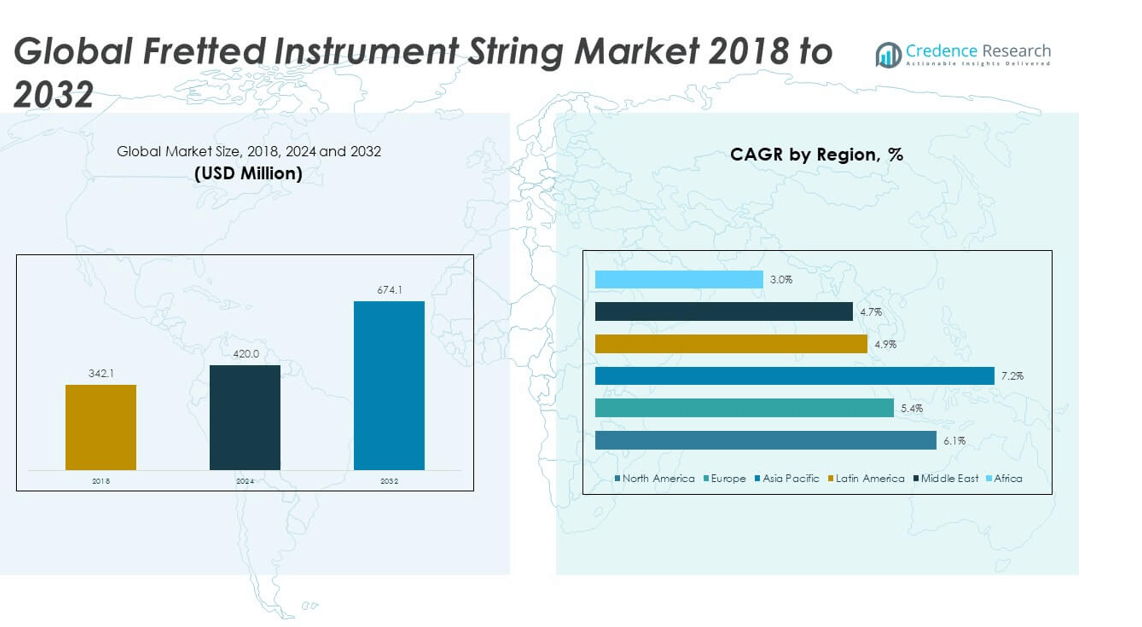
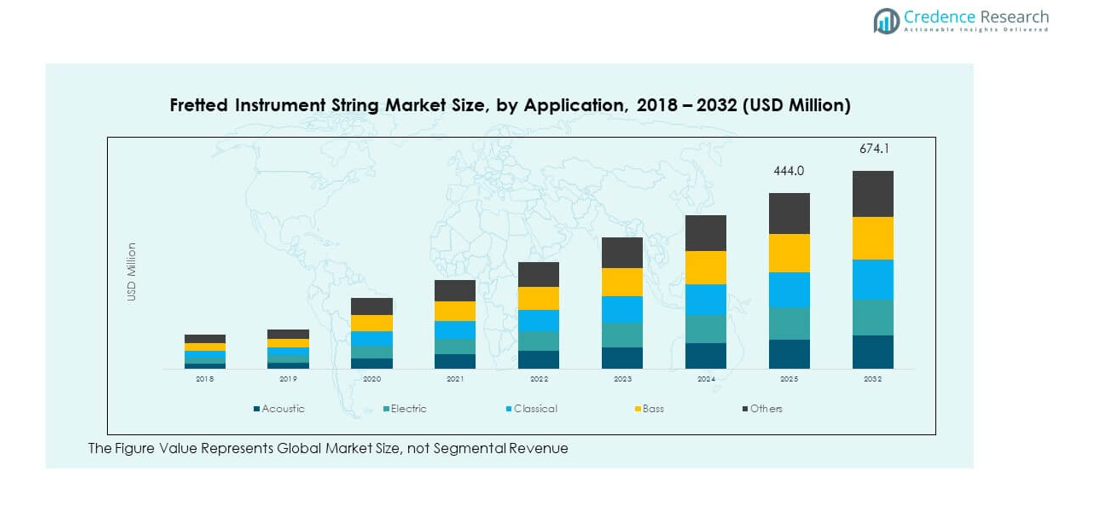
The Fretted Instrument String Market size was valued at USD 342.1 million in 2018 to USD 420.0 million in 2024 and is anticipated to reach USD 674.1 million by 2032, at a CAGR of 6.1% during the forecast period.
| REPORT ATTRIBUTE | DETAILS |
|---|---|
| Historical Period | 2020-2023 |
| Base Year | 2024 |
| Forecast Period | 2025-2032 |
| Fretted Instrument String Market Size 2024 | USD 420.0 million |
| Fretted Instrument String Market, CAGR | 6.1% |
| Fretted Instrument String Market Size 2032 | USD 674.1 million |
The market is witnessing steady growth driven by rising global interest in music as both a profession and leisure activity, alongside the increasing adoption of stringed instruments in genres such as rock, jazz, and classical. Demand is further fueled by technological innovations in string design that enhance durability, tone quality, and playability, meeting the needs of both professional musicians and hobbyists. Additionally, the surge in online music learning platforms and the expanding base of amateur players are amplifying the need for replacement strings, reinforcing consistent market expansion.
Regionally, North America and Europe lead the fretted instrument string market, supported by their well-established music industries, high instrument penetration, and strong presence of leading manufacturers. Asia-Pacific is emerging as a significant growth hub, with rising disposable incomes, growing popularity of Western music among younger populations, and increasing adoption of music education in countries like China, India, and Japan. Meanwhile, Latin America and the Middle East & Africa are gradually gaining traction as cultural influences and local music traditions create niche demand, contributing to the global market’s diversification.
Market Insights:
- The Fretted Instrument String Market was valued at USD 420.0 million in 2024 and is projected to reach USD 674.1 million by 2032, growing at a CAGR of 6.1% during the forecast period.
- Rising music education programs, online learning platforms, and institutional training continue to drive demand for acoustic and electric strings worldwide.
- Growing artist endorsements and live performance activities fuel recurring replacement demand, strengthening both premium and mid-range product categories.
- Raw material price volatility, including steel and nickel, creates cost pressure for manufacturers and limits pricing flexibility in competitive segments.
- North America holds the largest share of the market, supported by a strong music industry, professional adoption, and retail distribution networks.
- Asia Pacific is the fastest-growing region, driven by rising disposable incomes, expanding online retail, and increasing youth interest in Western music.
- Europe maintains steady growth due to its rich musical heritage, classical instrument demand, and institutional support for music education.
Market Drivers:
Rising Popularity of Music Education and Professional Training Programs Worldwide
Music schools, conservatories, and online learning platforms are expanding their reach, leading to higher demand for fretted instruments and strings. Parents and institutions encourage students to take up guitar, violin, and other fretted instruments to improve creativity and discipline. The Fretted Instrument String Market benefits from growing interest in structured learning programs that require frequent string replacement. It drives manufacturers to design products catering to beginners and intermediate learners. It also pushes retailers to stock a wide variety of affordable yet durable strings. Demand increases significantly during enrollment seasons in music academies. Professional training institutes rely on bulk purchases, strengthening long-term contracts with suppliers. This ongoing expansion ensures a consistent and reliable revenue stream.
- For instance, D’Addario & Company manufactures roughly 750,000 strings each day at its New York facility, covering a wide range of instruments including guitars, violins, mandolins, and violas, making it one of the largest string producers globally.
Technological Advancements in String Manufacturing and Material Innovation
Manufacturers invest in advanced materials such as coated steel, nickel alloys, and polymer blends that improve sound quality and extend string life. These innovations appeal to both professional musicians and hobby players seeking reliability and superior tone. The Fretted Instrument String Market witnesses growth from products that reduce frequent replacements. It drives competition among key players to create patent-protected technologies for performance strings. It pushes smaller firms to collaborate with research labs for material development. It allows manufacturers to cater to diverse tonal preferences across music genres. The constant innovation also supports customization, which improves brand loyalty. It secures a broader consumer base by offering premium and budget-friendly options.
- For instance, D’Addario’s XS string series applies an ultra-thin protective film, about one-tenth the thickness of a human hair, developed by its in-house team over several years to extend string life while maintaining the natural tone of uncoated strings.
Expanding Role of Live Performances, Festivals, and Global Music Tours
The surge in live concerts, global tours, and music festivals boosts demand for replacement strings due to intensive instrument use. Musicians often change strings before every major performance to maintain tonal accuracy. The Fretted Instrument String Market gains momentum from partnerships between string makers and touring artists. It drives consistent sales across international regions where live events thrive. It enables suppliers to showcase premium strings endorsed by celebrities, reinforcing brand visibility. Retailers and distributors experience seasonal demand peaks during festival periods. It builds a recurring cycle of consumption that strengthens the aftermarket segment. Increased collaborations between event organizers and manufacturers further enhance exposure and distribution opportunities.
Growing Online Retail Platforms and Direct-to-Consumer Sales Strategies
The rise of e-commerce platforms creates easy access to a wide range of instrument strings at competitive prices. Online marketplaces attract younger musicians who prefer digital shopping over traditional stores. The Fretted Instrument String Market benefits from companies offering personalized product recommendations and subscription services for regular string delivery. It improves customer retention and reduces gaps between purchases. It enhances the role of digital marketing in influencing brand choices. Global reach allows even smaller brands to compete with established players. It creates opportunities for bundling strings with instrument accessories in promotional campaigns. The efficiency of logistics networks ensures fast delivery that encourages repeat buying behavior.
Market Trends:
Increasing Customization and Personalization of Instrument Strings by Musicians
Players increasingly demand strings tailored to their playing style, instrument type, and tonal preference. Brands respond by offering varied gauges, finishes, and specialty coatings. The Fretted Instrument String Market experiences rising sales from niche product lines aimed at professionals. It leads to higher acceptance of premium-priced customized strings. It drives innovation in packaging that allows buyers to mix and match sets. Retailers adjust inventory to accommodate specialized demand categories. It strengthens brand-customer relationships through tailored solutions. Musicians value the ability to create a personalized playing experience that enhances performance quality.
Growing Influence of Eco-Friendly and Sustainable String Production Practices
Concerns over environmental impact push manufacturers toward sustainable sourcing and recyclable packaging. Companies adopt production techniques that minimize waste while ensuring consistent quality. The Fretted Instrument String Market reflects a clear shift toward eco-friendly products that attract environmentally conscious musicians. It builds trust among buyers who prioritize sustainability over price. It motivates firms to highlight green credentials in promotional campaigns. New materials such as biodegradable polymers gain attention in innovation pipelines. It strengthens corporate responsibility initiatives that align with global standards. The trend broadens acceptance of premium eco-friendly product lines in developed markets.
- For instance, Ernie Ball introduced a universal envelope system in August 2025 for its plain strings including Slinky and Earthwood lines standardizing packaging across several top-selling acoustic and electric models.
Expansion of Endorsements and Collaborations Between Artists and String Brands
Musicians with global recognition increasingly partner with manufacturers to launch signature string series. Such collaborations generate significant consumer attention and influence purchase decisions. The Fretted Instrument String Market sees higher adoption of celebrity-backed strings that reflect trust and quality assurance. It ensures long-term loyalty among fans who prefer endorsed products. It pushes firms to negotiate contracts with rising artists from diverse genres. It strengthens marketing campaigns that leverage live shows, streaming platforms, and social media. Retailers capitalize on the popularity of signature editions to boost premium segment sales. It enhances brand recognition and sets benchmarks for aspirational value.
- For instance, Soundbrenner's Core 2 incorporates a practice tracker, chromatic tuner, decibel meter, vibrating metronome, and smartwatch functionality enhancing music practice with multisensory feedback and performance tracking.
Rising Integration of Smart Technology for String Quality Monitoring and Performance Tracking
Technology firms explore ways to integrate sensors and smart coatings that monitor wear and tonal changes. These advancements provide musicians with real-time feedback on string condition and replacement needs. The Fretted Instrument String Market incorporates innovation that appeals to tech-savvy players seeking performance optimization. It supports the development of apps that sync with instruments for data analysis. It increases potential for hybrid products combining traditional craftsmanship with digital intelligence. Manufacturers gain a competitive edge by offering futuristic solutions. It opens new revenue channels for premium segments. Early adopters strengthen market acceptance of connected solutions in urban regions.
Market Challenges Analysis:
Intense Competition and Price Sensitivity Across Global Markets
The fretted instrument string industry faces stiff competition from numerous established brands and regional players. Companies compete aggressively on pricing, leading to thin profit margins in entry-level and mid-range categories. The Fretted Instrument String Market often struggles with balancing affordability and quality expectations. It creates challenges for small manufacturers who lack economies of scale. It forces firms to continuously innovate while maintaining cost efficiency. It also puts pressure on supply chains during raw material fluctuations. Retailers demand discounts and promotional deals that squeeze supplier profitability. Intense price-based rivalry often limits differentiation strategies.
Raw Material Volatility and Limited Awareness in Emerging Economies
Steel, nickel, and specialty coatings are core inputs for string manufacturing, and their cost fluctuations disrupt pricing stability. Manufacturers find it difficult to absorb sudden hikes without raising product prices. The Fretted Instrument String Market faces hurdles when educating consumers in emerging regions about quality and maintenance. It leads to slower adoption compared to established markets. It reduces willingness among beginners to invest in premium products. Limited awareness restricts growth opportunities outside developed economies. It forces firms to increase investments in marketing and awareness programs. Maintaining stable supply and demand balance remains a challenge across multiple regions.
Market Opportunities:
Expanding Penetration of Music in Education and Hobby Segments Worldwide
Educational institutions, community programs, and online platforms are promoting music at all levels, driving steady demand for affordable and durable strings. The Fretted Instrument String Market benefits from these initiatives as students and hobbyists form a large recurring customer base. It encourages companies to launch economy lines for bulk buyers. It enables online platforms to partner with schools for consistent supply contracts. It reinforces consumer habits of frequent replacements that stabilize revenue. It enhances opportunities for regional distributors to capture niche educational markets. It contributes to sustainable long-term demand across diverse demographics.
Rising Demand for Premium Strings Driven by Professional Musicians and Advanced Learners
Professional players and serious learners increasingly seek strings that deliver superior tonal precision and longer durability. The Fretted Instrument String Market gains momentum from premium segment growth supported by endorsements and technological innovations. It allows firms to differentiate products by emphasizing craftsmanship and quality assurance. It enhances opportunities for niche offerings such as signature editions and custom gauge strings. It ensures steady sales in developed regions with mature consumer bases. It supports direct-to-consumer strategies through digital platforms. It builds higher margins for manufacturers while reinforcing brand credibility among top-tier users.
Market Segmentation Analysis:
The Fretted Instrument String Market
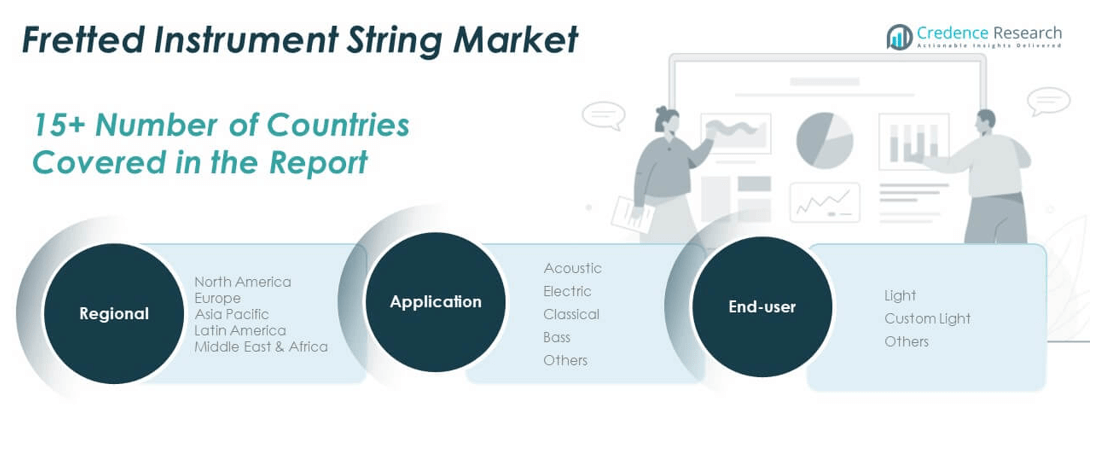
By application is segmented into acoustic, electric, classical, bass, and others. Acoustic strings hold significant demand due to their wide use among hobbyists and professional musicians who value tonal clarity. Electric strings drive growth through strong adoption in rock, pop, and contemporary genres where amplified sound dominates. Classical strings maintain steady demand in traditional and orchestral music, supported by music education programs. Bass strings cater to professional bands and recording artists who require durability and deep resonance. The “others” category reflects niche instruments that continue to attract a loyal consumer base. It ensures consistent diversification across global regions.
- For example, D’Addario XL Nickel Wound bass strings are widely considered the industry standard, prized for their bright tone, comfortable playability, and dependable construction. The strings utilize precision hex-core winding for accurate intonation and durability, and user reviews frequently highlight their extended lifespan and consistent performance.
By end-user, the market is categorized into light, custom light, and others. Light strings are widely preferred by beginners and casual players due to ease of play and affordability, making them the most accessible choice across retail channels. Custom light strings serve intermediate and professional players who seek a balance between comfort and tonal projection, reinforcing their appeal in the mid-range segment. The “others” category captures specialized gauges that meet the needs of advanced musicians pursuing unique tonal expressions. It enables manufacturers to address diverse preferences across genres and skill levels. This segmentation structure ensures that the market adapts to varying demands while supporting innovation in both mass and niche categories.
- For instance, Elixir Strings has maintained a strong market presence due to its patented Nanoweb coating, which offers extended tone life and enhanced corrosion resistance compared to conventional strings.
Segmentation:
By Application
- Acoustic
- Electric
- Classical
- Bass
- Others
By End-user
- Light
- Custom Light
- Others
By Region
- North America
- U.S.
- Canada
- Mexico
- Europe
- UK
- France
- Germany
- Italy
- Spain
- Russia
- Belgium
- Netherlands
- Austria
- Sweden
- Poland
- Denmark
- Switzerland
- Rest of Europe
- Asia Pacific
- China
- Japan
- South Korea
- India
- Australia
- Thailand
- Indonesia
- Vietnam
- Malaysia
- Philippines
- Taiwan
- Rest of Asia Pacific
- Latin America
- Brazil
- Argentina
- Peru
- Chile
- Colombia
- Rest of Latin America
- Middle East
- UAE
- KSA
- Israel
- Turkey
- Iran
- Rest of Middle East
- Africa
- Egypt
- Nigeria
- Algeria
- Morocco
- Rest of Africa
Regional Analysis:
North America
The North America Fretted Instrument String Market size was valued at USD 121.4 million in 2018 to USD 147.2 million in 2024 and is anticipated to reach USD 235.8 million by 2032, at a CAGR of 6.1% during the forecast period. North America accounts for 35.0% of the global market share in 2024. The region leads demand due to its well-established music industry, high concentration of professional musicians, and widespread adoption of guitar-based genres. The United States dominates consumption, driven by strong cultural influence and large-scale production. Canada supports growth through government-backed music education initiatives, while Mexico benefits from a growing retail distribution network. The market experiences strong replacement demand as professionals frequently update strings for live performances and studio sessions. E-commerce platforms enhance access for both beginners and advanced players. It strengthens its global leadership through technological innovation and strong consumer loyalty.
Europe
The Europe Fretted Instrument String Market size was valued at USD 86.6 million in 2018 to USD 102.1 million in 2024 and is anticipated to reach USD 154.3 million by 2032, at a CAGR of 5.4% during the forecast period. Europe holds 24.3% of the global market share in 2024. The region benefits from a rich musical heritage and strong demand across classical, folk, and contemporary genres. The UK, Germany, and France drive market adoption, supported by a robust base of instrument manufacturers and distributors. Southern European countries such as Spain and Italy contribute demand from traditional music styles, including flamenco and classical guitar. The region witnesses steady growth from institutional buyers such as orchestras and academies. E-commerce and retail networks expand accessibility, strengthening consumer adoption. The market remains competitive with regional brands focusing on sustainable and premium offerings. It continues to diversify consumption patterns across professional and amateur musicians.
Asia Pacific
The Asia Pacific Fretted Instrument String Market size was valued at USD 101.7 million in 2018 to USD 129.4 million in 2024 and is anticipated to reach USD 225.0 million by 2032, at a CAGR of 7.2% during the forecast period. Asia Pacific represents 30.8% of the global market share in 2024. The region emerges as a high-growth hub due to rising disposable incomes and rapid adoption of Western music among younger demographics. China and Japan dominate consumption, while India and South Korea show accelerating demand supported by music education and online learning platforms. Australia strengthens market presence with a growing live performance industry. Local manufacturers gain traction by offering affordable solutions tailored to beginners. Global brands expand distribution networks to capture emerging urban populations. The region experiences robust growth from e-commerce platforms that enable wide access to diverse string varieties. It consolidates its role as the fastest-growing regional market worldwide.
Latin America
The Latin America Fretted Instrument String Market size was valued at USD 17.0 million in 2018 to USD 20.7 million in 2024 and is anticipated to reach USD 30.1 million by 2032, at a CAGR of 4.9% during the forecast period. Latin America accounts for 4.9% of the global market share in 2024. Brazil leads demand, supported by a vibrant live music culture and traditional string-based genres. Argentina follows with strong adoption in folk and tango music styles. The market benefits from increasing retail penetration and the rise of regional distributors. Affordability drives consumer preferences, with local players competing in mid-range categories. Urbanization and cultural festivals further stimulate string demand across cities. Growth opportunities lie in expanding e-commerce networks that improve product accessibility. It continues to evolve as a niche but growing regional market.
Middle East
The Middle East Fretted Instrument String Market size was valued at USD 11.8 million in 2018 to USD 13.5 million in 2024 and is anticipated to reach USD 19.3 million by 2032, at a CAGR of 4.7% during the forecast period. The region holds 3.2% of the global market share in 2024. Demand is driven by rising interest in Western music and expanding cultural festivals in countries such as the UAE and Saudi Arabia. Turkey and Israel show consistent adoption due to their strong live performance scenes. Growth remains concentrated in urban centers where disposable income supports premium product purchases. Local distributors collaborate with global brands to enhance product penetration. Educational programs and hobbyist communities gradually improve awareness about quality strings. Online platforms provide a critical channel for market expansion. It sustains moderate growth supported by cultural diversification and rising youth interest in music.
Africa
The Africa Fretted Instrument String Market size was valued at USD 3.56 million in 2018 to USD 7.23 million in 2024 and is anticipated to reach USD 9.57 million by 2032, at a CAGR of 3.0% during the forecast period. Africa represents 1.7% of the global market share in 2024. South Africa leads demand with its established music festivals and live performance culture. Nigeria and Egypt contribute steadily through expanding youth-driven music adoption. Market growth is limited by affordability challenges and low awareness of premium offerings. Local musicians often rely on basic or unbranded products, restricting high-value sales. The region gradually benefits from international distributors entering metropolitan areas. Online retail platforms increase product visibility, encouraging growth among urban consumers. It remains a small but steadily developing market with potential for future expansion through cultural and educational initiatives.
Key Player Analysis:
- D’Addario
- Fender Musical Instruments Corporation
- Gibson Brands
- Ernie Ball Inc.
- GHS Strings
- F. Martin & Company Inc.
- Dunlop Manufacturing Inc.
- Dean Markley USA Inc.
- Kistron Co. Ltd.
- DR Handmade Strings
- Elixir Strings
Competitive Analysis:
The Fretted Instrument String Market is characterized by strong competition among global leaders such as D’Addario, Ernie Ball, Fender Musical Instruments, Gibson Brands, and C.F. Martin & Company. It shows a balanced mix of established multinational firms and specialized regional players that focus on niche segments. Key players emphasize product innovation, material advancements, and premium coatings to secure brand loyalty. It remains dynamic with frequent product launches, endorsements by professional musicians, and strategic collaborations. Mergers and acquisitions enhance distribution capabilities and market penetration. Companies strengthen their presence through e-commerce platforms and direct-to-consumer models. It sustains competitive intensity through differentiation strategies in tone quality, durability, and pricing tiers.
Recent Developments:
- In May 2025, Thalia Capos expanded its collaboration with Fender to deliver officially licensed accessories capos and pick pucks for guitarists across Europe. This partnership blends Thalia’s precision-engineered designs with Fender’s iconic brand identity, enhancing accessory options within the fretted instrument ecosystem.
- In January 2025, C. F. Martin & Co. unveiled a refreshed Standard Series acoustic guitar lineup at the NAMM Show, including new D-17, 000-17, and OM-45 models. They added Sitka spruce Golden Era bracing, a refined low-oval neck profile, beveled fingerboards, GE modern belly bridges, bone or ebony bridge pins, and vintage finishes with angled nuts and sleeker heels-blending classic tone with modern playability.
- In Sep 2024, D’Addario is celebrating its 50th anniversary with a special series of releases and events for musicians worldwide. To mark the milestone, the company has launched a curated collection of vintage-inspired merchandise such as T-shirts and hats that pay homage to its enduring legacy.
Market Concentration & Characteristics:
The Fretted Instrument String Market demonstrates moderate concentration with a few dominant global players holding significant revenue share. It reflects characteristics of a consumer-driven market where brand reputation, artist endorsements, and product reliability influence purchasing decisions. It maintains growth momentum through frequent string replacements driven by professional use and rising music education programs. Regional players compete in cost-sensitive segments, while leading firms focus on premium innovations. It exhibits strong resilience with diverse applications across acoustic, electric, classical, and bass instruments, ensuring broad demand stability.
Report Coverage:
The research report offers an in-depth analysis based on Application and End-user. It details leading market players, providing an overview of their business, product offerings, investments, revenue streams, and key applications. Additionally, the report includes insights into the competitive environment, SWOT analysis, current market trends, as well as the primary drivers and constraints. Furthermore, it discusses various factors that have driven market expansion in recent years. The report also explores market dynamics, regulatory scenarios, and technological advancements that are shaping the industry. It assesses the impact of external factors and global economic changes on market growth. Lastly, it provides strategic recommendations for new entrants and established companies to navigate the complexities of the market.
Future Outlook:
- The Fretted Instrument String Market is expected to expand with rising global interest in music education and institutional programs.
- Growing penetration of online learning platforms will support consistent demand across beginner and intermediate musicians.
- Premium string categories will gain momentum through technological advancements in coatings and material durability.
- Strong endorsement deals between artists and brands will continue to influence consumer purchasing preferences.
- Regional manufacturers will focus on affordable options to capture cost-sensitive segments in emerging economies.
- Expanding digital retail networks will strengthen direct-to-consumer channels and drive higher brand visibility.
- Sustainable production practices and eco-friendly packaging will evolve into key differentiators for leading companies.
- Integration of smart technology into premium strings will attract tech-savvy musicians seeking advanced performance monitoring.
- Market growth will remain supported by rising live concerts, festivals, and studio recording activities worldwide.
- Continuous product diversification across acoustic, electric, classical, and bass segments will ensure broad demand stability.

Request a Free Sample
Fill in your details and we'll send you a free sample report.
- Sample data tables & charts
- Research methodology
Market Dynamics
Rising Popularity of Music Education and Professional Training Programs
The expansion of music schools, conservatories, and online learning platforms is increasing the number of students and hobbyists using fretted instruments, driving recurring demand for replacement strings and supporting steady market growth.
Technological Advancements in String Manufacturing and Material Innovation
Innovations such as coated steel, nickel alloys, and polymer blends are enhancing string durability and tone quality, appealing to both professionals and hobbyists and reducing the frequency of replacements, which boosts overall market value.
Expanding Role of Live Performances, Festivals, and Global Music Tours
The increase in live concerts and music festivals leads to higher string consumption as musicians frequently replace strings for optimal performance, creating a recurring aftermarket and strengthening demand across regions.
Growing Online Retail Platforms and Direct-to-Consumer Sales
The proliferation of e-commerce and direct sales channels makes a wide variety of strings accessible to global consumers, especially younger musicians, and supports subscription and personalized buying models that increase purchase frequency.
Increasing Customization and Personalization of Instrument Strings
Musicians are seeking strings tailored to their playing style and tonal preferences, prompting brands to offer a wider range of gauges, coatings, and specialty products, which drives premium segment growth and enhances brand loyalty.
Need a Custom Version of This Report?
Tailor the scope, geography, or segments to your exact requirements.
- Custom geography or segment scope
- Direct access to our analyst team
Frequently Asked Questions
What is the current market size for Fretted Instrument String Market, and what is its projected size in 2032?
Which Fretted Instrument String Market segment held the largest share in 2024?
What are the primary factors fueling the growth of the Fretted Instrument String Market?
Who are the leading companies in the Fretted Instrument String Market?
Table of Content
Chapter 1 Market Segmentation
- 1.1 Segmentation Framework
- 1.1.1 Product and Service Classification
- 1.1.2 Application and End-Use Classification
- 1.1.3 Technology and Solution Classification
- 1.1.4 Customer and Distribution Channel Classification
- 1.1.5 Geographic Segmentation
- 1.1.6 Market Segment Definitions and Boundaries
- 1.2 By End-user
- 1.2.1 Light
- 1.2.2 Custom Light
- 1.2.3 Others
- 1.3 By Application
- 1.3.1 Acoustic
- 1.3.2 Electric
- 1.3.3 Classical
- 1.3.4 Bass
- 1.3.5 Others
Chapter 2 Introduction
- 2.1 Report Objectives and Scope
- 2.2 Product Definition and Industry Terminology
- 2.3 Market Inclusions and Exclusions
- 2.4 Research Process
- 2.4.1 Primary Research and Expert Interviews
- 2.4.2 Secondary Research and Source Review
- 2.4.3 Top-Down and Bottom-Up Estimation
- 2.4.4 Data Triangulation and Verification
- 2.5 Market Size Measurement Basis
- 2.5.1 2024: USD 420.0 million → 2032: USD 674.1 million
- 2.6 Historical and Forecast Reference Periods
- 2.6.1 Base Year: 2024
- 2.6.2 Forecast Period: 2024-2032
- 2.7 Research Assumptions and Limitations
Chapter 3 Executive Summary
- 3.1 Market Snapshot and Key Findings
- 3.2 Base-Year Market Size, 2024
- 3.3 Forecast Market Size, 2032
- 3.4 Revenue and Volume Growth Outlook
- 3.5 Key Demand and Supply Indicators
- 3.6 Leading Market Segments
- 3.7 Fastest-Growing Market Opportunities
- 3.8 Regional Performance Highlights
- 3.9 Technology and Industry Transformation
- 3.10 Competitive Landscape Summary
- 3.11 Analyst View and Strategic Implications
Chapter 4 Global Fretted Instrument String Market Trends and Developments
- 4.1 Historical Industry Development
- 4.2 Recent Market Trends and Developments
- 4.3 Demand and Customer Behavior Trends
- 4.4 Technology and Product Innovation
- 4.5 Artificial Intelligence, Automation and Digitalization
- 4.6 Local Manufacturing and Supply Chain Realignment
- 4.7 Industry Partnerships, Mergers and Acquisitions
- 4.8 Sustainability and Circular Economy Developments
- 4.9 Government and Private Sector Investment Trends
- 4.10 Emerging Business Models and Commercialization
- 4.11 Industry Developments and Announcements
Chapter 5 Global Fretted Instrument String Market Production, Supply and Demand Analysis
- 5.1 Demand Trend and Consumption Analysis
- 5.2 Demand Forecast, 2024-2032
- 5.3 Production and Output Trend
- 5.4 Production and Output Forecast, 2024-2032
- 5.5 Installed Capacity and Capacity Utilization
- 5.6 Company-Wise Production Plants and Statistics
- 5.6.1 Installed Production Capacity
- 5.6.2 Actual Production
- 5.6.3 Planned Capacity and Expansion Targets
- 5.7 Supply Chain Structure and Procurement Trends
- 5.8 Supply-Demand Gap and Bottlenecks
- 5.9 Import Dependence and Sourcing Structure
- 5.10 Contract Manufacturing and Outsourcing
- 5.11 Regional Supply and Demand Concentration
Chapter 6 Global Fretted Instrument String Market Pricing Analysis
- 6.1 Pricing Structure and Measurement
- 6.2 Historical Pricing Trends
- 6.3 Pricing Outlook, 2024-2032
- 6.4 Average Selling Price and Unit Economics
- 6.5 Pricing by Product and Market Segment
- 6.6 Geographic Pricing Differences
- 6.7 Key Input, Energy, Labor and Logistics Costs
- 6.8 Contract Pricing and Purchasing Models
- 6.9 Pricing Sensitivity and Competitive Positioning
- 6.10 Price, Margin and Profitability Implications
Chapter 7 Global Fretted Instrument String Market Dynamics
- 7.1 Market Growth Drivers
- 7.1.1 Demand-Side Drivers
- 7.1.2 Technology and Innovation Drivers
- 7.1.3 Infrastructure and Investment Drivers
- 7.1.4 Regulatory and Policy Drivers
- 7.2 Market Restraints
- 7.2.1 Cost and Affordability Constraints
- 7.2.2 Technology and Adoption Barriers
- 7.2.3 Supply Chain and Operational Constraints
- 7.3 Market Challenges
- 7.3.1 Competitive Pressure and Margin Erosion
- 7.3.2 Skills, Infrastructure and Implementation Gaps
- 7.4 Emerging Market Opportunities
- 7.5 Market Dynamics Impact and Time-Horizon Assessment
Chapter 8 Global Fretted Instrument String Value Chain Analysis
- 8.1 Industry Value Chain Overview
- 8.2 Upstream Suppliers and Critical Inputs
- 8.3 Technology and Component Providers
- 8.4 Manufacturing or Service Delivery
- 8.5 Distribution, Channel Partners and Integrators
- 8.6 Downstream Applications and End Users
- 8.7 Value Addition and Profit Pools
- 8.8 Vertical Integration and Outsourcing
- 8.9 Supplier Concentration and Risk
- 8.10 Supply Chain Localization and Resilience
Chapter 9 Global Fretted Instrument String Market Regulations and Policies
- 9.1 Relevant Laws, Standards and Compliance Frameworks
- 9.2 Product, Service, Safety and Quality Requirements
- 9.3 Government Policies, Incentives and Subsidies
- 9.4 Imports, Exports and Trade Barriers
- 9.5 Public Procurement and Local Content Requirements
- 9.6 Environmental and Sustainability Compliance
- 9.7 Upcoming Policy Changes and Market Implications
Chapter 10 Global Fretted Instrument String Market Hotspots and Opportunities
- 10.1 Market Opportunity Mapping and Growth Hotspots
- 10.2 High-Growth Applications and Customer Groups
- 10.3 Underserved Markets and White-Space Opportunities
- 10.4 Emerging Technology and Product Opportunities
- 10.5 New Capacity and Investment Hotspots
- 10.6 Market Entry and Expansion Opportunities
- 10.7 Distribution and Partnership Opportunities
- 10.8 Near-Term and Long-Term Commercial Potential
- 10.9 Opportunity Attractiveness and Execution Risks
Chapter 11 Global Fretted Instrument String Market Outlook, 2024-2032
- 11.1 Market Size and Analysis
- 11.1.1 Revenue (Market Measurement: 2024: USD 420.0 million → 2032: USD 674.1 million)
- 11.1.2 Market Volume and Quantity Sold
- 11.1.3 Historical Market Size
- 11.1.4 Base-Year Market Size, 2024
- 11.2 Market Forecast, 2024-2032
- 11.2.1 Revenue Forecast to 2032
- 11.2.2 Volume Forecast to 2032
- 11.2.3 CAGR and Year-on-Year Growth
- 11.2.4 Incremental Revenue Opportunity
- 11.3 Forecast Assumptions and Scenario Analysis
- 11.3.1 Base-Case Forecast
- 11.3.2 Optimistic and Conservative Scenarios
- 11.3.3 Technology, Pricing and Policy Sensitivities
- 11.4 Market Attractiveness and Growth Outlook
Chapter 12 Global Fretted Instrument String Market Segmentation and Outlook
- 12.1 Segmentation Summary and Market Shares, 2024
- 12.2 Largest and Fastest-Growing Segments
- 12.3 By End-user - Market Size and Forecast, 2024-2032
- 12.3.1 Segment Definition and Scope
- 12.3.2 Historical Market Size
- 12.3.3 Revenue Forecast, 2024-2032
- 12.3.4 Volume Forecast, 2024-2032
- 12.3.5 Base-Year Market Share, 2024
- 12.3.6 Segment CAGR and Growth Drivers
- 12.3.7 Subsegment Market Size and Forecast
- 12.3.7.1 Light
- 12.3.7.2 Custom Light
- 12.3.7.3 Others
- 12.3.8 Subsegment Pricing and Adoption Trends
- 12.3.9 Leading Suppliers and Competition
- 12.3.10 Regional Demand and Opportunities
- 12.4 By Application - Market Size and Forecast, 2024-2032
- 12.4.1 Segment Definition and Scope
- 12.4.2 Historical Market Size
- 12.4.3 Revenue Forecast, 2024-2032
- 12.4.4 Volume Forecast, 2024-2032
- 12.4.5 Base-Year Market Share, 2024
- 12.4.6 Segment CAGR and Growth Drivers
- 12.4.7 Subsegment Market Size and Forecast
- 12.4.7.1 Acoustic
- 12.4.7.2 Electric
- 12.4.7.3 Classical
- 12.4.7.4 Bass
- 12.4.7.5 Others
- 12.4.8 Subsegment Pricing and Adoption Trends
- 12.4.9 Leading Suppliers and Competition
- 12.4.10 Regional Demand and Opportunities
- 12.5 Segment Growth Comparison
- 12.6 Segment Attractiveness and Priority Matrix
Chapter 13 Global Fretted Instrument String End-Use and Application Market Outlook
- 13.1 End-Use Industry and Customer Demand Structure
- 13.2 Leading Applications and Customer Groups
- 13.3 End-Use Market Size, Share and Forecast
- 13.4 Major End-Use Industry Deep Dives
- 13.4.1 Customer Requirements and Use Cases
- 13.4.2 Demand and Replacement Cycles
- 13.4.3 Technical and Regulatory Considerations
- 13.4.4 Purchasing and Procurement Models
- 13.4.5 Leading Vendors and Distribution Channels
- 13.4.6 Forecast and Commercial Opportunities
- 13.5 Emerging Applications and Cross-Segment Demand
- 13.6 End-Use Industry Investment Priorities
Chapter 14 Global Fretted Instrument String Geographic Market Outlook, 2024-2032
- 14.1 Regional Market Size and Share, 2024
- 14.2 Regional Market Forecast, 2024-2032
- 14.3 Regional Pricing, Production and Demand Differences
- 14.4 North America
- 14.4.1 United States
- 14.4.2 Canada
- 14.4.3 Mexico
- 14.5 Europe
- 14.5.1 Germany
- 14.5.2 France
- 14.5.3 Italy
- 14.5.4 United Kingdom
- 14.5.5 Spain
- 14.5.6 Poland
- 14.5.7 Russia
- 14.5.8 Netherlands
- 14.5.9 Belgium
- 14.5.10 Sweden
- 14.5.11 Denmark
- 14.5.12 Norway
- 14.5.13 Rest of Europe
- 14.6 Asia Pacific
- 14.6.1 China
- 14.6.2 India
- 14.6.3 Japan
- 14.6.4 South Korea
- 14.6.5 Thailand
- 14.6.6 Indonesia
- 14.6.7 Vietnam
- 14.6.8 Malaysia
- 14.6.9 Australia
- 14.6.10 Rest of Asia Pacific
- 14.7 Latin America
- 14.7.1 Brazil
- 14.7.2 Argentina
- 14.7.3 Colombia
- 14.7.4 Chile
- 14.7.5 Rest of Latin America
- 14.8 Middle East
- 14.8.1 Saudi Arabia
- 14.8.2 United Arab Emirates
- 14.8.3 Turkey
- 14.8.4 Israel
- 14.8.5 Iran
- 14.8.6 Rest of the Middle East
- 14.9 Africa
- 14.9.1 South Africa
- 14.9.2 Egypt
- 14.9.3 Nigeria
- 14.9.4 Morocco
- 14.9.5 Rest of Africa
- 14.10 Regional Investment, Policy and Supply Chain Differences
- 14.11 Regional Competitive Landscape
- 14.12 Geographic Growth Hotspots
Chapter 15 Global Fretted Instrument String Technology, Innovation and Sustainability Outlook
- 15.1 Technology Landscape and Maturity
- 15.2 Product, Process and Service Innovation
- 15.3 AI, Automation and Digital Tools in the Industry
- 15.4 Technology Adoption and Performance Benchmarking
- 15.5 Innovation Pipeline and R&D Investment
- 15.6 Patent and Intellectual Property Trends
- 15.7 Energy Efficiency and Resource Management
- 15.8 Sustainability, Recycling and Circularity
- 15.9 Technology Roadmap, 2024-2032
- 15.10 Risks of Obsolescence and Technology Substitution
Chapter 16 Global Fretted Instrument String Market Key Strategic Imperatives
- 16.1 Growth and Market Entry Priorities
- 16.2 High-Return Products and Segments
- 16.3 Pricing, Profitability and Cost Optimization
- 16.4 Technology Investment and Product Differentiation
- 16.5 Supply Chain Localization and Resilience
- 16.6 Distribution and Customer Acquisition
- 16.7 Partnership, Acquisition and Capacity Strategy
- 16.8 Regional Expansion Priorities
- 16.9 Short-, Medium- and Long-Term Actions
Chapter 17 Competition Outlook
- 17.1 Industry Competition Characteristics
- 17.2 Market Structure and Concentration
- 17.3 Market Share and Competitive Positioning, 2024
- 17.4 Company-Wise Revenue and Product Benchmarking
- 17.5 Production and Service Capacity Benchmarking
- 17.6 Technology, Pricing and Differentiation
- 17.7 Regional Footprint and Distribution Strength
- 17.8 Mergers, Acquisitions and Strategic Alliances
- 17.9 New Entrants and Competitive Threats
- 17.10 Porter's Five Forces and Industry Attractiveness
- 17.11 Competitive Outlook, 2024-2032
Chapter 18 Company Profiles
- 18.1 Company Coverage and Selection Criteria
- 18.2 D’Addario
- 18.2.1 Business Description
- 18.2.2 Company Ownership and Geographic Presence
- 18.2.3 Product and Service Portfolio
- 18.2.4 Manufacturing and Operating Footprint
- 18.2.5 Production Capacity and Expansion Plans
- 18.2.6 Financial Performance and Investment
- 18.2.7 Market Share and Competitive Position
- 18.2.8 Technology and Innovation Capabilities
- 18.2.9 Strategic Alliances or Partnerships
- 18.2.10 Recent Developments
- 18.2.11 Growth Strategy and Outlook
- 18.3 Fender Musical Instruments Corporation
- 18.4 Gibson Brands
- 18.5 Ernie Ball Inc.
- 18.6 GHS Strings
- 18.7 F. Martin & Company Inc.
- 18.8 Dunlop Manufacturing Inc.
- 18.9 Dean Markley USA Inc.
- 18.10 Kistron Co. Ltd.
- 18.11 Elixir Strings
- 18.12 Other Relevant Market Participants
Note: Every listed company is profiled on the structure shown under the first company. The company list is preliminary and may change based on research findings, market developments, data availability and client requirements.
Chapter 19 Disclaimer
- 19.1 Research and Forecast Disclaimer
- 19.2 Data Source and Estimation Limitations
Note: The depth of individual sections depends on data availability for this market. Volume, capacity, trade and other unit-based metrics are included where applicable.

