
Colocation and cloud halls set regional conversion spending
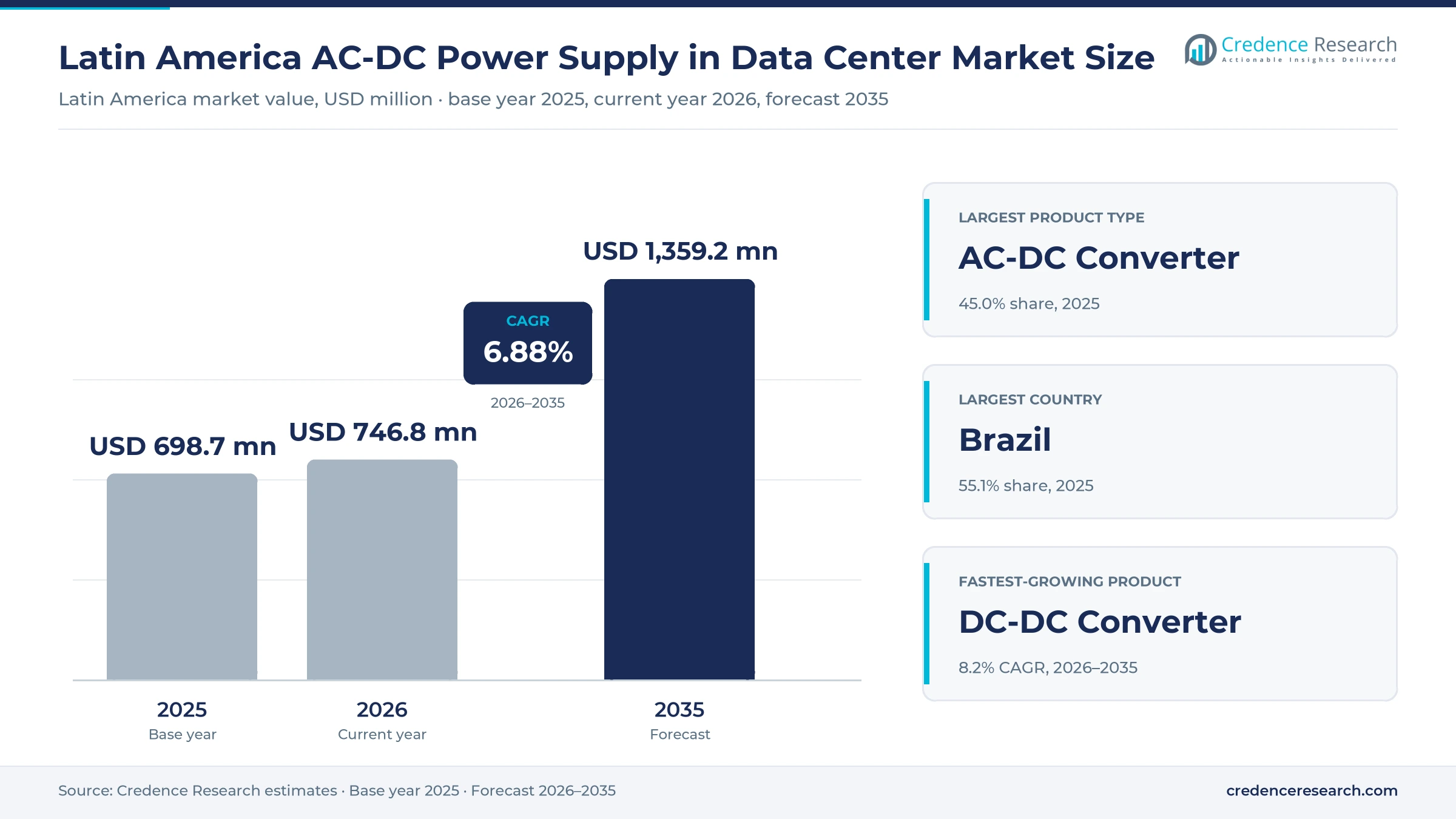
The Latin America AC-DC power supply in data center market was valued at USD 698.7 million in 2025 and is projected to increase from USD 746.8 million in 2026 to USD 1.36 billion by 2035, registering a CAGR of 6.88% during 2026–2035. Spending comes from cloud providers and colocation operators fitting out halls around São Paulo, Querétaro, Santiago and Bogotá, from telecom carriers and banks that still run their own server rooms, and from AI campuses that remain mostly at the planning stage. Brazil held the largest country share, 55.1% in 2025, because it hosts most of the halls now under construction in the region. Colombia is the fastest-growing country at 8.3% a year, as new wholesale campuses near Bogotá move into construction. The main technical change is the shift from single-phase server power supplies toward modular three-phase UPS frames and higher-voltage DC distribution in AI racks.
Rack supplies, UPS frames and board converters set the scope
This report values the power conversion equipment installed each year in data centers across Brazil, Mexico, Chile, Colombia, Argentina and the rest of the region. It counts redundant server and rack AC-DC power supplies, DC-DC converters that step bus voltage down to processors, memory and storage, and uninterruptible power supply systems ranging from rack units to modular three-phase frames that protect whole halls.
Standby generators, medium-voltage switchgear, cabling and cooling are excluded, although their design decides how much conversion capacity each hall needs. Power supplies shipped inside servers are counted at component value, which is why the total runs above data center UPS sales alone. Most hardware is imported and reaches operators through distributors, server assemblers and electrical integrators, while a growing share of frames is assembled in Mexican plants.
Latin America AC-DC Power Supply in Data Center Market Insights
- The Latin America AC-DC power supply in data center market rises from USD 698.7 million in 2025 to USD 1.36 billion by 2035, a 6.88% CAGR during 2026–2035, as colocation and cloud halls multiply.
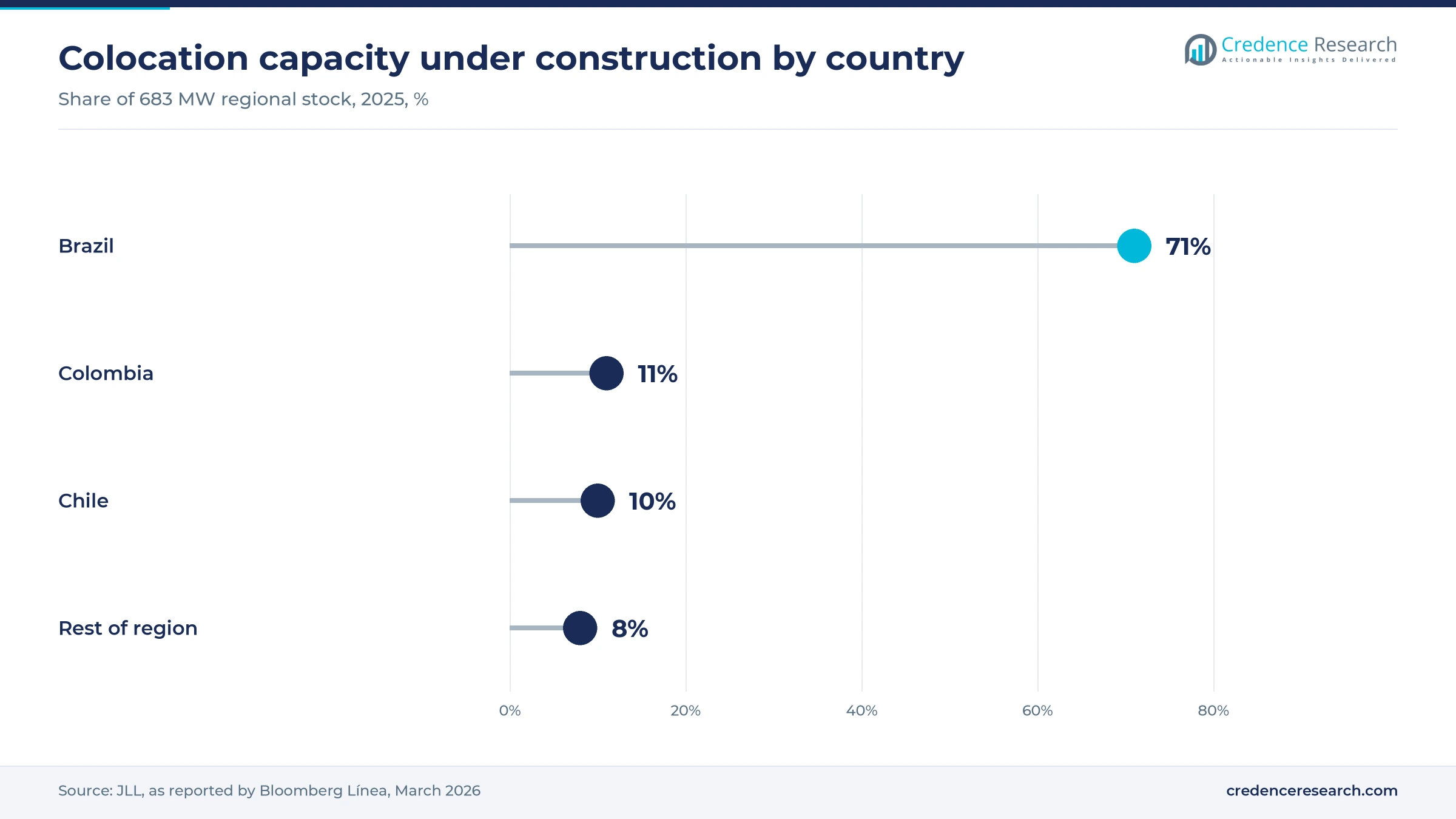
- Brazil held 55.1% of 2025 value, because it accounts for 71% of the 683 MW of colocation capacity that JLL counted under construction in the region.
- AC-DC Converter led with 45.0% of 2025 value, because every new server ships with at least two hot-swap power supplies.
- Mexico more than doubled operating data center capacity from 115 MW in 2024 to 279 MW in 2026, although grid limits now slow new projects.
- Brazil enacted Law 15,504 in September 2026, suspending federal taxes on data center equipment for operators that run on renewable or low-emission power.
Server converters lead as DC stages and large frames gain
Server converters lead while DC-DC stages grow fastest
Based on product type, the market is categorized into AC-DC converter, DC-DC converter and UPS systems. AC-DC Converter led with 45.0% of 2025 value, because every server installed in a new hall carries redundant hot-swap power supplies, and Brazil alone reached 706 MW of capacity in August 2026 after adding a record 106 MW since December 2025, according to JLL figures reported by S&P Global. DC-DC Converter grows fastest at 8.2% a year, as AI racks move conversion toward the processor, and NVIDIA plans an 800 VDC power rack for the second half of 2026 that feeds DC-DC stages inside each rack.
Mid-power units lead as hall-scale frames gain share
Based on power rating, the market is categorized into less than 500W, 500W to 1000W, 1000W to 10kW, 10kW to 50kW, and more than 50kW. 1000W to 10kW led with 37.0% of 2025 value because it spans server supplies and rack UPS units such as the APC Smart-UPS SRT 10 kVA model that CDW listed in November 2026. More Than 50kW grows fastest at 8.1% a year, as the Mexican Association of Data Centers projected in a 2025 study that Mexico will add more than one and a half gigawatts by 2030, mostly in wholesale halls.
IT companies lead while public agencies grow fastest
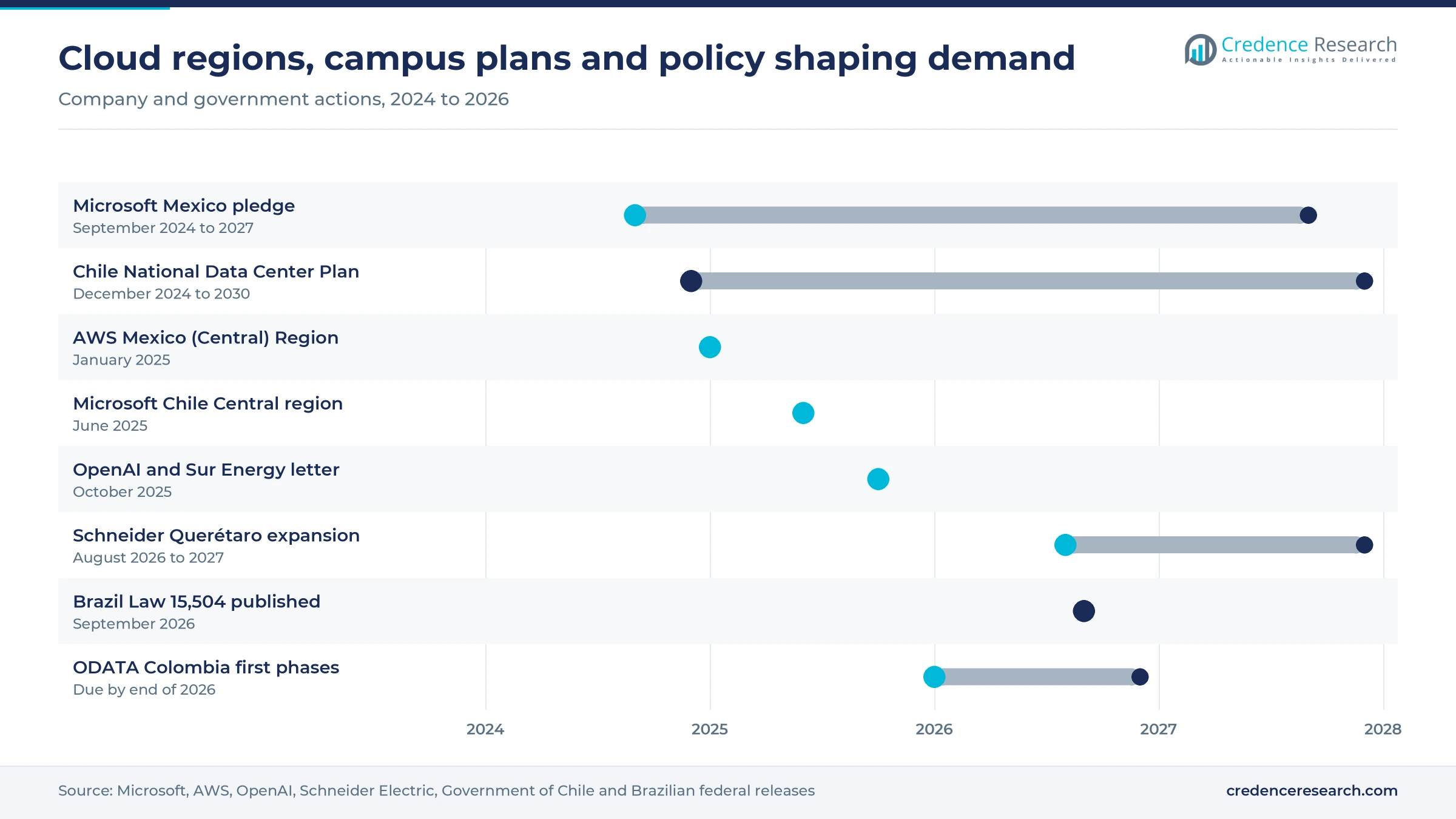
Based on end user, the market is categorized into government & healthcare, IT industry, telecommunication industry and others. IT Industry led with 52.0% of 2025 value because cloud providers and colocation landlords fit out most new halls, and Microsoft committed USD 1.3 billion over three years to Mexican cloud and AI infrastructure in September 2024, the company said. Government & Healthcare grows fastest at 7.4% a year, as Chile's National Data Center Plan, presented in December 2024, includes a state multi-cloud shared service that will move public workloads into modern, monitored halls.
| Segment Group | Leading Sub-segment | Share, 2025 | Fastest-growing Sub-segment | CAGR, 2026–2035 |
|---|---|---|---|---|
| By Product Type | AC-DC Converter | 45.0% | DC-DC Converter | 8.2% |
| By Power Rating | 1000W to 10kW | 37.0% | More Than 50kW | 8.1% |
| By End User | IT Industry | 52.0% | Government & Healthcare | 7.4% |
Watt ratings, topology and currency set equipment prices
Conversion equipment is priced per unit for rack products and per kilowatt for hall-scale UPS frames, with batteries, installation and multiyear service quoted separately. Most hardware is imported and invoiced in dollars, so moves in the real, the Mexican peso and the Colombian peso pass into tender prices within one budget cycle. Server power supplies are bought inside server contracts, which leaves their price with server makers and import duty rules. Hyperscale tenders press frame prices down, while suppliers earn better margins on lithium battery cabinets, monitoring software and maintenance contracts that run for the life of a hall.
| Offer or input | Typical price or fee | Basis |
|---|---|---|
| APC Smart-UPS SRT 10 kVA rack UPS, 230 V | USD 11,807.99 sale price, USD 17,685 list | CDW listing, November 2026 |
| Redundant hot-swap server power supply, 1.4 kW to 3.2 kW | USD 150 to USD 450 per unit | Credence Research estimate from vendor list prices |
| Modular three-phase UPS for a new hall | USD 150 to USD 250 per kW installed | Credence Research estimate from tender and list price inputs |
| 48 V rack power shelf with rectifier modules | USD 2,000 to USD 6,000 per shelf | Credence Research estimate from vendor price ranges |
Request a Free Sample
Fill in your details and we'll send you a free sample report.
- Sample data tables & charts
- Research methodology
Hall construction, cloud regions and tax relief lift orders
Colocation construction nearly triples hall capacity
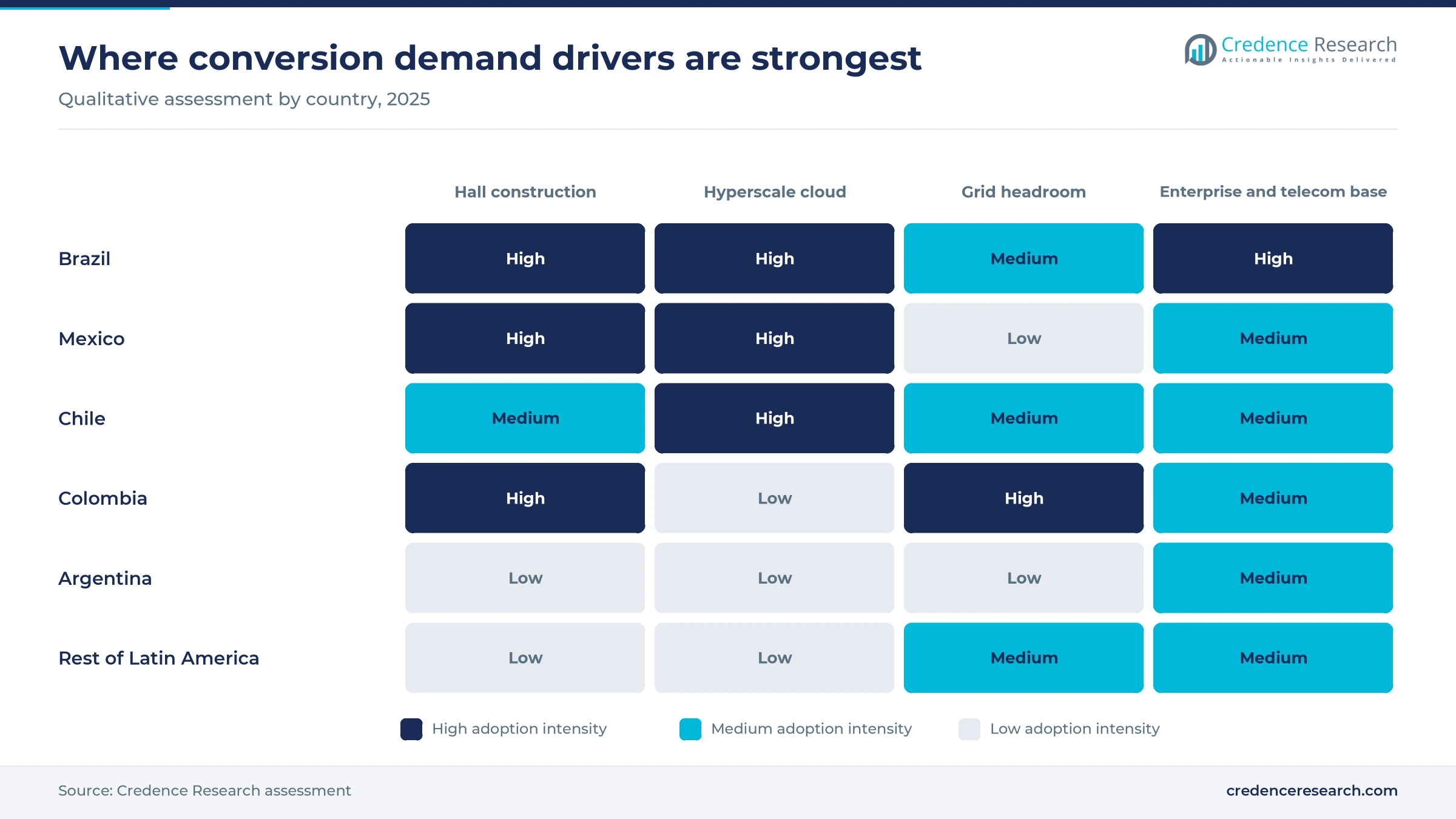
Colocation construction is the largest single source of new conversion orders, because every hall needs UPS frames and rectifiers before tenants install a single server. JLL counted Latin American colocation inventory rising from 384 MW in 2019 to 1,105 MW in 2025, a compound growth rate of 16% a year, Bloomberg Línea reported in March 2026. Querétaro, São Paulo and Barueri took 82% of the capacity delivered in 2025. The same JLL data put 683 MW under construction, with Brazil holding 71% of that stock. Every megawatt added brings redundant UPS capacity and server power supplies with it, which is why Brazil holds the largest country share and why suppliers with stock in these clusters capture most new orders.
Hyperscale cloud regions widen server power demand
Hyperscale cloud regions add server fleets far larger than enterprise rooms, and each fleet is refreshed on its own cycle, which gives converter makers repeat demand after the first fit-out. AWS launched its Mexico (Central) Region in Querétaro in January 2025 with a plan to invest USD 5 billion over 15 years, TechCrunch reported. Microsoft opened its Chile Central region in June 2025 across three separate sites in the Santiago metropolitan area, running on solar and wind power contracted from AES Andes. Santiago already holds 93 MW of hyperscale capacity, or 46% of the regional total, InvestChile reported in April 2026, citing JLL. Hyperscalers buy to their own specifications, so suppliers with approved power supply and UPS designs win volume in every refresh.
Brazil's Redata law lowers imported equipment costs
Brazil now offers a dedicated tax regime that cuts the landed cost of imported data center hardware, the category that holds most UPS frames and power supplies. Law 15,504, published on Sept. 15, 2026, suspends PIS/Pasep, Cofins, IPI and import tax on equipment and components for enrolled data centers, the Chamber of Deputies news agency reported. Operators must buy all electricity from renewable or low-emission sources and keep at least 10% of capacity for the domestic market. They must also invest 2% of the value of benefited products in Brazil, with at least 40% of that going to the North, Northeast and Center-West. Whether every conversion product qualifies depends on enrollment rules that still await regulation, which is an evidence gap for pricing.
AI campus plans add long-dated demand outside Brazil
Large AI campus plans are spreading future conversion demand beyond the São Paulo and Querétaro clusters, although most remain plans rather than energized halls. OpenAI signed a letter of intent with Sur Energy in October 2025 to explore a large data center project in Argentina, OpenAI said. The Buenos Aires Times reported a potential investment of up to USD 25 billion and up to 500 MW in Patagonia under the RIGI incentive scheme. In Chubut, Green Capital plans a 300 MW first phase in Trelew, with construction projected for 2028, the same newspaper reported in October 2026. Suppliers therefore book first phases only, and the gap between announced gigawatts and energized megawatts is the main forecast uncertainty.
DC racks and Mexican assembly reshape how gear is bought
Higher-voltage DC racks shift value toward DC stages
AI hall designers are shifting from AC power supplies in every server toward higher-voltage DC distribution, with DC-DC conversion placed near the accelerator. NVIDIA said its MGX-compatible 800 VDC power rack arrives in the second half of 2026 and slots into existing AC halls without changes to the building electrical system. NVIDIA, Google and Microsoft have developed the architecture through the Open Compute Project and published a joint white paper in March 2026. Microsoft runs a cloud region in Chile and is expanding AI infrastructure in Mexico, so designs it adopts can reach Latin American halls without a local standards process. This shift explains why DC-DC converters grow at 8.2% a year, while makers of standard 1U server supplies face slower unit growth.
Power equipment makers shift assembly into Mexico
Global power makers are shifting final assembly of critical power equipment into Mexico, which shortens delivery to Querétaro halls and cuts exposure to transpacific freight. Schneider Electric is adding 115,000 square meters of industrial space in Querétaro for electrical distribution and critical energy infrastructure aimed at data centers, with two facilities completed and a third planned, Mexico News Daily reported in August 2026. The company expects 4,000 direct jobs there by the end of 2027, adding to existing plants in Nuevo León and Tlaxcala. Vertiv's 2025 annual report states that its Americas segment sells AC and DC power management products in North and Latin America. Buyers gain shorter lead times, while importers without regional assembly lose on delivery dates.
Colombia's hydro-backed campuses open hall-scale orders
Colombia offers suppliers an opening to win hall-scale UPS and converter orders while its campuses are still at an early stage. ODATA plans USD 1.3 billion for two campuses near Bogotá, BG02 with 24 MW in Mosquera and BG03 with up to 120 MW in Tenjo, DCD reported. Both first construction phases are due by the end of 2026, and BG03 will connect directly to the local transmission system. Colombia already held 11% of the regional colocation stock under construction in 2025, according to JLL, which supports the fastest country growth in this report. Suppliers that open local stock, commissioning crews and battery service near Bogotá can win these first phases before the market concentrates around a few operators.
Chile's national plan opens renewable campus sites
Chile's data center policy gives suppliers a visible pipeline of campuses sited on renewable power. The National Data Center Plan 2024–2030, presented on Dec. 5, 2024, adds a permits guide for 2025 to 2027 and a mapping tool in IDE Chile that marks energy availability and suitable land, law firm Carey said. GPS Property expects about USD 1,691 million of investment and more than 356 MW of new capacity by 2031, Diario Financiero reported in January 2026. Scala Data Centers chose Chile for 25% of its 220 MW under construction, InvestChile reported. Suppliers offering lithium UPS frames sized for phased solar-powered campuses can capture this demand.
Grid gaps, customs risk and self-supply rules slow orders
Mexican grid limits delay hall energization
Converter and UPS orders follow hall energization, so grid shortfalls push supplier revenue into later years. Mexico raised operating capacity from 115 MW in 2024 to 235 MW in 2025 and 279 MW in 2026, yet Mexico Business News says power availability is now the main growth constraint. The IMCO think tank found that only 11% of approved transmission spending was executed in 2025, Expansión reported. Suppliers holding stock for Querétaro projects are most exposed, unless operators add on-site generation.
Customs disputes expose importers of power hardware
Most conversion hardware crosses a border before installation, so customs rulings can halt deliveries for whole product lines. In January 2024, Mexico's tax administration SAT began a process to suspend the importer registration of a Vertiv subsidiary over a contested customs audit, the company disclosed in its 2025 annual report, before the matter was settled by payment. Distributors and integrators that import under one registration carry the most risk, so larger buyers now ask for local assembly or dual sourcing.
Argentina's self-supply rule raises campus costs
Argentina requires very large new loads to bring their own power, which raises the upfront cost of AI campuses that would buy hall-scale UPS frames. The Energy Secretariat created the Extraordinary Demand Regime, under which major projects must secure and pay for their own energy supply, the Buenos Aires Times reported in October 2026. Installed third-party capacity is small, with CABASE counting 14 facilities above 1 MW totaling nearly 32 MW. Suppliers betting on Patagonia are most exposed if generation finance slips.
Local outages raise reliability costs in Querétaro
Concentration in one Mexican state raises the reliability cost of each new hall and draws public scrutiny. Querétaro holds 72% of Mexico's installed data center capacity, and residents of nearby towns report outages lasting days, Expansión reported in August 2026. For operators, the same weak local network means longer UPS autonomy and more on-site generation per megawatt. Smaller colocation and enterprise operators are most exposed, because they carry that extra cost without hyperscale budgets, which delays some projects.
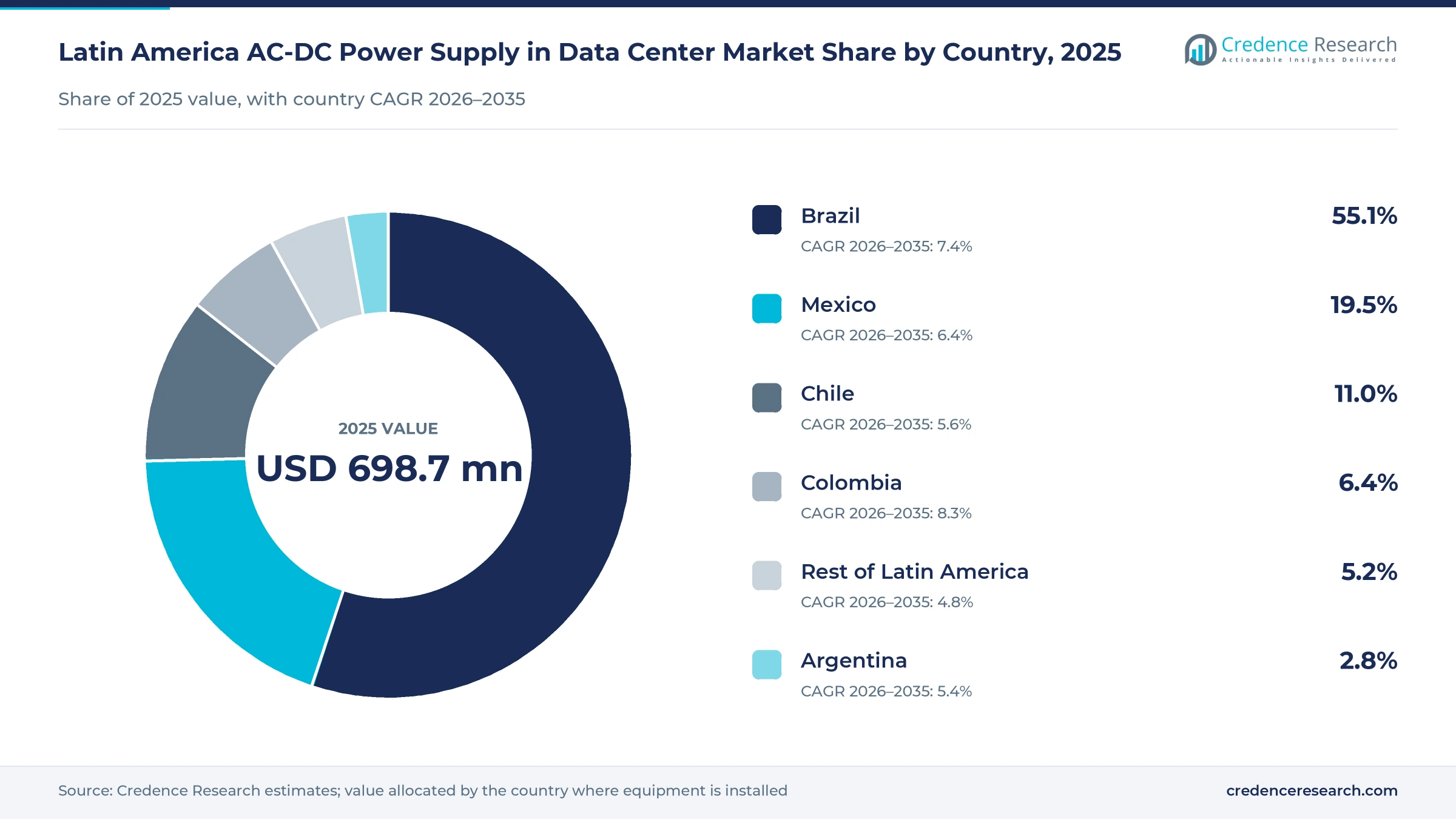
Brazil buys most while Colombia adds capacity fastest
| Country | Value, 2025 (USD million) | Share, 2025 | CAGR, 2026–2035 |
|---|---|---|---|
| Brazil | 385.0 | 55.1% | 7.4% |
| Mexico | 136.3 | 19.5% | 6.4% |
| Chile | 76.9 | 11.0% | 5.6% |
| Colombia | 44.7 | 6.4% | 8.3% |
| Rest of Latin America | 36.3 | 5.2% | 4.8% |
| Argentina | 19.6 | 2.8% | 5.4% |
Brazil leads on São Paulo and Northeast construction
Brazil held 55.1% of 2025 value and grows at 7.4% a year through 2035. JLL counted 660 MW under construction in August 2026, 56% of it pre-committed, S&P Global reported. Fortaleza had 227 MW under construction, most of it a ByteDance project at the Pecém port complex starting with 200 MW. This pipeline keeps Brazil the main buyer of hall-scale frames, and São Paulo state remains the core of Brazilian conversion equipment demand while Ceará adds the largest new campus.
Mexico grows on Querétaro cloud campuses
Mexico held 19.5% of 2025 value and grows at 6.4% a year. Hyperscale and colocation operators, including Amazon, CloudHQ, Equinix, Microsoft and Ascenty, have built in Querétaro, Expansión reported. President Claudia Sheinbaum inaugurated a natural gas power plant in the state in December 2025, although the grid remains tight. Demand for UPS frames follows wholesale colocation leasing in Querétaro, while edge sites in Monterrey add smaller rack units.
Chile grows on Santiago hyperscale halls
Chile held 11.0% of 2025 value and grows at 5.6% a year. JLL counted 166 MW of colocation capacity in operation, about 15% of the regional total and third in Latin America, after Chile added 18 MW in 2025, InvestChile reported. Ascenty and Equinix drove that growth, and Chile held 10% of the regional stock under construction. Credence Research expects Chilean buyers to favor lithium UPS frames and high-efficiency rectifiers, because operators that buy renewable power also track conversion losses closely.
Colombia grows fastest on campuses near Bogotá
Colombia held 6.4% of 2025 value and is the fastest-growing country at 8.3% a year. ODATA's existing BG01 site in Bogotá, opened in 2018, has 14.6 MW of IT capacity, so the two campuses noted above would raise the operator's local base roughly tenfold. Hyperscale tenants follow this kind of wholesale capacity, which is why Credence Research expects Colombian purchases of frames above 50 kW to rise faster than in any other country. Tenant timing remains the main uncertainty for these frame orders.
Argentina waits on Patagonian AI campus decisions
Argentina held 2.8% of 2025 value and grows at 5.4% a year. The Tengo Data register lists 67 data centers, 52 of them operating, and seven of the 13 announced projects sit in Neuquén, the Buenos Aires Times reported in October 2026. The OpenAI letter and the Trelew plan noted above remain plans, so Credence Research models only modest growth until a Patagonian campus reaches construction.
Rest of Latin America relies on telecom and enterprise rooms
Rest of Latin America held 5.2% of 2025 value and grows at 4.8% a year. Peru, Uruguay, Panama and Central America buy mostly rack UPS, telecom rectifiers and server supplies for carrier, bank and government rooms. This edition found no verified hall pipeline for these countries comparable with Colombia or Chile, so Credence Research estimates their share from connectivity and enterprise demand, which is an evidence gap that later editions should close.
Cloud regions, AI campus letters and a Brazilian tax law
| Development | Status and market relevance |
|---|---|
| In January 2025, AWS launched its Mexico (Central) Region in Querétaro with a plan to invest USD 5 billion over 15 years. | Operational launch; investment runs over 15 years. |
| In June 2025, Microsoft opened its Chile Central cloud region across three sites in the Santiago metropolitan area. | Operational launch; powered by solar and wind contracts with AES Andes. |
| In October 2025, OpenAI and Sur Energy signed a letter of intent to explore a large AI data center in Argentina. | Letter of intent; no final investment decision or start date yet. |
| In August 2026, Schneider Electric announced a 115,000-square-meter expansion in Querétaro for critical power equipment. | Two facilities completed; a third is planned for a later phase. |
| In September 2026, Brazil published Law 15,504, creating the Redata tax regime for data center equipment. | Law enacted; enrollment rules await regulation. |
DC racks, rack shelves and lithium frames change designs
- High-voltage DC power racks distribute direct current along a row of AI racks, which removes AC conversion stages inside each server.
- 48-volt rack shelves feed servers through a shared busbar, which cuts the number of separate supplies per rack and raises conversion efficiency.
- Lithium-ion modular UPS replaces lead-acid strings with smaller battery cabinets and hot-swap power modules, which suits halls that add load in phases.
- Titanium-class server supplies convert grid power at very high efficiency across partial loads, which lowers the heat that cooling plant must remove.
Need a Custom Version of This Report?
Tailor the scope, geography, or segments to your exact requirements.
- Custom geography or segment scope
- Direct access to our analyst team
Global power makers face local UPS brands on smaller rooms
Competition in the Latin America AC-DC power supply in data center market splits between global power makers selling hall frames and regional brands selling rack and room units. Schneider Electric and Vertiv compete for hyperscale and colocation fit-outs with complete power packages, and Schneider's Querétaro expansion gives it local supply for Mexican halls. Eaton, ABB and Huawei bid modular frames and lithium battery systems, while Delta Electronics and Advanced Energy supply server and rack power supplies to server makers. Legrand, Engetron and Industrias Sola Basic compete for enterprise, bank and telecom rooms, where price and delivery decide most orders. Buyers judge suppliers on efficiency at partial load, lithium options, lead times, approvals for hyperscale campus builds and service coverage across several countries.
How is the supply side organized?
The supply side runs in three tiers that meet in every large hall. Global power makers, led by Schneider Electric, Vertiv, Eaton, ABB, Delta Electronics and Huawei, sell modular three-phase frames, rectifier systems and monitoring to hyperscale and colocation operators. Regional brands such as Engetron in Brazil and Industrias Sola Basic in Mexico compete in rack and room UPS for enterprises, banks and telecom sites. Server power supplies arrive inside servers from Delta, Advanced Energy and other Asian makers. Entry barriers sit in hyperscale design approvals and service coverage, and margins concentrate in batteries, monitoring and maintenance.
Conversion suppliers that Latin American operators shortlist
| Company | Type | Role in the market |
|---|---|---|
| Schneider Electric | Full-line supplier | Sells Galaxy three-phase UPS frames, rack UPS and power distribution for halls |
| Vertiv | Full-line supplier | Supplies Liebert UPS, DC power systems and monitoring across Latin America |
| Eaton | Full-line supplier | Sells 9395-series three-phase UPS and rack power distribution for data centers |
| Delta Electronics | Power electronics maker | Makes server power supplies, Modulon modular UPS and telecom rectifiers |
| ABB | Full-line supplier | Sells modular three-phase UPS and electrification equipment for data centers |
| Huawei | Digital power supplier | Sells modular UPS and SmartLi lithium battery systems for data centers |
| Legrand | Full-line supplier | Sells Keor UPS and SMS-branded UPS units for IT and network rooms |
| Advanced Energy | Power supply specialist | Designs AC-DC server power supplies, power shelves and DC-DC converters |
| Engetron | Brazilian UPS maker | Builds modular online UPS for Brazilian enterprise and data center rooms |
| Industrias Sola Basic | Mexican UPS maker | Makes UPS units and voltage regulators for Mexican IT and telecom rooms |
Energized megawatts, not announced gigawatts, set value
Credence Research's view is that energized megawatts, not announced gigawatts, will decide how much value the Latin America AC-DC power supply in data center market adds by 2035. Brazil and Mexico will keep most spending because their halls are already under construction, while Colombia and Chile add the fastest new demand from smaller bases. Server AC-DC converters lead today, yet higher-voltage DC racks will move value toward DC-DC stages in AI halls. Suppliers with Mexican assembly, lithium frames and service crews in several countries should gain the most share.
Estimates rest on capacity, price and project disclosures
The report uses 2025 as the base year and 2026 to 2035 as the forecast period. The 2025 value brings the earlier Credence Research estimate for 2023 forward at its own growth rate and was checked against installed and planned capacity, redundant power supply counts, UPS prices and the Brazil country estimate. Market values come from the Credence Research model, and the country, product type, power rating and end user splits are Credence Research estimates informed by public data. Sources include government and legislative releases, company filings and announcements, property adviser data reported by business publishers, and retailer listings, and no interviews or surveys were used.
Brazil leads to 2035 as Colombia and Chile add halls
Credence Research expects conversion equipment value to rise from USD 746.8 million in 2026 to USD 1.36 billion by 2035, as halls now under construction in Brazil, Mexico, Colombia and Chile are energized and filled with servers. Brazil remains the largest buyer, while Colombia keeps the fastest pace from its small base. Hall-scale frames above 50 kW and DC-DC converters gain share as AI racks spread, and lithium batteries replace lead-acid strings in most new frames. The main risks are grid delays in Mexico and slow decisions on Patagonian AI campuses, while Redata regulation offers upside.
Grid access and AI campus timing set the range
The range to 2035 depends on how many announced megawatts reach energization and how quickly AI halls adopt higher-voltage DC racks. Mexican transmission spending and Brazilian grid allocation decide the pace of the two largest markets. Final investment decisions in Patagonia and first phases near Bogotá add upside, while weaker currencies would raise imported hardware prices and delay enterprise projects in every case.
| Scenario | CAGR, 2026–2035 | Value, 2035 | What has to hold |
|---|---|---|---|
| Downside | 4.9% | USD 1.15 billion | Grid works stall in Mexico and AI halls skip rack AC-DC stages early |
| Base | 6.88% | USD 1.36 billion | Brazilian, Mexican and Colombian halls under construction energize broadly on schedule |
| Upside | 8.9% | USD 1.61 billion | Patagonian and Chilean AI campuses reach construction and Redata covers power hardware |
Frequently Asked Questions
How big is the Latin America AC-DC power supply in data center market?
How much data center capacity does Latin America have?
Which country leads the market?
Which product type leads conversion spending?
What does a data center UPS cost?
Why is Mexican data center growth slowing?
How does Brazil's Redata law affect equipment buyers?
Who are the main companies in this market?
Table of Content
Chapter 1 Market Segmentation
- 1.1 Segmentation Framework
- 1.1.1 Product and Service Classification
- 1.1.2 Application and End-Use Classification
- 1.1.3 Technology and Solution Classification
- 1.1.4 Customer and Distribution Channel Classification
- 1.1.5 Geographic Segmentation
- 1.1.6 Market Segment Definitions and Boundaries
- 1.2 By Product Type
- 1.2.1 AC-DC Converter
- 1.2.2 UPS Systems
- 1.2.3 DC-DC Converter
- 1.3 By Power Rating
- 1.3.1 Less Than 500W
- 1.3.2 500W to 1000W
- 1.3.3 1000W to 10kW
- 1.3.4 10kW to 50kW
- 1.3.5 More Than 50kW
- 1.4 By End User
- 1.4.1 IT Industry
- 1.4.2 Telecommunication Industry
- 1.4.3 Government & Healthcare
- 1.4.4 Others
- 1.5 By Country
- 1.5.1 Brazil
- 1.5.2 Mexico
- 1.5.3 Chile
- 1.5.4 Colombia
- 1.5.5 Argentina
- 1.5.6 Rest of Latin America
Chapter 2 Introduction
- 2.1 Report Objectives and Scope
- 2.2 Product Definition and Industry Terminology
- 2.3 Market Inclusions and Exclusions
- 2.4 Research Process
- 2.4.1 Primary Research and Expert Interviews
- 2.4.2 Secondary Research and Source Review
- 2.4.3 Top-Down and Bottom-Up Estimation
- 2.4.4 Data Triangulation and Verification
- 2.5 Market Size Measurement Basis
- 2.5.1 2025: USD 698.7 million → 2035: USD 1.36 billion
- 2.6 Historical and Forecast Reference Periods
- 2.6.1 Historical Period: 2018-2025
- 2.6.2 Base Year: 2025
- 2.6.3 Forecast Period: 2025-2035
- 2.7 Research Assumptions and Limitations
Chapter 3 Executive Summary
- 3.1 Market Snapshot and Key Findings
- 3.2 Base-Year Market Size, 2025
- 3.3 Forecast Market Size, 2035
- 3.4 Revenue and Volume Growth Outlook
- 3.5 Key Demand and Supply Indicators
- 3.6 Leading Market Segments
- 3.7 Fastest-Growing Market Opportunities
- 3.8 Regional Performance Highlights
- 3.9 Technology and Industry Transformation
- 3.10 Competitive Landscape Summary
- 3.11 Analyst View and Strategic Implications
Chapter 4 Latin America AC-DC Power Supply in Data Center Market Trends and Developments
- 4.1 Historical Industry Development, 2018-2025
- 4.2 Recent Market Trends and Developments
- 4.3 Demand and Customer Behavior Trends
- 4.4 Technology and Product Innovation
- 4.5 Artificial Intelligence, Automation and Digitalization
- 4.6 Local Manufacturing and Supply Chain Realignment
- 4.7 Industry Partnerships, Mergers and Acquisitions
- 4.8 Sustainability and Circular Economy Developments
- 4.9 Government and Private Sector Investment Trends
- 4.10 Emerging Business Models and Commercialization
- 4.11 Industry Developments and Announcements
Chapter 5 Latin America AC-DC Power Supply in Data Center Market Production, Supply and Demand Analysis
- 5.1 Demand Trend and Consumption Analysis, 2018-2025
- 5.2 Demand Forecast, 2025-2035
- 5.3 Production and Output Trend, 2018-2025
- 5.4 Production and Output Forecast, 2025-2035
- 5.5 Installed Capacity and Capacity Utilization
- 5.6 Company-Wise Production Plants and Statistics
- 5.6.1 Installed Production Capacity
- 5.6.2 Actual Production
- 5.6.3 Planned Capacity and Expansion Targets
- 5.7 Supply Chain Structure and Procurement Trends
- 5.8 Supply-Demand Gap and Bottlenecks
- 5.9 Import Dependence and Sourcing Structure
- 5.10 Contract Manufacturing and Outsourcing
- 5.11 Regional Supply and Demand Concentration
Chapter 6 Latin America AC-DC Power Supply in Data Center Market Pricing Analysis
- 6.1 Pricing Structure and Measurement
- 6.2 Historical Pricing Trends, 2018-2025
- 6.3 Pricing Outlook, 2025-2035
- 6.4 Average Selling Price and Unit Economics
- 6.5 Pricing by Product and Market Segment
- 6.6 Geographic Pricing Differences
- 6.7 Key Input, Energy, Labor and Logistics Costs
- 6.8 Contract Pricing and Purchasing Models
- 6.9 Pricing Sensitivity and Competitive Positioning
- 6.10 Price, Margin and Profitability Implications
Chapter 7 Latin America AC-DC Power Supply in Data Center Market Dynamics
- 7.1 Market Growth Drivers
- 7.1.1 Demand-Side Drivers
- 7.1.2 Technology and Innovation Drivers
- 7.1.3 Infrastructure and Investment Drivers
- 7.1.4 Regulatory and Policy Drivers
- 7.2 Market Restraints
- 7.2.1 Cost and Affordability Constraints
- 7.2.2 Technology and Adoption Barriers
- 7.2.3 Supply Chain and Operational Constraints
- 7.3 Market Challenges
- 7.3.1 Competitive Pressure and Margin Erosion
- 7.3.2 Skills, Infrastructure and Implementation Gaps
- 7.4 Emerging Market Opportunities
- 7.5 Market Dynamics Impact and Time-Horizon Assessment
Chapter 8 Latin America AC-DC Power Supply in Data Center Value Chain Analysis
- 8.1 Industry Value Chain Overview
- 8.2 Upstream Suppliers and Critical Inputs
- 8.3 Technology and Component Providers
- 8.4 Manufacturing or Service Delivery
- 8.5 Distribution, Channel Partners and Integrators
- 8.6 Downstream Applications and End Users
- 8.7 Value Addition and Profit Pools
- 8.8 Vertical Integration and Outsourcing
- 8.9 Supplier Concentration and Risk
- 8.10 Supply Chain Localization and Resilience
Chapter 9 Latin America AC-DC Power Supply in Data Center Market Regulations and Policies
- 9.1 Relevant Laws, Standards and Compliance Frameworks
- 9.2 Product, Service, Safety and Quality Requirements
- 9.3 Government Policies, Incentives and Subsidies
- 9.4 Imports, Exports and Trade Barriers
- 9.5 Public Procurement and Local Content Requirements
- 9.6 Environmental and Sustainability Compliance
- 9.7 Upcoming Policy Changes and Market Implications
Chapter 10 Latin America AC-DC Power Supply in Data Center Market Hotspots and Opportunities
- 10.1 Market Opportunity Mapping and Growth Hotspots
- 10.2 High-Growth Applications and Customer Groups
- 10.3 Underserved Markets and White-Space Opportunities
- 10.4 Emerging Technology and Product Opportunities
- 10.5 New Capacity and Investment Hotspots
- 10.6 Market Entry and Expansion Opportunities
- 10.7 Distribution and Partnership Opportunities
- 10.8 Near-Term and Long-Term Commercial Potential
- 10.9 Opportunity Attractiveness and Execution Risks
Chapter 11 Latin America AC-DC Power Supply in Data Center Market Outlook, 2025-2035
- 11.1 Market Size and Analysis
- 11.1.1 Revenue (Market Measurement: 2025: USD 698.7 million → 2035: USD 1.36 billion)
- 11.1.2 Market Volume and Quantity Sold
- 11.1.3 Historical Market Size, 2018-2025
- 11.1.4 Base-Year Market Size, 2025
- 11.2 Market Forecast, 2025-2035
- 11.2.1 Revenue Forecast to 2035
- 11.2.2 Volume Forecast to 2035
- 11.2.3 CAGR and Year-on-Year Growth
- 11.2.4 Incremental Revenue Opportunity
- 11.3 Forecast Assumptions and Scenario Analysis
- 11.3.1 Base-Case Forecast
- 11.3.2 Optimistic and Conservative Scenarios
- 11.3.3 Technology, Pricing and Policy Sensitivities
- 11.4 Market Attractiveness and Growth Outlook
Chapter 12 Latin America AC-DC Power Supply in Data Center Market Segmentation and Outlook
- 12.1 Segmentation Summary and Market Shares, 2025
- 12.2 Largest and Fastest-Growing Segments
- 12.3 By Product Type - Market Size and Forecast, 2025-2035
- 12.3.1 Segment Definition and Scope
- 12.3.2 Historical Market Size, 2018-2025
- 12.3.3 Revenue Forecast, 2025-2035
- 12.3.4 Volume Forecast, 2025-2035
- 12.3.5 Base-Year Market Share, 2025
- 12.3.6 Segment CAGR and Growth Drivers
- 12.3.7 Subsegment Market Size and Forecast
- 12.3.7.1 AC-DC Converter
- 12.3.7.2 UPS Systems
- 12.3.7.3 DC-DC Converter
- 12.3.8 Subsegment Pricing and Adoption Trends
- 12.3.9 Leading Suppliers and Competition
- 12.3.10 Regional Demand and Opportunities
- 12.4 By Power Rating - Market Size and Forecast, 2025-2035
- 12.4.1 Segment Definition and Scope
- 12.4.2 Historical Market Size, 2018-2025
- 12.4.3 Revenue Forecast, 2025-2035
- 12.4.4 Volume Forecast, 2025-2035
- 12.4.5 Base-Year Market Share, 2025
- 12.4.6 Segment CAGR and Growth Drivers
- 12.4.7 Subsegment Market Size and Forecast
- 12.4.7.1 Less Than 500W
- 12.4.7.2 500W to 1000W
- 12.4.7.3 1000W to 10kW
- 12.4.7.4 10kW to 50kW
- 12.4.7.5 More Than 50kW
- 12.4.8 Subsegment Pricing and Adoption Trends
- 12.4.9 Leading Suppliers and Competition
- 12.4.10 Regional Demand and Opportunities
- 12.5 By End User - Market Size and Forecast, 2025-2035
- 12.5.1 Segment Definition and Scope
- 12.5.2 Historical Market Size, 2018-2025
- 12.5.3 Revenue Forecast, 2025-2035
- 12.5.4 Volume Forecast, 2025-2035
- 12.5.5 Base-Year Market Share, 2025
- 12.5.6 Segment CAGR and Growth Drivers
- 12.5.7 Subsegment Market Size and Forecast
- 12.5.7.1 IT Industry
- 12.5.7.2 Telecommunication Industry
- 12.5.7.3 Government & Healthcare
- 12.5.7.4 Others
- 12.5.8 Subsegment Pricing and Adoption Trends
- 12.5.9 Leading Suppliers and Competition
- 12.5.10 Regional Demand and Opportunities
- 12.6 By Country - Market Size and Forecast, 2025-2035
- 12.6.1 Segment Definition and Scope
- 12.6.2 Historical Market Size, 2018-2025
- 12.6.3 Revenue Forecast, 2025-2035
- 12.6.4 Volume Forecast, 2025-2035
- 12.6.5 Base-Year Market Share, 2025
- 12.6.6 Segment CAGR and Growth Drivers
- 12.6.7 Subsegment Market Size and Forecast
- 12.6.7.1 Brazil
- 12.6.7.2 Mexico
- 12.6.7.3 Chile
- 12.6.7.4 Colombia
- 12.6.7.5 Argentina
- 12.6.7.6 Rest of Latin America
- 12.6.8 Subsegment Pricing and Adoption Trends
- 12.6.9 Leading Suppliers and Competition
- 12.6.10 Regional Demand and Opportunities
- 12.7 Segment Growth Comparison
- 12.8 Segment Attractiveness and Priority Matrix
Chapter 13 Latin America AC-DC Power Supply in Data Center End-Use and Application Market Outlook
- 13.1 End-Use Industry and Customer Demand Structure
- 13.2 Leading Applications and Customer Groups
- 13.3 End-Use Market Size, Share and Forecast
- 13.4 Major End-Use Industry Deep Dives
- 13.4.1 Customer Requirements and Use Cases
- 13.4.2 Demand and Replacement Cycles
- 13.4.3 Technical and Regulatory Considerations
- 13.4.4 Purchasing and Procurement Models
- 13.4.5 Leading Vendors and Distribution Channels
- 13.4.6 Forecast and Commercial Opportunities
- 13.5 Emerging Applications and Cross-Segment Demand
- 13.6 End-Use Industry Investment Priorities
Chapter 14 Latin America AC-DC Power Supply in Data Center Geographic Market Outlook, 2025-2035
- 14.1 Regional Market Size and Country-Level Shares, 2025
- 14.2 Country Market Size Comparison, 2025
- 14.3 Country Market Forecasts, 2025-2035
- 14.4 Subregional Industrial and Demand Clusters
- 14.5 Intra-Regional Pricing and Cost Differences
- 14.6 Cross-Border Trade and Supply Networks
- 14.7 Regional Supply and Demand Balances
- 14.8 Country Opportunity Comparison and Prioritization
Note: Every listed country is covered on the structure shown under the first country.
Chapter 15 Latin America AC-DC Power Supply in Data Center Technology, Innovation and Sustainability Outlook
- 15.1 Technology Landscape and Maturity
- 15.2 Product, Process and Service Innovation
- 15.3 AI, Automation and Digital Tools in the Industry
- 15.4 Technology Adoption and Performance Benchmarking
- 15.5 Innovation Pipeline and R&D Investment
- 15.6 Patent and Intellectual Property Trends
- 15.7 Energy Efficiency and Resource Management
- 15.8 Sustainability, Recycling and Circularity
- 15.9 Technology Roadmap, 2025-2035
- 15.10 Risks of Obsolescence and Technology Substitution
Chapter 16 Latin America AC-DC Power Supply in Data Center Market Key Strategic Imperatives
- 16.1 Growth and Market Entry Priorities
- 16.2 High-Return Products and Segments
- 16.3 Pricing, Profitability and Cost Optimization
- 16.4 Technology Investment and Product Differentiation
- 16.5 Supply Chain Localization and Resilience
- 16.6 Distribution and Customer Acquisition
- 16.7 Partnership, Acquisition and Capacity Strategy
- 16.8 Regional Expansion Priorities
- 16.9 Short-, Medium- and Long-Term Actions
Chapter 17 Competition Outlook
- 17.1 Industry Competition Characteristics
- 17.2 Market Structure and Concentration
- 17.3 Market Share and Competitive Positioning, 2025
- 17.4 Company-Wise Revenue and Product Benchmarking
- 17.5 Production and Service Capacity Benchmarking
- 17.6 Technology, Pricing and Differentiation
- 17.7 Regional Footprint and Distribution Strength
- 17.8 Mergers, Acquisitions and Strategic Alliances
- 17.9 New Entrants and Competitive Threats
- 17.10 Porter's Five Forces and Industry Attractiveness
- 17.11 Competitive Outlook, 2025-2035
Chapter 18 Company Profiles
- 18.1 Company Coverage and Selection Criteria
- 18.2 Schneider Electric
- 18.2.1 Business Description
- 18.2.2 Company Ownership and Geographic Presence
- 18.2.3 Product and Service Portfolio
- 18.2.4 Manufacturing and Operating Footprint
- 18.2.5 Production Capacity and Expansion Plans
- 18.2.6 Financial Performance and Investment
- 18.2.7 Market Share and Competitive Position
- 18.2.8 Technology and Innovation Capabilities
- 18.2.9 Strategic Alliances or Partnerships
- 18.2.10 Recent Developments
- 18.2.11 Growth Strategy and Outlook
- 18.3 Vertiv
- 18.4 Eaton
- 18.5 Delta Electronics
- 18.6 ABB
- 18.7 Huawei
- 18.8 Legrand
- 18.9 Advanced Energy
- 18.10 Engetron
- 18.11 Industrias Sola Basic
- 18.12 Other Relevant Market Participants
Note: Every listed company is profiled on the structure shown under the first company. The company list is preliminary and may change based on research findings, market developments, data availability and client requirements.
Chapter 19 Disclaimer
- 19.1 Research and Forecast Disclaimer
- 19.2 Data Source and Estimation Limitations
Note: The depth of individual sections depends on data availability for this market. Volume, capacity, trade and other unit-based metrics are included where applicable.

