
| REPORT ATTRIBUTE | DETAILS |
|---|---|
| Historical Period | 2020-2023 |
| Base Year | 2024 |
| Forecast Period | 2025-2032 |
| Home Exchange Service Market Size 2024 | USD 5332 Million |
| Home Exchange Service Market, CAGR | 1.92% |
| Home Exchange Service Market Size 2032 | USD 6208 Million |
Market Overview:
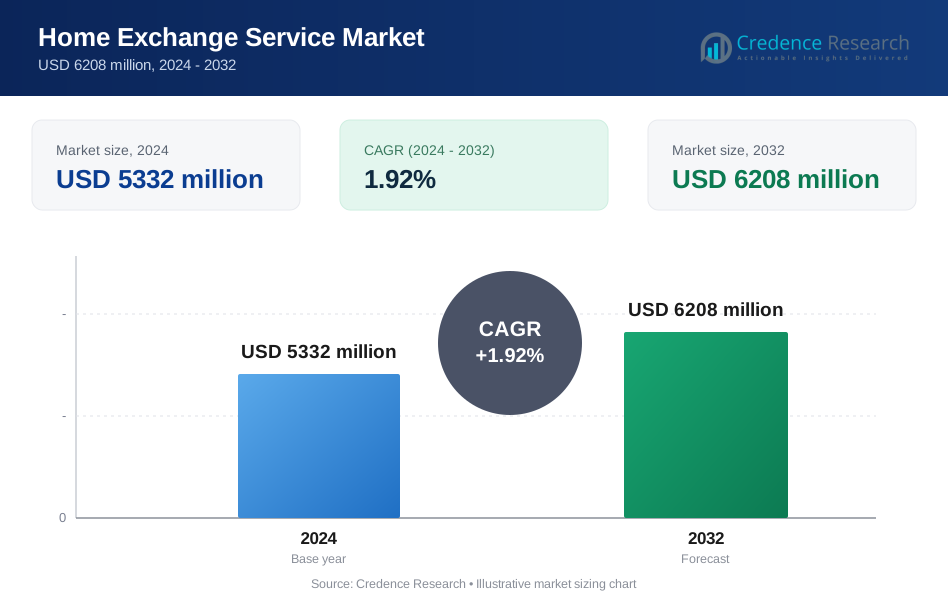
Home Exchange Service Market size was valued at USD 5332 Home Exchange Service Market million in 2024 and is anticipated to reach USD 6208 million by 2032, at a CAGR of 1.92% during the forecast period (2024-2032).
Several factors are driving the expansion of the home exchange service market. Firstly, the growing trend of experiential travel, where travelers seek local, authentic experiences, has made home exchanges an attractive option. This shift in consumer preference towards unique travel experiences is pushing the demand for home exchange services. Additionally, the rise of the digital nomad culture, especially post-pandemic, has created a surge in demand for flexible, long-term accommodation solutions that home exchanges can offer. As more individuals work remotely, they seek affordable, comfortable living arrangements abroad. Furthermore, the increased trust in home-sharing platforms, fueled by secure transaction processes and user reviews, has also contributed to the market's growth. The growing availability of comprehensive insurance policies and professional services further reassures users. As more people recognize the benefits of home exchanges, both homeowners and travelers are becoming more comfortable with the concept, driving adoption globally. This trend is also being supported by a growing awareness of sustainable travel options.
Regionally, North America holds the largest share of the home exchange service market, owing to the high number of tech-savvy users and a well-established base of home exchange platforms. The popularity of vacation rentals and the strong presence of major home exchange players like HomeExchange and Love Home Swap contribute to North America's dominance. Europe also represents a substantial portion of the market, with countries such as France, the UK, and Germany leading in demand. These regions benefit from high levels of domestic and international travel, which fuel the adoption of home exchange services. The Asia-Pacific region is expected to witness the fastest growth during the forecast period, driven by rising middle-class incomes, increasing travel preferences, and greater acceptance of home-sharing models. Countries like China, Japan, and Australia are showing growing interest in sustainable and cost-effective accommodation alternatives. The market in these regions will benefit from expanding internet access, rising disposable incomes, and a growing interest in cost-effective, sustainable travel options.
Market Insights:
- The Home Exchange Service Market was valued at USD 5332 million in 2024 and is projected to reach USD 6208 million by 2032, with a CAGR of 1.92% during the forecast period. This growth is driven by the increasing demand for flexible, cost-effective travel options.
- Experiential travel, where travelers seek authentic local experiences, has fueled demand for home exchanges. These services offer an immersive and affordable alternative to traditional accommodations.
- The rise of digital nomads post-pandemic has contributed to the market’s growth, with long-term accommodation solutions becoming more sought after. Home exchanges offer flexible and affordable options for remote workers.
- The trust and security provided by home-sharing platforms, enhanced by technological advancements like secure transactions and user reviews, have played a key role in expanding the market.
- Home exchanges promote sustainability by reusing existing properties, which reduces the need for new accommodations. This aligns with growing eco-consciousness among travelers.
- The Home Exchange Service Market faces legal and regulatory challenges due to varying rules on short-term rentals and property sharing across regions, which could limit its growth.
- North America holds the largest market share at 40%, followed by Europe at 35%. The Asia-Pacific region is expected to experience rapid growth, driven by rising incomes and greater acceptance of home-sharing.
Market Drivers:
Growing Demand for Experiential Travel
The increasing desire for authentic and unique travel experiences is a significant driver for the Home Exchange Service Market. Travelers are shifting their focus from traditional hotel stays to more immersive experiences that offer a connection to local cultures and communities. Home exchanges provide an opportunity to live like a local, adding value to a traveler’s journey. This preference for experiential travel has encouraged consumers to explore alternatives such as home exchanges. The market benefits from this shift, as it enables travelers to access authentic stays in residential neighborhoods. More people are seeking meaningful travel, contributing to the demand for home exchange services.
- For instance, the 2025 Arival U.S. Experiences Traveler Outlook found that two out of three travelers aged 18–54 consider available experiences, food, and attractions to be very or extremely important when choosing a destination, highlighting the growing priority on immersive travel experiences.
Rise of the Digital Nomad Culture
The rise of digital nomads, particularly post-pandemic, has accelerated the need for flexible accommodation solutions. As remote work becomes more common, individuals seek long-term, affordable housing options abroad. The Home Exchange Service Market directly benefits from this trend, as it offers cost-effective solutions for those who travel frequently for work or leisure. With remote work creating more opportunities to live in different locations, people are increasingly choosing home exchanges to find comfortable, fully-equipped homes without the burden of hotel costs. It aligns well with the needs of digital nomads, who value flexibility and affordability.
Trust and Security in Home-Sharing Platforms
Increased trust in home-sharing platforms has been crucial to the market's expansion. Technological advancements have made it easier for users to book stays securely, while comprehensive user reviews and ratings offer additional confidence. As people become more familiar with platforms like HomeExchange and others, they are more likely to participate in home exchanges, driving growth in the market. Homeowners feel secure offering their properties in exchange for others, knowing there are systems in place to ensure safety and transparency. These improvements have built credibility within the market, facilitating wider adoption of home exchanges globally.
Cost-Effective and Sustainable Travel Solutions
Cost-effectiveness is another significant driver of the Home Exchange Service Market. Home exchanges allow travelers to save money on accommodation, which can be particularly appealing in expensive destinations. It also offers sustainable travel alternatives by promoting the reuse of existing spaces, reducing the need for new accommodations. The appeal of reducing travel costs while supporting sustainable practices has made home exchange services more popular. As travelers increasingly prioritize sustainability, the market is well-positioned to thrive, offering a solution that benefits both individuals and the environment.
- For instance, a family of five from Jacksonville, Florida, reported saving over $30,000 in a single year by using HomeExchange.com for 138 days of travel, with accommodation savings alone estimated at $20,700.
Market Trends:
Increasing Popularity of Long-Term Home Exchanges
One of the key trends in the Home Exchange Service Market is the growing demand for long-term home exchanges. While short-term exchanges have traditionally been popular, travelers are now seeking extended stays, particularly in locations that cater to remote workers and digital nomads. These long-term exchanges provide more flexibility and allow travelers to experience a destination over a longer period. The rise of remote work has fueled this trend, with more people opting to live and work in different locations while maintaining their professional responsibilities. Long-term home exchanges offer cost-effective solutions and help travelers avoid expensive rental fees, further driving their popularity in the market. As more people embrace the concept of slow travel, this trend is expected to continue to shape the future of the market.
- For instance, HomeExchange reported that the longest home exchange arranged through its platform lasted 336 days between a family in France and one in British Columbia, highlighting the appeal and feasibility of extended stays for immersive cultural experiences.
Integration of Technology and Enhanced User Experience
Another emerging trend in the Home Exchange Service Market is the integration of advanced technologies that enhance the user experience. Home exchange platforms are increasingly adopting smart technologies such as artificial intelligence (AI) to streamline the booking process and provide personalized recommendations. These technologies help users find homes that best suit their preferences, offering a more tailored and efficient experience. The incorporation of secure payment systems, virtual tours, and enhanced communication features has further boosted consumer confidence and satisfaction. As technology continues to evolve, it is expected to play an even larger role in improving the overall user experience, making home exchanges more accessible and attractive to a wider audience. This trend indicates that the market will continue to innovate, offering new tools to meet the needs of modern travelers.
- For instance, HomeExchange provides up to $1,000,000 in insurance coverage for damages beyond the standard $500 deposit, ensuring peace of mind and a safer experience for users.
Market Challenges Analysis:
Trust and Security Concerns
One of the major challenges in the Home Exchange Service Market is the concern over trust and security. While platforms have introduced measures such as verified user profiles, insurance coverage, and reviews, there is still hesitancy among users regarding the safety of exchanging homes. Homeowners may worry about potential damages to their properties, while travelers might fear receiving subpar accommodations. This challenge can hinder the adoption of home exchanges, particularly among first-time users or those unfamiliar with the platform. Ensuring transparent communication and robust security measures remains crucial to addressing these concerns.
- For instance, HomeExchange offers a $1,000,000 protection policy for both hosts and guests, and reports that 99.7% of exchanges are incident-free, demonstrating the effectiveness of their trust and safety protocols.
Legal and Regulatory Hurdles
The Home Exchange Service Market faces legal and regulatory challenges that could affect its growth. Different regions have varying regulations regarding short-term rentals and property sharing, and navigating these legal frameworks can be complex. In some jurisdictions, home exchanges may be subject to restrictions or additional taxes, limiting the potential market size. These regulatory hurdles can create uncertainties for both homeowners and service providers. The lack of uniform global regulations complicates the expansion of home exchange services, requiring platforms to adapt to local laws and policies.
Market Opportunities:
Expansion in Emerging Markets
The Home Exchange Service Market presents significant opportunities in emerging markets where the middle class is expanding, and travel preferences are evolving. In regions such as Asia-Pacific and Latin America, the growing disposable incomes and interest in international travel create a promising landscape for home exchanges. These regions offer vast untapped potential for home exchange platforms, as travelers seek more affordable and immersive options. By expanding into these markets, platforms can capitalize on increasing internet penetration, improved connectivity, and the rise of eco-conscious travel, fostering further growth in the market.
Integration of Sustainable Travel Practices
The increasing global focus on sustainability offers a unique opportunity for the Home Exchange Service Market to position itself as a key player in eco-friendly travel. Home exchanges promote sustainable tourism by reducing the need for new accommodations, thus lowering the carbon footprint associated with travel. This aligns with the growing consumer preference for responsible and environmentally conscious travel options. Platforms that emphasize sustainability in their offerings can attract a broader demographic, particularly eco-conscious travelers. As the demand for sustainable alternatives rises, home exchange services are well-positioned to capitalize on this trend, promoting green travel options to a global audience.
Market Segmentation Analysis:
By Customer Type
The Home Exchange Service Market is divided into individual and corporate customers. Individual customers hold the majority share, driven by the demand for affordable and flexible travel solutions. These customers seek immersive, authentic travel experiences and prefer the cost-effectiveness of home exchanges. The corporate customer segment, including digital nomads and remote workers, is growing steadily as more companies adopt remote work policies, leading to a demand for long-term, flexible accommodations.
- For instance, the platform Love Home Swap reported that over 110,000 members have used its service to arrange home exchanges for their vacations.
By Property Type
The market is segmented by property type, which includes residential homes, apartments, and vacation homes. Residential homes dominate the market, offering a broad selection of accommodations for travelers seeking local experiences. Vacation homes, often found in tourist-heavy locations, cater to travelers looking for premium options. Apartments are increasingly popular, especially in urban areas, as they provide convenient, cost-effective stays for both short-term and long-term visitors.
- For instance, the Office for National Statistics reported that in 2023, UK residents took 86.2 million trips abroad, driving strong demand for vacation homes as part of the short-term rental market.
By Duration of Stay
The market is further categorized by duration of stay, with short-term and long-term stays being the primary divisions. Short-term stays are more common, typically used by travelers for vacations or brief visits. Long-term stays, however, have gained traction, especially among remote workers and digital nomads, who require more flexible, extended accommodation solutions. The rise in long-term stays has broadened the market's scope, creating new opportunities for platforms to cater to these evolving needs.
Segmentations:
By Customer Type
- Individual Customers
- Corporate Customers (e.g., digital nomads, remote workers)
By Property Type
- Residential Homes
- Apartments
- Vacation Homes
By Duration of Stay
- Short-term Stays
- Long-term Stays
By Purpose of Exchange
- Leisure Travel
- Business Travel
- Relocation/Temporary Living
By Level of Trust and Experience
- First-time Users
- Experienced Users
By Region
- North America
- Europe
- Asia-Pacific
- Rest of the World
Regional Analysis:
North America: Dominance and Technological Adoption
North America accounts for 40% of the Home Exchange Service Market, driven by a combination of high internet penetration, advanced technology adoption, and a large base of tech-savvy consumers. The United States, in particular, is home to several leading home exchange platforms, making it a key market for growth. Travelers in this region are increasingly seeking alternative accommodation options that offer more flexibility, cost-effectiveness, and local experiences. North America benefits from a strong trend towards experiential travel and digital nomadism, with more individuals opting for long-term stays abroad. These factors contribute to the market's growth and position North America as a dominant region for home exchange services.
Europe: Strong Market Demand and Established Platforms
Europe holds a 35% share of the Home Exchange Service Market, with countries like the United Kingdom, France, and Germany leading in demand for home exchange services. The region is characterized by a high level of international travel, which fuels the popularity of home exchanges. In Europe, home exchange platforms are well-established, and many consumers view it as a viable alternative to traditional accommodation options. The demand for unique travel experiences, coupled with rising interest in sustainable tourism, has led to increased adoption of home exchange services. Europe’s diverse cultural landscape also supports the preference for immersive travel experiences, further driving growth in the market.
Asia-Pacific: Rapid Growth and Emerging Potential
The Asia-Pacific region captures 15% of the Home Exchange Service Market but is expected to experience the fastest growth during the forecast period. The rise of the middle class, increasing disposable incomes, and growing interest in international travel contribute to this rapid expansion. Countries like China, Japan, and Australia are witnessing a surge in the adoption of home exchange services, with travelers looking for affordable and authentic accommodations. The region’s strong manufacturing ecosystem and investment in digital infrastructure support the growth of home exchange platforms. As internet access improves and cultural acceptance of home-sharing models increases, Asia-Pacific presents significant opportunities for market expansion in the coming years.
Key Player Analysis:
- Homestay
- HomeExchange
- HomeLink Inteational
- Culture Go Go
- Casa Particular Cuba
- Couchsurfing
- Wwoof
- Homestayin
- Love Home Swap
- Bedycasa
- Knok
- Airbnb
Competitive Analysis:
The Home Exchange Service Market is highly competitive, with several key players offering varying platforms and services. Leading platforms such as HomeExchange, Love Home Swap, and GuestToGuest dominate the market, each providing unique value propositions like extensive user bases, secure transaction processes, and customer support services. These companies leverage advanced technologies to enhance user experiences, offering features such as verified profiles, personalized recommendations, and secure payment systems. New entrants are attempting to capture market share by focusing on niche segments, such as eco-conscious travelers or long-term stays for digital nomads. However, established platforms maintain their competitive advantage through strong brand recognition and a wide network of members. Competition is further intensified by the growing demand for flexible, cost-effective travel solutions, which encourages innovation and differentiation in service offerings. As the market evolves, customer trust, platform security, and service quality will remain critical factors for success.
Recent Developments:
- In June 2024, HomeExchange Collection(the luxury branch of HomeExchange) announced a partnership with luxury concierge service Quintessentially.
- In May 2025, HomeExchange launched "Global HomeExchange Day," an annual event to celebrate and promote the home exchange model, with activities and meetups worldwide scheduled for June 8, 2025.
Market Concentration & Characteristics:
The Home Exchange Service Market is characterized by moderate concentration, with a few dominant players holding significant market share. Major platforms such as HomeExchange, Love Home Swap, and GuestToGuest lead the market, providing robust networks and secure transaction systems. These platforms focus on offering flexible, cost-effective, and personalized accommodation options, which cater to the growing demand for experiential travel and long-term stays. Smaller entrants often target niche segments, such as eco-conscious travelers or specific regional markets, attempting to carve out a place in the market through specialized offerings. The competitive landscape is shaped by factors such as user trust, platform security, and service differentiation, with technology playing a key role in enhancing the overall customer experience. Despite the presence of a few large players, the market is still evolving, and opportunities remain for new entrants and innovation.
Report Coverage:
The research report offers an in-depth analysis based on Customer Type, Property Type, Duration of Stay, Purpose of Exchange, Level of Trust and Experience and Region. It details leading market players, providing an overview of their business, product offerings, investments, revenue streams, and key applications. Additionally, the report includes insights into the competitive environment, SWOT analysis, current market trends, as well as the primary drivers and constraints. Furthermore, it discusses various factors that have driven market expansion in recent years. The report also explores market dynamics, regulatory scenarios, and technological advancements that are shaping the industry. It assesses the impact of external factors and global economic changes on market growth. Lastly, it provides strategic recommendations for new entrants and established companies to navigate the complexities of the market.
Future Outlook:
- The Home Exchange Service Market is expanding into emerging regions such as Asia-Pacific and Latin America, driven by rising middle-class incomes and increasing travel preferences.
- Platforms are incorporating smart home features, enhancing user experience and convenience during exchanges.
- There is a growing emphasis on eco-friendly travel options, with home exchanges promoting sustainability by reducing the need for new accommodations.
- To address trust concerns, platforms are implementing robust security protocols, including verified user profiles and secure transaction processes.
- The market is witnessing a diversification in property types available for exchange, catering to a broader range of preferences and budgets.
- Hybrid models combining simultaneous and non-simultaneous exchanges are gaining popularity, offering greater flexibility to users.
- Businesses are increasingly adopting home exchange programs for employee relocation and temporary assignments, expanding the market's scope.
- Specialized platforms targeting specific demographics or interests are emerging, catering to niche markets within the home exchange sector.
- Varying regulations across regions pose challenges, requiring platforms to navigate complex legal landscapes to operate effectively.
- The adoption of artificial intelligence and machine learning is streamlining operations and enhancing personalized user experiences in the home exchange market.
Request a Free Sample
Fill in your details and we'll send you a free sample report.
- Sample data tables & charts
- Research methodology
Market Dynamics
Growing Demand for Experiential Travel
Travelers are increasingly seeking authentic, local experiences over traditional hotel stays, making home exchanges attractive for those wanting to immerse themselves in different cultures and communities.
Rise of Digital Nomad Culture
The increase in remote work and digital nomadism, especially post-pandemic, has driven demand for flexible, long-term accommodation solutions that home exchange services can uniquely provide.
Enhanced Trust and Security in Platforms
Advancements in secure transaction processes, user verification, and comprehensive insurance policies have increased consumer confidence in home exchange platforms, encouraging broader adoption.
Cost-Effective and Sustainable Travel Solutions
Home exchanges offer significant cost savings on accommodation and promote sustainability by reusing existing properties, aligning with the growing preference for eco-friendly and budget-conscious travel.
Expansion in Emerging Markets
Rising disposable incomes and greater internet penetration in regions like Asia-Pacific and Latin America are opening new opportunities for home exchange platforms to reach untapped traveler segments.
Need a Custom Version of This Report?
Tailor the scope, geography, or segments to your exact requirements.
- Custom geography or segment scope
- Direct access to our analyst team
Frequently Asked Questions
What is the current size of the Home Exchange Service Market?
What factors are driving the growth of the Home Exchange Service Market?
What are the key segments within the Home Exchange Service Market?
What are some challenges faced by the Home Exchange Service Market?
Who are the major players in the Home Exchange Service Market?
Table of Content
Chapter 1 Market Segmentation
- 1.1 Segmentation Framework
- 1.1.1 Product and Service Classification
- 1.1.2 Application and End-Use Classification
- 1.1.3 Technology and Solution Classification
- 1.1.4 Customer and Distribution Channel Classification
- 1.1.5 Geographic Segmentation
- 1.1.6 Market Segment Definitions and Boundaries
- 1.2 By Customer Type
- 1.2.1 Individual Customers
- 1.2.2 Corporate Customers (e.g., digital nomads, remote workers)
- 1.3 By Property Type
- 1.3.1 Residential Homes
- 1.3.2 Apartments
- 1.3.3 Vacation Homes
- 1.4 By Duration of Stay
- 1.4.1 Short-term Stays
- 1.4.2 Long-term Stays
- 1.5 By Purpose of Exchange
- 1.5.1 Leisure Travel
- 1.5.2 Business Travel
- 1.5.3 Relocation/Temporary Living
Chapter 2 Introduction
- 2.1 Report Objectives and Scope
- 2.2 Product Definition and Industry Terminology
- 2.3 Market Inclusions and Exclusions
- 2.4 Research Process
- 2.4.1 Primary Research and Expert Interviews
- 2.4.2 Secondary Research and Source Review
- 2.4.3 Top-Down and Bottom-Up Estimation
- 2.4.4 Data Triangulation and Verification
- 2.5 Market Size Measurement Basis
- 2.5.1 2024: USD 5332 million → 2032: USD 6208 million
- 2.6 Historical and Forecast Reference Periods
- 2.6.1 Base Year: 2024
- 2.6.2 Forecast Period: 2024-2032
- 2.7 Research Assumptions and Limitations
Chapter 3 Executive Summary
- 3.1 Market Snapshot and Key Findings
- 3.2 Base-Year Market Size, 2024
- 3.3 Forecast Market Size, 2032
- 3.4 Revenue and Volume Growth Outlook
- 3.5 Key Demand and Supply Indicators
- 3.6 Leading Market Segments
- 3.7 Fastest-Growing Market Opportunities
- 3.8 Regional Performance Highlights
- 3.9 Technology and Industry Transformation
- 3.10 Competitive Landscape Summary
- 3.11 Analyst View and Strategic Implications
Chapter 4 Global Home Exchange Service Market Trends and Developments
- 4.1 Historical Industry Development
- 4.2 Recent Market Trends and Developments
- 4.3 Demand and Customer Behavior Trends
- 4.4 Technology and Product Innovation
- 4.5 Artificial Intelligence, Automation and Digitalization
- 4.6 Local Manufacturing and Supply Chain Realignment
- 4.7 Industry Partnerships, Mergers and Acquisitions
- 4.8 Sustainability and Circular Economy Developments
- 4.9 Government and Private Sector Investment Trends
- 4.10 Emerging Business Models and Commercialization
- 4.11 Industry Developments and Announcements
Chapter 5 Global Home Exchange Service Market Supply and Demand Analysis
- 5.1 Demand Trend and Consumption Analysis
- 5.2 Demand Forecast, 2024-2032
- 5.3 Supply Chain Structure and Procurement Trends
- 5.4 Supply-Demand Gap and Bottlenecks
- 5.5 Import Dependence and Sourcing Structure
- 5.6 Regional Supply and Demand Concentration
Chapter 6 Global Home Exchange Service Market Pricing Analysis
- 6.1 Pricing Structure and Measurement
- 6.2 Historical Pricing Trends
- 6.3 Pricing Outlook, 2024-2032
- 6.4 Pricing by Product and Market Segment
- 6.5 Geographic Pricing Differences
- 6.6 Key Input, Energy, Labor and Logistics Costs
- 6.7 Contract Pricing and Purchasing Models
- 6.8 Pricing Sensitivity and Competitive Positioning
- 6.9 Price, Margin and Profitability Implications
Chapter 7 Global Home Exchange Service Market Dynamics
- 7.1 Market Growth Drivers
- 7.1.1 Demand-Side Drivers
- 7.1.2 Technology and Innovation Drivers
- 7.1.3 Infrastructure and Investment Drivers
- 7.1.4 Regulatory and Policy Drivers
- 7.2 Market Restraints
- 7.2.1 Cost and Affordability Constraints
- 7.2.2 Technology and Adoption Barriers
- 7.2.3 Supply Chain and Operational Constraints
- 7.3 Market Challenges
- 7.3.1 Competitive Pressure and Margin Erosion
- 7.3.2 Skills, Infrastructure and Implementation Gaps
- 7.4 Emerging Market Opportunities
- 7.5 Market Dynamics Impact and Time-Horizon Assessment
Chapter 8 Global Home Exchange Service Value Chain Analysis
- 8.1 Industry Value Chain Overview
- 8.2 Upstream Suppliers and Critical Inputs
- 8.3 Technology and Component Providers
- 8.4 Manufacturing or Service Delivery
- 8.5 Distribution, Channel Partners and Integrators
- 8.6 Downstream Applications and End Users
- 8.7 Value Addition and Profit Pools
- 8.8 Vertical Integration and Outsourcing
- 8.9 Supplier Concentration and Risk
- 8.10 Supply Chain Localization and Resilience
Chapter 9 Global Home Exchange Service Market Regulations and Policies
- 9.1 Relevant Laws, Standards and Compliance Frameworks
- 9.2 Product, Service, Safety and Quality Requirements
- 9.3 Government Policies, Incentives and Subsidies
- 9.4 Imports, Exports and Trade Barriers
- 9.5 Public Procurement and Local Content Requirements
- 9.6 Data Protection, AI and Cybersecurity Compliance
- 9.7 Upcoming Policy Changes and Market Implications
Chapter 10 Global Home Exchange Service Market Hotspots and Opportunities
- 10.1 Market Opportunity Mapping and Growth Hotspots
- 10.2 High-Growth Applications and Customer Groups
- 10.3 Underserved Markets and White-Space Opportunities
- 10.4 Emerging Technology and Product Opportunities
- 10.5 New Capacity and Investment Hotspots
- 10.6 Market Entry and Expansion Opportunities
- 10.7 Distribution and Partnership Opportunities
- 10.8 Near-Term and Long-Term Commercial Potential
- 10.9 Opportunity Attractiveness and Execution Risks
Chapter 11 Global Home Exchange Service Market Outlook, 2024-2032
- 11.1 Market Size and Analysis
- 11.1.1 Revenue (Market Measurement: 2024: USD 5332 million → 2032: USD 6208 million)
- 11.1.2 Historical Market Size
- 11.1.3 Base-Year Market Size, 2024
- 11.2 Market Forecast, 2024-2032
- 11.2.1 Revenue Forecast to 2032
- 11.2.2 CAGR and Year-on-Year Growth
- 11.2.3 Incremental Revenue Opportunity
- 11.3 Forecast Assumptions and Scenario Analysis
- 11.3.1 Base-Case Forecast
- 11.3.2 Optimistic and Conservative Scenarios
- 11.3.3 Technology, Pricing and Policy Sensitivities
- 11.4 Market Attractiveness and Growth Outlook
Chapter 12 Global Home Exchange Service Market Segmentation and Outlook
- 12.1 Segmentation Summary and Market Shares, 2024
- 12.2 Largest and Fastest-Growing Segments
- 12.3 By Customer Type - Market Size and Forecast, 2024-2032
- 12.3.1 Segment Definition and Scope
- 12.3.2 Historical Market Size
- 12.3.3 Revenue Forecast, 2024-2032
- 12.3.4 Base-Year Market Share, 2024
- 12.3.5 Segment CAGR and Growth Drivers
- 12.3.6 Subsegment Market Size and Forecast
- 12.3.6.1 Individual Customers
- 12.3.6.2 Corporate Customers (e.g., digital nomads, remote workers)
- 12.3.7 Subsegment Pricing and Adoption Trends
- 12.3.8 Leading Suppliers and Competition
- 12.3.9 Regional Demand and Opportunities
- 12.4 By Property Type - Market Size and Forecast, 2024-2032
- 12.4.1 Segment Definition and Scope
- 12.4.2 Historical Market Size
- 12.4.3 Revenue Forecast, 2024-2032
- 12.4.4 Base-Year Market Share, 2024
- 12.4.5 Segment CAGR and Growth Drivers
- 12.4.6 Subsegment Market Size and Forecast
- 12.4.6.1 Residential Homes
- 12.4.6.2 Apartments
- 12.4.6.3 Vacation Homes
- 12.4.7 Subsegment Pricing and Adoption Trends
- 12.4.8 Leading Suppliers and Competition
- 12.4.9 Regional Demand and Opportunities
- 12.5 By Duration of Stay - Market Size and Forecast, 2024-2032
- 12.5.1 Segment Definition and Scope
- 12.5.2 Historical Market Size
- 12.5.3 Revenue Forecast, 2024-2032
- 12.5.4 Base-Year Market Share, 2024
- 12.5.5 Segment CAGR and Growth Drivers
- 12.5.6 Subsegment Market Size and Forecast
- 12.5.6.1 Short-term Stays
- 12.5.6.2 Long-term Stays
- 12.5.7 Subsegment Pricing and Adoption Trends
- 12.5.8 Leading Suppliers and Competition
- 12.5.9 Regional Demand and Opportunities
- 12.6 By Purpose of Exchange - Market Size and Forecast, 2024-2032
- 12.6.1 Segment Definition and Scope
- 12.6.2 Historical Market Size
- 12.6.3 Revenue Forecast, 2024-2032
- 12.6.4 Base-Year Market Share, 2024
- 12.6.5 Segment CAGR and Growth Drivers
- 12.6.6 Subsegment Market Size and Forecast
- 12.6.6.1 Leisure Travel
- 12.6.6.2 Business Travel
- 12.6.6.3 Relocation/Temporary Living
- 12.6.7 Subsegment Pricing and Adoption Trends
- 12.6.8 Leading Suppliers and Competition
- 12.6.9 Regional Demand and Opportunities
- 12.7 Segment Growth Comparison
- 12.8 Segment Attractiveness and Priority Matrix
Chapter 13 Global Home Exchange Service End-Use and Application Market Outlook
- 13.1 End-Use Industry and Customer Demand Structure
- 13.2 Leading Applications and Customer Groups
- 13.3 End-Use Market Size, Share and Forecast
- 13.4 Major End-Use Industry Deep Dives
- 13.4.1 Customer Requirements and Use Cases
- 13.4.2 Demand and Replacement Cycles
- 13.4.3 Technical and Regulatory Considerations
- 13.4.4 Purchasing and Procurement Models
- 13.4.5 Leading Vendors and Distribution Channels
- 13.4.6 Forecast and Commercial Opportunities
- 13.5 Emerging Applications and Cross-Segment Demand
- 13.6 End-Use Industry Investment Priorities
Chapter 14 Global Home Exchange Service Geographic Market Outlook, 2024-2032
- 14.1 Regional Market Size and Share, 2024
- 14.2 Regional Market Forecast, 2024-2032
- 14.3 Regional Pricing, Production and Demand Differences
- 14.4 North America
- 14.4.1 United States
- 14.4.2 Canada
- 14.4.3 Mexico
- 14.5 Europe
- 14.5.1 Germany
- 14.5.2 France
- 14.5.3 Italy
- 14.5.4 United Kingdom
- 14.5.5 Spain
- 14.5.6 Poland
- 14.5.7 Russia
- 14.5.8 Netherlands
- 14.5.9 Belgium
- 14.5.10 Sweden
- 14.5.11 Denmark
- 14.5.12 Norway
- 14.5.13 Rest of Europe
- 14.6 Asia Pacific
- 14.6.1 China
- 14.6.2 India
- 14.6.3 Japan
- 14.6.4 South Korea
- 14.6.5 Thailand
- 14.6.6 Indonesia
- 14.6.7 Vietnam
- 14.6.8 Malaysia
- 14.6.9 Australia
- 14.6.10 Rest of Asia Pacific
- 14.7 Latin America
- 14.7.1 Brazil
- 14.7.2 Argentina
- 14.7.3 Colombia
- 14.7.4 Chile
- 14.7.5 Rest of Latin America
- 14.8 Middle East
- 14.8.1 Saudi Arabia
- 14.8.2 United Arab Emirates
- 14.8.3 Turkey
- 14.8.4 Israel
- 14.8.5 Iran
- 14.8.6 Rest of the Middle East
- 14.9 Africa
- 14.9.1 South Africa
- 14.9.2 Egypt
- 14.9.3 Nigeria
- 14.9.4 Morocco
- 14.9.5 Rest of Africa
- 14.10 Regional Investment, Policy and Supply Chain Differences
- 14.11 Regional Competitive Landscape
- 14.12 Geographic Growth Hotspots
Chapter 15 Global Home Exchange Service Technology, Innovation and Sustainability Outlook
- 15.1 Technology Landscape and Maturity
- 15.2 Product, Process and Service Innovation
- 15.3 AI, Automation and Digital Tools in the Industry
- 15.4 Technology Adoption and Performance Benchmarking
- 15.5 Innovation Pipeline and R&D Investment
- 15.6 Energy Efficiency and Resource Management
- 15.7 Sustainability, Recycling and Circularity
- 15.8 Technology Roadmap, 2024-2032
- 15.9 Risks of Obsolescence and Technology Substitution
Chapter 16 Global Home Exchange Service Market Key Strategic Imperatives
- 16.1 Growth and Market Entry Priorities
- 16.2 High-Return Products and Segments
- 16.3 Pricing, Profitability and Cost Optimization
- 16.4 Technology Investment and Product Differentiation
- 16.5 Supply Chain Localization and Resilience
- 16.6 Distribution and Customer Acquisition
- 16.7 Partnership, Acquisition and Capacity Strategy
- 16.8 Regional Expansion Priorities
- 16.9 Short-, Medium- and Long-Term Actions
Chapter 17 Competition Outlook
- 17.1 Industry Competition Characteristics
- 17.2 Market Structure and Concentration
- 17.3 Market Share and Competitive Positioning, 2024
- 17.4 Company-Wise Revenue and Product Benchmarking
- 17.5 Production and Service Capacity Benchmarking
- 17.6 Technology, Pricing and Differentiation
- 17.7 Regional Footprint and Distribution Strength
- 17.8 Mergers, Acquisitions and Strategic Alliances
- 17.9 New Entrants and Competitive Threats
- 17.10 Porter's Five Forces and Industry Attractiveness
- 17.11 Competitive Outlook, 2024-2032
Chapter 18 Company Profiles
- 18.1 Company Coverage and Selection Criteria
- 18.2 HomeExchange
- 18.2.1 Business Description
- 18.2.2 Company Ownership and Geographic Presence
- 18.2.3 Product and Service Portfolio
- 18.2.4 Manufacturing and Operating Footprint
- 18.2.5 Financial Performance and Investment
- 18.2.6 Market Share and Competitive Position
- 18.2.7 Technology and Innovation Capabilities
- 18.2.8 Strategic Alliances or Partnerships
- 18.2.9 Recent Developments
- 18.2.10 Growth Strategy and Outlook
- 18.3 Love Home Swap
- 18.4 HomeLink International
- 18.5 Couchsurfing
- 18.6 Airbnb
- 18.7 Homestay
- 18.8 Bedycasa
- 18.9 Knok
- 18.10 Casa Particular Cuba
- 18.11 Wwoof
- 18.12 Other Relevant Market Participants
Note: Every listed company is profiled on the structure shown under the first company. The company list is preliminary and may change based on research findings, market developments, data availability and client requirements.
Chapter 19 Disclaimer
- 19.1 Research and Forecast Disclaimer
- 19.2 Data Source and Estimation Limitations
Note: The depth of individual sections depends on data availability for this market. Volume, capacity, trade and other unit-based metrics are included where applicable.

