Market Overview
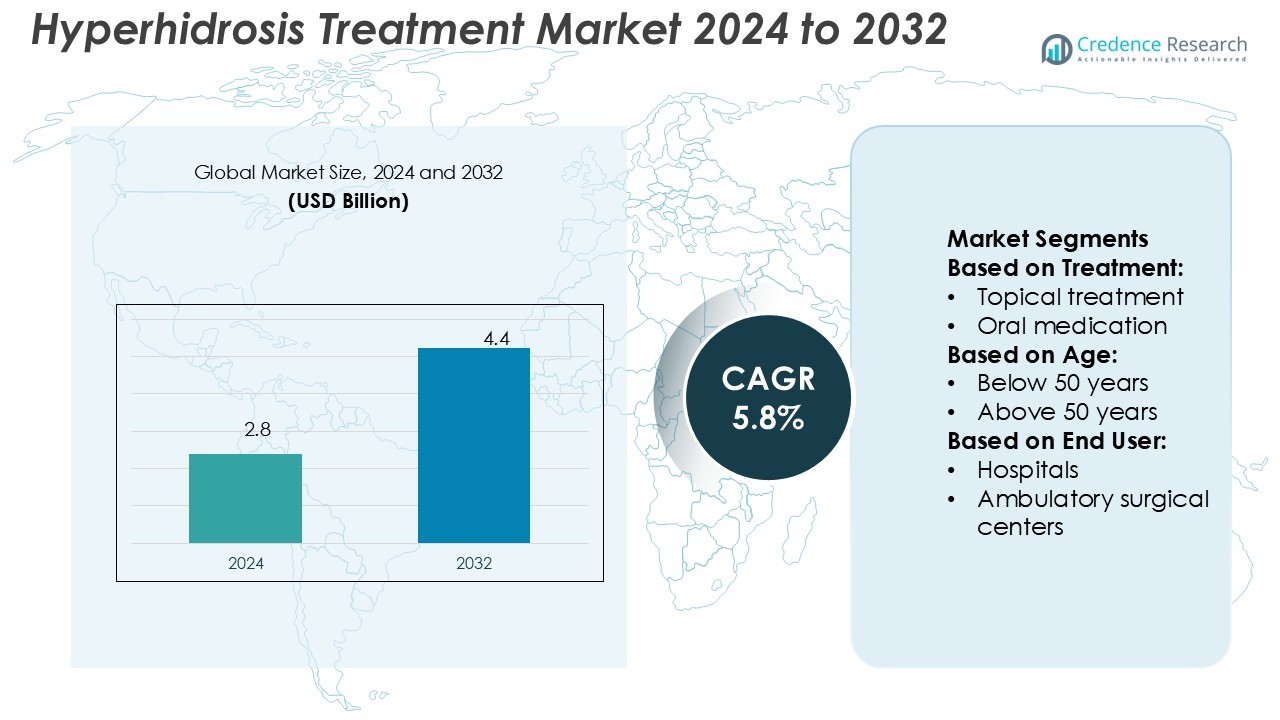
Hyperhidrosis Treatment Market size was valued USD 2.8 billion in 2024 and is anticipated to reach USD 4.4 billion by 2032, at a CAGR of 5.8% during the forecast period.
| REPORT ATTRIBUTE | DETAILS |
|---|---|
| Historical Period | 2020-2023 |
| Base Year | 2024 |
| Forecast Period | 2025-2032 |
| Hyperhidrosis Treatment Market Size 2024 | USD 2.8 Billion |
| Hyperhidrosis Treatment Market, CAGR | 5.8% |
| Hyperhidrosis Treatment Market Size 2032 | USD 4.4 Billion |
The hyperhidrosis treatment market is driven by leading players such as AbbVie Inc., Dermavant Sciences Inc., Kaken Pharmaceutical Co., Ltd., Eli Lilly and Company, Hugel, Inc., Intas Pharmaceuticals Ltd., Avanor Healthcare Ltd., Dermadry Laboratories Inc., Brickell Biotech Inc., and Eirion Therapeutics, Inc. These companies focus on expanding their portfolios through advanced drug formulations, innovative devices, and strategic partnerships to strengthen global presence. North America dominates the market with a 38% share, supported by strong healthcare infrastructure, high awareness, and favorable reimbursement policies. The region’s leadership is reinforced by the availability of specialized dermatology services and advanced treatment adoption.
Market Insights
- The hyperhidrosis treatment market size was USD 2.8 billion in 2024 and is projected to reach USD 4.4 billion by 2032, growing at a CAGR of 5.8%.
- Market growth is driven by rising awareness, increasing diagnosis rates, and strong demand for minimally invasive therapies such as botulinum toxin injections, which hold the largest treatment share.
- Key trends include the adoption of advanced devices like iontophoresis systems, integration of lifestyle-oriented treatments in dermatology clinics, and innovation in long-lasting drug formulations to improve patient compliance.
- Competition is shaped by global players focusing on innovation and partnerships, while restraints include high treatment costs, limited reimbursement in many regions, and side effects that affect patient compliance.
- North America leads with 38% share, followed by Europe with 29% and Asia-Pacific with 22%, while hospitals dominate end-user segments due to infrastructure and advanced treatment availability.
Market Segmentation Analysis:
By Treatment
The hyperhidrosis treatment market is dominated by botulinum toxin injections, holding the largest share due to their proven effectiveness and long-lasting results. These injections temporarily block the nerves responsible for excessive sweating, making them a preferred choice among patients seeking non-invasive yet reliable outcomes. Demand is further driven by rising awareness, increased cosmetic applications, and FDA approvals for multiple body areas. While topical treatments and iontophoresis are gaining adoption, particularly for mild cases, botulinum toxin injections remain the market leader because of their high success rate and strong clinical evidence.
- For instance, Dermavant Sciences Inc. reported positive Phase III trial results for Qbrexza (glycopyrronium tosylate) cloth, where gravimetric sweat testing supported a significant reduction in sweat production compared to vehicle after four weeks of daily use, in studies involving over 450 individuals.
By Age
The below 50 years segment accounts for the dominant market share, driven by higher prevalence of primary hyperhidrosis in younger individuals. Patients in this age group actively seek treatment to improve daily comfort, work productivity, and social interactions. Increased awareness campaigns, availability of advanced therapies, and willingness to undergo procedures like botulinum toxin injections contribute to strong uptake. Above 50 years shows steady growth as aging populations turn to treatment for secondary hyperhidrosis, but younger demographics remain the key driver of market demand.
- For instance, Kaken Pharmaceutical’s ECCLOCK® (sofpironium bromide gel, 5%) was approved in November 2020 following positive results from a Japanese Phase 3 trial of 281 patients.
By End-user
Hospitals represent the leading end-user segment, capturing the largest share due to advanced infrastructure and availability of multidisciplinary treatment options. Patients often prefer hospitals for procedures such as botulinum toxin injections and surgical treatments, which require trained specialists and advanced facilities. The hospital segment is further supported by reimbursement policies and wider accessibility in urban areas. Dermatology clinics and ambulatory surgical centers are also gaining ground due to personalized care and cost-effective services, but hospitals continue to dominate as the primary hub for advanced hyperhidrosis treatment.
Key Growth Drivers
Rising Awareness and Diagnosis Rates
Growing awareness campaigns and improved clinical diagnosis significantly drive the hyperhidrosis treatment market. Patients increasingly recognize excessive sweating as a treatable condition rather than a lifestyle issue. Dermatologists and healthcare organizations actively promote advanced therapies such as botulinum toxin injections and iontophoresis. Educational initiatives and patient support groups improve treatment-seeking behavior, particularly among younger populations. Enhanced diagnosis rates expand the patient pool, fueling demand for both non-invasive and surgical options. This increasing acceptance directly boosts revenue growth across hospitals, clinics, and ambulatory centers, consolidating the market’s overall expansion.
- For instance, Hugel develops botulinum toxin products under names such as Botulax / Letybo, including 50 IU, 100 IU and 200 IU formulations. In Q2 2025, Hugel’s net sales from toxin products reached KRW 61.2 billion, supporting over 100 billion cumulative toxin sales in the first half.
Advancements in Minimally Invasive Therapies
The availability of innovative, minimally invasive treatment options fuels strong market growth. Botulinum toxin injections, iontophoresis, and topical antiperspirants are gaining preference due to proven efficacy, reduced downtime, and better safety profiles. Manufacturers are developing new formulations and devices that improve patient compliance and treatment outcomes. For instance, long-lasting botulinum toxin solutions are being explored to reduce repeated sessions. These advancements attract patients who prefer effective yet convenient solutions. The focus on improved patient experience continues to strengthen adoption, positioning minimally invasive options as critical growth drivers in the hyperhidrosis treatment market.
- For instance, AbbVie and Allergan presented positive Phase 3 trial data showing that Botox formulations met all primary and secondary endpoints in treating platysma prominence.
Increasing Cosmetic and Lifestyle Applications
The growing overlap between dermatology and aesthetics enhances demand for hyperhidrosis treatments. Excessive sweating impacts self-confidence, driving patients to seek therapies for underarms, palms, and facial areas. Rising disposable incomes and heightened interest in personal grooming encourage treatment uptake. Cosmetic clinics integrate hyperhidrosis procedures into their service portfolios, promoting affordability and accessibility. The association between appearance, confidence, and social acceptance makes treatments appealing to younger demographics. Expanding lifestyle-driven demand not only broadens the patient base but also positions hyperhidrosis care as a profitable segment in dermatology and cosmetic practices globally.
Key Trends & Opportunities
Integration of Advanced Dermatology Devices
The market is witnessing a strong shift toward device-based solutions like iontophoresis and laser therapies. These technologies provide safer, long-term results and are increasingly offered in dermatology clinics. Integration of wearable devices to monitor sweating patterns also supports personalized treatment approaches. Companies are innovating with portable and user-friendly devices, creating opportunities in home-based care. This technological evolution not only improves patient adherence but also opens avenues for manufacturers to expand into consumer-centric segments, positioning advanced devices as a key growth frontier in the hyperhidrosis treatment market.
- For instance, Brickell has developed its proprietary patient-report outcome scale HDSM-Ax, validated such that a 1-point change (on a 0–4 scale) is clinically meaningful.
Expanding Medical Tourism in Emerging Economies
Emerging economies, particularly in Asia-Pacific and Latin America, present strong opportunities through medical tourism. Countries such as Thailand, India, and Brazil offer cost-effective dermatological procedures, attracting international patients. The availability of skilled specialists and advanced infrastructure at competitive prices boosts the appeal. Patients from developed countries increasingly seek affordable hyperhidrosis treatments abroad, particularly botulinum toxin procedures. This trend strengthens cross-border collaborations and stimulates investment in local healthcare infrastructure. Growing affordability and international patient inflow highlight medical tourism as a major opportunity for regional growth in the hyperhidrosis treatment landscape.
- For instance, Eirion’s pipeline includes ET-01, a topical botulinum formulation using nanoemulsion transdermal delivery and skin microporation. This two-step application is completed in under 10 minutes and avoids injections.
Key Challenges
High Treatment Costs and Limited Reimbursement
The elevated cost of advanced treatments such as botulinum toxin injections and surgical procedures remains a key barrier. In many regions, reimbursement coverage for hyperhidrosis treatments is limited or excluded, categorizing them as cosmetic rather than medical. This restricts accessibility for middle- and low-income patients, particularly in emerging economies. Even in developed markets, insurance limitations force patients to bear significant out-of-pocket expenses. The high cost burden reduces adoption rates and hinders market expansion, posing a significant challenge for long-term growth potential.
Side Effects and Patient Compliance Issues
Side effects associated with treatments create concerns for both patients and physicians. Botulinum toxin injections may cause muscle weakness, while oral medications often carry systemic side effects such as dry mouth or blurred vision. Surgical procedures, though effective, involve risks of compensatory sweating and scarring. These complications reduce patient willingness to pursue certain therapies. Additionally, repetitive treatments such as iontophoresis demand consistent compliance, which many patients find difficult to maintain. Safety risks and compliance hurdles act as restraining factors, slowing the pace of adoption across treatment modalities.
Regional Analysis
North America
North America leads the hyperhidrosis treatment market with a 38% share, supported by strong adoption of advanced therapies such as botulinum toxin injections and iontophoresis. High awareness levels, favorable reimbursement frameworks, and strong presence of leading pharmaceutical companies drive growth. The U.S. dominates the region, benefiting from advanced healthcare infrastructure and active clinical research in dermatology. Rising demand for minimally invasive treatments and FDA approvals for wider applications reinforce regional dominance. Canada contributes steadily, driven by growing patient awareness and government initiatives supporting access to dermatology services, further strengthening North America’s leadership position.
Europe
Europe holds 29% of the global hyperhidrosis treatment market, driven by rising awareness and supportive healthcare systems. Countries such as Germany, the UK, and France lead adoption due to high spending on dermatological care and access to innovative therapies. The region benefits from strong penetration of botulinum toxin treatments, supported by CE approvals and skilled practitioners. Growing emphasis on outpatient services at dermatology clinics fuels accessibility for younger patients. Southern and Eastern Europe are emerging with increasing demand, supported by improving healthcare infrastructure. The combination of innovation, regulation, and affordability positions Europe as a strong market player.
Asia-Pacific
Asia-Pacific accounts for 22% of the hyperhidrosis treatment market and is projected as the fastest-growing region. Rising awareness of hyperhidrosis, expanding healthcare infrastructure, and growing affordability of dermatology services drive growth. Japan, South Korea, and China lead adoption with advanced technologies and high cosmetic treatment demand. Increasing medical tourism in countries like Thailand and India also contributes to regional expansion. Young populations and rising disposable incomes further support treatment uptake. Local manufacturers introducing cost-effective solutions are strengthening accessibility, while government initiatives to modernize healthcare systems create opportunities for advanced treatment penetration across the region.
Latin America
Latin America captures 6% of the hyperhidrosis treatment market, driven by growing demand in Brazil, Mexico, and Argentina. Expanding middle-class populations and rising awareness of dermatological conditions contribute to higher treatment adoption. Brazil leads with advanced aesthetic and dermatology sectors, supporting strong uptake of botulinum toxin injections. However, limited reimbursement coverage and economic disparities restrict wider access in rural areas. Multinational companies are increasing investments to strengthen distribution networks and enhance awareness. While growth is moderate compared to developed regions, improving healthcare accessibility and rising demand for cosmetic procedures create favorable conditions for regional market expansion.
Middle East & Africa
The Middle East & Africa account for 5% of the global hyperhidrosis treatment market, with growth concentrated in Gulf countries like Saudi Arabia and the UAE. Rising disposable incomes, expanding private healthcare facilities, and high demand for aesthetic treatments fuel adoption. Hospitals and dermatology clinics in urban centers offer advanced procedures such as botulinum toxin injections and surgical treatments. However, limited awareness and affordability challenges in African countries hinder widespread adoption. International collaborations and government investments in healthcare infrastructure are expected to improve access, positioning the region for gradual growth in the coming years.
Market Segmentations:
By Treatment:
- Topical treatment
- Oral medication
By Age:
- Below 50 years
- Above 50 years
By End User:
- Hospitals
- Ambulatory surgical centers
By Geography
- North America
- U.S.
- Canada
- Mexico
- Europe
- Germany
- France
- U.K.
- Italy
- Spain
- Rest of Europe
- Asia Pacific
- China
- Japan
- India
- South Korea
- South-east Asia
- Rest of Asia Pacific
- Latin America
- Brazil
- Argentina
- Rest of Latin America
- Middle East & Africa
- GCC Countries
- South Africa
- Rest of the Middle East and Africa
Competitive Landscape
The hyperhidrosis treatment market is characterized by strong competition among leading players including Dermavant Sciences Inc., Kaken Pharmaceutical Co., Ltd., Avanor Healthcare Ltd., Eli Lilly and Company, Dermadry Laboratories Inc., Hugel, Inc., Intas Pharmaceuticals Ltd., AbbVie Inc., Brickell Biotech Inc., and Eirion Therapeutics, Inc. The hyperhidrosis treatment market is highly competitive, shaped by continuous innovation in both drug-based and device-based solutions. Companies are focusing on developing advanced therapies such as long-lasting botulinum toxin formulations, improved iontophoresis devices, and topical treatments with enhanced efficacy and safety profiles. The competitive environment is further driven by strategic collaborations, licensing agreements, and research investments aimed at expanding treatment indications and improving patient compliance. Emerging players are entering the market with cost-effective alternatives, increasing accessibility across regions. This dynamic landscape emphasizes innovation, affordability, and global reach as key factors influencing competition.
Key Player Analysis
- Dermavant Sciences Inc.
- Kaken Pharmaceutical Co., Ltd.
- Avanor Healthcare Ltd.
- Eli Lilly and Company
- Dermadry Laboratories Inc.
- Hugel, Inc.
- Intas Pharmaceuticals Ltd
- AbbVie Inc.
- Brickell Biotech Inc.
- Eirion Therapeutics, Inc.
Recent Developments
- In February 2025, Fred Hutch researchers engineered 3D-printed skin organoids to screen 20 anti-HSV compounds, identifying several candidates with minimal cytotoxicity.
- In January 2025, Dermata Therapeutics and Revance Therapeutics reports positive Phase 2a data for a topical botulinum toxin platform that achieved meaningful sweat reduction without injections, opening a path to compete head-on with energy devices.
- In July 2024, Botanix Pharmaceuticals launched Sofdra through a digital-first strategy and centralized pharmacy distribution Botanix Pharmaceuticals.
- In October 2023, Rational Vaccines received in NIH grants for HSV research, including a new diagnostic test, live-attenuated HSV-1 strain for ocular herpes, and development of a prophylactic and therapeutic vaccine.
Report Coverage
The research report offers an in-depth analysis based on Treatment, Age, End-User and Geography. It details leading market players, providing an overview of their business, product offerings, investments, revenue streams, and key applications. Additionally, the report includes insights into the competitive environment, SWOT analysis, current market trends, as well as the primary drivers and constraints. Furthermore, it discusses various factors that have driven market expansion in recent years. The report also explores market dynamics, regulatory scenarios, and technological advancements that are shaping the industry. It assesses the impact of external factors and global economic changes on market growth. Lastly, it provides strategic recommendations for new entrants and established companies to navigate the complexities of the market.
Future Outlook
- The market will expand with rising awareness and improved diagnostic rates.
- Botulinum toxin injections will remain the leading treatment choice.
- Device-based therapies like iontophoresis will gain wider adoption.
- Topical and oral medications will improve with better safety profiles.
- Younger demographics will continue driving strong treatment demand.
- Hospitals and dermatology clinics will strengthen their role as primary providers.
- Emerging economies will experience higher growth through medical tourism.
- Technological innovations will enhance minimally invasive treatment options.
- Reimbursement improvements will support greater patient accessibility.
- Competition will intensify as new entrants introduce cost-effective solutions.

Request a Free Sample
Fill in your details and we'll send you a free sample report.
- Sample data tables & charts
- Research methodology
Market Dynamics
Rising Awareness and Diagnosis Rates
Increased public education and clinical initiatives have led to greater recognition of hyperhidrosis as a treatable medical condition, expanding the diagnosed patient pool and fueling demand for both non-invasive and advanced therapies.
Advancements in Minimally Invasive Therapies
The development and adoption of innovative treatments such as botulinum toxin injections and iontophoresis systems offer effective, low-downtime solutions, attracting patients who seek convenience and improved safety profiles.
Increasing Cosmetic and Lifestyle Applications
Growing societal focus on personal appearance and confidence, especially among younger demographics, is driving demand for hyperhidrosis treatments for underarms, palms, and facial areas, integrating these therapies into both dermatology and cosmetic practices.
Integration of Advanced Dermatology Devices
The introduction of user-friendly, portable devices like iontophoresis systems and wearable sweat monitors is enhancing patient compliance and enabling home-based care, opening new consumer-centric market segments.
Expanding Medical Tourism in Emerging Economies
Countries in Asia-Pacific and Latin America are attracting international patients with cost-effective, high-quality hyperhidrosis treatments, boosting regional growth and encouraging investment in healthcare infrastructure.
Need a Custom Version of This Report?
Tailor the scope, geography, or segments to your exact requirements.
- Custom geography or segment scope
- Direct access to our analyst team
Frequently Asked Questions
What is the current market size for Hyperhidrosis Treatment Market, and what is its projected size in 2032?
At what Compound Annual Growth Rate is the Hyperhidrosis Treatment Market projected to grow between 2025 and 2032?
Which Hyperhidrosis Treatment Market segment held the largest share in 2024?
What are the primary factors fueling the growth of the Hyperhidrosis Treatment Market?
Who are the leading companies in the Hyperhidrosis Treatment Market?
Which region commanded the largest share of the Hyperhidrosis Treatment Market in 2024?
Table of Content
Chapter 1 Market Segmentation
- 1.1 Segmentation Framework
- 1.1.1 Product and Service Classification
- 1.1.2 Application and End-Use Classification
- 1.1.3 Technology and Solution Classification
- 1.1.4 Customer and Distribution Channel Classification
- 1.1.5 Geographic Segmentation
- 1.1.6 Market Segment Definitions and Boundaries
- 1.2 By Age
- 1.2.1 Below 50 years
- 1.2.2 Above 50 years
- 1.3 By End User
- 1.3.1 Hospitals
- 1.3.2 Ambulatory surgical centers
- 1.3.3 Dermatology clinics
- 1.4 By Treatment
- 1.4.1 Botulinum toxin injections
- 1.4.2 Topical treatment
- 1.4.3 Oral medication
- 1.4.4 Iontophoresis
- 1.4.5 Surgical treatment
Chapter 2 Introduction
- 2.1 Report Objectives and Scope
- 2.2 Product Definition and Industry Terminology
- 2.3 Market Inclusions and Exclusions
- 2.4 Research Process
- 2.4.1 Primary Research and Expert Interviews
- 2.4.2 Secondary Research and Source Review
- 2.4.3 Top-Down and Bottom-Up Estimation
- 2.4.4 Data Triangulation and Verification
- 2.5 Market Size Measurement Basis
- 2.5.1 2024: USD 2.8 billion → 2032: USD 4.4 billion
- 2.6 Historical and Forecast Reference Periods
- 2.6.1 Base Year: 2024
- 2.6.2 Forecast Period: 2024-2032
- 2.7 Research Assumptions and Limitations
Chapter 3 Executive Summary
- 3.1 Market Snapshot and Key Findings
- 3.2 Base-Year Market Size, 2024
- 3.3 Forecast Market Size, 2032
- 3.4 Revenue and Volume Growth Outlook
- 3.5 Key Demand and Supply Indicators
- 3.6 Leading Market Segments
- 3.7 Fastest-Growing Market Opportunities
- 3.8 Regional Performance Highlights
- 3.9 Technology and Industry Transformation
- 3.10 Competitive Landscape Summary
- 3.11 Analyst View and Strategic Implications
Chapter 4 Global Hyperhidrosis Treatment Market Trends and Developments
- 4.1 Historical Industry Development
- 4.2 Recent Market Trends and Developments
- 4.3 Demand and Customer Behavior Trends
- 4.4 Technology and Product Innovation
- 4.5 Artificial Intelligence, Automation and Digitalization
- 4.6 Local Manufacturing and Supply Chain Realignment
- 4.7 Industry Partnerships, Mergers and Acquisitions
- 4.8 Sustainability and Circular Economy Developments
- 4.9 Government and Private Sector Investment Trends
- 4.10 Emerging Business Models and Commercialization
- 4.11 Industry Developments and Announcements
Chapter 5 Global Hyperhidrosis Treatment Market Production, Supply and Demand Analysis
- 5.1 Demand Trend and Consumption Analysis
- 5.2 Demand Forecast, 2024-2032
- 5.3 Production and Output Trend
- 5.4 Production and Output Forecast, 2024-2032
- 5.5 Installed Capacity and Capacity Utilization
- 5.6 Company-Wise Production Plants and Statistics
- 5.6.1 Installed Production Capacity
- 5.6.2 Actual Production
- 5.6.3 Planned Capacity and Expansion Targets
- 5.7 Supply Chain Structure and Procurement Trends
- 5.8 Supply-Demand Gap and Bottlenecks
- 5.9 Import Dependence and Sourcing Structure
- 5.10 Contract Manufacturing and Outsourcing
- 5.11 Regional Supply and Demand Concentration
Chapter 6 Global Hyperhidrosis Treatment Market Pricing Analysis
- 6.1 Pricing Structure and Measurement
- 6.2 Historical Pricing Trends
- 6.3 Pricing Outlook, 2024-2032
- 6.4 Average Selling Price and Unit Economics
- 6.5 Pricing by Product and Market Segment
- 6.6 Geographic Pricing Differences
- 6.7 Key Input, Energy, Labor and Logistics Costs
- 6.8 Contract Pricing and Purchasing Models
- 6.9 Pricing Sensitivity and Competitive Positioning
- 6.10 Price, Margin and Profitability Implications
Chapter 7 Global Hyperhidrosis Treatment Market Dynamics
- 7.1 Market Growth Drivers
- 7.1.1 Demand-Side Drivers
- 7.1.2 Technology and Innovation Drivers
- 7.1.3 Infrastructure and Investment Drivers
- 7.1.4 Regulatory and Policy Drivers
- 7.2 Market Restraints
- 7.2.1 Cost and Affordability Constraints
- 7.2.2 Technology and Adoption Barriers
- 7.2.3 Supply Chain and Operational Constraints
- 7.3 Market Challenges
- 7.3.1 Competitive Pressure and Margin Erosion
- 7.3.2 Skills, Infrastructure and Implementation Gaps
- 7.4 Emerging Market Opportunities
- 7.5 Market Dynamics Impact and Time-Horizon Assessment
Chapter 8 Global Hyperhidrosis Treatment Value Chain Analysis
- 8.1 Industry Value Chain Overview
- 8.2 Upstream Suppliers and Critical Inputs
- 8.3 Technology and Component Providers
- 8.4 Manufacturing or Service Delivery
- 8.5 Distribution, Channel Partners and Integrators
- 8.6 Downstream Applications and End Users
- 8.7 Value Addition and Profit Pools
- 8.8 Vertical Integration and Outsourcing
- 8.9 Supplier Concentration and Risk
- 8.10 Supply Chain Localization and Resilience
Chapter 9 Global Hyperhidrosis Treatment Market Regulations and Policies
- 9.1 Relevant Laws, Standards and Compliance Frameworks
- 9.2 Product, Service, Safety and Quality Requirements
- 9.3 Government Policies, Incentives and Subsidies
- 9.4 Imports, Exports and Trade Barriers
- 9.5 Public Procurement and Local Content Requirements
- 9.6 Environmental and Sustainability Compliance
- 9.7 Upcoming Policy Changes and Market Implications
Chapter 10 Global Hyperhidrosis Treatment Market Hotspots and Opportunities
- 10.1 Market Opportunity Mapping and Growth Hotspots
- 10.2 High-Growth Applications and Customer Groups
- 10.3 Underserved Markets and White-Space Opportunities
- 10.4 Emerging Technology and Product Opportunities
- 10.5 New Capacity and Investment Hotspots
- 10.6 Market Entry and Expansion Opportunities
- 10.7 Distribution and Partnership Opportunities
- 10.8 Near-Term and Long-Term Commercial Potential
- 10.9 Opportunity Attractiveness and Execution Risks
Chapter 11 Global Hyperhidrosis Treatment Market Outlook, 2024-2032
- 11.1 Market Size and Analysis
- 11.1.1 Revenue (Market Measurement: 2024: USD 2.8 billion → 2032: USD 4.4 billion)
- 11.1.2 Market Volume and Quantity Sold
- 11.1.3 Historical Market Size
- 11.1.4 Base-Year Market Size, 2024
- 11.2 Market Forecast, 2024-2032
- 11.2.1 Revenue Forecast to 2032
- 11.2.2 Volume Forecast to 2032
- 11.2.3 CAGR and Year-on-Year Growth
- 11.2.4 Incremental Revenue Opportunity
- 11.3 Forecast Assumptions and Scenario Analysis
- 11.3.1 Base-Case Forecast
- 11.3.2 Optimistic and Conservative Scenarios
- 11.3.3 Technology, Pricing and Policy Sensitivities
- 11.4 Market Attractiveness and Growth Outlook
Chapter 12 Global Hyperhidrosis Treatment Market Segmentation and Outlook
- 12.1 Segmentation Summary and Market Shares, 2024
- 12.2 Largest and Fastest-Growing Segments
- 12.3 By Age - Market Size and Forecast, 2024-2032
- 12.3.1 Segment Definition and Scope
- 12.3.2 Historical Market Size
- 12.3.3 Revenue Forecast, 2024-2032
- 12.3.4 Volume Forecast, 2024-2032
- 12.3.5 Base-Year Market Share, 2024
- 12.3.6 Segment CAGR and Growth Drivers
- 12.3.7 Subsegment Market Size and Forecast
- 12.3.7.1 Below 50 years
- 12.3.7.2 Above 50 years
- 12.3.8 Subsegment Pricing and Adoption Trends
- 12.3.9 Leading Suppliers and Competition
- 12.3.10 Regional Demand and Opportunities
- 12.4 By End User - Market Size and Forecast, 2024-2032
- 12.4.1 Segment Definition and Scope
- 12.4.2 Historical Market Size
- 12.4.3 Revenue Forecast, 2024-2032
- 12.4.4 Volume Forecast, 2024-2032
- 12.4.5 Base-Year Market Share, 2024
- 12.4.6 Segment CAGR and Growth Drivers
- 12.4.7 Subsegment Market Size and Forecast
- 12.4.7.1 Hospitals
- 12.4.7.2 Ambulatory surgical centers
- 12.4.7.3 Dermatology clinics
- 12.4.8 Subsegment Pricing and Adoption Trends
- 12.4.9 Leading Suppliers and Competition
- 12.4.10 Regional Demand and Opportunities
- 12.5 By Treatment - Market Size and Forecast, 2024-2032
- 12.5.1 Segment Definition and Scope
- 12.5.2 Historical Market Size
- 12.5.3 Revenue Forecast, 2024-2032
- 12.5.4 Volume Forecast, 2024-2032
- 12.5.5 Base-Year Market Share, 2024
- 12.5.6 Segment CAGR and Growth Drivers
- 12.5.7 Subsegment Market Size and Forecast
- 12.5.7.1 Botulinum toxin injections
- 12.5.7.2 Topical treatment
- 12.5.7.3 Oral medication
- 12.5.7.4 Iontophoresis
- 12.5.7.5 Surgical treatment
- 12.5.8 Subsegment Pricing and Adoption Trends
- 12.5.9 Leading Suppliers and Competition
- 12.5.10 Regional Demand and Opportunities
- 12.6 Segment Growth Comparison
- 12.7 Segment Attractiveness and Priority Matrix
Chapter 13 Global Hyperhidrosis Treatment End-Use and Application Market Outlook
- 13.1 End-Use Industry and Customer Demand Structure
- 13.2 Leading Applications and Customer Groups
- 13.3 End-Use Market Size, Share and Forecast
- 13.4 Major End-Use Industry Deep Dives
- 13.4.1 Customer Requirements and Use Cases
- 13.4.2 Demand and Replacement Cycles
- 13.4.3 Technical and Regulatory Considerations
- 13.4.4 Purchasing and Procurement Models
- 13.4.5 Leading Vendors and Distribution Channels
- 13.4.6 Forecast and Commercial Opportunities
- 13.5 Emerging Applications and Cross-Segment Demand
- 13.6 End-Use Industry Investment Priorities
Chapter 14 Global Hyperhidrosis Treatment Geographic Market Outlook, 2024-2032
- 14.1 Regional Market Size and Share, 2024
- 14.2 Regional Market Forecast, 2024-2032
- 14.3 Regional Pricing, Production and Demand Differences
- 14.4 North America
- 14.4.1 United States
- 14.4.2 Canada
- 14.4.3 Mexico
- 14.5 Europe
- 14.5.1 Germany
- 14.5.2 France
- 14.5.3 Italy
- 14.5.4 United Kingdom
- 14.5.5 Spain
- 14.5.6 Poland
- 14.5.7 Russia
- 14.5.8 Netherlands
- 14.5.9 Belgium
- 14.5.10 Sweden
- 14.5.11 Denmark
- 14.5.12 Norway
- 14.5.13 Rest of Europe
- 14.6 Asia Pacific
- 14.6.1 China
- 14.6.2 India
- 14.6.3 Japan
- 14.6.4 South Korea
- 14.6.5 Thailand
- 14.6.6 Indonesia
- 14.6.7 Vietnam
- 14.6.8 Malaysia
- 14.6.9 Australia
- 14.6.10 Rest of Asia Pacific
- 14.7 Latin America
- 14.7.1 Brazil
- 14.7.2 Argentina
- 14.7.3 Colombia
- 14.7.4 Chile
- 14.7.5 Rest of Latin America
- 14.8 Middle East
- 14.8.1 Saudi Arabia
- 14.8.2 United Arab Emirates
- 14.8.3 Turkey
- 14.8.4 Israel
- 14.8.5 Iran
- 14.8.6 Rest of the Middle East
- 14.9 Africa
- 14.9.1 South Africa
- 14.9.2 Egypt
- 14.9.3 Nigeria
- 14.9.4 Morocco
- 14.9.5 Rest of Africa
- 14.10 Regional Investment, Policy and Supply Chain Differences
- 14.11 Regional Competitive Landscape
- 14.12 Geographic Growth Hotspots
Chapter 15 Global Hyperhidrosis Treatment Technology, Innovation and Sustainability Outlook
- 15.1 Technology Landscape and Maturity
- 15.2 Product, Process and Service Innovation
- 15.3 AI, Automation and Digital Tools in the Industry
- 15.4 Technology Adoption and Performance Benchmarking
- 15.5 Innovation Pipeline and R&D Investment
- 15.6 Patent and Intellectual Property Trends
- 15.7 Energy Efficiency and Resource Management
- 15.8 Sustainability, Recycling and Circularity
- 15.9 Technology Roadmap, 2024-2032
- 15.10 Risks of Obsolescence and Technology Substitution
Chapter 16 Global Hyperhidrosis Treatment Market Key Strategic Imperatives
- 16.1 Growth and Market Entry Priorities
- 16.2 High-Return Products and Segments
- 16.3 Pricing, Profitability and Cost Optimization
- 16.4 Technology Investment and Product Differentiation
- 16.5 Supply Chain Localization and Resilience
- 16.6 Distribution and Customer Acquisition
- 16.7 Partnership, Acquisition and Capacity Strategy
- 16.8 Regional Expansion Priorities
- 16.9 Short-, Medium- and Long-Term Actions
Chapter 17 Competition Outlook
- 17.1 Industry Competition Characteristics
- 17.2 Market Structure and Concentration
- 17.3 Market Share and Competitive Positioning, 2024
- 17.4 Company-Wise Revenue and Product Benchmarking
- 17.5 Production and Service Capacity Benchmarking
- 17.6 Technology, Pricing and Differentiation
- 17.7 Regional Footprint and Distribution Strength
- 17.8 Mergers, Acquisitions and Strategic Alliances
- 17.9 New Entrants and Competitive Threats
- 17.10 Porter's Five Forces and Industry Attractiveness
- 17.11 Competitive Outlook, 2024-2032
Chapter 18 Company Profiles
- 18.1 Company Coverage and Selection Criteria
- 18.2 AbbVie Inc.
- 18.2.1 Business Description
- 18.2.2 Company Ownership and Geographic Presence
- 18.2.3 Product and Service Portfolio
- 18.2.4 Manufacturing and Operating Footprint
- 18.2.5 Production Capacity and Expansion Plans
- 18.2.6 Financial Performance and Investment
- 18.2.7 Market Share and Competitive Position
- 18.2.8 Technology and Innovation Capabilities
- 18.2.9 Strategic Alliances or Partnerships
- 18.2.10 Recent Developments
- 18.2.11 Growth Strategy and Outlook
- 18.3 Dermavant Sciences Inc.
- 18.4 Kaken Pharmaceutical Co., Ltd.
- 18.5 Eli Lilly and Company
- 18.6 Hugel, Inc.
- 18.7 Intas Pharmaceuticals Ltd.
- 18.8 Avanor Healthcare Ltd.
- 18.9 Dermadry Laboratories Inc.
- 18.10 Brickell Biotech Inc.
- 18.11 Eirion Therapeutics, Inc.
- 18.12 Other Relevant Market Participants
Note: Every listed company is profiled on the structure shown under the first company. The company list is preliminary and may change based on research findings, market developments, data availability and client requirements.
Chapter 19 Disclaimer
- 19.1 Research and Forecast Disclaimer
- 19.2 Data Source and Estimation Limitations
Note: The depth of individual sections depends on data availability for this market. Volume, capacity, trade and other unit-based metrics are included where applicable.