
| REPORT ATTRIBUTE | DETAILS |
|---|---|
| Historical Period | 2020-2023 |
| Base Year | 2024 |
| Forecast Period | 2025-2032 |
| Investment Management Software Market Size 2024 | USD 7,640 Million |
| Investment Management Software Market, CAGR | 11.6% |
| Investment Management Software Market Size 2032 | USD 18,383 Million |
Market Overview:
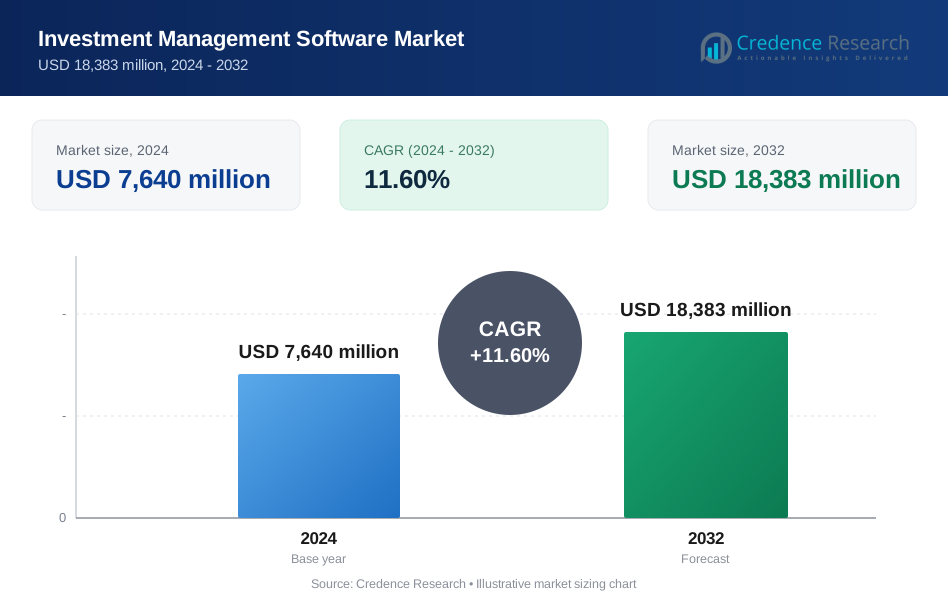
The Investment Management Software Market is projected to grow from USD 7,640 million in 2024 to USD 18,383 million by 2032, registering a compound annual growth rate (CAGR) of 11.6%.
The Investment Management Software Market growth is driven by the increasing demand for automation and digitization in financial services, which enhances efficiency and accuracy in portfolio management. Rising complexities in investment strategies and regulatory compliance compel firms to adopt advanced software solutions to streamline operations and ensure transparency. The growing adoption of artificial intelligence, machine learning, and big data analytics enables personalized investment insights and real-time decision-making, further boosting market expansion. Additionally, the surge in wealth management services and increasing retail investor participation contribute to the rising need for scalable and user-friendly platforms. Cloud-based deployment models gain traction due to their cost-effectiveness, flexibility, and ease of integration with existing systems. Trends indicate a shift toward mobile-enabled solutions and enhanced cybersecurity features to protect sensitive financial data. Furthermore, strategic partnerships between software providers and financial institutions accelerate innovation, driving continuous improvements in software capabilities and user experience across the investment management landscape.
The Investment Management Software Market spans key regions including North America, Europe, and Asia Pacific, each contributing significantly to global growth. North America leads with 40 percent market share, driven by a mature financial ecosystem and high technology adoption. Europe holds 25 percent, fueled by strict regulatory standards and increasing demand for compliance and risk management solutions. Asia Pacific accounts for 20 percent, reflecting rapid economic growth and rising retail investor participation. Key players operating across these regions include BlackRock Solutions, SS&C Technologies, SimCorp, Fidelity National Information Services (FIS), Charles River Development, FactSet Research Systems, Envestnet, Broadridge Financial Solutions, Addepar, Orion Advisor Solutions, Morningstar, and Eze Software (SS&C Eze). These companies focus on innovation, regional customization, and strategic partnerships to strengthen their market presence and meet diverse client needs worldwide.
Market Insights:
- The Investment Management Software Market is projected to grow from USD 7,640 million in 2024 to USD 18,383 million by 2032, registering a CAGR of 11.6%.
- Market growth is driven by increasing demand for automation and digitization in financial services, enhancing portfolio management efficiency and accuracy.
- Adoption of artificial intelligence, machine learning, and big data analytics enables personalized investment insights and real-time decision-making, fueling expansion.
- Wealth management services and rising retail investor participation increase demand for scalable, user-friendly platforms.
- Cloud-based deployment models gain traction due to cost-effectiveness, flexibility, and ease of integration, with trends moving toward mobile-enabled solutions and enhanced cybersecurity.
- North America leads with 40% market share, followed by Europe at 25% driven by regulatory standards, and Asia Pacific at 20% fueled by rapid economic growth and expanding retail investors.
- Key challenges include complex regulatory compliance, evolving data privacy laws, and integration difficulties with legacy systems, requiring continuous software updates and adaptable solutions.
Market Drivers:
Rising Demand for Automation and Operational Efficiency:
The increasing complexity of financial markets and investment strategies drives financial institutions to adopt advanced software solutions. Investment management software automates tasks such as trade processing, reporting, and compliance checks, reducing human error and operational costs. It streamlines portfolio management by integrating data from multiple sources, improving decision-making speed and accuracy. Firms require tools that handle diverse asset classes and regulatory frameworks efficiently, fueling demand. Real-time analytics enhance risk management and portfolio optimization, propelling ongoing investment in innovation and software upgrades.
- For instance, Fidelity collaborated with iCapital to offer wealth managers access to hundreds of alternative investment strategies and integrated digital transaction execution, significantly improving workflow efficiency and client reporting for registered investment advisors and broker-dealers.
Adoption of Artificial Intelligence and Advanced Analytics:
The Investment Management Software Market benefits greatly from integrating artificial intelligence (AI), machine learning, and big data analytics. These technologies enable predictive modeling and personalized investment recommendations, helping asset managers identify opportunities and risks more precisely. AI-driven automation speeds up data processing and client reporting, freeing resources for strategic work. Firms use advanced analytics to optimize portfolio performance and improve client engagement. This technological progress meets investor expectations for customized, data-driven services while supporting regulatory compliance through enhanced transparency and audit capabilities.
Growth of Wealth Management and Retail Investment:
The expanding wealth management sector and rising retail investor participation increase demand for investment management software solutions. Financial advisors and wealth managers need robust platforms to deliver tailored strategies and maintain detailed client profiles. Retail investors seek digital tools offering easy access to investment products and real-time portfolio tracking. Software providers respond by creating user-friendly interfaces and mobile apps to attract this growing base. Increasing global wealth, especially in emerging markets, further drives market growth. Providers focus on scalability and enhanced functionality to meet diverse client needs efficiently.
Shift Toward Cloud-Based Solutions and Enhanced Security:
Cloud deployment models gain momentum in the Investment Management Software Market due to scalability, flexibility, and cost advantages. Firms prefer cloud solutions for seamless integration with existing systems and remote access, supporting hybrid work environments. Cloud platforms enable faster software updates and smooth collaboration among global teams. Enhanced cybersecurity features address concerns over data breaches and regulatory scrutiny. Providers implement strong encryption, multi-factor authentication, and continuous monitoring to protect sensitive financial data. This focus on security builds client trust and ensures compliance, increasing the appeal of cloud-based offerings.
- For instance, a US investment bank transitioned its global research division-comprising over 800 analysts and producing 150,000 reports annually-to a cloud platform hosted on AWS. The deployment implemented advanced encryption and application-level security, meeting both ISO/IEC 27017 standards and the bank’s own stringent security requirements, which helped boost productivity and maintain high data protection levels.
Market Trends:
Increasing Integration of Artificial Intelligence and Machine Learning:
The Investment Management Software Market increasingly incorporates artificial intelligence (AI) and machine learning (ML) to enhance decision-making and operational efficiency. AI-powered predictive analytics enable asset managers to analyze large volumes of data in real time, identifying investment opportunities and risks with greater precision. Automation of routine processes such as portfolio rebalancing and risk management reduces manual errors and speeds execution. Machine learning models continuously improve by learning from market trends and investor behavior, enabling personalized investment strategies. This trend pushes software providers to innovate rapidly and deliver smarter, more adaptive solutions.
Expansion of Cloud-Based Solutions and SaaS Models:
Cloud computing adoption transforms the Investment Management Software Market by promoting Software-as-a-Service (SaaS) offerings. Firms benefit from scalable and flexible cloud platforms that reduce upfront IT infrastructure investments and enable rapid deployment. Cloud-based solutions provide anywhere, anytime access to data and applications, supporting remote and hybrid workforce models. Continuous updates enhance software capabilities and user experience. Integration with third-party tools becomes easier, fostering collaboration across global teams. The cloud shift accelerates innovation cycles, allowing firms to respond quickly to evolving business needs and regulatory changes.
- For instance, BlackRock migrated its Aladdin investment platform to Microsoft Azure, enabling faster product delivery, enhanced scalability, and improved operational resilience for its global investment operations.
Focus on Enhanced Cybersecurity and Data Privacy:
Cybersecurity and data privacy gain critical importance in the Investment Management Software Market due to rising regulatory demands and sophisticated cyber threats. Providers embed advanced security features such as multi-factor authentication, end-to-end encryption, and intrusion detection within their platforms. Compliance with regulations like GDPR and SEC guidelines drives firms to prioritize secure data handling and risk management. Real-time monitoring and rapid incident response capabilities strengthen defenses against breaches. This emphasis on security builds client trust and safeguards sensitive financial information, making it a central element of software offerings.
- For instance, SS&C Technologies’ investment management solutions use real-time monitoring and automated audit trails, enabling rapid incident response and transparent reporting for regulatory compliance.
Adoption of Mobile and User-Centric Platforms:
The Investment Management Software Market emphasizes mobile accessibility and enhanced user experience to meet investor demands. Mobile applications offer real-time portfolio tracking, enabling investors to monitor and manage assets on the go. User-friendly interfaces simplify navigation and provide clear, actionable insights through visual analytics. These features improve communication between advisors and clients, supporting personalized service delivery. The rise of retail investors fuels demand for convenient, mobile-first solutions. Providers focus on continuously updating features and integrating new technologies to maintain engagement and competitive advantage through superior usability.
Market Challenges Analysis:
Complex Regulatory Compliance and Data Privacy Requirements:
The Investment Management Software Market faces significant challenges due to evolving regulatory frameworks and stringent data privacy laws. Firms must ensure software solutions comply with global regulations such as GDPR, SEC mandates, and other regional standards, which often vary and change frequently. It demands continuous updates and rigorous auditing capabilities within the software. Failure to meet compliance can lead to severe penalties and reputational damage. Navigating these complex requirements increases operational costs and complicates software development. Providers must balance functionality with compliance to deliver reliable, secure platforms that satisfy regulatory expectations without hindering performance.
Integration Difficulties and Legacy System Limitations:
Many investment firms struggle to integrate new software with existing legacy systems, posing a major challenge in the Investment Management Software Market. It complicates data migration and synchronization across disparate platforms, leading to inefficiencies and potential data inconsistencies. Legacy infrastructure often lacks flexibility, hindering the adoption of advanced features such as AI and cloud deployment. Integration challenges delay implementation timelines and increase costs. Software providers must develop adaptable solutions capable of seamless interoperability. Overcoming these limitations requires careful planning and investment, which can slow technology modernization efforts across the industry.
- For instance, Fidelity partnered with iCapital to integrate alternative investment solutions into its Wealthscape platform. This collaboration enabled straight-through processing and eliminated manual subscription document completion, but required significant API integrations to ensure seamless data transfer and interoperability between legacy and new systems.
Market Opportunities:
Expansion in Emerging Markets and Growing Retail Investor Base:
The Investment Management Software Market presents significant opportunities due to rising wealth and increasing financial literacy in emerging economies. Growing retail investor participation creates demand for accessible, easy-to-use platforms that offer real-time portfolio management and personalized investment advice. It enables providers to develop scalable solutions tailored to diverse client needs and regulatory environments. Expanding internet penetration and mobile device usage further support market growth by enhancing software accessibility. Firms that focus on localizing features and complying with regional regulations can capture new customer segments. This opportunity encourages innovation in user experience and product offerings to meet evolving investor expectations.
Advancements in Technology and Demand for Customized Solutions:
Rapid technological progress fuels opportunities in the Investment Management Software Market through the integration of artificial intelligence, blockchain, and cloud computing. It allows firms to offer enhanced analytics, improved transparency, and secure transaction capabilities. Growing demand for personalized investment strategies and real-time insights pushes providers to innovate and differentiate their offerings. Cloud adoption reduces costs and accelerates deployment, appealing to a wider client base. The rise of environmental, social, and governance (ESG) investing also drives demand for software that supports responsible investment analysis. Providers leveraging these trends position themselves to capitalize on evolving market requirements and gain competitive advantage.
Market Segmentation Analysis:
By Component
The Investment Management Software Market segments into software and services components. The software segment dominates due to continuous demand for advanced portfolio management, risk analysis, and compliance tools. It offers automation, real-time analytics, and seamless integration with financial data sources. The services segment includes consulting, implementation, and support, which help firms customize and optimize software deployment. Growing complexity in investment strategies increases the need for professional services, supporting ongoing software adoption and upgrades. Providers focus on delivering comprehensive solutions that combine both components to enhance client satisfaction and operational efficiency.
By Deployment Mode
The market divides into on-premises and cloud deployment modes, with cloud gaining significant traction. Cloud solutions offer scalability, flexibility, and cost-efficiency, enabling firms to access platforms remotely and integrate easily with existing systems. It supports faster software updates and collaboration among global teams. On-premises deployments remain preferred by institutions with strict data control and regulatory requirements. However, the shift toward cloud-based models accelerates due to increasing acceptance of digital transformation in the financial sector. Providers continue to enhance cloud security and compliance features to meet client demands.
By Application
Application segments include portfolio management, compliance management, risk management, reporting, and others. Portfolio management holds the largest share, driven by the need to optimize asset allocation and maximize returns. Compliance management grows steadily as regulatory pressure intensifies, requiring robust monitoring and reporting tools. Risk management gains importance due to market volatility and evolving financial risks. Reporting solutions enhance transparency and investor communication through real-time data visualization. Other applications cover performance analysis and client relationship management. The Investment Management Software Market expands by addressing diverse application needs with specialized, integrated platforms.
Segments:
Based on Component
- Software
- Services
Based on Deployment Mode
- On-Premises
- Cloud
Based on Application
- Portfolio Management
- Compliance Management
- Risk Management
- Reporting
- Others
Based on End-User
- Banks
- Investment Management Firms
- Trading & Exchange Firms
- Brokerage Firms
- Others
Based on the Geography:
- North America
- U.S.
- Canada
- Mexico
- Europe
- Germany
- France
- U.K.
- Italy
- Spain
- Rest of Europe
- Asia Pacific
- China
- Japan
- India
- South Korea
- South-east Asia
- Rest of Asia Pacific
- Latin America
- Brazil
- Argentina
- Rest of Latin America
- Middle East & Africa
- GCC Countries
- South Africa
- Rest of the Middle East and Africa
Regional Analysis:
North America
North America holds the largest share in the Investment Management Software Market, accounting for 40 percent of the global revenue. The region benefits from a mature financial services industry, high adoption of advanced technologies, and strong regulatory frameworks. It houses major software providers and financial institutions that drive demand for sophisticated investment management solutions. Firms prioritize automation, compliance, and risk mitigation, fueling software innovation. The presence of numerous asset management firms and wealth management companies further accelerates market growth. Investments in AI, cloud computing, and cybersecurity remain strong. North America continues to lead by offering cutting-edge platforms and services to meet evolving client requirements.
Europe
Europe accounts for 25 percent of the Investment Management Software Market, driven by robust regulatory standards and a growing emphasis on compliance and risk management. The region’s financial hubs demand software solutions that ensure transparency and support complex investment strategies. Cloud adoption gains momentum, supported by investments in digital infrastructure and data privacy laws such as GDPR. Firms in Europe increasingly focus on ESG (environmental, social, and governance) investing, requiring customized software capabilities. The presence of global and regional players fosters competitive innovation. Europe’s market expands steadily with technology integration and regulatory compliance as key growth factors.
Asia Pacific
Asia Pacific captures 20 percent market share in the Investment Management Software Market, reflecting rapid economic growth and rising investor awareness in emerging economies. Increasing wealth and expanding retail investor bases drive demand for accessible and scalable investment software. The region embraces cloud-based solutions due to cost advantages and mobile accessibility. Financial institutions invest in automation and analytics to improve portfolio performance and client engagement. Regulatory frameworks continue to evolve, prompting firms to adopt compliant platforms. Asia Pacific presents strong growth potential as it balances modernization with diverse market needs, attracting global software providers to expand their presence.
Key Player Analysis:
- Orion Advisor Solutions
- FactSet Research Systems
- SS&C Technologies
- Morningstar
- Envestnet
- Broadridge Financial Solutions
- Fidelity National Information Services (FIS)
- SimCorp
- BlackRock Solutions
- Addepar
- Charles River Development
- Eze Software (SS&C Eze)
Competitive Analysis:
The Investment Management Software Market features intense competition among key players striving to deliver innovative, scalable solutions. Leading companies such as BlackRock Solutions, SS&C Technologies, SimCorp, and Fidelity National Information Services (FIS) focus on expanding their product portfolios through technological advancements like AI, cloud computing, and advanced analytics. It emphasizes customer-centric customization, seamless integration, and robust security to differentiate offerings. Strategic partnerships, mergers, and acquisitions remain common tactics to enhance market presence and expand geographic reach. Smaller firms like Addepar and Orion Advisor Solutions concentrate on niche markets with specialized tools targeting wealth management and retail investors. Continuous investment in research and development enables players to address evolving regulatory requirements and client expectations. Competition drives rapid innovation and service improvement, shaping the future landscape of the Investment Management Software Market.
Recent Developments:
- In April 2024, CrowdStreet integrated blockchain technology into its platform to improve transparency and security in real estate investment transactions.
- In May 2024, SyndicationPro introduced an AI-driven analytics module to help real estate syndicators analyze market trends and optimize investment strategies.
- In February 2024, Domos FS launched a cloud-based solution designed for private equity firms, offering advanced portfolio management and investor reporting tools.
- In March 2024, ATWeb released an updated version of its investment management software with a redesigned user interface and strengthened data security protocols to better support financial institutions.
Market Concentration & Characteristics:
The Investment Management Software Market demonstrates a moderately concentrated competitive landscape dominated by a few key players such as BlackRock Solutions, SS&C Technologies, and SimCorp. These companies leverage advanced technologies, extensive client networks, and strong financial resources to maintain market leadership and expand their global footprints. It features a dynamic mix of large established firms alongside specialized niche providers that cater to diverse market segments like wealth management, retail investing, and institutional asset management. The market characteristics include rapid innovation cycles driven by evolving investor needs, increasing adoption of cloud-based and AI-powered solutions, and a growing emphasis on regulatory compliance and data security. Customer demands focus heavily on scalability, customization, seamless integration capabilities, and user-friendly interfaces. Intense competition encourages continuous product enhancements, strategic partnerships, and acquisitions, shaping market dynamics and fostering sustained growth within the Investment Management Software Market. This environment challenges providers to balance innovation with compliance and operational efficiency to meet diverse client requirements.
Report Coverage:
The research report offers an in-depth analysis based on Component, Deployment Mode, Application, End-User and Geography. It details leading market players, providing an overview of their business, product offerings, investments, revenue streams, and key applications. Additionally, the report includes insights into the competitive environment, SWOT analysis, current market trends, as well as the primary drivers and constraints. Furthermore, it discusses various factors that have driven market expansion in recent years. The report also explores market dynamics, regulatory scenarios, and technological advancements that are shaping the industry. It assesses the impact of external factors and global economic changes on market growth. Lastly, it provides strategic recommendations for new entrants and established companies to navigate the complexities of the market.
Future Outlook:
- The Investment Management Software Market will rapidly advance through continuous integration of emerging technologies and innovative features.
- Firms will rely heavily on artificial intelligence to improve accuracy and efficiency in investment decision-making processes.
- Cloud-based deployment will lead the market, offering scalable, flexible, and cost-effective software solutions for users globally.
- Enhanced cybersecurity protocols will become essential to protect sensitive client data from growing cyber threats and breaches.
- Regulatory compliance requirements will increasingly influence software design, ensuring firms meet evolving legal standards effectively.
- Software providers will focus on improving user experience and mobile accessibility to attract and retain diverse investor bases.
- Platforms will enhance compatibility with legacy systems, enabling smoother integration and minimizing operational disruptions for firms.
- Demand will grow for personalized, data-driven insights that empower investors to make more informed portfolio decisions.
- Collaborative partnerships between software companies and financial institutions will drive faster innovation and expanded service offerings.
- Emerging economies will present strong opportunities for market expansion due to increasing financial literacy and digital adoption.
Request a Free Sample
Fill in your details and we'll send you a free sample report.
- Sample data tables & charts
- Research methodology
Need a Custom Version of This Report?
Tailor the scope, geography, or segments to your exact requirements.
- Custom geography or segment scope
- Direct access to our analyst team
Frequently Asked Questions
What is the current size of the Investment Management Software Market?
What factors are driving the growth of the Investment Management Software Market?
What are the key segments within the Investment Management Software Market?
What are some challenges faced by the Investment Management Software Market?
Who are the major players in the Investment Management Software Market?
Table of Content
Chapter 1. Report Introduction
- 1.1 Report Description & Purpose
- 1.1.1 Report Title & Market Definition
- 1.1.2 Unique Selling Propositions (USP) & Key Differentiators
- 1.1.3 Value Proposition for Stakeholders
- 1.2 Research Objectives
- 1.2.1 Market Sizing Objectives (Volume & Revenue) (Volume Where Applicable)
- 1.2.2 Segmentation Objectives
- 1.2.3 Competitive Intelligence Objectives
- 1.2.4 Forecast & Scenario Objectives
- 1.3 Report Scope
- 1.3.1 Investment Management Software Scope – Segments & Subsegments Covered
- 1.3.2 Geographic Scope – Regions & Countries Covered
- 1.3.3 Historical Period, Base Year & Forecast Period (2024; forecast to 2032)
- 1.3.4 Inclusions & Exclusions
- 1.4 Industry Classification & Applicable Codes
- 1.5 Currency, Measurement Units & Valuation Basis
- 1.6 Target Stakeholders
- 1.7 Limitations & Assumptions
Chapter 2. Executive Summary
- 2.1 Global Investment Management Software Market Snapshot
- 2.1.1 Market Size – Historical (2024) & Forecast (2024-2032) (2024: USD 7,640 million → 2032: USD 18,383 million)
- 2.1.2 Volume & Revenue – Global Totals (Volume Where Applicable)
- 2.1.3 Key Market Highlights – Top Five Facts
- 2.2 Investment Management Software Market Segmentation Snapshot
- 2.2.1 Market Split by Region – 2024 vs. 2032
- 2.3 Competitive Snapshot
- 2.3.1 Top 10 Players by Revenue Share – 2024
- 2.3.2 Top 10 Players by Volume Share – 2024 (Volume Where Applicable)
- 2.3.3 Recent Strategic Developments (18-Month Summary)
- 2.4 Key Investment Highlights & Strategic Conclusions
Chapter 3. Investment Management Software Market Dynamics & Industry Analysis
- 3.1 Market Overview & Context
- 3.1.1 Investment Management Software Market Position in the Broader Industry Value Chain
- 3.1.2 Demand Structure & Purchasing Dynamics
- 3.1.3 Market Maturity & Development Stage by Region
- 3.2 Investment Management Software Market Drivers
- 3.3 Investment Management Software Market Restraints & Challenges
- 3.4 Investment Management Software Market Opportunities
- 3.5 Porter's Five Forces Analysis
- 3.5.1 Threat of New Entrants
- 3.5.2 Bargaining Power of Suppliers
- 3.5.3 Bargaining Power of Buyers
- 3.5.4 Threat of Substitutes
- 3.5.5 Competitive Rivalry – Intensity Assessment
- 3.6 Investment Management Software Value Chain Analysis
- 3.6.1 Upstream – Key Inputs, Resources & Suppliers
- 3.6.1.1 Key Input/Resource 1
- 3.6.1.2 Key Input/Resource 2
- 3.6.1.3 Key Input/Resource 3
- 3.6.2 Midstream – Core Operations & Value Creation
- 3.6.2.1 Operating Model & Process Overview
- 3.6.2.2 Key Operating Locations & Capabilities by Company
- 3.6.3 Downstream – Market Channels & End Users
- 3.6.3.1 Direct Sales & Customer Engagement Channels
- 3.6.3.2 Indirect Sales, Intermediaries & Partner Channels
- 3.6.4 Value Chain Profitability Analysis
- 3.6.1 Upstream – Key Inputs, Resources & Suppliers
- 3.7 PESTEL Analysis
- 3.7.1 Political Factors
- 3.7.2 Economic Factors
- 3.7.3 Social Factors
- 3.7.4 Technological Factors
- 3.7.5 Environmental Factors
- 3.7.6 Legal Factors
- 3.8 Investment Management Software Supply Chain Analysis
- 3.8.1 Critical Input & Resource Availability Risk Assessment
- 3.8.2 Supplier & Operational Concentration Risk (Geographic Exposure)
- 3.8.3 Supply & Service Disruption Impact Analysis
- 3.9 Regulatory & Policy Landscape
Note: The regulatory and policy landscape section covers regulations based on their applicability to the market, Investment Management Software category, geography, and scope of the study. Only regulatory frameworks with a material impact on operations, compliance, trade, sustainability, or market access are analyzed in detail.
Chapter 4. Key Investment Pockets & Opportunity Analysis
- 4.1 Investment Management Software Market Attractiveness Analysis
- 4.1.1 By Region – Investment Attractiveness Matrix (Market Size × CAGR)
- 4.2 Absolute Revenue Growth Opportunity
- 4.2.1 By Region – Absolute Revenue Growth Through 2032
- 4.3 Incremental Demand Opportunity
- 4.3.1 By Region – Incremental Demand Through 2032
- 4.3.2 Segment – Incremental Demand
- 4.4 Emerging Submarket Opportunity Deep Dive (Subject to Applicability)
- 4.5 Priority Market Opportunity Scorecards
- 4.5.1 United States
- 4.5.2 Europe
- 4.5.3 Asia
- 4.5.4 Middle East & Africa
Note: Priority market opportunity scorecards reflect the geographic scope and strategic relevance of the study. Listed markets are indicative and may be adapted to the industry.
Chapter 5. Investment Management Software Cross-Border Trade & Market Access Analysis
- 5.1 International Trade & Cross-Border Activity Overview
- 5.1.1 Global Export Value by Country (2024)
- 5.1.2 Global Export Volume by Country (2024) (Volume Where Applicable)
- 5.1.3 Global Import Value by Country (2024)
- 5.1.4 Global Import Volume by Country (2024) (Volume Where Applicable)
- 5.1.5 Net Trade Balance by Country (2024)
- 5.2 Export Analysis – Segment
- 5.2.1 Category 1 (Applicable Classification Code)
- 5.2.2 Category 2 (Applicable Classification Code)
- 5.2.3 Category 3 (Applicable Classification Code)
- 5.2.4 Category 4 (Applicable Classification Code)
- 5.2.5 Category 5 (Applicable Classification Code)
- 5.3 Import Analysis – Segment
- 5.3.1 Category 1 (Applicable Classification Code)
- 5.3.2 Category 2 (Applicable Classification Code)
- 5.3.3 Category 3 (Applicable Classification Code)
- 5.3.4 Category 4 (Applicable Classification Code)
- 5.3.5 Category 5 (Applicable Classification Code)
- 5.4 Cross-Border Pricing & Transaction Benchmarks
- 5.4.1 Export Pricing – Segment & Country
- 5.4.2 Import Pricing – Segment & Source Country
- 5.4.3 Price Trends (2024)
- 5.5 Key Cross-Border Trade & Delivery Routes
- 5.5.1 Cross-Border Trade/Delivery Route 1
- 5.5.2 Cross-Border Trade/Delivery Route 2
- 5.5.3 Cross-Border Trade/Delivery Route 3
- 5.5.4 Cross-Border Trade/Delivery Route 4
- 5.5.5 Cross-Border Trade/Delivery Route 5
- 5.6 Trade Policy & Market Access Impact Assessment
- 5.6.1 Tariff & Non-Tariff Barriers
- 5.6.2 Regional Trade & Economic Integration Frameworks
- 5.6.3 Bilateral & Multilateral Trade Agreements
- 5.6.4 Cross-Border Operating, Licensing & Localization Requirements
Note: This chapter applies where cross-border trade or delivery is relevant to Investment Management Software. Goods, services, and digital offerings are assessed using applicable classifications and transaction measures. Import-export volumes, trade balances, and route analyses are included only where meaningful to the market.
Chapter 6. Competitive Landscape & Company Benchmarking
- 6.1 Investment Management Software Market Concentration & Structure
- 6.1.1 Herfindahl-Hirschman Index (HHI) – vs. 2024
- 6.1.2 Leading, Mid-Sized & Emerging Player Structure
- 6.1.3 Global, Regional & Local Player Dynamics
- 6.2 Investment Management Software Market Share Analysis – 2024
- 6.2.1 Global Revenue Share by Company
- 6.2.2 Global Volume Share by Company (Volume Where Applicable)
- 6.2.3 Regional Revenue Share
- 6.2.4 Market Share Evolution ( vs. 2024)
- 6.2.5 Company Market Share by Key Segment
- 6.2.6 Company Market Share by Customer Group
- 6.3 Operating Scale, Capacity & Infrastructure Analysis
- 6.3.1 Global Operating Scale & Supply Capacity
- 6.3.2 Resource Utilization & Operating Efficiency
- 6.3.3 Output, Service Delivery & Activity Metrics
- 6.3.4 Operating Footprint & Infrastructure Map
- 6.3.5 Planned Operational & Capacity Expansion
- 6.4 Investment Management Software Competitive Benchmarking Matrix
- 6.4.1 Revenue, Growth, Profitability & Operating Metric Comparison
- 6.4.2 Channel Revenue Mix
- 6.4.3 Geographic Revenue Exposure
- 6.4.4 R&D Intensity
- 6.4.5 Sustainability Maturity
- 6.5 Strategic Developments in Investment Management Software (Last 24 Months)
- 6.5.1 Mergers, Acquisitions & Divestments
- 6.5.2 New Products, Services & Solutions in Investment Management Software
- 6.5.3 Operational & Infrastructure Expansions
- 6.5.4 Strategic Alliances, Joint Ventures & Partnerships
- 6.5.5 Distribution Expansion & Market Entry
- 6.5.6 Sustainability & ESG Initiatives
- 6.6 Competitive Strategy Mapping
- 6.6.1 Leader, Challenger, Follower & Niche Classification
- 6.6.2 Pricing Strategy Comparison
- 6.6.3 Channel Strategy Matrix
Note: Strategic developments are included based on their materiality and the availability of reliable information.
Chapter 7. Global Investment Management Software Market – By Sales & Delivery Channel
- 7.1 Segment Overview
- 7.1.1 Volume & Revenue Split by Channel (2024 & 2032) (Volume Where Applicable)
- 7.1.2 Channel Mix Evolution (2024-2032)
Chapter 8. Regional Market Analysis – Global Overview
- 8.1 Global Regional Overview
- 8.1.1 Regional Volume Share (Volume Where Applicable)
- 8.1.2 Regional Revenue Share
- 8.1.3 Regional Volume by Region (Volume Where Applicable)
- 8.1.4 Regional Revenue by Region
- 8.1.5 Regional Forecast Through 2032
- 8.2 Cross-Regional Segment Analysis
- 8.2.1 By Sales & Delivery Channel
- 8.2.2 By Competitive Positioning & Price Tier
Chapter 9. North America Investment Management Software Market
- 9.1 United States
- 9.2 Canada
- 9.3 Mexico
Chapter 10. Europe Investment Management Software Market
- 10.1 Germany
- 10.2 France
- 10.3 Italy
- 10.4 United Kingdom
- 10.5 Spain
- 10.6 Poland
- 10.7 Russia
- 10.8 Netherlands
- 10.9 Belgium
- 10.10 Sweden
- 10.11 Denmark
- 10.12 Norway
- 10.13 Rest of Europe
Chapter 11. Asia Pacific Investment Management Software Market
- 11.1 China
- 11.2 India
- 11.3 Japan
- 11.4 South Korea
- 11.5 Thailand
- 11.6 Indonesia
- 11.7 Vietnam
- 11.8 Malaysia
- 11.9 Australia
- 11.10 Rest of Asia Pacific
Chapter 12. Latin America Investment Management Software Market
- 12.1 Brazil
- 12.2 Argentina
- 12.3 Colombia
- 12.4 Chile
- 12.5 Rest of Latin America
Chapter 13. Middle East Investment Management Software Market
- 13.1 Saudi Arabia
- 13.2 United Arab Emirates
- 13.3 Turkey
- 13.4 Israel
- 13.5 Iran
- 13.6 Rest of the Middle East
Chapter 14. Africa Investment Management Software Market
- 14.1 South Africa
- 14.2 Egypt
- 14.3 Nigeria
- 14.4 Morocco
- 14.5 Rest of Africa
Chapter 15. Investment Management Software Company Profiles
- 15.1 [Company 01]
- 15.1.1 Company Overview
- 15.1.2 Key Management Personnel
- 15.1.3 Products & Services Portfolio
- 15.1.4 Financial Performance
- 15.1.5 Key Market Focus & Geographic Presence
- 15.1.6 Recent Developments & Strategic Initiatives
Note: The company profile list is preliminary and may change based on research findings, market developments, data availability, and client requirements.
Chapter 16. Appendices
- Appendix A – List of Abbreviations & Acronyms
- Appendix B – Industry Classification Code Reference – Full Series
- Appendix C – Supply, Output & Operating Capacity Data Tables
- Appendix D – End-Use & Demand Base Tables
- Appendix E – Demand, Adoption & Usage Assumptions
- Appendix F – Pricing & Revenue Metric Reference Tables
- Appendix G – Company Operations & Infrastructure Database
- Appendix H – Cross-Border Trade & Activity Data Tables (Where Applicable)
- Appendix I – Regulatory Summary Tables
- Appendix J – Primary Research Participant List (Anonymized)
- Appendix K – Primary Research Questionnaire Framework
- Appendix L – Data Sources & Bibliography
- Appendix M – Market Size Divergence & Source Comparison
Chapter 17. Research Methodology
- 17.1 Research Framework & Philosophy
- 17.2 Secondary Research – Sources, Hierarchy & Data Extraction
- 17.3 Data Modeling – Bottom-Up & Top-Down Market Sizing
- 17.4 Primary Research – Stakeholder Framework, LOI & Sample Sizes
- 17.5 Forecast Methodology – Regression, Scenario & Sensitivity Analysis
- 17.6 Quality Control – Four-Layer Validation Framework
- 17.7 Limitations & Standard Assumptions
- 17.8 Disclaimer
