
New halls and attack volume set protection budgets
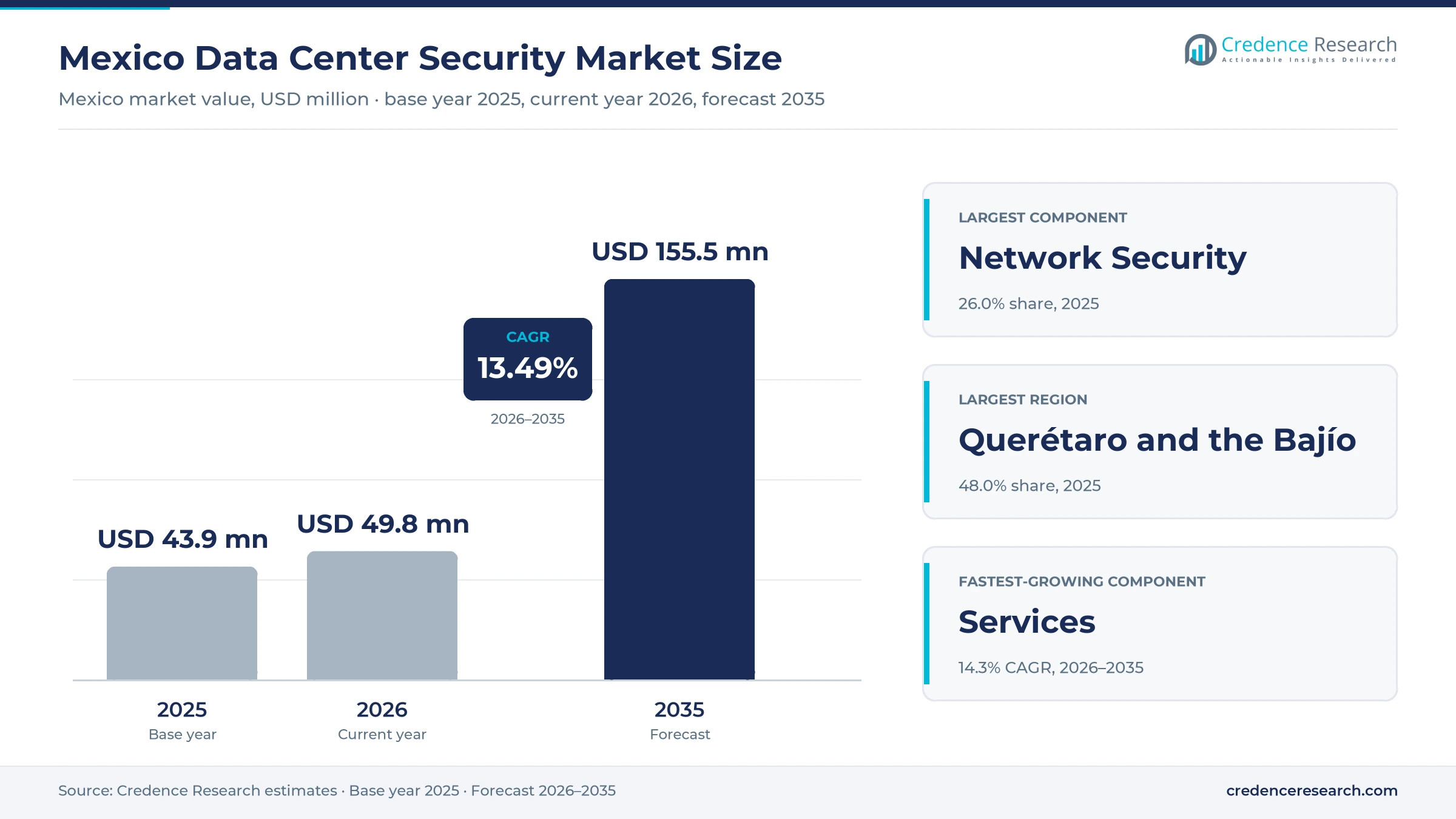
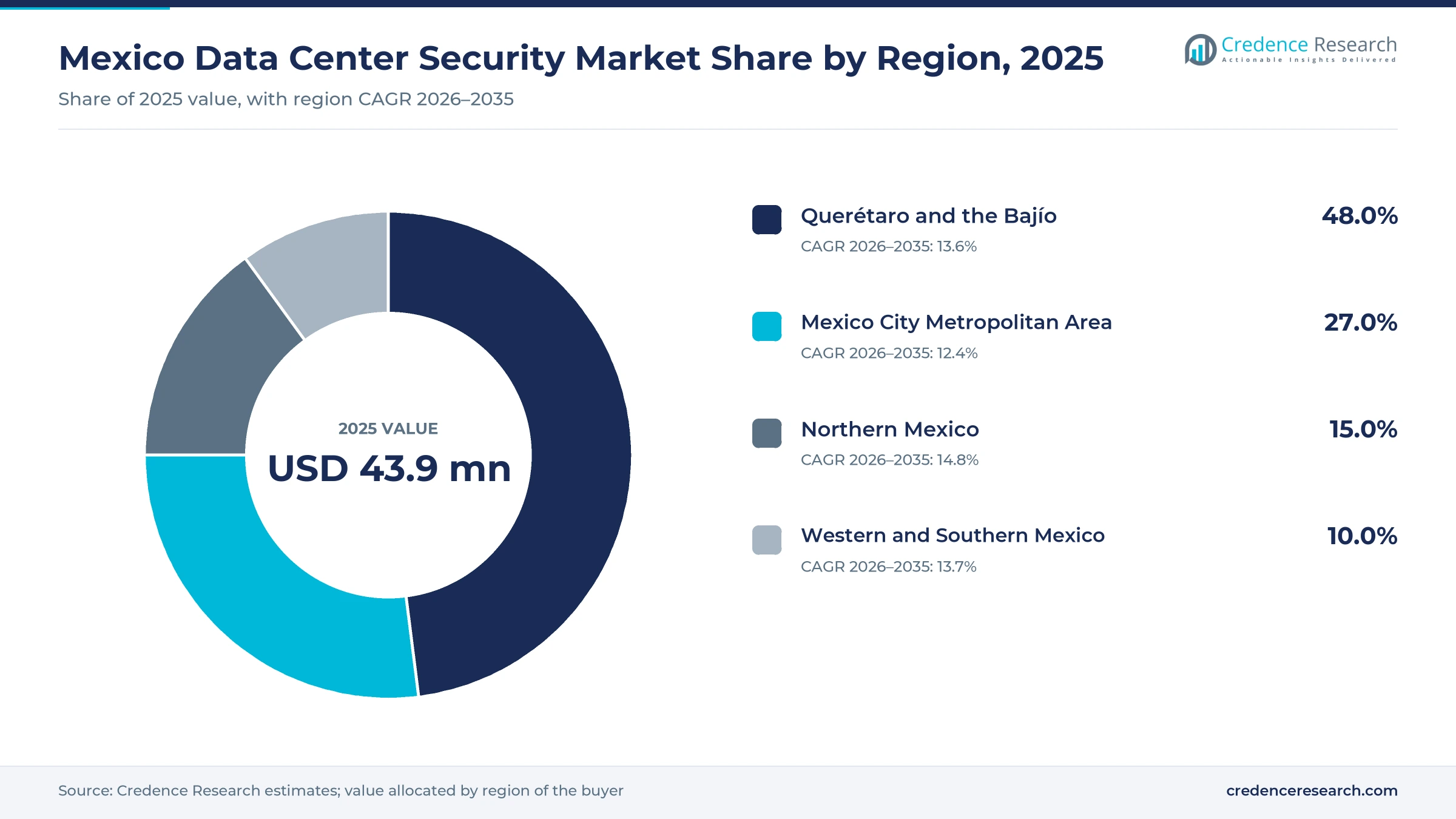
The Mexico data center security market was valued at USD 43.9 million in 2025 and is projected to increase from USD 49.8 million in 2026 to USD 155.5 million by 2035, registering a CAGR of 13.49% during 2026–2035. Spending comes from colocation and cloud operators that fence, monitor and segment new halls, from banks and federal agencies that run their own data rooms under stricter rules, and from integrators that sell monitoring as a monthly service. Querétaro and the Bajío held the largest regional share, 48.0% in 2025, because most operating capacity sits in Querétaro, while Northern Mexico grows fastest at 14.8% a year as Monterrey and border cities add sites. The most important regulatory change came in March 2025, when a new federal law on personal data held by private parties replaced the earlier statute and moved oversight away from the former transparency institute. Buyers now weigh audit evidence as heavily as attack prevention when they choose suppliers.
Perimeter, network and monitoring controls bought for each hall
The market counts what owners and tenants of data centers in Mexico spend on physical protection such as perimeter barriers, video, intrusion detection and access control, on network, data, identity and event-monitoring controls deployed for the facility and its hosted systems, and on consulting, integration and managed monitoring services. Operators usually buy physical systems through integrators during construction and logical controls as subscriptions renewed every year.
General office cybersecurity, consumer products and the security that cloud providers build into their own platforms are excluded. The value chain runs from equipment and software makers through distributors and integrators to managed service providers, and margins are widest in recurring monitoring contracts rather than in one-time hardware sales.
Mexico Data Center Security Market Insights
- The Mexico data center security market was valued at USD 43.9 million in 2025 and is projected to reach USD 155.5 million by 2035, growing at a 13.49% CAGR during 2026–2035.
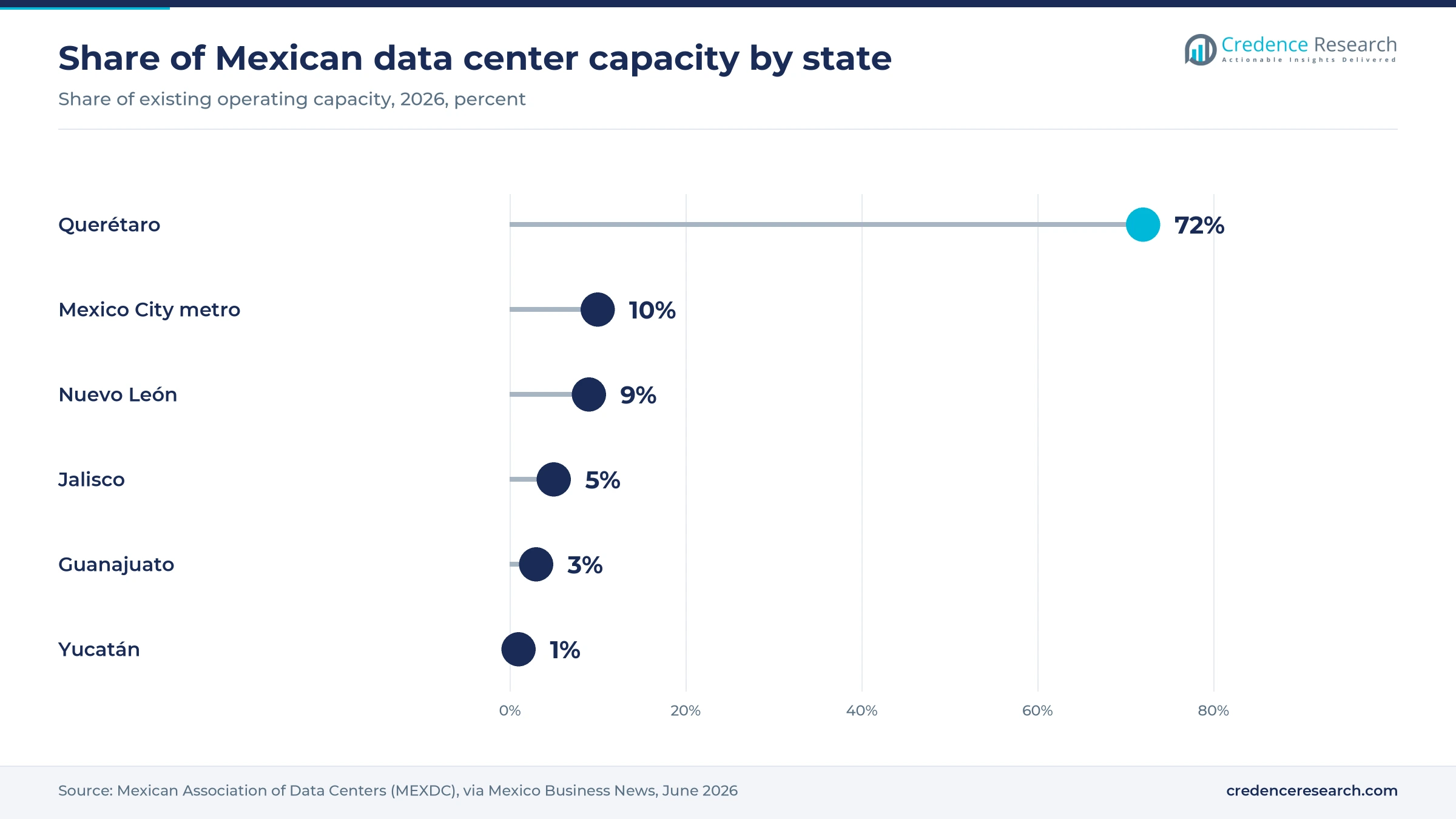
- Querétaro and the Bajío held 48.0% of 2025 value, because Querétaro alone hosts 72% of national operating data center capacity, according to MEXDC.
- Network security held 26.0% of 2025 value, as segmentation and traffic inspection are the first logical controls installed in every new hall.
- Mexico recorded 40.6 billion attempted cyberattacks in the first half of 2025 and ranked second in Latin America, according to Fortinet's FortiGuard Labs.
- Hewlett Packard Enterprise completed its acquisition of Juniper Networks on July 2, 2025, combining two networking portfolios sold to Mexican data center buyers.
Network controls lead while managed services grow fastest
Segmentation spending keeps network security in front
Based on component, the market is categorized into physical security, network security, data security, identity and access management, security information and event management, and services. Network Security led with 26.0% of 2025 value because segmentation and traffic inspection are bought for every hall, and Mexico faced 40.6 billion attempted intrusions in the first half of 2025, according to Fortinet's FortiGuard Labs as reported by Mexico Business News. Services grow fastest at 14.3% as operators outsource monitoring, and demand for cybersecurity and technology specialists in Mexico rose 35% in 2024, according to the Mexican Association of Human Capital Companies.
Large data centers lead while medium sites grow fastest
Based on type, the market is categorized into small, medium and large data centers. Large data centers led with 52.0% of 2025 value because campus operators protect wide perimeters, many halls and several tenants at once, and the largest Mexican facility, in Querétaro, operates at 149 MW, according to MEXDC data reported by Mexico Business News in June 2026. Medium data centers grow fastest at 14.1% as regional operators add sites, and Telmex added data centers in Tijuana and Chihuahua, both certified to ICREA Level III, to its Triara network, according to DPL News in November 2026.
IT and telecom lead while government grows fastest
Based on end use, the market is categorized into IT and telecom, BFSI, government, retail and e-commerce, manufacturing, healthcare and others. IT & Telecom led with 31.0% of 2025 value because colocation, cloud and carrier operators own most halls, and Equinix opened its MO2 site in Apodaca with more than 720 cabinets and a USD 81 million first phase, according to ComputerWeekly. Government grows fastest at 14.9% from a smaller base, as the Digital Transformation and Telecommunications Agency is set to receive MXN 3,852 million in 2026, a real increase above 20%, according to Expansión, although that budget is not exclusive to cybersecurity.
| Segment Group | Leading Sub-segment | Share, 2025 | Fastest-growing Sub-segment | CAGR, 2026–2035 |
|---|---|---|---|---|
| By Component | Network Security | 26.0% | Services | 14.3% |
| By Type | Large Data Center | 52.0% | Medium Data Center | 14.1% |
| By End Use | IT & Telecom | 31.0% | Government | 14.9% |
Monitoring labor costs drive most service contracts
Buyers in Mexico pay for physical systems per device and per project, for firewalls and identity tools as an appliance or license plus an annual subscription, and for monitoring per managed device or per month. Labor is the main cost in service contracts, because a round-the-clock monitoring seat needs about five analysts across shifts. Operators that cannot hire enough analysts buy managed monitoring, which shifts margin toward providers that spread staff across many clients. Imported cameras, readers and appliances also carry duties that move with trade policy. Published firewall list prices and monitoring fees in Mexico are an evidence gap, because vendors quote through partners.
| Item | Typical price or fee | Basis |
|---|---|---|
| Average cost of a data breach, Latin America | USD 2.51 million per breach, 316 days to identify and contain | IBM Cost of a Data Breach 2025, via ComputerWeekly |
| Import duty on video cameras, HS 8525.81.01 | 10% most-favored-nation rate for countries without a trade agreement | Camtom tariff listing (indicative), 2026 |
| Import tariff, goods from countries without a trade agreement | Up to 35%, some lines 50%, from Jan. 1, 2026 | FreightWaves, December 2025 |
Request a Free Sample
Fill in your details and we'll send you a free sample report.
- Sample data tables & charts
- Research methodology
Attack volume, new capacity and data rules lift spending
Mexico ranks second in Latin America for attacks
Attack volume turns protection from a compliance line into an operating cost that operators cannot defer. The intrusion volume noted above ranked Mexico second in Latin America in the first half of 2025, according to Fortinet's FortiGuard Labs. Scitum's SCILabs found that Mexico accounted for 15.90% of ransomware attacks in the region in the same period, behind Brazil at 33.85%, according to UnoTV. The federal cybersecurity plan of December 2025 counted 155 Mexican victims listed on digital extortion forums between 2019 and 2025, with LockBit behind about a quarter of attacks. Operators respond with segmentation, inspection and isolated backups, and that demand keeps network security the largest component.
A capacity pipeline several times the installed base
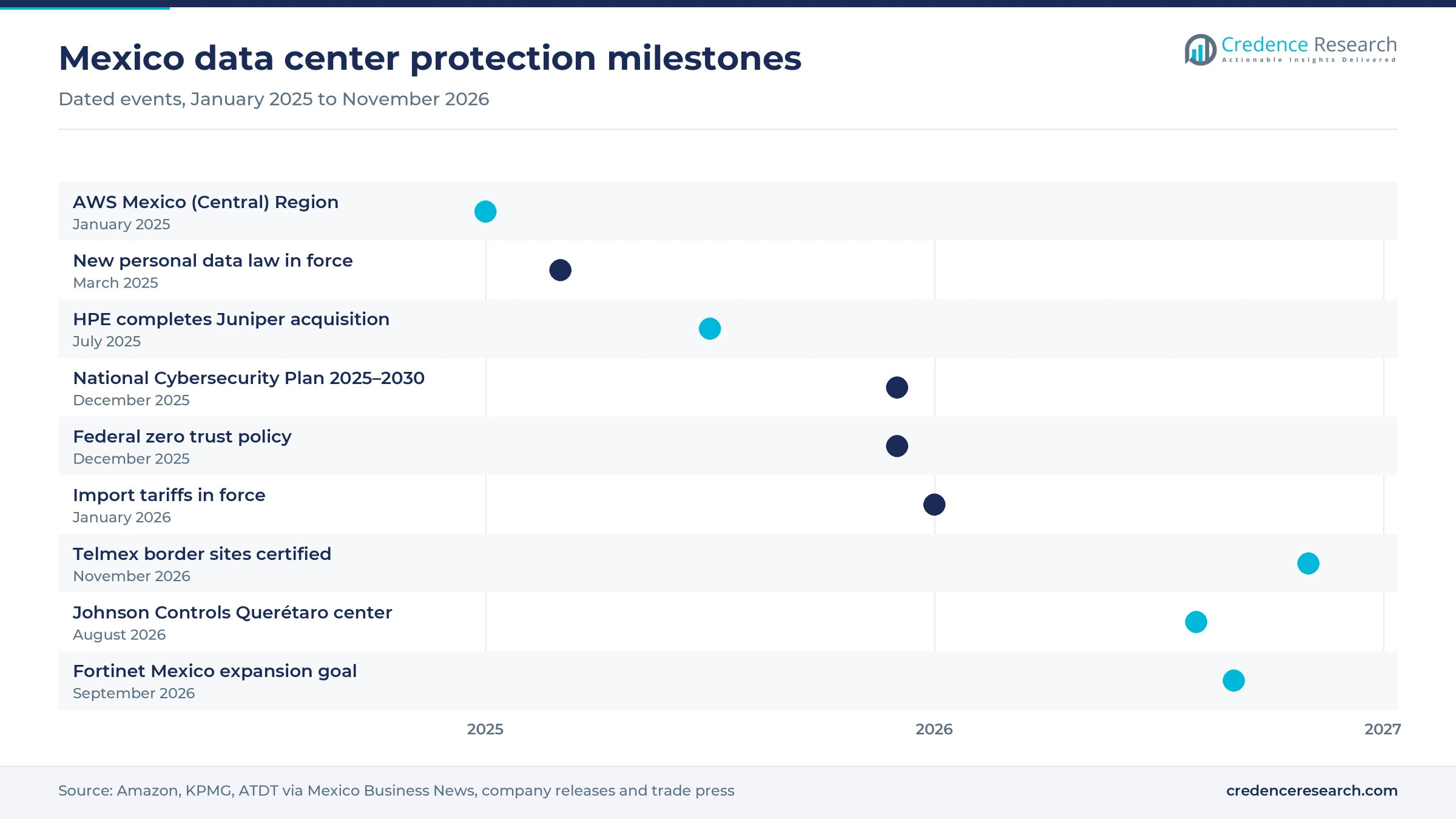
Every new hall needs fences, cameras, readers and logical controls before a tenant can move in. The Mexican Association of Data Centers counts 279 MW installed, 205 MW under construction and 1,730 MW announced, according to Mexico Business News in June 2026. The association also expects more than USD 18 billion of direct investment and 1,516 MW of added power capacity from 2025 to 2030, a target rather than committed capital. AWS launched its Mexico (Central) Region with three Availability Zones in January 2025 and plans to invest more than USD 5 billion over 15 years, according to Amazon. Integrators of access control systems and video gain first, because they are hired during construction.
A new data protection law raises audit pressure
Operators that host personal data for banks, retailers and hospitals must now show their controls to a different authority. The new federal law on personal data held by private parties was published in the Official Gazette on March 20, 2025 and took effect the next day, according to KPMG. Oversight passed to the Ministry of Anticorruption and Good Government, and the former transparency institute, INAI, was dissolved, according to the same analysis. The federal zero trust policy of December 2025 also requires audit clauses and minimum security standards for cloud providers in federal contracts, according to Mexico Business News. Hosting providers with documented controls win regulated tenants, while those without logs and access records lose bids.
A broad online user base expands hosted workloads
More online banking, retail and public services mean more systems hosted in Mexican halls and more traffic to inspect. Individuals using the internet reached 83.1% of the population in 2024, up from 69.6% in 2019, according to the World Bank. Secure internet servers rose from about 349 to about 532 per million people between 2021 and 2024, according to the same World Bank data. AWS lists BBVA, Hospital Angeles and the states of Guanajuato, Jalisco and Michoacán among its active customers in Mexico, according to Amazon. Each regulated workload placed in a local hall adds identity, encryption and logging requirements that hosting operators must meet before contracts are signed.
Converged protection and zero trust reshape purchases
Physical and cyber protection are converging
Operators are shifting toward platforms that join video, access, fire and network alerts to address cyber-physical risks, creating openings for integrated monitoring across new halls. Mexico Business News reported in December 2025 that the main threats to these sites include unauthorized access, sabotage, human error and IT and operational technology convergence, with responses built on 24/7 automated monitoring. Axis Communications shows more than 100 linked video, access control and audio devices at its Mexico City Experience Center. Johnson Controls opened a Querétaro service center in August 2026 for fire protection, building controls and electronic security, adding to more than 180 technicians it employs in Mexico, according to MexicoIndustry. Suppliers that service both layers locally gain longer contracts, while single-product installers lose specification power.
Zero trust and cloud-delivered controls are rising
Federal agencies and large enterprises are shifting toward zero trust architectures and cloud-delivered access controls to address remote and multicloud traffic, creating openings for identity and access management across hosted systems. The Digital Transformation and Telecommunications Agency requires federal entities to adopt zero trust and report critical incidents within 24 hours, according to Mexico Business News in December 2025. Fortinet said in September 2026 that SASE opportunities in Latin America grew more than 500% and that it aims to raise Mexican operating resources by 30%, according to ITSitio. HPE presented identity-based access control and data center segmentation to Mexican partners in February 2026. Identity vendors gain, while perimeter-only appliances face shorter refresh cycles.
Managed monitoring is an opening for mid-size operators
Operators that cannot staff a round-the-clock team need outsourced monitoring, which favors local providers with Spanish-speaking analysts and incident teams. KIO says its Cyber SOC has more than 130 cybersecurity experts, manages more than 2,200 devices and runs a CSIRT around the clock. Telmex sells protection services from Scitum, its cybersecurity unit, alongside hosting in its Triara data center network, according to DPL News in November 2026. About 86% of Mexican organizations plan to raise cybersecurity budgets in 2026, according to PwC data cited by Mexico Business News. Providers of managed detection services gain recurring revenue that hardware sellers cannot match.
Northern edge sites are an opening for local protection
Industrial automation and lower latency to Texas are pulling smaller sites into northern Mexico, which creates new perimeters to protect outside Querétaro. Mexico Business News reported in December 2025 that edge data centers are moving to northern Mexico, especially Monterrey, to serve IoT and industrial automation. The C5 found that Nuevo León accounts for 24% of cyberattacks in Mexico, with digital threats up 78% over the previous year, according to Mexico Business News in May 2026. New border sites add capacity for colocation operators and their tenants. Integrators with crews in Monterrey and border cities gain first access, while Querétaro-only service teams face long travel times.
Scarce analysts, draft rules and tariffs slow buyers
Analyst shortages leave monitoring seats unfilled
Only 1.4% of the 341,000 technology students in higher education focus on cybersecurity, according to ANUIES data reported by Mexico Business News in June 2026, so the pool of new analysts grows slowly. Operators of smaller and regional data centers are most exposed, because large providers and banks outbid them for the few trained analysts. Many of them will delay in-house monitoring and buy outside services instead, which limits their own hiring.
A general cybersecurity law is still a draft
The federal government intends to present a General Cybersecurity Law, but Expansión reported in January 2026 that the draft has conceptual and structural gaps, according to Víctor Ruiz of Silikn. The national plan cites NIST and ISO/IEC 27001 as references without making them mandatory. Private operators therefore lack a binding minimum standard, which slows compliance-led purchases. Vendors that sell on regulation rather than threat reduction face the highest risk until the law passes.
New import tariffs may raise equipment costs
The Senate approved tariffs of up to 35% on most goods and up to 50% on some goods from countries without a trade agreement on Dec. 10, 2025, covering more than 1,400 products from Jan. 1, 2026, according to FreightWaves. Whether camera, reader and appliance tariff lines carry the higher rates is an evidence gap. Integrators that rely on Asian-made cameras and readers are most exposed, while North American assembly gains on landed cost.
Small firms hosting their own servers underinvest
Small and mid-size firms that run their own server rooms buy fewer controls than colocation operators, which caps the small data center segment. Only 3% of companies in Nuevo León use advanced technology to optimize internal processes, while small and mid-size firms make up 90% of companies in the state, according to Mexico Business News in May 2026. These firms are most exposed to ransomware, and many will move workloads to colocation rather than secure their own rooms.
Querétaro leads while the north grows fastest
| Region | Value, 2025 (USD million) | Share, 2025 | CAGR, 2026–2035 |
|---|---|---|---|
| Querétaro and the Bajío | 21.1 | 48.0% | 13.6% |
| Mexico City Metropolitan Area | 11.8 | 27.0% | 12.4% |
| Northern Mexico | 6.6 | 15.0% | 14.8% |
| Western and Southern Mexico | 4.4 | 10.0% | 13.7% |
Querétaro and the Bajío lead on campus capacity
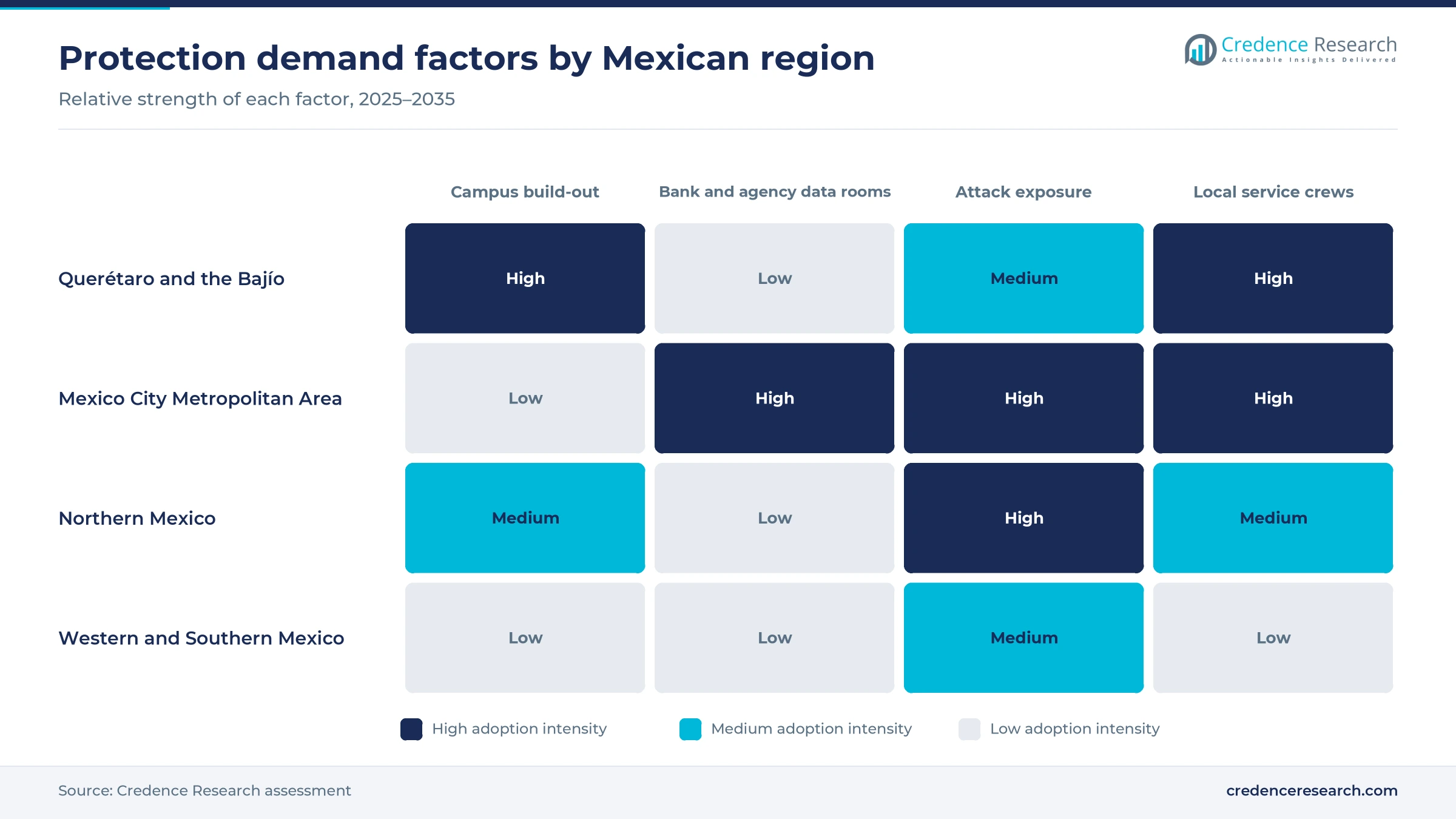
Querétaro and the Bajío held 48.0% of 2025 value and grow at 13.6% a year. Querétaro holds 72% of national operating capacity and Guanajuato 3%, according to MEXDC data reported by Mexico Business News in June 2026. The value share sits below the capacity share because hyperscale tenants supply much of their own logical protection on their hyperscale campuses. The Johnson Controls service center described above gives operators a local technician base close to the campuses.
Mexico City carries bank and government data rooms
The Mexico City Metropolitan Area held 27.0% of 2025 value and grows at 12.4% a year. The metro area holds 10% of national operating capacity, according to MEXDC, but banks and federal agencies keep many protected data rooms near their headquarters. Banco de México requires financial entities to run an information security unit at the highest level, headed by a CISO. That concentration keeps identity and event-monitoring spending per site above the national average.
Northern Mexico grows fastest on edge and border sites
Northern Mexico held 15.0% of 2025 value and grows fastest at 14.8% a year. Nuevo León holds 9% of national operating capacity, the third-largest state share, according to MEXDC. The Equinix site in Apodaca, the Telmex border sites and the high share of attacks in Nuevo León described above all add protection demand. More than 60% of the national transmission network operates near maximum capacity, with bottlenecks in Nuevo León and northern border states, which may delay some sites.
Western and southern Mexico start from a small base
Western and southern Mexico held 10.0% of 2025 value and grow at 13.7% a year. Jalisco holds 5% of national operating capacity and Yucatán 1%, according to MEXDC. State governments in Jalisco and Michoacán already run workloads on AWS, which shifts some protection spending to cloud contracts rather than local halls. Published data on protection projects in the south are thin, so this estimate rests on more assumptions than the others.
Acquisitions, service centers and policy steps since 2025
| Development | Status and market relevance |
|---|---|
| In July 2025, Hewlett Packard Enterprise completed its acquisition of Juniper Networks and later folded Juniper into HPE Networking. | Completed acquisition; the combined portfolio is sold to Mexican data center buyers through ten named partners. |
| In December 2025, the Digital Transformation and Telecommunications Agency published the General Cybersecurity Policy for federal agencies. | Policy published; the agency has 180 days after it takes effect to issue technical guidelines. |
| In November 2026, Telmex said its new Tijuana and Chihuahua data centers obtained ICREA Level III certification. | Certification milestone; it extends managed protection to border regions. |
| In August 2026, Johnson Controls inaugurated a service center in Querétaro for industrial clients and data center operators. | Operational launch; it adds a spare-parts warehouse, a repair center and a technician base in the Bajío. |
| In September 2026, Fortinet set a goal to raise its Mexican operating resources by 30% by the end of 2026. | Plan; the company had more than 15 open commercial positions in Mexico. |
Segmentation, monitoring and identity decide each design
- Microsegmentation divides traffic between racks, tenants and workloads, which limits how far ransomware can spread once an attacker is inside a hall.
- Event monitoring and response platforms collect logs from firewalls, servers and access systems, which lets a monitoring center spot incidents and prove compliance to auditors.
- Multi-factor and biometric access combines cards, codes and biometrics at doors and consoles, which ties every physical and logical entry to a named person.
- Video analytics flags loitering, tailgating and perimeter breaches in real time, which reduces the number of guards needed on large campuses.
Need a Custom Version of This Report?
Tailor the scope, geography, or segments to your exact requirements.
- Custom geography or segment scope
- Direct access to our analyst team
Channel reach and local SOC capacity decide contracts
Competition runs on three fronts, and buyers often pick a different leader for each. Network vendors compete on segmentation, inspection and cloud-delivered access, with Cisco selling switching, firewalls and Umbrella cloud protection, Fortinet expanding its Mexican team, Palo Alto Networks selling firewalls and cloud protection through Mexican partners, and HPE selling the combined HPE and Juniper portfolio. Managed service providers compete on analysts and response times, and Scitum, backed by Telmex and KIO run monitoring centers with local incident teams. Physical protection suppliers compete on installed base and service crews, with Honeywell and Johnson Controls offering access, video and fire systems and Axis supplying network cameras. Operators increasingly favor suppliers that can combine layers under one contract, which raises the value of partnerships between network vendors and local monitoring providers.
Global vendors sell through partners while local providers run monitoring
Supply in this market is organized in three separate layers of companies. Global network and software vendors such as Cisco, Fortinet, Palo Alto Networks and HPE sell through distributors and integrators, and HPE named ten partners, including TD SYNNEX, Ingram, Grupo CVA and CompuSoluciones, at its Mexican networking event in February 2026. Fortinet reports more than 14,000 partners across Latin America as a whole. Local providers such as Scitum and KIO run monitoring centers, and physical systems come from Honeywell, Johnson Controls and Axis through installers. Entry is easiest in installation and hardest in monitoring, where trained analysts and response teams are scarce, so margins sit in recurring service contracts.
Network, managed service and physical protection suppliers in Mexico
| Company | Type | Role in the market |
|---|---|---|
| Cisco Systems, Inc. | Network and cloud protection vendor | Segmentation, firewalls and cloud-delivered protection sold in Mexico |
| Fortinet, Inc. | Network protection vendor | Firewalls and SASE sold in Mexico through partners, with a growing local team |
| Palo Alto Networks, Inc. | Network protection vendor | Firewalls and cloud protection sold in Mexico through partners |
| Hewlett Packard Enterprise (Juniper Networks) | Networking vendor | Data center switching, segmentation and identity-based access through Mexican partners |
| Scitum (Telmex) | Managed service provider | Monitoring, threat intelligence and incident response across Telmex data centers |
| KIO | Data center and managed service provider | Runs a 24/7 Cyber SOC and CSIRT alongside its Mexican data centers |
| Honeywell International Inc. | Physical protection supplier | Access control, video, intrusion and fire systems for Mexican data centers |
| Johnson Controls International plc | Physical protection and building systems supplier | Fire protection, electronic security and building controls for data center operators |
| Axis Communications AB (Canon) | Network video and access supplier | Network cameras and access devices sold through Mexican integrators |
Managed monitoring, not hardware, will set the pace
Credence Research's view is that managed monitoring, not hardware, will set the pace of the Mexico data center security market through 2035. Physical systems are bought once per hall, while monitoring and response contracts renew every year and grow with the number of devices under watch. The analyst shortage noted above means few operators can run their own centers, which favors providers that pool analysts across clients. Suppliers that pair network controls with local response teams are best placed, while sellers of standalone appliances face pressure on price.
2025 estimate rebuilt from the earlier edition and checked
The report uses 2025 as the base year and forecasts to 2035. Market values in this report come from the Credence Research model. This edition of the Mexico data center security report brings the previous 2023 estimate forward to 2025 with its original growth rate and checks the result against installed capacity, typical protection spending per facility and public investment plans. Segment and regional shares are Credence Research estimates based on association capacity data, government statistics, regulator and legal guidance, trade press and company announcements. No interviews or surveys were carried out for this edition.
Capacity delivery and staffing set the pace to 2035
In the base case the Mexico data center security market grows at 13.49% a year through 2035, as halls now under construction connect and operators protect them with physical, network and monitoring controls. Network security keeps the largest component share, while services grow at 14.3% a year, the fastest rate of any component, on outsourced monitoring. Querétaro and the Bajío keep the largest regional share, and Northern Mexico gains on edge and border sites. Analyst shortages, a draft cybersecurity law and equipment tariffs are the main risks to that path.
Capacity delivery and staffing decide the range of outcomes
The outcome depends mainly on how fast announced halls receive grid power, whether operators can staff or outsource monitoring, and how strict the final cybersecurity law becomes. Grid delays, a slow law and higher equipment tariffs would hold growth near the downside case. Faster connections, a binding minimum standard for critical infrastructure and wider use of managed monitoring would push spending toward the upside.
| Scenario | CAGR, 2026–2035 | Value, 2035 | What has to hold |
|---|---|---|---|
| Downside | 10.5% | USD 122.2 million | Grid queues delay new halls and the cybersecurity law stalls in Congress |
| Base | 13.49% | USD 155.5 million | Halls under construction connect on time and managed monitoring spreads gradually |
| Upside | 16.0% | USD 189.2 million | A binding law defines critical infrastructure and northern sites scale quickly |
Frequently Asked Questions
How big is the Mexico data center security market?
How many cyberattacks does Mexico face?
How much data center capacity does Mexico have?
Which component leads the market?
Which region leads the market?
What data protection rules apply to Mexican data centers?
What are the main challenges for buyers?
Which companies lead the market?
Table of Content
Chapter 1 Market Segmentation
- 1.1 Segmentation Framework
- 1.1.1 Product and Service Classification
- 1.1.2 Application and End-Use Classification
- 1.1.3 Technology and Solution Classification
- 1.1.4 Customer and Distribution Channel Classification
- 1.1.5 Geographic Segmentation
- 1.1.6 Market Segment Definitions and Boundaries
- 1.2 By Component
- 1.2.1 Network Security
- 1.2.2 Physical Security
- 1.2.3 Data Security
- 1.2.4 Identity and Access Management (IAM)
- 1.2.5 Security Information and Event Management (SIEM)
- 1.2.6 Services
- 1.3 By Type
- 1.3.1 Large Data Center
- 1.3.2 Medium Data Center
- 1.3.3 Small Data Center
- 1.4 By End Use
- 1.4.1 IT & Telecom
- 1.4.2 BFSI
- 1.4.3 Government
- 1.4.4 Retail & E-commerce
- 1.4.5 Manufacturing
- 1.4.6 Healthcare
- 1.4.7 Others
Chapter 2 Introduction
- 2.1 Report Objectives and Scope
- 2.2 Product Definition and Industry Terminology
- 2.3 Market Inclusions and Exclusions
- 2.4 Research Process
- 2.4.1 Primary Research and Expert Interviews
- 2.4.2 Secondary Research and Source Review
- 2.4.3 Top-Down and Bottom-Up Estimation
- 2.4.4 Data Triangulation and Verification
- 2.5 Market Size Measurement Basis
- 2.5.1 2025: USD 43.9 million → 2035: USD 155.5 million
- 2.6 Historical and Forecast Reference Periods
- 2.6.1 Historical Period: 2018-2025
- 2.6.2 Base Year: 2025
- 2.6.3 Forecast Period: 2025-2035
- 2.7 Research Assumptions and Limitations
Chapter 3 Executive Summary
- 3.1 Market Snapshot and Key Findings
- 3.2 Base-Year Market Size, 2025
- 3.3 Forecast Market Size, 2035
- 3.4 Revenue and Volume Growth Outlook
- 3.5 Key Demand and Supply Indicators
- 3.6 Leading Market Segments
- 3.7 Fastest-Growing Market Opportunities
- 3.8 Regional Performance Highlights
- 3.9 Technology and Industry Transformation
- 3.10 Competitive Landscape Summary
- 3.11 Analyst View and Strategic Implications
Chapter 4 Mexico Data Center Security Market Trends and Developments
- 4.1 Historical Industry Development, 2018-2025
- 4.2 Recent Market Trends and Developments
- 4.3 Demand and Customer Behavior Trends
- 4.4 Technology and Product Innovation
- 4.5 Artificial Intelligence, Automation and Digitalization
- 4.6 Local Manufacturing and Supply Chain Realignment
- 4.7 Industry Partnerships, Mergers and Acquisitions
- 4.8 Sustainability and Circular Economy Developments
- 4.9 Government and Private Sector Investment Trends
- 4.10 Emerging Business Models and Commercialization
- 4.11 Industry Developments and Announcements
Chapter 5 Mexico Data Center Security Market Production, Supply and Demand Analysis
- 5.1 Demand Trend and Consumption Analysis, 2018-2025
- 5.2 Demand Forecast, 2025-2035
- 5.3 Production and Output Trend, 2018-2025
- 5.4 Production and Output Forecast, 2025-2035
- 5.5 Installed Capacity and Capacity Utilization
- 5.6 Company-Wise Production Plants and Statistics
- 5.6.1 Installed Production Capacity
- 5.6.2 Actual Production
- 5.6.3 Planned Capacity and Expansion Targets
- 5.7 Supply Chain Structure and Procurement Trends
- 5.8 Supply-Demand Gap and Bottlenecks
- 5.9 Import Dependence and Sourcing Structure
- 5.10 Contract Manufacturing and Outsourcing
- 5.11 Regional Supply and Demand Concentration
Chapter 6 Mexico Data Center Security Market Pricing Analysis
- 6.1 Pricing Structure and Measurement
- 6.2 Historical Pricing Trends, 2018-2025
- 6.3 Pricing Outlook, 2025-2035
- 6.4 Average Selling Price and Unit Economics
- 6.5 Pricing by Product and Market Segment
- 6.6 Geographic Pricing Differences
- 6.7 Key Input, Energy, Labor and Logistics Costs
- 6.8 Contract Pricing and Purchasing Models
- 6.9 Pricing Sensitivity and Competitive Positioning
- 6.10 Price, Margin and Profitability Implications
Chapter 7 Mexico Data Center Security Market Dynamics
- 7.1 Market Growth Drivers
- 7.1.1 Demand-Side Drivers
- 7.1.2 Technology and Innovation Drivers
- 7.1.3 Infrastructure and Investment Drivers
- 7.1.4 Regulatory and Policy Drivers
- 7.2 Market Restraints
- 7.2.1 Cost and Affordability Constraints
- 7.2.2 Technology and Adoption Barriers
- 7.2.3 Supply Chain and Operational Constraints
- 7.3 Market Challenges
- 7.3.1 Competitive Pressure and Margin Erosion
- 7.3.2 Skills, Infrastructure and Implementation Gaps
- 7.4 Emerging Market Opportunities
- 7.5 Market Dynamics Impact and Time-Horizon Assessment
Chapter 8 Mexico Data Center Security Value Chain Analysis
- 8.1 Industry Value Chain Overview
- 8.2 Upstream Suppliers and Critical Inputs
- 8.3 Technology and Component Providers
- 8.4 Manufacturing or Service Delivery
- 8.5 Distribution, Channel Partners and Integrators
- 8.6 Downstream Applications and End Users
- 8.7 Value Addition and Profit Pools
- 8.8 Vertical Integration and Outsourcing
- 8.9 Supplier Concentration and Risk
- 8.10 Supply Chain Localization and Resilience
Chapter 9 Mexico Data Center Security Market Regulations and Policies
- 9.1 Relevant Laws, Standards and Compliance Frameworks
- 9.2 Product, Service, Safety and Quality Requirements
- 9.3 Government Policies, Incentives and Subsidies
- 9.4 Imports, Exports and Trade Barriers
- 9.5 Public Procurement and Local Content Requirements
- 9.6 Environmental and Sustainability Compliance
- 9.7 Data Protection, AI and Cybersecurity Compliance
- 9.8 Upcoming Policy Changes and Market Implications
Chapter 10 Mexico Data Center Security Market Hotspots and Opportunities
- 10.1 Market Opportunity Mapping and Growth Hotspots
- 10.2 High-Growth Applications and Customer Groups
- 10.3 Underserved Markets and White-Space Opportunities
- 10.4 Emerging Technology and Product Opportunities
- 10.5 New Capacity and Investment Hotspots
- 10.6 Market Entry and Expansion Opportunities
- 10.7 Distribution and Partnership Opportunities
- 10.8 Near-Term and Long-Term Commercial Potential
- 10.9 Opportunity Attractiveness and Execution Risks
Chapter 11 Mexico Data Center Security Market Outlook, 2025-2035
- 11.1 Market Size and Analysis
- 11.1.1 Revenue (Market Measurement: 2025: USD 43.9 million → 2035: USD 155.5 million)
- 11.1.2 Market Volume and Quantity Sold
- 11.1.3 Historical Market Size, 2018-2025
- 11.1.4 Base-Year Market Size, 2025
- 11.2 Market Forecast, 2025-2035
- 11.2.1 Revenue Forecast to 2035
- 11.2.2 Volume Forecast to 2035
- 11.2.3 CAGR and Year-on-Year Growth
- 11.2.4 Incremental Revenue Opportunity
- 11.3 Forecast Assumptions and Scenario Analysis
- 11.3.1 Base-Case Forecast
- 11.3.2 Optimistic and Conservative Scenarios
- 11.3.3 Technology, Pricing and Policy Sensitivities
- 11.4 Market Attractiveness and Growth Outlook
Chapter 12 Mexico Data Center Security Market Segmentation and Outlook
- 12.1 Segmentation Summary and Market Shares, 2025
- 12.2 Largest and Fastest-Growing Segments
- 12.3 By Component - Market Size and Forecast, 2025-2035
- 12.3.1 Segment Definition and Scope
- 12.3.2 Historical Market Size, 2018-2025
- 12.3.3 Revenue Forecast, 2025-2035
- 12.3.4 Volume Forecast, 2025-2035
- 12.3.5 Base-Year Market Share, 2025
- 12.3.6 Segment CAGR and Growth Drivers
- 12.3.7 Subsegment Market Size and Forecast
- 12.3.7.1 Network Security
- 12.3.7.2 Physical Security
- 12.3.7.3 Data Security
- 12.3.7.4 Identity and Access Management (IAM)
- 12.3.7.5 Security Information and Event Management (SIEM)
- 12.3.7.6 Services
- 12.3.8 Subsegment Pricing and Adoption Trends
- 12.3.9 Leading Suppliers and Competition
- 12.3.10 Regional Demand and Opportunities
- 12.4 By Type - Market Size and Forecast, 2025-2035
- 12.4.1 Segment Definition and Scope
- 12.4.2 Historical Market Size, 2018-2025
- 12.4.3 Revenue Forecast, 2025-2035
- 12.4.4 Volume Forecast, 2025-2035
- 12.4.5 Base-Year Market Share, 2025
- 12.4.6 Segment CAGR and Growth Drivers
- 12.4.7 Subsegment Market Size and Forecast
- 12.4.7.1 Large Data Center
- 12.4.7.2 Medium Data Center
- 12.4.7.3 Small Data Center
- 12.4.8 Subsegment Pricing and Adoption Trends
- 12.4.9 Leading Suppliers and Competition
- 12.4.10 Regional Demand and Opportunities
- 12.5 By End Use - Market Size and Forecast, 2025-2035
- 12.5.1 Segment Definition and Scope
- 12.5.2 Historical Market Size, 2018-2025
- 12.5.3 Revenue Forecast, 2025-2035
- 12.5.4 Volume Forecast, 2025-2035
- 12.5.5 Base-Year Market Share, 2025
- 12.5.6 Segment CAGR and Growth Drivers
- 12.5.7 Subsegment Market Size and Forecast
- 12.5.7.1 IT & Telecom
- 12.5.7.2 BFSI
- 12.5.7.3 Government
- 12.5.7.4 Retail & E-commerce
- 12.5.7.5 Manufacturing
- 12.5.7.6 Healthcare
- 12.5.7.7 Others
- 12.5.8 Subsegment Pricing and Adoption Trends
- 12.5.9 Leading Suppliers and Competition
- 12.5.10 Regional Demand and Opportunities
- 12.6 Segment Growth Comparison
- 12.7 Segment Attractiveness and Priority Matrix
Chapter 13 Mexico Data Center Security End-Use and Application Market Outlook
- 13.1 End-Use Industry and Customer Demand Structure
- 13.2 Leading Applications and Customer Groups
- 13.3 End-Use Market Size, Share and Forecast
- 13.4 Major End-Use Industry Deep Dives
- 13.4.1 Customer Requirements and Use Cases
- 13.4.2 Demand and Replacement Cycles
- 13.4.3 Technical and Regulatory Considerations
- 13.4.4 Purchasing and Procurement Models
- 13.4.5 Leading Vendors and Distribution Channels
- 13.4.6 Forecast and Commercial Opportunities
- 13.5 Emerging Applications and Cross-Segment Demand
- 13.6 End-Use Industry Investment Priorities
Chapter 14 Mexico Data Center Security Geographic Market Outlook, 2025-2035
- 14.1 Domestic Market Distribution and Demand Clusters
- 14.2 State- or Province-Wise Market Size and Forecast, 2025-2035
- 14.3 City and Metropolitan Market Outlook
- 14.4 Industrial, Manufacturing and Commercial Clusters
- 14.5 Geographic Concentration of Key End Users
- 14.6 Local Pricing and Purchasing Differences
- 14.7 Domestic Production Facilities and Capacity Map
- 14.8 Local Infrastructure and Project Pipeline
- 14.9 State-Level Policy and Incentive Differences
- 14.10 Subnational Investment Hotspots and Opportunities
- 14.11 Distribution and Logistics Networks
- 14.12 Domestic Competitive Footprint
Chapter 15 Mexico Data Center Security Technology, Innovation and Sustainability Outlook
- 15.1 Technology Landscape and Maturity
- 15.2 Product, Process and Service Innovation
- 15.3 AI, Automation and Digital Tools in the Industry
- 15.4 Technology Adoption and Performance Benchmarking
- 15.5 Innovation Pipeline and R&D Investment
- 15.6 Patent and Intellectual Property Trends
- 15.7 Energy Efficiency and Resource Management
- 15.8 Sustainability, Recycling and Circularity
- 15.9 Technology Roadmap, 2025-2035
- 15.10 Risks of Obsolescence and Technology Substitution
Chapter 16 Mexico Data Center Security Market Key Strategic Imperatives
- 16.1 Growth and Market Entry Priorities
- 16.2 High-Return Products and Segments
- 16.3 Pricing, Profitability and Cost Optimization
- 16.4 Technology Investment and Product Differentiation
- 16.5 Supply Chain Localization and Resilience
- 16.6 Distribution and Customer Acquisition
- 16.7 Partnership, Acquisition and Capacity Strategy
- 16.8 Regional Expansion Priorities
- 16.9 Short-, Medium- and Long-Term Actions
Chapter 17 Competition Outlook
- 17.1 Industry Competition Characteristics
- 17.2 Market Structure and Concentration
- 17.3 Market Share and Competitive Positioning, 2025
- 17.4 Company-Wise Revenue and Product Benchmarking
- 17.5 Production and Service Capacity Benchmarking
- 17.6 Technology, Pricing and Differentiation
- 17.7 Regional Footprint and Distribution Strength
- 17.8 Mergers, Acquisitions and Strategic Alliances
- 17.9 New Entrants and Competitive Threats
- 17.10 Porter's Five Forces and Industry Attractiveness
- 17.11 Competitive Outlook, 2025-2035
Chapter 18 Company Profiles
- 18.1 Company Coverage and Selection Criteria
- 18.2 Cisco Systems, Inc.
- 18.2.1 Business Description
- 18.2.2 Company Ownership and Geographic Presence
- 18.2.3 Product and Service Portfolio
- 18.2.4 Manufacturing and Operating Footprint
- 18.2.5 Production Capacity and Expansion Plans
- 18.2.6 Financial Performance and Investment
- 18.2.7 Market Share and Competitive Position
- 18.2.8 Technology and Innovation Capabilities
- 18.2.9 Strategic Alliances or Partnerships
- 18.2.10 Recent Developments
- 18.2.11 Growth Strategy and Outlook
- 18.3 Fortinet, Inc.
- 18.4 Palo Alto Networks, Inc.
- 18.5 Hewlett Packard Enterprise (Juniper Networks)
- 18.6 Scitum (Telmex)
- 18.7 KIO
- 18.8 Honeywell International Inc.
- 18.9 Johnson Controls International plc
- 18.10 Axis Communications AB (Canon)
- 18.11 Other Relevant Market Participants
Note: Every listed company is profiled on the structure shown under the first company. The company list is preliminary and may change based on research findings, market developments, data availability and client requirements.
Chapter 19 Disclaimer
- 19.1 Research and Forecast Disclaimer
- 19.2 Data Source and Estimation Limitations
Note: The depth of individual sections depends on data availability for this market. Volume, capacity, trade and other unit-based metrics are included where applicable.

