
Market Overview:
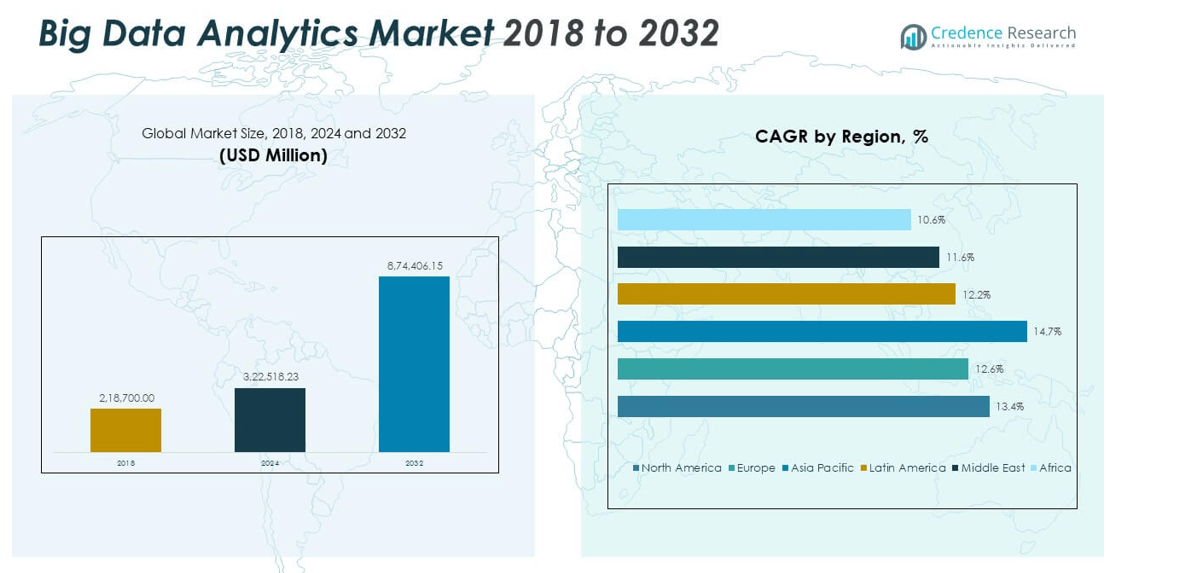
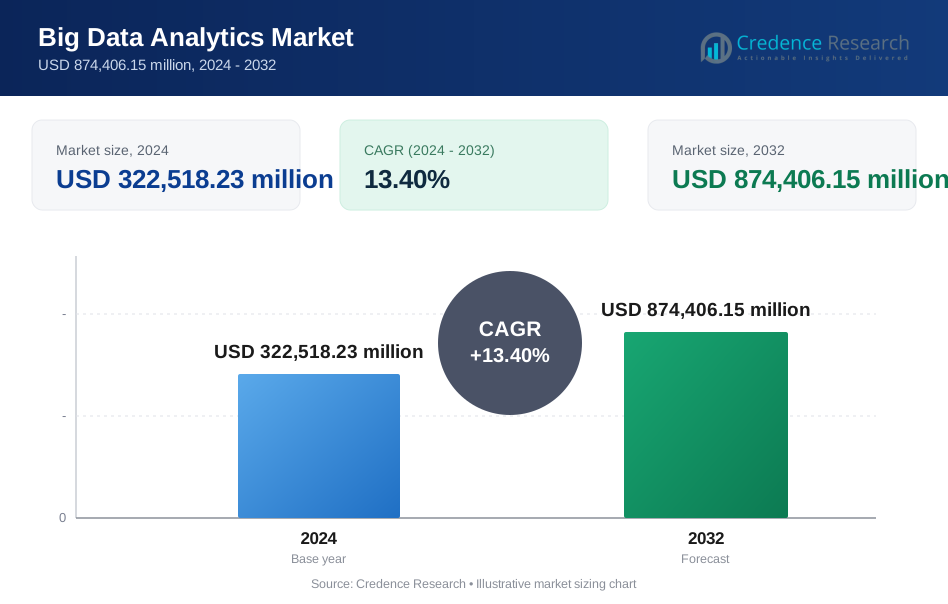
The Global Big Data Analytics Market size was valued at USD 218,700.00 million in 2018 to USD 322,518.23 million in 2024 and is anticipated to reach USD 874,406.15 million by 2032, at a CAGR of 13.40% during the forecast period.
| REPORT ATTRIBUTE | DETAILS |
|---|---|
| Historical Period | 2020-2023 |
| Base Year | 2024 |
| Forecast Period | 2025-2032 |
| Big Data Analytics Market Size 2024 | USD 322,518.23 million |
| Big Data Analytics Market, CAGR | 13.40% |
| Big Data Analytics Market Size 2032 | USD 874,406.15 million |
The market growth is driven by the rising adoption of data-driven decision-making across industries. Increasing data volumes from IoT devices, digital transformation initiatives, and cloud-based analytics solutions are fueling demand. Businesses are leveraging advanced analytics tools for predictive insights, operational efficiency, and customer engagement. The integration of AI and machine learning with analytics platforms further enhances real-time decision-making, supporting industries like finance, healthcare, retail, and manufacturing.
North America dominates the Global Big Data Analytics Market due to strong technological infrastructure and early adoption by enterprises. Europe follows closely, driven by strict regulatory compliance and digital innovation initiatives. Asia-Pacific is emerging rapidly, led by expanding IT infrastructure, rising investments in digitalization, and the growing presence of tech-driven economies such as China and India. The Middle East and Latin America are witnessing steady growth as governments and businesses embrace data analytics to optimize performance and enhance competitiveness.
Market Insights:
- The Global Big Data Analytics Market was valued at USD 218,700.00 million in 2018, reached USD 322,518.23 million in 2024, and is projected to attain USD 874,406.15 million by 2032, expanding at a CAGR of 13.40% during the forecast period.
- North America (36.3%), Europe (25%), and Asia Pacific (29.1%) together account for the majority of global revenue. North America leads due to advanced IT infrastructure and strong enterprise adoption, while Europe benefits from data protection regulations that encourage analytics modernization.
- Asia Pacific is the fastest-growing region with a 1% share, supported by rapid digital transformation, growing e-commerce, and government investments in AI and smart infrastructure.
- Advanced Analytics (AA) holds the largest segmental share, driven by demand for predictive modeling and decision optimization across BFSI and healthcare sectors.
- Data Discovery and Visualization (DDV) follows as a key contributor, enabling real-time insights and interactive reporting that enhance business intelligence and operational agility.
Market Drivers:
Rising Data Generation and Growing Need for Data-Driven Decision Making
The Global Big Data Analytics Market is expanding due to massive data generation from digital platforms, IoT devices, and social networks. Organizations are focusing on extracting actionable insights from unstructured data to improve efficiency and reduce operational costs. It enables predictive decision-making that enhances strategic planning and customer targeting. Industries such as healthcare, retail, and BFSI are adopting analytics to gain competitive advantages. Data monetization is becoming a key revenue stream for enterprises. Real-time analytics tools support quicker business responses and accurate forecasting. Companies rely on data visualization platforms to simplify complex data interpretation. This growth highlights the increasing role of data as a business asset.
Integration of Artificial Intelligence and Machine Learning in Analytics Platforms
AI and ML are transforming the analytical landscape by automating data processing and improving accuracy. These technologies enable predictive insights and faster analysis of large data sets. The Global Big Data Analytics Market benefits from AI-driven models that enhance personalization and customer experience. Intelligent algorithms identify hidden patterns, enabling better product recommendations and fraud detection. Enterprises use machine learning for adaptive analytics that evolves with user behavior. Automation reduces manual effort and shortens decision cycles. Businesses are also deploying natural language processing to enhance human–machine interaction. It strengthens efficiency and broadens analytics applications across industries.
- For instance, Google integrated Gemini AI into BigQuery in 2025, allowing real-time analytics and actionable insights, with marketers reporting cost savings and enhanced campaign automation for large-scale operations.
Expanding Cloud-Based Solutions and Growing Scalability Requirements
The adoption of cloud analytics solutions is accelerating due to flexibility and lower infrastructure costs. Cloud platforms offer seamless integration, storage scalability, and real-time processing capabilities. The Global Big Data Analytics Market leverages cloud ecosystems for improved accessibility and collaboration. Enterprises benefit from hybrid cloud environments that balance security and scalability. Cloud-based tools reduce latency and enhance the performance of analytical operations. Vendors are offering SaaS-based analytics models to simplify deployment. It encourages adoption among small and medium enterprises seeking cost-effective insights. This shift is redefining business agility and innovation across data-centric organizations.
Regulatory Compliance and Rising Focus on Data Security and Governance
Regulatory standards such as GDPR and HIPAA are driving stronger data governance frameworks. Companies are prioritizing secure data management to build trust and avoid penalties. The Global Big Data Analytics Market is witnessing investments in encryption, access control, and monitoring tools. It supports data transparency while maintaining compliance with privacy laws. Enterprises are deploying analytics to audit data usage and improve accountability. Security analytics tools help detect anomalies and potential breaches in real time. Organizations also focus on maintaining ethical AI practices and protecting consumer rights. These factors reinforce the growing importance of compliance-led analytics strategies.
Market Trends:
Shift Toward Predictive and Prescriptive Analytics for Strategic Insights
The Global Big Data Analytics Market is evolving from descriptive analytics toward predictive and prescriptive models. Businesses use these tools to anticipate trends and simulate potential outcomes. Predictive models enhance decision accuracy and risk assessment. Prescriptive analytics helps optimize resource allocation and operational planning. Industries apply these methods to improve production efficiency and customer engagement. It increases the ability to make proactive business adjustments. The use of scenario-based modeling supports smarter forecasting. This trend reflects the growing importance of future-oriented analytics capabilities.
- For instance, IBM and SAP announced in January 2024 their collaboration on new AI solutions, with the IBM watsonx platform integrated into SAP Business Technology Platform to boost productivity and automate operations in the consumer packaged goods sector.
Growing Use of Edge Analytics and Real-Time Data Processing
Edge analytics is gaining traction as organizations demand faster insights close to data sources. The Global Big Data Analytics Market benefits from the ability to process data locally, reducing latency. Real-time analytics supports instant decision-making in applications like autonomous systems and IoT. Companies integrate edge computing with AI to improve responsiveness and efficiency. This model reduces bandwidth usage and enhances data security. Businesses use it to analyze streaming data for dynamic environments. Edge platforms also enable decentralized operations for remote facilities. This shift strengthens business continuity and operational intelligence.
- For instance, at CES 2025, Siemens showcased the Industrial Copilot ecosystem and Industrial Edge platform, enabling rapid, real-time AI decision-making on the shop floor to minimize downtime and enhance operational flexibility for hundreds of global factories.
Increasing Demand for Industry-Specific and Custom Analytics Solutions
The need for sector-focused solutions is reshaping analytics offerings across industries. The Global Big Data Analytics Market sees rising adoption in domains like finance, logistics, and healthcare. Vendors design tools that address unique industry KPIs and regulatory challenges. Tailored dashboards help organizations align analytics with business goals. It allows better control over process optimization and performance tracking. Companies rely on industry-specific algorithms to enhance predictive precision. Custom analytics boosts user engagement and implementation success rates. This personalization trend drives innovation in data analytics platforms.
Integration of Data Analytics with IoT and Smart Infrastructure
IoT connectivity continues to expand, creating new data sources for analytics platforms. The Global Big Data Analytics Market is integrating IoT data for advanced operational visibility. Smart infrastructure projects use analytics to monitor energy, transport, and public safety systems. Businesses gain insights from sensor-based data for predictive maintenance and efficiency. It improves real-time monitoring and incident response. Governments deploy analytics to manage urban infrastructure and reduce resource waste. IoT-driven analytics also supports sustainability and smart city planning. This convergence of IoT and analytics is redefining digital transformation across industries.
Market Challenges Analysis:
High Implementation Costs and Shortage of Skilled Data Professionals
High deployment costs limit adoption among small and mid-sized enterprises. Advanced analytics systems require substantial investments in hardware, software, and integration. The Global Big Data Analytics Market faces a gap between data availability and skilled workforce capacity. It struggles with the shortage of data scientists, engineers, and analysts. Organizations spend heavily on recruitment and training to fill expertise gaps. Limited technical capability leads to underutilization of data assets. Small businesses find it difficult to justify high implementation costs. These challenges slow the pace of technology adoption across developing regions.
Data Privacy Concerns and Complex Integration Across Multiple Systems
Data privacy remains a major concern due to rising cyber threats and regulatory scrutiny. The Global Big Data Analytics Market is affected by compliance complexities when managing global datasets. It faces integration challenges while merging data from legacy and modern systems. Inconsistent data formats often cause inefficiencies and analytical errors. Organizations must invest in secure APIs and interoperability frameworks. Maintaining data accuracy across cloud and on-premise systems adds complexity. Companies risk data silos that hinder a unified analytics view. These limitations affect scalability and operational efficiency across diverse enterprises.
Market Opportunities:
Rising Adoption of Advanced Analytics in Emerging Economies and SMEs
Emerging economies present vast potential for analytics adoption due to expanding digital infrastructure. The Global Big Data Analytics Market is benefiting from increased investment in data-driven ecosystems. SMEs are embracing analytics to enhance operational agility and competitiveness. Governments are supporting digitalization through cloud initiatives and tech funding. It opens new growth channels across Asia-Pacific, Latin America, and Africa. Affordable analytics solutions tailored for small enterprises are gaining popularity. Local vendors are introducing scalable models suited for regional markets. This expansion is expected to broaden global market penetration significantly.
Growing Integration of Analytics with Automation, AI, and Business Intelligence
The convergence of automation, AI, and BI creates strong opportunities for innovation. The Global Big Data Analytics Market is leveraging these technologies to deliver smarter decision systems. Integrated platforms offer end-to-end visibility across operations, finance, and customer relations. AI-enabled analytics enhances self-service data exploration and visualization. It helps organizations automate repetitive tasks and focus on strategic insights. Cross-functional integration enables faster time-to-value for analytics projects. Businesses adopting this approach achieve improved forecasting accuracy and resource efficiency. This synergy is transforming enterprise-level intelligence and market expansion potential.
Market Segmentation Analysis:
By Component
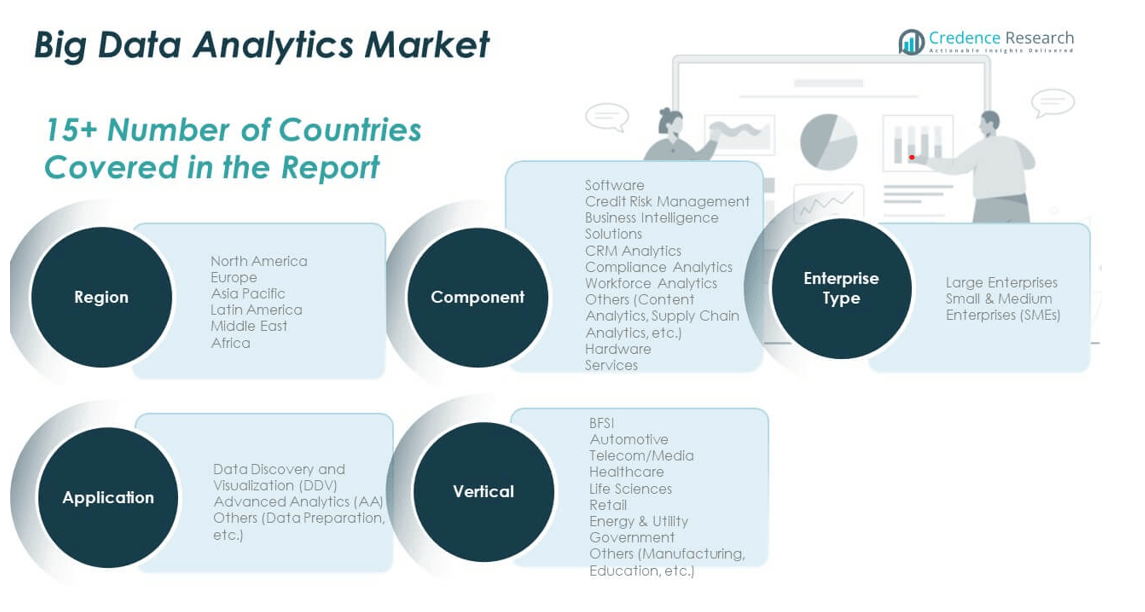
The Global Big Data Analytics Market is categorized into software, hardware, and services. The software segment dominates due to the rising demand for advanced solutions such as credit risk management, business intelligence, CRM analytics, compliance analytics, and workforce analytics. It also includes other tools like content and supply chain analytics that help enterprises manage data effectively. Hardware supports infrastructure scalability, while services ensure seamless integration and maintenance. Increasing adoption of cloud platforms and SaaS-based tools strengthens this segment’s growth across industries.
- For instance, Microsoft’s Fabric Data Warehouse delivered a 36% performance boost across customer workloads in 2025, successfully processing 464TB of data in a single query for Willis Tower Watson, marking major real-world efficiency advancements.
By Application
The market is segmented into Data Discovery and Visualization (DDV), Advanced Analytics (AA), and others such as data preparation. DDV tools are gaining traction for providing actionable insights through intuitive dashboards and real-time visualization. Advanced analytics enables predictive and prescriptive modeling that supports critical decision-making. It assists businesses in improving operational efficiency and understanding customer behavior. The continuous integration of AI and machine learning enhances the value of these applications across enterprises.
- For instance, Tableau released a September 2025 update to Pulse, introducing advanced conversational AI-powered Q&A, enhanced metrics insights, and geo-aware latency features for improved enterprise data visualization efficiency.
By Enterprise Type
The enterprise type segment includes large enterprises and small & medium enterprises (SMEs). Large enterprises lead the market due to higher technology budgets and the need for data-driven operations. SMEs are adopting analytics solutions rapidly to improve competitiveness and reduce costs. It promotes scalability and supports digital transformation initiatives across both segments.
By Vertical
The market spans sectors such as BFSI, automotive, telecom/media, healthcare, retail, energy & utility, government, and others including manufacturing and education. BFSI remains a key adopter due to credit risk and compliance analytics needs. Healthcare and retail sectors use analytics for patient insights and consumer personalization. Growing adoption across government and utilities drives the market’s expansion globally.
Segmentation:
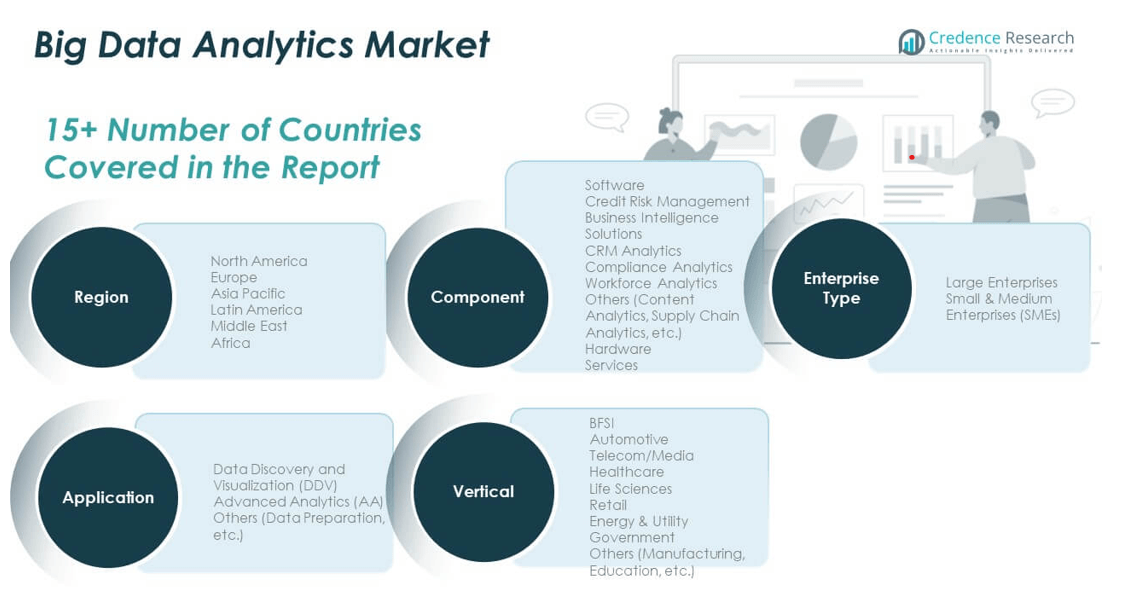
By Component
- Software
- Credit Risk Management
- Business Intelligence Solutions
- CRM Analytics
- Compliance Analytics
- Workforce Analytics
- Others (Content Analytics, Supply Chain Analytics, etc.)
- Hardware
- Services
By Application
- Data Discovery and Visualization (DDV)
- Advanced Analytics (AA)
- Others (Data Preparation, etc.)
By Enterprise Type
- Large Enterprises
- Small & Medium Enterprises (SMEs)
By Vertical
- BFSI
- Automotive
- Telecom/Media
- Healthcare
- Retail
- Energy & Utility
- Government
- Others (Manufacturing, Education, etc.)
By Region
- North America
- S.
- Canada
- Mexico
- Europe
- UK
- France
- Germany
- Italy
- Spain
- Russia
- Rest of Europe
- Asia Pacific
- China
- Japan
- South Korea
- India
- Australia
- Southeast Asia
- Rest of Asia Pacific
- Latin America
- Brazil
- Argentina
- Rest of Latin America
- Middle East
- GCC Countries
- Israel
- Turkey
- Rest of Middle East
- Africa
- South Africa
- Egypt
- Rest of Africa
Regional Analysis:
North America
The North America Global Big Data Analytics Market size was valued at USD 80,481.60 million in 2018 to USD 117,265.69 million in 2024 and is anticipated to reach USD 317,498.45 million by 2032, at a CAGR of 13.4% during the forecast period. North America holds the largest market share of around 36.3%, driven by high technology adoption across industries such as BFSI, healthcare, and retail. It benefits from strong digital infrastructure, established data centers, and early adoption of AI and cloud analytics. Enterprises in the U.S. and Canada lead in integrating predictive analytics for business optimization. Growing investments in IoT, automation, and real-time analytics strengthen regional growth. The presence of major players like IBM, Microsoft, and Oracle enhances innovation. Data privacy regulations and focus on compliance analytics further fuel adoption. It remains a mature and innovation-driven market for data intelligence solutions.
Europe
The Europe Global Big Data Analytics Market size was valued at USD 59,923.80 million in 2018 to USD 85,071.49 million in 2024 and is anticipated to reach USD 218,385.26 million by 2032, at a CAGR of 12.6% during the forecast period. Europe accounts for around 25% of the global market share, supported by regulatory mandates such as GDPR that promote responsible data usage. The region witnesses strong demand across manufacturing, BFSI, and government sectors. Germany, the UK, and France are the key contributors due to advanced industrial digitalization. European enterprises emphasize data governance, security, and transparency. Increasing R&D investments in AI and analytics software support innovation. The rise of smart city initiatives and IoT integration drives data analytics deployment. It demonstrates consistent growth in both cloud-based and on-premise analytics adoption.
Asia Pacific
The Asia Pacific Global Big Data Analytics Market size was valued at USD 55,549.80 million in 2018 to USD 85,417.60 million in 2024 and is anticipated to reach USD 254,715.21 million by 2032, at a CAGR of 14.7% during the forecast period. Asia Pacific captures about 29.1% of the global market share and stands as the fastest-growing region. Strong economic expansion in China, India, Japan, and South Korea supports this growth. Rising digitization, cloud adoption, and e-commerce acceleration boost analytics usage. Governments are investing in smart infrastructure and digital governance platforms. Businesses across BFSI, retail, and telecom leverage analytics for operational efficiency and consumer engagement. Increasing data generation from social media and IoT expands the need for scalable platforms. It reflects a vibrant ecosystem driven by innovation and cost-effective analytics solutions.
Latin America
The Latin America Global Big Data Analytics Market size was valued at USD 11,809.80 million in 2018 to USD 17,219.24 million in 2024 and is anticipated to reach USD 42,732.22 million by 2032, at a CAGR of 12.2% during the forecast period. Latin America holds about 4.9% of the total market share, led by Brazil and Mexico. Growing awareness of data-driven strategies among enterprises supports steady expansion. Businesses in sectors such as banking, telecom, and retail are modernizing analytics infrastructure. Governments are adopting data platforms to enhance transparency and service delivery. Limited local expertise and infrastructure constraints pose challenges but are improving gradually. International vendors are expanding partnerships and offering localized solutions. It shows strong potential for cloud-based and mobile analytics adoption in the coming years.
Middle East
The Middle East Global Big Data Analytics Market size was valued at USD 6,779.70 million in 2018 to USD 9,221.92 million in 2024 and is anticipated to reach USD 21,952.40 million by 2032, at a CAGR of 11.6% during the forecast period. The region accounts for about 2.5% of global revenue, with growth driven by digital transformation in GCC countries. Governments are adopting analytics to enhance public administration, smart cities, and energy management. The UAE and Saudi Arabia are leading innovation through national data initiatives. Enterprises in oil & gas, logistics, and banking are leveraging data platforms for strategic insights. Cloud adoption is accelerating through partnerships with global providers. It benefits from expanding digital infrastructure and regulatory modernization. The region is becoming a developing hub for data analytics and AI integration.
Africa
The Africa Global Big Data Analytics Market size was valued at USD 4,155.30 million in 2018 to USD 8,322.28 million in 2024 and is anticipated to reach USD 19,122.61 million by 2032, at a CAGR of 10.6% during the forecast period. Africa holds around 2.2% of the total market share and is at an early stage of analytics adoption. South Africa leads due to developed IT ecosystems and enterprise investments. Expanding mobile connectivity and fintech innovation are driving data generation. Governments are using analytics for public policy and infrastructure development. Limited data literacy and high infrastructure costs restrict growth, though progress is visible. Global companies are partnering with local firms to improve analytics capacity. It shows promising potential as digital inclusion and cloud access improve across the continent.
Key Player Analysis:
- IBM Corporation (U.S.)
- SAP SE (Germany)
- Microsoft Corporation (U.S.)
- SAS Institute Inc. (U.S.)
- FICO (U.S.)
- Oracle Corporation (U.S.)
- Salesforce Inc. (U.S.)
- Equifax Inc. (U.S.)
- TransUnion (U.S.)
- Alteryx (U.S.)
- QlikTech International AB (U.S.)
- Teradata (U.S.)
- Accenture (Ireland)
- Moody’s Corporation (U.S.)
- Verisk Analytics, Inc. (U.S.)
- ScienceSoft USA Corporation (U.S.)
- Datamatics Global Services Limited (India)
- Xenonstack (U.S.)
Competitive Analysis:
The Global Big Data Analytics Market is highly competitive, characterized by continuous technological innovation and strategic partnerships. Major players such as IBM, SAP, Microsoft, Oracle, and SAS Institute dominate through advanced software suites and integrated AI capabilities. It shows intense rivalry among firms focusing on data integration, predictive analytics, and visualization tools. Companies are expanding their global presence through mergers and acquisitions to enhance service portfolios. Open-source and cloud-based solutions are driving competition from emerging vendors. Firms invest heavily in R&D to strengthen platform scalability and interoperability. The growing preference for end-to-end analytics ecosystems intensifies competitive dynamics across industries.
Recent Developments:
- In October 2025, IBM Corporation announced a strategic partnership with Groq to accelerate enterprise AI deployment. By integrating GroqCloud’s inference technology into IBM’s watsonx Orchestrate platform, IBM clients gain access to high-speed AI inference for big data analytics, with an emphasis on cost efficiency and real-time performance for industries like healthcare and finance.
- On October 6, 2025, SAP SE unveiled significant expansions to its AI-powered business suite during the SAP Connect event in Las Vegas, including next-generation role-based digital assistants and the Business Data Cloud (BDC) Connect platform with integrations to Google Cloud and Databricks. These moves enable real-time analytics, break down data silos, and deliver actionable insights to enterprises.
- In October 2025, Microsoft Corporation officially launched Power Platform Release Wave 2 and celebrated Power BI’s 10th anniversary with advanced new features in Microsoft Fabric—a unified analytics platform. This update embeds Copilot AI into Power BI and other business apps, enabling intent-first development and seamless integration of enterprise data and AI-driven analytics.
- On October 13, 2025, Oracle Corporation introduced the Oracle AI Data Platform, a comprehensive solution for connecting enterprise data to generative AI models and workflow automation. The platform leverages Oracle Cloud Infrastructure and Autonomous AI Database, aiming to simplify agentic automation and accelerate secure AI initiatives for businesses.
- On October 13, 2025, Salesforce Inc. announced the global availability of Agentforce 360, an integrated platform that connects human users, AI agents, and data to automate and elevate enterprise workflows. Agentforce 360 is designed to boost productivity and customer engagement, now serving more than 12,000 clients globally.
Report Coverage:
The research report offers an in-depth analysis based on component, application, enterprise type, and vertical. It details leading market players, providing an overview of their business, product offerings, investments, revenue streams, and key applications. Additionally, the report includes insights into the competitive environment, SWOT analysis, current market trends, as well as the primary drivers and constraints. Furthermore, it discusses various factors that have driven market expansion in recent years. The report also explores market dynamics, regulatory scenarios, and technological advancements that are shaping the industry. It assesses the impact of external factors and global economic changes on market growth. Lastly, it provides strategic recommendations for new entrants and established companies to navigate the complexities of the market.
Future Outlook:
- Increasing use of AI and machine learning will drive advanced data modeling.
- Cloud-based analytics platforms will dominate enterprise adoption strategies.
- Demand for real-time data insights will rise across industries.
- SMEs will increasingly adopt affordable SaaS analytics tools.
- Integration of analytics with IoT and automation will expand operational intelligence.
- Data privacy compliance will strengthen governance frameworks globally.
- Predictive analytics will enhance risk management in BFSI and healthcare sectors.
- Edge analytics will gain traction for faster processing near data sources.
- Partnerships between global and regional vendors will enhance solution diversity.
- Continuous innovation in visualization tools will improve business decision-making.
Request a Free Sample
Fill in your details and we'll send you a free sample report.
- Sample data tables & charts
- Research methodology
Need a Custom Version of This Report?
Tailor the scope, geography, or segments to your exact requirements.
- Custom geography or segment scope
- Direct access to our analyst team
Frequently Asked Questions
What is the current market size for Global Big Data Analytics Market, and what is its projected size in 2032?
At what Compound Annual Growth Rate is the Global Big Data Analytics Market projected to grow between 2025 and 2032?
Which is the leading market for Big Data Analytics Market?
What are the key drivers for the growth of the Big Data Analytics Market?
Which is the major segment in Big Data Analytics Market by Component?
Which is the major segment in Big Data Analytics Market by Application?
Table of Content
Chapter 1. Report Introduction
- 1.1 Report Description & Purpose
- 1.1.1 Report Title & Market Definition
- 1.1.2 Unique Selling Propositions (USP) & Key Differentiators
- 1.1.3 Value Proposition for Stakeholders
- 1.2 Research Objectives
- 1.2.1 Market Sizing Objectives (Volume & Revenue)
- 1.2.2 Segmentation Objectives
- 1.2.3 Competitive Intelligence Objectives
- 1.2.4 Forecast & Scenario Objectives
- 1.3 Report Scope
- 1.3.1 Big Data Analytics Scope – Types & Subtypes Covered
- 1.3.2 Geographic Scope – Regions & Countries Covered
- 1.3.3 Historical Period, Base Year & Forecast Period (2024; forecast to 2032)
- 1.3.4 Inclusions & Exclusions
- 1.4 HS Code & Classification Framework
- 1.5 Currency, Units & Pricing Basis
- 1.6 Target Stakeholders
- 1.7 Limitations & Assumptions
Chapter 2. Executive Summary
- 2.1 Global Big Data Analytics Market Snapshot
- 2.1.1 Market Size – Historical (2024) & Forecast (2024-2032) (2024: USD 322,518.23 million → 2032: USD 874,406.15 million)
- 2.1.2 Volume & Revenue – Global Totals
- 2.1.3 Key Market Highlights – Top Five Facts
- 2.2 Big Data Analytics Market Segmentation Snapshot
- 2.2.1 Market Split by Region – 2024 vs. 2032
- 2.3 Competitive Snapshot
- 2.3.1 Top 10 Players by Revenue Share – 2024
- 2.3.2 Top 10 Players by Volume Share – 2024
- 2.3.3 Recent Strategic Developments (18-Month Summary)
- 2.4 Key Investment Highlights & Strategic Conclusions
Chapter 3. Big Data Analytics Market Dynamics & Industry Analysis
- 3.1 Market Overview & Context
- 3.1.1 Big Data Analytics Market Position in the Broader Automotive Value Chain
- 3.1.2 OEM vs. Replacement Market Dynamics
- 3.1.3 Market Maturity & Development Stage by Region
- 3.2 Big Data Analytics Market Drivers
- 3.3 Big Data Analytics Market Restraints & Challenges
- 3.4 Big Data Analytics Market Opportunities
- 3.5 Porter's Five Forces Analysis
- 3.5.1 Threat of New Entrants
- 3.5.2 Bargaining Power of Suppliers
- 3.5.3 Bargaining Power of Buyers
- 3.5.4 Threat of Substitutes
- 3.5.5 Competitive Rivalry – Intensity Assessment
- 3.6 Big Data Analytics Value Chain Analysis
- 3.6.1 Upstream – Raw Material/Input Suppliers
- 3.6.1.1 Raw Material/Input 1
- 3.6.1.2 Raw Material/Input 2
- 3.6.1.3 Raw Material/Input 3
- 3.6.2 Midstream – Production/Manufacturing/Service Delivery
- 3.6.2.1 Production/Process Overview
- 3.6.2.2 Key Facility Locations & Capacity by Manufacturer
- 3.6.3 Downstream – Distribution & End Consumer
- 3.6.3.1 Primary Channel – B2B/OEM
- 3.6.3.2 Secondary Channels – Dealer, Retail, Online, Direct
- 3.6.4 Value Chain Profitability Analysis
- 3.6.1 Upstream – Raw Material/Input Suppliers
- 3.7 PESTEL Analysis
- 3.7.1 Political Factors
- 3.7.2 Economic Factors
- 3.7.3 Social Factors
- 3.7.4 Technological Factors
- 3.7.5 Environmental Factors
- 3.7.6 Legal Factors
- 3.8 Big Data Analytics Supply Chain Analysis
- 3.8.1 Raw Material/Input Supply Risk Assessment
- 3.8.2 Manufacturing Concentration Risk (Geographic Exposure)
- 3.8.3 Trade Disruption Impact Analysis
- 3.9 Regulatory & Policy Landscape
Note: The regulatory and policy landscape section covers regulations based on their applicability to the market, Big Data Analytics category, geography, and scope of the study. Only regulatory frameworks with a material impact on operations, compliance, trade, sustainability, or market access are analyzed in detail.
Chapter 4. Key Investment Pockets & Opportunity Analysis
- 4.1 Big Data Analytics Market Attractiveness Analysis
- 4.1.1 By Region – Investment Attractiveness Matrix (Volume × CAGR)
- 4.2 Absolute Revenue Growth Opportunity
- 4.2.1 By Region – Absolute USD Growth Through 2032
- 4.3 Incremental Volume Opportunity
- 4.3.1 By Region – Incremental Volume Through 2032
- 4.3.2 Segment – Incremental Volume
- 4.4 Emerging Submarket Opportunity Deep Dive (Subject to Applicability)
- 4.5 Emerging Market Opportunity Scorecards
- 4.5.1 United States
- 4.5.2 Europe
- 4.5.3 Asia
- 4.5.4 Middle East & Africa
Note: Emerging Market Opportunity Scorecards will be included based on relevance and strategic importance. Regions listed are indicative and may vary depending on data availability and market dynamics.
Chapter 5. Big Data Analytics Import-Export Analysis & Trade Flows
- 5.1 Global Trade Overview
- 5.1.1 Global Export Value by Country (2024)
- 5.1.2 Global Export Volume by Country (2024)
- 5.1.3 Global Import Value by Country (2024)
- 5.1.4 Global Import Volume by Country (2024)
- 5.1.5 Net Trade Balance by Country (2024)
- 5.2 Export Analysis – Segment
- 5.2.1 Type 1 (HS Code)
- 5.2.2 Type 2 (HS Code)
- 5.2.3 Type 3 (HS Code)
- 5.2.4 Type 4 (HS Code)
- 5.2.5 Type 5 (HS Code)
- 5.3 Import Analysis – Segment
- 5.3.1 Type 1 (HS Code)
- 5.3.2 Type 2 (HS Code)
- 5.3.3 Type 3 (HS Code)
- 5.3.4 Type 4 (HS Code)
- 5.3.5 Type 5 (HS Code)
- 5.4 Average Unit Trade Prices
- 5.4.1 Average Export Price – Segment & Country
- 5.4.2 Average Import Price – Segment & Source Country
- 5.4.3 Price Trends (2024)
- 5.5 Key Trade Route Analysis
- 5.5.1 Trade Route 1
- 5.5.2 Trade Route 2
- 5.5.3 Trade Route 3
- 5.5.4 Trade Route 4
- 5.5.5 Trade Route 5
- 5.6 Trade Policy Impact Assessment
- 5.6.1 US Anti-Dumping & Section 301 Tariffs
- 5.6.2 EU Customs Union Impact
- 5.6.3 Major Free Trade Agreements
- 5.6.4 USMCA Rules of Origin
Note: Trade policy analysis will be included only where relevant to the Big Data Analytics market.
Chapter 6. Competitive Landscape & Company Benchmarking
- 6.1 Big Data Analytics Market Concentration & Structure
- 6.1.1 Herfindahl-Hirschman Index (HHI) – vs. 2024
- 6.1.2 Tier 1, Tier 2 & Tier 3 Market Structure
- 6.1.3 Global, Regional & Local Player Dynamics
- 6.2 Big Data Analytics Market Share Analysis – 2024
- 6.2.1 Global Revenue Share by Company
- 6.2.2 Global Volume Share by Company
- 6.2.3 Regional Revenue Share
- 6.2.4 Market Share Evolution ( vs. 2024)
- 6.2.5 OEM Segment Share by Company
- 6.2.6 Replacement Segment Share by Company
- 6.3 Production/Delivery Capacity & Facility Analysis
- 6.3.1 Global Installed Capacity
- 6.3.2 Capacity Utilization Rates
- 6.3.3 Production/Output Volume
- 6.3.4 Facility Locations & Capacity Map
- 6.3.5 Planned Capacity Additions
- 6.4 Big Data Analytics Competitive Benchmarking Matrix
- 6.4.1 Revenue, Volume, CAGR & Profitability Comparison
- 6.4.2 Channel Revenue Mix
- 6.4.3 Geographic Revenue Exposure
- 6.4.4 R&D Intensity
- 6.4.5 Sustainability Maturity
- 6.5 Strategic Developments in Big Data Analytics (Last 24 Months)
- 6.5.1 Mergers, Acquisitions & Divestments
- 6.5.2 New Big Data Analytics Launches
- 6.5.3 Facility Expansions
- 6.5.4 Strategic Alliances, Joint Ventures & Partnerships
- 6.5.5 Distribution Expansion & Market Entry
- 6.5.6 Sustainability & ESG Initiatives
- 6.6 Competitive Strategy Mapping
- 6.6.1 Leader, Challenger, Follower & Niche Classification
- 6.6.2 Pricing Strategy Comparison
- 6.6.3 Channel Strategy Matrix
Note: Strategic developments are included based on their materiality and the availability of reliable information.
Chapter 7. Global Big Data Analytics Market – By Distribution Channel
- 7.1 Segment Overview
- 7.1.1 Volume & Revenue Split by Channel (2024 & 2032)
- 7.1.2 Channel Mix Evolution (2024-2032)
Chapter 8. Regional Market Analysis – Global Overview
- 8.1 Global Regional Overview
- 8.1.1 Regional Volume Share
- 8.1.2 Regional Revenue Share
- 8.1.3 Regional Volume by Region
- 8.1.4 Regional Revenue by Region
- 8.1.5 Regional Forecast Through 2032
- 8.2 Cross-Regional Segment Analysis
- 8.2.1 By Distribution Channel
- 8.2.2 By Brand/Price Tier
Chapter 9. North America Big Data Analytics Market
- 9.1 United States
- 9.2 Canada
- 9.3 Mexico
Chapter 10. Europe Big Data Analytics Market
- 10.1 Germany
- 10.2 France
- 10.3 Italy
- 10.4 United Kingdom
- 10.5 Spain
- 10.6 Poland
- 10.7 Russia
- 10.8 Netherlands
- 10.9 Belgium
- 10.10 Sweden
- 10.11 Denmark
- 10.12 Norway
- 10.13 Rest of Europe
Chapter 11. Asia Pacific Big Data Analytics Market
- 11.1 China
- 11.2 India
- 11.3 Japan
- 11.4 South Korea
- 11.5 Thailand
- 11.6 Indonesia
- 11.7 Vietnam
- 11.8 Malaysia
- 11.9 Australia
- 11.10 Rest of Asia Pacific
Chapter 12. Latin America Big Data Analytics Market
- 12.1 Brazil
- 12.2 Argentina
- 12.3 Colombia
- 12.4 Chile
- 12.5 Rest of Latin America
Chapter 13. Middle East Big Data Analytics Market
- 13.1 Saudi Arabia
- 13.2 United Arab Emirates
- 13.3 Turkey
- 13.4 Israel
- 13.5 Iran
- 13.6 Rest of the Middle East
Chapter 14. Africa Big Data Analytics Market
- 14.1 South Africa
- 14.2 Egypt
- 14.3 Nigeria
- 14.4 Morocco
- 14.5 Rest of Africa
Chapter 15. Big Data Analytics Company Profiles
- 15.1 [Company 01]
- 15.1.1 Company Overview
- 15.1.2 Key Management Personnel
- 15.1.3 Products & Services Portfolio
- 15.1.4 Financial Performance
- 15.1.5 Key Market Focus & Geographic Presence
- 15.1.6 Recent Developments & Strategic Initiatives
Note: The company profile list is preliminary and may change based on research findings, market developments, data availability, and client requirements.
Chapter 16. Appendices
- Appendix A – List of Abbreviations & Acronyms
- Appendix B – Industry Classification Code Reference – Full Series
- Appendix C – Production & Capacity Data Tables
- Appendix D – End-Use & Demand Base Tables
- Appendix E – Consumption & Replacement Rate Assumptions
- Appendix F – ASP Reference Tables
- Appendix G – Manufacturing & Facility Database
- Appendix H – Import-Export Data Tables
- Appendix I – Regulatory Summary Tables
- Appendix J – Primary Research Participant List (Anonymized)
- Appendix K – Primary Research Questionnaire Framework
- Appendix L – Data Sources & Bibliography
- Appendix M – Market Size Divergence & Source Comparison
Chapter 17. Research Methodology
- 17.1 Research Framework & Philosophy
- 17.2 Secondary Research – Sources, Hierarchy & Data Extraction
- 17.3 Data Modeling – Bottom-Up & Top-Down Market Sizing
- 17.4 Primary Research – Stakeholder Framework, LOI & Sample Sizes
- 17.5 Forecast Methodology – Regression, Scenario & Sensitivity Analysis
- 17.6 Quality Control – Four-Layer Validation Framework
- 17.7 Limitations & Standard Assumptions
- 17.8 Disclaimer
