
Market Overview
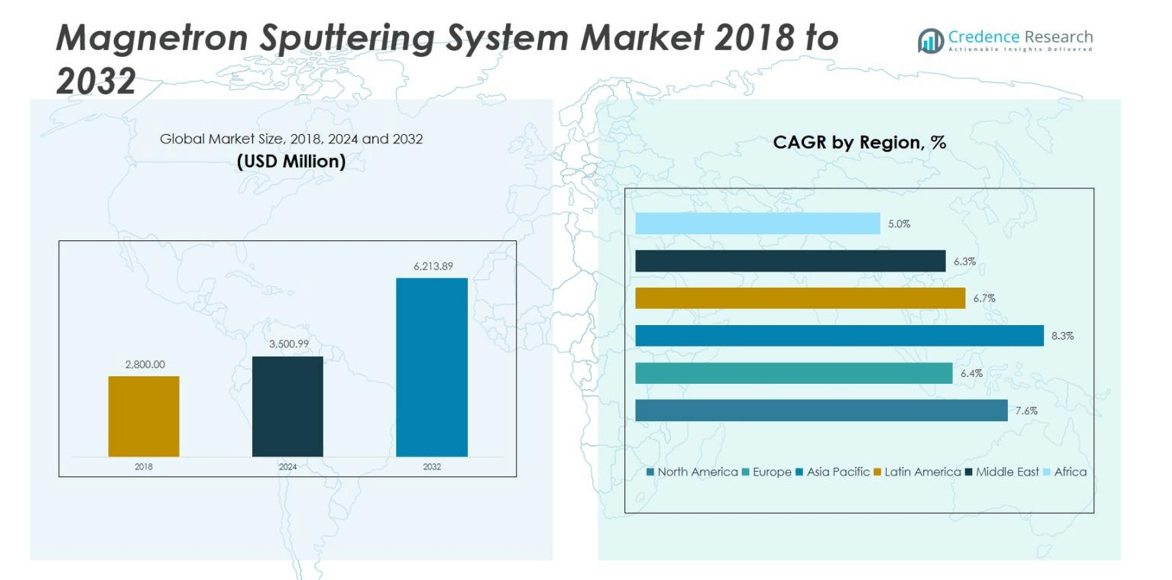
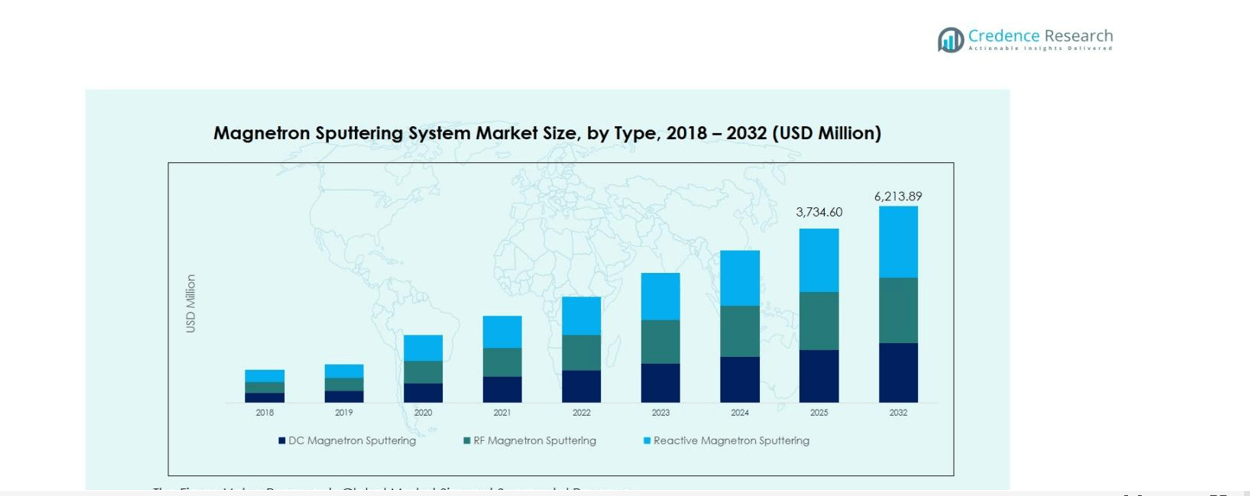
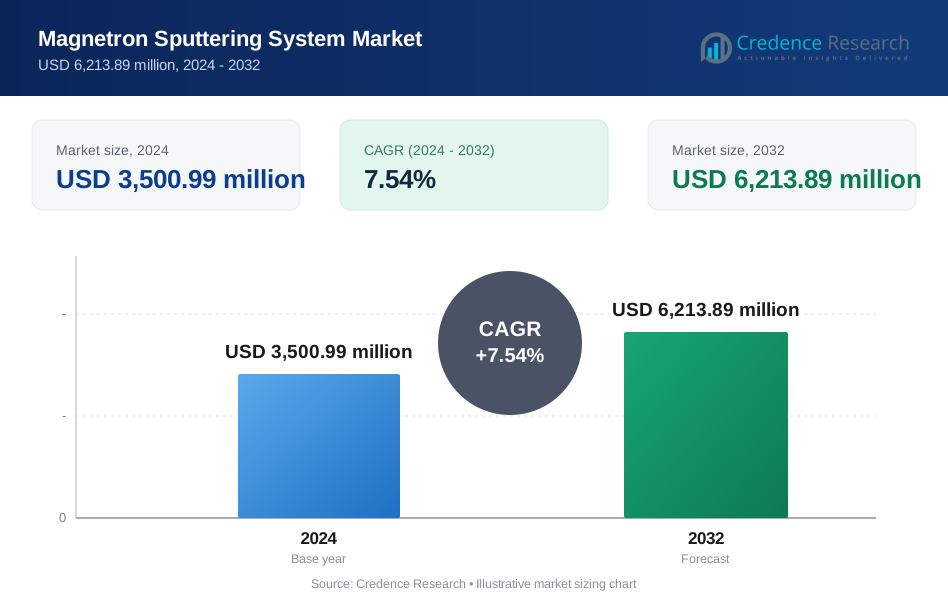
The Global Magnetron Sputtering System Market size was valued at USD 2,800.0 million in 2018, reaching USD 3,500.99 million in 2024, and is anticipated to attain USD 6,213.89 million by 2032, expanding at a CAGR of 7.54% during the forecast period.
| REPORT ATTRIBUTE | DETAILS |
|---|---|
| Historical Period | 2020-2023 |
| Base Year | 2024 |
| Forecast Period | 2025-2032 |
| Magnetron Sputtering System Market Size 2024 | USD 3,500.99 million |
| Magnetron Sputtering System Market, CAGR | 7.54% |
| Magnetron Sputtering System Market Size 2032 | USD 6,213.89 million |
The Magnetron Sputtering System Market is led by prominent players such as Kurt J. Lesker Company, ULVAC Inc., Veeco Instruments Inc., Singulus Technologies AG, Bühler AG, Denton Vacuum LLC, and Oxford Instruments plc. These companies dominate through strong product portfolios, technological innovation, and global distribution networks. They focus on precision coating solutions for semiconductors, solar cells, and industrial applications. Asia Pacific leads the global market with a commanding 46.5% share in 2024, driven by rapid industrialization, semiconductor fabrication, and renewable energy expansion. North America follows with 22.4%, supported by advanced R&D infrastructure and growing demand for thin-film technologies in electronics and aerospace manufacturing.
Market Insights
- The Global Magnetron Sputtering System Market was valued at USD 3,500.99 million in 2024 and is projected to reach USD 6,213.89 million by 2032, growing at a CAGR of 7.54%.
- Rising demand for thin-film coatings in semiconductors, solar energy, and electronic devices drives strong market growth across industrial sectors.
- The market trend is shifting toward automation, AI-based process control, and advanced compound target materials for higher coating precision and energy efficiency.
- Competition remains moderate, with key players such as ULVAC Inc., Veeco Instruments Inc., and Kurt J. Lesker Company focusing on R&D, partnerships, and expansion in high-demand regions.
- Asia Pacific leads the market with a 5% share, followed by North America (22.4%) and Europe (17.4%), while the DC Magnetron Sputtering segment dominates by type with about 40% share, driven by its efficiency in high-volume production.
Market Segmentation Analysis:
By Type
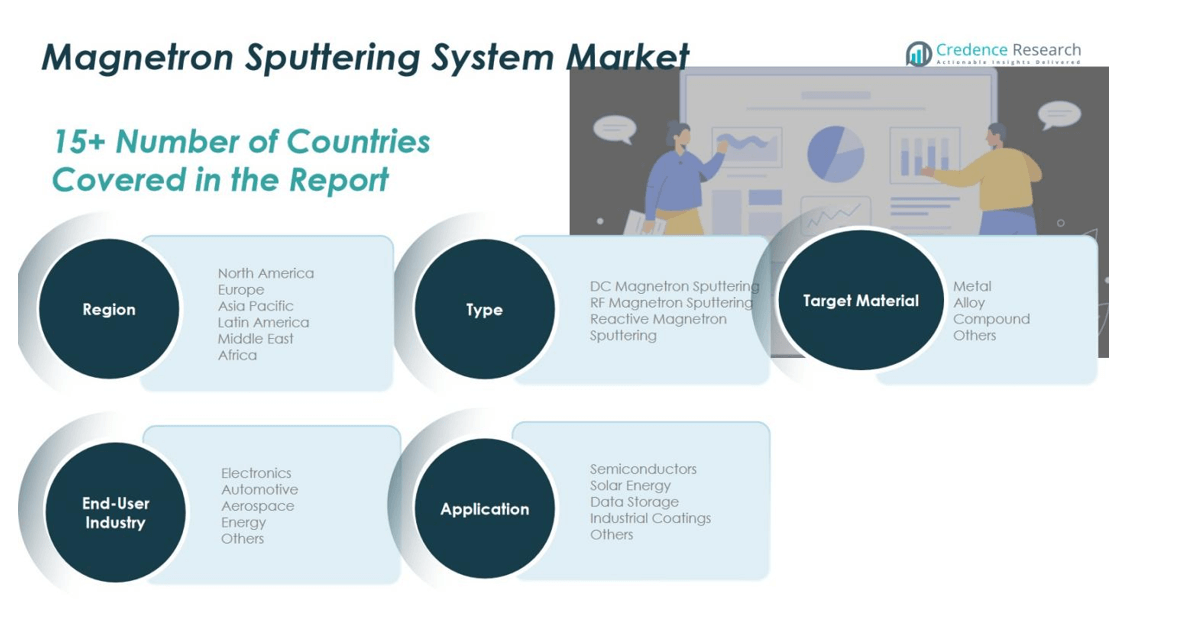
The DC Magnetron Sputtering segment dominates the market with around 40% share, driven by its efficiency and cost-effectiveness in depositing conductive materials. It remains the preferred option for mass production of thin films in electronics and industrial coatings. RF Magnetron Sputtering holds roughly 30% share, gaining traction due to its versatility in handling non-conductive and dielectric materials for advanced semiconductor and optical applications. Reactive Magnetron Sputtering, accounting for about 30%, is rising rapidly for its ability to produce complex compound films such as oxides and nitrides used in solar cells and sensors.
- For instance, Denton Vacuum offers advanced DC sputtering systems that enable precise deposition of metal films for industrial electronics.
By Application
The Semiconductors segment leads with approximately 45% share, supported by strong demand for precise and uniform thin-film deposition in chip fabrication and display panels. Solar Energy applications represent around 20% share, fueled by increased thin-film photovoltaic manufacturing using transparent conductive coatings. Data Storage contributes about 15%, driven by the need for magnetic films in hard drives and next-generation memory. Industrial Coatings hold nearly 12% share, emphasizing wear-resistant and decorative coatings for automotive and manufacturing sectors, while Other applications account for 8%, including optics and specialty films.
- For instance, BASF SE offers innovative coatings for automotive OEMs and industrial applications, improving durability, chemical resistance, and aesthetic appeal for vehicles and machinery.
By Target Material
The Metal segment holds the dominant 50% market share, attributed to the extensive use of metallic targets such as aluminum, copper, and titanium in electronics and energy applications. Alloy targets, covering about 25%, are valued for providing enhanced mechanical and thermal properties across aerospace and automotive industries. The Compound segment, with nearly 20% share, benefits from growing use of oxide and nitride materials in solar and semiconductor coatings. Other target materials, accounting for 5%, include high-entropy alloys and specialized ceramics for niche applications like optical and smart coatings.
Key Growth Drivers
Rising Demand from Semiconductor and Electronics Manufacturing
The growing use of thin-film technologies in semiconductor production drives the magnetron sputtering system market. These systems enable precise deposition of conductive and dielectric layers essential for microchips, sensors, and displays. Increasing demand for smaller, high-performance electronic components has pushed manufacturers to adopt advanced sputtering technologies for better control and uniformity. Expanding fabrication facilities in Asia-Pacific, particularly in China, South Korea, and Taiwan, further amplify the need for efficient sputtering solutions to meet the semiconductor industry’s evolving production requirements.
- For instance, Samsung in South Korea is investing heavily in advanced sputtering for its upcoming 3nm chip fabs in the Gyeonggi Province mega cluster, aiming to enhance layer precision in chip manufacturing.
Expanding Applications in Solar and Energy Storage Technologies
Magnetron sputtering systems are gaining traction in renewable energy sectors, especially in thin-film solar cell and battery electrode manufacturing. The technology allows uniform coating of transparent conductive oxides and protective films, improving device efficiency and durability. Growing investments in solar power infrastructure and clean energy policies across Europe, the U.S., and Asia-Pacific have boosted adoption. Manufacturers are leveraging sputtering to enhance photovoltaic cell performance and support sustainable production practices, making this a critical growth area within the overall market landscape.
- For instance, AGC Plasma Technology Solutions has developed large-area magnetron sputtering equipment capable of coating substrates as large as 3.2 meters by 6 meters, significantly enhancing energy efficiency and durability in architectural glass, which is crucial for solar energy installations.
Advancements in Material Science and Coating Techniques
Continuous innovation in target materials and deposition methods strengthens the market outlook. The introduction of new metal, alloy, and compound targets enables the creation of customized coatings with superior adhesion, hardness, and optical properties. These improvements have expanded magnetron sputtering’s role beyond electronics into aerospace, optics, and automotive applications. The shift toward high-precision coatings for wear resistance and energy efficiency has encouraged R&D investment, promoting long-term growth and technological competitiveness across global manufacturing sectors.
Key Trends & Opportunities
Integration of Automation and AI in Deposition Processes
Automation and artificial intelligence are transforming magnetron sputtering systems by enhancing process control, uniformity, and efficiency. AI-driven analytics optimize film thickness and target utilization, reducing operational costs and waste. Manufacturers are integrating predictive maintenance and automated calibration to improve throughput in large-scale production environments. This digital transformation not only boosts productivity but also positions sputtering systems as essential tools for smart manufacturing, aligning with Industry 4.0 trends across the semiconductor and materials industries.
- For instance, LG Display Company uses VSim software to simulate magnetron sputtering erosion patterns, enabling them to optimize target design and improve process predictability in their production line.
Emerging Demand for Nanocoatings and Flexible Electronics
The rise of flexible displays, wearable sensors, and nanostructured materials creates new opportunities for magnetron sputtering systems. These applications require ultra-thin, defect-free coatings achievable through advanced sputtering techniques. Growing adoption of flexible substrates in consumer electronics and medical devices fuels demand for adaptable coating equipment. As nanotechnology evolves, magnetron sputtering is positioned to support next-generation material innovation, driving revenue streams for manufacturers catering to emerging high-value markets.
- For instance, flexible In2O3 thin films used in flexible electronics have been fabricated successfully through magnetron sputtering, demonstrating high electrical performance and mechanical flexibility.
Key Challenges
High Equipment and Maintenance Costs
The high initial cost of magnetron sputtering systems limits their adoption, particularly among small and medium manufacturers. These systems require substantial investment in vacuum infrastructure, precision controls, and maintenance operations. Frequent component replacements, such as targets and power supplies, add to operating expenses. This cost barrier slows penetration in developing markets despite increasing technological demand. Vendors are focusing on modular and energy-efficient system designs to reduce lifecycle costs and improve accessibility.
Technical Complexity and Process Optimization Issues
Maintaining consistency in film thickness, uniformity, and target utilization presents ongoing challenges. Variations in plasma behavior, substrate materials, and reactive gas composition complicate process optimization. These factors demand skilled technicians and precise control systems to achieve desired coating outcomes. Industries with strict performance requirements, such as aerospace and microelectronics, often face extended calibration cycles and downtime. Addressing these technical hurdles through automation and advanced monitoring tools remains essential for sustaining growth and operational efficiency.
Regional Analysis
North America
North America accounted for a 22.4% market share in 2024, with the market rising from USD 639.8 million in 2018 to USD 784.55 million in 2024, projected to reach USD 1,389.44 million by 2032, growing at a CAGR of 7.6%. Growth is driven by strong demand from semiconductor and electronics manufacturing, particularly in the U.S. The region’s emphasis on R&D in thin-film technology, along with investments in renewable energy coatings, supports steady expansion. The presence of major equipment manufacturers and technological innovation also enhances market penetration.
Europe
Europe holds a 17.4% share of the global market, expanding from USD 515.2 million in 2018 to USD 608.38 million in 2024, and is forecast to reach USD 992.69 million by 2032, growing at a CAGR of 6.4%. The region benefits from robust industrial manufacturing and strong adoption in automotive and aerospace coatings. European firms increasingly adopt magnetron sputtering systems to enhance energy efficiency and product durability. Germany, France, and the U.K. lead regional demand, supported by research initiatives focused on advanced materials and green manufacturing processes.
Asia Pacific
Asia Pacific dominates the global market with a 46.5% share in 2024, making it the largest regional segment. The market expanded from USD 1,271.2 million in 2018 to USD 1,627.42 million in 2024 and is expected to reach USD 3,052.89 million by 2032, growing at the highest CAGR of 8.3%. Rapid industrialization, semiconductor fabrication growth, and the booming solar energy sector drive this dominance. China, Japan, South Korea, and India are major contributors, with extensive investments in display panels, consumer electronics, and renewable technologies.
Latin America
Latin America represents a 7.2% share of the market, rising from USD 203.0 million in 2018 to USD 251.69 million in 2024, and is projected to reach USD 418.63 million by 2032 at a CAGR of 6.7%. The region’s growth is supported by increasing demand for advanced coating systems in industrial, automotive, and energy applications. Brazil leads the market with expanding electronics and manufacturing sectors. Investments in renewable energy projects and modernization of production facilities continue to drive steady adoption across the region.
Middle East
The Middle East contributes about 5.3% share to the global market, growing from USD 114.8 million in 2018 to USD 135.12 million in 2024, and reaching USD 218.14 million by 2032, registering a CAGR of 6.3%. The regional growth is fueled by diversification in energy and industrial manufacturing sectors. Countries like the UAE and Saudi Arabia are increasingly adopting sputtering systems for solar and semiconductor applications. Rising technological partnerships and infrastructure investments in smart manufacturing are enhancing the region’s overall adoption rate.
Africa
Africa accounts for a 3.6% market share, with the market increasing from USD 56.0 million in 2018 to USD 93.84 million in 2024, and projected to reach USD 142.11 million by 2032, growing at a CAGR of 5.0%. Growth is moderate but steady, driven by emerging electronics assembly and renewable energy industries, particularly in South Africa and Egypt. Limited industrial infrastructure and high equipment costs remain challenges, but government initiatives promoting local manufacturing and technology adoption are gradually improving market accessibility and investment potential.
Market Segmentations:
By Type
- DC Magnetron Sputtering
- RF Magnetron Sputtering
- Reactive Magnetron Sputtering
By Application
- Semiconductors
- Solar Energy
- Data Storage
- Industrial Coatings
- Others
By Target Material
- Metal
- Alloy
- Compound
- Others
By End-User Industry
- Electronics
- Automotive
- Aerospace
- Energy
- Others
By Region
- North America
- U.S.
- Canada
- Mexico
- Europe
- Germany
- France
- U.K.
- Italy
- Spain
- Rest of Europe
- Asia Pacific
- China
- Japan
- India
- South Korea
- South-east Asia
- Rest of Asia Pacific
- Latin America
- Brazil
- Argentina
- Rest of Latin America
- Middle East & Africa
- GCC Countries
- South Africa
- Rest of the Middle East and Africa
Competitive Landscape
The competitive landscape of the Magnetron Sputtering System Market features major players such as Kurt J. Lesker Company, ULVAC Inc., Veeco Instruments Inc., Singulus Technologies AG, Denton Vacuum LLC, Bühler AG, Oxford Instruments plc, Angstrom Engineering Inc., and PVD Products Inc. These companies compete on technological innovation, product performance, and global reach. The market is moderately consolidated, with leading firms focusing on expanding product portfolios and enhancing automation, precision control, and energy efficiency. Strategic collaborations with semiconductor and solar manufacturers are common, enabling tailored system integration for specific applications. Continuous R&D investments aim to improve deposition uniformity, scalability, and cost efficiency. Emerging companies are entering niche areas such as nanocoating and flexible electronics sputtering, intensifying competition. Regional expansion across Asia-Pacific and Europe further shapes the landscape, while partnerships and acquisitions remain key strategies for strengthening distribution networks and advancing next-generation sputtering technologies.
Key Player Analysis
- Kurt J. Lesker Company
- AJA International, Inc.
- Angstrom Engineering Inc.
- ULVAC, Inc.
- Plasma Process Group
- PVD Products, Inc.
- Singulus Technologies AG
- Veeco Instruments Inc.
- Bühler AG
- Oxford Instruments plc
- Semicore Equipment, Inc.
- Denton Vacuum LLC
- Von Ardenne GmbH
- Kenosistec Srl
- Scientific Vacuum Systems Ltd.
- Moorfield Nanotechnology Limited
- Shincron Co., Ltd.
Recent Developments
- In April 12 2024, Singulus Technologies AG introduced its new GENERIS PVD inline magnetron sputtering system, designed for coating bipolar plates used in fuel cells and electrolyzers, marking a significant innovation in vacuum coating technology.
- On July 6 2022, Denton Vacuum LLC announced a new order for its Versa magnetron sputtering cluster system from a leading Asian sensor manufacturer, highlighting increased demand for advanced thin-film deposition solutions in high-precision applications.
- On 12 April 2024, Singulus Technologies AG launched an advanced PVD sputtering system for coating bipolar plates used in fuel cells and electrolyzers.
- On March 26, 2024, Lam Research Corporation announced a breakthrough pulsed laser deposition (PLD) technique using its new Pulsus™ system, optimized for MEMS and 5G components, enhancing film performance (specifically, enabling higher scandium content in AlScN films) in RF filters and microphones
Report Coverage
The research report offers an in-depth analysis based on Type, Application, Target Material, End-User Industry and Region. It details leading market players, providing an overview of their business, product offerings, investments, revenue streams, and key applications. Additionally, the report includes insights into the competitive environment, SWOT analysis, current market trends, as well as the primary drivers and constraints. Furthermore, it discusses various factors that have driven market expansion in recent years. The report also explores market dynamics, regulatory scenarios, and technological advancements that are shaping the industry. It assesses the impact of external factors and global economic changes on market growth. Lastly, it provides strategic recommendations for new entrants and established companies to navigate the complexities of the market.
Future Outlook
- The market will continue expanding due to strong demand from semiconductor and electronics manufacturing.
- Asia-Pacific will remain the fastest-growing region driven by industrialization and renewable energy projects.
- Increased adoption of magnetron sputtering in solar cell production will enhance its long-term growth potential.
- Advancements in automation and AI integration will improve system efficiency and process accuracy.
- Development of new target materials will enable broader applications in coatings and nanotechnology.
- Growing investments in R&D will strengthen the technological competitiveness of key manufacturers.
- The shift toward miniaturized and high-performance devices will boost demand for precise thin-film deposition.
- Expansion in electric vehicle and battery manufacturing will create new opportunities for sputtering systems.
- Strategic collaborations and mergers will accelerate innovation and global market presence.
- Sustainability initiatives and energy-efficient coating technologies will shape future system designs and investments.
Request a Free Sample
Fill in your details and we'll send you a free sample report.
- Sample data tables & charts
- Research methodology
Need a Custom Version of This Report?
Tailor the scope, geography, or segments to your exact requirements.
- Custom geography or segment scope
- Direct access to our analyst team
Frequently Asked Questions
What is the current market size for Magnetron Sputtering System Market, and what is its projected size in 2032?
At what Compound Annual Growth Rate is the Magnetron Sputtering System Market projected to grow between 2025 and 2032?
Which Magnetron Sputtering System Market segment held the largest share in 2024?
What are the primary factors fueling the growth of the Magnetron Sputtering System Market?
Who are the leading companies in the Magnetron Sputtering System Market?
Who are the major players in this market?
Table of Content
Chapter 1. Report Introduction
- 1.1 Report Description & Purpose
- 1.1.1 Report Title & Market Definition
- 1.1.2 Unique Selling Propositions (USP) & Key Differentiators
- 1.1.3 Value Proposition for Stakeholders
- 1.2 Research Objectives
- 1.2.1 Market Sizing Objectives (Volume & Revenue) (Volume Where Applicable)
- 1.2.2 Segmentation Objectives
- 1.2.3 Competitive Intelligence Objectives
- 1.2.4 Forecast & Scenario Objectives
- 1.3 Report Scope
- 1.3.1 Magnetron Sputtering System Scope – Segments & Subsegments Covered
- 1.3.2 Geographic Scope – Regions & Countries Covered
- 1.3.3 Historical Period, Base Year & Forecast Period (2024; forecast to 2032)
- 1.3.4 Inclusions & Exclusions
- 1.4 Industry Classification & Applicable Codes
- 1.5 Currency, Measurement Units & Valuation Basis
- 1.6 Target Stakeholders
- 1.7 Limitations & Assumptions
Chapter 2. Executive Summary
- 2.1 Global Magnetron Sputtering System Market Snapshot
- 2.1.1 Market Size – Historical (2024) & Forecast (2024-2032) (2024: USD 3,500.99 million → 2032: USD 6,213.89 million)
- 2.1.2 Volume & Revenue – Global Totals (Volume Where Applicable)
- 2.1.3 Key Market Highlights – Top Five Facts
- 2.2 Magnetron Sputtering System Market Segmentation Snapshot
- 2.2.1 Market Split by Region – 2024 vs. 2032
- 2.3 Competitive Snapshot
- 2.3.1 Top 10 Players by Revenue Share – 2024
- 2.3.2 Top 10 Players by Volume Share – 2024 (Volume Where Applicable)
- 2.3.3 Recent Strategic Developments (18-Month Summary)
- 2.4 Key Investment Highlights & Strategic Conclusions
Chapter 3. Magnetron Sputtering System Market Dynamics & Industry Analysis
- 3.1 Market Overview & Context
- 3.1.1 Magnetron Sputtering System Market Position in the Broader Industry Value Chain
- 3.1.2 Demand Structure & Purchasing Dynamics
- 3.1.3 Market Maturity & Development Stage by Region
- 3.2 Magnetron Sputtering System Market Drivers
- 3.3 Magnetron Sputtering System Market Restraints & Challenges
- 3.4 Magnetron Sputtering System Market Opportunities
- 3.5 Porter's Five Forces Analysis
- 3.5.1 Threat of New Entrants
- 3.5.2 Bargaining Power of Suppliers
- 3.5.3 Bargaining Power of Buyers
- 3.5.4 Threat of Substitutes
- 3.5.5 Competitive Rivalry – Intensity Assessment
- 3.6 Magnetron Sputtering System Value Chain Analysis
- 3.6.1 Upstream – Key Inputs, Resources & Suppliers
- 3.6.1.1 Key Input/Resource 1
- 3.6.1.2 Key Input/Resource 2
- 3.6.1.3 Key Input/Resource 3
- 3.6.2 Midstream – Core Operations & Value Creation
- 3.6.2.1 Operating Model & Process Overview
- 3.6.2.2 Key Operating Locations & Capabilities by Company
- 3.6.3 Downstream – Market Channels & End Users
- 3.6.3.1 Direct Sales & Customer Engagement Channels
- 3.6.3.2 Indirect Sales, Intermediaries & Partner Channels
- 3.6.4 Value Chain Profitability Analysis
- 3.6.1 Upstream – Key Inputs, Resources & Suppliers
- 3.7 PESTEL Analysis
- 3.7.1 Political Factors
- 3.7.2 Economic Factors
- 3.7.3 Social Factors
- 3.7.4 Technological Factors
- 3.7.5 Environmental Factors
- 3.7.6 Legal Factors
- 3.8 Magnetron Sputtering System Supply Chain Analysis
- 3.8.1 Critical Input & Resource Availability Risk Assessment
- 3.8.2 Supplier & Operational Concentration Risk (Geographic Exposure)
- 3.8.3 Supply & Service Disruption Impact Analysis
- 3.9 Regulatory & Policy Landscape
Note: The regulatory and policy landscape section covers regulations based on their applicability to the market, Magnetron Sputtering System category, geography, and scope of the study. Only regulatory frameworks with a material impact on operations, compliance, trade, sustainability, or market access are analyzed in detail.
Chapter 4. Key Investment Pockets & Opportunity Analysis
- 4.1 Magnetron Sputtering System Market Attractiveness Analysis
- 4.1.1 By Region – Investment Attractiveness Matrix (Market Size × CAGR)
- 4.2 Absolute Revenue Growth Opportunity
- 4.2.1 By Region – Absolute Revenue Growth Through 2032
- 4.3 Incremental Demand Opportunity
- 4.3.1 By Region – Incremental Demand Through 2032
- 4.3.2 Segment – Incremental Demand
- 4.4 Emerging Submarket Opportunity Deep Dive (Subject to Applicability)
- 4.5 Priority Market Opportunity Scorecards
- 4.5.1 United States
- 4.5.2 Europe
- 4.5.3 Asia
- 4.5.4 Middle East & Africa
Note: Priority market opportunity scorecards reflect the geographic scope and strategic relevance of the study. Listed markets are indicative and may be adapted to the industry.
Chapter 5. Magnetron Sputtering System Cross-Border Trade & Market Access Analysis
- 5.1 International Trade & Cross-Border Activity Overview
- 5.1.1 Global Export Value by Country (2024)
- 5.1.2 Global Export Volume by Country (2024) (Volume Where Applicable)
- 5.1.3 Global Import Value by Country (2024)
- 5.1.4 Global Import Volume by Country (2024) (Volume Where Applicable)
- 5.1.5 Net Trade Balance by Country (2024)
- 5.2 Export Analysis – Segment
- 5.2.1 Category 1 (Applicable Classification Code)
- 5.2.2 Category 2 (Applicable Classification Code)
- 5.2.3 Category 3 (Applicable Classification Code)
- 5.2.4 Category 4 (Applicable Classification Code)
- 5.2.5 Category 5 (Applicable Classification Code)
- 5.3 Import Analysis – Segment
- 5.3.1 Category 1 (Applicable Classification Code)
- 5.3.2 Category 2 (Applicable Classification Code)
- 5.3.3 Category 3 (Applicable Classification Code)
- 5.3.4 Category 4 (Applicable Classification Code)
- 5.3.5 Category 5 (Applicable Classification Code)
- 5.4 Cross-Border Pricing & Transaction Benchmarks
- 5.4.1 Export Pricing – Segment & Country
- 5.4.2 Import Pricing – Segment & Source Country
- 5.4.3 Price Trends (2024)
- 5.5 Key Cross-Border Trade & Delivery Routes
- 5.5.1 Cross-Border Trade/Delivery Route 1
- 5.5.2 Cross-Border Trade/Delivery Route 2
- 5.5.3 Cross-Border Trade/Delivery Route 3
- 5.5.4 Cross-Border Trade/Delivery Route 4
- 5.5.5 Cross-Border Trade/Delivery Route 5
- 5.6 Trade Policy & Market Access Impact Assessment
- 5.6.1 Tariff & Non-Tariff Barriers
- 5.6.2 Regional Trade & Economic Integration Frameworks
- 5.6.3 Bilateral & Multilateral Trade Agreements
- 5.6.4 Cross-Border Operating, Licensing & Localization Requirements
Note: This chapter applies where cross-border trade or delivery is relevant to Magnetron Sputtering System. Goods, services, and digital offerings are assessed using applicable classifications and transaction measures. Import-export volumes, trade balances, and route analyses are included only where meaningful to the market.
Chapter 6. Competitive Landscape & Company Benchmarking
- 6.1 Magnetron Sputtering System Market Concentration & Structure
- 6.1.1 Herfindahl-Hirschman Index (HHI) – vs. 2024
- 6.1.2 Leading, Mid-Sized & Emerging Player Structure
- 6.1.3 Global, Regional & Local Player Dynamics
- 6.2 Magnetron Sputtering System Market Share Analysis – 2024
- 6.2.1 Global Revenue Share by Company
- 6.2.2 Global Volume Share by Company (Volume Where Applicable)
- 6.2.3 Regional Revenue Share
- 6.2.4 Market Share Evolution ( vs. 2024)
- 6.2.5 Company Market Share by Key Segment
- 6.2.6 Company Market Share by Customer Group
- 6.3 Operating Scale, Capacity & Infrastructure Analysis
- 6.3.1 Global Operating Scale & Supply Capacity
- 6.3.2 Resource Utilization & Operating Efficiency
- 6.3.3 Output, Service Delivery & Activity Metrics
- 6.3.4 Operating Footprint & Infrastructure Map
- 6.3.5 Planned Operational & Capacity Expansion
- 6.4 Magnetron Sputtering System Competitive Benchmarking Matrix
- 6.4.1 Revenue, Growth, Profitability & Operating Metric Comparison
- 6.4.2 Channel Revenue Mix
- 6.4.3 Geographic Revenue Exposure
- 6.4.4 R&D Intensity
- 6.4.5 Sustainability Maturity
- 6.5 Strategic Developments in Magnetron Sputtering System (Last 24 Months)
- 6.5.1 Mergers, Acquisitions & Divestments
- 6.5.2 New Products, Services & Solutions in Magnetron Sputtering System
- 6.5.3 Operational & Infrastructure Expansions
- 6.5.4 Strategic Alliances, Joint Ventures & Partnerships
- 6.5.5 Distribution Expansion & Market Entry
- 6.5.6 Sustainability & ESG Initiatives
- 6.6 Competitive Strategy Mapping
- 6.6.1 Leader, Challenger, Follower & Niche Classification
- 6.6.2 Pricing Strategy Comparison
- 6.6.3 Channel Strategy Matrix
Note: Strategic developments are included based on their materiality and the availability of reliable information.
Chapter 7. Global Magnetron Sputtering System Market – By Sales & Delivery Channel
- 7.1 Segment Overview
- 7.1.1 Volume & Revenue Split by Channel (2024 & 2032) (Volume Where Applicable)
- 7.1.2 Channel Mix Evolution (2024-2032)
Chapter 8. Regional Market Analysis – Global Overview
- 8.1 Global Regional Overview
- 8.1.1 Regional Volume Share (Volume Where Applicable)
- 8.1.2 Regional Revenue Share
- 8.1.3 Regional Volume by Region (Volume Where Applicable)
- 8.1.4 Regional Revenue by Region
- 8.1.5 Regional Forecast Through 2032
- 8.2 Cross-Regional Segment Analysis
- 8.2.1 By Sales & Delivery Channel
- 8.2.2 By Competitive Positioning & Price Tier
Chapter 9. North America Magnetron Sputtering System Market
- 9.1 United States
- 9.2 Canada
- 9.3 Mexico
Chapter 10. Europe Magnetron Sputtering System Market
- 10.1 Germany
- 10.2 France
- 10.3 Italy
- 10.4 United Kingdom
- 10.5 Spain
- 10.6 Poland
- 10.7 Russia
- 10.8 Netherlands
- 10.9 Belgium
- 10.10 Sweden
- 10.11 Denmark
- 10.12 Norway
- 10.13 Rest of Europe
Chapter 11. Asia Pacific Magnetron Sputtering System Market
- 11.1 China
- 11.2 India
- 11.3 Japan
- 11.4 South Korea
- 11.5 Thailand
- 11.6 Indonesia
- 11.7 Vietnam
- 11.8 Malaysia
- 11.9 Australia
- 11.10 Rest of Asia Pacific
Chapter 12. Latin America Magnetron Sputtering System Market
- 12.1 Brazil
- 12.2 Argentina
- 12.3 Colombia
- 12.4 Chile
- 12.5 Rest of Latin America
Chapter 13. Middle East Magnetron Sputtering System Market
- 13.1 Saudi Arabia
- 13.2 United Arab Emirates
- 13.3 Turkey
- 13.4 Israel
- 13.5 Iran
- 13.6 Rest of the Middle East
Chapter 14. Africa Magnetron Sputtering System Market
- 14.1 South Africa
- 14.2 Egypt
- 14.3 Nigeria
- 14.4 Morocco
- 14.5 Rest of Africa
Chapter 15. Magnetron Sputtering System Company Profiles
- 15.1 [Company 01]
- 15.1.1 Company Overview
- 15.1.2 Key Management Personnel
- 15.1.3 Products & Services Portfolio
- 15.1.4 Financial Performance
- 15.1.5 Key Market Focus & Geographic Presence
- 15.1.6 Recent Developments & Strategic Initiatives
Note: The company profile list is preliminary and may change based on research findings, market developments, data availability, and client requirements.
Chapter 16. Appendices
- Appendix A – List of Abbreviations & Acronyms
- Appendix B – Industry Classification Code Reference – Full Series
- Appendix C – Supply, Output & Operating Capacity Data Tables
- Appendix D – End-Use & Demand Base Tables
- Appendix E – Demand, Adoption & Usage Assumptions
- Appendix F – Pricing & Revenue Metric Reference Tables
- Appendix G – Company Operations & Infrastructure Database
- Appendix H – Cross-Border Trade & Activity Data Tables (Where Applicable)
- Appendix I – Regulatory Summary Tables
- Appendix J – Primary Research Participant List (Anonymized)
- Appendix K – Primary Research Questionnaire Framework
- Appendix L – Data Sources & Bibliography
- Appendix M – Market Size Divergence & Source Comparison
Chapter 17. Research Methodology
- 17.1 Research Framework & Philosophy
- 17.2 Secondary Research – Sources, Hierarchy & Data Extraction
- 17.3 Data Modeling – Bottom-Up & Top-Down Market Sizing
- 17.4 Primary Research – Stakeholder Framework, LOI & Sample Sizes
- 17.5 Forecast Methodology – Regression, Scenario & Sensitivity Analysis
- 17.6 Quality Control – Four-Layer Validation Framework
- 17.7 Limitations & Standard Assumptions
- 17.8 Disclaimer
