Narcolepsy care moves from symptom control to orexin repair
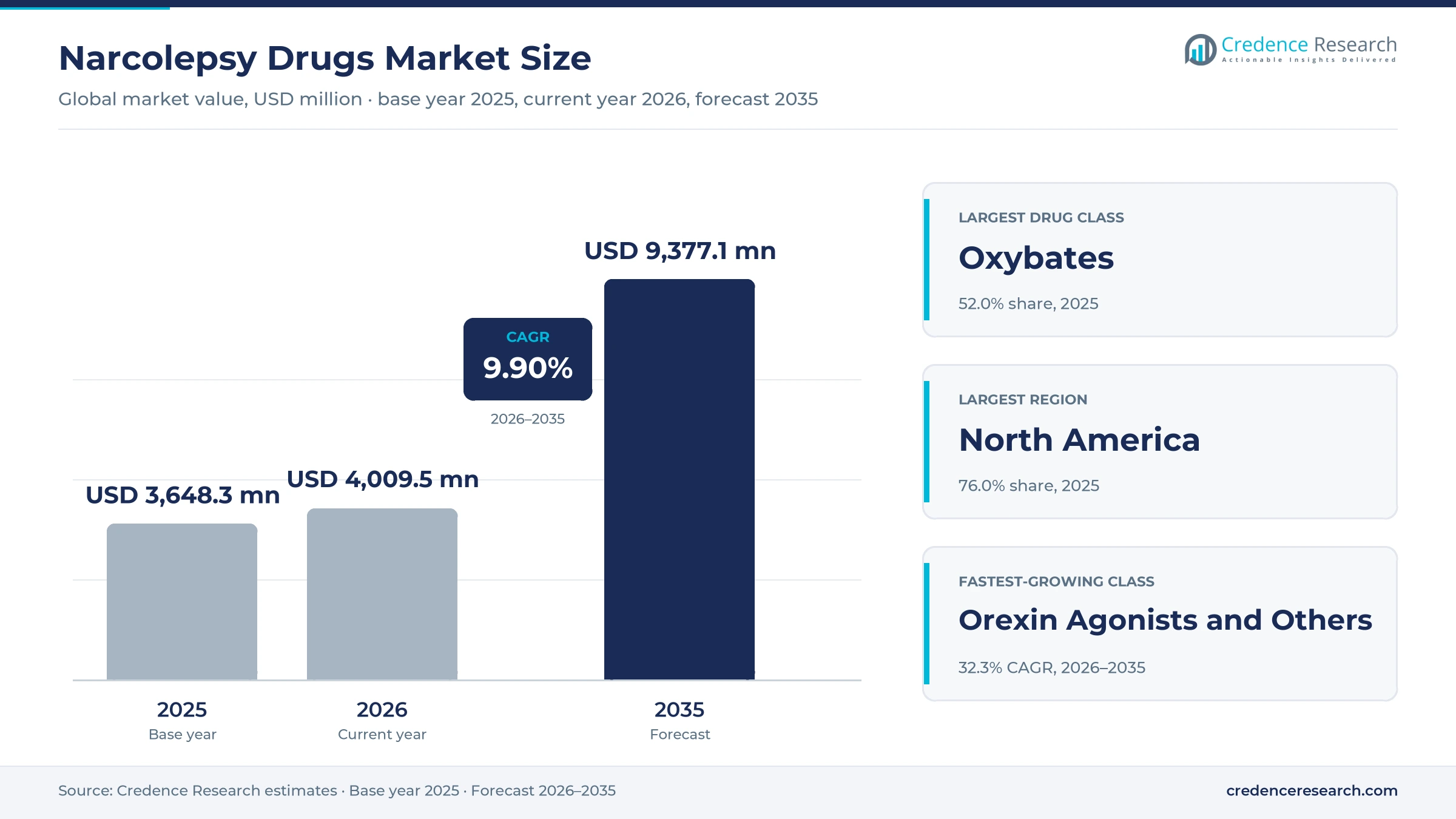
The global narcolepsy drugs market was valued at USD 3.65 billion in 2025 and is projected to increase from USD 4.01 billion in 2026 to USD 9.38 billion by 2035, registering a CAGR of 9.90% during 2026–2035. Spending comes from nightly oxybate solutions, daily pitolisant tablets, older wake-promoting agents and, since November 2026, the first orexin receptor agonist taken by adults with narcolepsy type 1. North America held the largest regional share, 76.0% in 2025, because branded oxybates and pitolisant are priced and reimbursed at U.S. specialty levels. Asia Pacific is the fastest-growing region at 12.6% a year, as Japan approved the first orexin agonist in August 2026 and China had cleared it as well. The main commercial change is a shift from drugs that mask sleepiness toward medicines that replace the missing orexin signal, which lifts value per patient but faces payer step therapy against cheap generic modafinil.
Which medicines carry the value in narcolepsy treatment?
The market counts sales of prescription medicines used to treat excessive daytime sleepiness, cataplexy and disturbed night sleep in narcolepsy type 1 and type 2. That covers sodium, mixed-salt and once-nightly oxybates, pitolisant, solriamfetol, modafinil, armodafinil and stimulants, antidepressants used for cataplexy, and orexin receptor agonists. Sleep specialists choose the regimen, while insurers and controlled-drug rules decide access.
Sales of the same medicines for idiopathic hypersomnia, obstructive sleep apnea and attention disorders are excluded, as are sleep studies and devices. Splitting oxybate and stimulant sales between narcolepsy and these other uses is the most assumption-heavy step in the estimate.
Narcolepsy Drugs Market Insights
- The narcolepsy drugs market grows from USD 3.65 billion in 2025 to USD 9.38 billion by 2035, a 9.90% CAGR over 2026–2035, as orexin agonists add a premium tier to oxybates.
- North America held 76.0% of 2025 value, because branded oxybates and pitolisant sell at U.S. specialty prices well above European levels.
- Oxybates led drug classes with 52.0% of 2025 value, as Jazz counted about 10,950 narcolepsy patients on Xywav at the end of 2025.
- The FDA approved Takeda's Orzeyful for adults with narcolepsy type 1 in August 2026, and U.S. launch followed on Nov. 12, 2026, after DEA scheduling.
- Wakix generics that settled patent cases can launch no earlier than March 2030, which sets the first large patent cliff in the forecast.
Oxybates hold the most value as orexin agonists arrive
Why do oxybates hold the largest share of value?
Based on drug class, the market is categorized into oxybates, histamine H3 receptor antagonists, wake-promoting agents and stimulants, and orexin agonists and others. Oxybates led with 52.0% of 2025 value, because one nightly product treats sleepiness, cataplexy and broken sleep at a specialty price. Jazz reported about 10,950 narcolepsy patients on Xywav exiting 2025, before counting Lumryz and generic sodium oxybate users. Orexin Agonists and Others grow fastest at 32.3% a year, as Orzeyful reached U.S. pharmacies on Nov. 12, 2026, and alixorexton entered phase 3 testing in April 2026.
How do specialty pharmacies control access?
Based on distribution channel, the market is categorized into specialty pharmacies, retail pharmacies and hospital pharmacies. Specialty Pharmacies led with 74.0% of 2025 value, because oxybates move only through restricted distribution systems that NINDS describes as tightly controlled. Takeda chose Accredo as the exclusive U.S. specialty pharmacy for Orzeyful at its November 2026 launch. Specialty Pharmacies also grow fastest at 10.4% a year, because every branded oxybate and the new orexin tier move only through restricted specialty networks. Retail volume is mostly low-priced generic modafinil and methylphenidate, a stimulant also among the main ADHD medicines.
Why do adults account for most spending?
Based on age group, the market is categorized into adults and pediatric. Adults led with 87.0% of 2025 value, because diagnosis often comes years after the first symptoms and most treated patients are adults by the time a specialist confirms the disease. The FDA letter for Orzeyful limits use to adults with type 1 disease and waives pediatric assessment under orphan status. Adults also grow fastest at 10.1% a year, since the premium orexin tier opens to them first while children rely on oxybates and pitolisant.
| Segment Group | Leading Sub-segment | Share, 2025 | Fastest-growing Sub-segment | CAGR, 2026–2035 |
|---|---|---|---|---|
| By Drug Class | Oxybates | 52.0% | Orexin Agonists and Others | 32.3% |
| By Distribution Channel | Specialty Pharmacies | 74.0% | Specialty Pharmacies | 10.4% |
| By Age Group | Adults | 87.0% | Adults | 10.1% |
Orexin agonists set a new price ceiling above oxybates
Prices in narcolepsy span three tiers, from generic tablets that cost less than one dollar a day to orphan brands sold at six-figure yearly list prices. Branded oxybates and orexin agonists are priced per month of therapy, and net prices fall below list after rebates and patient support programs. Price pressure comes from generic modafinil, which payers use as a first step, and from oxybate generics. Orzeyful priced above Xywav, which signals that sellers expect payers to value the disease-modifying mechanism. Net prices after rebates are not published, which is an evidence gap.
| Product | Typical price or fee | Basis |
|---|---|---|
| Orzeyful (oveporexton), 60 tablets | USD 16,500 list per bottle, about one month | Takeda list price reported by Medical Daily, November 2026 |
| Xywav (low-sodium oxybate) | About USD 142,000 a year at list | pharmaphorum, November 2026 |
| Wakix (pitolisant) 17.8 mg, 30 tablets | USD 8,720.87 cash price | Drugs.com price guide, November 2026 |
| Modafinil 200 mg generic, 30 tablets | USD 25.85 to USD 25.98 cash price | Drugs.com price guide, November 2026 |
Request a Free Sample
Fill in your details and we'll send you a free sample report.
- Sample data tables & charts
- Research methodology
Six-figure therapies and a larger treated patient pool
How large is the pool of patients still to be treated?
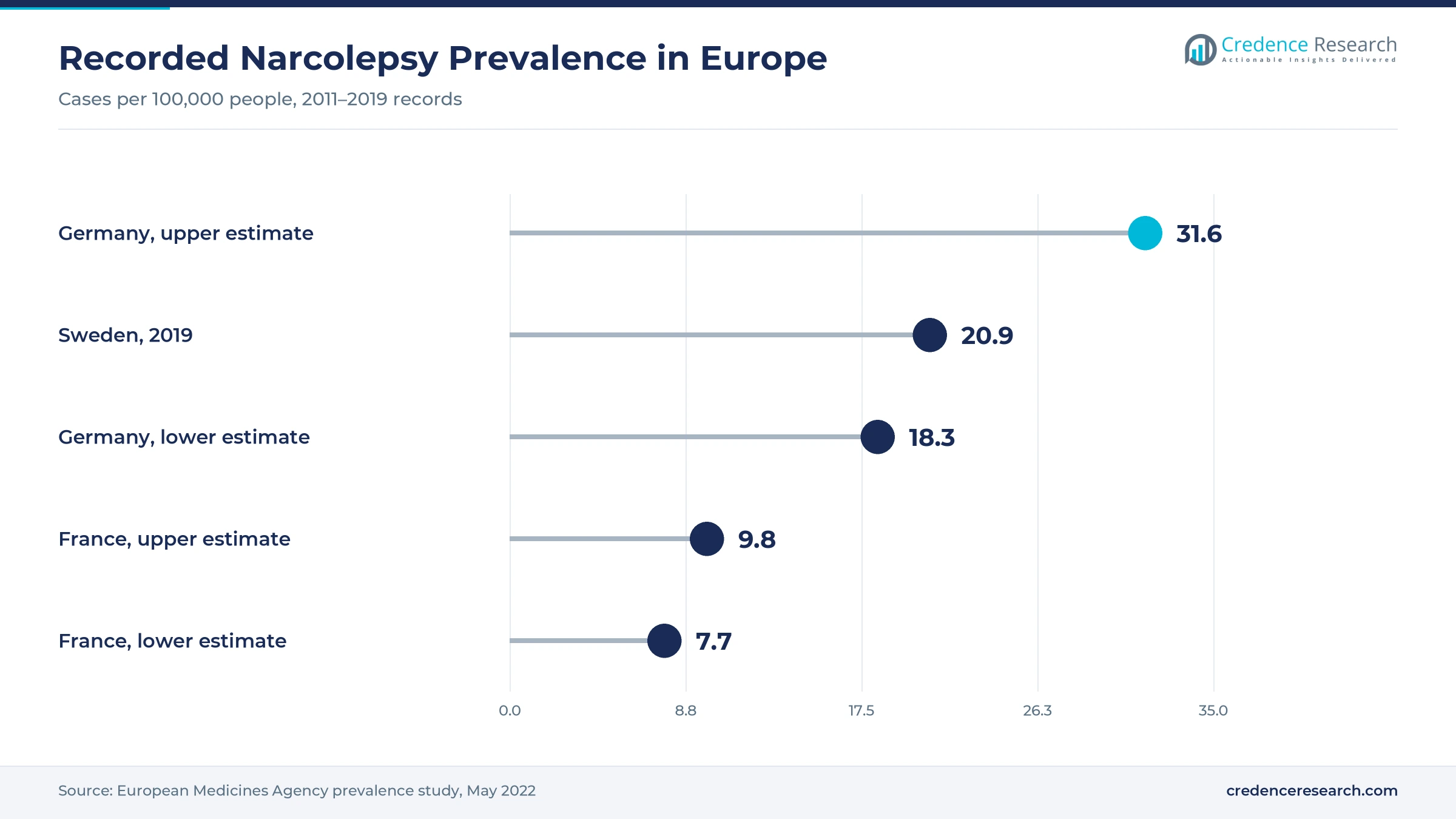
Patient numbers well above current treated counts give branded sellers room to add volume for years. Takeda puts the U.S. population with narcolepsy type 1 at about 120,000, according to pharmaphorum in November 2026. Alkermes estimates that more than 50,000 U.S. narcolepsy patients are eligible for oxybate therapy. In Europe, a European Medicines Agency study found recorded prevalence in German health records roughly two to four times the French level over the 2011 to 2019 period, a gap that points to missed diagnosis rather than less disease. Each newly diagnosed adult can stay on therapy for decades, so diagnosis rates matter more to sellers than incidence.
Why do low-sodium and once-nightly oxybates lift value per patient?
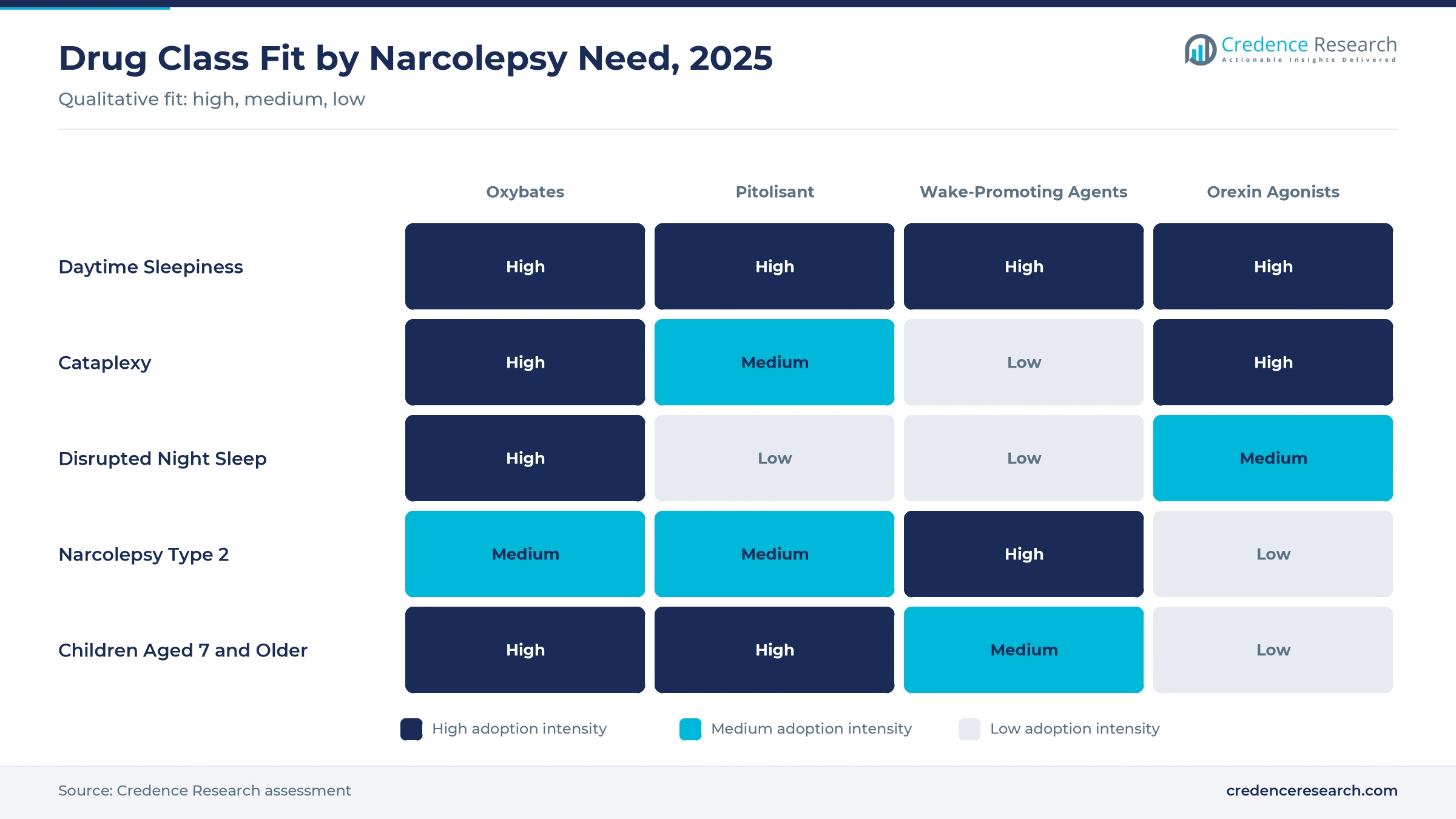
Reformulated oxybates raise spending per patient because they replace older twice-nightly sodium solutions with products that carry higher prices and better tolerability. Jazz counted about 16,175 active Xywav patients at the end of 2025, of whom about 10,950 had narcolepsy and the rest idiopathic hypersomnia. Xywav cuts the sodium load of nightly dosing, which matters for patients with cardiovascular risk. Lumryz, approved by the FDA on May 1, 2023, removes the middle-of-the-night second dose. Both products sell at six-figure annual list prices, shown in the pricing table, so each switch from generic sodium oxybate adds value even when patient numbers stay flat.
How does a non-scheduled option widen prescribing?
Pitolisant widens the treated base because doctors can prescribe it to patients who cannot or will not take a controlled substance. NINDS describes pitolisant as the only non-scheduled product for treating excessive daytime sleepiness in adults with narcolepsy. Harmony said its average patient count on Wakix rose by about 400 to roughly 8,500 in the fourth quarter of 2025, the third straight quarter of 400 or more additions. In Europe, Bioprojet has held EU authorization for Wakix since March 31, 2016, for narcolepsy in patients aged six and older. Steady additions sustain the specialty pharmacy channel and give pitolisant a durable base before generic entry.
What does the first orexin agonist approval add to demand?
Orexin agonists add a new premium tier because they replace the missing wake signal behind type 1 disease rather than masking symptoms. The FDA approval letter for Orzeyful dated Aug. 5, 2026 covers adults with narcolepsy type 1 and made approval effective only once DEA scheduling was published. Two 12-week, placebo-controlled trials enrolled 273 adults and showed gains in wakefulness and fewer cataplexy attacks, according to Psychiatric Times. By Aug. 24, 2026, Takeda also held approvals in Japan and China. Patients who stay sleepy on oxybates or pitolisant are the first candidates, which lifts the Orexin Agonists and Others group from a small base.
A crowded orexin pipeline and sleep franchise deals
A second wave of orexin agonists moves through trials
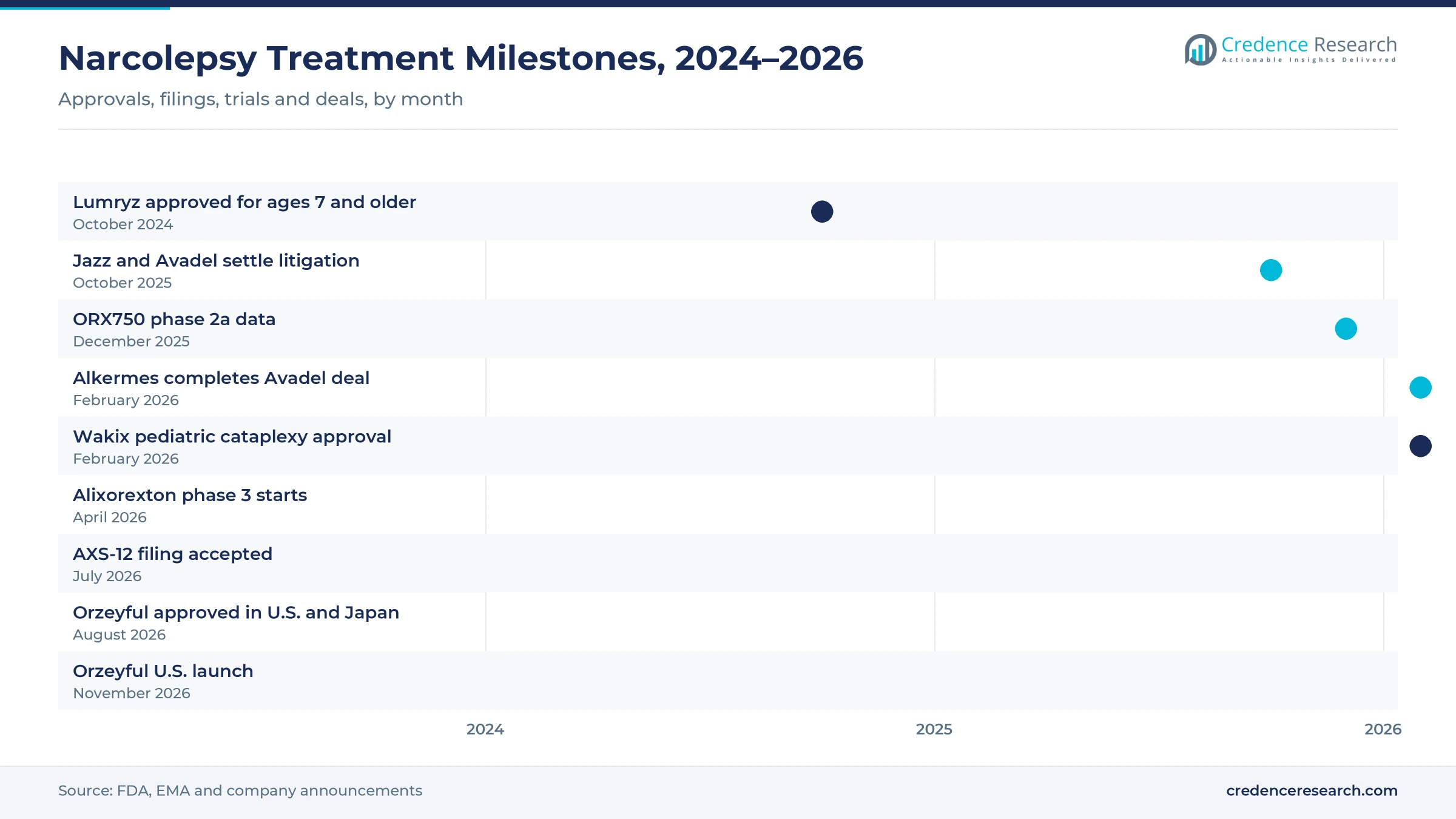
Developers are shifting from one orexin product to a crowded class, which will turn the premium tier into a contested market well before 2035. Alkermes started three phase 3 Brilliance studies of alixorexton in April 2026, with about 150 patients in each type 1 study and about 180 in the type 2 study. Centessa reported in December 2025 that ORX750 cut weekly cataplexy by 87% against placebo at 1.5 mg in its phase 2a CRYSTAL-1 study. Takeda is also testing balumorexton in idiopathic hypersomnia in phase 2. Type 2 patients, who lack an orexin label today, are the group where later entrants can win share.
Sleep franchises consolidate through acquisitions and settlements
Larger neuroscience companies are buying narcolepsy assets to secure revenue streams that already reach specialist prescribers. Alkermes completed its acquisition of Avadel on Feb. 12, 2026, adding Lumryz to its alixorexton program. In October 2025, Jazz and Avadel settled all litigation, and Avadel agreed to pay Jazz a 3.85% royalty on Lumryz narcolepsy sales through Feb. 18, 2036, while Lumryz may be marketed for future indications such as idiopathic hypersomnia only from March 1, 2028. Alkermes can now sell an oxybate today and an orexin drug later through one sales team, a model that raises the bar for single-product developers of sleep disorder treatments.
Where is the opening in cataplexy-focused oral therapy?
Patients whose main problem is cataplexy, and who want to avoid nightly oxybates, form a clear opening for a daytime tablet. The FDA accepted Axsome's application for AXS-12, reboxetine, in July 2026 and set a target action date of May 1, 2027. In the phase 3 SYMPHONY trial of 90 patients, cataplexy attacks fell 83% on AXS-12 against 66% on placebo at week five, according to Psychiatric Times. The drug also carries FDA orphan designation for the treatment of narcolepsy, which brings seven years of exclusivity if approved. An approval would give sleep specialists an on-label daytime alternative to the off-label antidepressants they prescribe today, which feeds the Orexin Agonists and Others group.
Can pediatric labels open an earlier treatment window?
Pediatric labels create an opening because symptoms often start in childhood while branded treatment has mostly served adults. NINDS says symptoms usually begin between ages 7 and 25, and diagnosis is often delayed for years. The FDA approved Lumryz for patients aged seven and older on Oct. 16, 2024, and added a cataplexy indication for children aged six and older to Wakix on Feb. 13, 2026. Pharmanovia took the European and Middle East rights to solriamfetol in February 2023 and committed to a pivotal pediatric study. Companies with child labels gain patients early, and those patients can stay on one brand into adulthood, which builds long refill histories.
Generic entry, drug scheduling and payer step therapy
How do oxybate generics erode the oldest product line?
Generic sodium oxybate pulls value out of the original twice-nightly product as prices fall. Hikma launched the first authorized generic of Xyrem in the U.S. on Jan. 3, 2023, with 180 days of exclusivity, and Amneal later launched an authorized generic as well. Jazz now serves most of its oxybate patients with Xywav, but sellers without a reformulated oxybate are most exposed, as payers prefer the generic for new patients.
What happens when pitolisant loses exclusivity?
Pitolisant faces generic competition from 2030, which caps the value of the H3 antagonist class. Harmony said six of seven generic filers have settled and can launch no earlier than March 2030, subject to pediatric exclusivity. Harmony is most exposed, so its lifecycle plan rests on a gastro-resistant version, whose submission it said in May 2026 was on track for the second quarter with a decision expected in early 2027, and a high-dose version in phase 3 targeting 2028. A completed filing could not be confirmed from public company sources.
How do drug scheduling rules slow new launches?
Controlled-substance rules delay launches and restrict where patients can fill prescriptions. The FDA letter for Orzeyful made approval effective only after the DEA published its scheduling notice, and Schedule IV took effect on Nov. 12, 2026, about three months after the August decision. Oxybates also remain in tightly restricted dispensing programs that limit which pharmacies can fill them. New entrants with novel mechanisms are most exposed, since each must wait for scheduling before selling.
Why could payers ration the orexin tier?
Payers can ration orexin agonists because cheap generics already treat daytime sleepiness for many patients. Medical Daily reported in November 2026 that prior authorization and step therapy may apply to Orzeyful, which carries a list price near USD 200,000 a year. Tolerability also matters, as 51% of CRYSTAL-1 patients reported frequent urination. Smaller orexin developers are most exposed if insurers limit use to patients who fail two drugs.
U.S. pricing anchors value while Asia Pacific gains
| Region | Value, 2025 (USD billion) | Share, 2025 | CAGR, 2026–2035 |
|---|---|---|---|
| North America | 2.77 | 76.0% | 9.5% |
| Europe | 0.47 | 13.0% | 10.4% |
| Asia Pacific | 0.29 | 8.0% | 12.6% |
| Latin America | 0.07 | 1.8% | 10.7% |
| Middle East & Africa | 0.04 | 1.2% | 11.1% |
North America leads on branded launches and specialty prices
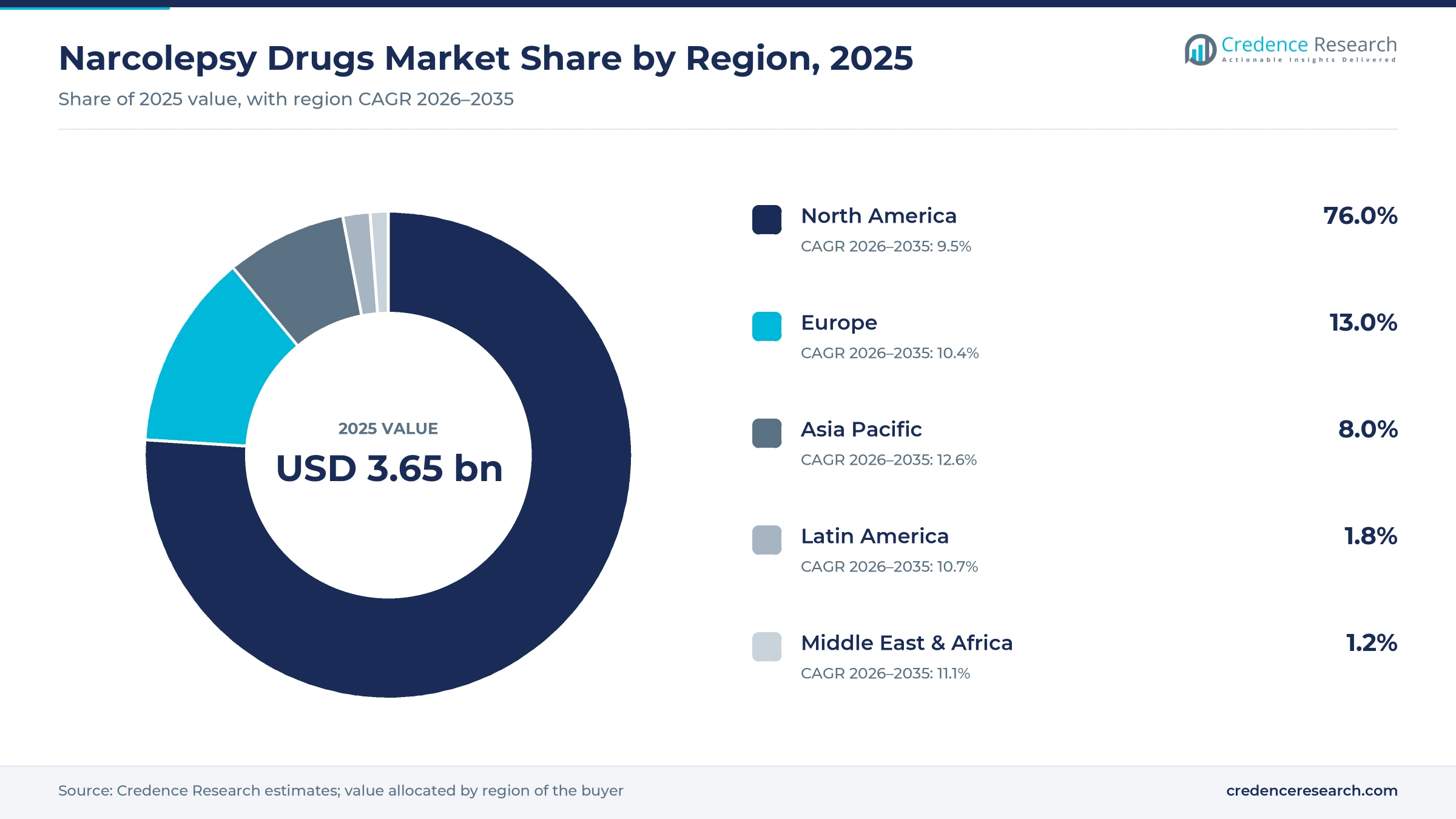
North America held 76.0% of 2025 value and grows at 9.5% a year through 2035. The U.S. is the main market for Xywav, Lumryz and Wakix, Orzeyful launched there in November 2026, and U.S. specialty pharmacies handle dispensing under controlled-drug rules. The type 1 population noted above sets a large ceiling for orexin uptake. Growth sits below the global rate because oxybate generics and the 2030 Wakix generic date hit U.S. sales first.
Europe grows on diagnosis gains and licensed partners
Europe held 13.0% of 2025 value and grows at 10.4% a year. Unlike Asia Pacific, where the premium tier starts with orexin agonists, Europe built its branded base on pitolisant, which Paris-based Bioprojet has sold under EU authorization since March 2016, while Pharmanovia markets solriamfetol. The wide gap in recorded prevalence between German and French data, described in the drivers, suggests that better diagnosis could add patients faster than price gains. National health technology assessment and reference pricing keep value per patient well below U.S. levels, and Takeda's August 2026 release listed Orzeyful approvals only in the U.S., Japan and China.
Asia Pacific is the fastest-growing region after 2026 approvals
Asia Pacific held 8.0% of 2025 value and is the fastest-growing region at 12.6% a year. Takeda announced Japanese approval of Orzeyful for adults with type 1 disease on Aug. 24, 2026, and said China had also approved it for patients aged 16 and older. These approvals open a premium tier in markets that relied mainly on modafinil and stimulants. Published data on treated patients and uptake in Japan and China are thin, which is an evidence gap in this estimate.
Latin America relies on older generic wake-promoting agents
Latin America held 1.8% of 2025 value and grows at 10.7% a year through 2035. The model assumes that most treated patients in Brazil and Mexico take generic modafinil or methylphenidate, as branded oxybates and pitolisant have limited registration in the region. Published treatment volumes and prices for narcolepsy in Latin America are scarce, so this share is one of the least certain in the model.
Middle East and Africa start from a small specialist base
The Middle East & Africa held 1.2% of 2025 value and grows at 11.1% a year. Pharmanovia leads launch activity for solriamfetol across the Middle East and North Africa under its 2023 license, and Gulf hospitals with sleep laboratories account for most diagnosed patients in the model. Across most of Africa, sleep testing is scarce, and no regional sales data for narcolepsy medicines are published.
Approvals, filings and a takeover reshape the field
| Development | Status and market relevance |
|---|---|
| In February 2026, Alkermes completed its acquisition of Avadel Pharmaceuticals, adding Lumryz once-nightly sodium oxybate. | Completed acquisition. Puts an oxybate and an orexin program under one owner. |
| In February 2026, the FDA approved a cataplexy indication for Harmony's Wakix in patients aged six and older. | Approval. Extends pitolisant use in children aged six and older. |
| In April 2026, Alkermes started three phase 3 Brilliance studies of alixorexton in narcolepsy type 1 and type 2. | Testing, enrolling. Second orexin agonist in late-stage trials. |
| In July 2026, the FDA accepted Axsome's new drug application for AXS-12 in cataplexy, with a May 1, 2027, target date. | Filing accepted, under review. Would add an on-label daytime cataplexy tablet. |
| In August 2026, the FDA approved Takeda's Orzeyful, and the U.S. launch followed on Nov. 12, 2026, after Schedule IV placement. | Approval and operational launch. First orexin agonist on sale. |
Five mechanisms now compete for the same patients
- Oxybates taken at bedtime consolidate night sleep and reduce daytime sleepiness and cataplexy, under restricted distribution.
- Pitolisant blocks the histamine H3 receptor to raise wake-promoting histamine and is the only non-scheduled product for daytime sleepiness.
- Wake-promoting agents such as modafinil, armodafinil and solriamfetol treat daytime sleepiness and remain the low-cost first step.
- Orexin receptor agonists such as oveporexton replace the missing orexin signal in type 1 disease with a twice-daily tablet.
- Noradrenaline reuptake inhibitors such as AXS-12 target cataplexy during the day, with an FDA decision expected in May 2027.
Need a Custom Version of This Report?
Tailor the scope, geography, or segments to your exact requirements.
- Custom geography or segment scope
- Direct access to our analyst team
Four branded sellers face a new orexin entrant
Competition in narcolepsy treatment centers on a few branded sellers that hold restricted, high-priced products. Jazz leads in oxybates with Xywav and the original Xyrem, and Alkermes now competes against it with Lumryz after buying Avadel. Harmony sells Wakix in the U.S., while Bioprojet holds the pitolisant license in Europe. Takeda entered in November 2026 with Orzeyful, the first orexin agonist, and Alkermes is the closest follower with alixorexton in phase 3. Axsome sells solriamfetol in the U.S. and awaits a decision on AXS-12, while Pharmanovia carries solriamfetol in Europe and the Middle East. Teva supplies modafinil and armodafinil, and Hikma and Amneal sell generic sodium oxybate. Companies compete on label breadth, dosing convenience, scheduling class and payer contracts. Pricing power sits with whoever owns an exclusive mechanism, which is why orexin programs now attract most investment.
How concentrated is the branded supply side?
Supply is concentrated in a few branded sellers, because each successful product needs orphan exclusivity, patents, controlled-drug registration and a specialist sales force. Jazz, Harmony, Alkermes and Takeda hold the main U.S. brands, while Bioprojet and Pharmanovia carry pitolisant and solriamfetol in Europe. Generic makers such as Teva, Hikma and Amneal compete only where exclusivity has ended, and their margins are thin. Margins sit with the brand owners, and the barriers of trials, scheduling and restricted distribution keep the number of real sellers small.
Companies profiled and their roles in this market
| Company | Type | Role in the market |
|---|---|---|
| Jazz Pharmaceuticals plc | Originator | Xywav low-sodium oxybate and Xyrem sodium oxybate for narcolepsy |
| Harmony Biosciences Holdings, Inc. | Specialty pharma | Wakix pitolisant tablets in the U.S. for adults and children |
| Takeda Pharmaceutical Company Limited | Originator | Orzeyful oveporexton, first orexin agonist for narcolepsy type 1 |
| Alkermes plc (Avadel) | Specialty pharma | Lumryz once-nightly sodium oxybate and alixorexton in phase 3 |
| Bioprojet Pharma | Originator | Wakix pitolisant marketing authorization holder in the European Union |
| Axsome Therapeutics, Inc. | Specialty pharma | Sunosi solriamfetol in the U.S. and AXS-12 under FDA review |
| Pharmanovia | Specialty pharma | Sunosi solriamfetol in Europe and the Middle East and North Africa |
| Teva Pharmaceutical Industries Ltd. | Brand and generic manufacturer | Provigil and Nuvigil brands and generic modafinil and armodafinil |
| Hikma Pharmaceuticals PLC | Generic manufacturer | Authorized generic sodium oxybate oral solution in the U.S. |
| Amneal Pharmaceuticals, Inc. | Generic manufacturer | Authorized generic sodium oxybate oral solution in the U.S. |
Orexin agonists decide who leads after 2030
Credence Research's view is that orexin agonists decide which company leads the narcolepsy drugs market after 2030. Oxybates keep the largest share through the late 2020s, but their growth slows as generics spread and pitolisant meets its own generic date in 2030. The orexin tier carries the highest price and the clearest clinical gain in type 1 disease, and three programs now compete for it. Sellers that pair an existing oxybate or pitolisant base with an orexin product, as Alkermes aims to do, are best placed to hold specialist prescribers.
Patient counts and list prices anchor the model
The report uses 2025 as the base year and forecasts market value to 2035, with growth rates stated for 2026–2035. Market values come from the Credence Research market model, which combines treated patients, product mix and list prices adjusted for rebates by region, and the earlier edition of this report was brought to the 2025 base with its own growth rate and checked against these inputs. Splits by drug class, channel, age group and region are Credence Research estimates. Sources used include FDA, EMA and NINDS material, company releases, published studies and public price guides. No primary interviews or surveys were used to build the estimates.
Phase 3 readouts and the 2030 generic date set the path
By 2035, the narcolepsy drugs market reaches USD 9.38 billion, with orexin agonists the main source of new value. Alixorexton and ORX750 results decide whether the class extends to type 2 disease before 2030. Oxybates remain the largest class for most of the forecast, although generic sodium oxybate keeps pulling down older product value. Wakix generics from March 2030 reduce H3 antagonist value unless newer formulations hold patients. Asia Pacific gains share as Japanese and Chinese patients start orexin therapy, and payer step therapy remains the main brake on uptake.
Orexin uptake and generic timing set the 2035 range
The range of outcomes depends on how fast payers open the orexin tier and how hard generics hit oxybates and pitolisant. The base case assumes steady Orzeyful uptake in type 1 disease, one more orexin approval before 2030 and Wakix generics from 2030. A downside follows if step therapy holds orexin use to refractory patients. An upside needs orexin labels in type 2 disease and an EU approval.
| Scenario | CAGR, 2026–2035 | Value, 2035 | What has to hold |
|---|---|---|---|
| Downside | 7.9% | USD 7.95 billion | Payers restrict orexin agonists to refractory type 1 patients and oxybate generics deepen |
| Base | 9.90% | USD 9.38 billion | Steady orexin uptake in type 1 disease and one more orexin approval before 2030 |
| Upside | 11.4% | USD 10.59 billion | Orexin labels extend to type 2 disease and Europe approves the first agent |
Frequently Asked Questions
How big is the narcolepsy drugs market?
Which drug class holds the largest share?
What is Orzeyful and when did it launch?
How much do narcolepsy medicines cost?
Which region holds the largest share?
Which new narcolepsy treatments are in late-stage development?
When do Wakix generics enter the U.S. market?
Who are the leading companies?
Table of Content
Chapter 1 Market Segmentation
- 1.1 Segmentation Framework
- 1.1.1 Product and Service Classification
- 1.1.2 Application and End-Use Classification
- 1.1.3 Technology and Solution Classification
- 1.1.4 Customer and Distribution Channel Classification
- 1.1.5 Geographic Segmentation
- 1.1.6 Market Segment Definitions and Boundaries
- 1.2 By Drug Class
- 1.2.1 Oxybates
- 1.2.2 Histamine H3 Receptor Antagonists
- 1.2.3 Wake-Promoting Agents and Stimulants
- 1.2.4 Orexin Agonists and Others
- 1.3 By Age Group
- 1.3.1 Adults
- 1.3.2 Pediatric
Chapter 2 Introduction
- 2.1 Report Objectives and Scope
- 2.2 Product Definition and Industry Terminology
- 2.3 Market Inclusions and Exclusions
- 2.4 Research Process
- 2.4.1 Primary Research and Expert Interviews
- 2.4.2 Secondary Research and Source Review
- 2.4.3 Top-Down and Bottom-Up Estimation
- 2.4.4 Data Triangulation and Verification
- 2.5 Market Size Measurement Basis
- 2.5.1 2025: USD 3.65 billion → 2035: USD 9.38 billion
- 2.6 Historical and Forecast Reference Periods
- 2.6.1 Historical Period: 2018-2025
- 2.6.2 Base Year: 2025
- 2.6.3 Forecast Period: 2025-2035
- 2.7 Research Assumptions and Limitations
Chapter 3 Executive Summary
- 3.1 Market Snapshot and Key Findings
- 3.2 Base-Year Market Size, 2025
- 3.3 Forecast Market Size, 2035
- 3.4 Revenue and Volume Growth Outlook
- 3.5 Key Demand and Supply Indicators
- 3.6 Leading Market Segments
- 3.7 Fastest-Growing Market Opportunities
- 3.8 Regional Performance Highlights
- 3.9 Technology and Industry Transformation
- 3.10 Competitive Landscape Summary
- 3.11 Analyst View and Strategic Implications
Chapter 4 Global Narcolepsy Drugs Market Trends and Developments
- 4.1 Historical Industry Development, 2018-2025
- 4.2 Recent Market Trends and Developments
- 4.3 Demand and Customer Behavior Trends
- 4.4 Technology and Product Innovation
- 4.5 Artificial Intelligence, Automation and Digitalization
- 4.6 Local Manufacturing and Supply Chain Realignment
- 4.7 Industry Partnerships, Mergers and Acquisitions
- 4.8 Sustainability and Circular Economy Developments
- 4.9 Government and Private Sector Investment Trends
- 4.10 Emerging Business Models and Commercialization
- 4.11 Industry Developments and Announcements
Chapter 5 Global Narcolepsy Drugs Market Production, Supply and Demand Analysis
- 5.1 Demand Trend and Consumption Analysis, 2018-2025
- 5.2 Demand Forecast, 2025-2035
- 5.3 Production and Output Trend, 2018-2025
- 5.4 Production and Output Forecast, 2025-2035
- 5.5 Installed Capacity and Capacity Utilization
- 5.6 Company-Wise Production Plants and Statistics
- 5.6.1 Installed Production Capacity
- 5.6.2 Actual Production
- 5.6.3 Planned Capacity and Expansion Targets
- 5.7 Supply Chain Structure and Procurement Trends
- 5.8 Supply-Demand Gap and Bottlenecks
- 5.9 Import Dependence and Sourcing Structure
- 5.10 Contract Manufacturing and Outsourcing
- 5.11 Regional Supply and Demand Concentration
Chapter 6 Global Narcolepsy Drugs Market Pricing Analysis
- 6.1 Pricing Structure and Measurement
- 6.2 Historical Pricing Trends, 2018-2025
- 6.3 Pricing Outlook, 2025-2035
- 6.4 Average Selling Price and Unit Economics
- 6.5 Pricing by Product and Market Segment
- 6.6 Geographic Pricing Differences
- 6.7 Key Input, Energy, Labor and Logistics Costs
- 6.8 Contract Pricing and Purchasing Models
- 6.9 Pricing Sensitivity and Competitive Positioning
- 6.10 Price, Margin and Profitability Implications
Chapter 7 Global Narcolepsy Drugs Market Dynamics
- 7.1 Market Growth Drivers
- 7.1.1 Demand-Side Drivers
- 7.1.2 Technology and Innovation Drivers
- 7.1.3 Infrastructure and Investment Drivers
- 7.1.4 Regulatory and Policy Drivers
- 7.2 Market Restraints
- 7.2.1 Cost and Affordability Constraints
- 7.2.2 Technology and Adoption Barriers
- 7.2.3 Supply Chain and Operational Constraints
- 7.3 Market Challenges
- 7.3.1 Competitive Pressure and Margin Erosion
- 7.3.2 Skills, Infrastructure and Implementation Gaps
- 7.4 Emerging Market Opportunities
- 7.5 Market Dynamics Impact and Time-Horizon Assessment
Chapter 8 Global Narcolepsy Drugs Value Chain Analysis
- 8.1 Industry Value Chain Overview
- 8.2 Upstream Suppliers and Critical Inputs
- 8.3 Technology and Component Providers
- 8.4 Manufacturing or Service Delivery
- 8.5 Distribution, Channel Partners and Integrators
- 8.6 Downstream Applications and End Users
- 8.7 Value Addition and Profit Pools
- 8.8 Vertical Integration and Outsourcing
- 8.9 Supplier Concentration and Risk
- 8.10 Supply Chain Localization and Resilience
Chapter 9 Global Narcolepsy Drugs Market Regulations and Policies
- 9.1 Relevant Laws, Standards and Compliance Frameworks
- 9.2 Product, Service, Safety and Quality Requirements
- 9.3 Government Policies, Incentives and Subsidies
- 9.4 Imports, Exports and Trade Barriers
- 9.5 Public Procurement and Local Content Requirements
- 9.6 Environmental and Sustainability Compliance
- 9.7 Upcoming Policy Changes and Market Implications
Chapter 10 Global Narcolepsy Drugs Market Hotspots and Opportunities
- 10.1 Market Opportunity Mapping and Growth Hotspots
- 10.2 High-Growth Applications and Customer Groups
- 10.3 Underserved Markets and White-Space Opportunities
- 10.4 Emerging Technology and Product Opportunities
- 10.5 New Capacity and Investment Hotspots
- 10.6 Market Entry and Expansion Opportunities
- 10.7 Distribution and Partnership Opportunities
- 10.8 Near-Term and Long-Term Commercial Potential
- 10.9 Opportunity Attractiveness and Execution Risks
Chapter 11 Global Narcolepsy Drugs Market Outlook, 2025-2035
- 11.1 Market Size and Analysis
- 11.1.1 Revenue (Market Measurement: 2025: USD 3.65 billion → 2035: USD 9.38 billion)
- 11.1.2 Market Volume and Quantity Sold
- 11.1.3 Historical Market Size, 2018-2025
- 11.1.4 Base-Year Market Size, 2025
- 11.2 Market Forecast, 2025-2035
- 11.2.1 Revenue Forecast to 2035
- 11.2.2 Volume Forecast to 2035
- 11.2.3 CAGR and Year-on-Year Growth
- 11.2.4 Incremental Revenue Opportunity
- 11.3 Forecast Assumptions and Scenario Analysis
- 11.3.1 Base-Case Forecast
- 11.3.2 Optimistic and Conservative Scenarios
- 11.3.3 Technology, Pricing and Policy Sensitivities
- 11.4 Market Attractiveness and Growth Outlook
Chapter 12 Global Narcolepsy Drugs Market Segmentation and Outlook
- 12.1 Segmentation Summary and Market Shares, 2025
- 12.2 Largest and Fastest-Growing Segments
- 12.3 By Drug Class - Market Size and Forecast, 2025-2035
- 12.3.1 Segment Definition and Scope
- 12.3.2 Historical Market Size, 2018-2025
- 12.3.3 Revenue Forecast, 2025-2035
- 12.3.4 Volume Forecast, 2025-2035
- 12.3.5 Base-Year Market Share, 2025
- 12.3.6 Segment CAGR and Growth Drivers
- 12.3.7 Subsegment Market Size and Forecast
- 12.3.7.1 Oxybates
- 12.3.7.2 Histamine H3 Receptor Antagonists
- 12.3.7.3 Wake-Promoting Agents and Stimulants
- 12.3.7.4 Orexin Agonists and Others
- 12.3.8 Subsegment Pricing and Adoption Trends
- 12.3.9 Leading Suppliers and Competition
- 12.3.10 Regional Demand and Opportunities
- 12.4 By Age Group - Market Size and Forecast, 2025-2035
- 12.4.1 Segment Definition and Scope
- 12.4.2 Historical Market Size, 2018-2025
- 12.4.3 Revenue Forecast, 2025-2035
- 12.4.4 Volume Forecast, 2025-2035
- 12.4.5 Base-Year Market Share, 2025
- 12.4.6 Segment CAGR and Growth Drivers
- 12.4.7 Subsegment Market Size and Forecast
- 12.4.7.1 Adults
- 12.4.7.2 Pediatric
- 12.4.8 Subsegment Pricing and Adoption Trends
- 12.4.9 Leading Suppliers and Competition
- 12.4.10 Regional Demand and Opportunities
- 12.5 Segment Growth Comparison
- 12.6 Segment Attractiveness and Priority Matrix
Chapter 13 Global Narcolepsy Drugs Geographic Market Outlook, 2025-2035
- 13.1 Regional Market Size and Share, 2025
- 13.2 Regional Market Forecast, 2025-2035
- 13.3 Regional Pricing, Production and Demand Differences
- 13.4 North America
- 13.4.1 United States
- 13.4.2 Canada
- 13.4.3 Mexico
- 13.5 Europe
- 13.5.1 Germany
- 13.5.2 France
- 13.5.3 Italy
- 13.5.4 United Kingdom
- 13.5.5 Spain
- 13.5.6 Poland
- 13.5.7 Russia
- 13.5.8 Netherlands
- 13.5.9 Belgium
- 13.5.10 Sweden
- 13.5.11 Denmark
- 13.5.12 Norway
- 13.5.13 Rest of Europe
- 13.6 Asia Pacific
- 13.6.1 China
- 13.6.2 India
- 13.6.3 Japan
- 13.6.4 South Korea
- 13.6.5 Thailand
- 13.6.6 Indonesia
- 13.6.7 Vietnam
- 13.6.8 Malaysia
- 13.6.9 Australia
- 13.6.10 Rest of Asia Pacific
- 13.7 Latin America
- 13.7.1 Brazil
- 13.7.2 Argentina
- 13.7.3 Colombia
- 13.7.4 Chile
- 13.7.5 Rest of Latin America
- 13.8 Middle East
- 13.8.1 Saudi Arabia
- 13.8.2 United Arab Emirates
- 13.8.3 Turkey
- 13.8.4 Israel
- 13.8.5 Iran
- 13.8.6 Rest of the Middle East
- 13.9 Africa
- 13.9.1 South Africa
- 13.9.2 Egypt
- 13.9.3 Nigeria
- 13.9.4 Morocco
- 13.9.5 Rest of Africa
- 13.10 Regional Investment, Policy and Supply Chain Differences
- 13.11 Regional Competitive Landscape
- 13.12 Geographic Growth Hotspots
Chapter 14 Global Narcolepsy Drugs Technology, Innovation and Sustainability Outlook
- 14.1 Technology Landscape and Maturity
- 14.2 Product, Process and Service Innovation
- 14.3 AI, Automation and Digital Tools in the Industry
- 14.4 Technology Adoption and Performance Benchmarking
- 14.5 Innovation Pipeline and R&D Investment
- 14.6 Patent and Intellectual Property Trends
- 14.7 Energy Efficiency and Resource Management
- 14.8 Sustainability, Recycling and Circularity
- 14.9 Technology Roadmap, 2025-2035
- 14.10 Risks of Obsolescence and Technology Substitution
Chapter 15 Global Narcolepsy Drugs Market Key Strategic Imperatives
- 15.1 Growth and Market Entry Priorities
- 15.2 High-Return Products and Segments
- 15.3 Pricing, Profitability and Cost Optimization
- 15.4 Technology Investment and Product Differentiation
- 15.5 Supply Chain Localization and Resilience
- 15.6 Distribution and Customer Acquisition
- 15.7 Partnership, Acquisition and Capacity Strategy
- 15.8 Regional Expansion Priorities
- 15.9 Short-, Medium- and Long-Term Actions
Chapter 16 Competition Outlook
- 16.1 Industry Competition Characteristics
- 16.2 Market Structure and Concentration
- 16.3 Market Share and Competitive Positioning, 2025
- 16.4 Company-Wise Revenue and Product Benchmarking
- 16.5 Production and Service Capacity Benchmarking
- 16.6 Technology, Pricing and Differentiation
- 16.7 Regional Footprint and Distribution Strength
- 16.8 Mergers, Acquisitions and Strategic Alliances
- 16.9 New Entrants and Competitive Threats
- 16.10 Porter's Five Forces and Industry Attractiveness
- 16.11 Competitive Outlook, 2025-2035
Chapter 17 Company Profiles
- 17.1 Company Coverage and Selection Criteria
- 17.2 Jazz Pharmaceuticals plc
- 17.2.1 Business Description
- 17.2.2 Company Ownership and Geographic Presence
- 17.2.3 Product and Service Portfolio
- 17.2.4 Manufacturing and Operating Footprint
- 17.2.5 Production Capacity and Expansion Plans
- 17.2.6 Financial Performance and Investment
- 17.2.7 Market Share and Competitive Position
- 17.2.8 Technology and Innovation Capabilities
- 17.2.9 Strategic Alliances or Partnerships
- 17.2.10 Recent Developments
- 17.2.11 Growth Strategy and Outlook
- 17.3 Harmony Biosciences Holdings, Inc.
- 17.4 Takeda Pharmaceutical Company Limited
- 17.5 Alkermes plc (Avadel)
- 17.6 Bioprojet Pharma
- 17.7 Axsome Therapeutics, Inc.
- 17.8 Pharmanovia
- 17.9 Teva Pharmaceutical Industries Ltd.
- 17.10 Hikma Pharmaceuticals PLC
- 17.11 Amneal Pharmaceuticals, Inc.
- 17.12 Other Relevant Market Participants
Note: Every listed company is profiled on the structure shown under the first company. The company list is preliminary and may change based on research findings, market developments, data availability and client requirements.
Chapter 18 Disclaimer
- 18.1 Research and Forecast Disclaimer
- 18.2 Data Source and Estimation Limitations
Note: The depth of individual sections depends on data availability for this market. Volume, capacity, trade and other unit-based metrics are included where applicable.