
Record meat imports keep Philippine freezers full
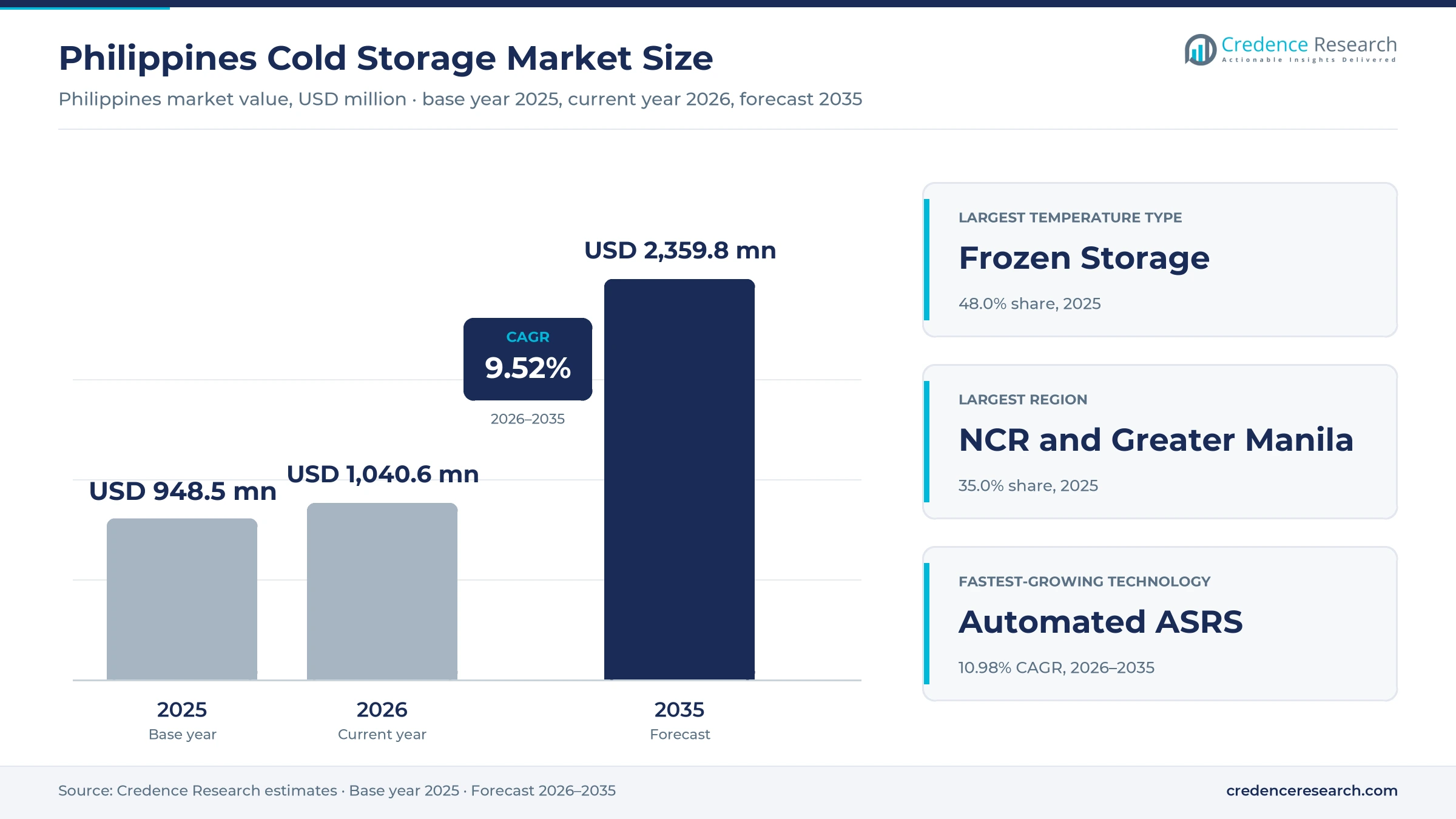
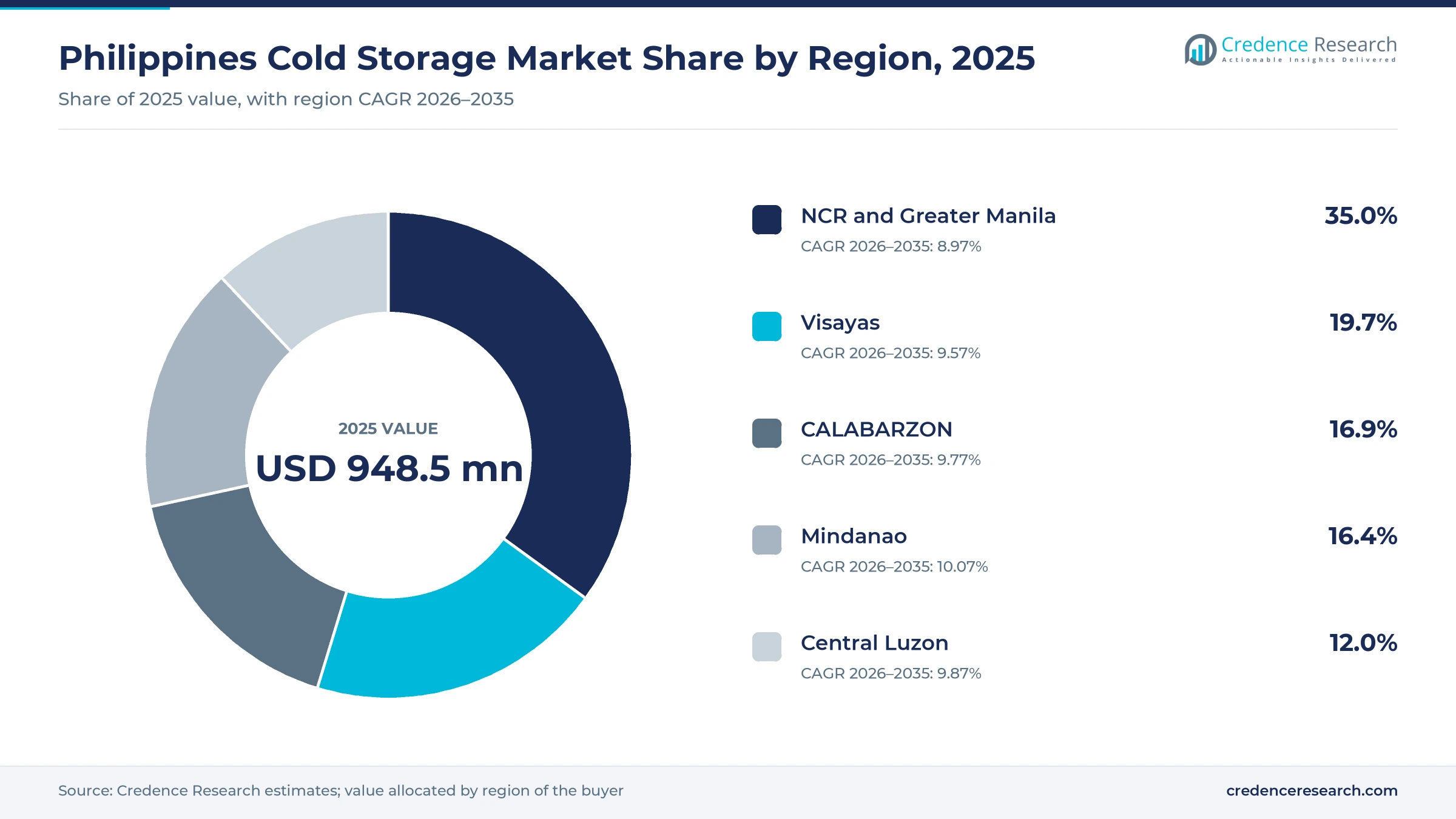
The Philippines cold storage market was valued at USD 948.5 million in 2025 and is projected to increase from USD 1.04 billion in 2026 to USD 2.36 billion by 2035, registering a CAGR of 9.52% during 2026–2035. Demand comes from importers of frozen pork, chicken and beef, from processors and retail chains, and from farm groups that need to cut post-harvest losses. NCR and Greater Manila held the largest regional share, 35.0% in 2025, because the Manila port complex receives most reefer imports and serves the largest consumer base. Mindanao is the fastest-growing region at 10.07% a year, as new pallet capacity opens in Davao del Norte and Cagayan de Oro. Meanwhile, the Department of Agriculture has set aside P3 billion for up to 99 public cold storage facilities, including modular chillers for farming areas. As a result, capacity is spreading from Metro Manila toward provincial hubs that sit closer to producers and regional ports.
What does the Philippine cold storage estimate count?
The estimate counts revenue from storing frozen, chilled, multi-temperature and controlled-ambient goods in Philippine facilities. It covers public refrigerated warehouses, dedicated distribution centers, blast freezing hubs and hybrid solar cold stores. Buyers usually pay per pallet per day, with added fees for handling, blast freezing, picking and value-added services.
The estimate excludes refrigerated trucking, reefer container leasing and the sale of refrigeration equipment to end users. It also excludes in-store freezers at supermarkets and restaurants, because those assets sit outside third-party warehouses. The value chain runs from importers, fishers and farmers through storage operators to processors, retailers and hospitals.
Philippines Cold Storage Market Insights
- The market was valued at USD 948.5 million in 2025 and is projected to reach USD 2.36 billion by 2035, registering a CAGR of 9.52% during 2026–2035.
- NCR and Greater Manila held 35.0% of Philippine value in 2025, because most frozen meat imports land at Manila ports.
- Frozen storage led with 48.0% of 2025 value, as imported pork and chicken require holding at deep-freeze temperatures.
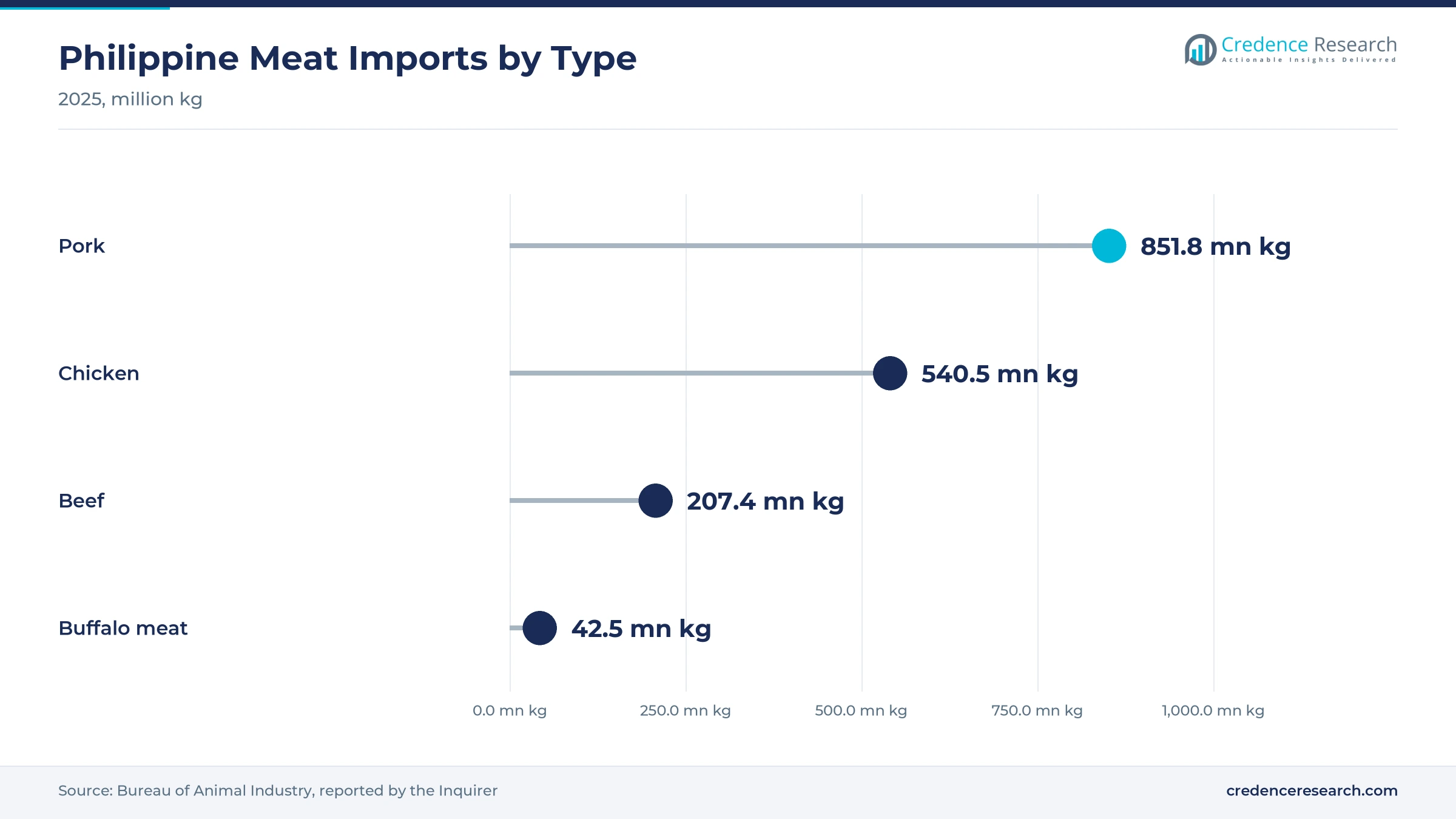
- Philippine meat imports reached 1.64 billion kg in 2025, up more than 13% from 2024, which kept freezer rooms heavily booked.
- GMAC launched an 11,728-pallet facility in Davao del Norte in March 2026, the largest cold storage site reported in Mindanao.
Frozen rooms lead while automated sites grow fastest
Why does frozen storage hold the largest share?
Based on temperature type, the market is categorized into frozen storage, chilled storage, multi-temperature storage and controlled-ambient storage. Frozen Storage led with 48.0% of 2025 value, because imported pork, chicken and seafood arrive frozen and stay in deep-freeze rooms until sale. Multi-Temperature Storage grows fastest at 10.37% a year, as new buildings offer separate frozen and chilled chambers for mixed retail loads.
Which end uses fill Philippine cold rooms?
Based on end-use industry, the market is categorized into meat and poultry, seafood, dairy and frozen foods, fruits and vegetables, and pharmaceuticals and biologics. Meat and Poultry led with 38.0% of 2025 value, because pork and chicken make up most import volume. Pharmaceuticals and Biologics grow fastest at 10.44% a year, as vaccines and biologics need validated storage.
Who rents most pallet space in the Philippines?
Based on customer type, the market is categorized into food importers and traders, food manufacturers and processors, retail and foodservice chains, agricultural cooperatives and consolidators, and healthcare distributors. Food Importers and Traders led with 36.0% of 2025 value, because they hold imported stock between arrivals and sales. Agricultural Cooperatives and Consolidators grow fastest at 10.31% a year, as public modular chillers reach farming towns.
How fast are automated facilities spreading?
Based on technology, the market is categorized into conventional racking with WMS, automated ASRS facilities, IoT temperature monitoring and energy-efficient refrigeration systems. Conventional Racking with WMS led with 58.0% of 2025 value, because most existing warehouses use selective racks and forklifts. Automated ASRS Facilities grow fastest at 10.98% a year, as high-bay buildings save land in Metro Manila and cut handling losses.
| Segment Group | Leading Sub-segment | Share, 2025 | Fastest-growing Sub-segment | CAGR, 2026–2035 |
|---|---|---|---|---|
| By Temperature Type | Frozen Storage | 48.0% | Multi-Temperature Storage | 10.37% |
| By End-Use Industry | Meat and Poultry | 38.0% | Pharmaceuticals and Biologics | 10.44% |
| By Customer Type | Food Importers and Traders | 36.0% | Agricultural Cooperatives and Consolidators | 10.31% |
| By Technology | Conventional Racking with WMS | 58.0% | Automated ASRS Facilities | 10.98% |
Request a Free Sample
Fill in your details and we'll send you a free sample report.
- Sample data tables & charts
- Research methodology
Imports, public builds and automation lift demand
How do frozen food imports lift storage demand?
Frozen food imports are the main driver, because nearly every imported carton of meat must pass through a freezer before sale. Meat imports reached 1.64 billion kg in 2025, up more than 13% from 1.45 billion kg in 2024, according to Bureau of Animal Industry figures reported by the Inquirer. Pork made up 851.76 million kg, up 16.2%, while chicken reached 540.52 million kg, up 14.5%. Brazil supplied 679.24 million kg, or 41.3% of the total. Food also accounted for 14.8% of merchandise imports in 2025, based on World Bank data. As a result, food importers and traders held 36.0% of 2025 value, because they rent pallet space between vessel arrival and distribution.
Why does public cold storage investment matter?
Public investment in cold storage widens the market beyond Metro Manila, because farm areas have long lacked chilled space. The Department of Agriculture plans up to 99 cold storage facilities with a P3 billion budget, according to Malaya Business Insight. The funds combine P1.5 billion of unprogrammed funds approved in 2024 with P1.5 billion under the 2025 budget. Large sites will hold 2,800 to 3,500 pallet positions each, while about 96 modular units will store 7 to 15 metric tons each. In June 2025, the agriculture secretary said the new warehouses will use hybrid solar, wind and grid power. Therefore, agricultural cooperatives and consolidators grow at 10.31% a year.
How do automation and integrated services raise demand?
Automation and service integration raise demand, because operators that bundle storage, freezing and delivery win long contracts with retailers. ORCA Cold Chain Solutions opened a 14-story, 20,000-pallet facility in Taguig in February 2020 using an automated storage and retrieval system and warehouse management software. Its two Metro Manila sites held 34,342 pallet positions in 2022. Royal Cargo operates about 140,000 square meters of cold space for more than 33,000 pallets and formed a joint venture with SCG JWD in 2023. In addition, the GMAC Davao site uses a form of AI to adjust temperatures for different goods. In turn, automated ASRS facilities grow at 10.98% a year.
Does port congestion push cargo into warehouses?
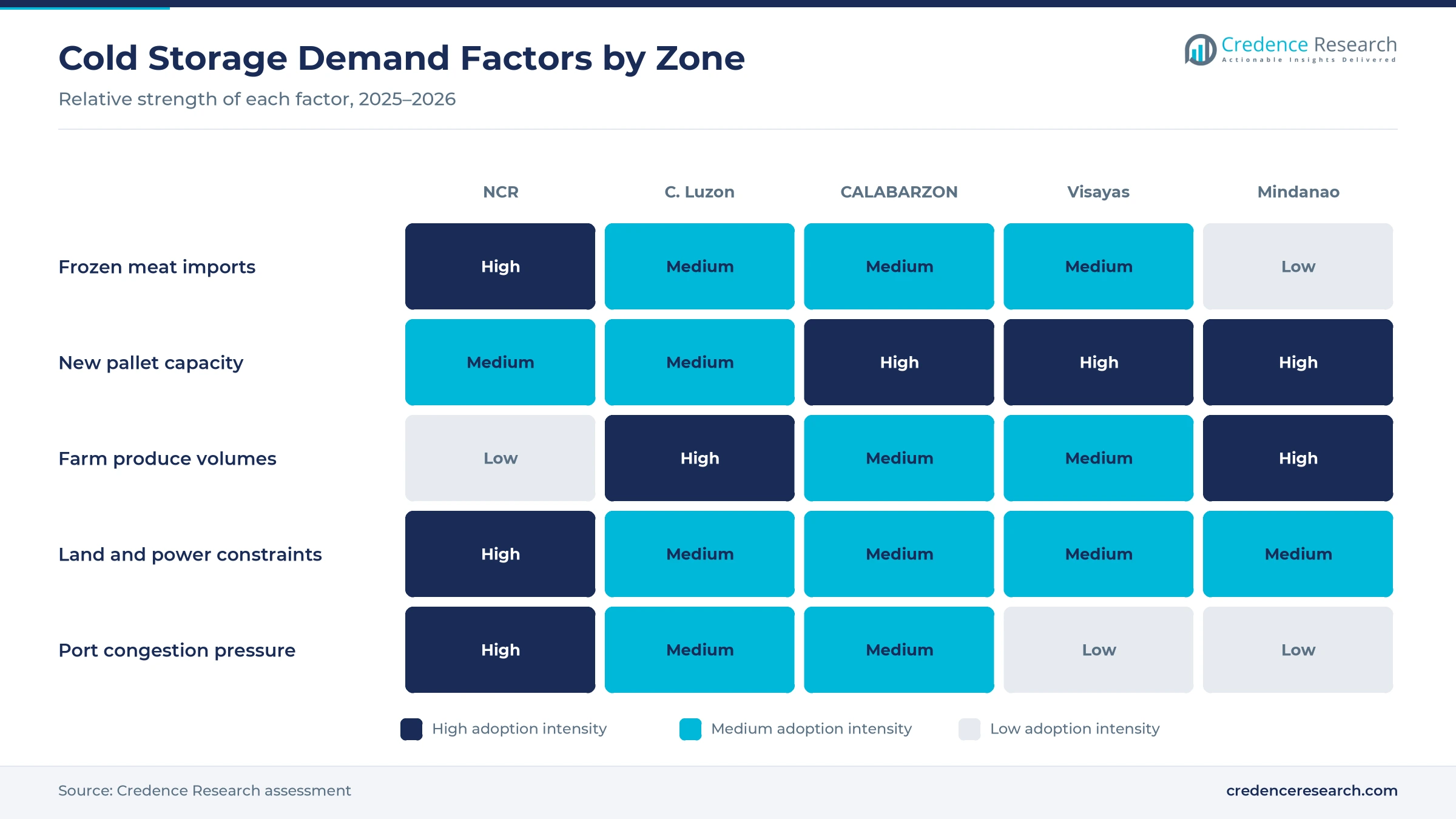
Port congestion adds a further driver, because importers move frozen cargo off terminals quickly when reefer yards run full. Reefer utilization at the Manila International Container Terminal reached 105.98% on Feb. 2, 2026, according to PortCalls Asia. Utilization was still 102.17% two days later, and about 5.98% of reefer volume sat outside standard slots. The port users group warned that some importers were using reefer containers as long-term storage, which risks power faults and spoilage. Customs officials also reported yard utilization above 80% in January 2025 and most of December 2025. Consequently, warehouses near Manila ports absorb overflow cargo, which supports steady demand in NCR and Greater Manila.
Regional hubs and developer networks reshape supply
Why are Mindanao and Visayas hubs rising?
Capacity is shifting toward Mindanao and Visayas hubs, because shipping frozen goods from Manila adds cost and time for island markets. GMAC, a joint venture of Glacier Megafridge and AC Logistics formed in 2021, opened a 5,348-pallet facility in Cagayan de Oro in June 2023. It then launched an 11,728-pallet site in the Anflo Industrial Estate in Davao del Norte, reported by Daily Tribune on March 12, 2026. The Davao site holds temperatures from minus 30 to plus 10 degrees Celsius and employs about 119 people. In Cebu, ALogis Artico broke ground on a 6,000-pallet facility in Consolacion in September 2025. As a result, Mindanao gains new capacity faster than any other zone in the country.
How are developer networks changing supply?
Developer-led networks are rising, because property groups can bundle land, power and buildings into ready cold storage parks. AyalaLand Logistics opened ALogis Artico Santo Tomas in Batangas in May 2024 with 5,000 pallet positions and 16 cold rooms. Those rooms run from 5 to minus 25 degrees Celsius, and the network reached 15,300 pallet positions across four facilities. The Consolacion site in Cebu is set for completion in the third quarter of 2026. Meanwhile, Damosa Land hosts the GMAC Davao facility inside its 63-hectare estate. These projects raise demand for commercial refrigeration equipment, and CALABARZON grows at 9.77% a year.
Can hybrid solar cold stores open farm markets?
Hybrid solar cold stores are an opening, because many farming and fishing towns face unstable grid power and high electricity prices. The Department of Agriculture said in June 2025 that its new warehouses will combine solar and wind power with the main grid, mainly for remote and underserved farm areas. Its mega cold storage sites will range from 1,700 to more than 8,000 pallet positions. The program also covers refrigerated vans, dryers, packaging equipment and ice plants for farm groups. Modular units sized like 40-foot container vans can operate within three months of construction. Therefore, fruits and vegetables gain a larger share of chilled space, as onions, mangoes and other crops gain chilled space near farms.
Will pharmaceutical storage become a larger niche?
Pharmaceutical storage is a second opening, because vaccines, insulin and biologics need validated temperature control and full records. ORCA said in its 2022 listing documents that its facilities could store one million COVID-19 vaccines, and local governments used its sites for vaccine storage. The Philippine population reached 112,729,484 in the 2024 census, which enlarges the base for routine immunization and chronic care. Urban residents also made up 55.8% of the population in 2025, based on World Bank data, which concentrates hospital and pharmacy demand. Healthcare distributors also need IoT monitoring tools to pass customer audits. As a result, pharmaceuticals and biologics grow at 10.44% a year.
Power costs and port bottlenecks squeeze operators
Why do power costs weigh on cold store margins?
Electricity is one of the largest operating costs for refrigerated warehouses, because compressors run around the clock in a tropical climate. Operators outside Luzon also face grid interruptions that force them to run diesel generators. As a result, storage rates must cover energy costs that can swing with fuel prices and peak demand. Many operators respond with rooftop solar, better insulation and efficient compressors, which raise upfront capital needs.
How do port and trucking bottlenecks affect operators?
Port and trucking bottlenecks disrupt warehouse planning, because frozen cargo often arrives in waves before holidays and the Lunar New Year. When trucks are short, containers stay at terminals and pallets reach warehouses late or all at once. Consequently, operators face idle docks one week and overflow the next, which strains labor and refrigeration loads. Better appointment systems and off-dock yards help smooth these peaks over time.
Why is land near ports so hard to secure?
Land near ports and highways is scarce and expensive, especially in Metro Manila and nearby Bulacan and Cavite. This raises building costs for large freezer warehouses that need wide truck yards and reliable power connections. Therefore, many new projects move to industrial estates farther from the city, which adds trucking time for retail deliveries. High-bay automated buildings ease the problem but require larger capital budgets and skilled engineers.
Do food safety and skills gaps slow expansion?
Food safety compliance and skills gaps slow expansion, because operators need trained staff for temperature records, sanitation and halal or export handling. Small provincial cold rooms often lack qualified refrigeration technicians and monitoring systems. As a result, spoilage and audit failures remain risks for importers and pharmaceutical clients. Training programs, remote monitoring and partnerships with larger operators are the main ways companies close these gaps.
Greater Manila holds the largest share of capacity
| Region | Value, 2025 (USD million) | Share, 2025 | CAGR, 2026–2035 |
|---|---|---|---|
| NCR and Greater Manila | 332.0 | 35.0% | 8.97% |
| Visayas | 186.9 | 19.7% | 9.57% |
| CALABARZON | 160.3 | 16.9% | 9.77% |
| Mindanao | 155.6 | 16.4% | 10.07% |
| Central Luzon | 113.8 | 12.0% | 9.87% |
Why does NCR and Greater Manila lead capacity?
NCR and Greater Manila held 35.0% of 2025 value and grows at 8.97% a year. This lead reflects the Manila port complex, where most frozen meat and seafood imports arrive in reefer containers. Large operators such as ORCA run multistory sites in Taguig and Caloocan, close to supermarkets, restaurants and processors. However, growth is slower than in other zones, because land is scarce and new capacity moves to nearby provinces.
How does the Visayas use cold storage?
The Visayas held 19.7% of 2025 value and grows at 9.57% a year. Cebu is the main hub, because its port serves as a transshipment point for frozen goods moving across the central islands. AyalaLand Logistics already runs a cold storage site in Mandaue and broke ground on a 6,000-pallet facility in Consolacion in September 2025. Fishing, poultry and sugar areas in Negros and Panay add steady demand for chilled and frozen rooms.
What drives demand in CALABARZON?
CALABARZON held 16.9% of 2025 value and grows at 9.77% a year. The region is the most populous in the country, with 16,933,234 residents in the 2024 census, and hosts many food processing plants in Laguna, Batangas and Cavite. AyalaLand Logistics opened a 5,000-pallet facility in Santo Tomas, Batangas in May 2024. As a result, the region gains share as processors and importers move stock out of Metro Manila to industrial parks.
Why is Mindanao the fastest-growing zone?
Mindanao held 16.4% of 2025 value and grows at 10.07% a year, the fastest of the five zones. GMAC opened a 5,348-pallet facility in Cagayan de Oro in June 2023 and an 11,728-pallet site in Davao del Norte in March 2026. Banana, tuna, poultry and fruit producers in the south need chilled and frozen space close to their farms and ports. Therefore, new capacity in Davao and Northern Mindanao reduces reliance on shipping goods to Manila.
How does central Luzon support Manila supply?
Central Luzon held 12.0% of 2025 value and grows at 9.87% a year. The region is a major source of rice, vegetables, poultry and hogs, and its highways link farms to Metro Manila within a few hours. Royal Cargo opened a cold chain hub with 14,000 pallet positions in Plaridel, Bulacan in 2018. In addition, the Department of Agriculture is considering a large public facility in Cabanatuan, Nueva Ecija, which would add capacity for farm groups.
Hub openings and public programs from 2024 to 2026
| Development | Status and market relevance |
|---|---|
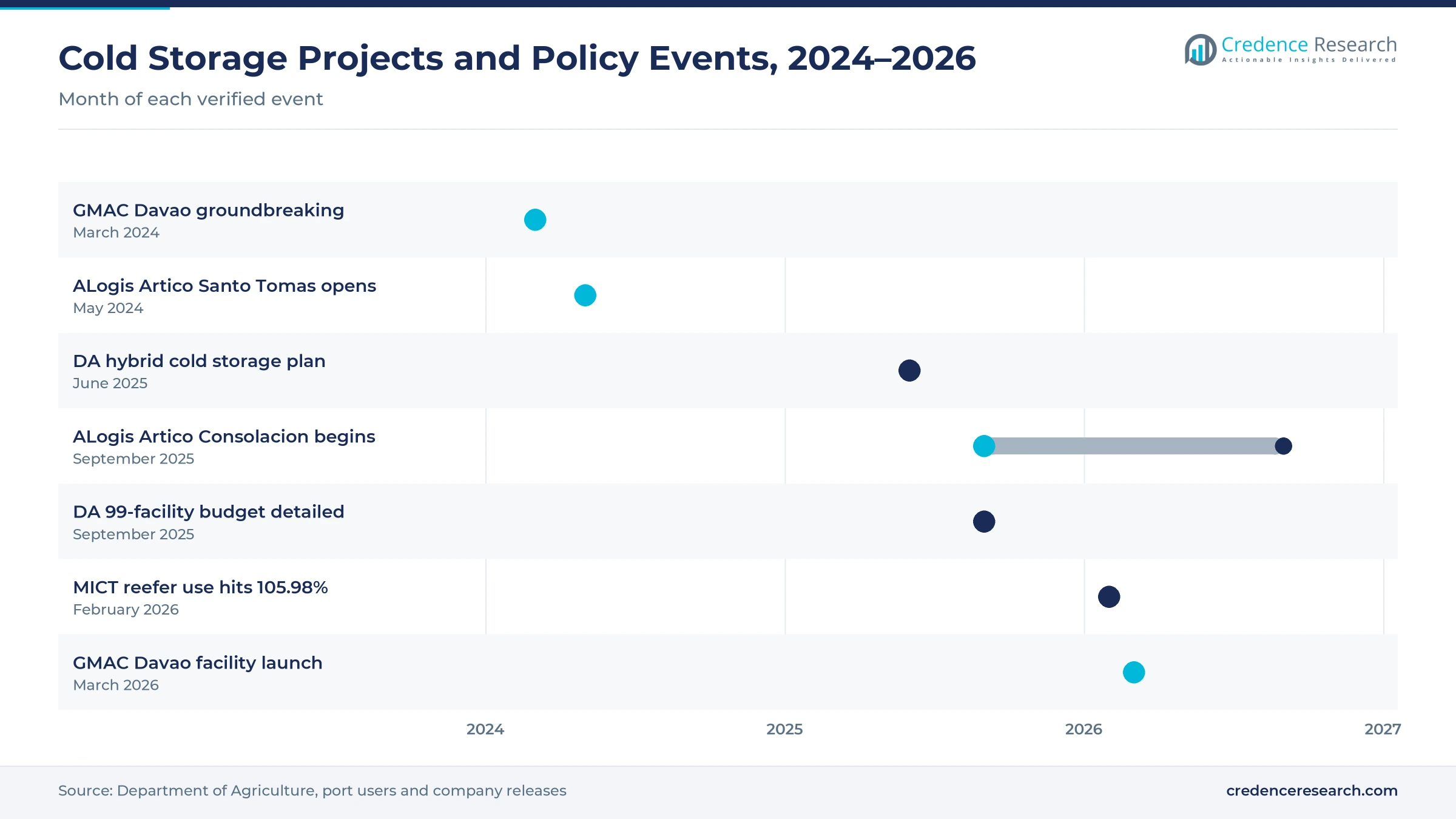
| In March 2024, Damosa Land, Glacier Megafridge and AC Logistics broke ground on a GMAC cold storage facility in Panabo City, Davao del Norte. | Planned to hold temperatures from minus 30 to plus 10 degrees Celsius |
| In May 2024, AyalaLand Logistics opened ALogis Artico Santo Tomas in Batangas with 5,000 pallet positions and 16 cold rooms. | Raised its network to 15,300 pallet positions across four facilities |
| In June 2025, the Department of Agriculture said its new cold storage warehouses will use hybrid solar, wind and grid power. | Mega sites planned at 1,700 to more than 8,000 pallet positions |
| In September 2025, AyalaLand Logistics broke ground on the 6,000-pallet ALogis Artico Consolacion facility in Cebu. | Completion targeted for the third quarter of 2026 |
| In March 2026, GMAC launched an 11,728-pallet cold storage facility in the Anflo Industrial Estate, Davao del Norte. | Largest cold storage site reported in Mindanao, with about 119 jobs |
Automated racking and smart monitoring gain ground
- High-bay automated racking stacks pallets in tall buildings served by cranes, which saves scarce land near Manila and reduces handling damage.
- Warehouse management systems track each pallet by lot and expiry date, which helps importers rotate stock and pass food safety audits.
- Wireless temperature sensors send readings from rooms and docks to cloud dashboards, which gives pharmaceutical and retail clients a full audit trail.
- Hybrid solar refrigeration combines rooftop panels and batteries with grid power, which cuts energy bills for provincial cold rooms.
Need a Custom Version of This Report?
Tailor the scope, geography, or segments to your exact requirements.
- Custom geography or segment scope
- Direct access to our analyst team
Logistics groups and developers compete on location
Competition combines logistics groups, property developers and local cold storage owners. Royal Cargo runs one of the largest networks and partnered with SCG JWD in 2023. ORCA Cold Chain Solutions operates automated, multistory facilities in Taguig and Caloocan. Glacier Megafridge builds regional hubs through its GMAC venture with AC Logistics in Cagayan de Oro and Davao del Norte. ALogis Artico, the cold storage brand of AyalaLand Logistics, is expanding in Batangas and Cebu. The companies list also includes METS Cold Storage Services, BigBlue Logistics, Jentec Storage, Royale Cold Storage, FAST Logistics Group and Vifel Ice Plant and Cold Storage among active competitors. Operators compete on location near ports, temperature range, blast freezing capacity, food safety records and the ability to add trucking and inventory services.
Companies profiled and their roles in this market
| Company | Type | Role in the market |
|---|---|---|
| Royal Cargo Inc. | Integrated logistics provider | Runs about 140,000 square meters of cold space for more than 33,000 pallets |
| ORCA Cold Chain Solutions | Cold storage operator | Automated 20,000-pallet facility in Taguig and a second site in Caloocan |
| Glacier Megafridge Inc. | Cold storage operator | Partner in GMAC, with hubs in Cagayan de Oro and Davao del Norte |
| ALogis Artico | Developer-owned operator | AyalaLand Logistics brand with sites in Batangas and Cebu |
Credence Research view on capacity growth
Credence Research's view is that Philippine cold storage will grow fastest outside Metro Manila over the next decade. Record meat imports keep central freezers busy, but the most important change is new pallet capacity in Davao, Cagayan de Oro and Cebu. Public modular chillers will also bring cold rooms to farm towns for the first time. However, power costs and port congestion will keep pressure on margins. Operators that combine efficient refrigeration, automated racking and reliable trucking are best placed to win long-term contracts from importers, retailers and healthcare distributors.
How the Philippine estimate was built
The report uses 2025 as the base year on a calendar basis, with values in USD million at current prices. Market values come from the Credence Research model, which links pallet capacity, utilization and typical storage rates to food import and production volumes. Regional shares for 2025 come from the client data, while regional growth rates and segment splits are Credence Research estimates. Sources used are Bureau of Animal Industry figures, World Bank data, Department of Agriculture statements, the 2024 census, port user reports and company releases, and no interviews or surveys were used.
Provincial hubs and pharma demand shape growth to 2035
Spending is expected to reach USD 2.36 billion by 2035, a 9.52% CAGR during 2026–2035, as importers, processors and farm groups rent more chilled and frozen space. Growth should be strongest in the late 2020s, when the GMAC, ALogis Artico and public facilities add capacity in provincial hubs. After that, automated buildings, solar power and pharmaceutical storage will shape where operators invest. Port congestion and electricity costs may slow some projects, but rising food imports and urban demand keep the long-term outlook positive.
Frequently Asked Questions
How big is the Philippines cold storage market?
Which region leads Philippine cold storage demand?
Which temperature type holds the largest share?
How large were Philippine meat imports in 2025?
What is the Department of Agriculture building?
Which region grows fastest through 2035?
Which companies compete in this market?
How does port congestion affect cold storage?
Table of Content
Chapter 1 Market Segmentation
- 1.1 Segmentation Framework
- 1.1.1 Product and Service Classification
- 1.1.2 Application and End-Use Classification
- 1.1.3 Technology and Solution Classification
- 1.1.4 Customer and Distribution Channel Classification
- 1.1.5 Geographic Segmentation
- 1.1.6 Market Segment Definitions and Boundaries
- 1.2 By Temperature Type
- 1.2.1 Frozen Storage
- 1.2.2 Chilled Storage
- 1.2.3 Multi-Temperature Storage
- 1.2.4 Controlled-Ambient Storage
- 1.3 By End-Use Industry
- 1.3.1 Meat and Poultry
- 1.3.2 Seafood
- 1.3.3 Dairy and Frozen Foods
- 1.3.4 Fruits and Vegetables
- 1.3.5 Pharmaceuticals and Biologics
- 1.4 By Customer Type
- 1.4.1 Food Importers and Traders
- 1.4.2 Food Manufacturers and Processors
- 1.4.3 Retail and Foodservice Chains
- 1.4.4 Agricultural Cooperatives and Consolidators
- 1.4.5 Healthcare Distributors
- 1.5 By Technology
- 1.5.1 Conventional Racking with WMS
- 1.5.2 Automated ASRS Facilities
- 1.5.3 IoT Temperature Monitoring
- 1.5.4 Energy-Efficient Refrigeration Systems
Chapter 2 Introduction
- 2.1 Report Objectives and Scope
- 2.2 Product Definition and Industry Terminology
- 2.3 Market Inclusions and Exclusions
- 2.4 Research Process
- 2.4.1 Primary Research and Expert Interviews
- 2.4.2 Secondary Research and Source Review
- 2.4.3 Top-Down and Bottom-Up Estimation
- 2.4.4 Data Triangulation and Verification
- 2.5 Market Size Measurement Basis
- 2.5.1 2025: USD 948.5 million → 2035: USD 2.36 billion
- 2.6 Historical and Forecast Reference Periods
- 2.6.1 Historical Period: 2018-2025
- 2.6.2 Base Year: 2025
- 2.6.3 Forecast Period: 2025-2035
- 2.7 Research Assumptions and Limitations
Chapter 3 Executive Summary
- 3.1 Market Snapshot and Key Findings
- 3.2 Base-Year Market Size, 2025
- 3.3 Forecast Market Size, 2035
- 3.4 Revenue and Volume Growth Outlook
- 3.5 Key Demand and Supply Indicators
- 3.6 Leading Market Segments
- 3.7 Fastest-Growing Market Opportunities
- 3.8 Regional Performance Highlights
- 3.9 Technology and Industry Transformation
- 3.10 Competitive Landscape Summary
- 3.11 Analyst View and Strategic Implications
Chapter 4 Philippines Cold Storage Market Trends and Developments
- 4.1 Historical Industry Development, 2018-2025
- 4.2 Recent Market Trends and Developments
- 4.3 Demand and Customer Behavior Trends
- 4.4 Technology and Product Innovation
- 4.5 Artificial Intelligence, Automation and Digitalization
- 4.6 Local Manufacturing and Supply Chain Realignment
- 4.7 Industry Partnerships, Mergers and Acquisitions
- 4.8 Sustainability and Circular Economy Developments
- 4.9 Government and Private Sector Investment Trends
- 4.10 Emerging Business Models and Commercialization
- 4.11 Industry Developments and Announcements
Chapter 5 Philippines Cold Storage Market Production, Supply and Demand Analysis
- 5.1 Demand Trend and Consumption Analysis, 2018-2025
- 5.2 Demand Forecast, 2025-2035
- 5.3 Production and Output Trend, 2018-2025
- 5.4 Production and Output Forecast, 2025-2035
- 5.5 Installed Capacity and Capacity Utilization
- 5.6 Company-Wise Production Plants and Statistics
- 5.6.1 Installed Production Capacity
- 5.6.2 Actual Production
- 5.6.3 Planned Capacity and Expansion Targets
- 5.7 Supply Chain Structure and Procurement Trends
- 5.8 Supply-Demand Gap and Bottlenecks
- 5.9 Import Dependence and Sourcing Structure
- 5.10 Contract Manufacturing and Outsourcing
- 5.11 Regional Supply and Demand Concentration
Chapter 6 Philippines Cold Storage Market Pricing Analysis
- 6.1 Pricing Structure and Measurement
- 6.2 Historical Pricing Trends, 2018-2025
- 6.3 Pricing Outlook, 2025-2035
- 6.4 Average Selling Price and Unit Economics
- 6.5 Pricing by Product and Market Segment
- 6.6 Geographic Pricing Differences
- 6.7 Key Input, Energy, Labor and Logistics Costs
- 6.8 Contract Pricing and Purchasing Models
- 6.9 Pricing Sensitivity and Competitive Positioning
- 6.10 Price, Margin and Profitability Implications
Chapter 7 Philippines Cold Storage Market Dynamics
- 7.1 Market Growth Drivers
- 7.1.1 Demand-Side Drivers
- 7.1.2 Technology and Innovation Drivers
- 7.1.3 Infrastructure and Investment Drivers
- 7.1.4 Regulatory and Policy Drivers
- 7.2 Market Restraints
- 7.2.1 Cost and Affordability Constraints
- 7.2.2 Technology and Adoption Barriers
- 7.2.3 Supply Chain and Operational Constraints
- 7.3 Market Challenges
- 7.3.1 Competitive Pressure and Margin Erosion
- 7.3.2 Skills, Infrastructure and Implementation Gaps
- 7.4 Emerging Market Opportunities
- 7.5 Market Dynamics Impact and Time-Horizon Assessment
Chapter 8 Philippines Cold Storage Value Chain Analysis
- 8.1 Industry Value Chain Overview
- 8.2 Upstream Suppliers and Critical Inputs
- 8.3 Technology and Component Providers
- 8.4 Manufacturing or Service Delivery
- 8.5 Distribution, Channel Partners and Integrators
- 8.6 Downstream Applications and End Users
- 8.7 Value Addition and Profit Pools
- 8.8 Vertical Integration and Outsourcing
- 8.9 Supplier Concentration and Risk
- 8.10 Supply Chain Localization and Resilience
Chapter 9 Philippines Cold Storage Market Regulations and Policies
- 9.1 Relevant Laws, Standards and Compliance Frameworks
- 9.2 Product, Service, Safety and Quality Requirements
- 9.3 Government Policies, Incentives and Subsidies
- 9.4 Imports, Exports and Trade Barriers
- 9.5 Public Procurement and Local Content Requirements
- 9.6 Environmental and Sustainability Compliance
- 9.7 Upcoming Policy Changes and Market Implications
Chapter 10 Philippines Cold Storage Market Hotspots and Opportunities
- 10.1 Market Opportunity Mapping and Growth Hotspots
- 10.2 High-Growth Applications and Customer Groups
- 10.3 Underserved Markets and White-Space Opportunities
- 10.4 Emerging Technology and Product Opportunities
- 10.5 New Capacity and Investment Hotspots
- 10.6 Market Entry and Expansion Opportunities
- 10.7 Distribution and Partnership Opportunities
- 10.8 Near-Term and Long-Term Commercial Potential
- 10.9 Opportunity Attractiveness and Execution Risks
Chapter 11 Philippines Cold Storage Market Outlook, 2025-2035
- 11.1 Market Size and Analysis
- 11.1.1 Revenue (Market Measurement: 2025: USD 948.5 million → 2035: USD 2.36 billion)
- 11.1.2 Market Volume and Quantity Sold
- 11.1.3 Historical Market Size, 2018-2025
- 11.1.4 Base-Year Market Size, 2025
- 11.2 Market Forecast, 2025-2035
- 11.2.1 Revenue Forecast to 2035
- 11.2.2 Volume Forecast to 2035
- 11.2.3 CAGR and Year-on-Year Growth
- 11.2.4 Incremental Revenue Opportunity
- 11.3 Forecast Assumptions and Scenario Analysis
- 11.3.1 Base-Case Forecast
- 11.3.2 Optimistic and Conservative Scenarios
- 11.3.3 Technology, Pricing and Policy Sensitivities
- 11.4 Market Attractiveness and Growth Outlook
Chapter 12 Philippines Cold Storage Market Segmentation and Outlook
- 12.1 Segmentation Summary and Market Shares, 2025
- 12.2 Largest and Fastest-Growing Segments
- 12.3 By Temperature Type - Market Size and Forecast, 2025-2035
- 12.3.1 Segment Definition and Scope
- 12.3.2 Historical Market Size, 2018-2025
- 12.3.3 Revenue Forecast, 2025-2035
- 12.3.4 Volume Forecast, 2025-2035
- 12.3.5 Base-Year Market Share, 2025
- 12.3.6 Segment CAGR and Growth Drivers
- 12.3.7 Subsegment Market Size and Forecast
- 12.3.7.1 Frozen Storage
- 12.3.7.2 Chilled Storage
- 12.3.7.3 Multi-Temperature Storage
- 12.3.7.4 Controlled-Ambient Storage
- 12.3.8 Subsegment Pricing and Adoption Trends
- 12.3.9 Leading Suppliers and Competition
- 12.3.10 Regional Demand and Opportunities
- 12.4 By End-Use Industry - Market Size and Forecast, 2025-2035
- 12.4.1 Segment Definition and Scope
- 12.4.2 Historical Market Size, 2018-2025
- 12.4.3 Revenue Forecast, 2025-2035
- 12.4.4 Volume Forecast, 2025-2035
- 12.4.5 Base-Year Market Share, 2025
- 12.4.6 Segment CAGR and Growth Drivers
- 12.4.7 Subsegment Market Size and Forecast
- 12.4.7.1 Meat and Poultry
- 12.4.7.2 Seafood
- 12.4.7.3 Dairy and Frozen Foods
- 12.4.7.4 Fruits and Vegetables
- 12.4.7.5 Pharmaceuticals and Biologics
- 12.4.8 Subsegment Pricing and Adoption Trends
- 12.4.9 Leading Suppliers and Competition
- 12.4.10 Regional Demand and Opportunities
- 12.5 By Customer Type - Market Size and Forecast, 2025-2035
- 12.5.1 Segment Definition and Scope
- 12.5.2 Historical Market Size, 2018-2025
- 12.5.3 Revenue Forecast, 2025-2035
- 12.5.4 Volume Forecast, 2025-2035
- 12.5.5 Base-Year Market Share, 2025
- 12.5.6 Segment CAGR and Growth Drivers
- 12.5.7 Subsegment Market Size and Forecast
- 12.5.7.1 Food Importers and Traders
- 12.5.7.2 Food Manufacturers and Processors
- 12.5.7.3 Retail and Foodservice Chains
- 12.5.7.4 Agricultural Cooperatives and Consolidators
- 12.5.7.5 Healthcare Distributors
- 12.5.8 Subsegment Pricing and Adoption Trends
- 12.5.9 Leading Suppliers and Competition
- 12.5.10 Regional Demand and Opportunities
- 12.6 By Technology - Market Size and Forecast, 2025-2035
- 12.6.1 Segment Definition and Scope
- 12.6.2 Historical Market Size, 2018-2025
- 12.6.3 Revenue Forecast, 2025-2035
- 12.6.4 Volume Forecast, 2025-2035
- 12.6.5 Base-Year Market Share, 2025
- 12.6.6 Segment CAGR and Growth Drivers
- 12.6.7 Subsegment Market Size and Forecast
- 12.6.7.1 Conventional Racking with WMS
- 12.6.7.2 Automated ASRS Facilities
- 12.6.7.3 IoT Temperature Monitoring
- 12.6.7.4 Energy-Efficient Refrigeration Systems
- 12.6.8 Subsegment Pricing and Adoption Trends
- 12.6.9 Leading Suppliers and Competition
- 12.6.10 Regional Demand and Opportunities
- 12.7 Segment Growth Comparison
- 12.8 Segment Attractiveness and Priority Matrix
Chapter 13 Philippines Cold Storage End-Use and Application Market Outlook
- 13.1 End-Use Industry and Customer Demand Structure
- 13.2 Leading Applications and Customer Groups
- 13.3 End-Use Market Size, Share and Forecast
- 13.4 Major End-Use Industry Deep Dives
- 13.4.1 Customer Requirements and Use Cases
- 13.4.2 Demand and Replacement Cycles
- 13.4.3 Technical and Regulatory Considerations
- 13.4.4 Purchasing and Procurement Models
- 13.4.5 Leading Vendors and Distribution Channels
- 13.4.6 Forecast and Commercial Opportunities
- 13.5 Emerging Applications and Cross-Segment Demand
- 13.6 End-Use Industry Investment Priorities
Chapter 14 Philippines Cold Storage Geographic Market Outlook, 2025-2035
- 14.1 Regional Market Size and Country-Level Shares, 2025
- 14.2 Country Market Size Comparison, 2025
- 14.3 Country Market Forecasts, 2025-2035
- 14.4 Subregional Industrial and Demand Clusters
- 14.5 Intra-Regional Pricing and Cost Differences
- 14.6 Cross-Border Trade and Supply Networks
- 14.7 Regional Supply and Demand Balances
- 14.8 Country Opportunity Comparison and Prioritization
Note: Every listed country is covered on the structure shown under the first country.
Chapter 15 Philippines Cold Storage Technology, Innovation and Sustainability Outlook
- 15.1 Technology Landscape and Maturity
- 15.2 Product, Process and Service Innovation
- 15.3 AI, Automation and Digital Tools in the Industry
- 15.4 Technology Adoption and Performance Benchmarking
- 15.5 Innovation Pipeline and R&D Investment
- 15.6 Patent and Intellectual Property Trends
- 15.7 Energy Efficiency and Resource Management
- 15.8 Sustainability, Recycling and Circularity
- 15.9 Technology Roadmap, 2025-2035
- 15.10 Risks of Obsolescence and Technology Substitution
Chapter 16 Philippines Cold Storage Market Key Strategic Imperatives
- 16.1 Growth and Market Entry Priorities
- 16.2 High-Return Products and Segments
- 16.3 Pricing, Profitability and Cost Optimization
- 16.4 Technology Investment and Product Differentiation
- 16.5 Supply Chain Localization and Resilience
- 16.6 Distribution and Customer Acquisition
- 16.7 Partnership, Acquisition and Capacity Strategy
- 16.8 Regional Expansion Priorities
- 16.9 Short-, Medium- and Long-Term Actions
Chapter 17 Competition Outlook
- 17.1 Industry Competition Characteristics
- 17.2 Market Structure and Concentration
- 17.3 Market Share and Competitive Positioning, 2025
- 17.4 Company-Wise Revenue and Product Benchmarking
- 17.5 Production and Service Capacity Benchmarking
- 17.6 Technology, Pricing and Differentiation
- 17.7 Regional Footprint and Distribution Strength
- 17.8 Mergers, Acquisitions and Strategic Alliances
- 17.9 New Entrants and Competitive Threats
- 17.10 Porter's Five Forces and Industry Attractiveness
- 17.11 Competitive Outlook, 2025-2035
Chapter 18 Company Profiles
- 18.1 Company Coverage and Selection Criteria
- 18.2 Glacier Megafridge Inc.
- 18.2.1 Business Description
- 18.2.2 Company Ownership and Geographic Presence
- 18.2.3 Product and Service Portfolio
- 18.2.4 Manufacturing and Operating Footprint
- 18.2.5 Production Capacity and Expansion Plans
- 18.2.6 Financial Performance and Investment
- 18.2.7 Market Share and Competitive Position
- 18.2.8 Technology and Innovation Capabilities
- 18.2.9 Strategic Alliances or Partnerships
- 18.2.10 Recent Developments
- 18.2.11 Growth Strategy and Outlook
- 18.3 METS Cold Storage Services Inc.
- 18.4 BigBlue Logistics Corporation
- 18.5 Royal Cargo Inc.
- 18.6 Jentec Storage Inc.
- 18.7 Royale Cold Storage
- 18.8 FAST Logistics Group
- 18.9 ORCA Cold Chain Solutions
- 18.10 ALogis Artico
- 18.11 Vifel Ice Plant and Cold Storage Inc.
- 18.12 Other Relevant Market Participants
Note: Every listed company is profiled on the structure shown under the first company. The company list is preliminary and may change based on research findings, market developments, data availability and client requirements.
Chapter 19 Disclaimer
- 19.1 Research and Forecast Disclaimer
- 19.2 Data Source and Estimation Limitations
Note: The depth of individual sections depends on data availability for this market. Volume, capacity, trade and other unit-based metrics are included where applicable.

