Market Overview
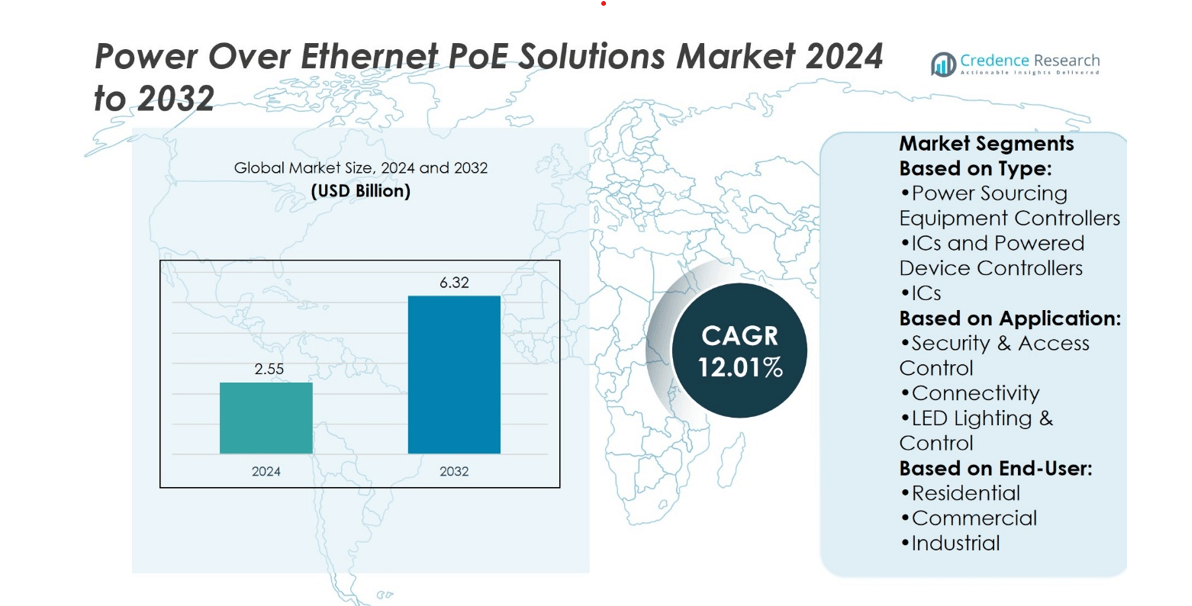
Power Over Ethernet (PoE) Solutions Market size was valued at USD 2.55 billion in 2024 and is anticipated to reach USD 6.32 billion by 2032, at a CAGR of 12.01% during the forecast period.
| REPORT ATTRIBUTE |
DETAILS |
| Historical Period |
2020-2023 |
| Base Year |
2024 |
| Forecast Period |
2025-2032 |
| Power Over Ethernet (PoE) Solutions Market Size 2024 |
USD 2.55 billion |
| Power Over Ethernet (PoE) Solutions Market, CAGR |
12.01% |
| Power Over Ethernet (PoE) Solutions Market Size 2032 |
USD 6.32 billion |
The Power Over Ethernet (PoE) Solutions Market grows through strong drivers such as rising adoption of IoT devices, increasing demand for smart building automation, and the need for cost-efficient infrastructure that simplifies power and data delivery. It benefits from the expansion of cloud computing, data centers, and smart city initiatives that rely on scalable and reliable connectivity. Key trends include the shift toward higher power standards like IEEE 802.3bt, integration with energy-efficient lighting and surveillance systems, and expansion into industrial and outdoor deployments. It continues to position itself as a critical enabler of digital transformation across multiple sectors.
The Power Over Ethernet (PoE) Solutions Market shows strong geographical presence with North America leading through advanced digital infrastructure, Europe focusing on sustainable smart building adoption, and Asia-Pacific emerging as the fastest-growing region driven by urbanization and smart city projects. Latin America and the Middle East & Africa present steady growth through infrastructure modernization and public safety initiatives. Key players driving the market include Cisco Systems, Texas Instruments, Broadcom, Belden, STMicroelectronics, Hewlett Packard Enterprise, CommScope, Microchip Technology, Silicon Laboratories, and Analog Devices.
Market Insights
- Power Over Ethernet (PoE) Solutions Market size was valued at USD 2.55 billion in 2024 and is expected to reach USD 6.32 billion by 2032, growing at a CAGR of 12.01%.
- Rising adoption of IoT devices and smart building automation fuels strong demand for simplified and cost-efficient infrastructure.
- Expansion of cloud computing, data centers, and smart city initiatives strengthens the role of PoE in scalable connectivity.
- Competition remains high with leading players focusing on innovation, interoperability, and energy-efficient product portfolios.
- Limitations in power capacity, compatibility with legacy systems, and security concerns act as restraints for wider adoption.
- North America leads with advanced infrastructure, Europe emphasizes sustainable smart building projects, and Asia-Pacific shows the fastest growth through urbanization and digital initiatives.
- Latin America and the Middle East & Africa register steady growth with investments in public safety, infrastructure modernization, and government-backed smart city programs.
Access crucial information at unmatched prices!
Request your sample report today & start making informed decisions powered by Credence Research Inc.!
Download Sample
Market Drivers
Rising Adoption of IoT Devices and Smart Infrastructure
The Power Over Ethernet PoE Solutions Market gains momentum from the rapid expansion of IoT devices and connected systems across industries. It enables seamless power and data transmission through a single cable, reducing infrastructure complexity and installation costs. The growing deployment of smart lighting, surveillance cameras, and access control systems increases demand for scalable PoE solutions. Enterprises adopt PoE for its ability to support high-density device integration without additional electrical wiring. It strengthens efficiency in smart buildings, healthcare facilities, and transportation hubs. The market benefits from rising investments in digital infrastructure projects that prioritize reliability, scalability, and reduced downtime.
- For instance, Cisco Systems reported in 2022 that it had deployed more than 100 million PoE-enabled switch ports globally, powering IoT devices such as IP cameras, wireless access points, and smart building systems across enterprise and industrial environments.
Expansion of Cloud-Based Services and Data Centers
The expansion of cloud computing and data-intensive applications drives strong demand for efficient network solutions. It supports power delivery to wireless access points, VoIP phones, and network switches essential in cloud-based environments. Modern data centers rely on PoE to ensure energy-efficient connectivity while meeting increasing bandwidth needs. It enhances operational flexibility by enabling remote device management and centralized monitoring. Businesses embrace it to optimize infrastructure in edge computing and hybrid cloud models. The Power Over Ethernet PoE Solutions Market leverages this trend to deliver reliable connectivity for both large-scale enterprises and smaller digital service providers.
- For instance, Hewlett Packard Enterprise (HPE) reported in 2022 that its Aruba Networking division had shipped more than 18 million PoE-enabled switch ports worldwide, many deployed in data centers and cloud service infrastructures to ensure reliable power and connectivity for high-density network devices.
Growth in Surveillance and Security Applications
The rising need for advanced surveillance and security systems fuels market adoption. It powers high-definition IP cameras, biometric scanners, and connected alarms without requiring separate electrical circuits. Growing urbanization and public safety initiatives create strong demand for integrated PoE-based monitoring networks. It ensures uninterrupted operation of security systems while simplifying maintenance and upgrades. Enterprises and municipalities deploy it to secure facilities, transport networks, and public spaces. The market expands further as AI-enabled video analytics and smart surveillance increase reliance on stable and scalable PoE infrastructure.
Energy Efficiency and Cost-Effective Infrastructure Solutions
The emphasis on energy efficiency and cost control supports wider adoption of PoE solutions. It reduces material use and lowers labor costs by consolidating power and data transmission into one system. Enterprises and institutions benefit from simplified installations that minimize downtime and support future scalability. It aligns with sustainability goals by optimizing power consumption and reducing overall environmental impact. Businesses also gain flexibility in deploying devices across workspaces without costly electrical retrofits. The Power Over Ethernet PoE Solutions Market strengthens its role as organizations seek infrastructure that combines performance, efficiency, and long-term value.
Market Trends
Increasing Integration with Smart Building Ecosystems
The Power Over Ethernet PoE Solutions Market evolves through stronger integration with smart building technologies. It enables centralized control of lighting, HVAC, and security systems through a single networked infrastructure. Enterprises adopt this approach to improve energy efficiency and enhance workplace automation. It supports flexible layouts that adapt to modern open office concepts and hybrid work models. The trend drives adoption in commercial spaces, healthcare facilities, and educational institutions where seamless connectivity is critical. It positions PoE as a core enabler of intelligent building design and management.
- For instance, Siemens reported in 2021 that it had deployed PoE-enabled smart building solutions across more than 2,000 commercial buildings worldwide, integrating connected lighting, access control, and HVAC management into unified digital platforms.
Advancement Toward Higher Power Standards and Multi-Gigabit Speeds
A key trend is the move toward higher power delivery standards and faster data transmission. It supports devices requiring up to 90 watts under IEEE 802.3bt, expanding applications to advanced displays, wireless access points, and smart kiosks. Enterprises adopt PoE for multi-gigabit Ethernet to meet growing bandwidth needs in digital workplaces. It aligns with the demand for low-latency and high-speed connectivity in data-heavy environments. The Power Over Ethernet PoE Solutions Market gains relevance as industries shift toward scalable, future-ready networks. It secures a critical role in supporting next-generation enterprise infrastructure.
- For instance, Silicon Laboratories reported in its 2022 annual results that it shipped over 10 million wireless IoT and infrastructure chips annually, including Ethernet transceivers and PoE-enabled solutions that support high-power, multi-gigabit connectivity in enterprise and industrial networks.
Expansion in Industrial and Outdoor Deployments
The adoption of PoE extends beyond offices into industrial and outdoor environments. It powers rugged devices such as industrial sensors, wireless radios, and IP cameras used in harsh conditions. Manufacturers deploy it to simplify cabling in factories while ensuring system reliability. It supports smart transportation systems, traffic management, and outdoor surveillance with reduced infrastructure costs. Governments and enterprises adopt it for urban infrastructure upgrades, including smart poles and public Wi-Fi networks. This trend broadens the scope of PoE applications across non-traditional sectors.
Growing Role of PoE in Sustainable and Cost-Optimized Networks
Sustainability targets push organizations to choose energy-efficient technologies. It supports green building certifications by lowering power waste and simplifying infrastructure. Enterprises value its ability to cut material use and reduce electrical loads while supporting device scalability. It aligns with corporate sustainability initiatives and smart city projects across global markets. The Power Over Ethernet PoE Solutions Market benefits from this focus by positioning itself as a cost-effective and environmentally conscious solution. It enhances long-term value for both enterprises and public infrastructure projects.
Market Challenges Analysis
Limitations in Power Capacity and Compatibility with Legacy Systems
The Power Over Ethernet PoE Solutions Market faces constraints linked to power delivery limits and compatibility challenges. It supports a wide range of devices, but high-power applications such as advanced servers, large displays, or industrial machinery often require greater capacity than current standards allow. Enterprises struggle with integrating PoE into legacy infrastructure where older switches or cabling cannot sustain higher loads. It creates additional costs for system upgrades, which can discourage adoption in budget-sensitive sectors. Variations in standards between manufacturers further complicate deployment and interoperability. It reduces flexibility for organizations seeking seamless connectivity across diverse devices.
Network Reliability, Security Risks, and Implementation Costs
Another challenge lies in maintaining reliability and addressing security vulnerabilities. It consolidates power and data into one network, making the entire system more exposed to outages or cyberattacks. Organizations must invest in backup power solutions, robust firewalls, and monitoring tools to reduce risks, which increases total ownership costs. It also raises concerns about overheating in dense environments, leading to performance inefficiencies. Small and medium enterprises face difficulties in justifying the initial investment in advanced switches and cabling infrastructure. The Power Over Ethernet PoE Solutions Market must address these hurdles to expand adoption across cost-sensitive and security-driven industries.
Market Opportunities
Expansion Through Smart Cities, 5G Infrastructure, and Edge Computing
The Power Over Ethernet PoE Solutions Market holds significant opportunities through the rapid development of smart cities, 5G networks, and edge computing infrastructure. It supports smart poles, surveillance systems, and public Wi-Fi networks that form the backbone of urban digitization projects. Governments invest heavily in intelligent transportation and energy-efficient public infrastructure, creating demand for scalable PoE systems. It enables efficient deployment of 5G small cells and edge devices where reliable power and data are critical. Enterprises and municipalities adopt it to reduce costs while improving connectivity in dense environments. The trend opens new revenue streams for vendors that deliver ruggedized, high-capacity PoE solutions tailored to urban and telecom applications.
Rising Demand in Healthcare, Education, and Sustainable Infrastructure Projects
Emerging opportunities exist in healthcare facilities, educational institutions, and green building initiatives. The Power Over Ethernet PoE Solutions Market benefits from the need for reliable connectivity in telemedicine platforms, patient monitoring devices, and digital classrooms. It supports interactive learning tools, IP cameras, and wireless access points with reduced installation costs. Institutions and enterprises prioritize sustainability, and PoE aligns well with energy-efficient construction standards. It positions itself as an enabler for digital transformation strategies while addressing cost and efficiency targets. Growing adoption across these verticals expands the scope of PoE solutions beyond enterprise IT into mission-critical and sustainability-driven sectors.
Market Segmentation Analysis:
By Type
The Power Over Ethernet PoE Solutions Market is segmented by type into power sourcing equipment (PSE) controllers & ICs and powered device (PD) controllers & ICs. Power sourcing equipment controllers & ICs hold a vital role in enabling network switches, routers, and injectors to deliver reliable power and data through Ethernet cables. It supports a growing number of connected devices in enterprise networks and data centers that require high performance and scalability. Powered device controllers & ICs are essential in equipment such as IP phones, access points, and surveillance systems. It drives efficiency in smart buildings, healthcare facilities, and industrial automation environments where consistent connectivity is critical. Both categories complement each other to create an integrated ecosystem that improves flexibility and reduces infrastructure complexity.
- For instance, Microchip Technology announced that it had shipped more than 500 million PoE IC ports globally by 2021, positioning it as one of the leading suppliers of PSE and PD controller solutions for enterprise networking and IoT applications.
By Application
By application, the market covers security & access control, connectivity, LED lighting & control, and infotainment. Security & access control represents a strong segment, with PoE powering IP cameras, biometric readers, and monitoring systems. Connectivity is another key driver, with enterprises relying on PoE to deliver uninterrupted power to wireless access points and VoIP phones. LED lighting & control gains traction in smart buildings where energy efficiency and automation create demand for integrated solutions. Infotainment also expands adoption by supporting digital signage, interactive displays, and connected kiosks in retail and hospitality sectors. It highlights how diverse applications continue to shape demand across both public and private domains.
- For instance, MERCUSYS, a networking brand under TP-Link, reported shipping over 150 million devices globally by 2022, including PoE-enabled routers and access points that support both residential connectivity and industrial automation requirements.
By End User
By end user, the market is divided into residential, commercial, and industrial categories. Commercial deployment leads, with businesses adopting PoE to streamline office infrastructure, enhance connectivity, and reduce installation costs. Residential adoption grows with the rising use of smart home devices such as lighting, entertainment systems, and connected security solutions. It simplifies household integration while offering flexibility for future expansion. Industrial usage strengthens as factories and logistics facilities deploy rugged PoE systems to support sensors, control systems, and automated equipment. The broad presence across sectors underscores its importance as a foundation for efficient and scalable network infrastructure.
Segments:
Based on Type:
- Power Sourcing Equipment Controllers
- ICs and Powered Device Controllers
- ICs
Based on Application:
- Security & Access Control
- Connectivity
- LED Lighting & Control
Based on End-User:
- Residential
- Commercial
- Industrial
Based on the Geography:
- North America
- Europe
- UK
- France
- Germany
- Italy
- Spain
- Russia
- Belgium
- Netherlands
- Austria
- Sweden
- Poland
- Denmark
- Switzerland
- Rest of Europe
- Asia Pacific
- China
- Japan
- South Korea
- India
- Australia
- Thailand
- Indonesia
- Vietnam
- Malaysia
- Philippines
- Taiwan
- Rest of Asia Pacific
- Latin America
- Brazil
- Argentina
- Peru
- Chile
- Colombia
- Rest of Latin America
- Middle East
- UAE
- KSA
- Israel
- Turkey
- Iran
- Rest of Middle East
- Africa
- Egypt
- Nigeria
- Algeria
- Morocco
- Rest of Africa
Regional Analysis
North America
North America holds a significant share of the Power Over Ethernet PoE Solutions Market, accounting for around 33% of the global market. The region benefits from advanced digital infrastructure, high adoption of smart building solutions, and growing investments in cloud data centers. Enterprises across the United States and Canada integrate PoE into office complexes, healthcare institutions, and educational campuses to improve efficiency and reduce cabling costs. It supports the large-scale deployment of IP cameras, access points, and VoIP systems that are integral to enterprise security and communication networks. Government initiatives promoting smart city development also strengthen adoption of PoE in public infrastructure projects. The strong presence of key technology providers further drives innovation, enabling North America to maintain its leadership position.
Europe
Europe accounts for approximately 28% of the global market, driven by widespread adoption of energy-efficient technologies and strict regulatory frameworks supporting sustainable infrastructure. Countries such as Germany, the United Kingdom, and France lead adoption with advanced commercial and residential projects that integrate smart lighting and automation. The growing emphasis on green building certifications, including BREEAM and LEED standards, accelerates the deployment of PoE in construction and retrofitting projects. It also supports the expansion of surveillance and security applications across transportation, healthcare, and education sectors. European enterprises increasingly prioritize PoE to align with digital transformation goals while reducing operational costs. The market benefits from a mature industrial base and strong focus on sustainable innovation.
Asia-Pacific
Asia-Pacific represents the fastest-growing region, holding nearly 25% of the global market. Rapid urbanization, growing investments in smart city projects, and widespread adoption of IoT-enabled devices drive demand across China, India, Japan, and South Korea. Enterprises adopt PoE for large-scale deployments in manufacturing hubs, educational institutions, and healthcare facilities. It supports the expansion of high-speed connectivity in densely populated urban centers where cost-effective infrastructure is critical. The presence of strong manufacturing capabilities and government-backed digitalization programs further accelerate regional adoption. Asia-Pacific continues to emerge as a key hub for next-generation PoE deployments with strong long-term growth prospects.
Latin America
Latin America accounts for about 8% of the market, with demand supported by infrastructure modernization and rising adoption of smart technologies. Brazil and Mexico lead the region with growing implementation of PoE-based surveillance, public Wi-Fi, and enterprise connectivity solutions. It simplifies infrastructure for organizations seeking cost-efficient network upgrades in resource-constrained environments. The adoption of PoE-enabled LED lighting and smart access systems in commercial buildings strengthens regional growth. Governments also focus on smart city projects to improve urban mobility and public safety, creating opportunities for PoE vendors. While adoption remains at a developing stage, rising awareness of energy efficiency and cost optimization supports continued expansion.
Middle East & Africa
The Middle East & Africa holds nearly 6% of the global market, with growth fueled by investments in smart city projects and industrial modernization. Countries such as the UAE, Saudi Arabia, and South Africa lead adoption with projects focused on intelligent transportation, digital healthcare, and smart building infrastructure. It powers IP-based surveillance, access control, and communication systems widely used in commercial and government facilities. Strong demand for cost-efficient infrastructure in developing economies also creates opportunities for PoE-enabled connectivity solutions. The market faces challenges in terms of limited awareness and higher implementation costs, but steady investments in digital infrastructure strengthen adoption. This region continues to gain momentum as urbanization and government-backed digitalization initiatives expand.
Shape Your Report to Specific Countries or Regions & Enjoy 30% Off!
Key Player Analysis
- Cisco Systems
- Texas Instruments
- Belden
- STMicroelectronics
- Hewlett Packard Enterprise (HPE)
- CommScope
- Broadcom
- Microchip Technology
- Silicon Laboratories
- Analog Devices
Competitive Analysis
The Power Over Ethernet (PoE) Solutions Market features players such as Cisco Systems, Texas Instruments, Belden, STMicroelectronics, Hewlett Packard Enterprise (HPE), CommScope, Broadcom, Microchip Technology, Silicon Laboratories, and Analog Devices. The Power Over Ethernet (PoE) Solutions Market demonstrates a highly competitive environment shaped by rapid technological advancement and increasing demand for scalable connectivity. Companies focus on expanding product portfolios that support higher power standards, multi-gigabit data transfer, and energy-efficient performance. Innovation in PoE controllers, switches, and integrated circuits plays a central role in enabling smart building ecosystems, industrial automation, and urban infrastructure projects. The market also reflects strong emphasis on interoperability, with vendors ensuring compliance with global standards to enhance device compatibility. Strategic investments in research, sustainability initiatives, and regional expansions further strengthen competitive positioning. The continuous push toward intelligent, cost-effective, and future-ready solutions ensures that competition remains dynamic and innovation-driven across diverse application areas.
Recent Developments
- In July 2025, Advantech launched a new series of one of the most powerful edge AI computing solutions which incorporates industrial PCs with Qualcomm-Snapdragon X Elite. These devices are best suited for PoE smart infrastructure systems due to their ultra-fast AI acceleration coupled with 5G and Wi-Fi 7.
- In June 2025, CommScope launched a new series of fiber infrastructure solutions aimed at helping enterprise network service providers support more devices and applications at the edge. Fiber REACH is designed to offer power and extension of connectivity for networks with the ability to offer gigabit speeds in a network’s edge.
- In January 2025, Microchip introduced the GS series of PoE midspan devices with 15W, 30W, 60W, and upcoming 90W variants, fully complying with the latest ENERGY STAR specifications. These devices not only enhance PoE deployment sustainability, especially for powering wireless access points and IoT devices, but also improve reliability.
- In May 2024, Broadcom Inc., one of the prominent industry participants, introduced its newest range of 400G PCIe Gen 5.0 adapters. The new product launched by the company is capable of offering open, standards-based enhanced Ethernet network interface control.
Report Coverage
The research report offers an in-depth analysis based on Type, Application, End-User and Geography. It details leading market players, providing an overview of their business, product offerings, investments, revenue streams, and key applications. Additionally, the report includes insights into the competitive environment, SWOT analysis, current market trends, as well as the primary drivers and constraints. Furthermore, it discusses various factors that have driven market expansion in recent years. The report also explores market dynamics, regulatory scenarios, and technological advancements that are shaping the industry. It assesses the impact of external factors and global economic changes on market growth. Lastly, it provides strategic recommendations for new entrants and established companies to navigate the complexities of the market.
Future Outlook
- The market will expand with wider adoption of smart building solutions and intelligent infrastructure.
- It will benefit from the growing integration of IoT devices across residential, commercial, and industrial sectors.
- Higher power standards will support advanced applications such as smart displays and next-generation wireless access points.
- Enterprises will adopt PoE to simplify network architecture and reduce long-term operational costs.
- Data centers and cloud facilities will drive demand for scalable PoE-enabled connectivity.
- Smart city projects will accelerate deployments in surveillance, traffic management, and public Wi-Fi networks.
- The market will see stronger adoption in healthcare and education sectors through digital transformation initiatives.
- Energy efficiency and sustainability goals will increase reliance on PoE-based solutions.
- Industrial automation and edge computing will create new growth opportunities for ruggedized PoE systems.
- Continuous innovation in semiconductor design will enhance performance, interoperability, and device compatibility.



