Vital sign tracking moves from ward beds to homes
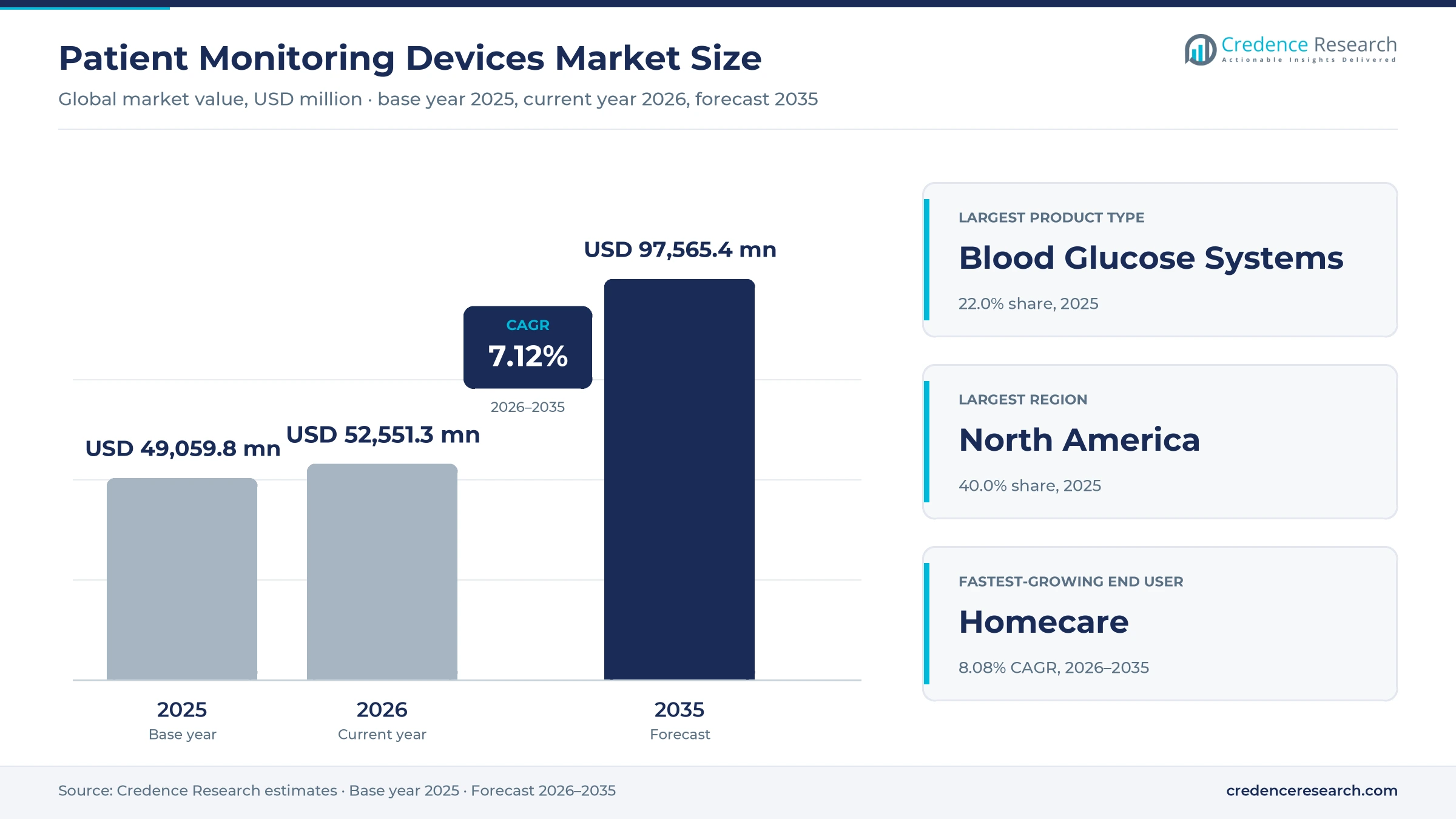
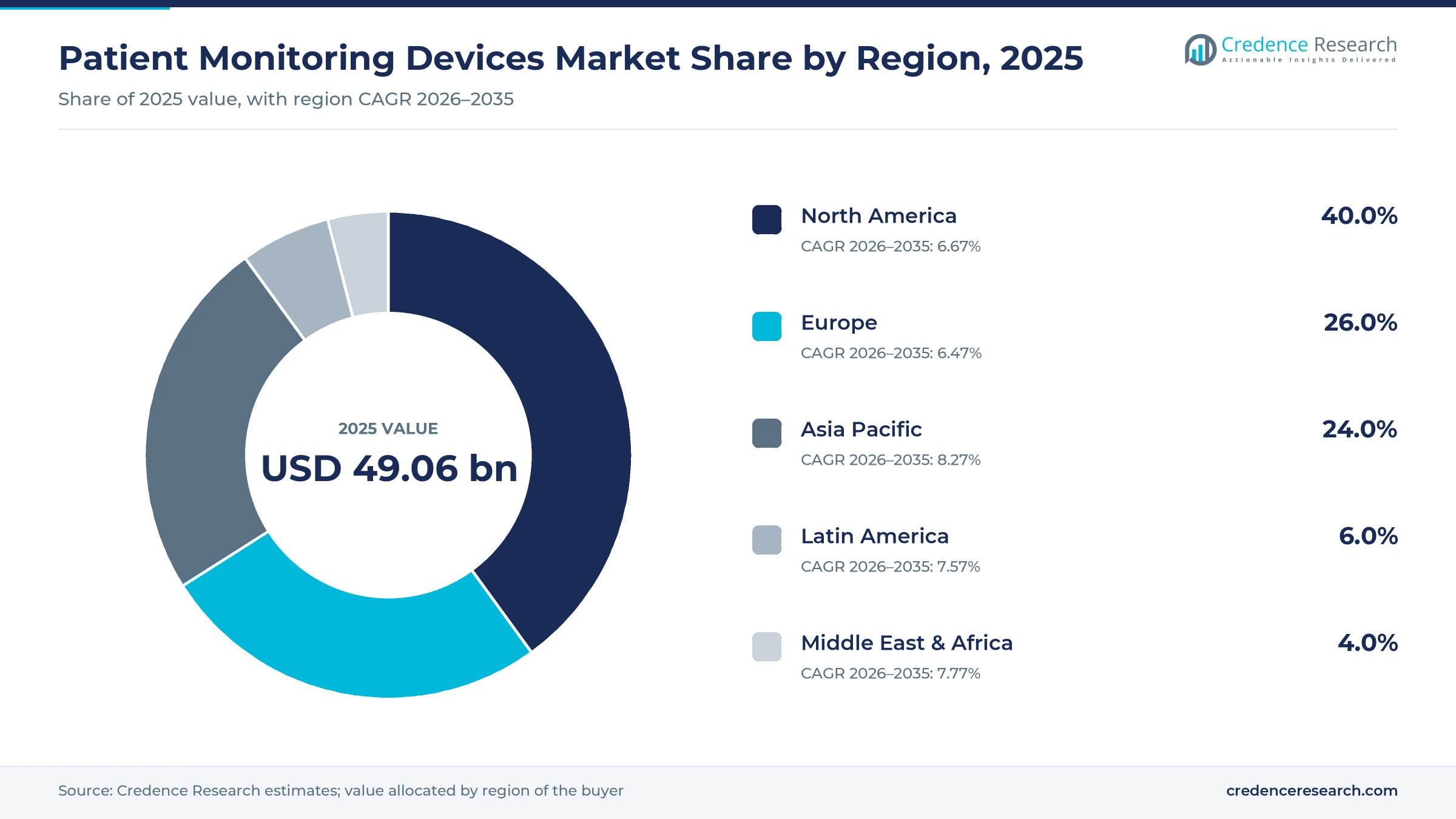
The global patient monitoring devices market was valued at USD 49.06 billion in 2025 and is projected to increase from USD 52.55 billion in 2026 to USD 97.57 billion by 2035, registering a CAGR of 7.12% during 2026–2035. Demand comes from a rising number of people with heart disease, diabetes, hypertension and chronic lung disease, longer hospital stays among older patients and the spread of care outside hospital wards. North America held the largest regional share, 40.0% in 2025, because U.S. hospitals and payers fund connected bedside systems and glucose sensors at scale. Asia Pacific is the fastest-growing region at 8.27% a year, as China and India add intensive care beds and private hospitals. The commercial picture changed in March 2024, when U.S. regulators cleared the first glucose biosensor sold without a prescription. As a result, glucose tracking began to reach consumers and people with type 2 diabetes who do not use insulin.
Which vital sign products does this analysis cover?
The analysis counts blood glucose systems, cardiac monitors, multi-parameter bedside units, respiratory and temperature products, hemodynamic and pressure systems, fetal and neonatal units, neuromonitoring equipment, weight scales and related products. Values are based on manufacturer selling prices, including sensors and software sold with each system.
Imaging equipment, ventilators, infusion pumps and stand-alone health apps sit outside the scope of this analysis. The value chain runs from sensor, chip and software suppliers through equipment makers and distributors to hospitals, surgery centers, home care providers, pharmacies and consumers.
Patient Monitoring Devices Market Insights
- The patient monitoring devices market grows from USD 49.06 billion in 2025 to USD 97.57 billion by 2035, a 7.12% CAGR as chronic disease care moves toward continuous tracking.
- North America held 40.0% of global vital sign equipment value in 2025, supported by connected hospital systems and wide glucose sensor use.
- Blood glucose systems led product types with 22.0% of 2025 value and also grow fastest at 7.97% a year.
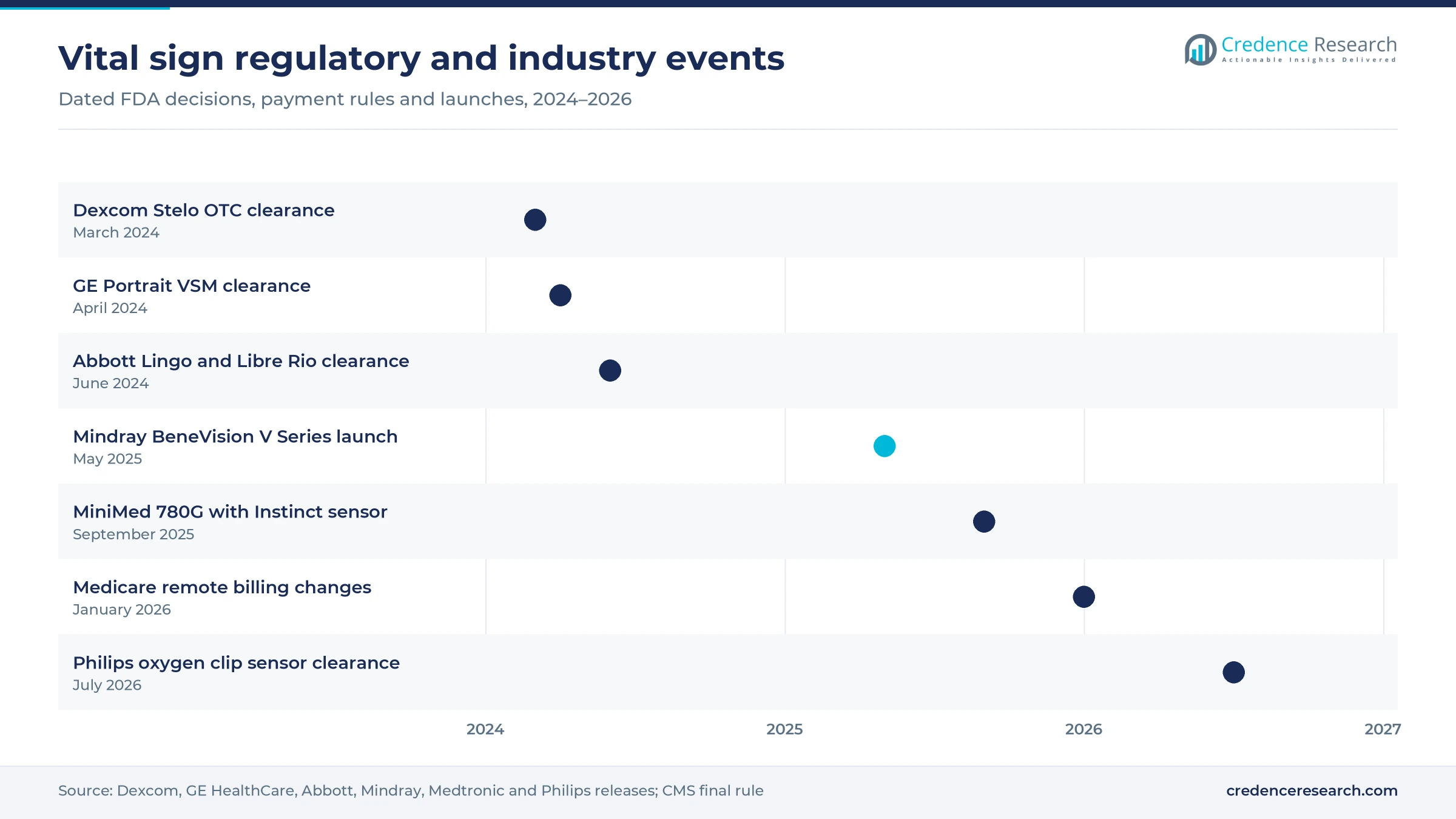
- In March 2024, Dexcom received FDA clearance for Stelo, the first glucose biosensor cleared for use without a prescription in the United States.
- In September 2025, the FDA cleared the Medtronic MiniMed 780G system to work with the Abbott-made Instinct sensor, linking two major suppliers.
Glucose systems lead as homecare grows fastest
Why do glucose systems lead product spending?
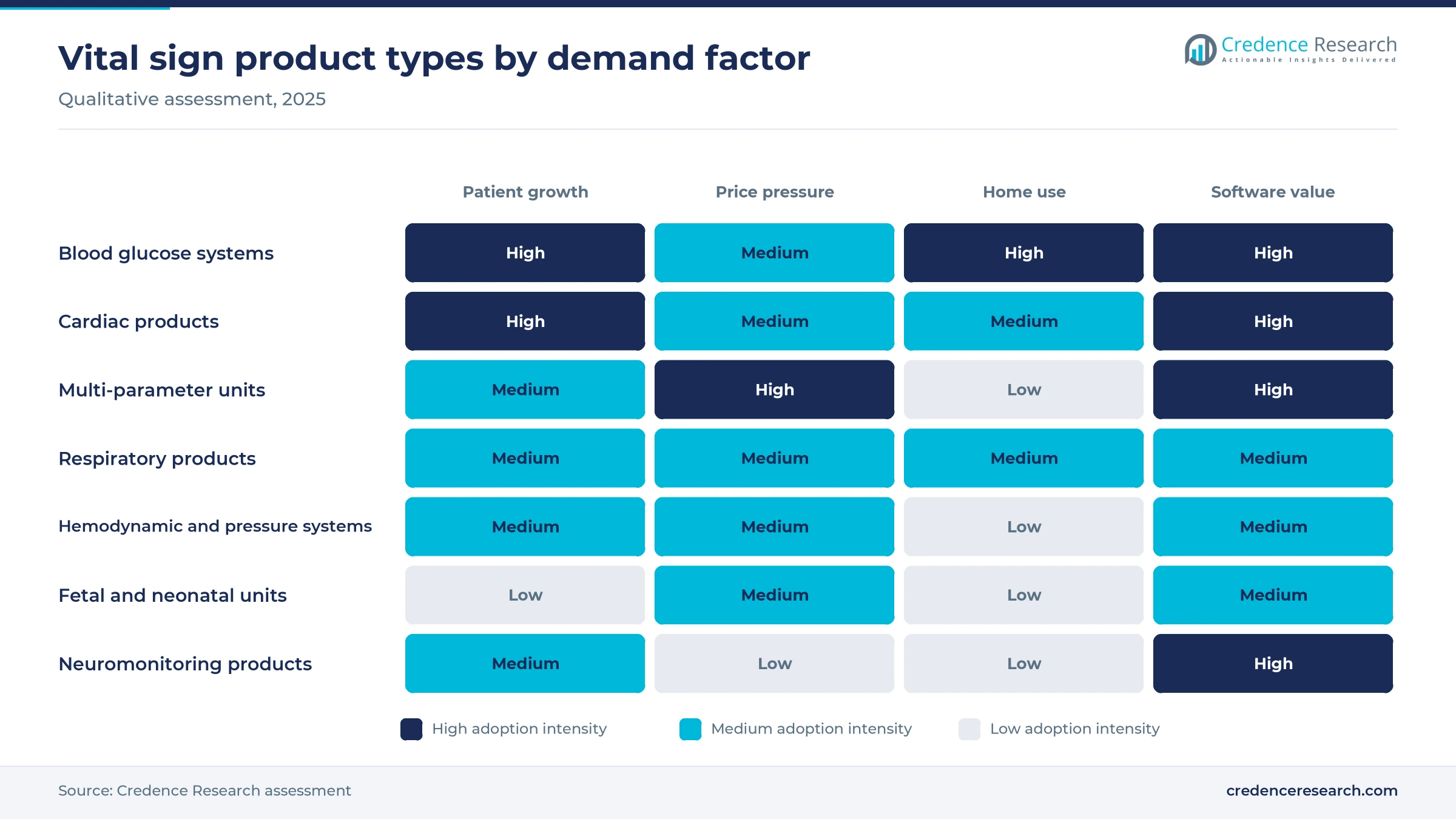
Based on product type, the market is categorized into blood glucose systems, cardiac products, multi-parameter units, respiratory products, temperature products, hemodynamic and pressure systems, fetal and neonatal units, neuromonitoring products, weight products and others. Blood Glucose Monitoring Systems led with a 22.0% share of 2025 value and also grow fastest at 7.97% a year. This position reflects recurring sensor sales to people with diabetes and new over-the-counter buyers. Sensor data also feeds automated insulin pumps that adjust doses during the day.
Why does homecare grow fastest among end users?
Based on end user, the market is categorized into hospitals and clinics, ambulatory surgical centers, homecare and others. Hospitals and Clinics led with a 52.0% share of 2025 value, because intensive care, operating rooms and general wards need bedside and central station systems. Homecare grows fastest at 8.08% a year, as wearable sensors and remote data review let patients stay at home. Other users include long-term care facilities, emergency services and sports medicine providers.
| Segment Group | Leading Sub-segment | Share, 2025 | Fastest-growing Sub-segment | CAGR, 2026–2035 |
|---|---|---|---|---|
| By Product Type | Blood Glucose Monitoring Systems | 22.0% | Blood Glucose Monitoring Systems | 7.97% |
| By End User | Hospitals and Clinics | 52.0% | Homecare | 8.08% |
Request a Free Sample
Fill in your details and we'll send you a free sample report.
- Sample data tables & charts
- Research methodology
Chronic disease and aging keep bedside demand high
How does the rise in chronic disease sustain demand?
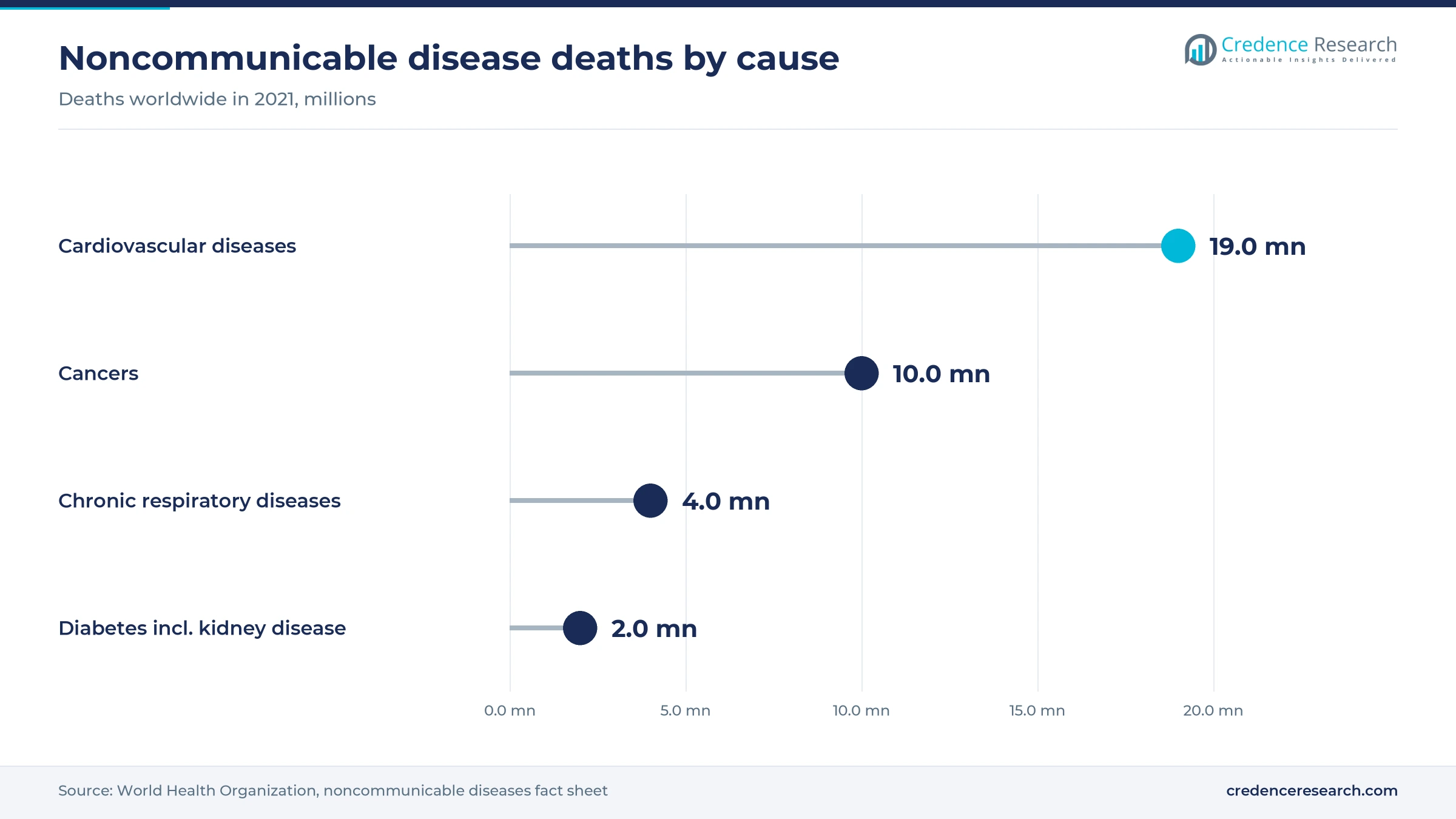
The rise in chronic disease sustains demand, because heart, lung and metabolic conditions need regular measurement of vital signs. The World Health Organization reports that noncommunicable diseases killed at least 43 million people in 2021, equal to 75% of deaths not related to the pandemic. Cardiovascular diseases caused at least 19 million of these deaths, followed by cancers at 10 million and chronic respiratory diseases at 4 million. WHO also estimates that 1.4 billion adults aged 30 to 79 had hypertension in 2024, which equals 33% of that age group. As a result, cardiac, blood pressure and respiratory products remain core purchases for hospitals and clinics worldwide.
Why does the diabetes burden lift glucose sensor sales?
The diabetes burden lifts glucose sensor sales, because people who track glucose need new sensors every one to two weeks. WHO data show that the number of people living with diabetes rose from 200 million in 1990 to 830 million in 2022. Abbott stated in June 2024 that about 6 million people worldwide use its FreeStyle Libre systems, and that about 38.4 million Americans have diabetes. In turn, recurring sensor purchases make blood glucose systems the largest product type, with 22.0% of 2025 value. This base keeps growing as more health systems pay for sensors in type 2 diabetes, not only for insulin users.
How does population aging raise bedside and home demand?
Population aging raises bedside and home demand, because older adults have more chronic conditions and longer hospital stays. WHO estimates that by 2030 one in six people in the world will be aged 60 years or over. The agency also expects the number of people aged 80 years or older to triple between 2020 and 2050 to reach 426 million. Older patients often need cardiac, blood pressure, oxygen and temperature checks after surgery and during recovery. As a result, hospitals buy more ward systems, while homecare grows fastest among end users at 8.08% a year as families and insurers support recovery outside the hospital.
Why does Medicare payment reform widen remote data use?
Medicare payment reform widens remote data use, because it lowers the bar for billing home measurement services. The 2026 Medicare Physician Fee Schedule final rule, published in November 2025, allows payment when data is collected on 2 to 15 days in a 30-day period, down from a 16-day minimum. The same rule allows treatment management to be billed at 10 minutes a month instead of 20 minutes, from Jan. 1, 2026. These changes let clinics enroll patients with short recovery periods, not only long-term chronic cases. In turn, demand rises for connected blood pressure cuffs, weight scales and oximeters that send readings to care teams through telehealth platforms.
Wearable sensors and home data reshape vital sign care
How is over-the-counter glucose tracking shifting demand?
Over-the-counter glucose tracking is shifting demand toward consumers, because sensors no longer need a prescription in the United States. In March 2024, Dexcom received FDA clearance for Stelo, the first glucose biosensor cleared for use without a prescription, for adults who do not use insulin. The company said about 25 million Americans with type 2 diabetes do not use insulin. In June 2024, Abbott received clearance for Lingo and Libre Rio, two more over-the-counter systems for adults. As a result, pharmacies and online stores have become a new sales channel, which supports the 7.97% annual growth of blood glucose systems through 2035.
Why are wearable ward systems rising in general care?
Wearable ward systems are rising in general care, because spot checks every few hours can miss early signs of deterioration. In April 2024, GE HealthCare received FDA clearance for its Portrait VSM vital signs unit, which measures five signs, namely blood pressure, pulse rate, oxygen saturation, temperature and respiratory rate. The company noted that vital signs are typically checked every 4 to six hours on general wards, which leaves long gaps. Portrait VSM also links to Portrait Mobile, a wireless wearable that tracks respiratory rate, oxygen saturation and pulse rate continuously. In turn, hospitals are adding continuous tracking outside intensive care, which supports multi-parameter and respiratory product sales.
Can automated insulin delivery open added sensor demand?
Sensor makers have a clear opening in automated insulin delivery, because each pump system needs a compatible glucose sensor. In September 2025, the FDA cleared the Medtronic MiniMed 780G system to work with the Instinct sensor made by Abbott, which can be worn for up to 15 days. The FDA also approved the system for adults with insulin-requiring type 2 diabetes, a much larger group than type 1 users. Medtronic said pre-orders for its own Simplera Sync sensor would begin in September 2025, which gives users a second sensor option. As a result, partnerships between pump and sensor suppliers can widen the base of people who buy sensors every two weeks.
Where can accurate oximetry open demand for new sensors?
Accurate oximetry gives suppliers room to replace older sensors, because regulators now ask for better performance across skin tones. In January 2025, the FDA issued draft guidance asking pulse oximeter makers to enroll more study participants and to use the Monk Skin Tone scale in testing. In July 2026, Philips received FDA clearance for a reusable oxygen clip sensor with an accuracy root mean square of 1.6%, below the 3% level recognized by the FDA. Philips said accuracy varied by less than 0.5% between light and dark skin groups. In turn, hospitals that update fleets can also add capnography and other respiratory measurements to the same bedside units.
Alarm fatigue, accuracy gaps and cost slow adoption
Why does alarm fatigue limit wider use on hospital wards?
Alarm fatigue limits wider use on hospital wards, because frequent false alarms distract nurses and slow responses to real events. Continuous tracking on general wards can multiply the number of alerts that staff must review each shift. This burden makes some hospitals cautious about adding wearable systems to every bed. As a result, suppliers invest in smarter alarm filters, early warning scores and central review stations to reduce noise for nurses.
How do data security rules raise costs for connected systems?
Data security rules raise costs for connected systems, because every networked bedside unit and home sensor can expose patient data. Hospitals must test, patch and track each device on clinical networks, which adds work for information technology teams. Regulators also expect makers to document security controls before clearance and after launch. In turn, smaller suppliers face higher costs to compete with large companies that already run security programs.
Why do payment gaps slow home program growth outside the U.S.?
Payment gaps slow home program growth outside the United States, because many public insurers do not pay for remote measurement services. Hospitals in these countries must fund home sensors from fixed budgets, which limits program size. Patients in lower-income regions often pay for glucose sensors and blood pressure cuffs out of pocket. As a result, adoption remains concentrated in wealthier markets, while suppliers offer lower-cost products and leasing to reach other buyers.
How do accuracy concerns delay purchases of consumer sensors?
Accuracy concerns delay some purchases of consumer sensors, because clinicians want proof that readings match laboratory or hospital measurements. Abbott reported that 77.1% of its Lingo biosensors lasted the full 14-day wear period in a study. Oximeter accuracy across skin tones has also drawn new regulatory attention since January 2025. In turn, hospitals and insurers often wait for real-world evidence before they recommend new consumer devices to patients.
North America leads as Asia Pacific gains pace
| Region | Value, 2025 (USD billion) | Share, 2025 | CAGR, 2026–2035 |
|---|---|---|---|
| North America | 19.62 | 40.0% | 6.67% |
| Europe | 12.76 | 26.0% | 6.47% |
| Asia Pacific | 11.77 | 24.0% | 8.27% |
| Latin America | 2.94 | 6.0% | 7.57% |
| Middle East & Africa | 1.96 | 4.0% | 7.77% |
Why do U.S. payers keep North America in the lead?
North America held a 40.0% share of 2025 value and grows at 6.67% a year through 2035. The United States drives this position, because Medicare and private insurers pay for glucose sensors and remote measurement services. U.S. regulators cleared over-the-counter glucose sensors in 2024 and lowered remote billing thresholds from 2026, which widen the base of buyers. Large hospital systems also renew bedside fleets on regular cycles.
Why do China and India drive Asia Pacific demand growth?
Asia Pacific held a 24.0% share of 2025 value and is the fastest-growing region at 8.27% a year. China and India add intensive care beds, private hospitals and diabetes clinics, which need bedside units and glucose systems. Mindray Medical International Ltd and Nihon Kohden Corporation compete strongly across the region. In April 2026, Nihon Kohden launched its Life Scope E7 bedside unit in India after an import license from the national regulator in February 2026.
How do European hospital tenders shape purchases?
Europe held a 26.0% share of 2025 value and grows at 6.47% a year, the slowest pace of the five regions. Germany, France, the United Kingdom and Italy account for much of the spending, and suppliers such as Drägerwerk AG & Co. KGaA and Philips Healthcare are based in the region. However, public tenders and long equipment lives keep value growth below the global average.
Why are private hospitals lifting Latin American demand?
Latin America held a 6.0% share of 2025 value and grows at 7.57% a year through 2035. Brazil and Mexico lead regional spending, because private hospital groups are adding intensive care and surgical capacity. Public systems still buy basic bedside units through tenders, which keeps price competition strong.
Why do Gulf hospital projects lead Middle East demand?
The Middle East and Africa held a 4.0% share of 2025 value and grows at 7.77% a year through 2035. Gulf states fund new hospitals with connected intensive care systems, while much of Africa relies on basic equipment. This gap limits the use of advanced systems outside major cities and private centers.
FDA clearances and launches in vital sign care since 2024
| Development | Status and market relevance |
|---|---|
| In March 2024, Dexcom received FDA clearance for Stelo, the first glucose biosensor cleared for use without a prescription. | Cleared; for adults 18 and older who do not use insulin |
| In April 2024, GE HealthCare received FDA 510(k) clearance for the Portrait VSM vital signs unit. | Cleared; links with the Portrait Mobile wireless wearable system |
| In May 2025, Mindray introduced its BeneVision V Series bedside system at Euroanaesthesia 2025 in Lisbon. | Launched; links with handheld ultrasound and includes a wireless transport module |
| In September 2025, the FDA cleared the Medtronic MiniMed 780G system to work with the Abbott-made Instinct sensor. | Cleared; system also approved for adults with insulin-requiring type 2 diabetes |
| In July 2026, Philips received FDA 510(k) clearance for a next-generation reusable oxygen clip sensor. | Cleared; availability in select global markets planned for later in 2026 |
Wearable patches, AI alerts and connected platforms advance
- Continuous glucose sensors measure glucose every few minutes for up to 15 days, which replaces many finger-stick tests and feeds insulin delivery systems.
- Wearable ward sensors track respiratory rate, oxygen saturation and pulse continuously, which helps nurses catch deterioration between spot checks.
- AI alert filtering ranks and suppresses low-value alarms, which reduces alarm fatigue on busy wards and intensive care units.
- Brain activity tracking adds electroencephalography to bedside units, which helps intensive care teams manage sedation and seizures.
- Connected data platforms send readings from bedside and home equipment to records and care teams, which supports remote review and billing.
Need a Custom Version of This Report?
Tailor the scope, geography, or segments to your exact requirements.
- Custom geography or segment scope
- Direct access to our analyst team
Suppliers compete on connected bedside and home systems
Competition is led by a group of established medical technology companies with broad bedside and sensor portfolios. Philips Healthcare, GE Healthcare, Nihon Kohden Corporation, Mindray Medical International Ltd and Drägerwerk AG & Co. KGaA compete in multi-parameter bedside units, central stations and intensive care systems. Medtronic plc and Abbott Laboratories lead in glucose sensors and cardiac rhythm products, and their September 2025 sensor link shows how rivals now partner on connected diabetes care. Welch Allyn serves physician offices and general wards with vital signs equipment. Natus Medical focuses on neurology and newborn care products, while Narang Medical supplies lower-cost equipment to hospitals in India and export markets. As a result, buyers favor suppliers that combine accurate sensors, connected software, alarm management and reliable service across hospital and home settings.
Companies profiled and their roles in this market
| Company | Type | Role in the market |
|---|---|---|
| Medtronic plc | Diversified | Glucose sensors, insulin delivery and cardiac rhythm products |
| Abbott Laboratories | Diversified | FreeStyle Libre glucose sensors and cardiac products |
| Philips Healthcare | Diversified | IntelliVue bedside units and oxygen sensors |
| GE Healthcare | Diversified | Portrait and bedside vital sign systems |
| Nihon Kohden Corporation | Specialist | Life Scope bedside units and neurology equipment |
| Mindray Medical International Ltd | Diversified | BeneVision bedside and transport systems |
| Drägerwerk AG & Co. KGaA | Diversified | Intensive care and operating room systems |
| Welch Allyn | Specialist | Vital signs equipment for clinics and wards |
| Natus Medical | Specialist | Neurology and newborn care products |
| Narang Medical | Specialist | Lower-cost hospital equipment and supplies |
Continuous glucose and home data set the growth pace
Credence Research's view is that continuous glucose sensors and home data will set the pace of growth through 2035, because recurring sensor purchases and remote billing add value faster than hospital bed counts. The overall market grows at 7.12% a year, supported by chronic disease, aging and wider payment for home measurement. Hospitals still hold the largest share, yet wearable ward systems will raise spending per bed. Companies that combine accurate sensors, connected software and alarm management will win the most hospital and home contracts.
How Credence Research sized vital sign equipment
The report uses 2025 as the base year and 2026 to 2035 as the forecast period. Market values come from the Credence Research model, which builds spending by product type, end user and region. Regional and segment splits are Credence Research estimates informed by World Health Organization statistics, U.S. regulator decisions, Medicare payment rules and company press releases. No primary interviews or surveys were used in preparing this edition of the report.
Vital sign equipment outlook to 2035
By 2035, the patient monitoring devices market is projected to reach USD 97.57 billion, with growth led by glucose sensors, wearable ward systems and home measurement programs. Glucose systems will remain the largest product type, as more people with type 2 diabetes and consumers buy sensors. North America keeps the highest spending per patient, while Asia Pacific adds the most new hospital installations. Care will move further into homes, because payment rules and wearable sensors support remote review. As a result, advantage will depend on sensor accuracy, software and service.
Frequently Asked Questions
How big is the global patient monitoring devices market?
Which product type leads the patient monitoring devices market?
Which region leads spending on vital sign equipment?
Which end user accounts for most vital sign equipment spending?
How did over-the-counter glucose sensors change the market?
How do 2026 Medicare rules affect remote vital sign tracking?
Who are the leading patient monitoring device companies?
What restrains growth in patient monitoring devices?
Table of Content
Chapter 1 Market Segmentation
- 1.1 Segmentation Framework
- 1.1.1 Product and Service Classification
- 1.1.2 Application and End-Use Classification
- 1.1.3 Technology and Solution Classification
- 1.1.4 Customer and Distribution Channel Classification
- 1.1.5 Geographic Segmentation
- 1.1.6 Market Segment Definitions and Boundaries
- 1.2 By Product Type
- 1.2.1 Blood Glucose Monitoring Systems
- 1.2.2 Cardiac Monitoring Devices
- 1.2.3 Multi-parameter Monitoring Devices
- 1.2.4 Respiratory Monitoring Devices
- 1.2.5 Temperature Monitoring Devices
- 1.2.6 Hemodynamic/Pressure Monitoring Devices
- 1.2.7 Fetal & Neonatal Monitoring Devices
- 1.2.8 Neuromonitoring Devices
- 1.2.9 Weight Monitoring Devices
- 1.2.10 Others
- 1.3 By End User
- 1.3.1 Hospitals and Clinics
- 1.3.2 Ambulatory Surgical Centers
- 1.3.3 Homecare
- 1.3.4 Others
Chapter 2 Introduction
- 2.1 Report Objectives and Scope
- 2.2 Product Definition and Industry Terminology
- 2.3 Market Inclusions and Exclusions
- 2.4 Research Process
- 2.4.1 Primary Research and Expert Interviews
- 2.4.2 Secondary Research and Source Review
- 2.4.3 Top-Down and Bottom-Up Estimation
- 2.4.4 Data Triangulation and Verification
- 2.5 Market Size Measurement Basis
- 2.5.1 2025: USD 49.06 billion → 2035: USD 97.57 billion
- 2.6 Historical and Forecast Reference Periods
- 2.6.1 Historical Period: 2018-2025
- 2.6.2 Base Year: 2025
- 2.6.3 Forecast Period: 2025-2035
- 2.7 Research Assumptions and Limitations
Chapter 3 Executive Summary
- 3.1 Market Snapshot and Key Findings
- 3.2 Base-Year Market Size, 2025
- 3.3 Forecast Market Size, 2035
- 3.4 Revenue and Volume Growth Outlook
- 3.5 Key Demand and Supply Indicators
- 3.6 Leading Market Segments
- 3.7 Fastest-Growing Market Opportunities
- 3.8 Regional Performance Highlights
- 3.9 Technology and Industry Transformation
- 3.10 Competitive Landscape Summary
- 3.11 Analyst View and Strategic Implications
Chapter 4 Global Patient Monitoring Devices Market Trends and Developments
- 4.1 Historical Industry Development, 2018-2025
- 4.2 Recent Market Trends and Developments
- 4.3 Demand and Customer Behavior Trends
- 4.4 Technology and Product Innovation
- 4.5 Artificial Intelligence, Automation and Digitalization
- 4.6 Local Manufacturing and Supply Chain Realignment
- 4.7 Industry Partnerships, Mergers and Acquisitions
- 4.8 Sustainability and Circular Economy Developments
- 4.9 Government and Private Sector Investment Trends
- 4.10 Emerging Business Models and Commercialization
- 4.11 Industry Developments and Announcements
Chapter 5 Global Patient Monitoring Devices Market Production, Supply and Demand Analysis
- 5.1 Demand Trend and Consumption Analysis, 2018-2025
- 5.2 Demand Forecast, 2025-2035
- 5.3 Production and Output Trend, 2018-2025
- 5.4 Production and Output Forecast, 2025-2035
- 5.5 Installed Capacity and Capacity Utilization
- 5.6 Company-Wise Production Plants and Statistics
- 5.6.1 Installed Production Capacity
- 5.6.2 Actual Production
- 5.6.3 Planned Capacity and Expansion Targets
- 5.7 Supply Chain Structure and Procurement Trends
- 5.8 Supply-Demand Gap and Bottlenecks
- 5.9 Import Dependence and Sourcing Structure
- 5.10 Contract Manufacturing and Outsourcing
- 5.11 Regional Supply and Demand Concentration
Chapter 6 Global Patient Monitoring Devices Market Pricing Analysis
- 6.1 Pricing Structure and Measurement
- 6.2 Historical Pricing Trends, 2018-2025
- 6.3 Pricing Outlook, 2025-2035
- 6.4 Average Selling Price and Unit Economics
- 6.5 Pricing by Product and Market Segment
- 6.6 Geographic Pricing Differences
- 6.7 Key Input, Energy, Labor and Logistics Costs
- 6.8 Contract Pricing and Purchasing Models
- 6.9 Pricing Sensitivity and Competitive Positioning
- 6.10 Price, Margin and Profitability Implications
Chapter 7 Global Patient Monitoring Devices Market Dynamics
- 7.1 Market Growth Drivers
- 7.1.1 Demand-Side Drivers
- 7.1.2 Technology and Innovation Drivers
- 7.1.3 Infrastructure and Investment Drivers
- 7.1.4 Regulatory and Policy Drivers
- 7.2 Market Restraints
- 7.2.1 Cost and Affordability Constraints
- 7.2.2 Technology and Adoption Barriers
- 7.2.3 Supply Chain and Operational Constraints
- 7.3 Market Challenges
- 7.3.1 Competitive Pressure and Margin Erosion
- 7.3.2 Skills, Infrastructure and Implementation Gaps
- 7.4 Emerging Market Opportunities
- 7.5 Market Dynamics Impact and Time-Horizon Assessment
Chapter 8 Global Patient Monitoring Devices Value Chain Analysis
- 8.1 Industry Value Chain Overview
- 8.2 Upstream Suppliers and Critical Inputs
- 8.3 Technology and Component Providers
- 8.4 Manufacturing or Service Delivery
- 8.5 Distribution, Channel Partners and Integrators
- 8.6 Downstream Applications and End Users
- 8.7 Value Addition and Profit Pools
- 8.8 Vertical Integration and Outsourcing
- 8.9 Supplier Concentration and Risk
- 8.10 Supply Chain Localization and Resilience
Chapter 9 Global Patient Monitoring Devices Market Regulations and Policies
- 9.1 Relevant Laws, Standards and Compliance Frameworks
- 9.2 Product, Service, Safety and Quality Requirements
- 9.3 Government Policies, Incentives and Subsidies
- 9.4 Imports, Exports and Trade Barriers
- 9.5 Public Procurement and Local Content Requirements
- 9.6 Environmental and Sustainability Compliance
- 9.7 Upcoming Policy Changes and Market Implications
Chapter 10 Global Patient Monitoring Devices Market Hotspots and Opportunities
- 10.1 Market Opportunity Mapping and Growth Hotspots
- 10.2 High-Growth Applications and Customer Groups
- 10.3 Underserved Markets and White-Space Opportunities
- 10.4 Emerging Technology and Product Opportunities
- 10.5 New Capacity and Investment Hotspots
- 10.6 Market Entry and Expansion Opportunities
- 10.7 Distribution and Partnership Opportunities
- 10.8 Near-Term and Long-Term Commercial Potential
- 10.9 Opportunity Attractiveness and Execution Risks
Chapter 11 Global Patient Monitoring Devices Market Outlook, 2025-2035
- 11.1 Market Size and Analysis
- 11.1.1 Revenue (Market Measurement: 2025: USD 49.06 billion → 2035: USD 97.57 billion)
- 11.1.2 Market Volume and Quantity Sold
- 11.1.3 Historical Market Size, 2018-2025
- 11.1.4 Base-Year Market Size, 2025
- 11.2 Market Forecast, 2025-2035
- 11.2.1 Revenue Forecast to 2035
- 11.2.2 Volume Forecast to 2035
- 11.2.3 CAGR and Year-on-Year Growth
- 11.2.4 Incremental Revenue Opportunity
- 11.3 Forecast Assumptions and Scenario Analysis
- 11.3.1 Base-Case Forecast
- 11.3.2 Optimistic and Conservative Scenarios
- 11.3.3 Technology, Pricing and Policy Sensitivities
- 11.4 Market Attractiveness and Growth Outlook
Chapter 12 Global Patient Monitoring Devices Market Segmentation and Outlook
- 12.1 Segmentation Summary and Market Shares, 2025
- 12.2 Largest and Fastest-Growing Segments
- 12.3 By Product Type - Market Size and Forecast, 2025-2035
- 12.3.1 Segment Definition and Scope
- 12.3.2 Historical Market Size, 2018-2025
- 12.3.3 Revenue Forecast, 2025-2035
- 12.3.4 Volume Forecast, 2025-2035
- 12.3.5 Base-Year Market Share, 2025
- 12.3.6 Segment CAGR and Growth Drivers
- 12.3.7 Subsegment Market Size and Forecast
- 12.3.7.1 Blood Glucose Monitoring Systems
- 12.3.7.2 Cardiac Monitoring Devices
- 12.3.7.3 Multi-parameter Monitoring Devices
- 12.3.7.4 Respiratory Monitoring Devices
- 12.3.7.5 Temperature Monitoring Devices
- 12.3.7.6 Hemodynamic/Pressure Monitoring Devices
- 12.3.7.7 Fetal & Neonatal Monitoring Devices
- 12.3.7.8 Neuromonitoring Devices
- 12.3.7.9 Weight Monitoring Devices
- 12.3.7.10 Others
- 12.3.8 Subsegment Pricing and Adoption Trends
- 12.3.9 Leading Suppliers and Competition
- 12.3.10 Regional Demand and Opportunities
- 12.4 By End User - Market Size and Forecast, 2025-2035
- 12.4.1 Segment Definition and Scope
- 12.4.2 Historical Market Size, 2018-2025
- 12.4.3 Revenue Forecast, 2025-2035
- 12.4.4 Volume Forecast, 2025-2035
- 12.4.5 Base-Year Market Share, 2025
- 12.4.6 Segment CAGR and Growth Drivers
- 12.4.7 Subsegment Market Size and Forecast
- 12.4.7.1 Hospitals and Clinics
- 12.4.7.2 Ambulatory Surgical Centers
- 12.4.7.3 Homecare
- 12.4.7.4 Others
- 12.4.8 Subsegment Pricing and Adoption Trends
- 12.4.9 Leading Suppliers and Competition
- 12.4.10 Regional Demand and Opportunities
- 12.5 Segment Growth Comparison
- 12.6 Segment Attractiveness and Priority Matrix
Chapter 13 Global Patient Monitoring Devices End-Use and Application Market Outlook
- 13.1 End-Use Industry and Customer Demand Structure
- 13.2 Leading Applications and Customer Groups
- 13.3 End-Use Market Size, Share and Forecast
- 13.4 Major End-Use Industry Deep Dives
- 13.4.1 Customer Requirements and Use Cases
- 13.4.2 Demand and Replacement Cycles
- 13.4.3 Technical and Regulatory Considerations
- 13.4.4 Purchasing and Procurement Models
- 13.4.5 Leading Vendors and Distribution Channels
- 13.4.6 Forecast and Commercial Opportunities
- 13.5 Emerging Applications and Cross-Segment Demand
- 13.6 End-Use Industry Investment Priorities
Chapter 14 Global Patient Monitoring Devices Geographic Market Outlook, 2025-2035
- 14.1 Regional Market Size and Share, 2025
- 14.2 Regional Market Forecast, 2025-2035
- 14.3 Regional Pricing, Production and Demand Differences
- 14.4 North America
- 14.4.1 United States
- 14.4.2 Canada
- 14.4.3 Mexico
- 14.5 Europe
- 14.5.1 Germany
- 14.5.2 France
- 14.5.3 Italy
- 14.5.4 United Kingdom
- 14.5.5 Spain
- 14.5.6 Poland
- 14.5.7 Russia
- 14.5.8 Netherlands
- 14.5.9 Belgium
- 14.5.10 Sweden
- 14.5.11 Denmark
- 14.5.12 Norway
- 14.5.13 Rest of Europe
- 14.6 Asia Pacific
- 14.6.1 China
- 14.6.2 India
- 14.6.3 Japan
- 14.6.4 South Korea
- 14.6.5 Thailand
- 14.6.6 Indonesia
- 14.6.7 Vietnam
- 14.6.8 Malaysia
- 14.6.9 Australia
- 14.6.10 Rest of Asia Pacific
- 14.7 Latin America
- 14.7.1 Brazil
- 14.7.2 Argentina
- 14.7.3 Colombia
- 14.7.4 Chile
- 14.7.5 Rest of Latin America
- 14.8 Middle East
- 14.8.1 Saudi Arabia
- 14.8.2 United Arab Emirates
- 14.8.3 Turkey
- 14.8.4 Israel
- 14.8.5 Iran
- 14.8.6 Rest of the Middle East
- 14.9 Africa
- 14.9.1 South Africa
- 14.9.2 Egypt
- 14.9.3 Nigeria
- 14.9.4 Morocco
- 14.9.5 Rest of Africa
- 14.10 Regional Investment, Policy and Supply Chain Differences
- 14.11 Regional Competitive Landscape
- 14.12 Geographic Growth Hotspots
Chapter 15 Global Patient Monitoring Devices Technology, Innovation and Sustainability Outlook
- 15.1 Technology Landscape and Maturity
- 15.2 Product, Process and Service Innovation
- 15.3 AI, Automation and Digital Tools in the Industry
- 15.4 Technology Adoption and Performance Benchmarking
- 15.5 Innovation Pipeline and R&D Investment
- 15.6 Patent and Intellectual Property Trends
- 15.7 Energy Efficiency and Resource Management
- 15.8 Sustainability, Recycling and Circularity
- 15.9 Technology Roadmap, 2025-2035
- 15.10 Risks of Obsolescence and Technology Substitution
Chapter 16 Global Patient Monitoring Devices Market Key Strategic Imperatives
- 16.1 Growth and Market Entry Priorities
- 16.2 High-Return Products and Segments
- 16.3 Pricing, Profitability and Cost Optimization
- 16.4 Technology Investment and Product Differentiation
- 16.5 Supply Chain Localization and Resilience
- 16.6 Distribution and Customer Acquisition
- 16.7 Partnership, Acquisition and Capacity Strategy
- 16.8 Regional Expansion Priorities
- 16.9 Short-, Medium- and Long-Term Actions
Chapter 17 Competition Outlook
- 17.1 Industry Competition Characteristics
- 17.2 Market Structure and Concentration
- 17.3 Market Share and Competitive Positioning, 2025
- 17.4 Company-Wise Revenue and Product Benchmarking
- 17.5 Production and Service Capacity Benchmarking
- 17.6 Technology, Pricing and Differentiation
- 17.7 Regional Footprint and Distribution Strength
- 17.8 Mergers, Acquisitions and Strategic Alliances
- 17.9 New Entrants and Competitive Threats
- 17.10 Porter's Five Forces and Industry Attractiveness
- 17.11 Competitive Outlook, 2025-2035
Chapter 18 Company Profiles
- 18.1 Company Coverage and Selection Criteria
- 18.2 Medtronic plc
- 18.2.1 Business Description
- 18.2.2 Company Ownership and Geographic Presence
- 18.2.3 Product and Service Portfolio
- 18.2.4 Manufacturing and Operating Footprint
- 18.2.5 Production Capacity and Expansion Plans
- 18.2.6 Financial Performance and Investment
- 18.2.7 Market Share and Competitive Position
- 18.2.8 Technology and Innovation Capabilities
- 18.2.9 Strategic Alliances or Partnerships
- 18.2.10 Recent Developments
- 18.2.11 Growth Strategy and Outlook
- 18.3 GE Healthcare
- 18.4 Philips Healthcare
- 18.5 Nihon Kohden Corporation
- 18.6 Abbott Laboratories
- 18.7 Mindray Medical International Ltd
- 18.8 Narang Medical
- 18.9 Drägerwerk AG & Co. KGaA
- 18.10 Welch Allyn
- 18.11 Natus Medical
- 18.12 Other Relevant Market Participants
Note: Every listed company is profiled on the structure shown under the first company. The company list is preliminary and may change based on research findings, market developments, data availability and client requirements.
Chapter 19 Disclaimer
- 19.1 Research and Forecast Disclaimer
- 19.2 Data Source and Estimation Limitations
Note: The depth of individual sections depends on data availability for this market. Volume, capacity, trade and other unit-based metrics are included where applicable.