Market Overview
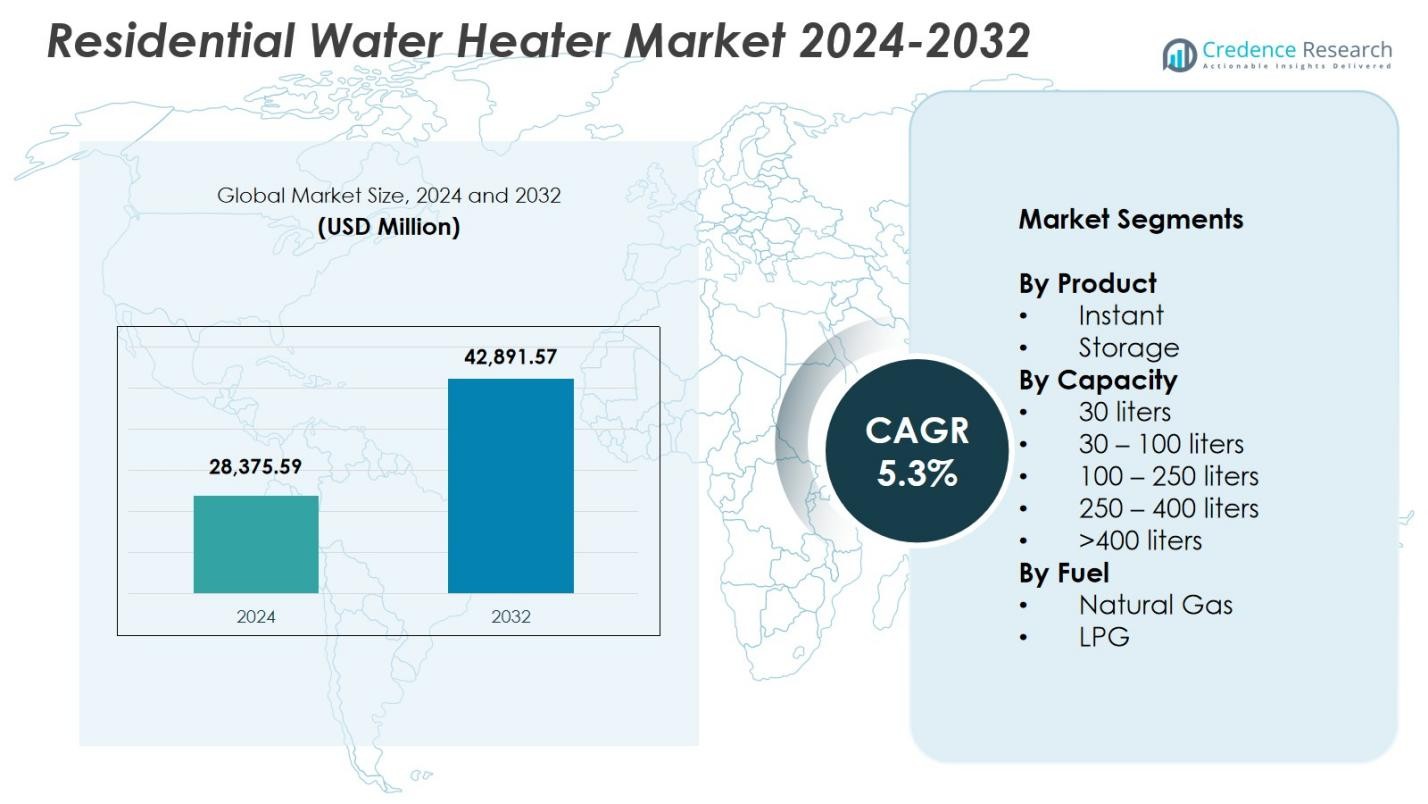
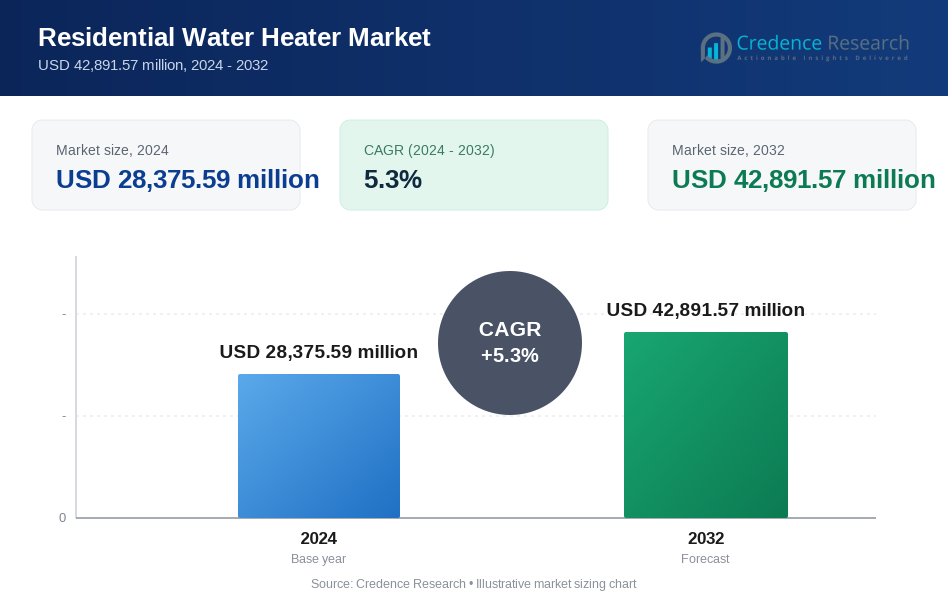
Residential Water Heater Market size was valued at USD 28,375.59 million in 2024 and is anticipated to reach USD 42,891.57 million by 2032, at a CAGR of 5.3% during the forecast period.
| REPORT ATTRIBUTE | DETAILS |
|---|---|
| Historical Period | 2020-2023 |
| Base Year | 2024 |
| Forecast Period | 2025-2032 |
| Residential Water Heater Market Size 2024 | USD 28,375.59 Million |
| Residential Water Heater Market, CAGR | 5.3% |
| Residential Water Heater Market Size 2032 | USD 42,891.57 Million |
Residential Water Heater Market is shaped by leading players such as A. O. Smith India Water Products Pvt. Ltd., Ariston Holding N.V., American Standard Water Heaters, Bosch Thermotechnology Corp., Bradford White Corporation, Ferroli S.p.A, GE Appliances, Haier Inc., Havells India Ltd., and Lennox International Inc., all of whom strengthen their presence through energy-efficient technologies and expanded portfolios. Asia-Pacific led the market with 33.8% share in 2024, driven by rapid urbanization, rising residential construction, and strong adoption of both instant and storage systems. North America and Europe follow, supported by high-efficiency regulations and growing demand for smart, connected water heating solutions.
Market Insights
- Residential Water Heater Market reached USD 28,375.59 million in 2024 and will grow at a CAGR of 5.3% through 2032.
- Market growth is driven by rising adoption of energy-efficient heaters, strong residential construction activity, and increasing consumer shift toward smart, IoT-enabled systems.
- Key trends include expanding demand for heat pump, hybrid, and solar-integrated heaters, along with advanced insulation, digital controls, and predictive maintenance features.
- Leading players focus on product innovation, enhanced distribution, and localized manufacturing, with the storage segment dominating at 71.4% share and natural gas leading fuel type with 58.7% share.
- Asia-Pacific led with 33.8% share, followed by North America at 32.6% and Europe at 27.4%, driven by strong replacement demand, regulatory efficiency mandates, and expanding gas infrastructure.
 Market Segmentation Analysis:
By Product:
In the Residential Water Heater Market, the storage segment dominated with 71.4% share in 2024, driven by its higher suitability for multi-point water usage, consistent hot-water availability, and strong adoption across urban and semi-urban households. Storage heaters benefit from improved insulation technologies, faster heating coils, and enhanced energy-efficiency ratings that meet regulatory standards. Manufacturers continue to innovate with corrosion-resistant tanks, smart temperature controls, and long-life heating elements, supporting stronger replacement demand. The instant segment grows steadily due to compact designs and lower electricity consumption, but storage systems retain clear leadership due to wider functional versatility.
- For instance, Bradford White uses Vitraglas tank lining with Microban antimicrobial protection alongside the Hydrojet Total Performance System to minimize sediment buildup and enhance efficiency.
By Capacity:
The 30–100 liters segment led the Residential Water Heater Market with 46.2% share in 2024, supported by its optimal suitability for nuclear families and widespread installation in apartments and mid-sized homes. This capacity range offers the right balance of water volume, energy efficiency, and installation flexibility, making it the preferred choice for both new construction and renovation projects. Growing availability of BEE-rated models, rapid urbanization, and rising middle-class adoption further strengthen demand. Segments such as 100–250 liters gain traction in larger households, but the 30–100 liters range continues to dominate due to its broad applicability.
- For instance, Crompton Arno Neo 25L storage water heater delivers 2000 W heating at 8 bar pressure with BEE 5 Star rating and 3-level safety features.
By Fuel:
The natural gas segment dominated the Residential Water Heater Market with 58.7% share in 2024, driven by its lower operating cost, faster heating capability, and strong penetration across regions with established gas pipeline infrastructure. Consumers prefer natural gas heaters for long-term cost savings and higher thermal efficiency compared to alternative fuels. Government initiatives expanding residential gas connectivity and rising adoption of dual-safety valve systems further support segment leadership. LPG-based heaters remain relevant in off-grid and semi-urban areas, but the natural gas segment holds a clear lead due to wider accessibility and superior performance in continuous-use households.
Key Growth Drivers
Rising Adoption of Energy-Efficient and Smart Water Heaters
Growing consumer preference for energy-efficient appliances significantly drives the Residential Water Heater Market. Households increasingly adopt smart heaters equipped with features such as Wi-Fi connectivity, remote temperature control, leakage detection, and energy-usage insights. Regulatory mandates promoting high-efficiency models and the introduction of BEE-rated and ENERGY STAR-certified products further accelerate demand. Manufacturers are investing heavily in heat pump technologies, improved insulation materials, and faster-heating elements, enabling substantial reductions in electricity consumption. This shift toward intelligent, eco-friendly systems continues to strengthen market expansion across urban and semi-urban regions.
- For instance, Rheem's Smart Electric Water Heater features LeakSense™ detection that identifies leaks in as little as 15 seconds and LeakGuard™ automatic shut-off, limiting water loss to under 20 ounces while enabling Wi-Fi app control for temperature and usage monitoring.
Rapid Urbanization and Expansion of Residential Construction
The ongoing surge in urban housing development stimulates strong demand for residential water heaters. Increasing construction of apartments, gated communities, and modern homes boosts installation rates of both storage and instant models. Rising disposable incomes and lifestyle upgrades encourage consumers to opt for premium, multi-mode water heating systems. Additionally, government initiatives supporting affordable housing and rapid penetration of piped gas networks provide a solid foundation for market growth. As home renovation and replacement cycles shorten, the need for durable, high-efficiency heaters further drives consistent demand across major population centers.
- For instance, Voltas launched its Aqua Prime series storage water heaters featuring Quartzline technology with a 100% copper heating element and 8-bar pressure rating for high-rise buildings, supported by 6-level safety features including a multi-function valve.
Growing Penetration of Natural Gas and Renewable Heating Technologies
Expanding natural gas infrastructure plays a vital role in accelerating market adoption, especially in regions prioritizing low-cost and efficient fuel options. Natural gas heaters gain momentum due to faster heating capability, reduced operational costs, and enhanced safety features. Simultaneously, renewable heating technologies such as solar water heaters and hybrid heat pump systems attract eco-conscious consumers aiming to reduce energy bills and carbon footprints. Supportive government incentives, tax credits, and net-metering policies encourage broader deployment of these technologies, strengthening their contribution to long-term market growth.
Key Trends & Opportunities
Shift Toward Smart, IoT-Enabled Water Heating Ecosystems
A major trend reshaping the market is the accelerated integration of IoT, AI, and cloud-based monitoring into water heating systems. Smart heaters increasingly allow predictive maintenance, consumption analytics, remote operation, and automated scheduling, enabling households to optimize energy usage. Manufacturers invest in app-connected diagnostics and adaptive heating algorithms that improve performance and safety. As consumers demand greater control and convenience, opportunities rise for vendors offering intelligent heating platforms that seamlessly integrate with home automation ecosystems and deliver enhanced user experiences.
- For instance, A.O. Smith's HeatBot Wifi water heater integrates with the A.O. Smith Smart App for remote operation from anywhere, Alexa voice control, and timer modes to deliver hot water on demand while tracking energy consumption.
Strong Market Opportunity for Solar and Heat Pump Water Heaters
Growing emphasis on sustainability and global carbon-reduction targets creates significant opportunities for solar and heat pump water heaters. These systems deliver high-efficiency heating with substantially lower operating costs, aligning with rising consumer awareness and government-led clean energy initiatives. Advancements in hybrid designs, improved heat exchangers, and low-ambient performance capabilities make renewable heaters more suitable for diverse climates. As utility incentives and subsidies expand, adoption increases across environmentally conscious households, opening strong avenues for manufacturers developing durable, high-performance green heating solutions.
- For instance, Tata Power Solar Systems Ltd offers flat plate collector solar water heaters with capacities from 150-300 liters, designed for varied Indian climatic conditions with high efficiency suited to residential use.
Key Challenges
High Upfront Costs and Installation Complexities
Despite long-term cost savings, many high-efficiency water heaters especially solar, heat pump, and advanced gas models face adoption barriers due to their elevated upfront costs. Installation complexities such as space requirements, piping adjustments, and professional setup further discourage budget-sensitive consumers. In regions with low electricity tariffs or limited infrastructure support, traditional heaters remain preferred. Manufacturers must address cost optimization, simplified installation, and consumer awareness gaps to accelerate the shift toward advanced technologies and reduce resistance among first-time buyers.
Infrastructure Limitations and Fuel Availability Gaps
Market expansion is constrained in areas lacking stable electricity supply, piped natural gas networks, or adequate rooftop space for solar systems. Fuel availability disparities directly impact consumer choices, limiting adoption of efficient gas or renewable-based heaters in many developing regions. Variations in regulatory frameworks, building codes, and safety standards further add complexity for manufacturers and installers. Overcoming these challenges requires coordinated infrastructure development, improved distribution networks, and supportive policy frameworks to ensure wider accessibility of modern water heating solutions.
Regional Analysis
North America
North America held 32.6% share in 2024, driven by strong adoption of energy-efficient and smart water heaters across the U.S. and Canada. Demand is supported by stringent efficiency regulations, high residential replacement rates, and increasing preference for natural gas and heat pump systems. Growth in single-family housing construction and consumer shifts toward IoT-enabled models further strengthen market expansion. Manufacturers benefit from mature distribution channels and rising investment in tankless technologies. Federal incentives promoting sustainable heating solutions also accelerate the transition toward high-performance, low-emission residential water heating systems across the region.
Europe
Europe accounted for 27.4% share in 2024, largely influenced by stringent environmental regulations, widespread adoption of renewable heating solutions, and rapid expansion of heat pump water heaters. Countries such as Germany, the U.K., France, and Italy lead demand due to strong replacement cycles and rising household investments in energy-efficient appliances. The region’s push toward decarbonization and reduced reliance on fossil fuels supports growing deployment of solar-integrated and hybrid systems. Smart home adoption further enhances demand for connected heaters, while government-backed subsidy programs continue to drive upgrades to high-efficiency models across residential properties.
Asia-Pacific
Asia-Pacific dominated the Residential Water Heater Market with 33.8% share in 2024, driven by rapid urbanization, rising middle-class income levels, and large-scale residential construction across China, India, Japan, and Southeast Asia. Expanding electrification, stronger gas pipeline networks, and increasing preference for storage and instant heaters fuel market growth. Manufacturers benefit from high-volume demand, particularly in emerging economies undergoing modernization of household infrastructure. Government initiatives promoting energy-efficient appliances and expanding renewable water heating solutions further accelerate adoption. The region remains the fastest-growing market due to strong demographics and sustained residential development.
Latin America
Latin America captured 4.1% share in 2024, supported by rising demand for affordable electric and gas-based water heaters across Brazil, Mexico, Argentina, and Chile. Growth is driven by expanding urban housing, increasing adoption of mid-capacity storage heaters, and rising availability of branded, energy-efficient models at competitive pricing. Economic recovery and infrastructure improvements strengthen installation rates in multi-family dwellings. While renewable heaters gain gradual traction, traditional systems continue to dominate due to cost sensitivity. Manufacturers see opportunities in durable, low-maintenance models tailored to varying climate conditions and evolving household energy usage patterns across the region.
Middle East & Africa
The Middle East & Africa region held 2.1% share in 2024, driven by expanding residential construction, rising electrification, and increasing adoption of electric storage heaters across the Gulf countries and parts of Africa. Hot water demand continues to grow due to lifestyle modernization, higher living standards, and rapid urban development. Solar water heaters witness strong interest, particularly in sun-rich markets such as the UAE, Saudi Arabia, and South Africa, supported by renewable energy policies. Despite infrastructure disparities in parts of Africa, the region offers long-term potential as affordability improves and energy-efficient technologies gain wider penetration.
Market Segmentations:
By Product
- Instant
- Storage
By Capacity
- 30 liters
- 30 – 100 liters
- 100 – 250 liters
- 250 – 400 liters
- >400 liters
By Fuel
- Natural Gas
- LPG
By Geography
- North America
- U.S.
- Canada
- Mexico
- Europe
- Germany
- France
- U.K.
- Italy
- Spain
- Rest of Europe
- Asia Pacific
- China
- Japan
- India
- South Korea
- South-east Asia
- Rest of Asia Pacific
- Latin America
- Brazil
- Argentina
- Rest of Latin America
- Middle East & Africa
- GCC Countries
- South Africa
- Rest of the Middle East and Africa
Competitive Landscape
Competitive landscape in the Residential Water Heater Market features leading players such as A. O. Smith India Water Products Pvt. Ltd., Ariston Holding N.V., American Standard Water Heaters, Bosch Thermotechnology Corp., Bradford White Corporation, Ferroli S.p.A, GE Appliances, Haier Inc., Havells India Ltd., and Lennox International Inc. These companies strengthen their market presence through continuous product innovation, energy-efficient technologies, and expanded distribution networks. Manufacturers increasingly invest in smart, IoT-enabled heaters with advanced diagnostics, remote control, and predictive maintenance capabilities to meet rising consumer expectations. Strategic initiatives-including capacity expansions, partnerships with utilities, and enhanced after-sales service-help brands improve customer retention and strengthen competitive positioning. Growing emphasis on regulatory compliance and sustainability drives companies to adopt low-emission heating technologies, corrosion-resistant materials, and high-efficiency heat pump and hybrid systems. As demand surges across urban and developing regions, players focus on localized manufacturing, multi-tier pricing strategies, and digital retail channels to capture wider consumer segments.
Key Player Analysis
- Havells India Ltd.
- American Standard Water Heaters
- GE Appliances
- Ferroli S.p.A
- Lennox International Inc.
- A. O. Smith India Water Products Pvt. Ltd.
- Bosch Thermotechnology Corp.
- Haier Inc.
- Bradford White Corporation, USA
- Ariston Holding N.V.
Recent Developments
- In May 2025 Ariston Group and Lennox International Inc. announced a joint venture to introduce Lennox-branded residential water heaters in North America by 2026.
- In November 2025 Apparent Inc. launched a DC-powered solar water heater for residential use that can operate entirely off-grid using standard photovoltaic panels.
- In June 2025, GE Appliances launched the GE Profile GEOSPRING Smart Hybrid Heat Pump Water Heater, offering up to 4.7× the energy efficiency of standard electric heaters and up to 60% more hot water capacity.
Report Coverage
The research report offers an in-depth analysis based on Product, Capacity, Fuel and Geography. It details leading market players, providing an overview of their business, product offerings, investments, revenue streams, and key applications. Additionally, the report includes insights into the competitive environment, SWOT analysis, current market trends, as well as the primary drivers and constraints. Furthermore, it discusses various factors that have driven market expansion in recent years. The report also explores market dynamics, regulatory scenarios, and technological advancements that are shaping the industry. It assesses the impact of external factors and global economic changes on market growth. Lastly, it provides strategic recommendations for new entrants and established companies to navigate the complexities of the market.
Future Outlook
- The market will witness accelerated adoption of energy-efficient and smart water heaters across residential households.
- Heat pump and hybrid systems will gain momentum as consumers prioritize sustainability and lower operating costs.
- IoT-enabled heaters with remote monitoring and predictive maintenance will become standard offerings.
- Expansion of natural gas infrastructure will drive increased installation of gas-based water heating systems.
- Solar-integrated water heaters will grow steadily as renewable energy policies strengthen globally.
- Manufacturers will invest more in corrosion-resistant materials and long-life heating components to enhance durability.
- Replacement demand will rise as aging residential systems are upgraded with high-efficiency models.
- Urban housing development will continue to create substantial demand for compact, instant, and mid-capacity heaters.
- Regional brands will expand through localized manufacturing and cost-effective product portfolios.
- Digital retail channels and service platforms will play a bigger role in influencing consumer purchasing decisions.
Request a Free Sample
Fill in your details and we'll send you a free sample report.
- Sample data tables & charts
- Research methodology
Need a Custom Version of This Report?
Tailor the scope, geography, or segments to your exact requirements.
- Custom geography or segment scope
- Direct access to our analyst team
Frequently Asked Questions
What is the current market size for Residential Water Heater Market, and what is its projected size in 2032?
At what Compound Annual Growth Rate is the Residential Water Heater Market projected to grow between 2024 and 2032?
Which Residential Water Heater Market segment held the largest share in 2024?
What are the primary factors fueling the growth of the Residential Water Heater Market?
Who are the leading companies in the Residential Water Heater Market?
Which region commanded the largest share of the Residential Water Heater Market in 2024?
Table of Content
Chapter 1 Market Segmentation
- 1.1 Segmentation Framework
- 1.1.1 Product and Service Classification
- 1.1.2 Application and End-Use Classification
- 1.1.3 Technology and Solution Classification
- 1.1.4 Customer and Distribution Channel Classification
- 1.1.5 Geographic Segmentation
- 1.1.6 Market Segment Definitions and Boundaries
Chapter 2 Introduction
- 2.1 Report Objectives and Scope
- 2.2 Product Definition and Industry Terminology
- 2.3 Market Inclusions and Exclusions
- 2.4 Research Process
- 2.4.1 Primary Research and Expert Interviews
- 2.4.2 Secondary Research and Source Review
- 2.4.3 Top-Down and Bottom-Up Estimation
- 2.4.4 Data Triangulation and Verification
- 2.5 Market Size Measurement Basis
- 2.5.1 2024: USD 28,375.59 million → 2032: USD 42,891.57 million
- 2.6 Historical and Forecast Reference Periods
- 2.6.1 Base Year: 2024
- 2.6.2 Forecast Period: 2024-2032
- 2.7 Research Assumptions and Limitations
Chapter 3 Executive Summary
- 3.1 Market Snapshot and Key Findings
- 3.2 Base-Year Market Size, 2024
- 3.3 Forecast Market Size, 2032
- 3.4 Revenue and Volume Growth Outlook
- 3.5 Key Demand and Supply Indicators
- 3.6 Leading Market Segments
- 3.7 Fastest-Growing Market Opportunities
- 3.8 Regional Performance Highlights
- 3.9 Technology and Industry Transformation
- 3.10 Competitive Landscape Summary
- 3.11 Analyst View and Strategic Implications
Chapter 4 Global Residential Water Heater Market Trends and Developments
- 4.1 Historical Industry Development
- 4.2 Recent Market Trends and Developments
- 4.3 Demand and Customer Behavior Trends
- 4.4 Technology and Product Innovation
- 4.5 Artificial Intelligence, Automation and Digitalization
- 4.6 Local Manufacturing and Supply Chain Realignment
- 4.7 Industry Partnerships, Mergers and Acquisitions
- 4.8 Sustainability and Circular Economy Developments
- 4.9 Government and Private Sector Investment Trends
- 4.10 Emerging Business Models and Commercialization
- 4.11 Industry Developments and Announcements
Chapter 5 Global Residential Water Heater Market Production, Supply and Demand Analysis
- 5.1 Demand Trend and Consumption Analysis
- 5.2 Demand Forecast, 2024-2032
- 5.3 Production and Output Trend
- 5.4 Production and Output Forecast, 2024-2032
- 5.5 Installed Capacity and Capacity Utilization
- 5.6 Company-Wise Production Plants and Statistics
- 5.6.1 Installed Production Capacity
- 5.6.2 Actual Production
- 5.6.3 Planned Capacity and Expansion Targets
- 5.7 Supply Chain Structure and Procurement Trends
- 5.8 Supply-Demand Gap and Bottlenecks
- 5.9 Import Dependence and Sourcing Structure
- 5.10 Contract Manufacturing and Outsourcing
- 5.11 Regional Supply and Demand Concentration
Chapter 6 Global Residential Water Heater Market Pricing Analysis
- 6.1 Pricing Structure and Measurement
- 6.2 Historical Pricing Trends
- 6.3 Pricing Outlook, 2024-2032
- 6.4 Average Selling Price and Unit Economics
- 6.5 Pricing by Product and Market Segment
- 6.6 Geographic Pricing Differences
- 6.7 Key Input, Energy, Labor and Logistics Costs
- 6.8 Contract Pricing and Purchasing Models
- 6.9 Pricing Sensitivity and Competitive Positioning
- 6.10 Price, Margin and Profitability Implications
Chapter 7 Global Residential Water Heater Market Dynamics
- 7.1 Market Growth Drivers
- 7.1.1 Demand-Side Drivers
- 7.1.2 Technology and Innovation Drivers
- 7.1.3 Infrastructure and Investment Drivers
- 7.1.4 Regulatory and Policy Drivers
- 7.2 Market Restraints
- 7.2.1 Cost and Affordability Constraints
- 7.2.2 Technology and Adoption Barriers
- 7.2.3 Supply Chain and Operational Constraints
- 7.3 Market Challenges
- 7.3.1 Competitive Pressure and Margin Erosion
- 7.3.2 Skills, Infrastructure and Implementation Gaps
- 7.4 Emerging Market Opportunities
- 7.5 Market Dynamics Impact and Time-Horizon Assessment
Chapter 8 Global Residential Water Heater Value Chain Analysis
- 8.1 Industry Value Chain Overview
- 8.2 Upstream Suppliers and Critical Inputs
- 8.3 Technology and Component Providers
- 8.4 Manufacturing or Service Delivery
- 8.5 Distribution, Channel Partners and Integrators
- 8.6 Downstream Applications and End Users
- 8.7 Value Addition and Profit Pools
- 8.8 Vertical Integration and Outsourcing
- 8.9 Supplier Concentration and Risk
- 8.10 Supply Chain Localization and Resilience
Chapter 9 Global Residential Water Heater Market Regulations and Policies
- 9.1 Relevant Laws, Standards and Compliance Frameworks
- 9.2 Product, Service, Safety and Quality Requirements
- 9.3 Government Policies, Incentives and Subsidies
- 9.4 Imports, Exports and Trade Barriers
- 9.5 Public Procurement and Local Content Requirements
- 9.6 Environmental and Sustainability Compliance
- 9.7 Upcoming Policy Changes and Market Implications
Chapter 10 Global Residential Water Heater Market Hotspots and Opportunities
- 10.1 Market Opportunity Mapping and Growth Hotspots
- 10.2 High-Growth Applications and Customer Groups
- 10.3 Underserved Markets and White-Space Opportunities
- 10.4 Emerging Technology and Product Opportunities
- 10.5 New Capacity and Investment Hotspots
- 10.6 Market Entry and Expansion Opportunities
- 10.7 Distribution and Partnership Opportunities
- 10.8 Near-Term and Long-Term Commercial Potential
- 10.9 Opportunity Attractiveness and Execution Risks
Chapter 11 Global Residential Water Heater Market Outlook, 2024-2032
- 11.1 Market Size and Analysis
- 11.1.1 Revenue (Market Measurement: 2024: USD 28,375.59 million → 2032: USD 42,891.57 million)
- 11.1.2 Market Volume and Quantity Sold
- 11.1.3 Historical Market Size
- 11.1.4 Base-Year Market Size, 2024
- 11.2 Market Forecast, 2024-2032
- 11.2.1 Revenue Forecast to 2032
- 11.2.2 Volume Forecast to 2032
- 11.2.3 CAGR and Year-on-Year Growth
- 11.2.4 Incremental Revenue Opportunity
- 11.3 Forecast Assumptions and Scenario Analysis
- 11.3.1 Base-Case Forecast
- 11.3.2 Optimistic and Conservative Scenarios
- 11.3.3 Technology, Pricing and Policy Sensitivities
- 11.4 Market Attractiveness and Growth Outlook
Chapter 12 Global Residential Water Heater Market Segmentation and Outlook
- 12.1 Segmentation Summary and Market Shares, 2024
- 12.2 Largest and Fastest-Growing Segments
- 12.3 Segment Growth Comparison
- 12.4 Segment Attractiveness and Priority Matrix
Chapter 13 Global Residential Water Heater Geographic Market Outlook, 2024-2032
- 13.1 Regional Market Size and Share, 2024
- 13.2 Regional Market Forecast, 2024-2032
- 13.3 Regional Pricing, Production and Demand Differences
- 13.4 North America
- 13.4.1 United States
- 13.4.2 Canada
- 13.4.3 Mexico
- 13.5 Europe
- 13.5.1 Germany
- 13.5.2 France
- 13.5.3 Italy
- 13.5.4 United Kingdom
- 13.5.5 Spain
- 13.5.6 Poland
- 13.5.7 Russia
- 13.5.8 Netherlands
- 13.5.9 Belgium
- 13.5.10 Sweden
- 13.5.11 Denmark
- 13.5.12 Norway
- 13.5.13 Rest of Europe
- 13.6 Asia Pacific
- 13.6.1 China
- 13.6.2 India
- 13.6.3 Japan
- 13.6.4 South Korea
- 13.6.5 Thailand
- 13.6.6 Indonesia
- 13.6.7 Vietnam
- 13.6.8 Malaysia
- 13.6.9 Australia
- 13.6.10 Rest of Asia Pacific
- 13.7 Latin America
- 13.7.1 Brazil
- 13.7.2 Argentina
- 13.7.3 Colombia
- 13.7.4 Chile
- 13.7.5 Rest of Latin America
- 13.8 Middle East
- 13.8.1 Saudi Arabia
- 13.8.2 United Arab Emirates
- 13.8.3 Turkey
- 13.8.4 Israel
- 13.8.5 Iran
- 13.8.6 Rest of the Middle East
- 13.9 Africa
- 13.9.1 South Africa
- 13.9.2 Egypt
- 13.9.3 Nigeria
- 13.9.4 Morocco
- 13.9.5 Rest of Africa
- 13.10 Regional Investment, Policy and Supply Chain Differences
- 13.11 Regional Competitive Landscape
- 13.12 Geographic Growth Hotspots
Chapter 14 Global Residential Water Heater Technology, Innovation and Sustainability Outlook
- 14.1 Technology Landscape and Maturity
- 14.2 Product, Process and Service Innovation
- 14.3 AI, Automation and Digital Tools in the Industry
- 14.4 Technology Adoption and Performance Benchmarking
- 14.5 Innovation Pipeline and R&D Investment
- 14.6 Patent and Intellectual Property Trends
- 14.7 Energy Efficiency and Resource Management
- 14.8 Sustainability, Recycling and Circularity
- 14.9 Technology Roadmap, 2024-2032
- 14.10 Risks of Obsolescence and Technology Substitution
Chapter 15 Global Residential Water Heater Market Key Strategic Imperatives
- 15.1 Growth and Market Entry Priorities
- 15.2 High-Return Products and Segments
- 15.3 Pricing, Profitability and Cost Optimization
- 15.4 Technology Investment and Product Differentiation
- 15.5 Supply Chain Localization and Resilience
- 15.6 Distribution and Customer Acquisition
- 15.7 Partnership, Acquisition and Capacity Strategy
- 15.8 Regional Expansion Priorities
- 15.9 Short-, Medium- and Long-Term Actions
Chapter 16 Competition Outlook
- 16.1 Industry Competition Characteristics
- 16.2 Market Structure and Concentration
- 16.3 Market Share and Competitive Positioning, 2024
- 16.4 Company-Wise Revenue and Product Benchmarking
- 16.5 Production and Service Capacity Benchmarking
- 16.6 Technology, Pricing and Differentiation
- 16.7 Regional Footprint and Distribution Strength
- 16.8 Mergers, Acquisitions and Strategic Alliances
- 16.9 New Entrants and Competitive Threats
- 16.10 Porter's Five Forces and Industry Attractiveness
- 16.11 Competitive Outlook, 2024-2032
Chapter 17 Company Profiles
- 17.1 Company Coverage and Selection Criteria
- 17.2 Leading Market Participants – Standard Profile Structure
- 17.2.1 Business Description
- 17.2.2 Company Ownership and Geographic Presence
- 17.2.3 Product and Service Portfolio
- 17.2.4 Manufacturing and Operating Footprint
- 17.2.5 Production Capacity and Expansion Plans
- 17.2.6 Financial Performance and Investment
- 17.2.7 Market Share and Competitive Position
- 17.2.8 Technology and Innovation Capabilities
- 17.2.9 Strategic Alliances or Partnerships
- 17.2.10 Recent Developments
- 17.2.11 Growth Strategy and Outlook
- 17.3 Other Relevant Market Participants
Note: Every listed company is profiled on the structure shown under the first company. The company list is preliminary and may change based on research findings, market developments, data availability and client requirements.
Chapter 18 Disclaimer
- 18.1 Research and Forecast Disclaimer
- 18.2 Data Source and Estimation Limitations
Note: The depth of individual sections depends on data availability for this market. Volume, capacity, trade and other unit-based metrics are included where applicable.