Market Overview
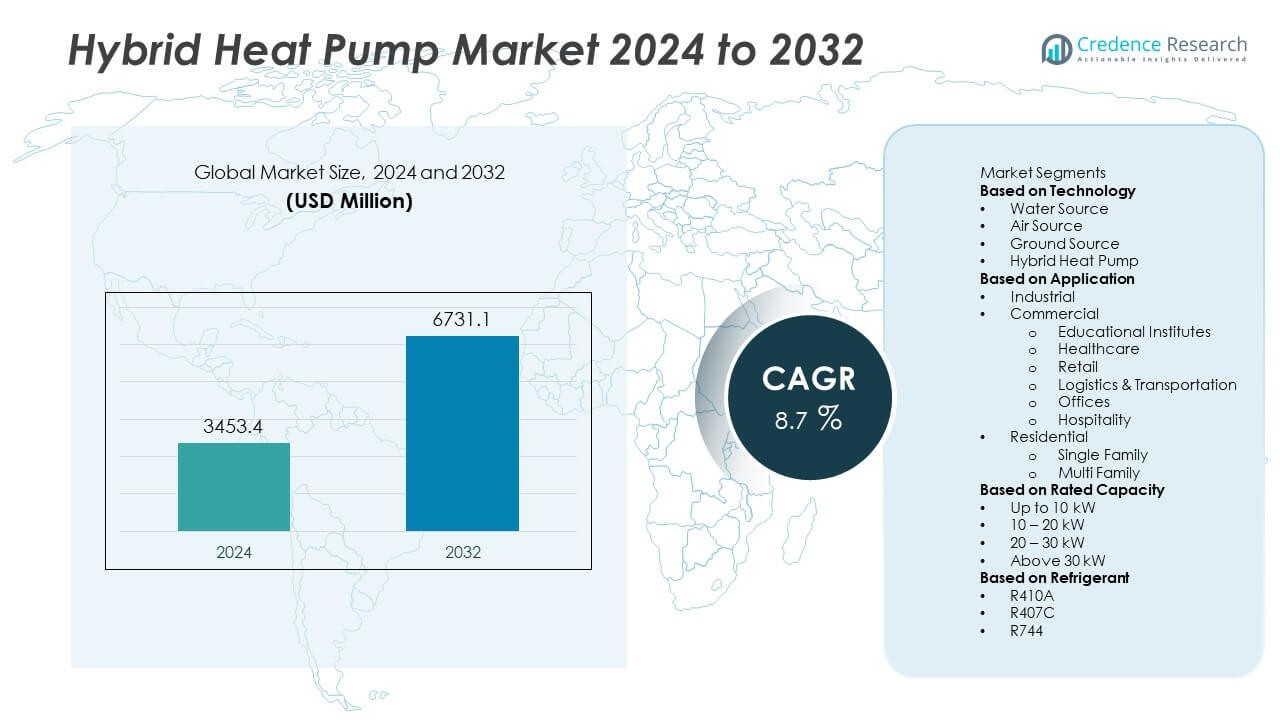
The Hybrid Heat Pump Market size was valued at USD 3,453.4 million in 2024 and is projected to reach USD 6,731.1 million by 2032, registering a CAGR of 8.7% during the forecast period.
| REPORT ATTRIBUTE | DETAILS |
|---|---|
| Historical Period | 2020-2024 |
| Base Year | 2024 |
| Forecast Period | 2025-2032 |
| Hybrid Heat Pump Market Size 2024 | USD 3,453.4 Million |
| Hybrid Heat Pump Market, CAGR | 8.7% |
| Hybrid Heat Pump Market Size 2032 | USD 6,731.1 Million |
The Hybrid Heat Pump Market grows due to increasing demand for energy-efficient, low-emission heating solutions driven by environmental regulations and rising energy costs. It benefits from government incentives promoting renewable energy integration and stricter building codes requiring sustainable heating technologies. Technological advancements in smart controls, inverter compressors, and cold-climate adaptability enhance system performance and user appeal.
The Hybrid Heat Pump Market has a strong presence across North America, Europe, Asia Pacific, Latin America, and the Middle East & Africa, each region driven by unique regulatory frameworks and energy needs. North America leads with significant investments in energy-efficient infrastructure and cold-climate adaptations. Asia Pacific exhibits rapid growth fueled by urbanization and increasing demand for sustainable heating solutions in countries like China, Japan, and South Korea. Emerging markets in Latin America and the Middle East & Africa show growing adoption driven by infrastructure development and environmental awareness. Key players shaping the market include Daikin Industries Ltd., Mitsubishi Electric Corporation, Viessmann Werke GmbH & Co. KG, and Panasonic Corporation, all leveraging technological innovation, extensive distribution networks, and strategic partnerships to expand their footprint and address diverse regional requirements effectively.
Market Insights
- The Hybrid Heat Pump Market was valued at USD 3,453.4 million in 2024 and is projected to reach USD 6,731.1 million by 2032, growing at a CAGR of 8.7% during the forecast period.
- It grows due to increasing demand for energy-efficient and low-emission heating solutions driven by regulatory policies and rising energy costs.
- Market trends include integration of smart controls, IoT-enabled remote monitoring, and improvements in cold-climate adaptability to enhance system performance.
- Leading companies such as Daikin Industries Ltd., Mitsubishi Electric Corporation, Viessmann Werke GmbH & Co. KG, and Panasonic Corporation focus on innovation and expanding global presence.
- High upfront costs and installation complexities pose challenges, especially in retrofit applications and price-sensitive markets.
- North America and Europe lead adoption due to stringent energy regulations and mature infrastructure, while Asia Pacific experiences rapid growth fueled by urbanization and renewable energy integration.
- Emerging markets in Latin America and the Middle East & Africa present growth opportunities driven by infrastructure development and increasing environmental awareness.
Market Drivers
Rising Demand for Energy-Efficient and Low-Emission Heating Solutions
The increasing focus on reducing greenhouse gas emissions and improving energy efficiency is a major driver for the Hybrid Heat Pump Market. These systems combine renewable energy sources with conventional heating methods to lower carbon footprints while ensuring consistent performance. It provides an optimal balance between cost-effectiveness and environmental responsibility. Rising energy costs encourage homeowners and businesses to adopt hybrid heat pumps for long-term operational savings. Government-backed energy efficiency targets further accelerate adoption across residential and commercial sectors. This alignment with sustainability goals positions hybrid heat pumps as a preferred choice in modern heating solutions.
- For instance, Daikin Industries Ltd. developed the Altherma 3 Hybrid system which achieves a seasonal coefficient of performance (SCOP) of 4.85, enhancing energy efficiency even in cold climates, thereby reducing operational carbon emissions substantially.
Government Incentives and Supportive Policy Frameworks
National and regional governments are implementing tax incentives, subsidies, and regulatory mandates to promote hybrid heat pump installations. The Hybrid Heat Pump Market benefits from rebate programs that offset initial investment costs for both households and enterprises. It aligns with building energy codes and renewable energy integration targets, encouraging wider adoption. Stricter regulations on fossil fuel heating systems in several countries drive the transition toward hybrid models. Public funding for low-carbon heating infrastructure also supports the expansion of installation networks. These measures enhance market growth by reducing financial and regulatory barriers for end users.
- For instance, in 2024, the UK government’s Boiler Upgrade Scheme provided grants up to £5,000 per household specifically for hybrid heat pump installations, significantly increasing consumer uptake and accelerating market expansion.
Technological Advancements Enhancing System Performance
Continuous innovation in compressor technology, refrigerants, and smart controls is significantly improving the performance of hybrid heat pumps. The Hybrid Heat Pump Market leverages IoT-enabled controls for remote monitoring and automated energy optimization. It benefits from the integration of advanced inverter-driven compressors, which enhance energy efficiency under varying load conditions. The use of low-GWP refrigerants reduces environmental impact while maintaining high heating capacity. Hybrid systems are now capable of operating effectively in colder climates, expanding their geographical suitability. These advancements improve both consumer appeal and return on investment.
Growing Adoption in Residential and Commercial Applications
The demand for hybrid heat pumps is rising across housing developments, office complexes, and industrial facilities. The Hybrid Heat Pump Market is supported by the need for reliable, all-season heating solutions with reduced operational costs. It offers scalability for small residential units as well as large commercial buildings. Increased awareness of lifecycle cost benefits is encouraging property developers and facility managers to choose hybrid systems during new construction and retrofit projects. The flexibility to integrate with solar PV systems further enhances value propositions. This expanding adoption base ensures sustained market growth across multiple end-user segments.
Market Trends
Integration of Smart Controls and IoT for Optimized Performance
The adoption of advanced digital controls and IoT integration is transforming the Hybrid Heat Pump Market. Smart thermostats, mobile applications, and AI-driven optimization enable users to monitor and adjust system performance remotely. It ensures energy use is automatically adapted to weather conditions and occupancy patterns, improving efficiency. Predictive maintenance capabilities reduce downtime and extend equipment life. Data analytics allow system adjustments that optimize cost savings over time. These features are becoming standard as consumers seek more intelligent and responsive heating solutions.
- For instance, Mitsubishi Electric’s Ecodan series integrates a cloud-based control platform allowing remote monitoring and scheduling, with real-time adjustments that reduce energy consumption by up to 15%, while its AI algorithms analyze over 10,000 data points daily to optimize heating cycles.
Expansion of Hybrid Systems for Cold Climate Applications
Technological advancements are enabling hybrid heat pumps to operate effectively in low-temperature environments. The Hybrid Heat Pump Market benefits from innovations such as enhanced compressor designs and cold-climate refrigerants. It extends market reach into regions where conventional heat pumps were previously less effective. Improved defrost cycles and auxiliary heating integration maintain consistent indoor comfort even during extreme winter conditions. This capability is attracting both residential and commercial users in colder regions. Manufacturers are focusing R&D efforts on further enhancing performance reliability under sub-zero temperatures.
- For instance, NIBE Industrier AB developed the S Series hybrid heat pump capable of maintaining full heating capacity at outdoor temperatures as low as -25°C, with integrated defrost cycles reducing energy consumption during cold weather by over 20% compared to earlier models.
Growing Integration with Renewable Energy Sources
Hybrid heat pumps are increasingly designed to work alongside solar photovoltaic and other renewable systems. The Hybrid Heat Pump Market leverages this integration to further reduce dependency on fossil fuels. It allows excess renewable energy generation to be stored or directly utilized for heating, lowering utility costs. Grid-interactive models enable participation in demand response programs, offering additional savings opportunities. This trend aligns with global decarbonization efforts and appeals to environmentally conscious consumers. The compatibility with renewable infrastructure also strengthens hybrid systems’ value in sustainable building projects.
Rising Demand for Compact and Modular System Designs
Manufacturers are introducing hybrid heat pumps with modular configurations and compact footprints to cater to space-constrained applications. The Hybrid Heat Pump Market benefits from designs that allow easy installation in both new and retrofit projects. It simplifies integration with existing HVAC infrastructure, reducing installation time and labor costs. Lightweight units with flexible mounting options expand deployment possibilities in residential, commercial, and light industrial settings. Modular components also facilitate easier servicing and future upgrades. This focus on design versatility is driving higher adoption in urban and high-density areas.
Market Challenges Analysis
High Initial Costs and Installation Complexity Limiting Adoption
The Hybrid Heat Pump Market faces a significant barrier from its relatively high upfront costs compared to conventional heating systems. Advanced components, dual heating mechanisms, and integration capabilities drive higher manufacturing expenses. It also requires skilled technicians for proper installation, which can increase labor charges, particularly in retrofit projects. Complex integration with existing heating systems may involve additional equipment or modifications. This cost factor can deter budget-conscious consumers and small businesses despite the potential for long-term savings. Limited awareness of available subsidies or financing options further slows adoption in some markets. Manufacturers and policymakers must address these challenges to improve affordability and accessibility.
Operational Efficiency Variability in Different Climate Conditions
Hybrid heat pumps deliver strong performance in moderate climates, but their efficiency can vary significantly in extreme temperature regions. The Hybrid Heat Pump Market must address performance drops in prolonged cold spells where auxiliary heating operates more frequently, increasing energy use. It also faces challenges in ensuring optimal system switching between heat pump and backup heating to prevent energy waste. Inconsistent efficiency levels can impact consumer satisfaction and limit repeat adoption. Regional differences in energy tariffs and fuel availability further complicate performance and cost-effectiveness calculations. Advancements in control algorithms and climate-specific system designs are necessary to ensure consistent benefits across diverse environments.
Market Opportunities
Rising Demand for Low-Carbon Heating Solutions in Residential and Commercial Sectors
The Hybrid Heat Pump Market can expand rapidly by meeting the growing demand for energy-efficient and low-carbon heating technologies. Governments worldwide are enforcing stricter building energy codes and offering incentives for sustainable heating upgrades. It benefits from being a transitional solution that combines renewable electricity with conventional heating sources, making it attractive for markets with varying energy prices and supply conditions. Residential retrofits present a significant opportunity as consumers seek to replace aging boilers without sacrificing comfort. In commercial applications, hybrid systems can deliver consistent performance in large buildings with fluctuating heating demands. Manufacturers introducing scalable, modular systems can capture broader market segments.
Integration with Smart Energy Management and Renewable Energy Systems
The integration of hybrid heat pumps with smart controls and renewable energy sources creates strong growth potential. The Hybrid Heat Pump Market is positioned to leverage advancements in IoT-enabled monitoring and AI-driven optimization to improve efficiency and lower operating costs. It can be paired with rooftop solar, battery storage, or district heating networks to enhance sustainability and energy resilience. Demand is rising from utility-driven demand response programs that reward consumers for shifting energy usage during peak times. Rural and off-grid locations also offer untapped potential where hybrid systems can provide reliable heating despite variable renewable generation. Expanding partnerships between technology providers, energy utilities, and equipment manufacturers will accelerate adoption in these high-potential markets.
Market Segmentation Analysis:
By Technology
The Hybrid Heat Pump Market is segmented into air-to-water, ground-to-water, and water-to-water systems. Air-to-water hybrid heat pumps hold a dominant position due to easier installation, lower upfront costs, and adaptability to various building types. Ground-to-water systems provide higher efficiency and stable performance in regions with consistent ground temperatures, making them suitable for colder climates. Water-to-water systems serve niche applications where an accessible water source is available, offering exceptional energy efficiency. It benefits from ongoing advancements in compressor design, refrigerants, and control systems, which enhance operational performance across all technology types. The trend toward integrating multiple heat sources within a single system strengthens technology diversification.
- For instance, Viessmann’s water-to-water heat pump delivers stable operation with a nominal heating capacity of 30 kW while integrating seamlessly with district heating networks.
By Application
Applications include residential, commercial, and industrial sectors, with the residential segment leading adoption. The Hybrid Heat Pump Market serves residential users seeking a balance between renewable energy use and dependable heating, especially in retrofit projects where full electrification is impractical. Commercial applications are expanding due to the demand for energy-efficient heating in offices, retail spaces, and hospitality facilities. Industrial adoption is gaining traction in processes requiring moderate heating loads and where environmental targets drive investment in low-carbon solutions. It addresses the need for stable heating in varying load conditions by combining heat pumps with auxiliary systems such as gas or oil boilers. Each application benefits from tailored configurations to meet sector-specific operational demands.
- For instance, Mitsubishi Electric’s Ecodan systems provide scalable solutions with heating capacities ranging from 8 kW to 40 kW tailored for commercial building demands.
By Rated Capacity
Rated capacity segments range from below 10 kW, 10–20 kW, to above 20 kW, catering to different building sizes and heating requirements. Below 10 kW systems dominate the residential segment, delivering efficiency and cost-effectiveness for single-family homes and small apartments. Systems rated between 10–20 kW serve mid-sized commercial buildings, multi-residential complexes, and large homes with higher heating needs. Units above 20 kW target industrial facilities and large commercial structures where heating demand is substantial and continuous. The Hybrid Heat Pump Market benefits from manufacturers expanding capacity options to address a wider range of applications, while advanced modulation controls help optimize performance across varying loads. It positions capacity segmentation as a key factor in matching systems to user-specific heating profiles.
Segments:
Based on Technology
- Water Source
- Air Source
- Ground Source
- Hybrid Heat Pump
Based on Application
- Industrial
- Commercial
- Educational Institutes
- Healthcare
- Retail
- Logistics & Transportation
- Offices
- Hospitality
- Residential
- Single Family
- Multi Family
Based on Rated Capacity
- Up to 10 kW
- 10 – 20 kW
- 20 – 30 kW
- Above 30 kW
Based on Refrigerant
- R410A
- R407C
- R744
Based on the Geography:
- North America
- U.S.
- Canada
- Mexico
- Europe
- UK
- France
- Germany
- Italy
- Spain
- Russia
- Belgium
- Netherlands
- Austria
- Sweden
- Poland
- Denmark
- Switzerland
- Rest of Europe
- Asia Pacific
- China
- Japan
- South Korea
- India
- Australia
- Thailand
- Indonesia
- Vietnam
- Malaysia
- Philippines
- Taiwan
- Rest of Asia Pacific
- Latin America
- Brazil
- Argentina
- Peru
- Chile
- Colombia
- Rest of Latin America
- Middle East
- UAE
- KSA
- Israel
- Turkey
- Iran
- Rest of Middle East
- Africa
- Egypt
- Nigeria
- Algeria
- Morocco
- Rest of Africa
Regional Analysis
North America
North America holds approximately 29% of the Hybrid Heat Pump Market, driven by strong regulatory support for energy-efficient technologies and the rising adoption of low-carbon heating solutions. The United States leads regional demand due to widespread awareness of environmental policies, state-level incentives, and the need to replace aging heating infrastructure. Canada contributes significantly through adoption in cold-weather regions, where hybrid systems help maintain efficiency during extreme winter conditions. The market benefits from ongoing advancements in system design and controls tailored to diverse climatic zones. Commercial adoption is increasing as building owners aim to meet stringent energy performance targets. It gains momentum from established manufacturing capabilities and a robust distribution network, supporting both retrofit and new construction projects.
Europe
Europe accounts for the largest share at approximately 38% of the Hybrid Heat Pump Market, supported by aggressive decarbonization targets and government-backed subsidy programs. Countries such as Germany, the United Kingdom, and France are at the forefront due to strong regulatory frameworks and consumer incentives for heat pump installations. Scandinavian nations also record high adoption rates, leveraging hybrid solutions to optimize heating efficiency in cold climates while reducing carbon emissions. The region benefits from advanced manufacturing expertise and the integration of renewable energy sources with hybrid systems. Rising energy costs further accelerate adoption as end-users seek to reduce operational expenses. It demonstrates strong demand across both residential and commercial sectors, reinforced by continuous policy alignment with EU energy efficiency goals.
Asia Pacific
Asia Pacific represents around 24% of the Hybrid Heat Pump Market and is the fastest-growing regional segment. Japan leads adoption with government-driven programs promoting hybrid systems as part of its carbon neutrality strategy. China shows rapid market expansion due to large-scale urban development projects and industrial applications in regions with seasonal climate variation. Australia and South Korea also contribute significantly, focusing on energy efficiency in both residential and commercial buildings. The market benefits from cost-competitive manufacturing, growing urbanization, and a rising middle class seeking modern heating solutions. It is further strengthened by technological innovation and integration with renewable energy sources, allowing hybrid systems to meet varying climate needs across the region.
Latin America
Latin America holds approximately 5% of the Hybrid Heat Pump Market, with Brazil and Mexico leading regional adoption. Growth is supported by expanding construction activities and increasing interest in energy-efficient building solutions. Hybrid systems appeal to regions with fluctuating energy prices and variable climatic conditions, offering flexibility in operation. Government energy efficiency programs in urban areas encourage both residential and commercial uptake. The market faces cost-related barriers, but partnerships with international manufacturers and access to financing solutions help overcome adoption challenges. It shows growth potential in tourism-driven economies where sustainable infrastructure investments are a priority.
Middle East & Africa
The Middle East & Africa region accounts for about 4% of the Hybrid Heat Pump Market, with demand concentrated in the Gulf Cooperation Council (GCC) countries and South Africa. The GCC nations, particularly the UAE and Saudi Arabia, are investing in hybrid systems to support sustainable building standards and meet energy diversification goals. South Africa leads adoption in the African subcontinent, driven by the need for reliable heating and cooling solutions in mixed-climate zones. The market benefits from increasing awareness of energy-efficient technologies and the integration of hybrid systems into high-profile infrastructure projects. It remains at an early growth stage but shows significant potential as regional governments advance green building codes and renewable energy targets.
Key Player Analysis
- NIBE Industrier AB
- Panasonic Corporation
- Glen Dimplex Group
- Mitsubishi Electric Corporation
- Viessmann Werke GmbH & Co. KG
- Daikin Industries Ltd.
- StiebelEltron
- Vaillant Group
- Ingersoll Rand Plc
- Melrose Industries PLC
Competitive Analysis
The competitive landscape of the Hybrid Heat Pump Market features prominent global players focusing on innovation, technological advancement, and expanding market reach. Key players include Daikin Industries Ltd., Mitsubishi Electric Corporation, Viessmann Werke GmbH & Co. KG, Panasonic Corporation, NIBE Industrier AB, Glen Dimplex Group, Vaillant Group, Ingersoll Rand Plc, StiebelEltron, and Melrose Industries PLC. These companies leverage extensive R&D investments to enhance the efficiency, durability, and climate adaptability of their hybrid heat pump systems. Daikin and Mitsubishi Electric emphasize advanced inverter compressor technology and integration with smart control systems to optimize energy consumption. Viessmann and Panasonic focus on modular and scalable designs that cater to both residential and commercial applications. NIBE Industrier and Vaillant capitalize on strong European market presence, aligning with stringent energy regulations and sustainability targets. Glen Dimplex and Ingersoll Rand prioritize expanding product portfolios through acquisitions and strategic partnerships to increase geographic coverage. StiebelEltron and Melrose Industries enhance their competitive edge by offering customizable solutions tailored to specific climatic conditions and user requirements. This competitive intensity drives continuous innovation and supports market growth, positioning these companies as leaders in the evolving landscape of energy-efficient heating solutions.
Recent Developments
- In May 2025, NIBE reported a return to a more traditional seasonal pattern in its largest product categories, indicating a recovery in demand for heat pump systems.
- In April 2025, Viessmann introduced the Vitocal IDU-AH hybrid heat pump, offering capacities up to 18.5 kW, and the Vitocal IDU-A Modular for systems with multiple heating circuits.
- In May 2024, Glen Dimplex unveiled the "NetZero Hybrid," the UK's first heat pump certified for 100% hydrogen backup, compatible with 2027 H2 grid trials.
Market Concentration & Characteristics
The Hybrid Heat Pump Market exhibits moderate concentration with a combination of global HVAC leaders and specialized regional manufacturers competing for market share. It features strong product differentiation driven by technological innovation, including advanced inverter compressors, smart control integration, and environmentally friendly refrigerants. The market favors companies with robust R&D capabilities, extensive distribution networks, and compliance with evolving regulatory standards targeting energy efficiency and carbon reduction. Procurement channels largely consist of government contracts, commercial projects, and residential retrofits, creating high barriers to entry for new players. It benefits from growing demand across residential, commercial, and industrial sectors, where hybrid heat pumps provide an effective balance of energy savings and reliable heating. Competitive strategies focus on expanding product portfolios, improving system modularity, and enhancing climate adaptability to address diverse geographic and customer requirements. The emphasis on sustainability, cost-effectiveness, and performance reliability continues to drive innovation and shape market dynamics.
Report Coverage
The research report offers an in-depth analysis based on Technology, Application, Rated Capacity, Refrigerant and Geography. It details leading market players, providing an overview of their business, product offerings, investments, revenue streams, and key applications. Additionally, the report includes insights into the competitive environment, SWOT analysis, current market trends, as well as the primary drivers and constraints. Furthermore, it discusses various factors that have driven market expansion in recent years. The report also explores market dynamics, regulatory scenarios, and technological advancements that are shaping the industry. It assesses the impact of external factors and global economic changes on market growth. Lastly, it provides strategic recommendations for new entrants and established companies to navigate the complexities of the market.
Future Outlook
- Demand will increase due to stricter energy efficiency regulations worldwide.
- Integration of smart controls and IoT will enhance system performance and user convenience.
- Expansion into colder climates will drive adoption with improved cold-weather capabilities.
- Growing retrofit opportunities in residential and commercial sectors will support market growth.
- Renewable energy integration will strengthen hybrid heat pump appeal.
- Technological advances will focus on reducing system complexity and installation costs.
- Modular and scalable systems will meet diverse heating capacity requirements.
- Emerging markets will offer new growth avenues driven by urbanization and infrastructure development.
- Collaboration between manufacturers and governments will accelerate adoption through incentives.
- Continuous R&D will improve refrigerants and energy-saving features to meet sustainability targets.

Request a Free Sample
Fill in your details and we'll send you a free sample report.
- Sample data tables & charts
- Research methodology
Market Dynamics
Rising Demand for Energy-Efficient and Low-Emission Heating Solutions
Growing environmental regulations and the need to reduce greenhouse gas emissions are pushing both residential and commercial sectors to adopt hybrid heat pumps, which offer a balance of cost-effectiveness and sustainability by combining renewable and conventional heating methods.
Government Incentives and Supportive Policy Frameworks
National and regional governments are offering tax incentives, subsidies, and regulatory mandates that lower the upfront cost and encourage the installation of hybrid heat pumps, accelerating market adoption especially in regions with aggressive decarbonization targets.
Technological Advancements in Smart Controls and Cold-Climate Adaptability
Continuous innovation in inverter compressors, smart IoT-enabled controls, and cold-climate refrigerants is enhancing system performance, making hybrid heat pumps more attractive and reliable even in regions with harsh winters.
Growing Retrofit and New Construction Opportunities
The need to replace aging heating infrastructure and comply with stricter building codes is driving demand for hybrid heat pumps in both retrofit and new construction projects, particularly in mature markets like North America and Europe.
Integration with Renewable Energy Systems
Hybrid heat pumps are increasingly being designed to integrate with solar PV and other renewable sources, enabling users to further reduce utility costs and carbon footprints, which aligns with global trends toward sustainable and resilient energy solutions.
Need a Custom Version of This Report?
Tailor the scope, geography, or segments to your exact requirements.
- Custom geography or segment scope
- Direct access to our analyst team
Frequently Asked Questions
What is the current market size for Hybrid Heat Pump, and what is its projected size in 2032?
At what Compound Annual Growth Rate is the Hybrid Heat Pump market projected to grow between 2025 and 2032?
Which Hybrid Heat Pump market segment held the largest share in 2024?
What are the primary factors fueling the growth of the Hybrid Heat Pump market?
Who are the leading companies in the Hybrid Heat Pump market?
Which region commanded the largest share of the Hybrid Heat Pump market in 2024?
Table of Content
Chapter 1 Market Segmentation
- 1.1 Segmentation Framework
- 1.1.1 Product and Service Classification
- 1.1.2 Application and End-Use Classification
- 1.1.3 Technology and Solution Classification
- 1.1.4 Customer and Distribution Channel Classification
- 1.1.5 Geographic Segmentation
- 1.1.6 Market Segment Definitions and Boundaries
- 1.2 By Technology
- 1.2.1 Air Source
- 1.2.2 Ground Source
- 1.2.3 Water Source
- 1.2.4 Hybrid Heat Pump
- 1.3 By Application
- 1.3.1 Residential (Single Family, Multi Family)
- 1.3.2 Commercial (Offices, Retail, Hospitality, Healthcare, Educational Institutes, Logistics & Transportation)
- 1.3.3 Industrial
- 1.4 By Refrigerant
- 1.4.1 R410A
- 1.4.2 R407C
- 1.4.3 R744
- 1.5 By Rated Capacity
- 1.5.1 Up to 10 kW
- 1.5.2 10 – 20 kW
- 1.5.3 20 – 30 kW
- 1.5.4 Above 30 kW
Chapter 2 Introduction
- 2.1 Report Objectives and Scope
- 2.2 Product Definition and Industry Terminology
- 2.3 Market Inclusions and Exclusions
- 2.4 Research Process
- 2.4.1 Primary Research and Expert Interviews
- 2.4.2 Secondary Research and Source Review
- 2.4.3 Top-Down and Bottom-Up Estimation
- 2.4.4 Data Triangulation and Verification
- 2.5 Market Size Measurement Basis
- 2.5.1 2024: USD 3,453.4 million → 2032: USD 6,731.1 million
- 2.6 Historical and Forecast Reference Periods
- 2.6.1 Base Year: 2024
- 2.6.2 Forecast Period: 2024-2032
- 2.7 Research Assumptions and Limitations
Chapter 3 Executive Summary
- 3.1 Market Snapshot and Key Findings
- 3.2 Base-Year Market Size, 2024
- 3.3 Forecast Market Size, 2032
- 3.4 Revenue and Volume Growth Outlook
- 3.5 Key Demand and Supply Indicators
- 3.6 Leading Market Segments
- 3.7 Fastest-Growing Market Opportunities
- 3.8 Regional Performance Highlights
- 3.9 Technology and Industry Transformation
- 3.10 Competitive Landscape Summary
- 3.11 Analyst View and Strategic Implications
Chapter 4 Global Hybrid Heat Pump Market Trends and Developments
- 4.1 Historical Industry Development
- 4.2 Recent Market Trends and Developments
- 4.3 Demand and Customer Behavior Trends
- 4.4 Technology and Product Innovation
- 4.5 Artificial Intelligence, Automation and Digitalization
- 4.6 Local Manufacturing and Supply Chain Realignment
- 4.7 Industry Partnerships, Mergers and Acquisitions
- 4.8 Sustainability and Circular Economy Developments
- 4.9 Government and Private Sector Investment Trends
- 4.10 Emerging Business Models and Commercialization
- 4.11 Industry Developments and Announcements
Chapter 5 Global Hybrid Heat Pump Market Production, Supply and Demand Analysis
- 5.1 Demand Trend and Consumption Analysis
- 5.2 Demand Forecast, 2024-2032
- 5.3 Production and Output Trend
- 5.4 Production and Output Forecast, 2024-2032
- 5.5 Installed Capacity and Capacity Utilization
- 5.6 Company-Wise Production Plants and Statistics
- 5.6.1 Installed Production Capacity
- 5.6.2 Actual Production
- 5.6.3 Planned Capacity and Expansion Targets
- 5.7 Supply Chain Structure and Procurement Trends
- 5.8 Supply-Demand Gap and Bottlenecks
- 5.9 Import Dependence and Sourcing Structure
- 5.10 Contract Manufacturing and Outsourcing
- 5.11 Regional Supply and Demand Concentration
Chapter 6 Global Hybrid Heat Pump Market Pricing Analysis
- 6.1 Pricing Structure and Measurement
- 6.2 Historical Pricing Trends
- 6.3 Pricing Outlook, 2024-2032
- 6.4 Average Selling Price and Unit Economics
- 6.5 Pricing by Product and Market Segment
- 6.6 Geographic Pricing Differences
- 6.7 Key Input, Energy, Labor and Logistics Costs
- 6.8 Contract Pricing and Purchasing Models
- 6.9 Pricing Sensitivity and Competitive Positioning
- 6.10 Price, Margin and Profitability Implications
Chapter 7 Global Hybrid Heat Pump Market Dynamics
- 7.1 Market Growth Drivers
- 7.1.1 Demand-Side Drivers
- 7.1.2 Technology and Innovation Drivers
- 7.1.3 Infrastructure and Investment Drivers
- 7.1.4 Regulatory and Policy Drivers
- 7.2 Market Restraints
- 7.2.1 Cost and Affordability Constraints
- 7.2.2 Technology and Adoption Barriers
- 7.2.3 Supply Chain and Operational Constraints
- 7.3 Market Challenges
- 7.3.1 Competitive Pressure and Margin Erosion
- 7.3.2 Skills, Infrastructure and Implementation Gaps
- 7.4 Emerging Market Opportunities
- 7.5 Market Dynamics Impact and Time-Horizon Assessment
Chapter 8 Global Hybrid Heat Pump Value Chain Analysis
- 8.1 Industry Value Chain Overview
- 8.2 Upstream Suppliers and Critical Inputs
- 8.3 Technology and Component Providers
- 8.4 Manufacturing or Service Delivery
- 8.5 Distribution, Channel Partners and Integrators
- 8.6 Downstream Applications and End Users
- 8.7 Value Addition and Profit Pools
- 8.8 Vertical Integration and Outsourcing
- 8.9 Supplier Concentration and Risk
- 8.10 Supply Chain Localization and Resilience
Chapter 9 Global Hybrid Heat Pump Market Regulations and Policies
- 9.1 Relevant Laws, Standards and Compliance Frameworks
- 9.2 Product, Service, Safety and Quality Requirements
- 9.3 Government Policies, Incentives and Subsidies
- 9.4 Imports, Exports and Trade Barriers
- 9.5 Public Procurement and Local Content Requirements
- 9.6 Environmental and Sustainability Compliance
- 9.7 Upcoming Policy Changes and Market Implications
Chapter 10 Global Hybrid Heat Pump Market Hotspots and Opportunities
- 10.1 Market Opportunity Mapping and Growth Hotspots
- 10.2 High-Growth Applications and Customer Groups
- 10.3 Underserved Markets and White-Space Opportunities
- 10.4 Emerging Technology and Product Opportunities
- 10.5 New Capacity and Investment Hotspots
- 10.6 Market Entry and Expansion Opportunities
- 10.7 Distribution and Partnership Opportunities
- 10.8 Near-Term and Long-Term Commercial Potential
- 10.9 Opportunity Attractiveness and Execution Risks
Chapter 11 Global Hybrid Heat Pump Market Outlook, 2024-2032
- 11.1 Market Size and Analysis
- 11.1.1 Revenue (Market Measurement: 2024: USD 3,453.4 million → 2032: USD 6,731.1 million)
- 11.1.2 Market Volume and Quantity Sold
- 11.1.3 Historical Market Size
- 11.1.4 Base-Year Market Size, 2024
- 11.2 Market Forecast, 2024-2032
- 11.2.1 Revenue Forecast to 2032
- 11.2.2 Volume Forecast to 2032
- 11.2.3 CAGR and Year-on-Year Growth
- 11.2.4 Incremental Revenue Opportunity
- 11.3 Forecast Assumptions and Scenario Analysis
- 11.3.1 Base-Case Forecast
- 11.3.2 Optimistic and Conservative Scenarios
- 11.3.3 Technology, Pricing and Policy Sensitivities
- 11.4 Market Attractiveness and Growth Outlook
Chapter 12 Global Hybrid Heat Pump Market Segmentation and Outlook
- 12.1 Segmentation Summary and Market Shares, 2024
- 12.2 Largest and Fastest-Growing Segments
- 12.3 By Technology - Market Size and Forecast, 2024-2032
- 12.3.1 Segment Definition and Scope
- 12.3.2 Historical Market Size
- 12.3.3 Revenue Forecast, 2024-2032
- 12.3.4 Volume Forecast, 2024-2032
- 12.3.5 Base-Year Market Share, 2024
- 12.3.6 Segment CAGR and Growth Drivers
- 12.3.7 Subsegment Market Size and Forecast
- 12.3.7.1 Air Source
- 12.3.7.2 Ground Source
- 12.3.7.3 Water Source
- 12.3.7.4 Hybrid Heat Pump
- 12.3.8 Subsegment Pricing and Adoption Trends
- 12.3.9 Leading Suppliers and Competition
- 12.3.10 Regional Demand and Opportunities
- 12.4 By Application - Market Size and Forecast, 2024-2032
- 12.4.1 Segment Definition and Scope
- 12.4.2 Historical Market Size
- 12.4.3 Revenue Forecast, 2024-2032
- 12.4.4 Volume Forecast, 2024-2032
- 12.4.5 Base-Year Market Share, 2024
- 12.4.6 Segment CAGR and Growth Drivers
- 12.4.7 Subsegment Market Size and Forecast
- 12.4.7.1 Residential (Single Family, Multi Family)
- 12.4.7.2 Commercial (Offices, Retail, Hospitality, Healthcare, Educational Institutes, Logistics & Transportation)
- 12.4.7.3 Industrial
- 12.4.8 Subsegment Pricing and Adoption Trends
- 12.4.9 Leading Suppliers and Competition
- 12.4.10 Regional Demand and Opportunities
- 12.5 By Refrigerant - Market Size and Forecast, 2024-2032
- 12.5.1 Segment Definition and Scope
- 12.5.2 Historical Market Size
- 12.5.3 Revenue Forecast, 2024-2032
- 12.5.4 Volume Forecast, 2024-2032
- 12.5.5 Base-Year Market Share, 2024
- 12.5.6 Segment CAGR and Growth Drivers
- 12.5.7 Subsegment Market Size and Forecast
- 12.5.7.1 R410A
- 12.5.7.2 R407C
- 12.5.7.3 R744
- 12.5.8 Subsegment Pricing and Adoption Trends
- 12.5.9 Leading Suppliers and Competition
- 12.5.10 Regional Demand and Opportunities
- 12.6 By Rated Capacity - Market Size and Forecast, 2024-2032
- 12.6.1 Segment Definition and Scope
- 12.6.2 Historical Market Size
- 12.6.3 Revenue Forecast, 2024-2032
- 12.6.4 Volume Forecast, 2024-2032
- 12.6.5 Base-Year Market Share, 2024
- 12.6.6 Segment CAGR and Growth Drivers
- 12.6.7 Subsegment Market Size and Forecast
- 12.6.7.1 Up to 10 kW
- 12.6.7.2 10 – 20 kW
- 12.6.7.3 20 – 30 kW
- 12.6.7.4 Above 30 kW
- 12.6.8 Subsegment Pricing and Adoption Trends
- 12.6.9 Leading Suppliers and Competition
- 12.6.10 Regional Demand and Opportunities
- 12.7 Segment Growth Comparison
- 12.8 Segment Attractiveness and Priority Matrix
Chapter 13 Global Hybrid Heat Pump End-Use and Application Market Outlook
- 13.1 End-Use Industry and Customer Demand Structure
- 13.2 Leading Applications and Customer Groups
- 13.3 End-Use Market Size, Share and Forecast
- 13.4 Major End-Use Industry Deep Dives
- 13.4.1 Customer Requirements and Use Cases
- 13.4.2 Demand and Replacement Cycles
- 13.4.3 Technical and Regulatory Considerations
- 13.4.4 Purchasing and Procurement Models
- 13.4.5 Leading Vendors and Distribution Channels
- 13.4.6 Forecast and Commercial Opportunities
- 13.5 Emerging Applications and Cross-Segment Demand
- 13.6 End-Use Industry Investment Priorities
Chapter 14 Global Hybrid Heat Pump Geographic Market Outlook, 2024-2032
- 14.1 Regional Market Size and Share, 2024
- 14.2 Regional Market Forecast, 2024-2032
- 14.3 Regional Pricing, Production and Demand Differences
- 14.4 North America
- 14.4.1 United States
- 14.4.2 Canada
- 14.4.3 Mexico
- 14.5 Europe
- 14.5.1 Germany
- 14.5.2 France
- 14.5.3 Italy
- 14.5.4 United Kingdom
- 14.5.5 Spain
- 14.5.6 Poland
- 14.5.7 Russia
- 14.5.8 Netherlands
- 14.5.9 Belgium
- 14.5.10 Sweden
- 14.5.11 Denmark
- 14.5.12 Norway
- 14.5.13 Rest of Europe
- 14.6 Asia Pacific
- 14.6.1 China
- 14.6.2 India
- 14.6.3 Japan
- 14.6.4 South Korea
- 14.6.5 Thailand
- 14.6.6 Indonesia
- 14.6.7 Vietnam
- 14.6.8 Malaysia
- 14.6.9 Australia
- 14.6.10 Rest of Asia Pacific
- 14.7 Latin America
- 14.7.1 Brazil
- 14.7.2 Argentina
- 14.7.3 Colombia
- 14.7.4 Chile
- 14.7.5 Rest of Latin America
- 14.8 Middle East
- 14.8.1 Saudi Arabia
- 14.8.2 United Arab Emirates
- 14.8.3 Turkey
- 14.8.4 Israel
- 14.8.5 Iran
- 14.8.6 Rest of the Middle East
- 14.9 Africa
- 14.9.1 South Africa
- 14.9.2 Egypt
- 14.9.3 Nigeria
- 14.9.4 Morocco
- 14.9.5 Rest of Africa
- 14.10 Regional Investment, Policy and Supply Chain Differences
- 14.11 Regional Competitive Landscape
- 14.12 Geographic Growth Hotspots
Chapter 15 Global Hybrid Heat Pump Technology, Innovation and Sustainability Outlook
- 15.1 Technology Landscape and Maturity
- 15.2 Product, Process and Service Innovation
- 15.3 AI, Automation and Digital Tools in the Industry
- 15.4 Technology Adoption and Performance Benchmarking
- 15.5 Innovation Pipeline and R&D Investment
- 15.6 Patent and Intellectual Property Trends
- 15.7 Energy Efficiency and Resource Management
- 15.8 Sustainability, Recycling and Circularity
- 15.9 Technology Roadmap, 2024-2032
- 15.10 Risks of Obsolescence and Technology Substitution
Chapter 16 Global Hybrid Heat Pump Market Key Strategic Imperatives
- 16.1 Growth and Market Entry Priorities
- 16.2 High-Return Products and Segments
- 16.3 Pricing, Profitability and Cost Optimization
- 16.4 Technology Investment and Product Differentiation
- 16.5 Supply Chain Localization and Resilience
- 16.6 Distribution and Customer Acquisition
- 16.7 Partnership, Acquisition and Capacity Strategy
- 16.8 Regional Expansion Priorities
- 16.9 Short-, Medium- and Long-Term Actions
Chapter 17 Competition Outlook
- 17.1 Industry Competition Characteristics
- 17.2 Market Structure and Concentration
- 17.3 Market Share and Competitive Positioning, 2024
- 17.4 Company-Wise Revenue and Product Benchmarking
- 17.5 Production and Service Capacity Benchmarking
- 17.6 Technology, Pricing and Differentiation
- 17.7 Regional Footprint and Distribution Strength
- 17.8 Mergers, Acquisitions and Strategic Alliances
- 17.9 New Entrants and Competitive Threats
- 17.10 Porter's Five Forces and Industry Attractiveness
- 17.11 Competitive Outlook, 2024-2032
Chapter 18 Company Profiles
- 18.1 Company Coverage and Selection Criteria
- 18.2 Daikin Industries Ltd.
- 18.2.1 Business Description
- 18.2.2 Company Ownership and Geographic Presence
- 18.2.3 Product and Service Portfolio
- 18.2.4 Manufacturing and Operating Footprint
- 18.2.5 Production Capacity and Expansion Plans
- 18.2.6 Financial Performance and Investment
- 18.2.7 Market Share and Competitive Position
- 18.2.8 Technology and Innovation Capabilities
- 18.2.9 Strategic Alliances or Partnerships
- 18.2.10 Recent Developments
- 18.2.11 Growth Strategy and Outlook
- 18.3 Mitsubishi Electric Corporation
- 18.4 Viessmann Werke GmbH & Co. KG
- 18.5 Panasonic Corporation
- 18.6 NIBE Industrier AB
- 18.7 Glen Dimplex Group
- 18.8 Vaillant Group
- 18.9 Ingersoll Rand Plc
- 18.10 StiebelEltron
- 18.11 Melrose Industries PLC
- 18.12 Other Relevant Market Participants
Note: Every listed company is profiled on the structure shown under the first company. The company list is preliminary and may change based on research findings, market developments, data availability and client requirements.
Chapter 19 Disclaimer
- 19.1 Research and Forecast Disclaimer
- 19.2 Data Source and Estimation Limitations
Note: The depth of individual sections depends on data availability for this market. Volume, capacity, trade and other unit-based metrics are included where applicable.