Russia Air Conditioner Market Overview:
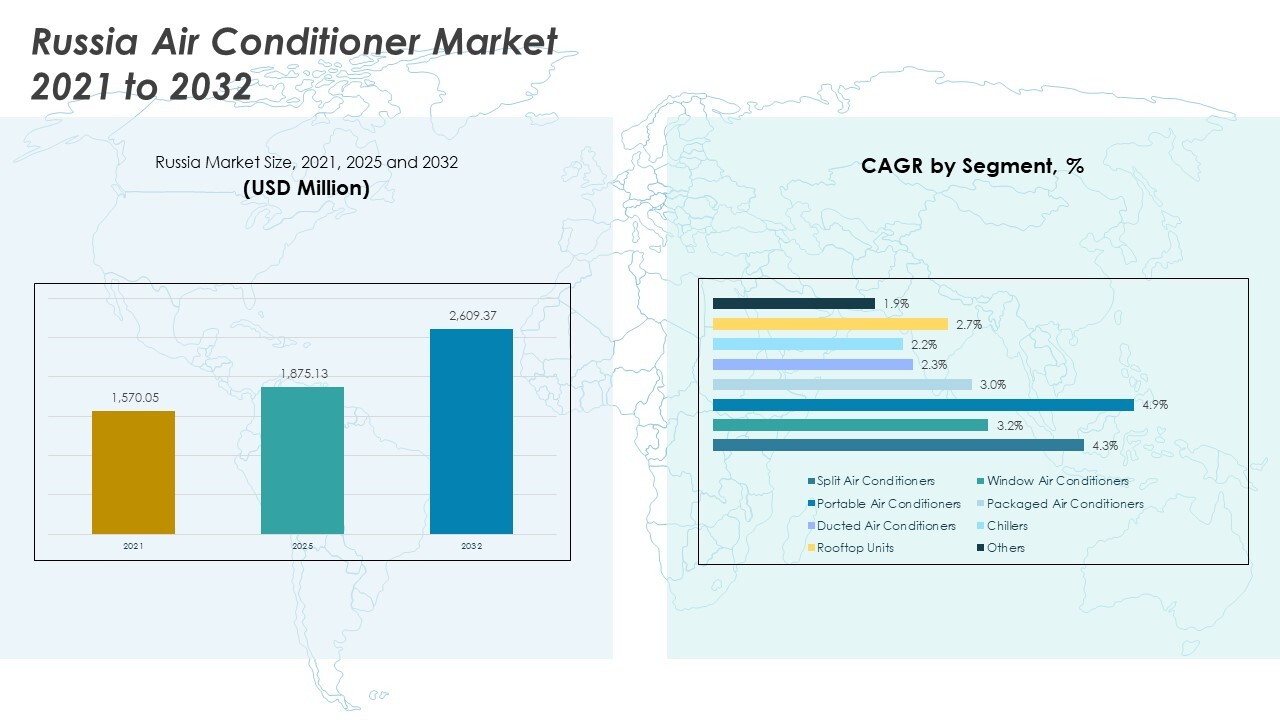
The Russia Air Conditioner Market size was valued at USD 1,570.05 MN in 2021 and reached USD 1,875.13 MN in 2025. It is anticipated to reach USD 2,609.37 MN by 2032, growing at a CAGR of 4.8% from 2025 to 2032.
| REPORT ATTRIBUTE | DETAILS |
|---|---|
| Historical Period | 2021-2024 |
| Base Year | 2025 |
| Forecast Period | 2025-2032 |
| Russia Air Conditioner Market Size 2025 | USD 1,875.13 million |
| Russia Air Conditioner Market, CAGR | 3.67% |
| Russia Air Conditioner Market Size 2032 | USD 2,609.37 million |
Russia Air Conditioner Market Insights
- Market growth is supported by rising cooling needs in urban housing, commercial building modernization, replacement demand, wider inverter adoption and growing use of portable cooling systems.
- Split Air Conditioners hold the strongest product position, supported by broad residential adoption, flexible installation, room-level cooling performance and steady replacement of older units.
- Portable Air Conditioners are projected to record the fastest listed segment CAGR at 4.9%, supported by retrofit demand, rental housing, heatwave-led purchases and lower installation complexity.
- Residential demand remains strong because Russian households increasingly use air conditioning for seasonal comfort, indoor air quality improvement and flexible cooling in apartments and private homes.
Russia Air Conditioner Market Segment Insights
By product type
By product type, Split Air Conditioners held the strongest position in 2025, supported by broad use across apartments, private homes, offices, retail units and small commercial facilities. The segment is projected to grow at a CAGR of 4.3%, driven by replacement demand, wider use of inverter models and consumer preference for efficient room-level cooling. Portable Air Conditioners are expected to grow fastest at a CAGR of 4.9% because they serve renters, temporary users and buildings where fixed installation is difficult. Window Air Conditioners remain relevant in selective price-sensitive applications and are projected to grow at a CAGR of 3.2%. Packaged Air Conditioners, Ducted Air Conditioners, Chillers and Rooftop Units serve commercial buildings, offices, hotels, retail facilities and institutional properties, but their growth remains more moderate because project budgets, building design and installation complexity influence adoption.
By technology
By technology, Inverter Air Conditioners led the Russia Air Conditioner Market in 2025 because customers increasingly value lower electricity use, stable cooling and quieter operation. Inverter systems are gaining share as residential and commercial users replace older non-inverter systems with more efficient units. Non-inverter Air Conditioners remain present in cost-sensitive demand, but their share is expected to decline as buyers focus more on lifecycle cost and performance. Smart / Connected Air Conditioners are gaining traction in premium residential and commercial applications because users seek remote control, scheduling and energy monitoring. Solar-powered and Hybrid Air Conditioners remain emerging categories, but they offer selective long-term opportunities where customers seek lower-carbon or energy-resilient cooling options.
By end user
By end user, Residential customers held the stronger position in 2025 because apartment cooling, private housing upgrades and replacement demand continue to support sales. Rising summer temperature variability and higher comfort expectations are increasing the use of Split Air Conditioners and Portable Air Conditioners across major cities and regional urban centers. Residential buyers often prioritize affordability, energy efficiency, low-noise operation and simple installation. Commercial users represent a steady demand base across offices, shopping centers, hotels, restaurants, health care facilities, schools and public buildings. Commercial adoption is shaped by indoor comfort needs, HVAC modernization, retail expansion and energy cost control. Demand from both end users is expected to rise through 2032 as cooling becomes more common in homes and commercial spaces.
By sales channel
By sales channel, Distributor / Dealer Sales held a strong position in 2025 because air conditioner purchases often require product advice, installer coordination, warranty support and regional inventory access. HVAC Contractors remain important because system sizing, refrigerant handling, electrical compatibility and installation quality directly affect performance. Retail Stores continue to serve residential customers seeking split, window and portable air conditioners. Online / E-commerce is growing as consumers compare prices, review models and purchase portable or room units through digital platforms. Direct Sales remain important for commercial buyers, developers, public institutions and large accounts that require project-based procurement. Sales channel performance will depend on seasonal demand planning, installer availability and after-sales service quality.
Key market drivers
Rising urban cooling demand
Rising urban cooling demand is becoming a core growth engine for the Russia Air Conditioner Market as larger cities and regional centers push air conditioning from a discretionary purchase toward a practical comfort upgrade for homes, offices, and neighborhood retail spaces. Demand is no longer confined to premium buyers, because more households now want dependable cooling in bedrooms, living rooms, and home offices, while landlords and small businesses increasingly treat cooling as a standard amenity. M.Video-Eldorado research cited by AirVent showed that demand for air conditioners and split systems in Russia rose 25% in March 2024 from a year earlier, with first-quarter demand up 20% year over year, highlighting fast-moving urban purchase momentum. Split air conditioners remain the chief beneficiaries because they deliver efficient room-by-room cooling and fit apartment layouts well. Portable units also gain during sudden heat waves when buyers need immediate relief without permanent installation.
Energy efficiency and inverter replacement
Energy efficiency and inverter replacement are supporting market growth as Russian buyers move away from older systems that consume more power, cool less evenly, and often struggle to meet current comfort expectations in homes and commercial spaces. Inverter air conditioners are especially attractive because they adjust compressor output to match real cooling demand, which improves temperature stability, reduces wasted electricity, and makes daily use feel quieter and more refined. A UNEP mapping report found that annual air-conditioner sales in Russia climbed from 145,000 units in 2000 to 1.8 million in 2010, underscoring how a large installed base has matured into a replacement pool where efficiency upgrades now carry clear economic value. This replacement cycle favors brands that offer deep inverter portfolios, dependable after-sales service, and strong installer relationships across major cities. It also lifts demand for connected premium split systems and efficient commercial cooling products, since building operators increasingly evaluate equipment through the lens of lifetime operating cost rather than just initial purchase price.
Commercial building and retail modernization
Commercial building and retail modernization continue to support air-conditioner demand across offices, shopping destinations, hotels, restaurants, clinics, and public facilities as property owners focus more closely on indoor comfort, tenant retention, and operational efficiency. Cooling upgrades are becoming part of broader asset improvement programs, especially where older HVAC infrastructure can no longer deliver consistent performance during peak seasonal demand or align with modern expectations for occupant experience. AirVent reports that Russia was the third largest VRF market in Europe with more than 26,000 units sold in 2023, showing that larger properties are actively investing in centralized and semi-centralized cooling systems for complex multi-zone environments. This trend supports demand for packaged units, ducted systems, chillers, and rooftop equipment in projects where scale, zoning, and maintenance planning matter. HVAC contractors and direct sales channels remain especially important because commercial buyers typically need system design, installation, commissioning, and long-term service wrapped into a single decision.
Smart and connected cooling adoption
Smart and connected cooling adoption is strengthening demand as Russian consumers and facility managers look for simpler control, better visibility over energy use, and a more seamless link between air conditioning and broader digital lifestyles. Smart air conditioners appeal to premium residential buyers and office operators because app-based control, scheduling, and remote access make it easier to manage comfort settings across changing occupancy patterns without constant manual adjustment. M.Video-Eldorado reported that in the first quarter of 2023, sales of smart devices for home security and automation in Russia increased 1.5 times year over year, while speakers with virtual assistants grew 2.2 times, signaling a wider consumer shift toward connected ecosystems that can also accelerate acceptance of smart cooling. These features matter increasingly because preventive maintenance alerts and usage monitoring help users avoid breakdowns and operate systems more transparently. Brands that combine inverter efficiency, intuitive software, and dependable service are likely to strengthen their position across premium and mid-range segments.
Key Trends and Opportunities
Portable and retrofit cooling demand rises
Portable and retrofit cooling demand is becoming a major opportunity because many apartments and older buildings face constraints on fixed air conditioner installation. Portable Air Conditioners are projected to grow at a CAGR of 4.9%, the fastest among listed product types. These systems appeal to renters, temporary residents and households that need fast cooling without permanent outdoor units. Retrofit demand also supports Split Air Conditioners where building layouts allow installation. Retail Stores and Online / E-commerce are expected to benefit because portable units often sell quickly during warmer periods. Suppliers that offer compact designs, lower noise and better energy efficiency can capture stronger demand.
Inverter and smart systems gain share
Inverter and smart systems are gaining share as customers shift from basic cooling products to more efficient and controllable systems. Inverter Air Conditioners support stable indoor temperatures and lower energy use, while connected features improve convenience. This trend is strongest among urban households and commercial buyers that value comfort, performance and long-term cost savings. Smart systems also help users schedule cooling and reduce unnecessary energy consumption. Manufacturers that combine inverter compressors, user-friendly apps and strong warranty support can strengthen premium positioning. This trend will support replacement demand and higher average selling prices through 2032.
Commercial HVAC upgrades create premium opportunities
Commercial HVAC upgrades create premium opportunities for Packaged Air Conditioners, Ducted Air Conditioners, Chillers, Rooftop Units and Hybrid Air Conditioners. Offices, hotels, retail centers, public buildings and health care facilities need reliable systems that support comfort and operational continuity. Chillers are projected to grow at a CAGR of 2.2%, while Ducted Air Conditioners are projected to grow at a CAGR of 2.3%, reflecting slower but stable project-linked demand. Rooftop Units are projected to grow at a CAGR of 2.7%, supported by selected commercial and industrial installations. Direct Sales and HVAC Contractors will remain important because larger projects require engineering, commissioning and maintenance support.
Key Market Challenges
High installation cost and building constraints
High installation cost and building constraints remain key challenges for the Russia Air Conditioner Market. Many older apartment buildings require careful planning for outdoor unit placement, refrigerant lines, drainage, electrical capacity and building approvals. Fixed systems can face installation barriers in dense urban buildings and properties with limited exterior space. These constraints can delay purchases or shift demand toward Portable Air Conditioners. Customers also need qualified HVAC Contractors to install systems safely and correctly. Brands and installers that simplify retrofit installation and provide clear cost guidance will be better positioned to reduce this barrier.
Seasonal demand spikes and supply pressure
Seasonal demand spikes create operational challenges for manufacturers, distributors, retailers and installers. Heat events can trigger sudden demand for Split Air Conditioners and Portable Air Conditioners, which may strain inventory, delivery and installation capacity. Retail Stores and Online / E-commerce channels must manage stock availability during peak periods. HVAC Contractors may face labor bottlenecks when installation requests rise quickly. Seasonal concentration also affects working capital, promotion planning and regional distribution. Companies with stronger forecasting, inventory planning and service networks can manage these pressures more effectively.
Supply chain, import and service complexity
Supply chain, import and service complexity creates a major challenge for the market. Air conditioner availability can be affected by import conditions, component access, currency volatility, logistics disruption and service part supply. Brands and distributors must maintain reliable inventories while managing cost pressure and changing customer demand. After-sales service also matters because installation quality, warranty support and spare parts availability shape customer trust. Commercial customers require stronger service commitments for larger HVAC systems. Companies with resilient distribution networks, trained contractors and stable parts support will be better positioned to compete.
Regional Analysis
Central Russia
Central Russia represents the largest demand area because Moscow and surrounding regions combine dense housing, office activity, retail facilities and stronger purchasing power. Residential buyers favor Split Air Conditioners and Portable Air Conditioners for apartment cooling, while commercial users invest in efficient systems for offices, hospitality and retail properties. Replacement demand is important as customers upgrade older units with inverter and smart models. Distributor / Dealer Sales and HVAC Contractors play major roles because buyers require product guidance and installation support. Central Russia is expected to remain the leading demand center through 2032.
Northwest Russia
Northwest Russia supports steady demand through urban housing, commercial buildings, public facilities and tourism-linked activity. St. Petersburg and nearby areas provide a meaningful base of residential and commercial customers seeking flexible cooling systems during warmer periods. Demand is more seasonal than in warmer regions, but comfort expectations and building modernization support adoption. Portable Air Conditioners and Split Air Conditioners serve residential users, while commercial buildings use packaged, ducted and centralized systems where needed. Online / E-commerce and Retail Stores play an important role in residential purchases. Growth will remain steady and replacement-led.
Southern Russia
Southern Russia shows stronger cooling demand because warmer climates increase the need for air conditioning across homes, hotels, restaurants, offices and public buildings. Residential adoption is supported by heat exposure and demand for indoor comfort during long warm periods. Split Air Conditioners see broad use among households and small businesses, while commercial demand comes from hospitality, retail and public facilities. Seasonal demand spikes can create pressure on product availability and installation capacity. HVAC Contractors remain important because fixed systems require proper installation and service. Southern Russia is expected to remain a high-priority region for cooling suppliers.
Volga and Ural regions
Volga and Ural regions support steady air conditioner demand through industrial activity, urban households, commercial facilities and public buildings. Residential customers increasingly adopt split and portable systems for summer comfort, while commercial users seek efficient cooling for offices, stores and institutional properties. Industrial and commercial sites create demand for larger systems, including packaged units, chillers and rooftop units in selected applications. Distributor networks are important because demand is spread across several regional cities. Growth will depend on income levels, building upgrades, installer availability and replacement cycles. The region will remain a stable mid-sized demand base.
Siberia and Far East
Siberia and Far East represent smaller but relevant markets where demand is concentrated in urban centers, commercial properties and selected residential applications. Cooling demand is more seasonal, but summer heat events can drive short-term purchases of Portable Air Conditioners and Split Air Conditioners. Remote logistics and service coverage can raise product costs and affect availability. Commercial facilities, offices, hotels and public buildings create steady but selective demand for reliable cooling systems. Online / E-commerce can support broader product access, while local contractors remain important for installation. Growth will remain moderate through 2032.
Report Attribute Details
| Report Attribute | Details |
| Historical Period | 2021–2024 |
| Base Year | 2025 |
| Forecast Period | 2025–2032 |
| Market Size in 2021 | USD 1,570.05 MN |
| Market Size in 2025 | USD 1,875.13 MN |
| Market Size in 2032 | USD 2,609.37 MN |
| CAGR | 4.8% |
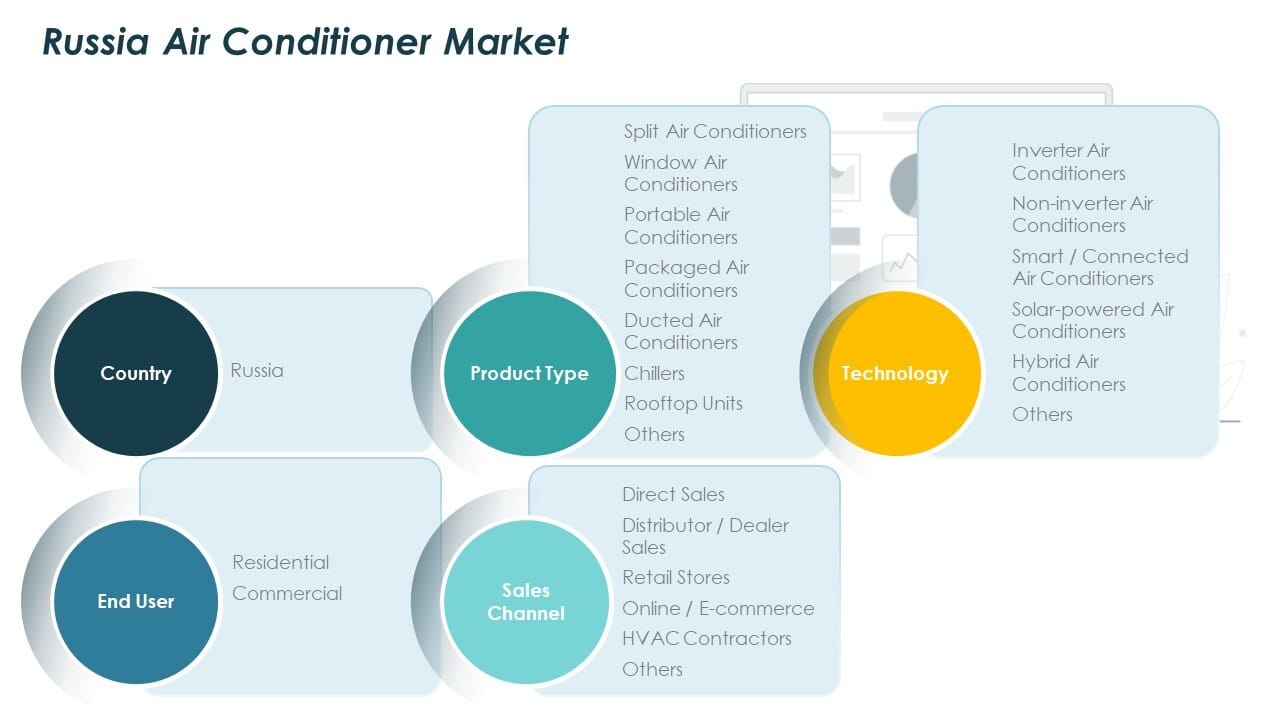
| Segments Covered | Product Type, Technology, End User and Sales Channel |
| Key Companies Covered | Daikin Industries Ltd., Carrier Global Corporation, Mitsubishi Electric Corporation, Panasonic Corporation, Mitsubishi Heavy Industries Ltd., Johnson Controls International plc, LG Electronics Inc., Samsung Electronics Co. Ltd., Trane Technologies plc and Haier Group Corporation |
Russia Air Conditioner Market Segmentations
By Product Type
- Split Air Conditioners
- Window Air Conditioners
- Portable Air Conditioners
- Packaged Air Conditioners
- Ducted Air Conditioners
- Chillers
- Rooftop Units
- Others
By Technology
- Inverter Air Conditioners
- Non-inverter Air Conditioners
- Smart / Connected Air Conditioners
- Solar-powered Air Conditioners
- Hybrid Air Conditioners
- Others
By End User
- Residential
- Commercial
By Sales Channel
- Direct Sales
- Distributor / Dealer Sales
- Retail Stores
- Online / E-commerce
- HVAC Contractors
- Others
Key Players
- Daikin Industries Ltd.
- Carrier Global Corporation
- Mitsubishi Electric Corporation
- Panasonic Corporation
- Mitsubishi Heavy Industries Ltd.
- Johnson Controls International plc
- LG Electronics Inc.
- Samsung Electronics Co. Ltd.
- Trane Technologies plc
- Haier Group Corporation
Recent Developments
- In February 2026, SuperAir reported a company update from AIRVent 2026 in Moscow, where it exhibited its latest ventilation and air-conditioning innovations and said the showcase drew strong interest from industry professionals across Russia and the CIS. In February 2026, that appearance signaled continued supplier engagement with the Russian HVAC channel through trade-show-led product visibility and distributor outreach.
- In February 2026, Aquaflame 2026 opened in Moscow with more than 600 companies and over 220 first-time participants presenting new and established engineering solutions, including climate and air-conditioning equipment. In February 2026, the scale of the event made it a notable product-launch window for suppliers targeting Russia’s residential and commercial cooling market.
- In February 2026, AIRVent 2026 was held in Moscow from 3 to 6 February as an international exhibition for ventilation, air conditioning, and refrigeration, bringing together more than 200 HVAC/R market participants. In February 2026, the organizer’s post-event recap said the four-day exhibition helped set the direction for development of the climate-equipment market, making it an important industry update for brands active in Russia.to-inform.
- In June 2026, AIRVent’s official news feed published an industry update saying Russia’s air-conditioning systems market in 2025-2026 was moving into a stabilization phase after record growth. In June 2026, while not a merger or acquisition event, the update mattered as a sector-level company signal because it framed the operating environment facing air-conditioner brands, importers, and distributors in Russia heading into the summer season.
Report Coverage
The research report offers an in-depth analysis based on product type, technology, end user, sales channel and geography. It details leading market players, providing an overview of their business positioning, product offerings, revenue relevance and strategic role in the Russia Air Conditioner Market. The report includes insights into the competitive environment, market trends, growth drivers, restraints and opportunities. It also examines urban cooling demand, energy efficiency, inverter replacement, commercial building modernization, smart cooling adoption and seasonal demand patterns as major factors shaping market development. The report assesses the impact of building constraints, installation capacity, import conditions, service networks and product availability on market growth. It provides strategic recommendations for manufacturers, distributors, HVAC contractors, retailers, commercial building owners, investors and new entrants seeking to navigate Russia’s residential and commercial cooling market.
Future Outlook
- Demand for air conditioners in Russia will continue to rise as urban households and commercial buildings adopt more efficient cooling systems.
- Split Air Conditioners will remain the leading product type because they offer flexible installation, efficient room cooling and broad residential suitability.
- Portable Air Conditioners will record the fastest listed segment growth at a CAGR of 4.9%, supported by retrofit demand and heatwave-led purchases.
- Inverter Air Conditioners will gain wider adoption as customers prioritize lower electricity use and improved temperature control.
- Smart / Connected Air Conditioners will grow as users seek app-based controls, scheduling and energy monitoring.
- Residential demand will remain strong because households increasingly use cooling for seasonal comfort and indoor air quality improvement.
- Commercial demand will remain steady across offices, hotels, retail stores, health care facilities and public buildings.
- Distributor / Dealer Sales and HVAC Contractors will remain critical because installation support, product selection and after-sales service influence purchasing decisions.
- Chillers and Ducted Air Conditioners will grow at moderate rates because demand remains project-linked and capital-intensive.
- Competitive intensity will increase as HVAC companies compete on efficiency, pricing, smart controls, service networks and product availability.

Request a Free Sample
Fill in your details and we'll send you a free sample report.
- Sample data tables & charts
- Research methodology
Need a Custom Version of This Report?
Tailor the scope, geography, or segments to your exact requirements.
- Custom geography or segment scope
- Direct access to our analyst team
Frequently Asked Questions
What is the current market size for the Russia Air Conditioner Market and what is its projected size in 2032?
At what CAGR is the Russia Air Conditioner Market projected to grow?
Which product type segment is expected to lead the Russia Air Conditioner Market?
Which product type segment is projected to grow fastest?
Which technology segment holds the strongest position in the market?
Who are the leading companies in the Russia Air Conditioner Market?
Which end user segment supports strong market demand?
Table of Content
Chapter 1 Market Segmentation
- 1.1 Segmentation Framework
- 1.1.1 Product and Service Classification
- 1.1.2 Application and End-Use Classification
- 1.1.3 Technology and Solution Classification
- 1.1.4 Customer and Distribution Channel Classification
- 1.1.5 Geographic Segmentation
- 1.1.6 Market Segment Definitions and Boundaries
Chapter 2 Introduction
- 2.1 Report Objectives and Scope
- 2.2 Product Definition and Industry Terminology
- 2.3 Market Inclusions and Exclusions
- 2.4 Research Process
- 2.4.1 Primary Research and Expert Interviews
- 2.4.2 Secondary Research and Source Review
- 2.4.3 Top-Down and Bottom-Up Estimation
- 2.4.4 Data Triangulation and Verification
- 2.5 Market Size Measurement Basis
- 2.5.1 2025: USD 1,875.13 MN → 2032: USD 2,609.37 MN
- 2.6 Historical and Forecast Reference Periods
- 2.6.1 Base Year: 2025
- 2.6.2 Forecast Period: 2025-2032
- 2.7 Research Assumptions and Limitations
Chapter 3 Executive Summary
- 3.1 Market Snapshot and Key Findings
- 3.2 Base-Year Market Size, 2025
- 3.3 Forecast Market Size, 2032
- 3.4 Revenue and Volume Growth Outlook
- 3.5 Key Demand and Supply Indicators
- 3.6 Leading Market Segments
- 3.7 Fastest-Growing Market Opportunities
- 3.8 Regional Performance Highlights
- 3.9 Technology and Industry Transformation
- 3.10 Competitive Landscape Summary
- 3.11 Analyst View and Strategic Implications
Chapter 4 Russia Air Conditioner Market Trends and Developments
- 4.1 Historical Industry Development
- 4.2 Recent Market Trends and Developments
- 4.3 Demand and Customer Behavior Trends
- 4.4 Technology and Product Innovation
- 4.5 Artificial Intelligence, Automation and Digitalization
- 4.6 Local Manufacturing and Supply Chain Realignment
- 4.7 Industry Partnerships, Mergers and Acquisitions
- 4.8 Sustainability and Circular Economy Developments
- 4.9 Government and Private Sector Investment Trends
- 4.10 Emerging Business Models and Commercialization
- 4.11 Industry Developments and Announcements
Chapter 5 Russia Air Conditioner Market Production, Supply and Demand Analysis
- 5.1 Demand Trend and Consumption Analysis
- 5.2 Demand Forecast, 2025-2032
- 5.3 Production and Output Trend
- 5.4 Production and Output Forecast, 2025-2032
- 5.5 Installed Capacity and Capacity Utilization
- 5.6 Company-Wise Production Plants and Statistics
- 5.6.1 Installed Production Capacity
- 5.6.2 Actual Production
- 5.6.3 Planned Capacity and Expansion Targets
- 5.7 Supply Chain Structure and Procurement Trends
- 5.8 Supply-Demand Gap and Bottlenecks
- 5.9 Import Dependence and Sourcing Structure
- 5.10 Contract Manufacturing and Outsourcing
- 5.11 Regional Supply and Demand Concentration
Chapter 6 Russia Air Conditioner Market Pricing Analysis
- 6.1 Pricing Structure and Measurement
- 6.2 Historical Pricing Trends
- 6.3 Pricing Outlook, 2025-2032
- 6.4 Average Selling Price and Unit Economics
- 6.5 Pricing by Product and Market Segment
- 6.6 Geographic Pricing Differences
- 6.7 Key Input, Energy, Labor and Logistics Costs
- 6.8 Contract Pricing and Purchasing Models
- 6.9 Pricing Sensitivity and Competitive Positioning
- 6.10 Price, Margin and Profitability Implications
Chapter 7 Russia Air Conditioner Market Dynamics
- 7.1 Market Growth Drivers
- 7.1.1 Demand-Side Drivers
- 7.1.2 Technology and Innovation Drivers
- 7.1.3 Infrastructure and Investment Drivers
- 7.1.4 Regulatory and Policy Drivers
- 7.2 Market Restraints
- 7.2.1 Cost and Affordability Constraints
- 7.2.2 Technology and Adoption Barriers
- 7.2.3 Supply Chain and Operational Constraints
- 7.3 Market Challenges
- 7.3.1 Competitive Pressure and Margin Erosion
- 7.3.2 Skills, Infrastructure and Implementation Gaps
- 7.4 Emerging Market Opportunities
- 7.5 Market Dynamics Impact and Time-Horizon Assessment
Chapter 8 Russia Air Conditioner Value Chain Analysis
- 8.1 Industry Value Chain Overview
- 8.2 Upstream Suppliers and Critical Inputs
- 8.3 Technology and Component Providers
- 8.4 Manufacturing or Service Delivery
- 8.5 Distribution, Channel Partners and Integrators
- 8.6 Downstream Applications and End Users
- 8.7 Value Addition and Profit Pools
- 8.8 Vertical Integration and Outsourcing
- 8.9 Supplier Concentration and Risk
- 8.10 Supply Chain Localization and Resilience
Chapter 9 Russia Air Conditioner Market Regulations and Policies
- 9.1 Relevant Laws, Standards and Compliance Frameworks
- 9.2 Product, Service, Safety and Quality Requirements
- 9.3 Government Policies, Incentives and Subsidies
- 9.4 Imports, Exports and Trade Barriers
- 9.5 Public Procurement and Local Content Requirements
- 9.6 Environmental and Sustainability Compliance
- 9.7 Upcoming Policy Changes and Market Implications
Chapter 10 Russia Air Conditioner Market Hotspots and Opportunities
- 10.1 Market Opportunity Mapping and Growth Hotspots
- 10.2 High-Growth Applications and Customer Groups
- 10.3 Underserved Markets and White-Space Opportunities
- 10.4 Emerging Technology and Product Opportunities
- 10.5 New Capacity and Investment Hotspots
- 10.6 Market Entry and Expansion Opportunities
- 10.7 Distribution and Partnership Opportunities
- 10.8 Near-Term and Long-Term Commercial Potential
- 10.9 Opportunity Attractiveness and Execution Risks
Chapter 11 Russia Air Conditioner Market Outlook, 2025-2032
- 11.1 Market Size and Analysis
- 11.1.1 Revenue (Market Measurement: 2025: USD 1,875.13 MN → 2032: USD 2,609.37 MN)
- 11.1.2 Market Volume and Quantity Sold
- 11.1.3 Historical Market Size
- 11.1.4 Base-Year Market Size, 2025
- 11.2 Market Forecast, 2025-2032
- 11.2.1 Revenue Forecast to 2032
- 11.2.2 Volume Forecast to 2032
- 11.2.3 CAGR and Year-on-Year Growth
- 11.2.4 Incremental Revenue Opportunity
- 11.3 Forecast Assumptions and Scenario Analysis
- 11.3.1 Base-Case Forecast
- 11.3.2 Optimistic and Conservative Scenarios
- 11.3.3 Technology, Pricing and Policy Sensitivities
- 11.4 Market Attractiveness and Growth Outlook
Chapter 12 Russia Air Conditioner Market Segmentation and Outlook
- 12.1 Segmentation Summary and Market Shares, 2025
- 12.2 Largest and Fastest-Growing Segments
- 12.3 Segment Growth Comparison
- 12.4 Segment Attractiveness and Priority Matrix
Chapter 13 Russia Air Conditioner Geographic Market Outlook, 2025-2032
- 13.1 Domestic Market Distribution and Demand Clusters
- 13.2 State- or Province-Wise Market Size and Forecast, 2025-2032
- 13.3 City and Metropolitan Market Outlook
- 13.4 Industrial, Manufacturing and Commercial Clusters
- 13.5 Geographic Concentration of Key End Users
- 13.6 Local Pricing and Purchasing Differences
- 13.7 Domestic Production Facilities and Capacity Map
- 13.8 Local Infrastructure and Project Pipeline
- 13.9 State-Level Policy and Incentive Differences
- 13.10 Subnational Investment Hotspots and Opportunities
- 13.11 Distribution and Logistics Networks
- 13.12 Domestic Competitive Footprint
Chapter 14 Russia Air Conditioner Technology, Innovation and Sustainability Outlook
- 14.1 Technology Landscape and Maturity
- 14.2 Product, Process and Service Innovation
- 14.3 AI, Automation and Digital Tools in the Industry
- 14.4 Technology Adoption and Performance Benchmarking
- 14.5 Innovation Pipeline and R&D Investment
- 14.6 Patent and Intellectual Property Trends
- 14.7 Energy Efficiency and Resource Management
- 14.8 Sustainability, Recycling and Circularity
- 14.9 Technology Roadmap, 2025-2032
- 14.10 Risks of Obsolescence and Technology Substitution
Chapter 15 Russia Air Conditioner Market Key Strategic Imperatives
- 15.1 Growth and Market Entry Priorities
- 15.2 High-Return Products and Segments
- 15.3 Pricing, Profitability and Cost Optimization
- 15.4 Technology Investment and Product Differentiation
- 15.5 Supply Chain Localization and Resilience
- 15.6 Distribution and Customer Acquisition
- 15.7 Partnership, Acquisition and Capacity Strategy
- 15.8 Regional Expansion Priorities
- 15.9 Short-, Medium- and Long-Term Actions
Chapter 16 Competition Outlook
- 16.1 Industry Competition Characteristics
- 16.2 Market Structure and Concentration
- 16.3 Market Share and Competitive Positioning, 2025
- 16.4 Company-Wise Revenue and Product Benchmarking
- 16.5 Production and Service Capacity Benchmarking
- 16.6 Technology, Pricing and Differentiation
- 16.7 Regional Footprint and Distribution Strength
- 16.8 Mergers, Acquisitions and Strategic Alliances
- 16.9 New Entrants and Competitive Threats
- 16.10 Porter's Five Forces and Industry Attractiveness
- 16.11 Competitive Outlook, 2025-2032
Chapter 17 Company Profiles
- 17.1 Company Coverage and Selection Criteria
- 17.2 Leading Market Participants – Standard Profile Structure
- 17.2.1 Business Description
- 17.2.2 Company Ownership and Geographic Presence
- 17.2.3 Product and Service Portfolio
- 17.2.4 Manufacturing and Operating Footprint
- 17.2.5 Production Capacity and Expansion Plans
- 17.2.6 Financial Performance and Investment
- 17.2.7 Market Share and Competitive Position
- 17.2.8 Technology and Innovation Capabilities
- 17.2.9 Strategic Alliances or Partnerships
- 17.2.10 Recent Developments
- 17.2.11 Growth Strategy and Outlook
- 17.3 Other Relevant Market Participants
Note: Every listed company is profiled on the structure shown under the first company. The company list is preliminary and may change based on research findings, market developments, data availability and client requirements.
Chapter 18 Disclaimer
- 18.1 Research and Forecast Disclaimer
- 18.2 Data Source and Estimation Limitations
Note: The depth of individual sections depends on data availability for this market. Volume, capacity, trade and other unit-based metrics are included where applicable.