Market Overview:
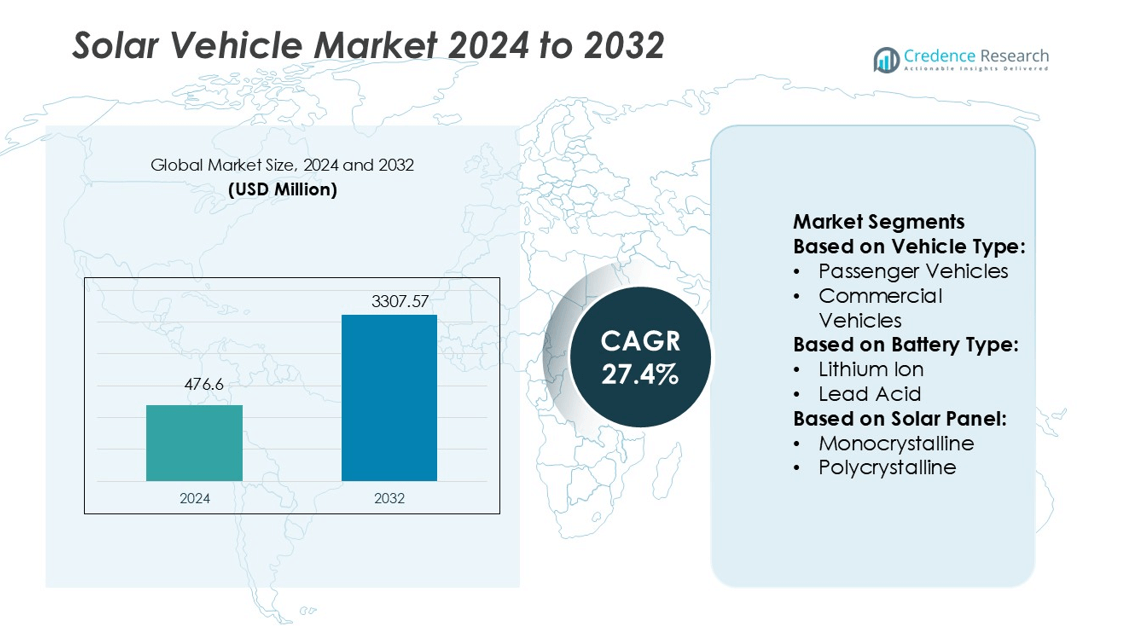
Solar Vehicle Market size was valued USD 476.6 million in 2024 and is anticipated to reach USD 3307.57 million by 2032, at a CAGR of 27.4% during the forecast period.
| REPORT ATTRIBUTE | DETAILS |
|---|---|
| Historical Period | 2020-2023 |
| Base Year | 2024 |
| Forecast Period | 2025-2032 |
| Solar Vehicle Market Size 2024 | USD 476.6 million |
| Solar Vehicle Market, CAGR | 27.4% |
| Solar Vehicle Market Size 2032 | USD 3307.57 million |
The solar vehicle market is driven by leading players including Daimler AG, Mahindra & Mahindra Limited, Sono Motors GmbH, Tesla, Inc, Ford Motor Company, Lightyear, Toyota Motor Corporation, VENTURI, Volkswagen AG, and Nissan. These companies focus on integrating high-efficiency solar panels, advanced batteries, and lightweight designs to extend vehicle range and enhance performance. Startups such as Lightyear and Sono Motors pioneer fully solar-powered models, while established automakers expand solar-electric hybrid offerings to capture wider markets. Regionally, Asia-Pacific leads the market with a 36% share in 2024, supported by large-scale manufacturing, government incentives, and rapid adoption of renewable mobility solutions.
Market Insights
- The solar vehicle market size was valued at USD 476.6 million in 2024 and is projected to reach USD 3307.57 million by 2032, growing at a CAGR of 27.4%.
- Growing demand for sustainable mobility and government incentives for clean energy adoption are driving strong market growth.
- Key players focus on high-efficiency solar panels, advanced lithium-ion batteries, and lightweight designs, with startups introducing fully solar-powered cars and established automakers offering hybrid solutions.
- High initial costs and limited energy conversion efficiency of solar panels remain major restraints for large-scale adoption.
- Asia-Pacific leads with 36% share in 2024 due to manufacturing strength and incentives, North America follows with 34% share, and Europe holds 29%, while passenger vehicles dominate the market by vehicle type.
Market Segmentation Analysis:
By Vehicle Type
Passenger vehicles dominate the solar vehicle market with the largest share, driven by rising consumer adoption of sustainable mobility solutions. Growing demand for eco-friendly personal transport and government incentives for clean energy vehicles enhance this segment’s growth. Passenger cars also benefit from advancements in lightweight solar panels that improve efficiency without affecting design or performance. In contrast, commercial vehicles adopt solar integration at a slower pace, limited by higher upfront costs and technical challenges. However, fleet operators exploring long-term savings in fuel and maintenance costs are expanding potential applications.
- For instance, Architect has deployed more than 91 GW of solar tracking and racking systems globally as with utility-level projects accounting for a majority of this capacity, showcasing its technological ability to scale renewable integration.
By Battery Type
Lithium-ion batteries hold the dominant share in the solar vehicle market due to their higher energy density, longer lifecycle, and faster charging capabilities compared to lead acid and other types. Their lightweight design supports better efficiency and vehicle range, making them the preferred choice for both passenger and commercial vehicles. Continuous advancements in lithium-ion technology, such as improved thermal management and declining costs, further strengthen this segment’s dominance. Lead acid batteries remain relevant in low-cost applications, but their limited energy efficiency reduces competitiveness. Alternative chemistries attract interest but remain at an early stage.
- For instance, GameChange Solar’s MaxSpan fixed-tilt racking system uses a low number of posts per megawatt (MW), with recent reports indicating as few as 96 posts per MW. Configurations like the 3-up portrait have used as few as 120 posts per MW, while earlier 2-up portrait designs have used higher post counts.
By Solar Panel
Monocrystalline solar panels lead the market with the highest share, supported by their superior efficiency rates, compact design, and ability to generate higher power output in limited space. Their integration into vehicle rooftops enhances range extension and reduces dependency on external charging infrastructure. Automakers prefer monocrystalline panels for premium models due to their durability and strong performance in diverse weather conditions. Polycrystalline panels, while more affordable, lag behind because of lower efficiency and larger space requirements. The push for long-term sustainability and advanced mobility solutions continues to favor monocrystalline adoption as the dominant solar panel type.
Market Overview
Rising Demand for Sustainable Mobility
The growing emphasis on reducing carbon emissions is a major driver of the solar vehicle market. Consumers increasingly prefer eco-friendly transportation, and solar-powered vehicles address both fuel dependency and environmental concerns. Government policies supporting renewable energy integration in mobility further accelerate adoption. Tax benefits, purchase incentives, and zero-emission targets push manufacturers to expand production. Automakers are aligning strategies with global sustainability goals, integrating solar technology into mainstream vehicle designs. This driver ensures strong momentum across both developed and emerging markets.
- For instance, AllEarth Renewables manufactures a dual-axis solar tracker system that supports a fixed number of solar modules per structure, typically 20 or 24 panels.
Advancements in Solar and Battery Technologies
Rapid technological progress in solar panels and battery systems enhances the efficiency and feasibility of solar vehicles. Monocrystalline panels offer higher power density, enabling greater energy output in limited space. Meanwhile, lithium-ion batteries dominate with better lifecycle performance and faster charging speeds. R&D efforts by automakers and battery producers are lowering costs, improving thermal management, and increasing driving ranges. Such advancements not only address consumer performance concerns but also broaden solar vehicle applications in passenger and commercial segments. This synergy fuels continuous innovation and long-term market expansion.
- For instance, ArcelorMittal offers the Magnelis® ZM800 steel coating, which provides durability for ground-buried poles for up to 25 years. The coating also ensures the longevity of aerial components, with some specifications indicating a potential lifetime of up to 40 years.
Supportive Government Regulations and Incentives
Governments worldwide are implementing favorable policies to promote solar and electric vehicles. Subsidies, grants, and tax exemptions lower adoption costs for consumers, while stricter emission standards pressure automakers to innovate. Infrastructure development, such as solar-powered charging stations, complements vehicle adoption and enhances user confidence. Countries with strong renewable energy policies are leading adoption rates, influencing global market growth. These measures also encourage private investments in R&D, boosting production capabilities. Supportive regulation ensures both consumer affordability and industry profitability, solidifying solar vehicles as a key player in sustainable mobility.
Key Trends & Opportunities
Integration of Solar Panels into Electric Vehicles
A notable trend is the integration of high-efficiency solar panels into existing electric vehicle platforms. Automakers are embedding monocrystalline panels into rooftops and body surfaces to extend driving range. This approach reduces reliance on charging infrastructure and enhances energy independence for users. Companies like Toyota and Sono Motors are pioneering solar-electric hybrids, demonstrating commercial viability. The trend creates opportunities for vehicle differentiation, with solar integration becoming a premium feature in both passenger and fleet vehicles. Adoption of this innovation is expected to expand steadily.
- For instance, Product datasheets and reports confirm that panels in the LG NeON H series typically came in configurations of 120 or 144 half-cells [1, 4]. LG NeON H BiFacial 72-cell module (equivalent to 144 half-cells) was a specific product configuration.
Expansion into Commercial Vehicle Fleets
The commercial vehicle segment presents significant growth opportunities as logistics and public transport sectors pursue sustainability. Fleet operators benefit from reduced fuel costs and lower emissions by adopting solar-powered buses, vans, and trucks. Governments are also piloting solar-integrated public transport systems to meet climate goals. The large surface area of commercial vehicles enables higher solar panel integration, improving efficiency. With rising e-commerce and last-mile delivery services, this trend creates a strong opportunity for solar adoption. It positions commercial fleets as a key growth frontier in the market.
- For instance, Panasonic previously manufactured high-performance HIT® solar modules, such as the N330/N335 series, which were known for their low degradation rates, often below 0.3% annually, and stable performance, especially in high temperatures.
Rising R&D Collaborations and Investments
Growing collaboration between automakers, solar panel manufacturers, and research institutions is shaping new opportunities. Joint ventures and technology-sharing agreements accelerate innovation in solar cell efficiency and battery integration. Venture capital firms and government funds are channeling investments into solar vehicle startups, boosting commercialization. These collaborations also focus on scaling production to reduce costs and make solar vehicles more accessible. As competition intensifies, partnerships ensure faster deployment of advanced technologies and strengthen market presence. This trend indicates a dynamic future driven by innovation-led growth opportunities.
Key Challenges
High Initial Costs of Solar Vehicles
Despite environmental benefits, solar vehicles face limited adoption due to high upfront costs. The integration of advanced solar panels and lithium-ion batteries significantly raises production expenses. For consumers, purchase prices remain higher compared to conventional or even standard electric vehicles. This cost barrier restricts adoption among middle-income buyers, particularly in price-sensitive markets. While long-term savings in fuel and maintenance are attractive, the initial affordability gap poses a major challenge. Achieving economies of scale and further technological cost reductions remain essential to overcoming this obstacle.
Limited Energy Conversion Efficiency
Another key challenge is the limited efficiency of current solar panels in vehicle applications. Even high-quality monocrystalline panels convert only a fraction of solar energy into usable power, restricting range extension. Weather dependence further affects energy generation, reducing practicality in low-sunlight regions. This limitation curbs consumer confidence and slows large-scale adoption. To address this, companies must invest heavily in R&D to improve efficiency levels and design optimized panel integration. Until these technological barriers are overcome, the challenge of limited energy conversion will remain a restraint on growth.
Regional Analysis
North America
North America holds a strong position in the solar vehicle market with a 34% share in 2024. The region benefits from advanced automotive manufacturing, high consumer awareness, and robust government incentives for renewable transportation. The United States drives adoption with federal tax credits, state-level subsidies, and active R&D programs. Canada supports deployment through clean energy initiatives and public transport electrification. Increasing demand for sustainable passenger vehicles and solar-powered fleets further strengthens market penetration. With growing investments in solar panel efficiency and charging infrastructure, North America is expected to maintain its leadership during the forecast period.
Europe
Europe accounts for 29% of the solar vehicle market in 2024, driven by stringent emission reduction targets and strong government regulations. Germany leads adoption with innovation in solar-integrated electric vehicles, supported by R&D funding and partnerships with automakers. The Netherlands and France expand deployment through incentives and charging infrastructure projects. Rising demand for clean public transport also boosts solar-powered bus initiatives. Growing consumer acceptance of eco-friendly cars, combined with strict CO₂ reduction policies, supports steady growth. Europe’s focus on sustainability ensures that the region remains a central hub for technological innovation and large-scale solar vehicle adoption.
Asia-Pacific
Asia-Pacific dominates the solar vehicle market with the highest share of 36% in 2024. China leads with significant investments in renewable mobility and large-scale production capabilities. Japan advances adoption through solar-electric hybrids and government-backed innovation programs. India shows strong potential as clean mobility initiatives expand with government incentives and solar integration in public transport. Rapid urbanization, rising fuel costs, and consumer demand for eco-friendly vehicles further drive growth. The region’s manufacturing strength and favorable policies make it the fastest-growing market, offering both large-scale production capacity and strong opportunities for future expansion.
Latin America
Latin America captures 6% of the solar vehicle market in 2024, with adoption still in its early stages. Brazil leads the region, supported by clean energy policies and pilot projects in solar-integrated electric buses. Mexico shows potential through growing EV adoption and partnerships with global automakers. High solar energy availability creates opportunities for cost-effective vehicle integration, but economic constraints and limited infrastructure hinder widespread adoption. Despite these challenges, increasing government focus on sustainability and renewable mobility suggests gradual expansion. Latin America presents long-term growth prospects, particularly in public transport and fleet applications.
Middle East & Africa
The Middle East & Africa region holds a 5% share of the solar vehicle market in 2024. Countries like the UAE and Saudi Arabia are investing in clean mobility as part of diversification strategies under Vision 2030 initiatives. Abundant solar resources provide a natural advantage, enabling large-scale solar integration in vehicles and infrastructure. South Africa also shows emerging interest in renewable mobility solutions. However, high upfront costs and limited adoption of EV infrastructure remain barriers. Ongoing projects, government-led initiatives, and international collaborations highlight growth potential, positioning the region as an emerging market with long-term opportunities.
Market Segmentations:
By Vehicle Type:
- Passenger Vehicles
- Commercial Vehicles
By Battery Type:
- Lithium Ion
- Lead Acid
By Solar Panel:
- Monocrystalline
- Polycrystalline
By Geography
- North America
- U.S.
- Canada
- Mexico
- Europe
- UK
- France
- Germany
- Italy
- Spain
- Russia
- Belgium
- Netherlands
- Austria
- Sweden
- Poland
- Denmark
- Switzerland
- Rest of Europe
- Asia Pacific
- China
- Japan
- South Korea
- India
- Australia
- Thailand
- Indonesia
- Vietnam
- Malaysia
- Philippines
- Taiwan
- Rest of Asia Pacific
- Latin America
- Brazil
- Argentina
- Peru
- Chile
- Colombia
- Rest of Latin America
- Middle East
- UAE
- KSA
- Israel
- Turkey
- Iran
- Rest of Middle East
- Africa
- Egypt
- Nigeria
- Algeria
- Morocco
- Rest of Africa
Competitive Landscape
The competitive landscape of the solar vehicle market features prominent players such as Daimler AG, Mahindra & Mahindra Limited, Sono Motors GmbH, Tesla, Inc, Ford Motor Company, Lightyear, Toyota Motor Corporation, VENTURI, Volkswagen AG, and Nissan. The competitive landscape of the solar vehicle market is shaped by continuous innovation, strategic partnerships, and growing investments in renewable mobility. Companies are focusing on integrating high-efficiency solar panels, advanced lithium-ion batteries, and lightweight materials to enhance performance and extend vehicle range. Startups and established automakers alike are exploring new business models, including solar-powered passenger cars, fleet applications, and public transport solutions. Collaborations with research institutes and government programs further support advancements in efficiency and cost reduction. This competitive environment fosters rapid technological progress, positioning solar vehicles as a transformative solution in the global mobility sector.
Key Player Analysis
- Daimler AG
- Mahindra & Mahindra Limited
- Sono Motors GmbH
- Tesla, Inc
- Ford Motor Company
- Lightyear
- Toyota Motor Corporation
- VENTURI
- Volkswagen AG
- Nissan
Recent Developments
- In June 2025, Swap Robotics received an undisclosed investment from Silicon Ranch to expand solar robotic operations and product development. The company will focus on utility-scale solar construction and maintenance technologies that could influence vehicle-integrated photovoltaic manufacturing processes.
- In January 2025, Aptera announced progress toward market readiness with its production-intent solar electric vehicle, demonstrating advancements in solar-only vehicle architectures and specialized aerodynamic design for extended solar range.
- In September 2024, Lightyear successfully secured over in funding to develop advanced solar systems for vehicles. This investment aims to enhance the efficiency and range of electric cars by integrating solar technology.
- In January 2023, Sono Group N.V., a key player in solar mobility solutions, secured funding from CINEA (European Climate, Infrastructure, and Environment Executive Agency) to enhance the development of solar technology
Report Coverage
The research report offers an in-depth analysis based on Vehicle Type, Battery Type, Solar Panel and Geography. It details leading market players, providing an overview of their business, product offerings, investments, revenue streams, and key applications. Additionally, the report includes insights into the competitive environment, SWOT analysis, current market trends, as well as the primary drivers and constraints. Furthermore, it discusses various factors that have driven market expansion in recent years. The report also explores market dynamics, regulatory scenarios, and technological advancements that are shaping the industry. It assesses the impact of external factors and global economic changes on market growth. Lastly, it provides strategic recommendations for new entrants and established companies to navigate the complexities of the market.
Future Outlook
- The solar vehicle market will expand with rising global demand for sustainable mobility.
- Advancements in solar panel efficiency will improve driving range and vehicle performance.
- Integration of solar roofs in electric vehicles will become a mainstream feature.
- Government incentives and emission reduction targets will accelerate adoption.
- Commercial fleets will increasingly adopt solar vehicles for cost savings and sustainability goals.
- Collaborations between automakers and solar technology firms will drive innovation.
- Improved battery technologies will enhance energy storage and charging capabilities.
- Emerging markets will create new growth opportunities through clean mobility initiatives.
- Infrastructure development, including solar-powered charging stations, will support market growth.
- Rising consumer awareness of renewable mobility will strengthen long-term adoption.

Request a Free Sample
Fill in your details and we'll send you a free sample report.
- Sample data tables & charts
- Research methodology
Market Dynamics
Rising Demand for Sustainable Mobility
Increasing consumer preference for eco-friendly transportation and the need to reduce carbon emissions are driving the adoption of solar vehicles. Solar-powered vehicles address both environmental concerns and fuel dependency, making them attractive for both individuals and fleet operators.
Government Incentives and Regulatory Support
Supportive policies such as tax benefits, purchase incentives, and stricter emission standards are accelerating the adoption of solar vehicles. These measures lower the cost barrier for consumers and encourage automakers to invest in solar technology integration.
Advancements in Solar and Battery Technologies
Continuous improvements in monocrystalline solar panels and lithium-ion batteries are enhancing vehicle efficiency, range, and performance. Technological progress is making solar vehicles more practical and appealing, supporting broader market adoption.
Integration of Solar Panels into Electric Vehicles
Automakers are increasingly embedding high-efficiency solar panels into electric vehicle platforms, extending driving range and reducing reliance on charging infrastructure. This trend is creating new opportunities for differentiation and value-added features in both passenger and commercial vehicles.
Expansion into Commercial Vehicle Fleets
Logistics and public transport sectors are exploring solar vehicle adoption to reduce fuel costs and emissions. The large surface area of commercial vehicles allows for greater solar panel integration, making them ideal candidates for solar-powered mobility solutions.
Need a Custom Version of This Report?
Tailor the scope, geography, or segments to your exact requirements.
- Custom geography or segment scope
- Direct access to our analyst team
Frequently Asked Questions
What is the current market size for Solar Vehicle Market, and what is its projected size in 2032?
At what Compound Annual Growth Rate is the Solar Vehicle Market projected to grow between 2025 and 2032?
Which Solar Vehicle Market segment held the largest share in 2024?
What are the primary factors fueling the growth of the Solar Vehicle Market?
Who are the leading companies in the Solar Vehicle Market?
Table of Content
Chapter 1 Market Segmentation
- 1.1 Segmentation Framework
- 1.1.1 Product and Service Classification
- 1.1.2 Application and End-Use Classification
- 1.1.3 Technology and Solution Classification
- 1.1.4 Customer and Distribution Channel Classification
- 1.1.5 Geographic Segmentation
- 1.1.6 Market Segment Definitions and Boundaries
- 1.2 By Solar Panel
- 1.2.1 Monocrystalline
- 1.2.2 Polycrystalline
- 1.3 By Battery Type
- 1.3.1 Lithium Ion
- 1.3.2 Lead Acid
- 1.4 By Vehicle Type
- 1.4.1 Passenger Vehicles
- 1.4.2 Commercial Vehicles
Chapter 2 Introduction
- 2.1 Report Objectives and Scope
- 2.2 Product Definition and Industry Terminology
- 2.3 Market Inclusions and Exclusions
- 2.4 Research Process
- 2.4.1 Primary Research and Expert Interviews
- 2.4.2 Secondary Research and Source Review
- 2.4.3 Top-Down and Bottom-Up Estimation
- 2.4.4 Data Triangulation and Verification
- 2.5 Market Size Measurement Basis
- 2.5.1 2024: USD 476.6 million → 2032: USD 3307.57 million
- 2.6 Historical and Forecast Reference Periods
- 2.6.1 Base Year: 2024
- 2.6.2 Forecast Period: 2024-2032
- 2.7 Research Assumptions and Limitations
Chapter 3 Executive Summary
- 3.1 Market Snapshot and Key Findings
- 3.2 Base-Year Market Size, 2024
- 3.3 Forecast Market Size, 2032
- 3.4 Revenue and Volume Growth Outlook
- 3.5 Key Demand and Supply Indicators
- 3.6 Leading Market Segments
- 3.7 Fastest-Growing Market Opportunities
- 3.8 Regional Performance Highlights
- 3.9 Technology and Industry Transformation
- 3.10 Competitive Landscape Summary
- 3.11 Analyst View and Strategic Implications
Chapter 4 Global Solar Vehicle Market Trends and Developments
- 4.1 Historical Industry Development
- 4.2 Recent Market Trends and Developments
- 4.3 Demand and Customer Behavior Trends
- 4.4 Technology and Product Innovation
- 4.5 Artificial Intelligence, Automation and Digitalization
- 4.6 Local Manufacturing and Supply Chain Realignment
- 4.7 Industry Partnerships, Mergers and Acquisitions
- 4.8 Sustainability and Circular Economy Developments
- 4.9 Government and Private Sector Investment Trends
- 4.10 Emerging Business Models and Commercialization
- 4.11 Industry Developments and Announcements
Chapter 5 Global Solar Vehicle Market Production, Supply and Demand Analysis
- 5.1 Demand Trend and Consumption Analysis
- 5.2 Demand Forecast, 2024-2032
- 5.3 Production and Output Trend
- 5.4 Production and Output Forecast, 2024-2032
- 5.5 Installed Capacity and Capacity Utilization
- 5.6 Company-Wise Production Plants and Statistics
- 5.6.1 Installed Production Capacity
- 5.6.2 Actual Production
- 5.6.3 Planned Capacity and Expansion Targets
- 5.7 Supply Chain Structure and Procurement Trends
- 5.8 Supply-Demand Gap and Bottlenecks
- 5.9 Import Dependence and Sourcing Structure
- 5.10 Contract Manufacturing and Outsourcing
- 5.11 Regional Supply and Demand Concentration
Chapter 6 Global Solar Vehicle Market Pricing Analysis
- 6.1 Pricing Structure and Measurement
- 6.2 Historical Pricing Trends
- 6.3 Pricing Outlook, 2024-2032
- 6.4 Average Selling Price and Unit Economics
- 6.5 Pricing by Product and Market Segment
- 6.6 Geographic Pricing Differences
- 6.7 Key Input, Energy, Labor and Logistics Costs
- 6.8 Contract Pricing and Purchasing Models
- 6.9 Pricing Sensitivity and Competitive Positioning
- 6.10 Price, Margin and Profitability Implications
Chapter 7 Global Solar Vehicle Market Dynamics
- 7.1 Market Growth Drivers
- 7.1.1 Demand-Side Drivers
- 7.1.2 Technology and Innovation Drivers
- 7.1.3 Infrastructure and Investment Drivers
- 7.1.4 Regulatory and Policy Drivers
- 7.2 Market Restraints
- 7.2.1 Cost and Affordability Constraints
- 7.2.2 Technology and Adoption Barriers
- 7.2.3 Supply Chain and Operational Constraints
- 7.3 Market Challenges
- 7.3.1 Competitive Pressure and Margin Erosion
- 7.3.2 Skills, Infrastructure and Implementation Gaps
- 7.4 Emerging Market Opportunities
- 7.5 Market Dynamics Impact and Time-Horizon Assessment
Chapter 8 Global Solar Vehicle Value Chain Analysis
- 8.1 Industry Value Chain Overview
- 8.2 Upstream Suppliers and Critical Inputs
- 8.3 Technology and Component Providers
- 8.4 Manufacturing or Service Delivery
- 8.5 Distribution, Channel Partners and Integrators
- 8.6 Downstream Applications and End Users
- 8.7 Value Addition and Profit Pools
- 8.8 Vertical Integration and Outsourcing
- 8.9 Supplier Concentration and Risk
- 8.10 Supply Chain Localization and Resilience
Chapter 9 Global Solar Vehicle Market Regulations and Policies
- 9.1 Relevant Laws, Standards and Compliance Frameworks
- 9.2 Product, Service, Safety and Quality Requirements
- 9.3 Government Policies, Incentives and Subsidies
- 9.4 Imports, Exports and Trade Barriers
- 9.5 Public Procurement and Local Content Requirements
- 9.6 Environmental and Sustainability Compliance
- 9.7 Upcoming Policy Changes and Market Implications
Chapter 10 Global Solar Vehicle Market Hotspots and Opportunities
- 10.1 Market Opportunity Mapping and Growth Hotspots
- 10.2 High-Growth Applications and Customer Groups
- 10.3 Underserved Markets and White-Space Opportunities
- 10.4 Emerging Technology and Product Opportunities
- 10.5 New Capacity and Investment Hotspots
- 10.6 Market Entry and Expansion Opportunities
- 10.7 Distribution and Partnership Opportunities
- 10.8 Near-Term and Long-Term Commercial Potential
- 10.9 Opportunity Attractiveness and Execution Risks
Chapter 11 Global Solar Vehicle Market Outlook, 2024-2032
- 11.1 Market Size and Analysis
- 11.1.1 Revenue (Market Measurement: 2024: USD 476.6 million → 2032: USD 3307.57 million)
- 11.1.2 Market Volume and Quantity Sold
- 11.1.3 Historical Market Size
- 11.1.4 Base-Year Market Size, 2024
- 11.2 Market Forecast, 2024-2032
- 11.2.1 Revenue Forecast to 2032
- 11.2.2 Volume Forecast to 2032
- 11.2.3 CAGR and Year-on-Year Growth
- 11.2.4 Incremental Revenue Opportunity
- 11.3 Forecast Assumptions and Scenario Analysis
- 11.3.1 Base-Case Forecast
- 11.3.2 Optimistic and Conservative Scenarios
- 11.3.3 Technology, Pricing and Policy Sensitivities
- 11.4 Market Attractiveness and Growth Outlook
Chapter 12 Global Solar Vehicle Market Segmentation and Outlook
- 12.1 Segmentation Summary and Market Shares, 2024
- 12.2 Largest and Fastest-Growing Segments
- 12.3 By Solar Panel - Market Size and Forecast, 2024-2032
- 12.3.1 Segment Definition and Scope
- 12.3.2 Historical Market Size
- 12.3.3 Revenue Forecast, 2024-2032
- 12.3.4 Volume Forecast, 2024-2032
- 12.3.5 Base-Year Market Share, 2024
- 12.3.6 Segment CAGR and Growth Drivers
- 12.3.7 Subsegment Market Size and Forecast
- 12.3.7.1 Monocrystalline
- 12.3.7.2 Polycrystalline
- 12.3.8 Subsegment Pricing and Adoption Trends
- 12.3.9 Leading Suppliers and Competition
- 12.3.10 Regional Demand and Opportunities
- 12.4 By Battery Type - Market Size and Forecast, 2024-2032
- 12.4.1 Segment Definition and Scope
- 12.4.2 Historical Market Size
- 12.4.3 Revenue Forecast, 2024-2032
- 12.4.4 Volume Forecast, 2024-2032
- 12.4.5 Base-Year Market Share, 2024
- 12.4.6 Segment CAGR and Growth Drivers
- 12.4.7 Subsegment Market Size and Forecast
- 12.4.7.1 Lithium Ion
- 12.4.7.2 Lead Acid
- 12.4.8 Subsegment Pricing and Adoption Trends
- 12.4.9 Leading Suppliers and Competition
- 12.4.10 Regional Demand and Opportunities
- 12.5 By Vehicle Type - Market Size and Forecast, 2024-2032
- 12.5.1 Segment Definition and Scope
- 12.5.2 Historical Market Size
- 12.5.3 Revenue Forecast, 2024-2032
- 12.5.4 Volume Forecast, 2024-2032
- 12.5.5 Base-Year Market Share, 2024
- 12.5.6 Segment CAGR and Growth Drivers
- 12.5.7 Subsegment Market Size and Forecast
- 12.5.7.1 Passenger Vehicles
- 12.5.7.2 Commercial Vehicles
- 12.5.8 Subsegment Pricing and Adoption Trends
- 12.5.9 Leading Suppliers and Competition
- 12.5.10 Regional Demand and Opportunities
- 12.6 Segment Growth Comparison
- 12.7 Segment Attractiveness and Priority Matrix
Chapter 13 Global Solar Vehicle Geographic Market Outlook, 2024-2032
- 13.1 Regional Market Size and Share, 2024
- 13.2 Regional Market Forecast, 2024-2032
- 13.3 Regional Pricing, Production and Demand Differences
- 13.4 North America
- 13.4.1 United States
- 13.4.2 Canada
- 13.4.3 Mexico
- 13.5 Europe
- 13.5.1 Germany
- 13.5.2 France
- 13.5.3 Italy
- 13.5.4 United Kingdom
- 13.5.5 Spain
- 13.5.6 Poland
- 13.5.7 Russia
- 13.5.8 Netherlands
- 13.5.9 Belgium
- 13.5.10 Sweden
- 13.5.11 Denmark
- 13.5.12 Norway
- 13.5.13 Rest of Europe
- 13.6 Asia Pacific
- 13.6.1 China
- 13.6.2 India
- 13.6.3 Japan
- 13.6.4 South Korea
- 13.6.5 Thailand
- 13.6.6 Indonesia
- 13.6.7 Vietnam
- 13.6.8 Malaysia
- 13.6.9 Australia
- 13.6.10 Rest of Asia Pacific
- 13.7 Latin America
- 13.7.1 Brazil
- 13.7.2 Argentina
- 13.7.3 Colombia
- 13.7.4 Chile
- 13.7.5 Rest of Latin America
- 13.8 Middle East
- 13.8.1 Saudi Arabia
- 13.8.2 United Arab Emirates
- 13.8.3 Turkey
- 13.8.4 Israel
- 13.8.5 Iran
- 13.8.6 Rest of the Middle East
- 13.9 Africa
- 13.9.1 South Africa
- 13.9.2 Egypt
- 13.9.3 Nigeria
- 13.9.4 Morocco
- 13.9.5 Rest of Africa
- 13.10 Regional Investment, Policy and Supply Chain Differences
- 13.11 Regional Competitive Landscape
- 13.12 Geographic Growth Hotspots
Chapter 14 Global Solar Vehicle Technology, Innovation and Sustainability Outlook
- 14.1 Technology Landscape and Maturity
- 14.2 Product, Process and Service Innovation
- 14.3 AI, Automation and Digital Tools in the Industry
- 14.4 Technology Adoption and Performance Benchmarking
- 14.5 Innovation Pipeline and R&D Investment
- 14.6 Patent and Intellectual Property Trends
- 14.7 Energy Efficiency and Resource Management
- 14.8 Sustainability, Recycling and Circularity
- 14.9 Technology Roadmap, 2024-2032
- 14.10 Risks of Obsolescence and Technology Substitution
Chapter 15 Global Solar Vehicle Market Key Strategic Imperatives
- 15.1 Growth and Market Entry Priorities
- 15.2 High-Return Products and Segments
- 15.3 Pricing, Profitability and Cost Optimization
- 15.4 Technology Investment and Product Differentiation
- 15.5 Supply Chain Localization and Resilience
- 15.6 Distribution and Customer Acquisition
- 15.7 Partnership, Acquisition and Capacity Strategy
- 15.8 Regional Expansion Priorities
- 15.9 Short-, Medium- and Long-Term Actions
Chapter 16 Competition Outlook
- 16.1 Industry Competition Characteristics
- 16.2 Market Structure and Concentration
- 16.3 Market Share and Competitive Positioning, 2024
- 16.4 Company-Wise Revenue and Product Benchmarking
- 16.5 Production and Service Capacity Benchmarking
- 16.6 Technology, Pricing and Differentiation
- 16.7 Regional Footprint and Distribution Strength
- 16.8 Mergers, Acquisitions and Strategic Alliances
- 16.9 New Entrants and Competitive Threats
- 16.10 Porter's Five Forces and Industry Attractiveness
- 16.11 Competitive Outlook, 2024-2032
Chapter 17 Company Profiles
- 17.1 Company Coverage and Selection Criteria
- 17.2 Daimler AG
- 17.2.1 Business Description
- 17.2.2 Company Ownership and Geographic Presence
- 17.2.3 Product and Service Portfolio
- 17.2.4 Manufacturing and Operating Footprint
- 17.2.5 Production Capacity and Expansion Plans
- 17.2.6 Financial Performance and Investment
- 17.2.7 Market Share and Competitive Position
- 17.2.8 Technology and Innovation Capabilities
- 17.2.9 Strategic Alliances or Partnerships
- 17.2.10 Recent Developments
- 17.2.11 Growth Strategy and Outlook
- 17.3 Mahindra & Mahindra Limited
- 17.4 Sono Motors GmbH
- 17.5 Tesla, Inc
- 17.6 Ford Motor Company
- 17.7 Lightyear
- 17.8 Toyota Motor Corporation
- 17.9 VENTURI
- 17.10 Volkswagen AG
- 17.11 Nissan
- 17.12 Other Relevant Market Participants
Note: Every listed company is profiled on the structure shown under the first company. The company list is preliminary and may change based on research findings, market developments, data availability and client requirements.
Chapter 18 Disclaimer
- 18.1 Research and Forecast Disclaimer
- 18.2 Data Source and Estimation Limitations
Note: The depth of individual sections depends on data availability for this market. Volume, capacity, trade and other unit-based metrics are included where applicable.