
Market Insights
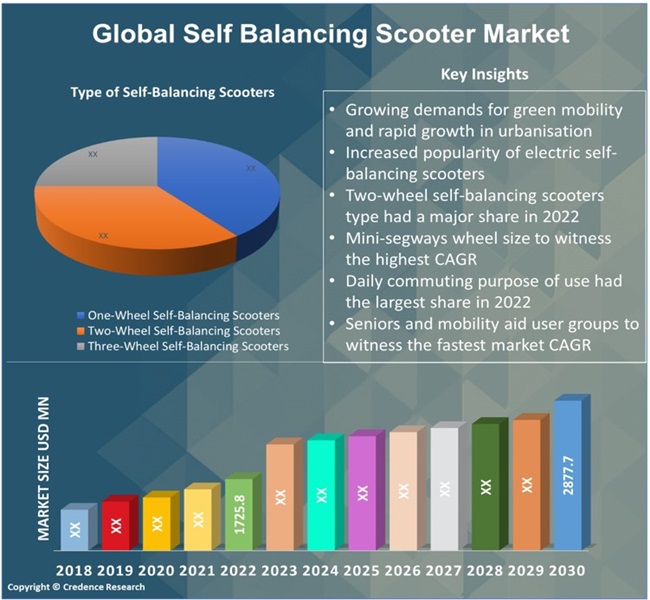
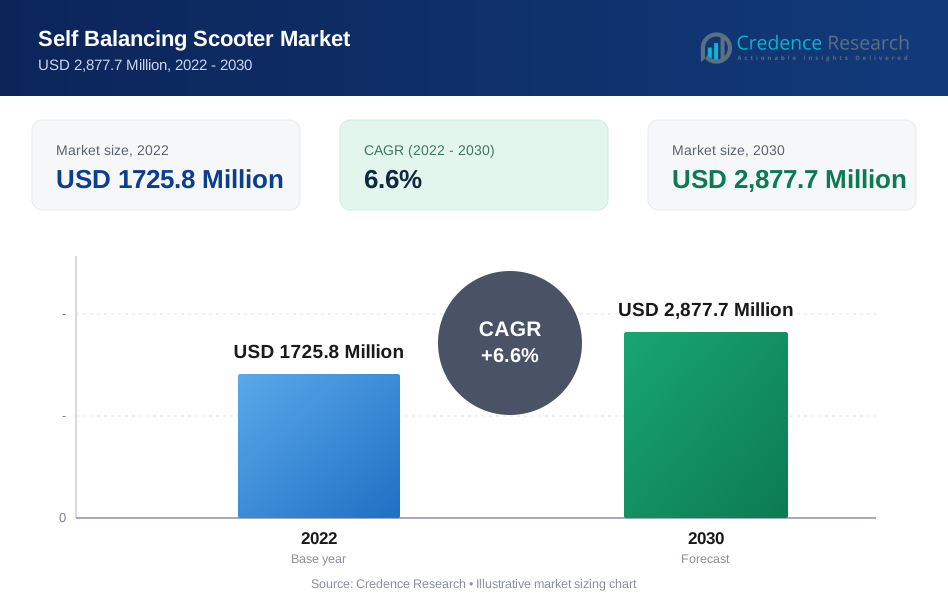
- The global demand for self-balancing scooters was valued at USD 1725.8 Million in 2022 and is expected to reach USD 2877.7 Million in 2030, growing at a CAGR of 6.6% between 2023 and 2030.
- The two-wheel self-balancing scooters segment is the market leader by type of self-balancing scooters, accounting for more than 40% of total value in 2022, while the one-wheel self-balancing scooters segment is estimated to grow rapidly in the projection period.
- The mini-segways category is expected to expand rapidly in the forecast period, while the standard-sized wheels segment had the highest market share in 2022.
- The smart model's features and functionality dominate the global need for self-balancing scooters, accounting for more than 38% in 2022, and are predicted to expand at a high CAGR.
- The seniors and mobility aid category is expected to expand the fastest throughout the forecast timeline, while the adult age and user groups segment had a market share of more than 42% in 2022.
- With a significant market share of over 44% in 2022 and projections of high CAGR growth, the daily commuting purpose-of-use category will likely continue to dominate the global demand for self-balancing scooters.
- The low-powered models category dominated the market with 58% of the total revenue share by motor power and speed. In contrast, the high-powered models category will expand fastest over the projected time frame.
- The mid-range price models category is expected to expand quickly over the forecast period, while the budget models segment had the greatest market share in 2022.
- North America is fueling the rapid growth of the self-balancing scooter industry with over one-third share in 2022, while Asia Pacific and Europe collectively account for just under 54% share in 2022. Europe held over 20% market revenue share in 2022.
- The integration of highly advanced technologies, such as smart connectivity, improved battery life, and enhanced safety features, has played a major role in shaping the market landscape.
- Increased awareness of environmental concerns and a shift toward sustainable transportation options have contributed to the growing adoption of electric personal transportation devices, including self-balancing scooters.
Executive Summary
Market Definition
The self-balancing scooter market involves producing, distributing, and selling personal electric mobility devices for short-distance transportation. These scooters, also known as hoverboards, typically feature a platform with two motorised wheels, gyroscopic sensors for balance, and an electric propulsion system. Users control the scooter's movement by shifting their body weight, allowing intuitive and responsive navigation. The market includes many self-balancing scooter models with varying designs, features, and capabilities, catering to diverse consumer preferences for convenient, eco-friendly, and technologically advanced personal transportation solutions.
Market Overview
The global self-balancing scooter market has witnessed rapid growth in recent years and is predicted to grow at a CAGR of 6.6% between 2023 and 2030. The market was valued at USD 1725.8 million in 2022 and is projected to reach USD 2877.7 million in 2030.
The self-balancing scooter market aligns with global trends favouring sustainable and tech-integrated urban mobility solutions. These scooters, featuring electric propulsion and gyroscopic balancing systems, have become popular last-mile connectivity options in urban areas. With continuous innovation in battery technology and smart features, such as Bluetooth connectivity and GPS tracking, the market caters to a diverse consumer base seeking convenient and eco-friendly transportation. Safety considerations have led to regulatory standards, and manufacturers focus on enhancing stability and incorporating advanced braking systems. Economic factors and supply chain dynamics, including trade tariffs, influence market dynamics, while e-commerce channels play a crucial role in product accessibility.
Segmentation by Type of Self-Balancing Scooters
- The one-wheel self-balancing scooter segment is poised to exhibit an exceptional CAGR in the forecasted period, driven by its unique design and potential for specialised applications.
- The two-wheel self-balancing scooters segment currently leads the market share, accounting for over 40% in 2022, owing to their widespread adoption for urban commuting and recreational use.
Segmentation by Wheel Size
- The mini-segways segment is anticipated to achieve the highest CAGR over the projected period, reflecting a growing preference for compact and portable self-balancing scooters.
- Standard-sized wheels currently dominate the market share by over 35% in 2022, balancing stability and manoeuvrability.
Segmentation by Features and Functionality
- Smart models constitute the dominant features and functionality category, satisfying over 38% of the global demand for self-balancing scooters in 2022. This demand is driven by integrating advanced technologies for enhanced user experience.
- The hoverboards with handlebars segment is expected to achieve the highest CAGR over the upcoming years, responding to consumer demand for additional stability and control.
Segmentation by Age and User Groups
- The seniors and mobility aid segment are poised to post the fastest CAGR throughout the predicted period, indicating a growing recognition of self-balancing scooters as mobility aids for the elderly.
- The adults category currently leads the market share with over 42% in 2022, reflecting the widespread adoption among the working-age population.
Segmentation by Purpose of Use
- The off-roading and sports segment is anticipated to register the highest CAGR, driven by the increasing popularity of self-balancing scooters for recreational and adventure purposes.
- With a market share of nearly 44% in 2022, the daily commuting category is currently in the lead, reflecting the practical use of self-balancing scooters for everyday transportation needs.
Segmentation by Motor Power and Speed
- The high-powered models segment is expected to witness the highest CAGR in the coming years, catering to enthusiasts seeking enhanced speed and performance.
- The low-powered models segment currently dominates the global market share, holding over 58% in 2022, appealing to a broad consumer base for their ease of use and suitability for urban environments.
Segmentation by Price Range
- Budget models dominate the global demand for self-balancing scooters, accounting for more than 46% in 2022, making them accessible to a wide range of consumers.
- The rest of the self-balancing scooter market demand comes from mid-range and premium price models, catering to consumers seeking advanced features and premium build quality.
Segmentation by Region
- North America remains a notably profitable region for industry players, accounting for over one-third of the share in 2022, driven by a tech-savvy consumer base and established urban infrastructure.
- Europe and Asia Pacific contributed just under 54% share in 2022, with Europe showcasing a robust market presence and Asia Pacific demonstrating significant growth potential.
- The rest of the world, including Latin America, the Middle East, and Africa, fulfils the remaining demand for self-balancing scooters, presenting diverse regional dynamics and growth opportunities.
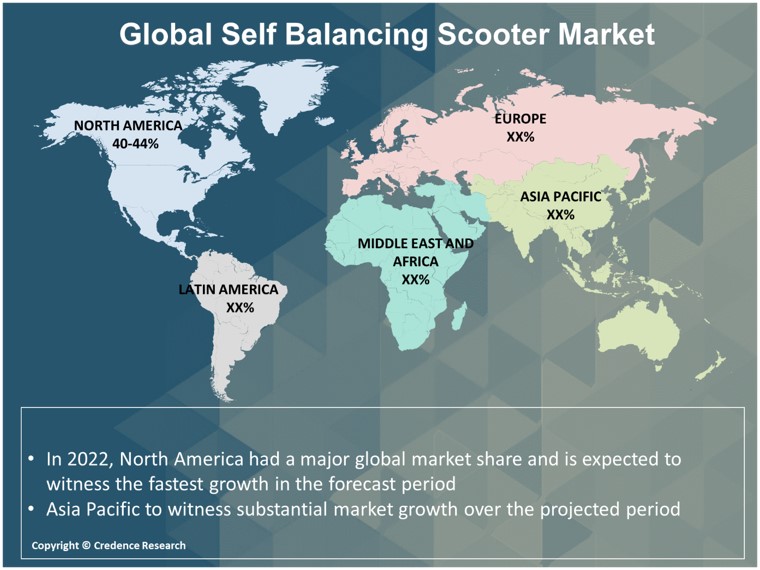
In 2022, North America dominated the revenue share in the global self-balancing scooter market primarily due to a combination of established consumer awareness, robust urban infrastructure, and a tech-savvy demographic that embraces innovative personal mobility solutions. The well-developed e-commerce ecosystem facilitated easy accessibility to self-balancing scooters, contributing to widespread regional adoption. Moreover, stringent safety regulations and consumer preferences for eco-friendly transportation options aligned with the electric-powered nature of self-balancing scooters, further boosting their popularity. The cultural affinity for recreational and tech-driven products and favourable economic conditions also positioned North America as a leading market for self-balancing scooters.
The Asia Pacific is anticipated to experience the most rapid growth in the self-balancing scooter industry over the projection period. This regional growth can be attributed to several factors, including the burgeoning population, increasing urbanisation, and a rising demand for convenient and sustainable personal mobility solutions. As economies in the Asia Pacific continue to develop, there is a heightened need for efficient last-mile connectivity options, and self-balancing scooters align well with this demand. Furthermore, the presence of key manufacturing hubs for electronic components and a thriving tech culture contribute to the regional potential to lead in technological innovations within the self-balancing scooter market.
Key Highlights of the Report
The global self-balancing scooter market is segmented by type of self-balancing scooters, wheel size, features and functionality, age and user groups, purpose of use, motor power and speed, price range, and region. The one-wheel self-balancing scooter type segment is anticipated to experience a notable growth rate, owing to the increased demand for agile and innovative designs. In terms of wheel size, the mini-segways segment is poised for growth, indicating a preference for compact and portable scooters. Smart models dominate the features and functionality category, aligning with the tech-savvy preferences of consumers. The seniors and mobility aid segment are projected to post the highest CAGR, highlighting the evolving perception of self-balancing scooters as effective mobility aids for older people. In terms of purpose of use, the off-roading and sports segment is poised for substantial growth, catering to enthusiasts seeking recreational and adventure applications. The high-powered model segment is expected to witness increased demand, catering to enthusiasts seeking enhanced performance. Budget models are in high demand, providing accessibility to a broad consumer base.
Rising urbanisation and local commuting requirements, a preference for electric mobility as an eco-friendly and effective alternative, and high portability compared to other personal electric vehicles all contribute to the global growth of the self-balancing scooter market. In addition, the market for self-balancing scooters is predicted to rise rapidly over the projection period due to factors including ongoing product development that gives businesses a competitive edge and rising R&D expenditures for improved battery technology.
North America is a notably lucrative regional market for self-balancing scooters, owing to a tech-savvy consumer base and well-established metropolitan infrastructure. The region has embraced the practical use of self-balancing scooters for daily transportation, contributing to its large market share. On the other hand, Asia Pacific showcases substantial growth potential attributed to increasing urbanisation, economic development, and a rising demand for efficient last-mile connectivity solutions. Moreover, the popularity of self-balancing scooters for recreational and sports purposes, especially in off-roading scenarios, positions the Asia Pacific as a region with diverse applications and a burgeoning market for these innovative personal mobility devices.
What Are The Main Drivers Of The Global Self-Balancing Scooter Market?
The main drivers of the global self-balancing scooter market are rooted in the increasing demand for convenient and sustainable personal mobility solutions. Increased technological advancements, including improved battery life and the integration of smart features, contribute to the appeal of these scooters. The rise of urbanisation and the need for efficient last-mile connectivity options in crowded city environments further propel market growth. Environmental sustainability plays a major role, with consumers seeking electric-powered alternatives to traditional transportation. Moreover, the diverse consumer demographic, including urban commuters and tech enthusiasts, fuels the adoption of self-balancing scooters.
What Are The Major Challenges Faced By The Global Self-Balancing Scooter Market?
The global self-balancing scooter market faces several challenges, including safety concerns and the need for stringent regulations to mitigate potential risks associated with usage. Manufacturers face difficulties meeting diverse consumer demands due to the subjective nature of design preferences and the necessity to navigate evolving trends. Economic factors, such as fluctuating disposable income levels, can impact consumer purchasing decisions, while supply chain disruptions and trade tariffs also contribute to uncertainties in the market. Moreover, concerns related to the perception of self-balancing scooters in terms of their practicality, durability, and safety compared to alternative modes of transportation pose challenges for market penetration.
What Are The Growth Opportunities In The Global Self-Balancing Scooter Market?
The global self-balancing scooter market presents growth opportunities driven by ongoing technological innovations, such as advancements in battery technology and the integration of smart features, which can enhance product performance and user experience. Expansion into untapped geographical markets, particularly in developing regions with increasing urbanisation, offers significant growth potential. The rising trend of sustainability and eco-conscious consumer behaviour creates opportunities for market players to promote electric-powered self-balancing scooters as environmentally friendly alternatives. Collaborations with ride-sharing platforms and tourism services, coupled with the introduction of versatile models for recreational use, contribute to diversifying revenue streams. In addition, addressing evolving consumer needs, such as customisation options and affordability, can unlock further growth avenues in the dynamic personal mobility landscape.
Market Drivers
Several factors drive the global self-balancing scooter market. The following are the key drivers of the global self-balancing scooter market:
Technological Advancements and Smart Features
The continuous evolution of technology, including improvements in battery efficiency, motor performance, and the integration of smart features, serves as a major driver for the self-balancing scooter market expansion. Innovations such as longer battery life, faster charging times, and incorporating Bluetooth connectivity, mobile app controls, and GPS tracking enhance the overall user experience. These technological advancements improve the practicality and performance of self-balancing scooters and contribute to their attractiveness among tech-savvy consumers. The market's ability to offer cutting-edge features that align with the preferences of modern users promotes growth and positions self-balancing scooters as sophisticated and convenient personal transportation devices.
Market Restraints
The global self-balancing scooter market faces challenges that may hinder its growth. These include the following:
Safety Concerns and Regulatory Challenges
One key restraint facing the global self-balancing scooter market is the persistent concern over safety issues and the regulatory challenges associated with their use. Accidents and injuries related to self-balancing scooters have raised apprehensions among consumers and regulatory bodies, leading to the implementation of safety standards and regulations. These impact the market by necessitating compliance measures and potentially limiting certain features or capabilities. Striking a balance between innovation and safety and ensuring adherence to diverse regional regulations remains challenging for manufacturers and hinders the unfettered growth of the self-balancing scooter industry.
Opportunities
The global self-balancing scooter market offers significant growth opportunities. These include the following:
Innovation in Eco-Friendly and Sustainable Solutions
The global emphasis on environmental sustainability and the increasing preference for eco-friendly transportation solutions create a substantial opportunity for the self-balancing scooter market developments. Manufacturers can focus on developing and promoting models with enhanced sustainability features, including energy-efficient batteries, recyclable materials, and manufacturing processes with a reduced environmental footprint. Positioning self-balancing scooters as a green alternative to traditional transportation modes aligns with global sustainability goals and attracts environmentally conscious consumers. Investing in research & development to improve energy efficiency and reduce the ecological impact of self-balancing scooters enhances market competitiveness. It addresses the growing demand for sustainable personal mobility solutions in a world increasingly focused on environmental conservation.
Competitive Landscape
Key Players
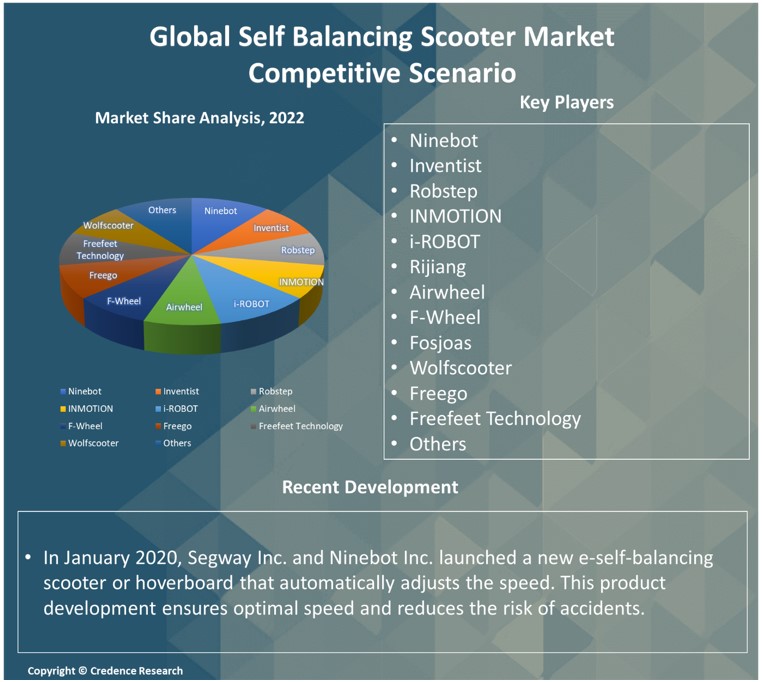
The competitive landscape of the global self-balancing scooter market is marked by a mix of established manufacturers and newer entrants striving to capture market share through innovation and differentiation. The following are some of the top market players and their market shares:
- Ninebot
- Inventist
- Robstep
- INMOTION
- i-ROBOT
- OSDRICH
- Rijiang
- ESWING
- Airwheel
- F-Wheel
- Fosjoas
- Wolfscooter
- Freego
- Freefeet Technology
- Others
These key players in the industry differentiate themselves through continuous technological advancements, the incorporation of smart features, and distinctive design aesthetics. E-commerce platforms serve as crucial channels for product accessibility, enabling established and emerging brands to reach a global consumer base. Partnerships, collaborations, and strategic alliances are becoming increasingly common strategies as companies seek to enhance their market presence and explore new growth opportunities.
In July 2023, BMW Motorrad launched the BMW CE 02, branded an 'eParkourer' by the manufacturer, with two performance options. It has a top speed of 95 kmph for the 11-kW variant and 45 kmph for the 4-kW type. The self-balancing scooter includes a TFT display for riding data and a USB-C charging port for smartphones. A companion smartphone app lets users record their journeys and monitor the CE 02's battery status.
Summary of Key Findings
- The global self-balancing scooter market has seen robust growth in recent years attributed to increasing urbanisation, where compact and portable personal transportation solutions are in demand for short-distance commuting.
- The market is segmented by type of self-balancing scooter, wheel size, features and functionality, age and user groups, purpose of use, motor power and speed, price range, and region.
- Smart models with advanced features and functionalities lead the market, catering to tech-savvy consumers.
- The off-roading and sports category offers exciting market opportunities, appealing to enthusiasts seeking recreational and adventure applications.
- Safety concerns and regulatory challenges pose key restraints, emphasising the need for a delicate balance between innovation and compliance in the self-balancing scooter industry.
- Manufacturers are diversifying their product offerings, providing a range of models with varying features, designs, and price points to cater to a broad consumer base.
Future Outlook
- The industry will likely witness an emerging focus on sustainability, with eco-friendly features becoming more prominent in self-balancing scooter designs.
- The market is experiencing a trend towards integrating smart technologies, such as Bluetooth connectivity, mobile app controls, and GPS tracking, enhancing the overall user experience.
- Rental and sharing services for self-balancing scooters in urban environments are becoming more prevalent, offering users a flexible and cost-effective alternative for short-term use.
- The rising availability of government incentives, subsidies, and supportive regulations for electric-powered personal mobility devices majorly impacts the market's growth by encouraging adoption.
Segmentation
By Type of Self-Balancing Scooters
- One-Wheel Self-Balancing Scooters
- Two-Wheel Self-Balancing Scooters
- Three-Wheel Self-Balancing Scooters
By Wheel Size
- Mini-Segways
- Standard-Sized Wheels
- Off-Road and All-Terrain Models
By Features and Functionality
- Basic Models
- Smart Models
- Hoverboards with Handlebars
By Age and User Groups
- Children and Youth
- Adults
- Seniors and Mobility Aid
By Purpose of Use
- Recreation and Leisure
- Daily Commuting
- Off-Roading and Sports
By Motor Power and Speed
- Low-Powered Models
- High-Powered Models
By Price Range
- Budget Models
- Mid-Range Models
- Premium Models
By Region
- North America
- The U.S.
- Canada
- Mexico
- Europe
- Germany
- France
- The U.K.
- Italy
- Spain
- Rest of Europe
- Asia Pacific
- China
- Japan
- India
- South Korea
- South-east Asia
- Rest of Asia Pacific
- Latin America
- Brazil
- Argentina
- Rest of Latin America
- Middle East & Africa
- GCC Countries
- South Africa
- Rest of the Middle East and Africa
Request a Free Sample
Fill in your details and we'll send you a free sample report.
- Sample data tables & charts
- Research methodology
Need a Custom Version of This Report?
Tailor the scope, geography, or segments to your exact requirements.
- Custom geography or segment scope
- Direct access to our analyst team
Frequently Asked Questions
What is the current size of the global self-balancing scooter market?
What is the expected growth rate of the self-balancing scooter market between 2023 and 2030?
Which segment is leading the market share in terms of wheel size?
Which features and functionality segment governs the global demand for self-balancing scooters?
Table of Content
Chapter 1. Report Introduction
- 1.1 Report Description & Purpose
- 1.1.1 Report Title & Market Definition
- 1.1.2 Unique Selling Propositions (USP) & Key Differentiators
- 1.1.3 Value Proposition for Stakeholders
- 1.2 Research Objectives
- 1.2.1 Market Sizing Objectives (Volume & Revenue) (Volume Where Applicable)
- 1.2.2 Segmentation Objectives
- 1.2.3 Competitive Intelligence Objectives
- 1.2.4 Forecast & Scenario Objectives
- 1.3 Report Scope
- 1.3.1 Self Balancing Scooter Scope – Segments & Subsegments Covered
- 1.3.2 Geographic Scope – Regions & Countries Covered
- 1.3.3 Historical Period, Base Year & Forecast Period (2022; forecast to 2030)
- 1.3.4 Inclusions & Exclusions
- 1.4 Industry Classification & Applicable Codes
- 1.5 Currency, Measurement Units & Valuation Basis
- 1.6 Target Stakeholders
- 1.7 Limitations & Assumptions
Chapter 2. Executive Summary
- 2.1 Global Self Balancing Scooter Market Snapshot
- 2.1.1 Market Size – Historical (2022) & Forecast (2022-2030) (2022: USD 1725.8 Million → 2030: USD 2,877.7 Million)
- 2.1.2 Volume & Revenue – Global Totals (Volume Where Applicable)
- 2.1.3 Key Market Highlights – Top Five Facts
- 2.2 Self Balancing Scooter Market Segmentation Snapshot
- 2.2.1 Market Split by Region – 2022 vs. 2030
- 2.3 Competitive Snapshot
- 2.3.1 Top 10 Players by Revenue Share – 2022
- 2.3.2 Top 10 Players by Volume Share – 2022 (Volume Where Applicable)
- 2.3.3 Recent Strategic Developments (18-Month Summary)
- 2.4 Key Investment Highlights & Strategic Conclusions
Chapter 3. Self Balancing Scooter Market Dynamics & Industry Analysis
- 3.1 Market Overview & Context
- 3.1.1 Self Balancing Scooter Market Position in the Broader Industry Value Chain
- 3.1.2 Demand Structure & Purchasing Dynamics
- 3.1.3 Market Maturity & Development Stage by Region
- 3.2 Self Balancing Scooter Market Drivers
- 3.3 Self Balancing Scooter Market Restraints & Challenges
- 3.4 Self Balancing Scooter Market Opportunities
- 3.5 Porter's Five Forces Analysis
- 3.5.1 Threat of New Entrants
- 3.5.2 Bargaining Power of Suppliers
- 3.5.3 Bargaining Power of Buyers
- 3.5.4 Threat of Substitutes
- 3.5.5 Competitive Rivalry – Intensity Assessment
- 3.6 Self Balancing Scooter Value Chain Analysis
- 3.6.1 Upstream – Key Inputs, Resources & Suppliers
- 3.6.1.1 Key Input/Resource 1
- 3.6.1.2 Key Input/Resource 2
- 3.6.1.3 Key Input/Resource 3
- 3.6.2 Midstream – Core Operations & Value Creation
- 3.6.2.1 Operating Model & Process Overview
- 3.6.2.2 Key Operating Locations & Capabilities by Company
- 3.6.3 Downstream – Market Channels & End Users
- 3.6.3.1 Direct Sales & Customer Engagement Channels
- 3.6.3.2 Indirect Sales, Intermediaries & Partner Channels
- 3.6.4 Value Chain Profitability Analysis
- 3.6.1 Upstream – Key Inputs, Resources & Suppliers
- 3.7 PESTEL Analysis
- 3.7.1 Political Factors
- 3.7.2 Economic Factors
- 3.7.3 Social Factors
- 3.7.4 Technological Factors
- 3.7.5 Environmental Factors
- 3.7.6 Legal Factors
- 3.8 Self Balancing Scooter Supply Chain Analysis
- 3.8.1 Critical Input & Resource Availability Risk Assessment
- 3.8.2 Supplier & Operational Concentration Risk (Geographic Exposure)
- 3.8.3 Supply & Service Disruption Impact Analysis
- 3.9 Regulatory & Policy Landscape
Note: The regulatory and policy landscape section covers regulations based on their applicability to the market, Self Balancing Scooter category, geography, and scope of the study. Only regulatory frameworks with a material impact on operations, compliance, trade, sustainability, or market access are analyzed in detail.
Chapter 4. Key Investment Pockets & Opportunity Analysis
- 4.1 Self Balancing Scooter Market Attractiveness Analysis
- 4.1.1 By Region – Investment Attractiveness Matrix (Market Size × CAGR)
- 4.2 Absolute Revenue Growth Opportunity
- 4.2.1 By Region – Absolute Revenue Growth Through 2030
- 4.3 Incremental Demand Opportunity
- 4.3.1 By Region – Incremental Demand Through 2030
- 4.3.2 Segment – Incremental Demand
- 4.4 Emerging Submarket Opportunity Deep Dive (Subject to Applicability)
- 4.5 Priority Market Opportunity Scorecards
- 4.5.1 United States
- 4.5.2 Europe
- 4.5.3 Asia
- 4.5.4 Middle East & Africa
Note: Priority market opportunity scorecards reflect the geographic scope and strategic relevance of the study. Listed markets are indicative and may be adapted to the industry.
Chapter 5. Self Balancing Scooter Cross-Border Trade & Market Access Analysis
- 5.1 International Trade & Cross-Border Activity Overview
- 5.1.1 Global Export Value by Country (2022)
- 5.1.2 Global Export Volume by Country (2022) (Volume Where Applicable)
- 5.1.3 Global Import Value by Country (2022)
- 5.1.4 Global Import Volume by Country (2022) (Volume Where Applicable)
- 5.1.5 Net Trade Balance by Country (2022)
- 5.2 Export Analysis – Segment
- 5.2.1 Category 1 (Applicable Classification Code)
- 5.2.2 Category 2 (Applicable Classification Code)
- 5.2.3 Category 3 (Applicable Classification Code)
- 5.2.4 Category 4 (Applicable Classification Code)
- 5.2.5 Category 5 (Applicable Classification Code)
- 5.3 Import Analysis – Segment
- 5.3.1 Category 1 (Applicable Classification Code)
- 5.3.2 Category 2 (Applicable Classification Code)
- 5.3.3 Category 3 (Applicable Classification Code)
- 5.3.4 Category 4 (Applicable Classification Code)
- 5.3.5 Category 5 (Applicable Classification Code)
- 5.4 Cross-Border Pricing & Transaction Benchmarks
- 5.4.1 Export Pricing – Segment & Country
- 5.4.2 Import Pricing – Segment & Source Country
- 5.4.3 Price Trends (2022)
- 5.5 Key Cross-Border Trade & Delivery Routes
- 5.5.1 Cross-Border Trade/Delivery Route 1
- 5.5.2 Cross-Border Trade/Delivery Route 2
- 5.5.3 Cross-Border Trade/Delivery Route 3
- 5.5.4 Cross-Border Trade/Delivery Route 4
- 5.5.5 Cross-Border Trade/Delivery Route 5
- 5.6 Trade Policy & Market Access Impact Assessment
- 5.6.1 Tariff & Non-Tariff Barriers
- 5.6.2 Regional Trade & Economic Integration Frameworks
- 5.6.3 Bilateral & Multilateral Trade Agreements
- 5.6.4 Cross-Border Operating, Licensing & Localization Requirements
Note: This chapter applies where cross-border trade or delivery is relevant to Self Balancing Scooter. Goods, services, and digital offerings are assessed using applicable classifications and transaction measures. Import-export volumes, trade balances, and route analyses are included only where meaningful to the market.
Chapter 6. Competitive Landscape & Company Benchmarking
- 6.1 Self Balancing Scooter Market Concentration & Structure
- 6.1.1 Herfindahl-Hirschman Index (HHI) – vs. 2022
- 6.1.2 Leading, Mid-Sized & Emerging Player Structure
- 6.1.3 Global, Regional & Local Player Dynamics
- 6.2 Self Balancing Scooter Market Share Analysis – 2022
- 6.2.1 Global Revenue Share by Company
- 6.2.2 Global Volume Share by Company (Volume Where Applicable)
- 6.2.3 Regional Revenue Share
- 6.2.4 Market Share Evolution ( vs. 2022)
- 6.2.5 Company Market Share by Key Segment
- 6.2.6 Company Market Share by Customer Group
- 6.3 Operating Scale, Capacity & Infrastructure Analysis
- 6.3.1 Global Operating Scale & Supply Capacity
- 6.3.2 Resource Utilization & Operating Efficiency
- 6.3.3 Output, Service Delivery & Activity Metrics
- 6.3.4 Operating Footprint & Infrastructure Map
- 6.3.5 Planned Operational & Capacity Expansion
- 6.4 Self Balancing Scooter Competitive Benchmarking Matrix
- 6.4.1 Revenue, Growth, Profitability & Operating Metric Comparison
- 6.4.2 Channel Revenue Mix
- 6.4.3 Geographic Revenue Exposure
- 6.4.4 R&D Intensity
- 6.4.5 Sustainability Maturity
- 6.5 Strategic Developments in Self Balancing Scooter (Last 24 Months)
- 6.5.1 Mergers, Acquisitions & Divestments
- 6.5.2 New Products, Services & Solutions in Self Balancing Scooter
- 6.5.3 Operational & Infrastructure Expansions
- 6.5.4 Strategic Alliances, Joint Ventures & Partnerships
- 6.5.5 Distribution Expansion & Market Entry
- 6.5.6 Sustainability & ESG Initiatives
- 6.6 Competitive Strategy Mapping
- 6.6.1 Leader, Challenger, Follower & Niche Classification
- 6.6.2 Pricing Strategy Comparison
- 6.6.3 Channel Strategy Matrix
Note: Strategic developments are included based on their materiality and the availability of reliable information.
Chapter 7. Global Self Balancing Scooter Market – By Sales & Delivery Channel
- 7.1 Segment Overview
- 7.1.1 Volume & Revenue Split by Channel (2022 & 2030) (Volume Where Applicable)
- 7.1.2 Channel Mix Evolution (2022-2030)
Chapter 8. Regional Market Analysis – Global Overview
- 8.1 Global Regional Overview
- 8.1.1 Regional Volume Share (Volume Where Applicable)
- 8.1.2 Regional Revenue Share
- 8.1.3 Regional Volume by Region (Volume Where Applicable)
- 8.1.4 Regional Revenue by Region
- 8.1.5 Regional Forecast Through 2030
- 8.2 Cross-Regional Segment Analysis
- 8.2.1 By Sales & Delivery Channel
- 8.2.2 By Competitive Positioning & Price Tier
Chapter 9. North America Self Balancing Scooter Market
- 9.1 United States
- 9.2 Canada
- 9.3 Mexico
Chapter 10. Europe Self Balancing Scooter Market
- 10.1 Germany
- 10.2 France
- 10.3 Italy
- 10.4 United Kingdom
- 10.5 Spain
- 10.6 Poland
- 10.7 Russia
- 10.8 Netherlands
- 10.9 Belgium
- 10.10 Sweden
- 10.11 Denmark
- 10.12 Norway
- 10.13 Rest of Europe
Chapter 11. Asia Pacific Self Balancing Scooter Market
- 11.1 China
- 11.2 India
- 11.3 Japan
- 11.4 South Korea
- 11.5 Thailand
- 11.6 Indonesia
- 11.7 Vietnam
- 11.8 Malaysia
- 11.9 Australia
- 11.10 Rest of Asia Pacific
Chapter 12. Latin America Self Balancing Scooter Market
- 12.1 Brazil
- 12.2 Argentina
- 12.3 Colombia
- 12.4 Chile
- 12.5 Rest of Latin America
Chapter 13. Middle East Self Balancing Scooter Market
- 13.1 Saudi Arabia
- 13.2 United Arab Emirates
- 13.3 Turkey
- 13.4 Israel
- 13.5 Iran
- 13.6 Rest of the Middle East
Chapter 14. Africa Self Balancing Scooter Market
- 14.1 South Africa
- 14.2 Egypt
- 14.3 Nigeria
- 14.4 Morocco
- 14.5 Rest of Africa
Chapter 15. Self Balancing Scooter Company Profiles
- 15.1 [Company 01]
- 15.1.1 Company Overview
- 15.1.2 Key Management Personnel
- 15.1.3 Products & Services Portfolio
- 15.1.4 Financial Performance
- 15.1.5 Key Market Focus & Geographic Presence
- 15.1.6 Recent Developments & Strategic Initiatives
Note: The company profile list is preliminary and may change based on research findings, market developments, data availability, and client requirements.
Chapter 16. Appendices
- Appendix A – List of Abbreviations & Acronyms
- Appendix B – Industry Classification Code Reference – Full Series
- Appendix C – Supply, Output & Operating Capacity Data Tables
- Appendix D – End-Use & Demand Base Tables
- Appendix E – Demand, Adoption & Usage Assumptions
- Appendix F – Pricing & Revenue Metric Reference Tables
- Appendix G – Company Operations & Infrastructure Database
- Appendix H – Cross-Border Trade & Activity Data Tables (Where Applicable)
- Appendix I – Regulatory Summary Tables
- Appendix J – Primary Research Participant List (Anonymized)
- Appendix K – Primary Research Questionnaire Framework
- Appendix L – Data Sources & Bibliography
- Appendix M – Market Size Divergence & Source Comparison
Chapter 17. Research Methodology
- 17.1 Research Framework & Philosophy
- 17.2 Secondary Research – Sources, Hierarchy & Data Extraction
- 17.3 Data Modeling – Bottom-Up & Top-Down Market Sizing
- 17.4 Primary Research – Stakeholder Framework, LOI & Sample Sizes
- 17.5 Forecast Methodology – Regression, Scenario & Sensitivity Analysis
- 17.6 Quality Control – Four-Layer Validation Framework
- 17.7 Limitations & Standard Assumptions
- 17.8 Disclaimer
