Sorting and Grading Machines Market Overview:
The global Sorting and Grading Machines market was valued at USD 4,637.1 million in 2024 and is projected to reach USD 7,062.7 million by 2032, registering a CAGR of 5.4% during the forecast period.
| REPORT ATTRIBUTE | DETAILS |
|---|---|
| Historical Period | 2020-2023 |
| Base Year | 2024 |
| Forecast Period | 2025-2032 |
| Sorting and Grading Machines Market Size 2024 | USD 4,637.1 million |
| Sorting and Grading Machines Market, CAGR | 5.4% |
| Sorting and Grading Machines Market Size 2032 | USD 7,062.7 million |
Top players in the Sorting and Grading Machines market include TOMRA Systems ASA, Bühler Group, Key Technology Inc., Satake Corporation, Allgaier Werke GmbH, BoMill AB, Aweta G&P, Daewon GSI Co., Ltd., Sesotec GmbH, and Meyer Manufacturing Co., Ltd. These companies invest in optical, sensor-based, and machine vision solutions that improve sorting speed and accuracy across food, recycling, and industrial applications. North America leads the global market with 34% share due to advanced automation and strict food quality rules, followed by Europe with strong sustainability regulations and recycling initiatives. Asia Pacific expands fastest due to rising processed food production, industrial automation, and mining sector growth.
Sorting and Grading Machines Market Insights
- The Sorting and Grading Machines market reached USD 4,637.1 million in 2024 and will grow at a CAGR of 5.4% through 2032.
- Growing automation in food processing drives demand for optical sorting machines, which lead the type segment with 43% share due to fast detection and high accuracy.
- Machine vision and AI-enabled systems remain key trends supporting defect recognition, waste reduction, and real-time quality control in food, mining, and recycling operations.
- Competitive analysis shows leading companies investing in high-speed optical technology and modular systems, while high installation cost and skilled workforce shortages limit rapid adoption across developing markets.
- Regional analysis indicates North America holds 34% share due to advanced automation, Europe maintains 28% share driven by sustainability regulations, and Asia Pacific grows fastest with rising food production, industrialization, and mining sector expansion.
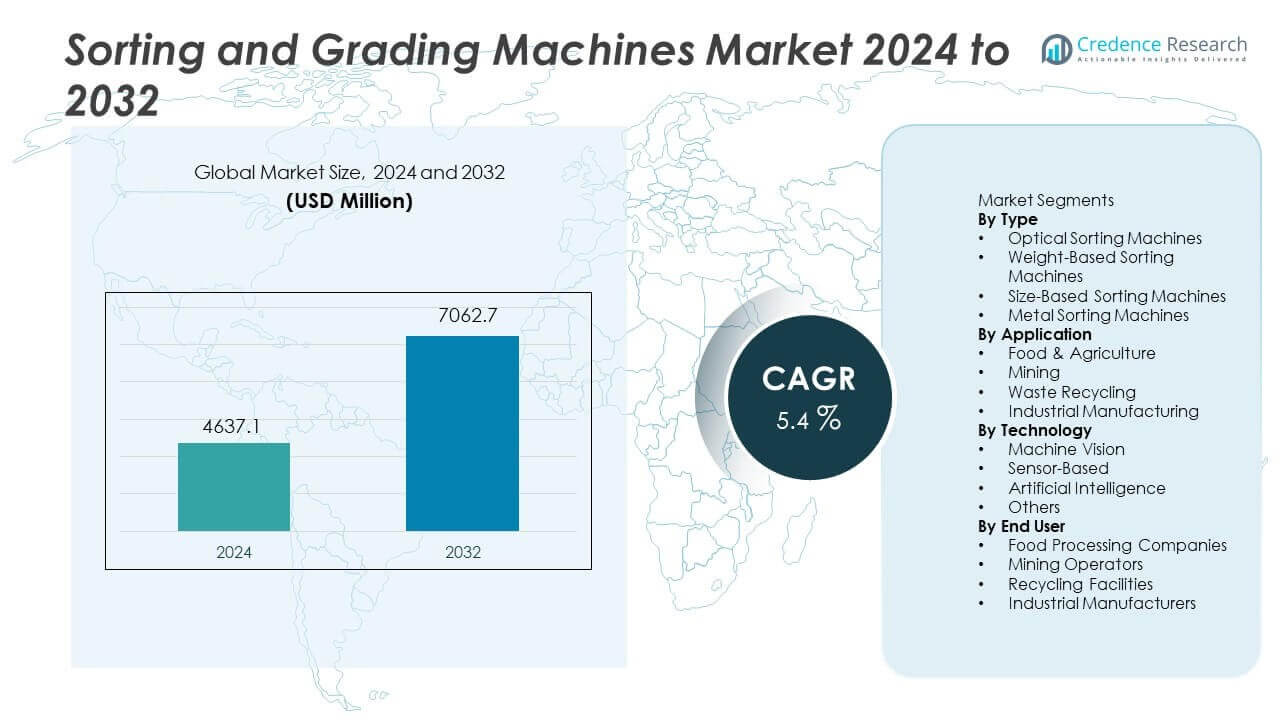
Sorting and Grading Machines Market Segmentation Analysis:
By Type
Optical sorting machines hold the leading position with 43% share driven by fast detection capability, accurate separation, and broad adoption in food processing and waste recycling lines. Weight-based sorting machines account for 27% share supported by packaging, grain processing, and bulk food handling. Size-based systems hold 19% share, especially in fruit, vegetable, and seafood processing where grading by dimension is required. Metal sorting machines capture 11% share with strong demand in scrap handling and recycling operations. Rising automation across production plants supports optical system dominance due to high throughput and precision.
- For instance, TOMRA installed numerous optical sorting units worldwide, with each unit processing substantial amounts of product per hour using various high-resolution sensors configured for specific applications.
By Application
Food and agriculture dominate this segment with 46% share due to rising processed food consumption, strict quality standards, and increasing adoption of automated sorting lines in fruit, vegetable, and grain processing. Mining accounts for 22% share, supported by ore grading and mineral separation. Waste recycling holds 20% share driven by circular economy policies and advanced contamination detection. Industrial manufacturing represents 12% share, adopting sorting systems to ensure material consistency. Higher food safety requirements and labor replacement trends fuel demand in the leading food segment.
- For instance, Aweta deployed grading lines capable of sorting many fruits per hour using advanced camera systems and internal quality sensors for surface and internal quality checks.
By Technology
Machine vision leads this segment with 48% share due to strong adoption for surface defect detection, color sorting, and precision grading in food and recycling plants. Sensor-based systems account for 26% share supported by metal detection, density sensing, and moisture identification. Artificial intelligence captures 18% share with growing integration in autonomous recognition, robotic pick-and-place, and advanced defect mapping. Other technologies represent 8% share, including manual and semi-automated setups. Growing use of vision-guided and AI-enabled sorting improves yield, reduces waste, and enhances processing efficiency across end-use sectors.
Key Growth Drivers
Rising Automation in Food Processing and Packaging
Food processors invest in automated sorting and grading solutions to improve product consistency, reduce manual errors, and meet strict quality requirements. Optical and vision-based machines detect defects, contaminants, and color variations at high speed, enabling faster processing. Demand continues rising across fruit, vegetable, grain, and meat processing due to safety standards and growing processed food consumption. Automation also helps reduce labor shortage issues and operational costs, pushing higher adoption across emerging and developed markets.
- For instance, Bühler’s SORTEX H optical grader handles an exceptionally large amount of wheat per hour while detecting extremely subtle defects.
Growing Waste Recycling and Circular Economy Initiatives
Increasing recycling targets and growing focus on sustainable waste management drive strong demand for sorting systems in municipal and industrial applications. Advanced optical and sensor-based machines improve separation accuracy for plastics, paper, metal, and e-waste streams. Governments invest in recycling infrastructure and impose regulations that promote material recovery. These developments increase adoption of high-speed sorting lines with contamination control and improved operational efficiency.
- For instance, Sesotec’s VARISORT+ system sorts large quantities of mixed plastic waste per hour with metal detection capabilities for precise material recovery.
Expanding Use in Mining and Industrial Materials
The mining industry deploys advanced sorting machines for ore grading, mineral classification, and impurity detection, improving yield and processing efficiency. Industrial manufacturers adopt automated sorting to enhance product quality and meet material standards in production chains. Growing focus on precision and material consistency supports adoption across packaging, construction, and chemicals.
Key Trends and Opportunities
AI-Powered Sorting and Self-Learning Systems
Manufacturers integrate AI and machine learning to recognize complex defects, automate classification decisions, and improve sorting accuracy over time. These technologies enable predictive detection, real-time adjustments, and reduced material rejection. AI-driven platforms support higher throughput, improved product traceability, and data-driven optimization.
- For instance, Key Technology's VERYX AI engine rapidly evaluates data from multiple sensors to refine decision accuracy during vegetable inspection, operating with enhanced speed and efficiency.
Expansion of Smart Vision Sensors and Robotic Integration
Sorting lines increasingly adopt vision-guided robotics to handle varied product shapes, hazardous materials, and high-speed lines. Smart camera systems enable multi-parameter inspection and faster decision-making in food, mining, and recycling industries. Robotics reduce labor dependency and enhance hygienic processing in food applications.
- For instance, ABB’s FlexPicker vision-guided robot executes 120 picks per minute with integrated 2D and 3D cameras for snack and bakery sorting.
Key Challenges
High Installation and Maintenance Cost
Advanced sorting and grading machines require high initial investment, specialized installation, and skilled operation. Small and medium enterprises face financial challenges adopting high-performance systems. Maintenance costs and technology upgrades also increase operational expense.
Lack of Skilled Workforce and Technical Expertise
Operating machine vision, AI sorting, and complex automated systems requires trained personnel. Many emerging markets face shortages in technical expertise, leading to slower adoption and lower technology utilization. Training needs and capability gaps affect system efficiency and uptime.
Regional Analysis
North America
North America holds near 34% share driven by strong automation in food processing, grain sorting, and packaged food manufacturing. The United States leads adoption due to high labor costs and strict product quality rules in agriculture and meat processing. Optical and machine vision systems gain demand in recycling lines as the region implements advanced circular economy practices. Automation in industrial manufacturing further expands technology deployment across packaging and material handling. Canada and Mexico record stable adoption in fruit and vegetable processing, which supports continued investment.
Europe
Europe accounts for near 28% share supported by advanced food safety requirements, growing waste recycling targets, and smart manufacturing adoption across major economies. Countries such as Germany, France, and the Netherlands use high-end vision sorting for agriculture, dairy, and packaged food industries. Strict sustainability laws encourage automated recycling and material recovery systems. Optical sorting gains high penetration in waste processing plants, while agricultural producers implement grading systems for export-quality food and beverage products. Strong environmental and quality regulations sustain market growth across the region.
Asia Pacific
Asia Pacific holds near 23% share and records the fastest growth due to rising food production, expanding processed food consumption, and strong adoption of automation in China, India, and Southeast Asia. Government focus on food quality standards boosts optical sorting across grain, rice, and fruit processing industries. Rapid development in mining, packaging, and recycling sectors further increases demand for advanced systems. Growing industrialization and rising labor costs encourage automation upgrades. Japan and South Korea lead high-tech adoption, while emerging economies expand basic sorting capacity.
Latin America
Latin America represents near 9% share supported by rising fruit and vegetable exports, grain processing, and increasing interest in automated sorting solutions in Brazil, Mexico, and Chile. Agricultural modernization drives the use of grading systems for food export compliance. Adoption remains moderate due to investment limitations, but growing food export markets support future demand. Mining applications also create opportunities due to large mineral resources across the region.
Middle East and Africa
Middle East and Africa together account for near 6% share, driven by growing food processing and packaging industries in Gulf countries. Adoption in agriculture and recycling expands gradually with rising automation initiatives. Mining activities in Africa promote use of advanced sorting and material classification systems, though adoption remains selective due to high investment cost. Regional growth depends on industrial development, food manufacturing expansion, and waste management projects.
Sorting and Grading Machines Market Segmentations:
By Type
- Optical Sorting Machines
- Weight-Based Sorting Machines
- Size-Based Sorting Machines
- Metal Sorting Machines
By Application
- Food & Agriculture
- Mining
- Waste Recycling
- Industrial Manufacturing
By Technology
- Machine Vision
- Sensor-Based
- Artificial Intelligence
- Others
By End User
- Food Processing Companies
- Mining Operators
- Recycling Facilities
- Industrial Manufacturers
By Geography
- North America
- U.S.
- Canada
- Mexico
- Europe
- Germany
- France
- U.K.
- Italy
- Spain
- Rest of Europe
- Asia Pacific
- China
- Japan
- India
- South Korea
- South-east Asia
- Rest of Asia Pacific
- Latin America
- Brazil
- Argentina
- Rest of Latin America
- Middle East & Africa
- GCC Countries
- South Africa
- Rest of the Middle East and Africa
Competitive Landscape
Competitive landscape or analysis covers major players including TOMRA Systems ASA, Bühler Group, Key Technology Inc., Satake Corporation, Allgaier Werke GmbH, BoMill AB, Aweta G&P, Daewon GSI Co., Ltd., Sesotec GmbH, and Meyer Manufacturing Co., Ltd. Competition centers on developing high-precision optical and vision-based sorting systems that improve speed, reduce waste, and ensure consistent quality across food and industrial applications. Leading manufacturers invest in machine vision, AI-enabled detection, and modular designs that enhance flexibility across product categories. Partnerships with food processors and recycling plants help companies expand their installation base, while advanced technical service networks support long-term maintenance. Players also focus on automation upgrades and remote monitoring features that improve operational uptime. Rising adoption of smart sensors and robotic integration further intensifies competition among global and regional providers.
Key Player Analysis
- TOMRA Systems ASA
- Bühler Group
- Key Technology Inc.
- Satake Corporation
- Allgaier Werke GmbH
- BoMill AB
- Aweta G&P
- Daewon GSI Co., Ltd.
- Sesotec GmbH
- Meyer Manufacturing Co., Ltd
Recent Developments
- In August 2025, Bühler Group introduced the SORTEX R500 rice-specialist optical sorter with autonomous operation and advanced precision for rice processors.
- In May 2025, Bühler Group launched the SORTEX AI700 optical sorter with deep-learning impurity detection for food processing, improving quality and yield.
Report Coverage
The research report offers an in-depth analysis based on Type, Application, Technology, End User and Geography. It details leading market players, providing an overview of their business, product offerings, investments, revenue streams, and key applications. Additionally, the report includes insights into the competitive environment, SWOT analysis, current market trends, as well as the primary drivers and constraints. Furthermore, it discusses various factors that have driven market expansion in recent years. The report also explores market dynamics, regulatory scenarios, and technological advancements that are shaping the industry. It assesses the impact of external factors and global economic changes on market growth. Lastly, it provides strategic recommendations for new entrants and established companies to navigate the complexities of the market.
Future Outlook
- Demand will rise with rapid automation in food and agriculture.
- Optical and machine vision systems will lead adoption across processing lines.
- AI-based sorting will expand in defect detection and autonomous decision making.
- Robotic integration will improve speed and lower labor dependency.
- Recycling plants will adopt high-precision systems to meet circular economy targets.
- Mining operations will deploy advanced sensors for ore quality improvement.
- Industrial manufacturing will increase automation for consistent material grading.
- North America and Europe will continue adopting smart automation upgrades.
- Asia Pacific will expand fastest with food processing and industrial development.
- Players will invest in software and data analytics to enhance sorting performance.

Request a Free Sample
Fill in your details and we'll send you a free sample report.
- Sample data tables & charts
- Research methodology
Need a Custom Version of This Report?
Tailor the scope, geography, or segments to your exact requirements.
- Custom geography or segment scope
- Direct access to our analyst team
Frequently Asked Questions
What is the current market size for Sorting and Grading Machines market, and what is its projected size in 2032?
At what Compound Annual Growth Rate is the Sorting and Grading Machines market projected to grow between 2024 and 2032?
Which Sorting and Grading Machines market segment held the largest share in 2024?
What are the primary factors fueling the growth of the Sorting and Grading Machines market?
Who are the leading companies in the Sorting and Grading Machines market?
Which region commanded the largest share of the Sorting and Grading Machines market in 2024?
Table of Content
Chapter 1 Market Segmentation
- 1.1 Segmentation Framework
- 1.1.1 Product and Service Classification
- 1.1.2 Application and End-Use Classification
- 1.1.3 Technology and Solution Classification
- 1.1.4 Customer and Distribution Channel Classification
- 1.1.5 Geographic Segmentation
- 1.1.6 Market Segment Definitions and Boundaries
Chapter 2 Introduction
- 2.1 Report Objectives and Scope
- 2.2 Product Definition and Industry Terminology
- 2.3 Market Inclusions and Exclusions
- 2.4 Research Process
- 2.4.1 Primary Research and Expert Interviews
- 2.4.2 Secondary Research and Source Review
- 2.4.3 Top-Down and Bottom-Up Estimation
- 2.4.4 Data Triangulation and Verification
- 2.5 Market Size Measurement Basis
- 2.5.1 2024: USD 4,637.1 million → 2032: USD 7,062.7 million
- 2.6 Historical and Forecast Reference Periods
- 2.6.1 Base Year: 2024
- 2.6.2 Forecast Period: 2024-2032
- 2.7 Research Assumptions and Limitations
Chapter 3 Executive Summary
- 3.1 Market Snapshot and Key Findings
- 3.2 Base-Year Market Size, 2024
- 3.3 Forecast Market Size, 2032
- 3.4 Revenue and Volume Growth Outlook
- 3.5 Key Demand and Supply Indicators
- 3.6 Leading Market Segments
- 3.7 Fastest-Growing Market Opportunities
- 3.8 Regional Performance Highlights
- 3.9 Technology and Industry Transformation
- 3.10 Competitive Landscape Summary
- 3.11 Analyst View and Strategic Implications
Chapter 4 Global Sorting and Grading Machines Market Trends and Developments
- 4.1 Historical Industry Development
- 4.2 Recent Market Trends and Developments
- 4.3 Demand and Customer Behavior Trends
- 4.4 Technology and Product Innovation
- 4.5 Artificial Intelligence, Automation and Digitalization
- 4.6 Local Manufacturing and Supply Chain Realignment
- 4.7 Industry Partnerships, Mergers and Acquisitions
- 4.8 Sustainability and Circular Economy Developments
- 4.9 Government and Private Sector Investment Trends
- 4.10 Emerging Business Models and Commercialization
- 4.11 Industry Developments and Announcements
Chapter 5 Global Sorting and Grading Machines Market Production, Supply and Demand Analysis
- 5.1 Demand Trend and Consumption Analysis
- 5.2 Demand Forecast, 2024-2032
- 5.3 Production and Output Trend
- 5.4 Production and Output Forecast, 2024-2032
- 5.5 Installed Capacity and Capacity Utilization
- 5.6 Company-Wise Production Plants and Statistics
- 5.6.1 Installed Production Capacity
- 5.6.2 Actual Production
- 5.6.3 Planned Capacity and Expansion Targets
- 5.7 Supply Chain Structure and Procurement Trends
- 5.8 Supply-Demand Gap and Bottlenecks
- 5.9 Import Dependence and Sourcing Structure
- 5.10 Contract Manufacturing and Outsourcing
- 5.11 Regional Supply and Demand Concentration
Chapter 6 Global Sorting and Grading Machines Market Pricing Analysis
- 6.1 Pricing Structure and Measurement
- 6.2 Historical Pricing Trends
- 6.3 Pricing Outlook, 2024-2032
- 6.4 Average Selling Price and Unit Economics
- 6.5 Pricing by Product and Market Segment
- 6.6 Geographic Pricing Differences
- 6.7 Key Input, Energy, Labor and Logistics Costs
- 6.8 Contract Pricing and Purchasing Models
- 6.9 Pricing Sensitivity and Competitive Positioning
- 6.10 Price, Margin and Profitability Implications
Chapter 7 Global Sorting and Grading Machines Market Dynamics
- 7.1 Market Growth Drivers
- 7.1.1 Demand-Side Drivers
- 7.1.2 Technology and Innovation Drivers
- 7.1.3 Infrastructure and Investment Drivers
- 7.1.4 Regulatory and Policy Drivers
- 7.2 Market Restraints
- 7.2.1 Cost and Affordability Constraints
- 7.2.2 Technology and Adoption Barriers
- 7.2.3 Supply Chain and Operational Constraints
- 7.3 Market Challenges
- 7.3.1 Competitive Pressure and Margin Erosion
- 7.3.2 Skills, Infrastructure and Implementation Gaps
- 7.4 Emerging Market Opportunities
- 7.5 Market Dynamics Impact and Time-Horizon Assessment
Chapter 8 Global Sorting and Grading Machines Value Chain Analysis
- 8.1 Industry Value Chain Overview
- 8.2 Upstream Suppliers and Critical Inputs
- 8.3 Technology and Component Providers
- 8.4 Manufacturing or Service Delivery
- 8.5 Distribution, Channel Partners and Integrators
- 8.6 Downstream Applications and End Users
- 8.7 Value Addition and Profit Pools
- 8.8 Vertical Integration and Outsourcing
- 8.9 Supplier Concentration and Risk
- 8.10 Supply Chain Localization and Resilience
Chapter 9 Global Sorting and Grading Machines Market Regulations and Policies
- 9.1 Relevant Laws, Standards and Compliance Frameworks
- 9.2 Product, Service, Safety and Quality Requirements
- 9.3 Government Policies, Incentives and Subsidies
- 9.4 Imports, Exports and Trade Barriers
- 9.5 Public Procurement and Local Content Requirements
- 9.6 Environmental and Sustainability Compliance
- 9.7 Upcoming Policy Changes and Market Implications
Chapter 10 Global Sorting and Grading Machines Market Hotspots and Opportunities
- 10.1 Market Opportunity Mapping and Growth Hotspots
- 10.2 High-Growth Applications and Customer Groups
- 10.3 Underserved Markets and White-Space Opportunities
- 10.4 Emerging Technology and Product Opportunities
- 10.5 New Capacity and Investment Hotspots
- 10.6 Market Entry and Expansion Opportunities
- 10.7 Distribution and Partnership Opportunities
- 10.8 Near-Term and Long-Term Commercial Potential
- 10.9 Opportunity Attractiveness and Execution Risks
Chapter 11 Global Sorting and Grading Machines Market Outlook, 2024-2032
- 11.1 Market Size and Analysis
- 11.1.1 Revenue (Market Measurement: 2024: USD 4,637.1 million → 2032: USD 7,062.7 million)
- 11.1.2 Market Volume and Quantity Sold
- 11.1.3 Historical Market Size
- 11.1.4 Base-Year Market Size, 2024
- 11.2 Market Forecast, 2024-2032
- 11.2.1 Revenue Forecast to 2032
- 11.2.2 Volume Forecast to 2032
- 11.2.3 CAGR and Year-on-Year Growth
- 11.2.4 Incremental Revenue Opportunity
- 11.3 Forecast Assumptions and Scenario Analysis
- 11.3.1 Base-Case Forecast
- 11.3.2 Optimistic and Conservative Scenarios
- 11.3.3 Technology, Pricing and Policy Sensitivities
- 11.4 Market Attractiveness and Growth Outlook
Chapter 12 Global Sorting and Grading Machines Market Segmentation and Outlook
- 12.1 Segmentation Summary and Market Shares, 2024
- 12.2 Largest and Fastest-Growing Segments
- 12.3 Segment Growth Comparison
- 12.4 Segment Attractiveness and Priority Matrix
Chapter 13 Global Sorting and Grading Machines Geographic Market Outlook, 2024-2032
- 13.1 Regional Market Size and Share, 2024
- 13.2 Regional Market Forecast, 2024-2032
- 13.3 Regional Pricing, Production and Demand Differences
- 13.4 North America
- 13.4.1 United States
- 13.4.2 Canada
- 13.4.3 Mexico
- 13.5 Europe
- 13.5.1 Germany
- 13.5.2 France
- 13.5.3 Italy
- 13.5.4 United Kingdom
- 13.5.5 Spain
- 13.5.6 Poland
- 13.5.7 Russia
- 13.5.8 Netherlands
- 13.5.9 Belgium
- 13.5.10 Sweden
- 13.5.11 Denmark
- 13.5.12 Norway
- 13.5.13 Rest of Europe
- 13.6 Asia Pacific
- 13.6.1 China
- 13.6.2 India
- 13.6.3 Japan
- 13.6.4 South Korea
- 13.6.5 Thailand
- 13.6.6 Indonesia
- 13.6.7 Vietnam
- 13.6.8 Malaysia
- 13.6.9 Australia
- 13.6.10 Rest of Asia Pacific
- 13.7 Latin America
- 13.7.1 Brazil
- 13.7.2 Argentina
- 13.7.3 Colombia
- 13.7.4 Chile
- 13.7.5 Rest of Latin America
- 13.8 Middle East
- 13.8.1 Saudi Arabia
- 13.8.2 United Arab Emirates
- 13.8.3 Turkey
- 13.8.4 Israel
- 13.8.5 Iran
- 13.8.6 Rest of the Middle East
- 13.9 Africa
- 13.9.1 South Africa
- 13.9.2 Egypt
- 13.9.3 Nigeria
- 13.9.4 Morocco
- 13.9.5 Rest of Africa
- 13.10 Regional Investment, Policy and Supply Chain Differences
- 13.11 Regional Competitive Landscape
- 13.12 Geographic Growth Hotspots
Chapter 14 Global Sorting and Grading Machines Technology, Innovation and Sustainability Outlook
- 14.1 Technology Landscape and Maturity
- 14.2 Product, Process and Service Innovation
- 14.3 AI, Automation and Digital Tools in the Industry
- 14.4 Technology Adoption and Performance Benchmarking
- 14.5 Innovation Pipeline and R&D Investment
- 14.6 Patent and Intellectual Property Trends
- 14.7 Energy Efficiency and Resource Management
- 14.8 Sustainability, Recycling and Circularity
- 14.9 Technology Roadmap, 2024-2032
- 14.10 Risks of Obsolescence and Technology Substitution
Chapter 15 Global Sorting and Grading Machines Market Key Strategic Imperatives
- 15.1 Growth and Market Entry Priorities
- 15.2 High-Return Products and Segments
- 15.3 Pricing, Profitability and Cost Optimization
- 15.4 Technology Investment and Product Differentiation
- 15.5 Supply Chain Localization and Resilience
- 15.6 Distribution and Customer Acquisition
- 15.7 Partnership, Acquisition and Capacity Strategy
- 15.8 Regional Expansion Priorities
- 15.9 Short-, Medium- and Long-Term Actions
Chapter 16 Competition Outlook
- 16.1 Industry Competition Characteristics
- 16.2 Market Structure and Concentration
- 16.3 Market Share and Competitive Positioning, 2024
- 16.4 Company-Wise Revenue and Product Benchmarking
- 16.5 Production and Service Capacity Benchmarking
- 16.6 Technology, Pricing and Differentiation
- 16.7 Regional Footprint and Distribution Strength
- 16.8 Mergers, Acquisitions and Strategic Alliances
- 16.9 New Entrants and Competitive Threats
- 16.10 Porter's Five Forces and Industry Attractiveness
- 16.11 Competitive Outlook, 2024-2032
Chapter 17 Company Profiles
- 17.1 Company Coverage and Selection Criteria
- 17.2 Leading Market Participants – Standard Profile Structure
- 17.2.1 Business Description
- 17.2.2 Company Ownership and Geographic Presence
- 17.2.3 Product and Service Portfolio
- 17.2.4 Manufacturing and Operating Footprint
- 17.2.5 Production Capacity and Expansion Plans
- 17.2.6 Financial Performance and Investment
- 17.2.7 Market Share and Competitive Position
- 17.2.8 Technology and Innovation Capabilities
- 17.2.9 Strategic Alliances or Partnerships
- 17.2.10 Recent Developments
- 17.2.11 Growth Strategy and Outlook
- 17.3 Other Relevant Market Participants
Note: Every listed company is profiled on the structure shown under the first company. The company list is preliminary and may change based on research findings, market developments, data availability and client requirements.
Chapter 18 Disclaimer
- 18.1 Research and Forecast Disclaimer
- 18.2 Data Source and Estimation Limitations
Note: The depth of individual sections depends on data availability for this market. Volume, capacity, trade and other unit-based metrics are included where applicable.