
CVD And CVI Vacuum Furnaces Market Overview:
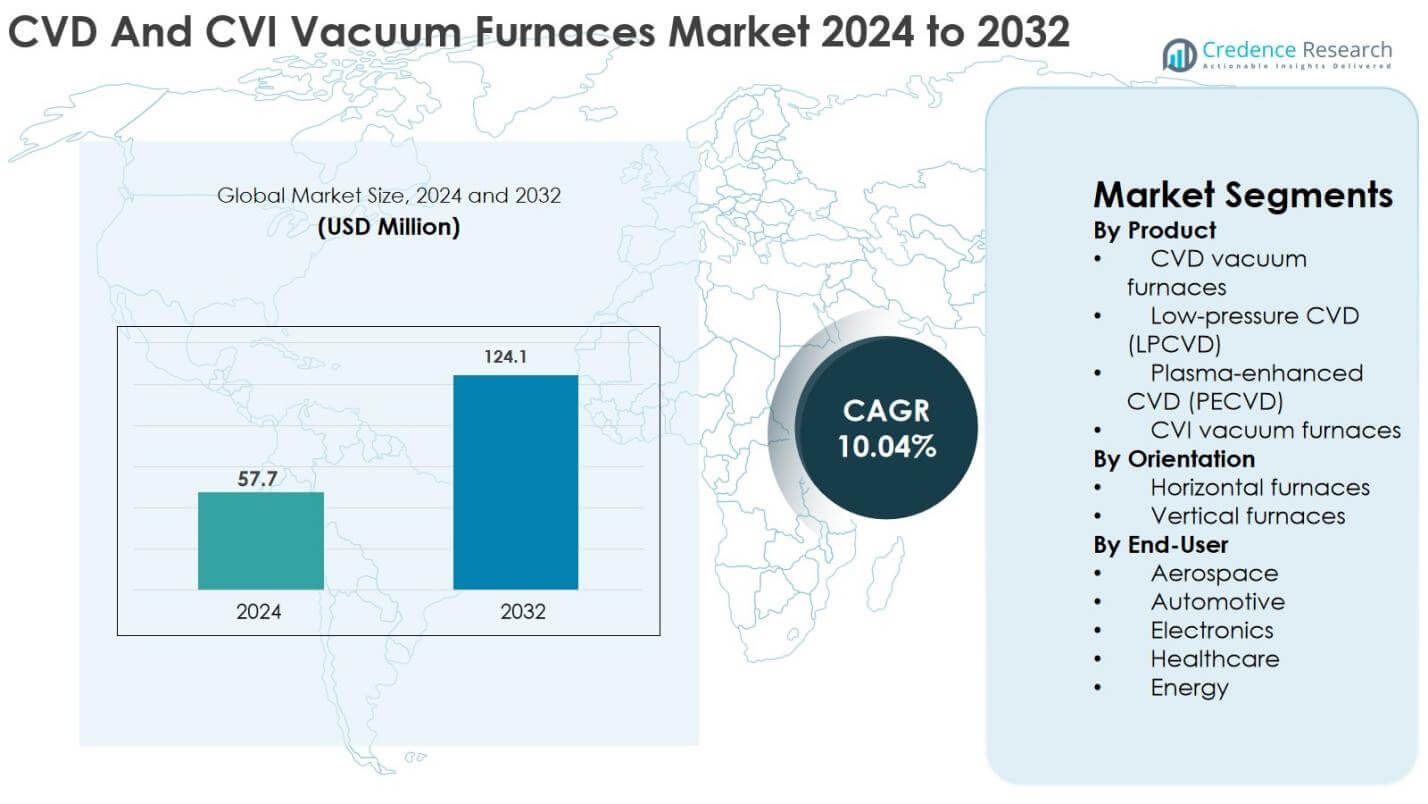
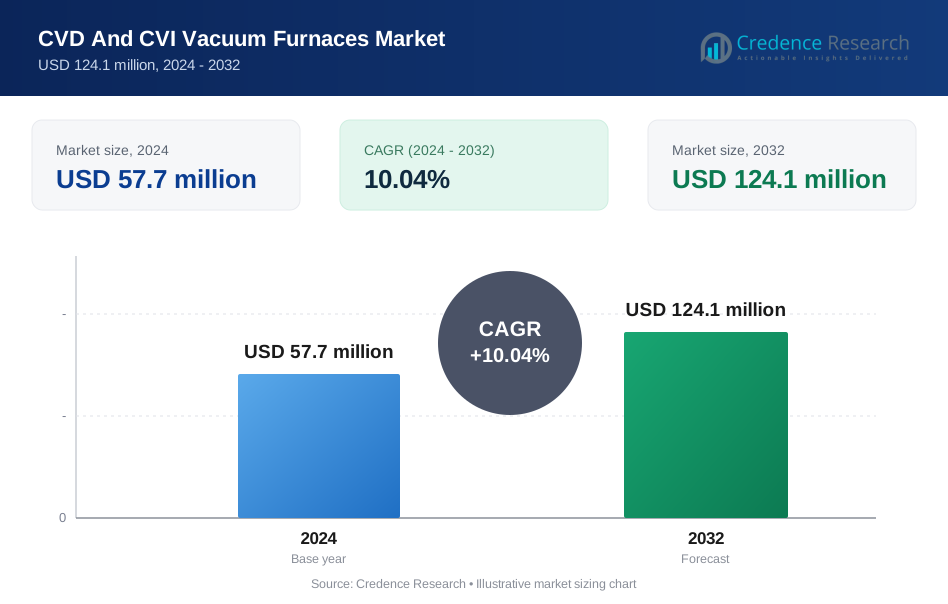
The CVD and CVI Vacuum Furnaces market size was valued at USD 57.7 million in 2024 and is anticipated to reach USD 124.1 million by 2032, growing at a CAGR of 10.04% during the forecast period.
| REPORT ATTRIBUTE | DETAILS |
|---|---|
| Historical Period | 2020-2023 |
| Base Year | 2024 |
| Forecast Period | 2025-2032 |
| CVD And CVI Vacuum Furnaces Market Size 2024 | USD 57.7 million |
| CVD And CVI Vacuum Furnaces Market, CAGR | 10.04% |
| CVD And CVI Vacuum Furnaces Market Size 2032 | USD 124.1 million |
CVD And CVI Vacuum Furnaces Market Insights
- Market growth is driven by rising demand for advanced composites and high-purity coatings from aerospace, electronics, and energy industries, with increasing adoption of CVD and CVI processes for high-temperature and precision manufacturing.
- Key trends include automation-enabled vacuum furnaces, improved process control, and growing use of LPCVD and PECVD technologies, while CVD vacuum furnaces dominate the product segment with around 62.4% share in 2024.
- The market features specialized players competing on customization, high-temperature capability, and application-specific solutions, with continuous R&D investment and aftermarket services strengthening long-term positioning.
- Regionally, North America leads with 34.2% share, followed by Asia-Pacific at 30.8% driven by semiconductor expansion, and Europe holding 26.5% share supported by aerospace and automotive materials demand.
CVD And CVI Vacuum Furnaces Market Segmentation Analysis:
By Product
The By Product segment of the CVD and CVI Vacuum Furnaces market is led by CVD vacuum furnaces, which accounted for around 62.4% market share in 2024, driven by their extensive use in semiconductor fabrication, advanced coatings, and composite material processing. Within this category, Low-Pressure CVD (LPCVD) dominates due to its superior film uniformity, scalability, and suitability for high-volume manufacturing. Strong demand from electronics and aerospace industries, along with increasing adoption of high-purity and high-temperature materials, continues to support growth. CVI vacuum furnaces are expanding steadily, supported by rising carbon-carbon and ceramic matrix composite applications.
- For instance, ASM International’s A400 and A412 LPCVD batch furnaces are widely used for polysilicon and nitride deposition in 200 mm and 300 mm wafer fabs.
By Orientation
The By Orientation segment is dominated by horizontal furnaces, holding approximately 58.1% share in 2024, owing to their flexibility, ease of loading, and compatibility with large or multiple substrates. Horizontal configurations are widely preferred in LPCVD and CVI processes for aerospace and electronics applications, where consistent thermal profiles and batch processing efficiency are critical. Their dominance is reinforced by lower operational complexity and cost advantages compared to vertical systems. Vertical furnaces are gaining traction in space-constrained facilities and advanced semiconductor processes, supported by higher throughput and reduced contamination risks.
- For instance, Schunk Carbon Technology employs horizontal CVI furnaces to densify carbon‑carbon and CMC brake components for aviation and high‑performance industrial applications.
By End-User
The By End-User segment is led by the electronics industry, which captured around 34.7% market share in 2024, driven by rapid growth in semiconductors, power electronics, MEMS, and advanced packaging technologies. Increasing investments in chip manufacturing, compound semiconductors, and thin-film deposition processes significantly fuel demand. The aerospace sector follows closely, supported by rising use of CVI furnaces for carbon-carbon and ceramic matrix composites in aircraft and defense systems. Automotive, healthcare, and energy sectors contribute steadily, supported by lightweight materials, medical devices, and energy-efficient components.
Key Growth Drivers
Rising Demand for Advanced Composite Materials
The CVD and CVI Vacuum Furnaces market is strongly driven by increasing demand for advanced composite materials, particularly carbon–carbon and ceramic matrix composites used in aerospace, defense, and high-temperature industrial applications. These materials require precise infiltration and deposition processes that only CVI and advanced CVD vacuum furnaces can deliver. Growing aircraft production, rising defense modernization programs, and increasing adoption of lightweight, high-strength components accelerate furnace installations. Additionally, expanding use of composites in automotive performance parts and energy applications further supports demand. The ability of CVI furnaces to produce components with superior thermal stability, corrosion resistance, and mechanical integrity positions them as critical equipment in next-generation material manufacturing.
- For instance, GE Aerospace manufactures CMC turbine shrouds and nozzles for its LEAP and GE9X engines using CVD/CVI processes to achieve high temperature capability and weight reduction.
Expansion of Semiconductor and Electronics Manufacturing
Rapid growth in semiconductor fabrication and advanced electronics manufacturing significantly drives the CVD and CVI Vacuum Furnaces market. CVD furnaces are essential for thin-film deposition, wafer processing, and compound semiconductor manufacturing, supporting applications in power electronics, MEMS, sensors, and optoelectronics. Rising investments in chip fabrication facilities, increasing demand for electric vehicles, 5G infrastructure, and renewable energy electronics accelerate adoption. The shift toward wide-bandgap semiconductors such as silicon carbide and gallium nitride further boosts furnace demand, as these materials require high-temperature, controlled-atmosphere deposition processes achievable through advanced CVD systems.
- For instance, Applied Materials’ Producer and Centura CVD platforms are widely used for dielectric, barrier, and epitaxial layer deposition in high‑volume 200 mm and 300 mm wafer fabs
Increasing Focus on High-Performance and High-Purity Manufacturing
Industries are increasingly prioritizing high-performance, high-purity manufacturing processes, driving adoption of CVD and CVI vacuum furnaces. Healthcare devices, aerospace components, and energy systems require defect-free coatings and precisely engineered material structures to meet strict regulatory and performance standards. Vacuum furnace technologies enable superior process control, uniformity, and contamination-free environments, supporting stringent quality requirements. This driver is reinforced by growing regulatory scrutiny, higher product reliability expectations, and the need for longer component lifecycles, making advanced CVD and CVI furnaces indispensable in critical manufacturing environments.
Key Trends & Opportunities
Technological Advancements and Process Automation
Ongoing technological advancements in furnace design, digital controls, and automation present significant opportunities in the CVD and CVI Vacuum Furnaces market. Manufacturers are integrating advanced sensors, real-time monitoring, and software-driven process optimization to enhance deposition uniformity, reduce cycle times, and improve energy efficiency. Automation minimizes human intervention, improves repeatability, and lowers operational risks, making systems more attractive to high-volume and precision manufacturers. These innovations expand adoption across semiconductor fabs, aerospace material producers, and research facilities, while also supporting scalable production and reduced operating costs.
- For instance, Ipsen’s Turbo²Treater vacuum furnace platform incorporates PLC-based controls, data logging, and recipe management to optimize heat-treatment and reduce manual adjustments.
Growing Adoption in Energy and Sustainability Applications
The increasing focus on clean energy and sustainability creates new growth opportunities for CVD and CVI vacuum furnaces. These systems play a vital role in producing components for fuel cells, nuclear energy, advanced batteries, and renewable energy systems. CVI furnaces enable fabrication of heat-resistant composites for energy infrastructure, while CVD processes support coatings that enhance efficiency and durability. As governments and industries invest in energy transition initiatives, demand for high-performance materials manufactured through vacuum furnace technologies continues to expand, opening new application areas beyond traditional aerospace and electronics markets.
- For instance, Bloom Energy uses high‑temperature processing and CVD‑based coatings in manufacturing its solid oxide fuel cell (SOFC) stacks to improve durability and electrochemical performance.
Key Challenges
High Capital Investment and Operating Costs
High initial capital investment remains a major challenge in the CVD and CVI Vacuum Furnaces market. Advanced furnace systems require significant upfront costs for equipment, installation, and facility integration, limiting adoption among small and mid-sized manufacturers. Operating expenses related to energy consumption, maintenance, and specialized consumables further increase total ownership costs. These financial barriers can delay procurement decisions, particularly in cost-sensitive industries, and may restrict market expansion in emerging economies despite growing demand for advanced materials.
Complex Process Control and Skilled Workforce Requirements
The complexity of CVD and CVI processes poses another critical challenge for market growth. Achieving consistent deposition quality requires precise control over temperature, pressure, gas flow, and reaction chemistry, demanding highly skilled operators and engineers. Shortages of trained personnel increase operational risks and limit scalability for some end users. Additionally, process development and optimization can be time-intensive, slowing time-to-market for new applications. These factors increase reliance on experienced suppliers and comprehensive after-sales support, adding to overall system costs and adoption complexity.
Regional Analysis
North America
North America accounted for 34.2% market share in 2024 in the CVD and CVI Vacuum Furnaces market, driven by strong demand from the aerospace, defense, and semiconductor industries. The region benefits from advanced manufacturing infrastructure, high R&D spending, and early adoption of next-generation materials such as ceramic matrix and carbon–carbon composites. The presence of major aerospace OEMs, defense contractors, and semiconductor fabs supports sustained furnace demand. Growth is further reinforced by increasing investments in power electronics, space programs, and high-performance medical devices requiring precision deposition and infiltration technologies.
Europe
Europe held 26.5% market share in 2024, supported by a strong aerospace and automotive manufacturing base across Germany, France, and the UK. The region’s focus on lightweight materials, fuel efficiency, and advanced coatings drives steady adoption of CVD and CVI vacuum furnaces. Increasing investments in semiconductor manufacturing, renewable energy systems, and research institutions further contribute to growth. Strict quality standards and emphasis on high-purity, energy-efficient manufacturing processes favor advanced vacuum furnace technologies, particularly in aerospace components, industrial ceramics, and high-performance automotive applications.
Asia-Pacific
Asia-Pacific dominated the market with around 30.8% share in 2024, driven by rapid expansion of semiconductor manufacturing, electronics production, and advanced material processing in China, Japan, South Korea, and Taiwan. Strong government support for chip fabrication, electric vehicles, and renewable energy infrastructure significantly boosts demand for CVD vacuum furnaces. The region also shows rising adoption of CVI furnaces for aerospace components and industrial composites. Cost-competitive manufacturing, expanding industrial base, and increasing investments in high-temperature and high-purity processes position Asia-Pacific as the fastest-growing regional market.
Latin America
Latin America accounted for about 4.6% market share in 2024, reflecting gradual adoption of CVD and CVI vacuum furnaces across industrial and research applications. Growth is supported by expanding automotive manufacturing, energy infrastructure development, and increasing focus on advanced materials in countries such as Brazil and Mexico. While high capital costs limit widespread adoption, rising investments in aerospace components, electronics assembly, and industrial coatings are creating niche demand. The region presents long-term growth potential as manufacturing capabilities and technological investments continue to improve.
Middle East & Africa
The Middle East & Africa region held 3.9% market share in 2024, driven by selective investments in aerospace, defense, energy, and advanced industrial manufacturing. Countries in the Middle East are increasingly focusing on high-performance materials for energy, space, and defense applications, supporting demand for CVI and CVD vacuum furnaces. In Africa, adoption remains limited but is gradually increasing through research institutions and specialized industrial projects. Government-led industrial diversification initiatives and rising focus on advanced manufacturing technologies support steady, long-term market development.
CVD And CVI Vacuum Furnaces Market Segmentations:
By Product
- CVD vacuum furnaces
- Low-pressure CVD (LPCVD)
- Plasma-enhanced CVD (PECVD)
- CVI vacuum furnaces
By Orientation
- Horizontal furnaces
- Vertical furnaces
By End-User
- Aerospace
- Automotive
- Electronics
- Healthcare
- Energy
By Geography
- North America
- U.S.
- Canada
- Mexico
- Europe
- Germany
- France
- U.K.
- Italy
- Spain
- Rest of Europe
- Asia Pacific
- China
- Japan
- India
- South Korea
- South-east Asia
- Rest of Asia Pacific
- Latin America
- Brazil
- Argentina
- Rest of Latin America
- Middle East & Africa
- GCC Countries
- South Africa
- Rest of the Middle East and Africa
Competitive Landscape
The competitive landscape of the CVD and CVI Vacuum Furnaces market is characterized by the presence of specialized global and regional manufacturers competing on technological capability, process customization, and application-specific solutions. Key players such as PVA TePla AG, CVD Equipment Corporation, SECO/WARWICK, INC., Centorr Vacuum Industries, and HHV Thermal Technologies Pvt. Ltd. focus on advanced furnace design, high-temperature performance, and precision process control to serve aerospace, semiconductor, and advanced materials industries. Companies including AVS, Inc., HTS Vacuum Furnaces, Graphite Furnace Systems, LLC, Semicorex Advanced Material Technology Co., Ltd., and Advanced Corporation for Materials & Equipments strengthen competition through niche offerings, regional expansion, and aftermarket services. Continuous R&D investment, automation integration, and customized CVD/CVI solutions remain key strategies shaping market positioning.
Key Player Analysis
- CVD Equipment Corporation
- HHV Thermal Technologies Pvt. Ltd.
- SECO/WARWICK, INC.
- Graphite Furnace Systems, LLC
- Semicorex Advanced Material Technology Co., Ltd.
- Centorr Vacuum Industries
- AVS, Inc.
- HTS Vacuum Furnaces
- PVA TePla AG
- Advanced Corporation for Materials & Equipments
Recent Developments
- In November 2025, SECO/WARWICK India signed a contract to supply a Vector single-chamber vacuum furnace to Bhuj Polymers under the “Made in India” program, marking the company’s first SECO/WARWICK vacuum furnace delivered and built locally in Pune for advanced vacuum hardening processes
- In October 2025, CVD Equipment Corporation received an order for two PVT150™ Physical Vapor Transport systems from Stony Brook University for their new onsemi Silicon Carbide Crystal Growth Center to support semiconductor research and wide-bandgap material development.
Report Coverage
The research report offers an in-depth analysis based on Product, Orientation, End-User and Geography. It details leading market players, providing an overview of their business, product offerings, investments, revenue streams, and key applications. Additionally, the report includes insights into the competitive environment, SWOT analysis, current market trends, as well as the primary drivers and constraints. Furthermore, it discusses various factors that have driven market expansion in recent years. The report also explores market dynamics, regulatory scenarios, and technological advancements that are shaping the industry. It assesses the impact of external factors and global economic changes on market growth. Lastly, it provides strategic recommendations for new entrants and established companies to navigate the complexities of the market.
Future Outlook
- Demand for CVD and CVI vacuum furnaces will increase steadily due to rising adoption of advanced composites and high-performance materials across aerospace and defense applications.
- Semiconductor manufacturing expansion will continue to support sustained growth, particularly for CVD furnaces used in thin-film deposition and wide-bandgap semiconductor processing.
- Automation, digital process control, and real-time monitoring will become standard features to improve consistency, yield, and operational efficiency.
- Adoption of LPCVD and PECVD technologies will accelerate as industries seek higher precision, scalability, and lower defect rates.
- Energy and sustainability applications will create new opportunities, especially in fuel cells, advanced batteries, and renewable energy components.
- Demand for high-temperature and ultra-high-purity furnace systems will rise due to stricter quality and performance requirements.
- Customized and application-specific furnace designs will gain preference among aerospace, electronics, and research institutions.
- Emerging economies will witness gradual adoption as local manufacturing capabilities and technical expertise improve.
- Strategic partnerships between furnace manufacturers and end users will increase to support process development and innovation.
- Aftermarket services, upgrades, and long-term maintenance contracts will play a growing role in vendor differentiation and revenue stability.
Request a Free Sample
Fill in your details and we'll send you a free sample report.
- Sample data tables & charts
- Research methodology
Need a Custom Version of This Report?
Tailor the scope, geography, or segments to your exact requirements.
- Custom geography or segment scope
- Direct access to our analyst team
Frequently Asked Questions
What is the current market size for CVD And CVI Vacuum Furnaces market, and what is its projected size in 2032?
At what Compound Annual Growth Rate is the CVD And CVI Vacuum Furnaces market projected to grow between 2024 and 2032?
Which CVD And CVI Vacuum Furnaces market segment held the largest share in 2024?
What are the primary factors fueling the growth of the CVD And CVI Vacuum Furnaces market?
Who are the leading companies in the CVD And CVI Vacuum Furnaces market?
Which region commanded the largest share of the CVD And CVI Vacuum Furnaces market in 2024?
Table of Content
Chapter 1. Report Introduction
- 1.1 Report Description & Purpose
- 1.1.1 Report Title & Market Definition
- 1.1.2 Unique Selling Propositions (USP) & Key Differentiators
- 1.1.3 Value Proposition for Stakeholders
- 1.2 Research Objectives
- 1.2.1 Market Sizing Objectives (Volume & Revenue)
- 1.2.2 Segmentation Objectives
- 1.2.3 Competitive Intelligence Objectives
- 1.2.4 Forecast & Scenario Objectives
- 1.3 Report Scope
- 1.3.1 CVD And CVI Vacuum Furnaces Scope – Types & Subtypes Covered
- 1.3.2 Geographic Scope – Regions & Countries Covered
- 1.3.3 Historical Period, Base Year & Forecast Period (2024; forecast to 2032)
- 1.3.4 Inclusions & Exclusions
- 1.4 HS Code & Classification Framework
- 1.5 Currency, Units & Pricing Basis
- 1.6 Target Stakeholders
- 1.7 Limitations & Assumptions
Chapter 2. Executive Summary
- 2.1 Global CVD And CVI Vacuum Furnaces Market Snapshot
- 2.1.1 Market Size – Historical (2024) & Forecast (2024-2032) (2024: USD 57.7 million → 2032: USD 124.1 million)
- 2.1.2 Volume & Revenue – Global Totals
- 2.1.3 Key Market Highlights – Top Five Facts
- 2.2 CVD And CVI Vacuum Furnaces Market Segmentation Snapshot
- 2.2.1 Market Split by Region – 2024 vs. 2032
- 2.3 Competitive Snapshot
- 2.3.1 Top 10 Players by Revenue Share – 2024
- 2.3.2 Top 10 Players by Volume Share – 2024
- 2.3.3 Recent Strategic Developments (18-Month Summary)
- 2.4 Key Investment Highlights & Strategic Conclusions
Chapter 3. CVD And CVI Vacuum Furnaces Market Dynamics & Industry Analysis
- 3.1 Market Overview & Context
- 3.1.1 CVD And CVI Vacuum Furnaces Market Position in the Broader Automotive Value Chain
- 3.1.2 OEM vs. Replacement Market Dynamics
- 3.1.3 Market Maturity & Development Stage by Region
- 3.2 CVD And CVI Vacuum Furnaces Market Drivers
- 3.3 CVD And CVI Vacuum Furnaces Market Restraints & Challenges
- 3.4 CVD And CVI Vacuum Furnaces Market Opportunities
- 3.5 Porter's Five Forces Analysis
- 3.5.1 Threat of New Entrants
- 3.5.2 Bargaining Power of Suppliers
- 3.5.3 Bargaining Power of Buyers
- 3.5.4 Threat of Substitutes
- 3.5.5 Competitive Rivalry – Intensity Assessment
- 3.6 CVD And CVI Vacuum Furnaces Value Chain Analysis
- 3.6.1 Upstream – Raw Material/Input Suppliers
- 3.6.1.1 Raw Material/Input 1
- 3.6.1.2 Raw Material/Input 2
- 3.6.1.3 Raw Material/Input 3
- 3.6.2 Midstream – Production/Manufacturing/Service Delivery
- 3.6.2.1 Production/Process Overview
- 3.6.2.2 Key Facility Locations & Capacity by Manufacturer
- 3.6.3 Downstream – Distribution & End Consumer
- 3.6.3.1 Primary Channel – B2B/OEM
- 3.6.3.2 Secondary Channels – Dealer, Retail, Online, Direct
- 3.6.4 Value Chain Profitability Analysis
- 3.6.1 Upstream – Raw Material/Input Suppliers
- 3.7 PESTEL Analysis
- 3.7.1 Political Factors
- 3.7.2 Economic Factors
- 3.7.3 Social Factors
- 3.7.4 Technological Factors
- 3.7.5 Environmental Factors
- 3.7.6 Legal Factors
- 3.8 CVD And CVI Vacuum Furnaces Supply Chain Analysis
- 3.8.1 Raw Material/Input Supply Risk Assessment
- 3.8.2 Manufacturing Concentration Risk (Geographic Exposure)
- 3.8.3 Trade Disruption Impact Analysis
- 3.9 Regulatory & Policy Landscape
Note: The regulatory and policy landscape section covers regulations based on their applicability to the market, CVD And CVI Vacuum Furnaces category, geography, and scope of the study. Only regulatory frameworks with a material impact on operations, compliance, trade, sustainability, or market access are analyzed in detail.
Chapter 4. Key Investment Pockets & Opportunity Analysis
- 4.1 CVD And CVI Vacuum Furnaces Market Attractiveness Analysis
- 4.1.1 By Region – Investment Attractiveness Matrix (Volume × CAGR)
- 4.2 Absolute Revenue Growth Opportunity
- 4.2.1 By Region – Absolute USD Growth Through 2032
- 4.3 Incremental Volume Opportunity
- 4.3.1 By Region – Incremental Volume Through 2032
- 4.3.2 Segment – Incremental Volume
- 4.4 Emerging Submarket Opportunity Deep Dive (Subject to Applicability)
- 4.5 Emerging Market Opportunity Scorecards
- 4.5.1 United States
- 4.5.2 Europe
- 4.5.3 Asia
- 4.5.4 Middle East & Africa
Note: Emerging Market Opportunity Scorecards will be included based on relevance and strategic importance. Regions listed are indicative and may vary depending on data availability and market dynamics.
Chapter 5. CVD And CVI Vacuum Furnaces Import-Export Analysis & Trade Flows
- 5.1 Global Trade Overview
- 5.1.1 Global Export Value by Country (2024)
- 5.1.2 Global Export Volume by Country (2024)
- 5.1.3 Global Import Value by Country (2024)
- 5.1.4 Global Import Volume by Country (2024)
- 5.1.5 Net Trade Balance by Country (2024)
- 5.2 Export Analysis – Segment
- 5.2.1 Type 1 (HS Code)
- 5.2.2 Type 2 (HS Code)
- 5.2.3 Type 3 (HS Code)
- 5.2.4 Type 4 (HS Code)
- 5.2.5 Type 5 (HS Code)
- 5.3 Import Analysis – Segment
- 5.3.1 Type 1 (HS Code)
- 5.3.2 Type 2 (HS Code)
- 5.3.3 Type 3 (HS Code)
- 5.3.4 Type 4 (HS Code)
- 5.3.5 Type 5 (HS Code)
- 5.4 Average Unit Trade Prices
- 5.4.1 Average Export Price – Segment & Country
- 5.4.2 Average Import Price – Segment & Source Country
- 5.4.3 Price Trends (2024)
- 5.5 Key Trade Route Analysis
- 5.5.1 Trade Route 1
- 5.5.2 Trade Route 2
- 5.5.3 Trade Route 3
- 5.5.4 Trade Route 4
- 5.5.5 Trade Route 5
- 5.6 Trade Policy Impact Assessment
- 5.6.1 US Anti-Dumping & Section 301 Tariffs
- 5.6.2 EU Customs Union Impact
- 5.6.3 Major Free Trade Agreements
- 5.6.4 USMCA Rules of Origin
Note: Trade policy analysis will be included only where relevant to the CVD And CVI Vacuum Furnaces market.
Chapter 6. Competitive Landscape & Company Benchmarking
- 6.1 CVD And CVI Vacuum Furnaces Market Concentration & Structure
- 6.1.1 Herfindahl-Hirschman Index (HHI) – vs. 2024
- 6.1.2 Tier 1, Tier 2 & Tier 3 Market Structure
- 6.1.3 Global, Regional & Local Player Dynamics
- 6.2 CVD And CVI Vacuum Furnaces Market Share Analysis – 2024
- 6.2.1 Global Revenue Share by Company
- 6.2.2 Global Volume Share by Company
- 6.2.3 Regional Revenue Share
- 6.2.4 Market Share Evolution ( vs. 2024)
- 6.2.5 OEM Segment Share by Company
- 6.2.6 Replacement Segment Share by Company
- 6.3 Production/Delivery Capacity & Facility Analysis
- 6.3.1 Global Installed Capacity
- 6.3.2 Capacity Utilization Rates
- 6.3.3 Production/Output Volume
- 6.3.4 Facility Locations & Capacity Map
- 6.3.5 Planned Capacity Additions
- 6.4 CVD And CVI Vacuum Furnaces Competitive Benchmarking Matrix
- 6.4.1 Revenue, Volume, CAGR & Profitability Comparison
- 6.4.2 Channel Revenue Mix
- 6.4.3 Geographic Revenue Exposure
- 6.4.4 R&D Intensity
- 6.4.5 Sustainability Maturity
- 6.5 Strategic Developments in CVD And CVI Vacuum Furnaces (Last 24 Months)
- 6.5.1 Mergers, Acquisitions & Divestments
- 6.5.2 New CVD And CVI Vacuum Furnaces Launches
- 6.5.3 Facility Expansions
- 6.5.4 Strategic Alliances, Joint Ventures & Partnerships
- 6.5.5 Distribution Expansion & Market Entry
- 6.5.6 Sustainability & ESG Initiatives
- 6.6 Competitive Strategy Mapping
- 6.6.1 Leader, Challenger, Follower & Niche Classification
- 6.6.2 Pricing Strategy Comparison
- 6.6.3 Channel Strategy Matrix
Note: Strategic developments are included based on their materiality and the availability of reliable information.
Chapter 7. Global CVD And CVI Vacuum Furnaces Market – By Distribution Channel
- 7.1 Segment Overview
- 7.1.1 Volume & Revenue Split by Channel (2024 & 2032)
- 7.1.2 Channel Mix Evolution (2024-2032)
Chapter 8. Regional Market Analysis – Global Overview
- 8.1 Global Regional Overview
- 8.1.1 Regional Volume Share
- 8.1.2 Regional Revenue Share
- 8.1.3 Regional Volume by Region
- 8.1.4 Regional Revenue by Region
- 8.1.5 Regional Forecast Through 2032
- 8.2 Cross-Regional Segment Analysis
- 8.2.1 By Distribution Channel
- 8.2.2 By Brand/Price Tier
Chapter 9. North America CVD And CVI Vacuum Furnaces Market
- 9.1 United States
- 9.2 Canada
- 9.3 Mexico
Chapter 10. Europe CVD And CVI Vacuum Furnaces Market
- 10.1 Germany
- 10.2 France
- 10.3 Italy
- 10.4 United Kingdom
- 10.5 Spain
- 10.6 Poland
- 10.7 Russia
- 10.8 Netherlands
- 10.9 Belgium
- 10.10 Sweden
- 10.11 Denmark
- 10.12 Norway
- 10.13 Rest of Europe
Chapter 11. Asia Pacific CVD And CVI Vacuum Furnaces Market
- 11.1 China
- 11.2 India
- 11.3 Japan
- 11.4 South Korea
- 11.5 Thailand
- 11.6 Indonesia
- 11.7 Vietnam
- 11.8 Malaysia
- 11.9 Australia
- 11.10 Rest of Asia Pacific
Chapter 12. Latin America CVD And CVI Vacuum Furnaces Market
- 12.1 Brazil
- 12.2 Argentina
- 12.3 Colombia
- 12.4 Chile
- 12.5 Rest of Latin America
Chapter 13. Middle East CVD And CVI Vacuum Furnaces Market
- 13.1 Saudi Arabia
- 13.2 United Arab Emirates
- 13.3 Turkey
- 13.4 Israel
- 13.5 Iran
- 13.6 Rest of the Middle East
Chapter 14. Africa CVD And CVI Vacuum Furnaces Market
- 14.1 South Africa
- 14.2 Egypt
- 14.3 Nigeria
- 14.4 Morocco
- 14.5 Rest of Africa
Chapter 15. CVD And CVI Vacuum Furnaces Company Profiles
- 15.1 [Company 01]
- 15.1.1 Company Overview
- 15.1.2 Key Management Personnel
- 15.1.3 Products & Services Portfolio
- 15.1.4 Financial Performance
- 15.1.5 Key Market Focus & Geographic Presence
- 15.1.6 Recent Developments & Strategic Initiatives
Note: The company profile list is preliminary and may change based on research findings, market developments, data availability, and client requirements.
Chapter 16. Appendices
- Appendix A – List of Abbreviations & Acronyms
- Appendix B – Industry Classification Code Reference – Full Series
- Appendix C – Production & Capacity Data Tables
- Appendix D – End-Use & Demand Base Tables
- Appendix E – Consumption & Replacement Rate Assumptions
- Appendix F – ASP Reference Tables
- Appendix G – Manufacturing & Facility Database
- Appendix H – Import-Export Data Tables
- Appendix I – Regulatory Summary Tables
- Appendix J – Primary Research Participant List (Anonymized)
- Appendix K – Primary Research Questionnaire Framework
- Appendix L – Data Sources & Bibliography
- Appendix M – Market Size Divergence & Source Comparison
Chapter 17. Research Methodology
- 17.1 Research Framework & Philosophy
- 17.2 Secondary Research – Sources, Hierarchy & Data Extraction
- 17.3 Data Modeling – Bottom-Up & Top-Down Market Sizing
- 17.4 Primary Research – Stakeholder Framework, LOI & Sample Sizes
- 17.5 Forecast Methodology – Regression, Scenario & Sensitivity Analysis
- 17.6 Quality Control – Four-Layer Validation Framework
- 17.7 Limitations & Standard Assumptions
- 17.8 Disclaimer
