
Demister Market Overview:
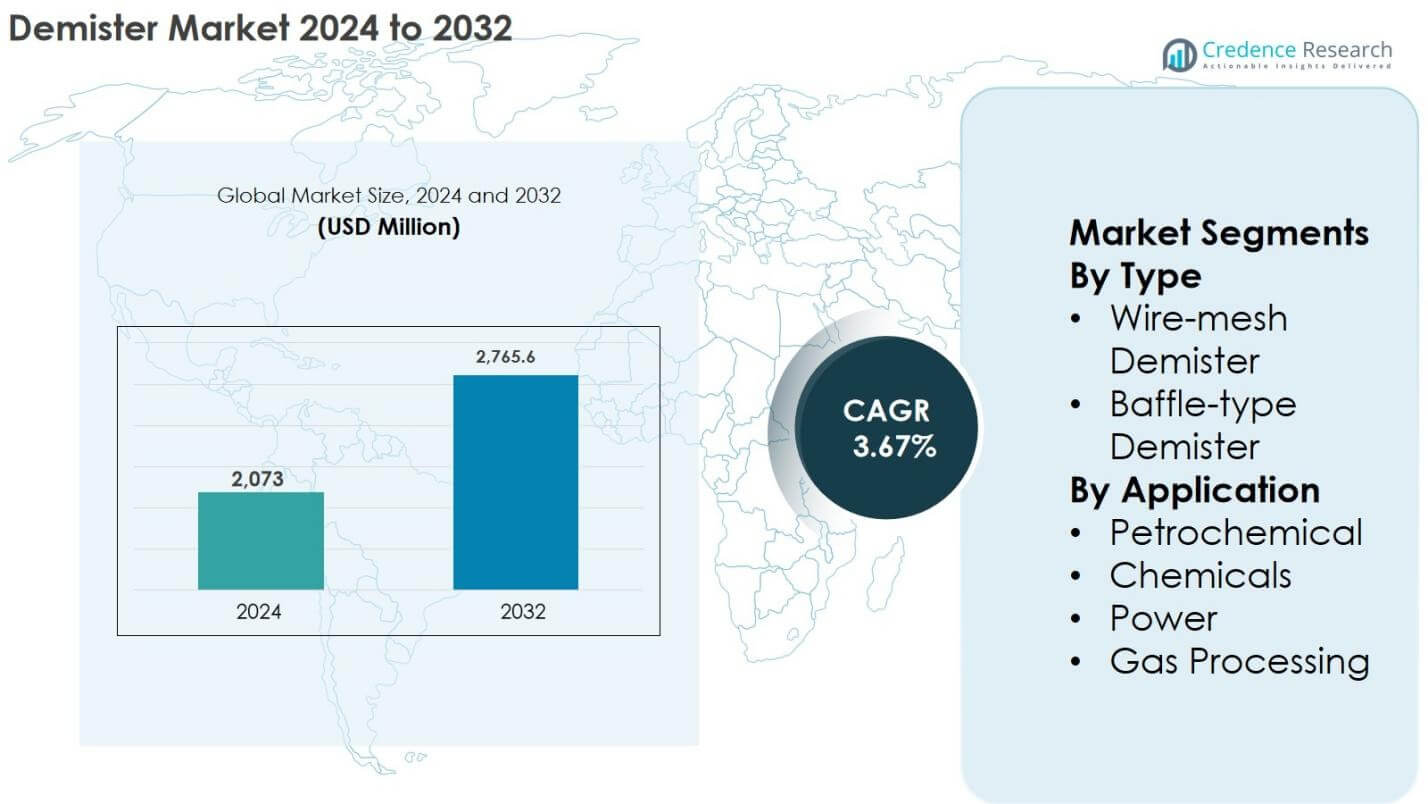
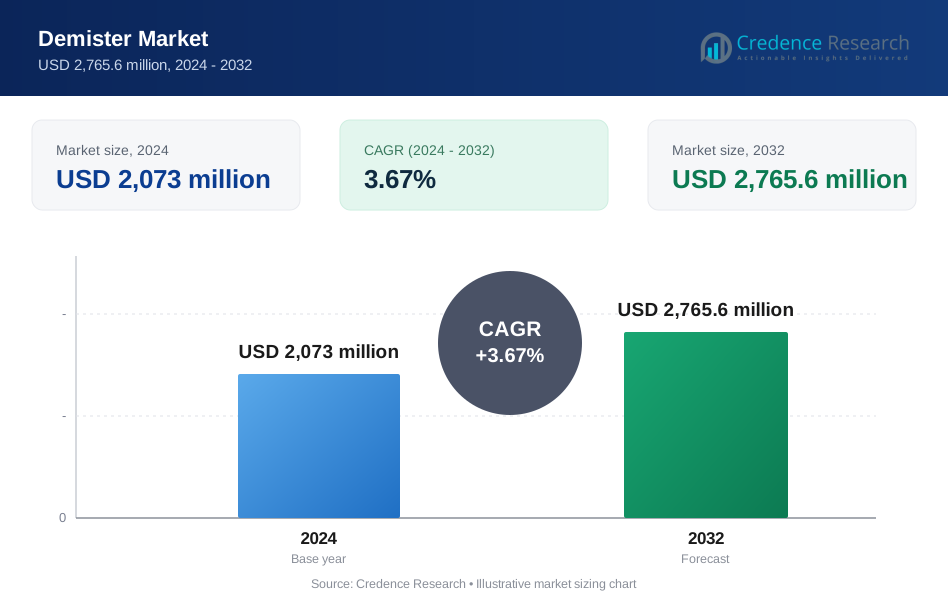
The Demister market size was valued at USD 2,073 million in 2024 and is anticipated to reach USD 2,765.6 million by 2032, at a CAGR of 3.67% during the forecast period.
| REPORT ATTRIBUTE | DETAILS |
|---|---|
| Historical Period | 2020-2023 |
| Base Year | 2024 |
| Forecast Period | 2025-2032 |
| Demister Market Size 2024 | USD 2,073 million |
| Demister Market, CAGR | 3.67% |
| Demister Market Size 2032 | USD 2,765.6 million |
Demister Market Insights
- Market growth is driven by stringent emission regulations, rising petrochemical and chemical processing capacity, and increasing focus on operational efficiency and equipment protection across industrial facilities.
- Wire-mesh demisters dominate the market with about 58% segment share due to high efficiency, low pressure drop, and wide adoption in continuous-process industries, while petrochemical applications lead with nearly 36% share.
- Competition is shaped by established global manufacturers and regional players focusing on customized designs, material innovation, and cost efficiency to meet diverse industrial requirements.
- Asia-Pacific holds around 30% market share driven by rapid industrialization, North America accounts for about 32% supported by regulatory compliance and retrofits, Europe contributes nearly 27% through sustainability-led upgrades, while Latin America and Middle East & Africa together represent the remaining share with steady growth.
Demister Market Segmentation Analysis:
By Type
The Demister market by type is primarily segmented into wire-mesh demisters and baffle-type demisters, with wire-mesh demisters emerging as the dominant sub-segment, accounting for 58% market share in 2024. This dominance is driven by their high efficiency in capturing fine liquid droplets, low pressure drop, and cost-effective installation across a wide range of industrial systems. Wire-mesh demisters are widely preferred in continuous-process industries due to their simple design, ease of maintenance, and adaptability to corrosive environments, supporting sustained demand growth across both retrofitting and new installations.
- For instance, Sulzer’s KnitMesh wire-mesh mist eliminators are deployed in crude distillation and vacuum columns in refineries to reduce liquid entrainment while minimizing energy losses, according to Sulzer’s product literature.
By Application
By application, the Demister market is led by the petrochemical segment, which held 36% market share in 2024, followed by chemicals, power, and gas processing. Petrochemical dominance is supported by stringent emission regulations, large-scale distillation and separation operations, and the need to protect downstream equipment from liquid carryover. High operating temperatures, complex vapor-liquid separation requirements, and continuous capacity expansions in refining and petrochemical complexes further accelerate adoption, making demisters a critical component for operational efficiency and regulatory compliance.
- For instance, Koch-Glitsch highlights its mist eliminators in amine and glycol contactors in gas treating units to prevent solvent losses and reduce fouling in downstream compressors and heat exchangers.
Key Growth Drivers
Stringent Environmental and Emission Regulations
Stringent environmental and emission regulations are a primary growth driver for the demister market, compelling industries to adopt effective vapor–liquid separation solutions. Regulatory authorities across major industrial regions continue to tighten limits on acid mist, particulate emissions, and liquid aerosols released from petrochemical, chemical, power, and gas processing plants. Demisters enable facilities to meet compliance requirements by efficiently removing entrained droplets before gas discharge, reducing environmental impact and health risks. Increasing penalties for non-compliance and rising inspection frequency further accelerate adoption. In parallel, corporate sustainability goals and ESG commitments are encouraging investment in advanced demister systems that support cleaner operations, improved air quality, and long-term regulatory compliance across industrial facilities.
- For instance, in Europe, refineries and chemical plants use Sulzer mist eliminators in scrubbers and absorbers to comply with Industrial Emissions Directive requirements on stack emissions, as highlighted in Sulzer’s separation technology case references.
Expansion of Petrochemical and Chemical Processing Capacity
The continued expansion of petrochemical and chemical processing capacity globally is a significant driver for the demister market. Rapid industrialization in Asia-Pacific, the Middle East, and parts of Latin America is driving investments in refineries, fertilizers, specialty chemicals, and gas processing plants. Demisters are essential components in distillation columns, absorbers, scrubbers, and separators, where effective phase separation is critical for maintaining product quality and protecting downstream equipment. As plants scale operations and operate under higher pressures and temperatures, the demand for reliable demister solutions increases. Both greenfield projects and capacity expansion in existing facilities are contributing to sustained growth across this segment.
- For instance, Saudi Aramco’s large integrated refining and petrochemical projects, such as the Jazan and Jazan IGCC complexes, use mist eliminators in distillation and gas-cleaning sections to control liquid carryover and protect gas turbines, as documented in project and technical literature.
Focus on Operational Efficiency and Equipment Protection
Increasing focus on operational efficiency and equipment protection is strongly supporting demister market growth. Liquid carryover in gas streams can lead to corrosion, fouling, compressor damage, and unexpected shutdowns, resulting in high maintenance and production losses. Demisters mitigate these risks by ensuring stable separation performance and consistent process conditions. Industrial operators increasingly recognize demisters as cost-saving components that enhance equipment lifespan and reduce downtime. This driver is particularly important in continuous-process industries such as petrochemicals and power generation, where operational disruptions have significant financial and safety implications, reinforcing long-term demand for demister installations.
Key Trends & Opportunities
Advancements in Demister Materials and Design
Technological advancements in demister materials and design represent a key trend shaping the market. Manufacturers are developing high-efficiency wire-mesh structures, optimized vane profiles, and corrosion-resistant materials to improve performance under demanding operating conditions. Innovations focus on achieving higher separation efficiency while minimizing pressure drop, supporting energy-efficient plant operations. Customized demister designs tailored to specific process requirements are gaining traction, particularly in complex chemical and gas processing applications. These advancements create opportunities for suppliers to offer value-added solutions, expand into specialized industrial niches, and strengthen long-term customer relationships through performance-driven differentiation.
- For instance, Munters highlights advanced mist eliminators manufactured from engineered plastics and special alloys for corrosive flue‑gas and scrubber environments, allowing long service life and stable performance in specialized industrial niches.
Rising Demand from Emerging Economies
Emerging economies present strong growth opportunities for the demister market due to rapid industrial expansion and infrastructure development. Increasing investments in refining, chemical manufacturing, and power generation are driving demand for emission control and separation technologies. Governments in these regions are also strengthening environmental regulations, pushing industries toward compliance-focused equipment adoption. As multinational companies establish production facilities and local manufacturers upgrade existing plants, demand for cost-effective and durable demister solutions continues to rise. This trend supports market expansion beyond mature regions and creates opportunities for both global and regional suppliers.
- For instance, India’s ongoing refinery and petrochemical capacity additions under Indian Oil Corporation and Bharat Petroleum projects have increased the deployment of mist eliminators in distillation and gas-cleaning units to meet emission and reliability requirements, as reflected in project and technical tenders.
Key Challenges
High Initial Installation and Customization Costs
High initial installation and customization costs remain a key challenge for the demister market. Many industrial processes require application-specific designs, specialized materials, and precise engineering, increasing upfront capital expenditure. For small and medium-sized plants, these costs can delay adoption despite long-term operational benefits. Retrofitting existing systems also presents challenges, as it may require downtime, structural modifications, and additional engineering support. These factors can limit short-term demand, particularly in cost-sensitive markets, making affordability and design optimization critical considerations for manufacturers.
Performance Constraints Under Extreme Operating Conditions
Performance constraints under extreme operating conditions pose another significant challenge for the demister market. High gas velocities, variable flow rates, and aggressive chemical environments can reduce separation efficiency or accelerate material degradation if not properly addressed. Inadequate demister selection or improper installation may lead to re-entrainment, pressure drop issues, and reduced system reliability. Addressing these challenges requires advanced engineering expertise, precise material selection, and regular maintenance, increasing operational complexity for end users. This challenge underscores the importance of technical support and customized solutions in demanding industrial applications.
Regional Analysis
North America
North America accounted for 32% of the Demister market share in 2024, driven by strong demand from the petrochemical, chemical, and power generation industries. The region benefits from strict environmental and emission regulations that mandate effective vapor–liquid separation systems across industrial facilities. High investments in refinery upgrades, shale gas processing, and industrial retrofitting projects continue to support demister adoption. Additionally, the presence of mature industrial infrastructure and a strong focus on operational efficiency and equipment protection further sustain demand. Replacement of aging separation equipment also contributes significantly to steady market growth across the region.
Europe
Europe held 27% market share in the Demister market in 2024, supported by stringent environmental standards and a strong regulatory framework focused on emission reduction. Chemical processing, refining, and power generation industries drive consistent demand for high-efficiency demisters. The region’s emphasis on sustainability, energy efficiency, and industrial decarbonization encourages adoption of advanced separation technologies. Upgrades in existing industrial plants and investments in specialty chemicals and gas processing further support market growth. Western Europe remains the largest contributor, while Eastern Europe shows gradual growth due to expanding industrial activities and regulatory alignment.
Asia-Pacific
Asia-Pacific dominated the Demister market with 30% market share in 2024, making it the fastest-growing regional segment. Rapid industrialization, expanding petrochemical capacity, and rising investments in chemical manufacturing and power generation drive strong demand. Countries such as China, India, and Southeast Asian nations are witnessing large-scale infrastructure and refinery projects, increasing the need for emission control equipment. Strengthening environmental regulations and growing awareness of operational efficiency further support adoption. Both new plant installations and capacity expansions in existing facilities contribute significantly to sustained regional growth.
Latin America
Latin America accounted for 6% of the Demister market share in 2024, supported by steady growth in oil & gas, petrochemical, and power sectors. Countries such as Brazil and Mexico are investing in refinery modernization and gas processing infrastructure, driving demand for vapor–liquid separation solutions. While regulatory enforcement is less stringent than in developed regions, gradual tightening of environmental norms is encouraging adoption. Industrial expansion, combined with increasing focus on equipment reliability and reduced maintenance costs, supports moderate but consistent growth across the region.
Middle East & Africa
The Middle East & Africa region held 5% of the Demister market share in 2024, primarily driven by extensive oil & gas and petrochemical operations. Large-scale refining and gas processing facilities in the Middle East generate strong demand for demisters to ensure process efficiency and emission control. Ongoing investments in downstream capacity expansion and industrial diversification further support market growth. In Africa, demand remains comparatively limited but is gradually increasing with industrial development and energy infrastructure projects. The region’s growth is closely tied to energy-sector investments and regulatory progress.
Demister Market Segmentations:
By Type
- Wire-mesh Demister
- Baffle-type Demister
By Application
- Petrochemical
- Chemicals
- Power
- Gas Processing
By Geography
- North America
- U.S.
- Canada
- Mexico
- Europe
- Germany
- France
- U.K.
- Italy
- Spain
- Rest of Europe
- Asia Pacific
- China
- Japan
- India
- South Korea
- South-east Asia
- Rest of Asia Pacific
- Latin America
- Brazil
- Argentina
- Rest of Latin America
- Middle East & Africa
- GCC Countries
- South Africa
- Rest of the Middle East and Africa
Competitive Landscape
The competitive landscape of the Demister market is moderately consolidated, with established global players and specialized regional manufacturers competing on product efficiency, customization capabilities, material innovation, and aftersales support. Leading companies such as Sulzer, Koch-Glitsch, Munters, and MECS maintain strong positions through advanced demister designs, broad industrial portfolios, and long-term relationships with petrochemical and chemical producers. Players including Geovent, FABCO-AIR, Met-Pro Environmental Air Solutions, and AMACS focus on niche applications, emission-control solutions, and engineered systems. Asian manufacturers such as Ningbo T.C.I Co.,Ltd and Boegger Industrial Limited compete through cost efficiency and expanding regional reach. Competition is driven by regulatory compliance needs, demand for high-efficiency separation, and growing customization across industrial processes.
Key Player Analysis
- Munters
- Koch-Glitsch
- Boegger Industrial Limited
- Sulzer
- Geovent
- FABCO-AIR
- Ningbo T.C.I Co.,Ltd
- Champion
- Met-Pro Environmental Air Solutions
- AMACS
Recent Developments
- In September 2025, Uno Minda Ltd., a Tier-1 automotive supplier, introduced a comprehensive car-care product range for the Indian aftermarket, spanning both interior and exterior maintenance solutions. The portfolio includes wash shampoos, waterless wash products, polish, glass anti-fog spray, windshield cleaner foam, and demisters.
- In August 2023, Mahindra & Mahindra Ltd., a globally recognized SUV manufacturer, announced the launch of the all-new Scorpio in New Zealand, following the successful debut of the XUV700 in March 2023. The new Scorpio is designed to redefine its segment and features rear wiper and washer systems, an integrated demister, and silver skid plates.
- In February 2023, the Range Rover Velar unveiled an upgraded interior with advanced technology enhancements, allowing users to customize the sidebar for quick access to in-car functions such as Pivi Pro media and navigation applications, vehicle camera controls, and window demisters, thereby enhancing overall driving convenience and functionality.
Report Coverage
The research report offers an in-depth analysis based on Type, Application, and Geography. It details leading market players, providing an overview of their business, product offerings, investments, revenue streams, and key applications. Additionally, the report includes insights into the competitive environment, SWOT analysis, current market trends, as well as the primary drivers and constraints. Furthermore, it discusses various factors that have driven market expansion in recent years. The report also explores market dynamics, regulatory scenarios, and technological advancements that are shaping the industry. It assesses the impact of external factors and global economic changes on market growth. Lastly, it provides strategic recommendations for new entrants and established companies to navigate the complexities of the market.
Future Outlook
- The Demister market will witness steady demand driven by continuous expansion of petrochemical and chemical processing industries.
- Stricter environmental and emission regulations will reinforce long-term adoption across industrial facilities.
- Wire-mesh demisters will remain the preferred product type due to high efficiency and operational reliability.
- Growing investments in gas processing and power generation will support consistent market growth.
- Replacement of aging separation equipment will contribute significantly to recurring demand.
- Technological advancements will improve separation efficiency and reduce pressure drop in demanding applications.
- Custom-engineered demister solutions will gain importance for complex and high-temperature processes.
- Emerging economies will offer strong growth opportunities through industrialization and infrastructure development.
- Focus on plant efficiency and equipment protection will increase demister integration in process design.
- Strategic partnerships and regional expansion will shape competitive positioning among market players.
Request a Free Sample
Fill in your details and we'll send you a free sample report.
- Sample data tables & charts
- Research methodology
Need a Custom Version of This Report?
Tailor the scope, geography, or segments to your exact requirements.
- Custom geography or segment scope
- Direct access to our analyst team
Frequently Asked Questions
What is the current market size for Demister market, and what is its projected size in 2032?
At what Compound Annual Growth Rate is the Demister market projected to grow between 2024 and 2032?
Which Demister market segment held the largest share in 2024?
What are the primary factors fueling the growth of the Demister market?
Who are the leading companies in the Demister market?
Which region commanded the largest share of the Demister market in 2024?
Table of Content
Chapter 1. Report Introduction
- 1.1 Report Description & Purpose
- 1.1.1 Report Title & Market Definition
- 1.1.2 Unique Selling Propositions (USP) & Key Differentiators
- 1.1.3 Value Proposition for Stakeholders
- 1.2 Research Objectives
- 1.2.1 Market Sizing Objectives (Volume & Revenue)
- 1.2.2 Segmentation Objectives
- 1.2.3 Competitive Intelligence Objectives
- 1.2.4 Forecast & Scenario Objectives
- 1.3 Report Scope
- 1.3.1 Demister Scope – Types & Subtypes Covered
- 1.3.2 Geographic Scope – Regions & Countries Covered
- 1.3.3 Historical Period, Base Year & Forecast Period (2024; forecast to 2032)
- 1.3.4 Inclusions & Exclusions
- 1.4 HS Code & Classification Framework
- 1.5 Currency, Units & Pricing Basis
- 1.6 Target Stakeholders
- 1.7 Limitations & Assumptions
Chapter 2. Executive Summary
- 2.1 Global Demister Market Snapshot
- 2.1.1 Market Size – Historical (2024) & Forecast (2024-2032) (2024: USD 2,073 million → 2032: USD 2,765.6 million)
- 2.1.2 Volume & Revenue – Global Totals
- 2.1.3 Key Market Highlights – Top Five Facts
- 2.2 Demister Market Segmentation Snapshot
- 2.2.1 Market Split by Region – 2024 vs. 2032
- 2.3 Competitive Snapshot
- 2.3.1 Top 10 Players by Revenue Share – 2024
- 2.3.2 Top 10 Players by Volume Share – 2024
- 2.3.3 Recent Strategic Developments (18-Month Summary)
- 2.4 Key Investment Highlights & Strategic Conclusions
Chapter 3. Demister Market Dynamics & Industry Analysis
- 3.1 Market Overview & Context
- 3.1.1 Demister Market Position in the Broader Automotive Value Chain
- 3.1.2 OEM vs. Replacement Market Dynamics
- 3.1.3 Market Maturity & Development Stage by Region
- 3.2 Demister Market Drivers
- 3.3 Demister Market Restraints & Challenges
- 3.4 Demister Market Opportunities
- 3.5 Porter's Five Forces Analysis
- 3.5.1 Threat of New Entrants
- 3.5.2 Bargaining Power of Suppliers
- 3.5.3 Bargaining Power of Buyers
- 3.5.4 Threat of Substitutes
- 3.5.5 Competitive Rivalry – Intensity Assessment
- 3.6 Demister Value Chain Analysis
- 3.6.1 Upstream – Raw Material/Input Suppliers
- 3.6.1.1 Raw Material/Input 1
- 3.6.1.2 Raw Material/Input 2
- 3.6.1.3 Raw Material/Input 3
- 3.6.2 Midstream – Production/Manufacturing/Service Delivery
- 3.6.2.1 Production/Process Overview
- 3.6.2.2 Key Facility Locations & Capacity by Manufacturer
- 3.6.3 Downstream – Distribution & End Consumer
- 3.6.3.1 Primary Channel – B2B/OEM
- 3.6.3.2 Secondary Channels – Dealer, Retail, Online, Direct
- 3.6.4 Value Chain Profitability Analysis
- 3.6.1 Upstream – Raw Material/Input Suppliers
- 3.7 PESTEL Analysis
- 3.7.1 Political Factors
- 3.7.2 Economic Factors
- 3.7.3 Social Factors
- 3.7.4 Technological Factors
- 3.7.5 Environmental Factors
- 3.7.6 Legal Factors
- 3.8 Demister Supply Chain Analysis
- 3.8.1 Raw Material/Input Supply Risk Assessment
- 3.8.2 Manufacturing Concentration Risk (Geographic Exposure)
- 3.8.3 Trade Disruption Impact Analysis
- 3.9 Regulatory & Policy Landscape
Note: The regulatory and policy landscape section covers regulations based on their applicability to the market, Demister category, geography, and scope of the study. Only regulatory frameworks with a material impact on operations, compliance, trade, sustainability, or market access are analyzed in detail.
Chapter 4. Key Investment Pockets & Opportunity Analysis
- 4.1 Demister Market Attractiveness Analysis
- 4.1.1 By Region – Investment Attractiveness Matrix (Volume × CAGR)
- 4.2 Absolute Revenue Growth Opportunity
- 4.2.1 By Region – Absolute USD Growth Through 2032
- 4.3 Incremental Volume Opportunity
- 4.3.1 By Region – Incremental Volume Through 2032
- 4.3.2 Segment – Incremental Volume
- 4.4 Emerging Submarket Opportunity Deep Dive (Subject to Applicability)
- 4.5 Emerging Market Opportunity Scorecards
- 4.5.1 United States
- 4.5.2 Europe
- 4.5.3 Asia
- 4.5.4 Middle East & Africa
Note: Emerging Market Opportunity Scorecards will be included based on relevance and strategic importance. Regions listed are indicative and may vary depending on data availability and market dynamics.
Chapter 5. Demister Import-Export Analysis & Trade Flows
- 5.1 Global Trade Overview
- 5.1.1 Global Export Value by Country (2024)
- 5.1.2 Global Export Volume by Country (2024)
- 5.1.3 Global Import Value by Country (2024)
- 5.1.4 Global Import Volume by Country (2024)
- 5.1.5 Net Trade Balance by Country (2024)
- 5.2 Export Analysis – Segment
- 5.2.1 Type 1 (HS Code)
- 5.2.2 Type 2 (HS Code)
- 5.2.3 Type 3 (HS Code)
- 5.2.4 Type 4 (HS Code)
- 5.2.5 Type 5 (HS Code)
- 5.3 Import Analysis – Segment
- 5.3.1 Type 1 (HS Code)
- 5.3.2 Type 2 (HS Code)
- 5.3.3 Type 3 (HS Code)
- 5.3.4 Type 4 (HS Code)
- 5.3.5 Type 5 (HS Code)
- 5.4 Average Unit Trade Prices
- 5.4.1 Average Export Price – Segment & Country
- 5.4.2 Average Import Price – Segment & Source Country
- 5.4.3 Price Trends (2024)
- 5.5 Key Trade Route Analysis
- 5.5.1 Trade Route 1
- 5.5.2 Trade Route 2
- 5.5.3 Trade Route 3
- 5.5.4 Trade Route 4
- 5.5.5 Trade Route 5
- 5.6 Trade Policy Impact Assessment
- 5.6.1 US Anti-Dumping & Section 301 Tariffs
- 5.6.2 EU Customs Union Impact
- 5.6.3 Major Free Trade Agreements
- 5.6.4 USMCA Rules of Origin
Note: Trade policy analysis will be included only where relevant to the Demister market.
Chapter 6. Competitive Landscape & Company Benchmarking
- 6.1 Demister Market Concentration & Structure
- 6.1.1 Herfindahl-Hirschman Index (HHI) – vs. 2024
- 6.1.2 Tier 1, Tier 2 & Tier 3 Market Structure
- 6.1.3 Global, Regional & Local Player Dynamics
- 6.2 Demister Market Share Analysis – 2024
- 6.2.1 Global Revenue Share by Company
- 6.2.2 Global Volume Share by Company
- 6.2.3 Regional Revenue Share
- 6.2.4 Market Share Evolution ( vs. 2024)
- 6.2.5 OEM Segment Share by Company
- 6.2.6 Replacement Segment Share by Company
- 6.3 Production/Delivery Capacity & Facility Analysis
- 6.3.1 Global Installed Capacity
- 6.3.2 Capacity Utilization Rates
- 6.3.3 Production/Output Volume
- 6.3.4 Facility Locations & Capacity Map
- 6.3.5 Planned Capacity Additions
- 6.4 Demister Competitive Benchmarking Matrix
- 6.4.1 Revenue, Volume, CAGR & Profitability Comparison
- 6.4.2 Channel Revenue Mix
- 6.4.3 Geographic Revenue Exposure
- 6.4.4 R&D Intensity
- 6.4.5 Sustainability Maturity
- 6.5 Strategic Developments in Demister (Last 24 Months)
- 6.5.1 Mergers, Acquisitions & Divestments
- 6.5.2 New Demister Launches
- 6.5.3 Facility Expansions
- 6.5.4 Strategic Alliances, Joint Ventures & Partnerships
- 6.5.5 Distribution Expansion & Market Entry
- 6.5.6 Sustainability & ESG Initiatives
- 6.6 Competitive Strategy Mapping
- 6.6.1 Leader, Challenger, Follower & Niche Classification
- 6.6.2 Pricing Strategy Comparison
- 6.6.3 Channel Strategy Matrix
Note: Strategic developments are included based on their materiality and the availability of reliable information.
Chapter 7. Global Demister Market – By Distribution Channel
- 7.1 Segment Overview
- 7.1.1 Volume & Revenue Split by Channel (2024 & 2032)
- 7.1.2 Channel Mix Evolution (2024-2032)
Chapter 8. Regional Market Analysis – Global Overview
- 8.1 Global Regional Overview
- 8.1.1 Regional Volume Share
- 8.1.2 Regional Revenue Share
- 8.1.3 Regional Volume by Region
- 8.1.4 Regional Revenue by Region
- 8.1.5 Regional Forecast Through 2032
- 8.2 Cross-Regional Segment Analysis
- 8.2.1 By Distribution Channel
- 8.2.2 By Brand/Price Tier
Chapter 9. North America Demister Market
- 9.1 United States
- 9.2 Canada
- 9.3 Mexico
Chapter 10. Europe Demister Market
- 10.1 Germany
- 10.2 France
- 10.3 Italy
- 10.4 United Kingdom
- 10.5 Spain
- 10.6 Poland
- 10.7 Russia
- 10.8 Netherlands
- 10.9 Belgium
- 10.10 Sweden
- 10.11 Denmark
- 10.12 Norway
- 10.13 Rest of Europe
Chapter 11. Asia Pacific Demister Market
- 11.1 China
- 11.2 India
- 11.3 Japan
- 11.4 South Korea
- 11.5 Thailand
- 11.6 Indonesia
- 11.7 Vietnam
- 11.8 Malaysia
- 11.9 Australia
- 11.10 Rest of Asia Pacific
Chapter 12. Latin America Demister Market
- 12.1 Brazil
- 12.2 Argentina
- 12.3 Colombia
- 12.4 Chile
- 12.5 Rest of Latin America
Chapter 13. Middle East Demister Market
- 13.1 Saudi Arabia
- 13.2 United Arab Emirates
- 13.3 Turkey
- 13.4 Israel
- 13.5 Iran
- 13.6 Rest of the Middle East
Chapter 14. Africa Demister Market
- 14.1 South Africa
- 14.2 Egypt
- 14.3 Nigeria
- 14.4 Morocco
- 14.5 Rest of Africa
Chapter 15. Demister Company Profiles
- 15.1 [Company 01]
- 15.1.1 Company Overview
- 15.1.2 Key Management Personnel
- 15.1.3 Products & Services Portfolio
- 15.1.4 Financial Performance
- 15.1.5 Key Market Focus & Geographic Presence
- 15.1.6 Recent Developments & Strategic Initiatives
Note: The company profile list is preliminary and may change based on research findings, market developments, data availability, and client requirements.
Chapter 16. Appendices
- Appendix A – List of Abbreviations & Acronyms
- Appendix B – Industry Classification Code Reference – Full Series
- Appendix C – Production & Capacity Data Tables
- Appendix D – End-Use & Demand Base Tables
- Appendix E – Consumption & Replacement Rate Assumptions
- Appendix F – ASP Reference Tables
- Appendix G – Manufacturing & Facility Database
- Appendix H – Import-Export Data Tables
- Appendix I – Regulatory Summary Tables
- Appendix J – Primary Research Participant List (Anonymized)
- Appendix K – Primary Research Questionnaire Framework
- Appendix L – Data Sources & Bibliography
- Appendix M – Market Size Divergence & Source Comparison
Chapter 17. Research Methodology
- 17.1 Research Framework & Philosophy
- 17.2 Secondary Research – Sources, Hierarchy & Data Extraction
- 17.3 Data Modeling – Bottom-Up & Top-Down Market Sizing
- 17.4 Primary Research – Stakeholder Framework, LOI & Sample Sizes
- 17.5 Forecast Methodology – Regression, Scenario & Sensitivity Analysis
- 17.6 Quality Control – Four-Layer Validation Framework
- 17.7 Limitations & Standard Assumptions
- 17.8 Disclaimer
